Archive for September 25, 2017

Islamists Responsible for Rohingya Refugee Crisis

September 25, 2017

Islamists Responsible for Rohingya Refugee Crisis, Gatestone Institute, Mohshin Habib, September 25, 2017

(Please see also, Reporting on the Rohingya: “The Tip of a Huge Iceberg of Misinformation” and Critics: State Department Delaying Aid Congress Provided to Yazidis, Christians in Iraq. — DM)

Rather than placing all blame on the Burmese government for this critical situation, the concerned international community and human rights groups must recognize the real threat. Only then can Kyi begin to implement the recommendations spelled out in the plan for a “peaceful, fair and prosperous future for the people of Rakhine” — which she herself commissioned.

*********************************

The current crisis is being depicted — wrongly — as the “ethnic cleansing” of an innocent Muslim minority by Burma’s security forces, and the “apathy” to the plight of the Rohingyas by Aung San Suu Kyi, Burma’s foreign minister and its de facto head of state.

“Their [the Rohingyas’] tactics are terrorism. There’s no question about it. [Kyi is] not calling the entire Rohingya population terrorists, she is referring to a group of people who are going around with guns, machetes, and IEDs and killing their own people in addition to Buddhists, Hindus, and others that get in their way. They have killed a lot of security forces, and they are wreaking havoc in the region. The people who are running and fleeing out to Bangladesh… are fleeing their own radical groups…. [T]he international community has to sort out the facts before making accusations.” — Patricia Clapp, Chief of the U.S. Mission to Myanmar from 1999 to 2002.

The origins of the Bengali Muslim jihad in Western Myanmar in the late 19th century through the World War II era, illustrates that it is “rooted in Islam’s same timeless institution of expansionist jihad which eliminated Buddhist civilization in northern India.” — Dr. Andrew Bostom, author and scholar of Islam.

A surge in clashes between Islamist terrorists and the government of Burma (Myanmar) is at the root of a refugee crisis in Southeast Asia that has caused the United Nations and international media to focus attention on the Rohingyas in the northern Rakhine, an isolated province in the west of the Buddhist-majority country.

In late August 2017, a terrorist group calling itself the Arakan Rohingya Salvation Army (ARSA) launched a series of coordinated attacks on Burmese security forces in northern Rakhine. When the Burmese Army announced that it had responded by killing 370 assailants, Rohingya activists claimed that many of the dead were innocent people who had not been involved in the attacks. They also accused the authorities of demolishing Rohingya villages — devastation that was shown in satellite images released by Human Rights Watch — but the Burmese government said that it was carried out by ARSA, which had committed similar attacks on Burmese police in October 2016.

Since those events, hundreds of thousands of Rohingyas — Muslims who settled in Burma prior to its independence in 1948 — have been fleeing for the last two years, primarily to neighboring India and Bangladesh, in an attempt to escape violence and poverty. Fearing for its national security, on the grounds that among the refugees are ARSA terrorists and sympathizers with ties to ISIS and other Islamist organizations, India issued a deportation order for the Rohingyas who had crossed the border illegally. This move, however, was met with resistance by the Indian Supreme Court. Bangladesh has addressed the problem by severely restricting the movement of the Rohingya refugees.

The outcry on behalf of the innocent men, women and children who are caught in the crossfire of the radicals — who claim to represent their interests — is completely justified. No humanitarian solution to their plight can be found or implemented, nevertheless, without understanding the conflict — and the true culprits behind it.

The current crisis is being depicted — wrongly — as the “ethnic cleansing” of an innocent Muslim minority by Burma’s security forces, and the “apathy” to the plight of the Rohingyas by Aung San Suu Kyi, Burma’s foreign minister and its de facto head of state. As PJ Media reported, many critics in the media and among human rights groups are calling for Kyi to be stripped of the Nobel Peace Prize she was awarded in 1991 for her campaign on behalf of democratization and against the country’s military junta rulers.
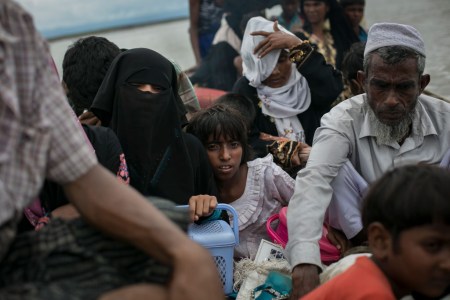
Rohingya refugees from Burma arrive in Bangladesh, on September 17, 2017. The current crisis is being depicted — wrongly — as the “ethnic cleansing” of an innocent Muslim minority, but the true culprits are radical Islamists among the Rohingyas themselves, who with guns, machetes and bombs are killing their own people, in addition to Buddhists, Hindus, and others that get in their way. (Photo by Allison Joyce/Getty Images)

Yet, as the report pointed out, Priscilla Clapp, who served as U.S. chief of mission in Burma from 1999 to 2002, strongly disputes the current “narrative” about Kyi and the response of her government to the terrorist attacks in Rakhine last October and August. In a September 7 interview with France 24 (a partial transcript of which was provided by PJ Media), Clapp argued that the attacks were “perpetrated by people in the Rohingya diaspora living in Pakistan and Saudi Arabia coming in through Bangladesh,” with the more recent one

“timed to follow the…presentation of the recommendations of the Kofi Annan international commission on Rakhine, which Aung Sun Suu Kyi has accepted and agreed to implement [and which] call for a long-term solution there….Their tactics are terrorism. There’s no question about it. [Kyi is] not calling the entire Rohingya population terrorists, she is referring to a group of people who are going around with guns, machetes, and IEDs and killing their own people in addition to Buddhists, Hindus, and others that get in their way. They have killed a lot of security forces, and they are wreaking havoc in the region. The people who are running and fleeing out to Bangladesh are not only fleeing the response of the security forces, they are fleeing their own radical groups because they’ve been attacking Rohingya, and in particular the leadership who were trying to work with the government on the citizenship process and other humanitarian efforts that were underway there… [T]he international community has to sort out the facts before making accusations.”

Clapp’s assertions are backed up by an extensive analysis in 2005, written by Dr. Aye Chan, Professor of Southeast Asian History at Kanda International University in Japan, and discussed recently in a piece by author Andrew Bostom. According to Bostom, Chan’s article, “The Development of a Muslim Enclave in Arakan (Rakhine) State of Burma (Myanmar),” on the origins of the Bengali Muslim jihad in Western Myanmar in the late 19th century through the World War II era, illustrates that it is “rooted in Islam’s same timeless institution of expansionist jihad which eliminated Buddhist civilization in northern India.”

Bostom also referred to an open letter, penned by Chan in 2014 to then-UN Secretary General Ban Ki-moon, demonstrating the transparent if “strenuous efforts” of Bengali Muslim migrants to Northwestern Myanmar “to take away Rakhine’s [Arakan’s] own [Buddhist] ethnic identity from the Rakhine people.”

To grasp the intent of the jihadists in Rakhine, it is important to look into the workings of ARSA — formerly Harakah Al-Yaqin (“Faith Movement” in Arabic) — which was created after the June 2012 Rohingya riots against a Buddhist community.

The group’s main leader, Attaullah Abu Ammar Junnani (known familiarly as Ata Ullah), was born in Karachi, Pakistan to a migrant Rohingya father and grew up in Mecca, Saudi Arabia, where he attended a religious Islamic school and developed ties with Saudi clerics. According to the Burmese government, Ata Ullah, at some point, also received training in guerilla warfare under the Taliban in Pakistan. Although he claims to be fighting “on behalf of Myanmar’s long-oppressed Rohingya Muslim minority,” his methods are those of all Islamist terrorists. The danger to Burma — and the reason that India and Bangladesh fear that the refugees pose a security problem — is that Ata Ullah will manage to radicalize a growing number of Rohingyas, both inside and out of the country.

Rather than placing all blame on the Burmese government for this critical situation, the concerned international community and human rights groups must recognize the real threat. Only then can Kyi begin to implement the recommendations spelled out in the plan for a “peaceful, fair and prosperous future for the people of Rakhine” — which she herself commissioned.

Mohshin Habib, a Bangladeshi author, columnist and journalist, is Executive Editor of The Daily Asian Age.

Critics: State Department Delaying Aid Congress Provided to Yazidis, Christians in Iraq

September 25, 2017

Critics: State Department Delaying Aid Congress Provided to Yazidis, Christians in Iraq, Washington Free Beacon , September 25, 2017

Iraqis Yazidis dance during a ceremony celebrating the Yazidi New Year north east of Mosul / Getty Images

Human rights activists and Catholic groups are questioning why the State Department still appears reluctant to direct money Congress appropriated to assist Christians, Yazidis, and other persecuted religious minorities in Iraq but this week quickly dispatched $32 million to help a majority Muslim group fleeing violence in Burma.

The State Department on Thursday announced it would provide a humanitarian aid package worth nearly $32 million to the Rohingya, a persecuted minority group in Burma. More than 400,000 Rohingya have fled Burma, a majority Buddhist nation, for Bangladesh over the past month to escape wide-scale violence that the United Nations’ top human rights official has labeled ethnic cleansing.

The aid package came the day after Secretary of State Rex Tillerson spoke with Aung San Suu Kyi, the de facto leader of Burma, and urged the Burmese government and military to “address deeply troubling allegations of human rights abuses and violations.”

Tillerson’s quick efforts to help the Rohingya demonstrated the State Department’s ability to quickly direct humanitarian aid to a threatened minority group. However, critics say the swift action stands in sharp contrast to State’s foot-dragging when it comes to directing funds to Yazidis, Christians, and other religious minorities facing genocide in Iraq.

Earlier this year, Congress allocated more than $1.4 billion in funds for refugee assistance and included specific language to ensure that part of the money would be used to assist Yazidis, Christians, and Shia Muslims—all groups the State Department deemed victims of genocide in 2016. Over the summer, Tillerson affirmed his belief that these religious minority groups in Iraq are the victims of Islamic-State genocide.

Lawmakers who passed the bills providing the funds, as well as human rights activists and Catholic charities, were encouraged by Tillerson’s affirmation of the genocide declaration, but they say his statements have done nothing to change the situation on the ground. The Yazidis and Christians are still not getting the necessary money to help them rebuild their lives and communities in the Northern Iraq’s Ninevah province, where they have thrived for thousands of years.

The Knights of Columbus, a global Catholic charity that has spent years on the ground housing and feeding thousands of Yazidis and Christians ground, said a much larger rebuilding plan is needed to save them extinction from Iraq. Congress has already responded by allocating funds, but the State Department is preventing them from getting directly to the communities in Iraq, according to GOP lawmakers and human rights activists.

ISIS murders and kidnappings, as well as efforts to flee this persecution, have radically reduced the Yazidi and Christian population in Iraq. Christians, which numbered between 800,000 to 1.4 million in 2002, number fewer than 250,000 now. Without action, these lawmakers and activists warn, Christians could soon disappear completely from Iraq.

The Yazidi population also has plummeted, although estimates of how far the population has fallen vary wildly, ranging from the tens of thousands to hundreds of thousands since ISIS launched its attack in the Sinjar region of Iraq in 2014.

Despite the congressional commitment, lawmakers and human rights activists say most of the U.S. taxpayer money going to help people in Iraq is channeled through the United Nations, which has a “religion-blind” policy of distributing most of the money to refugee camps that Yazidis and Christians avoid out of fear of further violence and persecution.

“It is always good when people who are in danger are helped. But why is there a terrible disparity between our government’s treatment of the Rohingya Muslims in Burma and the absolute lack of help for Yazidis and Christians in Iraq, whom Secretary Tillerson declared last month to be victims of genocide?” asked Nina Shea, an international human rights lawyer who directs the Hudson Institute’s Center for Religious Freedom.

“In Iraq, we should be helping people who are victims of genocide, but our government is not,” she said. “We should be caring for religious minorities. But our government is not. We should be concerned about religious freedom. But our government is not.”

Shea, who spent 12 years as a commissioner on the U.S. Commission on International Religious Freedom, said the dearth of U.S. taxpayer resources getting to these communities is incredibly frustrating, considering the direct national security interests of rebuilding those communities. Displaced Christians specifically could help play a stabilizing role in the Ninevah Plain area of Iraq if they have enough infrastructure and support to rebuild their homes and communities, she said.

If they had the resources, they also could combat Iran’s colonization of northern Iraq, where pro-Iranian militias are illegally buying up Christian-owned property in the area to try to broaden their influence, she said.

“Right now, Iran is using the Ninevah province as a land bridge to Syria and the Mediterranean and that is a threat to our interests and Israel’s interests,” she said.

The State Department’s inaction continues despite President Trump’s promise to do everything in his power to defend and protect “historic Christian communities of the Middle East.” Trump made the pledge after meeting with Pope Francis and again in the wake of the ISIS attack on Coptic Christians in Egypt in late May.

A State Department official did not respond directly to questions about why the money is not getting to Yazidis and Christians despite the genocide declaration. Instead, the officials stressed that the U.S. government is the largest single donor to the Iraq and Syria humanitarian crises, having contributed $1.7 billion since fiscal year 2014.

“The United States closely monitors the needs of all vulnerable, displaced and conflict-affected populations, including members of religious and ethnic minorities and has taken extraordinary measures to aid imperiled civilians,” the official said in a statement to the Washington Free Beacon.

“Freedom of thought, conscience, and religion or belief is fundamental to the United States and who we are. The United States remains committed to ensuring the protection of religious freedoms for all,” the official added.

Congressional aides dispute any suggestion that the United States is committed to ensuring that Yazidis and Christians communities remain in Iraq.

Lawmakers on Capitol Hill and human rights activists are tracking the list of U.N. development projects in Iraq closely and said there are only very minor projects in Christian towns and communities, such as one that would repair a canopy on a municipal building and no major infrastructure or road projects that would help Christian communities return and provide interim jobs for those returning.

The Iranians, in contrast, just opened a new elementary school, mosque, and library in the Ninevah region, she said.

The continued push to get the funds to Yazidis and Christians on the ground comes the same week that the U.N. Security Council created an investigative team aiming to hold ISIS accountable for war crimes and genocide in Iraq.

U.N. Ambassador Nikki Haley called the resolution creating the team a “landmark” development. “It is a major step towards addressing the death, suffering, and injury of the victims of crimes committed by ISIS in Iraq—crimes that include genocide. These victims have been Yazidis, Christians, Shia and Sunni Muslims, and many, many more.”

Shea and other activists consider the resolution a good first step but argue it is critically important that Yazidi and Christian leaders are appointed to help lead the investigative team aiming to hold ISIS accountable for war crimes and genocide in Iraq.

According to a Security Council resolution calling on the U.N. secretary-general to create the investigative team, its mission would be to collect, preserve and store evidence of ISIS war crimes and genocide.

Russia Releases Photos Showing US Special Ops At ISIS Positions In Syria

September 25, 2017

Source: Russia Releases Photos Showing US Special Ops At ISIS Positions In Syria | Zero Hedge

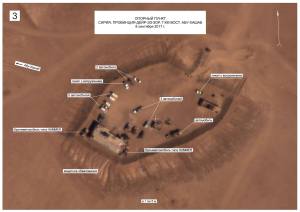
The Russian Defense Ministry has released aerial images allegedly showing ISIS, the SDF, and US special forces working side-by-side on the battlefield against Syrian and Russian forces in Dier ez-Zor, Syria.

As Adam Garrie reports, via The Duran,it has long been thought that the US proxy militia SDF is operating in collusion with ISIS in various parts of Syria. This has especially been the case in respect of Deir ez-Zor. In Deir ez-Zor, the Russian Defense Ministry has previously stated that the Syrian Arab Army and their allies are fired on most intensely from positions known to be held by the SDF.

Furthermore, Russian Defense Ministry Spokesman Major General Igor Konashenkov recently stated,

“SDF militants work to the same objectives as Daesh terrorists. Russian drones and intelligence have not recorded any confrontations between Daesh and the ‘third force’, SDF”.

He added that Russia will not hesitate to target SDF forces that threaten the battle field progress and personal safety of Russia’s allies, namely the Syrian Arab Army.

Other reports surfaced of US military helicopters airlifting known ISIS commanders to safety as the Syrian Arab Army made its advance on the former ISIS stronghold of Deir ez-Zor. All of this has happened as the US is moving its proxy Kurdish led SDF forces from Raqqa to Deir ez-Zor, in a move that appears to be an attempt to stop Syrian forces from liberating their own country’s legally recognised territory.

Now, the Russian Defense Ministry has released a statement followed by 12 photos showing how SDF forces work alongside US special forces in ISIS controlled areas without facing any resistance from ISIS. Furthermore, none of the US or Kurdish led forces even take defensive positions which indicate that they are cooperating with ISIS rather than engaging in a perverse truce. In other words, the SDF, US special forces and ISIS move among each other in the same manner as allies do.

The following is the statement from the Russian Defense Ministry on the matter:

#US Special Operations Forces (#SOF) units enable US-backed Syrian Democratic Forces (#SDF) units to smoothly advance through the ISIS formations.

Facing no resistance of the ISIS militants, the #SDF units are advancing along the left shore of the #Euphrates towards #Deir_ez_Zor.

The aerial photos made on September 8-12 over the ISIS locations recorded a large number of American #Hummer vehicles, which are in service with the #America‘s #SOF.

The shots clearly show the US SOF units located at strongholds that had been equipped by the ISIS terrorists. Though there is no evidence of assault, struggle or any US-led coalition airstrikes to drive out the militants.

Despite that the US strongholds being located in the ISIS areas, no screening patrol has been organized at them. This suggests that the#US_troops feel safe in terrorist controlled regions”.

This demonstrates that in spite of Donald Trump’s apparent wiliness to abandon the policy of aiding jihadist groups, not only has this policy not changed, but such a reality now includes full scale battlefield collusion with ISIS.

This also helps explain why in June of this year, SDF forces allowed ISIS terrorists to peacefully leave Raqqa and head towards Deir ez-Zor, a place which is now unquestionably the largest remaining ISIS stronghold in east of Libya.

But now, not only are US proxies allowing ISIS to peacefully retreat but they are visibly coalescing on the battle field. These realities also corroborate the story of SDF fighters being wounded in a Syrian led strike on known ISIS targets. As I wrote previously in The Duran, this is because SDF militants are fighting beside ISIS.

The fact of the matter is that, the Kurdish led SDF and ISIS now share the same strategic goals, in spite of apparent ideological differences. Both seek to aggressively and illegally prevent Syria from liberating her sovereignty territory and in so doing, both are challenging the territorial unity and integrity of the Syrian Arab Republic. Likewise, each group’s ideology is opposed to the Arabist Constitution of Syria, seeking instead to lay the ground work for sectarian ideologies in the areas they seek to illegally annex.

Most worryingly, both militant groups are clearly collaborating and colluding with each other and with the United States, in a proxy war against Syria and the interests and safety of her allies, including Russia and Iran.

What once was only partly clear, is now as clear as the following colour photographs from the Russian Defense Ministry.

The images released by the Russian Defense Ministry encourage speculation that the US and SDF forces have some sort of “understanding” with IS terrorists operating in the region, according to Ammar Waqqaf, the director of the Gnosos think tank.

“From the footage, the Americans seem to be and the SDF seem to be quite at leisure, they are not expecting any attack any time soon,” Waqqaf told RT.

“The reason why this may be the case is that there has been some sort of understandings with ISIS over there. Probably they were given some amnesty, that they are not going to be prosecuted, … or they were given guarantees that they would not be given back to the state.”

The SDF, ISIS and the United States are fighting on the same side of the conflict in Syria, it is the side of terrorism which seeks to destroy the secular, modern, pluralistic and independent Syrian Arab Republic.

Earlier in September, Russian Defense Ministry spokesman Major General Igor Konashenkov accused the SDF of collusion with ISIS terrorists. “SDF militants work to the same objectives as IS terrorists. Russian drones and intelligence have not recorded any confrontations between IS and the ‘third force,’ the SDF,” Konashenkov said.

This proves that the Hollywood actor Morgan Freeman was correct. The US and Russia are at war, albeit a proxy war which includes ISIS.


Israel seeking to block fresh Palestinian bid to join Interpol

September 25, 2017

PA request expected to come to vote after being stopped short in 2015 and 2016, amid Israeli concerns of sensitive info being leaked to terror groups

September 24, 2017, 11:05 pm

Source: Israel seeking to block fresh Palestinian bid to join Interpol | The Times of Israel

Delegation of Interpol member countries attend the General Assembly in Bali, Indonesia on November 7, 2016. (AP Photo/Firdia Lisnawati)


Israel is seeking to thwart the Palestinian Authority’s latest bid to join the international law enforcement body Interpol over concerns it would leak sensitive information to Palestinian terror groups.

Interpol’s General Assembly will convene for its annual meeting in China on Tuesday, where the international policing organization will vote on new members.

In an effort to disqualify the Palestinians, Israeli diplomats have been lobbying behind the scenes for stricter criteria for new members, as first reported last week by i24News.

Diplomats have also sought to dissuade Interpol officials from voting in favor of Palestinian membership if the request comes to a vote this week, according to a source in Jerusalem.

The PA’s request will will go to a vote later this week if approved by Interpol’s Executive Committee. According to the Ynet news website, the Committee is likely to postpone Tuesday’s discussion on Palestinian membership, effectively vetoing the bid.

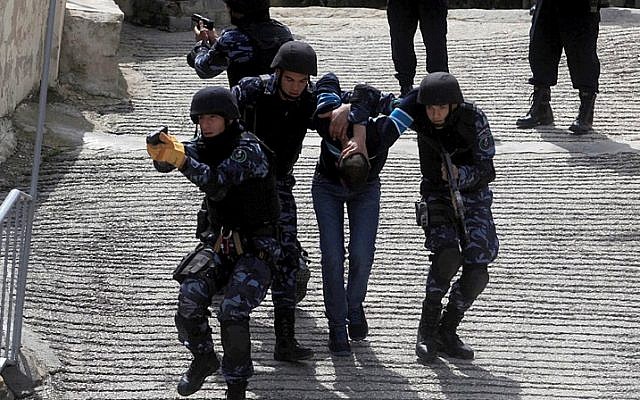
Illustrative: Palestinian police take part in a training session in the West Bank city of Ramallah in 2014. (Issam Rimawi/Flash90)

However, if the Committee doesn’t table the discussion, the Palestinian membership request will be brought for a vote in the General Assembly. Israeli officials say the PA will likely be able to garner the necessary two-thirds majority if the vote goes to the assembly.

As a policy, Israel generally attempts to block the Palestinians from joining international organizations, which would give them de facto recognition as a state.

Last year, Israel successfully prevented the Palestinians from joining Interpol, with a 62 members of the Executive Committee voting to postpone the request.

The PA’s first request in 2015 was rejected by Interpol on grounds that it was submitted too late for discussion by that year’s assembly.

Interpol logo

But this year, Palestinians have launched their own diplomatic efforts to secure membership in the world body.

PA police chief head Hazem Atallah met Interpol’s Secretary General Jurgen Stock in Lyon, France, last month to campaign for Palestinian membership.

Along with the PA, Kosovo will also be seeking Interpol membership at this year’s General Assembly.

Interpol, the world’s biggest international organization after the United Nations, enables member states to exchange intelligence and to work together to find ways to cope with international crime, from terrorism to human trafficking.

At UN, Abbas deplores creation of State of Israel

September 25, 2017

In UN General Assembly Speeches, Palestinian and Iranian Leaders Savage Israel and Zionism.

September 23, 2017

Source: At UN, Abbas deplores creation of State of Israel

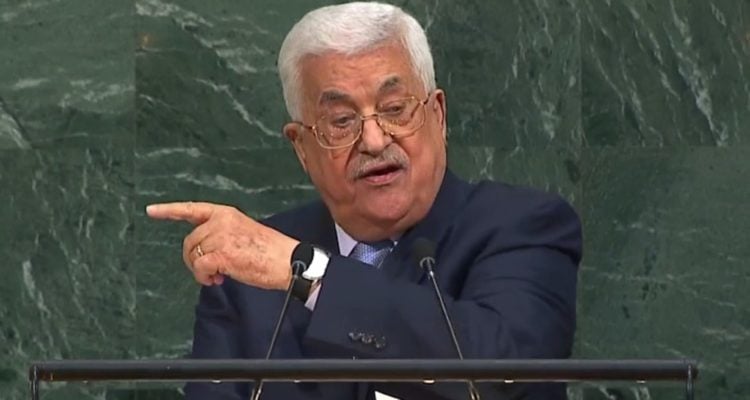
Palestinian Authority President Mahmoud Abbas addresses U.N. General Assembly. (UN)

Attacks on Israel’s legitimacy were in full flow at the UN General Assembly session in New York City on Wednesday, as Palestinian Authority President Mahmoud Abbas denounced the 1917 Balfour Declaration — in which Britain announced its support for “the establishment in Palestine of a national home for the Jewish people” — as a “crime against our people,” while Iranian President Hassan Rouhani described the Jewish state as “the rogue Zionist regime,” in language harking back to the “Zionism-is-racism” days at the world body during the 1970s.

In an angry speech in which he repeatedly accused Israel of violating international law and abandoning the two-state solution, Abbas — moments after wishing Jews a “Happy New Year” on the eve of Rosh Hashana — slammed the United Kingdom for having launched the process which led to the creation of the State of Israel in the first place.

Abbas charged the British with having “inflicted a grave injustice on the Palestinian people” by issuing the Balfour Declaration, asserting that in 1917, “97 percent of the inhabitants of Palestine were Palestinians.” While 90,000 Jews lived in Palestine at the time, out of a total population of 600,000, the PLO — of which Abbas is the chairman — declares in its charter that Jews who “normally resided” in the country before the “Zionist invasion” of 1917 “will be considered Palestinians.”

Abbas: Palestine was ‘Prosperous, Progressive’ State

Claiming that the Palestine of 1917 was a “prosperous, progressive” country, Abbas said that the Balfour Declaration and the subsequent imposition of the British Mandate amounted to a “historical injustice.”

“What is worse is that this November, [the British government] wants to celebrate the 100th anniversary of this crime against our people,” Abbas said, before calling on the UK to “apologize” for the Balfour Declaration as well as “provide compensation.”

The uncompromising tone of Abbas’s comments on the Balfour Declaration was reflected in the rest of the Palestinian leader’s speech. Abbas furiously attacked American and Israeli efforts to end discrimination against the Jewish state at the UN, calling on the Human Rights Council to retain its notorious permanent “Agenda Item Seven,” which focuses exclusively on alleged Israeli transgressions.

Continually accusing Israel of practicing “apartheid,” Abbas called for a boycott of the country — albeit without mentioning the activist phrase “boycott, divestment and sanctions” (BDS). The “international community,” he said, had to end “all forms of direct and indirect support to the occupation,” and he demanded that Israel be confronted with an international onslaught “similar to the international community’s approach to the apartheid regime in South Africa.”

Abbas also called for the publication of the Human Rights Council’s so-called “blacklist” of companies that conduct business with Israeli communities in the West Bank. “Why should we hide this list?” Abbas asked rhetorically. “It is like terrorism — everyone should see this list to know who violates international law.”

Abbas restated his commitment to the Palestinian “right of return,” regarded by most Israelis as code for the destruction of the Jewish state, positioning it as a critical final-status issue that could only be negotiated once Israel agreed to substantial territorial concessions. Insisting the Israel has foregone the two-state solution, he nevertheless thanked outside parties, including the US President Donald Trump’s administration, for attempting to revive peace negotiations.

Abbas Salutes ‘Martyrs’ and ‘Courageous Prisoners’

Nor was there any change announced to the PA’s policy of paying monthly stipends to convicted terrorists and their families at a cost of more than $300 million annually. Avoiding the payments question specifically, Abbas announced, “I salute our glorious martyrs and courageous prisoners in Israeli jails, and I tell them all that freedom is coming and that the occupation shall come to an end.”

Israeli Ambassador to the UN Danny Danon expressed disgust with Abbas’ speech.

“Mahmoud Abbas has spread falsehoods from the UN podium which encourage hate, instead of ending the education towards violence in the PA,” Danon stated. “Today’s lies and excuses have proven once again that the Palestinian leadership is a serial evader of peace.”

Rouhani, meanwhile, could not even bring himself to utter the word “Israel” during his own address to the General Assembly earlier on Wednesday.

Iranian Envoys are ‘Poets, Mystics and Philosophers’

After issuing a call for “moderation,” Rouhani went on to say it was “reprehensible that the rogue Zionist regime that threatens international and regional security with its nuclear arsenal has the audacity to preach to peaceful nations.”

In another part of his speech, Rouhani described Israel as “the rogue racist regime,” before calling Israelis “usurpers” who had “trampled on the basic rights of the Palestinians.”

Rouhani restated that Iran would not accept any renegotiation of the July 2015 nuclear deal it agreed to with six world powers. The Iranian president also denied his country was dispatching its own troops abroad and supporting proxies, such as Hezbollah, throughout the Middle East, claiming, “We do not export our revolution through force of arms.”

“We enter hearts and engage minds, we recite our poetry and engage in discourse on our philosophers,” Rouhani said. “Our ambassadors are poets, mystics and philosophers.”

Like Abbas, Rouhani also offered Jewish New Year greetings, saying, “We rescued the Jews from Babylonian servitude” — a reference to the ancient Emperor Cyrus, who reigned in Persia one thousand years before the Islamic conquest, and who is revered in the Jewish Bible for having rebuilt the Temple in Jerusalem.