Archive for September 1, 2017

Justice Scalia on “The Very Human Realities” in Arpaio’s Arizona

September 1, 2017

Justice Scalia on “The Very Human Realities” in Arpaio’s Arizona, Power Line,  Paul Mirengoff, September 1, 2017

(As I recall, Obama abrogated by executive order many of the immigration laws passed by Congress. — DM)

Scalia concluded with a question:

Are the sovereign States at the mercy of the Federal Executive’s refusal to enforce the Nation’s immigration laws? A good way of answering that question is to ask: Would the States conceivably have entered into the Union if the Constitution itself contained the Court’s holding?

 For me, the story here is less about hypocrisy than about realizing what can easily happen when the federal government abrogates its duty to enforce laws that are vital to the safety and well-being of certain communities.

****************************

Whichever way one comes down regarding President Trump’s pardon of Sheriff Joe Arpaio, I think it’s important to recognize the context in which Arpaio took the over-zealous law enforcement actions that led to his conviction. That context was described by Justice Scalia in his opinion (concurring in part and dissenting in part) in Arizona v. U.S., a decision that struck down in large measure an Arizona immigration enforcement law called S.B. 1070.

Justice Scalia wrote:

Today’s opinion, ap­proving virtually all of the Ninth Circuit’s injunction against enforcement of the four challenged provisions of Arizona’s law, deprives States of what most would consider the defining characteristic of sovereignty: the power to exclude from the sovereign’s territory people who have no right to be there. Neither the Constitution itself nor even any law passed by Congress supports this result. . . .

Scalia added:

As is often the case, discussion of the dry legalities that are the proper object of our attention suppresses the very human realities that gave rise to the suit. Arizona bears the brunt of the country’s illegal immigration problem. Its citizens feel themselves under siege by large numbers of illegal immigrants who invade their property, strain their social services, and even place their lives in jeopardy. Federal officials have been unable to remedy the problem, and indeed have recently shown that they are unwilling to do so. Thousands of Arizona’s estimated 400,000 illegal immigrants—including not just children but men and women under 30—are now assured immunity from en­forcement, and will be able to compete openly with Ari­zona citizens for employment.

Arizona has moved to protect its sovereignty—not in contradiction of federal law, but in complete compliance with it. The laws under challenge here do not extend or revise federal immigration restrictions, but merely enforce those restrictions more effectively. If securing its territory in this fashion is not within the power of Arizona, we should cease referring to it as a sovereign State.

(Emphasis added)

Scalia concluded with a question:

Are the sovereign States at the mercy of the Federal Executive’s refusal to enforce the Nation’s immigration laws? A good way of answering that question is to ask: Would the States conceivably have entered into the Union if the Constitution itself contained the Court’s holding?

Of course not.

Daniel Horowitz, whose recent article invokes these words by Scalia, writes:

There is something fundamentally wrong when people delegitimize the pardon of one sheriff — whether you agree or disagree with Trump’s decision — but unquestionably support the de facto judicial pardons of millions of illegal aliens, including some of the most violent ones, even though courts manifestly lack such power.

Moreover, Obama illegally “pardoned” (plus gave affirmative benefits to) 900,000 illegal aliens, including the likes of Salvador Diaz-Garcia, who allegedly raped a 19-year old American and broke almost every bone in her face.

Of course, some strong critics of the Arpaio pardon did not support the de facto pardons Horowitz describes. For me, the story here is less about hypocrisy than about realizing what can easily happen when the federal government abrogates its duty to enforce laws that are vital to the safety and well-being of certain communities.

Federal Court Dismisses Entire Justice Department Mosque Case

September 1, 2017

Federal Court Dismisses Entire Justice Department Mosque Case, PJ Media,  J. Christian Adams, September 1, 2017

(Please see also, Justice Department Forces Christian Pastor to Testify on Islam Views. — DM)

This opinion does raise serious questions, however, about how an abusive and intrusive effort was launched to go after Christian pastors and to ask them to reveal their beliefs about Islam even after a case settled. We’ll be seeking answers.

Next week, Eric Dreiband will have his confirmation hearing to finally fill the vacancy for Assistant Attorney General for Civil Rights. I doubt that abusive and intrusive discovery against Christian pastors about their theological views of Islam is a top agenda item for Mr. Dreiband.

**************************

Yesterday, I reported on an outlandish effort to shake down a Christian pastor about his views on Islam by the Justice Department in an Obama-era holdover case.

Today, a federal court entirely dismissed the Justice Department’s case.

United States District Court Judge Norman Moon ruled that the case was moot because the mosque settled with Culpeper County. The mosque obtained a settlement allowing it to pump and haul sewage from the land.

The United States had sought to keep the case alive, and to conduct wide ranging and intrusive discovery against third parties such as Pastor Steve Harrelson of the Mt. Lebanon Baptist Church.  Harrelson, as discussed in detail in yesterday’s piece, had been served with a Justice Department subpoena compelling him to testify about his views on Islam and to deliver any papers or documents he had about Islam to the government.

The court ruled that because the county had settled with the mosque, the case was done. This means that DOJ won’t be able to probe the Christian pastor for his views on Islam.

Judge Moon wrote:

Taken together, the Government’s additional measures are marginal quibbles that overlook the forest for the trees. They are based on a presumption of bad faith by the County, a presumption supported by little more than bald assertions and which the County has overcome with compelling and unimpeached evidence.

Ouch.

Moon’s ruling means this hunt is now over, as long as the Trump-run Justice Department does not appeal, something it had better not do.  I was all set to appear with Tucker Carlson to discuss this abuse of power, and the particular people at DOJ behind it! Too bad. Judge Moon may have mooted that also.

This opinion does raise serious questions, however, about how an abusive and intrusive effort was launched to go after Christian pastors and to ask them to reveal their beliefs about Islam even after a case settled. We’ll be seeking answers.

Next week, Eric Dreiband will have his confirmation hearing to finally fill the vacancy for Assistant Attorney General for Civil Rights. I doubt that abusive and intrusive discovery against Christian pastors about their theological views of Islam is a top agenda item for Mr. Dreiband.

You can read the full opinion here.

It’s Time for Qatar to Stop Its Regional Meddling

September 1, 2017

It’s Time for Qatar to Stop Its Regional Meddling, Investigative Project on Terrorism, Abha Shankar, August 31, 2017

Tehran sees Bahrain as a historic part of Iran and sees Saudi efforts to suppress the Shiite popular revolt as an “invasion,” making Bahrain a proxy battleground for the regional rivals. Riyadh, in turn, accuses Doha of supporting Iran-allied rebels in Yemen, known as Houthis.

Qatar’s failure to stop colluding with destabilizing elements to pursue its regional ambitions will only end up throwing the Middle East into deeper chaos.

***************************

Bahrain is threatening to file a complaint with the United Nations Security Council and the International Criminal Court against fellow Gulf state Qatar for supporting terrorism and interfering in Bahrain’s internal affairs.

Qatar has engaged in “fourth generation warfare crimes” to destabilize Bahrain, a senior official told the Saudi-owned Al Arabiya news organization last week. “Fourth generation warfare” is described as “a concept of warfare that is decentralized, utilizes terrorism as a tactic and relies on media manipulation.”

A Bahraini TV documentary alleges that the Qatar-financed Academy of Change used “claims of peaceful activism” to push for regime change in Saudi Arabia, Bahrain, the United Arab Emirates, and Kuwait.

The documentary, “Academy of Destruction,” aired confessions that key figures affiliated with the academy “were sent to Manama to execute the Qatari goal to spread incitement and chaos to topple the regime in Bahrain.”

The academy is headed by Hisham Morsi, the son-in-law of blacklisted Muslim Brotherhood cleric Yusuf al-Qaradawi.

Qatar’s financial backing of the global Islamist Muslim Brotherhood movement and chummy ties with Iran have helped fuel regional unrest that threatens to destabilize existing regimes in the boycotting countries.

Doha’s meddling in the internal affairs of regional Arab states led Bahrain – along with Saudi Arabia, the UAE, and Egypt – to impose an economic and diplomatic blockade in early June.

The boycotting countries issued a list of 13 demands to lift the embargo. Those demands call on Qatar to cut its support for the Muslim Brotherhood and scale down its ties with Iran.

Qatar rejected the demands saying they violate its sovereignty, causing the boycotting states to replace them with six broad principles urging Doha “to refrain from interfering in the internal affairs of States and from supporting illegal entities.”

One alleged conspiracy had Qatar working with Iran to overthrow the Bahraini regime during the Arab Spring protests of 2011, Al Arabiya reported. Bahraini TV broadcast a recording alleged to be a conversation between Qatar’s former Prime Minister Sheikh Hamad bin Jassim bin Jaber al-Thani and Bahraini Shia dissident Sheikh Ali Salman plotting to oust Bahrain’s ruling al-Khalifa family.

This revelation built upon an earlier report that Hamad bin Jassim masterminded a 2011 Qatar-sponsored initiative to work with Iran and Bahraini opposition groups, in particular Ali Salman’s Al-Wefaq Society, to foment unrest and destabilize the region.

The broader Iranian-Saudi struggle for Middle East dominance has made Doha’s cozy relationship with Tehran a point of contention with the Riyadh-led quartet. Bahrain holds Qatar responsible for “media incitement, support for armed terrorist activities and funding linked to Iranian groups to carry out sabotage and spreading chaos” in the island nation. Since a Saudi-led military intervention in Bahrain in 2011 sought to quell weeks of Shia-dominated demonstrations against the ruling al-Khalifa Sunni monarchy, the country has been hit by sporadic protests by its majority Shia community that were reportedly backed by Qatar.

Tehran sees Bahrain as a historic part of Iran and sees Saudi efforts to suppress the Shiite popular revolt as an “invasion,” making Bahrain a proxy battleground for the regional rivals. Riyadh, in turn, accuses Doha of supporting Iran-allied rebels in Yemen, known as Houthis.

Things came to a head between Qatar and the Saudi-led quartet in April when Doha agreed to pay $1 billion in ransom to Iranian security officials and an al-Qaida-affiliated Syrian Islamist group. The deal, reported to be “the straw that broke the camel’s back,” secured the release of 26 Qataris, including members of the royal family, kidnapped during a hunting trip to Iraq.

Problems with Qatar have been festering for some time. In 2013-2014, Qatar’s Emir Sheikh Tamim bin Hamad al-Thani signed the Riyadh Agreements, but then failed to live up to its commitments. The agreements sought to build “a new phase of fraternal relations” and called on Qatar to stop supporting the Muslim Brotherhood. Qatar also promised not to support rebel factions fighting Gulf Cooperation Council (GCC) countries in Yemen and Egypt.

Neither pledge was fulfilled.

In addition to its ties to Iran, Qatar’s support for various Brotherhood movements is another sore point. Since the 2011 Arab Spring uprisings, Doha has gone all-out to embrace Muslim Brotherhood branches in Egypt, Gaza, Libya, Syria and Tunisia. The tiny but gas-rich Gulf state pumped billions of dollars into the former Muslim Brotherhood-led government in Egypt, armed and aided Islamist rebel factions in Libya and Syria, and pledged millions to the Brotherhood’s Palestinian terrorist offshoot Hamas. Its government-backed Al Jazeera news network has helped advance Islamist agendas and provided a platform to Hamas and Muslim Brotherhood dissidents from other Gulf countries and Egypt.

Although the UAE and Saudi Arabia had earlier embraced Muslim Brotherhood members fleeing repression in their home countries, the Gulf monarchies subsequently had a falling out with the Islamist movement after its local networks sought to politicize Islam. In a 2002 interview, the late Saudi Prince Nayef Bin Abdl Aziz famously alleged the Brotherhood sought to “politicize Islam for self-serving purposes” and claimed “that the root of all our problems and issues is the Muslim Brotherhood.”

In March 2011, several members of the UAE’s al-Islah organization signed a political petition that demanded “an elected parliament with legislative powers” leading to a major crackdown on the Islamist group. A Facebook group “The UAE Revolution” called for “a revolution against the era of Sheikhs, a revolution against oppression and suppression of freedoms in the UAE, a revolution against those who have looted from the people of the UAE.”

More than 65 members of al-Islah were sentenced up to 15 years in the UAE in July 2013 for plotting to overthrow the Gulf monarchy in a trial contested by human rights groups. In an opinion piece the previous month, Emirati political analyst Sultan Sooud al-Qassemi had called the Brotherhood “the greatest threat to the UAE” and urged the Gulf monarchy to “take immediate measures to show that it will not stand for such threats” from the Islamist movement.

Egypt turned into another battleground for the Gulf monarchies in the wake of the Arab Spring. Relations between Qatar and Saudi Arabia became strained when a Muslim Brotherhood-led government came to power in Egypt in 2012. President Mohammad Morsi’s government backed uprisings against Arab monarchies and engaged in outreach to Riyadh’s arch rival Iran. Doha, on the other hand, provided Morsi’s government billions of dollars in aid. After the military ousted Morsi’s Muslim Brotherhood-led government in July 2013, Saudi Arabia and the UAE together offered $8 billion in aid to help pump up the Egyptian economy. The Muslim Brotherhood was subsequently designated a terrorist organization by Saudi Arabia, the UAE, and Egypt.

Qatar’s maverick foreign policy seeks to use Iran, the Muslim Brotherhood and other extremists as strategic weapons to upend Saudi dominance and further destabilize the Middle East. The Muslim Brotherhood’s successes in overthrowing regimes in Egypt, Tunisia, and other places in its quest for a global Caliphate has Saudi Arabia and the UAE worried that Qatar’s support may invigorate the Brotherhood in the Gulf monarchies and create civil unrest.

Qatar just restored full diplomatic ties with Iran that broke off last year following attacks on Saudi diplomatic facilities in Tehran. Doha’s close ties to the Islamic Republic will ensure continued collaboration with Iran-backed terrorist groups in Saudi Arabia’s restive eastern region of Qatif and Bahrain. Doha will also continue supporting Iran-backed Houthi militias in Yemen complicating the existing political, military, and humanitarian crisis in the country, where a Saudi-led military intervention is underway.

Qatar points to “Saudi and Emirati hypocrisy” by arguing that both the Gulf monarchies have a “shameful history” of support for terror and extremism; so why is the island Gulf nation being singled out? But Doha misses a key point: The question is not so much about either side’s support for terror as it is about the bigger and more important issue of regional stability. Qatar needs to recognize this fact and refrain from falling victim to its contentious history and the ambitions of its post-1995 leadership that wants Doha to pursue an independent foreign policy and be a major power in the region. Qatar’s failure to stop colluding with destabilizing elements to pursue its regional ambitions will only end up throwing the Middle East into deeper chaos.

UN Chief Guterres, the Media and Palestinian Fake News

September 1, 2017

UN Chief Guterres, the Media and Palestinian Fake News, Gatestone InstituteBassam Tawil, September 1, 2107

(Please see also, INTO THE FRAY: The Taylor Force Act – Putting “Palestine” in perspective. — DM)

One of the mothers who attended the meeting with the UN chief was Latifa Abu Hmaid. Four of her sons, Nasser, Sharif, Nasr and Mohammed are serving multiple life sentences for their role in terrorism. The Palestinian Authority (PA) chose the mother of these terrorists because they are all members of President Mahmoud Abbas’s ruling Fatah faction, which is regularly described by Western media outlets as a moderate and pragmatic Palestinian party that believes in the two-state solution and peace with Israel.

The minimum the UN chief and his aides could have done is to call out the PA leadership and condemn it for the ambush and the fabricated report from the official Palestinian news agency. Had Israel been involved in a similar incident, we would have witnessed a diplomatic crisis, prompted by the UN secretary general and his spokesmen as well as the international media. Palestinians, as usual, are given a pass.

The lie about “Jewish extremists” setting fire to the Al-Aqsa Mosque has become so widespread and accepted that even senior Muslim scholars such as Abbas’s Grand Mufti, Sheikh Mohamed Hussein, has also been spreading the blood libel. He and most Palestinians continue to describe the Australian Christian arsonist as a “Jewish extremist.”

According to the Palestinian propaganda machine, nearly without exception, the terrorists were on their way to buy bread for their mothers or visit their grandmothers. These were innocent victims, the story goes, arrested or shot by Israel for no reason. Then there are the lies about Israelis “planting” knives near the bodies of terrorists who stab or try to murder Jews. Western journalists and others accept these lies as facts.

Fake news is an old story in the Palestinian world. Yet recently, fake news has been taken to new heights by Palestinian spin-doctors, who have been working overtime to mislead the international community and media. A number of stories published in the past few days in the Palestinian media demonstrate the extent to which Palestinians are prepared to go to deceive the world and impact international public opinion.

Excellence is often a virtue — except when one excels at lying. And if there is one thing at which the Palestinians have excelled in the past few decades, it is spreading lies about its conflict with Israel. The mainstream media in the West usually takes the fake-news bait — it sells papers! — and demonstrates tolerance, if not sympathy, toward Palestinian-produced fake news fabrications.

The most recent case of Palestinian fake news emerged during United Nations Secretary-General Antonio Guterres’s visit to Ramallah, the de facto capital of the Palestinians. The UN chief, who does not seem to be familiar with the Palestinian culture of lies, fell victim to a typical PR stunt organized by his Palestinian hosts.

According to the Wafa news agency, the official organ of the Palestinian Authority (PA), Guterres “held a meeting on Tuesday evening (August 29) with families of Palestinian martyrs and prisoners held in Israeli occupation prisons.” The report said that the families called on the UN secretary-general to take rapid and serious action to save the lives of more than 6500 male and female prisoners held in Israeli prisons. Wafa then quoted Guterres as saying: “We understand the suffering of the Palestinian prisoners and we will work with the relevant parties to end their suffering.”

First, it ought to be of interest that the “prisoners” and “martyrs” are Palestinians who were involved, directly and indirectly, in terror attacks. Many of the prisoners have Jewish blood on their hands and were convicted of often unspeakable crimes.

Second, it quickly became clear that the meeting between the UN chief and the Palestinian families was part of an ambush set up by his Palestinian hosts in Ramallah. According to a UN spokesman, Guterres was surprised by the sudden request of the Palestinian Authority to meet with the “mothers of detained children” but that he agreed to meet with them. To his great credit, Guterres also issued a clarification that the report in Wafa that he had expressed sympathy for the prisoners’ plight was “fabricated.”

Third, it is worth noting that one of the mothers who attended the meeting with the UN chief was Latifa Abu Hmaid, from the Al-Ama’ri refugee camp near Ramallah. Four of her sons, Nasser, Sharif, Nasr and Mohammed are serving multiple life sentences for their role in terrorism. The Palestinian Authority chose the mother of these terrorists because they are all members of President Mahmoud Abbas’s ruling Fatah faction, which is regularly described by Western media outlets as a moderate and pragmatic Palestinian party that believes in the two-state solution and peace with Israel.

The response of the UN chief’s spokesman to the “fabricated” report by Abbas’s Wafa news agency and the unscheduled meeting with the families of the “prisoners” and “martyrs” is a fine example of how the Palestinian Authority manipulates the world’s top diplomat. The PA and other Palestinians, however, have been getting away with this for decades.

The minimum the UN chief and his aides could have done is to call out the PA leadership and condemn it for the ambush and the fabricated report on the official Palestinian news agency. Had Israel been involved in a similar incident, we would have witnessed a diplomatic crisis, prompted by the UN secretary general and his spokesmen as well as the international media. Palestinians, as usual, are given a pass.

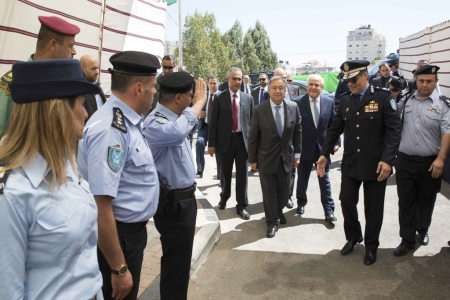
United Nations Secretary-General Antonio Guterres during his to Ramallah, August 29, 2017. (Image source: UN Photo/Ahed Izhiman)

In another example of Palestinian fake news designed to slander Israel and win international sympathy, several Palestinian media outlets have been reporting during the past week that an Israeli female undercover agent masquerading as a nurse has been uncovered in a Palestinian hospital in Hebron.

According to the fake reports, the “nurse” was an Israeli settler who had helped the Israel Defense Forces infiltrate the hospital to arrest and shoot Palestinian fugitives. A quick check of the facts revealed that the Palestinians were apparently referring to a Western volunteer who had worked in the hospital to treat Palestinian patients. The hospital administration has strongly denied the reports, which continue to spread like fire on social media and Palestinian news websites. The purpose of the fake reports is to implicate Israel and present it as a state that shows disregard for hospitals and patients. This case shows that rumors and fake news are regularly accepted as facts in the world of the Palestinians and Arabs.

Or consider another example of how the Palestinian propaganda machine operates. On August 23, the same Palestinian news agency, Wafa, reported on the anniversary of the 1969 fire at the Al-Aqsa Mosque in Jerusalem.

First, the historical facts: On August 21, 1969, an Australian citizen named Denis Michael Rohan set fire to the pulpit of the Al-Aqsa Mosque. Rohan was arrested for the arson attack, tried and found to be insane. He was hospitalized in a mental institution before finally being deported from Israel in 1974.

Since 1969, however, the Palestinians have repeated the lie that Israel and Jews were behind the arson attack. The fact that Rohan was a Christian is apparently inconsequential to them.

So this year, marking the anniversary of the arson, this is what Abbas’s official mouthpiece, Wafa, had this priceless piece of perjury to say: “The Al-Aqsa Mosque was torched by Jewish extremists in 1969.”

The lie about “Jewish extremists” setting fire to the Al-Aqsa Mosque has become so widespread and accepted that even senior Muslim scholars such as Abbas’s Grand Mufti, Sheikh Mohamed Hussein, has also been spreading the blood libel. He and most Palestinians continue to describe the Australian Christian arsonist as a “Jewish extremist.”

These lies are simply a few recent examples that extend a long list of Palestinian fake news and blood libels aimed at framing Israel and inciting the world against it. Take for example, the famous Palestinian lies about terrorists: according to the Palestinian propaganda machine, nearly without exception, the terrorists were on their way to buy bread for their mothers or visit their grandmothers. These were innocent victims, the story goes, arrested or shot by Israel for no reason. Then there are the lies about Israelis “planting” knives near the bodies of terrorists who stab or try to murder Jews. Western journalists and others accept these lies as facts.

The manipulation of the UN chief in Ramallah comes as no surprise to those familiar with Palestinian tactics of deception. The question, however, remains: For how long will the international community receive with equanimity the lies that Palestinians spit in its face, lies that hour after hour, day after day, only endanger the lives of both Palestinians and Jews, promote an all-too-welcomed anti-Semitism, and worst – contrary to the claims of those who purport to want to help them — prolong the suffering of Palestinians who dream of one day living in freedom –like their neighbors, the Israelis — with institutions of democracy like free speech, an independent judiciary and educational system, and most of all, with accountable leadership?

Bassam Tawil is a Muslim based in the Middle East.

Glazov Moment: Gorka’s Departure – A Troubling Sign of Brotherhood’s Grip.

September 1, 2017

Glazov Moment: Gorka’s Departure – A Troubling Sign of Brotherhood’s Grip via YouTube, August 31, 2017

(Please see also, Trump struggling with John Kelly’s strict operation: Report. What about McMaster?– DM)


McMaster brings top Obama admin officials into NSC, sources say

September 1, 2017

McMaster brings top Obama admin officials into NSC, sources say, Conservative Review, Jordan Schachtel, August 31, 2017

(Please see also, Trump struggling with John Kelly’s strict operation: Report. — DM)

At the time, Ylber (pronounced ill-BEAR) was deputy chief of staff to Secretary of Defense Carter, where he helped develop the Obama administration’s foreign policy, focusing on Iran and Iraq. Ylber also worked on the administration’s highly controversial nuclear deal with the Tehran regime.

**************************

National security adviser H.R. McMaster has quietly pulled in high-ranking officials from the Obama administration into senior positions on his staff, current and former administration officials told Conservative Review.

In recent months, McMaster has hired influential members of the Obama Pentagon. One of these individuals was assigned to boost the Iran nuclear deal with Tehran, while the other became a trusted aide to former defense chief Ash Carter.

The recent hires are Ylli and Ylber Bajraktari, Albanian-Kosovan brothers who elevated to the top of government in the Obama administration.

A 2016 Medium profile of the brothers describes the major influence they have had in crafting policies for the previous administration.

“I have never heard of a story of two brothers playing such a critical behind-the-scenes role at the Pentagon,” Carl Woog, a senior Obama NSC adviser, commented to Partnership for Public Service.

“Ylber travels with [Sec. Carter] to international destinations and attends all his Pentagon meetings on foreign policy matters,” the article said.

At the time, Ylber (pronounced ill-BEAR) was deputy chief of staff to Secretary of Defense Carter, where he helped develop the Obama administration’s foreign policy, focusing on Iran and Iraq. Ylber also worked on the administration’s highly controversial nuclear deal with the Tehran regime.

Getting Tough on North Korea: Iran and Other Mirages

September 1, 2017

Getting Tough on North Korea: Iran and Other Mirages, 38 North, September 1, 2017

The thrust of the article is that sanctions will not deter the Kim regime from pursuing its thus far successful efforts to become a nuclear power. They have not worked well in other nations, despite some similarities with North Korea, and will not work there either.

I look forward to reading the subsequent column discussing “how tough sanctions might be merged with a broader political-military effort to stabilize the situation.” Do we need merely “to stabilize the situation,” or do we need to do something more drastic to change it so that North Korea will (a) cease to be a nuclear threat now and (b) be disabled from becoming one again?  — DM)

A subsequent column will discuss how tough sanctions might be merged with a broader political-military effort to stabilize the situation.

***************************

As North Korea moves closer to its goal of being able to target key parts of the United States with nuclear weapons, it has produced a near universal consensus in Washington that it is “time to get tough” with Pyongyang. By and large this consensus still centers on the same policy tools it has for the past dozen years: economic sanctions capable of coercing Pyongyang into capitulating to US and UN demands that it end its nuclear and ballistic missile programs. Sanctions are clearly preferable to war, but they do not offer a viable strategy for untying the Gordian Knot that is North Korea.

Those advocating the “get tough with sanctions” approach to the North Korean nuclear and missile problem in turn base their approach on two dubious assumptions.[1] First, they believe that there is a great deal of additional economic pressure that can be put on North Korea. Some who share this assumption believe the US has a number of unilateral tools that could achieve US objectives. Others—like President Trump—believe that China holds the key by threatening economic pressure on Pyongyang and that China can be persuaded or coerced into using its leverage on Kim Jong Un. Second, advocates of this approach believe that this additional pressure will likely produce a positive result: North Korean capitulation to US demands or—failing that—a change of regime in the DPRK.

Those who believe sanctions are the answer to the North Korean problem point in particular to the sanctions regime developed against Iran’s nuclear program. They assert that sanctions on Iran were more severe than they are today on North Korea. They add that when the international community got serious about sanctions on Iranian oil and Iranian oil revenue, the regime became serious at the P5+1 negotiations. Thus, if only the US and China would get as serious about sanctions on North Korea, Pyongyang would be faced with the choice of collapse or agreement to end its nuclear and missile adventure.

Can Additional Economic Pressure Succeed?

Some parts of the economic pressure argument are borne out by the facts. From about 2005 until late 2011, the Iran and North Korean sanctions regimes were quite similar. Both were primarily targeted on the two countries’ nuclear and missile programs and their purposes were to deny those programs material, technology or financial support. But, from about 2010 onward—prompted in no small part by actions of the US Congress—Iranian sanctions increasingly targeted broader economic activities. This included the sale of gasoline, investment in Iranian oil infrastructure, shipping and airlines.

Most important, with the passage of the National Defense Authorization Act in the United States and the promulgation of an EU action almost at the same time, Iranian oil exports and the repatriation to Iran of proceeds from such exports were targeted. The US legislation, in particular, included secondary sanctions of global reach requiring all foreign consumers of Iranian oil to significantly reduce their purchases of Iranian oil or face draconian US financial sanctions. This was backed by a robust sanctions outreach effort by the Departments of Treasury, State and Energy and—unnoticed by many—significant contributions by a network of non-government entities that tracked the behavior of Iranian shipping, oil exporting and sanctions evasion entities. It is, therefore, accurate to state that Iranian sanctions were tougher in nature and in implementation than the sanctions record against North Korea. [2]

There are several problems, however, with using Iran as the model for the resolution of the North Korean nuclear and missile issue:

  • First, Iran had a great deal more to damage than North Korea has. The Kim dynasty’s bizarre economic policies have inflicted far more damage on the North Korean economy than anything the outside world will ever do.
  • Second, Iran had much more robust foreign trade throughout the period of sanctions application than North Korea has ever had. Iran was far more dependent on foreign trade and access to foreign currency than North Korea, thus its economy could be more easily hurt.
  • Third, Iran’s most important external economic link—the EU—was enthusiastic about the oil and related sanctions. The same can’t be said about the DPRK’s economic lifeline—China.
  • Fourth, the Iranian government’s extensive dependence on revenue from foreign oil sales for its government budget—including its comprehensive program of consumer subsidies and social expenditures—made the government politically vulnerable.
  • Fifth, despite its many anti-democratic and repressive aspects, the Iranian government is far more sensitive to public opinion than the Kim Regime. Iran changed its negotiating stance not because its Supreme Leader felt too much pain to go on, but rather because voters in the 2013 Iranian presidential election made it clear they wanted a negotiated end to the nuclear issue and an escape from sanctions.
  • Sixth, sanctions against Iran were implemented in conjunction with a robust active multilateral negotiating effort and—as we learned only later—a back channel for US bilateral engagement. This is not the case currently for North Korea.
  • Finally, Iran did not have nuclear weapons. It was not being asked to trade away a fundamental component of its security strategy. According to the unclassified version of the US intelligence community’s National Intelligence Estimate, Iran had already made the decision not to continue its nuclear weapons production and design program.[3]

Thus, in terms of vulnerability to sanctions, political structure, diplomatic context and strategic orientation, Iran posed a very different sanctions problem than the challenge the international community faces with North Korea. In the case of North Korea, these countries are seeking to coerce a personalist dictator with a narrow governing elite and little remaining political competition, with enormous coercive power at home, and extensive control of his country’s resource allocation to give up a fundamental component of what he believes to be crucial to his national (and personal) survival. To put it clearly, the last dollar available in North Korea will go to Kim; the next-to-the last will go to his bodyguards; and the third-to-the last to the nuclear and missile program—no matter who starves or what else collapses.

Will Kim Capitulate?

The other key assumption of a “get tough” approach is that crippling sanctions might persuade the Kim regime to capitulate rather than collapse. But there is another possibility: the North Korean regime would conclude that capitulation to the sanctions would have no better result for it than it did for Libyan strong man Gaddafi. They might consider it better to gamble on an “Assad gambit”: a final horrible fight hoping the US and South Korea would recoil at the carnage or that Beijing or Moscow might step in to preserve them. In this respect, there is a cautionary tale to consider from another US confrontation with an East Asian dictatorship.

In July 1941, in response to the Japanese invasion of Indochina, President Roosevelt took a series of steps that look very much like the sanctions advocated by those who want to get tough on the DPRK. He froze Japanese assets and required that Japan obtain specific export licenses to obtain any US goods—including oil upon which the Japanese economy and military was dependent. Subsequently, the US government denied Japan the right to use the US dollar to purchase goods, thus making it impossible to obtain oil even if licenses were granted. Those who made the decision to take this step were confident Japan would not go to war over the sanctions, since both US and Japanese leaders knew it would be a suicidal act for Japan to do so. The Japanese military chose to gamble on an attack on the US fleet and a simultaneous invasion of South East Asian oil fields. Four years of total war in the Pacific ensued. The Japanese decision was indeed suicidal, but it cost a great deal in American blood and treasure to confirm it.

Lessons Learned from Iraqi Sanctions

Iraq presents a much closer analogue to the North Korea situation when considering a “get tough” sanctions campaign. Very shortly after the 1990 Iraqi invasion of Kuwait, the UN Security Council passed UNSCR 661.[4] This resolution in simple and in unequivocal terms placed a full-scale arms, trade and financial embargo on Iraq and Iraqi-occupied Kuwait.[5]Within three weeks, the UNSC backed up the embargo with an authorization for member states to enforce the trade embargo with a maritime interdiction force—essentially a legal blockade.[6] Thus, from the very outset the Iraqi sanctions regime was nearly total in scope and backed by the threat of military enforcement. It would soon also add an additional coercive element: a time limit connected with a threat to move on to the use of force to implement the Council’s demands on the Iraqi withdrawal from Kuwait in UNSCR 678.

The combination of extensive economy-killing sanctions with the threat of force would carry over into the post-conflict era in connection primarily with unresolved questions about Saddam Hussein’s WMD and missile programs. The cease-fire resolution[7] explicitly links the cessation of hostilities following Hussein’s crushing military defeat with resolution of these questions. Moreover, the United States and its coalition partners reserved and exercised the right to use force in order to implement that resolution. This is what the extreme case of “getting tough” with sanctions really looks like. Yet, despite the vast impact of sanctions and the overwhelming military and political coalition lined up against him, Hussein refused to withdraw from Kuwait (believing that it was and had always been Iraqi territory) and even after defeat refused to take the steps necessary to get sanctions lifted.

The problems policymakers faced in Iraq and the nature and motivations of the opponent are very similar to those presented by the Kim regime. The Iraq sanctions regime was tougher than anything Iran, North Korea or almost any other country has faced. This underscores how difficult it is even with the most coercive sanctions available to force a regime based on one-man control and vicious coercive capabilities to yield, especially when the dictator can simply reallocate pain away from his henchmen to the general population. There are, no doubt, a number of reasons unique to Saddam Hussein that contributed to the failure of Iraqi sanctions to achieve their objectives, but there are also factors that will play in a “get tough” effort against Pyongyang. These include the following:

  • Highly coercive regimes are not cowed by public pain;
  • Regimes with extensive central control of the economy can shift resources internally to protect regime elites and the military, thus, at least for some time, holding them harmless from sanctions at the expense of the general population;
  • High impact sanctions also raise the risk premium sanctions busters can earn; border nations are particularly subject to large temptations either at the official or black market level. (The Turkish border during the Iraq sanctions regime showed a disheartening example of this. One can only imagine what the Chinese border would look like in the case of expanded North Korean sanctions.)
  • In the face of determined resistance by a coercive regime, even the most thorough sanctions will take years to take sufficient effect.

Conclusion

Tough sanctions on North Korea are going to be a component of any effort to deal with the North Korean nuclear and missile issue. They at least delay and perhaps can prevent the slide towards miscalculation and war that we see today. But we need to be very careful about adopting models from the (historically rare) instances when sanctions succeeded. We also need to be wary of the assumptions behind the current suggestions for getting tough on Pyongyang through sanctions. The record shows even the most draconian sanctions may not move a repressive one-man regime in the right direction and that, in some circumstances, they can ignite the very conflict they were designed to prevent. A subsequent column will discuss how tough sanctions might be merged with a broader political-military effort to stabilize the situation.


  1. [1]

    There are a number of excellent pieces to cite in the “get tough” school. These include Joshua Stanton, Sung-Yoon Lee and Bruce Klingner, “Getting Tough on North Korea,” Foreign Affairs, May/June 2017, pp. 63-75; David Thompson, “Risky Business,” C4ADS, July 2017; and Anthony Ruggiero, “Restricting North Korea’s Access to Finance,” Testimony before the House Committee on Financial Services Subcommittee on Monetary and Trade Policy, July 19, 2017.

  2. [2]

    For a recent analysis of the Iran sanctions regime and how it might be applied to North Korea see, Edward Fishman, Peter Harrell and Elizabeth Rosenberg, “A Blueprint for New Sanctions on North Korea,” Center for New American Security, July 2017.

  3. [3]

    Director of National Intelligence, “Iran Nuclear Intentions and Capabilities,” National Intelligence Council, November 2007.

  4. [4]

    United Nations Security Council Resolution 661, August 6, 1990.

  5. [5]

    There were exceptions for humanitarian goods, but these were subject to oversight by the UN Sanctions Committee. This was a cumbersome process and it would be some time before Saddam Hussein was able to corrupt it.

  6. [6]

    United Nations Security Council Resolution 665, August 25, 1990.

  7. [7]

    United Nations Security Council Resolution 687, April 3, 1991, Section C.

INTO THE FRAY: The Taylor Force Act – Putting “Palestine” in perspective

September 1, 2017

INTO THE FRAY: The Taylor Force Act – Putting “Palestine” in perspective, Israel National News, Dr. Martin Sherman, September 1, 2017

The proposed bill, which was recently passed in the Senate Foreign Relations Committee with overwhelming bipartisan support, is designed to stop American financial aid to the Palestinian Authority [PA] until it ceases its generous payments to individuals who commit acts of terrorism and to the families of deceased terrorists.

Perversely, under the prevailing conditions, the more gruesome the act of terror and the longer the sentence imposed on the perpetrator, the greater the remuneration!

Indeed, as the Wall Street Journal points out, under existing circumstances, “U.S. aid becomes a transfer payment for terrorists”.

This is clearly an unconscionable situation and hence legislation to contend with it, and correct it, was not only appropriate, but imperative.

At the end of the day, the clash between Jew and Arab over the Holy Land is a clash between two collectives. For the Jewish collective, the Palestinian collective is—and must be treated as it sees itself: An implacable enemy, not a prospective peace partner.

*********************************

Congress is finally considering legislation to stop the Palestinian Authority from incentivizing violence…This has to stop, and the Taylor Force Act…attempts to do that. As it currently stands, the act would cut U.S. foreign assistance to the ‘West Bank’ and Gaza in its entirety if the “payments for acts of terrorism against United States and Israeli citizens …do not stop…. There should definitely be no ‘pay to slay’, but…[b]eing smart counts for more than being right. And the smart approach is one that also recognizes that innocent Palestinians…should not be forced to pay for the mistakes of a government they cannot control. – David Makovsky et al“The Smart Way to End ‘Pay to Slay’”, Foreign Policy, August 2, 2017.

Lesley Stahl, on CBS’s 60 Minutes on the effects of US led sanctions against Iraq (May 12, 1996): We have heard that half a million children have died. I mean, that’s more children than died in Hiroshima. And, you know, is the price worth it?” 

Madelaine Albright, then U.S. ambassador to the United Nations , subsequently President Clinton’s Secretary of State: I think this is a very hard choice, but the price — we think the price is worth it.

Recently, three members of the well-known think-tank, the Washington Institute for Near East Policy, posted an article on the new legislative initiative, named the Taylor Force Act after the West Point graduate and veteran, who was killed in a terrorist attack in Israel last year.

Appropriate and imperative

The proposed bill, which was recently passed in the Senate Foreign Relations Committee with overwhelming bipartisan support, is designed to stop American financial aid to the Palestinian Authority [PA] until it ceases its generous payments to individuals who commit acts of terrorism and to the families of deceased terrorists.

Perversely, under the prevailing conditions, the more gruesome the act of terror and the longer the sentence imposed on the perpetrator, the greater the remuneration!

Indeed, as the Wall Street Journal points out, under existing circumstances, “U.S. aid becomes a transfer payment for terrorists”.

This is clearly an unconscionable situation and hence legislation to contend with it, and correct it, was not only appropriate, but imperative.

The need for a punitive response to the egregious “pay for slay” custom of the PA was conceded by the previously mentioned Washington Institute article, entitled “The Smart Way to End ‘Pay to Slay’”.

Penned by David Makovsky,  distinguished fellow  and director of the project on the Middle East Peace Process, veteran diplomat Dennis Ross, distinguished fellow and counsellor on the U.S.-Israel Strategic Relationship, and Lia Weiner, a research assistant, it clearly proclaims “There should definitely be no ‘pay to slay’… This has to stop.”

“…the ‘mistakes’ of a government they cannot control”.

However, it cautions against an across-the-board cessation of US funds to the PA, calling for a more nuanced (read “watered-down”) application of the punitive cuts: “Threats of sweeping cuts to Palestinian aid may hurt the cause more than they help.” They warn that “To entirely defund U.S. aid to the ‘West Bank’ and Gaza is…to halt economic and social progress there”, proposing instead an approach that “recognizes that innocent Palestinians…should not be forced to pay for the mistakes of a government they cannot control”.

But making the innocent members of the population pay for the nefarious deeds of governments they “cannot control” has been the hall mark of American policy across the globe for years—even when those governments have been far more tyrannical than the PA.

Indeed, why should “innocent Palestinians” merit greater consideration than “innocents”   in a range of despotic regimes against which the US has imposed punishing, at times crippling, economic penalties—such as Iraq, Iran and North Korea?

For example the US-led UN sanctions against Saddam Hussein-controlled Iraq inflicted wide-spread suffering (see introductory excerpt) on innocent Iraqis—including women, infants and the elderly—who, arguably, had much less chance of influencing the actions of their government than do the “innocent Palestinians” with regard to Abbas’s PA.

A government reflecting popular preferences

Indeed, while it is true that they “have not been able to vote in an election for more than a decade”, and to a large measure cannot “control” the current PA government, they certainly did empower it.  In fact, it is in many ways, a government of their making—and theirs alone.

After all, in the last elections held in 2006, the Islamist terror organization Hamas and PA president Abbas’s Fatah won just over 90% of the vote—with the former winning 74 and the later 45 of the 132 seats in the Palestinian Legislative Council. Interestingly, the third largest party was a faction representing the radical hardline Popular Front for the Liberation of Palestine (PFLP), a terrorist group founded by the infamous George Habash and headed today by Ahmed Saadat, currently in an Israeli prison for his part in planning the 2001 assassination of Israeli minister, Rehavam Zeevi .

Moreover, parties focusing on socio-economic reforms and human rights fared extremely poorly. Thus, the “Third Way” headed by former PA prime minister Salam Fayyad and a former PA Minister, the well-known Hanan Ashrawi, won a paltry 2 seats, while the National Coalition for Justice and Democracy,  headed by prominent physician and human rights activist  Eyad El-Sarraj won, well…none

“Palestine”: What the polls predict

However, not only did the last elections show a vast endorsement of rejectionist views (both Fatah and Hamas –and the PFLP–vehemently reject any recognition of Israel as the nation-state of the Jews), but recent public opinion polls provide little cause for optimism that this is likely to change.Indeed, should Abbas leave his post, the most popular candidates are Fatah’s Marwan Barghouti, currently serving multiple life sentences in Israel for a myriad of lethal acts of terror, and Hamas’s Ismail Haniyeh. 

Moreover, findings for legislatives elections show that almost 70% would vote for either Fatah or Hamas, 10% for all other parties, with over 20% being undecided.

Thus, there is little reason to believe that—were new elections to be held—they would produce a sea-change for the better in the composition of the PA, or its policy.  In fact, there is considerable room for concern that the very opposite might well be true.

But perhaps most damaging to Makovsky, Ross and Weiner’s contention that “innocent Palestinians…should not be forced to pay for the mistakes of a government they cannot control” is the finding that there is near unanimous public endorsement  for the very financial support that the Taylor Force Act is intended to terminate.

“Pay to Slay” & Vox Populi 

Stunningly (or not), a July 2017 survey by Palestinian Center of Policy and Survey Research, headed by the well-known Palestinian pollster, Dr. Khalil Shikaki, found that “an almost total consensus rejects pressure on the PA to terminate payments to Palestinian security prisoners” and   “91% are opposed to the suspension of PA payments to Palestinian security prisoners [i.e. jailed terrorists- MS] in Israeli jails; only 7% support such measure”.

This is precisely the reality mirrored in an article that appeared in Tablet Magazine this week by Alex Kane, according to which” the prisoner payment program is one of the most popular PA programs, and it would be political suicide for the PA to halt it.

So, in stark contradiction to the impression conveyed by Makovsky, Ross and Weiner, the “pay to slay” policy is not something foisted on a reluctant peace-seeking  “innocent” Palestinian population , but is, in fact enthusiastically embraced by it—reflecting nothing more (or less) than vox populi.

Indeed, it is more than a little disturbing to see such “luminaries” as Makovsky and Ross propagating views demonstrably detached from reality, in what appears to be  a misplaced endeavor to create the false impression that, overall, the Palestinians,  share their  worldview—when, in fact,  they clearly seem to have a very different one…

Self-contradictory, self-obstructive “rationale”

But beyond the fact that their contentions sit uneasily with the empirical evidence, they appear to have additional disconcerting implications. Thus, they endorse the view that “although a tough message [should be] sent to the PA about the consequences of incentivizing violence”, they recommend that measures undertaken should “prevent any deterioration in the quality of life for Palestinians lest that lead to greater radicalization”.

This appears to reflect a curious rationale which suggests that if one is punished for bad behavior, then one’s behavior will become…worse???

This never was a consideration in, say, Serbia, where markets, hospitals, buses, bridges and old age facilities—to name but a few civilian targets that were hit in high altitude bombing sorties in the US-led NATO attacks in the Balkans War of the 1990s.

Indeed, the claim that harsh punitive measures against an authoritarian regime will only make the regime –or the population under its control—more recalcitrant flies in the face of the most basic elements of deterrence theory. After all, if the threat of harsh measures cannot coerce the regime to modify its behavior, why should measures less harsh do the trick?

Moreover, if the collective is not forced to feel the consequences of actions carried out in its name- there is clearly no reason for these actions to cease.  This is particularly true in the case of the “pay to slay” practice, which, while it may be implemented by an authoritarian regime, is widely endorsed by the general public. In this context, the rationale advanced by Makovsky, Ross et al appears to be at once both self-contradictory and self-obstructive.

 Clash of collectives 

It is of course somewhat discomforting to see such well-placed and well-connected pundits misread the lay-of-the-land so profoundly. For such gross misperception can only help perpetuate the conflict and its attendant suffering.

Firstly, these misperceptions nourish the false premise that privation drives radicalization, which is clearly disproven by the radicalization of many seemingly well-integrated Muslim youth in Europe, and the fact that in several Arab countries the greatest animosity towards Israel is harbored by the professional, well-to-do echelons of society.

Secondly, they obscure the real nature of the Israel-Arab conflict and hence, hamper the efforts to bring it to an end—diverting efforts toward bogus “causes”.

In this regard, then-defense minister Moshe-“Bogey” Yaalon, in a November 2015 address, correctly diagnosed the conflict as a clash of collectives i.e.  “…predominantly a war of wills, of two societies with conflicting wills”.

But, if the clash is essentially one between collectives, surely victory will require one collective breaking the will of the rival collective. Accordingly, ensuring that said rival can maintain its daily routine hardly seems the most promising stratagem to adopt in an effort to break its will and achieve victory.Indeed, if anything, it would seem the exigencies for a collective victory over an adversarial collective would dictate the diametrically opposite endeavor – disrupt the daily routine of the adversary. After all, misdeeds perpetrated in the name of the Palestinian collective must carry a price, which the collective pays – for if not, it will have no incentive to curb them.

Implacable enemy not prospective peace partner

The Palestinian population is thus not some hapless victim of the terror groups, as some might suggest but the very crucible from which such groups have emerged. It has by its own hand, by its deeds and declarations, made it clear that it will not—except on some temporary, tactical basis –brook any manifestation of Jewish political independence/national sovereignty) “between the River and the Sea”.

At the end of the day, the clash between Jew and Arab over the Holy Land is a clash between two collectives. For the Jewish collective, the Palestinian collective is—and must be treated as it sees itself: An implacable enemy, not a prospective peace partner.

Accordingly, the conflict, as one between collectives cannot be individualized .One collective must emerge victorious, the other vanquished. Only then, after victory/defeat, can the issue of personal misfortune be addressed.

This, then, is the perspective in which Palestinian society must be placed—and the perspective from which the formulation of the Taylor Force Act be addressed.

Martin Sherman is the founder and executive director of the Israel Institute for Strategic Studies.

James Comey, Hillary’s Real Campaign Manager

September 1, 2017

James Comey, Hillary’s Real Campaign Manager, Front Page MagazineMatthew Vadum, September 1, 2017

Of course, critics savaged Trump’s rationale for axing Comey at the time, claiming as the supremely silly Russian collusion conspiracy theory was gaining traction in the media, that the president was obstructing justice to save his own skin.

Exploding in huge, scary fireballs of anger visible from orbit, they ridiculed him, calling him a budding dictator. They claimed he had created a dire constitutional crisis. They demanded his impeachment and imprisonment – or worse.

But once again it appears Trump was right about a media-saturated, manufactured matter of public controversy, one in a series that over the president’s brief time in office has whipped the yet-to-exhausted Left into a frenzy.

Hillary thought she was above the law. Apparently, the new evidence shows Comey thought she was, too.

*********************************

The insufferable, morally preening former FBI Director James B. Comey Jr., intentionally gave Hillary Clinton’s campaign a boost last year by deciding to sabotage the email investigation by exonerating the then-candidate before key witnesses had even been interviewed, new evidence suggests.

Citing Comey’s bungling of the Clinton email investigation, President Trump unceremoniously fired him by press release on May 9, three-and-a-half years into his 10-year term. Trump was attacked in the media for not caring about Comey’s presumably hurt feelings. He based his decision on a U.S. Department of Justice memo authored by Deputy Attorney General Rod J. Rosenstein that found Comey had, among other things, usurped then-Attorney General Loretta Lynch’s authority by taking it upon himself to unilaterally clear Clinton.

Rosenstein excoriated Comey, whose side of the story has long been championed by the media. “I do not understand his refusal to accept the nearly universal judgment that he was mistaken. Almost everyone agrees that the Director made serious mistakes; it is one of the few issues that unites people of diverse perspectives.”

Comey’s endless posturing and palace intrigues damaged the FBI, causing morale to plummet. As a result, “the FBI’s reputation and credibility have suffered substantial damage, and it has affected the entire Department of Justice,” Rosenstein asserted. “That is deeply troubling to many Department employees and veterans, legislators and citizens.”

Of course, critics savaged Trump’s rationale for axing Comey at the time, claiming as the supremely silly Russian collusion conspiracy theory was gaining traction in the media, that the president was obstructing justice to save his own skin.

Exploding in huge, scary fireballs of anger visible from orbit, they ridiculed him, calling him a budding dictator. They claimed he had created a dire constitutional crisis. They demanded his impeachment and imprisonment – or worse.

But once again it appears Trump was right about a media-saturated, manufactured matter of public controversy, one in a series that over the president’s brief time in office has whipped the yet-to-exhausted Left into a frenzy.

Upon Comey’s dismissal, Trump said the FBI “is one of our nation’s most cherished and respected institutions and today will mark a new beginning for our crown jewel of law enforcement.”

Exactly right.

As Americans are now painfully aware, the congenitally devious Clintons had created a hacker-friendly, slap-dash private email system while she headed the U.S. Department of State to frustrate Freedom of Information Act requesters, shield Hillary’s correspondence from congressional oversight, and steer money to the international cash-for-future-presidential-favors clearinghouse known as the Bill, Hillary and Chelsea Clinton Foundation. The “homebrew” email servers Mrs. Clinton used are at the heart of the scandal over her mishandling of an Islamic terrorist attack in militant-infested Benghazi, Libya on the 11th anniversary of 9/11 that left four Americans, including U.S. ambassador Chris Stevens, dead.

Hillary thought she was above the law. Apparently, the new evidence shows Comey thought she was, too.

The case that the handwringing, sanctimonious Comey was thoroughly corrupt, exquisitely marinated in the swamp waters and flesh pools of decadent official Washington, was already fairly solid but with these new revelations it seems even more obvious that he was less top cop than grand inquisitor. He thought of himself as judge and jury, justice be damned. As long as he ended up looking good, all was well, in his eyes.

Senate Judiciary Committee chairman Chuck Grassley (R-Iowa) and Judiciary subcommittee chairman Lindsey Graham (R-S.C.) reportedly sent a letter to current FBI Director Chris Wray yesterday about Comey’s conduct as head of the FBI.

“Conclusion first, fact-gathering second—that’s no way to run an investigation,” read the correspondence. “The FBI should be held to a higher standard than that, especially in a matter of such great public interest and controversy.”

From reading redacted transcripts of interviews conducted last fall with senior aides to Comey – his chief of staff James Rybicki and Trisha Anderson, the FBI’s principal deputy general counsel of national security and cyberlaw – Grassley’s committee discovered that as FBI chief Comey prematurely drafted a letter clearing Clinton of email-related wrongdoing.

The testimony appears to establish that Comey started working on a public statement giving Clinton a clean legal bill of health before the FBI had gotten around to speaking with 17 witnesses in the probe, including Clinton and two of her senior aides, Cheryl Mills and Heather Samuelson. The two senators noted that Comey began working on his exculpatory communique even before Mills and Samuelson brokered what the lawmakers called a “highly unusual” limited immunity deal with the Justice Department that prevented officials from looking into communications between the two aides and Colorado-based Platte River Networks, which oversaw Clinton’s unusual email system after she left Foggy Bottom to run for president.

“According to the unredacted portions of the transcripts, it appears that in April or early May of 2016, Mr. Comey had already decided he would issue a statement exonerating Secretary Clinton,” the letter by Grassley and Graham stated.

That was long before FBI agents finished their work. Mr. Comey even circulated an early draft statement to select members of senior FBI leadership. The outcome of an investigation should not be prejudged while FBI agents are still hard at work trying to gather the facts.

As Daniel Greenfield freshly opined:

There was never any serious possibility that Hillary Clinton would have been indicted. And we know that. But throughout the process, Comey pretended that he was dotting all the i’s and crossing all the t’s. But it was all a show. Comey and his top people knew what the outcome would be ahead of time. They were just going through the motions.

Tom Fitton, president of Judicial Watch, told Fox News Channel’s Tucker Carlson last night that the new evidence “shows the investigation truly was a sham.”

Fitton added that the FBI also appears to have helped to pay for opposition research against Trump. He was referring to the Russian “piss-gate” dossier published by cat-video website BuzzFeed. “They started paying, it looks like, the expert behind the dodgy dossier … during the campaign.”

“We asked the FBI for documents about any payments they made to the author of the Trump-Russia dossier and they came back to us and they said we can’t even confirm or deny whether any such documents exist.”

The FBI is not being run, Fitton said, by “someone with the interest of the American people [in mind] in terms of getting some transparency about the misconduct of the FBI during the Obama administration as they were working to, really, nail Trump through this really awkward – and let’s put it this way – conspiratorial relationship with the authors of the Trump dossier.”

By now politics junkies don’t need to be reminded it was at an unusual, much-watched presser on July 5, 2016, that Comey acknowledged the massive body of evidence that was accumulating against Clinton and described it at some length. He stipulated that the former secretary of state probably broke the law when she used hacker-friendly private email servers to conduct official business.

But after airing this very dirty laundry, Comey inexplicably gave Clinton a pass. “Although there is evidence of potential violations of the statutes regarding the handling of classified information, our judgment is that no reasonable prosecutor would bring such a case.”

Guided by politics, not the law, Comey pontificated that Clinton and her aides were “extremely careless” in their handling of classified documents but that there was no evidence of criminal intent. He made this statement even though the relevant national security statute does not actually require intent: mishandling intelligence, even inadvertently, is enough to land people with less pull than Hillary has, in hot water.

As former federal prosecutor Andrew C. McCarthy wrote at the time, “the FBI rewrote the statute, inserting an intent element that Congress did not require.”

So, as it turns out, Comey was ripped from his powerful perch in the nick of time.

Some critics say the media-savvy, morally preening Comey presided over a J. Edgar Hoover-like reign of terror while he ran the FBI.

Comey was far more powerful than an FBI director ought to be. When the president fired Comey, Brit Hume observed, “For better or worse, no FBI director since J. Edgar Hoover had taken so large a role in the political life of this country as James Comey.”

Around the same time Tucker Carlson was positively scathing in his assessment of Comey’s tenure. He said lawmakers on both sides of the aisle were intimidated by Comey – and for good reason.

Just how powerful was James Comey? Let’s put it this way: He was feared in a way that no appointed bureaucrat should ever be feared in a free society. Time and again elected lawmakers on both sides came on this show and expressed worry and concern about his behavior, but they did so only during commercial breaks with the cameras off. Why? Because they were terrified at the prospect of criticizing him in public. They certainly don’t have that fear of the sitting president of the United States and that tells you everything you need to know about Jim Comey.

That sounds about right.

Hezbollah Chief Demands Lebanon Capture Land from Israeli Golan Heights

September 1, 2017

Hezbollah arch-terrorist Hassan Nasrallah has called on Lebanon to oust Israel from territory in the Golan Heights.

By: JNS

Sep 1, 2017

Source: Hezbollah Chief Demands Lebanon Capture Land from Israeli Golan Heights | United with Israel

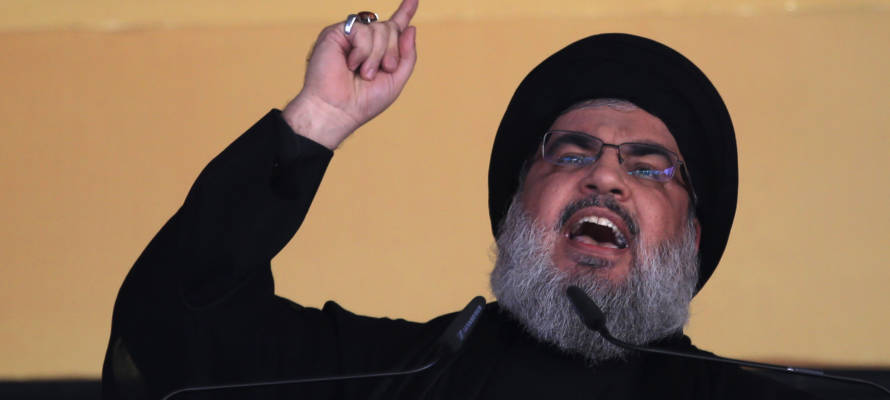
Hassan Nasrallah (AP Photo/Hassan Ammar)

Hezbollah arch-terrorist Hassan Nasrallah has called on Lebanon to oust Israel from territory in the Golan Heights.

“We call on the state to devise a plan and take a sovereign decision to liberate the Shebaa Farms and the Kfarshouba Hills,” Nasrallah said in a televised speech on Thursday, the Lebanese news site Naharnet reported.

Shebaa Farms, which is located along Israel’s border with Lebanon in the Golan Heights and known as Mount Dov, was captured by Israel from Syria in the 1967 Six Day War. While Nasrallah claims that the territory belongs to Lebanon, most of the international community, including Syria, does not recognize this claim.

Nasrallah also announced that he made a rare visit to Damascus to meet with Syrian President Bashar al-Assad.

“I personally went to Damascus” to see President Bashar al-Assad, Nasrallah said.

 Since the Second Lebanon War in 2006 the terror chief has rarely left his network of secret bunkers.

Nasrallah’s statements come after the terror group declared a victory in its battle against the Islamic State in the border region between Lebanon and Syria. Around 600 Islamic State fighters were forced to leave from the border area and transferred into Islamic State-held territory in eastern Syria.

The Hezbollah leader said that the victory thwarted plans by the U.S. and Israel.

“Israel and the US’s dreams in the region are based on ISIS and they are collapsing,” Nasrallah said.

“The axis of resistance, with Russia’s help, thwarted the American-Israeli plan in the region. The Trump administration has brought diplomatic relations with Russia to its lowest ebb. The US poses the real threat to the world and is preparing to take us into nuclear war,” he continued.