Archive for August 28, 2017

Nikki Haley rumored for State after Tillerson distances himself from Trump

August 28, 2017

Nikki Haley rumored for State after Tillerson distances himself from Trump, DEBKAfile, August 28, 2017

Sources of Washington quote President Donald Trump as commenting recently: “Rex just doesn’t get it, he’s totally establishment in his thinking.” In an interview with Fox News’s Chris Wallace Sunday night, Secretary of State Rex Tillerson commented flatly: ”The president speaks for himself,” when asked if the president’s “both sides” comment on Charlottesville represented American values. He was the third senior cabinet member to distance himself from Trump’s response.

Some Washington insiders suggest that UN Ambassador Nikki Haley may be in line to replace Tillerson, with Deputy Secretary National Security Adviser Dina Powell possibly promoted to Haley’s job in New York.

Newsletter Distributed on College Campus Calls for Banning Veterans

August 28, 2017

Newsletter Distributed on College Campus Calls for Banning Veterans, PJ MediaTom Knighton, August 28, 2017

A newsletter distributed at the University of Colorado Colorado Springs says veterans shouldn’t be in college:

The newsletter reads as follows:

“A four-year, traditional university is supposed to be a place of learning, of understanding, of safety and security. However, there is an element among us who may be frustrating those goals: Veterans.

UCCS is known for its number of veterans who are full and part-time students. But these veterans of much of the school prides themselves on may be hurting the university.

First off, many veterans openly mock the ideas of diversity and safe spaces for vulnerable members of society. This is directly in contradiction to the mission of UCCS. Many veterans utter the mantra that they, “do not see color”. But the problem lies in their socialization into the military culture that is that of a white supremacist organization. They have been permanently tainted, and are no long fit for a four-year university.

Second, many students are frightened by the presence of veterans in their classrooms. Veterans usually have an overwhelming presence in the classroom, which can distract other students. This is usually true for vulnerable individual such as LGBTQQI2SAA, who have been known to be the butt of insensitive jokes made by veterans.

Finally, veterans usually are associated with extremists right-wing groups such as the tea party and the NRA. In order to provide a safe place for all students, extremist right-wing groups must be suppressed on campus. This would include their followers: veterans.

That is not to say that veterans should not be allowed an education. Veterans should be allowed to attend trade schools, or maybe even community college. But, in order to protect our academic institutions we must ban veterans from four-year universities.”

Oh, there is so much awful here.

Yes, veterans mock safe spaces. Especially the current batch of veterans who spent time being shot at in Iraq and Afghanistan. They’re not sympathetic to the idea that people might need a place to hide for fear of being looked at wrong.

Veterans aren’t mocking diversity in and of itself: after all, the military integrated prior to the rest of the nation, and it’s one of the most diverse bodies in the country. What veterans mock is the idea that diversity matters more than anything else. Something we all learn in the military is that competence matters more than skin color. Everything does. Just treat people as individuals.

I can’t help but laugh at the idea that the military is a white supremacist organization. The entity that named Gen. Colin Powell as the chairman of the Joint Chiefs.

This newsletter was apparently written in defense of people who are afraid of veterans on campus. I hate to break it to them, but there are veterans everywhere. They’re in almost every business, often succeeding in key roles because of their leadership and selflessness. If you feel unsafe, that’s on you. Because you’re safer with veterans than anyone else.

Further, veterans like myself served to protect these snowflakes’ right to free speech, and this is protected as that. However, make no mistake, none of us care that you’re bothered.

How to Get Out of the Iran Nuclear Deal

August 28, 2017

How to Get Out of the Iran Nuclear Deal, National Review, John R. Bolton, August 28, 2017

(A very dispiriting article appeared at MEMRI today. It notes that

Within three months, the U.S.’s position in the Middle East has changed from one of might and deterrence against Iran to one of weakness, retreat, and being deterred by Iran. This situation, of course, in no way reflects the real balance of power between the U.S. and Iran, neither generally nor regionally. It is an image created jointly by President Trump’s policies and Iran’s offensive approach.

. . . .

It is the approach of the Trump administration – which has agreed to Iran’s regional expansion, under the cover of the war on ISIS – that has prompted this huge shift in the attitude of Iran, which also is relying on Russian backing.

It appears that some in the National Security Council and elsewhere in the Trump administration have intentionally deprived President Trump of information he needs in order to deal resolutely with Iran and Iran scam. –DM)

Although candidate Donald Trump repeatedly criticized Barack Obama’s Iran nuclear agreement, his administration has twice decided to remain in the deal. It so certified to Congress, most recently in July, as required by law. Before the second certification, Trump asked repeatedly for alternatives to acquiescing yet again in a policy he clearly abhorred. But no such options were forthcoming, despite “a sharp series of exchanges” between the president and his advisers, as the New York Times and similar press reports characterized it. 

Many outside the administration wondered how this was possible: Was Trump in control, or were his advisers? Defining a compelling rationale to exit Obama’s failed nuclear deal and elaborating a game plan to do so are quite easy. In fact, Steve Bannon asked me in late July to draw up just such a game plan for the president — the option he didn’t have — which I did.

Here it is. It is only five pages long, but like instant coffee, it can be readily expanded to a comprehensive, hundred-page playbook if the administration were to decide to leave the Iran agreement. There is no need to wait for the next certification deadline in October. Trump can and should free America from this execrable deal at the earliest opportunity.

I offer the Iran nonpaper now as a public service, since staff changes at the White House have made presenting it to President Trump impossible. Although he was once kind enough to tell me “come in and see me any time,” those days are now over.

If the president is never to see this option, so be it. But let it never be said that the option didn’t exist.

I. Background:

The Trump Administration is required to certify to Congress every 90 days that Iran is complying with the July 2015 nuclear deal (the Joint Comprehensive Plan of Action — JCPOA), and that this agreement is in the national-security interest of the United States.1 While a comprehensive Iranian policy review is currently underway, America’s Iran policy should not be frozen. The JCPOA is a threat to U.S. national-security interests, growing more serious by the day. If the President decides to abrogate the JCPOA, a comprehensive plan must be developed and executed to build domestic and international support for the new policy. Under the Iran Nuclear Agreement Review Act of 2015, the President must certify every 90 days that:

(i) Iran is transparently, verifiably, and fully implementing the agreement, including all related technical or additional agreements;

(ii)  Iran has not committed a material breach with respect to the agreement or, if Iran has committed a material breach, Iran has cured the material breach;

(iii)  Iran has not taken any action, including covert activities, that could significantly advance its nuclear weapons program; and

(iv)  Suspension of sanctions related to Iran pursuant to the agreement is – (I)  appropriate and proportionate to the specific and verifiable measures taken by Iran with respect to terminating its illicit nuclear program; and (II) vital to the national-security interests of the United States.

(I)  appropriate and proportionate to the specific and verifiable measures taken by Iran with respect to terminating its illicit nuclear program; and

(II) vital to the national-security interests of the United States.

U.S. leadership here is critical, especially through a diplomatic and public education effort to explain a decision not to certify and to abrogate the JCPOA. Like any global campaign, it must be persuasive, thorough, and accurate. Opponents, particularly those who participated in drafting and implementing the JCPOA, will argue strongly against such a decision, contending that it is reckless, ill-advised, and will have negative economic and security consequences.

Accordingly, we must explain the grave threat to the U.S. and our allies, particularly Israel. The JCPOA’s vague and ambiguous wording; its manifest imbalance in Iran’s direction; Iran’s significant violations; and its continued, indeed, increasingly, unacceptable conduct at the strategic level internationally demonstrate convincingly that the JCPOA is not in the national-security interests of the United States. We can bolster the case for abrogation by providing new, declassified information on Iran’s unacceptable behavior around the world.

But as with prior Presidential decisions, such as withdrawing from the 1972 ABM Treaty, a new “reality” will be created. We will need to assure the international community that the U.S. decision will in fact enhance international peace and security, unlike the JCPOA, the provisions of which shield Iran’s ongoing efforts to develop deliverable nuclear weapons. The Administration should announce that it is abrogating the JCPOA due to significant Iranian violations, Iran’s unacceptable international conduct more broadly, and because the JCPOA threatens American national-security interests.

The Administration’s explanation in a “white paper” should stress the many dangerous concessions made to reach this deal, such as allowing Iran to continue to enrich uranium; allowing Iran to operate a heavy-water reactor; and allowing Iran to operate and develop advanced centrifuges while the JCPOA is in effect. Utterly inadequate verification and enforcement mechanisms and Iran’s refusal to allow inspections of military sites also provide important reasons for the Administration’s decision.

Even the previous Administration knew the JCPOA was so disadvantageous to the United States that it feared to submit the agreement for Senate ratification. Moreover, key American allies in the Middle East directly affected by this agreement, especially Israel and the Gulf states, did not have their legitimate interests adequately taken into account. The explanation must also demonstrate the linkage between Iran and North Korea. We must also highlight Iran’s unacceptable behavior, such as its role as the world’s central banker for international terrorism, including its directions and control over Hezbollah and its actions in Iraq, Syria, and Lebanon. The reasons Ronald Reagan named Iran as a state sponsor of terrorism in 1984 remain fully applicable today.

We must also highlight Iran’s unacceptable behavior, such as its role as the world’s central banker for international terrorism, including its directions and control over Hezbollah and its actions in Iraq, Syria, and Lebanon. The reasons Ronald Reagan named Iran as a state sponsor of terrorism in 1984 remain fully applicable today.

II. Campaign Plan Components

There are four basic elements to the development and implementation of the campaign plan to decertify and abrogate the Iran nuclear deal: 1.     Early, quiet consultations with key players such as the U.K., France, Germany, Israel, and Saudi Arabia, to tell them we are going to abrogate the deal based on outright violations and other unacceptable Iranian

1.     Early, quiet consultations with key players such as the U.K., France, Germany, Israel, and Saudi Arabia, to tell them we are going to abrogate the deal based on outright violations and other unacceptable Iranian behavior, and seek their input. 2.     Prepare the documented strategic case for withdrawal through a detailed white paper (including declassified intelligence as appropriate) explaining why the deal is harmful to U.S. national interests, how Iran has violated it, and why Iran’s behavior more broadly has only worsened since the deal was agreed. 3.     A greatly expanded diplomatic campaign should immediately follow the announcement, especially in Europe and the Middle East, and we should ensure

2.     Prepare the documented strategic case for withdrawal through a detailed white paper (including declassified intelligence as appropriate) explaining why the deal is harmful to U.S. national interests, how Iran has violated it, and why Iran’s behavior more broadly has only worsened since the deal was agreed. 3.     A greatly expanded diplomatic campaign should immediately follow the announcement, especially in Europe and the Middle East, and we should ensure

3.     A greatly expanded diplomatic campaign should immediately follow the announcement, especially in Europe and the Middle East, and we should ensure continued emphasis on the Iran threat as a top diplomatic and strategic priority.

4.     Develop and execute Congressional and public diplomacy efforts to build domestic and foreign support.

III. Execution Concepts and Tactics

1.     Early, quiet consultations with key players It is critical that a worldwide effort be initiated to inform our allies, partners, and others about Iran’s unacceptable behavior. While this effort could well leak to the press, it is nonetheless critical that we inform and consult with our allies and partners at the earliest possible moment, and, where appropriate, build into our effort their concerns and suggestions. This quiet effort will articulate the nature and details of the violations and the type of relationship the U.S. foresees in the future, thereby laying the foundation for imposing new sanctions barring the transfer of nuclear and missile technology or dual use technology to Iran. With Israel and selected others, we will discuss military options. With others in the Gulf region, we can also discuss means to address their concerns from Iran’s menacing behavior. The advance consultations could begin with private calls by the President, followed by more extensive discussions in capitals by senior Administration envoys. Promptly elaborating a comprehensive tactical diplomatic plan should be a high priority.

2.     Prepare the documented strategic case The White House, coordinating all other relevant Federal agencies, must forcefully articulate the strong case regarding U.S. national-security interests. The effort should produce a “white paper” that will be the starting point for the diplomatic and domestic discussion of the Administration decision to abrogate the JCPOA, and why Iran must be denied access to nuclear technology indefinitely. The white paper should be an unclassified, written statement of the Administration’s case, prepared faultlessly, with scrupulous attention to accuracy and candor. It should not be limited to the inadequacies of the JCPOA as written, or Iran’s violations, but cover the entire range of Iran’s continuing unacceptable international behavior.

Although the white paper will not be issued until the announcement of the decision to abrogate the JCPOA, initiating work on drafting the document is the highest priority, and its completion will dictate the timing of the abrogation announcement.

A thorough review and declassification strategy, including both U.S. and foreign intelligence in our possession should be initiated to ensure that the public has as much information as possible about Iranian behavior that is currently classified, consistent with protecting intelligence sources and methods. We should be prepared to “name names” and expose the underbelly of the Iranian Revolutionary Guard business activities and how they are central to the efforts that undermine American and allied national interests. In particular, we should consider declassifying information related to activities such as the Iran-North Korea partnership, and how they undermine fundamental interests of our allies and partners.

3.      Greatly expanded diplomatic campaign post-announcement

The Administration, through the NSC process, should develop a tactical plan that uses all available diplomatic tools to build support for our decision, including what actions we recommend other countries to take. But America must provide the leadership. It will take substantial time and effort and will require a “full court press” by U.S. embassies worldwide and officials in Washington to drive the process forward. We should ensure that U.S. officials fully understand the decision, and its finality, to help ensure the most positive impact with their interlocutors.

Our embassies worldwide should demarche their host governments with talking points (tailored as may be necessary) and data to explain and justify abrogating JCPOA. We will need parallel efforts at the United Nations and other appropriate multilateral organizations. Our embassies should not limit themselves to delivering the demarche, however, but should undertake extensive public diplomacy as well.

After explaining and justifying the decision to abrogate the deal, the next objective should be to recreate a new counter-proliferation coalition to replace the one squandered by the previous Administration, including our European allies, Israel, and the Gulf states. In that regard, we should solicit suggestions for imposing new sanctions on Iran and other measures in response to its nuclear and ballistic-missile programs, sponsorship of terrorism, and generally belligerent behavior, including its meddling in Iraq and Syria.

Russia and China obviously warrant careful attention in the post-announcement campaign. They could be informed just prior to the public announcement as a courtesy, but should not be part of the pre-announcement diplomatic effort described above. We should welcome their full engagement to eliminate these threats, but we will move ahead with or without them.

Iran is not likely to seek further negotiations once the JCPOA is abrogated, but the Administration may wish to consider rhetorically leaving that possibility open in order to demonstrate Iran’s actual underlying intention to develop deliverable nuclear weapons, an intention that has never flagged.

In preparation for the diplomatic campaign, the NSC interagency process should review U.S. foreign-assistance programs as they might assist our efforts. The DNI should prepare a comprehensive, worldwide list of companies and activities that aid Iran’s terrorist activities.

4.      Develop and execute Congressional and public diplomacy efforts

The Administration should have a Capitol Hill plan to inform members of Congress already concerned about Iran, and develop momentum for imposing broad sanctions against Iran, far more comprehensive than the pinprick sanctions favored under prior Administrations. Strong congressional support will be critical. We should be prepared to link Iranian behavior around the world, including its relationship with North Korea, and its terrorist activities. And we should demonstrate the linkage between Iranian behavior and missile proliferation as part of the overall effort that justifies a national-security determination that U.S. interests would not be furthered with the JCPOA.

Unilateral U.S. sanctions should be imposed outside the framework of Security Council Resolution 2231 so that Iran’s defenders cannot water them down; multilateral sanctions from others who support us can follow quickly.

The Administration should also encourage discussions in Congress and in public debate for further steps that might be taken to go beyond the abrogation decision. These further steps, advanced for discussion purposes and to stimulate debate, should collectively demonstrate our resolve to limit Iran’s malicious activities and global adventurism. Some would relate directly to Iran; others would protect our allies and partners more broadly from the nuclear proliferation and terrorist threats, such as providing F-35s to Israel or THAAD resources to Japan. Other actions could include:

End all landing and docking rights for all Iranian aircraft and ships at key allied ports;

End all visas for Iranians, including so called “scholarly,” student, sports, or other exchanges;

Demand payment with a set deadline on outstanding U.S. federal-court judgments against Iran for terrorism, including 9/11;

Announce U.S. support for the democratic Iranian opposition;

Expedite delivery of bunker-buster bombs;

Announce U.S. support for Kurdish national aspirations, including Kurds in Iran, Iraq, and Syria;

Provide assistance to Balochis, Khuzestan Arabs, Kurds, and others — also to internal resistance among labor unions, students, and women’s groups; Actively organize opposition to Iranian political objectives in the U.N.

IV. Conclusion

This effort should be the Administration’s highest diplomatic priority, commanding all necessary time, attention, and resources. We can no longer wait to eliminate the threat posed by Iran. The Administration’s justification of its decision will demonstrate to the world that we understand the threat to our civilization; we must act and encourage others to meet their responsibilities as well.

___________________________

1 Although this paper will refer to “the JCPOA,” the abrogation decision should also encompass the July 14, 2015, statement by the Security Council’s five permanent members and Germany, attached as Annex B to Security Council Resolution 2231. The JCPOA is attached as Annex A to Resolution 2231.
Netanyahu’s Empathy for Trump

August 28, 2017

Netanyahu’s Empathy for Trump, Front Page MagazineCaroline Glick, August 28, 2017

(Please see also, The Establishment And Antifa Go Hand In Hand and 25 Reasons to Reassign General H.R. McMaster. — DM)

You cannot appease people who want to destroy you. And you cannot succeed by embracing the failed policies of your predecessors that you were elected to roll back. The elites who reject you will never embrace you. The only way to govern successfully when you are under relentless assault is to empower your supporters and keep faith with them. 

**************************

Originally published in The Jerusalem Post.

Prime Minister Benjamin Netanyahu was attacked by the media for not jumping on the bandwagon and condemning US President Donald Trump for his response to the far-right and far-left rioters in Charlottesville earlier this month. It may be that he held his tongue because he saw nothing to gain from attacking a friendly president. But it is also reasonable to assume that Netanyahu held his tongue because he empathizes with Trump. More than any leader in the world, Netanyahu understands what Trump is going through. He’s been there himself – and in many ways, is still there. Netanyahu has never enjoyed a day in office when Israel’s unelected elites weren’t at war with him.

From a comparative perspective, Netanyahu’s experiences in his first term in office, from 1996 until 1999, are most similar to Trump’s current position. His 1996 victory over incumbent prime minister Shimon Peres shocked the political class no less than the American political class was stunned by Trump’s victory. And this makes sense. The historical context of Israel’s 1996 election and the US elections last year were strikingly similar.

In 1992, Israel’s elites, the doves who controlled all aspects of the governing apparatuses, including the security services, universities, government bureaucracies, state prosecution, Supreme Court, media and entertainment industry, were seized with collective euphoria when the Labor Party under the leadership of Yitzhak Rabin and Shimon Peres won Israel’s Left its first clear-cut political victory since 1974. Rabin and Peres proceeded to form the most dovish governing coalition in Israel’s history.

Then in 1993, after secret negotiations in Oslo, they shocked the public with the announcement that they had decided to cut a deal with Israel’s arch enemy, the PLO, a terrorist organization pledged to Israel’s destruction.

The elites, who fancied themselves the guardians of Israel’s democracy, had no problem with the fact that the most radical policy ever adopted by any government, one fraught with dangers for the nation and the state, was embarked upon with no public debate or deliberation.

To the contrary, they spent the next three years dancing around their campfire celebrating the imminent realization of their greatest dream. Israel would no longer live by its sword. It would be able to join a new, post-national world. In exchange for Jerusalem and a few other things that no one cared about, other than some fanatical religious people, Israel could join the Arab League or the European Union or both.

From 1993 through 1996, and particularly in the aftermath of Rabin’s assassination in November 1995, the media, the courts and every other aspect of Israel’s elite treated the fellow Israelis who rejected their positions as the moral and qualitative equivalent of terrorists. Like the murderers of innocents, these law-abiding Israelis were “enemies of peace.”

As for terrorism, the Oslo process ushered in not an era of peace, but an era of unprecedented violence. The first time Israelis were beset by suicide bombers in their midst was in April 1994, when the euphoria over the coming peace was at its height.

The 1996 election was the first opportunity the public had to vote on the Oslo process. Then, in spite of Rabin’s assassination and the beautiful ceremonies on the White House lawns with balloons and children holding flowers, the people of Israel said no thank you. We are Zionists, not post-Zionists. We don’t like to get blown to smithereens on buses, and we don’t appreciate being told that victims of terrorism are victims of peace.

Trump likewise replaced the most radical president the US has ever known. Throughout Barack Obama’s eight years in office, despite his failure to restore America’s economic prosperity or secure its interests abroad, Obama enjoyed the sycophantic support of the media, whose leading lights worshiped him and made no bones about it.

In one memorable exchange after Obama’s June 2009 speech in Cairo, where he presented the US as the moral equivalent of its enemies, Newsweek editor Evan Thomas told MSNBC host Chris Mitchell that Obama was “kind of God.”

Obama’s job, Thomas explained, was not merely to lead the US as his predecessor Ronald Reagan had done. Obama was above “provincial nationalism.” His job was to teach morality to humanity.

In Thomas’s words, “He’s going to bring all different sides together… He’s all about ‘let us reason together’… He’s the teacher. He is going to say, ‘Now, children, stop fighting and quarreling with each other.’ And he has a kind of a moral authority that he – he can – he can do that.”

The American Left’s adoration of Obama was so all-encompassing, and its control of the mainstream US media so extensive, that it never occurred to its members that the public disagreed with them. They were certain that Hillary Clinton, Obama’s chosen successor, would win.

In 1996, the Israeli elite greeted Netanyahu’s victory with shock and grief. The “good, enlightened” Israel they thought would rule forever had just been defeated by the unwashed mob. Peres summed up the results by telling reporters that “the Israelis” voted for him. And “the Jews” voted for Netanyahu. His followers shook their heads in mildly antisemitic disgust.

Their mourning quickly was replaced by a spasm of hatred for Netanyahu and his supporters that hasn’t disappeared even now, 21 years later.

The media’s war against Netanyahu began immediately. It was unrelenting and more often than not unhinged. So it was that two weeks after his victory, Jerusalem’s Kol Ha’ir weekly published a cover story titled, “Who are you, John Jay Sullivan?” The report alleged that Netanyahu was a CIA spy who went by the alias “John Jay Sullivan.” It took all of five minutes to take the air out of that preposterous balloon, but the media didn’t care – and it was all downhill from there.

Netanyahu, the media insisted, was a crook. He incited Yitzhak Rabin’s assassination. He may even have been the assassin. His wife, Sara, was mean to nannies. She was a bad mother. She was ill-mannered in general and probably crazy.

Any prominent politician or luminary who entered Netanyahu’s orbit was demonized and libeled. Authors who dared to have dinner with him, journalists who dared to write anything half-way supportive of him, were effectively excommunicated from their professional cliques.

His advisers and cabinet ministers found themselves under criminal investigation over nothing, and so did Netanyahu and his wife.

Every action his government took that could in any way be interpreted as a step toward weakening the elite’s control of the country brought bombastic headlines day after day, accusing Netanyahu of seeking to undermine the rule of law.

Every disgruntled cabinet minister, every slighted aide who publicly criticized Netanyahu, was given instant celebrity and star-for-a-news-cycle status.

The dovish commanders of the IDF and the Shin Bet were openly disloyal to Netanyahu in everything relating to the peace process with the PLO. Every attempt Netanyahu made to abandon his predecessors’ blind and misplaced faith in PLO chief Yasser Arafat was immediately leaked to the media. “Security sources” blamed Netanyahu for terrorist attacks.

When the Mossad bungled the assassination of Hamas chief Khaled Mashaal in Amman, it was Netanyahu’s fault. When Arafat used Netanyahu’s authorization of the opening of a new entrance to the Western Wall tunnels to unleash a terrorist offensive against Israel that left 15 Israelis dead in a week, then-Shin Bet director Ami Ayalon blamed Netanyahu at a live press conference.

The purpose of the leaks and the misdirection was to box Netanyahu in with no option other than to continue his predecessors’ failed policy of appeasing and empowering Palestinian terrorists.

Just as the notion that Netanyahu – the man who rejected their post-Zionist euphoria and insisted that there would be no new Middle East – had beaten their savior Peres blew the Israeli elites’ minds to bits, so the US elite has still refused to come to terms with the fact that Donald Trump, the man they view as nothing more than a nouveau riche vulgarian, beat the anointed successor of their idol Obama.

So they hate him and cannot stop demonizing him. Whether it’s Obama’s director of national intelligence James Clapper, who insisted that the Muslim Brotherhood is a “largely secular organization,” saying that Trump is insane, or Bob Costa from CNN calling him a white supremacist and antisemite, there is no lunatic depth the American Left will not plumb to attack, demonize and dehumanize Trump and his supporters.

So how is a leader to respond to this sort of onslaught? Netanyahu for his part gave up fighting at some point in his first term. Faced with the implacable animosity of an empowered elite that boxed him in at every turn, Netanyahu decided to try to give them what they wanted in the hope of surviving in office.

He made a deal with Arafat and Bill Clinton at Wye Plantation. He handed Hebron over to PLO control. He surrendered government control over selection of the attorney-general to a committee controlled by the elites and so sank Israeli democracy into the hole it is still in.

Since 1997, unelected lawyers unaccountable to elected officials have the power to dismantle democratically elected governments, essentially at will.

Netanyahu got nothing for his efforts. The media, prosecution, state bureaucracy and security services continued to wage political war against him until, with the help of the Clinton administration, they overthrew his government in 1999 and brought Ehud Barak to power. Barak presided over a government so radical that the Rabin-Peres government looked hawkish in comparison.

Before Israel could move past its elites, the fruits of their radical policies first had to be ingested. In the event, the fruits of those policies were 1,500 Israelis killed in the Palestinian terrorist war and the emergence of strategic threats and repeated wars from post-withdrawal Gaza and Lebanon.

Today it is clear that Trump is wrestling with how to proceed in governing, as the American elites openly seek his political and even personal destruction. One day he tacks to the establishment in the hopes of appeasing those who hate him, and the next day he embraces his supporters and repeats his campaign pledges to “drain the swamp.”

The lessons of Netanyahu’s first term – and to a degree, his subsequent terms in office as well – are clear enough and Trump would do well to apply them.

You cannot appease people who want to destroy you. And you cannot succeed by embracing the failed policies of your predecessors that you were elected to roll back. The elites who reject you will never embrace you. The only way to govern successfully when you are under relentless assault is to empower your supporters and keep faith with them.

ANALYSIS: How the tide is turning against Iran

August 28, 2017

ANALYSIS: How the tide is turning against Iran, Al Arabiya, Heshmat Alavi, August 28, 2017

(But please see, Iran, operating from Syria, will destroy Europe and North America. — DM)

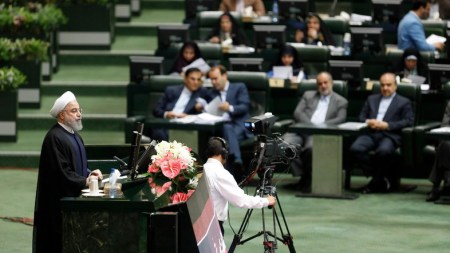
Iranian President Hassan Rouhani delivers a speech to the parliament in Tehran on August 20, 2017, (AFP)

As ISIS is losing ground in its two last enclaves of Raqqa and Deir el-Zor, there are many rightfully concerning reports of Iran seeking to chip further control in Syria.

All the while, there are also signs of contradictory remarks heard from senior Iranian officials, parallel to indications on the ground of how international counterparts are seeking their own interests that fall completely against those of Tehran’s.

Such incoherency signals nothing but troubling times ahead for Iran in losing its grasp of strategic interests across the Middle East, including Syria.

‘Not tantamount to meddling’

Similar sentiments were heard recently from Iranian Foreign Minister Mohammad Javad Zarif and Revolutionary Guards (IRGC) Quds Force commander Qassem Suleimani. Zarif exerted himself to defend Tehran’s carnage in other countries under the pretext of a mandate to defend human rights.

“The foreign policy of the Islamic Republic, based on the constitution, is a policy that is naturally founded on human rights. What is the meaning of human rights? It means defending the rights of innocent against oppressors… We have this definition in our constitution. This is not tantamount to meddling,” he claimed.

Zarif’s remarks were followed by Suleimani’s insight. “There were friends in high places, in our country’s domestic and foreign hierarchy, who argued not to get involved in Syria and Iraq, and sit back and respectfully defend the revolution. One individual asked you mean we go and defend dictators? The leader (referring to Iranian Supreme Leader Ali Khamenei) provided a clear response in saying when you look at the countries we have relations with, who is a dictator and who is not? We simply look at our interests,” he explained.

A troubling slate

The relations Khamenei refers to promote an image into the very nature of his establishment. Bashar Al-Assad’s dictatorship in Syria can be read as a reign of death and destruction. With Iran’s support and in the absence of a coordinated global response over 500,000 have been killed, scores more injured, over 12 million are internally displaced or forced to seek refuge abroad, and swathes of the country is left in ruins.

Iraq’s former prime minister Nouri Al-Maliki, another figure described as Tehran’s puppet, has a similar report card unfortunately gone neglected. The Sunni community was the main target of Al-Maliki’s Iran-backed wrath, fueling the rise of ISIS.

In Yemen the Houthis and ousted dictator Ali Abdullah Salah have also been at the receiving end of Iran’s support. As the Saudi-led coalition advances against Iran’s disastrous efforts, signs of major rifts, and even reports of clashes between the two forces, constitute a major quagmire for Tehran.

The Lebanese Hezbollah, Iran’s proxy offspring brought to life by the IRGC back in the early 1980s, are known to instigate the Syrian war by supporting Al-Assad, and pursuing Tehran’s interest wherever needed across the Middle East.

Looking abroad, Iran has established cozy relations with North Korea and Venezuela, both dictators whose people are starving. The Pyongyang-Tehran axis is especially raising concerns considering their close nuclear and ballistic missile collaboration.

Iran’s own dictatorship

This is a regime provoking a variety of bellicosities. Recent threats by Iranian President Hassan Rouhani and Atomic Energy Organization chief Ali Akbar Salehi of relaunching certain nuclear activities are reminders of the dangers of Iran acquiring nuclear weapons.

Extending equally to such concerns, and not receiving adequate consideration, is Iran’s ongoing human rights violations. Over 100 executions were reported in the month of July alone. This comes after more than 3,000 were sent to the gallows during Rouhani’s first term.

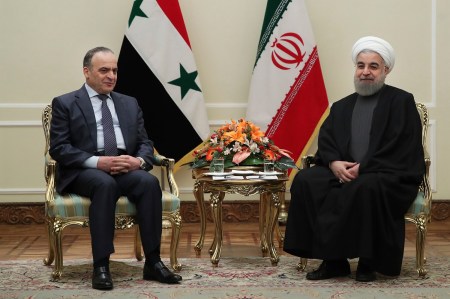
President Hassan Rouhani with Syrian Prime Minister Imad Khamis at his office in Tehran, on Jan. 18, 2017. (Iranian Presidency Office via AP)

More recent cases include the ongoing hunger strike of dozens of political prisoners in a jail west of Tehran going on for nearly four weeks now. These inmates are protesting prison guards resorting to violence and other repressive measures used to impose further pressures.

Concerned of this and the overall situation in Iran, Amnesty International in a statement demanded Iranian authorities “allow international monitors, including the UN Special Rapporteur on the situation of human rights in Iran, to conduct independent, unannounced inspections of Raja’i Shahr Prison and other prisons across the country.”

While this and many other such cases deserve an international inquiry, they do signal a significant change in tone of courage in Iran’s powder keg society against the ruling regime.

From others’ perspectives

Fortunately, there is an end to be seen in the Syrian war. However, six years after the spark of that revolution, the Syrian people have suffered tremendously mainly due to Obama’s compelling kowtowing to Iran.

The war has been draining Iran, forcing it to seek the support of other parties, including Russia. The more parties with stakes in Syria, and with the US taking a far more active stance, the more Iran sees its future in the country threatened.

As the Levant’s forthcoming is being blueprinted, high on the agenda must be thwarting Iran’s interests. With ISIS defeated in Iraq, there will be no legitimacy for Iran’s presence in Iraq in any shape or form. The same argument goes for Syria.

The international community, coming to realize Iran’s destructive nature, should take the initiative and demand the eviction of all Iranian elements from Syria, including IRGC members and foreign proxy members transferred from abroad.

Peace is the end

All said and done, comprehending Iran’s regime thrives on the mentality of spreading crises across the region is vital. Ceasefire and reconciliation are not in this regime’s nature, knowing increasing public demands will follow.

This regime has failed to provide in elementary needs inside Iran for the past four decades. Thus, satellite states abroad will be no exception. Peace and tranquility in the Middle East hinges on containing Iran’s influence from all its neighboring countries and a complete end to its lethal meddling.

A new chapter is being written in this flashpoint region’s history.

The Time Has Come to Stop the War on Free Speech

August 28, 2017

The Time Has Come to Stop the War on Free Speech, Front Page Magazine, Daniel Greenfield, August 28, 2017

Reagan and Eisenhower made it clear that mob violence would not be tolerated. And they were willing to back up the Constitution and our political freedoms with force.

That’s what must be done to restore First Amendment rights in Berkeley everywhere Antifa mobs seek to shut down the free speech of those they disagree with. If leftist governors and mayors won’t protect the rights and safety of their citizens, then it’s up to the federal government to step in and do it for them.

*********************************

Freedom of Assembly is the first and most important right of the Bill of Rights. Today it is being denied in cities like Berkeley and Portland where local left-wing governments have contrived to deny rally permits while giving the masked thugs of their leftist Antifa allies a blank check to assault those whose views they oppose.

In Berkley, Boston and San Francisco, the First Amendment doesn’t exist anymore.

The threat of violence that shut down the Patriot Prayer demonstration in San Francisco, an event scheduled to feature African American, Samoan and Latino speakers, is a case of fascism justifying itself by flying the false flag of “anti-fascism.” And it is the third such case this week – the others being Boston and Berkeley. The founder of Patriot Prayer, Joey Gibson, is a Japanese American who regards himself as a “person of color” and who had made it very clear that he opposes Neo-Nazis and white supremacists, and who has publicly stated that his goal is to promote “love” not hate.

This time the violence and hate were coming from one side, and one side only.

Gibson’s attempt to hold a demonstration to end hate was torpedoed by Nancy Pelosi and Mayor David Lee who falsely claimed that it was a proposed gathering of “white supremacists.” Pelosi insisted that Patriot Prayer should not be allowed a permit for Crissy Field in San Francisco. “The Constitution does not say that a person can yell ‘wolf’ in a crowded theater,” she insisted. But the only people crying wolf were Pelosi and the leftist thugs who caused it to be shut down.

In Berkeley, authorities denied free speech advocates a permit, and did little to prevent the leftist violence that broke out against a handful of individuals who showed up after the organizers had called it off.

James Queally, the crime reporter for the Los Angeles Times, tweeted, “There is a complete mob mentality here. People are randomly accusing random people of being Nazis.” Another Tweet added, “The moderate counter protesters are livid with the violence. ‘We need to get Antifa out of here.’ said man who helped break up fight.’”

The authorities are not going to do it. The choice is simple. Either we have a First Amendment. Or we don’t. If mobs of violent leftists with the complicity of leftist authorities can shut down any protest or speaker they don’t like, then we no longer have a Bill of Rights. All that’s left is leftist tyranny.

In the sixties, Governor Reagan sent in the National Guard to stop the violence at Berkeley. Governor Brown won’t do it. It’s up to President Trump to act.

And there’s precedent.

Mob rule will not be tolerated.

That was the message that President Eisenhower delivered to Americans in the fall of ’57 when he returned to the White House and ordered the deployment of the 101st Airborne to Little Rock, Arkansas.

The Governor of Arkansas, a progressive Democrat who was a product of the radical leftist Commonwealth College, had allowed a racist mob to rampage at Central High School in Little Rock.

Eisenhower warned that “disorderly mobs” operating “under the leadership of demagogic extremists” would not be allowed to terrorize citizens with the complicity of local authorities. He showed that the President of the United States was willing to protect civil rights with armed force.

“The only assurance I can give you is that the Federal Constitution will be upheld by me by every legal means at my command,” Eisenhower vowed.

And that’s what he did.

California, under Democrat rule, has become a rogue state ruled by leftist mobs and their political godfathers, where there are a million regulations, but no rule of law, where there is a code for everything, but where the Constitution no longer operates.

Antifa is a criminal terrorist organization. Its masked thugs know they are criminals which is why they hide their identities. The first responsibility of government is the safety of its citizens.  When violent thugs shut down free assemblies, government is not doing its job.

Reagan and Eisenhower made it clear that mob violence would not be tolerated. And they were willing to back up the Constitution and our political freedoms with force.

That’s what must be done to restore First Amendment rights in Berkeley everywhere Antifa mobs seek to shut down the free speech of those they disagree with. If leftist governors and mayors won’t protect the rights and safety of their citizens, then it’s up to the federal government to step in and do it for them.

Tea for the Tillerson

August 28, 2017

Tea for the Tillerson, Power Line, Scott Johnson, August 28, 2017 

(Bannon and Gorka are gone because they agree with President Trump. McMaster and Tillerson, who don’t, remain. Why? — DM)

Tillerson serves in high office at the pleasure of the president, fourth in line to the presidency. There are many things Tillerson could have truthfully said to support the president or at least not to undermine him, particularly in response to a UN committee statement. I’m pretty sure that John Bolton or Nikki Haley would have said them. Tillerson apparently didn’t think he could honorably do so.

If not, it’s time for him to go. I take it that he wants to go. He should get his wish sooner rather than later.

*****************************

Secretary of State Rex Tillerson appeared on Fox News Sunday with Chris Wallace yesterday. Video of the entire 13-minute interview is embedded below. Tillerson made news in one respect that belies his standing in the Trump administration.

Asked about President Trump’s response to the “racial protests in Charlottesville” (at 11:25) and a UN committee statement condemning the response, Tillerson responded in part: “I don’t believe anyone doubts the American people’s values or the commitment of the American government, or the government’s agencies to advancing those values and defending those values.”

Asked the obvious follow-up question regarding Trump himself, Tillerson responded: “The president speaks for himself, Chris.”

Tillerson serves in high office at the pleasure of the president, fourth in line to the presidency. There are many things Tillerson could have truthfully said to support the president or at least not to undermine him, particularly in response to a UN committee statement. I’m pretty sure that John Bolton or Nikki Haley would have said them. Tillerson apparently didn’t think he could honorably do so.

If not, it’s time for him to go. I take it that he wants to go. He should get his wish sooner rather than later.

https://www.youtube.com/watch?v=hLrrfWu-cvQ

The Establishment And Antifa Go Hand In Hand

August 28, 2017

The Establishment And Antifa Go Hand In Hand, Daily Caller, Scott Greer, August 27, 2017

Antifa violence broke out once again in Berkeley, California, this weekend.

On Sunday, a small number of supporters of President Trump decided to gather in the left-wing college town following the cancellation of two similar demonstrations in the area the day before. The reason for the cancellations was due to the large number of violent threats the pro-Trump organizers received.

The day Trump supporters actually showed up in the Bay Area gave leftists the chance to make good on their threats.

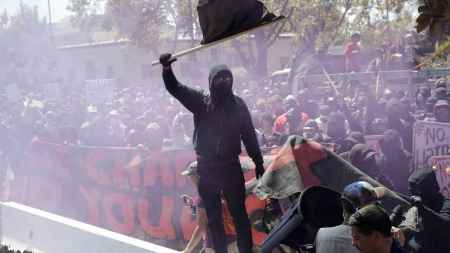
The scenes on the ground in Berkeley showed black-masked, red flag-waving thugs taking over the city and assaulting anyone they deemed to be a Nazi. It was a stark contrast to the heroic image Antifa has earned from journalists and politicians in the weeks since the violence in Charlottesville.

There were no clear Nazis in Berkeley, just your average Trump supporters. Yet that didn’t save them from a beating at the hands of Antifa.

Strangely enough, Antifa had drawn praise from the most unlikely of sources within the Trump administration just a few days before they rioted against free assembly in Berkeley.

In a interview with the Financial Times, Gary Cohn, a former Goldman Sachs executive and current White House economic adviser, publicly rebuked his boss Donald Trump’s response to the Charlottesville violence that both sides were at fault. He also praised Antifa as a force for good.

“Citizens standing up for equality and freedom can never be equated with white supremacists, neo-Nazis, and the KKK,” the top Trump adviser asserted.

There are many odd things about a Trump-aligned Goldman Sachs figurehead praising anti-capitalist rioters. It’s pretty strange to praise leftists who dedicate their lives to suppressing free speech and free assembly as standing up for freedom.

Antifa are pretty open about not liking these freedoms, as evidenced by their actions in Berkeley. So it’s hard to say they’re fighting for liberty — especially when they continually attack average Americans who support the president you work for.

What’s even more bizarre is for a Wall Street power player to stand with guys who fantasize about murdering bankers. Cohn is effectively defending people who see him as an evil monster who deserves violence as much as Nazis do.

The leftsts wish to tear down the whole financial system that Cohn has worked his whole life upholding, so why is he praising them?

The answer is that he doesn’t see Antifa as a threat at all. Wall Street folks don’t have to worry about the black-masked bloc assaulting them or burning down their offices. If they did, the federal government would ruthlessly pursue them as domestic terrorists.

But Cohn only sees them as attacking and harming marginal groups that have hardly any cultural capital. It doesn’t matter if those folks get hurt just expressing their constitutional rights, especially if those attacked might disrupt business.

Besides, how can you be a member of polite society and think even detestable Nazis deserve protection from violence?

But Antifa doesn’t just attack right-wing extremists. They also go after your average Trump supporters and conservatives.

However, that still might not be a problem for Cohn and other elites.

The White House economic adviser has drawn a lot of heat during his time in the administration for representing the opposite of Trumpism. Cohn likes unrestricted free trade. He supports globalism. He’s a fan of mass immigration. He has no time for culture war.

And, as seen by his position leading Goldman Sachs, he’s obviously very pro-elite. Cohn’s influence is often seen by Trump’s supporters on the Right as a major hindrance to the agenda they supported in the campaign.

Which brings us back to Antifa. For an anti-establishment group, they rarely, if ever, go after the establishment. Instead, they consign themselves to attacking random Trump supporters and white nationalists — hardly people close to the halls of power.

If these anti-capitalist leftists just focus on people who are opponents of policies Cohn supports, then why should he have a problem with them?

The chattering class has designated the alt-right, Breitbart, Trump voters, ICE and talk radio as far greater threats to American society than violent left-wingers. Cohn, in all likelihood, agrees with this sentiment.

The only threat that he may disagree with is that of President Trump, who is seen as the biggest threat to our country by America’s elites. Since Antifa also stands against Trump, it makes the group a natural ally to the establishment, in spite of their violence and anti-capitalist rhetoric.

Those qualms can be ignored if the anarchists’ energy is directed solely at enemies they share with the elites.

The violence in Berkeley is unlikely to convince Antifa’s supporters in media and politics to rethink their praise. As long as they don’t disrupt any Democratic Party events or Goldman Sachs meetings, they’ll still be heroes fighting for equality and freedom in the eyes of the elite.

This enabling will lead to more violence and embolden the black-clad thugs to continue their crusade against anyone they deem a Nazi. It’s doubtful that they will rethink their actions in light of receiving praise from Wall Street giants and Mitt Romney.

They just want to role play the Spanish Civil War, not attack the actual establishment.

Legend has Vladimir Lenin stating, “We will hang the capitalists with the rope that they sell us.”

Today’s Bolshevik wannabes likely see their new, powerful allies in the same light.

The capitalists of our age certainly don’t think they are a threat to the establishment, but that might change if the leftists are further emboldened.

When given the blank check to attack all Nazis, things might dramatically change when banks are singled out as havens of fascism.

Palestinian Incitement: Attack a Jew and Get a Passing Grade at School!

August 28, 2017

Aug 27, 2017

Source: Palestinian Incitement: Attack a Jew and Get a Passing Grade at School! | United with Israel

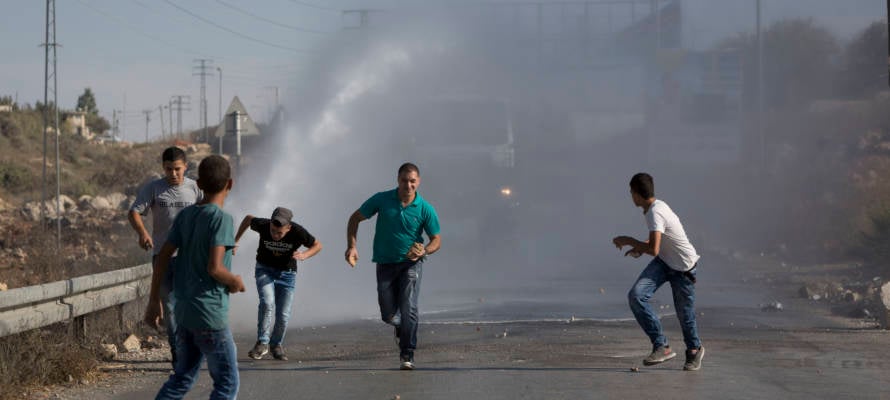
Palestinian youth and men throw stones and rocks at passing Israeli vehicles. (AP/Majdi Mohammed)

The Palestinian Education Ministry has granted any student who was arrested for throwing stones and/or Molotov cocktails at Israeli vehicles a passing grade.

Awarding passing grades to students who commit violent attacks against Israeli motorists is one of many methods of incitement to terror practiced by the Palestinian Authority (PA), the Jewish Press reported.

According to the news site, an Israeli security source told Channel 20:

“One time we stopped a terrorist who threw a Molotov cocktail and took him for interrogation, where we found out that he had decided to carry out the attack because that morning he had a matriculation exam, and it turns out that for them it is customary that someone who is arrested for carrying out an attack on the day of an exam to receive a passing grade automatically.”

“They are frightened of their fathers,” said another security source, “So if they know in advance that they are likely to fail the exam, they choose terrorism in order to get a passing grade.”

The more popular forms of PA incitement include, for example, cultural events glorifying terrorists; naming schools and city streets after terrorists; and TV shows for preschoolers, school-aged children and teens promoting anti-Semitism and lies about the “Zionist entity.”

Desperation to pass the school year is a less common reason for violence; nonetheless, several young terrorists admitted they carried out such attacks for that very reason, the Israeli security source said.

Stone-throwing has proven to be deadly in several cases. Adele Biton, for example, was critically wounded at the age of two in a 2013 rock-throwing terror attack. She spent almost two years in intensive care due to traumatic brain damage before succumbing to her wounds.

By: United with Israel Staff

Cadence Column: Asia, August 28, 2017

August 28, 2017

Cadence Column: Asia, August 28, 2017,   via China Daily Mail, August 28, 2017

China should be upset over North Korea for deeper reasons than on the surface. Trump’s “fire and fury” comment a few weeks ago was the clear explanation.

Donald Trump was not in favor of the W. Bush invasion of Iraq. Trump does not like large footprints of war. If this administration authorizes action in North Korea, it would not be anything like Iraq. It would be surgical and instant. There might not be time to react.

With the threat growing from China’s venture missions—flying its flag on man-made islands since it can’t find other ways to fly its flag on more soil—the Pentagon would be foolish not to seek an opportunity for a small demonstration. By not bringing North Korean threats to an absolute halt, China may be giving the US just that opportunity.

China and Russia neither want North Korea to be volatile nor shut down. Perhaps they don’t understand North Korea’s political DNA. It seems they all want to have their cake and eat it too and blame the world if they can’t, a mindset common in Communist regimes.

So, Communism itself is on trial, for its ability to deliver on its goals. But, so on trial also is Democracy’s ability to respond if Communism fails to deliver.