Archive for August 24, 2017

Mapping terrorist groups openly operating inside Pakistan

August 24, 2017

Mapping terrorist groups openly operating inside Pakistan, Long War Journal, August 23, 2017

Yesterday, Pakistan’s Ministry of Foreign Affairs took umbrage with President Trump’s speech where he called out Pakistan for harboring terrorist groups. The Ministry of Foreign Affairs claimed that “Pakistan does not allow a use of its territory against any country,” and denounced the so-called “false narrative of safe havens.”

Pakistan’s denial is laughable on its face. For decades, the country has permitted a number of jihadist groups to openly operate under its aegis. Many of these groups – such as Lashkar-e-Taiba, Harakat-ul-Muhahideen, Jaish-e-Mohammad, Hizbul Mujahideen, and Harakat ul-Jihad-i-Islami – were created with the support of Pakistan’s military and the Inter-Services Intelligence Directorate.

A map depicting the location some of these groups have known to operate from is embedded to illustrate the support Trump spoke about.

(The map is available at the link. — DM)

Pakistan helped create these groups with the idea that they would focus their activities against Indian forces in the state of Jammu and Kashmir to help bring down the country’s most critical enemy in India. Instead, these groups quickly became part of the South Asia jihadist network and allied themselves with the Taliban and al Qaeda. Lashkar-e-Taiba (LeT) was even formed at the behest of Osama bin Laden and Abdullah Azzam.

The Pakistani state has supported the Afghan Taliban since its founding. Without Pakistani support and safe haven, the Afghan Taliban would likely have a difficult time waging a successful insurgency in Afghanistan. The Afghan Taliban dinks and dunks across the border with ease, in and out of the tribal regions, where they plot, execute and then return to safety in Pakistan – where it also recruits, runs madrassas and training camps, and receives medical care for its wounded.

The Pakistani military and intelligence services support the Hafiz Gul Bahadar and the Mullah Nazir Groups, despite the fact that these two Taliban organizations wage jihad in Afghanistan and support al Qaeda and other terrorist movements.

While the Pakistan government has targeted and killed or captured key al Qaeda leaders inside Pakistan, the fact that Osama bin Laden was able to live in a large home just outside of Abbottabad, the nation’s West Point, and direct al Qaeda’s operations for years raises serious questions about what Pakistani military and intelligence leaders knew and if he received direct support.

Lashkar-e-Jhangvi began as an anti-Shia group and has joined the jihadist network. The Tehreek-e-Nafaz-e-Shariat-e-Mohammadi is a Taliban movement in northwestern Pakistan. Both have attacked the Pakistani state. Despite this, the Pakistani government has tolerated their existence.

This map does not include groups such as the Movement of the Taliban in Pakistan, the Islamic Movement of Uzbekistan, the Islamic Jihad Union, the Turkistan Islamic Party, and others as these terrorist outfits wage war against the Pakistani state, and the Pakistan military has actively targeted them.

Strides in the Struggle for an Independent Kurdistan

August 24, 2017

Strides in the Struggle for an Independent Kurdistan, Gatestone InstituteLawrence A. Franklin, August 24, 2017

The regional regime that is in the best position to threaten the drive for a free Kurdish state is that of Iran.

The country that has the most to lose in the event of an independent Kurdistan is Turkey, due to its huge population of ethnic Kurds, some of whom support the militant Kurdistan Workers Party (PKK), which has battled Turkey’s military for decades.

Ironically and thankfully, this combination of recently acquired combat experience on the part of the Kurds — plus widespread unrest in the region, still reeling from the “Arab Spring,” and the loss of Syrian and Iraqi sovereignty over swaths of their territories — improves the chance of a peaceful secession of Kurdistan from Iraq.

On September 25, 2017, the people of Iraqi Kurdistan will vote overwhelmingly in favor of establishing an independent nation-state. All ethnic groups, from Erbil to Zakho — and in other disputed areas claimed by the Kurdistan Regional Government (KRG), such as Kirkuk, Sinjar and Makmoor — are eligible to take part in the referendum.

Although the result of the plebiscite will not be binding, it is likely to enhance existing secessionist sentiment among the populace and increase pressure on KRG officials.

The Kurds’ dream of a separate state is more than a century old. Yet geography and the imperialist designs of outside forces have conspired to render that goal a nightmare. Predictably, the most vehement opposition to the establishment of an independent state for the Kurds comes from the major powers with large Kurdish minorities — including Iraq, Iran, Turkey and Syria. Apparently fearing that a Kurdish state would heighten irredentist sentiment among the Kurdish minorities within their territories to merge with a “Greater Kurdistan,” the governments of these countries view any form of Kurdish independence as a national-security threat. It is thus quite possible that one or more of the KRG’s neighbors will move militarily to prevent a Kurdish secession from Iraq.

The regional regime that is in the best position to threaten the drive for a Kurdish Free State is that of Iran. It already employs small pro-Iranian militias — the Kata’ib Sayyid al-Shuhada, Asa’ib Ahl al-Haq and the Badr Organization — on KRG territory, operating under the rubric of the Popular Mobilization Forces (PMF). Should Iran decide to take military action to prevent a Kurdish secession from Iraq, it will likely deploy the PMF to do so.

However, while the political and military asymmetry between Iraq’s Kurdish region and outside regional powers have seemed fixed, the historical inequality no longer exists. Currently, in fact, no state in the region easily could crush a determined effort by the Kurds to sever the artificial ties that have bound them, disadvantageously, to the Arab people of Mesopotamia.

This is chiefly due to the Peshmerga (“those who defy death”), Kurdish fighters who have become combat-hardened warriors; so much so that, with NATO air support in August 2014, they fought the Islamic State fighters to a standstill outside the gates of their regional capital, Erbil. In the event of a confrontation against the Peshmerga, even the pro-Iran PMF militias would pay a heavy price.

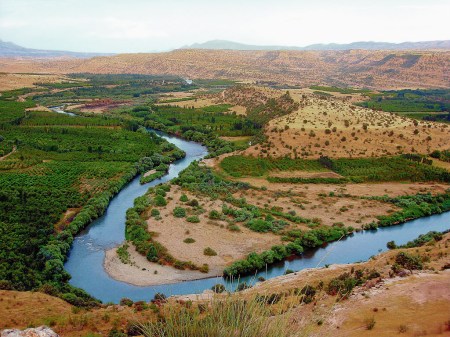
Greater Zab River near Erbil Iraqi Kurdistan. (Image source: jamesdale10/Wikimedia Commons)

Most of Iran’s Kurds live in the western part of the Islamic Republic, in Kordestan, West Azerbaijan and the Kermanshah provinces. Although regionally concentrated, they are not in a position to secede from Iran, due mainly to the efforts of Tehran’s intelligence services to suppress Kurdish irredentism by eviscerating rebel organizations. That could change, however, if Iraq’s Kurds are successful in seceding from the central government in Baghdad. For one thing, it might buoy Iran-based Kurdish groups — such as the Komela (Society of Revolutionary Toilers of Kordestan), the Kurd Democratic Party of Iran (KDPI) and the Free Life Party of Kordestan (PJAK) — and spur them to rise up against the regime in Tehran.

The country that has the most to lose in the event of an independent Kurdistan is Turkey, due to its huge population of ethnic Kurds, some of whom support the militant Kurdistan Workers Party (PKK), which has battled Turkey’s military for decades.

Although Turkey is also the greatest obstacle to Kurdish independence, Turkish troops have become entangled in the Syrian civil war. They have also not recuperated from the failed coup attempt against President Recep Tayyip Erdogan in the summer of 2016, an act that resulted, among other things, in a massive purge within the Turkish military.

To allay Istanbul’s apprehensions that an independent Kurdish state on its borders might energize Turkey’s Kurds to seek autonomy, KRG political leaders are likely to forswear any assistance to the PKK, at least publicly. Kurdish spokesmen will probably also point out that Turks could benefit from a stable Kurdistan’s pledge to keep the oil flowing to Turkey from Kurdish fields around Kirkuk.

Syria also has a Kurdish minority, making up about 10% of the general population, most of whom reside in the north and northeast — where they have established the Democratic Administration of Rojava. Due to the raging civil war, Damascus currently cannot spare the troops and resources it would take to suppress this Kurdish enclave. Nor does the Assad regime have the current capability to dismantle the Kurdish military opposition in Syria, particularly the effective Kurdish People’s Protection Units (YPG). In additions, tens of thousands of Syrian Kurds — along with Syria-based Turkmen, Arabs, Assyrians and Armenians – have banded together to form the Syrian Democratic Forces (SDF), which have been fighting ISIS, particularly in Raqaa.

Even if the Assad regime survives the bloody war, now in its sixth year, it will be too weak initially to suppress secession from its own Kurds.

Furthermore, the Syria that eventually emerges is likely to be a good deal smaller than its current size, which would force it to rely its Russian, Iranian and Hezbollah allies to conquer Rojava. Such a scenario would be thick with dangers, including a possible American military response.

Ironically and thankfully, this combination of recently-acquired combat experience on the part of the Kurds — plus widespread unrest in the region, still reeling from the “Arab Spring,” and the loss of Syrian and Iraqi sovereignty over swaths of their territories — improves the chance of a peaceful secession of Kurdistan from Iraq.

Dr. Lawrence A. Franklin was the Iran Desk Officer for Secretary of Defense Rumsfeld. He also served on active duty with the U.S. Army and as a Colonel in the Air Force Reserve, where he was a Military Attaché at the U.S. Embassy in Israel.

Charle Hebdo is back

August 24, 2017

(There has been little media coverage, most of it derogatory. — DM)

Source: MWC News.


The U.S. Constitution and civil war

August 24, 2017

The U.S. Constitution and civil war, Dan Miller’s Blog, August 24, 2017

(The views expressed in this article are mine and do not necessarily reflect those of Warsclerotic or its other editors. — DM)

I wrote and published this article on December 27, 2011. Providing historical perspectives on the constitutional ramifications of the war, it has had more than 46,000 views. Perhaps it may provide useful perspectives now, as we seem to be heading toward another potentially more deadly and divisive civil war.

Only we can prevent another civil war. Will we?

Formerly great universities, once bastions of constitutionally protected free speech, are now trying — often successfully — to kill it. Fake news abounds increasingly in our “mainstream” media, which neglect or minimize legitimate news. Our history, good and bad, are being relegated to the trash can.  Our history made America what she is and reflecting on it can help to make her even better.

************************************

Emasculating the Constitution is bad way to preserve the nation.

The first shots in the United States Civil War were fired by the South during an attack on Fort Sumter a century and a half ago on April 12, 1861, not long after President Lincoln’s election on November 6, 1860 and about five weeks after he assumed office on March 4, 1861.

As summarized by Wikipedia,

As Lincoln’s election became evident, secessionists made clear their intent to leave the Union before he took office the next March.[123] On December 20, 1860, South Carolina took the lead by adopting an ordinance of secession; by February 1, 1861, Florida, Mississippi, Alabama, Georgia, Louisiana, and Texas followed.[124][125] Six of these states then adopted a constitution and declared themselves to be a sovereign nation, the Confederate States of America.[124] The upper South and border states (Delaware, Maryland, Virginia, North Carolina, Tennessee, Kentucky, Missouri, and Arkansas) listened to, but initially rejected, the secessionist appeal.[126] President Buchanan and President-elect Lincoln refused to recognize the Confederacy, declaring secession illegal.[127] The Confederacy selected Jefferson Davis as their provisional President on February 9, 1861.[128]

The war still stirs “a trove of memories.”  Some are of glory, others of misery and despair. A few have suggested that we are now engaged in another “civil war” of sorts, although not an armed conflict. The prospect of armed conflict over various issues, including illegal immigration and infringements of the Constitutional right to bear arms, has been raised.  I occasionally come across comments at various blogs contending that the reelection of President Obama could precipitate another civil war; much the same as did President Lincoln’s election. It was noted here that thought has been given to a new civil war by some on the left.

[T]his afternoon, MSNBC’s Dylan Ratigan took to his show to yell fire in a crowded theater, asking viewers, “Are things in our country so bad that it might actually be time for a revolution? The answer is obviously ‘yes.’”

. . . .

Ratigan invites on cartoonist Ted Rall to talk about his new book The Anti-American Manifesto, and argue the case for violent overthrow of government. Quoting John Locke, Rall argues that “the people have an obligation to revolt,” and that “nothing will radicalize the American citizen more than being thrown out of their home by a bank.” Citing frustration with both parties, who he called “in bed with the duopoly,” Rall also noted that “the American left has been very peaceful since the early ’70s… and where has it gotten us?”

It seems to have been suggested here, in a piece written by Cokie Roberts in the contexts of Arizona’s then new immigration law and ObamaCare, that we need to ignore parts of the Constitution to save the rest.  According to this comment about her article,

Toward the end this statement is made: “It’s hard to imagine what would happen politically if the Supreme Court sided with some states against Congress. The already severely frayed fabric of government would certainly be further torn apart. It’s far better to leave the health care debate in the arena of electoral politics — and for the losers to accept defeat. That’s the essence of democracy.”

Again, the suggestion is made to just accept the federal government’s decree even if unconstitutional. The thing that struck me here though was the “essence of democracy” concept. That may be how a democracy works, but that’s not how a Constitutional Republic works.

It seems appropriate to look at the conditions that led to and resulted from Civil War (1861 – 1865) in the context of the U.S. Constitution.

The Civil War of 1861 – 1865

In this article, I examined some of the factors leading to the Civil war and questioned whether we might have another. I contended that it would be a very bad idea even though a Rasmussen poll released on August 7th had reported that

just 17% of Likely U.S. Voters think the federal government today has the consent of the governed. Sixty-nine percent (69%) believe the government does not have that consent. Fourteen percent (14%) are undecided.

Even though the rights of the states atrophied massively with our Civil War and have continued their decline ever since, to have another would brutalize if not destroy what’s left of the most important of the many documents that have made the United States exceptional among nations. As I wrote in my earlier Civil War piece,

The United States have the best constitution ever written; we need to protect and defend it as citizens bound, as well as protected, by it. Leaving the union is not the solution; we can be more effective from within than as outsiders and the Constitution deserves and needs all of the protection and defense we can provide.

As suggested below, failures to protect and defend the Constitution “as citizens bound, as well as protected, by it” propelled the Civil War and should not propel another.

The Civil War and States’ Rights

From a common Southern perspective, the Civil War was fought to preserve states’ rights. As noted in my earlier article,

Robert E. Lee and many others of the South held their principal allegiance to their states. However, they did not wish the Union to be divided by force.  According to Lee,

There is a terrible war coming, and these young men who have never seen war cannot wait for it to happen, but I tell you, I wish that I owned every slave in the South, for I would free them all to avoid this war.

Nor were they willing to have it restored by force over the objections of their states and were prepared to resist that force militarily. Shortly after Virginia had seceded on April 17, Colonel Lee — still an officer in the Army of the United States — wrote, “Virginia is my country, her I will obey, however lamentable the fate to which it may subject me.” After the war, in 1865, he declined an Englishman’s offer to escape the destruction of postwar Virginia: “I cannot desert my native state in the hour of her adversity. I must abide by her fortunes, and share her fate.” In a letter of April 20, 1861 to General Winfield Scott he asked that his resignation from the Army of the United States be accepted. The letter ended,

Save in defence of my native state, I never desire again to draw my sword. Be pleased to accept my most earnest wishes for the continuance of your happiness and prosperity, and believe me, most truly yours,

Virginia was the eighth of the eleven states to secede and was the state farthest north geographically. She became a principal battlefield during most of the Civil War.

The view that defense of states’ rights was the principal cause of the Southern Secession has been challenged, not well I think, for the reasons offered below, here and elsewhere.

Ending slavery as the reason for the Civil War

According to many, the Civil War was fought to end the scourge of slavery.  Not all in the North shared this view.  As noted in my earlier Civil War article, Lincoln had said on April 17, 1859,

I think Slavery is wrong, morally, and politically. I desire that it should be no further spread in these United States, and I should not object if it should gradually terminate in the whole Union.

I say that we must not interfere with the institution of slavery in the states where it exists, because the constitution forbids it, and the general welfare does not require us to do so. (emphasis added)

According to the National Endowment for the Humanities,

While the Civil War began as a war to restore the Union, not to end slavery, by 1862 President Abraham Lincoln came to believe that he could save the Union only by broadening the goals of the war. The Emancipation Proclamation [of 1863] is generally regarded as marking this sharp change in the goals of Lincoln’s war policy. (Insert added)

The United States Constitution

The U.S. Constitution should be considered as it dealt with the institution of slavery at the beginning of the Civil War in 1861 and until after the war ended with a Union victory in 1865. As soon-to-be-President Lincoln noted in 1859, the Constitution forbade interference “with the institution of slavery in the states where it exists.” Only after the Civil War was the Constitution amended, in 1865, 1868 and 1870, to eliminate slavery and its horrific consequences.

Slavery was contemplated and protected under the Constitution as ratified in 1788 and as it remained in force in 1865. Here are the pertinent articles; only one pertinent amendment, the Tenth, was in force as of the beginnings of the Civil War and, indeed, until the South was conquered.

Article I

Section 2. Representatives and direct Taxes shall be apportioned among the several States which may be included within this Union, according to their respective Numbers, which shall be determined by adding to the whole Number of free Persons, including those bound to Service for a Term of Years, and excluding Indians not taxed, three fifths of all other Persons.

Section 9: The Migration or Importation of such Persons as any of the States now existing shall think proper to admit, shall not be prohibited by the Congress prior to the Year one thousand eight hundred and eight, but a Tax or duty may be imposed on such Importation, not exceeding ten dollars for each Person. (Emphasis added)

Consistently with Section 9, the importation of slaves into the United States was prohibited by Federal law enacted in 1807 and effective as of January 1, 1808.

Article IV required the return of fugitive slaves who escaped to “free” states.

Section 2: No Person held to Service or Labour in one State, under the Laws thereof, escaping into another, shall, in Consequence of any Law or Regulation therein, be discharged from such Service or Labour, but shall be delivered up on Claim of the Party to whom such Service or Labour may be due.

In 1850, the Federal Fugitive Slave Act was enacted to ensure implementation of Article IV, Section 2. It was bitterly opposed in the North and was essentially nullified when the Civil War began.

Article V, by 1861 remained a part of the Constitution but was no longer effective due to its expiration date. It provided

[N]o Amendment which may be made prior to the Year One thousand eight hundred and eight shall in any Manner affect the first and fourth Clauses in the Ninth Section of the first Article;

Hence, when the Civil War began and until after it ended, Federal efforts to eliminate the institution of slavery by force of arms against the states where slavery was lawful contravened the protections to which the institution was there entitled under the Constitution. It could be argued that it also contravened the Tenth Amendment, quoted below.

By 1861, the Constitution had been ratified by thirty-four states, including those, and the citizens of which, engaged on both sides in the Civil War. Aside from the quoted portion of Article V which was already obsolete due to the passage of time, the protections afforded the institution of slavery were countermanded by the Thirteenth,  Fourteenth and Fifteenth Amendments only after the end of the Civil War. The process of Southern reconstruction impelled their ratification.

The Tenth Amendment, ratified in 1791 along with the rest of the Bill of Rights, remains in effect. It provides,

The powers not delegated to the United States by the Constitution, nor prohibited by it to the States, are reserved to the States respectively, or to the people.

The Thirteenth Amendment provides,

Section 1. Neither slavery nor involuntary servitude, except as a punishment for crime whereof the party shall have been duly convicted, shall exist within the United States, or any place subject to their jurisdiction.

Section 2. Congress shall have power to enforce this article by appropriate legislation.

Proposed on January 31, 1865, thirty states had ratified it by 1865. It “was specifically rejected by Delaware on Feb 8, 1865; by Kentucky on Feb 24, 1865; by New Jersey on Mar 16, 1865; and by Mississippi on Dec 4, 1865.” They later ratified it.  Although approved by Louisiana, Tennessee, Arkansas and Virginia,

The governments of Louisiana, Tennessee, and Arkansas were those established under President Lincoln’s Reconstruction policy.  In Virginia, the Thirteenth Amendment was ratified by a “rump” legislature, which had begun meeting in Alexandria shortly after the Civil War began, claiming to be the legitimate and loyal representative of the state in the Union.  It had earlier approved the creation of the state’s western counties into the new state of West Virginia.  The U.S. State Department accepted the ratification from those four and, later, other Southern states.

The Fourteenth Amendment provides in relevant part,

Section 1. All persons born or naturalized in the United States and subject to the jurisdiction thereof, are citizens of the United States and of the State wherein they reside. No State shall make or enforce any law which shall abridge the privileges or immunities of citizens of the United States; nor shall any State deprive any person of life, liberty, or property, without due process of law; nor deny to any person within its jurisdiction the equal protection of the laws.

Section 2. Representatives shall be apportioned among the several States according to their respective numbers, counting the whole number of persons in each State, excluding Indians not taxed. But when the right to vote at any election for the choice of electors for President and Vice President of the United States, Representatives in Congress, the Executive and Judicial officers of a State, or the members of the Legislature thereof, is denied to any of the male inhabitants of such State, being twenty-one years of age, and citizens of the United States, or in any way abridged, except for participation in rebellion, or other crime, the basis of representation therein shall be reduced in the proportion which the number of such male citizens shall bear to the whole number of male citizens twenty-one years of age in such State.

Proposed on June 13, 1866, the Fourteenth or “Reconstruction Amendment” had been ratified, also by thirty states, by 1868. It

was specifically rejected by Texas on Oct 27, 1866; by Georgia on Nov 6, 1866; by North Carolina on Dec 14, 1866; by South Carolina on Dec 20, 1866; by Kentucky on Jan 8, 1867; by Virginia on Jan 9, 1867; by Louisiana on Feb 6, 1867; by Delaware on Feb 8, 1867; and by Maryland on Mar 23, 1867. New Jersey’s ratification was rescinded on Mar 24, 1868; Ohio rescinded its ratification on Jan 15, 1868

Virginia (in 1869), Mississippi and Texas (in 1870), Delaware (in 1901), Maryland and California (in 1959) and Kentucky (in 1976) later ratified it. However, it is noted here that

When a fair vote was taken on it in 1865 . . . it was rejected by the Southern states and all the border states. Failing to secure the necessary three-fourths of the states, the Republican party, which controlled Congress, passed the Reconstruction Act of 1867 which placed the entire South under military rule.

The purpose of this, according to one Republican congressman, was to coerce Southern legislators to vote for the amendment “at the point of a bayonet.” President Andrew Johnson called this tactic “absolute despotism,” the likes of which had not been exercised by any British monarch “for more than 500 years.” For his outspokenness Johnson was impeached by the Republican Congress.

Although impeached (the articles of impeachment are at the link) by a vote of one hundred and twenty-six to forty-seven by the House, conviction by the Senate failed by one vote (thirty-five to nineteen). In 1875, Johnson became the first former President to serve in the Senate.  In 1862, President Lincoln had

appointed him military governor of Tennessee. In an effort to win votes from Democrats, Lincoln (a Republican) chose Johnson (a War Democrat) as his running mate in 1864 and they swept to victory in the presidential election.

The Fifteenth Amendment provides,

Section 1. The right of citizens of the United States to vote shall not be denied or abridged by the United States or by any State on account of race, color, or previous condition of servitude.

Section 2. The Congress shall have power to enforce this article by appropriate legislation.

Proposed on February 26, 1869, it was ratified by 1870, also by thirty states.  It was

specifically rejected by Kentucky on Mar 12, 1869; by Delaware on Mar 18, 1869; by Ohio on Apr 30, 1869; by Tennessee on Nov 16, 1869; by California on Jan 28, 1870; by New Jersey on Feb 7, 1870; and by Maryland on Feb 26, 1870. New York rescinded its ratification on Jan 5, 1870, and rescinded the rescission on Mar 30, 1970.

California later ratified it in 1962, Maryland in 1973, Kentucky in 1976 and Tennessee in 1997.

The Thirteenth, Fourteenth and Fifteenth Amendments permitted substantial growth in racial equality in later years.  Although ultimately beneficial, that does not diminish the heavy handed way in which they were proposed and ratified. Nor does it diminish the problem that in seeking to end slavery by force of arms against the Southern States, the Federal Government attempted to right wrongs by emasculating the Constitution.  History offers substantial support for the Southern view that it fought the Civil War to prevent efforts by the Federal Government to exceed its powers under the Constitution and thereby to nullify rights it guaranteed to the states. The Constitutional rights of the citizens of the Southern States which permitted slavery were among those the Federal government sought to nullify by the Civil War and later, having won, to defeat through Constitutional amendments during “Reconstruction.”

That is not intended to suggest that those who felt morally compelled to oppose slavery were in the wrong, only that the ends adopted lost more than a little of their luster by virtue of the means used. For the Federal Government to oppose slavery by force of arms was inconsistent with the Constitution from which all Federal powers derived and still derives legitimacy and under which the entire nation was and is still to be governed.

Conclusions

The U.S. Constitution is well worth saving, but not by violating, ignoring or otherwise diminishing it. We can properly amend it, a difficult process when the states are free to ratify or reject amendments.  However, it is the only viable way unlikely to lead to long lasting scars or conceivably to another Civil War. The rights of the States are the keystone of the Federal system upon which the country was founded and prospered; chipping away at them even piece by piece, a few at a time, is perverse.

To have another civil war to preserve the federal union by disregarding the Constitution would be no less destructive and no less perverse than was the former. The Constitution provides sufficient political and legislative processes, if wisely used, to implement necessary changes and enough judicial safeguards to prevent Federal overreach in doing so. The Executive is required to follow the Constitution and to usurp neither the Congressional nor the Judicial prerogatives it embodies. The individual rights it guarantees are no less crucial.  To avoid civil unrest and perhaps civil war, we should give far more thought than at present to returning to these and other basics of our form of government. Governments rot when their citizens let them and can recover only when their citizens demand it.
Why Does Anyone Listen to James Clapper Anymore?

August 24, 2017

Why Does Anyone Listen to James Clapper Anymore? PJ MediaRoger L Simon, August 23, 2017

James Clapper is evidently concerned Donald Trump is dangerous.  The former director of national intelligence questions the president’s “fitness for office” and believes he behaves in such an erratic manner that he might bomb North Korea and bring on Armageddon. Further, via Bridget Johnson:

Clapper slammed “this behavior and this divisiveness and the complete intellectual, moral and ethical void that the president of the United States exhibits,” and wondered “how much longer does the country have to, to borrow a phrase, endure this nightmare.”

Wow!… Well, Clapper should know something about “ethical voids.”  He also should have a good idea how long we will “endure” anything, nightmare or otherwise, because he knew what nearly every one of us said on the phone or wrote in our emails and texts at any time — or could have found out, if he had wanted to, almost instantly.

This is clear although Clapper tried to hide the truth by telling one of the most egregious lies I have ever heard from the lips of an American official, a lie meant to cover up an action by our government so evil it makes the lies of  Obama, Hillary, or Trump almost inconsequential. Virtually every U.S. citizen is now under some level of surveillance by our intelligence agencies — our privacy is dead — but James Clapper tried to deceive us all about it and make us think it isn’t so.

But don’t believe me.  Believe Wikipedia, which seems to have it right in this instance:

On March 12, 2013, during a United States Senate Select Committee on Intelligence hearing, Senator Ron Wyden quoted NSA director Keith B. Alexander’s keynote speech at the 2012 DEF CON. Alexander had stated that “Our job is foreign intelligence” and that “those who would want to weave the story that we have millions or hundreds of millions of dossiers on people, is absolutely false…. From my perspective, this is absolute nonsense.” Wyden then asked Clapper, “Does the NSA collect any type of data at all on millions or hundreds of millions of Americans?” He responded, “No, sir.” Wyden asked “It does not?” and Clapper said, “Not wittingly. There are cases where they could inadvertently, perhaps, collect, but not wittingly.” [31]

When Edward Snowden was asked during his January 26, 2014, TV interview in Moscow what the decisive moment was or why he blew the whistle, he replied: “Sort of the breaking point was seeing the director of national intelligence, James Clapper, directly lie under oath to Congress. … Seeing that really meant for me there was no going back.”[32]

Pretty stunning in the era of “unmaskings,” no?  How do you spell “creeping totalitarianism”?  I’m no fan of Edward Snowden, but it’s easy to see how a young man with his knowledge would react the way he did to the egregious prevarication by the director of national intelligence.

Reading the entire Wikipedia entry is instructional.  It’s almost a Comedy of Lies on Clapper’s part.  But here’s just a sampling:

On July 1, 2013, Clapper apologized, saying that “my response was clearly erroneous—for which I apologize.” [43] On July 2, Clapper said that he had forgotten about the Patriot Act and therefore had given an “erroneous” answer. [44]  

Clapper and NSA director Keith B. Alexander (left) were both accused of lying under oath to Congress[45] [46]

On December 19, 2013, seven GOP members of the United States Senate’s House Judiciary Committee called on Attorney General Eric Holder to investigate Clapper, stating “witnesses cannot be allowed to lie to Congress.”[47]

In January 2014, Robert S. Litt, general counsel to the Office of the DNI, stated that Clapper did not lie to Congress,[48] and in May 2015 clarified that Clapper “had absolutely forgotten the existence of” section 215 of the Patriot Act.[49]

In January 2014 six members of the House of Representatives wrote[50]to President Obama urging him to dismiss Clapper for lying to Congress,[51][52] but were rebuffed by the White House.[53]

Caitlin Hayden, a White House spokesman, said in an e-mailed statement that Obama has “full faith in Director Clapper’s leadership of the intelligence community. The Director has provided an explanation for his answers to Senator Wyden and made clear that he did not intend to mislead the Congress.”[53]

So clearly, Clapper — the DNI who “forgot” the Patriot Act — got away with lying to Congress, gracias à Obama.  And now we are supposed to believe Clapper’s alarmist characterization of Trump.

To many of us, the former DNI represents everything wrong with our government.  He is The Swamp squared — or perhaps cubed.  Although no doubt he believes at least some of his calumnies and exaggerations, I have a theory about why he’s making them and it’s simple.  Clapper wants do everything possible to deflect attention from his own dishonesty onto whomever (Trump, in this instance) in order to resurrect his own reputation.

The bigger question is why anyone is listening to him.  Perhaps they’re so accustomed to lies at this point, they’re disinterested in the truth. Or even prefer them.

Fascist fever: Nazi Trump magazine cover raises speculation about German media

August 24, 2017

Reports German media co-opted to play docile conduit for government disinformation raises questions as to true origin of magazine’s attack.

Mordechai Sones, 24/08/17 13:11

Source: Fascist fever: Nazi Trump magazine cover raises speculation about German media – Israel National News

Trump displaying Nazi proclivities at Western Wall, Jerusalem

Reuters

Amid reports by German journalists stating that their nation’s media has become a “government outlet which suppresses critical views”, German media’s open dislike for US President Donald Trump has reached a new level of invective, with the Stern weekly explicitly comparing the US President to Adolf Hitler in a photo-montage published on yesterday’s cover portraying Trump enwrapped in a US flag while brandishing a Nazi salute. The headline is a play on words turning Hitler’s autobiography Mein Kampf (My Struggle) to “Sein Kampf” – His Struggle.

https://twitter.com/ThatMediaMashup/status/900561249716416512?ref_src=twsrc%5Etfw&ref_url=http%3A%2F%2Fwww.israelnationalnews.com%2FNews%2FNews.aspx%2F234461

The lead article refers to President Trump’s alleged ties with the neo-Nazi right in the United States following the events in Charlottesville. The subtitle reads, “Neo-Nazis, Ku Klux Klan, Racism – How Trump spreads hatred in the United States.”

The German weekly’s cover has already aroused strong criticism, especially among American conservatives. In social networks, too, criticism of the “pointlessness” of the title page and the trivialization of Hitler’s crimes is excoriated: “Can you not criticize Trump without comparing him to Hitler?” And “Who is spreading hatred here?” are representative of responses by German journalists and various other organizations.

Disturbing as one magazine’s invective may be, reports that German media as a whole has been co-opted to serve as a docile conduit for government disinformation raises questions as to the true origin of Stern‘s attack on the President.

Protester holds golf ball with swastika at Trump press conference, Turnberry, Scotland

צילום: Reuters

Dutch media-website TPO Online published an interview with Dutch-German reporter Claudia Zimmermann, reported The Old Continent. As a reporter who had worked for the German Public Broadcaster WDR for 24 years, she was asked about the manner in which the refugee crisis and New Year’s Eve in Cologne were reported. In the broadcast, she was asked whether she was expected to report on migrants and refugees in a certain way.

Zimmermann answered, “Yes, we are of course, we are a public broadcaster, which means that we try, in every case, try to be positive in approaching the topic. In the beginning when Merkel’s Welcome culture was, very, well, good, then our stories were of course very positive, while at present it’s tilted a bit, so now there are more and more critical voices, also from the Public Broadcasters and of course from politics … We are a Public Broadcasting company, which means there are multiple commissions, that regulate what our program looks like. And we are more or less appointed to do so in a more or less pro-government way.”

The Old Continent reports that WDR responded by denying the Zimmermann’s ‘allegations’ against them, and allegedly forced her to sign an apology that reads: “I have talked nonsense on this program. Under pressure from the fact that the talk-show was live on air, I have sold a bunch of rubbish. This is very painful for me. Because never in my time as a freelance journalist have I been asked to report tendentiously or write towards a specific outcome.“

Zimmermann now reportedly claims that she never made these allegations and was forced to sign the apology, after which she has received almost no new work. She says that the entire structure of the German Public Broadcasting companies is geared towards censoring undesirable news.

For example, after Zimmermann witnessed girls being harassed in the streets, and learned that this was a daily occurrence, she “pitched it as a theme for WDR, but my colleagues said: ’we won’t do it, because that helps Pegida.’ That was a WDR editor. And there were similar situations. At the watercooler, where colleagues talked to each other they said ‘my God, is all that happening?’, but it was never reported on.”

Zimmermann is also quoted by Old Continent as explicitly referring to German media Trump coverage policy: “When I meet a former colleague in the street they tell me ‘I thought it’s very good that you said what you did, but I am really not allowed to talk to you.’ … Editors go to seminars in close-knit groups, only certain reporters are sent to Cologne, working closely together with a chief editorial staff. That’s why there are so few critical articles. … Comment and opinions are taken for news.

“I can see that with Trump. Even if you’re not a Trump fan, a journalist is meant to report on the news, as neutrally as possible, and the population makes its own picture. And the AfD is hushed up. It is just a machine to make opinions.“

US State Department Refuses to Endorse Two-State Solution

August 24, 2017

US State Department Refuses to Endorse Two-State Solution, The Jewish Press, August 24, 2017

(Please see also, Report: Palestinians to Give US Ultimatum on Peace Process:

Abbas is demanding that Trump publicly declare that the US regards the two-state solution as the only solution and that he insist Israel “stop creating facts on the ground” through construction in Jerusalem, Judea and Samaria.

— DM)

US State Department Spokesman Heather Nauert

In what can only be described as a complete about face, State Department Spokeswoman Heather Nauert would not make any statements endorsing or committing to the two-state solution for the Arab conflict with Israel.

Nauert said, “The President has made it clear that that is one of his top national security issues – one of his top priorities, I should say more correctly. We want to work toward a peace that both sides can agree to and that both sides find sustainable. Okay? We believe that both parties should be able to find a workable solution that works for both of them.”

This is particularly interesting in light of the recent statements by the Palestinian Authority ahead of the US delegation’s visit to the region, demanding the US clarify and confirm its endorsement of the two-state solution.

It very clear the Palestinian Authority received their clarification, just not the one they wanted to hear.

Nauert slaughtered another sacred cow when she pointed out the abject failure of the two-state solution to bring peace,

“It’s been many, many decades, as you well know, that the parties have not been able to come to any kind of good agreement and sustainable solution to this. So we leave it up to them to be able to work that through.”

Back in February, during PM Netanyahu’s meeting to the White House, President Trump said, “I’m looking at two-state and one-state, and I like the one that both parties like.”

It seems the President’s message trickled down to State.

The discussion on Israel begins at 14:24 in the video.

(The video is at the link. — DM)

The Transcript:

MS NAUERT: Okay, can we – let’s move on. Said, you want to talk about Israel? Okay.

QUESTION: Yes, absolutely. I want to talk about the delegation’s visit. On the eve of the visit, Palestinian Authority President Mahmoud Abbas said that he still does not understand what is the U.S. strategy regarding this effort that is ongoing. I mean, why are you so loath to say – to commit yourself – to recommit yourself to the two-state solution?

MS NAUERT: Look, we’ve talked about this since the first —

QUESTION: Right.

MS NAUERT: — day I got up here, and that is the importance of Middle East peace for this administration.

QUESTION: Right, but —

MS NAUERT: The President has made it clear that that is one of his top national security issues – one of his top priorities, I should say more correctly. We want to work toward a peace that both sides can agree to and that both sides find sustainable. Okay? We believe that both parties should be able to find a workable solution that works for both of them.

QUESTION: Right.

MS NAUERT: We are not going to state what the outcome has to be. It has to be workable to both sides. And I think, really, that’s the best view as to not really bias one side over the other, to make sure that they can work through it. It’s been many, many decades, as you well know, that the parties have not been able to come to any kind of good agreement and sustainable solution to this. So we leave it up to them to be able to work that through.

QUESTION: So are we departing from the long-held position that the outcome – the best possible outcome that everybody agrees upon is the two-state solution, a Palestinian state that lives side by side with Israel?

MS NAUERT: Look, our policy on this hasn’t changed.

QUESTION: Okay.

MS NAUERT: Okay? You can ask me the same question every time we sit down here together, but the policy hasn’t changed. (Laughter.)

Israel’s red lines in Syria long crossed by Iran

August 24, 2017

Israel’s red lines in Syria long crossed by Iran, DEBKAfile, August 23, 2017

Prime Minister Binyamin Netanyahu set out for President Vladimir Putin Israel’s red lines against Iran establishing a permanent, expanded military presence in Syria. This theme dominated their three-hour conversation in Sochi on Wednesday, Aug. 23. Netanyahu stiffened his warning with a veiled threat that should Iran or Hizballah cross those lines, there would be a regional war.

It was the first time that the prime minister had publicly threatened to go to war against Iran and Hizballah. After talking to Putin, he said to reporters that what is new today is Iran’s attempt to “Lebanonize Syria.” in the same way as it seized control of Lebanon through its surrogate, Hizballah. “We are looking at Tehran’s future takeover of Syria through its Shiite militias.

If that happens, “we will not remain passive,” he said – nor if Syria becomes a link in Iran’s overland corridor via Iraq and Syria to Lebanon. And we certainly can’t accept Iranians and Hizballah close to the Golan.

“We told President Putin plainly that we won’t put up with Iran using Syria as a military base for attacking Israel.

Putin, in the part of the meeting to which reporters had access, did not address Netanyahu’s remarks about Iran’s role in Syria, nor his warning of unilateral military action. The Russian president just repeated the standard Moscow line that foreign forces would not stay in Syria at the end of the war, but offered no timetable or guarantees.

The Russian leader would clearly prefer not to see an Israel war against Iran and Hizballah breaking out in Syria, DEBKAfile’s sources say, especially since Russian special forces, naval and air force contingents are deployed there – albeit not in large numbers.

At the same time, he may well find Netanyahu’s strong words useful for boosting Russia’s clout in Syria. If Tehran believes an Israeli war against its forces and Hizballah is potential, it will be in Iran’s interest to strengthen its military ties with Russia so as to gain its military and political backing.

For Putin, this would be a welcome change from the atmosphere of acrimony prevailing for some weeks between Iranian and Russian officers in Syria. Russian colonels have been posted at the most sensitive sectors in Syria, such as Aleppo, Hama, Homs and eastern Damascus. They are taking over both the military and civilian administration there and, in effect, shouldering the Iranian officers aside.

In Iraq, the Iranians seized control of the country from within, by setting up armed militias and getting them integrated in the national army, as Trojan horses. Tehran knows how to manage this ruse on the quiet, without drawing unwanted attention from the powers on the spot.

In Syria, the problem facing Israel is quite different. If Netanyahu shared sensitive intelligence with Putin that he had not known before, he can’t help noticing that Israel’s red lines for Iran’s expansion were crossed months ago, some of them with Russian assistance.

Four instances stand out:

1. Iran and Hizballah have already set up a chain of military bases in Syria – notably in the Qalamoun Mountains on the Syrian-Lebanese border, from which missiles can be launched against Israel.

2. Iran has already won its coveted land bridge through Iraq to Syria. Bashar Assad’s army has taken over whole sections of the Syrian-Iraqi border, and opened the door for pro-Iranian Shiite militias, Hizballah and Iraqi Shiite groups to move into strategic positions on both sides of the border.

3.  Netanyahu warned of the danger of planting an extremist Shiite entity in the heart of the Sunni Muslim region. But this is already underway. On orders from Moscow, the Syrian army’s 5th Corps is in the process of absorbing the pro-Iranian Shiite militias which fought for Assad.

The prime minister did not inform Putin of any timetable for Israeli action. But the Russian leader will take it for granted that the Israeli army will not move into Syria without a nod from the Trump administration in Washington.

For now, Putin and Trump are synchronizing their operations in Syria with better results than Netanyahu’s understanding with the US administration.