Archive for August 21, 2017

In Egypt, Clashes Between The Institution Of The Presidency And The Institution Of Al-Azhar

August 21, 2017

In Egypt, Clashes Between The Institution Of The Presidency And The Institution Of Al-Azhar, MEMRI, August 21, 2017

Introduction

Egypt’s Al-Azhar University, the most important institute of learning in the Sunni Muslim world, and its head, Sheikh Ahmad Al-Tayeb, are currently facing a political and media attack led by the institute of the Egyptian presidency, headed by President ‘Abd Al-Fatah Al-Sisi. This is the latest episode in the past two years of ongoing tension between the two institutions, over Al-Azhar’s apparent refusal to comply with the president’s dictates in matters of religion.

One aspect of the attack on Al-Azhar is President Al-Sisi’s direct criticism of Al-Azhar Sheikh Al-Tayeb; another is criticism of Al-Azhar in the government press; and yet another is parliamentary moves led by Al-Sisi’s associates aimed at limiting the authorities of the Al-Azhar sheikh. There have also been calls for Sheikh Al-Tayeb himself to step down.

The main criticism against Al-Azhar is that the institution has failed to join the ideological war on terrorism that is led by President Al-Sisi. Critics say that Al-Azhar is not complying with Al-Sisi’s major goal, announced in 2014 and frequently reiterated by him, to promote a renewal of the religious discourse in Egypt, and also point out that it is refusing to level the accusation  of heresy against the Islamic State (ISIS), which has claimed responsibility for several terror attacks in the country.[1] It is also being said that Al-Azhar’s curricula encourage young people to turn to terrorism. In addition, there is criticism of Al-Azhar’s refusal to change how divorces are handled, as Al-Sisi has also demanded.

Al-Azhar representatives, headed by Sheikh Al-Tayeb, have rejected these criticisms, calling them deliberate lies that damage Islam. To show that it is indeed fulfilling its role and that it is a moderate Islamic institution, Al-Azhar has in recent months held international conventions on the subject of fighting extremism, as well as meetings with young people, and has waged anti-extremism and anti-terrorism campaigns.[2]

It should be noted that despite the harsh criticism of Al-Azhar, and of Sheikh Al-Tayeb, it still has the public’s sympathy, and significant support from many members of parliament.

This report will focus on the tension between the Egyptian presidency and Al-Azhar, as reflected in statements by the leaders of both institutions, in parliamentary activity against it,  and in articles in the Egyptian press.

Al-Azhar Institute (image: balkans.aljazeera.ne)

Tension Between President Al-Sisi And Al-Azhar Sheikh Al-Tayeb

As stated, in recent months it has become evident that there is considerable tension between President Al-Sisi and Al-Azhar Sheikh Ahmad Al-Tayeb, as reflected in the president’s criticism of the sheikh both in public and in closed meetings. Currently, the main criticism against Al-Azhar is that it is not making sufficient efforts to advance the renewal of religious discourse in Egypt, as Al-Sisi has demanded. 

President Al-Sisi Repeatedly Reprimands Al-Azhar Sheikh – And Reportedly Threatens To Replace Him There have been several Egyptian newspaper reports concerning President’s Al-Sisi’s displeasure with Al-Azhar’s lack of action on this issue; he has made this clear in individual meetings with Sheikh Al-Tayeb and at public events.

At January 1, 2015 festivities marking the birthday of the Prophet Muhammad at the Egyptian Ministry of Endowments, Al-Sisi said to Sheikh Al-Tayeb: “The preachers are responsible to Allah for the renewal of the religious discourse and for improving the image of Islam. [On Judgment Day,] I will argue against you before Allah [if you do not do this].”[3]

Following a November 30, 2016 meeting between the two, the independent Egyptian daily Al-Misriyyoun reported on their chilly relationship and noted that the president was furious at Al-Azhar’s failure to vehemently attack political Islam organizations, specifically ISIS and the Muslim Brotherhood (MB) and for its continuing aggressive anti-Shi’ite position.[4]

There are, however, only a few such reports; for the most part, Al-Sisi is careful to express respect for Al-Azhar while at the same time clarifying his position vis-à-vis how it functions. Thus, he told the editors of government newspapers in a May 2017 interview: “Our general line is to protect the institutions of the Egyptian state, to urge them to fulfill their roles, and to develop them in a way that will suit the challenges and dangers that we face. Al-Azhar has a monumental status both inside and outside Egypt, and that is why we insist that it fulfill its role, because both the region and the world need it to do so.”[5]

At a June 21, 2017 event marking Laylat Al-Qadr, the night when, according to Muslim tradition, the Quran was first revealed to Muhammad, Al-Sisi praised Al-Azhar as a source of pride and for the position it has held for over a millennium. He went on to reiterate the need for a renewal of the religious discourse, calling it “a matter of life and death for the people and the ummah.”[6]

On July 26, 2017, four months after the April 8, 2017 Palm Sunday attacks on Mar Girgis church in Tanta and St. Marks Cathedral in Alexandria, Al-Sisi confirmed his decision to establish a Supreme Council for the Fight Against Extremism and Terrorism,” to be headed by him, and whose members would include the parliamentary speaker, the prime minister, the Al-Azhar sheikh, the Coptic Patriarch, various government ministers, the head of Egypt’s general intelligence service, the head of the Administrative Supervisory Authority, and public figures such as former Egyptian mufti Ali Goma’a.[7]However, even though the Al-Azhar sheikh is on the council, Egyptian media members who are close to the regime interpreted the establishment of the council as a blow to Al-Azhar’s authority; some even called it proof of Al-Azhar’s “demise.” The establishment of this council, they said, meant that the institution of the presidency had decided that it itself would act on the matter of renewing the religious discourse, instead of waiting for the Ministry of Endowments or for Al-Azhar to do so.[8]

Another serious dispute between Al-Sisi and Sheikh Al-Tayeb erupted over the issue of talaq ­– that is, a Muslim husband’s power to divorce his wife on the spot by merely telling her three times “I divorce you.” Al-Sisi again reprimanded Al-Tayeb in public. During a January 24, 2017 speech marking Police Day, he addressed him directly, saying: “You’ve tired me out, my friend.”[9] Al-Sisi went on to call for an end to this divorce practice, which is common in Egypt, and for divorce to be documented legally in order to reduce the rate of talaq divorces in the country.[10] In response, MP ‘Amr Hamroush hastened to prepare a bill regulating divorce.[11]

This demand by President Al-Sisi, which also garnered support from the Egyptian media, was perceived by the Al-Azhar institute as an affront to Islam, an attempt to secularize Egypt, and an attempt to circumvent the authority of the institute. In an announcement, Al-Azhar’s Council of Senior Scholars clarified that “by virtue of Al-Azhar’s religious responsibility and its status in the Egyptian ummah, as determined by the constitution of Egypt,” it had in recent months convened todiscuss current social issues, among them the issue of divorce in a religious context, and that it had decided that talaq is permitted. In this way, the council made it clear that Al-Azhar does indeed have decision-making authority in matters of Islamic law.[12]

Al-Azhar cleric Dr. Yahya Ismail said: “The war against Islam and its rulings is an old war. There is an ongoing, focused campaign to secularize Egypt…” He added: “This is a conspiracy against Islam and its guidelines… The rulings and conditions regarding divorce are known… The game of [legally] documenting divorce is an old one, and it is Christian clerics who were behind it [and who] tried to persuade some of [Egypt’s] presidents in this matter…” Al-Azhar lecturer Ahmed Karima also criticized Al-Sisi’s demand, saying: “Who will successfully eradicate this [talaq]? Only Allah or His Messenger… “[13]

Following the media uproar over the divorce issue, there was an attempt to calm the waters by both sides, and to show that things had returned to normal. On February 26, 2017, Al-Sisi stressed, in a meeting with Sheikh Al-Tayeb, that Al-Azhar is like a lighthouse for moderate Islamic ideology.[14] Al-Tayeb advisor Muhammad ‘Abd Al-Salam also denied that there was any disagreement between the two institutions of Al-Azhar and the presidency.[15]

Measures Against Al-Azhar: A Bill To Limit Al-Azhar Sheikh’s Authority And Establishment Of A Committee To Examine Al-Azhar Curricula

One manifestation of the anger at Al-Azhar was recent parliamentary measures against it and its sheikh aimed at limiting his authority and independence. Recently, MP Muhammad Abu Hamed, known to support Al-Sisi, proposed a change to the 1961 Al-Azhar Law regulating the authority of both the institute and its head. This bill was supported by parliamentary speaker Ali ‘Abd Al-A’al, who argued that the bill did not harm Al-Azhar.[16]

The main points of the amendment bill proposed by Abu Hamed make it clear that it is aimed at limiting the Al-Azhar sheikh’s authority and at increasing governmental control of the institute itself. For example, Section 2 of Abu Hamad’s bill states that the Al-Azhar sheikh is the Grand Imam of all Muslim clerics and that he represents the institute, but also states that his term is six years and that he can be reelected only once. The 1961 law did not mention the length of the sheikh’s term. Also according to the bill, the candidates for the position of sheikh are to be selected not just by Al-Azhar’s Council of Senior Scholars, as has been the case to date, but jointly by the council and Al-Azhar’s Academy of Islamic Research. Further, according to Section 5 of the  bill, if two-thirds of the members of Al-Azhar’s Council of Senior Scholars feel that the sheikh is not fulfilling his role appropriately, he is to be sent before an investigative committee comprising seven of this council’s leading members. This committee has the power to warn him, reprimand him, or “revoke his authority.” The original 1961 law included nothing regarding internal oversight of the Al-Azhar sheikh.[17]

Section 8 of the bill authorizes the president to appoint the imam and preacher of Al-Azhar’s mosque, from among three candidates that are to be put forward by Al-Azhar’s Council of Senior Scholars.[18] Also, Al-Azhar’s Council of Senior Scholars is to determine the content of the Friday sermons delivered at Al-Azhar mosque, and set regulations for religious, social, and cultural activities at the mosque.

It should be noted that an addition to the general definition of Al-Azhar’s role focuses on the importance of its role in developing religious discourse in a manner highlighting humane principles and unifying the Muslim ummah, and undermining the sources of the extremist discourse that crudely interprets Islam.[19]

Abu Hamed said of the bill that in today’s circumstances it is inconceivable that the Al-Azhar sheikh cannot be fired, and emphasized that three senior members of Al-Azhar’s Council of Senior Scholars are MB members.[20]

A further parliamentary step taken against the Al-Azhar institute relates to its educational curriculum. The chairman of the Religious Affairs Committee in the parliament, Osama Al-‘Abd, said that the committee has established a working group to examine the curriculum at the institute as part of a process to renew religious discourse in Egypt.[21]

Despite Abu Hamed’s bill and the examination of the curriculum, it is evident that there is much support in parliament for Sheikh Al-TayebAbu Hamed’s bill was criticized by several MPs who said that they had been unaware the law harmed the status of the Al-Azhar sheikh and asked that their signatures be removed from the bill. Further, MP Osama Sharshar wrote a memorandum to the parliamentary speaker that was signed by the majority of the 406 MPs demanding that the bill be opposed and not submitted because it was clearly aimed at harming one of the institutions of Egyptian society. Al-Azhar is a red line, he said, much like the military, and firing the Al-Azhar sheikh is practically heresy.[22]

For his part, Abu Hamed rejected the MPs’ request that their signatures be removed, and said that he would try to enlist the support of additional MPs and re-submit the bill during the next parliamentary session.[23] In this context, parliamentary sources revealed to the Egyptian daily Al-Shurouq that top-echelon officials had ordered that the bill be shelved.[24] Nevertheless, on several additional occasions Abu Hamed stressed that he intended to submit the bill, and that he had the signatures of 80 MPs who support it.[25]

On May 9, a delegation of MPs met with Sheikh Al-Tayeb, who thanked them for their opposition to those aiming to harm Al-Azhar and warned that any affront to it was a blow to Egypt’s position as defender of Islam and its moderateness.[26]

Allegations In Media That Al-Azhar Is Not Acting Against Terrorism; Calls For Sheikh Al-Tayeb To Resign

The establishment media hastened to stand by President Al-Sisi and fiercely attacked Al-Azhar, by publishing dozens of articles criticizing Al-Azhar on several fronts: its refusal to accuse ISIS of heresy; its curricula, which they alleged encourages extremism and even terrorism; extremist statements made by Al-Azhar clerics, including allegations of heresy against Christians[27] and against Egyptian philosopher Islam Behery.[28]

For example, in several of his columns in the government daily Al-Ahram, Ahmad ‘Abd Al-Tawab criticized  Al-Azhar, stating that it is not implementing President Al-Sisi’s orders to promote the renewal of religious discourse in Egypt. He wrote: “Without beating around the bush, [I will say that] the religious institutions have not taken a single serious step in order to comply with President Al-Sisi’s call for a religious revolution… Over two years have passed since the president’s call [for this], which was welcomed by the members of Al-Azhar, but the [number of] days [that have passed since] proves that the flexibility that they showed [at the time] was [just] so that the wave [would pass over their heads] quietly…”[29]

In another article, Al-Tawab wrote: “Al-Azhar’s scholars hastened to welcome President [Al-Sisi’s] call for a revolution [in the religious discourse], but this was not translated into real action. Furthermore, for the [past] two years, [Al-Azhar’s] activity has been in the opposite direction – merciless attacks on anyone whose opinion is different without hesitating to use the weapon of accusing them of heresy, filing lawsuits that put several people behind bars [and that were] based on laws which are up for amendment to bring them into line with the new constitution, and so on…”[30]

On January 26, 2017, Muhammad Al-Baz, editor of the Egyptian government daily Al-Dustour, called on the Al-Azhar sheikh to resign. He wrote: “Political experience since 2011 has proven that Dr. Al-Tayeb is not the right person for the position of [Al-Azhar] Sheikh… I believe in the sincerity of Dr. Al-Tayeb’s intentions to keep Al-Azhar distant from political activity, but is he actually doing this?…

“He has immersed himself in political activity, entered into struggles, and sided with opinions that were not in the best interest of the state. He has given his protection to people wandering around his office who he knows very well support the MB, and he has defended them with all his might. Instead of complying with the call to renew the religious discourse, he has continued with his activity to obstruct this call…

“I demand that the Al-Azhar sheikh submit his resignation – out of affection [for him], not hatred, [and] out of concern for him, not disparagement of his capability… I entreat him to comply with what we are demanding of him, and not to listen to the entourage surrounding him that wants him to remain in office to serve its own interests.”[31]

The attack on Al-Azhar and its head Sheikh Al-Tayeb escalated greatly following the Palm Sunday terror attacks on the Mar Girgis church in Tanta and St. Marks Cathedral in Alexandria; many journalists felt that Al-Azhar was to blame for the attacks because of its refusal to accuse ISIS of heresy. On April 14, 2017, the Al-Yawm Al-Sabi’ daily, whose board of directors is headed by Khaled Sallah who is close to the Al-Sisi regime, published an article titled “Why Does Al-Azhar Fear the War on Terrorism and the Renewal of Religious Discourse… Al-Tayeb Opposes ISIS’s Crimes, But Refuses to Accuse It Of Apostasy…”[31]

The article in Al-Yawm Al-Sabi’, April 14, 2017

Egyptian Writer: Al-Azhar Must Be Purged Of Extremism

Many articles stated that Al-Azhar is rife with clerics whose views are extremist. Sayyed ‘Abd Al-Magid, columnist for the Egyptian government daily Al-Ahram, wrote that Al-Azhar has an extremist majority that is protected by the Egyptian establishment, and called for purging it: “It is true that there are also enlightened people [at Al-Azhar], but they are a minority, against the vast majority that has it in its power to threaten, accuse of heresy, and to grant indulgencesThey are protected by several apparatuses, and are hosted by the sick government media. For this reason, purging Al-Azhar has become essential and cannot be delayed… Even though I do not agree with MP Abu Hamed, I absolutely support his efforts to limit the term of Al-Azhar Sheikh [Al-Tayeb], as long as [Al-Tayeb] does not manage to rectify the distortions [and renew the religious discourse], so that he will give way to another, who perhaps will carry out his duties…”[33]

Egyptian Writer: Al-Azhar Is Refusing To Accuse ISIS Of Heresy – But Accuses The Copts Of Heresy

In her column in the Egyptian daily Al-Masri Al-Yawm, Sahar Al-Ga’ara wrote that the Al-Azhar clerics who consider Christians to be infidels, such as Dr. Abdallah Rushdi,[34] actually reflect the position of Al-Azhar Sheikh Al-Tayeb. She said: “…Dr. ‘Abdallah Rushdi, a spoiled child of Al-Azhar, boldly danced on the blood of the victims [of the April 2017 terror attacks] at the Mar Girgis church in Tanta and St. Marks Cathedral in Alexandria… Rushdi did not deviate greatly from the Al-Azhar line, following in the path of the Grand Imam [Al-Azhar Sheikh Al-Tayeb], who had in the past expressed the same opinion, saying, ‘Yes, they [the Christians] are unbelievers because they do not believe in Muhammad or the Quran, and from this point of view they are considered unbelievers as far as I am concerned. But because I, as a Muslim, do not believe in the Holy Trinity or in Christianity as it is now, I [too] am considered by them to be an unbeliever…”[35]

“Al-Azhar does not accuse ISIS of heresy… but the Copts – they are like prisoners in a wounded homeland, who can be easily expelled from their homes, whose women are easily taken captive, whose churches can easily be blown up, who are easy to humiliate and remove from positions of leadership in the country [based on] the Islamic law [stating] ‘an unbeliever may not rule over a Muslim’…”[36]

Egyptian Writers: Al-Azhar Clerics Support The MB And Wahhabism

Numerous articles claimed that many Al-Azhar clerics are extremist and support the MB and Wahhabism. For example, ‘Ali Al-Fateh wrote in his column in Al-Masri Al-Yawm about the “spread of Salafi Wahhabism in Al-Azhar and outside it under the protection of the state apparatuses.” He added that Al-Azhar embraces Salafi-Wahhabi leaders and extremist ideology.[37]

Writer Khaled Montasser wrote in the Al-Watan daily: “We have said, reiterated, and clarified, again and again, that there is no rivalry and no battle against Al-Azhar as an historic entity, but [rather] with the Wahhabi stream that wants to hijack it.”[38]

Dandrawy Al-Harawy, acting editor of the government daily Al-Yawm Al-Sabi’, wrote: “‘Abbas Shuman, [Al-Azhar Deputy Sheikh and] the strong man among the clerics who control the administration of this institute, which the world regards as a beacon of moderate Islam, in not the only one who declared his sympathy for the MB and its president Muhammad Morsi. Apart from him there are four others, no less important and powerful than he…  as well as dozens of Al-Azhar University lecturers who are [MB] sympathizers and fans.”[39]

Also, Egyptian researcher Ahmad Abdou Maher stated, following the Palm Sunday church bombings, that the Salafis and Wahhabis had taken over Al-Azhar, and called for holding Al-Azhar accountable for its teaching of “depraved and criminal jurisprudence.” To see a MEMRI TV clip of his remarks, see:

(Video at the link. — DM)

Al-Azhar Rejects Criticism, Egyptian Writers Speak Out In Its Defense

Al-Azhar Sheikh Al-Tayeb, and Al-Azhar representatives rejected the accusations against the institute. In his weekly sermon on Egyptian television, Sheikh Al-Tayeb said that several media outlets were waging a campaign against Al-Azhar. There are elements acting deliberately to harm the roots of the nation, first and foremost Al-Azhar, he said, and noted that Al-Azhar is an element of stability in Egyptian society and in all Islamic societies. He said:

“The masses, not to mention the researchers and experts, feel that certain media outlets are waging a deliberate campaign against Al-Azhar. Those waging this campaign fall into two groups. [First,] the ones who know that what they are spreading in their programs on this [issue] is false and baseless, but [nevertheless regard] this as an opportunity to attract viewers and advertisers. In other words, they are guided by the financial criterion of [making a] profit… Every night [they] deceive public opinion, because when viewers constantly hear, on more than one program, that Al-Azhar’s curricula [spread] terror, and that Al-Azhar is the one cultivating terrorists, this [accusation] sticks in their mind… The second group that attacks Al-Azhar on certain media outlets is an organized and financed group which manufactures clashes between the ideological and religious values of societies [on the one hand] and the new material culture [on the other] in order to realize calculated plans that aim to destroy every authentic aspect of this umma, starting with Al-Azhar.”[40]

In other statements, during the April 26, 2017 “Religious Scholars of the East and West” conference at Al-Azhar, Al-Tayeb warned about the lies told by media that were linking terrorism to Islam and accusing Islam and Al-Azhar of being behind the two recent church attacks.[41]

Al-Azhar clerics rejected the claims that the institution’s curricula encourage extremism and violence. In an announcement, Al-Azhar’s Council of Senior Scholars stated: “The truth that is denied by the enemies of Islam, and also by the enemies of Al-Azhar, is that Al-Azhar’s curricula today are the same as yesterday…”[42]

Al-Azhar’s Council of Senior Scholars member Dr. Ahmad ‘Omar Hashem clarified that in Al-Azhar and its books there are no calls for extremism, violence, or terrorism, and that all the criticism of the institution is incorrect.[43]

Editor Of Egyptian Daily: Al-Azhar Cannot Possibly Be Blamed For The Spread Of Terrorism And Extremism

Defenders of Al-Azhar also made themselves heard in media outlets. Akram Al-Qassas, acting editor of the Al-Yawm Al-Sabi’ daily which is close to Egyptian intelligence apparatuses, stated that Al-Azhar cannot be held responsible for terrorism because terrorism and extremism are the result of economic, social, and cultural circumstances from years past. He wrote:

“Understanding the principles that underpin the relation between Islam and the state may be a better solution than clashing with and attacking Al-Azhar and blaming it for terror and extremism. It is better to conduct an open and honest dialogue among all the political and cultural elements in society. All signs indicate that terrorism, sectarianism and hatred result from factors that have built up over decades for many reasons – political, economic, social, educational and cultural. Moreover, it is impossible to ignore [the role played by] exported ideas that originate in other societies whose religious and ethnic makeup differs [from those of our societies]…

“We must not place the blame for the hatred, sectarianism and terror on one side only. It is important to review the circumstances, the way in which ISIS and organizations of its ilk emerged, and the extent to which they are influenced by doctrines that are theoretically related to Islam but whose content [actually] has nothing to do with religion. Proof of this can be seen in Iraq, which for decades after gaining its independence maintained its religious and ethnic diversity, but sectarianism only broke out [there] after the American invasion…  All this brings us back [to the conclusion] that holding Al-Azhar responsible for extremism is an exaggeration and ignores the [real] reasons and motivations [for extremism]…”[44]

Egyptian Writer: Al-Azhar’s Status Is Phenomenal And It Should Be Supported

‘Imad Hijab, columnist for Al-Ahram, wrote that instead of criticizing Al-Azhar, people should support it, in light of the danger threatening Islam and its image in the world. He stated:

“The great Imam, the Grand Sheikh of Al-Azhar, is held in the highest esteem by Sunni Muslims… all over the world, not only in Egypt…  as befitting  the great sheikhs of Al-Azhar who graced this honorable [institution] with their knowledge, experience, and humility…

“The current harsh criticism, and the hostile discourse of common citizens and the media, is directed at the role of Al-Azhar in general, not just at the Sheikh of Al-Azhar. It relates to the danger facing Islam and its image in the world with the increase in extremism and zealotry and the advent of organizations that spread terror and spill blood in the name of Islam, some of which are supported and funded by [various] countries and intelligence apparatuses. This great challenge requires [people] to support Al-Azhar instead of accusing it of exporting terror and terrorists.”

Alongside his defense of Al-Azhar, Hijab also criticized it and called on it to reform its curricula: “Al-Azhar must make an effort to fulfill its great and crucial role in meeting the needs of the hour, and present a program for renewing the religious discourse and the curricula so as to preserve the status of Islam.”[45]


* C. Meital is a research fellow at MEMRI.

*****************************

[1] The term “renewal of the religious discourse” was first coined by ‘Adly Mansour, acting president of Egypt (2013–2014)  following the removal of the Muslim Brotherhood regime in the country. It refers to rectifying the misunderstanding of the meaning of Islamic law in Egyptian society, in order to stop the spread of extremism and terrorism. For more on Al-Sisi’s call to Al-Azhar to advance the renewal of the religious discourse and the criticism of its failure to do so, see MEMRI Special Dispatch No. 6114, Egyptian Columnists On Al-Sisi Regime’s Campaign For ‘Renewal Of Religious Discourse’ As A Way Of Fighting Terrorism, July 23, 2015; MEMRI Special Dispatch No. 6549, Three Years Later: Egyptian President Al-Sisi’s Supporters Express Disappointment, Call His Regime Tyrannical, July 28, 2016; MEMRI Special Dispatch No. 6585, ‘Al-Ahram’ Columnist: Despite Al-Sisi’s Call For Revolution In Religious Discourse, Al-Azhar Scholars Continue On Their Extremist Path, August 24, 2016. For more on Al-Azhar’s refusal to accuse ISIS of heresy, see MEMRI Special Dispatch No. 5910, Al-Azhar: The Islamic State (ISIS) Is A Terrorist Organization, But It Must Not Be Accused Of Heresy, December 21, 2014. It should be noted that a recent statement by Muhammad Zaki, secretary general of Al-Azhar’s Supreme Da’wa Council, may indicate a change in the institution’s position on this matter. He said on April 14, 2017, in a response to a journalist’s question on the possibility of accusing two ISIS terrorists who blew themselves up at the churches in Tanta and Alexandria in April 2017, that a suicide bomber belonging to an extremist organization is an infidel if he believes that Islamic law permits this murder. He stressed that Al-Azhar issues accusations of heresy only based on certain principles and conditions, and added: “If he [the terrorist] considered the murder to be permitted, then he has committed heresy, and if he considers this an operation permitted by Islamic law, then he has committed heresy. If he thought this way and sacrificed his life for this, then he has committed heresy against that which was brought down to the Prophet Muhammad [i.e. the Quran]…”  For more on this, see Alarab.co.uk, April 17, 2017. It should be mentioned, however, that this was an isolated comment that has not so far been repeated by Al-Azhar officials. Moreover, Zaki himself said in a January 2017 interview that Al-Azhar cannot accuse ISIS of heresy. For more on this, see Albawabhnews.com, January 6, 2017.

[2] For more on the campaigns by Al-Azhar representatives with young people in the various provinces, see Al-Watan (Egypt), December 7, 2016; on the campaign titled “No to Violence, No to Blood” in cooperation with the Youth Ministry, see Al-Masri Al-Yawm, Egypt, December 14, 2016; on the international conference in Alexandria sponsored by Al-Azhar, see Al-Ahram, Egypt, January 21, 2017.

[3] Al-Watan (Egypt), January 1, 2015.

[4] Al-Misriyyoun (Egypt), December 1, 2016. This was Al-Sisi’s and Al-Tayeb’s fourth meeting that year, against the backdrop of internal struggles between Al-Azhar and the Ministry of Endowments. See Al-Misriyyoun (Egypt), December 2, 2016.

[5] Al-Ahram (Egypt), May 18, 2017.

[6] Al-Ahram (Egypt), June 22, 2017.

[7] Al-Ahram (Egypt), July 27, 2017.

[8] Rassd.com, April 10, 2017; Al-Misriyyoun (Egypt), April 19, 2017.

[9] Rassd.com, January 27, 2017.

[10] Rassd.com, January 24, 2017.

[11] Al-Watan (Egypt), February 6, 2017.

[12] Azhar.eg, February 5, 2017.

[13] Rassd.com, January 29, 2017.

[14] Al-Ahram (Egypt), February 27, 2017.

[15] Al-Yawm Al-Sabi’ (Egypt), February 11, 2017.

[16] Al-Masri Al-Yawm (Egypt), May 8, 2017.

[17] Egypt.gov.eg.

[18] From reports and commentaries about the bill, it emerges that this clause is another restriction on the authority of the sheikh of Al-Azhar, who can no longer choose the imam for the mosque. For more information see soutalomma.com from May 3, 2017.

[19] Al-Shurouq (Egypt), April 24, 2017, Al-Masri Al-Yawm (Egypt), April 25, 2017.

[20] Al-Yawm Al-Sabi’ (Egypt), April 26, 2017.

[21] Al-Yawm Al-Sabi’ (Egypt), April 20, 2017.

[22] Al-Yawm Al-Sabi’ (Egypt), May 3, 2017, Al-Masri Al-Yawm (Egypt), May 9, 2017, Al-Shurouq (Egypt), May 9, 2017.

[23] Al-Yawm Al-Sabi’ (Egypt), April 30, 2017, May 3, 2017, August 3, 2017, Al-Shurouq (Egypt), May 8, 2017.

[24] Al-Shurouq (Egypt), May 15, 2017.

[25] Masralarabia.com, June 2, 2017.

[26] Al-Masri Al-Yawm (Egypt), May 9, 2017.

[27] Following the Palm Sunday attacks on the churches in Alexandria and Tanta, Dr. ‘Abdallah Rushdi, an Al-Azhar scholar and the imam of the Al-Sayyida Nafisa mosque in Cairo, was interviewed on the TV show of Egyptian media personality Ahmed Moussa, who is close to the Egyptian regime, and stated that Christians are infidels. For more, see Al-Dustour(Egypt), May 22, 2017. In the interview, that was posted on the Al-Bawaba website, Rushdi expressed his opposition to the attack on Al-Azhar, and said that its graduates can fight extremist ideas. In answer to a question about why Al-Azhar does not accuse ISIS of heresy, Rushdi noted that their doing so would open the door to accusations against every thief or murderer, and then all of Egypt would be considered full of apostates. He also said that ISIS would turn this to its benefit and say that Al-Azhar is not adhering to Sunni custom. For more, see Albawabhnews.com, May 3, 2017. Following his anti-Christian statements, the Ministry of Endowments banned Rushdi from delivering sermons or teaching about religion. For more, see Al-Ahram, Egypt, May 16, 2017.

[28] Islam Behery is an Egyptian researcher and philosopher who was convicted of insulting religions and was released from prison by President Al-Sisi as part of a mass pardon of 82 prisoners. For more, see: Al-Hayat (London), November 17, 2016.

In a May 3, 2017 Egyptian TV show, acting Al-Azhar president Ahmed Hosni Taha called Behery an “infidel” and added that he had attacked the streams of Islam. The next day, in an apparent attempt to head off the attack in the Egyptian media that was sparked by Taha’s statement, the Al-Azhar sheikh fired Taha. However, the Al-Azhar spokesman did not explain the reason for his firing. Taha himself published an apology stating that he had not meant any offense and that his mistaken statement represented him alone, not Al-Azhar. Nevertheless, his apology did not convince Egyptian writers, who came out against his statements about Behery and cast doubts on the sincerity of his apology. For more see: Al-Misriyyoun (Egypt), May 4, 2017; rassd.com, May 5, 2017; Al-Masri Al-Yawm (Egypt), May 5, 2017; and also articles by Sahar Al-Ga’ara and Hamdi Rizq, columnists for the Egyptian daily Al-Masri Al-Yawm (Egypt, May 5, 2017.   

[29] Al-Ahram (Egypt), July 25, 2016. See also MEMRI Special Dispatch No. 6585, Al-Ahram’ Columnist: Despite Al-Sisi’s Call For Revolution In Religious Discourse, Al-Azhar Scholars Continue On Their Extremist Path, August 24, 2016.

[30] Al-Ahram (Egypt), August 6, 2016.

[31] Al-Dustour (Egypt), January 26, 2017.

[32] Al-Yawm Al-Sabi’ (Egypt), April 14, 2017.

[33] Al-Ahram (Egypt), April 18, 2017.

[34] See note 27.

[35] It should be noted that websites identified with the Salafis in Egypt have quoted these statements by Sheikh Al-Tayeb without noting where he made them. See also Fath-news.com, December 19, 2016; Anasalafy.com, December 20, 2016.

[36] Al-Masri Al-Yawm (Egypt), April 17, 2017.  Many Muslim scholars mentioned this principle, among them medieval Quranic exegete Ibn Al-Mundhir Al-Naysaburi (855-930), who wrote: “All the scholars who studied the Quran have agreed unanimously that an infidel may not rule over  a Muslim.” See dorar.net.

[37] Al-Masri Al-Yawm (Egypt), April 15, 2017.

[38] Al-Watan (Egypt), April 18, 2017.

[39] Al-Yawm Al-Sabi’ (Egypt), April 16, 2017.

[40] Azhar.eg, April 21, 2017.

[41] Al-Ahram (Egypt), April 27, 2017.

[42] Rassd.com, April 19, 2017.

[43] Al-Masri Al-Yawm (Egypt), April 20, 2017.

[44] Al-Yawm Al-Sabi’ (Egypt), April 21, 2017.

[45] Al-Ahram (Egypt), May 7, 2017.
Anti-Israel Leaders Hosted at State Dept. Seeking to Drive Wedge in U.S.-Israel Alliance

August 21, 2017

Anti-Israel Leaders Hosted at State Dept. Seeking to Drive Wedge in U.S.-Israel Alliance, Washinton Free Beacon , August 21, 2017

(Please see also, New US Mideast Director Implied Moral Equivalency between Palestinian Terror and Israel.

The newly appointed Middle East director at the State Department has a long record of criticizing and pressuring Israel. Isn’t anybody at the White House paying attention to who’s being hired over at Foggy Bottom?

Good question.– DM)

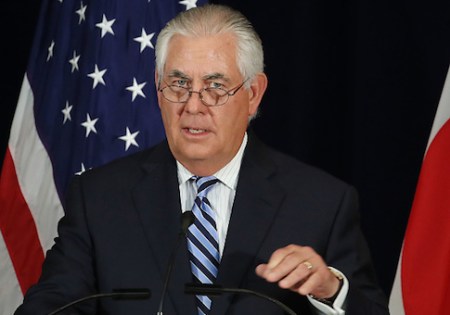
Secretary of State Rex Tillerson / Getty Images

The Free Beacon first reported last month that the State Department under Secretary Rex Tillerson has been in “open war” with the White House over a range of key issues, including Israel.

Multiple sources who spoke to the Free Beacon confirmed these fears, pointing to a recent State Department-authored report that blamed Israel for terror attacks and roiled congressional leaders who accused Tillerson’s State Department of promoting anti-Israel propaganda.

************************

The State Department’s recent hosting of an American Muslim organization known for its anti-Israel stance and support of boycotts of the Jewish state has sparked concern from those close to the Trump administration that these advocacy groups are seeking to drive a wedge into the United States’ relationship with Israel, which has hit speed bumps since Rex Tillerson assumed control of America’s chief diplomatic agency, according to multiple sources who spoke to the Washington Free Beacon.

The State Department hosted this month leaders from the U.S. Council of Muslim Organizations, which represents a number of organizations including American Muslims for Palestine, or AMP, an organization that promotes “extreme anti-Israel views” and “anti-Zionist” propaganda, according to the Anti-Defamation League, which tracks anti-Israel hate groups.

Representatives from the Council on American-Islamic Relations, Islamic Shura Council of Southern California, Islamic Circle of North America, and Muslim Ummah of North America also attended the meeting.

AMP, which partnered with the terror group Hamas’s main U.S. propaganda arm until it was shuttered in 2004, and the other groups met with several State Department officials to discuss the ongoing violence on Israel’s holy Temple Mount area, which has been the site of several riots and attacks on Israelis.

The groups were there to promote anti-Israel propaganda blaming Israel for the recent violence that began after Palestinian terrorists killed two Israeli security official stationed at the site, which is home to the Dome of the Rock and al-Aqsa mosques.

The meeting has prompted concern among pro-Israel leaders close to the Trump administration, who say the summit is part of larger effort by anti-Israel organizations to drive a wedge between the Trump administration and Israel at a critical juncture.

The Free Beacon first reported last month that the State Department under Secretary Rex Tillerson has been in “open war” with the White House over a range of key issues, including Israel.

Multiple sources who spoke to the Free Beacon confirmed these fears, pointing to a recent State Department-authored report that blamed Israel for terror attacks and roiled congressional leaders who accused Tillerson’s State Department of promoting anti-Israel propaganda.

The recent resignation of White House chief strategist Steve Bannon, who was viewed as one of the administration’s most pro-Israel voices, has further stoked these fears among pro-Israel leaders.

Multiple pro-Israel insiders who spoke to the Free Beacon expressed concerns about the State Department’s willingness to host an openly anti-Israel group during a time when tensions in the Middle East are running high.

Israeli officials are said to be concerned about the Trump administration’s stance on a range of issues, including its policy in Syria and other terror hotspots.

“Everyone knows this is the group funneling money from the Middle East to finance the [Boycott, Sanctions, and Divestment] movement,” said one prominent pro-Israel official who would only speak on background so as not to spark further tension with the White House. “They’re being investigated by the FBI and the state of Illinois for potential illicit financing activity. I really want to believe in Secretary Tillerson but between his reluctance to confront Iran and now this, it’s hard to justify his continuation as secretary of state.”

A State Department official confirmed the meeting took place, but would not specify who the American Muslim leaders met with and what exactly was discussed.

“The Department regularly hosts groups representing different constituencies in America to explain USG policy and hear their perspective,” the official told the Free Beacon. “The group was interested in U.S. policy on Jerusalem given events on the Temple Mount/Haram al Sharif last month, and met a cross-section of working level officials from different offices in the Department.”

Asked if administration officials were aware of the group’s anti-Israel views and ties to Hamas, the official said that State Department views Hamas as a terror organization and opposes boycotts of the Jewish state.

Noah Pollak, a political consultant who works with a range of pro-Israel organizations, criticized the State Department for hosting what he described as extremists who reject Israel’s right to exist and openly endorse terrorist groups.

“AMP is a front for jihadists, and doesn’t try very hard to hide it. Some of its founders were involved with the Holy Land Foundation, a Hamas fundraising front that was the biggest terror finance case in U.S. history,” Pollak said. “Its founder called for an ‘intifada’ here in America. Maybe next time there’s a flare-up of Palestinian violence the State Department can cut out the middle man and just meet directly with Hamas.”

Other pro-Israel insiders expressed concern over the meeting, but cautioned against putting too much stock in efforts by these Muslim American groups to drive a wedge into the U.S.-Israel relationship.

“Presidential administrations are going to meet with constituents,” said the source, a senior official at a large pro-Israel group. “That’s what they do. The question is if they believe what they hear, let alone act on it.”

“Judging by the public descriptions of the meeting, no one at the White House was buying whatever AMP was selling,” the source said. “That’s what we’d expect from the Trump administration, which has people who understand the value of the pro-Israel relationship like Victoria Coates in key positions to guide policy.”

New US Mideast Director Implied Moral Equivalency between Palestinian Terror and Israel

August 21, 2017

David Satterfield, who is slated to become the State Department’s New Mideast Director, has repeatedly suggested a moral equivalency between Palestinian terrorism and Israeli counterterrorism. Should someone with this perspective be dictating policy?

Source: New US Mideast Director Implied Moral Equivalency between Palestinian Terror and Israel | United with Israel

Palestinian leader Yasser Arafat and David Satterfield in 2001. (AP/Omar Rashedi

The newly appointed Middle East director at the State Department has a long record of criticizing and pressuring Israel. Isn’t anybody at the White House paying attention to who’s being hired over at Foggy Bottom?

David Satterfield, who is slated to become assistant secretary of state for Near East affairs next month, played a significant role in US policy and diplomacy concerning Israel and the Palestinians in the late 1990s and early 2000s. A look at some of his comments from that period reveals he repeatedly suggested a moral equivalency between Palestinian terrorism and Israeli counterterrorism.

Consider Satterfield’s remarks at the Center for Policy Analysis on Palestine (CPAP) Nov. 2, 2001. The date is important. It was the height of the second intifada. There was Palestinian terrorism on a daily basis. In the weeks prior, suicide bombers had struck at the Sbarro Pizzeria in Jerusalem (15 dead, 130 wounded) and the Nahariya train station (three dead, 94 wounded). In the midst of this bloodshed, Satterfield criticized Palestinian terrorism—and then proceeded to criticize Israel.

Making the aggressor and the victim appear to be equivalent, Satterfield declared (according to The Associated Press): “The intifada, whatever its origin, has become an ongoing process of calculated terror and escalation, reciprocated by actions which all too often by Israel proved inflammatory and provocative. Steps must be taken to bring this to a halt.”

 And a brief word about Satterfield’s troubling choice of venue. CPAP is an extreme anti-Israel group that should never be honored with the presence of a US government official. In 2003—just to cite a random example to illustrate the center’s mindset—the CPAP winter conference was titled “Israel’s Policy of Apartheid and Ethnic Cleansing.” Why would Satterfield choose to keep that kind of company?

Skewed Moral Equivalency

There was more moral equivalency from Satterfield the following year, at the Weinberg Founders Conference of the Washington Institute for Near East Policy in October 2002. Satterfield criticized Yasser Arafat, then blasted Israel for encircling Arafat’s terror headquarters, the “Muqata” compound in Ramallah. The Israeli action “was wholly unhelpful and froze the positive currents of reform and direct pressure placed upon [Arafat] by Palestinian elites,” Satterfield declared.

Once again, Satterfield was incapable of criticizing Palestinian terror leaders without simultaneously haranguing Israel’s self-defense actions.

On March 11, 2004, Satterfield gave the keynote address at the Israel Policy Forum’s conference in Washington, D.C. Again, note the venue. The Israel Policy Forum was established by the Israeli Labor party. The prime minister of Israel in March 2004 was Ariel Sharon, then leader of the Likud party. Satterfield was choosing to address the American wing of the Israeli opposition. Interesting.

Satterfield once again resorted to moral equivalency. “Hope is in very short supply right now,” he asserted, evidently referring to the still-raging intifada. Just two weeks earlier, eight Israelis had been massacred—and more than 60 wounded, including many schoolchildren—in the Liberty Bell Park bus bombing in downtown Jerusalem.

You would think that would be the cause of “hope being in very short supply.” But no—according to Satterfield, there were two reasons that hope was in short supply, not just one. Hope was “evaporating in the understandable rage of Israelis suffering through horrible acts of terror”—but hope also “is being swallowed up in the deep frustrations, daily humiliations and wounded dignity of Palestinians living under occupation.”

Israel’s Defense is ‘Inflammatory’ and ‘Provocative’?

Someone who perceives Israel’s legitimate self-defense actions as “inflammatory,” “provocative” and “unhelpful,” and who thinks that Israel and Palestinian terrorists are equally to blame for the erosion of hope, has a dangerously shallow understanding of Middle East reality. David Satterfield’s record demonstrates that he does not fully appreciate the difference between Palestinian aggressors and Israeli victims. He does not accept Israel’s right to take all necessary defensive actions against the stabbers, snipers and suicide bombers who threaten its citizens daily. Satterfield’s appointment should be rescinded immediately.

By: Stephen M. Flatow/JNS.org

Stephen M. Flatow, a vice president of the Religious Zionists of America, is an attorney in New Jersey and the father of Alisa Flatow, who was murdered in an Iranian-sponsored Palestinian terrorist attack in 1995.

The Rohrabacher-Assange meeting

August 21, 2017

The Rohrabacher-Assange meeting, Washington TimesDavid Keene, August 20, 2017

Smoking Gun Flash Drive Illustration by Greg Groesch/The Washington Times

The piece resulted in turmoil within the left-wing publication [the Nation] itself with many writers and contributors bitterly suggesting it should never have been printed because the publication has some sort of obligation to only publish material that strengthens rather than weakens the case against the president they despise.

*****************************************

ANALYSIS/OPINION:

California Rep. Dana Rohrabacher’s recent three-hour meeting with WikiLeaks head Julian Assange as reported earlier this week by The Hill may prove interesting in light of the allegations of several former high-ranking U.S. intelligence analysts that the Democratic National Committee was not hacked by the Russians or anyone else prior to last fall’s presidential election.

Mr. Rohrabacher said little after the meeting other than that Mr. Assange repeated his denial that the materials he obtained and made public did not come from the Russians, but claimed he had more information about what actually happened that he intended to share with President Trump.

The “common wisdom” in Washington circles is that the Russians were responsible for illegally hacking into the DNC computers during the campaign and leaked the emails thus obtained through WikiLeaks, but recent revelations suggest that there is at least a possibility that the “common wisdom” is dead flat wrong. If it is wrong and can be proven, the charges of “collusion” so dear to Mr. Trump’s opponents could collapse.

The Nation magazine earlier this month published a lengthy report on the conclusions of a number of intelligence analysts who have looked at the available evidence and concluded that it would have been physically impossible for the Russians to have done what Mr. Trump’s critics allege.

They maintain that the information that made its way into the public sphere wasn’t hacked at all, but leaked by someone within the DNC itself.

The Nation piece, by Patrick Lawrence titled “A New Report Raises Big Questions about Last Year’s DNC Hack,” claimed that for technical reasons, the data that was supposedly downloaded to a hacker could not have been downloaded in the manner alleged because the underlying data they analyzed showed it was downloaded far faster than would have been possible given the technology available to the supposed hacker at the time.

The only way they believe the data could have been downloaded in the time it was in fact downloaded was if the job was done internally to something like a thumb drive that was later turned over to WikiLeaks.

The piece resulted in turmoil within the left-wing publication itself with many writers and contributors bitterly suggesting it should never have been printed because the publication has some sort of obligation to only publish material that strengthens rather than weakens the case against the president they despise.

Many were particularly upset that the piece was picked up and praised by a number of conservative publications and commentators.

In response to the attacks, Katrina vanden Heuvel, the Nation’s editor and publisher has launched what she is calling a “post publication review” of the article.

It is certainly true that the allegations in the article are both controversial and contested, but it is at least possible that whether the Nation decides to trash its own writer and disavow the conclusions of his article, the analysts quoted in it are right.

The Obama administration, Hillary Clinton and Mr. Trump’s enemies take it as fact that the Russians were behind the “hacks” and that they constituted an attempt by Vladimir Putin’s regime to “affect” the outcome of the election and hint openly that it was all done in collusion with the Trump campaign. That, after all, is what Special Counsel Robert Mueller is trying to prove.

They almost as one dismiss evidence to the contrary, relying on the “consensus” view of “seventeen” US intelligence agencies that it was indeed the Russians who did it. The “consensus” view as former Obama Director of Intelligence James Clapper has since admitted was put together by “hand-picked” analysts from three agencies and never underwent the rigorous review one might have expected.

This is, of course, the same James Clapper who had earlier been caught lying to Congress.

When the Nation article first appeared, the Democratic National Committee responded in writing “U.S. intelligence agencies have concluded the Russian government hacked the DNC in an attempt to interfere in the election. Any suggestion otherwise is false and is just another conspiracy theory like those pushed by Trump and his administration.”

When The Hill article reporting on the Rohrabacher/Assange meeting appeared, the DNC was at it again, “We’ll take the word of the U.S. intelligence community over Julian Assange and Putin’s favorite Congressman,” said DNC Deputy Communications Director Adrienne Watson,

There are conspiracies and then there are conspiracies. Julian Assange may have the proof as to who is right and who is fantasizing and if he provided that proof to Mr. Rohrabacher things could get very interesting for all involved and especially for Mr. Clapper and those who have relied on his “consensus view.”

Chief of Naval Operations Orders Global ‘Operational Pause’

August 21, 2017

Navy responds to USS John S. McCain collision

BY:
August 21, 2017 12:48 pm

Source: Chief of Naval Operations Orders Global ‘Operational Pause’

Chief of Naval Operations Adm. John Richardson announced Monday a global pause in naval operations after the USS John S. McCain collided with a merchant ship near Singapore.

Richardson first provided an update on the U.S. Navy guided-missile destroyer in an official statement. The CNO said all possible assistance is being provided to the crew, their families, and the ship. He went on to say that because the incident was the second such incident as of late, a larger investigation into operations will take place.

In June, the USS Fitzgerald was part of a deadly collision with a Philippine-flagged container ship southwest of Tokyo.

“This is the second collision in three months, and the last in a series of incidents in the Pacific Theater,” Richardson said. “This trend demands more forceful action. As such, I’ve directed an operational pause be taken in all of our fleets around the world.”

“In addition to that operational pause, I’ve directed a more comprehensive review to ensure that we get at the contributing factors, the root causes of these incidents,” he continued. “This review is in addition to the investigations that are looking into the details of the collisions of the USS Fitzgerald and now the USS John S. McCain.”

Richardson said he has directed the commander of Fleet Forces Command, Adm. Philip Davidson, to lead the investigation, and the review will be on a “tight timeline.”

“We need to get to the bottom of this, so let’s get to it,” Richardson said.

Report: Bannon Urged Trump to Move U.S. Embassy to Jerusalem — Was Blocked by Jared Kushner

August 21, 2017

by Aaron Klein

21 Aug 2017

Source: Report: Bannon Urged Trump to Move U.S. Embassy to Jerusalem — Was Blocked by Jared Kushner

MANDEL NGAN/AFP/Getty Images

TEL AVIV – According to a report in Vanity Fair, while he served as White House chief strategist, Steve Bannon heavily lobbied President Trump to move the U.S. embassy from Tel Aviv to Israel’s capital, Jerusalem, but the move was blocked by Jared Kushner, President Trump’s son-in-law and senior adviser.

Citing three Bannon allies, the magazine further reported that Bannon boycotted a meeting with Palestinian Authority President Mahmoud Abbas, quipping, “I’m not going to breathe the same air as that terrorist.”

The magazine revealed that Bannon pushed a tougher stance against the PA, which pays salaries to terrorists imprisoned in the Jewish state for committing violent acts against Israelis and routinely incites against Israel.

Vanity Fair reported:

advertisement

Bannon, they say, lobbied Trump aggressively to move America’s embassy in Israel from Tel Aviv to Jerusalem, but was blocked by Kushner. And, according to three Bannon allies, Bannon pushed a tougher line against the Palestinians than Kushner did. In May, when Palestinian President Mahmoud Abbas visited the White House, Bannon stayed home. “I’m not going to breathe the same air as that terrorist,” Bannon texted a friend.

Abbas visited the White House and met with Trump last May.

Standing alongside Trump during his White House visit, Abbas attempted to whitewash decades of official PA incitement to violence and anti-Israel indoctrination that continue unabated to this day. “Mr. President, I affirm to you that we are raising our youth, our children, our grandchildren on a culture of peace,” Abbas claimed. “And we are endeavoring to bring about security, freedom and peace for our children to live like the other children in the world, along with the Israeli children in peace, freedom and security.”

Despite the PA’s repeated use of maps that erase Israel and PA propaganda calling for the dismantlement of the Jewish state, Abbas misleadingly claimed at the White House meeting that the “Palestinian people recognize the state of Israel.”

The official media and educational institutions of Abbas’s PA regularly incite against Israel. The Al Aqsa Martyrs Brigade, a terrorist group responsible for scores of suicide bombings and deadly shooting attacks, is closely aligned with Abbas’s Fatah Party and is routinely referred to as Fatah’s so-called military wing.

Abbas has refused to end payments to convicted terrorists, defending the stipends as a “social responsibility” even though the financing is said to encourage attacks against Israel.

During the 2016 presidential campaign, Trump had repeatedly pledged to move the U.S. embassy to Jerusalem. In July, Trump signed a waiver that delayed for six months a U.S. law requiring the embassy to be relocated from Tel Aviv to Jerusalem.

Bannon, meanwhile, submitted his resignation letter to the White House on August 7 and officially departed the administration last Friday. Within hours, he resumed his role as executive chairman of Breitbart News.

Bannon is known for his pro-Israel views. He was the driving force behind the founding of Breitbart Jerusalem and recruited this reporter to the news agency to defend Israel amid a constant barrage of biased news media reporting.

Aaron Klein is Breitbart’s Jerusalem bureau chief and senior investigative reporter. He is a New York Times bestselling author and hosts the popular weekend talk radio program, “Aaron Klein Investigative Radio.” Follow him on Twitter @AaronKleinShow. Follow him on Facebook.

Steve Bannon Leaves the White House

August 21, 2017

Steve Bannon Leaves the White House, Front Page MagazineDavid Horowitz and Matthew Vadum, August 21, 2017

He will now be a general to the troops on whom Trump’s future depends, and with the enormous platform that Breitbart represents – with perhaps a TV channel to amplify it – he will be in a prime position to mobilize the support that Trump needs, and to take on his enemies within the Republican camp. In short, this is the beginning of a new phase of the ongoing war to save our country. And Bannon’s role in this war will be even more important now.

***************************************

After helping to elect Donald Trump and pilot his White House through the turbulence of its first seven months, Stephen K. Bannon has left the administration and returned to Breitbart News, the conservative online news giant he captained before joining Trump a year ago.

What distinguishes Steve Bannon from other GOP operatives and conservative politicians are two things: vision and guts. The left in this country, the progressive and Democratic Party left is now organized around the anti-American creed of “identity politics.” This is the idea that “people of color” in America are oppressed by white supremacists – by people who are not “of color” and only a general purge of white racists and suppression of their free speech will rectify the injustice. This is the new racism, which serves as the principal weapon in Democrat attacks not only on the Trump White House but on all Republicans and patriots who oppose them.

“The longer they talk about identity politics, I got ’em,” Steve Bannon told the American Prospect. “I want them to talk about racism every day. If the Left is focused on race and identity, and we go with economic nationalism, we can crush the Democrats.”

You can probably count on one hand the number of Republican office-holders who think clearly and strategically like that. Or maybe one finger.

It is because Bannon understands the civil war which has now engulfed the political life of this nation that the secessionist left has focused its most vicious attacks on him, calling him a white nationalist, a white supremacist and an anti-Semite. Such attacks are transparently false, but they are in line with the left’s attacks on all their opponents as racists and fascists. These are the verbal equivalents of a nuclear option in political warfare and they reflect the existential nature of the conflict that is upon us. It is existential because the left has aimed at nothing less than the foundations of our democracy.

This was not a battle that could be fully engaged from the White House itself because so many people including the mainstream of the Republican Party are not yet awake to the nature of the conflict. They are too eager to seek approval from progressives who hate them.

Some on the right are concerned that without Bannon’s White House presence, Trump will become a prisoner of the globalist tendencies inside the administration and the appeasement instincts of the Republican in Congress. But they are wrong. Trump will still be Trump. He is not going to abandon the agendas or bury the instincts that made him endure the most hate-filled campaign in the history of American politics because he loves this country and wants to restore its greatness.

Although conservatives may thrill to the president’s frequent street fights with the Left, a president cannot be a relentless rebel. He has to put together a non-ideological majority and pick his fights shrewdly. Trump has already expressed his appreciation for the asset Bannon will be to him outside the White House. “Steve Bannon will be a tough and smart new voice at @BreitbartNews…maybe even better than ever before,” Trump tweeted Saturday. “Fake News needs the competition!” Yet, it’s more than fake news organizations that better look out when Bannon gets going.

Despite the departure of their hero, Bannon, Trump’s political base will not desert him because Bannon is gone. Trumpers appreciate the seditious nature and also the daunting magnitude of the forces ranged against his presidency. They will stick by him should he stumble or tack too precariously to the center. They are not fooled by progressive subterfuges and know where the violence and hate and lies are coming from, and the threat they are facing. Ultimately, the success of the Trump mission and the survival of his presidency will depend on this popular army he has called into being.

This is the plus side of Bannon’s departure, and his liberation from the constraints of being tied to closely to the Oval Office. He will now be a general to the troops on whom Trump’s future depends, and with the enormous platform that Breitbart represents – with perhaps a TV channel to amplify it – he will be in a prime position to mobilize the support that Trump needs, and to take on his enemies within the Republican camp. In short, this is the beginning of a new phase of the ongoing war to save our country. And Bannon’s role in this war will be even more important now.

“Now I’m free,” Bannon said after he left. “I’ve got my hands back on my weapons. Someone said, ‘it’s Bannon the Barbarian.’ I am definitely going to crush the opposition. There’s no doubt. I built an f—ing machine at Breitbart. And now I’m about to go back, knowing what I know, and we’re about to rev that machine up. And rev it up we will do.”

We at Frontpage and our friends at Breitbart have been fighting this war for twenty years and more. We were excited when Trump appeared as a champion of the cause, and even more when he recruited our friends Bannon and Steve Miller and Jeff Sessions to fight by his side. That’s why we are excited by Bannon’s return to Breitbart and look forward to joining him in the trenches of the battles to come.

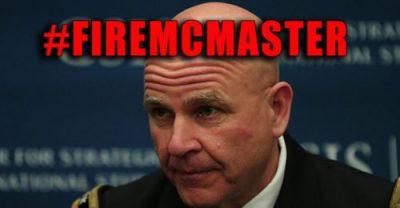
#FIREMcMASTER! He endorsed a book that tells U.S. Military service members to kiss a new copy of a quran after any quran desecrations

August 21, 2017

Source: #FIREMcMASTER! He endorsed a book that tells U.S. Military service members to kiss a new copy of a quran after any quran desecrations | BARE NAKED ISLAM

A book on terrorism endorsed and touted by H.R. McMaster, the embattled White House National Security Adviser, calls on the U.S. military to respond to any “desecrations” of the Quran by service members with an apology ceremony, and advocates kissing a new copy of the Quran before presenting the Islamic text to the local Muslim public.

BREITBART  The book’s author further demanded that any American soldier who “desecrates” the Quran be ejected from the foreign country of deployment, relieved of duty and turned over to a military judge for “punishment.”

“Desecration” of the Quran, according to the McMaster-endorsed book, includes such acts as “letting the Quran fall to the ground during a search, or more blatant instances.”

The book, reviewed in full by this reporter, was authored by U.S. military officer Youssef H. Aboul-Enein and is titled Militant Islamist Ideology: Understanding the Global Threat. McMaster provided a glowing blurb for the book jacket, referring to Aboul-Enein’s book as “an excellent starting point” for understanding terrorist ideology.

McMaster also promoted the book in ARMOR, the journal of the U.S. Army’s Armor Branch, published at Fort Benning, Georgia, where McMaster served as commanding general at the Ft. Benning Maneuver Center of Excellence.

McMaster wrote in his blurb for the book: “Militant Islamist Ideology deserves a wide readership among all those concerned with the problem of transnational terrorism, their ideology, and our efforts to combat those organizations that pose a serious threat to current and future generations of Muslims and non-Muslims alike.”

NASA Unveils Plan To Stop Yellowstone “Supervolcano” Eruption, There’s Just One Catch

August 21, 2017

Source: NASA Unveils Plan To Stop Yellowstone “Supervolcano” Eruption, There’s Just One Catch | Zero Hedge

A NASA plan to stop the Yellowstone supervolcano from erupting, could actually cause it to blow… triggering a nuclear winter that would wipe out humanity.

As we have detailed recently, government officials have been closely monitoring the activity in the Yellowstone caldera.

However, as SHTFplan.com’s Mac Slavo details, scientists at NASA have now come up with an incredibly risky plan to save the United States from the super volcano.

A NASA scientist has spoken out about the true threat of super volcanoes and the risky methods that could be used to prevent a devastating eruption. Lying beneath the tranquil and beautiful settings of Yellowstone National Park in the US lies an enormous magma chamber, called a caldera. It’s responsible for the geysers and hot springs that define the area, but for scientists at NASA, it’s also one of the greatest natural threats to human civilization as we know it.

Brian Wilcox, a former member of the NASA Advisory Council on Planetary Defense, shared a report on the natural hazard that hadn’t been seen outside of the agency until now. Following an article published by BBC about super volcanoes last month, a group of NASA researchers got in touch with the media to share a report previously unseen outside the space agency about the threat Yellowstone poses, and what they hypothesize could possibly be done about it.

 “I was a member of the NASA Advisory Council on Planetary Defense which studied ways for NASA to defend the planet from asteroids and comets,” explains Brian Wilcox of Nasa’s Jet Propulsion Laboratory (JPL) at the California Institute of Technology.  

“I came to the conclusion during that study that the supervolcano threat is substantially greater than the asteroid or comet threat.”

Yellowstone currently leaks about 60 to 70 percent of its heat into the atmosphere through stream water which seeps into the magma chamber through cracks, while the rest of the heat builds up as magma and dissolves into volatile gasses. The heat and pressure will reach the threshold, meaning an explosion is inevitable. When NASA scientists considered the fact that a super volcano’s eruption would plunge the earth into a volcanic winter, destroying most sources of food, starvation would then become a real possibility.  Food reserves would only last about 74 days, according to the UN, after an eruption of a super volcano, like that under Yellowstone.  And they have devised a risky plan that could end up blowing up in their faces.  Literally.

Wilcox hypothesized that if enough heat was removed, and the temperature of the super volcano dropped, it would never erupt. But he wants to see a 35% decrease in temperature, and how to achieve that, is incredibly risky. One possibility is to simply increase the amount of water in the supervolcano. As it turns to steam. the water would release the heat into the atmosphere, making global warming alarmists tremble.

 “Building a big aqueduct uphill into a mountainous region would be both costly and difficult, and people don’t want their water spent that way,” Wilcox says. “People are desperate for water all over the world and so a major infrastructure project, where the only way the water is used is to cool down a supervolcano, would be very controversial.”

So, NASA came up with an alternative plan. They believe the most viable solution could be to drill up to 10km down into the super volcano and pump down water at high pressure. The circulating water would return at a temperature of around 350C (662F), thus slowly day by day extracting heat from the volcano. And while such a project would come at an estimated cost of around $3.46 billion, it comes with an enticing catch which could convince politicians (taxpayers) to make the investment.

“Yellowstone currently leaks around 6GW in heat,” Wilcox says. “Through drilling in this way, it could be used to create a geothermal plant, which generates electric power at extremely competitive prices of around $0.10/kWh. You would have to give the geothermal companies incentives to drill somewhat deeper and use hotter water than they usually would, but you would pay back your initial investment, and get electricity which can power the surrounding area for a period of potentially tens of thousands of years. And the long-term benefit is that you prevent a future supervolcano eruption which would devastate humanity.”

Of course, drilling into a super volcano comes with its own risks, like the eruption that scientists are desperate to prevent. Triggering an eruption by drilling would be disastrous.

 “The most important thing with this is to do no harm,” Wilcox says.

“If you drill into the top of the magma chamber and try and cool it from there, this would be very risky. This could make the cap over the magma chamber more brittle and prone to fracture. And you might trigger the release of harmful volatile gases in the magma at the top of the chamber which would otherwise not be released.”

The cooling of Yellowstone in this manner would also take tens of thousands of years, but it is a plan that scientists at NASA are considering for every super volcano on earth.

 “When people first considered the idea of defending the Earth from an asteroid impact, they reacted in a similar way to the supervolcano threat,” Wilcox says.

“People thought, ‘As puny as we are, how can humans possibly prevent an asteroid from hitting the Earth.’ Well, it turns out if you engineer something which pushes very slightly for a very long time, you can make the asteroid miss the Earth. So the problem turns out to be easier than people think. In both cases it requires the scientific community to invest brain power and you have to start early. But Yellowstone explodes roughly every 600,000 years, and it is about 600,000 years since it last exploded, which should cause us to sit up and take notice.

Pink Floyd – Eclipse – 1973 – With Lyrics

August 21, 2017

( Happening today in my country of birth, the blessed USA. – JW )