Archive for July 2017

Feds Spends Millions on Failed Program to Combat Extremism in America

July 28, 2017

Feds Spends Millions on Failed Program to Combat Extremism in America, Washington Free Beacon, , July 28, 2017
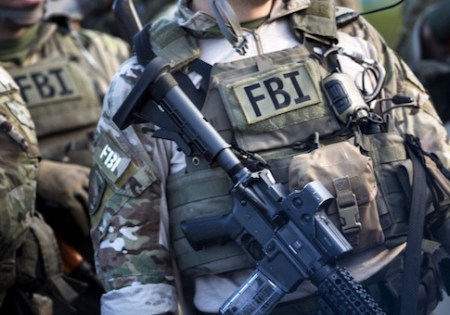
Members of a Federal Bureau of Investigation SWAT team are seen during an FBI field training exercise / Getty Images

“The time has come to definitely have a more direct approach,” said Raheel Raza, president of Muslims Facing Tomorrow, which seeks to counter extremist ideologies. “Fluff stuff and interfaith dialogue hasn’t really led to much deradicalization. There needs to be specific policies put in place that tackle the ideology.”

Raza also called on Congress to formally designate the Muslim Brotherhood as a terrorist organization due to its efforts to foment radical ideologies.

***************************************

The U.S. government has spent millions in taxpayer dollars on programs to combat violent extremism, despite the absence of evidence these programs have prevented the growth of terrorists in the United States, according to Congress, which criticized the FBI and Department of Homeland Security for enacting policy preventing its authorities from referencing “Islam” and “Islamic terrorism.”

The FBI and DHS are still providing upwards of $10 million dollars to fund a slew of community organizations committed to countering the rise of homegrown terrorism. Nevertheless there is little evidence these programs have had an impact, and in some cases, the money has been awarded to “partisan” organizations that have ties to the anti-Israel movement and radical groups such as Black Lives Matter, according to Congress.

The matter sparked a heated debate Thursday between congressional officials on the House National Security Subcommittee and senior law enforcement officials in the Trump administration.

Lawmakers accused DHS and the FBI of relying on Obama-era policies that downplay Islamic terrorism, despite clear guidance from the Trump administration that it does not support this approach.

Law enforcement anti-extremism training manuals—which were codified under an Obama-era program known as Countering Violent Extremism, or CVE—continue to ban the use of such terms as “Islamic extremism.”

While government reports have concluded that these programs are a failure, federal agencies continue to rely on them, sparking concern in Congress amid an uptick in domestic terrorism cases.

The FBI continues to have active terrorism investigations in all 50 states and at least 128 individuals have been charged in the last three years of attempting to aid ISIS.

Rep. Ron DeSantis (R., Fla.), chair of the subcommittee on national security, verbally sparred with officials from DHS and FBI, who continue to maintain that these CVE programs have been a success.

“Radical Islamic extremism is the primary driver of this problem and deserves the federal government’s immediate attention,” DeSantis said during the hearing.

“Currently, [DHS] still follows the Obama-era policies related to CVE,” DeSantis added. “The guidance developed during the Obama administration specifically limits any intelligence or law enforcement investigative activity through CVE.”

“The government manuals, they will not mention radical Islam, they don’t use anything associated with the word Islam,” he said.

“By leaving this information on the table, CVE efforts are potentially missing opportunities to identify and disrupt terrorist plots,” DeSantis said. “Obama era guidance also fails to properly identify the threat of radical Islamic ideology.”

The Obama-era guidance on the matter, which is still being used, “does not even mention radical Islamic terrorism at all,” DeSantis said.

Grants totaling some $10 million for community organizations that are part of the CVE effort are still being awarded to groups with “questionable agendas,” DeSantis said, noting instances in which grants were given to partisan organizations and those with stated anti-Israel agendas.

DHS has declined to share information on these grant recipients with Congress and also has refused multiple requests from these lawmakers for a briefing on the situation, DeSantis disclosed.

Experts who testified alongside officials from DHS and the FBI also described the CVE programs as a failure.

“The time has come to definitely have a more direct approach,” said Raheel Raza, president of Muslims Facing Tomorrow, which seeks to counter extremist ideologies. “Fluff stuff and interfaith dialogue hasn’t really led to much deradicalization. There needs to be specific policies put in place that tackle the ideology.”

Raza also called on Congress to formally designate the Muslim Brotherhood as a terrorist organization due to its efforts to foment radical ideologies.

Raza pointed to polls showing that 27 percent of Muslims support the execution of non-believers, while around 26 percent of young American Muslims believe that suicide bombing against non-Muslims can be justified.

Rabbi Avraham Sinai is a former member of Hezbolla

July 28, 2017

Rabbi Avraham Sinai is a former member of Hezbollah who converted to Judaism. Rabbi Sinai was a Shia Muslim living in Lebanon in the 1980s. After witnessing the merciless persecution of Shia Muslims in Lebanon, by the PLO, a secular Sunni group, Rabbi Sinai decided to work with Israel.

When the PLO’s influence waned and the Shia terrorist group Hezbollah was founded, Rabbi Sinai’s Israeli handlers persuaded him to sign up. For years, he worked as an Israeli spy within Hezbollah’s, until his cover was blown.

He eventually was able to relocate to Israel with his wife, where they both converted to Judaism. His work for Israeli intelligence saved many lives.

May his life and memory be blessed…


Secrets of War: Israeli Intelligence – World’s best…

July 28, 2017

The history and most famous operations of the Mossad, Sayeret Matkal and the Shabak.

Narated by Charlton Heston


WATCH: ‘Not fair’ to ask Palestinians to stop slaughtering Jews in their homes

July 28, 2017

July 27, 2017

Source: WATCH: ‘Not fair’ to ask Palestinians to stop slaughtering Jews in their homes

Riyad Mansour, the Palestinian Authority’s ambassador to the United Nations, when questioned by a reporter about the slaughter of a Jewish family at their Sabbath meal last week, justified such attacks as “resistance.”


Netanyahu says despicable terrorists ‘must be executed’

July 28, 2017

By: Adina Katz, World Israel News

July 27, 2017

Source: Netanyahu says despicable terrorists ‘must be executed’

PM Netanyahu speaks to bereaved widow Michal Salomon during a condolence call. (Facebook)

During a condolence call to the Salomon family, the Israeli leader said, “it’s time for the death penalty for terrorists.”

Prime Minister Benjamin and Sara Netanyahu made a condolence visit Thursday to the Salomon family, who lost three members in a Palestinian terror attack in Halamish/Neve Tzuf last Friday.

The terrorist, Omar al-Abed, 19, burst into the family home with a knife during their Shabbat dinner.

“Its time for the death penalty for terrorists,” he told the bereaved family.

 The death penalty “is anchored in law. We need here unanimity among the judges, but they also want to know the government’s position.

“And my position as prime minister, in this case, of such a despicable murderer, is that you must execute him,” the prime minister stated.

The terrorist “should not smile any more,” he added, likely referring to a photo of the murderer smiling in a Jerusalem hospital bed, where Al-Abed was being treated for gunshot wounds. An off-duty soldier and neighbor of the victims, upon hearing the screams, ran to the scene and shot him, thus preventing the slaughter of several more family members, including five children who are now orphaned.

By: Adina Katz, World Israel News


Modernizing America’s Nuclear Capabilities Is a Must

July 27, 2017

Modernizing America’s Nuclear Capabilities Is a Must, Gatestone InstitutePeter Huessy, July 27, 2017

(Russia is not our only nuclear or nuclear-capable enemy. What about Iranian, Chinese and North Korean nukes and delivery systems, now and in the future? — DM)

In 1989, America had 1,000 nuclear missile silos, and a small number of additional bomber and submarine bases and submarines at sea, facing 13,500 Soviet warheads. Today, the U.S. has 450 such silos facing 1,750 Russian warheads. That is a switch from a ratio of 13 Russian warheads to every U.S. missile silo, to a ratio of 4 Russian warheads to every U.S. missile silo. Getting rid of Minuteman ICBMs would reverse that progress and make the ratio even worse, with 175 Russian warheads to every U.S. missile silo. How is that an improvement?

The U.S. “cannot afford to delay modernization initiatives” while the “American people and our allies are counting on congressional action to fund our nuclear enterprise modernization efforts.” — General Robin Rand, the commander of the Air Force Global Strike Command.

America’s ability to defend itself is at stake.

In April 2017, the Pentagon launched the U.S. Defense Department’s legislatively mandated quadrennial Nuclear Posture Review to determine American policy, strategy and capabilities. The process now underway involves testimony from experts arguing over how the estimated $27 billion spent annually (growing over the next decade by an additional $10 billion a year) on America’s nuclear arsenal should be allocated.

One claim, made by a number of experts, is that investing in the effort to upgrade America’s exiting nuclear arsenal — the land-based intercontinental ballistic missiles (ICBMs) — would be destabilizing and wasteful. They are, it is claimed, highly vulnerable to enemy attack and therefore do not provide deterrence. Among the 40 House members who suggest killing the land-based missiles is the ranking Democratic member of the House Armed Services Committee.

The opposite position was expressed recently by General Robin Rand, the commander of the Air Force Global Strike Command (AFGSC). He persuasively argued that, far from being either destabilizing or unnecessary, “Our bomber and Intercontinental Ballistic Missile (ICBM) forces, and our nuclear command, control, and communications systems defend our national interests, assure our allies and partners, and deter potential adversaries.”

Addressing the Senate Armed Services Strategic Forces Subcommittee on June 7, Rand said, “ICBMs are the sole weapon system capable of rapid global response and impose a time-proven and unpalatable cost to attack by peer, near-peer and aspiring nuclear nations.”

The discrepancy in viewpoints stems from the difference in perception about American nuclear power and deterrence. Those who disagree with Rand are stuck in Cold War thinking, which has become largely irrelevant in today’s world. To understand this better, a review of the history of the U.S.-Soviet arms race is necessary.

In January 1967, U.S. President Lyndon Johnson announced that the USSR had greatly expanded its powerful multiple-warhead land-based missiles, as well as having begun to build an anti-ballistic-missile defense system (ABM) around Moscow — which would enable it to launch a first strike against the U.S. without fear of an effective retaliation against Soviet leadership bunkers — and called for strategic arms limitations talks (SALT).

Johnson’s successor, Richard Nixon, continued with the process, formally launching the negotiations in November 1969 that led to the signing of the SALT I executive agreement in May 1972. When Gerald Ford became president, he agreed with Soviet President Leonid Brezhnev on a general framework for a second agreement — SALT II — marginally to limit the deployment capabilities of each side, but still allow major increases in warheads, especially powerful, multi-warhead land-based Soviet missiles.

Although SALT II was signed in June 1979 by Ford’s successor, President Jimmy Carter, it was never ratified by the Senate, members of which, on both sides of the aisle, argued that it would not “reverse trends in the military balance adverse to the United States.” A week after 19 senators expressed this warning in a letter to Carter, the Soviets invaded Afghanistan and Carter withdrew the treaty from further consideration.

Carter’s successor, Ronald Reagan — who had been vehemently opposed SALT II before his election — knew its upward limits would readily accommodate his proposed modernization efforts and thus agreed to abide by it in principle. But here, he switched gears while pursuing a markedly different military and diplomatic avenue, in the form of the Strategic Arms Reduction Treaty (START). Reagan proposed that the U.S. simultaneously modernize while seeking reductions, instead of merely allowing huge increases in warheads under the SALT process. This also challenged the Soviet idea of a nuclear freeze — especially in that the Soviets were well through their nuclear modernization and the United States had not even begun.

Early in the Reagan administration, the U.S. still continued seeking to make its land-based silo missiles better able to withstand a massive Soviet strike. Many plans were examined, but all were expensive and required the use of a great deal of land on which to move the missiles on trains, trucks or mobile launchers.

Ultimately, in 1983, Reagan reached a simple, but elegant, solution: a three-step program. First, deep reductions in nuclear weapons; second, putting the new, modern, large 10-warhead Peacekeeper land-based missiles in existing Minuteman silos, and third, simultaneously developing a much smaller mobile missile with only one warhead, to be built later. This was essentially accomplished during the three successive administrations after the end of the Cold War, but with one key change. Given that the number of Russian and American strategic warheads eventually were reduced by more than 90% under the START I, Moscow and New START Treaties, American silo-based missiles — all with only a single warhead — became fundamentally survivable, even deployed in silos where they remain today.

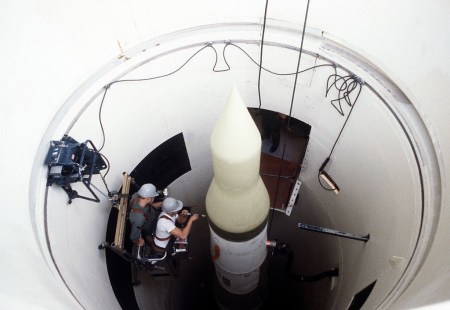
A Minuteman III intercontinental ballistic missile in its silo in Whiteman Air Force Base, Missouri, circa 1980. (Image source: U.S. Department of Defense)

The situation is therefore now the opposite of what it was during the 1970s and 1980s. At the height of the Cold War, the U.S. — with 1,000 American missile silos — faced more than 13,000 Soviet (subsequently Russian) warheads, or a 13-to-1 ratio. Today, we face roughly 1,750 Russian warheads but have 450 silos, a 4-to-1 ratio. In other words, the strategic environment became more stable, not less, and eliminating the very nuclear triad responsible for this stability makes no sense.

Although the nuclear triad was conceptualized and developed during the Cold War, maintaining it is just as imperative today. ICBMs are as highly stabilizing now as they were highly destabilizing prior to the dramatic reduction in the number of warheads from 1981-2017.

Why is that?

In 1989, America had 1,000 nuclear missile silos, and a small number of additional bomber and submarine bases and submarines at sea, facing 13,500 Soviet warheads. Today, the U.S. has 450 such silos facing 1,750 Russian warheads. That is a switch from a ratio of 13 Russian warheads to every U.S. missile silo, to a ratio of 4 Russian warheads to every U.S. missile silo. Getting rid of Minuteman ICBMs would reverse that progress and make the ratio even worse, with 175 Russian warheads to every U.S. missile silo. How is that an improvement?

It is crucial, therefore, to continue to invest in modernizing the ICBMs. As for the suggestion — among some of the less extreme anti-ICBM analysts — that the current ICBM force be extended for a few more years and modernization be reassessed later — is not a viable option, according to General Rand. He says that the U.S. “cannot afford to delay modernization initiatives” while the “American people and our allies are counting on congressional action to fund our nuclear enterprise modernization efforts.”

Let us hope that those who do not grasp how necessary it is for the United States to go forward with the ground-based strategic deterrent have little influence over the Nuclear Posture Review that is currently underway. America’s ability to defend itself is at stake.

Dr. Peter Huessy is President of GeoStrategic Analysis, a defense consulting firm he founded in 1981, as well as Director of Strategic Deterrent Studies at the Mitchell Institute for Aerospace Studies. He was also for 20 years, the senior defense consultant at the National Defense University Foundation.

Time for US to Support Regime Change in Iran – Raymond Tanter

July 27, 2017

Time for US to Support Regime Change in Iran – Raymond Tanter, Iran News Update, July 27, 2017

(Please see also, US seeks to test Iran deal with its new inspections and The Iran dilemma of the Saudi crown prince. Is a “peaceful transition”  possible? Even if it is not, we should support it. — DM)

When asked whether the Trump administration supports “a philosophy of regime change in Iran, Secretary of State Rex Tillerson said the U.S. would work with Iranian opposition groups toward the “peaceful transition of that government.”

Sen. John McCain (R-Ariz.) echoed Tillerson’s view, saying “it’s time the Iranian people had a free and open society and a functioning democracy,” effectively a call for regime change.

The Obama quote reassuring the Iranian regime that its survival was not on the table stands in marked contrast to those of Tillerson and McCain, for whom the idea of regime change from the people of Iran is on the table, or at least under the table in and around the Trump White House.

****************************

The following is an op-ed by former US National Security Council staff member Professor Raymond Tanter on Iran policy options for the United States. The article was published on The Hill website on Wednesday, July 26:

The time may be right for President Trump to consider and pursue regime change in Iran. Consider three quotes that provide a way of looking back to look forward:

President Obama in 2013 address to the United Nations:

“We are not seeking regime change, and we respect the right of the Iranian people to access peaceful nuclear energy.”

When asked whether the Trump administration supports “a philosophy of regime change in Iran, Secretary of State Rex Tillerson said the U.S. would work with Iranian opposition groups toward the “peaceful transition of that government.”

Sen. John McCain (R-Ariz.) echoed Tillerson’s view, saying “it’s time the Iranian people had a free and open society and a functioning democracy,” effectively a call for regime change.

The Obama quote reassuring the Iranian regime that its survival was not on the table stands in marked contrast to those of Tillerson and McCain, for whom the idea of regime change from the people of Iran is on the table, or at least under the table in and around the Trump White House.

On July 1, an event was held in Paris; there, I had conversations with Rep. Ted Poe (R-Texas), who explicitly called for regime change from within Iran by supporting Iranian oppositionists, in particular, the National Council of Resistance of Iran (NCRI).

Ditto for other Trump allies, including John Bolton, former U.S. ambassador to the United Nations during the George W. Bush administration. On July 1, Bolton, said:

“There is a viable opposition to the rule of the ayatollahs, and that opposition is centered in this room today. I had said for over 10 years since coming to these events, that the declared policy of the United States of America should be … to change the regime itself. And that’s why, before 2019, we here will celebrate in Tehran!”

The Way Forward

“Trump time” suggests a period of analysis of options as the President’s National Security Council reviews Iran policy. The review could present three options to Trump.

First, follow the Obama precedent of reassuring Tehran the United States will not challenge the rule of the unelected Ayatollahs. Trump and the Congress, however, are so strongly opposed to the Iranian regime, they are unlikely to countenance the Obama policy toward Iran, which Trump considers “appeasement.” Obama lost his bet that Iran would moderate its ballistic missile testing, state-supported international terrorism, and human rights violations. His nuclear deal was inconsistent with regime change from within, e.g., via a coalition of dissident groups.

Second, order preparations for the kind of coup d’état the CIA and British MI-6 intelligence service carried out in 1953, which overthrew a democratically-elected government in Iran. “All the Shah’s Men” describes how the coup occurred and the unintended negative consequences for Iranian perceptions of America for changing Iran’s government by covert action.

Indicative of this option is an editorial in The New York Times of July 18, which sounds the alarm that, “A drumbeat of provocative words, outright threats and actions — from President Trump and some of his top aides as well as Sunni Arab leaders and American activists — is raising tensions that could lead to armed conflict with Iran.”

But regime change from within is more than just an American issue. It is a “people of Iran” issue and what they want; it is not about the U.S. military going to war with Iran, as the editorial suggests.

Third, support the pro-democracy coalition of dissidents, the NCRI, which is best able to mobilize other oppositionists into an even wider coalition. Also, there’s a new sheriff in town, President Trump, and he expressed a strong presence in his Riyadh address: Trump the deal-maker but one with core principles like “Drive them out.”

“Drive them out of your places of worship,” Trump said of extremists, “drive them out of your holy land. Drive them out of this earth.”

After the July 1 rally in Paris, Fox News reported the next day the president might defy the Iranian regime by signaling his willingness to look kindly on the resistance: “The Trump administration is potentially considering seeking a strategy to try to topple the regime.” The resistance, however, only needs American political and perhaps economic support to effect “regime change from within.”

Even if he does not go so far as to topple the regime, Trump could increase his leverage against the Ayatollahs by supporting the resistance, conditioned on its continued eschewing of terrorist tactics. Doing so is bound to weaken an already faltering regime. In this respect, the tide is turning against Tehran in favor of the opposition.

The Bottom Line

The Iranian resistance benefits from aligning with the United States because the resistance is firmly in the camp of civilized states and does not commit acts of barbarism. Hence, President Trump is more likely to reach out to the Iranian opposition during his review of Iran policy than did President Obama, who valued the nuclear deal with Tehran too much to jeopardize it by opening up to the resistance.

Dr. Raymond Tanter (@AmericanCHR) served as a senior member on the National Security Council staff in the Reagan-Bush administration and is now Professor Emeritus at the University of Michigan.

McMaster Ousts Trump Adviser who Tried to Fire Obama Holdovers

July 27, 2017

McMaster Ousts Trump Adviser who Tried to Fire Obama Holdovers, The Point (Front Page Magazine), Daniel Greenfield, July 27, 2017

(We elected Trump to be our President. But who is running the Trump administration? — DM)

But Mattis and McMaster have forced out Derek Harvey. And it’s up to President Trump to act. Or to let the McMaster-Mattis swamp control his foreign policy. And make sure it’s Jeb Bush’s foreign policy.

President Trump can reverse his decision. Just as he overruled McMaster’s bid to replace Ezra Watnick-Cohen, the guy who outed the Obama spying on Trump’s people, with the woman who drafted the Benghazi talking points. Not to mention Mattis’ plan to bring in Hillary’s Secretary of Defense and the Muslim Broptherhood’s favorite woman.

*******************************************

Derek Harvey was the key figure when it came to the Middle East. He was against the Iran Deal and the funding of Palestinian Authority terror. He called out Islamic Jihad. He tried to force out the Obama holdovers running our foreign policy. 

And now he’s gone.

McMaster’s purge at the NSC continues. Flynn’s people get forced out and replaced with establishment zombies. The Obama holdovers continue to run foreign policy. The swamp is now in full control of the NSC.

This one is a really big win for McMaster. And a great loss for America. It will set back our ability to fight Islamic terrorism. Iran, Al Qaeda and the Palestinian Authority are celebrating today.

President Trump can reverse his decision. Just as he overruled McMaster’s bid to replace Ezra Watnick-Cohen, the guy who outed the Obama spying on Trump’s people, with the woman who drafted the Benghazi talking points. Not to mention Mattis’ plan to bring in Hillary’s Secretary of Defense and the Muslim Broptherhood’s favorite woman.

But Mattis and McMaster have forced out Derek Harvey. And it’s up to President Trump to act. Or to let the McMaster-Mattis swamp control his foreign policy. And make sure it’s Jeb Bush’s foreign policy.

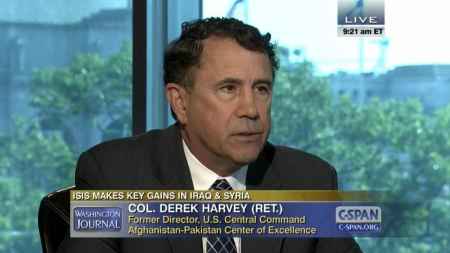
Derek Harvey, a top Middle East adviser to President Donald Trump, has been fired from his position at the National Security Council, effective today…

Two sources tell TWS that Harvey’s departure is not a direct result of the internecine staff fighting, but he was viewed by some top Trump aides as too close to Steve Bannon

Harvey has experience as an intelligence officer, as an analyst at military commands, American embassies, and in the Defense Intelligence Agency. He’s viewed as an out-of-the-box thinker who has shown a keen knack for identifying threats before they’ve matured.

Here’s how Bob Woodward described Harvey in his 2008 book The War Within:

“In the late 1980s, Harvey traveled throughout Iraq by taxicab—500 miles, village to village—interviewing locals, sleeping on mud floors with a shower curtain for a door. He [was] full of questions, intensely curious and entirely nonthreatening. After the 1991 Gulf War, when the CIA was predicting the inevitable fall of Iraqi dictator Saddam Hussein, Harvey, then a major, insisted that Hussein would survive because members of the Sunni community knew their fortunes were tied to his. He was right. Months before the 9/11 terrorist attacks, Harvey wrote an intelligence paper declaring that al Qaeda and the Taliban leadership in Afghanistan posed a strategic threat to the United States.”

Harvey hasn’t been afraid to call out Islamic terrorism as a threat. And he was the point man for trying to force out the Obama holdovers.

That dispute was followed by a bigger one. Bannon and Trump, according to White House officials, pressed McMaster to fire a list of Obama holdovers at the National Security Council who were suspected of leaking to the press. The list of names was compiled by Derek Harvey, a former Defense Intelligence Agency colonel who was initially hired by Flynn. McMaster balked. He refused to fire anyone on the list and asserted that he had the authority to fire and hire National Security Council staff. He also argued that many of these appointees would be ending their rotation at the White House soon enough.

Instead the holdovers forced him out. McMaster and Mattis and Obama won. Again.

Harvey has been a firm opponent of the Iran Deal. He’s not perfect on Islam, but he has emphasized the theological connection to Islamic terrorism. And he tried to halt the funding of Palestinian Authority terrorism.

Haaretz has learned that Harvey – whose appointment was reported Thursday in The Wall Street Journal – was one of the officials who earlier this week instructed the U.S. State Department to issue a statement saying it was reexamining the outgoing administration’s decision to transfer $221 million to the Palestinian Authority during President Barack Obama’s last hours in office.

A government source described Harvey as “the new Rob Malley,” referring to the former Obama administration official who was in charge of Middle East affairs at the outgoing NSC.
But while Malley’s background was mostly academic and diplomatic, Harvey spent most of his adult life either in uniform or working for the intelligence community.

Harvey has also published articles and analyses, many of them critical of the Obama administration’s foreign policy in the Middle East.

Harvey called to strengthen the U.S. relationship with Israel, Egypt and Saudi Arabia. “Why won’t President Obama talk to Egyptian President Sisi [sic]? Sisi has taken on the threat of violent, intolerant Islamic jihadism at great personal risk. Obama will reconcile with the Castro brothers and Iranian Mullahs but won’t talk to a friend like President Sisi,” Harvey wrote.

“They’re ignoring the intelligence — and I think Secretary Kerry, I hate to say it, must be smoking dope,” Harvey was quoted as saying on “Newsmax Prime.” “He is not paying attention to the intelligence and he does not understand the enemy with his statements.”

The left hated Derek Harvey for his views.

Harvey shares Trump’s belief that in order for the United States to prevail in its fight against the self-declared Islamic State, al-Qaida, their various offshoots and a variety of other groups, American officials need to declare that the country is at war with “radical Islamic extremism” or the “radical jihadist agenda” or “militant Islam” — all of which he uses interchangeably. On his blog, which has been shut down since he joined the Trump administration, Harvey argued that Obama’s failure to do so hampered the effort against such groups.

It really is past time to drain the foreign policy swamp.

The Iran dilemma of the Saudi crown prince

July 27, 2017

The Iran dilemma of the Saudi crown prince, Washington Times, S. Rob Sobhani, July 26, 2017

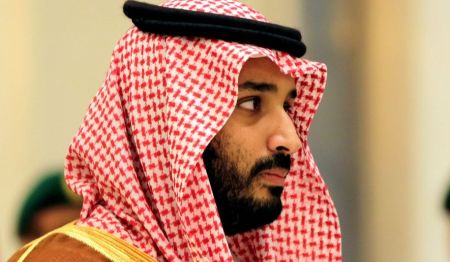
Saudi Crown Prince Mohammed bin Salman Associated Press photo

The first step that Saudi Arabia’s new crown prince can take is to deliver an address to the Iranian people in which he lays out his vision for a peaceful and friendly relation with people of Iran. In this address, Mohammed bin Salman can touch upon the rich history of Iran, its unique culture and heritage, and end by extending his hand of friendship to his natural allies — the people of Iran.

*************************************************

ANALYSIS/OPINION:

The starting point for any policy that the new crown prince of Saudi ArabiaMohammed bin Salman, adopts toward the Islamic Republic of Iran is to understand two basic facts. First, the Iranian regime continues to be the most serious threat to regional security in the Middle East and the major state sponsor of terrorism. Second, the Iranian people continue to be the most serious threat to the Islamic regime and the only real hope for a fundamental change in Iran.

If Mohammed bin Salman adopts the right policies in his dealings with the Islamic regime, not only will he go down in history as the leader who solved the “Iran Problem,” he will also usher in a new economic dynamic within the broader Middle East. In view of his friendship with President Trump, any new and bold approach by Mohammed bin Salman toward the Islamic regime in Tehran will no doubt have the full support of the president and his entire national security team.

To date Saudi policy toward Iran has not produced the results that Riyadh had hoped would either appease the mullahs or contain the bad behavior of the regime in Tehran. For example, the latest policy decision by Saudi Arabia to confront the Iranian regime by war through proxy in Yemen has not deterred the Islamic Revolutionary Guard Corps (IRGC). The conflict in Yemen is fast becoming a quagmire for Riyadh. According to some estimates, the Saudi effort to confront Iran in Yemen is costing the kingdom around $600 million per month. After spending billions of dollars, Saudi Arabia is not close to thwarting the designs of Ayatollah Ali Khamenei to build a beachhead on the Arabian Peninsula by supporting his Houthi allies.

Indeed, the Saudi narrative against the Iranian regime, eloquently enunciated by Foreign Minister Adel Al-Jubair, captures the essence of Tehran’s dangerous behavior in places like Yemen, Bahrain, Syria and Lebanon, but it does not address the fundamental underlying challenge: how to deal with a regime that is the mortal enemy of Saudi Arabia.

The overarching policy that Mohammed bin Salman should seriously consider is to adopt a soft-power approach to solving his Iran dilemma. This policy starts by drawing a clear distinction between the people of Iran and their rulers. The first step that Saudi Arabia’s new crown prince can take is to deliver an address to the Iranian people in which he lays out his vision for a peaceful and friendly relation with people of Iran. In this address, Mohammed bin Salman can touch upon the rich history of Iran, its unique culture and heritage, and end by extending his hand of friendship to his natural allies — the people of Iran.

The concrete steps the young crown prince may wish to consider following his address to the Iranian people are as follows: First, he can announce the creation of a fund to pay for the pilgrimage of elderly Iranians to Mecca and Medina. For the average Iranian whose per-capita gross national product has shrunk since the overthrow of Mohammed Reza Shah Pahlavi, making the obligatory visit to Islam’s holiest sites has become a financial burden. Mohammed bin Salman can endear himself to millions of Iranians through this act of charity.

Abbas is playing a dangerous game

July 27, 2017

Abbas is playing a dangerous game, Israel Hayom, Yaron Blum, July 27, 2017

(Please see also, Israel’s public diplomacy challenge. “Of course, the world rightly assumes that no nation would willingly give up what is rightly theirs, and so millions watching from the sidelines throw their support behind the violent side that refuses to compromise.” — DM)

The threat of stopping the security coordination with Israel is likely to turn on Abbas, as Hamas is lurking around the corner, waiting for the opportunity to stage a coup against the Palestinian Authority as it did in 2007 in the Gaza Strip. The need to calm these players down is of the utmost importance if the wave of incitement is to stop becoming a wave of more lone terrorist attacks.

***********************************

The Temple Mount crisis is far from over. The latest excuse for the Palestinians’ riots is Israel’s decision to conduct manual security checks on the Temple Mount complex.

How transparent and pathetic. Everyone with something at stake on the Temple Mount or Al-Aqsa mosque understands that the site has become a fantastic vantage point from which to promote personal interests. For the average Muslims, the Temple Mount and any change in its status quo is a red line. Indeed, this motif prompts millions in the Muslim world to take to the streets and is strong enough to glue the various streams in Muslim and Palestinian communities worldwide together.

Tensions apparently came to an end after an agreement between Jordan and Israel to take down the metal detectors and security cameras installed on the Temple Mount after the July 14 terrorist attack carried out by three gunmen from Umm al-Fahm. Despite this, the Muslim players found an excuse to reignite the playing field. And who are these players’ captains? The Palestinian Authority, Hamas, organizations active around Al-Aqsa, Waqf workers, the Northern Branch of the Islamic Movement, and Turkey.

Even though Turkish President Recep Tayyip Erdogan is once again disparaging Israel and its policies, despite agreements between him and Israel, the star of the week is Palestinian Authority President Mahmoud Abbas. From a point of great weakness against rivals in the Fatah movement, such as exiled party official Mohammed Dahlan — not to mention Hamas — Abbas realized that the “Al-Aqsa is in danger” narrative had the potential to add to his failing power. At the moment he is doing everything to ignite the streets, whether through his own voice or through the heads of the Tanzim, one of Fatah’s militant factions, and Fatah itself.

Palestinian Authority and Palestinian security apparatus officials, who had received orders to suspend the security coordination with Israel before its decision to remove security measures on the site, are now calling to further escalate the popular struggle by taking to the streets in protests planned for Friday in the Temple Mount area against the “occupation.”

Abbas’ recent declarations and direct involvement in the escalation stand out in their irregularity and are worrying. Most of all, however, these are new because they do not hide behind excuses. He is not meandering, maybe because he feels that the bullets in his gun are running out and this step can improve his current low position. Abbas is playing a double game: With the U.S. and the international community, he conveys a message of willingness to negotiate with Israel; while on the other hand, when speaking of the Temple Mount crisis, he comes out with contradictory, obtrusive statements on cutting ties, as well as calls likely to be construed as condoning terrorist activity by young Fatah and Tanzim members.

The threat of stopping the security coordination with Israel is likely to turn on Abbas, as Hamas is lurking around the corner, waiting for the opportunity to stage a coup against the Palestinian Authority as it did in 2007 in the Gaza Strip. The need to calm these players down is of the utmost importance if the wave of incitement is to stop becoming a wave of more lone terrorist attacks.

Meanwhile, a handful of residents in the Jewish community in Hebron are taking advantage of the situation by invading the Machpelah House, adjacent to the Cave of the Patriarchs, over which they claim ownership. This creates a new and dangerous point of contention, as well as a post the Israeli army and police are forced to protect. Some would understand this development as a provocation for escalation — and it is difficult to argue with that.

Yaron Blum is a former senior Shin Bet security service officer.