Islamic Relief Fails a Whitewash, Gatestone Institute, Samuel Westrop, July 3, 2017
(Please see also, What Hamas Wants. — DM)
Even if the Canadian branch of Islamic Relief claims not to have directly funded these Hamas groups, its own accounts reveal grants of millions of dollars to its parent organization, Islamic Relief Worldwide, which oversees the movement of money to a number of Hamas fronts.
Islamic Relief branches also receive money from several terror-linked Middle Eastern charities, including those established by Sheikh al Zindani, whom the US government has designated a “Global Terrorist.”
Islamic Relief did not much care for the exposé. Reyhana Patel, a senior figure at its Canadian branch, first persuaded the Post to bowdlerize the article by removing some of the sourced material and adding sentences in defense of Islamic Relief.
On May 20, a Muslim cleric, Nouman Ali Khan spoke at a fundraising event in Toronto for Islamic Relief, one of the largest Muslim charities in the world.
Khan preaches that prostitutes and pornographic actors are “filth” and that “you have to punish them … They’re not killed; they’re whipped. And they’re whipped a hundred times.” Khan has also declared that God gives men “license” to beat unfaithful wives, and that Muslim women are committing a “crime” if they object to the religious text that he says permits this abuse.
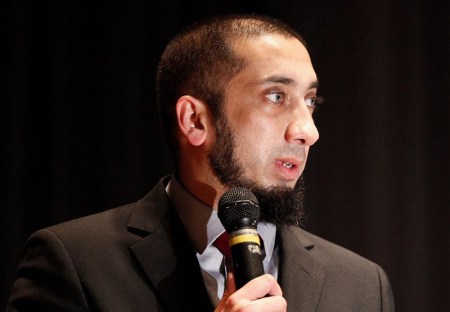 Muslim cleric Nouman Ali Khan says that God gives men “license” to beat unfaithful wives, and that Muslim women are committing a “crime” if they object to the religious text that he says permits this abuse. (Image source: Rossi101/Wikimedia Commons)
Before the event took place, this author had written about Khan and Islamic Relief in the National Post, with the help of colleagues at the Middle East Forum.
Islamic Relief did not much care for the exposé. Reyhana Patel, a senior figure at its Canadian branch, first persuaded the Post to bowdlerize the article by removing some of the sourced material and adding sentences in defense of Islamic Relief.
Patel then published in the Post a response that denounced our research as “false… one-sided and unsubstantiated.”
Really? In a rather major failing, she failed even to address Nouman Ali Khan’s presence at the Islamic Relief event.
Instead, she boasted of her own humanitarian goodness and attacked the Middle East Forum (MEF) as an “anti-Muslim think tank” that “uses some of its resources to paint a negative picture of Islam and Muslims.” MEF has always, in fact, argued the very opposite. It believes that if radical Islam is the problem, then moderate Islam is the solution. This very maxim can be found in dozens of articles on its website. MEF supports a number of moderate Muslim groups working to challenge extremism, and encourages others to do the same.
It is old habit of Islamists to accuse anti-Islamist activists of being anti-Muslim, because it allows them misleadingly to conflate Islam and Islamism. That obfuscation severely inhibits the work of moderate Muslims trying to free their faith from the grip of these extremists.
Patel’s only reference to the charges of Middle East Forum, in fact, appears to be a deliberate misquote. She writes that MEF “labelled Islamic Relief Canada a ‘terrorist organization which regularly gives platforms to preachers who incite hatred against women, Jews, homosexuals and Muslim minorities.'” Islamic Relief does indeed regularly give platforms to such preachers — Nouman Ali Khan is just one example in the weekly pattern of this charity and its branches across the world.
But MEF did not claim that Islamic Relief was a “terrorist organization.” I wrote that it was “financially linked with a number of terrorist groups.” Islamic Relief branches have, for example, indeed given money to several groups in Gaza linked to the designated terrorist group Hamas. These include the Al Falah Benevolent Society, which the Meir Amit Intelligence and Terrorism Information Centre describes as one of “Hamas’s charitable societies.” And even if the Canadian branch of Islamic Relief claims not to have directly funded these Hamas groups, its own accounts reveal grants of millions of dollars to its parent organization, Islamic Relief Worldwide, which oversees the movement of money to a number of Hamas fronts.
Islamic Relief branches also receives money from several terror-linked Middle Eastern charities, including those established by Sheikh al Zindani, whom the US government has designated a “Global Terrorist.”
Although MEF believes that Islamic Relief is financially linked to terror, no one wrote that the charity itself is a terrorist organization. Others, however, are less circumspect. In 2014, the United Arab Emirates designated Islamic Relief as a terrorist organization. And in 2016, the banking giant HSBC shut down Islamic Relief’s bank accounts in the United Kingdom “amid concerns that cash for aid could end up with terrorist groups abroad.”
Perhaps Reyhana Patel hoped that by smearing the Middle East Forum, and telling her readers about her love of “diversity … tolerance and inclusion,” she could sell Islamic Relief as a force for good. The charity’s regular promotion of hate preachers and financial links to terrorist groups, however, says otherwise.
And is Patel herself really so dedicated to supporting peace and tolerance? Her social media posts and a short-lived career as a journalist suggest not. Patel has a history, it seems, of attacking organizations that oppose religious extremism. In 2014, Patel wrote an article condemning Student Rights, a British organization that works to expose homophobia, racism and other forms of extremism on campus. Without seriously addressing the group’s research, Patel described the organization as “sensationalist and misleading.” Sound familiar?
Patel has also defended gender-segregation imposed by Muslim student groups at Britain’s public universities, and then complained that Muslim women who oppose this misogynistic behavior “seem to want to discredit and deamonise [sic] me.”
Further, Patel has expressed praise for Malia Bouattia, a prominent student activist in Britain whose anti-Semitism was the subject of national media coverage. In 2011, Bouattia condemned a university with a large Jewish population as a “Zionist outpost.” In 2014, she opposed a motion at a student conference that condemned ISIS on the grounds that such condemnation was “Islamophobic.” That same year, a British parliamentary report concluded that Bouattia was guilty of “outright racism.”
If this is the company Reyhana Patel keeps, then perhaps Nouman Ali Khan’s extremism is a perfect fit for Islamic Relief Canada.
Islamic Relief was designated a terrorist organization by a pious Muslim country. Western banks have closed its accounts over terrorism concerns, and, just last month, Britain’s Charity Commission starting investigating the charity for hosting a preacher who justifies killing homosexuals.
The Islamic Relief franchise is a charitable front for extremism in the West. That it has managed to build a favorable reputation is testament to the careful doublespeak of its officials. Such duplicity should not be tolerated.
Samuel Westrop is the Director of Islamist Watch, a project of the Middle East Forum.
The Media is the Greatest Enemy of a Free Press, Front Page Magazine, Daniel Greenfield, July 3, 2017
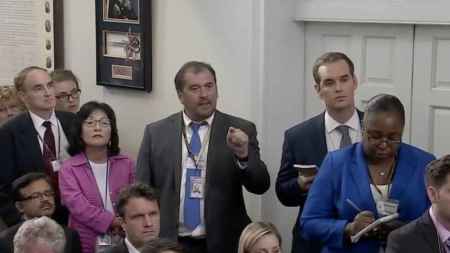
Americans, from the government to the streets, must make it clear that there is no fourth branch of government. Only when the media cartel has been broken, can a free press rise once again.
********************************
The media finally found its hero.
The hero was Brian Karem, the sweaty, surly and unshaven correspondent for Playboy, who whined that Sarah Huckabee-Sanders, the Deputy White House Press Secretary, was “bullying” the abused media.
Vox dubbed Karem “heroic” for defending “CNN’s honor.” The media’s “honor” has fallen so low that it needs defending by the red light district. If the media’s honor gets any lower, its honor will need an assist from the Mafia, Mexican drug cartels, NAMBLA and the Toxic Waste Association of America.
Karem claimed to be inspired by the tantrums of CNN’s Jim Acosta. CNN was particularly upset by the White House denying the network the precious video that it needs to show off its latest Trump attacks.
Off-camera briefings are a good start. Off-media briefings would be even better.
Under the illiterate headline, “We Stood Up to the Administration Today Because Free Press is Crucial,” Karem wrote at Playboy, “The administration supports the First Amendment – just not the people who practice it.”
And the only people entitled to practice the First Amendment, according to the media, own the media. They don’t need to know basic grammar. They don’t need to have their facts right. They just need to be part of huge media conglomerates with left-wing politics whose mission is attacking conservatives.
What got Karem’s goat (and the goats of the rest of the media herd) was that Sanders had given the first question to Breitbart. And conservative sites are not entitled to the protections of the First Amendment.
A free press is crucial. And when the White House fights for a free press by diversifying the press corps, it’s upholding the spirit of a free press that the media cartel is fighting to kill.
The entire “Fake News” outcry that Karem and the rest of his “honorable” colleagues in the media are whining about began with a media plot to censor conservative sites on social media for “Fake News.”
Why does the media believe that Playboy, but not Breitbart or the Daily Caller, have a right to be heard?
“I don’t like the entire institution of the press and free speech being castigated,” Brian Karem wheedled. “The foundation of a free republic is a free press.”
The media has reached rock bottom when a porn magazine’s correspondent starts claiming to be foundation of a free republic.
And when the media enthusiastically agrees.
The foundation of a free republic is free people. Free people have the right to say what they please. They can do it on social media, at a political protest or in the pages of a newspaper. Freedom doesn’t begin and end with the media cartel. Even though the media cartel would like nothing better.
“We can’t take the bullying anymore. It’s undermining the fourth estate, it’s undermining the first amendment,” the Playboy correspondent whined elsewhere.
America isn’t supposed to have a Fourth Estate. That’s France. But that’s what the media is. It’s not a free press. It’s a cartel that leverages control over what was once the free press. Few conservatives are allowed into its ranks. Its partisan mission is to support the left and oppose the right.
The First Amendment gives the media the freedom to do it. Not the institutional authority.
It’s the media that has zero respect for the First Amendment. Its contempt for the religious freedoms of the First Amendment is notorious. But its hostility for the free press is a more recent innovation.
The media has viciously fought the White House’s effort to diversify the press corps by bringing in conservative media. Karem’s tantrum was an outgrowth of that larger battle. Its push for “fact checks” is a cynical effort to embed censorship of conservative media outlets into Facebook and Google News. The media is the greatest enemy of a free press. And it should be treated that way.
It’s an unelected and illegitimate fourth branch of government backed by a handful of powerful interests that insists on setting the national agenda, determining who gets elected and impeaching them if the voters disagree. That is the coup that the fourth branch is busy trying to pull on President Trump.
And the media insists on determining who gets to belong to it. Playboy, yes. Breitbart, DailyCaller and Front Page Magazine, no. Playboy is a heroic defender of the media’s “honor.” Conservative sites must be censored so all that the media deems “Fake News” doesn’t undermine its political agenda.
But the media doesn’t get to decide who can belong to a free press. And what news is fake.
President Trump, Sarah Sanders Huckabee and others have called out the media as “Fake News.” And that outrages the media cartel because it challenges its institutional authority.
The media’s institutional authority shouldn’t just be challenged, it must be broken.
A free press is open to everyone. The media is a closed cartel. A free press has a diversity of opinions. The media has only one. A free press is a dialogue. The media silences dissent, from individuals to conservative outlets. A free press does not attempt to usurp democracy. That is the entire purpose of the media cartel. It manufactures an artificial consensus through mass communications propaganda.
The internet has made the media irrelevant. It also killed the very last of its ethics and journalistic integrity. All that remains are a network of partisan left-wing sites trailed by dead tree paper and dead cable outlets integrated into one heaving mess that connects CNN to ESPN to Playboy to Teen Vogue.
The media cartel is a network of money and power. This illegitimate network intersects with other institutional left-wing networks in the non-profit sector, the political sector, the academic sector and many others. Each network is a thread in a spider web that is choking the life out of this nation. And at the center sit the radical spiders that pull all the strings.
The obscene efforts of the media cartel to wrap itself in the tattered shrouds of the First Amendment are as disgusting as a man who murdered his parents begging the court to have mercy on an orphan.
The media is waging a ruthless campaign to censor its opponents under the guise of “Fake News”. Yet it plays the victim when it is criticized (rather than censored) for the dishonest lies of its partisan agenda.
It has made war on the Constitution. It rejects some parts of the Bill of Rights entirely. It is now engaged in a gargantuan effort to reverse the results of a national election. And when it is called out for its abuses of power, it contends that to criticize it is to undermine the foundation of a free republic.
How can you possibly have a free republic without CNN, MSNBC and the Washington Post? But a better question might be, how can you have a free republic when a leftist media cartel is running it?
The government should not privilege a media cartel or confuse its arrogance with authority.
Off-camera briefings should become off-media briefings. Media outlets that want to act like campus crybullies should be booted. Dot coms that clamor for Net Neutrality but then use media “fact checks” to censor conservative competitors should be called out for their partisan hypocrisy.
The White House’s battle against the media cartel is the best defense of the First Amendment.
Americans, from the government to the streets, must make it clear that there is no fourth branch of government. Only when the media cartel has been broken, can a free press rise once again.
Ignatius: Fighters in Syria Cheer Mention of Trump’s Name, Washington Free Beacon, July 3, 2017
Washington Post columnist David Ignatius said Monday that during his travels in Syria, rebel fighters there cheered any mention of President Donald Trump’s name.
Appearing on MSNBC’s “Morning Joe,” Ignatius prefaced his comments by warning that he would say something “sympathetic to Trump.” It was only the second airing of the show since Trump touched off a firestorm with his tweets mocking Joe Scarborough and Mika Brzezinski.
“As I traveled across Syria meeting with Syrian fighters who were trying to take down the regime of Bashar al-Assad, every time the name President Trump was mentioned, there were cheers from the audience,” he said in a clip flagged by Legal Insurrection.
One Syrian Kurdish commander, Ignatius said, colorfully remarked Trump had the equivalent of what would be called “cajones” in Spanish. Ignatius said Trump’s looser approach allowed commanders on the ground to more expeditiously carry out operations.
“More seriously, the big attacks that have taken place around Raqqa, one in particular, a surprise landing by helicopter, I was told, by the top U.S. commanders, would not have taken place if it hadn’t been for President Trump’s decision to delegate military authorities down to the level of command,” Ignatius said. “Under Obama, that would have taken a couple weeks of White House meetings, and they still wouldn’t have made up their mind.”
In March, the U.S. airlifted hundreds of fighters in an attack to help cut off Raqqa, the Islamic State’s proclaimed capital. The New York Times reported this was a result of Trump’s delegating approach.
Trump ordered a retaliatory strike against Syria in April after Assad’s regime killed more than 80 people in a chemical attack. Last week, the White House publicly threatened him with a “heavy price” if he carried out another attack.
U.S. Ambassador to the United Nations Nikki Haley said Trump’s warning to the Syrian regime to not deploy a chemical weapons attack saved “many innocent men, women and children.”
Palestinians: Mohammad Dahlan, the New Mayor of the Gaza Strip? Gatestone Institute, Khaled Abu Toameh, July 3, 2017
(Please see also, What Hamas Wants. — DM)
This new reality could buy quiet in the short term. In the long term, however, Hamas is likely to emerge as stronger and more prepared for the next war with Israel.
***********************************
Dahlan will be functioning under the watchful eye of Hamas, which will remain the real de facto and unchallenged ruler of the Gaza Strip. Hamas is willing to allow Dahlan to return to the Palestinian political scene through the Gaza Strip window. But he will be on a very short leash.
Dahlan’s presence in the Gaza Strip will not deter Hamas from continuing with its preparations for another war with Israel.
Dahlan will find himself playing the role of fundraiser for the Palestinians in the Gaza Strip while Hamas hides behind his formidable political shoulders.
Mohammed Dahlan is an aspiring Palestinian with huge political ambitions. Specifically, he hopes to succeed Mahmoud Abbas as president of the Palestinian Authority (PA). Knowing this, Abbas expelled him from the ruling Fatah faction in 2011. Since then, Dahlan has been living in the United Arab Emirates.
Hamas, the Islamist movement that has controlled the Gaza Strip for the past decade, used to consider Dahlan one of its fiercest enemies.
As commander of the notorious Preventive Security Service (PSS) in the Gaza Strip in the 1990s, Dahlan was personally responsible for the PA’s security crackdown on Hamas. On his instructions, hundreds of Hamas activists were routinely targeted and detained.
The enmity was mutual; Dahlan too considered Hamas a major threat to him and the PA regime in the Gaza Strip.
Dahlan’s contempt for Hamas knew no limits. On his orders, Hamas founder and spiritual leader Ahmed Yassin was placed under house arrest.
Two other senior Hamas officials, Mahmoud Zahar and Abdel Aziz Rantisi, were repeatedly detained and tortured by Dahlan’s agents. At one point, Dahlan ordered his interrogators to shave the two men’s beards as a way of humiliating them.
During and after its violent takeover of the Gaza Strip in 2007, Hamas targeted Dahlan’s PSS and loyalists. Some were killed or incarcerated, while many others were forced to flee the Gaza Strip to Egypt and the West Bank. For many years, Dahlan was at the top of Hamas’s most wanted fugitives. No longer.
Erstwhile enemies, Dahlan and Hamas today have a common foe: Mahmoud Abbas. They seem about to join forces to repay him for the humiliation they have suffered at his hands.
Dahlan has long sought revenge for Abbas’s decision to expel him from Fatah and prosecute him on charges of murder and embezzlement. Dahlan will never forgive Abbas for dispatching security officers to raid his Ramallah residence and confiscate documents and other equipment. On that day, Dahlan slunk out of Ramallah.
Dahlan found refuge in the United Arab Emirates, a wealthy Gulf country whose rulers seem very fond of him. He receives millions of dollars from his Gulf hosts. Until today, Abbas regards Dahlan, who was once an intimate associate, as his main enemy.
Exile has been good for Dahlan. Thanks to the United Arab Emirates and Egypt, Dahlan has amassed enough power and money to become a major player in the Palestinian arena.
In the past few years, he has succeeded in building bases of power in the West Bank and Gaza Strip, largely with the cash that he has been providing to his loyalists and others.
More importantly, Dahlan has succeeded in building a personal relationship with Egyptian President Abdel Fattah el-Sisi, who also seems rather partial to him. While this relationship has alienated Abbas, Hamas sees it as an opportunity to rid itself of its increased isolation in the Gaza Strip.
Hamas’s predicament has been exacerbated by the continued Egyptian blockade on the Gaza Strip, specifically the closure of the Rafah border crossing, and a series of punitive measures taken by Abbas in recent weeks.
These measures, which are being described by Hamas as a “declaration of war” on the Gaza Strip, include refusing to pay for electricity that Israel supplies to the Gaza Strip, halting the shipment of medicine from the West Bank, denying permits to patients to leave the Gaza Strip for medical treatment, and cutting off salaries to thousands of PA and Hamas civil servants and former security prisoners (who had served time in Israeli prisons).
Dahlan is desperate to make a comeback to the Palestinian political scene. He is fed up with exile, far from his friends in the West Bank and Gaza Strip. He is also aware that the 82-year-old Abbas may be nearing his end, especially in light of rumors concerning his failing health.
 Mohammed Dahlan addresses a political rally on January 7, 2007 in Gaza City. (Photo by Abid Katib/Getty Images)
Dahlan also sees Hamas’s desperation now that its main patron, Qatar, is facing massive pressure from Saudi Arabia and other Arab countries to cease funding the Islamist movement and its mother group, Muslim Brotherhood.
Hamas wants to hold on to power in the Gaza Strip at any cost, even if that means swallowing the poison pill of aligning itself with someone like Dahlan.
Hamas has no intention of changing its ideology or engaging in any peace process with Israel. It will not recognize Israel’s right to exist or abandon the “armed struggle” to liberate all of Palestine, “from the Mediterranean Sea to the Jordan River.” The name of the game, as far as Hamas is considered, is survival.
Hamas fears that the continued Egyptian blockade and Abbas’s draconian measures may undermine its rule over the Gaza Strip.
Even worse, Hamas fears that the pressure and sanctions could trigger a Palestinian “intifada” in the Gaza Strip. Hamas knows full well that the electricity crisis and lack of medicine is destined to explode in its face.
Hamas believes it has now found a way out of the crisis.
Ironically, yesterday’s number one enemy, Dahlan, could prove to be the savior — the very Dahlan who imprisoned and tortured and killed many Hamas members and leaders. The same Dahlan who, as a security commander in the Gaza Strip, was responsible for security coordination with the “Zionist enemy.” The Dahlan who is one of the main byproducts and symbols of the Oslo Accords, which Hamas continues to reject to this day.
Last month, Hamas leaders traveled to Cairo for talks with Egyptian intelligence officials and representatives of Dahlan, on ways of ending the “humanitarian crisis” in the Gaza Strip. It was the first meeting of its kind between Dahlan’s men and Hamas leaders.
Mahmoud Zahar, a senior Hamas official, disclosed that the two sides reached “understandings” over a number of issues, including the reopening of the Rafah crossing between Egypt and Gaza, and allowing entry of medicine and fuel for the power plants in the Gaza Strip.
Hamas also reached an agreement with the Egyptians to build a security buffer zone along the border between the Gaza Strip and Egypt, to stop the smuggling of weapons and the infiltration of terrorists. This week, Hamas bulldozers were already seen breaking ground along the border.
The unexpected rapprochement between Dahlan and Hamas has already resulted in the return of some of Dahlan’s loyalists to the Gaza Strip. Now, everyone is waiting to see if and when Dahlan himself will be permitted to return to his home in the Gaza Strip.
Sources in the Gaza Strip believe that the countdown for Dahlan’s return has begun. The sources also believe that he may be entrusted with serving as “prime minister” of a new government, while Hamas remains in charge of overall security in the Gaza Strip.
In fact, Hamas already has its own “administrative committee” that functions as a government.
Dahlan’s role will be to help break the blockade on the Gaza Strip, attract Arab and Western funds, and improve living conditions and the economy.
Dahlan, in short, may be on his way to become Mayor of the Gaza Strip.
Already this week, there were signs that Dahlan may have already succeeded in convincing Hamas that he is indeed the long-awaited savior: Egyptians began dispatching trucks loaded with fuel to the Gaza Strip to help solve the electricity crisis. Moreover, the Egyptian authorities have expressed readiness to reopen the Rafah terminal.
The “understandings” reached between Dahlan and Hamas may help alleviate the suffering of the Palestinians in the Gaza Strip and pave the way for improving the economy. However, the biggest winner will be Hamas, which is not being required to make any meaningful concessions other than allowing Dahlan and his loyalists back into the Gaza Strip.
Dahlan will be functioning under the watchful eye of Hamas, which will remain the real de facto and unchallenged ruler of the Gaza Strip. Hamas is willing to allow Dahlan to return to the Palestinian political scene through the Gaza Strip window. But he will be on a very short leash.
Dahlan’s presence in the Gaza Strip will not deter Hamas from continuing with its preparations for another war with Israel.
Hamas is not going to stop digging tunnels along the border with Israel for fear of Dahlan. He will likely enjoy extensive civilian powers, but security matters will remain in the hands of Hamas and its military wing, Ezaddin al-Qassam.
Dahlan will find himself playing the role of fundraiser for the Palestinians in the Gaza Strip while Hamas hides behind his formidable political shoulders.
This new reality could buy quiet in the short term. In the long term, however, Hamas is likely to emerge as stronger and more prepared for the next war with Israel.
For Dahlan and Hamas, it’s win-win. No wonder, then, that Abbas and his friends in the West Bank are angry and anxious.
The unholy alliance between Dahlan and Hamas, in their view, is nothing less than an attempt to establish a separate Palestinian state in the Gaza Strip.
The international audience might wish to take note: it is now official — the division between the West Bank and Gaza Strip marks the end of the so-called two-state solution. On the Palestinian street, it appears that the Palestinians are closer than ever to achieving two separate entities of their own — one that is run by Abbas’s Palestinian Authority and another controlled by Hamas and Dahlan.
Khaled Abu Toameh, an award-winning journalist and television presence, is based in Jerusalem.
What Hamas Wants, Front Page Magazine, Herbert London, July 3, 2017

As is evident, there cannot be a negotiated settlement in the Middle East unless you are considering an Israel engaged in preemptive surrender. In the mind of Hamas, a peace treaty similar to the one negotiated between Israel and Egypt would be a form of high treason. Hamas regards itself as the spearhead in the struggle against world Zionism and will not concede an inch of this designation.
***********************************
Illusions in the Middle East die hard. However, with the publication of Hamas’ new political document, there shouldn’t be any doubt about the motives of this Muslim Brotherhood organization. The western press continues to assert that Hamas is “moderating” its views, but the document itself offers a different picture.
The main points of the new political document are:
In the last year, Hamas has altered the wording in many of its public statements to seem accommodating. Presumably naiveté in the West has given it leverage at the U.N. and as a legitimate political actor on the world stage. In fact, the modification in language is an exercise in “taqiyyah” (deception in the cause of Allah). Impression, not substance, is what counts for Hamas officials.
The real goal is to gain control of the PLO, thereby securing legitimate rule over all the Palestinian territories and using that influence on international bodies. To subvert Israel’s power, Hamas deploys diplomatic and propaganda techniques. Hence it is often difficult to distinguish between lies, fabrications and exaggerated claims coming from the leadership.
With the publication of the new political document, Hamas is hoist by its own petard. There is no question it will not recognize the Jewish state. Moreover, any claim about Israel that relies on historical antecedents is deemed inaccurate. For Hamas, Israel is an historic blindspot. Fortunately, there are those in the Trump White House who understand the futility of the Hamas stance.
Should one engage in a serious investigation of Hamas, it will become obvious that the goals have remained unaltered, the purpose of the organization intact and tactics unchanged. There is a good reason to suspect that will be the case decades ahead, for if Hamas had modified its position it could not attract volunteers to its cause.
Netanyahu slammed Hamas as the metamorphosis of an ideology that emerged in 1928. He claims that it does little more than proselytize for radical ideas. Whether Netanyahu is right, is less relevant than how Hamas describes itself. Here the Netanyahu claims and the Hamas document converge. If the land of Palestine is consecrated for future Moslem generations until Judgment Day, every individual sharing the faith has an obligation – as part of his religious duty – to fight for this territory free of Jews. A good Muslim is he who loudly proclaims, “Hail to Jihad!” and struggles continuously for the achievement of liberation.
As is evident, there cannot be a negotiated settlement in the Middle East unless you are considering an Israel engaged in preemptive surrender. In the mind of Hamas, a peace treaty similar to the one negotiated between Israel and Egypt would be a form of high treason. Hamas regards itself as the spearhead in the struggle against world Zionism and will not concede an inch of this designation.
So let’s get over the pollyannish view peace can be negotiated. It will not be negotiated as long as one side at the negotiating table wants to kill those across from them. That is the reality, however difficult it is to accept.
Herbert London in President of the London Center for Policy Research.
UK Universities and the PC Police, Clarion Project, Meira Svirsky, July 3, 2017
 Jonaya English (Photo: Video screenshot)
A police offer in the UK has threatened young woman he will pressure her university to withdraw her acceptance over a comment she made on social media about Islamist terrorism. He has also threatened her with charges of harassment.
The young woman, named Jonaya English and who is set to enter Newcastle University, engaged with a former high school acquaintance on Twitter after the attack at the Finsbury Mosque.
The acquaintance, who tweets under the handle of @mariamiwaseem posted a tweet stating that UK’s anti-radicalization program Prevent is tainted because it created suspicion about Muslims being terrorists; moreover, the Finsbury Mosque attack proves that Muslims are victims, not perpetrators.
In response, English tweeted back that, while the attack on the mosque was wrong, one attack on a mosque proved nothing and that the majority of the time, Muslims were the perpetrators of attacks. “Where do they learn it?” English asked. “The Quran.”
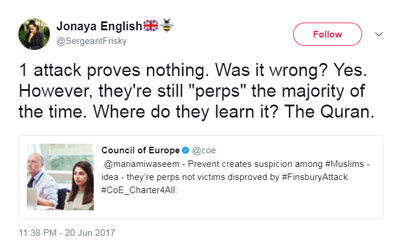
English subsequently received an email from Police Constable Mohammed Khan, saying that if she didn’t engage with him, he would ask Newcastle University to withdraw its offer to her as a “safeguarding measure.”
The officer’s communications to English appear below in a tweet by UK media personality Katie Hopkins who asks the officer’s Northumbria Police Department: “Who is the head of your force please? Are you guys sharia?”

“I was stating a fact,” English states in a video (below) she made to explain the incident. “Muslims are the perpetrators most of the time, and they get these ideas from the Quran.”
English continued, “The thing that made this disgusting was that the officer, who was also a Muslim, said that he will try to get the university to withdraw my [acceptance]. I wrote a tweet about a political opinion which is all over the political forum which is Twitter. Somebody [who] clearly doesn’t like this decides to report me for ‘harassment.’ It’s … simply an allegation (and a false one at that) and the officer says he’s going to get my offer withdrawn.”
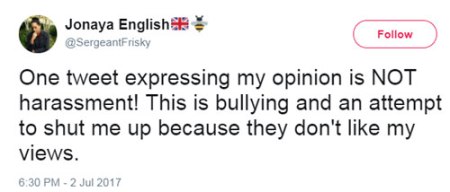
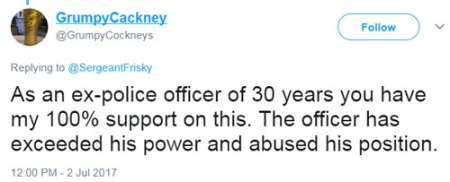
As one former police officer said: “This officer has exceeded his power and abused his position.”
While the saga of this story continues, it is worth contrasting it to statements made by the president of the UK’s Salford University’s Student Union. Zamzam Ibrahim, a Muslim of Somali decent who was elected president of the union in March, recently made headlines with her responses to questions posed on AskFM (a question and answer-based social media network).
When asked, “What’s the one book you think everyone should be required to read?” she answered, “The Quran, We would have an Islamic takeover!”
Ibrahim, who recently completely a bachelor’s degree in business and financial management, also opposes the UK government’s Prevent program, calling it “disastrous” and “racist.”

Writing under the hashtag #IfIwasPresident, Ibrahim tweeted, “I’d oppress white people just to give them a taste of what they put us through! #LMFAO [Laughing my f—king ass off] ”
Yet, no complaints of harassment or threats from the police have been brought against Ibrahim.
The stifling of conversation – including the chilling effect on free speech caused by members of the UK police force – set a dangerous precedent for democratic societies worldwide. Officers, whose job it is to uphold the law – which includes the guarantee of free speech — are becoming self-appointed (or worse, are directed to become) enforcers of political correctness (i.e., whatever values happen to be in style at the moment).
Preventing the free exchange of ideas and, in this case, pushing the narrative that Islamists are not the main perpetrators of terror attacks, not only defies the facts, but it creates an atmosphere that breeds violence such as the revenge attack on the Finsbury Mosque.
If we not allowed to talk about Islamism, the driving force behind the world’s current blight of terrorism, it will be left to the far-right extremists to defend their countries in the only language they are convinced will be effective.
Source: Xi Jinping to meet Putin in Moscow for 3rd time this year to strike $10bn worth of deals — RT News

FILE PHOTO: Russian President Vladimir Putin shakes hands with Chinese President Xi Jinping during their meeting. © Aleksey Nikolskyi / Reuters
Xi is making a two-day stop on his way to Germany, where a G20 summit is set to take place later this week.
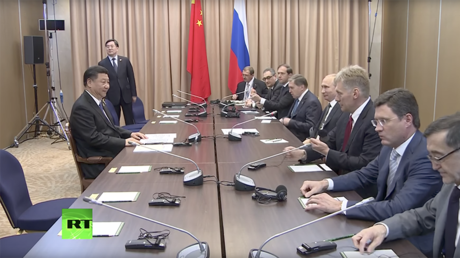
Putin will hold an informal meeting with Xi on Monday evening, Kremlin spokesman Dmitry Peskov said.
“This evening, within Chinese President Xi Jinping’s official visit, there will be an informal dinner for President Putin and Xi Jinping at the Kremlin,” Peskov told journalists.
Xi’s official visit would start on Tuesday and will include bilateral talks, according to the spokesman.
“It will have an unusual format [of the meeting]: the leaders will meet [Russian and Chinese] representatives of the public, businesses and media, who will briefly inform Putin and Xi Jinping on their cooperation,” Peskov added.
Ahead of his visit, the Chinese leader gave an interview to Russia’s TASS news agency, in which he particularly focused on the issue of deployment of the US THAAD missile defense systems to South Korea.
Xi criticized the move as “disrupting the strategic balance in the region” and threatening the security interests of all countries in the region, including Russia and China. He also reiterated that Beijing is urging Washington and Seoul to back away from the decision to deploy THAAD systems to the Korean peninsula.
Less than a month ago, Putin and Xi met in Kazakhstan’s capital, Astana, on the sidelines of a Shanghai Cooperation Organization summit. At that time, Putin called the upcoming meeting in Moscow “a major event in bilateral relations,” noting that it would have a “significant” impact on bilateral ties.
“By tradition, we use every opportunity to meet and to discuss bilateral relations and the international agenda,” the Russian president said.
The Chinese leader noted that “every new meeting brings new opportunities for an exchange of opinions,” adding that “the numerous meetings at various venues indicate the high level of bilateral relations” between Moscow and Beijing.
Before the Astana meeting on June 8, Xi had hosted Putin in Beijing during the high-level ‘One Belt, One Road’ forum, which brought together dozens of heads of state in May to discuss international cooperation.
During Xi’s visit to Moscow, scheduled for July 3-4, Russia and China will sign several contracts worth a total of $10 billion, as well as more than a dozen intergovernmental agreements on cooperation in various fields, TASS reported, citing Chinese Assistant Foreign Minister Li Huilai.

Andrey Denisov, Russia’s ambassador to China, told TASS the leaders will sign numerous corporate agreements between Russian and Chinese companies. “We’re discussing a number of draft documents, both on government and corporate levels. And we have dozens of documents relating to the former group,” he said.
Moscow and Beijing are determined to align positions on pressing international issues, he said. Close ties allow the countries “to pursue a rather close course on various aspects of the agenda of international organizations, including the United Nations,” according to the ambassador. “To put it directly, it produces a sobering effect on our partners in these international organizations,” he added.
“When good intentions framed in lofty words lead to chaos, the collapse of states and, in the long run, to bloodshed and numerous human casualties, the role of stabilizers, of the factors that may have a cooling, stabilizing effect on the generally turbulent international situation is very important. And Russian-Chinese relations are, to my mind, such a stabilizing factor,” Denisov said.
Chinese envoy to Moscow Li Hui said, “the comprehensive strategic partnership of coordination between China and Russia has been developing stably, sustainably, and at a high level.”
Moscow and Beijing have strengthened their strategic partnership on the international stage, Li noted, adding that they have been jointly pushing for political solutions to the Korean nuclear issue and the Syrian crisis.
Source: Israel Hayom | Modi: Israel is perceived as a technological powerhouse
Ahead of his historic visit to Israel, Indian Prime Minister Narendra Modi tells Israel Hayom that the two countries are ready to “take the relationship to a new level” • Israel “braved many odds” and has “amazing accomplishments,” he says.
|
Israel Hayom Editor-in-Chief Boaz Bismuth with Indian Prime Minister Narendra Modi
|
It is not every day that one meets a prime minister representing 1.2 billion people, one considered a superstar at home and abroad. Maybe that is why the meeting with Indian Prime Minister Narendra Modi felt so special.
Modi is set to arrive in Israel on July 4 for what will be a historic visit: the first to this country by a sitting Indian prime minister. Despite the disparity in the sizes of the two countries, the relationship between them is one of equals, as far as he is concerned.
Modi is a different kind of leader. With sky-high popularity among Indians, he can say what he wants and push for the reforms he seeks. He has tried to move India forward and make it a global leader. For him, the path to achieving those goals passes through Israel. This should be a badge of honor for all Israelis. He knows Indians love him, but he also knows that he must not fail. That is his big challenge.
When I arrive at Modi’s official residence, I discover that the man who always looks tough in front of the cameras is a friendly person who knows how to smile. He takes immense pride in his success in pulling himself up by the bootstraps after being born into poverty.
Exuding confidence, Modi shares with me a local dictum he uses as his mantra: “Sarvajan Hitay Sarvajan Sukhay, Sabka Saath, Sabka Vikas.” Loosely translated, it means, “In the interest of all, for the benefit of all, together with all, development for all.”
Throughout the interview, he makes a conscious effort to point out the deep ties between the Indian and Israeli peoples. He believes the two nations are soulmates. They share a spirit of entrepreneurship and innovation that gives the partnership its own dimension. He and his people have also gone out of their way to tap into this sentiment by organizing a rally for the local Indian community in Tel Aviv on July 5, to be led by Modi himself. He considers this a very important part of his trip, his way of showing his respect to the local Indian community.
Q. What do you know about Israel? Have you ever visited Israel?
“I got firsthand experience of Israel during my visit to Israel in 2006, as chief minister of the Indian State of Gujarat, to take part in an Agritech exhibition. I am happy to return after more than a decade, and I look forward to seeing the developments and advances Israel has made in this time.
“I share the view of many of my fellow citizens about Israel. In India, Israel is perceived as a technological powerhouse, and a country that has braved many odds. Many tech-based inventions have their roots in Israeli universities and laboratories and have benefited humankind. These include articles ranging from USB flash drives to cherry tomatoes. The way you transformed yourself from being a water-deficient country to a water-surplus country; the manner in which you made your deserts bloom, are all amazing accomplishments. All these images have made a deep imprint on my mind.”
Q. Why have you made a decision to go ahead with this historic visit?
“Bilateral ties between our countries have always been strong. In fact, over the years, they have been continuously expanding and diversifying. In the recent past, the steady strengthening of our ties has begun finding reflection and reinforcement in high-level visits. You would have noticed that the frequency of exchanges has gone up over the last three years. No Indian president or prime minister had visited Israel before our president visited in 2015. President Reuven Rivlin’s visit to India in 2016 was only the second Israeli presidential visit to India.
“My forthcoming visit reminds us of the deep and centuries old connect between our societies. It is in line with our view that our ties should be reflected in all spheres of our engagement and backed by regular high-level contact. I think that this year, as we celebrate 25 years of our diplomatic relations, it is an opportune occasion to take the relationship to a new level.”
Q. Does this decision imply a more pro-Israel posture in the U.N.?
“Our positions at the U.N. are based on the merit of specific issues and driven by our core values and principles. We remain engaged with all our partners, including Israel, in finding optimal outcomes at the U.N. and other multilateral fora that reflect our commonly shared priorities and concerns. India is not in favor of singling out any country at the U.N.”
Q. Does India still consider itself unaligned with either the West or the East?
“We believe in the philosophy of ‘Vasudhaiva Kutumbakam,’ which means ‘the world is one family.’ We want to engage constructively with both the East and the West.
Q. Are Israel and India facing the same threat of terrorism?
“Terrorism is a global menace. India and Israel are not immune to it either. We are in full agreement that elements which perpetrate violence on innocent people should not be allowed to flourish. Cross-border terrorism is a major challenge for us. Divisive forces across our border are trying to disrupt the unity of our nation. These troublemakers often misuse religion as a tool to misguide youth in our country and our regions. Terrorism should not be equated with any particular religion. India and Israel could cooperate even more closely and complement each other’s efforts to fight with the menace of terrorism.”
Q. Is this a reset or an upgrade of relations?
“My visit has its own significance as this is the first time ever that an Indian PM is visiting Israel. I am confident that my visit will lead to further strengthening of our relations in different areas and also open up new priorities for cooperation.”
Q. Will you agree to visit Jerusalem and the Western Wall like President Donald Trump?
“The principal objective of my visit is to deepen bilateral relations between India and Israel. I am sure I will visit Jerusalem. Elements of my visit and its program is being so arranged so that we can focus to taking forward our partnership with Israel in all the spheres, including technology and innovation links, agriculture and efficient resource use. “
Q. What is your position on the question of sovereignty in Jerusalem? Will India move its embassy?
“We believe in a two-state solution in which both Israel and a future Palestinian state coexist peacefully. A final-status agreement should respect the sentiments and address demands of all affected parties. The key to finding a solution to this issue lies with the affected parties. India supports all efforts to find an acceptable solution to all the pending issues, including Jerusalem. I assume the question refers to our embassy in Tel Aviv. We will take a decision on that after both sides have come to an agreement on Jerusalem.”
Q. Your biography, as a man who grew up in poverty and climbed up the ladder with hard work to become the country’s head of government, is impressive by any measure. But despite your past, you are an ardent supporter of the capitalist system and want to liberalize the economy. Can you explain what shaped your worldview?
“I do not believe in any ‘-isms.’ I, and my government work with the motto of ‘Together with all, development for all.’ We want our youth to become not just job-seekers but job-givers. We will adopt all measures necessary to unlock the innovation and entrepreneurial potential of our youth. My yardstick for supporting or advocating any course of action is the net benefit or value it brings to the lives of our people. And when this consideration is put first, the results can be deeply rewarding. I have seen that in my own home state, Gujarat in Western India, where I was the chief minister for 13 years, and now on the national scale in India.”
Q. You have tried to reform Indian society, in part by the use of modern technology in remote and rural communities that lack proper sanitary conditions. Can Israel play a role in this?
“Certainly. Israel could be a technology partner in this process of transformation. Israel’s capabilities offer a good match for our flagship schemes like Clean Ganga [the effort to clean the Ganges River] and Smart Cities. Israeli technologies could also be used to improve the quality of lives of hundreds of thousands of people in our country if Israeli innovators remodel their products according to the needs of our rural population. It is important to understand market trends among the rural sections.”
Q. What is the difference between the approach Israelis and Indians have when it comes to business, agriculture and other fields?
“As societies, India and Israel are both driven by a strong entrepreneurial mindset. Business cultures in the two countries are unique and have evolved from their respective context in which each has evolved. There may be differences in their approach but the Indian and Israeli businessmen whom I know have told me that both have similar scientific temperament.
Q. How can we describe to the average person what innovation ties are there between Israelis and Indians?
“I think the average person is highly aware of our innovation ties as the outcome of our engagement touches his life. Our perspective on innovation may be varied by but we both rely on it to add wealth and value to our societies. Israelis and Indians are innovative by birth. India and Israel both support and sustain unique innovation ecosystems. Our common effort is also to link the creativity of innovation with the energy of entrepreneurship.
Q. What kind of Israeli imports does India seek?
“We are not looking at a traditional import-export relationship with Israel. It is more than a buyer-seller relationship. We are more interested in a tech-based partnership with an emphasis on ‘Make in India.’ The Israeli industry has been fairly positive to many of our flagship schemes like ‘Clean Ganga.’ There is tremendous scope for deepening the extent of partnership in India’s flagship schemes.”
China says Sino-British Joint Declaration on Hong Kong no longer has meaning, China Daily Mail, Craig Hill, July 1, 2017
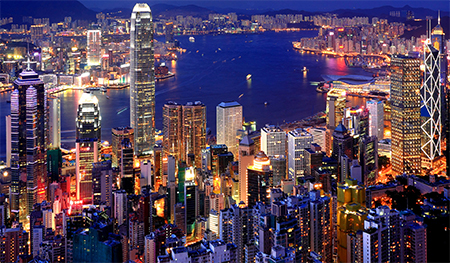 Hong Kong
China said on Friday the joint declaration with Britain over Hong Kong, which laid the blueprint over how the city would be ruled after its return to China in 1997, was a historical document that no longer had any practical significance.
In response, Britain said the declaration remained in force and was a legally valid treaty to which it was committed to upholding.
The stark announcement from the Chinese Foreign Ministry, that is sure to raise questions over Beijing’s commitment to Hong Kong’s core freedoms, came the same day Chinese President Xi Jinping said in Hong Kong the “one country, two systems” formula was recognized “by the whole world”.
It was not immediately clear if Foreign Ministry spokesman Lu Kang was attacking just the idea of continued British involvement in Hong Kong, which marks the 20th anniversary of Chinese rule on Saturday, or the principles in the document.
The Sino-British Joint Declaration, signed in 1984 by then British Prime Minister Margaret Thatcher and Chinese Premier Zhao Ziyang, laid out how Britain would end its century-and-a-half long rule over Hong Kong. It also guarantees the city’s rights and freedoms under the “two systems” formula.
Under Hong Kong’s mini-constitution, the Basic Law, Hong Kong was guaranteed its freedoms for “at least 50 years” after 1997.
Lu told reporters during a regular briefing on Friday that the document no longer binds China.
“Now Hong Kong has returned to the motherland’s embrace for 20 years, the Sino-British Joint Declaration, as a historical document, no longer has any practical significance, and it is not at all binding for the central government’s management over Hong Kong. The UK has no sovereignty, no power to rule and no power to supervise Hong Kong after the handover,” Lu said.
Britain said it had a legal responsibility to ensure China abided by its obligations under the declaration.
“The Sino-British Joint Declaration remains as valid today as it did when it was signed over 30 years ago,” a British Foreign Officespokeswoman said.
“It is a legally binding treaty, registered with the U.N. and continues to be in force. As a co-signatory, the UK government is committed to monitoring its implementation closely.”
On Thursday, British Foreign Secretary Boris Johnson said Britain hoped that Hong Kong would make more progress toward democracy.
“Britain’s commitment to Hong Kong – enshrined in the Joint Declaration with China – is just as strong today as it was 20 years ago,” Johnson said. “I’ve no doubt that Hong Kong’s future success will depend on the rights and freedoms protected by that treaty.”
Reporting by Ben Blanchard in Beijing and Michael Holden in London; Writing by Venus Wu; Editing by Nick Macfie and Alison Williams)




 anneinpt
 artaxes
 danmillerinpanama
 davidking1530
 Peter Hofman
 Joseph Wouk
 Peter
Peter Louisiana Steve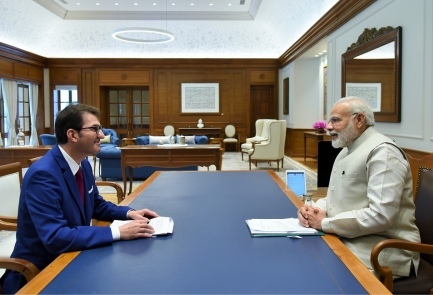
 WarSclerotic
Recent Comments