Archive for July 20, 2017

Is Turkey Becoming Another Iran?

July 20, 2017

Is Turkey Becoming Another Iran? Gatestone InstituteUzay Bulut, July 20, 2017

“Because Muslims do not carry out the requirements of their faith, today all Palestinian territories are under the Zionist occupation. Gaza and the West Bank are like open prisons. Due to the embargo and isolation imposed on Palestine, children are dying of hunger and the ill cannot be treated because of a lack of medicine. As there is not enough food, even drinking water is not provided.”

“The Jews are the enemies of the entire ummah [Islamic nation]. Our prophet said that we will fight against the Jews before the end of days. Standing for the ummah, our Muslim siblings in Palestine and Gaza are struggling against them. I wish we too had the opportunity to be in Gaza and Palestine and help our siblings. I wish we too could fight against cursed Jews.”

With more Islamization of the Turkish educational system will come the segregation of women and men and the deterioration of women’s rights; more pressure and hostility to non-Muslim communities; more violent anti-Semitism; more anti-Western and anti-Israel bigotry, as well as more sympathy with, and even active participation in, jihad. These developments will automatically create less stability and less safety both in Turkey and throughout the Middle East as well as Europe.

Given the political developments in Turkey for more than a decade, the country seems to be fast-forwarding to be the second — and possibly even a more dangerous version of — the Islamic Republic of Iran.

***************************

Evolution will no longer be taught in Turkish secondary schools, after being described as a “controversial subject” by the government.

So, the question naturally arises what exactly will Turkish schoolchildren be taught instead. The answer is “jihad.” Turkey is in the process of including the concept of jihad in compulsory school curricula. In eighth grade, jihad will also be taught under the title “Struggling on the Path to Allah: Jihad,” under a chapter called “Worshipping Allah.”

The Ministry of National Education has also increased class hours for the mandatory course in “religion, culture and morality,” and decreased art and philosophy classes to one hour per week.

Turkey has recently been in the news for various developments that include, among other matters, its record number of jailed journalists, the destruction of Kurdish towns and forced displacement of thousands of Kurds, the dismissal or suspension of thousands of government employees for political reasons, the arrest of thousands of citizens for allegedly “organizing” last year’s failed coup, the creeping conversion of the Hagia Sophia Basilica-museum into a mosque, and the seizure of Assyrian Christian lands, churches and cemeteries by the government.

One additional trend begging the media’s attention is the determined Islamization of the Turkish educational system.

Here is a short list of some of the latest developments in Turkish schools and their curricula:

Turkey to stop teaching evolution in secondary schools as part of new national curriculum

Evolution will no longer be taught in Turkish secondary schools after being described as a “controversial subject” by the government. The head of the education ministry’s curriculum board, Alpaslan Durmuş, said a section on Darwinism would be cut from biology classes from 2019.

“We have excluded controversial subjects for students at an age unable yet to understand the issues’ scientific background,” he told a seminar in Ankara, according to Hurriyet Daily News.

“Jihad” in compulsory school curricula

So the question naturally arises what exactly will Turkish schoolchildren be taught instead. The answer is “jihad.” Turkey is in the process of including the concept of jihad in compulsory school curricula. According to a statement issued in January by the Turkish Ministry of National Education, Turkish textbooks will be teaching “jihad” as a “value” in classes at Imam Hatip middle schools (schools that offer an Islamic curriculum to pupils).

At a press conference, Ismet Yilmaz, the minister of national education, explained the details of the new curricula to the press. According to the newspaper Cumhuriyet, jihad will be taught in seventh grade while pupils study the fundamentals of “tawhid” (oneness of God) and wahdat (Islamic unity) civilization.”

In eighth grade, jihad will also be taught under the title “Struggling on the Path to Allah: Jihad” under the chapter called “Worshipping Allah.”

1.5 million Imam Hatip students across Turkey

Under Turkish president Recep Tayyip Erdogan’s Justice and Development Party (AKP), the number of Imam Hatip schools has ballooned from 500 to 3,500, with enrollment surging from 60,000 to 1,500,000 since the AKP first came to power in 2002.

The first Imam Hatip schools in Turkey were opened in 1924 during the rule of the Republic’s first president, Mustafa Kemal Ataturk, as vocational schools to train government-employed imams and Islamic scholars.

“All schools shall have masjids (mosques)”

The Ministry of National Education has also declared that for schools and other educational centers to be opened in Turkey, they have to have a washroom where people can perform ablution before reciting their prayers [salah] five times a day, as well as two masjids [mosques] — one for males and the other for females.

More Islamic classes, less art and philosophy

The Ministry of National Education has also increased class hours for the mandatory course in “religion, culture and morality” and decreased art and philosophy classes to one hour per week. The Ministry also repealed the “Regulations on Fine Arts Education,” which were enacted in 2008 “to give primary and secondary school students with special talents the necessary education to prepare them for the fine arts schools.”

Secularism, positivism “problems of faith”

The new curricula prepared by the Ministry of National Education to be studied at Turkish schools also describe “secularism, positivism, deism, agnosticism, atheism, nihilism, Satanism, reincarnation and false prophethood” as “problems of faith.”

Girls in niqabs in private-funded Islamic organizations

Full Islamization is overtly and increasingly on the rise in private associations, as well. The association of “Fans of the Prophet and the Generation of the Koran Platform” has been offering education on Islamic scriptures to its female and male members and organizing flamboyant ceremonies of “ratification.” The association has 63 branches across Turkey.

In 2014, for example, 144 female students wearing the niqab were given “documents of ratification” after completing their religious education in the city of Batman. The students were referred to with Arabic-Islamic names instead of their real Turkish or Kurdish names.

The association also celebrates “Jerusalem Day” on the last Friday of every Ramadan. Murat Güneş, a platform member, falsely claimed in his speech in the city of Batman last year:

“Because Muslims do not carry out the requirements of their faith, today all Palestinian territories are under the Zionist occupation. Gaza and the West Bank are like open prisons. Due to the embargo and isolation imposed on Palestine, children are dying of hunger and the ill cannot be treated because of a lack of medicine. As there is not enough food, even drinking water is not provided.”

Another Islamic organization famous for its female students, covered from head to toe is the Diyarbakir-based “Union of Scholars and Madrasahs” [Islamic theological schools].

After completing their four-year religious education organized by the Union, 78 female students in niqabs were presented with their “documents of ratification” in the city of Batman in 2015.

A graduate in niqab said: “This cause has sacrificed so many. Let them not forget that we — as individuals ready to sacrifice ourselves — will do anything that is required without making any concessions.”

The Union, which carries out activities all across Turkey, is also intensely interested in Israel. A Hamas delegation, for example, led by Osama Hamdan, who is in charge of the organization’s foreign affairs, visited the Diyarbakir headquarters of the Union in May of this year.

During the meeting, Mullah Enver Kılıçaslan, the head of the Union, said:

“The Jews are the enemies of the entire ummah [Islamic nation]. Our prophet said that we will fight against the Jews before the end of days. Standing for the ummah, our Muslim siblings in Palestine and Gaza are struggling against them. I wish we too had the opportunity to be in Gaza and Palestine and help our siblings. I wish we too could fight against cursed Jews.”

Turkey has for decades been hostile and discriminatory to its non-Muslim communities. Before the 1915 Christian genocide, the population of the territory that is now Turkey was about 15 million, about 4.5 million of which — nearly a third — was Christian. Today, one can hardly even talk of a Christian minority. Only 0.2 percent of the country’s current population is Christian or Jewish. This means that as a percentage of its population, Turkey has a smaller Christian community than any of its neighbors, including Syria, Iraq and Iran. So, the demographics of Turkey have already been Islamized. Now, the educational system is officially becoming Islamized, as well.

With more Islamization of the Turkish educational system will come the segregation of women and men and the deterioration of women’s rights; more pressure and hostility to non-Muslim communities; more violent anti-Semitism; more anti-Western and anti-Israel bigotry, as well as more sympathy with, and even active participation in, jihad. These developments will automatically create less stability and less safety both in Turkey and throughout the Middle East as well as Europe.

Given the political developments in Turkey for more than a decade, the country seems to be fast-forwarding to be the second — and possibly even a more dangerous version of — the Islamic Republic of Iran.

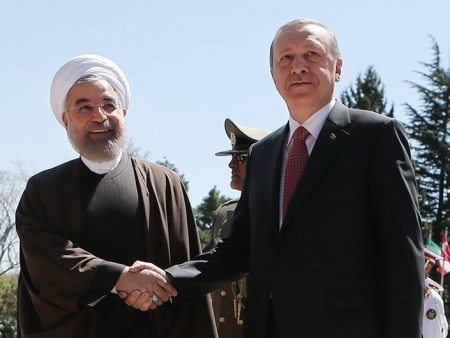
Iranian President Hassan Rouhani and Turkish President Recep Tayyip Erdogan in 2015. (Image source: Tasnim News Agency/Wikimedia Commons)

Uzay Bulut, a journalist born and raised a Muslim in Turkey, is currently based in Washington D.C. She is a writing fellow of the Middle East Forum.

State Dept. Country Reports on Terrorism 2016

July 20, 2017

State Dept. Country Reports on Terrorism 2016, July 2017

(Please see also, Trump State Dept Unsure Why Palestinian Terrorists Kill Israelis. — DM

Please excuse the formatting. The State Department Report is in PDF and therefore very difficult to format correctly for this site.– DM)

ISRAEL, THE WEST BANK AND GAZA, AND JERUSALEM

Overview: Israel was a committed counterterrorism partner in 2016. Israel again faced terrorist
threats from Iranian-support groups such as Hizballah in Lebanon. Other threats included
Palestinian terrorist groups such as Hamas, the Popular Resistance Committees, and Palestinian
Islamic Jihad (PIJ), particularly from Gaza but also from the West Bank; al-Qa’ida (AQ) and its
affiliates, and ISIS and its affiliates along its borders, such as ISIL-Sinai Province (ISIL-SP) and
the Jaysh Khalid ibn al-Waleed group (JKW, formerly the al-Yarmouk Martyrs Brigade) in the
Syrian Golan Heights. In addition, since 2015, Israel has faced numerous incidents of terrorist
attacks committed by individuals with no clear affiliation to terrorist organizations, termed “lone
offender” attacks.

Israeli security officials and politicians remained concerned about the terrorist threat posed to
Israel from Hizballah and Iran, highlighting that Iran, primarily through the efforts of its Islamic
Revolutionary Guard Corps-Qods Force, continued to fund and supply Hizballah. Israeli experts
believed that Iran has transferred to Hizballah advanced weapons systems such as anti-aircraft
and anti-ship cruise missile systems, and was continuing to transfer long-range rockets into
Lebanon. Also, Israeli officials were concerned about the proliferation of conventional and
non-conventional weapons from Syria to terrorist organizations. According to the Government
of Israel, Hizballah has stockpiled more than 130,000 rockets and missiles in Lebanon since the
2006 Lebanon War.

Israeli counterterrorism officials said Hamas and other Gaza terrorists made quantitative and
qualitative advances in their military capabilities. Israel assessed that Hamas and PIJ have
regained most of the military capabilities that were severely damaged during operation
“Protective Edge” (July 7 to August 26, 2014), and have, in some cases, expanded their
capabilities, including by constructing new offensive tunnels and acquiring other advanced
capabilities such as an arsenal of medium-to-long range rockets and unmanned aerial vehicles.
Gaza-based Palestinian terrorist organizations continued rocket and mortar attacks into Israeli
territory, although no Israeli fatalities were reported.

While Israel was not involved in the Global Coalition to Defeat ISIS, it shared information to
help track and stem the flow of foreign terrorist fighters through information exchanges on
counterterrorism issues with numerous governments. In support of the UN Security Council
(UNSC) ISIL (Da’esh) and al-Qa’ida sanctions regime, Israel regularly updated its list of foreign
terrorist organizations and individuals involved in terrorism to better align with UNSC sanctions
lists.

In 2016, Israel and the United States held numerous interagency counterterrorism dialogues to
discuss the broad range of threats in the region and to determine areas of collaboration to address
these challenges.

2016 Terrorist Incidents: Israel experienced numerous terrorist attacks in 2016 involving
weapons ranging from rockets and mortars to small arms and knives. The wave of violence that
began in late 2015, termed the “knife intifada,” gradually decreased during the year; nonetheless,
numerous Israelis and Palestinians were injured in these attacks. The following list details only a
fraction of the total terrorist incidents that occurred during the year.

• In January, an Israeli Arab gunman opened fire on several businesses in downtown
Tel Aviv, killing two people and wounding seven others. He subsequently killed a taxi
driver while fleeing the scene of the attack. Israeli officials identified the attacker as
31-year-old Nasha’at Melhem from the northern Israeli town of Ar’ara. Following a
week-long nationwide manhunt, Melhem was killed in an exchange of fire with Israeli
security forces.

• In March, a Palestinian man went on a stabbing spree in Jaffa Port, Tel Aviv, killing a
U.S. citizen and wounding 10 other people. The attack lasted approximately
20 minutes and ended after police shot and killed the assailant. Israeli authorities
identified the assailant as 22-year-old Bashar Masalha, from the West Bank village of
Kalandiya.

• In June, two Palestinian men opened fire on a popular market in downtown Tel Aviv,
killing four people and wounding seven others. Responding police arrested both
assailants, later identified as Muhammad and Khalid Mukhamra, cousins from the
West Bank town of Yatta. An Israel Security Agency (ISA) investigation determined
that ISIS online propaganda provided inspiration for the attack and friends of the
assailants assisted them with preparations.

• In November, Israel Defense Forces (IDF) units responded to machine gun and mortar
fire from JKW militants (an ISIS-aligned group) across the Syrian border. Israeli
forces crossed the Israeli security fence, while remaining within Israeli territory, and
called in an airstrike which killed four militants.

Legislation, Law Enforcement, and Border Security: Israel has a robust legal framework to
counter terrorism and promote international legal assistance in the investigation and prosecution
of terrorists.

The Israeli Knesset passed new counterterrorism legislation in 2016 that broadened the range of
activities subject to enhanced criminal sentencing. These activities include tunnel-digging, stone
throwing, incitement, and planning intended to assist terrorist organizations and individuals. The
Combatting Terrorism Law was designed to empower law enforcement authorities to preempt
the establishment of terrorist cells and attack planning. The new provisions contained in the law
codified numerous military and emergency orders issued under general emergency powers in
place since the founding of the State of Israel. They include: the Anti-Terrorism Ordinance of
1948, the Anti-Terrorist finance Law of 2005, and various regulations issued under pre-statehood
emergency defense authorities of 1945.

Non-governmental human rights organizations protested the Law’s broad definition of terrorism,
arguing it serves to codify counterterrorism powers that critics compared to martial law.
Additional concerns regarding the scope of Israeli counterterrorism legislation were directed
towards the criminalization of activities related to freedom of expression, association, and
peaceful assembly that could affect the Arab population of Israel.

The ISA and Israel National Police (INP) continued to cooperate with U.S. law enforcement
agencies on cases involving U.S. citizens killed in terrorist attacks. Elite Israeli units engaged in
counterterrorism operations included Yamam (Israeli Border Police) and IDF special operations
units, such as Sayaret Matkal and Duvdevan (Urban Warfare Counterterrorism Operations).
Israeli Border police have a “hot return” policy for visitors suspected of ties to terrorist or
criminal organizations. The border fence constructed along the border with Egypt, and fences
along the West Bank and Gaza, assisted Israeli security forces in preventing migrant inflows and
mitigating security threats. The West Bank and Gaza barriers were augmented by cameras,
sensors, and active patrols by Israeli Border Police and the IDF.

Israel’s airport security was considered robust by international security experts, particularly with
regard to its security screening and inspections program. The Israeli Ministry of Interior
maintained a voluntary biometric passport control system at Tel Aviv’s Ben Gurion International
Airport, which was available for Israeli passport holders over the age of 18 years. This system
facilitated both entry into and exit from Israel via an automatic kiosk for Israeli citizens who
successfully passed a background check and provided a scan of their hand.

Countering the Financing of Terrorism: The Israeli financial intelligence unit, the Israeli
Money Laundering and Terror Finance Prohibition Authority (IMPA), is a member of the
Egmont Group of Financial Intelligence Units. Israel was also welcomed as an observer to the
Financial Action Task Force (FATF) at the organization’s plenary meeting in February 2016, and
Israeli anti-money laundering (AML) experts have begun to participate in FATF peer reviews of
other countries’ anti-money laundering/countering the financing of terrorism regimes.
Israel’s counterterrorist finance regime continued to be enhanced through enforcement
operations and the inclusion of new groups under national terrorist finance laws. The
well-regulated Israeli banking industry worked to address suspected terrorist activity. Israeli
experts and officials continued to raise concerns about the issue of state-sponsored funding of
Hamas, and said that Hamas funded terrorists in the West Bank preparing to perpetrate terrorist
attacks against Israel, Israelis, or Israeli interests.

Financing of Hamas through charitable organizations remained a concern for Israeli authorities,
as did the funding of Hizballah through charities and illicit activity. In one high-profile case in
August, Israeli police charged Mohammad al-Halabi – the Director of the NGO World Vision in
Gaza – with diverting material and financial assistance to Hamas; the charity itself was not
implicated in the case.

Israel regularly updates the list of foreign terrorist organizations and individuals involved in
terrorism, to implement the UNSC ISIL (Da’esh) and al-Qa’ida sanctions regime. Israel also has
a domestic sanctions regime in place with the Anti-Terrorist finance Law of 2005, which allows
the Israeli Security Cabinet to declare a foreign organization to be classified as a foreign terrorist
organization in coordination with findings presented by a foreign country or by the UNSC.
The new counterterrorism law that entered into force on November 1 significantly reduced the
time it takes to adopt international designations. The UN sanctions lists were registered in the
formal government registry. Every domestic and UN designation was published in three
languages (Hebrew, Arabic, English), and run in three different newspapers, as required by law.
In addition, designations were published on the website of the IMPA and distributed by email to
the IMPA’s mailing list, which included banks, lawyers, and finance professionals.

For further information on money laundering and financial crimes, see the 2017 International
Narcotics Control Strategy Report (INCSR), Volume II, Money Laundering and Financial
Crimes: http://www.state.gov/j/inl/rls/nrcrpt/index.htm.

Countering Violent Extremism: The Government of Israel supported several organizations
that used educational and interreligious projects to build bridges between citizens of different
religions and beliefs. These interfaith initiatives benefitted a wide range of age groups and were
conducted in numerous fora, including from elementary schools to universities.
Israel’s national program, “City without Violence,” supported municipalities and local
authorities conducting programs to counter violence, crime, and violent extremism.
Israeli politicians and the public were increasingly concerned about online incitement’s role in
exacerbating the recent wave of violent attacks by so-called lone offender terrorists. The Israeli
government blamed social media companies and online platforms for not doing enough to
prevent the proliferation of online content inciting terrorism. The Israeli government also
considered legislation to obligate companies, such as Google and Facebook, to do more to
prevent incitement. Israel’s new counterterrorism law established a new criminal offense for
demonstrating solidarity with a terrorist organization or with an act of terrorism, and incitement
to terrorism, including via the internet and social media; the new criminal offense replaced and
consolidated two existing penal code offenses for incitement to terrorism.

International and Regional Cooperation: Israel continued its counterterrorism cooperation
with a range of regional and international institutions, including the United Nations, the
Organization of American States, and the Organization for Security and Cooperation in Europe.
Israel cooperated with numerous countries to thwart terrorist attacks and plots against Israelis or
Israeli interests abroad.

The West Bank and Gaza, and Jerusalem

Overview: The Palestinian Authority (PA) continued its counterterrorism efforts in the West
Bank where Hamas, Palestine Islamic Jihad, and the Popular Front for the Liberation of Palestine
remained present. The PA Security Forces (PASF) constrained the ability of those organizations
to conduct attacks, including through arrests in February and April of Hamas members in the
West Bank who were planning attacks against Israelis. The PA exercised varying degrees of
authority over the West Bank due to the Israel Defense Forces’ (IDF) continuing presence in
certain areas, per Oslo-era agreements. The Israeli Security Forces (ISF) also arrested members
of suspected terrorist organizations operating in the West Bank and Jerusalem.

Extremist Palestinians continued to conduct acts of violence and terrorism in the West Bank and
Jerusalem. The heightened period of violence that began in October 2015 abated significantly in
April 2016. However, sporadic lone offender stabbing, shooting, and vehicular attacks against
Israelis continued. A majority of perpetrators did not have any known organizational affiliation.
Attacks in 2016 resulted in the deaths of five Israeli citizens, including two dual U.S.-Israeli
nationals, and three ISF officers.

Extremist Israelis, including settlers, continued to conduct acts of violence as well as “price tag”
attacks (property crimes and violent acts by extremist Jewish individuals and groups in
retaliation for activity they deemed anti-settlement) in the West Bank and Jerusalem. In March,
Israeli settlers set fire to a Palestinian home south of Bethlehem and spray-painted “Death to
Arabs” on the walls. The UN reported 101 incidents of settler violence in 2016, compared to
221 in 2015. Israeli NGO Yesh Din reported 19 incidents of settler violence during the
October – November Olive Harvest, compared to 15 in 2015. There were no reports of fatalities.

Hamas continued to maintain security control of Gaza. There is evidence that Hamas continued
to prepare for future conflict with Israel. Several Gaza-based terrorist and militant groups
continued to launch rockets against Israel from Gaza. Gaza remained a base of operations for
several Salafist splinter groups, such as Jaysh Al Islam, and clan-based terrorist groups that
engaged in or facilitated terrorist attacks. Hamas confronted Salafists in Gaza by arresting and
detaining a number of them this year, but at the same time Hamas likely maintained ties to
Salafists in the Sinai. Despite claims of responsibility from individuals or groups in Gaza
purporting affiliation with ISIS, there is no definitive link confirming membership on a large
scale in Gaza.

2016 Terrorist Incidents:

• In February, three Palestinian assailants shot and killed an Israeli National Police (INP)
officer and injured a second in Jerusalem’s Old City. INP shot and killed the attackers.
• In April, a Palestinian member of Hamas detonated a bomb on a bus in Jerusalem,
injuring approximately 21 people. The assailant died of injuries from the explosion.
• In March and July, suspected Israeli settlers conducted two arson attacks against
Palestinian homes in the West Bank village of Douma, damaging homes of the relatives
of the Dawabsheh family, whose house in Douma was set on fire by settlers in July 2015
and resulted in the deaths of three Palestinians.
• In June, a Palestinian assailant stabbed to death a 13-year-old Israeli-American dual
national in her home in the West Bank settlement of Kiryat Arba. A private security
guard fatally shot the attacker.
• In October, a Palestinian member of Hamas shot and killed an Israeli civilian and INP
officer, and injured 12 others, while carrying out a drive-by shooting in Jerusalem. INP
shot and killed the attacker.

The United States continued to assist the PA’s counterterrorism efforts by providing training and
equipment to the PASF in the West Bank. The United States also assisted the PA criminal
justice system to conduct more thorough investigations and prosecutions of terrorist-related
activity, among other criminal acts, and to ensure safe incarceration of those held for trial or after
conviction for such crimes.

PA President Mahmoud Abbas reiterated his commitment to nonviolence, recognition of the
State of Israel, and pursuit of an independent Palestinian state through peaceful means. President
Abbas supported a security program involving disarmament of fugitive militants, arresting
members of terrorist organizations, and gradually dismantling armed groups in the West Bank.
In July, President Abbas instructed the PASF to intensify measures in the West Bank to ensure
the safety and security of people; security services subsequently increased efforts to disrupt
criminal activity, including the proliferation of illegal weapons.

Legislation, Law Enforcement, and Border Security: The PA continued to lack legislation
specifically tailored to counterterrorism, although existing Palestinian laws criminalize actions
that constitute terrorist acts. The PASF were active throughout the year in seizing illegal
weapons and closing down weapons manufacturing facilities in the West Bank.

The PA arrested terrorists, including Hamas elements suspected of terrorism, in the West Bank,
and the PASF and public prosecutors received training to enable better investigations of
terrorism-related crimes. The PA continued to develop its civilian justice institutions
(e.g. judiciary, police, prosecutors) to improve both investigative and prosecutorial functions.
The United States provided assistance to enable the PA to reduce case backlogs, improve warrant
executions, and upgrade forensic services.

The Preventive Security Organization (PSO) is the key PA institution by mandate and law that
works to prevent internal terrorist events and investigates security-related criminal conduct. In
practice, the General Intelligence Organization and the Military Intelligence Organization also
play a critical role in this effort. The PSO conducted investigations in coordination with public
prosecutors, but this cooperation could improve, especially the PSO’s ability to conduct criminal
investigations and gather admissible evidence. The United States assisted the PSO and the
Security Forces Justice Commission to help the PA move the prosecution of all civilian cases,
including those involving terrorism and security-related offenses, to the exclusive jurisdiction of
the civilian courts, and enhance cooperation between security service investigators and public
prosecutors.

Per the Oslo-era Accords, Israel controlled border security in the West Bank.

The primary limitation on PA counterterrorism efforts in Gaza remained Hamas’ control of the
area and the resulting inability of PASF to operate there. Limitations on PA counterterrorism
efforts in the West Bank included restrictions on the movement and activities of PASF in and
through areas of the West Bank for which the Government of Israel retained responsibility for
security under the terms of Oslo-era agreements. Moreover, ISF incursions into

Palestinian-controlled Area A at times disrupted ongoing PASF counterterrorism operations.
The PA advanced its forensic capabilities with the official opening of the Palestinian Civilian
Police forensic laboratory in November. The laboratory is capable of conducting basic
analyses/examinations in firearm and tool mark evidence, document examination, and drug and
chemical analysis. The PA already has a basic ability to examine and compare unknown prints
to known prints.

Countering the Financing of Terrorism: In 2015, the PA became a full member of the Middle
East and North Africa Financial Action Task Force, a Financial Action Task Force (FATF)-style
regional body. President Abbas issued Anti-Money Laundering and Terrorist financing Decree
No. 20 in December 2015, which criminalizes terrorist financing and defined terrorists, terrorist
acts, terrorist organizations, foreign terrorist fighters, and terrorist financing. It also makes
terrorism and terrorist acts predicate money laundering offenses, although the decree does not
fully meet international standards as it does not criminalize all forms of material support or the
financing of an individual terrorist in the absence of a link to a specific terrorist act. Because the
legislature has not convened since 2007, the PA remained unable to make legislative
improvements (without decree) required to bring the current law up to international standards.
The Palestinian Financial Follow-Up Unit (FFU) is a fully functional financial intelligence unit
with 19 employees and a computer system linking it with 15 banks licensed to operate in the
West Bank. Seven banks are local and eight are foreign, operating through a network of
302 branches in the West Bank and Gaza. There are 311 money changers. The banks file
suspicious transaction reports (STRs) and currency transaction reports electronically through this
system. In 2016, banks filed 113 STRs, compared to 108 in 2015. Although the FFU has
adequate staffing, authority, and equipment, restrictions in the law hinder its operational
effectiveness. The 2007 Anti-Money Laundering Law No. 7 restricts information sharing
between the FFU and any law enforcement agency, with the exception of the Attorney General’s
Office. While the FFU may pass information to any requesting authority according to the 2015
Decree, the Attorney General’s Office is the primary recipient of the FFU’s information.
Moreover, the PA has no effective control outside of Area A. The absence of PA law
enforcement and regulatory power in Areas B and C increased vulnerability.

For further information on money laundering and financial crimes, see the 2017 International
Narcotics Control Strategy Report (INCSR), Volume II, Money Laundering and Financial
Crimes: http://www.state.gov/j/inl/rls/nrcrpt/index.htm.

Countering Violent Extremism: The PA continued to counter violent extremism in the
West Bank through security operations to prevent attacks, the PASF’s outreach to Palestinian
communities to alert them to signs of youth at risk of extremism, and monitoring social media
for indicators of extremism and intent to carry out violent acts. During an interview broadcast in
March, President Abbas said he sent the PASF to schools to look for knives and to caution
Palestinian youth against undertaking attacks against Israelis. The PASF thwarted hundreds of
lone offender attacks, according to public statements by PA and Israeli government officials.
Continued drivers of violence included a lack of hope in achieving Palestinian statehood, Israeli
settlement construction in the West Bank, settler violence against Palestinians in the West Bank,
the perception that the Israeli government was changing the status quo on the Haram
Al Sharif/Temple Mount, and IDF tactics that the Palestinians considered overly aggressive.
The PA has taken significant steps during President Abbas’ tenure (2005 to date) to ensure that
official institutions in the West Bank under its control do not create or disseminate content that
incites violence. While some PA leaders have made provocative and inflammatory comments,
the PA has made progress in reducing official rhetoric that could be considered incitement to
violence. Explicit calls for violence against Israelis, direct exhortations against Jews, and
categorical denials by the PA of the possibility of peace with Israel are rare and the leadership
does not generally tolerate it. In April, President Abbas condemned an attack on a Jerusalem bus
and said he was against all forms of terrorist activity that affect Israelis and Palestinians. In
November, he said, “Incitement can lead to violence, and we must end it in every place.” During
a speech to the Seventh Fatah General Congress in November, Abbas expressed his commitment
to fight terrorism and to cooperate with regional and international parties in this endeavor, while
reaffirming a “culture of peace and tolerance and the renunciation of violence and extremism.”
According to the PA’s Palestinian Broadcasting Company’s code of conduct, it does not allow
programming that encourages “violence against any person or institution on the basis of race,
religion, political beliefs, or sex.” In practice, however, some instances of incitement took place
via official media. There were also some instances of inflammatory rhetoric and the posting of
political cartoons glorifying violence on official Fatah Facebook pages.

The PA maintains control over the content of Friday sermons delivered in approximately
1,800 West Bank mosques to ensure that they do not endorse incitement to violence. Weekly,
the PA Minister of Awqaf and Religious Affairs distributes approved themes and prohibits
incitement to violence. The PA’s ability to enforce these guidelines varies depending upon the
location of the Mosques and it had limited authority to control the content of sermons in
Israeli-controlled Area C. A senior PA religious official met in October with prominent Israeli
rabbis to discuss ways to increase religious tolerance in the region.

As part of a policy codified in 2003, the PA provided financial packages to Palestinian security
prisoners released from Israeli prisons in an effort to reintegrate them into society and prevent
recruitment by hostile political factions.

International and Regional Cooperation: PA justice and security leaders continued to
participate in regional conferences and meetings to counter terrorism. PASF personnel attended
a variety of international training courses related to counterterrorism at training facilities in
Jordan, Europe, and the United States.
Ezra Levant in Iraq: Kurdish Muslims who protect Christians

July 20, 2017

Ezra Levant in Iraq: Kurdish Muslims who protect Christians, Rebel Media via YouTube, July 20, 2017

(Please see also, Saudi Columnist: Christians Should Be Accepted As Equal Citizens, Not Treated As ‘Protected People’ (Dhimmis). — DM)


State Dept. Blames Israel for Terrorism, Claims Palestinians Rarely Incite Attacks

July 20, 2017

State Dept. Blames Israel for Terrorism, Claims Palestinians Rarely Incite Attacks, Washington Free Beacon, , July 20, 2017

(Who the @#$$$* is in charge of American foreign policy? The President or “his” Secretary of State? If Secretary Tillerson approved this, he must go. Now. — DM)

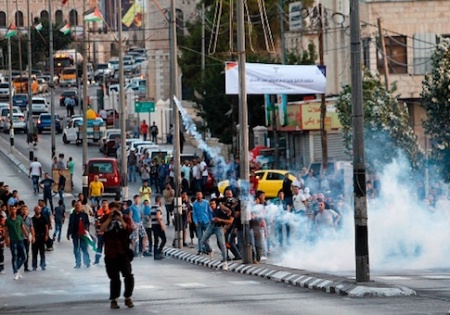
Palestinian protesters clash with Israeli security forces in the West Bank town of Bethlehem on July 19 / Getty Images

Regional organizations monitoring the situation routinely cite the Palestinian Authority and its senior officials as calling for violence against Israel and glorifying past terror acts.

Palestinian television programs also promote violence against Israel and Jews, with some aimed at children promoting hatred of the Jewish state.

The Palestinian government also uses U.S. taxpayer aid to pay salaries to one-time terrorists who are imprisoned in Israel. This issue has become a particular sticking point in peace talks with Israel, and Congress is currently considering legislation that could cut all aid to the PA until it formally ends this terror payment policy.

*********************************

The State Department is facing harsh criticism for claiming in an official report that Israel is to blame for terrorism attacks committed by Palestinians and accusing the Jewish state of being largely responsible for an impasse in peace negotiations, according to a leading member of Congress who is calling on the State Department to correct its “inaccurate and harmful” characterization of Israel.

The State Department, in its latest annual report on the global terrorism situation, blames Israeli security policies for stalling the peace process and claims that Palestinians rarely incite terror attacks.

The claims are coming under fierce criticism from pro-Israel advocates and have prompted one leading member of Congress to formally call on the Trump administration to amend the report to more accurately reflect the situation.

Rep. Peter Roskam (R. Ill.), co-chair of the House Republican Israel Caucus, criticized the latest report in a letter to Secretary of State Rex Tillerson and called on the administration to immediately amend it to portray Palestinian terror attacks as a primary reason for the impasse in peace talks.

The State Department’s current characterization, Roskam claims, is harmful to Israel and likely to impede efforts by the Trump administration to renew peace talks.

“The State Department report includes multiple findings that are both inaccurate and harmful to combating Palestinian terrorism,” Roskam wrote in a letter sent Thursday to the State Department, a copy of which was exclusively obtained by the Washington Free Beacon. “This report wrongly insinuates Israeli security measures on the Temple Mount and a stalled peace process as key forces behind terrorism.”

“Most egregiously,” Roskam adds, “it portrays the PA as innocent peacemakers far removed from being the source of terrorist activity.”

The State Department characterizes Palestinian calls for terrorism and violence against Israel as “rare,” stating: “Explicit calls for violence against Israelis, direct exhortations against Jews, and categorical denials by the [Palestinian Authority] of the possibility of peace with Israel are rare and the leadership does not generally tolerate it.”

“This assertion is demonstrably false,” Roskam writes. “The PA does not only tolerate terrorist attacks against Israelis but it also incites, rewards, and memorializes those who carry out these horrific attacks.”

Regional organizations monitoring the situation routinely cite the Palestinian Authority and its senior officials as calling for violence against Israel and glorifying past terror acts.

Palestinian television programs also promote violence against Israel and Jews, with some aimed at children promoting hatred of the Jewish state.

The Palestinian government also uses U.S. taxpayer aid to pay salaries to one-time terrorists who are imprisoned in Israel. This issue has become a particular sticking point in peace talks with Israel, and Congress is currently considering legislation that could cut all aid to the PA until it formally ends this terror payment policy.

In late 2015, during a massive wave of Palestinian terrorism, attackers carried out 181 stabbing attacks on Israelis, 159 shooting, and 60 vehicular ramming attacks, which called more than 50 Israelis and injured nearly 1,000.

Roskam notes this statistic in his letter to Tillerson.

“I write to express my concern about numerous mischaracterizations found in the 2016 State Department Country Reports on Terrorism, which undermine the prospect for Israeli-Palestinian peace and wrongly blame Israel for Palestinian terrorism against Israeli civilians,” Roskam writes.

“At the highest level, the Palestinian Authority (PA) leadership directly incites, rewards, and, in some cases, carries out, terrorist attacks against innocent Israelis,” the letter states. “In order to effectively combat terrorism, it is imperative that the United States accurately characterize its root cause—PA leadership.”

Roskam calls on the Trump administration “to modify this report to accurately characterize and hold accountable the root causes of Palestinian violence—PA leadership, and clarify the longstanding issue of Palestinian support for terrorism as the leading impediment to Israeli-Palestinian peace.”

One senior Congressional source tracking the situation told the Free Beacon that the State Department’s findings are appalling to Israel supporters.

“It is unacceptable that the State Department ignores PA-backed terrorism,” the source said, adding that Congress is working hard to pass legislation cutting off U.S. aid until the Palestinians cease paying terrorists.

“The State Department should be working to do the same,” the source said. “They can begin by correctly reporting the source of Palestinian terrorism—government-led incitement and policies that rewards terrorists.”

Saudi Columnist: Christians Should Be Accepted As Equal Citizens, Not Treated As ‘Protected People’ (Dhimmis)

July 20, 2017

Saudi Columnist: Christians Should Be Accepted As Equal Citizens, Not Treated As ‘Protected People’ (Dhimmis), MEMRI, July 20, 2017

These descriptions belong to an Islamic law perception of reality, which, from a modern perspective, is mistaken, and highlights the difference between reality as perceived by Islamic law and actual reality. All these labels [to describe non-Muslims] belong to a bygone historic age, hence the discrepancy [between the perceptions].

“The relationship between the modern state and its citizens is based on the principle of citizenship, which holds that all citizens are equal in rights and obligations, regardless of their religion and social affiliation. Every citizen has an equal right to the homeland, and his civil rights are derived from the validity of this, not from his religious affiliation. Therefore, in today’s world there is no one who may rightly be referred to as a ‘protected person’ or ‘protection seeker.’ A citizen is a citizen, and that’s all there is to it.

*********************************

Following the April 8, 2017 terrorist attacks against the churches in Alexandria and Tanta in Egypt, Tawfiq Al-Sayf, a columnist for the London-based Saudi daily Al-Sharq Al-Awsat, criticized Islamic countries for continuing to treat Christians as “protected people” (dhimmis), and not as citizens with equal rights. Al-Sayf called to abandon this approach, for it is based on Islamic law, which he says is not appropriate for the modern era and reality, and instead to adopt the modern concept of citizenship.

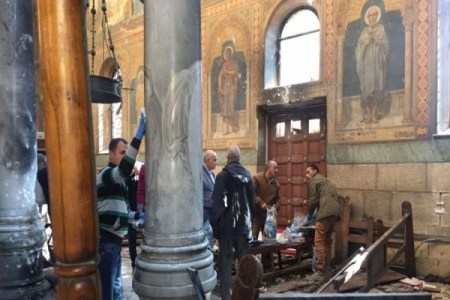
The church in Tanta, Egypt after the attack Source: Elaph.com

The following are translated excerpts from his column:[1]

“The terrorist attack against the two churches in Egypt generated a broad wave of condemnation among all Muslims –religious scholars, the general public, and politicians. I thank God that no one is praising these crimes, or justifying them. This is a positive development. [However,] in the statements of condemnation, my attention was drawn to the repeated use of terms such as ‘protection seekers,’ ‘protected people’ (dhimmis), ‘ and ‘People of the Book’ to describe the Coptic citizens who were the victims of the treacherous attack. Such terms are usually found in discussions among clerics, [who use it] to emphasize the prohibition against attacking non-Muslims. These terms are not neutral linguistic generalizations, but rather ‘facts [fixed] in the Islamic shari’a,’ according to the perception of the extremists, i.e. special terms charged with specific meaning. They are used… to refer to a totality of inter-relationships and categories, or [to grant] uniform meaning to the status of [certain] people in relationship to the person talking. These descriptions belong to an Islamic law perception of reality, which, from a modern perspective, is mistaken, and highlights the difference between reality as perceived by Islamic law and actual reality. All these labels [to describe non-Muslims] belong to a bygone historic age, hence the discrepancy [between the perceptions].

“These descriptions were coined with the inception of the [original] Islamic state, when its troops spread to [different] countries and it expanded, and relationships between Muslims and others developed. Thus there was a need to regulate the relationship between the victorious superpower and its strong [Muslim] people, and the weak individuals who surrendered voluntarily or were defeated. In these unique circumstances, these expressions were intended to emphasize the political control and responsibility of the state for all its subjects…

“As time passed and the Islamic legal perception permeated the general culture, religious affiliation became the only aspect [defining] social relationships, while [the proponents] of this approach failed to understand that it belonged to a bygone era. The concept of protection and patronage remained central to the definition of the relationship with non-Muslims, but at the same time they were not considered equal partners with respect to all rights, or ‘citizens’ in the modern sense. This approach is maintained in the Islamic law of today. A quick glance at numerous writings on this subject by modern-day Islamic jurisprudents and Islamic commentators is sufficient to reveal the problem with which they grappled when they wanted to consolidate an approach that would accommodate the heritage of religious law on the one hand, and the principles of [modern] politics, law, human rights and justice on the other.

“In fact, there is no need to settle the contradiction. [The concept of] the modern state belongs to a different set of ideas than the [concept of] state that existed at the time of the ancient Islamic state. In other words, it is something different, that can’t be comprehended in terms of the ancient approach…

“The relationship between the modern state and its citizens is based on the principle of citizenship, which holds that all citizens are equal in rights and obligations, regardless of their religion and social affiliation. Every citizen has an equal right to the homeland, and his civil rights are derived from the validity of this, not from his religious affiliation. Therefore, in today’s world there is no one who may rightly be referred to as a ‘protected person’ or ‘protection seeker.’ A citizen is a citizen, and that’s all there is to it.

“For the general public, this conclusion is nothing new, but I thought this was an appropriate opportunity to draw the attention of Islamic jurisprudents and their disciples to the difference between inherited thinking and the reality of our world today. This is a call to abandon the ancient perceptions, which are no longer useful and are unrealistic. It is a call to direct thinking to the real world and to adapt to it, rather than reduce thinking to a world of ancient documents and writings, and adhere to them and to their flaws.”

______________________

[1]Al-Sharq Al-Awsat (London), April 12, 2017.

Almost all of Iran’s diplomats in Kuwait to be expelled following terror ruling

July 20, 2017

Almost all of Iran’s diplomats in Kuwait to be expelled following terror ruling, DEBKAfile, July 20, 2017

Kuwait has shut down Iran’s cultural and other missions in the country and ordered the expulsion of almost all Iranian diplomats, including the ambassador, after the Kuwaiti supreme court reaffirmed the conviction of the members of a terror cell that spied for Tehran, smuggled explosives and was preparing to carry out terrorist attacks. The members of the cell are said to have acted as operatives for Hizballah and the Iranian Revolutionary Guard Corps.

The mastermind of the cell, which was broken up in August 2015, has been sentenced to life in prison. However, Kuwait’s Interior Ministry said Wednesday that 16 out of the 26 cell members are on the run. On Monday, a Kuwaiti newspaper claimed that 14 have fled by boat to Iran.

The Iranian ambassador, Alireza Enayati, was summoned to the Kuwaiti Foreign Ministry where he was told that the military and cultural missions had been closed, and that 15 out of the 19 Iranian diplomats in Kuwait are being expelled, according to Iran’s state-run television. Enayati himself was given 48 days to leave the country, Iran’s ISNA news agency said.

Girl in Saudi Gone Wild: There she was just a ’walkin’ down the mud-caked alley

July 20, 2017

Girl in Saudi Gone Wild: There she was just a ’walkin’ down the mud-caked alley, Al ArabiyaFatimah S. Baeshen, July 20, 2017

(An article of this sort probably would not have been published by Saudi media, and the young lady probably would not have been released, before President Trump’s Arab Summit and the elevation of the current, reform-minded, crown prince. — DM)

This op-ed was written before Khuloud was released.

A strut and a milliseconds-long backwards glance has captured the world’s attention.

The strut and glance in question were made by Khulood Al-Yafie, a beautiful miniskirt and crop top clad Yemeni woman visiting Saudi Arabia’s Ushaiger cultural heritage site. Her tour, recorded on video (which has since gone viral) has not only invoked the wrath of the Kingdom’s religious police and sizable conservative population but indirectly expanded the scope of social and cultural discourse inside the Kingdom.

I have visited Ushaiger. It is a sleepy historical site just outside the Saudi capital, Riyadh; a labyrinth of mudhuts and alleys that speaks to the country’s centuries-old heritage. For generations, the same families have occupied this religiously-conservative part of the country. So, a stunt like this tends to attract a tremendous amount of (possibly unwanted) publicity (despite the potentially positive ramifications for Saudi tourism – but I digress).

The moral issue

Questions as to the rightness or wrongness of Khulood’s actions aside, I want to spotlight the range of responses this incident elicited, rather than the incident itself, to highlight an important point about the role social media is playing in expanding the Kingdom’s public sphere (and the diversity of opinions contained within). After all the only reason we are talking about a beautiful woman’s stroll down a mud-caked alley is because said stroll occurred in a country popularly known in Western culture for autocracy, repression, and austere religious practices.

Historically, the Royal Court, the Council of Ministers, and the Shoura Council—have dominated decision making in the Kingdom. However, over the last ten years, the government has increasingly moved to allow for extended periods of public discourse on social, cultural, economic, and on very rare occasions, political moves.

This has occurred for several reasons; most importantly, either to normalize a controversial change through prolonged discussion or to hear the array of opinions that exist as they pertain to potential critical reforms in the hope of building a broader consensus. The key point is that once the public debate plays out it culminates into policy-change.

With this latest event we are witnessing, live and in real time, the expansion of social and cultural discourse in the Kingdom. And as with previous expansions, this incident may also come to impact policy; in this case, by further advancing women’s rights.

The fact that a women was bold enough to walk through Ushaiger, a traditional heritage site in the heart of Najd (the Kingdom’s conservative central region) without an abayah while wearing a mini-skirt and crop top speaks volumes as to where the Kingdom is heading with respect to social and cultural change. For this bold move to be captured and disseminated is one measure of progress but for the public – men and woman, conservatives and progressives – to freely debate this matter on social media is another sign of advancement in and of itself.

Oh, the times they are a’changin’…

I recently published Freedom of Tweet and Freedom to Seat, a report reviewing what the 1st amendment looks like in Saudi Arabia. In it, I discuss how a localized form of freedom of speech has not only been tolerated, but expanded, accommodated, and used to inform policy-decisions.

“In June 2013, Saudi Arabia changed from a Thursday–Friday to a Friday– Saturday weekend to align itself with other Middle Eastern economies, this despite pushback from the conservative base arguing that to do so would mimic the Western lifestyle. However, the government publicly floated the idea several years prior to instituting the change.

They allowed the Saudi public to openly debate the issue via informal channels such as Twitter, op-eds, and coffee shop conversations. Actual implementation of the transformation was quick—Saudis received one week’s notice— but, because this followed years of frank discussion, opposition to the change was limited.”

Khulood’s action, and the debate surrounding it, may well yield a similar result.

As for Khulood herself, she has been taken in for questioning by police and will likely be asked to sign a pledge not to repeat her actions, in order to placate Saudi’s more conservative elements, before ultimately being released.

____________________

Fatimah S. Baeshen is a director at the Arabia Foundation. A Saudi national, she joined the Arabia Foundation after having worked with the Saudi Ministry of Labor and the Saudi Ministry of Economy and Planning in Riyadh between 2014 and 2017. Her focus areas include the labor market, private sector development, and women’s economic empowerment.

Jeh Johnson: Trump’s ‘Rhetoric’ Has ‘Scared Off’ Illegal Immigrants

July 20, 2017

Jeh Johnson: Trump’s ‘Rhetoric’ Has ‘Scared Off’ Illegal Immigrants, Newsmax, Mark Swanson, July 20, 2017

(Good! — DM)

Former head of Homeland Security Jeh Johnson said President Donald Trump’s “rhetoric” has led to a decrease of “illegal migration on our southern border.”

Trump has “scared off” a lot of illegal immigrants, Johnson told CNN’s “New Day” morning program.

“Basically because, through his rhetoric he’s scared off a lot of women and children in central America who would rather stay in their desperate circumstances or just migrate to Mexico and stop there,” Johnson said.

Though Johnson worked for a president many called the “deporter-in-chief,” he said Trump and his administration should bring more compassion to fighting illegal immigration.

“We have to enforce our immigration laws consistent with our values and consistent with humanity,” Johnson told CNN.

“At the end of the day, when you enforce immigration laws, you have to be able to look yourself in the mirror, look your own family in the eye, recall the women and children who are desperate, to say, ‘I did my best to enforce the law consistent with our priorities and consistent with our values,'” Johnson said.

“And I hope that the current administration does not lose sight of that.”

Jordan’s intel tags Hizballah for Temple Mt. terror

July 20, 2017

Jordan’s intel tags Hizballah for Temple Mt. terror, DEBKAfile, July 20, 2017

Jordanian and Saudi intelligence services have come to the conclusion that the attack was the work of a Hizballah-run cell on orders from Iran. One of Hizballah’s signatures is the absence of any claim of responsibility.

Jordanian intelligence circles suspect that the Temple Mount attack was linked to the US-Russian deal for ceasefire zones in southwest Syria right up to the borders of Jordan and Israel. Both governments have demanded the exclusion of Iranian and Hizballah forces from those zones.

Hizballah not only maintains a presence in Daraa and the Syrian Golan, but has planted terrorist networks inside Israel and Jordan. The pro-Iranian terror group has long been suspected of recruiting networks in some Israeli Arab communities. By striking Temple Mount, Iran and Hizballah targeted both Israel and Jordan, which claims religious custodianship of its mosques.

************************

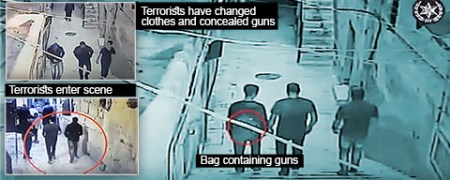
The Israeli police Thursday, July 20, released a video tape recording the movements of the terrorists heading for the murderous attack they committed on Temple Mount six days ago, when they shot dead two Israeli border guard police officers.

The film shows not three but four men who carefully stepped away from each other before entering the Al Aqsa Mosque. There, the three gunmen were handed their weapons by the fourth confederate, who made his escape among the crowds of worshippers exiting the mosque.

The police published the video Thursday ahead of Muslim Friday prayers – which brings tens of thousands of worshippers to Al Aqsa – as a reminder that the crime committed was a terrorist attack staged by Muslims at Islam’s third most sacred site – not the metal detectors Israel which installed for its safety. To drown this truth out, the Palestinians and Waqf officials have been raising a worldwide uproar over those detectors, as though nothing else happened to make them necessary.

The investigation going forward has established that the terrorists were far from amateurs. They acted coolly, with professional precision and were clearly highly trained and familiar with the terrain. It was a skilled terrorist cell that assaulted a shrine holy to three world faiths.

Even the absence of any claim of responsibility for the attack is a clue, especially since none of Israel’s investigators, be they police, security authorities or intelligence agencies, have so far thrown any light on the identity of the hand behind that cell.

However, DEBKAfile’s intelligence and counterterrorism sources report that Jordanian and Saudi intelligence services have come to the conclusion that the attack was the work of a Hizballah-run cell on orders from Iran. One of Hizballah’s signatures is the absence of any claim of responsibility.

On July 18, 2012, a suicide bomber blew himself up on a bus carrying Israeli tourists at the Bulgarian resort of Burgas, killing five Israelis and the Bulgarian driver and injuring 32. No organization has ever claimed this attack. Israeli intelligence uncovered evidence that it was orchestrated by Hizballah, but was never able to lay hands on the perpetrators.

The difference this time was that the three gunmen on Temple Mount had no intention of committing suicide. They did not expect the Israel police detail to react quickly enough to gun them down, but had meant to elude pursuit by fleeing to safety into Al Aqsa mosque. There they planned either to escape through ancient subterranean tunnels leading outside the Old City walls, or barricade themselves inside the cavernous mosque for a long shootout with Israel police.

Jordanian intelligence circles suspect that the Temple Mount attack was linked to the US-Russian deal for ceasefire zones in southwest Syria right up to the borders of Jordan and Israel. Both governments have demanded the exclusion of Iranian and Hizballah forces from those zones.

Tehran found an answer to this demand by demonstrating that its Lebanese proxy is capable of reaching deep inside Israel without recourse to external territory, because Hizballah not only maintains a presence in Daraa and the Syrian Golan, but has planted terrorist networks inside Israel and Jordan. The pro-Iranian terror group has long been suspected of recruiting networks in some Israeli Arab communities. By striking Temple Mount, Iran and Hizballah targeted both Israel and Jordan, which claims religious custodianship of its mosques.

Saudi-led bloc drops the list of 13 demands; now calls for six principles

July 20, 2017

Saudi-led bloc drops the list of 13 demands; now calls for six principles, World Affairs Journal, July 19, 2017

(Round and round it goes; where it stops nobody knows. — DM)

Doha skyline

The Peninsula / AP

UNITED NATIONS: Four Arab nations that are blockading Qatar have dropped their list of 13 demands to lift the siege.

Now the Saudi-led countries are urging Qatar to commit to six principles on combatting extremism and negotiate a plan to implement them.

Saudi Arabia, the United Arab Emirates, Egypt and Bahrain broke relations with Qatar in early June largely over their allegations that it supports extremist groups — a charge Qatar rejects. They initially made 13 demands, which Qatar said are “unrealistic and is not actionable”.

Saudi Arabia’s UN Ambassador Abdallah Al-Mouallimi told a briefing for a group of UN correspondents that the four nations are now committed to the six principles agreed to by their foreign ministers at a meeting in Cairo on July 5.

According to Al Jazeera the six principles are:

Commitment to combat extremism and terrorism in all their forms and to prevent their financing or providing havens.

Suspending all acts of provocation and speeches inciting hatred or violence.

Full compliance with the Riyadh Agreement of 2013 and the supplementary agreement and its implementation mechanisms of 2014 within the framework of the Gulf Cooperation Council.

Adherence to all the outcomes of the Arab Islamic American Summit held in May 2017 in Riyadh.

Refraining from interfering in the internal affairs of states and from supporting illegal entities.

The responsibility of all states of the international community to confront all forms of extremism and terrorism as a threat to international peace and security.

Al-Mouallimi said both sides can talk about details of “the tactics” and “the tools” to implement them — “and that’s where we can have discussion and compromise.”

The list of first 13 demands handed to Qatar on 22 June included shutting down the Al Jazeera news network, closing a Turkish military base, cutting ties with the Muslim Brotherhood and downgrading relations with Iran.

Al-Mouallimi said closing Al-Jazeera might not be necessary.

“If we can achieve that (the principles) without closing down Al-Jazeera, that’s also fine. The important thing is the objective and the principle involved.”

UAE Minister of State for International Cooperation Reem Al Hashimy said all the countries involved have strong relations with the United States “and we believe that the Americans have a very constructive and a very important role to play in hopefully creating a peaceful resolution to this current crisis.”

“We hope to be able to resolve this internally and among ourselves with the assistance of strong mediation, whether it’s from the U.S. or the Kuwaitis,” she said.

Diplomats from the four countries who attended the briefing said there have been discussions about possible next steps.

UAE Ambassador Lana Nusseibeh said that “if Qatar is unwilling to accept core principles around what defines terrorism or extremism in our region, it will be very difficult” for it to remain in the Gulf Cooperation Council with Saudi Arabia, the UAE and Bahrain.

“So it may be a parting of ways for a little while in order to work things out,” she said.