Archive for July 14, 2017

Operative who commissioned anti-Trump dossier to testify next week before Congress

July 14, 2017

Operative who commissioned anti-Trump dossier to testify next week before Congress. Washington TimesDan Boylan, July 14, 2017

U.S President Donald Trump speaks during a press conference with French President Emmanuel Macron at the Elysee Palace in Paris, Thursday, July 13, 2017. Trump will be the parade’s guest of honor to commemorate the 100th anniversary of the U.S

Thus far, Fusion GPS has refused to disclose the identity of political clients who financed the anti-Trump dossier — a line of questioning likely to cause major sparks to fly next week.

*******************************************

The founder of the Washington political opposition-research firm that commissioned the anti-Donald Trump dossier will testify next Wednesday before the Senate Judiciary Committee.

Glenn Simpson, one of the Russian election-meddling saga’s most mysterious and sought-after characters, will answers questions from a committee that has pressed for his appearance since early this spring.

In 2015, Mr. Simpson’s firm, Fusion GPS, hired former British intelligence agent commissioned Christopher Steele to compile opposition research on then-candidate Trump. For months Mr. Steele’s salacious 35-page dossier of unverified information was cited by Democrats as the reason for a special commission to investigate Mr. Trump and his aides for a supposed role in Russia’s hacking of Democratic Party email servers.

Three men — Mr. Trump’s attorney, a campaign volunteer and a tech company CEO — have publicly said the parts about them in the dossier are fiction. A Russian diplomat whom Mr. Steele accused of wrongdoing also called the dossier a fantasy.

Mr. Simpson, who founded Fusion GPS in 2009, worked previously for Roll Call newspaper and the Wall Street Journal.

Iowa Sen. Charles E. Grassley, chairman of the Judiciary committee, was the driving force behind securing Mr. Simpson’s testimony. Thus far, Fusion GPS has refused to disclose the identity of political clients who financed the anti-Trump dossier — a line of questioning likely to cause major sparks to fly next week.

On Wednesday, the Senate Judiciary Committee, which is scheduled to explore enforcement of the Foreign Agents Registration Act, will also hear testimony from British-American businessman Bill Browder.

Mr. Browder has called Mr. Simpson a “professional smear campaigner.”

Before the Trump dossier, Fusion GP worked on efforts to repeal the Magnitsky Act, a law enacted by the Obama administration in 2012 to punish Russian officials responsible for the death of Russian lawyer and whistleblower Sergei Magnitsky in a Moscow prison in 2009.

Magnitsky served as an attorney for Mr. Browder.

Mr. Grassley also said this week that he wants to hear testimony from former Trump campaign chairman Paul Manafort, who is not currently on Wednesday’s witness list.

Mr. Grassley told CNN Thursday the committee has also requested Donald Trump Jr. testify before the committee.

News in Washington this week was dominated by revelations that the younger Mr. Trump met with a Russian lawyer while his father campaigned for the presidency. He said he met with the lawyer, Natalia Veselnitskaya, because he thought she had negative information to divulge about his father’s opponent, Hillary Clinton.

Mr. Trump said that instead of discussing Ms. Clinton, Ms. Veselnitskaya instead discussed the Magnitsky Act.

It is not publicly known if Ms. Veselnitskaya had any interactions with Fusion GPS.

Jeff Sessions to appeal latest Hawaii travel ban decision to Supreme Court

July 14, 2017

Jeff Sessions to appeal latest Hawaii travel ban decision to Supreme Court, Washington ExaminerKelly Cohen, July 14, 2017

(Please see also, Hawaii judge rules Trump’s travel ban too strict, cannot ban grandparents and other family members. The circuit judge who issued the ruling said that it would be null if the government filed an emergency appeal. The appeal to the Supreme Court should have a similar effect. — DM)

Attorney General Jeff Sessions said Friday the Justice Department will appeal the latest decision by a Hawaii District Court to limit the scope of President Trump’s travel ban, and blasted the court for “micromanag[ing] the decisions of the coequal executive branch.”

“[T]he district court has improperly substituted its policy preferences for the national security judgments of the executive branch in a time of grave threats, defying both the lawful prerogatives of the Executive Branch and the directive of the Supreme Court,” Sessions said.

 Sessions said the court “undermined national security, delayed necessary action, created confusion, and violated a proper respect for separation of powers.”

The Justice Department will now turn again to the Supreme Court, Sessions said, calling having to do so something the Trump administration will do “reluctantly.”

The judge in Hawaii ruled Thursday night that Trump’s interpretation of the travel ban goes too far in banning family members from the United States.

Trump implemented the ban to allow people with close family ties to the U.S. enter from the six countries covered by the ban: Iran, Libya, Syria, Somalia, Sudan, and Yemen. But it said grandparents, grandchildren, brothers and sisters in law, aunts, uncles, nieces, nephews and cousins don’t qualify.

Video: Muslims murder two Israeli police officers in Temple Mount jihad attack

July 14, 2017

Video: Muslims murder two Israeli police officers in Temple Mount jihad attack, Jihad Watch

Hamas praised these jihad murders as “heroic,” which is a good example of the morally inverted world of Hamas and its U.S.-based front groups, along with their Leftist supporters.

“2 Israeli police officers confirmed dead following Temple Mount shooting,” RT, July 14, 2017 (thanks to the Geller Report):

Two police officers were fatally shot during an attack at the Temple Mount in Jerusalem Friday morning. Police Chief Roni Alsheich confirmed the deaths following the incident involving three assailants.

The two officers were amongst three people initially injured. Three armed assailants were then pursued, shot and killed by police.

The gunmen, reported by Reuters to be Arab-Israeli, arrived at the site which is holy to both Jews and Muslims, and made their way towards the Lions Gate in the Old City. “When they saw policemen they shot towards them and then escaped towards one of the mosques in the Temple Mount compound,” police spokeswoman Luba Simri.

According to Simri three firearms were found on the bodies of the attackers.

The officers were named by authorities as Hail Stawi, 30, and Kaamil Snaan, 22.

A spokesperson from Hamas praised the operation as “heroic” in a statement.

Authorities shut down the area following the attack, blocking access to the Aqsa Mosque. Palestinian Grand Mufti of Jerusalem, Mohammad Hussein encouraged Muslims to defy the shutdown, telling Reuters “We have urged our Palestinian people to rush to al Aqsa today and every day to hold their prayers.”

Israeli Prime Minister Benjamin Netanyahu, said the area, which can be accessed but not prayed at by Jews, will continue to be shared by both communities.

In a phone call to Netanyahu, Palestinian President Mahmoud Abbas condemned the attack. According to Palestinian news agency WAFA, Abbas urged Netanyahu to reopen access to the al-Aqsa Mosque.


The attackers’ identities have not yet been released.

 Friday prayers at the site were canceled for the first time in years, according to Haaretz….

ABC News: Christians Who Believe In The First Amendment Are A ‘Hate Group’

July 14, 2017

ABC News: Christians Who Believe In The First Amendment Are A ‘Hate Group’, The Federalist, July 13, 2017

ABC News’ Pete Madden and Erin Galloway smeared Christians who believe the Bill of Rights secures religious liberty as a “hate group,” in an article this week headlined, “Jeff Sessions addresses ‘anti-LGBT hate group,’ but DOJ won’t release his remarks.” The lede of the story made it clear this was not just the work of a rogue headline writer but the failure of the reporters themselves:

Attorney General Jeff Sessions delivered a speech to an alleged hate group at an event closed to reporters on Tuesday night, but the Department of Justice is refusing to reveal what he said.

First, a note that you can — and should — read the prepared remarks of the Attorney General here at The Federalist.

Who is this “hate group”? Alliance Defending Freedom is not a hate group at all, but a civil liberties organization that battles for religious liberty. And they’re not a fringe group either. They just weeks ago won their most recent Supreme Court victory — Trinity Lutheran v. Comer — 7-2. It was their fifth Supreme Court victory in seven years, during which time they’ve had no losses at the high court.

And the group is ranked among the top law firms in the country for its successes at the Supreme Court.

Most recently the non-profit law firm found out that the Supreme Court agreed to hear another one of their cases dealing with artistic freedom and religious liberty.

To characterize such an accomplished civil rights group as a ‘hate group’ is unacceptable and inexcusable. It boggles the mind why ABC News, in the midst of cratering credibility, would disparage Christian efforts in favor of religious liberty in such a mendacious way.

How in the world did this happen?

Well, for some reason ABC News chose to wholly adopt the Southern Poverty Law Center’s framing for the significance of the attorney general’s speech to the group. Check it out:

Here’s why reporters such as Pete Madden and Erin Galloway should be wary before slightly rewriting SPLC press releases and passing off the work as their own. SPLC previously had a reservoir of credibility based on a history of good work exposing legitimately nefarious individuals and groups. In recent years, however, that reservoir has all but dried up as SPLC has gone after reasonable groups it merely disagrees with politically but labels as hate groups. It engages in this campaign while ignoring serious problems on the left.

SPLC has the gall to list the Family Research Council as a “hate group,” for instance, even after an SPLC follower used an SPLC “hate map” to locate the Family Research Council offices in Washington, D.C., and commit an act of terrorism and attempted mass murder against the group. Thankfully, the SPLC-inspired terrorist was stopped by the security guard he shot when he arrived. Read all about that incident here.

The most recent attempted assassination by a left-wing terrorist was also a follower of SPLC. As Jeryl Bier wrote in the Wall Street Journal, “The Insidious Influence of the SPLC: Its branding of ‘hate groups’ and individuals is biased, sometimes false—and feeds polarization.”

Last week the SPLC found itself in the awkward position of disavowing the man who opened fire on Republican members of Congress during baseball practice. “We’re aware that the SPLC was among hundreds of groups that the man identified as the shooter ‘liked’ on Facebook,” SPLC president Richard Cohen said in a statement. “I want to be as clear as I can possibly be: The SPLC condemns all forms of violence.”

It’s not just Christians who SPLC targets. SPLC also faces legal action for placing British Muslim author and counter-extremism activist Maajid Nawaz on an anti-Muslim “hate list.”

The Southern Poverty Law Center has put my name on a list that calls me an ‘anti-Muslim extremist’. I am the only Muslim on the list. This list has smeared my name and possibly put me in physical danger. This is a message to those who think they can throw around damning labels like ‘Islamophobe’ ‘racist’ and ‘Nazi’ without any evidence and simply get away with it.

You can read more about Nawaz’s plight here at The Atlantic.

ABC News can certainly quote the Southern Poverty Law Center’s extreme views, but it shouldn’t build a story around the wholesale acceptance of their flawed premises. That turns journalism into anti-religious propaganda on behalf of a partisan group. Media outlets do not want to be perceived as enemies of average Americans. They should avoid giving people reason to view them as just that.

House passes NDAA authorizing huge spending boost for Trump’s Defense Department

July 14, 2017

House passes NDAA authorizing huge spending boost for Trump’s Defense Department, Washington ExaminerTravis J. Tritten, July 14, 2017

Senators are now weighing an NDAA authorizing $700 billion in spending, which also blows past Trump’s defense budget and also hikes aircraft, ship and troop numbers.

That bill has not yet made it to the Senate floor but could be considered before senators leave Washington at the end of the month for the summer recess.

**********************************

The House on Friday passed a defense policy bill that calls for more ships, aircraft, and soldiers, and authorizes $696 billion in defense spending in fiscal year 2018, well above President Trump’s request.

The House approved the National Defense Authorization Act after days of debate that saw lawmakers block many controversial amendments to the bill, including a proposed ban on transgender medical care for troops and the closure of excess military facilities. The House defeated that in a narrow 209-214 vote.

On Friday morning, the House also shot down a proposal from Rep. Trent Franks, R-Ariz., that would have required the Defense Department to assess the use of violent Islamic religious doctrine to support terrorism. Lawmakers defeated that amendment in another close vote, 208-217, which was followed by cheers on the floor from some Democrats.

A measure creating a new Space Corps military service survived debate and remained in the bill despite opposition from Defense Secretary Jim Mattis, Air Force leaders and the White House.

Despite these disputes, the NDAA passed easily in a bipartisan, 344-81 vote. Majorities in both parties supported it, and just eight Republicans voted against it along with 73 Democrats.

The House-passed NDAA bill would add 17,000 soldiers to the Army, something requested by the service but unfunded under the president’s budget, as well as authorize purchase of four additional Navy ships, 17 more F-35 fighter jets, and eight more F/A-18 Super Hornet jets. The House bill is comprised of two sections, one that would authorize $631.6 billion in base defense spending, and $65 billion in overseas war spending.

Trump requested a $603 billion defense plan in May that was already an increase over last year’s funding, but still focuses on shoring up existing forces and pushes his promised military buildup into 2019.

The House’s NDAA defense bill must be reconciled with Senate plans, but the vote Friday was another sign the two chambers may push big increases for the military for the coming fiscal year.

Senators are now weighing an NDAA authorizing $700 billion in spending, which also blows past Trump’s defense budget and also hikes aircraft, ship and troop numbers.

That bill has not yet made it to the Senate floor but could be considered before senators leave Washington at the end of the month for the summer recess.

The terrorist diaspora: After the fall of the caliphate

July 14, 2017

The terrorist diaspora: After the fall of the caliphate, Long War Journal, July 13, 2017

The cult of martyrdom has grown. A disturbingly large number of people are willing to kill themselves for the Islamic State’s cause. The number of suicide bombings claimed by the so-called caliphate dwarfs all other jihadist groups, including al Qaeda. In 2016, for instance, the Islamic State claimed 1,112 “martyrdom operations” in Iraq and Syria alone. Through the first six months of 2017, the organization claimed another 527 such bombings (nearly three-fourths of them using vehicle-borne improvised explosive devices, or VBIEDs) in those two countries. These figures do not include suicide attacks in other nations where Abu Bakr al Baghdadi’s loyalists are known to operate.

To put the Islamic State’s current “martyrdom operations” in perspective, consider data published by the Washington Post in 2008. According to the Post, there were just 54 suicide attacks in all of 2001, when al Qaeda’s “martyrs” launched the most devastating terrorist airline hijackings in history. The Islamic State currently eclipses that figure every month in Iraq and Syria, averaging 93 suicide bombings per month in 2016 and 88 per month so far in 2017. Many of these operations are carried out by foreign fighters.

[I]t is reasonable to conclude that the number of people willing to die for the sake of the so-called caliphate is disturbingly high – much higher than the number of willing martyrs in 2001 or even much more recently. Even though most of these people have been deployed in war zones, it is possible that more will be used outside of Iraq and Syria if they survive the fight and are able to travel to other countries. The Islamic State has already had some success in instigating would-be recruits to die for its cause in the West after they failed to emigrate to the lands of the caliphate. It is certainly possible that more will be sent into Europe or the U.S. in the future.

***********************************

[Editor’s Note: Below is Thomas Joscelyn’s testimony before the House Homeland Security Committee’s Task Force on Denying Terrorists Entry into the United States. The hearing is titled, “The Terrorist Diaspora: After the Fall of the Caliphate.” A version with footnotes will also be posted.]

Chairman Gallagher, Ranking Member Watson Coleman, and other distinguished Committee Members, thank you for inviting me to testify today concerning foreign fighters and the threat some of them pose to the U.S. and Europe.

The fall of Mosul and the likely fall of Raqqa won’t be the end of the Islamic State. The group has already reverted to its insurgent roots in some of the areas that have been lost. It also still controls some territory. The Islamic State will continue to function as a guerrilla army, despite suffering significant losses. In May, the Office of the Director of National Intelligence (ODNI) assessed that even though it was losing significant ground, the Islamic State “will likely have enough resources and fighters to sustain insurgency operations and plan terrorists [sic] attacks in the region and internationally” going forward. Unfortunately, I think ODNI’s assessment is accurate for a number of reasons, some of which I outline below. I also discuss some hypothetical scenarios, especially with respect to returning foreign fighters or other supporters already living in Europe or the U.S.

Recent history. The Islamic State’s predecessor quickly recovered from its losses during the American-led “surge,” capitalizing on the war in Syria and a politically poisonous environment in Iraq to rebound. Indeed, Abu Bakr al Baghdadi’s organization grew into an international phenomenon by the end of 2014, just three years after the U.S. withdrawal from Iraq was completed. Baghdadi’s men did this while defying al Qaeda’s leaders and competing with rival jihadist groups. This recent history should give us pause any time we hear rhetoric that sounds too optimistic about the end of the Islamic State’s caliphate. The enterprise has had enough resources at its disposal to challenge multiple actors for more than three years. There is no question that the Islamic State’s finances, senior personnel, and other assets have been hit hard. But it is premature to say its losses amount to a deathblow.

Uncertainty regarding size of total membership. While it is no longer at the peak of its power, the Islamic State likely still has thousands of dedicated members. We don’t even really know how many members it has Iraq and Syria, let alone around the globe. Previous U.S. estimates almost certainly undercounted the group’s ranks. In September 2014, at the beginning of the US-led air campaign, the CIA reportedly estimated that the Islamic State could “muster” between 20,000 and 31,500 fighters. This figure was “more than three times the previous estimates,” CNN noted. By December 2016, the U.S. military was estimating that 50,000 Islamic State fighters had been killed. By February 2017, U.S. Special Operations command concluded that more than 60,000 jihadists had perished. Two months later, in April 2017, the Pentagon reportedly estimated that 70,000 Islamic State fighters had been killed.

Taken at face value, these figures (beginning with the September 2014 approximation) would suggest that Abu Bakr al Baghdadi’s enterprise was able to replace its entire force structure more than two times over, while fighting multiple enemies on numerous fronts. This is, of course, highly unlikely. Even with its prolific recruiting campaign, it would be impossible for any cohesive fighting organization, let alone one under the sustained pressure faced by the Islamic State, to train, equip and deploy fighters this quickly. It is far more likely that the U.S. never had a good handle on how many jihadists are in its ranks and the casualty figures are guesstimates. The purpose of citing these figures is not to re-litigate the past, but instead to sound a cautionary alarm regarding the near-future: We likely do not even know how many members the Islamic State has in Iraq and Syria today.

The Islamic State is an international organization. Since November 2014, when Abu Bakr al Baghdadi first announced the establishment of “provinces” around the globe, the Islamic State’s membership grew outside of Iraq and Syria. This further complicates any effort to estimate its overall size. Some of these “provinces” were nothing more than small terror networks, while others evolved into capable insurgency organizations in their own right. The Libyan branch of the caliphate temporarily controlled the city of Sirte. Although the jihadists were ejected from their Mediterranean abode by the end of 2016, they still have some forces inside the country. Similarly, Wilayah Khorasan (or Khorasan province), which represents the “caliphate” in Afghanistan and Pakistan, seized upwards of ten districts in Afghanistan as of early 2016, but has since lost ground. More recently, jihadists in the Philippines seized much of Marawi, hoisting the Islamic State’s black banner over the city. Wilayah Sinai controls at least some turf, and is able launch spectacular attacks on security forces. It was responsible for downing a Russian airliner in October 2015. Other “provinces” exist in East Africa, West Africa, Yemen and elsewhere.

In May, the Office of the Director of National Intelligence (ODNI) reported that the so-called caliphate “is seeking to foster interconnectedness among its global branches and networks, align their efforts to ISIS’s strategy, and withstand counter-ISIS efforts.” Gen. John Nicholson, the commander of U.S. Forces-Afghanistan, has said that Wilayah Khorasan went through an “application process” and the Islamic State mothership provided it with “advice,” “publicity,” and “some financial support.” Although it is impossible to judge the extent of the Islamic State’s cohesion, as much of the data is not available, there is at least some connectivity between the group’s leadership and its “provinces” elsewhere. This is best seen on the media side, as the organization is particularly adept at disseminating messages from around the globe in multiple languages, despite some recent hiccups in this regard.

While their fortunes may rise or fall at any given time, this global network of Islamic State “provinces” will remain a formidable problem for the foreseeable future. Not only are they capable of killing large numbers of people in the countries they operate in, this structure also makes tracking international terrorist travel more difficult. For instance, counterterrorism officials have tied plots in Europe to operatives in Libya. This indicates that some of the Islamic State’s “external plotters,” who are responsible for targeting the West, are not stationed in Iraq and Syria. The U.S.-led air campaign has disrupted the Islamic State’s “external operations” capacity by killing a number of jihadists in this wing of the organization. But others live.

The cult of martyrdom has grown. A disturbingly large number of people are willing to kill themselves for the Islamic State’s cause. The number of suicide bombings claimed by the so-called caliphate dwarfs all other jihadist groups, including al Qaeda. In 2016, for instance, the Islamic State claimed 1,112 “martyrdom operations” in Iraq and Syria alone. Through the first six months of 2017, the organization claimed another 527 such bombings (nearly three-fourths of them using vehicle-borne improvised explosive devices, or VBIEDs) in those two countries. These figures do not include suicide attacks in other nations where Abu Bakr al Baghdadi’s loyalists are known to operate.

To put the Islamic State’s current “martyrdom operations” in perspective, consider data published by the Washington Post in 2008. According to the Post, there were just 54 suicide attacks in all of 2001, when al Qaeda’s “martyrs” launched the most devastating terrorist airline hijackings in history. The Islamic State currently eclipses that figure every month in Iraq and Syria, averaging 93 suicide bombings per month in 2016 and 88 per month so far in 2017. Many of these operations are carried out by foreign fighters.

These suicide bombers have been mainly used to defend Islamic State positions, including the city of Mosul, which was one of the self-declared caliphate’s two capitals. For instance, half of the “martyrdom operations” carried out in Iraq and Syria this year (265 of the 527 claimed) took place in the Nineveh province, which is home to Mosul. The “martyrs” were dispatched with increasing frequency after the campaign to retake the city began in October 2016, with 501 claimed suicide bombings in and around Mosul between then and the end of June 2017.

Some caveats are in order. It is impossible to verify the Islamic State’s figures with any precision. The fog of war makes all reporting spotty and not every suicide bombing attempt is recorded in published accounts. Some of the claimed “martyrdom operations” likely failed to hit their targets, but were counted by the Islamic State as attacks anyway. The U.S.-led coalition and Iraqi forces have routinely taken out VBIEDs before drivers could reach their mark. Not all “martyrs” are truly willing recruits. For instance, the Islamic State’s figures include numerous children who were pressed into service by Baghdadi’s goons.

Still, even taking into account these caveats, it is reasonable to conclude that the number of people willing to die for the sake of the so-called caliphate is disturbingly high – much higher than the number of willing martyrs in 2001 or even much more recently. Even though most of these people have been deployed in war zones, it is possible that more will be used outside of Iraq and Syria if they survive the fight and are able to travel to other countries. The Islamic State has already had some success in instigating would-be recruits to die for its cause in the West after they failed to emigrate to the lands of the caliphate. It is certainly possible that more will be sent into Europe or the U.S. in the future.

Children used in suicide attacks, executions and other operations. The Islamic State has a robust program, named “Cubs of the Caliphate,” for indoctrinating children. It is one of the most disturbing aspects of the organization’s operations. Not only does the Islamic State’s propaganda frequently feature children attending classes, its videos have proudly displayed the jihadists’ use of children as executioners.

Earlier this month, for instance, the group’s Wilayah Jazirah disseminated a video entitled, “They Left Their Beds Empty.” Four children are shown beheading Islamic State captives. The same production is laced with footage of the terrorists responsible for the November 2015 Paris attacks, as well as other plots in Europe. Indeed, the children are made to reenact some of the same execution scenes that the Paris attackers carried out before being deployed. The Islamic State’s message is clear: A new generation of jihadists is being raised to replace those who have fallen, including those who have already struck inside Europe.

The “Cubs of the Caliphate” program is not confined to Iraq and Syria, but also operates in Afghanistan and elsewhere. This means that numerous children who have been indoctrinated in the Islamic State’s ways will pose a disturbing challenge for authorities going forward. As I noted above, some have already been used in “martyrdom operations” in Iraq and Syria. It is possible that others could be used in a similar fashion outside of the group’s battlefields, in Europe or the U.S. One purpose behind making children or adults commit heinous acts is to shock their conscience into thinking there is no way back, that they have crossed a threshold and there is no return. There are no easy answers for how to best deal with this problem.

Diversity of terrorist plots. There are legitimate concerns about the possibility of well-trained fighters leaving Iraq and Syria for the West now that the Islamic State is losing its grip on some of its most important locales. We saw the damage that a team of Islamic State operatives can do in November 2015, when multiple locations in Paris were assaulted. Trained operatives have had a hand in other plots as well. This concern was succinctly expressed by EUROPOL in a recent report. “The number of returnees is expected to rise, if IS [Islamic State], as seems likely, is defeated militarily or collapses. An increasing number of returnees will likely strengthen domestic jihadist movements and consequently magnify the threat they pose to the EU.” While a true military defeat will be elusive, the central point stated here has merit, even though the number of arrests of returnees across Europe has recently declined. According to EUROPOL, “[a]rrests for travelling to conflict zones for terrorist purposes…decreased: from 141 in 2015 to 77 in 2016.” And there was a similar “decrease in numbers of arrests of people returning from the conflict zones in Syria and Iraq: from 41 in 2015 to 22 in 2016.”

However, the overall number of arrests “related to jihadist terrorism” rose from 687 in 2015 to 718 in 2015, meaning that most of these terror-related arrests do not involve returnees.

Still, returnees and the logistical support networks that facilitate travel to Iraq and Syria were prominently represented in court cases tried by EUROPOL member states. “As evidenced in the past couple of years, the majority of the verdicts for jihadist terrorism concerned offences related to the conflict in Syria and Iraq,” EUROPOL reported in its statistical review for 2016. “They involved persons who had prepared to leave for or have returned from the conflict zone, as well as persons who have recruited, indoctrinated, financed or facilitated others to travel to Syria and/or Iraq to join the terrorist groups fighting there.” In addition, “[i]ndividuals and cells preparing attacks in Europe and beyond were also brought before courts.”

These data show that while the threat posed by returnees is real, it is just one part of the overall threat picture. The Islamic State has encouraged supporters in the West to lash out in their home countries instead of traveling abroad, directed plots via “remote-control” guides, and otherwise inspired individuals to act on their own. These tactics often don’t require professional terrorists to be dispatched from abroad. The Islamic State has also lowered the bar for what is considered a successful attack, amplifying concepts first espoused by others, especially al Qaeda. A crude knife or machete attack that kills few people is trumpeted as the work of an Islamic State “soldier” or “fighter.” On Bastille Day in Nice, France last year, an Islamic State supporter killed more than 80 people simply by running them over with a lorry. Other Islamic State supporters have utilized this simple technique, repeatedly advocated by Abu Bakr al Baghdadi’s propagandists, as well.

However, I would urge caution. While the amateurs or individual actors have become more lethal over time, the risk of professionally-trained jihadists carrying out a mass casualty attack remains distinct. On average, the professionals can still do more damage than their amateur counterparts – if they are not stopped beforehand. The threat to aviation demonstrates the point. In October 2015, the Islamic State’s Wilayah Sinai downed a Russian airliner, killing all 224 people on board. Although the jihadists claim to have used a crude improvised explosive device, the plot required that well-placed personnel implant it at an optimal location within the aircraft. U.S. officials are attempting to stop even more sophisticated devices, built by either the Islamic State or al Qaeda, from being placed on board flights bound for Europe or America. Other professionally-planned attacks could involve bombing commuter trains, Mumbai-style sieges, or multi-pronged assaults. Therefore, if the professionals are able to evade security measures, they could easily kill more people than the average amateur.

Counterterrorism services in Europe and the U.S. have stopped a number of professional plots through the years. Some of those foiled in the past year may have been more serious than realized at the time. However, there is a risk that as counterterrorism authorities deal with a large number of individual or amateur plots, the professional terrorists will be able to find another window of opportunity. The various threats posed by the Islamic State have placed great strains on our defenses.

The Islamic State could seek to exploit refugee flows once again. “The influx of refugees and migrants to Europe from existing and new conflict zones is expected to continue,” EUROPOL reported in its review of 2016. The Islamic State “has already exploited the flow of refugees and migrants to send individuals to Europe to commit acts of terrorism, which became evident in the 2015 Paris attacks.” The so-called caliphate and “possibly other jihadist terrorist organizations may continue to do so.” While the overwhelming majority of migrants are seeking to better their lives, some will continue to pose a terrorist threat. European nations are dealing with this, in part, by deploying more “investigators” to “migration hotspots in Greece and soon also to Italy.” These “guest officers” will rotate “at key points on the external borders of the EU to strengthen security checks on the inward flows of migrants, in order to identify suspected terrorists and criminals, establishing a second line of defense.”

This makes it imperative that U.S. authorities share intelligence with their European counterparts and receive information in return to better track potential threats. The U.S. has led efforts to disrupt the Islamic State’s “external attack” arm and probably has the best intelligence available on its activities. But European nations have vital intelligence as well, and only by combining data can officials get a better sense of the overall picture. Recent setbacks with respect to this intelligence sharing, after details of British investigations were leaked in the American press, are troubling. But we can hope that these relationships have been repaired, or will be soon.

It should be noted that would-be jihadists who are already citizens of European countries could have an easier route into the U.S. than migrants fleeing the battlefields. It is much easier for a British citizen to get on a plane headed for the U.S. than for an Islamic State operative posing as a Syrian refugee to enter the U.S. clandestinely through Europe. Given recent events in the UK, and the overall scale of the jihadist threat inside Britain, this makes intelligence sharing on potential terrorists all the more crucial. British officials have said that they are investigating 500 possible plots involving 3,000 people on the “top list” of suspects at any given time. In addition, 20,000 people have been on the counterterrorism radar for one reason or another and are still considered potentially problematic.

Exporting terror know-how. It is possible that more of the Islamic State’s terrorist inventions will be exported from abroad into Europe or the U.S. As the self-declared caliphate sought to defend its lands, it devised all sorts of new means for waging war. It modified drones with small explosives and built its own small arms, rockets, bombs and the like. Al Qaeda first started to publish ideas for backpack bombs and other IEDs in its online manuals. The Islamic State has done this as well, but we shouldn’t be surprised if some of its other inventions migrate out of the war zones. The group could do this by publishing technical details in its propaganda, or in-person, with experienced operatives carrying this knowledge with them.

Germany: Infectious Diseases Spreading as Migrants Settle In

July 14, 2017

Germany: Infectious Diseases Spreading as Migrants Settle In, Gatestone InstituteSoeren Kern, July 14, 2017

A new report by the Robert Koch Institute (RKI), the federal government’s central institution for monitoring and preventing diseases, confirms an across-the-board increase in disease since 2015, when Germany took in an unprecedented number of migrants.

Some doctors say the actual number of cases of tuberculosis is far higher than the official figures suggest and have accused the RKI of downplaying the threat in an effort to avoid fueling anti-immigration sentiments.

“Around 700,000 to 800,000 applications for asylum were submitted and 300,000 refugees have disappeared. Have they been checked? Do they come from the high-risk countries?” — Carsten Boos, orthopedic surgeon, interview with Focus magazine.

A failed asylum seeker from Yemen who was given sanctuary at a church in northern Germany to prevent him from being deported has potentially infected more than 50 German children with a highly contagious strain of tuberculosis.

The man, who was sheltered at a church in Bünsdorf between January and May 2017, was in frequent contact with the children, some as young as three, who were attending a day care center at the facility. He was admitted to a hospital in Rendsburg in June and subsequently diagnosed with tuberculosis — a disease which only recently has reentered the German consciousness.

Local health authorities say that in addition to the children, parents and teachers as well as parishioners are also being tested for the disease, which can develop months or even years after exposure. It remains unclear if the man received the required medical exams when he first arrived in Germany, or if he is one of the hundreds of thousands of migrants who have slipped through the cracks.

The tuberculosis scare has cast a renewed spotlight on the increased risk of infectious diseases in Germany since Chancellor Angela Merkel allowed in around two million migrants from Africa, Asia and the Middle East.

A new report by the Robert Koch Institute (RKI), the federal government’s central institution for monitoring and preventing diseases, confirms an across-the-board increase in disease since 2015, when Germany took in an unprecedented number of migrants.

The Infectious Disease Epidemiology Annual Report — which was published on July 12, 2017 and provides data on the status of more than 50 infectious diseases in Germany during 2016 — offers the first glimpse into the public health consequences of the massive influx of migrants in late 2015.

The report shows increased incidences in Germany of adenoviral conjunctivitis, botulism, chicken pox, cholera, cryptosporidiosis, dengue fever, echinococcosis, enterohemorrhagic E. coli, giardiasis, haemophilus influenza, Hantavirus, hepatitis, hemorrhagic fever, HIV/AIDS, leprosy, louse-borne relapsing fever, malaria, measles, meningococcal disease, meningoencephalitis, mumps, paratyphoid, rubella, shigellosis, syphilis, toxoplasmosis, trichinellosis, tuberculosis, tularemia, typhus and whooping cough.

Germany has — so far at least — escaped the worst-case scenario: most of the tropical and exotic diseases brought into the country by migrants have been contained; there have no mass outbreaks among the general population. More common diseases, however, many of which are directly or indirectly linked to mass migration, are on the rise, according to the report.

The incidence of Hepatitis B, for example, has increased by 300% during the last three years, according to the RKI. The number of reported cases in Germany was 3,006 in 2016, up from 755 cases in 2014. Most of the cases are said to involve unvaccinated migrants from Afghanistan, Iraq and Syria. The incidence of measles in Germany jumped by more than 450% between 2014 and 2015, while the number of cases of chicken pox, meningitis, mumps, rubella and whooping cough were also up. Migrants also accounted for at least 40% of the new cases of HIV/AIDS identified in Germany since 2015, according to a separate RKI report.

The RKI statistics may be just the tip of the iceberg. The number of reported cases of tuberculosis, for example, was 5,915 in 2016, up from 4,488 cases in 2014, an increase of more than 30% during that period. Some doctors, however, believe that the actual number of cases of tuberculosis is far higher and have accused the RKI of downplaying the threat in an effort to avoid fueling anti-immigration sentiments.

In an interview with Focus, Carsten Boos, an orthopedic surgeon, warned that German authorities have lost track of hundreds of thousands of migrants who may be infected. He added that 40% of all tuberculosis pathogens are multidrug-resistant and therefore inherently dangerous to the general population:

“When asylum seekers come from countries with a high risk for tuberculosis infections, the RKI, as the highest German body for infection protection, should not downplay the danger. Is a federal institute using political correctness to conceal the unpleasant reality?

“The media reports that in 2015, the federal police registered about 1.1 million refugees. Around 700,000 to 800,000 applications for asylum were submitted and 300,000 refugees have disappeared. Have they been checked? Do they come from the high risk countries?

“One has the impression that in the RKI the left hand does not know what the right one is doing.”

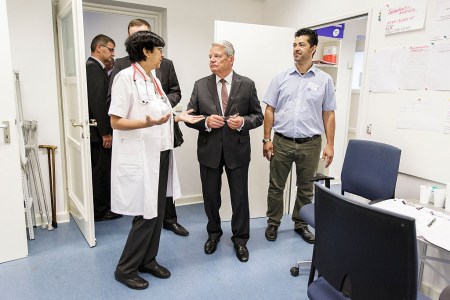
Joachim Gauck, then Germany’s president, speaks to doctors in the infirmary of a reception center for migrants on August 26, 2015 in Berlin-Wilmersdorf, Germany. (Photo by Jesco Denzel/Bundesregierung via Getty Images)

German newspapers have published a flurry of articles about the public health dimension of the migrant crisis. The articles often quote medical professionals with first-hand experience of treating migrants. Many admit that mass migration has increased the risk of infectious diseases in Germany. Headlines include:

Refugees Often Bring Unknown Diseases to the Host Country“; “Refugees Bring Rare Diseases to Berlin“; Refugees in Hesse: Return of Rare Diseases“; “Refugees Often Bring Unknown Diseases to Germany“; “Experts: Refugees Bring ‘Forgotten’ Diseases“; “Three Times More Hepatitis-B Cases in Bavaria“; “Cases of Tapeworm in Germany Increased by More than 30%“; “Infectious Disease: Refugees Bring Tuberculosis“; “Tuberculosis in Germany is on the Rise Again, Especially in the Big Cities: Caused by Migration and Poverty“; “Refugees Are Bringing Tuberculosis“; More Diseases in Germany: Tuberculosis is Back“; “Medical Practitioner Fears Tuberculosis Risk due to Refugee Wave“; “Significantly More Tuberculosis in Baden-Württemberg: Migrants often Affected“; “Expert: Refugee Policy to Blame for Measles Outbreak“; “Scabies on the Rise in North Rhine-Westphalia“; “Almost Forgotten Diseases Like Scabies Return to Bielefeld“; “Do You Come into Contact with Refugees? You Should Pay Attention“; and “Refugees: A Wide Range of Disorders.”

At the height of the migrant crisis in October 2015, Michael Melter, the chief physician at the University Hospital Regensburg, reported that migrants were arriving at his hospital with illnesses that are hardly ever seen in Germany. “Some of the ailments I have not seen for 20 or 25 years,” he said, “and many of my younger colleagues have actually never seen them.”

Marc Schreiner, director of international relations for the German Hospital Federation (Deutschen Krankenhausgesellschaft), echoed Melter’s concerns:

“In the clinics, it is becoming increasingly common to see patients with diseases that were considered to have been eradicated in Germany, such as scabies. These diseases must reliably be diagnosed, which is a challenge.”

Christoph Lange, a tuberculosis expert at the Research Center Borstel, said that German doctors were unfamiliar with many of the diseases imported by migrants: “It would be useful if tropical diseases and other diseases that are rare in our lives played a bigger role in the training of physicians.”

The German Society for Gastroenterology, Digestive and Metabolic Diseases recently held a five-day symposium in Hamburg to help medical practitioners diagnose diseases which are rarely seen in Germany. Those include:

  • Louse-borne relapsing fever (LBRF): During the past two years, at least 48 people in Germany were diagnosed with LBRF, a disease that was unheard of in the country before the migration crisis in 2015, according to the RKI report. The disease, which is transmitted by clothing lice, has been prevalent among migrants from East Africa who have been travelling for months to reach Germany on a single set of clothes. “We had all forgotten about LBRF,” said Hans Jäger, a Munich-based doctor. “It has a mortality rate of up to 40% if it is not recognized and not treated with antibiotics. The symptoms are like in malaria: fever, headache, skin rash.”
  • Lassa fever: In February 2016, a patient who had been infected in Togo, West Africa, was treated and died in Germany. After his death, a Lassa virus infection was confirmed in another person who had professional contact with the corpse of the deceased. The person was treated at an isolation facility and survived the disease. This was the first documented transmission of the Lassa virus in Germany.
  • Dengue fever: Nearly a thousand people were diagnosed with dengue fever, a mosquito-borne tropical disease, in Germany during 2016. This is up 25% from 2014, when 755 people were diagnosed with the disease.
  • Malaria: The number of people diagnosed with malaria jumped sharply in 2014 (1,007) and 2015 (1,063), but declined slightly in 2016 (970). Most of those affected contracted the disease in Africa, particularly from Cameroon, Ghana, Nigeria and Togo.
  • Echinococcosis: Between 2014 and 2016, more than 200 people in Germany have been diagnosed with echinococcosis, a tapeworm infection. This represents in an increase of around 30%. Those affected contracted the disease in Afghanistan, Bulgaria, Greece, Kosovo, Iraq, Macedonia, Morocco, Syria and Turkey.
  • Diphtheria: Between 2014 and 2016, more than 30 people in Germany have been diagnosed with diphtheria. Those affected contracted the disease in Ethiopia, Eritrea, Libya, Sri Lanka and Thailand.
  • Scabies: Between 2013 and 2016, the number of people diagnosed with scabies in North Rhine-Westphalia jumped by nearly 3,000%.

Meanwhile, Germany currently is in the throes of a measles outbreak that health authorities have linked to immigration from Romania. Around 700 people in Germany have been diagnosed with measles during the first six months of 2017, compared with 323 cases in all of 2016, according to the Robert Koch Institute. The measles outbreak has spread to all of Germany’s 16 federal states except one, Mecklenburg-Vorpommern, a state with a very low migrant population.

The epicenter of the measles crisis is in North Rhine-Westphalia (NRW), Germany’s most populous state and also the state with the highest number of migrants. Nearly 500 people have been diagnosed with measles in NRW during the first six months of 2017; most of the cases have been reported in Duisburg and Essen, where a 37-year-old mother of three children died from the disease in May. Outbreaks of measles have also been reported in Berlin, Cologne, Dresden, Hamburg, Leipzig, Munich and Frankfurt, where a nine-month-old baby was diagnosed with the disease.

On June 1, 2017, the German Parliament approved a controversial new law that requires kindergartens to inform German authorities if parents fail to provide evidence that they have consulted a doctor about vaccinating their children. Parents who refuse to comply face a fine of €2,500 ($2,850). “We cannot be indifferent to the fact that people are still dying of measles,” saidGerman Health Minister Hermann Gröhe. “That’s why we are tightening up regulations on vaccination.”

Some say the new law does not go far enough; they are calling for vaccinations to be made compulsory for everyone in Germany. Others say the law goes too far and infringes on privacy protections guaranteed by the German constitution; they add that parents, not the government, should decide what is best for their children. The fallout from Chancellor Merkel’s open-door migration policy continues.

The NeverTrump Outrage of a Disappointed Elite

July 14, 2017

The NeverTrump Outrate of a Disappointed Elite, Front Page Magazine, Bruce Thornton, July 14, 2017

The excessive outrage over Trump’s errors of style, which exceeds what we heard over Hillary’s corruption and felonious actions, cries out for explanation. For the principle that moral outrage should be proportional to the offense is not at work here. From the beginning of Trump’s campaign, the disproportion of his critics’ anger with their response to Obama’s and Clinton’s assault on law and the Constitution has shown that something else is going on: an elite class is angry that the highest power in the land, with all the attention and perks that go with it, is in the hands of a vulgarian who sneers at their class-defining proprieties and protocols.

In the end, all that matters at this point are Hillary Clinton is not president, Merrick Garland isn’t sitting on the Supreme Court, Obama’s Constitution-busting Executive Orders are being rolled back, overreaching federal agencies are being reined in, the corrupt activist media and the Democrats are self-destructing, and for the first time in a long time there’s a chance to tame the regulatory behemoth of the federal government. If Trump continues to deliver significant change, everything else will be a transient spectacle.

*************************************************

When I was a kid, an outfit called Big Time Wrestling would come to town. The favorite rivalry was between stage gringo Ray Stevens and the chivalric Pepper Gomez. Fierce disputes over which champion was better would break out on the playground after a bout. Then one day an older Mexican kid shattered our illusions by informing us that he had seen Stevens and Gomez laughing together over dinner in Chinatown.

Welcome to American politics, where the educational and economic elites, especially in the bicoastal politico-media complex, are bound together by a privilege that transcends the lurid dramas of conflicting ideologies.

Two recent columns talk about this divide between mass and elite in American society. David Brooks, house-conservative at the New York Times, wrote a much-ridiculed, but still perceptive column about what defines the American elite, and how they ensure that their children will inherit their privilege, and the less-privileged will be kept out. By using their wealth to “invest” in their kids’ success––the best schools, public or private; the means to pay for tutors, SAT prep courses, internships, and foreign travel; and the social connections to help them matriculate at Ivy League and other top-notch schools, 70% of whose admissions come from the top 25% of income distribution.

The gate-keeping comes in the form restrictive building codes that in deep-blue redoubts of privilege like San Francisco and Manhattan keep housing prices high, and schools demographically homogenous. The result is a shared social and cultural capital that is second-nature to insiders, but alien to those who have not been exposed to the knowledge, mores, manners, and taste that comprise it.

A specific example of elite solidarity across partisan lines appeared in a New York Post column by Maureen Callahan. She peruses the guest-list for an annual soiree hosted by Washington Post heiress Lally Weymouth in the Hamptons:

It was full of politicians and power brokers — the ones who pantomime outrage daily, accusing the other side of crushing the little guy, sure that the same voter will never guess that behind closed doors, they all get along.

Ivanka Trump and Jared Kushner partied with billionaire Democratic donor George Soros, who rubbed shoulders with billionaire GOP donor David Koch.

Chuck Schumer and Kellyanne Conway were there. So were Democratic Rep. Carolyn Maloney, Ronald Lauder, Carl Icahn, Joel Klein, Cathie Black, reporters Steve Clemons and Maria Bartiromo, columnists Richard Cohen and Margaret Carlson, Secretary of Commerce Wilbur Ross and Secretary of Transportation Elaine Chao, Ray Kelly, Bill Bratton and Steven Spielberg.

Like Pepper Gomez and Ray Stevens, these denizens of the 1% are fierce partisans in front of the cameras, but old pals at a tony party or a chic restaurant or a high-end golf resort. They share the same zip codes, the same tastes, the same amenities of celebrity and wealth, and ultimately the same interest: keeping themselves on top, and hoi polloi at a distance.

This social reality can help solve the mystery of Republican NeverTrumpers and their obsessive anger––Trump is a 1% traitor who has turned against his own in a bid for political power. From ancient Athens on, populist demagogues have usually been aristocrats who betray their class by enlisting the support of the grubby masses and legitimizing their grievances. They buy loyalty by promising to redistribute the property of the wealthy, and by sneering at their mores and taste, their education and proper pronunciation, and especially their reflexive sense of superiority.

In antiquity it was land and lineage that defined privilege. In our day, prep schools, top-ten university degrees, formal speech, correct diction, proper manners, and high-cult allusions all mark off the elite, and hide the fact that their position comes from money and connections as much as merit. Someone like Trump, who violates every one of these canons and enjoys the support of the “bitter clingers” and “deplorable” masses, infuriates the elite by challenging their right to rule by virtue of their presumed intellectual and cultural superiority.

The NeverTrump Republicans, of course, deny that there is such an establishment elite, or that they are members of it. But that’s like a fish denying it’s wet. Someone like NeverTrump hysteric Bret Stephens––son of a corporate vice president; graduate of the tony Middlesex School in Massachusetts; possessor of degrees from the University of Chicago and the London School of Economics; columnist for the New York Times­­––epitomizes elite privilege, and its anger at a class-betrayer like the vulgar, rule-breaking Donald Trump whom it deems unfit to rule.

The real evidence, however, that style rather than substance lies behind the NeverTrumpers’ hatred is the inconsistency of their standards of criticism. Right now all the angry talk is over Trump’s son meeting with a Russian lawyer, an alleged agent of Putin’s regime, because he thought he’d get some dirt on Hillary. “Collusion” they cry, or at the least yet another failure of judgment and protocol that compromises the whole Trump administration.

Talk about straining out the gnat but swallowing the camel! Where was this stratospheric dudgeon when Barack Obama was caught on a hot mic promising Putin’s flunkey that he would be “flexible” on missile-defense after the election? Where were all the hair-on-fire hysterics about supping with the Russian devil, and doing so solely for personal and partisan political gain? Or for unleashing the IRS, the DOJ, the NLRB, the EPA on progressives’ political enemies? Or for two of the most politicized AGs in recent memory? We could have used that passionate anger back then, but of course, apart from being “black,” and so triggering the guilty- white “preemptive cringe,” Obama had the right degrees, the right connections, and the right superficial manners and patter one expects from “one of us.”

The same is true of Hillary Clinton. Nothing Donald Trump has materially done comes even close to Clinton’s patently felonious behavior. Violating the law regarding the handling of classified information, then obstructing justice by “bleaching” her hard drive; lying to the faces of the grieving parents next to the coffins of their four children killed by her foreign policy blundering; running a pay-for-play foundation that put 20% of U.S. uraniuminto the hands of a Russian company in exchange for donations––by what moral metric is Donald Trump Jr.’s naively taking a meeting, on the promise of oppo-research, even remotely close to such compromising of our national security and the Constitution?

The excessive outrage over Trump’s errors of style, which exceeds what we heard over Hillary’s corruption and felonious actions, cries out for explanation. For the principle that moral outrage should be proportional to the offense is not at work here. From the beginning of Trump’s campaign, the disproportion of his critics’ anger with their response to Obama’s and Clinton’s assault on law and the Constitution has shown that something else is going on: an elite class is angry that the highest power in the land, with all the attention and perks that go with it, is in the hands of a vulgarian who sneers at their class-defining proprieties and protocols.

In the end, all that matters at this point are Hillary Clinton is not president, Merrick Garland isn’t sitting on the Supreme Court, Obama’s Constitution-busting Executive Orders are being rolled back, overreaching federal agencies are being reined in, the corrupt activist media and the Democrats are self-destructing, and for the first time in a long time there’s a chance to tame the regulatory behemoth of the federal government. If Trump continues to deliver significant change, everything else will be a transient spectacle.

Peace is light-years away

July 14, 2017

Peace is light-years away, Israel Hayom, Ruthie Blum, July 14, 2017

(Israel: give, give, give. Palestinians: take, take, take. But no peace. — DM)

So far, however, all Abbas has done is call the shots on the venue of a meeting ‎between his honchos and Trump’s team, agree to water and electricity deals that ‎benefit the PA and give the White House cause for false optimism. Undoubtedly, ‎he has already figured out how to get around the Taylor Force Act, if and when it ‎passes. A revised, bipartisan version of the bill, in particular — geared toward ‎guaranteeing that ordinary Palestinians are not robbed of humanitarian services ‎as a result of their leaders’ violations — will provide him with sufficient loopholes ‎to keep his “martyrs” in clover.‎

****************************

If the leaders of the Palestinian Authority had invested as much time, energy and ‎other people’s money in building a flourishing society as they do in the pursuit of ‎death and destruction, there would be no need for outside efforts to broker ‎peace between them and their Israeli counterparts. It takes only about 30 minutes ‎to drive from the Muqataa compound in Ramallah to the Prime Minister’s Office in ‎Jerusalem. Yet it is still easier for dignitaries from the United States and Europe to ‎spend hours on flights to Tel Aviv for the purpose of talking about a two-state ‎solution than it is for PA President Mahmoud Abbas to budge in any direction ‎other than backwards. ‎

Take this week, for instance, which began with the Palestinians’ refusal to host ‎U.S. Ambassador to Israel David Friedman — whom U.S. President Donald Trump ‎has included in his Mideast peacemaking team, along with advisers Jason ‎Greenblatt and Jared Kushner — in Ramallah. Friedman is too pro-Israel, as far as ‎Abbas is concerned. As a result, the meeting between American and Palestinian ‎officials on Tuesday took place at the King David Hotel in west Jerusalem. ‎

On Thursday, Greenblatt joined fellow envoys of the Middle East Quartet — the ‎U.S. (which he represents), the European Union, the United Nations and Russia — ‎in Jerusalem “to discuss current efforts to advance Middle East peace, as well as ‎the deteriorating situation in Gaza.”‎

Also on Thursday, Greenblatt announced that Israel had agreed to sell the PA 1.2 ‎billion cubic feet of water. This, he said, in addition to an electricity deal reached ‎between Israel and the PA on Monday, will improve the Palestinians’ standard of ‎living.‎

Meanwhile, in Washington, D.C. on Wednesday, the Senate Foreign Relations ‎Committee conducted a hearing on the proposed Taylor Force Act, named after ‎the former U.S. Army officer who — while on a trip to Israel in March 2016 — was ‎stabbed to death by a knife-wielding Palestinian on a rampage in Tel Aviv. The bill, ‎co-sponsored by Senators Lindsey Graham (R-S.C.), Dan Coats (R-‎Ind.) and Roy Blunt (R-Miss.), aims to halt American aid to the PA until it ‎stops paying salaries and stipends to imprisoned terrorists and the families of ‎those “martyred” while murdering Israelis. ‎

Testifying before the committee on behalf of the bill, Senior Fellow for Middle ‎Eastern Studies at the Council on Foreign Relations Elliott Abrams — who served as ‎deputy assistant to the president and deputy national security adviser in the ‎George W. Bush administration — railed against the “Palestinian practice of ‎making payments to individuals convicted of acts of terror, and their families or ‎survivors, in accordance with the severity of their acts and the length of their ‎sentences.” The “predictable effect of this practice,” he said, “is to reward and ‎incentivize acts of terror.”‎

Pointing to the billions of dollars that the U.S. has poured into the PA since its ‎establishment in the 1990s, Abrams said, “As long as the Palestinian government ‎is in effect rewarding terror, we need to be sure we make our objections — our ‎condemnation — known, and that cannot be merely in words. Our assistance ‎program must reflect our feeling of repugnance.” He then proposed a revision to ‎the bill that would enable the U.S. to continue funding hospitals and other ‎projects that benefit the Palestinian people, while preventing the money from ‎lining the pockets of corrupt bureaucrats.‎

Whether this carrot-and-stick approach to the PA was purposeful or inadvertent ‎is unclear. What is certain, however, is that the PA president is not turning over a ‎new leaf. Earlier this month, as Palestinian Media Watch reported, Abbas ‎was quoted on Fatah’s official Facebook page as proclaiming: “Even if I have to ‎leave my position, I will not compromise on the salary of a martyr or a prisoner, ‎as I am the president of the entire Palestinian people, including the prisoners, the ‎martyrs, the injured, the expelled and the uprooted.”‎

This sentiment was echoed recently by PA Prime Minister Rami Hamdallah. ‎Hamdallah — who launched the first-ever Palestinian-owned power substation in ‎Jenin with Israeli National Infrastructure, Energy and Water Resources Minister ‎Yuval Steinitz on Monday, and signed the electricity deal touted by Greenblatt — ‎vowed last month to continue rewarding terrorists.‎

On June 16, according to PMW, the official PA newspaper quoted Hamdallah ‎announcing: “On behalf of … Abbas and our Palestinian people, I salute all of the ‎martyrs’ families … [and] emphasize to them that their rights are protected. … We ‎remember the sacrifices and struggle of the pure martyrs, guardians of the land ‎and identity, who have turned our people’s cause into a historical epic of struggle ‎and resolve.”‎

Hamdallah’s reassurance came on the heels of U.S. Secretary of State Rex ‎Tillerson’s claim that the PA’s “intent is to cease the payments to the families of ‎those who have committed murder or violence against others.” Ironically, both ‎Israeli and Palestinian officials were incensed by the statement, and Tillerson was ‎forced to modify it. Washington and Ramallah — he said the following day — are ‎engaged in an “active discussion” on the matter.‎

So far, however, all Abbas has done is call the shots on the venue of a meeting ‎between his honchos and Trump’s team, agree to water and electricity deals that ‎benefit the PA and give the White House cause for false optimism. Undoubtedly, ‎he has already figured out how to get around the Taylor Force Act, if and when it ‎passes. A revised, bipartisan version of the bill, in particular — geared toward ‎guaranteeing that ordinary Palestinians are not robbed of humanitarian services ‎as a result of their leaders’ violations — will provide him with sufficient loopholes ‎to keep his “martyrs” in clover.‎

Ramallah may be a mere 10 miles from Jerusalem, but it — ‎like peace — is light-years away.‎

There may be hope for Sweden, after all

July 14, 2017

‘Time for international community to acknowledge Six-Day War is over and that Jerusalem is, has been, will always remain capital of Jews.’

Source: There may be hope for Sweden, after all – Israel National News

Sweden iStock

Swedish magazine Världen idag (“The World Today“) ran an article entitled Time for the UN to Accept the Outcome of the Six-Day War by Tomas Sandell. Arutz Sheva brings a translation of the article in its entirety for the wholly lucid dedication to truth Sandell demonstrates herein:

This week, the international community will mark the 50th anniversary of the Six-Day War and the reunification of Jerusalem. But despite the fact that Israel won its war against three Arab armies in early June 1967 in record time, the war seems to continue. Indeed, the international community still has difficulty accepting that the small country of Israel, against all odds over the Arab armies, and as a result of winning this war, received new lands.

The war ended formally after six days, June 10, 1967, but still fifty years later, the international community demands that the “occupied” territories of Israel should be returned even though it was not Israel who started the war. Thus, the Israeli “occupation” is considered to be the root of the entire Israel-Palestinian conflict.

The statement is incorrect for two different reasons. According to international law, one can not occupy an area already belonging to a legal entity. Judea and Samaria were assigned to the Jewish state in the 1922 Palestine Mandate in the land area that remained when the original mandate was divided into two parts, a Jewish Palestine (1948 Israel) and an Arab Palestine, today Jordan.

The United Nations partition plan of 1947, on the other hand, had been rejected by the Arab neighbors of Israel and thus never came into force. The lands that Israel regained in the Six-Day War therefore already belonged to it according to international law after being illegally occupied by Jordan for twenty years.

Secondly, international law expressly prohibits a war of aggression. On the other hand, it does not say anything about land areas gained after a regular war of defense. Thus, a country, or a group of countries, can not start a war of aggression and if they lose the war, the counterparty be called out for occupation. Public law can not reasonably forbid countries to defend themselves, or encourage countries to initiate a war of aggression with the promise that they can later regain all the territories that they lose. This would be a recipe for complete chaos where aggressive states are rewarded while the law-abiding ones have no legal rights.

Now it is therefore time for the international community to accept the outcome of the Six-Day War.

Indeed, in UN resolution 242, the Government of Israel has agreed that certain lands should be returned in a peace agreement, but the allegation that Israel is currently occupying Palestinian land is wrong because they “occupied territories” that never belonged to a Palestinian state.

When you repeat in international relations next week that the Six-Day War is the root of the Israel-Palestinian conflict, you are wrong.

If the Palestinian people (actually Arabs living in the Palestine Mandate) had been interested in their own state, one such was founded in 1947 when the UN partition plan offered them everything they are asking for today and more. In other words, one had twenty years, from 1947 to 1967, to create a state, but there was no interest. Therefore, it is intellectually unsound to claim that the war in 1967 is the core of the conflict.

As an external columnist, it is not my job to decide how to resolve the conflict, but the Israeli government has announced that it is prepared to negotiate with the Palestinians about a state, but insists that Jerusalem should remain the undivided capital of Israel, and that today’s status will not change and the Temple Mount be preserved under Jordanian administration. This is no unreasonable bargaining position.

After almost fifty years, it is time for the international community to acknowledge that the Six-Day War is over and that Jerusalem is, has been, and will always remain the capital of the Jews. This fact is acknowledged, de facto, every time a head of state travels to Jerusalem to meet the government of the country. These meetings do not happen in Tel Aviv but in Jerusalem. When you talk about partition of Jerusalem between East and West, you forget that only East Jerusalem with the Western Wall is the historic Jerusalem holy to the Jewish people. If you think Israel’s demands on Jerusalem are unreasonable, one has to consider the options, to share Jerusalem, and to create a new Mecca in East Jerusalem where no non-Muslim may enter.

For those who want to safeguard universal legal principles and values, it is therefore important to safeguard Jerusalem’s current status as a united city open to all religions as well as to those who do not belong to any religion. Jerusalem’s reunion is an event worth celebrating, for Christians, Muslims, as well as Jews.

Israeli troops maneuvering on outskirts of Rafah, Gaza Reuters