AG Sessions To Announce Investigations into leaks – Trump Admin – America’s Newsroom via YouTube, July 31, 2017
(Also a bit on Debbie Wasserman-Schultz and Imran Awan. — DM)
AG Sessions To Announce Investigations into leaks – Trump Admin – America’s Newsroom via YouTube, July 31, 2017
(Also a bit on Debbie Wasserman-Schultz and Imran Awan. — DM)
BREAKING: Scaramucci out after brief, turbulent stint at White House, Washington Times, Dave Boyer, July 31, 2017
 In this July 25, 2017, photo, White House communications director Anthony Scaramucci walks back to the West Wing of the White House in Washington. Six months into presidency, Donald Trump is saddled with a stalled agenda,
President Trump removed newly appointed White House communications director Anthony Scaramucci Monday, just over a week after the president had hired him to help force out chief of staff Reince Priebus.
The stunning move came just hours after Mr. Trump swore in his new chief of staff, retired Gen. John F. Kelly, former Homeland Security secretary.
When he was hired by his friend the president, Mr. Scaramucci made clear that he would report directly to Mr. Trump, not to the chief of staff. It wasn’t clear whether Mr. Scaramucci was insisting on the same direct access to the president upon Mr. Kelly’s new appointment.
Several news outlets reported that Mr. Scaramucci’s ouster came at the request of Mr. Kelly.
Mr. Scaramucci had the president’s blessing last week as he stepped up his criticisms of Mr. Priebus, which led to the resignation of Mr. Priebus on Thursday. The communications director even criticized Mr. Priebus as a “paranoid schizophrenic” in a profanity-laced tirade of an interview with the New Yorker.
But since then, Mr. Scaramucci had gone home to Long Island, New York, to see his newborn son. His wife, Deirdre, filed for divorce two weeks before giving birth last week.
Tehran’s New Scheme for Iraq, Gatestone Institute, Amir Taheri, July 31, 2017
The apparent de-sectarianization of pro-Iran Shiite parties will make it difficult for Allawi and other genuinely non-sectarian Shiite politicians, who are hostile to Iranian influence in Baghdad, to appeal to the Shiite majority on the basis of citizenship and “uruqah“.
The new “de-sectarianization” gambit will also put pressure on Kurdish parties at a time some of them are campaigning for an “independence” referendum. It would be more difficult to sell the idea of an “independent” mini-state of Kurdistan to international public opinion at a time that Iraq is seen to be moving towards a non-religious democratic and pluralist political system.
***************************
In his visit to Moscow last week, Iraqi Vice President Nuri Al-Maliki peddled what he presented as his big idea: inviting Russia to build “a significant presence” in Iraq to counter-balance that of the United States.
Since Maliki is reputed to be Tehran’s candidate as the next Iraqi Prime Minister his “invitation” to Russia cannot be dismissed as a mere personal whim.
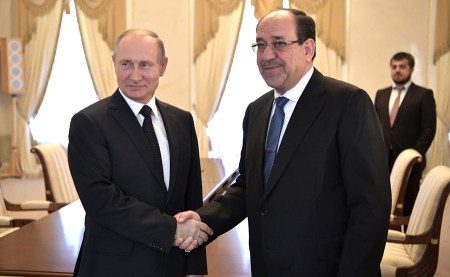 Russian President Vladimir Putin greets Iraqi Vice President Nuri Al-Maliki in Moscow, on July 25, 2017. (Image source: kremlin.ru)
With ISIS driven out of Mosul and, hopefully, soon to be driven other pockets of territory it still controls in Iraq, the decks are being cleared for the forthcoming general election that would decide the shape of the next government in Baghdad. Fancying itself as the “big winner” in Iraq, Iran’s leadership is working on a strategy to make that fancy a reality.
That strategy has three key elements.
The first is to create a new, supposedly “liberal” and “non-sectarian” Shi’ite coalition to dominate the next parliament and, through that, the next government in Baghdad. That requires a reshuffling of political cards and the discarding of some old outfits.
In an editorial last Tuesday, the Islamic Republic of Iran’s official news agency, IRNA, argued that “old formations” that had come into being during the struggle against Saddam Hussein and the subsequent post-liberation crisis were no longer capable of dealing with “new realities in Iraq.”
It was on the basis of that analysis that Ammar al-Hakim, a leading politician-cum-cleric announced his separation from the Supreme Council for the Islamic Revolution in Iraq and the formation of a new party named “National Wisdom Movement” (Tayar al-Hikmah al-Watani).
Hakim, who hails from an old and respected dynasty of clerics originally from Shiraz, argues that time has come to “break barriers of sects and ethnicities” in favor of the concept of “citizenship”. Thus he comes close to advocating the concept of “uruqah” (Iraqi-ness) that has long been a theme of such Iraqi Shiite politicians as Ayyad Allawi and Adel Abdul-Mahdi.
Sources in Tehran expect the “new model” to be adopted by other Shiite parties and groups. Prime Minister Haidar Al-Abadi is reportedly studying the creating of a new “secular” formation away from his original political home in the Ad-Da’awah (“The Call”) Party, which has always been a clearly sectarian formation.
Talks are already under way for the merger of Abadi’s support base with the Sadrist Movement led by Muqtada al-Sadr, scion of another distinguished clerical dynasty originally from Mahallat, southwest of Tehran. According to unconfirmed reports the new Abadi-Sadr coalition will be called “Freedom and Reconstruction”, a clearly non-sectarian identity.
Tehran’s hope is that Maliki will transform his wing of the Ad-Dawah into yet another “non-sectarian” outfit to support his bid for premiership, presumably with support from Hakim.
The apparent de-sectarianization of pro-Iran Shiite parties will make it difficult for Allawi and other genuinely non-sectarian Shiite politicians, who are hostile to Iranian influence in Baghdad, to appeal to the Shiite majority on the basis of citizenship and “uruqah“.
The new “de-sectarianization” gambit will also put pressure on Kurdish parties at a time some of them are campaigning for an “independence” referendum. It would be more difficult to sell the idea of an “independent” mini-state of Kurdistan to international public opinion at a time that Iraq is seen to be moving towards a non-religious democratic and pluralist political system.
The gambit will also make it more difficult for Arab Sunni sectarians to garner support in the name of resisting a Shiite sectarian takeover of government in Baghdad. Salim al-Juburi, a leading Arab Sunni politician and Speaker of the Iraqi Parliament, is reportedly moving towards the creation of a non-sectarian party of his own.
The second element of the Iranian strategy is to almost oblige the clerical authority in Najaf (Marja’iyah) to endorse, even reluctantly, a Shiite political leadership clearly committed to Iran. Tehran knows that no government in Baghdad would have a chance of success without at least tacit blessing from Grand Ayatollah Ai-Muhammad Sistani.
Sistani has consistently refused to play the sectarian card and has advised politicians of all shades to think in terms of national rather than religious considerations. Thus, Tehran’s decision to “de-sectarianize” the Iraqi parties it supports will be a concession to Sistani.
Tehran is offering yet another concession to Sistani by abandoning its campaign to influence the Grand Ayatollah’s succession. The initial Iranian candidate for succession, Ayatollah Mahmoud Shahrudi, a former senior official of the Islamic Republic, has been quietly cast aside and is reported to be in declining health.
Without formally saying so, Iran now admits that the issue of Sistani’s succession must be sorted out by the “howzah” (seminary) in Najaf possibly with some input from Qom and certainly not through diktat from Tehran.
The third element of the strategy is to draw Russia into Iraq as a façade for Iranian influence.
Iranian leaders know that the vast majority of Iraqis resent the emergence of Iran as arbiter of their destiny. Russia, however, is seen as remote enough not to pose a direct threat to the internal balance of power in Iraq. Yet, because Russia has no local support base in Iraq, it would have to rely on Iranian guidance and goodwill to play a leading role there.
A new Baghdad government composed of “non-sectarian” Shiite leaders, promising a better deal for Arab Sunnis and Kurds, and backed by Russia, will be a better cover for the spread and consolidation of Iranian influence in Iraq.
There is, of course, no guarantee that the new Iranian strategy will work. Many Iraqis, including some among those reputedly close to Iran, believe that Iraq itself can and must aspire after becoming a major player in the Middle East rather than playing Sancho Panza to the “Supreme Guide” in Tehran.
Iraqi leaders also see no logic in turning the United States and Arab states into enemies just to suit Tehran’s doomed empire-building project, especially at a time that the Islamic Republic seems to be heading for the choppy waters of Ayatollah Khamenei’s succession.
Remember:
The best laid schemes o’ mice an’ men
Often go awry
And leave us nought but grief and pain,
For promised joy.
Amir Taheri, formerly editor of Iran’s premier newspaper, Kayhan, before the Iranian revolution of 1979, is a prominent author based on Europe. He is the Chairman of Gatestone Europe.
This article first appeared in Asharq Al Awsat and is reprinted here with the kind permission of the author.
Trump, Putin, Xi: Talking fades to shows of force, DEBKAfile, July 31, 2017
(Please see also, Haley Says ‘No Value’ in Another UN Resolution Against North Korea: ‘The Time for Talk Is Over’. — DM)

The message from Beijing was clear: The threat to Chicago and Los Angeles would have to be dealt with by the White House in Washington, not Beijing.
********************************
Over the weekend, three world leaders, US president Donald Trump, Russia’s Vladimir Putin and China’s leader Xi Jinping stepped off the diplomatic path over their differences on world issues and switched to displays of military might.
In a show of force after North Korea’s two ICBM tests, two US B-1B bombers capable of delivering nuclear weapons, escorted by South Korean and Japanese fighters, took off from Guam Saturday, July 29 and cut across the Korean peninsula. There was no word on whether they entered North Korean skies.
Further west, US Vice President Mike Pence toured East European capitals. Speaking in Tallinn, Estonia, he assured “our Baltic allies” – as well as Georgia and Montenegro, his next destinations: “We are with you and will stand with you on behalf of freedom.” He said that the president would soon sign the latest round of sanctions voted on by Congress, since “Russia’s destabilizing activities and support for rogue regimes and its activities in Ukraine are unacceptable.”
Shortly after President Donald Trump criticized China over failing to deal with North Korea, President Xi Jinping in a general’s uniform viewed a huge military parade Sunday marking the People’s Liberation Army’s 90th anniversary. Xi is the PLA’s commander in chief. Whereas the annual parade usually takes place in Beijing, this one was staged at the remote Zhurihe military base in Inner Mongolia., with the participation of 12,000 soldiers, 100 bombers and fighters and a display of 600 weapons systems, 40 percent of them new products of China’s arms industries.
“The world isn’t safe at the moment,” the Chinese president told his people. “A strong army is needed more than ever.”
The Russian president meanwhile showcased his naval might in a huge parade of vessels stretching from the Dnieper River in Moscow to Saint Petersburg, through the Baltic port of Kaliningrad, to Crimea on the Black Sea and up to Russia’s Syrian base at Tartus. Taking part were 50 warships and submarines.
Standing on the deck of the presidential warship as it sailed past the Kremlin’s walls, Putin congratulated the Russian navy on its great advances.
He then disembarked, headed to his office and ordered 755 U.S. diplomats to leave the country by Sept. 1, in retaliation for the new round of sanctions against Russia ordered by the US Congress. More than 1,000 people are currently employed at the Moscow embassy and three US consulates in Russia.
“We waited for quite some time that maybe something will change for the better, had much hope that the situation will somehow change, but, judging by everything, if it changes, it will not be soon,” Putin said. “It is time for us to show that we will not leave anything unanswered.” He added menacingly that there are many areas of Russian-American cooperation whose discontinuation would be harmful to the US. “I hope we don’t have to go there,” he said.
These muscle-flexing steps by the three world powers add up to an ominous shift from their brink-of-cold war diplomatic interaction to a new level with the potential for tipping over into limited military clashes.
The penny has finally dropped for Trump that President Xi has no intention of cracking down on North Korea’s Kim Jong-un, even though he declared after a successful second test of an intercontinental ballistic missile that “the US mainland is without our striking range.”
The message from Beijing was clear: The threat to Chicago and Los Angeles would have to be dealt with by the White House in Washington, not Beijing.
Xi may accept that the US president may eventually be forced to take some military action against North Korea’s missile and nuclear facilities. But he may also be counting on such action being a one-off, like the 59-US Tomahawk missile barrage that hit the Syrian air base of Shayrat on April 7. Because that dramatic strike was not the start of an organized campaign against the regime in Damascus, it failed to unseat Bashar Assad and in fact made him stronger. Once America has vented its anger, the Chinese president hopes its military offensive against Kim will be over and done with.
For six months, Putin waited to see whether Trump was able to beat down the media-boosted war waged against his presidency by political and intelligence enemies at home, much of it focused on the Russian dimension. His patience with the US president and his troubles at home is clearly at an end.
On Sunday, July 30, Russian Deputy Foreign Minister Sergei Ryabkov called the new sanctions “completely weird and unacceptable,” adding “If the US side decides to move further towards further deterioration we will answer, we will respond in kind. We will mirror this. We will retaliate,” he stressed.
The gloves have clearly come off for the ramping up of friction among the three powers in the various world flashpoint arenas, whether in Europe, the Far East, or other places.
A Welcome Resignation at DHS, Power Line,
(Please see also, Break out the champagne: State Department officials quitting over “complete and utter disdain for our expertise.” Another pro-Islam official, the Director of Countering Violent Extremism, leaves the Department of Homeland Security. — DM)
Selim’s resignation is evidence of a clear and welcome break by the Trump administration from Obama-era policy on countering radical Islam
************************
I try to write about both the good and the bad of the Trump administration, as I see things.Here’s an important addition to the good column:
George Selim, a prominent Obama administration holdover known for engaging fringe Islamic radicals, has resigned from the Department of Homeland Security. Selim left his post as director of Countering Violent Extremism (CVE). . . .
A DHS source familiar with the situation. . .explained that Selim often clashed with Trump administration officials who sought to do away with the past president’s policies. Senior officials effectively quashed Selim’s efforts to maneuver Obama White House policies and strategies into the new administration, leaving a frustrated Selim with resignation as his only option.
I wrote about CVE here, describing it as a slush fund for CAIR and the Muslim Brotherhood. Indeed, Jordan Schachtel of Conservative Review notes that Selim admitted to hosting hundreds of meetings with officials from the CAIR, an Islamic advocacy group that federal prosecutors have labeled as a Muslim Brotherhood front group that was created to achieve the ends of Hamas (a U.S.-designated terrorist organization).
The premise of CVE is that the best way to fight violent extremists is with “non violent extremist” Salafi clergy who have the most influence on them. As Daniel Greenfield has said:
What it really comes down to is paying Muslims to argue with other Muslims on social media. And hope that the Muslims we’re paying to do the arguing are the good kind of extremists, like the Muslim Brotherhood, and not the bad kind of extremists, like ISIS. Even though they’re both vicious killers.
Greenfield added:
CVE not only doesn’t fight terrorism, it perpetuates the whole reason for it by outsourcing our interaction with domestic Muslims to the Saudis and the Muslim Brotherhood. That’s a big part of how we got a terrorism problem in the first place. CVE’s promoters have convinced us that the best way to fight Islamic terrorism is by partnering with Islamic terrorists.
In reality, the best way to fight Islamic terrorism is not to “parse different flavors of Islam,” as Greenfield put it, but to distinguish between those citizens whose allegiance we have and those whose allegiance we do not have. However, to quote Greenfield again, CVE “rejects the idea that Muslims should be expected to show their allegiance [to the United States] and instead demands that the United States show its allegiance to them.” It thus “inverts the balance of citizenship and invests the United States in an unspoken religious debate.”
One of the consequences of this approach was the watering down the FBI’s counterterrorism training materials, including the elimination of valuable information that would help agents identify terrorists. According to Patrick Poole, this “purge” contributed to clues being missed by the FBI in major terrorism cases, including last year’s bombing of the Boston Marathon
Thus, Selim’s resignation is evidence of a clear and welcome break by the Trump administration from Obama-era policy on countering radical Islam.
( Sounds like serious shit… – JW )

Nikki Haley / Getty Images
U.S. Ambassador to the United Nations Nikki Haley said Sunday that she is ready to take action and not just hold more talks following North Korea’s latest intercontinental ballistic missile (ICBM) launch.
Haley released a statement denying that the U.S. was seeking to form an emergency session at the U.N. She said that it would be useless and even counterproductive to further sanction the regime of North Korean leader Kim Jong-un without action.
“There is no point in having an emergency session if it produces nothing of consequence,” she said. “North Korea is already subject to numerous Security Council resolutions that they violate with impunity and that are not complied with by all U.N. Member States.”
“An additional security council resolution that does not significantly increase the international pressure on North Korea is of no value,” Haley said. “In fact, it is worse than nothing, because it sends the message to the North Korean dictator that the international community is unwilling to seriously challenge him.”
She directly addressed China, the regime’s closest ally, and said that Beijing must intervene. China has insisted that it is not responsible for North Korea, even as the U.S. has accused the Chinese leadership of propping up Pyongyang.
“China must decide whether it is finally willing to take this vital step. The time for talk is over,” Haley said. “The danger the North Korean regime poses to international peace is now clear to all.”
President Donald Trump also focused his Twitter fire on China. He said on Saturday that China does nothing on North Korea despite having “easy” options to “solve this problem.”
I am very disappointed in China. Our foolish past leaders have allowed them to make hundreds of billions of dollars a year in trade, yet…
…they do NOTHING for us with North Korea, just talk. We will no longer allow this to continue. China could easily solve this problem!
South Korea announced Saturday that it will begin talking with the Trump administration about expanding the country’s nuclear capabilities. The Chinese have opposed any actions that would put Seoul in control of nuclear weapons.
Japanese Prime Minister Shinzo Abe also told reporters that the Trump administration promised to “take all necessary measures to protect” Japan.
North Korea launched its latest test missile into Japanese waters on Friday.
“Expect more false allegations, more demonization, more threats…War is in the cards…”
Source: PCR: “The New Russian Sanctions Bill Is Washington’s Monument To Its Criminality” | Zero Hedge
Authored by Paul Craig Roberts,
The Congress of the United States by almost unanimous votes in both House and Senate has made it clear that Congress would rather destroy the President of the United States and to increase the risk of nuclear war than to avoid conflict with Russia by normalizing relations.
The vote on the new sanctions makes it pointless for President Trump to veto the bill, because it passed both houses by far more than the two-thirds vote required to over-ride the president’s veto. The only thing Trump can achieve with a veto is to prove the false charge that he is in league with Vladimir Putin
The new sanctions bill forecloses the possibility of reducing the rising tensions between the two major nuclear powers. It also shows that whatever interest Congress has, if any, in reducing the threat of war and in avoiding a break with Europe over the sanctions, Congress has a much greater interest in continuing to collect campaign contributions from the powerful and rich military/security complex and in playing to the growing hatred of Russia that is encouraged by the US media.
This reckless and irresponsible action by the US Congress makes completely clear that Washington has intentionally chosen conflict with Russia as the main element of US foreign policy. Perhaps now the Russian government will abandon its cherished illusion that an accommodition with Washington can be reached.
As I have written on many occasions, the only way Russia can achieve accommodation with Washington is to surrender and accept American hegemony. Any further resistance of the Russian government to this obvious fact would indicate dangerous delusion on the part of the Russian leadership.
The fig leaf Congress chose for its violation of diplomatic protocols and international law is the disproven allegation of Russian interference in behalf of Trump in the US presidential election. An organization of former US intelligence officers recently announced that forensic investigation has been made of the alleged Russian computer hacking, and the conclusion is that there was no hack; there was an internal leak, and the leak was copied onto a device and Russian “fingerprints” were added. There is no forensic evidence whatsoever that shows any indication of Russian hacking.
It is all made up, and everyone alleging Russian hacking knows it. There is no difference between the allegation of Russian hacking and Hitler’s allegation in 1939 that “last night Polish forces crossed our frontier,” Hitler’s fig leaf for his invasion of Poland.
That Congress uses a blatantly transparent lie to justify its violation of international law and intentionally worsens US relations with both Russia and the EU proves how determined Washington is to intensify conflict with Russia.
Expect more false allegations, more demonization, more threats.
Venezuela Is Now Either Cuba Or North Korea, Hot Air, Jazz Shaw, July 31, 2017
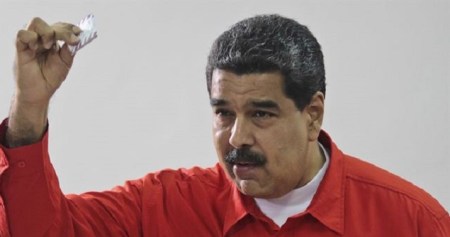
Sometimes I really hate it when I’m right. The “vote” in Venezuela yesterday went largely as expected, with the government of tyrant Nicolas Maduro claiming that upwards of eight million people voted to essentially wipe out the elected legislature and replace it with some window dressing which essentially makes him dictator of the country. This is a condition which could last for his entire life unless his people manage to find a way to oust him from office.
The vote was, of course, largely a sham. And as NBC News was reporting throughout the day, many of the polling places were frequently empty as Maduro’s many opponents boycotted the bogus proceedings.
Many polling stations were largely empty and more than 70 percent of the country was opposed to the vote in the first place, according to opinion surveys. Critics called it a naked power grab by President Nicolas Maduro.
As protesters clashed with police across the increasingly volatile country, only about 9 percent of eligible voters went to the polls, Delsa Solórzano, a prominent leader of the opposition party Un Nuevo Tiempo, said at a news conference Sunday night.
The country’s election authorities, meanwhile, put the number of voters at 8.1 million, equaling a 41.5 percent turnout.
Noticing something of a disparity there? Nearly three quarters of the country was opposed to and sitting out the vote according to recent polls. Election monitors put the turnout at 9% (which actually might be on the low side) and yet Maduro’s “election officials” said it was over 40%. Even if that was a valid figure, that’s still pretty low for something this historic in terms of completely reshaping the country’s government structure.
CNN describes just how much power Maduro has now and also grimly notes that the body count went up as even more protesters – including two teenagers – were slaughtered by his militias.
The election will allow Maduro to replace Venezuela’s current legislative body — the National Assembly — with the new assembly, which would be made up 545 members, all nominated by his administration.
Deadly clashes between protesters and police marred Sunday’s vote, which followed weeks of violent street protests in which many people have been killed or injured. On Sunday the death toll rose sharply with at least six people — including two teenagers — killed at protests and a National Guard officer also reported dead by the attorney general’s office.
More than 8,089,000 people or about 41.53% of registered Venezuelan voters cast ballots Sunday, according to Venezuela’s National Electoral Council.
Now the rest of the world has to decide what, if anything, to do about it. As far as the United States goes, our U.N. Ambassador, Nikki Haley immediately declared the vote to be “a sham” and said that the United States “would not accept the results.” Our State Department put out a statement condemning the results as well and promising a “strong and swift response”, though in somewhat gentler terms. But what does that mean? More sanctions? I’m not sure Maduro particularly cares at this point.
Unless there’s a drastic (and probably violent) change in course, the stage seems to be set. Maduro has completed his takeover and will now be able to rule essentially as a dictator. He’ll probably gather the support of a few other authoritarian regimes, but even that will be limited until he can get his oil production back up. (Assuming he can manage it.) For now, Venezuela will likely become a hermit kingdom, much in the style of either Fidel Castro’s Cuba during the early years or North Korea’s present regime. And the real losers in all of this will be the Venezuelan people. They are currently starving while living on some of the richest farmland on the continent and their government is almost bankrupt while sitting atop some of the largest proven crude oil reserves in the world. These are the fruits of socialism. Watch closely if you are cheering for similar policies in the United States.
Civilization Jihad at Upstate New York’s Chautauqua Institution, Understanding the Threat, July 31, 2017
(Please see also, What Is the World Council of Churches? — DM)
For 15 years, Chautauqua Institution has been the conduit for a successful Muslim Brotherhood Information Operation which has given the tens of thousands of people who attend their 9-week and individual programs a counter-factual understanding of Islam and the intentions of the Muslim Brotherhood.
****************************
The Chautauqua Institution, a non-profit educational center “originally the Chautauqua Lake Sunday School Assembly, was founded in 1874 as an educational experiment in out-of-school, vacation learning,” according to its website. Chautauqua supports theatre programs, debates on “The Suffrage,” hosts concerts with acts like Sheryl Crow, and is a significant driver for the Muslim Brotherhood’s jihadi Movement in the United States.
The major overtaking of Chautauqua by jihadis was led by Reverend Joan Brown Campbell, the Director of the Department of Religion at the Chautauqua Institution, and the first female to serve as the General Secretary of the National Council of the Churches of Christ in the USA (NCC) and as Director of the US Office of the World Council of Churches (WCC).
As those who follow UTT know, the National Council of Churches (NCC) in the United States has long defended and advocated for terrorist/jihadi organizations, including many of the Muslim Brotherhood front groups. The World Council of Churches has publicly called for Israel to release Hamas terrorists.
The Muslim Brotherhood’s stated method to overthrow the United States government and replace it with an Islamic State is “Civilization Jihad by OUR hands.” They get our leaders in the religious, political, military, law enforcement, media, intelligence, educational, and business communities to do their bidding for them.
And that is just what Reverend Joan Brown Campbell and the leaders of Chautauqua have done since 2002 – right after 9/11.
Reverend Campbell brought Karen Armstrong to Chautauqua Institution, which opened the doors of Chautauqua wide to Saudi Arabia, the Muslim Brotherhood, and jihadis from all over the planet. Armstrong is a former Catholic nun who defends jihadi martyrdom operations (“suicide bomber), advocates for jihadis, and blames 9/11 on United States and the West in general. She works closely with numerous MB leaders around the globe.
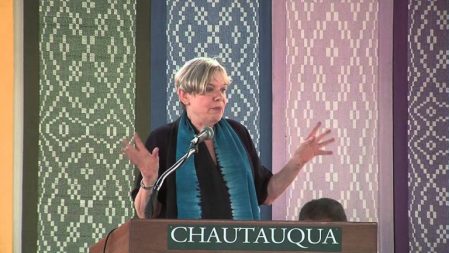 Jihadi/Terrorist defender and advocate Karen Armstrong speaking at Chautauqua Institution
The Family of Abraham/Abrahamic programs, brought to Chautauqua by Armstrong and her jihadi allies, are Muslim Brotherhood operations which perpetuate the lie that Christianity, Judaism, and Islam are three Abrahamic faiths which worship the same God. They never discuss the doctrinal components of Islam – which are the core of Islam – which call for the killing or subjugation of all non-muslims under sharia, nor do they mention that core Islamic doctrine teaches Jesus will return at the end of days and cast all Christians into hell for not converting to Islam and will slaughter all the Jews for being Jews (Bukhari 2222: Book 34, Hadith 169)
 Imam Feisal Rauf at the Chautauqua Institution
Since 2002, thanks to Karen Armstrong with support from Reverend Campbell, Chautauqua has hosted senior Muslim Brotherhood jurist Imam Feisal Abdul Rauf each summer. Rauf is the man behind the drive to build a mosque/Islamic Center at the site of the 9/11 attack in New York City through his Park 51 and Cordoba Initiative projects. He is also a sharia scholar whose book, Islam: A Sacred Law, reads like an ISIS publication, stating the purpose of Islam is to establish an Islamic State under sharia.
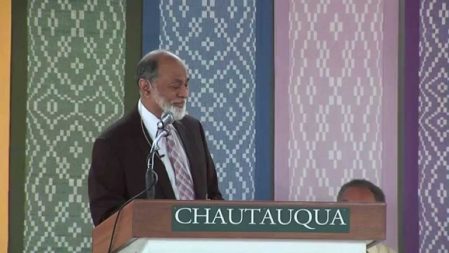 Abdul Malik Mujahid speaking at Chautauqua Institution
 ISNA’s (Hamas funder) Sayyid Syeed speaking at Chautauqua
Other suit-wearing jihadis Chautauqua brings in include: Abdul Malik Mujahid, listed as one of the world’s 500 most influential muslims (2011-2015), is a former President of the Islamic Circle of North America (ICNA) which was identified as a part of the Muslim Brotherhood Movement by the Department of Justice in the largest terrorism financing and Hamas trial ever successfully prosecuted in U.S. history (US v Holy Land Foundation, Dallas, 2008). He is also the six time Board chair of the Parliament of the World’s Religions and former Chairman of Hamas’ front organization the Council of the Islamic Organizations of Greater Chicago (CIOGC). Sayyid Syeed, the National Director for Interfaith outreach for the Islamic Society of North America (ISNA). ISNA was identified by the Department of Justice as a Muslim Brotherhood organization which directly funds the terrorist group Hamas, and whose stated goal is to wage “Civilization Jihad” in the United States to overthrow our government and replace it with an Islamic State; Dalia Mogahed, a leading female in the Muslim Brotherhood’s Islamic Movement who works with several MB/Hamas organizations like the Council on American Islamic Relations (CAIR), the Muslim Public Affairs Council (MPAC), the Islamic Circle of North America (ICNA) and others; Khalid Qazi, the founding Director of the Western New York chapter of the Muslim Brotherhood’s Muslim Public Affairs Council (MPAC); and many others including Sulayman Nyang, Dr. Laila Al-Marayati, and Eboo Patel.
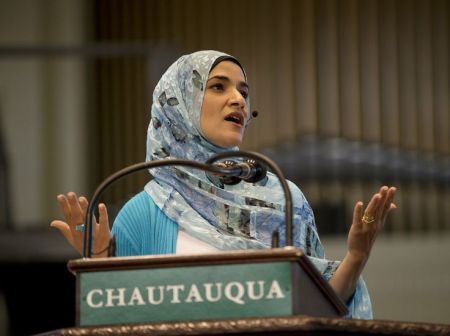 Dalia Mogahed speaking at Chautauqua Institution
 Khalid Qazi speaking at the Chautauqua Institution
This entire Muslim Brotherhood Chautauqua operation supported by John Esposito, the Director of the Prince Alwaleed bin Talal Center for Muslim and Christian Understanding at the formerly Catholic Georgetown University. Alwaleed bin Talal is a Saudi prince and one of the richest men in the world, who personally funds terrorists and Muslim Brotherhood operations – but I repeat myself. John Esposito at Georgetown University is a close colleague of bin Talal, defends jihadis and Islam, and continues to act a an agent of Saudi Arabia, a foreign power. FARA alert.
 NY Mayor Rudy Giuliani rejects $10 million check from Prince Alwaleed bin Talal because of his connections to terrorism
For 15 years, Chautauqua Institution has been the conduit for a successful Muslim Brotherhood Information Operation which has given the tens of thousands of people who attend their 9-week and individual programs a counter-factual understanding of Islam and the intentions of the Muslim Brotherhood.
This is a tremendously successful operation for our enemy.
Remember, this is Information Warfare. This war is about propaganda and political influence operations. Its more about counterintelligence and espionage than it is about “terrorism.”
Just ask Congress about their IT penetration by muslims.
What can you do besides sit there, read this, and get angry?
Remember, the best-dressed and “nicest” muslim in the room, is the most dangerous.
Source: IDF upgrades siren system to pinpoint incoming rocket alerts | The Times of Israel
Warnings will be more tightly aimed, and talk to citizens in their own languages

When an incoming rocket siren goes off, Israelis know the drill: rush to the nearest shelter or, if you’re on the road, lie face down with your hands protecting your head.
What politicians refer to as a “drizzle” of rockets has become a commonplace in Israel’s south, though there is barely an area of the country that hasn’t experienced the threat of rockets at some point.
Before and during the seven-week 2014 Israel-Gaza conflict, the Hamas rulers of the Strip fired thousands of missiles into Israeli communities. The Lebanon-based terror group Hezbollah has targeted the north of the country with rockets as well.
When a rocket penetrates into Israeli territory, sensors deployed along the borders, along with the Israeli Air Force, send out alerts that specify the source and type of the incoming threat. These alerts set off alarms around the country, whereupon citizens get instructions via TV, radio and their smartphones to enter the nearest shelters.
Now the IDF’s Home Front Command, in charge of civilian protection, is upgrading its siren system to allow it to be more selective about who it alerts and instructs to take shelter during a rocket attack.
Among the new developments being deployed is a mix of portable siren systems that can be attached to loudspeakers in public places, such as train stations, schools and malls, and private homes, to provide an extra layer of warning. An additional system, already in place previously, is a mobile siren system that can be deployed in fields or areas previously not covered by the alarms.

IDF’s new portable Nofar siren that can be attached to loudspeakers in public places (IDF Spokesperson Office)
So, if once inhabitants of relatively large swaths of land were sent scuttling for cover, now the alarms will sound only in the specific areas targeted by the rockets, said Lt. Col. Yehudit Halifa, the head of the Home Front Alert Branch in the IDF.
“We will be able to alert at the resolution of single cities, down to as much as a square kilometer,” Halifa said in an interview. “The system supports selective alerts, and we are now deploying the systems around the country.”
The fully automated system can also support various languages, like Russian or Amharic, so for example Amharic radio stations will automatically instruct listeners, in Amharic, to enter the shelters.
The new system was developed jointly by the “best of the brains” in the army jointly with civilian firms, Halifa said. In the future, these systems could be used to warn against other threats, such as earthquakes, and even distinguish automatically between various kinds of threats.
“This kind of alert doesn’t exist at the moment; we are working on it,” she said.




 anneinpt
 artaxes
 danmillerinpanama
 davidking1530
 Peter Hofman
 Joseph Wouk
 Peter
Peter Louisiana Steve
 WarSclerotic
Recent Comments