Archive for June 2017

Senate announces probe of Loretta Lynch behavior in 2016 election

June 23, 2017

Senate announces probe of Loretta Lynch behavior in 2016 election, Washington Times, Stephen Dinan, June 23, 2017

Letters also went to Clinton campaign staffer Amanda Renteria and Leonard Benardo and Gail Scovell at the Open Society Foundations. Mr. Benardo was reportedly on an email chain from the then-head of the Democratic National Committee suggesting Ms. Lynch had given assurances to Ms. Renteria, the campaign staffer, that the Clinton probe wouldn’t “go too far.”

********************************

The Senate Judiciary Committee has opened a probe into former Attorney General Loretta Lynch’s efforts to shape the FBI’s investigation into 2016 Democratic presidential nominee Hillary Clinton, the committee’s chairman announced Friday.

In a letter to Ms. Lynch, the committee asks her to detail the depths of her involvement in the FBI’s investigation, including whether she ever assured Clinton confidantes that the probe wouldn’t “push too deeply into the matter.”

Fired FBI Director James B. Comey has said publicly that Ms. Lynch tried to shape the way he talked about the investigation into Mrs. Clinton’s emails, and he also hinted at other behavior “which I cannot talk about yet” that made him worried about Ms. Lynch’s ability to make impartial decisions.

Mr. Comey said that was one reason why he took it upon himself to buck Justice Department tradition and reveal his findings about Mrs. Clinton last year.

The probe into Ms. Lynch comes as the Judiciary Committee is already looking at President Trump’s firing of Mr. Comey.

Sen. Charles E. Grassley, chairman of the committee, said the investigation is bipartisan. The letter to Ms. Lynch is signed by ranking Democratic Sen. Dianne Feinstein and also by Sens. Lindsey Graham and Sheldon Whitehouse, the chairman and ranking member of the key investigative subcommittee.

Letters also went to Clinton campaign staffer Amanda Renteria and Leonard Benardo and Gail Scovell at the Open Society Foundations. Mr. Benardo was reportedly on an email chain from the then-head of the Democratic National Committee suggesting Ms. Lynch had given assurances to Ms. Renteria, the campaign staffer, that the Clinton probe wouldn’t “go too far.”

At a Senate hearing earlier this month, Mr. Comey told lawmakers that Ms. Lynch had attempted to change the way the FBI described its probe of Mrs. Clinton’s use of a private email server. The change appeared to dovetail with how Mrs. Clinton’s supporters were characterizing the probe.

“At one point, [Ms. Lynch] directed me not to call it an ‘investigation’ but instead to call it a ‘matter,’ which confused me and concerned me,” Mr. Comey said during his June 8 testimony before the Senate Select Committee on Intelligence. “That was one of the bricks in the load that led me to conclude I have to step away from the department if we are to close this case credibly.”

Acknowledging that he didn’t know whether it was intentional, Mr. Comey said Ms. Lynch’s request “gave the impression the attorney general was looking to align the way we talked about our investigation with the way a political campaign was describing the same activity.”

Mr. Comey said the language suggested by Ms. Lynch was troublesome because it closely mirrored what the Clinton campaign was using. Despite his discomfort, Mr. Comey said, he agreed to Ms. Lynch’s language.

Trump’s State Department slaps down Hungarian PM, supports George Soros

June 23, 2017

Trump’s State Department slaps down Hungarian PM, supports George Soros, Refugee Resettlement Watch, Ann Corcoran, June 22, 2017

(About halfway into the article, we learn that one of Secretary Tillerson’s spokespersons delivered the message. Did Tillerson know or approve of the message? — DM)

In one more example of the US State Department being run by the ‘Deep State,’ we learned on Monday that Sec. of State Tillerson has basically told Hungarian Prime Minister Viktor Orban to stand down in his efforts to expose Soros’ subversive influence in that country.

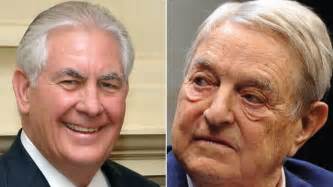
Big smooch from Sec. of State Tillerson to George Soros. Why is USDOS involved in Hungarian internal affairs?

Readers should know that Orban has become a leading champion for some in Europe for speaking forcefully and taking action to close his country’s borders to the invaders*** from the Middle East and Africa.

(Poland and the Czech Republic are doing the same in order to save their culture and economy.)

So, George Soros knows that Orban must be taken down.  (As many of you know Soros (aka György Schwartz ) was born to a Hungarian Jewish family in Budapest.)

Now, using his billions earned as a ruthless investor, he works to open borders worldwide and he hates Donald Trump, so one wonders why Trump’s State Department would even get involved in this Hungarian internal issue? Does it all boil down to the globalists’ desire for open borders that Soros champions?

Frankly, this news is stunning! But, it fits what we already believe—that the ‘Deep State’ is still running the show at the DOS. See here when they pulled a trick on Trump’s White House while Trump was on his world tour last month.

Here is some of the story at the Washington Examiner (emphasis is mine):

Secretary of State Rex Tillerson’s spokesperson urged Hungarian leaders to scrap legislation mandating that Hungarian nonprofits supported by foreign contributors identify their donors. The bill is the latest development in nationalist Prime Minister Viktor Orban’s ongoing campaign against Soros, but his domestic and international critics regard it also as a step toward Russian President Vladimir Putin.

Hungary joined NATO in 1999, when Orban was in the midst of a four-year run as prime minister. Since returning to the post in 2010 the midst of an economic crisis that required an international bailout, Orban has had a fraught relationship with the European Union. The 2015 refugee crisis created additional strain, and human rights groups criticized his efforts to constrict the flow of asylum-seekers into Hungary.

President Trump should be inviting Viktor Orban to the White House for a state dinner, not using his DOS to slap him down in his battle with George Soros!

Orban responded by attacking Soros, a campaign that hasn’t ended. “There is an important element in public life in Hungary which is not transparent and not open — and that is the Soros network, with its mafia-style operation and its agentlike organizations,” he said in June.

[….]

The Hungarian leader’s skepticism of the EU and “globalist” refugee policies, perhaps aided by Soros’ status as a prominent progressive donor, has endeared him to some American conservatives who see a likeness to Trump.

[….]

Hungary also passed legislation designed to shutter Central European University, one of the most prominent institutions in the country, due to funding from Soros. But, though Orban has praised Trump, the new president’s administration opposed that bill and continued to criticize his hostility to the nonprofits.

Continue reading here.

We already know that Soros has given millions to one US refugee contractor. https://refugeeresettlementwatch.wordpress.com/2017/02/26/hungarian-prime-minister-calls-out-george-soros-in-state-of-the-nation-speech/

“Hostility” toward nonprofits!  Is it hostile to demand to know who is funding the non-profits?

I want to know how much funding George Soros is giving to US refugee contractors and other Open borders agitation groups!

And, Hungarians have a right to know how Soros, an American, is secretly influencing their politics.

Come on Congress! How about a transparency law here in the US—call it the George Soros Transparency Act of 2017.

Afterthought!  While they are at it let’s have transparency about which Republicans in Congress are taking payola from Soros!

Go here for my complete archive on the ‘Invasion of Europe.’ It extends back many years.

John Bolton: Trump ‘in the Right Place’ on North Korea, but State Dept. Continues 25 Years of Failed Policy

June 23, 2017

John Bolton: Trump ‘in the Right Place’ on North Korea, but State Dept. Continues 25 Years of Failed Policy, BreitbartJohn Hayward, June 23, 2017

(Reunification of North and South Korea would be very expensive for South Korea and may not be as appealing to South Korea as it once was. China is very much opposed because it perceives — wrongly in my view — a unified Korea on its border as a threat. How about unification of North Korea and China instead? — DM)

“We’ve tried that for 25 years with respect to the nuclear program. It has had no effect. I don’t think you can change the behavior of the North Korean regime because I don’t think you can change its character,” he said.

“That, to me, is why the only real solution to eliminate the nuclear threat, to stop this treatment of both foreigners and their own citizens, to give the people of North Korea a chance for a decent life, you have to end the regime. My own view is you reunite North and South Korea. The U.S. has to persuade China it’s in their interests to do it. It’s a heavy lift. I acknowledge that. But otherwise, we just keep doing what we’ve done ever since this regime was formed shortly after World War II. It only respects force, and nobody wants to see use of force on the Korean peninsula today, with its potentially tragic consequences,” said Bolton.

“The State Department can keep doing what it’s done unsuccessfully for 25 years. Year 26 is going to be exactly the same. I think we’ve got to try something very, very different. If we don’t, we’re going to get the same result,” he cautioned.

Bolton said he thinks President Trump himself is “in the right place on this.”

********************************

On Friday’s Breitbart News Daily, former U.N. ambassador John Bolton talked about the death of American student Otto Warmbier, recently released from more than a year of captivity in North Korea, most of which he spent in a coma. He also discussed what Warmbier’s death means for America’s North Korea policy moving forward. Bolton then looked at the one-year anniversary of the Brexit vote and U.S. policy toward the Israeli-Palestinian conflict.

“It’s obviously a personal tragedy,” Bolton told SiriusXM host Alex Marlow. “Here’s a perfectly healthy young man, goes to North Korea, and comes back and dies a few days later. Obviously, we are all feeling for his family and his friends.”

“But I think for the United States as a whole, the lesson here is about the character of the North Korean regime: that they’re so barbaric, that even if you take everything they say as true, that Otto Warmbier stole a political poster – you know, that’s what college kids do. Slap him on the wrist, put him in jail for a day, kick him out of the country. That’s what civilized countries do, but not North Korea,” he said.

“Not only did they brutalize him; they lied about it consistently for a year-and-a-half,” he noted. “They’re still holding three other Americans. They have a long history of kidnapping South Korean and Japanese citizens over the past several decades. This is the way they treat foreigners. They run a 25-million-person prison camp in their own country, under just horribly primitive conditions for most citizens. And they’re pursuing deliverable nuclear weapons and appear to be pretty close to achieving that.”

“This is not a regime that you can reason with in the same sense Americans think of that term,” Bolton contended. “They may be rational in terms of the regime in North Korea, but it’s not rational in our terms. That’s why I’m somewhat distressed with the Trump administration reaction, or at least the State Department reaction of saying, ‘Well, we’re just going to apply more pressure on North Korea to get them to change their behavior.’”

“We’ve tried that for 25 years with respect to the nuclear program. It has had no effect. I don’t think you can change the behavior of the North Korean regime because I don’t think you can change its character,” he said.

“That, to me, is why the only real solution to eliminate the nuclear threat, to stop this treatment of both foreigners and their own citizens, to give the people of North Korea a chance for a decent life, you have to end the regime. My own view is you reunite North and South Korea. The U.S. has to persuade China it’s in their interests to do it. It’s a heavy lift. I acknowledge that. But otherwise, we just keep doing what we’ve done ever since this regime was formed shortly after World War II. It only respects force, and nobody wants to see use of force on the Korean peninsula today, with its potentially tragic consequences,” said Bolton.

“The State Department can keep doing what it’s done unsuccessfully for 25 years. Year 26 is going to be exactly the same. I think we’ve got to try something very, very different. If we don’t, we’re going to get the same result,” he cautioned.

Bolton said he thinks President Trump himself is “in the right place on this.”

“I think he, as much as anybody – maybe more than anybody in his administration – understands the danger of North Korea’s nuclear weapons program,” Bolton added. I think he understands and said publicly what a terrible treatment Otto Warmbier received. It should never happen to anybody and shouldn’t happen again.”

“He’s just tweeted a few days ago he doesn’t think China has delivered on the commitments Xi Jinping made when he was here in the United States at the Mar-a-Lago summit. What Trump said then, what he’s implied in the tweet, is that China’s jiving us again – as they have been on North Korea for 25 years, and the United States will have to solve this on its own,” he said.

“The question is whether the bureaucracy responds to the president. At this point, I don’t see it, unfortunately. I don’t rule it out. Obviously, things could be happening that are not public yet. But I think the president’s in one place, and the bureaucracy is in another. The bureaucracy’s in the same place on North Korea it has been for 25 years. It just doesn’t change,” he lamented.

Bolton’s policy recommendations for North Korea included restoring “all of the sanctions previously imposed on North Korea.”

“I would correct the Bush administration’s…one of Condi Rice’s worst mistakes is taking North Korea off our list of state sponsors of terrorism. I would put them right back on that list. They’re not only state sponsors, they are terrorists themselves, given this treatment of Otto Warmbier and many others, American and non-American alike,” he declared.

“I’d put the pressure on, no doubt about it, but I think we’ve got to be realistic: it’s not going to work. It’s not going to change their behavior. They’ll find ways to evade it. Sanctions have been evaded by the North Koreans successfully with the help of China and Russia for decades. We’ve got to have a very straight talk with China about reunification, and if that doesn’t work, then our options are limited and unattractive,” Bolton warned.

Marlow turned to Britain’s exit from the European Union, which reached its one-year anniversary on Friday. He noted that very little progress has been made during the past year.

“It’s disappointing, I must say,” Bolton agreed. “It’s due to several factors. It’s due to the fact that, obviously, David Cameron had to be replaced as prime minister. I think the supporters of leaving the European Union in the Conservative Party hoped to get a champion of the Leave position in as prime minister. That didn’t happen, although Theresa May seemed to be prepared to negotiate for a hard Brexit if necessary. But then she called this snap election, and it seemed like a brilliant move at the time, but it’s resulted in the Conservative Party actually losing seats in the House of Commons, so they’re in disarray.”

“I think it’s going to be hard for Theresa May to survive politically, so you’ve had this turmoil in domestic politics that’s gotten in the way of negotiations,” he said. “I think that those who advocated Leave just need to grit their teeth and continue on because the decision to leave was then, and is today, the right decision for Britain.”

“The elites, the high-minded in Europe and in Britain and in America, all think that they should reverse their decision. That’s not going to happen. People need to get used to that,” he said.

“I think President Trump said some time ago he wanted to step up and establish a bilateral trade relationship between the U.S. and a U.K. no longer in the E.U. I think we should be moving ahead on that,” Bolton advised. “There are certain constraints the Brits face, but we can lay out the big principles so that businesses and financial services institutions on both sides of the Atlantic know what’s coming. I think it’s a win-win for the U.S. and the U.K., and I hope we pay more attention to that.”

“As hard and as unproductive as the past year has been, the fundamental decision remains correct. They just need to fight through it,” he said.

Marlow observed that the hard British left has been working out an alliance with Islamists. “It seems like the encroaching Islamist philosophies of Islamism are becoming much more prevalent and more accepted, and it seems like the priorities of the folks in the Jeremy Corbyn wing of British politics seem to be getting a much more powerful voice than I was anticipating,” he said.

“I must say, within the Labor party in Britain, the only religion that seems to be favored is Islam,” Bolton replied. “Christianity, Judaism are old-fashioned. The levels of anti-Semitism in the Labor party are at historically high levels. I think it has to do with their ideology. I think that this self-segregation, this unwillingness to join the broader U.K. culture, is a huge potential problem.”

“You know, none of the European countries have the concept of the melting pot the way we do in the United States, where people come from all over the world and get into the melting pot and emerge as Americans,” he pointed out. “It’s a huge strength of the United States. It’s why we’ve been a draw for people from all over the world forever. They understand that when they come here, they’re going to do something very different in their lives. They’re going to join a nation that is unique in the world, founded on an idea, and they change.”

“When we’ve seen in recent years people coming to this country who don’t want to get into the melting pot, who don’t want to be Americanized – they don’t even like that word; I think it’s a word we should use more often – it’s a problem for us,” he added.

“The Brits are the closest of the European countries to having that ability, but it’s been failing them for a number of years. It doesn’t work at all on the continent of Europe itself. I think this split within society, this view that some can live under sharia law, everybody else will live under the regular English legal system, is the beginning of the end of the democratic society. I don’t want to be apocalyptic about it, but I think that’s the direction it’s moving in,” Bolton said.

“The Europeans are in the midst of a decision whether they understand it or not, given the hundreds of thousands – indeed, millions – of refugees and migrants that are coming from North Africa and the Middle East,” he contended. “This is a process that’s been in play for a long time. Maybe they don’t care so much about their cultural identity. That’s their choice to make, if they want to lose it. But there are demographic trends at play here that could foreshadow a very different Europe by the end of this century. If they don’t insist on integration into the broader society, then it won’t happen.”

“In the United States, people have come here historically because they want to become Americans. They want to shed some of the baggage of the countries they’re leaving from. To the extent we suffer from that same European problem, we will have the same issues here – maybe a little bit later than the Europeans, but inevitably, we will face the same problems,” he predicted.

“I think it’s emblematic of this unwillingness to deal with this issue that you’re seeing almost daily acts of terrorism across Europe. It hasn’t happened here yet, but we’re beginning to see that pattern, and I think it’s only going to get worse,” said Bolton.

Marlow asked for Bolton’s view of the visit by President Trump’s son-in-law Jared Kushner to the Middle East and the persistent issue of Palestinian payments to the families of suicide bombers, blatantly encouraging violence in a way that makes talk of a “peace process” farcical.

Bolton agreed these payments to the families of terrorists are “a very significant issue.”

“Secretary of State Tillerson testified – I think it’s about two weeks ago now – that the Palestinian Authority said it wasn’t going to make such payments anymore,” he recalled. “The next day, the government of Israel said that’s not true; it’s still going on.”

“You’ve got a fundamentally different perspective on many, many things in that region,” he said. “I think Jared Kushner, I think the president himself, are approaching this in good faith with a good heart. They want to see what they can do. I’ve believed for some time, however, that the two-state solution has run into a dead end. It’s not going to work. It’s not doable. The Palestinian Authority doesn’t have the legitimacy or the capability of making commitments and then carrying them out. I think you’ve got to look at something radically different.”

“I just have to say, as my honest diplomatic and political assessment, repeating the Middle East peace process as we’ve known it this past forty or fifty years, the idea of a two-state solution, isn’t going to go anywhere,” Bolton concluded.
A Tale of Two Terror Attacks and The New York Times

June 23, 2017

A Tale of Two Terror Attacks and The New York Times, Investigative Project on Terrorism, Noah Beck , June 23, 2017

Last month’s suicide bombing at an Ariana Grande concert in Manchester wasn’t the first time an Islamist terrorist targeted young people out for a night of fun. In 2001, a Hamas-affiliated terrorist blew himself up outside the Dolphinarium, a Tel Aviv nightclub, killing 21 Israelis, including 16 teenagers.

But news coverage of the two massacres was strikingly different, as the Manchester attack generated exponentially more attention. The New York Times, for example, offered a handful of small accounts about the Tel Aviv attack. But the Manchester bombing generated dozens of wire service and Times staff updates along with analysis stories and an editorial lamenting the horror of targeting children.

There are reasons why attacks in Europe are covered more exhaustively than those targeting Israelis. But as a result, Americans may not fully appreciate the depth of Palestinian violence because the near-daily examples of it are all but ignored.

The stark reporting contrast between the Manchester and Dolphinarium attacks reveals a change in how terrorism has been covered during the intervening 16 years. The Dolphinarium attack took place about three months before the September 11th attacks that dramatically increased media attention to terrorism.

A significant reporting gap continued after 9/11, however. Two 2002 shooting attacks within 12 days of each other prompted vastly different coverage by the New York Times. The July 4 shooting attack at Los Angeles International Airport, which claimed two lives, produced at least 13 articles. By contrast, nine people were murdered in a July 16 shooting and bombing attack against an Israeli bus going to the settlement of Immanuel. The Times devoted only one article to this slaughter.

The Times commits minimal attention to attacks on Israelis today. Last Friday’s fatal stabbing attack in Jerusalem received a scant 431-word article containing no images or references to “terror,” “terrorist,” or “terrorism.”

Worse, the newspaper ran a 243-word Associated Press article about the attack with a headline emphasizing the terrorists’ deaths, rather than their victim: “Palestinian Attackers Killed After Killing Israeli Officer.”

By contrast, the Times provided much more sympathetic coverage to an April terrorist attack in Paris that similarly claimed a police officer’s life. At 1,037 words, the article was almost three times as long, contained six photos of the attack scene, and referred six times to “terrorism” and thrice to “terrorist attack.”

An attack’s location plays a significant role in determining the extent of news coverage. Commentator Joe Concha calls this the “there versus here” phenomenon.

For example, the Times published eight articles about last November’s car ramming and stabbing attack at Ohio State University that killed no one, but injured 11 people. That included a profile of the suspected terrorist behind it. Deadlier attacks overseas generally receive far less coverage.

However, that “there versus here” explanation falters when comparing vehicular attacks in Israel with similar attacks in other non-US countries since Ohio State.

The March truck attack in Westminster that killed five people generated 20 articles. December’s Berlin Christmas market truck attack that killed 12 generated at least 50 articles.

By contrast, January’s truck attack in Jerusalem that killed four people generated just three articles and a mention in a daily news digest.

One reason European attacks receive more attention is that they raise new concerns about safety throughout the West, as the Islamic State pursues a campaign to hit soft targets wherever it can.

Another explanation may be that so many terrorist attacks in Israel have occurred over the last few decades that the Times has grown desensitized to them, no longer considering them as newsworthy.

Egyptian Copts, who have also suffered from Islamist terror for decades, may fall into the same unfortunate category. The attack last month in Minya, in which gunmen opened fire on Christian pilgrims, massacring 29, generated only four Times articles.

When the news media under-report terrorist attacks in places where they occur routinely, they do an injustice to victims in need of sympathy, while helping terrorists to defer the day that international leaders unite against them.

CAMERA, a nonprofit media watchdog, has compiled an extensive record of chronic anti-Israel coverage and commentary by the Times, and has launched billboard campaigns to expose the bias.

While some might point to the newspaper’s April decision to hire pro-Israel columnist Bret Stephens as a sign of growing balance on the issue, subsequent coverage led veteran Times critic Ira Stoll to argue that the move just gave the paper cover to intensify its anti-Israel slant. Stoll lists five Times op-eds, each of which “taken alone, would be totally outrageous and indefensible. The onslaught of all five of them, in six weeks, constitutes an outbreak of anti-Israel and anti-Jewish hostility at the Times.”

The Dolphinarium attack, one of Israel’s deadliest suicide bombings, marked its 16th anniversary on June 1. While it’s too late for the Times to give due coverage to the 16 teens and five adults who were slaughtered, the paper conceded the parallels between their fate and that of the Manchester victims, by running this op-ed by a survivor of the Dolphinarium massacre expressing empathy for those affected by the Ariana Grande attack.

However, when the Times published its May 23 editorial on the Manchester attack, it failed to mention the Dolphinarium attack, and thereby omitted the suicide bombing most similar to the Manchester attack in its targeting of children. The editorial duly notes how terrorists have shattered innocent lives, listing attacks in three European cities, but somehow forgets that Islamists have taken far more lives of Israelis “simply out enjoying themselves” than of all Islamist terror victims in Europe combined.

At least 1,600 Israelis have been killed in terrorist attacks since the 1993 Oslo accords that were intended to foster Israeli-Palestinian peace. How many more Israeli casualties are needed before the New York Times starts to cover them as it would European victims?

Trump signs VA reform bill, following through on campaign promise

June 23, 2017

Trump signs VA reform bill, following through on campaign promise, Fox NewsBarnini Chakraborty, June 23, 2017

President Trump on Friday signed a bill that would protect whistleblowers while making it easier to fire employees at the Department of Veterans Affairs.

The Department of Veterans Affairs Accountability and Whistleblower Protection Act passed by Congress this week streamlines the process to remove, demote, or suspend VA employees for poor performance or misconduct. In addition, it authorizes the VA secretary to recoup any bonuses awarded to employees who have acted improperly.

Under the new law, protections for whistleblowers will be expanded and the VA will be prevented from dismissing an employee who has an open complaint against the department.

The bill helped Trump follow through on a 2016 campaign promise.

The law marks the second time Congress has tried to change the disciplinary process at the VA. In 2014, the Choice Act was passed and tried to cut senior executives’ rights to appeal discipline to the Merit Systems Protection Board. However, a court ruled that it was unconstitutional and violated the Constitution’s appointments clause.

Ahead of the signing, Concerned Veterans for America, a conservative advocacy group, hailed the legislation as a positive step forward in a “new era of accountability, customer focus, and integrity at the department.”

Qatar’s neighbors issue steep list of demands to end crisis

June 23, 2017

Qatar’s neighbors issue steep list of demands to end crisis, Israel Hayom, Associated Press and Israel Hayom Staff, June 23, 2017

(Please see also, BREAKING: Gulf States Give Qatar List of Demands To Restore Diplomatic Relationships – All Demands Target The Muslim Brotherhood. — DM)

Emir of Qatar Tamim bin Hamad al-Thani | Photo credit: Reuters

Saudi Arabia and other Arab countries that have cut ties to Qatar issued a steep list of demands Thursday to end the crisis, insisting that their Persian Gulf neighbor shutter Al Jazeera, cut back diplomatic ties to Iran and close down a Turkish military base in Qatar.

In a 13-point list — presented to the Qataris by Kuwait, which is helping mediate the crisis — the countries also demand that Qatar sever all ties with the Muslim Brotherhood and with other groups including Hezbollah, al-Qaida and the Islamic State group.

Saudi Arabia, Egypt, the United Arab Emirates and Bahrain cut ties to Qatar this month over allegations the Persian Gulf country funds terrorism — an accusation that U.S. President Donald Trump has echoed. Those countries have now given Qatar 10 days to comply with all of the demands, which include paying an unspecified sum in compensation.

According to the list, Qatar must refuse to naturalize citizens from the four countries and expel those currently in Qatar, in what the countries describe as an effort to keep Qatar from meddling in their internal affairs.

They are also demanding that Qatar hand over all individuals who are wanted by those four countries for terrorism; stop funding any extremist entities that are designated as terrorist groups by the U.S.; and provide detailed information about opposition figures that Qatar has funded, ostensibly in Saudi Arabia and the other nations.

Qatar’s government did not have any immediate reaction to the list. Nor did the United States. Earlier this week, Secretary of State Rex Tillerson had insisted that Qatar’s neighbors provide a list of demands that was “reasonable and actionable.”

Though Qatar’s neighbors have focused their grievances on alleged Qatari support for extremism, they have also voiced loud concerns about Qatar’s relationship with Iran, the Shiite-led country that is a regional foe for Saudi Arabia and other Sunni-led nations.

The Iran provisions in the document say Qatar must shut down diplomatic posts in Iran, kick out from Qatar any members of the Iran’s elite Revolutionary Guard, and only conduct trade and commerce with Iran that complies with U.S. sanctions. Under the 2015 nuclear deal, nuclear-related sanctions on Iran were eased but other sanctions remain in place.

The demands regarding Al Jazeera, the Doha-based satellite broadcaster, state that Qatar must also shut down all affiliates. That presumably would mean Qatar would have to close down Al Jazeera’s English-language affiliate. Qatar’s neighbors accuse Al Jazeera of fomenting unrest in the region and supporting the Muslim Brotherhood.

If Qatar agrees to comply, the list asserts that it will be audited once a month for the first year, and then once per quarter in the second year after it takes effect. For the following 10 years, Qatar would be monitored annually for compliance.

Putin Wins Big

June 23, 2017

Putin Wins Big, Jewish Media Resources, Jonathan Rosenblum, June 23, 2017

(Putin is winning because the national focus is on non-events. Hence, our faith in the electoral system has been damaged and the ability of the Trump administration to focus on the agenda Trump was elected to pursue has been limited. The Congress, rather than focus on legislating, is preoccupied with investigations of non-events. That’s good for America’s enemies and bad for America. President Trump’s successes in focusing on his agenda despite the many distractions speak well of him. — DM)

Smith makes an insightful distinction between “consolations, vicious self-sung lullabies” and “conspiracy theories.” Examples of the former would be: Hillary lost because the Russians hacked the election; our children died because the Jews poisoned the wells.

But such “consolations,” as vicious as they may be, only become full-blown conspiracy theories when weaponized through the mass media for political use. The Protocols of the Elders of Zion would be the classic example of such a conspiracy theory. And, Smith points out, Hillary Clinton’s “deplorables” do not have the platforms “to proliferate weaponized narratives capable of doing real damage to our polity – the elites do.” And those elites — the press, the intelligence community, political parties – have been used to legitimize a conspiracy theory.

James Kirchik, another anti-Trump pundit (as well as a brilliant analyst on many issues) laments the way the “confirmation bias” has resulted in well-meaning, liberal anti-Trump journalists reporting stories that they want to be true and are emotionally true for them – e.g., stories of threatened or actual violence against minorities – but are factually false.

******************************

It is certain that Russia launched a massive hacking campaign to undermine the U.S. electoral process in 2016. That is a major issue that needs to be thoroughly investigated, and steps taken so that it does not recur.

Though the Russian involvement in the 2016 election targeted both presidential candidates at various times, it likely damaged Hillary Clinton’s campaign more. Confirmation in the emails hacked from the Democratic National Committee that the DNC had actively favored Clinton over her chief rival for the Democratic nomination, Senator Bernie Sanders, infuriated Sanders supporters. Conceivably enough of those supporters could have decided not to vote for Clinton based on those emails to have made a difference in the three crucial battleground states – Pennsylvania, Michigan, and Wisconsin.

Thus far, however, the primary focus on the Russian hacking has been with respect to the far-fetched claim that the Russians colluded with the Trump campaign fashion in some fashion The obsessive focus on that issue has turned the hacking into a major victory for Vladimir Putin by introducing an unparalleled degree of rancor and paralysis into the American political system.

James Kirchik writing in the May 3 American Interest (“Who Killed the Liberal World Order”), describes how at last September’s G-20 summit in Hangzhou, China, then President Obama confronted Russian President Vladimir Putin about the Russian hacking of the DNC, and told him to “cut it out” or “face serious consequences.” In October, according to Bloomberg News, the White House used a cyber version of the “red phone” to convey to the Kremlin detailed evidence of Russian hacking of voter data banks in numerous states. On both occasions, Putin, who had long since taken Obama’s measure, did nothing in response.

WHATEVER THE REASON Putin decided to interfere with the 2016 election, it was not because he feared Obama or Obama’s legacy-bearer, former Secretary of State Clinton. Starting with Clinton’s declared “reset” of relations with Russia, shortly after the Obama administration entered office in 2009, until Obama issued his warning at Hangzhou, the United States had repeatedly stood down in every possible confrontation with Russia.

The 2009 reset itself took place in the wake of the assassinations by Russian intelligence agents of Alexander Livinenko in London, where the former Russian intelligence operative he had been granted political asylum, and of Russia’s leading investigative journalist Anna Politkovskaya. Russia was also busy hardening control of areas of Georgia occupied by Russian troops. As part of the reset, the Obama administration abandoned plans to provide Poland and Czechoslovakia with anti-missile defenses.

During the 2012 presidential debates, Obama mocked his Republican opponent Mitt Romney for listing Russia as the United States’ primary international foe. “The 80s called. They want their foreign policy back,” teased Obama. And even prior to the 2012 campaign, Obama told Putin’s sidekick Dmitry Medvedev that he’d be able to be “more flexible” after the campaign, and asked for a little breathing room from Russia.

All Obama’s shows of good will, however, went unreciprocated by Putin. In 2013, Putin granted asylum to Edward Snowden, the former CIA employee who had exposed the U.S. National Security Agency’s surveillance methods. The same year Putin cracked down on foreign-funded NGO’s, and invaded the Ukraine. Obama refused to supply the Ukrainians with defensive weapons, as the United States had committed to do in the Budapest Memorandum, drafted when the former Soviet republics gave up their nuclear stockpiles.

In 2015, Soviet forces entered Syria in force to shore up the Assad regime, fairly daring the United States to challenge them. Previously, Putin had humiliated Obama by offering him a lifeline, when the latter refused to enforce his own redline against Assad’s deployment of chemical weapons.

PUTIN HAD reasons to prefer Trump to Clinton. He harbors a paranoid belief that Hillary orchestrated protests against him in 2011. And, writes Kirchik in the Los Angeles Times, he appreciated that Trump’s ignorant outbursts made “American politics – and by extension America – look like a foolish country.”

Putin may also have thought that Trump’s neo-Jacksonian, quasi-isolationist campaign talk would serve Russia’s interest in carving out a sphere of interest in its near abroad. But, as Kirchik notes in his American Interest piece, Obama’s “interconnected world,” without American power to back it up, had already resulted in a reduction of American influence and allowed Putin free rein in Russia’s near abroad.

The Russians were as shocked as everyone else, however, by Trump’s victory. Their goal was not so much to defeat Clinton, as to render it difficult for her (or Trump) to govern and to thereby “weaken the world’s last superpower,” writes Professor Mark Galeotti of the Institute of International Relations Prague in Tablet. And their means for doing so was to reduce America’s democratic legitimacy by calling the election results into question and reducing the scope for compromise and consensus in the American political system.

Or as veteran Moscow correspondent David Satter argued in the June 12 Wall Street Journal, Putin did not so much support Donald Trump, as he sought American political paralysis. The differences between Trump and Clinton were simply not that significant in his view.

Putin’s method is to sow chaos, to light a hundred brushfires and see which ones turn into full-fledged forest fires. “Putin is not a chess player,” writes Galeotti. “He and his people are improvisers and opportunists. They try to create multiple potential points of leverage, never knowing which will prove useful or not.”

One of those prongs was the so-called “Trump dossier, compiled by former British intelligence official Christopher Steele based on information “sold” to him by Russian intelligence officials. The document bears all the marks of a classic Russian disinformation campaign. “The kind of gossip that fills the Trump Dossier, writes Galeotti, is common currency in Moscow, “even if very little of it has any authority behind it aside from the speaker’s own imagination.”

One thing is almost certain: The Trump campaign did not collude with the Russians. Both Senator Diane Feinstein and Congressman Adam Schiff, the ranking Democrats on the Senate and House intelligence committees investigating Russia’s electoral involvement, respectively, have confirmed that they have seen nothing to implicate Trump or his aides in collusion with Russia.

The absence of collusion is, moreover, logically demonstrable. If there were collusion, the Russians would undoubtedly possess evidence of it. Since coming to office, the Trump administration has taken a much more aggressive anti-Russian stance than Obama ever did – targeting with cruise missiles an airfield and planes of Russian ally Bashir Assad and just this week shooting down a Syrian plane in a dogfight; allowing Montenegro’s entry into the NATO alliance; denying Exxon-Mobil a waiver for energy exploration in Russia; and sharply criticizing Russian support for the Taliban in Afghanistan. If Putin possessed incriminating evidence on Trump, he would have already revealed it in order to destroy President Trump. Elementary, my dear Watson.

DESPITE THE LACK OF ANY PLAUSIBLE EVIDENCE OF COLLUSION, Russian interference in the 2016 election has set in motion a “self-sustaining process,” in Galeotti’s words, in which “America is tearing itself apart with little need for Russian help.”

It is hard to know for sure whether those most actively promoting the Trump-Russian collusion narrative really believe it themselves or just see it as the best way of bringing down the president. About the latter they might be right. Already the anti-Trump forces have succeeded in gaining the appointment of a special prosecutor, and the scope of the special prosecutor’s investigation has expanded to legally flimsy charges of obstruction of justice against Trump. Once a special prosecutor is in the saddle there is no way of knowing where things will go. The longer the investigation continues the greater the chance of a prosecution for something entirely tangential to the original investigation.

Patrick Fitzgerald, for instance, was appointed special prosecutor to investigate the outing of CIA employee Valerie Flame. From the very outset of the investigation, he knew the source of that information; Undersecretary of State Richard Armitage was the one who told it to columnist Robert Novak. Armitage, however, was never prosecuted. But Fitzgerald carried on for years, until he claimed the scalp of Vice-President Richard Cheney’s top aide, Lewis “Scooter” Libby, on perjury charges, over statements given to investigators about which there were conflicting memories.

Putin has succeeded in driving a wedge between President and the intelligence agencies upon which he must rely for crucial decisions. Every week, a new leak emerges from some anonymous intelligence official – leaks which, if true, would subject the leaker to up to ten years in prison. Yet the source of these leaks has received little attention from the FBI or other investigative bodies.

Lee Smith bemoans in Tablet that the president’s very real flaws, which are “plain to every sentient being on the planet,” have been supplanted as a topic of discussion by a “toxic fabulism typical of Third World and Muslim societies.” “A vulgar conspiratorial mind-set [has become] the norm among the country’s educated elite . . . and is being legitimized daily by a truth-telling bureaucrats who make evidence-free and even deliberately false accusations behind a cloak of anonymity.”

Smith makes an insightful distinction between “consolations, vicious self-sung lullabies” and “conspiracy theories.” Examples of the former would be: Hillary lost because the Russians hacked the election; our children died because the Jews poisoned the wells.

But such “consolations,” as vicious as they may be, only become full-blown conspiracy theories when weaponized through the mass media for political use. The Protocols of the Elders of Zion would be the classic example of such a conspiracy theory. And, Smith points out, Hillary Clinton’s “deplorables” do not have the platforms “to proliferate weaponized narratives capable of doing real damage to our polity – the elites do.” And those elites — the press, the intelligence community, political parties – have been used to legitimize a conspiracy theory.

James Kirchik, another anti-Trump pundit (as well as a brilliant analyst on many issues) laments the way the “confirmation bias” has resulted in well-meaning, liberal anti-Trump journalists reporting stories that they want to be true and are emotionally true for them – e.g., stories of threatened or actual violence against minorities – but are factually false.

He points to the non-stop anti-Trump vitriol from the Twitter feed of the New York Times assistant Washington D.C. editor, Jonathan Weissmann – anti-Trump vitriol that matches his own – as an example of the mainstream press having lost any claim to the public’s trust about the news stories it publishes.

In the short-run the beneficiary of the mainstream media’s reporting of baseless stories, such as that the Russians successfully hacked voting machines in key states, is Donald Trump. By refuting the wilder accusations, he can evade the more substantive ones and, at the same time, stoke the anger that brought him to the presidency in the first place.

But in the long-run, the current state of political toxicity, manifested last week in an assassination attempt against GOP congressman, and the loss of credibility of our major media organizations weakens America and its place in the world. And the big winner from that is Vladimir Putin.

Freighter Was On Autopilot When It Hit US Destroyer

June 23, 2017

The deadly collision between a U.S. destroyer and a container ship June 17 took place while the freighter was on autopilot, according to Navy officials.

BY:
June 23, 2017 5:00 am

USS Fitzgerald did not detect container ship

Source: Freighter Was On Autopilot When It Hit US Destroyer

The deadly collision between a U.S. destroyer and a container ship June 17 took place while the freighter was on autopilot, according to Navy officials.

The Philippines-flagged cargo ship ACX Crystal was under control of a computerized navigation system that was steering and guiding the container vessel, according to officials familiar with preliminary results of an ongoing Navy investigation.

Investigators so far found no evidence the collision was deliberate.

Nevertheless, an accident during computerized navigation raises the possibility the container ship’s computer system could have been hacked and the ship deliberately steered into the USS Fitzgerald, an Arleigh Burke-class guided missile destroyer.

A more likely explanation is that collision was the result of an autopilot malfunction, or the autopilot’s warning signals, used to notify the ship’s operators, were missed.

The destroyer was severely damaged when the protruding undersea bow of the cargo ship struck Fitzgerald on the right side. Seven sailors died as a result and the captain and two others were injured. It was the Navy’s worst accident at sea.

The two ships hit about 64 miles off the coast of Japan.

The collision occurred at around 1:30 a.m. local time but was not reported by the freighter’s crew until around 2:25 a.m. Investigators believe the time lag was the result of the crew not realizing they had hit another ship.

Commercial ship autopilot systems normally require someone to input manually the course for the ship travel. The computer program then steers the ship by controlling the steering gear to turn the rudder.

The system also can be synchronized with an electronic chart system to allow the program to follow courses of a voyage plan.

Tracking data broadcast from the Crystal as part of the Automatic Identification System (AIS) shows the ship changed course by 90 degrees to the right and slightly reduced its speed between around 1:32 a.m. and 1:34 a.m. After that time, the data shows the ship turned to the left and resumed a northeastern coarse along its original track line.

Private naval analyst Steffan Watkins said the course data indicates the ship was running on autopilot. “The ACX Crystal powered out of the deviation it performed at 1:30, which was likely the impact with the USS Fitzgerald, pushing it off course while trying to free itself from being hung on the bow below the waterline,” Watkins told the Free Beacon.

The ship then continued to sail on for another 15 minutes, increasing speed before eventually reducing speed and turning around. “This shows the autopilot was engaged because nobody would power out of an accident with another ship and keep sailing back on course. It’s unthinkable,” he added.

Watkins said the fact that the merchant ship hit something and did not radio the coast guard for almost 30 minutes also indicates no one was on the bridge at the time of the collision.

By 2:00 a.m., the freighter had turned around and headed back to the earlier position, according to the tracking data.

The officials said the Crystal eventually came upon the stricken Fitzgerald.

The Fitzgerald’s AIS data was not available so its track was not reported publicly.

Chief of Naval Operations Adm. John Richardson traveled to Japan to oversee the transfer of the fallen sailors.

“There are multiple U.S. and Japanese investigations underway to determine the facts of the collision,” Richardson said in a statement. “Our goal is to learn all we can to prevent future accidents from occurring. This process will unfold as quickly as possible, but it’s important to get this right.”

According to the officials who spoke on condition of anonymity, initial reports on the incident indicate no crew member was manning the controls in the pilot house of the Crystal when it hit the Fitzgerald.

After impact, the freighter’s was not immediately aware that it had collided with anything and continued sailing. The ship’s crew then realized it had been in a collision and sailed back to try to determine what had happened.

Transport safety authorities and coast guard investigators in Japan on Thursday announced the data recorder from the Crystal had been secured, the Associated Press reported. The freighter is currently docked in the port of Yokohama, near Tokyo.

The Navy and Coast Guard are investigating the incident. The Fitzgerald is currently at its home port of Yokosuka naval base. The investigation is expected to be completed in several months.

For the Navy, investigators are trying to determine why the ship’s radar and other sensors did not detect the Crystal in time to take steps to avoid the collision.

The Fitzgerald is equipped with the AN/SPS-64 advanced military navigation radar, and also uses a commercial radar system to enhance the shipping traffic picture of ships in its vicinity.

Navy ships operate radar systems to detect approaching ships or submarines. Lookouts posted on the bridge are responsible for detecting ships that pose a risk of collision.

Additionally, all commercial ships over 300 tons are required under international rules to operate AIS location data. AIS information from Crystal should have been monitored by sailors on the bridge of the Fitzgerald.

The sailors aboard the 505-foot-long Fitzgerald waged what officials said was a heroic battle about the ship to seal off flooding after the collision.

“We were struck by the stories of heroism and sacrifice—by both the sailors on board and their families back home—as they fought the damage to their ship and brought her back to Yokosuka,” Richardson said.

The ship was not in danger of sinking but was listing to one side and was able to remain under its own power.

The bodies of the seven dead sailors were found in sealed off areas of the ship on Sunday after it reached port.

Vice Adm. Joseph Aucoin, commander of the U.S. 7th Fleet told reporters the Fitzgerald suffered extensive flooding and damage caused by a large puncture below the waterline on the starboard side underneath the pilot house.

The ship’s commander, Cmdr. Bryce Benson was airlifted by Japanese coast guard helicopter. Two other injured sailors also were evacuated. All appear to have injuries that are not life threatening.

The officials said Benson was in his stateroom at the time of the collision.

The Fitzgerald was commissioned in 1995 and has a crew of some 300 crew members. It has a top speed of 30 knots and is armed with Tomahawk cruise missiles, SM-1 anti-ship and anti-submarine missiles, as well as machine guns and torpedoes.

The Crystal was built in South Korea, is 730 feet long and capable of carrying up to 2,858 shipping containers.

The Crystal is classified as a mid-size container ship part of the Asia Container Express or ACX, an Asian container shipping trade subsidiary of NYK Line, a global shipping division of Japan’s Mitsubishi.


Everything You’re Not Being Told About The US War Against ISIS In Syria

June 23, 2017

Source: Everything You’re Not Being Told About The US War Against ISIS In Syria | Zero Hedge

Authored by Darius Shatahmasebi via TheAntiMedia.org,

It’s time to have a sane discussion regarding what is going on in Syria. Things have escalated exponentially over the past month or so, and they continue to escalate. The U.S. just shot down yet another Iranian-made drone within Syrian territory on Tuesday, even as authorities insist they “do not seek conflict with any party in Syria other than ISIS.”

Col. Ryan Dillon, chief U.S. military spokesman in Baghdad, seemed to indicate that the coalition would avoid escalating the conflict following Russia’s warning that it will now treat American aircraft as potential targets. He stated:

“As a result of recent encounters involving pro-Syrian regime and Russian forces, we have taken prudent measures to reposition aircraft over Syria so as to continue targeting ISIS forces while ensuring the safety of our aircrews given known threats in the battlespace.”

So what is really going on in Syria? Is the U.S. actually seeking an all-out confrontation with Syria, Iran, and Russia?

The first thing to note is that a policy switch under the Trump administration has seen the U.S. rely heavily on Kurdish fighters on the ground as opposed to the radical Gulf-state backed Islamist rebels, which the U.S. and its allies had been using in their proxy war for over half a decade. Even the Obama administration designated the Kurds the most effective fighting force against ISIS and partnered with them from time to time, but Turkey’s decision to directly strike these fighters complicates the matter to this day.

Further muddling the situation is the fact that the U.S. wants the Kurds to claim key Syrian cities after ISIS is defeated, including Raqqa. However, the reason this complicates matters is that, as Joshua Landis, head of the Middle Eastern Studies Center at the University of Oklahoma explains, the Kurds have “no money” nor do they have an air force.

“[T]hey’ll be entirely dependent on the US Air Force from now to eternity, and the United States will be stuck in a quagmire, defending a new Kurdish state that America had partnered with to defeat [ISIL],” Landis said, as reported by Quartz.

So what has the U.S. proposed as a solution to this perpetual dilemma? To put it simply, the U.S. is not only training the so-called Syrian Democratic Forces (SDF) to retain the vitally strategic border crossing area of al-Tanf, which, if owned and operated by the Syrian government, could link Iran to Syria, Iraq, and right through to Hezbollah in Lebanon (incidentally, al-Tanf is the latest instance of the U.S. shooting down an Iranian-made drone took place). The U.S. is now also backing these Kurdish fighters to retake an area known as Deir ez-Zor.

The Syrian government retains an isolated outpost at Deir ez-Zor, and the region is almost completely encircled by ISIS fighters. Just last week, a video emerged of convoys of ISIS fighters fleeing the war in Raqqa unscathed. Anti-Media speculated that these fighters were most likely headed towards Deir ez-Zor as they have done in the past, and this area is now widely regarded to be the scene of ISIS’ last stand in Syria.

The U.S. needs a strong ISIS presence in Deir ez-Zor to justify an offensive to retake the city, especially considering the fact that Syrian government troops are already present there. This is why the U.S. delivered airstrikes to stop government forces from repelling ISIS fighters in an air raid in September of last year that reportedly lasted well over an hour and killed over 60 government troops.

Deir ez-Zor is immensely important because it is home to Syria’s largest oil fields. As Quartz explains, according to Landis, America’s strategy is “for the Kurdish forces to take Deir al-Zour, the major regional city and the hub for its oil fields. That way, the Kurds would be able to afford to buy airplanes from the US, rather than require Washington to give them for free.

As Iranian-backed militiamen — supported by Iranian-made drones — amass upon a U.S. training base in al-Tanf, it is becoming increasingly clear that the Syrian government and its allies will not want to cede strategic territory to the U.S. without a fight. At the very least, Iran intends to encircle al-Tanf and cut the U.S. off from the rest of Syria, rendering the base useless for America’s goals in the country.

However, Deir ez-Zor is where things could potentially get more heated than they already are between the U.S. and the pro-Assad alliance in al-Tanf and Raqqa.

Russia, a staunch ally of Iran and Syria, is already bombing the areas around Deir ez-Zor in full preparation for this battle. According to the Independent, Russia just claimed it killed around 180 ISIS militants and two prominent commanders, Abu Omar al-Belijiki and Abu Yassin al-Masri, very close to ISIS’ stronghold in Deir ez-Zor.

Iran launched a mid-range ballistic missile attack on a position in Deir ez-Zor over the weekend, as well. According to Military Times, Iranian officials said the purpose of the strike was to send a message to the United States and Saudi Arabia and have warned of more strikes to come, with former Guard chief Gen. Mohsen Rezai — an Iranian politician — stating “[t]he bigger slap is yet to come.

Landis believes these recent escalations only mark a “gnashing of teeth and growling” between the Russians and the Americans and that both powers are merely working out where the new boundaries will fall between American-backed forces and Syrian government forces.

But there is a crucial difference between the Russian-led campaigns and the American-led campaigns within Syria: Russia was invited by the Syrian government and is not clearly not attempting to invade Syria in the traditional sense of the word, as they are relying on local troops to retake the territory that still belongs to the Syrian government. In contrast, the United States has invaded Syrian territory without authorization from Congress or the international community and has partnered with incredibly controversial militias on the ground to claim Syrian territory, further partitioning the country and over-complicating an already convoluted battle arena.

And what will happen if Syria decides that the oil-hub area of Deir ez-Zor is too important to allow the U.S.-backed forces to take it away from them? The fact that Russia and Iran are already bombing this area speaks volumes as to its strategic value, and it seems increasingly unlikely that the pro-Assad alliance will give up the location freely.

Further, having complete control of Deir ez-Zor without opening up the al-Tanf border to Syrian government control would make the liberation of Deir ez-Zor almost meaningless to Syria and its allies, as Deir ez-Zor would be cut off from the rest of Syria. The two offensives go hand in hand, and this is exactly why we see the war escalating rapidly on these two fronts.

Not to mention, Syrian Member of Parliament Ammar al-Asad reportedly just told Russian state-owned Sputnik that the Syrian army will respond to America’s provocative actions by conducting “massive strikes” on positions held by American-backed militants.

*  *  *

An optimist would view the recent developments in the humanitarian disaster that is the so-called Syrian revolution with the hope that the U.S., Iran, and Russia are merely muscle-flexing inside Syria in an attempt to control as much of the country as realistically possible following the downfall of ISIS – and will eventually settle amicably on a drawing of Syria’s new boundaries.

A pessimist might not be so hopeful, as Iran and China held naval drills in the Strait of Hormuz just days after Secretary of State Rex Tillerson admitted the U.S. is officially targeting Iran for a regime change operation.

First Russian base for SE Syria – near US garrison

June 23, 2017

DEBKAfile Exclusive Report June 23, 2017, 7:52 AM (IDT)

Source: First Russian base for SE Syria – near US garrison

The Russian engineering corps has started building a new base in southeastern Syria at a small village called Khirbet Ras Al-Wa’r in the Bir al-Qasab district. Until now, Moscow adhered to a policy of restricting its military presence to the western part of the country along the Mediterranean coast; no Russian troops were based further east than Palmyra.

The new facility is the first to be established since Moscow’s initial military intervention in the Syrian war in September, 2015. debkafile’s military sources say it will provide Russia with a lever of control over the volatile Syrian southeast and its borders, where US-backed and Iranian-backed forces are fighting for dominance. . Russian forces will also stand closer than ever before to the Israeli border – 85 kilometers from central Golan and 110 kilometers from southern Golan, not far from IDF military positions.
The new Russian foothold will be located strategically 96 kilometers from northern Jordan and 185 kilometers from the American and Jordanian special forces garrison at the al-Tanf crossing inside the Syrian, Jordanian and Iraqi border triangle.
Placing the new base just 50 kilometers from Damascus serves another primary function, that of securing  the strategic crossroads leading from eastern and southern Syria to the capital – in other words, propping up the regime of Syrian President Bashar Assad.

Our intelligence sources note that construction on the new Russian base began concurrently with the resumption his week of secret US-Russian talks in the Jordanian capital, Amman. They are led by Michael Ratney, the special US envoy for Syrian affairs and Aleksandr Lavrentiev, for Moscow.
There were reports on Thursday, June 22 of a trilateral accord reached between the US, Russia and Jordan for creating a demilitarized zone in southern Syria, that would also cover the Israeli and Jordanian borders. debkafile sources assert that no such accord has been reached. According to our information, the Russians put on the table a three-part plan for de-conflicting the incendiary situation in southeast Syria.  We can reveal its main points:

1. American forces will continue to hold the al-Tanf crossing. In return, they will agree to Iranian, Syrian and Hizballah forces capturing from ISIS – and holding – the border town of Abu Kamal, further to the north.

2. Moscow will guarantee the withdrawal of Iranian troops, pro-Iranian militias and Hizballah forces from southeastern Syria region at some point in the process.

3. A joint US-Russian administration will be established to conduct the day-to-day affairs of southeastern Syria, including the areas along the Israeli and Jordanian borders.

Washington has so far turned Moscow down on this plan for two reasons: First, the Syrian army’s conquest of Abu Kamal would strengthen Iran’s grip on the Syria-Iraq border area, the prevention of which is a primary US objective. And second, the Americans want Iranian and Hizballah forces out of the region before any other steps are taken – instead of later, as per the Russian guarantee. This, the Russian negotiators were not prepared to concede.