The Supreme Court said Monday that most of President Trump’s travel ban executive order can go into effect, delivering the first major victory to the new administration on perhaps his most controversial policy to date.
Justices said the lower court rulings that blocked Mr. Trump’s policy were far too broad, and said the president can begin to enforce his ban against foreigners who don’t already have some ties to the U.S.
That means the president can begin denying visas to visitors from six countries — Iran, Libya, Somalia, Sudan, Syria and Yemen — who don’t already have family in the U.S., or some other prior connection such as participation in an education program. Mr. Trump is also free to halt refugee admissions worldwide, with the same exception for people who already have a connection to the U.S.
The justices said Mr. Trump is at the peak of his powers when acting on national security concerns in immigration matters when dealing with people who don’t already have a tie to the U.S.
The court’s ruling was issued in an unsigned unanimous opinion, though Justices Clarence Thomas, Samuel A. Alito Jr. and Neil M. Gorsuch said they would have gone further and lifted the entire injunctions.
Justice Thomas said that the court’s ruling creates an impossible situation for the administration, which now must decide on who qualifies as already having ties to the U.S. and who doesn’t. He said to expect a rash of new lawsuits arguing over what level of connection is enough.
The court scheduled the broader case as part of its next session that begins in October — but pointedly suggested Mr. Trump may have concluded his broader review of U.S. visa policies by then, so there shouldn’t be a need to hear the case at all.
Two federal appeals courts had upheld injunctions of varying degrees of severity.
One court in Virginia ruled that Mr. Trump’s past words about Muslims showed an “animus” toward Muslims that invalidated the six-country travel ban, though they let the refugee restrictions remain in place. A court in California, though, struck down even the refugee restrictions, arguing the president broke the law because he never drew a specific connection between his actions and the national security concerns he said spurred him.
(The Supreme Court, in granting certiorari and allowing major portions of President Trump’s executive order to take immediate effect, appears to have rejected the specious ‘Muslim ban” vs First Amendment rhetoric of the lower courts. The WaPo writer seems to favor the lower court decisions. — DM)
The Supreme Court agreed on Monday to allow a limited version of President Trump’s ban on travelers from six mostly Muslim countries to take effect, and will consider in the fall the president’s broad powers in immigration matters in a case that raised fundamental issues of national security and religious discrimination.
The court made an important exception: it said the ban “may not be enforced against foreign nationals who have a credible claim of a bona fide relationship with a person or entity in the United States.”
The court also said in the ruling that it would consider whether the case will be moot by the time it hears it; the ban is supposed to be a temporary one while the government reviews its vetting procedures.
The action means that the administration may impose a 90-day ban on travelers from Libya, Iran, Somalia, Sudan, Syria and Yemen and a 120-day ban on all refugees entering the United States, with the exceptions noted by the court.
Trump said last week the ban would go into effect 72 hours after receiving an approval from the courts.
The proposed travel ban has been a major point of contention between Trump and civil rights groups, which say it was motivated by unconstitutional discrimination against Muslims.
Trump contends the ban is necessary to protect the nation while the administration decides whether tougher vetting procedures and other measures are needed. He has railed against federal judges who have blocked the move.
Because the executive order was stopped by lower courts, travelers from those countries have been entering the U.S. following normal visa procedures. Trump first moved to implement the restrictions in January in his first week in office.
His first executive order went into effect immediately, and resulted in chaos at airports in the U.S. and abroad, as travelers from the targeted countries were either stranded or sent back to their countries.
Lawyers for challengers to the order rushed to federal courts, and the order was stayed within days. The U.S. Court of Appeals for the 9th Circuit eventually said the order could not be implemented, infuriating the president, who said he would take the case to the Supreme Court.
But instead, his administration regrouped and issued a second order in March. It added a section detailing national security concerns, removed Iraq from the list of countries affected, deleted a section that had targeted Syrian refugees and removed a provision that favored Christian immigrants.
His lawyers told courts that the new order was written to respond to the 9th Circuit’s concerns. But a new round of lawsuits were immediately filed, and federal judges once again stopped the implementation.
A federal district judge in Maryland stopped the portion of the order affecting travelers from the six countries; a judge in Hawaii froze that portion and the part affecting the refugee programs.
Appeals courts on both coasts upheld those decisions.
The U.S. Court of Appeals for the 4th Circuit in Richmond agreed with U.S. District Judge Theodore D. Chuang in Maryland, who sided with opponents in finding that the ban violates the Constitution by intentionally discriminating against Muslims.
In a 10-to-3 decision, the court noted Trump’s remarks before and after his election about implementing a ban on Muslims, and said the executive order “in context drips with religious intolerance, animus and discrimination.”
The president’s authority, the court said, “cannot go unchecked when, as here, the president wields it through an executive edict that stands to cause irreparable harm to individuals across this nation,” Chief Judge Roger L. Gregory wrote.
Meanwhile, a three-judge panel of the 9th Circuit said Trump had not adhered to federal law in which Congress gives the president broad power in immigration matters.
The 9th Circuit opinion did not dwell on Trump’s public comments, nor did it declare that the president had run afoul of the Constitution because his intent was to discriminate. Instead, they ruled that the travel ban lacked a sufficient national security or other justification that would make it legal, and that violated immigration law.
“There is no finding that present vetting standards are inadequate, and no finding that absent the improved vetting procedures there likely will be harm to our national interests,” the judges wrote. “These identified reasons do not support the conclusion that the entry of nationals from the six designated countries would be harmful to our national interests.”
They added that national security is not a ‘talismanic incantation’ that, once invoked, can support any and all exercise of executive power.”
In both appeals courts, a minority of conservative judges had said their colleagues were making a mistake. Judges should look only to whether the executive orders were proper on their face, they said, without trying to decide if the president had ulterior motives, and defer to national security decisions made by the executive branch.
“The Supreme Court surely will shudder at the majority’s adoption of this new rule that has no limits or bounds,”wrote dissenting 4th Circuit Judge Paul V. Niemeyer .
Trump thundered on Twitter after the judicial setbacks that the second executive order was a “watered down version” of the first. And while his lawyers in court described the action as a temporary pause in immigration and administration officials corrected reporters who called it a travel ban, Trump did not agree.
“People, the lawyers and the courts can call it whatever they want, but I am calling it what we need and what it is, a TRAVEL BAN!” he wrote.
For the first time in nearly two decades, Ramadan has come and gone without the White House recognizing it with an iftar or Eid celebration, as had taken place each year under the Clinton, Bush and Obama administrations.
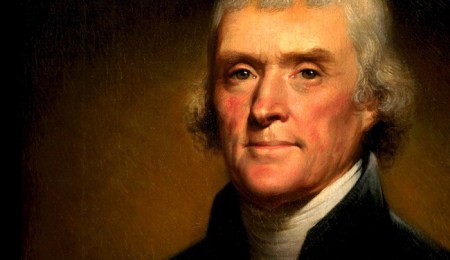
And the article by Amy Wang attempts to suggest that the “tradition” of the Iftar Dinner goes all the way back to Thomas Jefferson who, as is well known, was asked by a visiting Muslim envoy of the Bey of Tunis, one Sidi Soliman Mellimelli, to postpone the dinner to which Jefferson had invited him, along with others, until after sundown, which Jefferson, as a matter of courtesy, did.
The Post continues:
Jefferson’s decision to change the time of the meal to accommodate Mellimelli’s [the envoy from the Bey of Tunis] observance of Ramadan has been seized on by both sides in the 21st-century debate over Islam more than 200 years later. Historians have cited the meal as the first time an iftar took place in the White House — and it has been referenced in recent White House celebrations of Ramadan as an embodiment of the Founding Father’s respect for religious freedom. Meanwhile, critics on the far right have taken issue with the characterization of Jefferson’s Dec. 9, 1805, dinner as an iftar.
Notice how in the Post article it is “historians” (disinterested, authoritative, not to be doubted) who cite that 1805 meal as the first Iftar dinner in the White House, while those who deny that the meal was an “Iftar dinner” are described as being on the “far right,” apparently for no other reason than that very denial.
What actually happened is clear for those without an insensate need to make Islam, as Barack Obama has repeatedly claimed it was, “always part of America’s story.” And you can be as left-wing as all get out, and still recognize that Jefferson was not putting on an Iftar dinner. A little history will help: Mellimelli came to Washington as the envoy of the Bey of Tunis. The Americans had blockaded the port of Tunis, in order to force the Bey to halt his attacks on American shipping. Mellimelli was sent to make an agreement that would end the blockade. Invited by Jefferson to a dinner at the White House set for 3:30 (dinners were earlier in those pre-Edison days of our existence), he requested that it be held after sundown, in accordance with his Muslim practice, and Jefferson, a courteous man, obliged him. There is no hint that the dinner had changed in any way; no one then called it, or thought of it, as an “Iftar dinner.” Mellimelli himself did not describe it as an “Iftar dinner.” There is no record of it being anything other than the exact same dinner, the same menu, with wine (no removal of alcohol as would be necessary were it a real Iftar dinner), the only change being that of the three-hour delay until sunset. Nothing Jefferson said or did at the time, or in his later writings, indicates that he thought of that delayed dinner as an “Iftar dinner”; nor did he think he was in any way honoring Islam.
In fact, Jefferson had a very dim view of Islam, which came out of his experience in dealing with the Barbary Pirates, that is, the North African Muslims (in Morocco, Algiers, Tunis, and Tripoli), who attacked Christian shipping and seized ships and Christian sailors, and then demanded ransom. The sums were not trivial; the American Republic found itself spending 20% of its national budget on such payments. These continued until Jefferson became President, stopped the practice of paying such tribute, and instead made war on the Barbary Pirates. And that worked.
In 1786, years before he became president, Jefferson, along with John Adams, met with the Tripolitanian envoy Sidi Haji Abdrahaman in London. Perhaps by then Jefferson had read the Qur’an he had purchased in 1765 out of curiosity (no one knows how much of that Qur’an Jefferson may have read, or when, though some Muslim apologists have baselessly claimed he must have bought his Qur’an out of sympathetic interest in Islam.) If he did read it, it would have helped him to understand the motivations of the North African Muslims. Certainly by the time he became President in 1801, he was determined not to negotiate with the Barbary Pirates, but to implacably oppose with force these Muslims whom, he knew from his encounter with Abdrahaman in London, were permanently hostile to all non-Muslims.
In London, Jefferson and Adams had queried the Tripolitanian ambassador “concerning the ground of the pretensions to make war upon nations who had done them no injury” for the Americans had done nothing to deserve being attacked, and the ambassador replied, as Jefferson reported:
“It was written in their Koran, that all nations which had not acknowledged the Prophet were sinners, whom it was the right and duty of the faithful to plunder and enslave; and that every mussulman who was slain in this warfare was sure to go to paradise.”
And later, Jefferson reported to Secretary of State John Jay and to Congress at greater length, with a nearly identical quote from the ambassador:
“The ambassador answered us that [the right] was founded on the Laws of the Prophet, that it was written in their Koran, that all nations who should not have answered their authority were sinners, that it was their right and duty to make war upon them wherever they could be found, and to make slaves of all they could take as prisoners, and that every Mussulman who should be slain in battle was sure to go to Paradise.”
These reports do not sound as if they came from someone who thought well of Islam. The more dealings Jefferson had with the representatives of the Barbary states, and the more he learned from them directly of the tenets of the faith, the more he began to understand the aggressive nature of Islam, the centrality of Jihad, the inculcation of permanent hostility toward non-Muslims, and the heavenly reward for Jihadis slain in battle.
The Iftar dinner “tradition” begins not with Jefferson in 1805, and that three-hour delay in a meal that was otherwise unchanged, but with our latter-day interfaith outreach presidents — Clinton, Bush, Obama — each of whom, in his own way, has managed to ignore or misinterpret the texts and teachings of Islam.
That “tradition” of Iftar dinners in the White House is less than 20 years old, as compared with the other “tradition,” ten times as long, that is, the 200 years of Iftar-less presidencies. That short-lived “tradition” has been ended, for now, by an administration that, for all of its self-inflicted wounds and woes in other areas, continues to exhibit a better sense of what Islam, foreign and domestic, is all about, than its predecessors, and has no desire to obliquely honor it.
The interfaith outreach farce that the Iftar Dinner at the White House embodies, honoring Islam — while, all over the world, every day brings fresh news of Muslim atrocities against non-Muslims, more than 30,000 such attacks since 9/11/2001 alone, not to mention attacks as well against other Muslims deemed either of the wrong sect, or insufficient in the fervor of their faith — now comes to an end, if only for four years. That is certainly what Jefferson (and John Adams, and that most profound presidential student of Islam, John Quincy Adams), if not The Washington Post, would have wanted.
And since John Quincy Adams has been mentioned, why doesn’t The Washington Post take it upon itself to share with its readers what that most scholarly of our presidents wrote about Islam. It does not date. And it might prove most instructive.
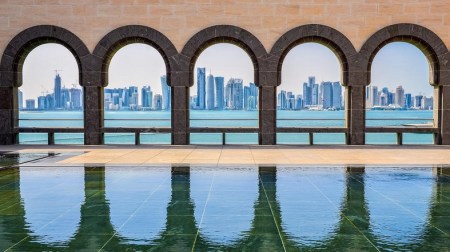
Angelo Codevilla lists the ways that Qatar has been peddling its influence in the West and especially in the US, even corrupting many institutions of the US national security “Deep State”. (Shutterstock)
After President Trump praised Saudi Arabia and its Gulf allies’ cutting of diplomatic and commercial contact with Qatar to force it to end its support for the Muslim Brotherhood, among other terrorists, an adviser to Secretary of State Rex Tillerson told The New York Times that, while “The president is focused on ending terrorism; the secretary is focused on diplomacy that will return GCC focus to fighting terrorism.”
The US government – the President notwithstanding – far from helping to isolate Qatar, will focus on ending that isolation and hope that this will have a beneficial effect on fighting terrorism.
Tillerson himself, while admitting that Qatar was supporting terrorism, made clear that this support was less important than the relationship itself.
“Qatar is one of the many entities that have capitalized on the US foreign policy establishment’s predispositions to Progressive ideology and to meddling. Let us abstract from such crude influence-buying as the Qatari government’s gift of one million dollars to the Clinton Foundation on the occasion of Bill Clinton’s 65th birthday or the lucrative business connections,” the author says.
******************
In a detailed analysis published recently by Security Studies Group, author and expert Angelo Codevilla, who is Professor Emeritus of International Relations at Boston University and a fellow of the Claremont Institute, goes into the historic role of American institutions, including the State Department and the CIA, to forge relationships with terror groups in the mistaken belief that they can be weaned away from violence.
He traces this flawed thinking by these state institutions and other actors to the Arab Gulf states rift with Qatar.
Codevilla writes: “As he applauds Saudi Arabia’s and its Gulf allies’ attempt to force Qatar to stop supporting terrorists, even his secretary of State not so subtly echoes the Establishment’s chorus that this is a bad idea. No one denies that whoever supports terrorism should stop doing so, that the state of Qatar in fact does support terrorists with billions of dollars, facilities, and a television network, and that the Muslim Brotherhood carries out terrorist acts directly and through affiliates. Hence the question imposes itself: how do opinions so contrary to reality and to the common sense of ordinary people acquire such power in high places?”
The author then lists the ways that Qatar has been peddling its influence in the West and especially in the US, even corrupting many institutions of the US national security “Deep State”.
“The counterintuitive influence of Muslim Brotherhood/Qatar is yet another example of what Herman Kahn used to call ”educated incapacity” – the inability of a few, acquired only by sustained effort, to understand or even to perceive realities obvious to the unschooled many,” writes Codevilla.
He then exmines how that influence has taken hold. “It is a story of how the Muslim Brotherhood’s ideas and the Qatari state’s money have encouraged the professors, think-tankers and bureaucrats of America’s National Security State to foist upon America a peculiar set of values and priorities by indulging their own prejudices.”
Indentical articles
The author points out that as President Trump was about to command the State Department “to list the Muslim Brotherhood as a terrorist organization (Egypt, Saudi Arabia, Syria, and the United Arab Emirates had already done so), Foreign Policy magazine and the Brookings Institution published nearly identical articles.”
After President Trump praised Saudi Arabia and its Gulf allies’ cutting of diplomatic and commercial contact with Qatar to force it to end its support for the Muslim Brotherhood, among other terrorists, an adviser to Secretary of State Rex Tillerson told The New York Times that, while “The president is focused on ending terrorism; the secretary is focused on diplomacy that will return GCC focus to fighting terrorism.”
In other words: The US government – the President notwithstanding – far from helping to isolate Qatar, will focus on ending that isolation and hope that this will have a beneficial effect on fighting terrorism.
Tillerson himself, while admitting that Qatar was supporting terrorism, made clear that this support was less important than the relationship itself.
Codevilla says that this was tantamount to saying: “We would rather support a Qatar that does not support terrorism. But we’ll support it even though it does.”
The answer also lies in the confluence between the Progressive prejudices of the American foreign policy establishment and the material reinforcement thereof by Muslim regimes, particularly that of Qatar.
The author painstakingly goes back to the post-World War II American security establishment and its moral compass, viewing view themselves on the side of the world’s emerging peoples, as “the true revolutionaries.”
Crude influence-buying
“Qatar is one of the many entities that have capitalized on the US foreign policy establishment’s predispositions to Progressive ideology and to meddling. Let us abstract from such crude influence-buying as the Qatari government’s gift of one million dollars to the Clinton Foundation on the occasion of Bill Clinton’s 65th birthday or the lucrative business connections,” the author says.
“Qatari operatives rightly regard these contributions, many deployed by their National Research Foundation, as having produced the political equivalent of strategically located military units,” says Codevilla.
There are American academic institutions in Qatar, and there are as well dozens of Qatari-supported foundations and countless scholars.
Codevilla concludes:“The al Thani family, which has ruled it for decades, has used the country’s great wealth to pursue influence abroad in ways that are inherently incompatible. Tamim, the current emir, has taken that foreign policy to a point where the incompatibilities may no longer coexist.”
The IDF struck two artillery launchers and an ammunition truck on the Syrian side of the border after “several Syrian projectiles” landed in Israeli territory without causing any casualties. A similar incident occurred in the same Golan Heights region on Saturday.
“In response to several Syrian projectiles launched towards Israel, IDF targeted 2 Syrian regime artillery positions & an ammunitions truck,” the Israel Defense Forces tweeted on their official feed on Sunday afternoon.
The tweet came three hours after the IDF said Syrian projectiles had “hit an open area in the northern Golan Heights,” while noting that “no injuries were reported.”
Moments ago, several projectiles fired from Syria hit an open area in the northern Golan Heights. No injuries reported.
Earlier on Sunday, Israeli Prime Minister Benjamin Netanyahu warned that even shells reaching Israeli territory accidentally would be met with a swift retribution.
“Our policy is clear: We will not tolerate any spillover or trickle whatsoever – neither mortars nor rockets, from any front,” Prime Minister Benjamin Netanyahu told his Cabinet on Sunday, vowing “we will respond strongly to any attack on our territory or our citizens,” according to the AP.
On Saturday, the IDF ordered an airstrike less than an hour after about 10 stray shells landed on Israel’s side of the border near Quneitra, where President Assad’s forces are battling Al-Nusra Front militants. Israel said that two tanks were destroyed.
Citing military sources, Syria’s SANA state news agency reported: “Israeli warplanes attacked services facilities and residential buildings… claiming a number of lives and causing material damage.”
Israel does not openly participate in the Syrian conflict, but since 2013 it has carried out several officially unacknowledged air strikes on its neighbor’s territory. According to Israeli officials, these have targeted the weapons supply routes of the Hezbollah militant movement, Israel’s Lebanon-based adversary.
In March, Syria said that it had launched anti-aircraft missiles aimed at Israeli military jets after they conducted airstrikes near the city of Palmyra, and were returning to base. Syrian media reported that one plane was downed, but Israel denied any losses.
According to the IDF, one of the Syrian projectiles was itself intercepted by an Israeli Arrow-2 missile, prompting Israel to disclose that its planes were operating in foreign airspace.
But for now, both these warfronts hang in the balance and are undecided. Also undecided on how and when to react are Israel and Jordan. Hizballah is already 3km from the Golan border, although Israel’s government and military leaders have pledged repeatedly that they would be allowed to come in so close.
**************************
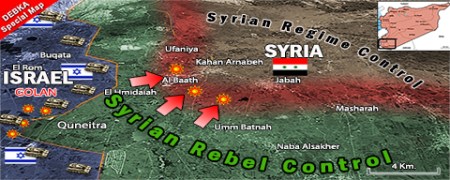
In the last 48 hours, Israel has conducted air strikes on and aimed tank fire at Syrian army positions near Quneitra’s northern suburb of Baath city, 3km from IDF Golan border defenses. (See map). Those positions were the source of the mortar shells that exploded on the Israeli Golan – 10 on Saturday, June 24 and three the next day. They came from a battle in which Syrian and Hizballah units were fighting off a Syrian rebel offensive around Quneitra.
The rebel militias set up a coalition to coordinate their offensive. It is dominated by the Hay’at Tahrir Al-Sham (HTS), which Damascus claims is an arm of Al Qaeda-Syria. In fact, it is an alignment of dozens of Islamist groups, some of which belonged and still do to Jabhat Fateh al-Sham – the former Nusra Front.
Fighting on the side of the Assad regime are the remnants of the Syrian army’s 90thBrigade, the Iranian Revolutionary Guards South Syrian command center, and the pro-Iranian Afghan Shiite militia.
They are joined by members of Hizballah’s Southern Shield Brigade.
This brigade is made up of Palestinians, Druzes, Circassians and local Syrians, whom Hizballah recruited and has posted in Hermon villages ready to launch terrorist attacks inside Israel.
The battle around Quneitra was preceded on June 17 by the assassination of Majd a-Din Khalik Khaymoud, commander of the Southern Shield Brigade and his two lieutenants, who were caught in an ambush near the village of Khan Arnabah. No party took responsibility for this attack.
Then, on Saturday, June 24, the rebel coalition launched its offensive on the Syrian-Hizballah units at Al-Baath, boasting that they would not stop until they reached Damascus. Although they caught the enemy by surprise, they were unable to follow up with a rapid advance, because they were pushed back by superior fire power. Since the Syrian mortars were aiming their fire at the rebel units concentrated around Quneitra, i.e., from east to west, some of the shells spilled over the border into the Golan.
When the rebels saw they were falling short of their objective, they drummed up a more modest goal: It was to open a second front in order to lighten the pressure on a separate rebel organization which for nearly three weeks has been fighting off fierce assaults on their positions in the southern Syrian town of Daraa, close to the Jordanian border.
Assad’s army, combined with large-scale Hizballah units and pro-Iranian forces, are therefore in full flight to seize control of Syria’s borders with Jordan and Israel. Amman and Jerusalem therefore face a twin peril on the Daraa and Al-Baath fronts. Both are anxious to keep Hizballah as far as possible from their territory.
But for now, both these warfronts hang in the balance and are undecided. Also undecided on how and when to react are Israel and Jordan. Hizballah is already 3km from the Golan border, although Israel’s government and military leaders have pledged repeatedly that they would be allowed to come in so close.
Southern view of the Cave of the Patriarchs . (photo credit:WIKIMEDIA)
The Tomb of the Patriarchs is Judaism’s second most holy site, after the Temple Mount and the Western Wall in Jerusalem’s Old City.
The Herodian Structure built around the tombs houses uniquely houses both Jewish prayer sanctuaries and the Ibrahimi Mosque.
The bulk of the Palestinian city of Hebron is located under the auspices of the Palestinian Authority. But the Tomb of the Patriarchs and some of its Old City, are located in a small area of the city under Israeli military control. Some 1,000 Jewish live in that section of the city.
*****************************
Israel has refused to allow a UNESCO investigatory team to make a field visit to Hebron in advance of pending July vote to register its Old City on the list of World Heritage in Danger under the “State of Palestine.”
This is a “principled and strategic” stand, Israel’s Ambassador to UNESCO in Paris Carmel Shama HaCohen said on Saturday.
Hebron’s Old City, including the Tomb of the Patriarchs, is one of the 35 sites the World Heritage Committee plans to consider for inscription on the World Heritage List when it meets in Krakow, Poland from July 2-12.
The Palestinian Authority has fast tracked the inscription process by claiming that the site is endangered.
Since UNESCO recognized Palestine as a member state in 2011, the Palestinian Authority has similarly fast tracked inscription of two other sites on the list of World Heritage in Danger. This includes the Church of the Nativity and the Pilgrimage Route in Bethlehem in 2012 and the ancient terraces of Battir (2014).
The International Council on Monuments and Sites, a professional body, which investigates nomination requests and provides recommendations for inscription on the list of World Heritage in Danger had recommended that both nominations go through the normal process after making field visits to both sites.
This time Israel has rejected its request to make a field visit to Hebron, this includes a refusal to grant entry visas to Israel for the group, Shama HaCohen said.
The 21-member World Heritage Committee rejected the ICOMOS conclusions not to place the Church of the Nativity and the terrace of Battir on its endangered list, Shama HaCohen said.
Therefore, it’s “a shame to waste the time and money” of the ICOMOS committee whose recommendations are otherwise typically adhered to with regard to the inscription process, Shama HaCohen said.
“Israel won’t take part in and won’t legitimize any Palestinian political moves under the guise of culture and heritage,” Shama HaCohen said.
The only steps it will take is to wage a diplomatic campaign to organize a large majority to block a process filled with “lies that plots against the state of Israel as well as the history and the connection of the Jewish people to this important holy site,” Shama HaCohen said.
“We are in the midst of a campaign against the opening of an additional Palestinian front in the religious and cultural war they are trying to force on us,” Shama HaCohen said.
He added that he hoped that this time around Israel would succeed in blocking the move.
The Tomb of the Patriarchs is Judaism’s second most holy site, after the Temple Mount and the Western Wall in Jerusalem’s Old City.
The Herodian Structure built around the tombs houses uniquely houses both Jewish prayer sanctuaries and the Ibrahimi Mosque.
The bulk of the Palestinian city of Hebron is located under the auspices of the Palestinian Authority. But the Tomb of the Patriarchs and some of its Old City, are located in a small area of the city under Israeli military control. Some 1,000 Jewish live in that section of the city.
The PA has warned that Israeli actions have placed the Herodian structure and Hebron’s historic Old City in danger. It has provided UNESCO with a list of complaints that includes placement of road blocks and checkpoints, the tear gas used to quell Palestinian demonstrations and failure to make necessary repairs. It has included in that list recent attempts by the Jewish residents of the city, to purchase property on Shuhadah Street.
Israel has rejected all claims that it has harmed the Tomb or the structures in the Old City.
It has further argued that Israel’s military control of that area of the city is based on a 1997 agreement with the PA. It has told UNESCO that any inscription of the site should be done at the request of both Israel and the Palestinians.
Administration officials have eliminated 2016 plans to fund Islamic groups allied to former President Barack Obama, and declined to schedule a 2017 Islamic ‘Iftar’ dinner where those groups were able to show their political influence to the ambassadors of wealthy Islamic countries.
The turnaround was made public on Friday when the Department of Homeland Security announced a revised list of the organizations which are getting DHS funds to help prevent young Muslims from becoming jihadis. The new list replaced an Obama list announced January 13, 2017, and it dropped a $800,000 grant for an Islamic seminary in Los Angeles, and a $393,000 grant for a linked organization, the Muslim Public Affairs Council Foundation.
The foundation is a spin-off of the D.C.-based Muslim Public Affairs Council, whose leaders were frequent advisors to Obama and his deputies, where they lobbied for a national strategy of letting semi-segregated Islamic political communities and groups — but not the FBI — play the leading role in combating Islamic terrorism.
Kelly explained his new pro-integration strategy in a June 22 event held in Congress, where he acknowledged that Islamic terrorists are acting for sincere religious reasons, saying:
They are out there doing what they think is their religion and think [it is] what they are supposed to be doing … What I’ve elected to do is take what little money I have in this regard and give it to what I consider to be the time-proven things — law enforcement from an outreach point of view and communities developing relationships … so that there’s an open line of communication so they know if they see this [advocacy or preparation for violence] happening in the home or they see it happening — that is to say, the move towards radicalism — or they see it happening in the churches or mosques, they know to call someone before that person typically crosses the line.
The departments June 23 statement emphasized that funding will be given to groups that cooperate with law enforcement:
The Department of Homeland Security (DHS) will award 26 grants — totaling $10 million for two years of programming — to organizations that will work to improve the security of our communities and prevent terrorism. Grantees were selected in part because of their potential to support law enforcement and other frontline defenders, to demonstrate programmatic effectiveness, and to use taxpayer resources efficiently to create independently sustainable programs. Grants were approved for local law enforcement agencies, state and local government agencies, universities, and non-profit organizations.
Kelly’s new funding list eliminated grants to several additional organizations, including $400,000 for Life After Hate Inc., $499,998 for the Somali-focused Ka Joog organization in Minneapolis, $40,000 for the Muslim American Leadership Alliance, and $396,585 for Unity Productions Foundation, whose lawyer in Mazen Asbahi.
In turn, Kelly shifted the money to the Global Peace Foundation in New Jersey, and to Hennepin County Sheriff’s Office in Minneapolis, and the Heartland Democracy Center in Minneapolis, where many local Somalis have preserved strong ties to Islamic armed groups in their homeland.
The funding cut-off came one day before the final day of the 2017 Ramadan season. In prior years, Obama invited Muslim ambassadors and U.S.-based Muslim allies to share a fast-breaking “Iftar dinner” at the White House. At Obama’s final 2016 Iftar, the attendees chanted “Four More Years!”
Trump’s officials did not explain why President Donald Trump choose to not hold an annual Iftar dinner this year.
One likely reason is that many Arab Muslim countries are bitterly divided against each other. For example, Saudi Arabia is threatening the neighboring countries of Quater, is waging war in neighboring Yemen, and is in a cold war with Iraq and Iran. Those divides between Islamic countries created a diplomatic headache for officials trying to decide cost costs and benefits of inviting the ambassador from each country for the Iftar dinner.
A second likely reason is that officials did not want to invite some of the Islamic advocates who worked with Obama’s deputies. For examples, the invitees to Obama’s Iftar dinners included the president of MPAC, Salam Al-Marayati, whose grant was cut June 23.
Another frequent Obama guest was Mohamed Magid, a Sudanese cleric who heads the All Dulles Area Muslim Society mosque in Northern Virginia. Magid is a former president of the Islamic Society of North America and was invited to shape anti-terrorism policy at the FBI and DHS. Both Al-Marayati and Magid have pushed so many Islamist claims that Obama’s deputies even tried to conceal their presence at the 2011 Iftar dinner.
During his eight years in office, Obama never invited Islamic reformers, such as Zuhdi Jasser, president of the American Islamic Forum for Democracy, a pro-Western Muslim group, to his Iftar dinners.
In response to Kelly’s shut-out from the grants, MPAC issued a protest in which it frankly admitted that it seeks to exclude the FBI from Islamic societies in the United States, such as mosques and affiliated community centers, or neighborhoods with a large Islamic population:
The notification letter we received today explained that upon further review, MPAC was excluded [from the grants] because we did not meet the criteria of working with law enforcement to counter violent extremism. This is true. Our position on this issue has consistently centered on community-led initiatives that improve mental health resources, access to counseling, and a host of other social services without [MPAC’s emphasis] the involvement or spectre of law enforcement.
While we have developed working relationships with law enforcement agencies in the past to improve officer training and the reporting of hate crimes, we have never conflated this work with community responses to issues of vulnerability and alienation. To do so would fundamentally compromise our ability to provide safe and nurturing spaces. Our grant application embodied those core principles, and its ultimate rejection by the Trump administration clearly demonstrates a dramatic and worrying change in approach…
The Trump Administration’s mishandling of the grant process underscores two fundamental flaws in its CVE [Countering VIolent Extremism] policy: it focuses on criminal investigations in a non-criminal space …. The exclusion of groups like MPAC point to a DHS that is ineffective in coordinating with communities and unconstitutional in its treatment of a religious minority. MPAC will continue challenging the trajectory of the Trump administration’s efforts in this space by advocating for a holistic approach that empowers rather than sidelines communities, focuses on all forms of violent threats, and fosters a climate of trust over fear. We are considering all legal options in light of these changes.
The MPAC strategy of excluding law-enforcement from Muslim civic groups reflects a broader effort by Islamic advocates to create and expand segregated Islamic neighborhoods throughout the United States, each of which is to be ruled by Islamic laws, in partial cooperation with federal and state law enforcement.
In 2005, for example, just four years after the 9/11 atrocity by 19 militant Islamists, Al-Maryati called for excluding law-enforcement from still-small Muslim communities. According to the Investigative Project on Terrorism, he told a meeting of the Islamic Society of North America that:
Counter-terrorism and counter-violence should be defined by us … We should define how an effective counter-terrorism policy should be pursued in this country. So, No. 1, we reject any effort, notion, and suggestion that Muslims should start spying on one another. Everywhere I go either somebody tells me that officials have met with them publicly or they tell me that they know who those folks are that are representing law enforcement. So we know they have communicated one way or the other with the Muslim community… The question is how do you deal with it in a healthy, open, transparent manner? That is why we are saying have them come in community forums, in open-dialogues, so they come through the front door and you prevent them having to come from the back door.
MPAC also has close ties to another defunded group, the “Bayan Claremont Islamic Graduate School,” an Islamic seminary whose president is named Jihad Turk. In February, the group announced it would decline funding from Trump’s DHS, although Obama’s DHS planned to award it $800,000.
This award was based on a proposal submitted in the summer of 2016 by Bayan Claremont, operating as a division of the Claremont School of Theology (CST), for a two-year project entitled “Flourishing Communities.” This project sought to elevate the capacity of non-profits and community organizations working to improve interreligious cooperation, civic engagement, and social justice. We will continue to pursue these goals with the support of our community and those who stand with us in solidarity.
The self-policing strategy favored by Al-Marayati and others was partly embraced in the Obama administration”s “Countering Violent Extremism” policy.
The policy refused to identify Islamic doctrines as the cause of Islamic attacks, and also tried to treat Islamic attacks as generic “violent extremism,” and also similar to violence by small-government groups, by ‘Nazi’ National Socialists, or by anti-abortion advocates. “Any approach that would single them [Islamic beleivers] out or target [Islamic adherents] for discrimination is not only wrong and un-American, but it would also be counter-productive because it would reduce the strength—the antibodies we have to resist terrorism,” Obama claimed in March 2016.
Obama’s deputies, including Homeland Secretary Jeh Johnson, also gave a leading role to MPAC and its leaders, including Al-Maryati.
After Obama’s departure, MPAC hired one of Obama’s policy aides, Zaki Barzinji. According to MPAC, Barzinji was “Senior Associate Director of Public Engagement and President Obama’s Liaison to Muslim-Americans… he was responsible for significantly deepening engagement and representation of Muslim communities across the country.”
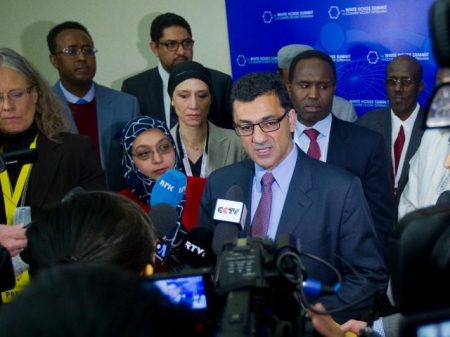
Obama hired other members of Islamic groups to serve at the DHS. For example, Kareem Shora was appointed to be the director of the Community Engagement Section at DHS, even though he had worked at the American-Arab Anti-Discrimination Committee. In a 2010 speech, for example, Shora said “We were not attacked by a faith [on 9/11]. We were attacked by violent extremists who were hijacking a faith … I felt, as a Muslim American, that I was attacked twice on 9/11 … those people attacked my own religion. They warped what the religion is all about, and so it is actually a very serious issue for me personally.”
Shora also used his speech to boast of his continued advocacy for Islamic groups: “Three years ago I had my name on [AADC] lawsuits against DHS, now I’m here speaking on behalf of DHS. I haven’t changed – the same exact points I made against special registration [of Muslim migrants] in 2007, I’m making internally in DHS in 2010.”
Shora’s LinkedIn page says he still holds the DHS job.
However, Obama’s CVE strategy failed to win much support among the media-magnified Islamic advocates, religious leaders, and political groups, who wanted even greater self-segregation and autonomy from the nation’s laws, plus more U.S. pressure on Israel. The lack of support for law enforcement coincided with the violent emergence of long-planned attacks by Muslims in San Bernardino and at the Orlando nightclub.
The legitimacy and credibility of many groups that claim to speak for Muslims in America are unclear. Many immigrants and Americans who are born into Muslim families ignore the tenets of Islam, and also ignore the well-funded political groups that are described as their representatives by Democrats and the media.
A 2011 Pew report, for example, showed that 48 percent of Muslims in America said that Islamic political groups had not done enough to condemn Islamic terrorism — while only 34 percent say the groups have done as much as they should.
A 2011 survey by Gallup reported that only 5.5 percent of Muslims in America felt they were best represented by the Islamic Society of North America. That survey also reported that only 28 percent of Muslims in America thought the Islamic groups were sufficiently vocal against terrorism.
Moreover, U.S. government’s don’t delegate law-enforcement roles to groups that define themselves by ethnic affiliations or religious tenets, such as Italian men’s clubs or the Catholic Church. Instead, people deal with government through their elected local, state and federal legislators, and through judges, but not via panels of religious leaders and agency officials.
Why was the FBI meddling in a U.S. presidential election? Partisan interference in the election by public agencies like the FBI and major news sources like NBC are far more worrisome than anything Russians allegedly might do from afar.
The FBI, too, is trying to stiff Congress’s investigation into the fake dossier:
**********************
The New York Post has an explosive report on the infamous “dossier” that tried to smear Donald Trump in order to swing the presidential election to Hillary Clinton. The source of the dossier is a Democratic Party opposition research firm called Fusion GPS:
The Senate Judiciary Committee earlier this month threatened to subpoena the firm, Fusion GPS, after it refused to answer questions and provide records to the panel identifying who financed the error-ridden dossier, which was circulated during the election and has sparked much of the Russia scandal now engulfing the White House.
***
Fusion GPS was on the payroll of an unidentified Democratic ally of Clinton when it hired a long-retired British spy to dig up dirt on Trump. In 2012, Democrats hired Fusion GPS to uncover dirt on GOP presidential nominee Mitt Romney. And in 2015, Democrat ally Planned Parenthood retained Fusion GPS to investigate pro-life activists protesting the abortion group.
No surprise there. What is shocking is the FBI’s apparent involvement in the effort to smear Trump with false rumors:
The FBI received a copy of the Democrat-funded dossier in August, during the heat of the campaign, and is said to have contracted in October to pay Steele $50,000 to help corroborate the dirt on Trump — a relationship that “raises substantial questions about the independence” of the bureau in investigating Trump, warned Senate Judiciary Chairman Chuck Grassley, R-Iowa.
It raises more questions than that. Why was the FBI meddling in a U.S. presidential election? Partisan interference in the election by public agencies like the FBI and major news sources like NBC are far more worrisome than anything Russians allegedly might do from afar.
The FBI, too, is trying to stiff Congress’s investigation into the fake dossier:
Senate investigators are demanding to see records of communications between Fusion GPS and the FBI and the Justice Department, including any contacts with former Attorney General Loretta Lynch, now under congressional investigation for possibly obstructing the Hillary Clinton email probe, and deputy FBI director Andrew McCabe, who is under investigation by the Senate and the Justice inspector general for failing to recuse himself despite financial and political connections to the Clinton campaign through his Democrat activist wife. Senate investigators have singled out McCabe as the FBI official who negotiated with Steele.
Like Fusion GPS, the FBI has failed to cooperate with congressional investigators seeking documents.
It appears that the Democratic Party has successfully corrupted the FBI as well as the CIA.
Fire exchanges between the Syrian army and opposition forces spilled over into the Israeli Golan Heights again on Sunday, even after the IDF’s aggressive retaliation the previous day to 10 errant projectiles that fell inside Israel.
No one was hurt in Sunday’s incident and no damage has been reported.
Sunday’s projectiles fell near Quneitra, in the same area as the projectiles on Saturday. IDF forces are now searching the area in an effort to file the fallen projectiles. According to initial estimates, there were only a handful of projectiles that fell inside Israeli territory.
IDF soldiers on the Golan border on Saturday (Photo: AFP)
In a similar instruction to Saturday, the IDF has asked farmers not work at plantations near the border in the Quneitra area. Despite that, all roads remain open and there have been no other special instruction for the civilian population in the area.








 anneinpt
 artaxes
 danmillerinpanama
 davidking1530
 Peter Hofman
 Joseph Wouk
 Peter
Peter Louisiana Steve
 WarSclerotic
Recent Comments