Archive for June 2017

History, Precedent and Comey Statement Show that Trump Did Not Obstruct Justice

June 8, 2017

History, Precedent and Comey Statement Show that Trump Did Not Obstruct Justice, Gatestone InstituteAlan M. Dershowitz, June 8, 2017

Comey has also acknowledged that the president had the constitutional authority to fire him for any or no cause. President Donald Trump also had the constitutional authority to order Comey to end the investigation of Flynn. He could have pardoned Flynn, as Bush pardoned Weinberger, thus ending the Flynn investigation, as Bush ended the Iran-Contra investigation. What Trump could not do is what Nixon did: direct his aides to lie to the FBI, or commit other independent crimes. There is no evidence that Trump did that.

*************************

The statement may provide political ammunition to Trump opponents, but unless they are willing to stretch James Comey’s words and take Trump’s out of context, and unless they are prepared to abandon important constitutional principles and civil liberties that protect us all, they should not be searching for ways to expand already elastic criminal statutes and shrink enduring constitutional safeguards in a dangerous and futile effort to criminalize political disagreements.

The first casualty of partisan efforts to “get” a political opponent — whether Republicans going after Clinton or Democrats going after Trump — is often civil liberties. All Americans who care about the Constitution and civil liberties must join together to protest efforts to expand existing criminal law to get political opponents.

Today it is Trump. Yesterday it was Clinton. Tomorrow it could be you.

In 1992, then-President George H.W. Bush pardoned Caspar Weinberger and five other individuals who had been indicted or convicted in connection with the Iran-Contra arms deal. The special prosecutor, Lawrence Walsh, was furious, accusing Bush of stifling his ongoing investigation and suggesting that he may have done it to prevent Weinberger or the others from pointing the finger of blame at Bush himself. The New York Times also reported that the investigation might have pointed to Bush himself.

This is what Walsh said:

“The Iran-contra cover-up, which has continued for more than six years, has now been completed with the pardon of Caspar Weinberger. We will make a full report on our findings to Congress and the public describing the details and extent of this cover-up.”

Yet President Bush was neither charged with obstruction of justice nor impeached. Nor have other presidents who interfered with ongoing investigations or prosecutions been charged with obstruction.

It is true that among the impeachment charges levelled against President Nixon was one for obstructing justice, but Nixon committed the independent crime of instructing his aides to lie to the FBI, which is a violation of section 1001 of the federal criminal code.

It is against the background of this history and precedent that the statement of former FBI Director James must be considered. Comey himself acknowledged that,

“throughout history, some presidents have decided that because ‘problems’ come from Justice, they should try to hold the Department close. But blurring those boundaries ultimately makes the problems worse by undermining public trust in the institutions and their work.”

Comey has also acknowledged that the president had the constitutional authority to fire him for any or no cause. President Donald Trump also had the constitutional authority to order Comey to end the investigation of Flynn. He could have pardoned Flynn, as Bush pardoned Weinberger, thus ending the Flynn investigation, as Bush ended the Iran-Contra investigation. What Trump could not do is what Nixon did: direct his aides to lie to the FBI, or commit other independent crimes. There is no evidence that Trump did that.

With these factors in mind, let’s turn to the Comey statement.

Former FBI Director James Comey’s written statement, which was released in advance of his Thursday testimony before the Senate Intelligence Committee, does not provide evidence that President Trump committed obstruction of justice or any other crime. Indeed it strongly suggests that even under the broadest reasonable definition of obstruction, no such crime was committed.

The crucial conversation occurred in the Oval Office on February 14 between the President and the then director. According to Comey’s contemporaneous memo, the president expressed his opinion that General Flynn “is a good guy.” Comey replied: “He is a good guy.”

The President said the following: “I hope you can see your way clear to letting this thing go.”

Comey understood that to be a reference only to the Flynn investigation and not “the broader investigation into Russia or possible links to the campaign.”

Comey had already told the President that “we were not investigating him personally.”

Comey understood “the President to be requesting that we drop any investigation of Flynn in connection with false statements about his conversations with the Russian ambassador in December.”

Comey did not say he would “let this go,” and indeed he did not grant the president’s request to do so. Nor did Comey report this conversation to the attorney general or any other prosecutor. He was troubled by what he regarded as a breach of recent traditions of FBI independence from the White House, though he recognized that “throughout history, some presidents have decided that because ‘problems’ come from the Department of Justice, they should try to hold the Department close.”

That is an understatement.

Throughout American history — from Adams to Jefferson to Lincoln to Roosevelt to Kennedy to Obama — presidents have directed (not merely requested) the Justice Department to investigate, prosecute (or not prosecute) specific individuals or categories of individuals.

It is only recently that the tradition of an independent Justice Department and FBI has emerged. But traditions, even salutary ones, cannot form the basis of a criminal charge. It would be far better if our constitution provided for prosecutors who were not part of the executive branch, which is under the direction of the president.

In Great Britain, Israel and other democracies that respect the rule of law, the Director of Public Prosecution or the Attorney General are law enforcement officials who, by law, are independent of the Prime Minister.

But our constitution makes the Attorney General both the chief prosecutor and the chief political adviser to the president on matters of justice and law enforcement.

The president can, as a matter of constitutional law, direct the Attorney General, and his subordinate, the Director of the FBI, tell them what to do, whom to prosecute and whom not to prosecute. Indeed, the president has the constitutional authority to stop the investigation of any person by simply pardoning that person.

Assume, for argument’s sake, that the President had said the following to Comey: “You are no longer authorized to investigate Flynn because I have decided to pardon him.” Would that exercise of the president’s constitutional power to pardon constitute a criminal obstruction of justice? Of course not. Presidents do that all the time.

The first President Bush pardoned Caspar Weinberger, his Secretary of Defense, in the middle of an investigation that could have incriminated Bush. That was not an obstruction and neither would a pardon of Flynn have been a crime. A president cannot be charged with a crime for properly exercising his constitutional authority

For the same reason, President Trump cannot be charged with obstruction for firing Comey, as he had the constitutional authority to do.

The Comey statement suggests that one reason the President fired him was because of his refusal or failure to publicly announce that the FBI was not investigating Trump personally. Trump “repeatedly” told Comey to “get that fact out,” and he did not.

If that is true, it is certainly not an obstruction of justice.

Nor is it an obstruction of justice to ask for loyalty from the director of the FBI, who responded “you will get that (‘honest loyalty’) from me.”

Comey understood that he and the President may have understood that vague phrase — “honest loyalty” — differently. But no reasonable interpretation of those ambiguous words would give rise to a crime. 
 Many Trump opponents were hoping that the Comey statement would provide smoking guns.

It has not.

Instead it has weakened an already weak case for obstruction of justice.

The statement may provide political ammunition to Trump opponents, but unless they are willing to stretch Comey’s words and take Trump’s out of context, and unless they are prepared to abandon important constitutional principles and civil liberties that protect us all, they should not be searching for ways to expand already elastic criminal statutes and shrink enduring constitutional safeguards in a dangerous and futile effort to criminalize political disagreements.

The first casualty of partisan efforts to “get” a political opponent — whether Republicans going after Clinton or Democrats going after Trump — is often civil liberties. All Americans who care about the Constitution and civil liberties must join together to protest efforts to expand existing criminal law to get political opponents.

Today it is Trump. Yesterday it was Clinton. Tomorrow it could be you.

WASHINGTON, DC – MAY 3: Director of the Federal Bureau of Investigation, James Comey testifies in front of the Senate Judiciary Committee during an oversight hearing on the FBI on Capitol Hill May 3, 2017 in Washington, DC.  (Photo by Eric Thayer/Getty Images)


Trump’s attorney responds to James Comey’s testimony

June 8, 2017

Trump’s attorney responds to James Comey’s testimony, Washington ExaminerAlex Pappas, June8, 2017

(Please see also, There’s Nothing About Comey. — DM)

President Trump’s attorney, Marc Kasowitz, responded to former FBI Director James Comey’s testimony on Thursday by saying Comey has confirmed that Trump was not under investigation as part of the Russian investigation.

Here is the full statement:

I am Marc Kasowitz, Predisent [sic] Trump’s personal lawyer.

Contrary to numerous false press accounts leading up to today’s hearing, Mr. Comey has now finally confirmed publicly what he repeatedly told the President privately: The President was not under investigation as part of any probe into Russian interference. He also admitted that there is no evidence that a single vote changed as a result of any Russian interference.

Mr Comey’s testimony also makes clear that the President never sought to impede the investigation into attempted Russian interference in the 2016 election, and in fact, according to Mr. Comey, the President told Mr. Comey “it would be good to find out” in that investigation if there were “some ‘satellite’ associates of his who did something wrong.” And he did not exclude anyone from that statement.

Consistent with that statement, the President never, in form or substance, directed or suggested that Mr. Comey stop investigating anyone, including suggesting that that [sic] Mr. Comey”let Flynn go.” As he publicly stated the next day, he did say to Mr. Comey, “General Flynn is a good guy, he has been through a lot” and also “asked how is General Flynn is doing.” Admiral Rogers testified that the President never “directed [him] to do anything . . . illegal, immoral, unethical or inappropriate” and never “pressured [him] to do so.” Director Coates [sic] said the same thing. The President likewise never pressured Mr. Comey. The President also never told Mr. Comey, “I need loyalty, I expect loyalty” in form or substance. Of course, the Office of the President is entitled to expect loyalty from those who are serving in an administration, and, from before this President took office to this day, it is overwhelmingly clear that there have been and continue to be those in government who are actively attempting to undermine this administration with selective and illegal leaks of classified information and privileged communications. Mr. Comey has now admitted that he is one of these leakers.

Today, Mr. Comey admitted that he unilaterally and surreptitiously made unauthorized disclosures to the press of privileged communications with the President. The leaks of this privileged information began no later than March 2017 when friends of Mr. Comey have stated he disclosed to them the conversations he had with the President during their January 27, 2017 dinner and February 14, 2017 White House meeting. Today, Mr. Comey admitted that he leaked to friends his purported memos of these privileged conversations, one of which he testified was classified. He also testified that immediately after he was terminated he authorized his friends to leak the contents of these memos to the press in order to “prompt the appointment of a special counsel.” Although Mr. Comey testified he only leaked the memos in response to a tweet, the public record reveals that the New York Times was quoting from these memos the day before the referenced tweet, which belies Mr. Comey’s excuse for this unauthorized disclosure of privileged information and appears to entirely retaliatory. We will leave it the appropriate authorities to determine whether this leaks should be investigated along with all those others being investigated. In sum, it is now established that there the President was not being investigated for colluding with the or attempting to obstruct that investigation. As the Committee pointed out today, these important facts for the country to know are virtually the only facts that have not leaked during the long course of these events.

Comey’s testimony, who testified about his past conversations with the president, was the first since Trump fired him last month. The former FBI director said during the hearing he believes Trump ousted him because of displeasure over how the Russia investigation casting a cloud over his presidency. Comey also said he told Trump he personally wasn’t under federal investigation and criticized media outlets for inaccurately reporting stories.

Did Comey Violate Laws In Leaking The Trump Memo?

June 8, 2017

Did Comey Violate Laws In Leaking The Trump Memo? Jonathan Turley’s Blog, Jonathan Turley, June 8, 2017

The admission of leaking the memos is problematic given the overall controversy involving leakers undermining the Administration. Indeed, it creates a curious scene of a former director leaking material against the President after the President repeatedly asked him to crack down on leakers.

**********************

One of the most interesting new disclosures today in the Comey hearing was the admission by former FBI Director James Comey that he intentionally used a “friend” on the Columbia law faculty to leak his memos to the media.  Comey says that he did so to force the appointment of a Special Counsel. However, those memos could be viewed as a government record and potential evidence in a criminal investigation.

Notably, Columbia Law School professor Daniel Richman as a faculty webpage that says that he is “currently an adviser to FBI Director James B. Comey.” Richman specializes in criminal law and criminal procedure.

The problem is that Comey’s description of his use of an FBI computer to create memo to file suggests that these are arguably government documents.  Comey admitted that he thought raised the issue with his staff and recognized that they might be needed by the Department or Congress.  They read like a type of field 302 form, which are core investigatory documents.

The admission of leaking the memos is problematic given the overall controversy involving leakers undermining the Administration. Indeed, it creates a curious scene of a former director leaking material against the President after the President repeatedly asked him to crack down on leakers.

Besides being subject to Nondisclosure Agreements, Comey falls under federal laws governing the disclosure of classified and nonclassified information.  Assuming that the memos were not classified (though it seems odd that it would not be classified even on the confidential level), there is 18 U.S.C. § 641 which makes it a crime to steal, sell, or convey “any record, voucher, money, or thing of value of the United States or of any department or agency thereof.”


Notably, Columbia Law School professor Daniel Richman as a faculty webpage that says that he is “currently an adviser to FBI Director James B. Comey.” Richman specializes in criminal law and criminal procedure.

The problem is that Comey’s description of his use of an FBI computer to create memo to file suggests that these are arguably government documents.  Comey admitted that he thought raised the issue with his staff and recognized that they might be needed by the Department or Congress.  They read like a type of field 302 form, which are core investigatory documents.

The admission of leaking the memos is problematic given the overall controversy involving leakers undermining the Administration. Indeed, it creates a curious scene of a former director leaking material against the President after the President repeatedly asked him to crack down on leakers.

Besides being subject to Nondisclosure Agreements, Comey falls under federal laws governing the disclosure of classified and nonclassified information.  Assuming that the memos were not classified (though it seems odd that it would not be classified even on the confidential level), there is 18 U.S.C. § 641 which makes it a crime to steal, sell, or convey “any record, voucher, money, or thing of value of the United States or of any department or agency thereof.”

What do you think?

There’s Nothing About Comey

June 8, 2017

There’s Nothing About Comey, Front Page Magazine, Daniel Greenfield, June 8, 2017

The FBI, as Comey lays out in a tedious opening that he knows his Democrat admirers will skip over to get to the juicy Trump stuff, was conducting a “counterintelligence investigation” not a criminal investigation. So there was no crime. Nor was the FBI investigating Trump. Nor is Trump being accused of obstructing an FBI investigation. 

All those carefully documented memos, the painstaking labor, amount to absolutely nothing.

But that’s because there was no crime to begin with. The rest is innuendo. The drip drop of a scandal without one ever materializing. Comey’s testimony will be another drop from that leaky faucet. Its only substance is theatrical. Detailed documentation creates the appearance of wrongdoing. Constant hearings maintain the illusion that something is being uncovered. Even when nothing is.

***************************

Never has one man broken more leftist hearts than James Brien Comey Jr.

The 6’8 former FBI director is once again the object of the left’s adoration. “A Beltway dreamboat, handsome as a movie star,” Salon gushes. “Our handsome young FBI director,” Gizmodo flutters its eyelashes. “How tall is James Comey? Tall. Like, really tall,” the Boston Globe coos. 

Now the Beltway dreamboat will be appearing live and in person in the Senate. It’s the biggest show in a big government town. Teenage girls hunting for Justin Bieber tickets have nothing on the media frenzy.

“The Comey Testimony: When, Where and How to Follow,” the New York Times breathlessly posts. As if it’s the World Series instead of awkward exchanges between a resentful lifer government man, Senate Democrats trying to prove that President Trump didn’t win the election and the moon landing was faked, and Senate Republicans trying to get on with the business of running the country.

And the left shouldn’t get too caught up in its new romance with James Comey. Not when his on and off again relationship with the media is Washington’s biggest soap opera.  Comey saved Hillary. Then he got the blame for costing her the election. He was a hero for supposedly investigating Trump. Then his Hillary testimony led to media outrage.  Trump fired him and he became a hero again.

The Washington Post went from “James Comey just stepped in it, big time” to “James Comey, is this man bothering you?”, “20 questions senators should ask James Comey” and “James Comey’s written testimony inspired this playlist” in one month.  Tomorrow it might be, “James Comey, we baked this cake for you.” Or it might be, “James Comey, we hate you and never want to see you again.”

Because James Comey has nothing except resentment at losing a cushy job he wasn’t very good at.

Comey’s career was doomed when he became a player in Democrat conspiracy theories. First, the left blamed him for Hillary’s defeat. Then it enlisted him as its champion to prove the election was hacked.

And the Beltway dreamboat can’t deliver. The curtain rises. The spotlight comes down. And Comey coughs out his carefully worded memos that describe in detail the furniture of the Oval Office.

No really.

“When the door by the grandfather clock closed… Reince Priebus leaned in through the door by the grandfather clock… I then got up and left out the door by the grandfather clock.”

Slate gushes, “James Comey’s Senate Testimony Is a Pulpy, Literary Treat.” If you really like grandfather clocks. Why write about grandfather clocks? Because Comey doesn’t have anything else to write about.

There’s no “there”, there.

The FBI, as Comey lays out in a tedious opening that he knows his Democrat admirers will skip over to get to the juicy Trump stuff, was conducting a “counterintelligence investigation” not a criminal investigation. So there was no crime. Nor was the FBI investigating Trump. Nor is Trump being accused of obstructing an FBI investigation.

All those carefully documented memos, the painstaking labor, amount to absolutely nothing.

But that’s because there was no crime to begin with. The rest is innuendo. The drip drop of a scandal without one ever materializing. Comey’s testimony will be another drop from that leaky faucet. Its only substance is theatrical. Detailed documentation creates the appearance of wrongdoing. Constant hearings maintain the illusion that something is being uncovered. Even when nothing is.

The better question is why do the memos even exist?

The left would like to believe that Comey was gathering evidence on President Trump. But they don’t contain anything incriminating about him. Instead Comey was trying to preemptively protect himself. To understand that is to understand who Comey is and why he got into this mess.

Never has one man broken more leftist hearts than James Brien Comey Jr.

The 6’8 former FBI director is once again the object of the left’s adoration. “A Beltway dreamboat, handsome as a movie star,” Salon gushes. “Our handsome young FBI director,” Gizmodo flutters its eyelashes. “How tall is James Comey? Tall. Like, really tall,” the Boston Globe coos.

Now the Beltway dreamboat will be appearing live and in person in the Senate. It’s the biggest show in a big government town. Teenage girls hunting for Justin Bieber tickets have nothing on the media frenzy.

“The Comey Testimony: When, Where and How to Follow,” the New York Times breathlessly posts. As if it’s the World Series instead of awkward exchanges between a resentful lifer government man, Senate Democrats trying to prove that President Trump didn’t win the election and the moon landing was faked, and Senate Republicans trying to get on with the business of running the country.

And the left shouldn’t get too caught up in its new romance with James Comey. Not when his on and off again relationship with the media is Washington’s biggest soap opera.  Comey saved Hillary. Then he got the blame for costing her the election. He was a hero for supposedly investigating Trump. Then his Hillary testimony led to media outrage.  Trump fired him and he became a hero again.

The Washington Post went from “James Comey just stepped in it, big time” to “James Comey, is this man bothering you?”, “20 questions senators should ask James Comey” and “James Comey’s written testimony inspired this playlist” in one month.  Tomorrow it might be, “James Comey, we baked this cake for you.” Or it might be, “James Comey, we hate you and never want to see you again.”

Because James Comey has nothing except resentment at losing a cushy job he wasn’t very good at.

Comey’s career was doomed when he became a player in Democrat conspiracy theories. First, the left blamed him for Hillary’s defeat. Then it enlisted him as its champion to prove the election was hacked.

And the Beltway dreamboat can’t deliver. The curtain rises. The spotlight comes down. And Comey coughs out his carefully worded memos that describe in detail the furniture of the Oval Office.

No really.

“When the door by the grandfather clock closed… Reince Priebus leaned in through the door by the grandfather clock… I then got up and left out the door by the grandfather clock.”

Slate gushes, “James Comey’s Senate Testimony Is a Pulpy, Literary Treat.” If you really like grandfather clocks. Why write about grandfather clocks? Because Comey doesn’t have anything else to write about.

There’s no “there”, there.

The FBI, as Comey lays out in a tedious opening that he knows his Democrat admirers will skip over to get to the juicy Trump stuff, was conducting a “counterintelligence investigation” not a criminal investigation. So there was no crime. Nor was the FBI investigating Trump. Nor is Trump being accused of obstructing an FBI investigation.

All those carefully documented memos, the painstaking labor, amount to absolutely nothing.

But that’s because there was no crime to begin with. The rest is innuendo. The drip drop of a scandal without one ever materializing. Comey’s testimony will be another drop from that leaky faucet. Its only substance is theatrical. Detailed documentation creates the appearance of wrongdoing. Constant hearings maintain the illusion that something is being uncovered. Even when nothing is.

The better question is why do the memos even exist?

The left would like to believe that Comey was gathering evidence on President Trump. But they don’t contain anything incriminating about him. Instead Comey was trying to preemptively protect himself. To understand that is to understand who Comey is and why he got into this mess.

One missile takes out ISIS command on Golan edge

June 8, 2017

One missile takes out ISIS command on Golan edge, DEBKAfile, June 8, 2017

DEBKAfile’s military sources report concerns in the US military commend lest Iranian general Qassem Soleimani decides to drop a division of Iranian special forces by helicopter, in order to catch the garrison off guard and capture the border crossing.

This concern increased after the Islamic State conducted a surprise bombing-cum-shooting attack on prize Iranian regime targets in Tehran on June 7. The Revolutionary Guards are bent on revenge and looking for an outstanding military success to cover this humiliation.

The US commanders are also under pressure on another score: the Iranians and Syrians have sent secret messages to Moscow complaining bitterly about the US air strike. They both made it clear that they command sufficient air and artillery fire power to overwhelm and wipe the ground with the American force in Syria.  Both Damascus and Tehran appear to be spoiling for a major showdown between their armies, using Hizballah and other Shiite proxies, and the US-led contingent.

***********************

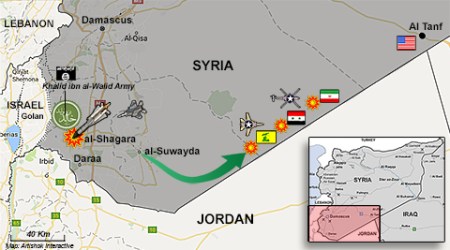
A single mystery missile, which could have been fired from the ground or the air early Wednesday morning, June 7, wiped out the entire top Islamic State command on the Syrian Golan, DEBKAfile’s military and intelligence sources report. All 16 officers of the 2,000-strong Khaled Ibn al Waleed army, the ISIS operations arm on the Syrian Golan, were present in the targeted building in the town of al-Shagara, located in the triangle where the Israeli, Syrian and Jordanian borders meet opposite the Sea of Galilee in northern Israel.

The unidentified missile blew up in the middle of a hall where the top command echelon were gathered to break their daily fast during the month of Ramadan and draw up plans. None of them survived.

Among them were the group’s chief, Gen. Abu Mohammed al-Makdessi; commander of operations, Gen. Abu Udai al-Homsi; and the group’s explosives expert who doubled as its religious leader, Abu Ali Shabat.

They operated under these aliases to conceal their real identities as former high Iraqi army officers who served in the late Saddam Hussein’s armed forces. They were also in senior command positions at the ISIS Syrian command center in Raqqa, when ISIS leader Abu Bakr al-Baghdadi decided to transfer them to the Syrian Golan to spearhead attacks that were planned to take place inside Israel and Jordan.

It took Al-Baghdad just a few hours to replace Magdessi as Khaled Ibn al-Waleed chief with a new man, Mohamed al-Refaei-Abu Hshem al-Askari.

On Tuesday, June 6, the day before the mysterious missile decapitated the Islamic State’s Golan force, US warplanes acted on another front to bomb a convoy of Iranian, Syrian and Hizballah forces that were traveling eastward from the southern town of Derra in the direction of the Al-Tanf border crossing.

Al Tanf, where US and Jordanian special forces units have established a garrison, is located in the triangle where the Syrian, Jordanian and Iraqi borders converge. The US planes destroyed several tanks, troop carriers, artillery pieces and antiaircraft systems, causing also fatalities and injuries, and so halted the convoy’s advance on the strategic crossing.

This was the second US air strike in three weeks on a similar target. The first was on May 18.

DEBKAfile’s military sources report concerns in the US military commend lest Iranian general Qassem Soleimani decides to drop a division of Iranian special forces by helicopter, in order to catch the garrison off guard and capture the border crossing.

This concern increased after the Islamic State conducted a surprise bombing-cum-shooting attack on prize Iranian regime targets in Tehran on June 7. The Revolutionary Guards are bent on revenge and looking for an outstanding military success to cover this humiliation.

The US commanders are also under pressure on another score: the Iranians and Syrians have sent secret messages to Moscow complaining bitterly about the US air strike. They both made it clear that they command sufficient air and artillery fire power to overwhelm and wipe the ground with the American force in Syria.  Both Damascus and Tehran appear to be spoiling for a major showdown between their armies, using Hizballah and other Shiite proxies, and the US-led contingent.

Report: PA Starved for Donations, Eager to Negotiate, Will Waive Demand for Settlement Freeze

June 8, 2017

Source: Report: PA Starved for Donations, Eager to Negotiate, Will Waive Demand for Settlement FreezeThe Jewish Press | David Israel | 14 Sivan 5777 – June 8, 2017 | JewishPress.com

Mahmoud Abbas and Donald Trump in Bethlehem, May 23, 2017.

Mahmoud Abbas is willing—temporarily—to abandon his demand that Israel freeze settlement construction, and would—also temporarily—set aside his campaign to prosecute Israel for war crimes, to get the peace talks moving under President Trump’s sponsorship, Abbas’s senior adviser Mohammad Mustafa told Bloomberg in an interview published on Wednesday.

Interestingly, according to Mustafa, what the PA needs now even more than getting Jews to stop adding rooms to their crammed homes in the settlements, is preventing an all-but-certain economic crisis in Judea, Samaria, and Gaza. They need the hundreds of millions of dollars pledged by donor nations. Show me the money, he demands, in essence, it’ll make me much more willing to talk peace.

Advertisement

“We have not made the settlements an up-front issue this time,” Mustafa said, explaining that “we think it’s better for all of us right now to focus on giving this new administration a chance to deliver.”

Mohammad Mustafa is Chairman of the Palestine Investment Fund, the PA’s former Minister of National Economy and its former Deputy Prime Minister. He has a master’s degree and PhD from George Washington University. With those qualifications, he is keenly aware, as he told Bloomberg, of the rampant unemployment in the PA, which is suffering the effects of international donors’ reneging on promised funds. These, obviously, is why Abbas is eager to start negotiating, never mind all those Jews who dare close off their terraces in eastern Jerusalem in alleged violation of the Geneva convention.

Mohammad Shtayyeh, who served as the PA’s minister of public works and housing, and minister of the Palestinian Economic Council for Development and Reconstruction, told Bloomberg that President Trump’s decision to keep the US embassy in Tel Aviv has endeared him to PA Arabs. “There is a new dynamic,” Shtayyeh noted.

Settlement construction freeze has always been a pre-condition for joining peace negotiations for PA Chairman Abbas. Never mind that, if you were to ask Jewish settlers, Prime Minister Netanyahu has kept Judea and Samaria construction-free for nine years now. For the Netanyahu government, talking about new housing in Judea and Samaria has largely replaced actually building anything.

Israel Steps Up Fight Against ISIS, as Terror Group Wages ‘War’ for Control of Egyptian Border

June 7, 2017

Israel Steps Up Fight Against ISIS, as Terror Group Wages ‘War’ for Control of Egyptian Border, Washington Free Beacon, , June 7, 2017

A picture taken on April 16, 2017 shows a general view of the Monastery of St. Catherine in Egypt’s south Sinai, where a policeman was killed and three others wounded on April 18, 2017 when gunmen opened fire on a checkpoint near the monastery, the interior ministry said, in an attack claimed by Islamic State jihadists. Security forces returned fire, wounding some of the attackers and “forcing them to flee”, it said. / AFP PHOTO / Pedro Costa Gomes (Photo credit should read PEDRO COSTA GOMES/AFP/Getty Images)

Israeli military officials are conducting scores of intelligence gathering operations along the border in conjunction with Egyptian officials, the source said.

“We have a very good working relationship with the Egyptian army, both in the intelligence and with actual” military officials, the IDF officer said. “We definitely work in tandem with the Egyptian military,” which has requested Israel’s help in gathering intelligence on ISIS and keeping tabs on its activity in Sinai.

Israel also has offered Egypt various military technologies to help combat the threat.

****************************

Israeli military forces are quietly conducting operations to counter the threat of Islamic State terrorists along the Sinai border area with Egypt, according to senior Israeli defense officials who described ISIS as the “most quickly advanced threat we’ve ever had.”

ISIS terrorists have been locked in what Israeli military officials described as an “ongoing war” along Sinai Peninsula, as they attempt to wrench control of the key territory along Israel’s southern border from Egyptian hands.

The daily battle, which has received little coverage in the Western media, has become a chief concern for Israeli Defense Forces (IDF) personnel operating along the Jewish state’s southern border, eclipsing even Hamas terrorists in the region.

Officials estimate that there are anywhere from 1,000 to 2,000 “active members of ISIS” operating in the Sinai region, a sizable force in an area that is largely lawless and has been seen as a primary terrorism tension point for some time. ISIS orchestrates terror attacks nearly every day of the week along the border, Israeli military officials disclosed.

With the rise of ISIS—an extremely well-funded and inter-connected network of some of the globe’s most vicious Islamic terrorists—the threat along the Sinai has significantly increased, becoming a primary focus for the IDF, which has been conducting intelligence gathering and military operations in a bid to prevent ISIS terrorists from crossing the Israeli border.

“ISIS is the most quickly advancing threat we’ve ever had,” one IDF officer working in the region told the Washington Free Beacon. “The rate with which they advance in resources and both capabilities and civil military training far outweighs and outpaces” the threats posed by Hamas and Hezbollah terrorists in Lebanon.

“There is what can be considered an ongoing almost war in the Sinai Peninsula now,” said the officer, who was not authorized to speak on record when discussing Israeli operations to counter ISIS.

“Not a day goes by where there is not an attack against the Egyptian army or Egyptian civilians by the faction of ISIS that is in the Sinai Peninsula,” the official disclosed.

ISIS conducts anywhere from five to seven terror attacks per week in the region, including sniper attacks, road side mine attacks on Egyptian military convoys, and improvised explosive device (IED) attacks, the official said.

ISIS terrorists in Sinai also are in possession of advanced military technology, such as anti-tank missiles, mortars, and long-range rockets, according to Israeli assessments.

“We’re talking about 10 casualties a week” as a result of ISIS, according to the Israeli military official.

One senior Trump administration official praised Israel’s efforts to combat ISIS, telling the Free Beacon that the president is encouraged by the Jewish state’s renewed efforts to work with Egypt and other Arab nations that often have had chilly relations with Israel.

“Of course it benefits the United States when our close partners and allies like Israel increase their capacity to defeat ISIS—but Israel’s long experience combatting terrorism is also one of the things that is bringing Israel closer to our Arab friends in the region,” the administration official, speaking on background, told the Free Beacon. “That was one of the key messages from President Trump’s recent trip.”

Despite the amount of violence in the contested border region, the Western media has largely ignored the battle.

The threat of ISIS has fostered increased cooperation between Israeli and Egyptian military officials.

Israeli military officials are conducting scores of intelligence gathering operations along the border in conjunction with Egyptian officials, the source said.

“We have a very good working relationship with the Egyptian army, both in the intelligence and with actual” military officials, the IDF officer said. “We definitely work in tandem with the Egyptian military,” which has requested Israel’s help in gathering intelligence on ISIS and keeping tabs on its activity in Sinai.

Israel also has offered Egypt various military technologies to help combat the threat.

“There have been times we’re we’ve been called on to aid in various missions,” the officer said.

ISIS is a particularly nefarious terror force that wholly embraces violence, making it more dangerous than even Hamas and Hezbollah, which tend to be more calculated in how and when they sponsor terrorism.

“Both Hamas and Hezbollah in Lebanon have outgrown being regular terrorist organizations and are almost governments,” the military official explained. “ISIS in the Sinai Peninsula has not reached that level yet so they have a lot less to lose and lot more to gain by carrying out bolder and stronger terrorist attacks. They most definitely have more of an edge.”

ISIS’s ability to galvanize support over the internet on social media sites such as Facebook and YouTube has made it a particularly virulent threat.

ISIS operatives routinely conduct intelligence-gathering operations using Facebook and other social media sites. Terrorist operatives are known to pose as Israeli and attempt to strike up online relationships with military personnel and other officials.

ISIS also is locked in a battle with Egyptian smugglers who have long operated a drug trade along the Sinai border. The terror group is attempting to wrest control of the trade from the smugglers who deal in drugs.

The money helps to fund ISIS’s operations, but could also arm them with highly coveted smuggling routes that would enable the group to funnel arms and even terrorist forces into Israeli territory.

“This is one of the major issues and struggles going on right now,” according to the Israeli military official. “That’s the major fear of the Israeli military down south, this skirmish going on between ISIS and the Bedouin smugglers. When it comes to a head we’ll suddenly start seeing a lot less hashish and heroin, and a lot more guns and even road side bombs right on the border.”

UN Secretary-General Launches Slanderous Attack on Israel

June 7, 2017

UN Secretary-General Launches Slanderous Attack on Israel, PJ MediaP. David Hornik, June 7, 2017

(If Mr. Guterres gets kicked out as the UN Secretary General, which won’t happen, a job may well await him at the Washington Post. Please see also
Washington Post Peddles Palestinian Propaganda, Part Two. — DM)

06/01/2017 Antonio Guterres, Secretary-General of the United Nations, at a meeting with Russian Minister of Foreign Affairs Sergei Lavrov on the sidelines of 2017 St. Petersburg International Economic Forum. Evgeny Biyatov/Sputnik via AP

“This occupation,” Guterres writes:

… has imposed a heavy humanitarian and development burden on the Palestinian people. Among them are generation after generation of Palestinians who have been compelled to grow up and live in ever more crowded refugee camps, many in abject poverty, and with little or no prospect of a better life for their children.

Further, he writes:

Resolving the Israeli-Palestinian conflict will remove a driver of violent extremism and terrorism in the Middle East and open the doors to cooperation, security, prosperity and human rights for all.

**********************

At this time 50 years ago, Israel was fighting the Six Day War and conquering territories. Since then it has returned the Sinai to Egypt, withdrawn from Gaza, retained control of the Golan Heights, and created a self-governing Palestinian entity in part of the West Bank while retaining overall security control there.

This 50-year anniversary has seen a flood of statements lauding or lamenting the Six Day War and its outcomes for Israel. Statements of the former kind emphasize that the war gave Israel defensible borders, a close alliance with the United States (by showing that Israel was a regional power), and, eventually, peace treaties with Egypt and Jordan.

Among the best in this vein were op-eds by Michael Oren and Bret Stephens.

Statements of the latter kind bemoan Israel’s “occupation” of the Palestinians and describe it as a disaster that has to end — fast. And UN Secretary-General Antonio Guterres offers some of the most egregious remarks in this vein.

“This occupation,” Guterres writes:

… has imposed a heavy humanitarian and development burden on the Palestinian people. Among them are generation after generation of Palestinians who have been compelled to grow up and live in ever more crowded refugee camps, many in abject poverty, and with little or no prospect of a better life for their children.

Further, he writes:

Resolving the Israeli-Palestinian conflict will remove a driver of violent extremism and terrorism in the Middle East and open the doors to cooperation, security, prosperity and human rights for all.

Let’s start with Guterres’ first claim about the alleged misery of Palestinian life since Israel took over the territory.

A few days before Guterres posted his statement, popular Israeli columnist Ben-Dror Yemini published a piece called “The truth about the occupation.” Yemini is not a right-winger; he wants Israel to eventually withdraw from most of the West Bank and separate from the Palestinians. But he also wants the discourse to be based on truth and not propaganda.

Yemini looks at some key elements of Palestinian life and compares the situations before and after the “Israeli occupation” (I use the scare quotes because Israel has withdrawn from Gaza and — except for anti-terror operations — Area A of the West Bank):

Education: Before the Six Day War in 1967, there was not a single university in the West Bank (under Jordanian rule) and Gaza (under Egyptian rule). “Today, there are more than 50 higher education institutions in the territories.”

Infant mortality: According to a Palestinian study and World Bank figures, the rate has gone from 152-162 per 1,000 live births in 1967 to: 132 in 1974, 53-56 in 1985, less than 30 in 1993, 25 in 2002, and 18 at present.

Yemini notes:

“The sharp drop, from 1976 to 1993, took place under direct Israeli rule. The drop continued under the Palestinian Authority, but at a more moderate pace.”

” … [The] infant mortality rate among the Palestinians is much lower than the global average of 31.7, and is significantly lower than the average in the Arab world — 28.”

Life expectancy: “[F]rom 48.6 in 1967 to about 73 (or 75, according to different sources) today.”

Writes Yemini:

“I can touch on more and more areas in which an objective examination will reveal an amazing improvement in the past 50 years. For example, in the area of water. In 1967, only four of 708 Palestinian towns and villages were connected to running water. Today, 643 communities are connected to running water (97% of the population).”

From the UN secretary-general’s description — “a heavy humanitarian and development burden on the Palestinian people … with little or no prospect of a better life for their children” — one would think Israel is mercilessly grinding the Palestinians down. The truth is very different.

Guterres’ description of the Israeli-Palestinian conflict — “a driver of violent extremism and terrorism in the Middle East” whose resolution would “open the door” to some sort of utopia — is even more shockingly at variance with the truth.

Before the “Arab Spring” erupted in 2011, such claims about the Israeli-Palestinian conflict being the cause of Middle East strife were par for the course.

Since then, the region has seen six years of apparently endless warfare — among Sunnis, Shiites, Alawites, and Kurds, among Islamists and non-Islamists, and among armies, militias, and terror organizations of every conceivable stripe — from Yemen to Iraq to Syria to Egypt to Libya, accompanied by the displacement of hundreds of thousands of people.

To say that all these disparate groups are bombing, shooting, besieging, and even gassing each other because of the Israelis and the Palestinians is to make a mockery of reality.

None of Yemini’s work implies that most Palestinians favor the current situation on the West Bank. They’ve been taught from the cradle that Jews are demons, that Tel Aviv and Haifa are “settlements,” and that the only just fate for the Israeli endeavor is to be annihilated.

Yet Westerners, including the UN secretary-general, are not required to adopt the viewpoint of a brainwashed Middle Eastern people.

The Palestinians not only hate Jews but — in classic Middle Eastern style — are riven by violent internal animosities between the Islamists of Hamas and the nationalists of Fatah, and between different Fatah factions.

Awareness of facts, as opposed to anti-Israeli canards, suggests that Israeli security control of the West Bank is — for now — better than the alternatives, and is in fact preventing another Middle Eastern hellhole from erupting.

The Identity Crisis Fueling European Muslim Radicalization

June 7, 2017

The Identity Crisis Fueling European Muslim Radicalization, Investigative Project on Terrorism, Abigail R. Esman, June 7, 2017

When tanks entered the streets of Istanbul and Ankara last summer in an attempt to overthrow the Turkish government, people swarmed the streets to fight them off. At the urging of their president, Recep Tayyip Erdogan, they pushed back against the coup, some waving Turkish flags, others waving guns. “What else would you do?” A friend in Istanbul asked me some months later. “When your government and your country are attacked, you fight back. It’s to be expected.”

Less expected, however, were the crowds of Turkish-Europeans who also took to the streets in cities like Rotterdam, where dozens demonstrated on the city’s Erasmus Bridge, waving Turkish flags and, in some cases, crying out “Allahu Akbar.” For many non-Turkish Europeans, the action felt almost threatening: Were these people Turkish or European? Could they reasonably be both? Or did they represent a fifth column, aiming to overtake Europe from within?

In Holland, members of Leefbaar Rotterdam (Livable Rotterdam), the populist political party founded by the late Pim Fortuyn, determined to address the issue head-on. They held a public panel discussion last week to debate the question of who these demonstrators were: traitors? Dual citizens with torn allegiances? Could they be true to both their Turkish heritage and to the Dutch culture in which they were born and raised?

Left unspoken were the more pressing questions, the ones the non-Turks really meant: do Dutch Turks identify more with the Islamist policies and values of Erdogan and his regime, or with the secular Enlightenment, the democratic culture of the West? What, after all, to think of the fact that the vast majority of European Turks voted for Erdogan in the November 2015 elections, and again voted against democracy in Turkey’s April 16 referendum, which gave him virtually limitless powers until 2029?

While this particular debate took place in Rotterdam, once the home of the Renaissance humanist Erasmus, these questions have hovered over all of Europe since the 2004 terrorist attacks in Madrid and, even more, the 2005 attacks in London – and not only about the Turks, but about Muslim immigrants in general.

With Europe facing a near-continual onslaught of Islamist terrorist attacks often perpetrated by homegrown extremists, those questions feel more urgent than ever.

But both the issue and its urgency are far more complex than a matter of allegiance. For many second- and third-generation immigrant youth, especially those from Turkey and Morocco, it is also a matter of identity. As dark-skinned immigrants with names like Fatima and Mohammed, they are often discriminated against in their home countries. The values of their families and their religious leaders do not always mesh with the values of their communities and governments. But when they visit their cousins and grandparents in Anatolia and rural Morocco, they find they don’t fit in there, either.

Many counterterrorism experts maintain that this situation makes Muslim European youth especially vulnerable to radicalization and recruitment by terror groups. As Belgian-Palestinian jihad expert Montasser AIDe’emeh has noted of Belgian Moroccan extremists such as the Paris and Brussels attackers, “The Islamic State is giving them what the Belgian government can’t give them – identity, structure. They don’t feel Moroccan or Belgian. They don’t feel part of either society.” And speaking to PBS’s Judy Woodruff, Peter Neumann, director of the International Center for the Study of Radicalization, observed that “the cause [of radicalization] is ultimately a conflict of identity. It is about second- or third-generation descendants of Muslim immigrants no longer feeling at home in their parents’ or grandparents’ culture, at the same time not being accepted into European societies.”

If this is true, then what to make of the Turkish-European dual citizens choosing, as most have, to support Erdogan’s Islamist policies while living in the liberal West? Are they integrated, assimilated, into the cultures in which they live, as most insisted during the Rotterdam debate? Or are they rather true to the norms of a Turkey that is becoming increasingly religious, turning increasingly eastward, and to a president who is gradually unraveling the secular Western vision of the republic’s founder, Mustafa Kemal Ataturk?

At the same time, does waving the Turkish flag when the country is attacked mean they are not actually Dutch? Should Dutch Jews not fly the flag of Israel, or Dutch-Americans have left their stars and stripes at home after 9/11?

“It’s more than just flags,” Ebru Umar, a Dutch-Turkish journalist who moderated last week’s event, explained in an e-mail. “The flags symbolize who they are…. They claim to be soldiers of Erdogan.” Hence, she said, “the people [demonstrating] on the [Erasmus] bridge were and are seen as not integrated. Ask them and they’ll answer they are integrated. And [yet] they tell you of course they adore Erdogan.” Indeed, she noted, they even stated it at the debate: “‘You can’t ask a child whom they love more: mum or dad.'”

It is a false equivalency, however. This is not about loving one parent more than another, but about accepting one of two opposing sets of values: those of secular democracies, or those of Islamist theocracies. There is no combining the two. There is no compromise.

Which is what makes these questions so very critical right now – not just for the Dutch, but for all Europeans, as they confront a complex, existential dilemma. Should they continue to alienate the growing population of young Muslims, and should those same young Muslims continue to resist assimilation, they will together be laying out the welcome mat for recruiters for jihad. But should Europe instead accept the Islamist leanings of those same Muslim youth, it will soon discover there was a fifth column after all – a movement to Islamize the West. And it will have succeeded.

Washington Post Peddles Palestinian Propaganda, Part Two

June 7, 2017

Washington Post Peddles Palestinian Propaganda, Part Two, Power LinePaul Mirengoff, June 7, 2017

He then moans that “some [centrists] even admire the settlers — for their can-do spirit and their ability to withstand attacks by Palestinian militants.” Admiring pioneers who withstand attacks by Israel’s sworn enemies? We can’t have that. What kind of Jews are we dealing with here, anyway?

******************************

Last week, the Washington Post dedicated an entire section of the paper to airing Palestinian grievances and talking points. The section was called “Occupied: Year 50.”

This week, the Post was back with more, turning the first five pages of its Sunday “Outlook” over to Dan Ephron so he could whine about Israeli settlements. I don’t recall anyone ever getting five pages in “Outlook” to write, or in this case rant, about anything.

Ephron’s piece is akin to last week’s rant by William Booth and Sufian Taha. Those two went on and on about the difficulties Palestinians face when traveling from the West Bank to Jerusalem, but never mentioned the reason why checkpoints exist — to protect Israel from the chronic acts of terrorism committed by Palestinians.

This week, Ephron goes on and on about how West Bank settlements have been “normalized” in the thinking of Israelis during the past 50 years, with scarcely a mention of the main reason why. In his telling, the expansion and “normalization” of settlements stems from the ability of settlers to influence public opinion and “bend[] the will of Israeli institutions.” But they could never have done so if the Palestinians had displayed a serious desire to trade land for peace. (Ephron doesn’t mention Palestinian intransigence until the last page and the 51st paragraph of his tome, and then does so only in passing).

Abba Eban, the Israeli diplomat who hoped — as many of us did — to see a trade of land for peace, perfectly captured the reason why the trade never occurred. After years of trying to make this deal, he said that the Palestinians “never miss an opportunity to miss an opportunity.”

Ephron professes surprise that, after 50 years, the opportunity may well irrevocably have been missed. As he traveled around the West Bank, Ephron was shocked that life in the settlements seems normal. Why, the town of Ariel has a thriving university, a soccer team that competes with clubs from “inside Israel,” a shopping mall, and (soon) a state-of-the-art hospital. And in Kiryat Arba, Israel’s national theater company staged a play.

It’s as if Ephron expected Israelis to demand that their settlers to leave no footprint — to live in tents and herd sheep for 50 years — while waiting for the Palestinians to give up their designs on conquering Israel.

In real life, time waits for no one — and certainly not for a people bent on destroying their neighbors.

Ephron also expresses amazement that most Israelis have no reverence for, or even clear concept of, the Green Line — the border Israelis abided by until the Arabs tried to conquer them in 1967. But why should they? The border was ridiculous — at its narrowest point from the Mediterranean coast to the demarcation line, Israel is only about nine miles wide — and it has not corresponded to reality on the ground for 50 years.

Here’s what would genuinely be shocking: for anyone to regard conditions that prevailed 50 years ago to be normal today.

Think of the territorial transformation of the United States between, say, 1800 and 1850. Expecting Israelis to remain confined within the Green Line is like expecting early Americans to remain in the 13 states, but with these differences: (1) none of the 13 original states was nine miles wide and (2) by the time of the American Founding, American Indians, to my knowledge, weren’t bent on driving the former colonists into the sea.

Many passages in Ephron’s article suggest that he is either clueless or, more likely, the captive of anti-Israel ideology. He complains that the settlements “with their swimming pools and other amenities are off limits” to Palestinians.

What is it about the self-preservation instinct that Ephron does not understand? And why, if he expects the settlements to be integrated, does he write at length about the need to forcibly relocate settlers — a minimum of 150,000 of them, he says — under any “peace” plan. In his view, large portions of the West Bank must be judenrein (free of Jews), but until then, Jews should swim with people who insist that they be relocated, and who might want to kill them.

Ephron seems concerned that many Israeli “centrists” have bought into the settlers’ “talking point” that the settlements bolster Israel’s security. However, he offers no evidence or argument that this view is incorrect.

He then moans that “some [centrists] even admire the settlers — for their can-do spirit and their ability to withstand attacks by Palestinian militants.” Admiring pioneers who withstand attacks by Israel’s sworn enemies? We can’t have that. What kind of Jews are we dealing with here, anyway?

I’ll conclude my rant on a personal note. I know a young Israeli woman who is not a centrist, but rather a leftist. She fell in love with a young man from a settler family. His family farms outside of the Green Line.

The young woman is among the Israelis who take the Green Line seriously. She has always been anti-settler. Her potential husband’s desire to live and work on the farm was a serious problem for her.

In the end, though, love prevailed. She currently resides on the West Bank. She is what Ephron would call a settler.

What was this woman supposed to do? Was she supposed to reject the love of her life and his family on the theory that they are obstacles to peace? Was she supposed to put off marriage and wait for the Palestinians to give up their aggressive designs and enter into a peace agreement that has been a chimera for 50 years?

The Palestinians have never missed an opportunity to miss an opportunity. Fortunately, the young woman, like so many other Israelis, did not miss hers.