Archive for June 21, 2017

Naming Bin Salman Saudi heir impacts US, Israel

June 21, 2017

Naming Bin Salman Saudi heir impacts US, Israel, DEBKAfile, June 21, 2017

US President Trump is taking the lead role along with Prince Mohammed bin Salman of Saudi Arabia, Sheikh Mohammad bin Zayed Al Nahyan of the United Arab Emirates, another crown prince, Egypt’s President Abdul-Fatteh El-Sisi, and Israel’s Prime Minister Binyamin Netanyahu.

******************************

The Saudi king’s decision to elevate his son Prince Mohammed bin Salman, 31, to crown prince and heir to the throne, in place of his cousin Mohammed bin Nayef – as part of a broad reshuffle, is not merely the internal affair of the royal hierarchy, but a game-changing international event.

DEBKAfile’s analysts see it as the outcome of a global and regional process initiated by Donald Trump soon after he settled in the White House in January. With his appointment as de facto ruler of the oil kingdom, the Saudi king’s son is ready to step into his allotted place in a new US-Arab-Israeli alliance that will seek to dominate Middle East affairs. Israel will be accepted in a regional lineup for the first time alongside the strongest Sunni Arab nations who all share similar objectives, especially the aim to stop Iran.

Trump’s trip to Riyadh and Jerusalem in early May laid the cornerstone for the new US-Sunni Arab bloc versus Iran’s Shiite grouping and also cemented Israel’s co-option.

This bloc is in its infancy and has yet to display staying power and prove the wisdom of its policies. But its contours have taken shape. US President Trump is taking the lead role along with Prince Mohammed bin Salman of Saudi Arabia, Sheikh Mohammad bin Zayed Al Nahyan of the United Arab Emirates, another crown prince, Egypt’s President Abdul-Fatteh El-Sisi, and Israel’s Prime Minister Binyamin Netanyahu.

Three of those leaders already maintain strong direct – albeit discreet – ties with Israel’s prime minister, its security establishment, military and various intelligence agencies.

In a lecture on Tuesday, June 20, Israel’s chief of staff, Lt. Gen. Gady Eisenkott, spoke of the covert relations between the IDF and certain Arab nations, which he did not name. There is clearly a lot going on under the surface in various political, economic, financial, intelligence and military fields.

Recent events in the region already point to President Trump acting on important matters, such as the confrontation with Iran, the war on terror, the Syrian conflict and US intervention in the Yemen conflict, on the advice of the two Arab crown princes rather than Defense Secretary James Mattis and Secretary of State Rex Tillerson.

This was strikingly demonstrated when Trump overrode Tillerson’s recommendation to apply diplomacy for resolving the dispute that led to four Arab nations boycotting Qatar, with the Saudis in the lead, whereas the president then demanded strong action to stop Qatar’s funding of terrorists. He therefore opted for the aggressive Saudi and UAE stance against Qatar’s ruler, Sheikh Tamim bin Hamad Al Thani.

These developments bear strongly on US-Russian relations. The two crown princes maintain active ties with President Vladimir Putin. They could, of course, act as go-betweens for smoothing relations between the White House and the Kremlin. But, on the other hand, their influence could be counter-productive and goad Trump into engaging the Russians in a limited confrontation in Syria. It is hard to see Washington and Moscow coming to terms in Syria at this point when the former is closely allied to Saudi Arabia and the UAE and Moscow maintains its loyalty to Tehran.

The evolving bonds between the US, Saudi Arabia, the UAE, Egypt and Israel are the source of President Trump’s optimism about the prospects of pulling off an Israeli-Palestinian peace accord, a vision which eluded all his predecessors in the White House, while knocking over the decades-old barriers between the moderate Arab nations and the Jewish State.

The first steps towards this goal are in the making. They will include exposing parts of their hidden interaction to the light of day, as well as such important symbolic actions, as opening Arab skies to the passage of Israeli commercial flights, or direct telephone links.

None of this is expected to transpire overnight but rather over years, especially since there is opposition to the process still to overcome in the Arab world, including Saudi Arabia, and also in the United States. Critics lay into Mohammed bin Salman, who has made his mark as a visionary social and economic reformer at home, as too young, brash and impatient to rule the kingdom. His decision to entangle Saudi Arabia in the Yemen war, which many believe it cannot win, is held up as evidence of his reckless nature.

But the process switched on by Trump in Riyadh took a large stride forward on June 21, with the formalization by King Salman of his young son’s role as the top mover and shaker in the Saudi kingdom. King Salman obtained the support of 31 out of 34 members of Saudi Arabia’s Allegiance Council for confirming Prince Muhammad Bin Salman as crown prince as well as deputy prime minister and minister of defense.
Israel furious as UN set host ’50 years of Israeli occupation’ event

June 21, 2017

Minister Gilad Erdan appeals to UN Secretary-General Guterres to stop hostile conference scheduled to take place at the UN headquarters this month; writing to Guterres and telling him the groups participating are entirely dedicated to defaming and ‘delegitimizing Israel’ Erdan also reaches out to US Senator Marco Rubio, urging him to ‘continue to speak out against use of UN funds to promote the BDS campaign.’

Itamar Eichner|Published:  21.06.17 , 14:37

Source: Ynetnews News – Israel furious as UN set host ’50 years of Israeli occupation’ event

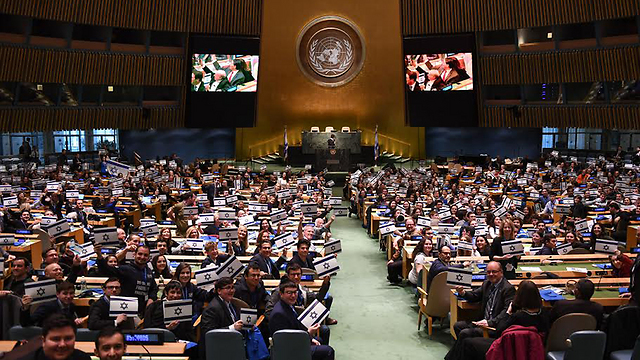
Anti-BDS conference at the UN (Photo: Shahar Azran)

Israel is gearing up to push back against a conference being hosted next week by the UN in the organization’s New York headquarters to mark what it describes as the “anniversary of the Israeli occupation.”

According to a report by the Ministry for Strategic Affairs, headed by Minister Gilad Erdan, several BDS and anti-Israel organizations will be taking part in the conference, which in the past has undertaken efforts to implement a series of hostile measures against Israeli officials.

These include, inter alia, issuing arrest warrants and prosecuting IDF officers and other officials for war crimes, openly calling for the boycotting of Israeli goods, promoting draft dodging in Israel and calling for Israelis to be tried in the International Criminal Court in The Hague for war crimes.

 The conference—titled “UN Forum to mark the 50th anniversary of the Israeli occupation”—is being organized by the UN Committee on Palestinian Rights, and will be held at the UN headquarters in New York from June 29-30.

Minister Erdan appealed to UN Secretary-General Antonio Guterres to prevent the conference from being held and to avoid UN funding for BDS events and UN entities whose sole purpose is to blacklist Israel.

“As Israel’s Minister of Strategic Affairs, responsible for leading Israel’s response to the international delegitimization and boycott (BDS) campaign against Israel, I write to you to protest in the strongest possible terms the use of UN funds and facilities to support an event aimed directly at promoting the delegitimization and boycott of Israel,” Erdan wrote to Guterres.

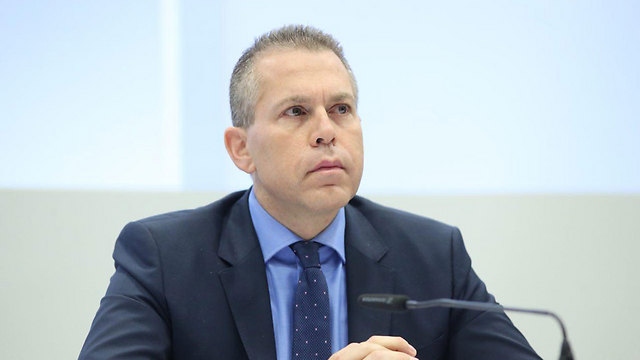
Gilad Erdan (Photo: Motti Kimchi) (Photo: Motti Kimchi)

Gilad Erdan (Photo: Motti Kimchi)

“Many of the organizations that will be given a platform by the UN at this event, including the American Friends Service Committee, Jewish Voice for Peace, Al-Haq, Al Mezan, Zochrot and others, are leaders of the anti-Israel BDS and legal warfare campaign,” he continued. “These organizations dedicate the majority of their energies to promoting economic, academic and cultural boycotts of Israel, attacking Israel in international legal and diplomatic forums, and delegitimizing Israel’s basic right to exist.

“Several have connections to designated terror groups while others publically glorify convicted terrorists.”

BDS protest

BDS protest

Erdan also sought to rally behind his cause the staunchly pro-Israel Republican senator Marco Rubio, whom he met earlier this month, discussing his fight against the efforts to delegitimize Israel and voicing his concern.

“I urge you to continue speaking out against the UN’s use of member states’ funds to promote the BDS campaign,” Erdan wrote after thanking Rubio for his “important initiatives for countering BDS,” as well as his “recent engagements with the UN Secretary-General” in his efforts to correct the “long-standing anti-Israel bias at the UN.”

In April, all 100 US senators signed a letter sent to Guterres urging him to act against discrimination against Israel in the United Nations.

(Translated & edited by Lior Mor)

King of Saudi Arabia overthrows heir to the throne

June 21, 2017

Saudi King Salman has ousted the heir to his throne, Prince Mohammed bin Nayef, and appointed his son Muhammad bin Salman as crown prince in his stead. The appointment was approved by the allegiance council with a majority of 31 votes out of 34.

Jun 21, 2017, 1:00PM Chelsea Mosery Birnbaum

Source: King of Saudi Arabia overthrows heir to the throne | JerusalemOnline

Saudi king ousts heir to the thrown Photo Credit: Reuters/ Channel 2 News

Saudi Arabia’s King Salman, 81, has named his son, Prince Mohammed bin Salman, first in line to the throne. The appointment was approved by Saudi Arabia’s allegiance council with a majority of 31 votes out of 34 members just after midnight on Wednesday.

Crown Prince Mohammed bin Salman will be replacing Prince Mohammed bin Nayef, the king’s nephew, who was in place to inherit the thrown and who has now been stripped of his influential position as interior minister.

Minister Tells Bloomberg Israeli-Saudi Back-Channel Relations to Become Official

June 21, 2017

Source: Minister Tells Bloomberg Israeli-Saudi Back-Channel Relations to Become OfficialThe Jewish Press | David Israel | 27 Sivan 5777 – June 21, 2017 | JewishPress.com

MK Ayoob Kara whispers in the ear of Prime Minister Benjamin Netanyahu at the Knesset, October 31, 2016.

On Tuesday night, Bloomberg reported the following:

“There’s a very good chance that we will soon have relations with what we call the Saudi coalition,” said Communications Minister Ayoob Kara, the Israeli cabinet’s only Arab member. “The Palestinian issue is No. 3 on the agenda today,” he said, behind security concerns about Iran and terrorism that Israel and Saudi Arabia have in common.

 There are very good reasons why this quote is questionable, not the least of which is that the Saudis and their Gulf neighbors don’t have to expose themselves to the scorn and wrath of a billion Arabs by recognizing the “Zionist entity” when they can get all the help and cooperation they need from said entity on the sly. And the “Palestinian issue” will never be demoted, at least officially, to third place, because it has to do with accepting the rule of an infidel over Haram land which used to be ruled by Muslims. It’s just not done.

Incidentally, there are two glaring errors in the Bloomberg paragraph above (had to get this off our chest): Ayoob Kara is not a cabinet minister, and he is not Arab. He is Druze (big difference in Israeli politics).

As to the actual message, namely that under the Iranian threat the Gulf States are willing to set aside their concerns about the Israeli-Palestinian issue, it could be more wishful thinking than thinking.

The Bloomberg story, Kushner Paves Way for Accelerated U.S. Push on Mideast Peace, suggests that the fact that President Trump this week sends two of his closest advisors, Jason Greenblatt and Jared Kushner, to the region, means that the White House is applying serious pressure on Prime Minister Netanyahu and Chairman Abbas into reviving their peace negotiations.

As Finance Minister Moshe Kahlon puts it in the Bloomberg story, Israel is feeling “mounting American pressure to advance a deal.” And Kahlon is a cabinet minister.

The same story says, “Saudi Arabia and its Gulf neighbors have indicated a willingness to upgrade unofficial ties with Israel, but veteran diplomats say that will depend on Israel’s willingness to withdraw from West Bank territory and commit to a Palestinian statehood, as spelled out in the 2002 Arab Peace Initiative.”

That’s generous. The actual plan, a.k.a. the “Saudi Initiative” (because it was originally floated by King Abdullah, who was still the crown prince of Saudi Arabia at the time), demands three fundamental concessions of Israel:

“Complete withdrawal from the occupied Arab territories, including the Syrian Golan Heights, to the 4 June 1967 line and the territories still occupied in southern Lebanon.

“Attain a just solution to the problem of Palestinian refugees to be agreed upon in accordance with the UN General Assembly Resolution No 194.

“Accept the establishment of an independent and sovereign Palestinian state on the Palestinian territories occupied since 4 June 1967 in the West Bank and Gaza Strip with East Jerusalem as its capital.”

In return for these three suicidal moves, the Arab states offered two pieces of paper:

“Consider the Arab–Israeli conflict over, sign a peace agreement with Israel, and achieve peace for all states in the region.

“Establish normal relations with Israel within the framework of this comprehensive peace.”

It’s interesting, by the way, that no one has inquired why the Arab states won’t reverse the process: first recognize Israel and consider the conflict finished, and then launch detailed negotiations over withdrawal, refugees, etc.

Dan Shapiro, Obama’s Ambassador to Israel, is one of the few voices that are cheering on the Kushner-Greenblatt visit this week. He is quoted by Bloomberg as suggesting that Kushner’s presence, after Trump has made the peace negotiations a centerpiece of his first foreign trip as president, “raises the stakes for everybody.”

Shapiro, who stayed in Israel after January 20 to join the Tel Aviv-based think tank Institute for National Security Studies, held a conference call with reporters on Monday, where he said, “It’s very difficult for any party in the region to say no” to Trump, unless “the [criminal] investigations drag on for a long period of time and there begin to be questions raised about the future of his administration, that will contribute to a lessening of his leverage.”

Which is probably why everybody, at this point, is reluctant to take serious steps toward reviving the negotiations: who knows whether Trump will survive his first year in office, never mind do it long enough for the ceremony in Stockholm where he would receive the Nobel Prize for Peace (a must these days for US presidents).

Also, as far as we’re concerned, Netanyahu should invite Minister Kara to join the cabinet – if only because he could translate those magnanimous Saudi offers from Arabic

ISIS Losing the Battle but Winning the War

June 21, 2017

by Giulio Meotti
June 21, 2017 at 5:00 am

Source: ISIS Losing the Battle but Winning the War

  • If ISIS is retreating in Mosul, it is rapidly advancing in Manchester. The Caliphate is winning its war in Europe. Six months ago in Britain, the rise of Jeremy Corbyn, the ultra-pacifist Labour party leader who blamed the “war on terror” for the recent attacks in Manchester and London, would have been unthinkable.
  • As the Caliphate razed to the ground everything in its path, Europe reacted as if that were just the result of regrettable manners that should not concern her. The Islamists, however, had other plans.
  • “Why, in August 2015, did ISIS need to blow up and destroy that temple of Baalshamin? Because it was a temple where pagans before Islam came to adore mendacious idols? No, it was because that monument was venerated by contemporary Westerners, whose culture includes an educated love for ‘historical monuments’ and a great curiosity for the beliefs of other people and other times. And Islamists want to show that Muslims have a culture that is different from ours, a culture that is unique to them”. — Paul Veyne, archeologist.

The Islamic State is crumbling — if too slowly. More than two years have passed since French President François Hollande promised, “We will bomb Raqqa“. Sooner or later, ISIS will probably be reduced to a small enclave with no territorial continuity, and its chief, Abu Bakr al Baghdadi, will be eliminated. It would, nevertheless, be most dangerous to dismiss these three years as a short parenthesis: Nazism did not last as long: “just” 12 years in power and five at war with the rest of Europe. The physical and cultural consequences of the Nazi tyranny are, unfortunately, still visible in Europe. The same will be said of the Islamic State. Three years of terror and conquests are not bad in for a war between the Caliphate vs. everyone else.

ISIS will leave behind an unprecedented terrorist infrastructure (277 Europeans killed on European soil in two years). If ISIS is retreating in Mosul, it is rapidly advancing in Manchester. The Caliphate is winning its war in Europe. Six months ago in the Britain, the rise of Jeremy Corbyn, the ultra-pacifist Labour party leader who blamed the “war on terror” for the recent attacks in Manchester and London, would have been unthinkable. His success is clearly linked to the recent bloodshed in British streets.

In the West, ISIS has assailed parliaments in Ottawa, cafés in Copenhagen, beaches in Nice, social centers in San Bernardino, metros and airports in Brussels, music festivals in Manchester, theaters, sports stadiums, restaurants and kosher markets in Paris, churches in Rouen, Christmas markets in Berlin, malls in Stockholm. Not bad for a “JV team“, as Barack Obama called the Caliphate.

ISIS has been an unparalleled attraction for the umma, the world community of the Islamic faithful: about 30,000 Muslims around the world — 6,000 from Europe — have left their homes to fight under the deadly black flag of the Caliph. ISIS was able to build a global network of terror. Jihadist groups such as Ansar Bayt al-Maqdis in Egypt, Abu Sayyaf in the Philippines, Ansar al-Sharia in Libya, Boko Haram in Nigeria, the Caucasus Emirate in Russia, and the Islamic Movement of Uzbekistan, along with others, have all pledged allegiance to ISIS. The Caliphate has also become the wealthiest terror group in history. Sebastian Gorka, a White House advisor on radical Islam, said: “The attacks of September 11, 2001, cost barely $500,000. ISIS makes that in six hours! Do you feel safe?”

ISIS has made evil viral. The world was stunned when ISIS submerged the Western imagination in the public executions of journalists, the massacres of captured troops, markets for sexual slavery, executions of gays, and public drownings, burning people alive and crucifixions. “Never before in history have terrorists had such easy access to the minds and eyeballs of millions”, wrote Brendan Koerner, noting that “ISIS is winning the social media war“. Often, evil works. A few weeks ago, in Paris, a Jewish woman, Sarah Halimi was killed by a Muslim shouting “Allahu Akbar”. The case was barely covered by the mainstream press. Then several French intellectuals demand the authorities to denounce it as a case of anti-Semitism. ISIS’s threats are now so intense that even academic experts of Islam, such as Gilles Kepel, are under police protection.

In a few months, the Islamic State cleared the historic colonial border of Sykes-Picot, conquered half of Syria, destroyed entire cities of prices antiquities such as Palmyra, reached the periphery of Baghdad, and kicked out the Iraqi army, in which the United States had invested 25 billion dollars. That is why many counter-terrorism analysts are intelligently asking if “ISIS is winning“.

ISIS’s main legacy, however, is devastation — both cultural and human. ISIS has been successful in making a blank slate, a sort of Islamic “year zero,” in which, after an apocalypse, history will start again — supposedly virgin and pure. The Caliphate will leave behind a Middle East more and more Islamic, not only in the landscape, but also in demography. ISIS swept away entire non-Muslim communities that will never return. Many Christian and Yazidi towns within its orbit will remain permanently empty due to the slaughter, the exile and the disappearance of survivors. The Islamic State has been able to destroy the ancient Christian community of Mosul.

A new study published in the weekly magazine Plos Medicine concluded that around 10,000 members of the ethnic and religious Yazidi minority were killed. The researchers estimated that 6,800 other Yazidis were kidnapped, with more than one third still missing.

Christianity in Iraq is over“, said Canon Andrew White, the great Anglican vicar of Baghdad. ISIS succeeded, for the first time in 2000 years, in cancelling Christian communion in Nineveh. Professor Amal Marogy, a native of Iraq, said, at a conference at the Hudson Institute, that while infrastructure such as the Mosul Dam can be saved from ISIS, the eradication of the Christian presence in Iraq means “the end of a peaceful civilization”. There are commentators who are now noting that “ISIS wins when Christians leave the Middle East“.

The jihadist recently vandalized ancient Roman statues and artifacts at the Syrian archaeological site of al-Salhiye, known as Dura Europos. ISIS devastated the most famous capitals of ancient Mesopotamia, from Nimrud to Hatra. “This destruction is unprecedented in recent history”, according to Marina Gabriel, coordinator of the American Schools of Oriental Research Cultural Heritage Initiatives, an institute that tracks the destruction of Islamic State.

The Nimrud ziggurat, built almost 2900 years ago — the most spectacular sacred structure known in ancient Mesopotamia — does not exist anymore. ISIS terrorists devastated the Mosul Public Library, where 10,000 manuscripts were burned or stolen. ISIS also managed to erase of the entire Jewish history of Mosul, including the tombs of Jonah, Seth and Daniel. The Caliphate destroyed the first Assyrian city, Khorsabad. The greatest devastation, however, took place in Palmyra, the most important archaeological jewel of the Middle East. Palmyra delenda est. The Islamic State also eliminated thousands of years of Syrian and Iraqi history, pulverizing exquisite ancient treasures such as the temple of Bal.

As the Caliphate razed to the ground everything in its path, Europe reacted as if that were just the result of regrettable manners that should not concern her. The Islamists, however, had other plans. Professor Paul Veyne writes in his book on Palmyra:

“Why, in August 2015, did ISIS need to blow up and destroy that temple of Baalshamin? Because it was a temple where pagans before Islam came to adore mendacious idols? No, it was because that monument was venerated by contemporary Westerners, whose culture includes an educated love for ‘historical monuments’ and a great curiosity for the beliefs of other people and other times. And Islamists want to show that Muslims have a culture that is different from ours, a culture that is unique to them. They blew up that temple in Palmyra and have pillaged several archaeological sites in the Near East to show that they are different from us and that they don’t respect what Western culture admires”.

That is why, after Palmyra, the Islamic State attacked music halls and other Western symbols in Europe. The “JV team” might be losing ground, but so far it is winning the war of civilizations. Will the West be able not only to free Raqqa and Mosul, but also to reverse this cultural avalanche trying to crush it?

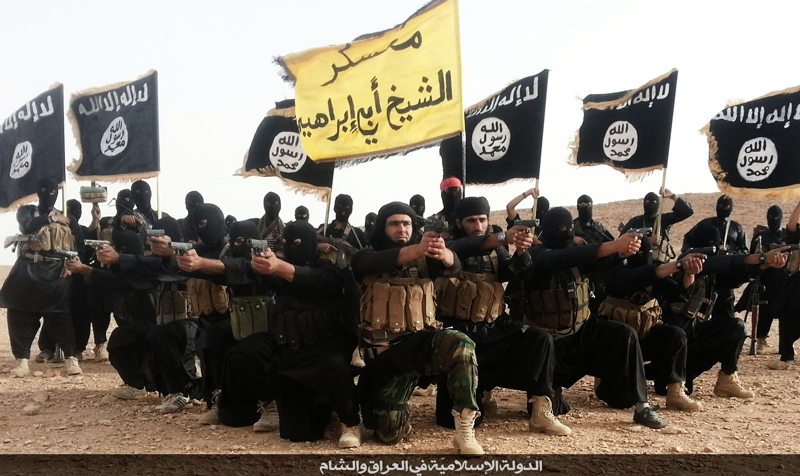
(Image source: Islamic State)

Giulio Meotti, Cultural Editor for Il Foglio, is an Italian journalist and author.

ISIS Setting Up Support Networks to Move Terrorists to Europe, Asia

June 21, 2017

Increased threat of terrorists infiltrating U.S.

BY:
June 21, 2017 5:00 am

Source: ISIS Setting Up Support Networks to Move Terrorists to Europe, Asia

The Islamic State is setting up networks to support the systematic movement of terrorists from the Middle East to Europe and Asia, according to U.S. defense officials.

“ISIS has several facilitators in place that assist the flow of fighters to Europe,” said one official who noted the group is exploiting travel networks used for large-scale human trafficking in the region. The networks include an organizational structure that has been discovered by U.S. and allied intelligence agencies to be using specific groups to help terrorists reach European soil. ISIS has assigned support personnel to the networks to facilitate the process.

No specific numbers were provided by the officials on ISIS fighters moving from strongholds in Syria and Iraq to Europe and Asia.

Many of the fighters, however, are returning nationals who joined ISIS several years ago where they received training and experience during Middle East conflicts. The fighters are regarded as hardened jihadists who will seek to infiltrate society and prepare for future attacks.

A second official said the use of human trafficking networks and refugees by ISIS has increased the danger that similar tactics will be used by the group to send fighters into the United States.

“Refugees from the Middle East could be exploited by ISIS to target the United States,” this official said.

The Trump administration is currently battling U.S. courts over President Trump’s executive order restricting travelers from entering the United States from six majority Muslim nations.

“There is always a possibility that a foreign fighter from a visa waiver country that has not been detected could return home to fly to the U.S. and conduct an attack,” the first official said.

“Our foreign fighter databases are good and information sharing is constantly improving but this scenario is plausible,” the official said. “Let’s not forget we have plenty of U.S. citizens that went to the so-called caliphate and the caliphate has over 100 nationalities on its bench.”

The threat was highlighted in Brussels Tuesday, where military security guards shot and killed a suspected terrorist who set off a small explosive device at a train station.

ISIS fighters also are moving in increasing numbers to Asia but it does not appear that ISIS is shifting its focus to Asia, the officials said.

“ISIS’s business model is to set up affiliates around the world they can leverage for worldwide attacks,” the first official said. “I think instead of shifting I would say attempting to expand with varying results.”

Asked about the overall ISIS threat to the United States and Europe, the officials said vehicle ramming attacks are increasing.

“The new tactic of renting or stealing large vehicles to ram in to crowded areas and ISIS’ own endorsement of these tactics present daunting challenges to intelligence and law enforcement officials,” the first official said. “We must work together to mitigate evolving threats.”

A report by the State Department’s Overseas Security Advisory Council noted that in the past six months, Islamic terrorists have conducted seven attacks in Germany, France, Sweden, and the United Kingdom, causing more than 50 deaths.

The danger is increasing, according to the June 7 report.

“The elevated Islamic extremist terrorist threat in Western Europe is expected to persist in 2017,” the report said.

“Some authorities assess that as ISIS continues to lose ground in Iraq and Syria, the group will focus on conducting attacks against the West in an attempt to maintain legitimacy among supporters,” the report added. “Operations and plotting may increase during times the group may consider symbolic or more permissive, such as holidays and busy travel months.”

The report said authorities in Europe have prevented a number of attacks since the beginning of the year. “The frequency and reach of terrorist activity affirms that the threat persists throughout the region,” it states.

The Islamic terror group is facing intense pressure from intelligence and law enforcement forces, according to the two officials with access to intelligence reports of the activities.

“The southeastern European region has been the gateway to Europe for foreign fighters wishing to travel west,” the first official said, adding that U.S. and allied nations are working hard to disrupt the logistics and support networks.

“This is especially reflected in ISIS’ rhetoric and propaganda—they are openly encouraging people to stay home and conduct knife and truck attacks,” the official added.

According to Interpol, over 4,000 human traffickers are operating in Europe and human trafficking within the continent is increasing.

Because of the ease of travel in Europe, “ISIS can leverage affordable modes of transportation to transverse Europe if they have documentation that will pass the scrutiny of border guards,” the official said.

A lack of coordination among European security services and porous borders that require minimal identification has boosted travel by ISIS fighters.

Army Gen. Curtis Scaparrotti, commander of the European Command, said in a speech last April that the battle against terrorism is difficult.

“This fight against terror and violent extremists will not be easy, nor will it be fast,” he said. “It is not a war of choice. It will take resources, determination, and resolve to see the end of terror in Europe.”

The European Command said the ISIS infiltration threat is a concern.

“To the south, we see a much more multi-faceted challenge of ungoverned spaces and unresponsive governments resulting in migrant flows of criminality, terrorism and foreign fighters in and out of these areas,” the command said in a statement.

“We are putting pressure on ISIL in many avenues,” the command said. “This is a long-term effort and not just a short-term challenge that we need to be thinking about. It will take a dedicated effort, not only from the air, but also on the ground to counter transnational threats.”

A key focus of the command is assessing threats to American forces and securing service members, civilians, family members, and facilities.

Meanwhile, the Pentagon announced on Tuesday that a key Islamic terror leader, Turki al Bin’ali, was killed in an airstrike in Syria May 31.

“Al Bin’ali had a central role in recruiting foreign terrorist fighters and provoking terrorist attacks around the world,” the Pentagon said in a statement.

“As chief cleric to ISIS since 2014, he provided propaganda to incite murder and other atrocities, attempted to legitimize the creation of the ‘caliphate,’ and was a close confidant of Abu Bakr al-Baghdadi.”

A Bahraini national, Bin’ali, 32, also used his propaganda writings and recorded lectures to attempt to “justify and encouraging the slaughter of innocents.”

The terrorist leader was active in recruiting ISIS fighters from Persian Gulf states to join the terror group in Syria. He also was involved in funding operations and giving propaganda lectures in Syria. He also sought to recruit rival al Qaeda terrorist leaders to join ISIS.

Saudi king upends royal succession, names son as 1st heir

June 21, 2017

Saudi king upends royal succession, names son as 1st heir, Fox News, Associated Press, June 21, 2017

(Please see also, IRGC Commanders: Our Main Aim Is Global Islamic Rule. Perhaps the IRGC statement of intentions was among the king’s reasons for making bin Salman the new crown prince. — DM)

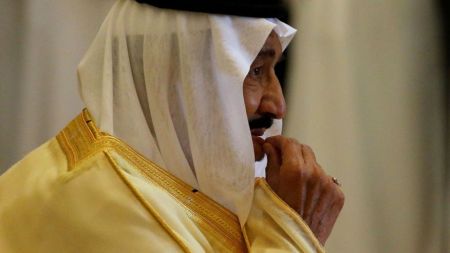
Saudi Arabia’s King Salman bin Abdulaziz Al Saud waits to greet President Trump in Riyadh (REUTERS)

In remarks aired on Saudi TV in May, Mohammed bin Salman framed the tensions with Iran in sectarian terms, saying it is Iran’s goal “to control the Islamic world” and to spread its Shiite doctrine. He also vowed to take “the battle” to Iran.

***************************

Saudi Arabia’s King Salman on Wednesday appointed his 31-year-old son Mohammed bin Salman as crown prince, placing him first-in-line to the throne and removing the country’s counterterrorism czar and a figure well-known to Washington from the line of succession.

In a series of royal decrees carried on the state-run Saudi Press Agency, the monarch stripped Prince Mohammed bin Nayef from his title as crown prince and from his powerful position as the country’s interior minister overseeing security.

The all-but-certain takeover of the throne by Mohammed bin Salman awards near absolute powers to a prince who has ruled out dialogue with rival Iran, has moved to isolate neighboring Qatar for its support of Islamist groups and who has led a devastating war in Yemen that has killed thousands of civilians.

The prince already oversees a vast portfolio as defense minister. He has become popular among some of Saudi Arabia’s majority young population for pushing reforms that have opened the deeply conservative country to entertainment and greater foreign investment as part of an effort to overhaul the economy.

He had previously been second-in-line to the throne as deputy crown prince, though royal watchers had long suspected his rise to power under his father’s reign might accelerate his ascension.

The young prince was little known to Saudis and outsiders before Salman became king in January 2015. He had previously been in charge of his father’s royal court when Salman was the crown prince.

The Saudi monarch, who holds near absolute powers, quickly awarded his son expansive powers to the surprise of many within the royal family who are more senior and more experienced than Mohammed bin Salman, also known by his initials MBS.

Meanwhile, Prince Abdulaziz bin Saud, 33, was named the new interior minister tasked with counterterrorism efforts and domestic security. His father is the governor of Saudi Arabia’s vast Eastern Province, home to much of the country’s oil wealth and most of its minority Shiites. The prince is also Mohammed bin Nayef’s nephew, and previously served as an adviser to the interior and defense ministries.

The royal decree issued Wednesday stated that “a majority” of senior royal members from the so-called Allegiance Council support the recasting of the line of succession. However, that vote of support appears to have been from a past gathering of the council two years ago when Mohammed bin Salman was named second-in-line to the throne, and Mohammed bin Nayef was named the king’s successor.

The Allegiance Council is a body made up of the sons and prominent grandsons of the founder of the Saudi state, the late King Abdul-Aziz, who vote to pick the king and crown prince from among themselves. The council does not appear to have met again before Wednesday’s sudden change.

Over the weekend, the king had issued a decree restructuring Saudi Arabia’s system for prosecutions that stripped Mohammed bin Nayef of longstanding powers overseeing criminal investigations, and instead ordered that a newly-named Office of Public Prosecution and prosecutor report directly to the monarch.

The prince had appeared to be slipping from public eye and was not believed to have played a significant role in Saudi and Emirati-led efforts to isolate Qatar for its support of Islamist groups and ties with Iran.

Instead, it was his nephew, Mohammed bin Salman, who embarked on major overseas visits, including a trip to the White House to meet President Donald Trump in March. That visit to Washington helped lay the foundation for Trump’s visit to Saudi Arabia in May, which marked the president’s first overseas visit and which was promoted heavily by the kingdom as proof of its weight in the region and wider Muslim world.

Saudi-U.S. relations had cooled under the Obama administration after Washington pursued a nuclear accord with Shiite-majority Iran that the Sunni-ruled kingdom strongly opposed.

The warm ties forged between Riyadh and Washington under the Trump administration may have helped accelerate Mohammed bin Salman’s ascension as crown prince.

Despite his ambitions, which include overhauling the economy to make it less reliant on oil, the prince has faced failures and criticism for the Saudi-led war in Yemen, which he oversees as defense minister.

The war, launched more than two years ago, has failed to dislodge Iranian-allied rebels known as Houthis from the capital, Sanaa, and has had devastating effects on the impoverished country. Rights groups say Saudi forces have killed scores of civilians and have called on the U.S., as well as the U.K. and France, to halt the sale of weapons to Saudi Arabia that could be used in the Yemen war.

The U.S. already is helping the Saudis with intelligence and logistical support for the bombing campaign in Yemen, and the Trump administration has signaled it could assist with greater intelligence support to counter Iranian influence there.

The newly-minted crown prince also raised eyebrows when he ruled out any chance of dialogue with Iran. In remarks aired on Saudi TV in May, Mohammed bin Salman framed the tensions with Iran in sectarian terms, saying it is Iran’s goal “to control the Islamic world” and to spread its Shiite doctrine. He also vowed to take “the battle” to Iran.

Iran and Saudi Arabia’s rivalry has played out in proxy wars across the region. They back opposite sides in the wars in Syria and Yemen and they support political rivals in Lebanon, Bahrain and Iraq. The conflicts have deepened Sunni-Shiite enmity between hard-liners on both sides.

Russian Su-27 warns off NATO F-16 trying to approach defense minister’s plane over Baltic

June 21, 2017

Source: Russian Su-27 warns off NATO F-16 trying to approach defense minister’s plane over Baltic (VIDEO) — RT News

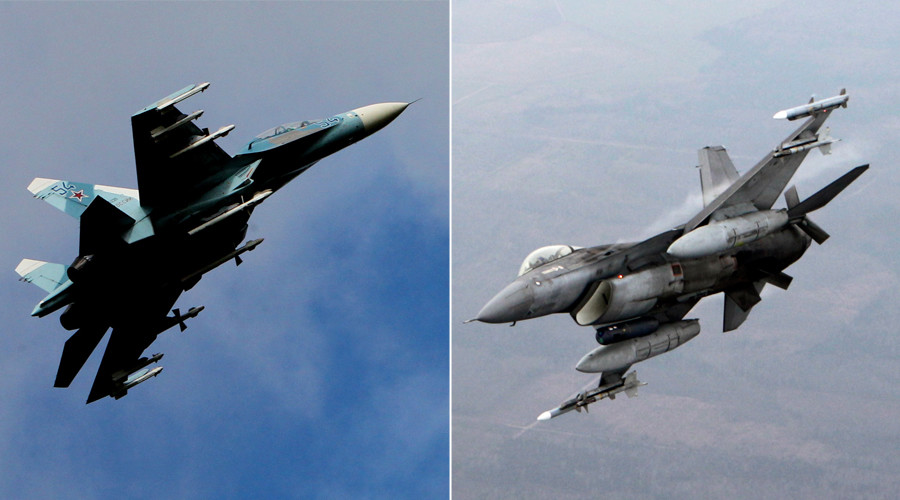
FILE PHOTO SU-27 and F-16 fighter jets © Sputnik / Reuters

A NATO F-16 fighter jet has tried to approach the Russian defense minister’s plane above the neutral waters of the Baltic Sea. The plane was warded off by a Russian Su-27 escorting the minister’s aircraft.

Russian plane was en route to the city of Kaliningrad, a western Russian exclave between Poland and Lithuania on the Baltic Sea, where Defense Minister Sergey Shoigu is scheduled to discuss security issues with defense officials on Wednesday.

The incident was first reported by journalists of Russian state news agencies on board Shoigu’s plane.

While one NATO aircraft tried to approach the Russian airplane, a Russian Su-27 fighter jet got in its way and tilted its wings, apparently showing its arms. The F-16 then flew away.

Read more

FILE PHOTO © A Russian Sukhoi SU-27 fighter jet. © Regis Duvignau

Kremlin spokesman Dmitry Peskov said that he has no information about the incident.

“It’s probably better to ask the Defense Ministry,” Peskov said in answer to journalists’ questions.

On Monday a US RC-135 spy plane flying toward the Russian border made a “provocative turn” toward a Baltic Fleet Su-27, which had been scrambled for an interception mission.

The encounters of Russian and US warplanes over the Baltic Sea waters have apparently become more frequent lately. A Russian fighter jet intercepted a small group of US warplanes, including Boeing KC-135 Stratotanker military refueling aircraft, two B-1 bombers and one B-52, during the BALTOPS (Baltic Operations) annual training exercise on June 10.

Earlier in June, the Russian military intercepted another B-52 bomber in the same area, and escorted by an Su-27 fighter away from Russian territory.