The Muslim Brotherhood-linked Hasm Movement claimed responsibility for a deadly terrorist attack targeting Egyptian security forces in Cairo on Sunday.
Its operatives detonated an “anti-vehicle explosive device” under a road “at the Maadi Autostrada south of Cairo… which led to the destruction of the military vehicle and the killing of two officers and the wounding of three other soldiers who still fighting death,” said a Hasm Movement statement released shortly after the attack and translated by the Investigative Project on Terrorism (IPT).
Intelligence collected by Egypt’s interior ministry suggests that the Muslim Brotherhood is establishing “terrorist entities,” including the Hasm Movement and others, to carry out attacks in an attempt to conceal the Brotherhood’s responsibility.
In May, Najah Ibrahim, a former leader of the terrorist organization Gamma’a Islamiya, revealed these terrorist offshoots consist of Muslim Brotherhood youth seeking to escalate violence against the Egyptian regime. Ibrahim told al-Hayat news that some Brotherhood leaders encouraged the terrorist groups to commit violence, according to an IPT translation.
Part of the terrorist group’s justification for Sunday’s attack alluded to Egypt’s controversial and impending transfer of two small islands in the Red Sea to Saudi Arabia.
“The continuation of the criminal coup [Egyptian] regime in selling the homeland, giving up its land and capabilities … obliges us to undertake more resistance activity to tear them off the chest of this helpless people,” the statement said.
Muslim Brotherhood figures continue to engage in violence incitement and encouraging others to conduct terrorist attacks.
In April, a senior Muslim Brotherhood member, ‘Izz Al-Din Dwedar, called for an “intifada” targeting Egyptian embassies around the world, in a Facebook post translated by The Middle East Media Research Institute (MEMRI).
In protest of death sentences handed to members of the Brotherhood in Egypt, Dwedar suggested for violent action on May 3.
Egyptians abroad should “protest [outside] Egyptian embassies and lay siege to them, and steadily escalate [their actions], up to and including raiding the embassies in some countries, disrupting their work and occupying them if possible, in order to raises awareness to our cause,” Dwedar wrote.
(The views expressed in this article are mine and do not necessarily reflect those of Warsclerotic or its other editors. — DM)
The present and future ownership of America, and indeed her existence, are in serious dispute. Our nation is more divided than ever in my thus far seventy-six years of life. That augurs well neither for our future as a nation nor for those of us who want our country back. Asking “Pretty please, Kind Masters, may we have our country back?” won’t help.
Robert Frost tried to read a poem he had written for JFK’s inauguration but was unable to do so. He had difficulties due to the bright sun and his age.
It was a cold and sunny day in 1961 and the 87 year old Frost could not read his poem,” Dedication”, that he wrote in honor of this special day for he was blinded by the bright sun. He fumpered on the podium because he could not see it and did not know it well. Richard Nixon came and held his top hat to block the sun for Mr.Frost who was extremely old and having problems. Instead, he recited from memory an oft requested poem, “The Gift Outright.”
I remember listening to Mr. Frost read The Gift Outright during an appearance at Yale, where I was an undergrad, back in 1959 or 196o. He had first recited it on December 5, 1941 — just two days before the Japanese attack on Pearl Harbor. He recites it in this video:
The land was ours before we were the land’s
She was our land more than a hundred years
Before we were her people. She was ours
In Massachusetts, in Virginia,
But we were England’s, still colonials,
Possessing what we still were unpossessed by,
Possessed by what we now no more possessed. Something we were withholding made us weak Until we found out that it was ourselves We were withholding from our land of living, And forthwith found salvation in surrender.
Such as we were we gave ourselves outright
(The deed of gift was many deeds of war)
To the land vaguely realizing westward,
But still unstoried, artless, unenhanced,
Such as she was, such as she will become. [Emphasis added.]
I wonder what Mr. Frost would think of America today. Is the land still ours? To whom do the sanctuary cities belong? Their lawful inhabitants or illegal immigrants? La Raza (The Race) wants us to cede parts of our land to Mexico. Who would care? How about the people who live there lawfully. What about the Islamic caliphate, long desired by adherents to the “Religion of Peace?” For practical purposes, much of Europe is now part of the Caliphate. Many Americans believe that we should follow Frau Merkel’s shining example of unlimited Islamic migration and achieve the same multicultural glory.
Are we still possessed by “our land of living”? I doubt that those who approve of sanctuary cities, unlimited illegal immigration, non-deportation of aliens unlawfully present in America and those who find Sharia law and America’s slow but accelerating Islamisation acceptable are possessed by the land. They have rejected her.
George Orwell said, “The most effective way to destroy people is to deny and obliterate their own understanding of their history.”
In the former Union of Soviet Socialist Republics, censorship, rewriting of history, and eliminating undesirable people became part of Soviets’ effort to ensure that the correct ideological and political spin was put on their history.
Deviation from official propaganda was punished by confinement in labor camps and execution.
Today there are efforts to rewrite history in the U.S., albeit the punishment is not so draconian as that in the Soviet Union.
New Orleans Mayor Mitch Landrieu had a Confederate Gen. Robert E. Lee monument removed last month. Former Memphis Mayor A.C. Wharton wanted the statue of Confederate Lt. Gen. Nathan Bedford Forrest, as well as the graves of Forrest and his wife, removed from the city park.
In Richmond, Virginia, there have been calls for the removal of the Monument Avenue statues of Confederate President Jefferson Davis and Gens. Robert E. Lee, Stonewall Jackson, and J.E.B. Stuart.
It’s not only Confederate statues that have come under attack. Just by having the name of a Confederate, such as J.E.B. Stuart High School in Falls Church, Virginia, brings up calls for a name change.
These history rewriters have enjoyed nearly total success in getting the Confederate flag removed from state capitol grounds and other public places.
Slavery is an undeniable fact of our history. The costly war fought to end it is also a part of the nation’s history. Neither will go away through cultural cleansing. [Emphasis added.]
Removing statues of Confederates and renaming buildings are just a small part of the true agenda of America’s leftists. [Emphasis added.]
Thomas Jefferson owned slaves, and there’s a monument that bears his name—the Thomas Jefferson Memorial in Washington, D.C. George Washington also owned slaves, and there’s a monument to him, as well—the Washington Monument in Washington.
Will the people who call for removal of statues in New Orleans and Richmond also call for the removal of the Washington, D.C., monuments honoring slaveholders Jefferson and Washington?
The Board of the Friends of Nash Farm Battlefield, Inc. is sad to announce that the museum, located on Nash Farm Battlefield, which was funded and maintained by our group, will close effective June 1, 2017. The main reason is that the current District 2 Commissioner, Dee Clemmons, has requested that ALL Confederate flags be removed from the museum, in addition to the gift shop, in an effort not to offend anyone. For anyone who studies the American Civil War, or War Between the States, they realize there were two parties that fought in this war. We have always prided ourselves with being an unbiased museum that told the entire story of the battles that took place on this property, as well as being a voice of the people in Henry County and Georgia during this time. These stories were told mainly through primary sources, sometimes secondary, but never tertiary sources. To exclude any Confederate flag would mean the historical value has been taken from our exhibits, and a fair interpretation could not be presented to each guest. Confederate flags were on this hallowed ground, as were the Union flags. To remove either of them would be a dishonor.
That’s just a bit of what’s been happening. Love it or hate it, it’s important to remember our history — as it was, not as today’s revisionists would like us to remember it.
The Civil War was deadly but generally fought with honor on both sides. I hope we do not have another. If it is a war between the left and right, I foresee little honor on the left.
America is a divided nation
Victor Davis Hanson, a scholar of classical history and a keen observer of current society, asks a good question in Can a Divided America Survive? The answer seems to be “probably not.”
The United States is currently the world’s oldest democracy.
But America is no more immune from collapse than were some of history’s most stable and impressive consensual governments. Fifth-century Athens, Republican Rome, Renaissance Florence and Venice, and many of the elected governments of early 20th-century Western European states eventually destroyed themselves, went bankrupt or were overrun by invaders.
The United States is dividing as rarely before. Half the country, mostly liberal America, is concentrated in 146 of the nation’s more than 3,000 counties — in an area that collectively represents less than 10 percent of the U.S. land mass. The other half, the conservative Red states of the interior of America, is geographically, culturally, economically, politically and socially at odds with Blue-state America, which resides mostly on the two coasts. [Emphasis added.]
The two Americas watch different news. They read very different books, listen to different music and watch different television shows. Increasingly, they now live lives according to two widely different traditions.
Barack Obama was elected president after compiling the most left-wing voting record in the U.S. Senate. His antidote, Donald Trump, was elected largely on the premise that traditional Republicans were hardly conservative.[Emphasis added.]
Red America and Blue America are spiraling into divisions approaching those of 1860, or of the nihilistic hippie/straight divide of 1968. [Emphasis added.]
Currently, some 27 percent of all Californians were not born in the United States. More than 40 million foreign-born immigrants currently reside in the U.S. — the highest number in the nation’s history.
Yet widely unchecked immigration comes at a time when the country has lost confidence in its prior successful adherence to melting-pot assimilation and integration. The ultimate result is a fragmenting of society into tribal cliques that vie for power, careers and influence on the basis of ethnic solidarity rather than shared Americanness. [Emphasis added.]
History is not very kind to multicultural chaos — as opposed to a multiracial society united by a single national culture. The fates of Rwanda, Iraq and the former Yugoslavia should remind us of our present disastrous trajectory. [Emphasis added.]
Either the United States will return to a shared single language and allegiance to a common and singular culture, or it will eventually descend into clannish violence. [Emphasis added.]
Based on Mr. Hanson’s analysis, the answer seems to be that unless America ceases to be as grossly divided as she now is, she will be displaced by something far worse. Indeed, it seems already to be happening. How about this bit of theater?
Members of the audience stood and cheered when the make-believe President Trump was knifed to death. Then, a Bernie Sanders supporter shot two Republican congressmen and a law enforcement officer at a baseball practice session in Alexandria Virginia. House Majority Whip Steve Scalise was nearly killed. Fortunately, his status has improved from “critical” to “serious,” and it now seems likely that after more surgery and months of rehabilitation he will be able to resume his congressional duties.
Does President Trump have anything to do with, or about, our current state of affairs?
Much of America’s current division and disharmony is wrongly blamed on President Trump. He has many opponents – the “deep state,” the Federal bureaucracy, Never Trumpers, many Democrats and the lamebrain media, the pro-Democrat bias of which is perhaps unprecedented. He needs to deal with them all, a truly Herculean task.
An article by Roger Kimball titled Trump vs, the Deep State offers some suggestions. Here is his conclusion, but please read the entire article:
The sociology of the Trump presidency—and the anti-Trump “resistance”—is an unwritten chapter in recent American history. As I say, I suspect it will have to be filed chiefly under “Snobbery, examples of,” but that’s as may be. This much I am convinced of: 1. Those who identify the “administrative state” (the “deep state,” etc.) as our chief political problem today are correct; 2. Donald Trump really is trying to unravel (“deconstruct,” “drain”) Leviathan; 3. The right-leaning anti-Trump campaign is so virulent because, even if unwittingly, it is itself part of the overweening bureaucrat dispensation that is the enemy of freedom; 4. Trump will survive to the extent that he is able to follow the example of his hero Andrew Jackson and challenge his challengers by pushing through his agenda undistracted from the yapping of the PC chihuahuas.
I see President Trump as potentially a primary force in restoring at least some semblance of American unity with honor.
Here is a poem I learned when in 11th or 12th grade English class. I have been unable to find it on any search engine, so here it is as I still remember it. I may well have forgotten parts of it. If anyone can supply a link and more of the text, I will be grateful.
An Aristocrat’s Prayer
If thou lovest, reason scatter.
If thou threatenest, make it matter.
If thou swearest, make it hot.
If thou hittest miss him not.
Doest thou argue, do it boldly.
Dost thou punish, do it coldly.
In forgiving hold not back.
And of feasting have no lack.
It is not politically correct, does not yearn for non-confrontation and is unlike anything of which our current establishment leaders would approve. In no way does it resemble “Pretty please, Kind Masters, may we have our country back?” President Trump is unlike members of the establishment; that is one of the reasons we elected him as well as one of the reasons the establishment despises him. He is bold, brash, willing to take strong stands and yet is able sincerely — not as a mere pretense — to forgive his enemies when they warrant it. Neither a Clinton, Bush, Romney nor any other establishment figure would have the potential, or the guts, to do as he does and must do.
U.S. pilots over Syria will defend themselves if attacked by Russians, a Pentagon spokesman said Monday, following a report that Russia will treat U.S. or coalition aircraft as targets if they fly over areas in western Syria controlled by Russia.
The Russian Defense Ministry made the threat Monday after a U.S. F/A-18E Super Hornet shot down a Syrian Su-22 after that plane bombed U.S.-backed Syrian Democratic Forces that are working with the U.S. to defeat the Islamic State on Sunday.
“Any aircraft, including planes and drones of the international coalition, detected in the operation areas west of the Euphrates River by the Russian air forces will be followed by Russian ground-based air defense and air defense aircraft as air targets,” the Defense Ministry said.
“We are aware of the Russian statements,” Navy Capt. Jeff Davis, a Pentagon spokesman, said Monday morning. “We do not seek conflict with any party in Syria other than ISIS, but we will not hesitate to defend ourselves or our partners if threatened,” Davis said.
A spokesman for the U.S.-led coalition said the Russian statement has had no effect on the operations in support of U.S.-backed Syrian fighters moving against ISIS in Raqqa in western Syria.
“Coalition aircraft continue to conduct operations throughout Syria, targeting ISIS forces and providing air support for coalition partner forces on the ground,” said Col. Ryan Dillon, chief U.S. military spokesman in Baghdad.
He also appeared to indicate the U.S. is avoiding the parts of Syria where Russia said U.S. planes would be tracked as potential targets or providing additional airpower to counter threats.
“As a result of recent encounters involving pro-Syrian regime and Russian forces, we have taken prudent measures to reposition aircraft over Syria so as to continue targeting ISIS forces while ensuring the safety of our aircrews given known threats in the battlespace,” Dillon said.
The statement was meant as a warning, said Viktor Ozerov, a member of the Russian parliament, described the Defense Ministry’s statement as a warning.
“I’m sure that because of this neither the U.S. nor anyone else will take any actions to threaten our aircraft,” he said, according to state-owned RIA Novosti news agency. “That’s why there’s no threat of direct confrontation between Russia and American aircraft.”
Russia, beyond making the threat to treat U.S. or coalition aircraft as targets, also said its “deconfliction” line with the U.S. has been shut down. The line was established so U.S. and Russian forces could avoid bombing each other as they fight ISIS.
Both Davis and Dillon insisted the hotline remains the best way to avoid future shoot-downs.
“The coalition is always available to de-conflict with the Russians to ensure the safety of coalition aircrews and operations,” Davis said. “The de-confliction line has proven effective at mitigating strategic miscalculations and de-escalating tense situations.”
Said Dillon: “We used the de-confliction line yesterday and remain open to using it. It has proven its worth in the past to tap down tensions.”
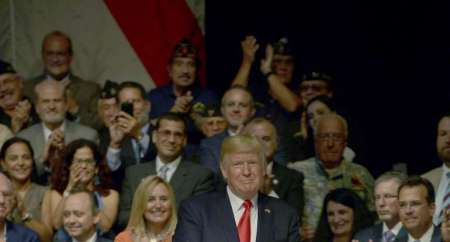
President Donald Trump speaks in the Little Havana neighborhood of Miami, Florida, on June 15, 2017, about re-instituting some of the restrictions on travel to Cuba and U.S. business dealings with entities tied to the Cuban military and intelligence services. (Photo by JL) (Sipa via AP Images)
The sociology of the Trump presidency—and the anti-Trump “resistance”—is an unwritten chapter in recent American history. As I say, I suspect it will have to be filed chiefly under “Snobbery, examples of,” but that’s as may be. This much I am convinced of: 1. Those who identify the “administrative state” (the “deep state,” etc.) as our chief political problem today are correct; 2. Donald Trump really is trying to unravel (“deconstruct,” “drain”) Leviathan; 3. The right-leaning anti-Trump campaign is so virulent because, even if unwittingly, it is itself part of the overweening bureaucrat dispensation that is the enemy of freedom; 4. Trump will survive to the extent that he is able to follow the example of his hero Andrew Jackson and challenge his challengers by pushing through his agenda undistracted from the yapping of the PC chihuahuas.
**********************************
With his typical panache, Frank Buckley asks the central political question of our time and hints at an answer with an original suggestion for remediation. The question is what to do about the “administrative state,” a.k.a., the regulatory state, the “deep state,” that Leviathan that Steve Bannon, President Trump’s chief strategist, has said he came to Washington to “deconstruct.”
As Buckley points out, that laudable goal is hedged around with difficulties, partly because the meddling class has built up such a formidably complex hive of extra-constitutional rules and regulations, partly because the populace has been supine for so long that strategies for effective rejoinder seem utopian at best. What, really, can one do about the proliferation of “guidance,” of the statute-like interference in the conduct of business or, indeed, of everyday life?
The Kafkaesque bureaucracy stymies ordinary people at every turn as it pursues its two overriding goals: the perfection of a “progressive,” i.e., socialist agenda and—just as important—the consolidation of its own power and perquisites.
What to do? The courts can only do so much without themselves falling prey to the molasses-like blandishments of the administrative state. Effective responses seem to be few and far between.
One model, Buckley notes, was provided by Andrew Jackson who, disgusted by the encroaching sclerosis and corruption of the bureaucracy he inherited, instituted a “spoils system.” He fired 10 percent of the federal workforce and replaced it with people of his own choosing. “Was that so bad?” Buckley asks, indulging in what Latinists refer to as a “Num” question: one expecting the answer no. As Buckley notes, even so partisan a liberal as Arthur M. Schlesinger, Jr., lulled perhaps by the historical distance of Jackson from our own time, thought that it was a positive development that helped to restore the people’s faith in government.
Donald Trump has himself said that he would like to cut the federal workforce by 10 percent and has outlined many other cost-saving and, more to the point, bureaucracy-cutting measures. Why are these efforts, many of which have already begun to bear fruit, not universally applauded, at least among conservatives?
I do not know the answer to that question. But it is certainly the case that Trump’s efforts are not universally applauded among conservatives. Buckley quotes a curious tweet emitted by my friend Bill Kristol, former editor of The Weekly Standard and a paid-up member of the ever Never Trump brigade: “obviously strongly prefer normal democratic and constitutional politics. But if it comes to it, prefer the deep state to the Trump state.”
What I find so curious about this tweet is the phrase “Trump state.” What is it? What horror does Bill envision that would lead him to prefer what Donald Trump has on offer to the “deep state”?
Ever since Trump was nominated, I suspected that he was going to govern as a far more conventional figure than some of his campaign rhetoric might have suggested. And so it has turned out to be. Sure, he continues to broadcast eyebrow-raising tweets and make provocative statements, but look at what he has actually done:
Nominated, and had confirmed, Neil Gorsuch to the Supreme court.
Nominated a score of federal judges whose impeccable conservative credentials should be balm to conservatives like Bill Kristol.
Changed the rules of engagement in hot spots like Syria and Afghanistan so that commanders on the ground, not Washington weenies, make decisions about appropriate military responses.
Outlined an ambitious tax plan that would slash taxes across the board.
Worked diligently to unravel the monstrosity of Obamacare.
Undertaken on his first foreign trip a robust articulation of his “America First,” anti-terrorist policy, all while demonstrating what progress in the Middle East might look like by flying, for the first time, directly from Saudi Arabia to Israel.
Made it possible for entrepreneurs to exploit America’s enormous energy-producing potential by scraping the prohibitions on coal mining, opening up the Keystone and Dakota pipelines, etc. etc.
Reduced illegal immigration by more than 70 percent just by being president.
Released a budget that makes meaningful cuts in federal programs.
Etc., etc., etc.,
Now, Bill Kristol knows all of this. So why does he speak of the “Trump state”? How does it differ from the “normal democratic and constitutional politics” he says he prefers?
I suspect, but do know know for sure, that the issue is largely aesthetic—what in an earlier time might have been called “snobbery.” Bill does not like where Donald Trump hails from. I don’t means Queens, NY, but rather the unschooled precincts of the spirit that people without the right credentials inhabit by definition. There are objective correlatives—a certain taste in ties, in victuals, even in feminine pulchritude—but it all boils down to a matter of style in the most comprehensive sense. Bill Kristol, scion of one of the most accomplished conservative intellectual couples of the last century, has it. Donald Trump does not. Bill is Harvard, not just because he went there, but because of the intellectual manners, the habitus, he internalized.
The sociology of the Trump presidency—and the anti-Trump “resistance”—is an unwritten chapter in recent American history. As I say, I suspect it will have to be filed chiefly under “Snobbery, examples of,” but that’s as may be. This much I am convinced of: 1. Those who identify the “administrative state” (the “deep state,” etc.) as our chief political problem today are correct; 2. Donald Trump really is trying to unravel (“deconstruct,” “drain”) Leviathan; 3. The right-leaning anti-Trump campaign is so virulent because, even if unwittingly, it is itself part of the overweening bureaucrat dispensation that is the enemy of freedom; 4. Trump will survive to the extent that he is able to follow the example of his hero Andrew Jackson and challenge his challengers by pushing through his agenda undistracted from the yapping of the PC chihuahuas.
(Using the Iranian Revolutionary Guard’s military power to advance the Iranian version of the “Religion of Peace” might seem strange to westerners, but earlier Islamic caliphates were established in much the same way. — DM)
In recent statements and speeches, Islamic Revolutionary Guards Corps (IRGC) commanders have emphasized that the Islamic Revolution in Iran is only the first stage on the path to the spread of the rule of Shi’ite Islam in the Middle East and worldwide, and that the mission of advancing the Islamic Revolution to these heights falls to the IRGC commanders.
The commanders reiterated the argument that the U.S., the leader of the “world of arrogance,” opposes Islam, and thus also Iran, which is, they say, the standard-bearer of the Revolution and its global vision. The U.S., they added, is acting to sabotage the plan to institute Islam worldwide, and is doing so by infiltrating the circles of decision-makers in Iran in order to impregnate them with Western cultural values and spark internal disputes among the Muslims. This is aimed at changing the direction of the Revolution and diverting it from its path. However, the robustness of the Revolution remains, they said, thanks to Iranian Supreme Leader ‘Ali Khamenei and the IRGC.
The following are translations of recent statements by senior IRGC commanders on this matter:
IRGC Commander Ja’fari: “We Are On The Path That Leads To The Rule Of Islam Worldwide”
On March 11, 2017, IRGC commander Ali Ja’fari said of the worldwide Islamic regime: “The history of Iran is replete with agreement on the Rule of the Jurisprudent [velayat ] which has [already] crossed Iran’s borders, and the united Islamic nation is being formed… We are on the path that leads to the rule of Islam worldwide.”[1]
On March 15, 2017, Ja’fari added on the same subject: “The Islamic Revolution is aimed at creating an infrastructure of the religion of God on earth, and it will wait for no man on its path advancement. All [Iranian] officials must adapt to the accelerated progress of the Revolution.
“The Islamic Revolution is now in its third stage – that is, [the stage] of assembling the Islamic government, and with God’s help it will pass this stage successfully despite the ups and downs that constantly occur.
“As IRGC commander, and as one of the commanders during the era of the Sacred Defense [i.e. the 1980-88 Iran-Iraq war], I believe that today the young people’s yearning to unconditionally defend the Revolution has expanded greatly relative to the era of the Sacred Defense. Their repeated requests to play a role alongside the defenders of the holy places indicate this.
“The religious seminaries and the IRGC bear the joint mission to advance and deepen the Islamic Revolution. This is God’s promise for the salvation of humanity, and we are charged with it. The senior revolutionary clerics and the IRGC will without a doubt actualize God’s promises, while implementing a comprehensive plan of the Islamic Revolution for shaping the picture of the Islamic world.
“Our internal spiritual and material potential for creating [such a global regime], and the robustness of the [Iranian] regime, which constitutes the main nucleus of this plan, are expanding in might. According to the words of [Ayatollah Ruhollah] Khomeini, if the revolution and the regime stop on the path, this will cause damage to Islam.”[2]
On April 30, 2017, at a teachers’ conference, Ja’fari said: “Some [people] have a flawed perception of the Islamic Revolution, for they think that its aim was only to defeat the regime of the Shah and to establish the Islamic regime [in Iran]. [But] if we look at the words of the Imam [Khomeini], we will discover a correspondence between the Islamic Revolution and the spread of the religion of Islam. In order to build the Islamic regime, there is no other path but to advance the Islamic Revolution… As the Imam said: If this Islamic regime is defeated, Islam is defeated.
“The framework of our activity is the Islamic Revolution, and first we must know what its aims are… The external dimension of the Revolution is based on the principle of Islam [as] derived from the lesson of the Ashura. This is in effect the principle of enmity towards evil and enmity towards the arrogance [the West, led by the U.S.]. This is actualized by means of the Islamic awakening against evil, and it is waged in the best possible way thanks to the Leader [Khamenei], who is its standard-bearer.”[3]
Supreme Leader’s Representative In The IRGC Saeedi: “The Islamic Revolution Is The Prelude To Islam Becoming Global”
Similar statements were made on March 15, 2017, by Ali Saeedi, Supreme Leader Khamenei’s representative in the IRGC: “There is no doubt that the Islamic Revolution is a prelude to Islam becoming global. Therefore, the Revolution must be strengthened in the best possible way, in order to create the framework for the revelation of God’s promise.”[4]
Deputy Qods Deputy Force Commander Esmail Qaani: “The Main Aim Is Global Rule”
On March 1, 2017, IRGC Qods Force deputy commander Esmail Qaani said: “Without a doubt, our martyrs and those of the dear ones like you Fatimiyyoun[5] will not settle for less than the global rule of the Imam Mahdi. Our martyrs inaugurated a great path. Syria and Aleppo are the temporary aims, and the main aim is global rule, which I hope is not far off.”[6]
IRGC Navy Commander Fadavi: “Today We Are Fighting Not At Home But Thousands Of Kilometers Beyond [Our] Borders”
IRGC Navy commander Ali Fadavi said on March 3, 2017: “Today, the thinking of the Islamic Revolution has expanded. Today, we are fighting not at home, but thousands of kilometers beyond [our] borders. Although our equipment does not compare to that of the enemy, with the blessing of faith in God and the martyrdom-seeking spirit, the enemies will fear us.”[7]
Prime Minister Benjamin Netanyahu leads a weekly Likud party faciton meeting at the Knesset in Jerusalem on June 19, 2017. (Yonatan Sindel/Flash90)
Prime Minister Benjamin Netanyahu warned Iran not to threaten Israel and to watch its own back Monday, hours after Tehran launched missiles into Syria in what was seen as a challenge to Israel.
“I have one message for Iran: Don’t threaten Israel,” Netanyahu said.
On Monday, Iran said it fired missiles against the Islamic State in eastern Syria in response to a terror attack carried by the group in Tehran, in which 12 people were killed.
Netanyahu said Israeli forces were “constantly tracking … the activities of Iran in the region.”
Israeli concerns about Iran in Syria have mostly centered around Tehran exploiting unrest in the country to set up a base to attack Israel, as well as transferring missile systems and other advanced arms to the Lebanon-based Hezbollah terror group.
“We are watching their actions and watching their words,” Netanyahu added.
Iran’s powerful Revolutionary Guard, a paramilitary force in charge of the country’s missile program, said it launched six Zolfaghar ballistic missiles from the western provinces of Kermanshah and Kurdistan. State television footage showed the missiles on truck missile launchers in the daylight before being launched at night.
Iran launches a ballistic missile at Islamic State targets in eastern Syria on June 18, 2017. (Islamic Revolutionary Guard Corps)
While the Iranian missile attack struck a blow to the Islamic State in particular, the strike was seen as a threatening message to other enemies.
“The Saudis and Americans are especially receivers of this message,” Gen. Ramazan Sharif of Iran’s Revolutionary Guard told state television in a telephone interview. “Obviously and clearly, some reactionary countries of the region, especially Saudi Arabia, had announced that they are trying to bring insecurity into Iran.”
However, speaking at his Yisrael Beytenu faction meeting on Monday, Defense Minister Avigdor Liberman said Israel was not concerned by Iran’s missile strike.
Yisrael Beytenu leader and Defense Minister Avigdor Liberman leads a faction meeting in the Knesset, May 8, 2017. (Miriam Alster/FLASH90)
“Israel is not worried — Israel is prepared for every development. And we are prepared, we have no concerns or worries,” Liberman said.
The missile attack was the first by Iran outside its own territory in nearly 30 years, since the Iran-Iraq war of 1980-88.
General Amir Ali Hajizadeh, who heads the Revolutionary Guards’ aerospace wing, told state television: “The missiles were fired from Iran and they passed over Iraq and landed in Syria.”
Hajizadeh boasted that “firing these missiles from 600 or 700 kilometers away onto a small building… demonstrates Iran’s capacity and intelligence capabilities” against jihadist groups
The US Senate has decided almost unanimously to sanction Iran for its nuclear activities and human rights record in a move that suggests a new, unified and stronger stand against Tehran.
A ballistic missile is launched and tested in an undisclosed location, Iran, March 9, 2016. . (photo credit:REUTERS)
The Senate’s near-unanimous decision on Thursday to sanction Iran for its human rights record, its ballistic missile work and its funding of militant organizations worldwide marks a new phase in congressional policy toward the nation just two years after a nuclear deal with its government bitterly divided Capitol Hill.
Those who opposed the 2015 accord feared it would secure Iran as a nuclear threshold state, providing Tehran with all the strategic benefits of a nuclear power without encumbering it with the costs that come with building the weapon itself. “Threshold” status would embolden the Iranians, Republicans argued, and would aggravate the problems they have wrought across the Middle East.
Yet Democrats said that Iran’s “destabilizing activities” could still be punished under the nuclear accord– that the Joint Comprehensive Plan of Action dealt exclusively with the nuclear issue, and that Congress was free to offset some of its adverse effects with measures that would combat Tehran’s regional ambitions. To the extent that Iran’s actions require “non-nuclear” sanctions, Senate Democrats said they would be prepared to act.
Those positions aligned Democrats and Republicans on a path forward, and the Countering Iran’s Destabilizing Activities Act of 2017 is the beginning of that path: 98 out of 100 senators voted in favor of the legislation, which now moves to the House for consideration.
Democrats who supported the bill were no longer held back by an administration protective of the nuclear deal and interested in rapprochement with Iran: Barack Obama’s former secretary of state, John Kerry– who negotiated the JCPOA– lobbied against the legislation on Twitter to no avail. US President Donald Trump has not yet commented on the bill and has ordered a State Department review of policy toward Iran and the nuclear accord.
Whatever those studies conclude, the congressional landscape on Iran appears to be reverting back to a pre-JCPOA era, when Democrats and Republicans often unified against Iran and resorted to sanctions tools to express it. The consensus strategy is to uphold the agreement in the short-term, countering Iran in “non-nuclear” spheres.
“There will be economic, diplomatic and material consequences for their aggression toward US interests, values and allies,” said Ben Cardin, ranking member of the Foreign Relations Committee and a top Democratic senator who opposed the nuclear deal.
The new bill would impose mandatory ballistic missile sanctions, target Iran’s Islamic Revolutionary Guard Corps (IRGC) and implement a new arms embargo.
“Iran is still the largest state sponsor of terrorism in the world. They are supporting groups that have toppled pro-Western governments throughout the Middle East, they have humiliated and unlawfully imprisoned American sailors on the high seas, and they continuously and flagrantly violate UN restrictions on their missile program,” said Senator Lindsey Graham, Republican of South Carolina. “These new sanctions will be a strong statement by the Congress and the Trump administration– that business as usual with Iran is over.”
On Monday morning, Russia’s Defense Ministry announced that planes from the U.S.-led coalition in Syria will be treated as hostile targets west of the Euphrates River. The announcement was made in response to the U.S. downing of a Syrian warplane on Sunday.
The Syrian plane was shot down by a U.S. Navy F/A-18E Super Hornet fighter after it dropped bombs near positions held by the Kurdish-led Syrian Democratic Forces, a major American ally in Syria. The SDF reported a number of its troops were injured by a ground attack from forces loyal to the regime of Bashar Assad, and it was forced to fall back from the town of Ja’Din, a town west of the Islamic State capital of Raqqa.
The SDF reported coming under attack from the Syrian regime’s Su-22 warplane after it was pushed out of Ja’Din. The U.S.-led coalition announced that it shot down the Syrian plane “in accordance with rules of engagement and in collective self-defense of coalition-partnered forces.”
“The demonstrated hostile intent and actions of pro-regime forces toward coalition and partner forces in Syria conducting legitimate counter-ISIS operations will not be tolerated,” the coalition stated.
According to the U.S. military, the pilot of the Syrian plane was able to eject.
“The attack stresses coordination between the US and ISIS, and it reveals the evil intentions of the US in administering terrorism and investing it to pass the US-Zionist project in the region,” the Syrian government responded.
The Washington Post notes it was the first American downing of a Syrian jet since U.S. forces entered Syria’s civil war in 2014, the first time a U.S. plane brought down a manned hostile aircraft in over a decade, and the fourth time in a month the U.S. military has been obliged to fire on pro-regime forces.
The Post reports that U.S. commanders used a special “deconfliction channel” to contact Russia before firing on the Syrian plane, in an effort to prevent the situation from escalating, and also conducted a “show of force” to warn Syrian forces away before resorting to live fire.
Despite these measures, Russia declared the American action illegal on Monday.
“Repeated combat actions by U.S. aviation under the cover of counterterrorism against lawful armed forces of a country that is a member of the U.N. are a massive violation of international law and de facto a military aggression against the Syrian Arab Republic,” said the Russian Defense Ministry.
Russia warned that planes from the U.S.-led coalition will be “tracked by the Russian ground and air anti-aircraft defense systems as air targets in the areas where Russian aviation is on combat missions in the Syrian sky.” The threat came up just short of promising to fire on those targets.
The Russians claimed the U.S. did not use the de-confliction hotline to warn them before shooting down the Syrian jet, and said Russian planes operating in the area could have been jeopardized. According to the Russian Defense Ministry’s statement, it will no longer participate in the de-confliction hotline.
The Associated Press notes that it made the same threat after the U.S. missile attack on a Syrian airbase in April, which would raise the question of whether anyone on Russia’s end picked up the phone, literally or figuratively speaking, when the U.S. used the de-confliction system on Sunday.
On Monday, the Syrian Democratic Forces said they will retaliate against any further attack from the Assad regime or its allies.
“The regime’s forces have mounted large-scale attacks using planes, artillery, and tanks since June 17,” an SDF spokesman said, as quoted by Reuters. “If the regime continues attacking our positions in Raqqa province, we will be forced to retaliate… and defend our forces.”
Reuters notes that the Syrian government has previously suggested it would focus its efforts on other parts of Raqqa during the drive to liberate it from the Islamic State, so the attack on SDF forces appears to mark a change in policy. SDF units have reportedly liberated four districts of the city from ISIS and is fighting over another three, so the Syrian attack may have been meant to stall out the SDF offensive and prevent the Kurdish-led coalition from controlling a large portion of the city.
The United States remains the world’s sole superpower. Realistic in our appraisal of national interests and prudent in their pursuit, our adversaries must never doubt our resolve.
****************************
On Sunday, an F-18 fighter jet (almost certainly from the Mediterranean-deployed USS George H.W. Bush carrier strike group), downed a Syrian Air Force Su-22 fighter jet.
It was the right decision for both tactical and strategic reasons.
For a start, the Syrian jet was bombing United States allies (the Kurdish-dominated Syrian Democratic Forces) on the ground. It was warned, but did not retreat.
Yet it’s not just relevant who the Syrians were bombing, it’s also important where they were doing so. Because the Su-22 was striking targets in north-central Syria, proximate to the Islamic State capital, Raqqa, and a town and dam, Taqba.
That locale matters for two reasons.
First, because the Syrian axis (Bashar Assad, Russia, Iran, the Lebanese Hezbollah, and other associated Shiite militias) are determined to displace U.S./allied forces from that area. The Assad axis recognizes that if it secures Taqba, it can push east of the Euphrates river and degrade anti-regime forces operating there with U.S. protection. As I’ve explained, this area of northern Syria is crucial for the future of the Syrian civil war.
Second, had the U.S. allowed axis forces to displace Kurdish forces from the area, the axis would have been able to disrupt the operation to retake Raqqa from the Islamic State. While the axis argue that they support the U.S.-led effort to defeat the Islamic State, the reality is different.
After all, the axis have vested interests in allowing the Islamic State to survive in some form. While the Islamic State is indeed their enemy, its existence allows the axis to pretend that the choice in Syria is between Assad, and the Islamic State and al Qaeda. Russia, especially, uses this narrative to delegitimate and attack more-moderate U.S.-supported Syrian rebel groups. Ever notice that the Russians always claim they are bombing “terrorists” in Syria? The Islamic State gives them that excuse.
Absent the threat of the Islamic State, the axis powers know that the world would view the Syrian regime much more harshly. Absent international jihadist groups in Syria, the regime would no longer be able to claim “we’re the best of a bad bunch.”
Still, there’s a broader issue at stake here.
This latest axis push against U.S. interests is just the tip of the iceberg. As I noted recently, the axis is also threatening a major U.S. base in south-eastern Syria. Collectively, these efforts are designed to test the Trump administration’s commitment to U.S. interests in Syria. Put simply, by escalating their threat against the U.S., and by dangling the prospect of future U.S. casualties, the Assad axis wishes for the Trump administration to back away from its resistance to Assad’s regime. They believe that, as was the case with President Barack Obama’s red lines, the U.S. can ultimately be compelled to yield.
For that reason, the U.S. response on Sunday was the right one.
A two-person U.S. aircrew in an advanced multirole fighter met a Soviet-era aircraft and outmatched it.
The United States remains the world’s sole superpower. Realistic in our appraisal of national interests and prudent in their pursuit, our adversaries must never doubt our resolve.






 anneinpt
 artaxes
 danmillerinpanama
 davidking1530
 Peter Hofman
 Joseph Wouk
 Peter
Peter Louisiana Steve
 WarSclerotic
Recent Comments