US President Donald Trump arrives in Saudi Arabia, Abbtakk News via YouTube, May 20, 2017
 What a difference an election makes
US President Donald Trump arrives in Saudi Arabia, Abbtakk News via YouTube, May 20, 2017
What a difference an election makes
by Alan M. Dershowitz
May 19, 2017 at 3:00 pm
Source: Who Will Stand up for Civil Liberties?
At a moment in history when the ACLU is quickly becoming a partisan left wing advocacy group that cares more about getting President Trump than protecting due process (see my recent op-ed in the Wall Street Journal,) who is standing up for civil liberties?
The short answer is no one. Not the Democrats, who see an opportunity to reap partisan benefit from the appointment of a special counsel to investigate any ties between the Trump campaign/ administration and Russia. Not Republican elected officials who view the appointment as giving them cover. Certainly not the media who are revelling in 24/7 “bombshells.” Not even the White House, which is too busy denying everything to focus on “legal technicalities” that may sound like “guilty man arguments.” Legal technicalities are of course the difference between the rule of law and the iron fist of tyranny. Civil liberties protect us all. As H.L. Mencken used to say: “The trouble about fighting for human freedom is that you have to spend much of your life defending sons of bitches: for oppressive laws are always aimed at them originally, and oppression must be stopped in the beginning if it is to be stopped at all.” History demonstrates that the first casualty of hyper-partisan politics is often civil liberties.
Consider the appointment of the special counsel to investigate “any links and/or coordination between the Russian government and individuals associated with the campaign of President Donald Trump.” Even if there were such direct links that would not constitute a crime under current federal law. Maybe it should, but prosecutors have no right to investigate matters that should be criminal but are not.
This investigation will be conducted in secret behind closed doors; witnesses will be denied the right to have counsel present during grand jury questioning; they will have no right to offer exculpatory testimony or evidence to the grand jury; inculpatory hearsay evidence will be presented and considered by the grand jury; there will be no presumption of innocence; no requirement of proof beyond a reasonable doubt, only proof sufficient to establish the minimal standard of probable cause. The prosecutor alone will tell the jury what the law is and why they should indict; and the grand jury will do his bidding. As lawyers quip: they will indict a ham sandwich if the prosecutor tells them to. This sounds more like Star Chamber injustice than American justice.
And there is nothing in the constitution that mandates such a kangaroo proceeding. All the Fifth Amendment says is: “no person shall be held to answer for a capital, or otherwise infamous crime, unless on a presentment or indictment of a Grand Jury.” The denials of due process come from prosecutorially advocated legislative actions. The founding fathers would be turning over in their graves if they saw what they intended as a shield to protect defendants, turned into a rusty sword designed to place the heavy thumb of the law on the prosecution side of the scale.
Advocates of the current grand jury system correctly point out that a grand jury indictment is not a conviction. The defendant has the right to a fair jury trial, with
all the safeguards provided in the constitution. But this ignores the real impact of an indictment on the defendant. Based on a one-sided indictment alone, the “ham sandwich” can be fired from his or her job or suspended from university. Consider what happened to the Arthur Andersen company and its thousands of employees when it was indicted for obstructing an official proceeding by destroying records relating to one of its clients. Although Andersen was ultimately vindicated, the indictment itself forced it into bankruptcy causing a loss of thousands of jobs and millions of dollars in shareholder values. Many individual have been indicted on the basis of one sided grand jury prosecutions and subsequently acquitted after a fair trial. Many of these individuals also suffered grievously as the result of being unfairly indicted.
Consider the consequences of an indictment by the special counsel’s grand jury in this matter. Not a conviction – just an indictment handed down by a grand jury that heard only one side in secret. It depends, of course on who the indictment named. In the Nixon case, for example, the president was named as an unindicted co- conspirator by the Watergate grand jury. This meant that he could not even defend himself at a trial. I was on the national board of the ACLU at the time. And although I despised Nixon and campaigned for his opponent, I wanted the ACLU to object to the unfairness of a one sided grand jury naming him as an unindicted co conspirator.
So I will be standing up for civil liberties during the duration of this investigation. As a civil libertarian, I care more about due process and the rule of law than I do about politics. But many people conflate my advocacy for civil liberties with support for President Trump. I have been bombarded with tweets such as: “Alan loves Donald. He’s throwing him lifelines;” “Has he been hired by Trump? Time to come clean;” “@AlanDersh I thought you were a smart guy. After hearing you support Trumpie, guess not;” “Has Trump already hired @AlanDersh to defend him? Clearly sounds that way;” and “No matter the subject, he inserts himself in the conversation with a full-throated and nonsensical defense of Trump.”
Let me be clear: I voted for Hillary Clinton and oppose many of President Trump’s policies. I would be taking the same position if the shoe were on the other foot – if Hillary Clinton had been elected and she were being subjected to an unfair process. Indeed I did do precisely that when she was threatened with prosecution. Remember the chants of “lock her up” during the campaign?
I will continue to monitor the current investigations into President Trump and his associated for any violation of civil liberties. I will call them as I see them, without regard to which side benefits.
Source: Rouhani declared winner in Iranian elections | The Times of Israel
State TV says incumbent has won second term with 57% of vote, beating hardline rival Ebrahim Raisi who received only 38%

TEHRAN, Iran — Iran’s state television has declared incumbent President Hassan Rouhani the winner of the country’s presidential election, giving him a second four-year term to see out his agenda calling for greater freedoms and outreach to the wider world.
State TV offered its congratulations in a brief statement Saturday, based on vote tallies.
Interior Minister Abdolreza Rahmani Fazli confirmed the result on state television, saying Rouhani had won 23.5 million votes — 57 percent — compared to 15.8 million — 38.3% — for hardline challenger Ebrahim Raisi.
It followed a huge 73 percent turnout on Friday — similar to the previous elections in 2013 — which forced authorities to extend polling by several hours.
“I congratulate the great victory of the Iranian nation in creating a huge and memorable epic in the continuation of the path of ‘wisdom and hope’,” tweeted Vice President Eshaq Jahangiri, referring to the government’s slogan.
Rouhani, a 68-year-old cleric who spearheaded a 2015 nuclear deal with world powers, framed the election as a choice between greater civil liberties and “extremism.”
Hardline cleric Raisi, 56, had positioned himself as a defender of the poor and called for a much tougher line with the West.
But his revolutionary rhetoric and efforts to win over working class voters with promises of increased handouts appear to have gained limited traction.
“Rouhani’s vote, particularly in rural areas, shows that Iranian people no longer believe in economic populism and radical change,” said Ali Vaez, Iran analyst for the International Crisis Group, a think tank.
“They have the maturity to understand that the solution to their country’s predicaments are in competent management of the economy and moderation in international relations,” Vaez told AFP.
Rouhani’s central first-term achievement was a deal with six powers led by the United States that eased crippling economic sanctions in exchange for curbs on Iran’s nuclear program.
He gained a reprieve this week when Washington agreed to continue waiving nuclear-related sanctions, keeping the deal on track for now.
But the election comes at a tense moment in relations with the United States, with President Donald Trump still threatening to abandon the accord and visiting Iran’s bitter regional rival Saudi Arabia this weekend.
Although Rouhani has been deeply entrenched in Iran’s security establishment since the early days of the revolution, he has emerged as the standard-bearer for reformists after their movement was decimated in the wake of mass protests in 2009.
“We’ve entered this election to tell those practicing violence and extremism that your era is over,” he said during the campaign.
At recent rallies, his supporters chanted the names of reformist leaders under house arrest since 2011 for their part in mass protests two years earlier.
International affairs researcher Foad Izadi, of Tehran University, said Rouhani may now have the leverage to push for more freedoms, despite opposition from the conservative-dominated judiciary and security services.
“A number of years have passed (since the 2009 protests) and the country is demonstrating a high level of stability — this gives the system confidence, which means more room for change,” Izadi said.
Last month, the Guardian Council excluded all but six candidates for the election but still left a stark choice between moderate-reformists and hardliners.
Two dropped out to back Raisi and Rouhani, respectively, while the remaining candidates — reformist Mostafa Hashemitaba and conservative Mostafa Mirsalim — were headed for only a marginal percentage of the votes.
Hashemitaba was among the first to predict an outright win for Rouhani as he offered his congratulations Saturday morning.
“Rouhani will apply his ever-increasing efforts for the dignity of Iran” in his next term, the reformist said.
Source: Trump receives royal welcome, honors from Saudi leader | The Times of Israel
King Salman bestows US leader with country’s highest civilian medal as presidential entourage is greeted with pomp and circumstance

RIYADH, Saudi Arabia — US President Donald Trump received Saudi Arabia’s highest civilian honor from Saudi King Salman Saturday and was greeted with a royal welcome by the Arab nation’s ruler, as he began his first trip abroad.
The king placed the Collar of Abdulaziz Al Saud around Trump’s neck at a ceremony at the Royal Court in Riyadh.
The host of the event declared that Trump was being honored for “his quest to enhance security and stability in the region and around the world.”
The honor has also been bestowed to Russian President Vladimir Putin, British Prime Minister Theresa May and Trump’s predecessor, Barack Obama.
Trump was joined by first lady Melania Trump and several senior White House aides who were interspersed with Saudi officials throughout a grand ballroom.
More than a dozen horses flanked the presidential limousine Saturday as Trump was slowly driven to the Royal Court in Riyadh.
Trumpets played and soldiers stood at attention as the president walked in. As he arrived, Trump told the king the spectacle was “very impressive.”
Trump and Salman were later expected to have lunch together and hold a bilateral meeting.
Trump’s visit is aimed at forging stronger alliances to combat terrorism while seeking to push past the series of controversies threatening to engulf his young administration.

Ivanka Trump (C-L) and Jared Kushner (C-R) arrive to attend the presentation of the Order of Abdulaziz al-Saud medal at the Saudi Royal Court in Riyadh on May 20, 2017. (AFP PHOTO / MANDEL NGAN)
The president flew to Riyadh overnight on Air Force One and was welcomed during an elaborate ceremony at the airport, punctuated by a military flyover and a handshake from Salman. Trump is the only American president to make Saudi Arabia, or any majority Muslim country, his first stop overseas as president — a scheduling choice designed in part to show respect to the region after more than a year of harsh anti-Muslim campaign rhetoric.
The president’s stop in Saudi Arabia kicks off an ambitious international debut. After two days of meetings in Riyadh, Trump will travel to Israel, have an audience with Pope Francis at the Vatican, and meet with allies at a NATO summit in Brussels and the Group of 7 wealthy nations in Sicily.
As he arrived, the president waved from the doorway of Air Force One and then descended the steps, joined by first lady Melania Trump. The 81-year-old King Salman, who used a cane for support, was brought to the steps of the plane on a golf cart. The two leaders exchanged pleasantries and Trump said it was “a great honor” to be there.
Several jets then flew overhead leaving a red, white and blue trail.
A few hours later, Trump tweeted for the first time on international soil as president, writing “Great to be in Riyadh, Saudi Arabia. Looking forward to the afternoon and evening ahead.”
Great to be in Riyadh, Saudi Arabia. Looking forward to the afternoon and evening ahead. #POTUSAbroad pic.twitter.com/JJOra0KfyR
— Donald J. Trump (@realDonaldTrump) May 20, 2017
White House officials hope the trip gives Trump the opportunity to recalibrate after one of the most difficult stretches of his young presidency. The White House badly bungled the president’s stunning firing of FBI Director James Comey, who was overseeing the federal investigation into possible ties between Trump’s campaign and Russia. On Wednesday, the Justice Department relented to calls from Democrats to name a special counsel, tapping former FBI chief Robert Mueller to lead the probe.
Moments after Trump lifted off for Saudi Arabia, fresh reports stemming from the Russia investigation surfaced and threatened to overshadow the trip. The New York Times reported that Trump called Comey “a real nut job” while discussing the ongoing investigation with two Russian officials visiting the Oval Office earlier this month. He also told them that firing Comey had “taken off” the “great pressure” he was feeling from the investigation, the Times reported.
Meanwhile, The Washington Post reported that an unidentified senior Trump adviser was being considered a “person of interest” in the law enforcement investigation. In addition, Comey agreed to testify at an open hearing of the Senate intelligence committee in the near future, the panel said.
Despite his domestic troubles, Trump was expected to get a warm reception in Saudi Arabia. The kingdom’s ruling family grew deeply frustrated with former President Barack Obama’s detente with Iran and his restrained approach to the conflict in Syria. The king did not greet Obama at the airport during his final visit to the nation last year.

A giant billboard bearing portraits of US President Donald Trump and Saudi Arabia’s King Salman, is seen on a main road in Riyadh, on May 19, 2017. (AFP PHOTO / GIUSEPPE CACACE)
Saudi Arabia offered Trump an elaborate welcome ahead of his two-day stay. Billboards featuring images of Trump and the king dotted the highways of Riyadh, emblazoned with the motto “Together we prevail.” Trump’s luxury hotel was bathed in red, white and blue lights and, at times, an image of the president’s face.
Trump and the king met briefly in the airport terminal for a coffee ceremony before the president headed to his hotel before the day’s other meetings. White House Chief of Staff Reince Priebus told reporters on Air Force One that Trump spent the flight meeting with staff, working on his upcoming speech to the Muslim world and getting a little sleep.
Melania Trump wore a black pantsuit with a golden belt and did not cover her head for the arrival, consistent with custom for foreign dignitaries visiting Saudi Arabia. In 2015, her husband had, in a tweet, criticized former first lady Michelle Obama for not wearing a headscarf during a visit to the kingdom.
For a president who campaigned on an “America First” platform, the trip is a crucial moment for US allies to size up his commitment to decades-long partnerships while trying to move behind his previous controversial statements.
“President Trump understands that America First does not mean America alone,” said H.R. McMaster, Trump’s national security adviser. “Prioritizing American interests means strengthening alliances and partnerships that help us extend our influence and improve the security of the American people.”
In a sweetener for Saudi Arabia, US officials said the Trump administration plans to announce $110 billion in advanced military equipment sales and training to the kingdom during the trip. The package includes tanks, combat ships, missile defense systems, radar and communications and cybersecurity technology.
After spending much of Saturday meeting with King Salman and other members of the royal family, Trump was to end the day at a banquet dinner at the Murabba Palace. On Sunday, he’ll hold meetings with more than 50 Arab and Muslim leaders converging on Riyadh for a regional summit focused largely on combating the Islamic State and other extremist groups.

US President Donald Trump (C-L) and Saudi Arabia’s King Salman bin Abdulaziz al-Saud (C-R) stop for coffee, in the presence of First Lady Melania Trump (R), in the terminal of King Khalid International Airport in Riyadh on May 20, 2017. (AFP Photo/Mandel Ngan)
Trump dodged one potential land mine when Sudanese President Omar al-Bashir, who has been indicted on war crime and genocide charges, announced that he would not attend the summit for personal reasons.
The centerpiece of Trump’s visit to Saudi Arabia will be a speech Sunday at the Arab-Islamic-American summit. White House aides view the address as a counter to Obama’s 2009 speech to the Muslim world, which Trump criticized as too apologetic for US actions in the region.
Trump will call for unity in the fight against radicalism in the Muslim world, casting the challenge as a “battle between good and evil” and urging Arab leaders to “drive out the terrorists from your places of worship,” according to a draft of the speech obtained by The Associated Press. The draft notably refrains from mentioning democracy and human rights — topics Arab leaders often view as US moralizing — in favor of the more limited goals of peace and stability.
It also abandons some of the harsh anti-Muslim rhetoric that defined Trump’s presidential campaign and does not contain the words “radical Islamic terror,” a phrase Trump repeatedly criticized Hillary Clinton for not using during last year’s campaign.
Copyright 2017 The Associated Press
The Revolutionary Guard’s long shadow over Iran’s presidential election, Long War Journal, Amir Toumaj, May 19, 2017
Iranians head to the polls today to choose between “bad and worse” in yet another unfair-and-unfree presidential election. The primary challenger, Ebrahim Raisi – who is considered a frontrunner to succeed Khamenei – has received the support of the Islamic Revolutionary Guard Corps – the protector of Ayatollah Ruhollah Khomeini’s Islamic revolution who have long cast a dark shadow over the country.
The Guard’s political interference has at times been so blatant that incumbent President Hassan Rouhani on Wednesday publicly called on it not to meddle. During the final debate last week, Rouhani criticized the Guards for mobilizing support for Raisi.
Some in the West point to this as proof that Rouhani is the “lesser of two evils,” yet the political effect of this difference is minimal: Rouhani cannot overcome the Guards and Supreme Leader Ali Khamenei on matters of foreign and security policy—to the extent that he even has differences with them. Rouhani’s feud with the corps goes back to the Iran-Iraq War and is less politically convulsive than can sometimes appear to outside observers.
Since 1989, the Revolutionary Guards’ intervention in Iranian politics and commerce has expanded dramatically under the watch of Supreme Leader Ali Khamenei, who has relied on the corps to consolidate his power.
While Rouhani has installed more intelligence ministry than Guard veterans in his cabinet, the corps overshadows all other security and military institutions.
Khamenei and the Guards exercise formal and informal means to check the elected branches. The corps’ decision-making hierarchy is dominated by a tightly-knit network of Iran-Iraq War (1980 – 1988) veterans loyal to the supreme leader. During the reform era (1997 – 2005), Khamenei and the Guards curtailed the agenda of former President Mohammad Khatami and purged reformists from the parliament.
As a partly conscript military organization, however, the 150,000-strong Guard Corps somewhat mirrors society, though more so the pro-regime base since Iranians who don’t support the regime often prefer to enlist in the regular army. The Revolutionary Guards purged their ranks after the massive demonstrations following the 2009 presidential election: many officers and the rank-and-file refused to attack protesters. Senior commanders have become more careful about vetting officers. Khamenei-picked clerical commissars enforce ideological conformity and the corps’ Counter Intelligence Organization, souped up after 2009, roots out dissent.
Factionalism among the Guards, however, remains. For instance, former senior commander and parliamentarian, Mansour Haghighatpour, told a pro-reform newspaper the Guards foiled his re-election bid in the northwestern district of Ardebil last year because he voted for the 2015 nuclear accord.
The Revolutionary Guard has promoted Raisi before he announced his presidential run. Raisi, who owes his power to the supreme leader, has long been close to Iran’s security services. After Khamenei last year appointed Raisi the trustee of Iran’s wealthiest endowment, the Reza Holy Precinct, top Guard commanders visited him in Mashhad. Media affiliated with the Revolutionary Guard then began promoting Raisi with the senior title of “Ayatollah.” That indicated Raisi was being groomed for the higher office of supreme leader, which nominally requires the senior clerical rank (the media has now returned to calling Raisi a mid-ranking cleric).
Even before the withdrawal of Mohammad-Baqer Qalibaf, the mayor of Tehran and a former senior Guard commander, from the presidential campaign, Raisi generated the most buzz in hardline circles. Prominent Guard theoretician Hassan Abbasi even claims there’s a “strange” aura to Raisi’s campaign rallies. Photos of guardsmen in Syria declaring their support for Raisi are now commonplace in Iranian social media. The corps’ weekly Sobh-e Sadegh’s latest edition all but endorses Raisi without naming him directly.
Some in Khamenei’s close circle successfully pushed Raisi to run for president even though he’d initially refused. Cleric Ali Panahian, head of the pro-Khamenei think tank Ammar Base, told a militant seminary audience in Qom this month that Raisi consented to run with reservations. Panahian viewed Raisi as “one of the sources of support” for the Islamic Republic regardless of “the result of the election.” Panahian has dubbed Raisi the “seyyed of the dispossessed” (“seyyed” is an honorific given to descendants of the Prophet Muhammad).
The Guard Corps has also directly mobilized supporters for Raisi’s campaign rallies. A reporter who attended Raisi’s Tehran campaign rally this week said the vast majority of attendees were members of the Basij – an all-volunteer, paramilitary organization that falls under the corps’ command. Eyewitnesses outside the campaign rally videotaped men on motorcycles and more than a dozen buses – hallmarks of the Guard’s mobilization.
The Revolutionary Guards might try to tip the results in Raisi’s favor. Polls by their media seem to predict a Raisi victory. The Guard Corps has attempted to station forces at Tehran’s ballot stations on election day, drawing a protest of a senior official from the interior ministry, which counts the votes and is under the control of Rouhani. Iranian parliamentarian Mahmoud Sadeghi this week warned about the spread of undercover security agents in Tehran, some of whom vowed to crush the “green sedition,” referring to the 2009 Green Movement. The Guard may want to rig the results by a few points to avoid the mistake of declaring Mahmoud Ahmadinejad the winner by a large margin, which instantly led to widespread suspicions of fraud and massive demonstrations.
Rouhani’s supporters may well accuse the corps and the supreme leader of fraud if Raisi wins. Rouhani has been leading the polls and the public expects high turnout of the reformist base, which could only benefit Rouhani. The president has loudly and repeatedly warned against the Guards’ meddling in this election.
For his part, Khamenei has not overtly expressed his preference for president but has criticized Rouhani throughout the campaign, and has vowed to “slap in the face” anyone who “wishes to disrupt security.” He obviously fears a repetition of 2009 that rocked the regime to its core.
Whatever the result of the election, the Guard Corps will remain the most powerful network in the country. A Raisi presidency would be beholden. A Rouhani victory, however, cannot roll back the Guards’ influence. The Islamic Republic’s history leaves no doubt that republican institutions are incapable of overcoming the unelected powers of the supreme leader and his praetorians, who perceive reform as an existential threat. The prospect for gradual, peaceful reform within the Islamic Republic is bleak.
If the President Is Not the Subject of a Criminal Investigation, Then Say So, PJ Media, Andrew C. McCarthy, May 19, 2017
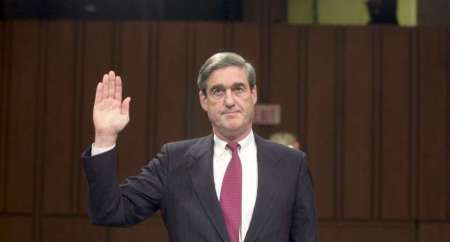 Succeeding Louis F. Freeh in Washington, DC. Robert Mueller named special prosecutor for Russia probe, Washington DC, USA – 17 May 2017 (Rex Features via AP Images)
Thus, to the extent it involves the president, the investigation announced to the public is a counterintelligence probe. That matters because it would mean the president is not a criminal suspect. A counterintelligence probe is not intended to build a criminal prosecution. It is intended to collect information. Its purpose is to uncover the actions and intentions of foreign powers to the extent they bear on American interests.
To this point, after months of congressional and intelligence-community investigations, there appears to be no evidence, much less strong proof, of a crime committed by Trump. But Democrats calculate that the assignment of a prosecutor implies that there must be an underlying crime — an implication that Sen. Graham’s comments reinforce. That is why they pushed so hard for a special counsel. It fills a big hole in their narrative. They can now say, “What do you mean no crime? They’ve appointed a prosecutor, so there must be a crime — collusion, obstruction, Russia … it’s a crime wave!”
******************************
Well is he, or isn’t he?
Almost everything in a counterintelligence investigation is classified. And much of what goes on in a criminal investigation is secret, kept confidential by investigators and prosecutors. But there is one thing that need be neither classified nor otherwise concealed from the American people: the status of the president.
Is the president of the United States the subject of a criminal investigation?
If he is not, then the Justice Department and special counsel Robert Mueller owe it to the country to say so. There is no reason to be coy about it. In fact, because a president under criminal suspicion would be crippled, his inability to govern detrimental to the nation, it is imperative to be forthright about his status.
Instead, political games are being played and the public is forming an impression — which I strongly suspect is a misimpression — based on semantics. There is no guaranteed outcome in an investigation, but the government should not be able to keep from us the precise nature of the investigation when it involves the president and when the fact that there is an investigation has already been disclosed publicly.
We’ve been told that the main investigation, the one that deputy attorney general Rod Rosenstein has appointed special counsel Mueller to conduct, is a counterintelligence investigation. That is what former FBI director James Comey revealed (with the approval of the Justice Department) in House testimony on March 20:
I have been authorized by the Department of Justice to confirm that the FBI, as part of our counterintelligence mission, is investigating the Russian government’s efforts to interfere in the 2016 presidential election and that includes investigating the nature of any links between individuals associated with the Trump campaign and the Russian government and whether there was any coordination between the campaign and Russia’s efforts. (Emphasis added.)
In appointing Mueller on May 17, Rosenstein issued an internal Justice Department order stating:
The Special Counsel is authorized to conduct the investigation confirmed by then-FBI Director James B. Comey in testimony before the House Permanent Select Committee on Intelligence on March 20, 2017, including (i) any links and/or coordination between the Russian government and individuals associated with the campaign of Donald Trump[.]
Thus, to the extent it involves the president, the investigation announced to the public is a counterintelligence probe. That matters because it would mean the president is not a criminal suspect. A counterintelligence probe is not intended to build a criminal prosecution. It is intended to collect information. Its purpose is to uncover the actions and intentions of foreign powers to the extent they bear on American interests.
Yet the New York Times reports that Rosenstein, in briefing the Senate Thursday:
… affirmed that the Justice Department’s inquiry was focused on possible crimes.
This portrayal of the purported “focus” of the investigation was echoed by several senators, including Republicans Lindsey Graham and John Cornyn.
To be clear, I don’t believe Graham and Cornyn are trying to create a misimpression. To the contrary, I think they are hoping to scale back high-profile congressional hearings about the controversy. Hearings that are paralyzing the administration and frittering away the legislative time needed to push forward the Trump agenda of addressing Obamacare’s ongoing collapse, tax reform, border enforcement, the confirmation of executive officials and judges, and so on.
Yet, listen to Sen. Graham:
You’ve got a special counsel who has prosecutorial powers now, and I think we in Congress have to be very careful not to interfere.
What he means is that once a Justice Department investigation gears up, Congress should back off. But his choice of words would lead any reasonable person to infer: “Ah-hah! Now we have a serious criminal investigation. People are going to be prosecuted.”
On the Democrats’ part, this conflation of intelligence and criminal investigations is quite intentional.
If the probe of Trump’s campaign is about crimes (rather than intelligence about Russia), then they move much closer to the ultimate goal of impeachment, to say nothing of the immediate goals of derailing Trump’s agenda and reaping an electoral windfall in 2018.
This has been one of my main objections to the appointment of a special counsel. To this point, after months of congressional and intelligence-community investigations, there appears to be no evidence, much less strong proof, of a crime committed by Trump. But Democrats calculate that the assignment of a prosecutor implies that there must be an underlying crime — an implication that Sen. Graham’s comments reinforce. That is why they pushed so hard for a special counsel. It fills a big hole in their narrative. They can now say, “What do you mean no crime? They’ve appointed a prosecutor, so there must be a crime — collusion, obstruction, Russia … it’s a crime wave!”
In advancing this storyline, Democrats have gotten plenty of help from the FBI and the Justice Department.
In his March 20 testimony, Comey elaborated:
As with any counterintelligence investigation, this will also include an assessment of whether any crimes were committed.
With due respect, this is a heavy-handed way of putting it. As is well-known throughout the FBI and Justice Department, it is not permissible to use counterintelligence investigative authority to conduct what is in reality a criminal case. It is true enough that if, in the course of a counterintelligence probe, FBI agents incidentally discover that crimes have been committed, they are not required to ignore those crimes. But the agents do not go into a counterintelligence probe with an eye toward collecting criminal evidence. If the point is to build a criminal case, you do a criminal investigation.
Rosenstein’s clumsily worded order also contributes to the confusion. The Comey testimony cited by Rosenstein made it clear that there is a broad investigation of Russian interference in the 2016 election, and that examining the nature of links and coordination — if any — between the Trump campaign and the Russian regime is just a part of it. Rosenstein’s order, by contrast, describes the investigation as if its sole focus is ties between the Trump campaign and Russia. For the life of me, I don’t understand why he framed it that way; he could simply have referred to “the investigation confirmed by” Comey and left it at that. Why would the Trump Justice Department gratuitously highlight the notion of Trump-Russia ties when, so far, none have been proved?
Moreover, Rosenstein’s memo goes on to explain that Mueller’s investigative jurisdiction includes any “matters” that arise out of the investigation. This is unavoidable: it needs to be clarified that the special counsel has authority to prosecute any crimes he may stumble upon while conducting the counterintelligence investigation. But the expression of this happenstance reinforces the notion that crimes have been committed.
And of course, crimes may well have been committed … but not, so far as we know, by Trump.
We might think about the main investigation, the counterintelligence investigation, as the mother ship. Attached to it, but not part of its core, are barnacles. There is the investigation of Michael Flynn, which is known to be a criminal probe — there is a grand jury issuing subpoenas, which is not something that happens in a counterintelligence investigation. There have also been suggestions of a barnacle, potentially criminal in nature, related to former Trump campaign chairman Paul Manafort, related to shady dealings with Ukrainian pols tied to Putin, in the years prior to the campaign.
Evidence of this (potentially) criminal activity came to light because the FBI and Justice Department were conducting the main counterintelligence investigation. Consequently, the activity comes within the special counsel’s jurisdiction — he is authorized to investigate and prosecute it. But this does not convert the main investigation into a criminal investigation. It is still a counterintelligence investigation.
So notice the cynical game: the public statements of the FBI, the Justice Department, and Democrats exploit the fact of the counterintelligence investigation as a basis for saying that agents are investigating Trump. But they are not investigating him as a criminal suspect — the subject of the counterterrorism investigation is Russia; Trump is relevant only to the extent that people connected to his campaign may have ties to Russia.
In tandem, the public statements of the FBI, the Justice Department, and Democrats exploit the fact that the activities of Flynn and Manafort are part of the investigation in order to describe the investigation as “criminal.” But the criminal aspects of the investigation are tangential to the main event, Russia and any potential ties to Trump, which is not criminal.
See the trick? Trump is part of the investigation, the investigation is part criminal, ergo: Trump must be a criminal suspect.
Such word games should not happen.
No one appreciates more than I do the importance of discretion in official public announcements about investigations. But when officials choose to make highly unusual public acknowledgments that an investigation is taking place, they should never create a misimpression. If they have done so, however inadvertently, they must clarify the record.
It is very simple, if President Trump is the subject of a criminal investigation, the Justice Department owes it to the American people, and to Trump, to say so. If he is not the subject of a criminal investigation, they should say so — and they should cease and desist suggestions to the contrary.
Trump Departs on First Trip Overseas, Associated Press via YouTube, May 19, 2017
(The President and First Lady appear to be healthy and happy, not weary and disturbed as some would prefer to see them. As Sundance at The Conservative Treehouse wrote,
Nothing makes the perpetually depressed liberal gnats more angry than beautiful people enjoying a fun, happy and beautiful life. So you can just imagine the level of apoplectic rage today brings as President Trump and First Lady Melania, together with Ivanka Trump and Jerrod, depart for their first overseas trip.
— DM)
Reflections on Trump’s First State Visit to the Middle East, The National Interest, Ahmed Charai, May 19, 2017
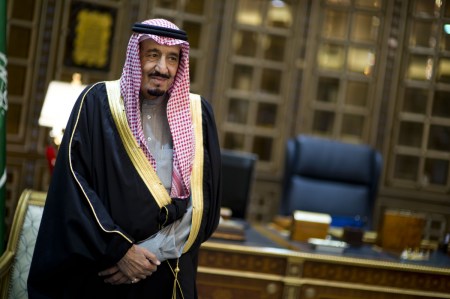 King Salman of Saudi Arabia in 2013. Flickr/Secretary of Defense
The Trump administration, working alongside its Arab allies, should promote moderate or quietist forms of Islam, and not remain neutral on religious matters. This means working with Islamic leaders, many of whom are state-funded imams, to challenge jihad on a religious basis and offer a form of faith shorn of violence.
These strategic insights come together in Morocco, where King Mohammed VI has used his religious role as commander of the faithful to inspire religious leaders to combat jihadism and urge tolerance and peace.
******************************
President Trump is visiting the Middle East. He will travel to Saudi Arabia and Israel, then visit the Vatican. Given the sequence of the first two, some observers speculated that he will attempt to revive the Israeli-Palestinian peace process, perhaps within a broader, regional framework. But different potential outcomes for Arab-Israeli relations, short of a peace settlement, may also be in the offing.
Both Saudi Arabia and Israel have proven themselves to be invaluable partners to the United States in the struggle against ISIS. An American-brokered framework whereby direct cooperation between the two is formalized—rather than a reliance on the United States as an intermediary—may create a framework to broaden the cooperation. Heightened partnership to counter the shared threat of Iran would be an obvious next step. The Trump administration’s new strategy is the creation of a regional alliance, focused on the Gulf countries but also including countries such as Egypt, Jordan and Morocco. A multilateral approach in which Israel plays a more direct and visible role in the coalition would signify a breakthrough. It would bolster confidence among Arab publics that broader cooperation and conflict resolution are warranted.
Donald Trump made the eradication of the Islamic State a priority during his campaign. He has been criticized for his more muscular strategy, as well as the desire to augment intelligence, economic and communications measures to put the screw to the organization.
It seems possible that the president is making a clean break with the Obama administration’s policy of disengagement from the Middle East. For Trump, the rubric of a “war on terrorism” seems to be appealing. Arabs appreciate the fact that, unlikely his predecessor, Trump appears to be recognizing the Shia extremist terror threat as represented by Iran and its proxy militias alongside the widely recognized Sunni jihadist threat.
In the view of this administration, this alliance should function like NATO, as an alliance (perhaps supported by the West) with multiple objectives. The eradication of Islamic State is the main objective, but the containment of Iranian influence in the region is also on the menu.
But of course, matters are not so simple.
At the geostrategic level, Russia and the pro-Iranian Shia arc cannot be ignored politically. The alliance between the two poses layers of complexity, whereby American and Russian accounts in the Baltic states and vis à vis NATO may be dragged into the diplomatic mix. Moscow cannot be excluded from the equation in any prospective political resolution in Syria. As for Iran, Russia wields heavy influence on its government and its security sector. Trump faces a Twister-like game of challenges in navigating the array of alliances, rivalries and hostilities among the players. Yet his aspiration to eradicate the Islamic State and block Iranian expansion in the region depends on his effective management of these quandaries.
Nor do Trump’s aspirations allow for neglect of the broader counterterrorism challenge beyond military action, intelligence work and even diplomacy. He must wage an ideological war, and challenge extremist strands within Arab and Islamic societies that guarantee the perpetuation of conflict—whatever the outcomes on the battlefield—unless they are addressed.
The Trump administration, working alongside its Arab allies, should promote moderate or quietist forms of Islam, and not remain neutral on religious matters. This means working with Islamic leaders, many of whom are state-funded imams, to challenge jihad on a religious basis and offer a form of faith shorn of violence.
These strategic insights come together in Morocco, where King Mohammed VI has used his religious role as commander of the faithful to inspire religious leaders to combat jihadism and urge tolerance and peace.
King Mohammed VI has demonstrated his commitment to deeper cooperation with neighboring countries by embarking on several state visits and signing an unprecedented number of economic-partnership conventions. He has also expressed support for joint efforts to combat radicalization, and officials from Cote d’Ivoire, Niger, Tunisia, and Guinea have indicated a willingness to train their imams in Morocco.
If Trump is looking for a healthy example of Muslim leaders bringing peace through Islam, Morocco is a good place to start.
May 19, 2017 1:20 pm
Source: U.S.-Saudi Arabia Ink ‘Largest Single Arms Deal in American History’ – Washington Free Beacon
The United States and Saudi Arabia have inked a $110 billion arms deal, the largest in American history, according to senior Trump administration officials who described the agreement as part of a major effort to counter Iranian threats in the region.
The arms deal will see the U.S. providing Saudi Arabia with a “full spectrum of capabilities,” including tanks, artillery, helicopters, armored carriers, combat ships, and an assortment of other advanced weapons systems, according to senior Trump administration officials working on the agreement.
The massive arms package is part of a larger effort by the Trump administration to boost U.S. allies in the region amid a growing threat from Iran, which has invested heavily in its own military since the landmark nuclear agreement was inked with the former Obama administration.
A large portion of the cash assets and other financial resources granted to Iran under the deal have been used to purchase advanced weapons and invest in the country’s ballistic missile program, which violates international agreements.
Trump administration officials touted the agreement, which will be officially announced by President Donald Trump on Saturday as he travels across the Middle East on his first foreign trip, as a major step towards countering Iranian intransigence in the region, which has spooked U.S. allies.
The package of arms is specifically meant to address regional threats, officials said.
“This package of defense equipment and services support the long-term security of Saudi Arabia and the Gulf region in the face of Iranian threats while also bolstering the Kingdom’s ability to contribute to counterterrorism operations across the region, reducing the burden on the U.S. military to conduct those operations,” explained one senior administration official who was only authorized to speak about the agreement on background.
Trump administration officials also maintained that nothing in the mammoth arms package would negate Israel’s military edge in the region, which remains a cornerstone of the U.S.-Israel alliance.
“I also need to stress that there is nothing in this package of sales, taken individually or as a whole, that will undermine Israel’s qualitative military edge,” one senior official said. “As a matter of law and of longstanding policy, the United States is committed to ensuring Israel maintains a qualitative military edge in the region.”
When completed, the $110 billion agreement with Saudi Arabia will be “the largest single arms deal in American history,” according to officials.
The arms deal runs the gamut of offensive and defensive equipment that can be used by Saudi Arabia in a range of environments, including on the cybersecurity and counterterrorism fronts.
“This package is threat-based and provides full-spectrum capabilities, which fall broadly into five categories: border security and counterterrorism; maritime and coastal security; air force modernization; air and missile defense; and cybersecurity and communications upgrade,” Trump administration officials said. “Combined, it will significantly augment the Kingdom of Saudi Arabia’s capabilities to help deter regional threats and the Kingdom’s ability to protect its borders and contribute to coalition counterterrorism operations.”
On the counterterror front, the United States will provide aerostats, tanks, artillery, counter-mortar radars, armored personnel carriers, helicopters, and an array of training for Saudi forces battling terrorists and other foreign enemies.
The arms package also will focus on modernizing Saudi Arabia’s air force. The U.S. will train Saudi forces to conduct airborne surveillance and hone their precision targeting abilities. As part of the package, the Saudis will receive intelligence-gathering aircraft, officials said.
Missile defense also is a key part of the arms package. The United States will provide the Saudis with Patriot and THAAD missiles in order to help the country protect itself from airborne attacks, particularly those posed by Iran’s increasingly sophisticated ballistic missile program.
“So the purpose of this package is to contribute—number one, contribute to a regional security architecture that advances defense cooperation for both the United States of America and the Kingdom of Saudi Arabia,” according to one senior administration official. “Two, provide our partners will full-spectrum capabilities. And, three, as part of providing full-spectrum capabilities, the use of other security cooperation programs, such as defense institution-building programs that address not only the material and related training, but also education and advising on strategy-planning doctrine and institutional support.”
The arms deal “demonstrates in the clearest terms possible the United States’ commitment to our partnership to Saudi Arabia and our Gulf partners while also expanding opportunities for American companies in the region and supporting tens of thousands of jobs in the U.S. defense industrial base,” one official said.
Hizballah’s elite force sustains heavy casualties from US air strike, DEBKAfile, May 19, 2017
(Please see also, The Devil’s Triangle: At-Tanf/Abu Kamal/Ar Rusafah. — DM)
US jets and assault helicopters took off from the Ayn al-Asad air base in western Iraqi for an operation to prevent the convoy from reaching the strategic Al-Tanf crossing at the intersection of the Syrian, Iraq and Jordanian borders.
***********************
Most of the damage inflicted by the US air strike Thursday in South Syria was sustained by Hizballah’s elite unit, the Radwan Force, DEBKAfile’s military sources disclose. This was the first aerial attack the United States has conducted on a combined Syrian-Iranian-Hizballah convoy in the seven-year Syrian war. Our sources add that the US jets and assault helicopters took off from the Ayn al-Asad air base in western Iraqi for an operation to prevent the convoy from reaching the strategic Al-Tanf crossing at the intersection of the Syrian, Iraq and Jordanian borders. They hit at least three of Hizballah’s armored vehicles and several trucks, which caught fire. The Americans and Hizballah have both imposed a blackout on the details of the incident and the scale of casualties.
DEBKAfile ran a number of stories this week disclosing the activities of US, British and Jordanian special operations forces in southern Syria for taking over key segments of the Syrian-Iraqi border, including the Al-Tanf crossing. US Secretary of Defense James Mattis commented this week that Washington had not change its policy of non-intervention in the Syria war, adding, “But we will defend our troops.”




 anneinpt
 artaxes
 danmillerinpanama
 davidking1530
 Peter Hofman
 Joseph Wouk
 Peter
Peter Louisiana Steve
 WarSclerotic
Recent Comments