Archive for May 19, 2017

The Revolutionary Guard’s long shadow over Iran’s presidential election

May 19, 2017

The Revolutionary Guard’s long shadow over Iran’s presidential election, Long War Journal, May 19, 2017

Iranians head to the polls today to choose between “bad and worse” in yet another unfair-and-unfree presidential election. The primary challenger, Ebrahim Raisi – who is considered a frontrunner to succeed Khamenei – has received the support of the Islamic Revolutionary Guard Corps – the protector of Ayatollah Ruhollah Khomeini’s Islamic revolution who have long cast a dark shadow over the country.

The Guard’s political interference has at times been so blatant that incumbent President Hassan Rouhani on Wednesday publicly called on it not to meddle. During the final debate last week, Rouhani criticized the Guards for mobilizing support for Raisi.

Some in the West point to this as proof that Rouhani is the “lesser of two evils,” yet the political effect of this difference is minimal:  Rouhani cannot overcome the Guards and Supreme Leader Ali Khamenei on matters of foreign and security policy—to the extent that he even has differences with them. Rouhani’s feud with the corps goes back to the Iran-Iraq War and is less politically convulsive than can sometimes appear to outside observers.

Since 1989, the Revolutionary Guards’ intervention in Iranian politics and commerce has expanded dramatically under the watch of Supreme Leader Ali Khamenei, who has relied on the corps to consolidate his power.

While Rouhani has installed more intelligence ministry than Guard veterans in his cabinet, the corps overshadows all other security and military institutions.

Khamenei and the Guards exercise formal and informal means to check the elected branches. The corps’ decision-making hierarchy is dominated by a tightly-knit network of Iran-Iraq War (1980 – 1988) veterans loyal to the supreme leader. During the reform era (1997 – 2005), Khamenei and the Guards curtailed the agenda of former President Mohammad Khatami and purged reformists from the parliament.

As a partly conscript military organization, however, the 150,000-strong Guard Corps somewhat mirrors society, though more so the pro-regime base since Iranians who don’t support the regime often prefer to enlist in the regular army.  The Revolutionary Guards purged their ranks after the massive demonstrations following the 2009 presidential election: many officers and the rank-and-file refused to attack protesters.  Senior commanders have become more careful about vetting officers.  Khamenei-picked clerical commissars enforce ideological conformity and the corps’ Counter Intelligence Organization, souped up after 2009, roots out dissent.

Factionalism among the Guards, however, remains. For instance, former senior commander and parliamentarian, Mansour Haghighatpour, told a pro-reform newspaper the Guards foiled his re-election bid in the northwestern district of Ardebil last year because he voted for the 2015 nuclear accord.

The Revolutionary Guard has promoted Raisi before he announced his presidential run. Raisi, who owes his power to the supreme leader, has long been close to Iran’s security services. After Khamenei last year appointed Raisi the trustee of Iran’s wealthiest endowment, the Reza Holy Precinct, top Guard commanders visited him in Mashhad.  Media affiliated with the Revolutionary Guard then began promoting Raisi with the senior title of “Ayatollah.” That indicated Raisi was being groomed for the higher office of supreme leader, which nominally requires the senior clerical rank (the media has now returned to calling Raisi a mid-ranking cleric).

Even before the withdrawal of Mohammad-Baqer Qalibaf, the mayor of Tehran and a former senior Guard commander, from the presidential campaign, Raisi generated the most buzz in hardline circles. Prominent Guard theoretician Hassan Abbasi even claims there’s a “strange” aura to Raisi’s campaign rallies. Photos of guardsmen in Syria declaring their support for Raisi are now commonplace in Iranian social media.  The corps’ weekly Sobh-e Sadegh’s latest edition all but endorses Raisi without naming him directly.

Some in Khamenei’s close circle successfully pushed Raisi to run for president even though he’d initially refused. Cleric Ali Panahian, head of the pro-Khamenei think tank Ammar Base, told a militant seminary audience in Qom this month that Raisi consented to run with reservations.  Panahian viewed Raisi as “one of the sources of support” for the Islamic Republic regardless of “the result of the election.”  Panahian has dubbed Raisi the “seyyed of the dispossessed” (“seyyed” is an honorific given to descendants of the Prophet Muhammad).

The Guard Corps has also directly mobilized supporters for Raisi’s campaign rallies.  A reporter who attended Raisi’s Tehran campaign rally this week said the vast majority of attendees were members of the Basij – an all-volunteer, paramilitary organization that falls under the corps’ command. Eyewitnesses outside the campaign rally videotaped men on motorcycles and more than a dozen buses – hallmarks of the Guard’s mobilization.

The Revolutionary Guards might try to tip the results in Raisi’s favor. Polls by their media seem to predict a Raisi victory. The Guard Corps has attempted to station forces at Tehran’s ballot stations on election day, drawing a protest of a senior official from the interior ministry, which counts the votes and is under the control of Rouhani.  Iranian parliamentarian Mahmoud Sadeghi this week warned about the spread of undercover security agents in Tehran, some of whom vowed to crush the “green sedition,” referring to the 2009 Green Movement. The Guard may want to rig the results by a few points to avoid the mistake of declaring Mahmoud Ahmadinejad the winner by a large margin, which instantly led to widespread suspicions of fraud and massive demonstrations.

Rouhani’s supporters may well accuse the corps and the supreme leader of fraud if Raisi wins. Rouhani has been leading the polls and the public expects high turnout of the reformist base, which could only benefit Rouhani. The president has loudly and repeatedly warned against the Guards’ meddling in this election.

For his part, Khamenei has not overtly expressed his preference for president but has criticized Rouhani throughout the campaign, and has vowed to “slap in the face” anyone who “wishes to disrupt security.” He obviously fears a repetition of 2009 that rocked the regime to its core.

Whatever the result of the election, the Guard Corps will remain the most powerful network in the country.   A Raisi presidency would be beholden.  A Rouhani victory, however, cannot roll back the Guards’ influence.  The Islamic Republic’s history leaves no doubt that republican institutions are incapable of overcoming the unelected powers of the supreme leader and his praetorians, who perceive reform as an existential threat.  The prospect for gradual, peaceful reform within the Islamic Republic is bleak.
If the President Is Not the Subject of a Criminal Investigation, Then Say So

May 19, 2017

If the President Is Not the Subject of a Criminal Investigation, Then Say So, PJ Media, Andrew C. McCarthy, May 19, 2017

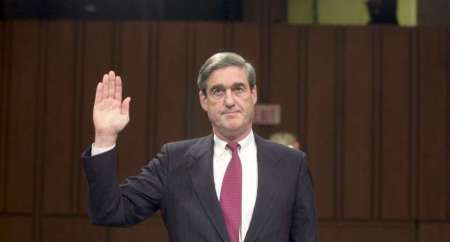
Succeeding Louis F. Freeh in Washington, DC. Robert Mueller named special prosecutor for Russia probe, Washington DC, USA – 17 May 2017 (Rex Features via AP Images)

Thus, to the extent it involves the president, the investigation announced to the public is a counterintelligence probe. That matters because it would mean the president is not a criminal suspect. A counterintelligence probe is not intended to build a criminal prosecution. It is intended to collect information. Its purpose is to uncover the actions and intentions of foreign powers to the extent they bear on American interests.

To this point, after months of congressional and intelligence-community investigations, there appears to be no evidence, much less strong proof, of a crime committed by Trump. But Democrats calculate that the assignment of a prosecutor implies that there must be an underlying crime — an implication that Sen. Graham’s comments reinforce. That is why they pushed so hard for a special counsel. It fills a big hole in their narrative. They can now say, “What do you mean no crime? They’ve appointed a prosecutor, so there must be a crime — collusion, obstruction, Russia … it’s a crime wave!”

******************************

Well is he, or isn’t he?

Almost everything in a counterintelligence investigation is classified. And much of what goes on in a criminal investigation is secret, kept confidential by investigators and prosecutors. But there is one thing that need be neither classified nor otherwise concealed from the American people: the status of the president.

Is the president of the United States the subject of a criminal investigation?

If he is not, then the Justice Department and special counsel Robert Mueller owe it to the country to say so. There is no reason to be coy about it. In fact, because a president under criminal suspicion would be crippled, his inability to govern detrimental to the nation, it is imperative to be forthright about his status.

Instead, political games are being played and the public is forming an impression — which I strongly suspect is a misimpression — based on semantics. There is no guaranteed outcome in an investigation, but the government should not be able to keep from us the precise nature of the investigation when it involves the president and when the fact that there is an investigation has already been disclosed publicly.

We’ve been told that the main investigation, the one that deputy attorney general Rod Rosenstein has appointed special counsel Mueller to conduct, is a counterintelligence investigation. That is what former FBI director James Comey revealed (with the approval of the Justice Department) in House testimony on March 20:

I have been authorized by the Department of Justice to confirm that the FBI, as part of our counterintelligence mission, is investigating the Russian government’s efforts to interfere in the 2016 presidential election and that includes investigating the nature of any links between individuals associated with the Trump campaign and the Russian government and whether there was any coordination between the campaign and Russia’s efforts. (Emphasis added.)

In appointing Mueller on May 17, Rosenstein issued an internal Justice Department order stating:

The Special Counsel is authorized to conduct the investigation confirmed by then-FBI Director James B. Comey in testimony before the House Permanent Select Committee on Intelligence on March 20, 2017, including (i) any links and/or coordination between the Russian government and individuals associated with the campaign of Donald Trump[.]

Thus, to the extent it involves the president, the investigation announced to the public is a counterintelligence probe. That matters because it would mean the president is not a criminal suspect. A counterintelligence probe is not intended to build a criminal prosecution. It is intended to collect information. Its purpose is to uncover the actions and intentions of foreign powers to the extent they bear on American interests.

Yet the New York Times reports that Rosenstein, in briefing the Senate Thursday:

 … affirmed that the Justice Department’s inquiry was focused on possible crimes.

This portrayal of the purported “focus” of the investigation was echoed by several senators, including Republicans Lindsey Graham and John Cornyn.

To be clear, I don’t believe Graham and Cornyn are trying to create a misimpression. To the contrary, I think they are hoping to scale back high-profile congressional hearings about the controversy. Hearings that are paralyzing the administration and frittering away the legislative time needed to push forward the Trump agenda of addressing Obamacare’s ongoing collapse, tax reform, border enforcement, the confirmation of executive officials and judges, and so on.

Yet, listen to Sen. Graham:

You’ve got a special counsel who has prosecutorial powers now, and I think we in Congress have to be very careful not to interfere.

What he means is that once a Justice Department investigation gears up, Congress should back off. But his choice of words would lead any reasonable person to infer: “Ah-hah! Now we have a serious criminal investigation. People are going to be prosecuted.”

On the Democrats’ part, this conflation of intelligence and criminal investigations is quite intentional.

If the probe of Trump’s campaign is about crimes (rather than intelligence about Russia), then they move much closer to the ultimate goal of impeachment, to say nothing of the immediate goals of derailing Trump’s agenda and reaping an electoral windfall in 2018.

This has been one of my main objections to the appointment of a special counsel. To this point, after months of congressional and intelligence-community investigations, there appears to be no evidence, much less strong proof, of a crime committed by Trump. But Democrats calculate that the assignment of a prosecutor implies that there must be an underlying crime — an implication that Sen. Graham’s comments reinforce. That is why they pushed so hard for a special counsel. It fills a big hole in their narrative. They can now say, “What do you mean no crime? They’ve appointed a prosecutor, so there must be a crime — collusion, obstruction, Russia … it’s a crime wave!”

In advancing this storyline, Democrats have gotten plenty of help from the FBI and the Justice Department.

In his March 20 testimony, Comey elaborated:

As with any counterintelligence investigation, this will also include an assessment of whether any crimes were committed.

With due respect, this is a heavy-handed way of putting it. As is well-known throughout the FBI and Justice Department, it is not permissible to use counterintelligence investigative authority to conduct what is in reality a criminal case. It is true enough that if, in the course of a counterintelligence probe, FBI agents incidentally discover that crimes have been committed, they are not required to ignore those crimes. But the agents do not go into a counterintelligence probe with an eye toward collecting criminal evidence. If the point is to build a criminal case, you do a criminal investigation.

Rosenstein’s clumsily worded order also contributes to the confusion. The Comey testimony cited by Rosenstein made it clear that there is a broad investigation of Russian interference in the 2016 election, and that examining the nature of links and coordination — if any — between the Trump campaign and the Russian regime is just a part of it. Rosenstein’s order, by contrast, describes the investigation as if its sole focus is ties between the Trump campaign and Russia. For the life of me, I don’t understand why he framed it that way; he could simply have referred to “the investigation confirmed by” Comey and left it at that. Why would the Trump Justice Department gratuitously highlight the notion of Trump-Russia ties when, so far, none have been proved?

Moreover, Rosenstein’s memo goes on to explain that Mueller’s investigative jurisdiction includes any “matters” that arise out of the investigation. This is unavoidable: it needs to be clarified that the special counsel has authority to prosecute any crimes he may stumble upon while conducting the counterintelligence investigation. But the expression of this happenstance reinforces the notion that crimes have been committed.

And of course, crimes may well have been committed … but not, so far as we know, by Trump.

We might think about the main investigation, the counterintelligence investigation, as the mother ship. Attached to it, but not part of its core, are barnacles. There is the investigation of Michael Flynn, which is known to be a criminal probe — there is a grand jury issuing subpoenas, which is not something that happens in a counterintelligence investigation. There have also been suggestions of a barnacle, potentially criminal in nature, related to former Trump campaign chairman Paul Manafort, related to shady dealings with Ukrainian pols tied to Putin, in the years prior to the campaign.

Evidence of this (potentially) criminal activity came to light because the FBI and Justice Department were conducting the main counterintelligence investigation. Consequently, the activity comes within the special counsel’s jurisdiction — he is authorized to investigate and prosecute it. But this does not convert the main investigation into a criminal investigation. It is still a counterintelligence investigation.

So notice the cynical game: the public statements of the FBI, the Justice Department, and Democrats exploit the fact of the counterintelligence investigation as a basis for saying that agents are investigating Trump. But they are not investigating him as a criminal suspect — the subject of the counterterrorism investigation is Russia; Trump is relevant only to the extent that people connected to his campaign may have ties to Russia.

In tandem, the public statements of the FBI, the Justice Department, and Democrats exploit the fact that the activities of Flynn and Manafort are part of the investigation in order to describe the investigation as “criminal.” But the criminal aspects of the investigation are tangential to the main event, Russia and any potential ties to Trump, which is not criminal.

See the trick? Trump is part of the investigation, the investigation is part criminal, ergo: Trump must be a criminal suspect.

Such word games should not happen.

No one appreciates more than I do the importance of discretion in official public announcements about investigations. But when officials choose to make highly unusual public acknowledgments that an investigation is taking place, they should never create a misimpression. If they have done so, however inadvertently, they must clarify the record.

It is very simple, if President Trump is the subject of a criminal investigation, the Justice Department owes it to the American people, and to Trump, to say so. If he is not the subject of a criminal investigation, they should say so — and they should cease and desist suggestions to the contrary.

Trump Departs on First Trip Overseas

May 19, 2017

Trump Departs on First Trip Overseas, Associated Press via YouTube, May 19, 2017

(The President and First Lady appear to be healthy and happy, not weary and disturbed as some would prefer to see them. As Sundance at The Conservative Treehouse wrote,

Nothing makes the perpetually depressed liberal gnats more angry than beautiful people enjoying a fun, happy and beautiful life.  So you can just imagine the level of apoplectic rage today brings as President Trump and First Lady Melania, together with Ivanka Trump and Jerrod, depart for their first overseas trip.

— DM)


Reflections on Trump’s First State Visit to the Middle East

May 19, 2017

Reflections on Trump’s First State Visit to the Middle East, The National InterestAhmed Charai, May 19, 2017

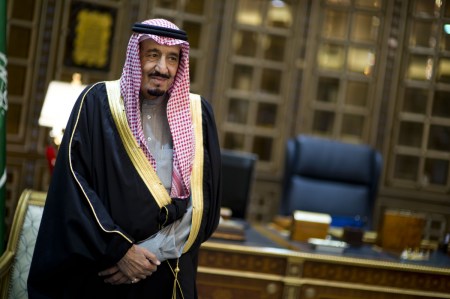
King Salman of Saudi Arabia in 2013. Flickr/Secretary of Defense

The Trump administration, working alongside its Arab allies, should promote moderate or quietist forms of Islam, and not remain neutral on religious matters. This means working with Islamic leaders, many of whom are state-funded imams, to challenge jihad on a religious basis and offer a form of faith shorn of violence.

These strategic insights come together in Morocco, where King Mohammed VI has used his religious role as commander of the faithful to inspire religious leaders to combat jihadism and urge tolerance and peace.

******************************

President Trump is visiting the Middle East. He will travel to Saudi Arabia and Israel, then visit the Vatican. Given the sequence of the first two, some observers speculated that he will attempt to revive the Israeli-Palestinian peace process, perhaps within a broader, regional framework. But different potential outcomes for Arab-Israeli relations, short of a peace settlement, may also be in the offing.

Both Saudi Arabia and Israel have proven themselves to be invaluable partners to the United States in the struggle against ISIS. An American-brokered framework whereby direct cooperation between the two is formalized—rather than a reliance on the United States as an intermediary—may create a framework to broaden the cooperation. Heightened partnership to counter the shared threat of Iran would be an obvious next step. The Trump administration’s new strategy is the creation of a regional alliance, focused on the Gulf countries but also including countries such as Egypt, Jordan and Morocco. A multilateral approach in which Israel plays a more direct and visible role in the coalition would signify a breakthrough. It would bolster confidence among Arab publics that broader cooperation and conflict resolution are warranted.

Donald Trump made the eradication of the Islamic State a priority during his campaign. He has been criticized for his more muscular strategy, as well as the desire to augment intelligence, economic and communications measures to put the screw to the organization.

It seems possible that the president is making a clean break with the Obama administration’s policy of disengagement from the Middle East. For Trump, the rubric of a “war on terrorism” seems to be appealing. Arabs appreciate the fact that, unlikely his predecessor, Trump appears to be recognizing the Shia extremist terror threat as represented by Iran and its proxy militias alongside the widely recognized Sunni jihadist threat.

In the view of this administration, this alliance should function like NATO, as an alliance (perhaps supported by the West) with multiple objectives. The eradication of Islamic State is the main objective, but the containment of Iranian influence in the region is also on the menu.

The use of a massively powerful bomb against the Islamic State in Afghanistan provided a mighty demonstration of strength, but may also have been intended to send a message about the president’s commitment to confront his adversaries with some of the most powerful tools in his arsenal.

But of course, matters are not so simple.

At the geostrategic level, Russia and the pro-Iranian Shia arc cannot be ignored politically. The alliance between the two poses layers of complexity, whereby American and Russian accounts in the Baltic states and vis à vis NATO may be dragged into the diplomatic mix. Moscow cannot be excluded from the equation in any prospective political resolution in Syria. As for Iran, Russia wields heavy influence on its government and its security sector. Trump faces a Twister-like game of challenges in navigating the array of alliances, rivalries and hostilities among the players. Yet his aspiration to eradicate the Islamic State and block Iranian expansion in the region depends on his effective management of these quandaries.

Nor do Trump’s aspirations allow for neglect of the broader counterterrorism challenge beyond military action, intelligence work and even diplomacy. He must wage an ideological war, and challenge extremist strands within Arab and Islamic societies that guarantee the perpetuation of conflict—whatever the outcomes on the battlefield—unless they are addressed.

The Trump administration, working alongside its Arab allies, should promote moderate or quietist forms of Islam, and not remain neutral on religious matters. This means working with Islamic leaders, many of whom are state-funded imams, to challenge jihad on a religious basis and offer a form of faith shorn of violence.

These strategic insights come together in Morocco, where King Mohammed VI has used his religious role as commander of the faithful to inspire religious leaders to combat jihadism and urge tolerance and peace.

King Mohammed VI has demonstrated his commitment to deeper cooperation with neighboring countries by embarking on several state visits and signing an unprecedented number of economic-partnership conventions. He has also expressed support for joint efforts to combat radicalization, and officials from Cote d’Ivoire, Niger, Tunisia, and Guinea have indicated a willingness to train their imams in Morocco.

If Trump is looking for a healthy example of Muslim leaders bringing peace through Islam, Morocco is a good place to start.

U.S.-Saudi Arabia Ink ‘Largest Single Arms Deal in American History’

May 19, 2017

Trump Admin Arming Saudis to Counter Iranian Threat

BY:

May 19, 2017 1:20 pm

Source: U.S.-Saudi Arabia Ink ‘Largest Single Arms Deal in American History’ – Washington Free Beacon

The United States and Saudi Arabia have inked a $110 billion arms deal, the largest in American history, according to senior Trump administration officials who described the agreement as part of a major effort to counter Iranian threats in the region.

The arms deal will see the U.S. providing Saudi Arabia with a “full spectrum of capabilities,” including tanks, artillery, helicopters, armored carriers, combat ships, and an assortment of other advanced weapons systems, according to senior Trump administration officials working on the agreement.

The massive arms package is part of a larger effort by the Trump administration to boost U.S. allies in the region amid a growing threat from Iran, which has invested heavily in its own military since the landmark nuclear agreement was inked with the former Obama administration.

A large portion of the cash assets and other financial resources granted to Iran under the deal have been used to purchase advanced weapons and invest in the country’s ballistic missile program, which violates international agreements.

Trump administration officials touted the agreement, which will be officially announced by President Donald Trump on Saturday as he travels across the Middle East on his first foreign trip, as a major step towards countering Iranian intransigence in the region, which has spooked U.S. allies.

The package of arms is specifically meant to address regional threats, officials said.

“This package of defense equipment and services support the long-term security of Saudi Arabia and the Gulf region in the face of Iranian threats while also bolstering the Kingdom’s ability to contribute to counterterrorism operations across the region, reducing the burden on the U.S. military to conduct those operations,” explained one senior administration official who was only authorized to speak about the agreement on background.

Trump administration officials also maintained that nothing in the mammoth arms package would negate Israel’s military edge in the region, which remains a cornerstone of the U.S.-Israel alliance.

“I also need to stress that there is nothing in this package of sales, taken individually or as a whole, that will undermine Israel’s qualitative military edge,” one senior official said. “As a matter of law and of longstanding policy, the United States is committed to ensuring Israel maintains a qualitative military edge in the region.”

When completed, the $110 billion agreement with Saudi Arabia will be “the largest single arms deal in American history,” according to officials.

The arms deal runs the gamut of offensive and defensive equipment that can be used by Saudi Arabia in a range of environments, including on the cybersecurity and counterterrorism fronts.

“This package is threat-based and provides full-spectrum capabilities, which fall broadly into five categories: border security and counterterrorism; maritime and coastal security; air force modernization; air and missile defense; and cybersecurity and communications upgrade,” Trump administration officials said. “Combined, it will significantly augment the Kingdom of Saudi Arabia’s capabilities to help deter regional threats and the Kingdom’s ability to protect its borders and contribute to coalition counterterrorism operations.”

On the counterterror front, the United States will provide aerostats, tanks, artillery, counter-mortar radars, armored personnel carriers, helicopters, and an array of training for Saudi forces battling terrorists and other foreign enemies.

The arms package also will focus on modernizing Saudi Arabia’s air force. The U.S. will train Saudi forces to conduct airborne surveillance and hone their precision targeting abilities. As part of the package, the Saudis will receive intelligence-gathering aircraft, officials said.

Missile defense also is a key part of the arms package. The United States will provide the Saudis with Patriot and THAAD missiles in order to help the country protect itself from airborne attacks, particularly those posed by Iran’s increasingly sophisticated ballistic missile program.

“So the purpose of this package is to contribute—number one, contribute to a regional security architecture that advances defense cooperation for both the United States of America and the Kingdom of Saudi Arabia,” according to one senior administration official. “Two, provide our partners will full-spectrum capabilities. And, three, as part of providing full-spectrum capabilities, the use of other security cooperation programs, such as defense institution-building programs that address not only the material and related training, but also education and advising on strategy-planning doctrine and institutional support.”

The arms deal “demonstrates in the clearest terms possible the United States’ commitment to our partnership to Saudi Arabia and our Gulf partners while also expanding opportunities for American companies in the region and supporting tens of thousands of jobs in the U.S. defense industrial base,” one official said.

Hizballah’s elite force sustains heavy casualties from US air strike

May 19, 2017

Hizballah’s elite force sustains heavy casualties from US air strike, DEBKAfile, May 19, 2017

(Please see also, The Devil’s Triangle: At-Tanf/Abu Kamal/Ar Rusafah. — DM)

US jets and assault helicopters took off from the Ayn al-Asad air base in western Iraqi for an operation to prevent the convoy from reaching the strategic Al-Tanf crossing at the intersection of the Syrian, Iraq and Jordanian borders.

***********************

Most of the damage inflicted by the US air strike Thursday in South Syria was sustained by Hizballah’s elite unit, the Radwan Force, DEBKAfile’s military sources disclose. This was the first aerial attack the United States has conducted on a combined Syrian-Iranian-Hizballah convoy in the seven-year Syrian war. Our sources add that the US jets and assault helicopters took off from the Ayn al-Asad air base in western Iraqi for an operation to prevent the convoy from reaching the strategic Al-Tanf crossing at the intersection of the Syrian, Iraq and Jordanian borders. They hit at least three of Hizballah’s armored vehicles and several trucks, which caught fire. The Americans and Hizballah have both imposed a blackout on the details of the incident and the scale of casualties.

DEBKAfile ran a number of stories this week disclosing the activities of US, British and Jordanian special operations forces in southern Syria for taking over key segments of the Syrian-Iraqi border, including the Al-Tanf crossing. US Secretary of Defense James Mattis commented this week that Washington had not change its policy of non-intervention in the Syria war, adding, “But we will defend our troops.”

A Coup Attempt, Not a Constitutional Crisis

May 19, 2017

A Coup Attempt, Not a Constitutional Crisis, PJ MediaDavid P. Goldman, May 18, 2017

Trump won by calling attention to the errors of his opponents and by dominating the news cycle. He played continuous offense. At the White House, by contrast, Trump has appeared cautious in stating his foreign policy goals, and defensive in responding to attacks on his performance and propriety. The policy issues that stood out clear during the campaign and helped Trump outflank the Republican Establishment have become fuzzy, especially after the firing of Gen. Flynn.

With the policy issues out of focus, Trump has lost control of the news cycle, and risks letting the news cycle control him. His opponents won’t succeed in dislodging him. But they have succeeded in distracting Trump from his policy agenda.

***************************

A ranking Republican statesman this week told an off-the-record gathering that a “coup” attempt was in progress against President Donald Trump, with collusion between the largely Democratic media and Trump’s numerous enemies in the Republican Party. The object of the coup, the Republican leader added, was not impeachment, but the recruitment of a critical mass of Republican senators and congressmen to the claim that Trump was “unfit” for office and to force his resignation.

It’s helpful to fan away the psychedelic fumes of allegation and innuendo and clarify just what Trump might have done wrong. Trump will not be impeached, and he will not be harried out of office. But he faces a formidable combination of media hostility—what the president today denounced as a “witch hunt”—and a divided White House staff prone to press leaks. The likely outcome will be a prolonged dirty war of words that will delay Trump’s domestic agenda and tie down his loyalists with the chores of fire-fighting.

One thinks of Gulliver tied down by the Lilliputians. Trump was elected by campaigning against the Republican Establishment as well as Obama, ridiculing their policy blunders in Iraq and Afghanistan and questioning their credibility. In the flurry of personal attacks, the underlying policy issues have faded into the background, and that gives the initiative to Trump’s enemies.

Nothing that has been alleged, much less proven, about President Trump comes close to the threshold for impeachment, as Prof. Jonathan Turley of George Washington University’s law school explained in a May 17 comment in The Hill. Even if Trump asked then FBI Director James Comey to go easy on Gen. Michael Flynn, Prof. Turley notes, “Encouraging leniency or advocating for an associate is improper but not necessarily” illegal. The charge of obstruction of justice presumes that there is an issue before the bar of justice, but as Turley adds, “There is no indication of a grand jury proceeding at the time of the Valentine’s Day meeting between Trump and Comey. Obstruction cases generally are built around judicial proceedings — not Oval Office meetings.”

The appointment of respected former FBI Director Robert Mueller as special counsel to look into allegations of Russian interference in the November 2016 election strongly suggests that the Trump team feels it has nothing to fear from a thorough review. In this case Trump’s detractors appear to be bluffing. Press reports of contacts between Trump’s campaign and Russian diplomats and businessmen appear to reflect the sort of conversations that every presidential campaign conducts with important foreign governments. It is not clear that Russia was responsible for the delivery of embarrassing Democratic National Committee emails to Wikileaks, moreover. Pro-Trump media report that DNC staffer Seth Rich was Wikileaks’ source. Rich was murdered on a Washington street in July 2016, and a counter-conspiracy theory is circulating about his death.

Then there is the alleged leak of highly classified intelligence on the laptop bomb threat to airliners, of which Wall Street Journal editors intoned, “Loose Lips Sink Presidencies.” Exactly what the president told the Russians is under dispute, but the salient fact in the case is that presidents and cabinet members frequently leak classified information without prompting the condemnations that piled up on Trump. Obama’s then Defense Secretary Leon Panetta leaked the role of Pakistani physician Shakil Afridi in locating Osama bin Laden’s lair, and President Obama himself revealed that Seal Team 6 had killed Osama, making the unit a subsequent  target for terrorists. Apart from inadvertent leaks, the Obama administration deliberately leaked British nuclear secrets to Russia, over bitter protests from London.

Why did Obama get a pass while Trump got the bum’s rush? Apart from the antipathy of the major media to a candidate who campaigned against them, there is the hostility of the intelligence agencies. That, the Wall Street Journal editors said, is Trump’s own fault: “Mr. Trump’s strife and insults with the intelligence community were also bound to invite blowback,” their May 17 editorial scolded. “In that case the public leaks about Mr. Trump’s actions, if true, will do more damage than whatever he said in private.”

The Journal editors imply that disaffection in the intelligence community is the result of Trump’s obstreperousness, but the source of the dispute is policy and accountability. Trump’s first national security adviser, Gen. Michael Flynn, was fired by Obama as head of the Defense Intelligence Agency for claiming that U.S. intelligence agencies bore some responsibility for the emergence of ISIS. The CIA funded Sunni rebels against the Assad regime including many from a branch of al-Qaeda, the al-Nusra Front, in its campaign to overthrow Syrian President Bashar al-Assad. Trump has shifted America’s priority to stopping the bloodshed in Syria rather than forcing out al-Assad, and is willing to work with Russia to achieve this—provided that the result doesn’t give undue influence to Iran, a senior administration official explained.

A shift to peacemaking and the limited possibility of a regional deal with Russia away from the covert war operations of the CIA under the Obama administration represents a major policy change. It threatens the credibility of Sen. McCain, the Wall Street Journal editorial page, and the Republican Establishment, not to mention the CIA officials who made their careers on collaboration with Syria’s Sunni rebels.

During the campaign, candidate Trump delivered an effective message that he would abandon the costly and unpopular nation-building campaigns of his predecessors and focus instead on America’s own security. He attacked not only Obama but the George W. Bush administration and the Republican Establishment which had fostered a failing policy in the region.

Trump won by calling attention to the errors of his opponents and by dominating the news cycle. He played continuous offense. At the White House, by contrast, Trump has appeared cautious in stating his foreign policy goals, and defensive in responding to attacks on his performance and propriety. The policy issues that stood out clear during the campaign and helped Trump outflank the Republican Establishment have become fuzzy, especially after the firing of Gen. Flynn.

With the policy issues out of focus, Trump has lost control of the news cycle, and risks letting the news cycle control him. His opponents won’t succeed in dislodging him. But they have succeeded in distracting Trump from his policy agenda.

The Devil’s Triangle: At-Tanf/Abu Kamal/Ar Rusafah

May 19, 2017

The Devil’s Triangle: At-Tanf/Abu Kamal/Ar Rusafah, Israel National News, Mark Langfan, May 19, 2017

This weekend President Trump must make the stakes clear to the Sunnis gathered in Saudi Arabia to meet him.  President Trump must bring truth to Arab and Islamic fantasies.  He must tell them Israel, and the ‘West Bank’ are not the issue; the only issue is fighting Iran and controlling the At-Tanf/Abu Kamal/Ar Rusafah Triangle.  The Arabs and the Sunnis themselves must contribute blood and treasure to securing this strategic triangle and killing the Iran monster before it can metastasize into an unstoppable one.

The US and the US coalition forces have to move, and move fast to control the At-Tanf/Abu Kamal/Ar Rusafah Triangle so as to avoid an Iran that will cause the death and destruction of millions of people for many, many decades into the future.

*************************

You may have carefully read all the newspapers about the Middle East, but you will likely have never heard about the three Syria cities of At Tanf, Abu Kamal, or Ar Rusafah.  But the soon-to-be-determined military control of the geographic area bounded by these 3 Syrian cities in Syria’s south east corner will determine the fate of the entire world. 

To see the area on a US government map so that you fully understand this article, click here.

If Iran and its proxies control these three Syrian cities, Iran will have achieved its strategic goal of creating a topologic unbroken ground corridor from Iran through Iraq, through Syria, through Lebanon to the Mediterranean Sea.  If Iran fails to secure this geographic Syrian triangle, Iran’s tens of billions of dollars spent to mass-murder Syrian Sunnis to create the foundation of its neo-Safavidic Empire will collapse under its own weight, and Iran’s Khomeneist Shiite Regime will likely implode.

Therefore, next month’s military victors in the battle for this strategic triangle will dictate decades of future conflict, or future peace in the Middle East and the world.

What’s the first order of battle?  If the Islamic State leaders are truly Sunnis, American and US Coalition forces should convince the Islamic State to cede and surrender Raqqah immediately, so US coalition forces can focus on and secure the At-Tanf/Abu Kamal/Ar Rusafah triangle immediately.  Otherwise, the US coalition will have to divert precious and scarce resources to conquering Raqqah, while Iran is redeploying its forces to steal the Triangle.

The question is simple.  Does the Islamic State want the Iranian Shiites to win the At-Tanf/Abu Kamal/Ar Rusafah Triangle, to win Syria, and become the unstoppable Shiite hegemon?  Or does the Sunni Islamic State want the Shiite Iran to lose?  The catastrophic scenario would be for the US coalition forces to win the Raqqah battle against the Islamic State, only to lose the Syrian war to the Islamic Republic of Iran.

The second order of battle?  Trump’s minions must convince the Russians that it is in Russia’s ultimate strategic national interest to allow the US coalition to quickly and decisively win the At-Tanf/Abu Kamal/Ar Rusafah Triangle.  The US must convince Russia that an Iran with a ground corridor through Iraq and Syria to the Mediterranean is as catastrophic to Russian vital national security interests in 2017 as Hitler’s acquisition of Czechoslovakia and Poland was to the Soviet Union in 1939.  Then, Stalin partnered with Hitler in building Hitler the highway for his Wehrmacht to invade the Soviet Union.

Once Iran militarily digests this Iraq-Syrian land corridor, Iran won’t need Russia anymore.  Putin will have created a unstoppable Islamic Terror Superpower.  Putin should remember Stalin’s exuberant celebration of occupying half of Poland was a short-lived delusion that soon came crashing down on his head when he had to face the ugly reality of Hitler’s Operation Barbarossa, the Nazi invasion of the Soviet Union that came close to occupying Moscow itself.

Iraq is a modern-day Czechoslovakia, and Syria is a modern-day Poland.  It is the Iranian war that will lay the groundwork for the next Iranian-Safavidic violent expansion throughout the Middle East.

The third order of battle?  This weekend President Trump must make the stakes clear to the Sunnis gathered in Saudi Arabia to meet him.  President Trump must bring truth to Arab and Islamic fantasies.  He must tell them Israel, and the ‘West Bank’ are not the issue; the only issue is fighting Iran and controlling the At-Tanf/Abu Kamal/Ar Rusafah Triangle.  The Arabs and the Sunnis themselves must contribute blood and treasure to securing this strategic triangle and killing the Iran monster before it can metastasize into an unstoppable one.

The US and the US coalition forces have to move, and move fast to control the At-Tanf/Abu Kamal/Ar Rusafah Triangle so as to avoid an Iran that will cause the death and destruction of millions of people for many, many decades into the future.

Speeding up to the grand finale

May 19, 2017

Speeding up to the grand finale, Venezuela News and Views, Daniel Duquenal  May 19, 2017

Today FINALLY the US has retaken sanctions against Venezuelan officials. Nothing less than the constitutional court judges have been added to the Treasury list, the OFAC´s  SDN. You know, those 8 TSJ members who have been consistently taking decisions against the National Assembly until they went ahead and tried the outright couple that has started this month and a half of violence and repression.

Meanwhile back in Washington, for all of his recent problems Trump is not forgetting about Venezuela, something for which we welcome his consistency. He received Santos and for all we know they did talk heavy on Venezuela. After all these are the two countries who have the most to fear from the final collapse of Venezuela. Colombia could have 2 million refugees over a few months and the US will see its share.

******************************

I was working on a text about how hard it has become to live in Caracas in the last month but today’s news make me realize that it is going to get much worse fast.

Highlighting Gladys because it makes me so happy

The Miami Herald gives you all. And it would be very difficult to exaggerate what they write or overstate the importance of it. Let’s start with a sound bite from General Torrealba, the one who three weeks ago (I think) had his HQ filmed as a horde of paramilitary colectivo motorbikers were leaving it, breaking any law that used to exist in Venezuela. That video was frightening by itself and promptly the buildings from were it was taken were searched (I think, memory fails me, and if not those buildings Barquisimeto has had several nights of building searches and looting and abuse and violence anyway)

Not that it mattered much for chavismo: after all it was a way to press on the psychological terror that Maduro has been leading (him as a figure head or the Cubans or someone else, does it matter?). But that recording goes too far as Torrealba calls for training of snipers and admitting that they will be used in a not so distant future even though other military objected (not for humanitarian reasons, mind you, but to save their skin).  This is The Hague court  material.

But if Torrealba thinks he can get away with it (oh hubris, when thy hold us in thrall!) he should think again. Today FINALLY the US has retaken sanctions against Venezuelan officials. Nothing less than the constitutional court judges have been added to the Treasury list, the OFAC´s SDN. You know, those 8 TSJ members who have been consistently taking decisions against the National Assembly until they went ahead and tried the outright coup that has started this month and a half of violence and repression.

Of course, on immediate terms it does not do them much harm but….  now Treasury can go against any of their front people; now no one that makes business with the US government can make business with them; obviously they cannot travel to the US anymore; not even to check on any property they may have since that one is frozen; and if their plane lands in a country sympathetic to the US, well, you know…..

Of course, they can still enjoy the unfrozen loot in Venezuela but the world has suddenly gone quite smaller around them.

Of course you could say that this is more ammunition for the propaganda regime and that in the end it will hut more the Venezuelan people than the regime. BULL SHIT!  We are already hurting quite a lot and truly with or without US sanctions against the regime personnel it is going to get worse for us. SO, please, foreign powers, fuck these bastards, give us at least that small consolation.

Of course, the regime will try to use this for its internal propaganda, which will fall on deaf ears courtesy of near starvation levels of an increasing share of the populace. But overseas they cannot counter the tide against the regime. Even Ecuador’s Correa is starting to raise his voice, timidly, but raised it is. Meanwhile back in Washington, for all of his recent problems Trump is not forgetting about Venezuela, something for which we welcome his consistency. He received Santos and for all we know they did talk heavy on Venezuela. After all these are the two countries who have the most to fear from the final collapse of Venezuela. Colombia could have 2 million refugees over a few months and the US will see its share. And the problems that come along as the latest trend is for exiled Venezuelans to hunt down chavistas hiding in Florida and harass them. Not something that I would do, but heck, who am I to condemn such activities from people that have lost it all to Chavez?

Meanwhile, to improve further its image overseas, the regime confiscated Henrique Capriles passport today as he was about to board a plane to a meeting on human rights. Right, well done Maduro! The irony here is that as the regime blocked one of the main figures of the opposition from traveling it did not imagine that within hours even with a passport the high court could not travel anywhere anymore. Well, maybe to Cuba. If their plane does not need to do an emergency landing in a pro US island.

Whatever it is you may think of all of this I trust that you will agree with me that the end, some end, is coming sooner than later.

Of course, you knew that already.


McMaster’s Western Wall evasion

May 19, 2017

McMaster’s Western Wall evasion, Israel Hayom, Ruthie Blum, May 19, 2017

(Please see also, Report: Top Trump Officials Behind Anti-Trump Leaks to Media.

McMaster was brought into the White House following the firing of Michael Flynn. McMaster and Dina Powell are not Trump loyalists, and had no affiliation to the president prior to his election.

Given this important fact, it is not inconceivable to think that career government employees, even though they work for the president, would be behind the anti-Trump leaks that continue to flow out of this White House.

According to another article at Israel Hayom, Trump says hasn’t ruled out visiting Western Wall with Netanyahu. — DM)

McMaster’s ideological differences with Trump became apparent from the minute he accepted the offer to replace Gen. Michael Flynn in the role of national security adviser. In fact, the first piece of advice he gave to the president was to delete the phrase “radical Islamic terrorism” from his February 28 address to a joint session of Congress. Thankfully, Trump did not take the advice.

Behind closed doors, Trump recently referred to McMaster as “a pain.” He certainly is turning out to be one.

***********************

In a press briefing at the White House on Tuesday — ahead of U.S. President Donald Trump’s trip to Saudi Arabia, Israel and Europe — National Security Adviser H.R. McMaster stammered when asked by a journalist if his boss believes that the Western Wall in Jerusalem is “part of Israel.”

“Part of what? I’m sorry,” McMaster replied, leaning forward, as if he had not heard the question. He did, however, answer the first half of the query: about whether Israeli Prime Minister Benjamin Netanyahu will be accompanying Trump on his visit to the Jewish holy site in the Israeli capital.

“No … I don’t … no Israel leaders will join President Trump to the Western Wall. He’s going to the Western Wall mainly in connection with the theme to connect with three of the world’s great religions. And to advance, to pay homage to these religious sites that he’s visiting, but also to highlight the theme that we all have to be united against what are really the enemies of all civilized people. And that we have to be joined together in a … in a … with an agenda of, of tolerance and moderation.”

This was his first evasion. His second came a few minutes later, when a different reporter pressed him to answer the original question about whether the U.S. administration considers the Western Wall part of Israel.

“Oh, that sounds like a policy decision, for, for … and you know, uh,” he said, laughing uncomfortably. “And that’s the president’s intention. … The president’s intention is to visit these sites to highlight the need for unity amongst three of the world’s great religions.”

McMaster’s refusal to state that the Western Wall is Israeli was highly significant, as it came in the wake of a scandal surrounding the issue. A day earlier, two officials from the U.S. Consulate in Jerusalem — later named as Obama administration leftovers David Berns and Jonathan Shrier — snapped at the Israeli team assisting in the preparations for Trump’s visit for asking about the possibility of Netanyahu and/or local film crews accompanying the president to the holy site, saying: “It’s none of your business. It’s not even part of your responsibility. It’s not your territory. It’s part of the West Bank.”

The outcry from Netanyahu’s office was quick to follow, as was a swift denial from the White House. “The comments about the Western Wall were not authorized communication and they do not represent the position of the United States and certainly not of the president,” a senior administration official told The Times of Israel.

This reaction from Washington could have been expected. Shortly before the spat erupted, the first thing that incoming U.S. Ambassador to Israel David Friedman did upon landing in the Holy Land was to pray at the very place that the consular officials deemed “none of Israel’s business.”

In a video released by the U.S. Embassy in Tel Aviv, Friedman said of his family, “We’re a bit tired, but we wanted to come straight to the holiest place in the entire Jewish world, the ‘Kotel Hamaaravi,’ the Western Wall.”

This was not the only clue that McMaster’s dodging reflected his own political unease about Israeli sovereignty, rather than instructions from Trump. Another was the wording of the prepared statement he read at the briefing before fielding questions from members of the media: “The president will then continue on to Jerusalem, where he will meet with President Rivlin and lay a wreath at Yad Vashem. The president will then deliver remarks at the Israel Museum, and celebrate the unique history of Israel and of the Jewish people, while reaffirming America’s unshakable bond with our closest ally in the Middle East.” And, after “urg[ing] Palestinian leaders to take steps that will help lead to peace … [Trump] will visit the Church of the Holy Sepulchre, and he will say a prayer at the Western Wall.”

McMaster’s ideological differences with Trump became apparent from the minute he accepted the offer to replace Gen. Michael Flynn in the role of national security adviser. In fact, the first piece of advice he gave to the president was to delete the phrase “radical Islamic terrorism” from his February 28 address to a joint session of Congress. Thankfully, Trump did not take the advice.

In his 1997 book, “Dereliction of Duty: Johnson, McNamara, the Joint Chiefs of Staff and the Lies That Led to Vietnam” — written as a doctoral thesis — McMaster examined the failure of the White House and Joint Chiefs of Staff to provide a successful plan to defeat the North Vietnamese army.

“The war in Vietnam was not lost in the field, nor was it lost on the front pages of The New York Times, or on the college campuses. It was lost in Washington, D.C., even before Americans assumed sole responsibility for the fighting in 1965 and before they realized the country was at war,” McMaster wrote.

It was precisely this kind of intellectual courage, coupled with battlefield prowess, which earned the brilliant military man bipartisan support as Flynn’s replacement. Sadly, these traits have not been on display where Israel and its radical Islamic terrorist enemies are concerned.

Behind closed doors, Trump recently referred to McMaster as “a pain.” He certainly is turning out to be one.