The Turkish President, Recep Tayyip Erdoğan, “believes in a radical Islamic solution to the problems in the region and the fact that terrorists are going to Europe is part of Turkish policy, and Turkey keeps getting a slap on the hand, but they get off the hook”, writes His Majesty King Abdullah of Jordan in a leaked memo.
Erdogan is working to conquer and Islamize Europe, with the willing help of his stooges, in the EU, most notably Angela Merkel.
“The King of Jordan claims Turkish President has a hand in terrorism,” by Oskar Aanmoen, Royal Central, March 26, 2017:
The Turkish President, Recep Tayyip Erdoğan, “believes in a radical Islamic solution to the problems in the region and the fact that terrorists are going to Europe is part of Turkish policy, and Turkey keeps getting a slap on the hand, but they get off the hook”, writes His Majesty King Abdullah of Jordan in a leaked memo.
It is the British newspaper, The Guardian who published the memo from King Abdullah. The memo is around one-year-old, and much has happened since the King of Jordan claimed that Turkey sends terrorists to Europe as part of state policy. Jordanian embassies in London and Washington did not comment on the leaks.
The leaked memo indicates the US lawmakers were personally briefed by His Majesty King Abdullah in January 2016 about plans for Jordan’s special forces to operate in Libya alongside with British SAS-troops. The memo also states that His Majesty met with US congressional leaders which include John McCain and speaker, Paul Ryan.
Six years of fighting in Syria have dramatically affected the Kingdom of Jordan, which has taken in more than 630,000 Syrian refugees, and His Majesty has repeatedly called for decisive action to end the conflict. His Majesty the King has said, “The problem is bigger than the Islamic State, this is a third world war, and this is Christians, Jews working with Muslims against outlaws.”…
Terrorist attacks in Russia are nothing new, but a bombing in St. Petersburg is. And Monday’s bombing in St. Petersburg, Russia’s second-largest city, certainly had a symbolic element: the attack took place during a visit by Russian President Vladimir Putin, in the city where he was born and raised. It was a perfect success for the bombers. Putin was embarrassed on his home turf.
Whether the Islamic State group or the Chechen underground was behind it, it’s clear to everyone that the attack that murdered Russian civilians had an Islamist element to it. Putin likes to compare Islamist terrorist to Nazism. At the time it wrote its considerable chapter in the war between the Soviets and the Nazis, St. Petersburg was called Leningrad. We can assume that the St. Petersburg bombing will only bolster Putin’s belief that Islamists and Nazis are cut from the same bloody cloth. Putin has every reason to fear a “Muslim spring” in Russia.
Since Russia first intervened in the Syrian civil war in September 2015, Putin has opted to present himself as the one who is leading the global war against terrorism. Former U.S. President Barack Obama left the field to Putin, and the latter stepped in to fill the vacuum the Americans left behind. Since then, Russia has become the victim of a number of attacks, but nearly all of them took place in the unstable republics in the Caucasus. The Russian security services have managed to thwart terrorist attacks in both Moscow and St. Petersburg, exposing the terrorist networks behind them.
Syrian President Bashar Assad has survived, Hezbollah has won, and Iran has pushed deep into Syria and Iraq. Russia’s Sunni Muslims, and there are a lot of them — comprising 15% of the country’s population, who worship at over 10,000 mosques — don’t like the link between Mother Russia and the Shiite axis. Russia’s ties to Iran at Saudi Arabia’s expense also open the door to terrorist attacks.
Recently, opposition to Putin in Russia has been on the rise, but the bombing Monday will presumably strengthen him. An external enemy has always united and fortified the Russian spirit. Russia also marked gains in the international arena, with the European Union and Paris expressing solidarity following the attack.
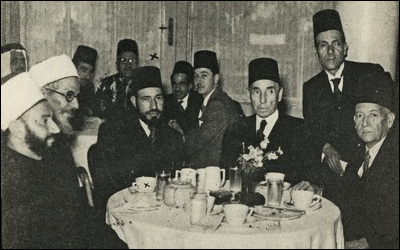
The Muslim Brotherhood was founded in 1928 by Hassan al-Banna (third from left). An Egyptian schoolteacher from a rural town north of Cairo, Banna engaged in Islamist activities from a young age, joining a local group that intimidated and harassed Christians and non-observing Muslims in his hometown.
What to make of the Muslim Brotherhood (MB)? During the Obama years, it became commonplace for the U.S. administration and its Western acolytes to portray the Muslim Brotherhood as a moderate option to “more radical” Muslim groups. Thus, for example, U.S. director of National Intelligence James Clapper incredibly described the organization as “largely secular”[1] while John Esposito of Georgetown University claimed that “Muslim Brotherhood affiliated movements and parties have been a force for democratization and stability in the Middle East.”[2]
On the other hand, in 2014, the United Arab Emirates formally designated[3] the Muslim Brotherhood and its local and international affiliates, including the U.S. based Council on American-Islamic Relations (CAIR),[4] as inter-national terrorist groups. A British government review commissioned the same year similarly asserted that
parts of the Muslim Brotherhood have a highly ambiguous relationship with violent extremism. Both as an ideology and as a network it has been a rite of passage for some individuals and groups who have gone on to engage in violence and terrorism.[5]
In the United States, Sen. Ted Cruz (R-Tex.) and Rep. Mario Diaz-Balart (R-Fla.) have recently introduced legislation to designate the Muslim Brotherhood as a terrorist organization. In February 2016, the U.S. House Judiciary Committee approved a house bill that calls on the State Department to designate the Muslim Brotherhood as a foreign terrorist organization. In July 2016, Rep. Dave Brat (R-Va.) introduced the “Naming the Enemy within Homeland Security Act,” a bill that prohibits the Department of Homeland Security from funding or collaborating with organizations or individuals associated with the Muslim Brotherhood.[6]
The question is—which view is correct? Without doubt, the second one is. The Muslim Brotherhood has been a militaristic organization since its inception and has operated as a terrorist entity for almost a century. It influenced the establishment of most modern Sunni terrorist organizations, including al-Qaeda, al-Gama’a al-Islamiyya (GI) Hamas, and the Islamic State (ISIS). These organizations have either been founded by current or former Brotherhood members or have been directly inspired, indoctrinated, or recruited by MB members and literature. Contrary to what the MB propagates to Westerners, MB violence is not just in the past but is an ongoing activity.
Historical Background
The Muslim Brotherhood was founded in 1928 by Hassan al-Banna (1906-49), an Egyptian schoolteacher and sometime watch repairer from a small rural town north of Cairo. Reared in a deeply devout household steeped in the Hanbali school of Islamic jurisprudence popular among Wahhabi and Salafi jihadists,[7] Banna engaged in Islamist activities from a young age, joining a local group that intimidated and harassed Christians and non-observing Muslims in his hometown.[8] He was also fascinated by secret societies, cults, and fraternal orders, which flourished in Egypt at the time, and this obsession drove him to form the Brotherhood as a fraternity cult with its own secret militia—al-Tanzim al-Khass (the Special Apparatus, also known as the Secret Apparatus)—charged with strategizing, funding, and executing military training and terror activities.[9]
During the first few decades of its existence, the Special Apparatus carried out numerous acts of political violence in Egypt, notably the 1947 assassination of Judge Ahmed Khazinder Bey and the 1948 assassination of Prime Minister Mahmoud Nuqrashi Pasha, who reportedly considered outlawing the MB.[10] At that time, according to a secret U.S. intelligence memorandum, the Brotherhood’s “commando units” were estimated to possess “secret caches of arms … reported to have 60,000 to 70,000 rifles.”[11] This military buildup was ac-companied by infiltration of the Egyptian army, including the conspiratorial group of Free Officers, who in July 1952 overthrew the monarchy in a bloodless coup.[12]
The Secret Apparatus was not only involved in assassinations but also carried out a large wave of terrorism and bombings.[13] Thus, for example, on Christmas Eve 1945 it bombed the British Club in Egypt, and in December 1946 bombed eight police stations in Cairo. Two years later, the Brotherhood bombed several Jewish homes in Cairo and many Jewish owned businesses and cinemas.[14] The Brotherhood also bombed trains in Sharqia and Ismailia, as well as the King George Hotel in Ismailia. In a 1948 raid on one of the organization’s Cairo offices, the police confiscated 165 bombs.[15]
After Banna’s assassination in 1949, Hassan Hudaybi, who succeeded him as MB general guide (al-Murshid al-Amm), claimed to have dissolved the Secret Apparatus in order to ease the government’s persecution of the movement,[16] only to be arrested in 1965 alongside other MB leaders for forming a new militia that engaged in military training with a view to assassinating President Gamal Abdel Nasser.[17] Hudaybi managed to escape with a three-year prison sentence (the MB’s foremost ideologue Sayyed Qutb was executed in 1966 together with two other leaders); his false denial of the MB’s military wing was to become a standard tactic of the Brotherhood to date.
Laying Infrastructure
This denial notwithstanding, the late 1960s and early 1970s saw the formation of a number of MB terror groups under ostensibly independent banners. The first such group was Gama’at al-Muslimin, commonly known as Takfir wa-l-Hijra (Excommunication and Emigration), formed by two leaders of the Secret Apparatus released from prison: Shukri Mustafa and Sheikh Ali Ismael, brother of MB leader Fattah Ismael who was executed alongside Qutb.[18] Another terrorist group created by the Brotherhood at the time was al-Gama’a al-Islamiyya (GI, the Islamic group), which was responsible for the October 1981 assassination of Egyptian president Anwar Sadat. Both groups were founded by active leaders of the Brotherhood, who never claimed to have left the organization or their leadership positions therein. Indeed, in his last speech, one month before his assassination, Sadat equated the GI with the Brotherhood and expressed regret for having released many Brotherhood operatives from prison.[19]
Omar Abdel Rahman (“The Blind Sheikh”) and nine others were convicted of seditious conspiracy in connection with the 1993 bombing of the World Trade Center.
During the 1990s, the Egyptian authorities battled against a sustained wave of Islamist terrorism involving attacks on government officials and the country’s Coptic minority, the murdering of foreign tourists as well as an audacious attempt on the life of President Hosni Mubarak while he was in Ethiopia in June 1995.[20] In the same year, GI’s leader and MB spiritual authority, Omar Abdel Rahman, known as “The Blind Sheikh,” and nine others were convicted of seditious conspiracy in connection with the 1993 bombing of the World Trade Center. Abdel Rahman is currently serving a life sentence in a federal prison in North Carolina, and in Muhammad Morsi’s first speech as Egyptian president in Tahrir Square, he called for Abdel Rahman’s release and acknowledged the sheikh’s family who was present in the audience.[21]
No less important was the formation of the movement’s International Apparatus by Banna’s son-in-law Said Ramadan. Having fled Egypt to Saudi Arabia in 1954, Ramadan moved to Geneva in 1958 where he established the International Apparatus under the guidance of Mustafa Mashour, head of the Secret Apparatus, future MB general guide, and author of its militant manifesto “Jihad Is the Way.”[22] The International Apparatus was not fully operational until the mid-1980s when Mashour, who fled Egypt after Sadat’s assassination, settled in West Germany[23] in 1986 where he reestablished the Apparatus.
The International Apparatus is not just responsible for the Brotherhood’s public operations, but is also involved in operating and funding terrorist groups responsible for attacks on American soil. Thus, for example, Chakib Ben Makhlouf, one of the most prominent leaders of the MB’s Geneva office, is also the president of the Federation of Islamic Organizations in Europe. He has been described by Egyptian member of parliament and terrorism expert Abdel Rahim Ali as “one of the most dangerous operatives of the Brotherhood’s International Apparatus.”[24] Likewise, according to Egyptian general Fouad Allam, who investigated the MB’s operations in the 1960s-70s, the Geneva office funneled funds that helped establish al-Gama’a al-Islamiyya.[25]
Later Influence
The International Apparatus’s most critical mission, though, has been to infiltrate, subvert, and recruit operatives from within the armies, governments, educational systems, and intelligence agencies of the MB’s targeted states, especially in the West, in what is called “civilization jihad.”
This term dates to a 1991 document titled The Explanatory Memorandum, drafted in a meeting that outlined the Muslim Brotherhood’s strategic goals for North America and entered as evidence in the Holy Land Foundation (HLF) terror funding trial in 2008—the largest terror financing case in U.S. history.[26] In 2009, five MB leaders were charged with providing material support to Hamas, the Brotherhood’s Palestinian branch and a designated foreign terrorist organization.
The 1980s and 1990s were the two most important decades for the “civilization jihad.” During this time, Hamas was transformed from an essentially missionary and charitable organization seeking to win Palestinian hearts and minds into a fully-fledged terror group during the first intifada (December 1987-September 1993), and the seeds were sown for the advent of al-Qaeda through the newly-formed Maktab al-Khidamat (MAK, the Services Bureau), also known as Maktab Khidamat al-Mujahidin al-Arab (the Services Bureau of Arab Jihadists) and the Afghan Services Bureau.
As jihadists flocked to Afghanistan and Pakistan to fight the Soviet occupation, the Brotherhood was busy running recruitment, jihadist services through its MAK offices throughout the Middle East. In 1984, MB operative Abdullah Azzam established the MAK office in Jordan.[27] Azzam’s philosophy helped establish and organize the Brotherhood’s “global jihad” movement, which earned him the alias, “The Father of Global Jihad.”[28] No less important, this philosophy inspired GI and Egyptian Islamic Jihad (EIJ) to try to export their terrorism and greatly inspired Osama bin Laden, whom Azzam taught at a Saudi university.[29]
In 1985, MB operatives Abdullah Azzam (L), bin Laden, and Ayman Zawahiri (R) founded MAK in Pakistan, which evolved into al-Qaeda. The Amman MAK recruited Abu Musab Zarqawi, who founded Jama’at al-Tawhid wa-l-Jihad, which evolved into al-Qaeda in Iraq and eventually into ISIS.
In 1985, Azzam, bin Laden and Ayman Zawahiri, leader of Takfir wa-l-Hijra who fled Egypt after the Sadat assassination, founded MAK in Pakistan, which subsequently evolved into al-Qaeda. Meanwhile, the Amman MAK office recruited one of the world’s most brutal terrorists of modern time, Abu Musab Zarqawi.[30] Mentored by Jordanian former MB leader Abu Muhammad Maqdisi, in 1999, Zarqawi founded Jama’at al-Tawhid wa-l-Jihad (Organization of Monotheism and Jihad), which six years later, evolved into al-Qaeda in Iraq (AQI) after Zarqawi pledged allegiance to bin Laden in late 2004. This group eventually morphed into ISIS after Zarqawi’s death in June 2006. Indeed, in a 2014 interview reported in Al-Arabiya News, the Muslim Brotherhood spiritual guide Yusuf Qaradawi admitted that ISIS leader Abu Bakr Baghdadi was a member of the Muslim Brotherhood.[31] For their part, several MB leaders publicly announced their support for ISIS, including the Qatar-based Sheikh Wagdy Ghoneim.[32]
The nature of al-Qaeda’s current relationship with the Brotherhood is somewhat unclear. While Zawahiri argued that bin Laden’s affiliation with the MB was severed in the 1980s due to differences over the anti-Soviet Afghanistan campaign,[33] this claim was discounted by Tharwat Kherbawy, the highest ranking MB member to have defected from the organization,[34] and also by evidence suggesting that the Brotherhood is still organizationally involved with al-Qaeda. Thus, for example, after Morsi’s July 2013 ouster from power, Zawahiri issued a videotaped statement on his behalf where he criticized Egyptian Salafi jihadists for not formally joining the Muslim Brotherhood’s Freedom and Justice Party to help it uphold Shari’a law.[35] In another statement, Zawahiri criticized the deposed MB president for having played politics with opponents,[36] but eventually prayed for his release and supported him while he was facing trial for inciting the killing of regime opponents and for espionage for foreign militant groups including Hamas, Hezbollah, and Iran’s Revolutionary Guard Corp.[37]
A Political Party or a Jihadi Group?
The Obama administration’s stubborn support for the Morsi regime and its tireless attempts to cast the MB as a moderate organization are preposterous—not only because the Brotherhood is the bedrock of some of the worst terror groups in today’s world but also because violence is endemic to the movement’s raison d’être: restoring the caliphate via violent jihad. Were the Brotherhood to give up this foundational goal, it would lose its legitimacy and sole reason for existence. This is why Banna used military terminology in structuring the MB, calling the organization “Allah’s battalion,”[38] a term used to this very day to denote the MB’s governing core; this is why the current Brotherhood leadership includes operatives who personally engaged in violent jihad and terror activities such as Abdel Moneim Abul Futuh.[39]
Osama Yassin, a former minister in Muhammad Morsi’s cabinet, revealed that members of the MB’s 95 Brigade militia engaged in the abduction, beating, and torture of “thugs” during riots leading to Mubarak’s downfall.
Furthermore, the organization’s Secret Apparatus remains intact and operational with new recruits required to undergo military training by such militias as the 95 Brigade,[40] which was established in 1995 and which played an active role in the January 2011 riots leading to Mubarak’s downfall. In a series of interviews with al-Jazeera TV, Osama Yassin, a former minister in Morsi’s cabinet, revealed that members of the brigade engaged in the abduction, beating, and torture of “thugs” and threw Molotov cocktails at their opponents.[41] Asked by an Egyptian newspaper to clarify these revelations,[42] the MB dismissed them as a joke. Still, the brigade operatives were later implicated in the killing of anti-Brotherhood protestors. In March 2014, for example, two operatives were sentenced to death after an online video clip showed them killing a teenager by throwing him from a building.[43]
According to the Brotherhood’s own standards and internal bylaws,[44] there are ten solid, unchangeable thawabit (precepts) in their organization’s bai’a (Islamic oath of allegiance) process. The fourth of these precepts is violent jihad and martyrdom,[45] which the Brotherhood states is an obligation of every individual Muslim, as well as the collective obligation of their organization.
Unfortunately, many American specialists either receive foreign funding or are otherwise oblivious to these facts and actively engage in a disinformation campaign. For example, a Brookings Institute article turned the meaning of the “fourth precept” of the Brotherhood’s bylaws on its head, stating that it stipulated that “during the process of establishing democracy and relative political freedom, the Muslim Brotherhood is committed to abide by the rules of democracy and its institutions.”[46]
Reality, of course, was quite different. When after Mubarak’s downfall the Muslim Brotherhood rose to power in a sham presidential election,[47] which brought its operative Mohamed Morsi to the presidential palace, its violent[48] and undemocratic rule triggered, in short notice, mass protests throughout the country that brought millions of protestors to the streets and enabled the military to overthrow Morsi in a bloodless coup.
Islamic Reformers
Indeed, the sheer brutality of ISIS and various Brotherhood-affiliated or inspired terror groups across the Middle East has led to the advent of a mainstream Islamic reformist movement that draws on vastly more popular support than the Brotherhood itself. This unprecedented revival of a reform-oriented movement has received too little attention in the West. For example, Islam Behery, one of the movement’s heroic leaders, was incarcerated for a year for blasphemy for insulting al-Azhar University and the Sunni doctrine on his television show.[49] For two years, that show had been dedicated daily to exposing the brutality and terrorism of Sunni doctrine while offering a non-theocratic, liberal interpretation of Islam that pushes for separation of mosque and state. Behery received a presidential pardon in December 2016, which was unprecedented in Egyptian history.
Another supporter of reformation and freedom of thought is Ibrahim Issa, a popular Egyptian commentator, television host, and owner and editor-in-chief of the independent opinion newspaper Al-Maqal. Earlier this year, Issa announced that he would end his TV show due to “current events,” kindling speculation that the cancellation was related to Saudi pressure on the Egyptian regime because of Issa’s criticism of the kingdom’s violent Wahhabi sect.[50] Issa’s reformist stance has placed him on terrorist hit lists since 1992, and he has been living under tight security ever since. His opposition to the Muslim Brotherhood has made him one of the organization’s high profile targets, and in 2015, he became the subject of an official fatwa declaring him an “infidel.”[51]
Another heroic figure of Islamic reform currently facing the possibility of incarceration for blasphemy is the popular author and prominent secular figure Sayyed Qemani. His sin: stating that al-Azhar University should be designated a terrorist organization.[52] Behery, Qemani, and their like have the support of the most mainstream media figures in Egypt and across the Middle East, and they have dramatically changed the Islamic political discourse. Yet Western audiences have almost never heard of their heroic efforts.
The war of ideas is highly dynamic in today’s Middle East. The vast majority of the region’s peaceful Muslims are marginalized by Western support for the Brotherhood and the West’s refusal to designate the MB as a terrorist organization.
Conclusion
The deadly Brotherhood cult is responsible for almost a century of terror since the young Banna engaged in the intimidation and harassment of his Christian and moderate Muslim neighbors. Since then, the Brotherhood established Hamas as its Palestinian wing. Three Brotherhood activists established al-Qaeda. Brotherhood leaders, from inside their prisons, founded al-Gama’a al-Islamiyya and Egyptian Islamic Jihad. Brotherhood members recruited the founder of Jama’at al-Tawhid wa-l-Jihad who started the trend of video decapitations, and one of its former operatives is currently acting as the caliph of Islamic State. The MB also has other connections to organizations on the U.S. government’s list of foreign terrorist organizations.
Neither Washington, nor any capital, can hope to counter Islamic terrorism successfully without allying with Muslim
figures fighting on the forefront of the battle of ideas. Washington can give these moderate Muslims a voice by designating the Muslim Brotherhood as a terrorist organization.
The Brotherhood has stated its intention to destroy the West’s “miserable house” by infiltrating Western society and institutions and subverting them from the inside.[53] Designating the Muslim Brotherhood as a foreign terrorist organization will stop its operatives from reaching sensitive positions in the intelligence community and in other powerful U.S. government positions. It will also stop Brotherhood operatives in the United States from funding terrorism operations worldwide.
[12] Khaled Mohieddin, Al’an Atakkalam: Mudhakkirat al-Thawra (Cairo: American University of Cairo Press, 1995), p. 45; Hassan Ashmawy, Mudhakkirat Harib (Cairo: Islamic Publishing House, 2000), p.15.
[13] Farouk Taifour, “Al-Juz’ al-Rabi: al-Ikhwan wa’l-Tanzimat al-Sirriya,” Egyptian Institute for Political and Strategic Studies, Cairo, EIPSS-EG.org, Feb. 24, 2016.
[22] Mustafa Mashour, “Al-Jihad huwa al-Sabil,” The Official Muslim Brotherhood Encyclopedia, IkhwanWiki.com, accessed Aug. 31, 2016; idem, “Jihad Is the Way,” trans. Palestinian Media Watch, Jerusalem, Feb. 9, 2011.
[27] Farouk Taifour, “Hal Kharajat Daesh min Rahm Fikr al-Ikhwan al-Muslimin?” Egyptian Institute for Political and Strategic Studies, Cairo, EIPSS-EG.org.
[28] “Abdullah Azzam: Overview,” Counter Extremist Project, New York, accessed Feb. 9, 2017.
[35] “Ta’kib al-Sheikh Ayman al-Zawahiri ala Azl Morsi wa-Tahdid al-Jaish,” You Tube, July 5, 2013.
[36] “Ayman al-Zawahiri Yuwajih Risalat Itab li-Morsi wa-Yadou Allah an Yafuku Asrahou,” You Tube, Feb. 11, 2014; Erich Follath, “Political Stability Eludes Polarized Egypt,” Der Spiegel (Hamburg), July 29, 2013.
[44] “Bylaws of the International Muslim Brotherhood,” June 1928.
[45] Muhammad Kandil, “Al-Thabit al-Rab’i: al-Jihad Salbiluna,” The Official Muslim Brotherhood Encyclopedia, IkhwanWiki.com, accessed Sept. 1, 2016; “The Muslim Brotherhood: Understanding its Roots and Impact, 1. Overview,” Foundation for Defense of Democracies, Washington, D.C., accessed Feb. 9, 2017.
[47] Daniel Pipes and Cynthia Farahat, “Egypt’s Sham Election,” National Review Online, Dec. 6, 2011; Shuruk News (Cairo), Mar. 22, 2016.
[48] Amb. Yahia Najm, Akhbar al-Yom TV (Cairo), in Cynthia Farahat, “CairoGate: Egyptian Diplomat Survives MB Torture Says ‘It was like a Nazi camp,'” Dec. 9, 2012.
[51]Bawabat al-Haraqat al-Islamiya (Cairo), Mar. 18, 2015. The fatwa was subsequently broadcast on the official Muslim Brotherhood television channel Rabaa, broadcasting from Turkey. See Al-Arabiya News, Dec. 5, 2017.
Fourteen people are killed, 51 wounded in suicide bombing in Tekhnologichesky Institut metro station in St. Petersburg, Russia • Bomber linked to radical Islamists groups • PM Netanyahu: Israel stands alongside the Russian people at this difficult time.
News Agencies and Israel Hayom Staff
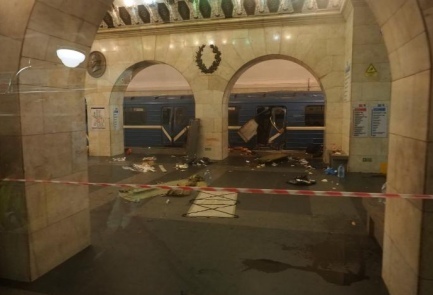
A train carriage damaged from the explosion at Tekhnologicheskiy institute metro station in St. Petersburg, Monday
<<
1
2
>>
A blast in a St. Petersburg train car on Monday that killed 14 people and wounded 51 was carried out by a suicide bomber with ties to radical Islamists, Russia’s Interfax news agency cited a law enforcement source as saying.
Russia’s National Anti-Terrorist Committee said an explosive device had been found at another station, hidden in a fire extinguisher, but had been defused.
There was no immediate claim of responsibility. Russian media reported Tuesday that the bomber was a Kyrgyz-born Russian citizen. A spokesman for Kyrgyzstan’s security service said it had received an official request from Russian security services to identify the suspect.
Kyrgyzstan, a predominantly Muslim Central Asian nation of 6 million, is Russia’s close political ally and hosts a Russian military airbase.
The blast raised security fears beyond Russian frontiers. France, which has itself suffered a series of attacks, announced additional security measures in Paris.
Russian President Vladimir Putin, who was in the city when the blast struck, visited the scene of the explosion late on Monday night and laid flowers at a makeshift shrine to the victims.
Russia has been on particular alert against Russian-speaking rebels returning from Syria, where they have fought alongside Islamic State, and is wary of any attempts to resume attacks that dogged the country several years ago.
Russia has experienced bomb attacks carried out by Islamist rebels from Russia’s North Caucasus region in the past. The uprising there has been largely crushed, but Russia’s military intervention in Syria has now made it a potential target for attacks by the Islamic State group, security experts say.
Earlier, Russian media broadcast closed circuit television footage of a bearded man they said was being sought by police as a suspect. However, Interfax reported that the man had come forward and been eliminated from inquiries.
The news agency, quoting an unidentified law enforcement source, said that human remains examined at the scene suggested that the blast had been carried out by a suicide bomber. It said the police had identified a suspect with links to radical Islamist groups banned in Russia.
If it is confirmed that the bomb was carried out by radical Islamists, the Kremlin is likely to argue the attack underlines the importance of its campaign in Syria, where it is backing President Bashar Assad in a fight against Islamist militants.
However, some sections of Russian society could see the metro bombing as proof that Putin’s decision to intervene in Syria has again made Russian civilians into targets.
Two years ago, Islamic State brought down a plane carrying Russian tourists home from a Red Sea resort. All 224 people on board the flight were killed.
U.S. President Donald Trump spoke with Putin on Monday to offer condolences to the victims of a attack. The White House issued a statement saying, “President Trump offered the full support of the United States government in responding to the attack and bringing those responsible to justice. Trump and President Putin agreed that terrorism must be decisively and quickly defeated.”
A statement by the Kremlin said Trump “extended his deep condolences to the relatives and loved ones of those killed as result of a barbaric terrorist act. The presidents noted that terrorism is the evil against which it is necessary to fight together.”
Putin reportedly thanked his American counterpart for showing solidarity with the Russian people.
Prime Minister Benjamin Netanyahu also offer Putin his condolences over the attack.
“On behalf of the government of Israel, I send condolences to President Putin and to the families of those who were murdered, following today’s bombing on the St. Petersburg subway. Israel stands alongside the Russian people at this difficult time.”
China also condemned the attack, with Foreign Minister Wang Yi offering condolences and support in a statement that said, “China resolutely opposed all types of terrorism.”
President Donald Trump gives a thumbs up to members of the media as he greets Egyptian President Abdel Fattah el-Sissi at the White House in Washington, Monday, April 3, 2017. (AP Photo/Andrew Harnik)
Among the issues reportedly discussed during Monday’s 150-minute meeting between US President Donald Trump and his Egyptian counterpart, Abdel-Fattah el-Sissi, were “ideas” for a possible Israeli-Palestinian peace summit to be held in Washington this coming summer.
While the initiative is in its beginning stages, the discussions complemented the recent meetings US Special Envoy for International Negotiations Jason Greenblatt held with Arab leaders, American diplomatic sources told the London-based al-Hayat newspaper in a report Tuesday morning.
At the Arab League Summit in Jordan last week, Greenblatt told Arab foreign ministers that Trump was committed to reaching a peace deal between Israel and the Palestinians that would “reverberate” throughout the Middle East and the world.
US Middle East envoy Jason Greenblatt meets Palestinian Authority President Mahmoud Abbas on the sidelines of the Arab League Summit in Amman, March 28, 2017 (Wafa/Thair Ghnaim)
During the summit Sissi said that his country had “sought and continues to seek a comprehensive and just solution to this issue, based on the establishment of a Palestinian state on the 1967 borders with East Jerusalem as its capital.”
During their Monday sit-down, which was characterized as “warm” and “positive,” Sissi told Trump, “You, Mr. President, can find a solution” to the Israeli-Palestinian impasse, pledging his country’s full support for any effort that would bring about a resolution.
The Egyptian president said peace between Israel and the Palestinians would be “the deal of the century,” echoing language used by Trump.
“You have a great friend and ally in the United States and in me,” Trump told Sissi, sweeping aside his predecessor’s concerns about democratic abuses in Egypt.
According to the Dubai-based al-Khaleej Times, Sissi and Jordan’s King Abdullah II were to present Trump with a framework for an Israeli-Palestinian peace deal during their respective visits to the White House this week.
Abdullah’s White House visit is scheduled for Wednesday.
Jordan’s King Abdullah II (R) and Egyptian President Abdel Fattah el-Sissi at Queen Alia International Airport in Amman on March 28, 2017. (AFP Photo/Khalil Mazraawi)
The initiative would reportedly start with a series of gestures, including a long-delayed release of Palestinian prisoners held in Israel and a complete moratorium on all Israeli settlement building in the West Bank.
Trump would then respond to the Jordanian-Egyptian initiative during his meeting with PA President Mahmoud Abbas, tentatively scheduled for later this month in Washington.
While al-Khaleej also reported that Trump is aiming to host an international peace conference, the Dubai paper suggested it would be held in September.
Tamar Pileggi and Dov Lieber contributed to this report
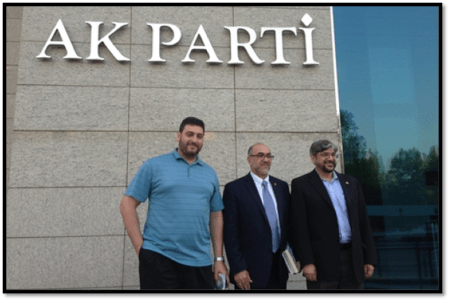
Osama Abu-Irshaid (National Director of American Muslims for Palestine, AMP, a founding member of the USCMO), USCMO Secretary General Oussama Jammal (center) and Naeem Baig (President of the Islamic Center of North America, ICNA, a founding member of the USCMO) outside AK Party Headquarters in Ankara, Turkey, during an August 2014 visit
While the Center for Security Policy has followed the activities of the USCMO, MLFA and AMJA, the realization of just how closely the Turkish government at the highest level is working in collusion with these Muslim Brotherhood-associated groups to thwart any legal measures that may be directed their way by the new Trump administration and Department of Justice led by Attorney General Jeff Sessions still comes as something of a shock. The U.S. Brotherhood and its international partners were way ahead of the Trump team in foreseeing a possible renewal of legal risk and liability under this new management and began taking steps to confront it. They bring significant financial and legal resources to the fight, plus, as we now see, state-level backing from NATO member Turkey whose pro-HAMAS stance has long been known.
But given that an official organization of the Ankara regime is now operating a large Center (with numerous associated centers and mosques) barely thirteen miles from the U.S. Capitol and working there in collaboration with the U.S. Muslim Brotherhood to thwart possible legal actions by the U.S. government is certainly noteworthy. As the international as well as U.S. Muslim Brotherhood gear up for coming confrontations, so must U.S. national security leadership as well.
************************
During the 2016 U.S presidential campaign, senior leadership figures of the United States Council of Muslim Organizations (USCMO) began strategic planning to ensure the advancement and protection of the group’s objectives, no matter who won the White House. USCMO Secretary General Oussama Jammal and HAMAS dba Council on American Islamic Relations (CAIR) Executive Director Nihad Awad set plans in motion to defend the Muslim Brotherhood’s Civilization Jihad inside the U.S. Those objectives were first exposed and described in the Center’s 2015 publication, in Star Spangled Shariah: The Rise of America’s First Muslim Brotherhood Party.
Joining directly in those efforts then and now is the pro-HAMAS Turkish government, under the leadership of President Recep Tayyip Erdoğan and his Justice and Development Party (AKP). The groundwork for what is now a close working relationship began well before the March 2014 announcement of the USCMO’s formation, but it is known that on 15 May 2013, a visiting President Erdoğan placed a ceremonial stone on the 16-acre construction site that would become the Turkish Diyanet Center of America in Lanham, Maryland. The following year, in August 2014, a USCMO delegation led by Secretary General Oussama Jammal traveled to Ankara to meet with President Erdoğan and AK Party leaders. And then, on 29 December 2014, in a recorded video message, Dr. Mehmet Görmez, President of the Presidency of Religious Affairs (Diyanet), addressed the 13th Annual MAS-ICNA (Muslim American Society-Islamic Circle of North America) Conference in Chicago, Illinois and discussed a gift for all Muslims: the Turkish Diyanet Center of America. Of note for the future of the US Muslim Brotherhood-Turkish relationship, this conference was sponsored by the Turkish-backed American Zakat Foundation and included the first-ever attendance of a Turkish-American group at a MAS-ICNA conference.
Turkish President Recep Tayyip Erdoğan shaking hands with USCMO Secretary General Oussama Jammal during the USCMO delegation reception with Erdoğan in NYC in September 2016
Turkish President Recep Tayyip Erdoğan addressing an assembly of US Muslim Brotherhood leadership during the week of the September 2016 UN General Assembly meeting. USCMO Secretary General Oussama Jammal is in the front row at the far right, Mazen Mokhtar, Executive Director of the Muslim American Society (MAS), can be seen in the middle, and Nihad Awad, CAIR Executive Director, is seated at the far left. Awad also welcomed the Turkish government delegation to CAIR’s WDC headquarters that same week.
It will be recalled that Erdoğan himself joined U.S. President Barack Obama on 2 April 2016 at the opening ceremonies for the Diyanet Center of America, located on a large 16-acre site in Lanham, Maryland. The Diyanet Center, also known as the Turkish American Cultural Center (TACC), is a wholly-owned facility of The Presidency of Religious Affairs, an official state institution of the Turkish government.
Under the Trump administration, the USCMO is especially concerned with legal issues, as calls were heard during the 2016 campaign urging that the 2008 Holy Land Foundation (HLF) HAMAS terror funding trial be re-opened to pursue possible cases against the more-than-200 unindicted co-conspirators named by the Department of Justice. Apparently concerned over possible vulnerability should the books of mosques, Islamic Centers and Muslim Brotherhood front groups come under renewed official scrutiny, CAIR and other members of the USCMO therefore engaged the services of the Muslim Legal Fund of America (MLFA), itself a founding member of the USCMO.
It should come as no surprise, then, that the first major event to be co-sponsored by the USCMO, TACC and the MLFA in the Trump era will be a 13 May 2017 Muslim Non-Profit Leadership Conference, to be held at the Diyanet Center of America. Among the program topics are Safeguarding 501(c)3 status; Board fiduciary responsibilities; record keeping and disclosure requirements; Fundraising regulations, state registrations, unrelated business income; and Banking regulations, FDIC, DOJ, Watchlists, international charitable giving.
One of the MLFA’s top legal representatives, now working openly with the U.S. Muslim Brotherhood, is U.S. Navy Lieutenant Commander (ret.) Charles Swift, formerly of the Judge Advocate General’s Corps. Swift, a 1984 graduate of the U.S. Naval Academy, who was recognized by the Muslim Brotherhood for his legal role advocating for client Salim Ahmed Hamdan in the U.S. Supreme Court case Hamdan v. Rumsfield548 US 557 (2006). This role doubtless contributed to the choice of Swift as Director and Counsel for the Constitutional Law Center for Muslims in America (CLCMA), a project of the Muslim Legal Fund of America led by Executive Director Khahil Meek.
The MLFA’s CLCMA project presents itself as dedicated to two primary missions:
“Challenging governmental security measures affecting Muslim communities which encroach upon the constitutional liberties guaranteed to all.”
“Protecting the rights of Muslim individuals and organizations in the United States to exercise their constitutionally and statutorily protected rights to worship.”
Pictured left to right: “Jihadis in Suits” Nihad Awad, Khalil Meek, Oussama Jammal
In apparent pursuance of these missions, the MLFA continues actively to seek the release from federal prison of defendants in the HLF trial, which concluded in late 2008 with a unanimous guilty verdict on all 108 counts. The MLFA also engages in lawfare, using lawsuits as an offensive means of shutting down opposition to its civilization jihad operations. For example, as noted by the Thomas More Law Center in the 2009 case of Joe KAUFMAN, Appellant, v. ISLAMIC SOCIETY OF ARLINGTON, Texas, Islamic Center of Irving, DFW Islamic Educational Center, Inc., Dar Elsalam Islamic Center, Al Hedayah Islamic Center, Islamic Association of Tarrant County, and Muslim American Society of Dallas, Appellees, No. 2-09-023-CV: “The head of that organization [MLFA], Khalil Meek, admitted on a Muslim radio show that lawsuits were being filed against Kaufman and others to set an example. Indeed, for the last several years, Muslim groups in the U.S. have engaged in the tactic of filing meritless lawsuits to silence any public discussion of Islamic terrorist threats.”
More recently, in response to U.S. President Donald J. Trump’s early March 2017 revised executive order to restrict immigration from six Muslim-majority nations, the MLFA working in conjunction with the USCMO, is referring all Muslims to its “advisory prepared by Constitutional Law Center for Muslims in America.” The MLFA may cloak itself in the colors of Star Spangled Shariah as a “constitutional rights organization” but Executive Director Khalil Meek still whines that “We continue to be troubled by this administration’s ongoing attempts to single out Muslims for adverse actions. Such blatant discrimination is a violation of our nation’s constitutional freedoms of speech, expression and religion.”
Finally, it is worth taking note of the following guidance. The Assembly of Muslim Jurists of America (AMJA) provides the authoritative juridical backup on Islamic Law (shariah) for the American Muslim community and U.S. Islamic legal organizations such as the MLFA. Addressing the U.S. Muslim community on 28 November 2016, shortly after Donald Trump won the U.S. presidential election, AMJA issued the following bracing statement:
“No one could possibly be unaware of the political storm that has recently overtaken this country…For this reason, the Assembly of Muslim Jurists in America is addressing the Imams, Islamic workers and the entire Muslim community with permanent values that must be emphasized during this stage as well as a number of principles to be used in dealing with these events, what has happened as well as what is expected to happen…Islam, with respect to its belief and legal foundations, is unalterably fixed. It does not accept any replacement for change.” (emphasis added)
While the Center for Security Policy has followed the activities of the USCMO, MLFA and AMJA, the realization of just how closely the Turkish government at the highest level is working in collusion with these Muslim Brotherhood-associated groups to thwart any legal measures that may be directed their way by the new Trump administration and Department of Justice led by Attorney General Jeff Sessions still comes as something of a shock. The U.S. Brotherhood and its international partners were way ahead of the Trump team in foreseeing a possible renewal of legal risk and liability under this new management and began taking steps to confront it. They bring significant financial and legal resources to the fight, plus, as we now see, state-level backing from NATO member Turkey whose pro-HAMAS stance has long been known.
But given that an official organization of the Ankara regime is now operating a large Center (with numerous associated centers and mosques) barely thirteen miles from the U.S. Capitol and working there in collaboration with the U.S. Muslim Brotherhood to thwart possible legal actions by the U.S. government is certainly noteworthy. As the international as well as U.S. Muslim Brotherhood gear up for coming confrontations, so must U.S. national security leadership as well.
The unashamed glorification of murderers; terrorists paraded as role models and paragons of virtue to yet another generation of Palestinians. Under these conditions of unremitting incitement, no Palestinian can talk about peace with Israel.
When President Abbas visits the White House, it will be interesting to see if his “peace” stance includes a discussion of the Diploma for Terror.
*********************************
A glance at their leaders and senior officials tells them that Palestinian Authority jobs go to “graduates” of Israeli prisons.
Besides sending a message to Palestinians about who is valued in Palestinian society, the Fatah leader is also making it clear that the path to leadership and employment passes through Israeli prisons. Abbas’s senior representative is telling Palestinians that there is no need for them to pursue actual education: Israeli prisons are the best “universities.”
The longer the time spent in prison, the higher the military rank. Ten years will earn them the rank of Colonel. More than that will earn them General. The path to winning a job with a PA ministry also passes through Israeli prisons. These are the leaders touted as role models to young Palestinians.
Palestinians who are being held in Israeli prisons are “a model for sensibility and national culture and constitute a pillar for the establishment of a Palestinian state.” This glorification of Palestinian prisoners, many of whom are behind bars for murdering Jews, was issued last week by Fayez Abu Aitah, a senior representative of President Mahmoud Abbas’s ruling Fatah faction.
Abu Aitah’s words of appreciation for murderers of Jews came during a visit he paid to Hatem al-Maghari, a Palestinian Authority (PA) policeman who was released last week after serving 17 years in prison for his role in the lynching of two Israeli reserve soldiers who mistakenly entered Ramallah. Upon his arrival at his home in the town of Rafah in the southern Gaza Strip, Al-Maghari received a hero’s welcome. Hundreds of Palestinians have since converged on his home to congratulate him on his release from prison and heap praise him on for his “contribution” to the Palestinian cause.
Abbas’s Fatah was quick to embrace al-Maghari as “one of our sons” in order to send a message to Palestinians that the Fatah faction is also involved in terror attacks against Israel. For years, Fatah’s opponents have been accusing it of abandoning the “armed struggle” in favor of a peace process with Israel. Groups such as Hamas, Popular Front for the Liberation of Palestine (PFLP) and Palestinian Islamic Jihad continue to criticize Fatah for not being sufficiently active in the terror campaign against Israel.
The release of al-Maghari provided an opportunity for Fatah to remind its Palestinian enemies of its “contribution” to the war against Israel. The lynching of the two soldiers inside a Palestinian Authority police station in Ramallah was one of the most brutal crimes perpetrated by Palestinians. The PA leadership has never accepted responsibility for the lynching of the two soldiers, who were being held by PA policemen inside the station after taking a wrong turn into the city as they were on their way to their base.
The hero’s welcome that al-Maghari received and the words of praise from Fatah leaders serve as a reminder of how murderers of Jews continue to be hailed as role models for Palestinians. President Abbas and his PA and Fatah representatives have long lauded Palestinian prisoners held by Israel as “heroes” and future leaders of a Palestinian state.
As Abu Aitah explained during his well-wishing visit to the released terrorist:
“The prisoners are the pillar of our national movement. They have sacrificed the best of our committed and responsible national cadres that are leading the struggle of our people. Our prisoners have turned (Israeli) prisons into universities from where the future leaders graduate.”
Besides sending a message to Palestinians about who is valued in Palestinian society, the Fatah leader is also making it clear that the path to leadership and employment passes through Israeli prisons. In no uncertain terms, he is saying to young Palestinians: “If you want to become a leader, you need to prove your qualifications by following the example of those Palestinians who carried out terror attacks against Israel and spent time in Israeli prison.” Again: Abbas’s senior representative is telling Palestinians that there is no need for them to pursue actual education: Israeli prisons are the best “universities.”
Palestinians have every reason to believe Abu Aitah; he is the top Fatah official. Just a glance at their leaders and senior officials tells them that Palestinian Authority jobs go to “graduates” of Israeli prisons. There is no shortage of such leaders who rose to power thanks to their involvement in terror attacks against Israel.
In the world of the Palestinians, terror is indeed the diploma of currency. Serving time in Israeli prison can even earn one a military rank without having to go to any military or security academy.
The PA, according to Palestinian sources, has one of the largest numbers of Generals and Colonels in the Arab world. Most of these high-ranking officers earned their titles thanks to the time they served in Israeli prison, not because they studied at any military academy.
Take, for example, Jibril Rajoub, the former commander of the Palestinian Authority’s notorious Preventive Security Force, who holds the rank of Major-General. Rajoub’s rank is largely the result of the 17 years he spent in Israeli prison for his role in terrorism. Rajoub is only one of dozens, if not hundreds, of former prisoners who hold such high-ranking titles but do not have any real military background.
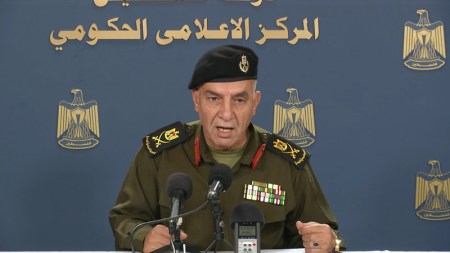
Many high-ranking PA security officials, such as Major-General Adnan Damiri, spokesman for the PA security forces, wear medals and decorations on their military uniforms even though they have not participated in any war. Damiri spent 10 years in Israeli prison for security-related offenses.
Many high-ranking Palestinian Authority (PA) security officials, such as Major-General Adnan Damiri, spokesman for the PA security forces, wear medals and decorations on their military uniforms even though they have not participated in any war. (Image source: PA video screenshot)
These are the leaders touted as role models to young Palestinians. No small number of Palestinian senior “officers” failed even to complete their high school education. But that should not bother any Palestinian who is dreaming of assuming a senior job in a Palestinian state.
On April 17, the Palestinians will again mark “Palestinian Prisoners’ Day” by holding as series of rallies in solidarity with prisoners who carried out terror attacks against Israel. This event is marked every year by Palestinians to honor the “heroes” who made “huge sacrifices” on behalf of the Palestinians.
These “sacrifices” include the maiming and murder of Jews. The annual event in the West Bank is sponsored and funded by Abbas’s Fatah, in turn funded by Europe and the West, in the context of glorifying terrorists and encouraging Palestinian youths to follow their presumably heroic example.
A Palestinian teenager who wishes to become a “general” under Abbas need not apply to any sort of academy. The shortest route to achieve rank is by carrying out a terror attack against Israel and doing time in Israeli prison. The longer the time spent in prison, the higher the military rank. Ten years will earn them the rank of Colonel. More than that will earn them General. The path to winning a job with a Palestinian Authority ministry also passes through Israeli prisons. Former prisoners are treated as the “good boys of the revolution” and granted the plum jobs. Meanwhile, those Palestinians who actually choose to become educated once again lose out.
It would be no surprise, then, if al-Maghari finds himself awarded the rank of General in Abbas’s Fatah-controlled security forces.
And so it continues: the unashamed glorification of murderers; terrorists paraded as role models and paragons of virtue to yet another generation of Palestinians. Under these conditions of unremitting incitement, no Palestinian can talk about peace with Israel.
When President Abbas visits the White House, it will be interesting to see if his “peace” stance includes a discussion of the Diploma for Terror.
In an article titled “Does Hizbullah Threaten Israel or Us” in the English-language Saudi daily Arab News, Lebanese columnist Diana Moukalled commented on the recent escalation in Hizbullah Secretary-General Hassan Nasrallah’s threats against Israel, including his threat to target Israel’s nuclear reactor in Dimona.[1] She assessed that this escalation in Nasrallah’s rhetoric is an attempt to make up for Hizbullah’s military losses in Syria and to garner popular support in light of the decline in Hizbullah’s and Iran’s global standing. She also noted that his threat to target the reactor is irresponsible because thousands of Palestinian and Israeli civilians live near it. Noting that Iran often uses Lebanon as an arena for its “adventures,” she warned that the current political climate might prompt Iran and Hizbullah to renew their aggression against Israel – which would be catastrophic for Lebanon, even more so than in previous confrontations.
“Israel has reacted to recent statements by Hezbollah leader Hassan Nasrallah with a mixture of mockery and cynicism, as he said Hezbollah was ready to bomb the Dimona nuclear reactor or ammonia tanks. Israeli websites reported military discussions indicating that Israel believes Hezbollah is facing a dilemma over aid and funds due to the fighting in Syria.
“In the past, Israel dealt more seriously and carefully with Hezbollah threats and movements, but this has seemingly changed. I am in no way praising Israel, an occupying racist state, or minimizing its danger as an aggressor. Rather, this is an attempt to understand the whirlwind of rhetoric recently launched by Nasrallah, which affects Lebanese, Palestinians and others living mere kilometers from the Dimona reactor.
“Everyone, primarily Hezbollah, knows that the results of any war or military action against Israel will be catastrophic. Nasrallah may have learned this lesson, since the southern front with Israel has been calm since the end of the last war 11 years ago.
“As such, escalating rhetoric to target nuclear reactors — near to which thousands of Palestinian and Israeli civilians live, and would be harmed by substantial radioactive fallout — is at the very least irresponsible and no more than a popular mobilization attempt.
“But these empty slogans seem more necessary today than ever, as Nasrallah’s words seem to be an attempt to rebuild a combat position against Israel and make up for Hezbollah’s losses in Syria. This approach seems logical given the view that rapid political developments and the international consensus around Syria will lead to Hezbollah’s exit from the country. This would result in an Iranian response wherever it can do so.
“In a realistic characterization of current politics, now is not the time to make decisions, but to make a show of force and assemble cards to be presented while waiting for a clearer understanding of US regional policy. Continued escalation against Iran and its influence in Syria may lead to Tehran and Hezbollah reverting to a policy of confrontation, including against Israel. Where better than Lebanon as a gateway for new Iranian adventures?
“But the situation is not as it was during the 2006 war, as Israel says its response will be massive against Hezbollah and Lebanon if Hezbollah takes military action against it. This threat includes Israel’s preparedness to target all Lebanese territory. Lebanese President Michel Aoun’s comments that Hezbollah’s weapons complement the role of the army serve as a pretext for Israel to target the army as well.
“The appropriate conditions to target Hezbollah will come soon, but Israel is in no rush for military action as it is monitoring Hezbollah’s financial, moral and military depletion in Syria, amid Arab hostility toward Hezbollah, compared with support in 2006, due to its regional role at Iran’s behest. Any threat posed by Hezbollah will affect Lebanese before anyone else, and more severely than in previous wars and crises.”
A U.S. Customs and Border Protection Air and Marine agent peers out of the open door of a helicopter during a patrol flight over McAllen, Texas, near the U.S.-Mexico border. (Associated Press)
The Homeland Security Department has been reluctant to send helicopters on nighttime missions to aid the Border Patrol, leaving agents to face drug smugglers and illegal immigrants without critical air cover, the chief of the agents’ labor union told Congress late last month.
Brandon Judd, an agent who is also president of the National Border Patrol Council, said that unless President Trump can solve that kind of bureaucratic bungling — and is willing to oust the Obama administration figures who botched the policies — he will struggle to secure the border.
The helicopters are one example of that, Mr. Judd said.
Mr. Judd said that when the Border Patrol controlled its own helicopters, it got the air support it needed. But after the Homeland Security Department was created more than a decade ago, the helicopters were turned over to the Office of Air and Marine, which has been reluctant to fly the nighttime hours the agents need.
“Right now the Office of Air and Marine, they fly very little at night,” he told the Senate Homeland Security and Governmental Affairs Committee. “In fact, in [the Rio Grande Valley sector], we had to use Coast Guard to fly sorties in certain areas. And when their apprehensions became so great, it’s my understanding the officer at Air and Marine asked them not to fly anymore at night in RGV because it was making them look bad.”
Officials at U.S. Customs and Border Protection, the agency that oversees both the Border Patrol and the Air and Marine division, declined to comment.
But Mr. Judd said it’s just one example of a bureaucracy erecting hurdles — what he called “kingdom-building” — that he said could stymie Mr. Trump’s immigration goals.
“We talk about securing the border, and the border — we can absolutely secure it, but it cannot be secure if our operations are not sound,” Mr. Judd told The Washington Times.
“What’s very concerning to Border Patrol agents is, to this point, we still have the same people who gave us all of the failed operations, who were the authors of the catch-and-release program. They’re still in charge — even under this current administration,” the union chief said. “That’s head-scratching, especially since the president said we’re going to drain the swamp.”
Mr. Trump’s early changes to enforcement policy, freeing agents to carry out the law enforcement duties they signed up for, has helped boost morale, said Mr. Judd and Chris Crane, the head of the union for the Immigration and Customs Enforcement Council.
But they said the agencies’ leadership needs attention.
Mr. Crane said “a good ol’ boy network” pervades ICE, which he said is too heavy on managers who get in the way of agents trying to enforce immigration laws in the interior. He said agents are eager to enforce laws against employers who hire illegal immigrants, but their hands are tied.
The complaints of bureaucratic bungling struck home with both Democrats and Republicans on the homeland security committee, who said they are eager to find bipartisan areas where they can help the agents get things going.
One challenge is the polygraph test, which all Border Patrol applicants must pass. The agency’s 75 percent failure rate is higher than that of any other law enforcement department, but the top brass say they are committed to it — even as they prepare to try to hire 5,000 more agents to comply with Mr. Trump’s executive orders.
Even police officers who have passed polygraphs for their current jobs but who are looking to transfer can end up failing, Mr. Judd said.
Both Democrats and Republicans said they are eager to clean up the immigration agencies within the Homeland Security Department and would like to find common ground with the agents and officers.
Sen. Claire McCaskill, Missouri Democrat, said the panelists want to know the names of bureaucrats who are standing in the way of smart enforcement — though she said the ICE and Border Patrol unions, which endorsed Mr. Trump in the election campaign, may have a greater claim to the president’s ear.
Still, one Democrat, Sen. Kamala D. Harris of California, said she worries that the agency is expanding too quickly, without training to protect illegal immigrants from overzealous enforcement. She wanted to make sure agents weren’t going after lesser-priority targets.
“When troops on the ground have not been trained, it leads to dysfunction because there is a lack of consistency and accountability and direction,” she told Mr. Crane, the chief of the union for ICE agents and officers.
Mr. Crane told her she misunderstood how agents in the field carried out their priority targeting.
Mr. Crane and Mr. Judd also said the government needs to be careful about salaries. Because ICE agents have higher pay and often have better living options away from remote border communities, Border Patrol agents may rush to join the other force.
Part of the problem is the complicated bureaucratic web.
ICE and the Border Patrol are separate law enforcement divisions within Homeland Security.
That bureaucratic mess also helps explain the problem with helicopter patrols along the border.
The Border Patrol used to have its own helicopters, but after CBP was created as part of Homeland Security, the Air and Marine division was created as a separate agency within CBP. Now, when agents want the assistance of eyes in the sky, they have to go outside their own chain of command.
Mr. Judd said the helicopters are a perfect illustration: Most illegal crossings are attempted at night, and air support is critical for maintaining visibility.
Just as important, when those attempting to sneak in hear a helicopter overhead, they are less likely to run — making the apprehension easier and less dangerous for agents.
Mr. Judd said the air division has dedicated most of its resources to the Border Patrol, but not at the right times, leaving the agents without night cover.
“We expected to see a huge change in the way CBP operates. There’s been no change to this point,” he said.
CBP has long faced questions about its use of air resources. The Homeland Security inspector general has been particularly withering in its evaluation of the drone program, saying CBP has a tough time keeping its aircraft aloft and in scheduling missions and can’t demonstrate the worth of the program.
CBP officials have said the inspector general is using suspect calculations.
Flights themselves can be dangerous.
In 2015, a helicopter was called in to assist local police who were trying to stop a drug smuggling attempt near Laredo, Texas. As the helicopter was making its second pass, it took fire from the Mexican side — perhaps as many as 15 rounds, two of which struck the aircraft.
CBP officials later said the man who fired on the helicopter was a specialized contractor whom the smugglers used to provide cover for their operations. Mexican authorities caught the man.
But in hopes of sending a message to the cartels, CBP sent to the region several Black Hawk helicopters, which can be armored to withstand enemy fire while continuing to fly.













 anneinpt
 artaxes
 danmillerinpanama
 davidking1530
 Peter Hofman
 Joseph Wouk
 Peter
Peter Louisiana Steve
 WarSclerotic
Recent Comments