Tom Fitton Discussing the Anti-Trump ‘Deep State’ and JW’s Lawsuits Over Voter Rolls & Ammo Bans, Judicial Watch via YouTube, April 14, 2017
Sharia Councils and Sexual Abuse in Britain, Gatestone Institute, Khadija Khan, April 14, 2017
As bad as this is, there is an even darker side to the story: Under sharia law, the second husband is under no obligation to give his wife a quick divorce – allowing him to keep her as his virtual sex slave for as long as he wishes.
If one asks how all of this jibes with British law, the answer is that it does not.
The UK-based NGO, Muslim Women’s Network, penned an open letter — with 100 signatories — to the British government and Home Affairs Select Committee demanding that the Sharia Council be investigated to determine whether its practices adhere to British law. In response, the Sharia Council declared the letter to be “Islamophobic” and accused the Muslim Women’s Network of being an anti-Muslim organization.
It is British law, not sharia, law that protects Muslim individuals and couples, as it does any other citizen. Contrary to what apologists for this travesty say, the plight of Muslim women should be treated as an issue of human rights.
The most recent scandal surrounding the sexual exploitation of Muslim women by Islamic religious leaders in the UK is yet further proof of the way in which Britain is turning a blind eye to horrific practices going on right under its nose.
A BBC investigation into “halala” — a ritual enabling a divorced Muslim woman to remarry her husband by first wedding someone else, consummating the union, and then being divorced by him — revealed that imams in Britain are not only encouraging this, but profiting financially from it. This depravity has led to many such women being held hostage, literally and figuratively, to men paid to become their second husbands.
This ritual, which is considered a misinterpretation of Islamic sharia law even by extremist Shi’ites and Saudi-style Salafists, is practiced by certain Islamic sects, such as Hanafis, Barelvis and Deobandis. When a husband repeats the Arabic word for divorce — talaq — three times to his wife, these sects consider a Muslim marriage null and void. For such a woman to be allowed to return to the husband who banished her, she must first marry someone else — and have sex with him — before the second husband divorces her.
These divorce rites, despite the laws of the land, are common in India, Bangladesh, Pakistan and other Asian countries, where a majority of the people belong to the Hanafi, Barelvi or Deobandi sects. Nevertheless, local seminaries, mosques and online services openly advertise and promote halala with impunity; it is accepted by society and rarely monitored by state authorities.
In Britain, halala has emerged as a booming business, with websites and social media sites offering to provide women with second husbands for exorbitant sums of money. As bad as this is, there is an even darker side to the story: Under sharia law, the second husband is under no obligation to give his wife a quick divorce — allowing him to keep her as his virtual sex slave for as long as he wishes.
One Muslim woman, who changed her mind about going through with halala after looking into the process, told the BBC that she knew others who did undergo the process, and ended up being sexually abused for months by the second husbands paid to marry them. According to a report in The Guardian, the Sharia Council of Britain says it deals with hundreds of divorce cases annually.
This infamous council is indirectly responsible for what essentially has become a rape pandemic, since it does nothing to stop or refute halala. In fact, it declares that the practice is completely legal under sharia law. The only caveat, the council states, is that the imams presiding over it are not following the proper guidelines, according to which the second marriage and divorce should not be premeditated, but rather happen naturally.
If one asks how all of this jibes with British law, the answer is that it does not. But young Muslims in the UK are discouraged by their communities from marrying through the British system, and are told to have imams perform their weddings and sharia councils register their marriages. Couples who comply end up being at the mercy of Islamic authorities in family matters, including divorce.
Due to its often unethical practices conducted in the name of religious law, the Sharia Council has come under scrutiny a number of times. Last November, for instance, the UK-based NGO, Muslim Women’s Network, penned an open letter — with 100 signatories — to the British government and Home Affairs Select Committee demanding that the Sharia Council be investigated to determine whether its practices adhere to British law.
In response, the Sharia Council declared the letter to be “Islamophobic” and accused the Muslim Women’s Network of being an anti-Muslim organization. In addition, Labour MP Naz Shah jumped to the defense of the Sharia Council, rejecting the idea of an inquiry, on the grounds that shutting down such councils could mean that more women would be stuck in abusive marriages.
While acknowledging that these councils could be used as a tool to deny women their rights, Shah said that they also serve as valuable arbitrators in marital disputes.
Her claims are totally baseless. It is British law, not sharia, law that protects Muslim individuals and couples, as it does any other citizen.
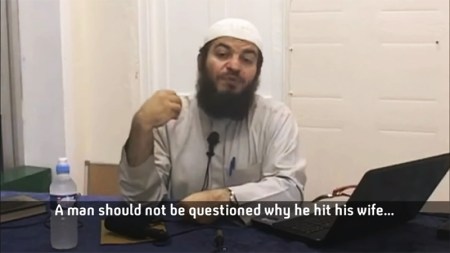 Haitham al-Haddad is a British shari’a council judge, and sits on the board of advisors for the Islamic Sharia Council. Regarding the handling of domestic violence cases, he stated in an interview, “A man should not be questioned why he hit his wife, because this is something between them. Leave them alone. They can sort their matters among themselves.” (Image source: Channel 4 News video screenshot)
Had the British government addressed Sharia Council malpractice when it was first revealed, we would not be facing this pandemic today. Contrary to what apologists for this travesty say, the plight of Muslim women should be treated as an issue of human rights.
It is time for the British government to wake up and take a tough stand on such unethical, and probably illegal, system. And the sooner the better, lest the whole sharia council system go “underground” and out of reach to protect thousands of women from abuse.
The U.S. is prepared to launch a preemptive strike with conventional weapons against North Korea should officials become convinced that Kim Jong Un is about to follow through with a nuclear weapons test, NBC reports.
Source: US May Launch Preemptive Strike On North Korea Ahead Of Nuclear Test | Zero Hedge
With just two days to go until North Korea’s “Day of the Sun” celebrations, when as reported yesterday it may conduct its 6th nuclear test at the Punggye-ri Nuclear Test Site, NBC reports citing multiple senior U.S. intelligence officials that in the latest stepwise escalation, the U.S. is prepared to launch a preemptive strike with conventional weapons against North Korea should officials become convinced that Kim Jong-Un’s nation North Korea is about to follow through with a nuclear weapons test. Note: North Korea does not even have to carry out the text: mere conviction on the side of the US that it would, is sufficient.
As first reported yesterday, North Korea warned that a “big event” is near, and U.S. officials say signs point to a nuclear test that could come as early as this weekend. According to multiple sources, the U.S. intelligence community has reported with “moderate confidence” that North Korea is preparing for its sixth underground nuclear test, though the U.S. is also in the dark regarding the specific timing.
The launch of a preemptive attack would naturally threatens a counterattack by Kim: the U.S. is thus “worried” that its strikes could provoke the volatile and unpredictable North Korean regime to launch its own blistering attack on its southern neighbor. “The leadership in North Korea has shown absolutely no sign or interest in diplomacy or dialogue with any of the countries involved in this issue,” said Victor Cha, the Korea Chair at the Center for Strategic and International Studies.
Meanwhile, intelligence officials have told NBC News that the U.S. Navy has positioned two destroyers capable of shooting Tomahawk cruise missiles in the region, one just 300 miles from the North Korean nuclear test site. Additionally, American heavy bombers are also positioned in Guam to attack North Korea should it be necessary, and earlier this week, the Pentagon announced that the USS Carl Vinson aircraft carrier strike group was being diverted to the area.
Earlier in the week, North Korea said it would “hit the U.S. first” with a nuclear weapon should there be any signs of U.S. strikes. On Thursday, North Korea warned of a “merciless retaliatory strike” should the U.S. take any action. It is almost as if the U.S. is eager to provoke the “irrational” North Korean dictator.
“By relentlessly bringing in a number of strategic nuclear assets to the Korean peninsula, the US is gravely threatening the peace and safety and driving the situation to the brink of a nuclear war,” said North Korea’s statement, which actually sounded quite rational and measured.
Futhermore, virtually everyone knows that Kim’s threats are those of a paper tiger: North Korea is not believed to have a deliverable long-range nuclear weapon, according to U.S. experts, nor does it yet possess an intercontinental missile. Which begs the question: why is the US getting involved in yet another regime change operation half way around the world?
South Korea’s top diplomat said today that the U.S. would consult with Seoul before taking any serious measures, or at least he hoped: “U.S. officials, mindful of such concerns here, repeatedly reaffirmed that (the U.S.) will closely discuss with South Korea its North Korea-related measures,” foreign minister Yun Byung told a special parliamentary meeting. “In fact, the U.S. is working to reassure us that it will not, just in case that we might hold such concerns.”
Of course, if the U.S. does not “closely discuss” any pre-strike plans, then… oops.
In any case, a new war may break out as soon as this weekend: “Two things are coming together this weekend,” said retired Adm. James Stavridis, former commander of NATO and an NBC analyst. “One is the distinct possibility of a sixth North Korean nuclear weapons detonation and the other is an American carrier strike group, a great deal of firepower headed right at the Korean Peninsula.”
The U.S. is aware that simply preparing an attack, even if it will only be launched if there is an “imminent” North Korean action, increases the danger of provoking a large conflict, multiple sources told NBC News.
“It’s high stakes,” a senior intelligence official directly involved in the planning told NBC News. “We are trying to communicate our level of concern and the existence of many military options to dissuade the North first.”
“It’s a feat that we’ve never achieved before but there is a new sense of resolve here,” the official said, referring to the White House.
The unofficial admission that a preemptive strike is imminent comes on the same day the U.S. announced the use of its MOAB in Afghanistan, attacking underground facilities, and on the heels of U.S. missile strikes on a Syrian airbase last week, a strike that took place while President Trump was meeting with Chinese President Xi Jinping at Mar-a-Lago.
Earlier today, Trump gave China what amounted to a tacit ultimatum: deal with North Korea, or Trump will.
And as the clock is ticking, officials have told NBC that Trump has talked to Chinese president Xi twice about North Korea since their Florida summit.
China has since sent its top nuclear negotiators to Pyongyang to communicate the gravity of the situation to the North, officials say. On Wednesday, President Xi called for a peaceful resolution to the escalating tensions.
It’s not just China: “Moscow has weighed in as well: “We are gravely concerned about Washington’s plans regarding North Korea, considering hints about the unilateral use of a military scenario” the Putin government said in a press release issued on Tuesday.”
Ultimately, the only thing standing between Kim and a Tomahawk is a decision by South Korea, where as a reminder, the political regime has been in chaos since the impeachment of former president Park.
Implementation of the preemptive U.S. plans, according to multiple U.S. officials, depends centrally on consent of the South Korean government. The sources stress that Seoul has got to be persuaded that action is worth the risk, as there is universal concern that any military move might provoke a North Korean attack, even a conventional attack across the DMZ.
Tensions have escalated on the Korean Peninsula, as this Saturday marks the anniversary of the birth of the nation’s founder — Kim il-Sung, grandfather of the current leader, Kim Jong-un. At the highest levels in South Korea and the U.S., sources told NBC News, there are fears North Korea could mark the “Day of the Sun” by testing a nuclear device. As discussed yesterday, North Korea in the past has used these national holidays to celebrate the strengths of the regime and to reinforce the national narrative of their independence, as confirmed by Cha.
“I think that is what President Trump is getting trying to get the Chinese to do,” said Cha. “[It] would impose real pain and force real choices on North Korea — whether the costs are worth it for them to continue to pursue this program if they no longer have any sustenance.”
In addition to the coal ships, the Chinese made an important gesture at the UN Thursday: A surprising abstention on a Security Council resolution condemning a Syrian chemical weapons attack. China didn’t stand with the Russians on Syria, as it has in the past.
But the biggest indicator may have been the market: for the first time in month, the S&P closed on the lowest tick of the day ahead of a long weekend, almost as if traders had no desire to go long into a the 72 hours in which there is a non-trivial chance that, in some form or another, a nuclear device may go off, coupled with the launch of an unknown number of US Tomahawk missiles.
INTO THE FRAY: Middle East meltdown, Israel National News, Dr. Martin Sherman, April 14, 2017
But of course the most troubling of questions regarding the regional integration question is this: If the allegedly moderate regimes really desire Israel’s help in confronting formidable common threats (the menace of Jihadi cohorts and the specter of nuclear Iran), why would they predicate that help on precisely the same concessions from Israel that they demanded prior to those threats arising? And were Israel to refuse those concessions would these “moderates” deny themselves the aid Israel could provide them—for the sake of the Palestinian-Arabs, for whom they have shown consistent disdain and contempt over decades?
Furthermore, if the “moderate” states see Israel’s strength as a determining factor in making it an attractive ally in combatting the common threat of radical Islamism, why would they insist on concessions that weaken it, and expose it to greater perils as a precondition to accepting its aid? Why would they press for concessions that are likely to fall—as they did in Gaza—to the very Jihadi elements that both they, and Israel, see as a common enemy?
****************************
Worst Chemical Attack in Years; US blames Assad – New York Times, April 4, 2017.
Death toll climbs in clashes at Palestinian camp in Lebanon – Reuters, April 9, 2017.
Deadly blasts hit Coptic churches in Tanta, Alexandria – Al Jazeera, April 10, 2017.
Five Sudanese soldiers killed in Yemen conflict – Reuters, April 12, 2017.
These four recent headlines, spanning barely a week, bear chilling testimony to the grim and grisly realities of the Arab world.
Barbaric business as usual
After all, had the several score killed in the April 4th chemical attack in Northern Syria been beheaded, or lynched, or burnt alive or slaughtered by any one of the other gruesome methods by which hundreds of thousands of civilians have lost their lives in the Syrian Civil War over the last five years, it is more than likely that their deaths would have gone largely unnoticed and unreported.Indeed, it would have been nothing more than brutal, barbaric business as usual for the region.
Across virtually the entire Arab world , from the Atlantic Ocean in the West to the Persian Gulf in the East; from the Sahara desert in the South to the upper reaches of the Euphrates in the North, naked violence engulfs entire countries – Syria, Iraq, Yemen, Libya. Others – like Lebanon and Egypt—are perennially on the cusp of its eruption; and in others (like Bahrain and Saudi Arabia), it lurks, simmering just below the surface, constrained only by the iron grip of police-state tyranny.
With painfully few—and dubious—exceptions (such as Iraq, teetering on the brink of failed state status and Tunisia, once the poster-child of the “Arab Spring”, now increasingly threatened by Jihadi Salafi insurgents—see here and here), the Arab regimes are a noxious brew of theocratic tyrannies, military dictatorships and/or nepotistic monarchies. The violent exchanges that rage throughout the region occur between a wide range of protagonists and across a myriad of schisms: Sunni vs Shia, radicals vs. monarchs, rebel insurgents vs incumbent rulers, Islamist extremists vs traditional regimes.
Death, depravity and despotism
It is against this doleful and daunting backdrop that the fatal follies of the past and of the emerging prescriptions for the future course of what has been perversely dubbed “the peace process”, must be assessed.
For as growing numbers of erstwhile advocates of the two-state paradigm are becoming increasingly skeptical—indeed, even despairing—of its viability within any foreseeable future, rather than admit the enormity of their error, they are now turning to a new false deity, no less ppreposterous or perilous than the tarnished chimera of two-statism.
This is the new cult of “regionalism”, which attempts to invert the twisted logic of two- statism—but leaves it just as twisted.
At the core, regionalism is the idea that, rather than strive for an agreement with the Palestinians as a necessary precursor to its acceptance by the states of the region, Israel can, and should, establish a pan-regional alliance with allegedly “moderate” states, driven by a recognition of common threats (the menace of Jihadi cohorts and the specter of nuclear Iran)—thereby paving its way to a resolution of the Palestinian issue.
Central to this new cult is the bizarre belief that Israel’s “integration” into region—which, as we have seen, is little more than a cesspool of death, depravity and despotism –is a goal both necessary and worthy—and one that the nation ought to strive to achieve.
Risible regionalism
Significantly, there are several glaring logical inconsistencies, non sequiturs and factual inaccuracies that plague the regional-integration doctrine.
First of all, as commonly presented, it almost inevitably entails circular reasoning – i.e. Israel should pursue relations with the moderate Arab states as a means of arriving at a resolution of the Palestinian problem; but the only way to arrive at such relations with the Arab world is to reach an agreement with the Palestinians. So, resolving the Palestinian issue becomes both the objective of the regional-integration and the means to achieve it!
Thus, for instance in an article, Regional integration only way for Israel to achieve security, Atlantic Council senior fellow H.A. Hellyer writes: “…the only realistic way for Israelis to thrive in the long term is for them to be integrated into the wider region, beginning with a comprehensive and just peace settlement…”
This statement is not only of dubious veracity—since Israel seems to be thriving rather well without (thankfully) being “integrated into the wider region—but seems to collide with a later contention by Hellyer, who writes elsewhere: “A sustainable peace for Israelis is predicated on their eventual integration into the wider region.”
So there you have it: “Integration into the wider region” must be preceded by “peace”; but “peace” must be predicated on (i.e. preceded by) “integration into the region”. Thus, resolving the Palestinian issue (a.k.a. “peace”) is presented both as the cause and effect of integration –having to precede it on the one hand, while being predicated on it, on the other.
Confusing, isn’t it??
Puzzling Pardo
But perhaps one of the most puzzling and perturbing endorsements of the regional-integration paradigm came in a speech delivered by Tamir Pardo the former Head of Israel’s Secret Intelligence Service, Mossad.
In it, Pardo identified the emergence of “a rare confluence of interests between Israel and the moderate Arab states.”
Pointing to the drawbacks of relations that are entirely covert, he remarked: “Secret relations that take place “under the radar” are by their nature transitory.” Accordingly, he advocated Israel’s overt integration into the region: “The key to regional integration is to build economic and social bridges between countries, facilitating trade and tourism…. The deeper, the more open and above board relations are, the better suited they will be to survive the inevitable shocks and disruptions that take place from time to time…. Israel’s regional integration is a key to its very survival.”
But he warned “None of this will happen without a resolution of the Palestinian problem.”
There are several disturbing defects—both conceptual and empirical–in this portrayal by Pardo, which seem to indicate that his undoubted ability in covert operations is not matched by a commensurate acumen for political analysis.
So, while Pardo may well be correct in his doubts as to the durability of secret relations, his faith in more overt one seems wildly at odds with Israel’s experience in past decades, causing one to puzzle over what could possibly be the basis for his unfounded contention, and his reasons for making it.
Puzzling (cont)
Indeed, the examples of Iran and Turkey clearly indicate that robust overt “economic and social bridges” as well as “trade and tourism” are of little value if the regime should change. After all, the relations with pre-revolutionary Iran and pre-Islamist Turkey could hardly have been closer or more cordial.
Yet, with the ascent to power of Khomeini in Iran and Erdogan in Turkey these ties proved, indeed, “transitory”. Of course, the metamorphosis was particularly dramatic and rapid in Iran, where Israel was transformed from being a trusted ally to a hated enemy almost immediately. In Turkey, the process was more gradual and less drastic, but there can be little comparison between the tight strategic ties of yesteryear and the hostile attitude that prevails today.
This volatility in relations between nations is one of the most profound flaws in the regional-integration proposal—especially when it is predicated on a resolution of the Palestinian issue. For while it is true that countries like Jordan, under the Hashemite dynasty, Egypt under Sisi, and the incumbent regimes in the Gulf may face common threats, it would be more than a stretch to characterize this as sharing long-term mutual interests with Israel.
Indeed, a yawning gulf separates between the seminal values that define the differing societies – with regard to individual liberties, gender equality, social diversity, religious pluralism—which clearly portends ample room for renewed adversarial relations once the common threat has been eliminated.
Palmerston…on perpetual allies
Israel would do well to heed the words of British Prime Minister, Lord Palmerston (1784-1865) on the fickleness of nations and their international ties “We have no eternal allies, and we have no perpetual enemies. Our interests are eternal and perpetual, and those interests it is our duty to follow”.This caveat is particularly pertinent in the case of the regional-integration paradigm. For in essence the deal to be struck is as follows: Israel is called upon to make perilous permanent concessions (to resolve the Palestinian issue) in exchange for a temporary alliance, based on the (ephemeral) word of rulers, who head not only some of the most decadent and despotic regimes on the planet, but also some of the most threatened.
Accordingly, there is little guarantee that the Arab entity that makes commitments toward Israel will be the entity called upon to honor them when need be. After all, what would be the value of any understanding on integration entered into in 2010 with say Syria, or Iraq or Libya…
Moreover, Israel was unable to prevent an Islamist takeover of Gaza. It is, therefore, highly unlikely that it could prevent an Islamist takeover by a resurgent Muslim Brotherhood in Egypt, or an Islamist coup in Jordan.
Thus, given the fact that the concessions Israel is called upon to make to resolve the Palestinian issue, are largely irrevocable, while the pledges given it are largely retractable, any regime change in Cairo and even more so in Amman would have potentially disastrous ramifications.
With an Islamist state abutting the envisaged Palestinian state from the East, dispatching irredentist insurgents to destabilize any purportedly peaceable Palestinian regime in the territory evacuated by Israel; with a regime in Cairo no longer interested in, or capable of, countering the Jihadi warlords in Sinai, pressing against Israel’s 200 km frontier and the land route to Eilat, Israel is likely to rue any credence it placed in regional integration.
The most troubling of questions
But of course the most troubling of questions regarding the regional integration question is this: If the allegedly moderate regimes really desire Israel’s help in confronting formidable common threats (the menace of Jihadi cohorts and the specter of nuclear Iran), why would they predicate that help on precisely the same concessions from Israel that they demanded prior to those threats arising? And were Israel to refuse those concessions would these “moderates” deny themselves the aid Israel could provide them—for the sake of the Palestinian-Arabs, for whom they have shown consistent disdain and contempt over decades?
Furthermore, if the “moderate” states see Israel’s strength as a determining factor in making it an attractive ally in combatting the common threat of radical Islamism, why would they insist on concessions that weaken it, and expose it to greater perils as a precondition to accepting its aid? Why would they press for concessions that are likely to fall—as they did in Gaza—to the very Jihadi elements that both they, and Israel, see as a common enemy?
Indeed one might ask: Why should Israel have to make any concessions so that the Arab states would deign to accept its aid in their battle against a grave common menace?
As Lewis Carroll’s Alice in Wonderland once sighed “It would be so nice if something made sense for a change.” It sure would! Regional integration: What Isaiah would say?
Of course one can only puzzle over what merit proponents of regional integration see in its implementation. Do they really want Israel to be absorbed into the morass of cruelty, corruption and cronyism that is the Middle East? What values that pervade their Arab neighbors, would they urge it to adopt in order to “integrate”?Misogynistic gender bias? Homophobic persecution of gays? Intolerance of social diversity? Repression of minority religious faiths? Suppression political dissidence? For were Israel to resist adopting these and other regional values, how on earth could it integrate into the region?
So, with the Mid-East on the cusp of melt-down, one can only imagine what Isaiah (5:20) would say of the proponents of regional integration: Woe unto them that call evil good, and good evil; that put darkness for light, and light for darkness; that put bitter for sweet, and sweet for bitter.
Martin Sherman is the founder and executive director of the Israel Institute for Strategic Studies.
Putting ‘America first’ in the Mideast, Israel Hayom, Ruthie Blum, April 14, 2017
Their argument now goes that Trump’s latest military moves — and shift in attitude toward NATO — are examples of policy “flip-flopping” from the “isolationism” expressed in his inaugural address to a newfound global interventionism. They contend that a president who so drastically and swiftly shifts gears is perfectly capable of performing yet another about-face when the mood arises.
Those who consider the Trump doctrine spelled out [in his inaugural address] as contradictory to the president’s performance in office so far seem to have lost something in translation.
******************************
America’s surgical strike on Syrian regime targets last Thursday night — and this Thursday’s “mother of all non-nuclear bomb” attack on Sunni terrorist infrastructure in Afghanistan — garnered surprisingly widespread bipartisan support, but put some of U.S. President Donald Trump’s critics in a bit of a rhetorical quandary. How could they word their defense of Trump’s bold yet not extreme warning shots without putting a dent in their distrust of the new occupant of the Oval Office?
Coming up with a solution to this problem turned out not to be so difficult for those pundits and politicians who have been paying close attention both to Syrian President Bashar Assad’s slaughter of his own people — most recently with chemical weapons — and to every syllable of Trump’s Twitter feed.
Their argument now goes that Trump’s latest military moves — and shift in attitude toward NATO — are examples of policy “flip-flopping” from the “isolationism” expressed in his inaugural address to a newfound global interventionism. They contend that a president who so drastically and swiftly shifts gears is perfectly capable of performing yet another about-face when the mood arises.
The trouble is that this assertion is both overly simplistic and inaccurate.
In the first place, Trump himself openly acknowledged that though he had said he was not going to intervene in Syria, he “changed his mind” when it was established that Assad was killing babies with sarin gas — after lying about having rid his country of chemical weapons. He has also openly declared war on the Islamic State group. This hardly constitutes a flip-flop. Instead, it indicates flexibility of thought and action on the part of a leader faced with a set of circumstances that warrants both.
The same goes for his statements on NATO, which he originally called “obsolete” and has since deemed necessary. His initial attack on the organization was that its members were not pulling their weight. This spurred them to make at least symbolic gestures, such as slightly increasing their budgets, to persuade him to reconsider. This is no small thing.
Secondly, Trump’s inaugural speech was not, in fact, an ode to isolationism; it was a reassertion of American greatness and power both domestically and on the world stage. Take the following excerpt, for example:
“For many decades, we’ve … subsidized the armies of other countries while allowing for the very sad depletion of our military; we’ve defended other nation’s borders while refusing to defend our own. … From this day forward, a new vision will govern our land. From this moment on … America will start winning again, winning like never before.”
And this: “We do not seek to impose our way of life on anyone, but rather to let it shine as an example for everyone to follow. We will reinforce old alliances and form new ones — and unite the civilized world against radical Islamic terrorism, which we will eradicate completely from the face of the earth. …
“It is time to remember that old wisdom our soldiers will never forget: that whether we are black or brown or white, we all bleed the same red blood of patriots, we all enjoy the same glorious freedoms, and we all salute the same great American flag.”
The speech concludes: “So to all Americans, in every city near and far, small and large, from mountain to mountain, and from ocean to ocean, hear these words: You will never be ignored again. Your voice, your hopes, and your dreams will define our American destiny. And your courage and goodness and love will forever guide us along the way. Together, we will make America strong again. We will make wealthy again. We will make America proud again. We will make America safe again. And yes, together, we will make America great again.”
Those who consider the Trump doctrine spelled out above as contradictory to the president’s performance in office so far seem to have lost something in translation.
Message in the MOAB, Power Line,
(Just for the halibut, please see also ‘March for Science’ Group Laments Trump’s Bombing Of ‘Marginalized’ ISIS Fighters. — DM)
Last week President Trump authorized a limited missile strike against the Syrian regime for its use of chemical weapons against civilians. I explicated what I thought was “the message in the missiles” (I stretched to find 10 messages). Yesterday the United States dropped the “mother of all bombs” — the most powerful conventional bomb in the American arsenal — on an Islamic State cave complex in Afghanistan on Thursday. The MOAB is the colloquial name given to the GBU-43/B Massive Ordnance Air Blast.
Here is the New York Times story on the Pentagon’s announcement. It is about as bad as one might expect under the circumstances. The Times seems mystified by the whole thing, taking it as another in an endless series of black marks against President Trump.
Like the military reprisal against the Syrian regime, the MOAB send a message or 10. Herewith, as William F. Buckley used to say, a few observations:
1. The MOAB has been around since 2002, but this is the first time it has been used in combat. It was used to achieve a specific military purpose (see notes 8 & 9 below) with respect to which the Obama administration had previously refrained. When I say “refrained,” I mean “restrained the military.” The era of Obama foreign policy is over.
2. Trump himself expanded on this point at the White House yesterday. He asserted there’s been a “tremendous difference” militarily between the Obama administration and the Trump administration. “If you look at what’s happened over the last eight weeks and compare that to really what’s happened over the last eight years, you’ll see there’s a tremendous difference,” Trump said. “And this was another very successful mission,” he added.
3. Trump elaborated. “Everybody knows exactly what happened. What I do, I authorized my military. We have given them total authorization. That’s what they’re doing.”
4. The MOAB serves as a reminder of other tools in the chest. The MOAB is not our biggest non-nuclear weapon. That is the Massive Ordnance Penetrator, or MOP. The National Interest reminds us that our Air Force also fields the GBU-57A/B Massive Ordnance Penetrator (MOP), which is a massive precision-guided 30,000lb bunker-busting weapon usually dropped from a Northrop Grumman B-2 Spirit stealth bomber.
5. The MOAB therefore sent a message to North Korea. It put an exclamation point on the military reprisal against the Syrian regime. It reiterated that the era of Obama foreign policy is over. Trump himself professed agnosticism on this point, but this was the message to North Korea: “I don’t know if this sends a message. It doesn’t make any difference if it does or not. North Korea is a problem. The problem will be taken care of.” What we see here is akin to the rhetorical device of apophysis or praeteritio.
6. Not coincidentally, NBC News reports: “U.S. may launch strike if North Korea reaches for nuclear trigger.” The use of the MOAB in Afghanistan makes the leaks here highly credible.
7. The MOAB sent a message to Iran. I can’t find a citation to support me here, but it’s obvious. What goes for North Korea goes for Iran.
8. The use of the bomb had a specific military purpose. As former intelligence officer and Army veteran Michael Pregent commented explained on FOX News last night, ISIS fighters in Afghanistan are using the massive tunnel complex that Al Qaeda used starting back in 2001 when U.S. forces were deployed to Afghanistan. “They used the same tunnel complex for bin Laden to escape to Pakistan,” Pregent said. “The Haqqani network, a terrorist organization out of Pakistan, uses it to bring in lethal aid. So you have these organizations like Al Qaeda, the Haqqani group, the Taliban and now ISIS using a tunnel complex to kill Americans in the past.” Thomas Spoehr has more to the same effect here.
9. At NRO, David French highlights what he calls “an important and painful point about our almost 16-year long war [in Afghanistan].” This is the point: “Excessive American caution has cost American lives and American limbs, and it has left families and friends of the victims with deep psychological wounds. Those wounds would be grievous enough in the best circumstances, but they’re compounded by the fact that many of the decisions not to shoot, not to use artillery, or not to drop bombs were based on a combination of rules of engagement and military misjudgments that were transparently foolish at the time.” (Please do read the whole thing.)
10. Don’t let me forget to mention that the Obama era in American foreign policy is over.
The White House A-Team, Bill Whittle Channel via YouTube, April 13, 2017
A breakdown on Trump’s dream team of Rex Tillerson, Nikki Haley, and H.R. McMaster after recent occurrences in Syria conflict.
Detroit doctor charged with female genital mutilation of seven-year-olds, The Foreign Desk – Reuters, Joseph Ax, April 13, 2017

(Reuters) – U.S. authorities have charged a Detroit doctor with performing genital mutilation on 7-year-old girls in what is believed to be the first case brought under a law prohibiting the procedure.
Jumana Nagarwala, an emergency room physician at a Detroit hospital who performed the procedures at an unnamed medical clinic in the Detroit suburb of Livonia, was scheduled to appear in federal court on Thursday, according to the U.S. Department of Justice.
“Female genital mutilation constitutes a particularly brutal form of violence against women and girls,” acting U.S. Attorney in Detroit Daniel Lemisch said in a statement. “The practice has no place in modern society and those who perform FGM on minors will be held accountable under federal law.”
Female genital mutilation, or FGM, typically involves the partial or total removal of the clitoris and is barred by numerous international treaties. The practice is common in several African countries, including Somalia, Sudan and Egypt, where it is often a cultural or religious tradition.
The practice was outlawed in the United States in 1996, though the Justice Department said the Michigan case appeared to be the first criminal prosecution of its kind.
A lawyer for Nagarwala did not immediately respond to a request for comment on Thursday afternoon.
Federal agents received a tip months ago that Nagarwala was performing FGM in Michigan, according to a criminal complaint unsealed on Thursday.
A review of her phone records led authorities to two 7-year-old girls who traveled with their parents to Michigan from Minnesota in February so they could undergo the procedure.
One of the children told investigators they were taken to Michigan for a “special” girls’ trip, the complaint said.
Medical exams of both girls showed their genitals had been altered, according to authorities.
Investigators tracked down several other child victims, the complaint said. Some parents acknowledged that Nagarwala had performed the procedures on their daughters, while others denied it.
A spokesman for Henry Ford Health System, which has employed Nagarwala as an emergency room physician, said she had been placed on administrative leave. Henry Ford Health System, which operates several Detroit-area hospitals, was not mentioned in the complaint.
“The alleged criminal activity did not occur at any Henry Ford facility,” David Olejarz said in an email. “We would never support or condone anything related to this practice.”
In addition to charges related to FGM, Nagarwala is charged with lying to federal agents after saying earlier this week that she did not engage in the practice.
The World Health Organization has estimated that more than 200 million girls and women alive today have undergone FGM, which can cause lasting health problems.
Source: US drops largest non-nuclear bomb on IS target in Afghanistan | The Times of Israel
( Iran: Please take note. – JW )
In first combat use of weapon, 11-ton ‘Mother Of All Bombs’ used in strike on jihadist cave complex

The Pentagon said Thursday US forces in Afghanistan dropped the military’s largest non-nuclear bomb on an Islamic State target in Afghanistan.
Pentagon spokesman Adam Stump said it was the first-ever combat use of the bomb, known as the GBU-43, which he said contains 11 tons of explosives. The US Air Force calls it the Massive Ordnance Air Blast bomb, or MOAB.
Based on the acronym, it has been nicknamed the “Mother Of All Bombs.”
The strike occurred at about 7:32 p.m. local time (15:02 GMT).
Stump said the bomb was dropped on a cave complex believed to be used by IS fighters in the Achin district of Nangarhar province, very close to the border with Pakistan.
“As ISIS-K’s losses have mounted, they are using IEDs, bunkers and tunnels to thicken their defense. This is the right munition to reduce these obstacles and maintain the momentum of our offensive against ISIS-K,” said US General John W. Nicholson, commander of American forces in Afghanistan, in a statement.
“US Forces took every precaution to avoid civilian casualties with this strike. US Forces will continue offensive operations until ISIS-K is destroyed in Afghanistan,” the US army said in a statement.
Referring to the Islamic State, White House spokesman Sean Spicer said: “We must deny them operational space, which we did.”
The MOAB was rapidly developed in 2002-2003 around the time of the US-led invasion of Iraq.
According to the Air Force, the last time the MOAB was tested in 2003, a huge mushroom cloud could be seen from 20 miles (32 kilometers) away.
The satellite-guided weapon is so large it is rolled off a transport aircraft rather than dropped from the weapons bay of a bomber. It is partially used to intimidate enemy forces after the noted success of its predecessor, the BLU-82 bomb, which dates back to the Vietnam war where it was used to clear jungle areas for helicopters.

Screenshot from a video of a Massive Ordnance Air Blast bomb (MOAB) test. (YouTube: Military Forces)
China’s nuclear get-out clause over defence of North Korea, South China Morning Post, Kristin Huang, April 13, 2017
(Another “hint” from China to North Korea? — DM)
China is not obliged to help defend North Korea from military attack if the reclusive state developed nuclear weapons, according to Chinese diplomatic and military observers.
The assessment comes as senior officials in Washington warn of a strike against the Pyongyang regime.
China and North Korea signed a mutual aid and cooperation treaty in 1961 as they sought to mount a united front against Western powers. It specifies that if one of the parties comes under armed attack, the other should render immediate assistance, including military support.
But the treaty also says both nations should safeguard peace and security.
For China, North Korea’s development of nuclear weapons in violation of the United Nations treaty on non-proliferation could amount to a breach of their pact, leaving Beijing with no obligation to lend a hand, observers said.
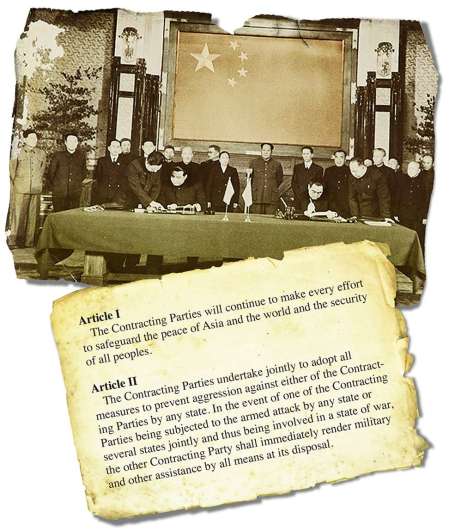
China could also have a get-out clause if any US military intervention was not deemed an armed attack.
“It’s hard to say how China would assist North Korea militarily in case of war, since North Korea is developing nuclear weapons, an act that might have already breached the treaty between the two nations,” said Li Jie, a retired Chinese naval colonel.
Shanghai-based military analyst Ni Lexiong said China would need to provide military assistance to North Korea if US land forces invaded, but Pyongyang’s violation of the UN non-proliferation treaty was a “strong reason” for Beijing to choose not to help.
Threats of military action against North Korea have grown, with US President Donald Trump saying Washington was prepared to act alone against Pyongyang.
A strike group headed by the aircraft carrier USS Carl Vinson has also been deployed to waters off the Korean peninsula.
Nevertheless, Beijing, North Korea’s economic lifeline, does have some interest in backing up its old ally. China fears the collapse of the regime in Pyongyang could lead to an influx of refugees into China and eliminate the buffer zone keeping US troops from the Chinese border.
But Ni said the possibility of a full-scale war was slim because the US was unlikely to send land forces into North Korea, preferring air strikes or missile launches instead.
“The situation would be much easier for China in this case. China would not have to mobilise its land forces to help North Korea,” he said. “China then only needs to send the North Sea Fleet or military aircraft to step up patrols of the Korean peninsula.”
Zhou Chenming, from the Knowfar Institute for Strategic and Defence Studies think tank, said war over North Korea was unlikely because all the parties involved were looking for ways to defuse tensions.
But if military conflict did erupt, China could help Pyongyang with supplies such as food and weaponry, such as old tanks.




 anneinpt
 artaxes
 danmillerinpanama
 davidking1530
 Peter Hofman
 Joseph Wouk
 Peter
Peter Louisiana Steve
 WarSclerotic
Recent Comments