Archive for April 21, 2017

Iran violating U.S. deal with secret nukes research, opposition group says

April 21, 2017

Iran violating U.S. deal with secret nukes research, opposition group says, Washington TimesRowan Scarborough, April 21, 2017

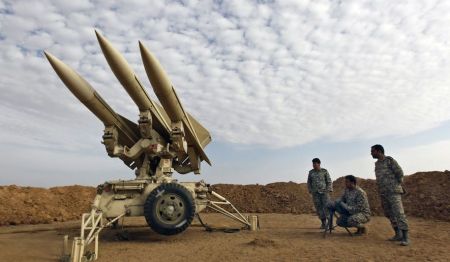
In this photo obtained from the Iranian Mehr News Agency, Iranian army members prepare missiles to be launched during a maneuver at an undisclosed location in Iran on Nov. 13, 2012. (AP Photo/Mehr News Agency, Majid Asgaripour) **FILE**

The council and MEK have a good track record over the years of disclosing Iranian nuke programs that operated under the radars of Western intelligence agencies. It boasts an extensive spying network inside the Defense Ministry, Islamic Revolutionary Guard Corps and other organs of the hard-line Islamic state ruled by religious mullahs.

The MEK said METFAZ is operating in a secret location unbeknownst to the International Atomic Energy Agency (IAEA), the world’s nuclear watchdog. In official communications, the regime refers to it as the code name “Research Academy.”

********************************

Iran is cheating on its historical deal with the U.S. by secretly conducting research into nuclear weapons components such as bomb triggers and enriched uranium, the main Iranian opposition group said Friday.

The regime is doing engineering and weaponization testing at a walled military complex south of Tehran, a location which Iran has declared off-limits to inspectors, said the National Council of Resistance of Iran (NCRI) and its main operational arm, the People’s Mujaheddin of Iran (MEK).

“This is the site that has been kept secret,” said Alireza Jafrazadeh, NCRI’s Washington office deputy director. “There is secret research to manufacture the bomb and basically cover up the real activities of the Iranian regime.”

The 2015 Joint Comprehensive Plan of Action (JCPOA), negotiated by the Obama administration, has become a major foreign policy issue for the Trump White House as it evaluates whether to reimpose economic sanctions on Tehran. Iran has benefited with billions of dollars in freed-up funds while it pursues interventions in Iraq, Syria and Yemen against U.S. interests.

The NCRI-MEK report came the day after Secretary of State Rex Tillerson lambasted Iran for its expansionist terrorist activities in the region which he said violated the spirit of the JCPOA. He called the deal a “failed approach” since Iran can break out and build bombs after 10 years.

The JCPOA outlaws the type of weaponization work described by the NCRI-MEK report.

The State Department reported this week that Iran was abiding by the deal hammered out by former Secretary of State John Kerry and approved by Russia and other powers.

The NCRI rebutted that conclusion during a press conference in Washington by saying it is providing new information on Iranian misdeeds.

The council and MEK have a good track record over the years of disclosing Iranian nuke programs that operated under the radars of Western intelligence agencies. It boasts an extensive spying network inside the Defense Ministry, Islamic Revolutionary Guard Corps and other organs of the hard-line Islamic state ruled by religious mullahs.

The NCRI asserts that Iran’s so-called “declared” sites were not disclosed by Iran, but by the intelligence work of MEK.

The heart of the NCRI-MEK intelligence report is a research operation known as the Organization of Defensive Innovation and Research (SPND) and its seven subdivision, which MEK said it first exposed in 2011.

“They are carrying out their research in various fields related to the manufacturing of a nuclear weapon,” the council’s report said. “In some of these fields, new initiatives have also been undertaken in order to keep the real objectives of the research a secret and to cover up the real activities.”

One those subdivisions, the Center of Research and Expansion of Technologies on Explosions and Impact (METFAZ) works on triggers and explosive yields, the statement said. The MEK disclosed METFAZ’s existence in 2009.

The MEK said METFAZ is operating in a secret location unbeknownst to the International Atomic Energy Agency (IAEA), the world’s nuclear watchdog. In official communications, the regime refers to it as the code name “Research Academy.”

The council investigation said that for the mullahs to continue METFAZ’s work undetected, they downsized a center in Sanjariana and transferred the research and testing to a new site in the military district of Parchin 20 miles south of Tehran.

“We are disclosing this for the first time today,” Mr. Jafrazadeh said. “They felt this was optimum location for shielding the actives of METFAZ.”

Reporters asked Mr. Jafrazadeh why the U.S.’s latest 90-day report to Congress say Iran was complying if it is now cheating.

He answered that the assessment is based on the IAEA monitoring known sites and measuring technical metrics, such as the amounts of enriched uranium.

He said that what the council is disclosing is secret weaponization work that now needs to be investigated. He said the council provided its report in the last few days to the Trump administration and the IAEA.

“We’re talking about an extensive covert operation by the Iranian regime,” he said.

Mr. Jafrazadeh said that when the IAEA visited a limited number of sites at Parchin in 2015, Iran had cleansed them of weaponization evidence.

“It needs to be inspected immediately,” Mr. Jafrazadeh said. He predicted this new intelligence report will prompt Iran to “clean out” its illicit work.

Iranian Supreme Leader Ali Khamenei has said that “inspection of our military sites is out of the question and is one of our red lines.” A number of Iranian leaders have repeated that warning in recent months.

The MEK provided satellite photos and descriptions of the exact locations of nuclear research inside the Parchin complex, such as “Plan 6” which is located at “the end of Babaj highway, Khojir-Parchin military road, after the tunnel on the southern side of Mamlo Dam.”

The site is protected by the Islamic Revolutionary Guard Corps, the dominant security force inside Iran.

The report described the musical chairs this way: “The move resulted in the subsiding of activities at the Sanjarian site. The Iranian regime has done its utmost to keep the Research Academy, which is an important site, a secret from the eyes of international organizations. The reason for the move was based on the conclusion reached by regime officials that the probability for the IAEA to get access to Parchin in the future is extremely low, which means that the site is an optimal location for shielding the regime’s activities in this regard.”

To bolster its findings, the MEK released what it said are the nuts and bolts of Iran’s cheating, such as the identities of 15 METFAZ personnel and their jobs descriptions, and addresses of various secret sites.

The SPND network is headquartered in Tehran in the “Nour Building,” near the Defense Minister which supervises operations.

“In order to understand the regime’s secret and illicit activities, it is critical that the IAEA inspect and monitor not only the Research Academy, but also all other sites related to SPND,” the NCRIR-MEK said. “This will help shed light on the scope of the regime’s secret military and nuclear activities.”

It added, “The weaponization program must be totally dismantled. There is no reason to maintain SPND, and all its subordinate organizations, including METFAZ. They have no peaceful, energy use whatsoever and, their only function is to facilitate the development of the nuclear bomb.”

Mr. Jafrazadeh termed as “ridiculous” Iran’s restrictions on military site inspections since it is the military that oversees nuclear bomb research.

The NCRI received a boost this week when Senate Armed Services Chairman John McCain, Arizona Republican, attended a council event in Tirana, Albania, its new home after spending years in Iraq.

He met privately with NCRI leader Maryam Rajavi.

The Washington Times asked the State Department to respond to the NCRI-MEK investigation.

A spokesman referred to Mr. Tillerson’s April 18 letter to Congress certifying that Iran is in compliance. Mr. Tillerson added that the Trump administration will conduct a review of whether the suspension of economic sanctions under JCPOA is in the U.S’s interest.

“Notwithstanding, Iran remains a leading state sponsor of terror through many platforms and methods,” Mr. Tillerson wrote.

Sermon At Dar Al-Hijra Islamic Center In Falls Church, VA: ‘There Is A Difference Between Bani Israel… And Current Jewish Community’; ‘We Are Dealing With Manipulation’; Muslims Must Understand That ‘The Children Of Israel’ Killed Prophets – They ‘Take Pride’ In Their ‘Zealotry… Their History Is Like That’

April 21, 2017

Sermon At Dar Al-Hijra Islamic Center In Falls Church, VA: ‘There Is A Difference Between Bani Israel… And Current Jewish Community’; ‘We Are Dealing With Manipulation’; Muslims Must Understand That ‘The Children Of Israel’ Killed Prophets – They ‘Take Pride’ In Their ‘Zealotry… Their History Is Like That’, MEMRI, April 21, 2017

In a sermon at the Dar Al-Hijra Islamic Center in Falls Church, in Fairfax County, Virginia, Egyptian-American imam Shaker Elsayed pointed out that “there is a difference between Bani Israil” – the Israelites – “and the current Jewish community.” It was “very smart,” he said, “for the Jews of today to call the state they occupied Israel,” adding “We are dealing with manipulation.” He stressed that Muslims need to understand that the “Children of Israel” killed prophets because they did not like their message, and added that they “take pride that they are a community of zealotry and commitment… Their history is like that.”

The Dar Al-Islam Islamic Center is known for its connection to Yemeni-American sheikh and, later, Al-Qaeda leader Anwar Al-Awlaki, who served as its imam from 2001-2001, and to two of the 9/11 hijackers, who had visited him at the mosque. Also, according to Al-Awlaki, Fort Hood shooter Nidal Hasan had worshipped there during his tenure as imam.[1]

The video of Elsayed’s talk was posted online on March 31, 2017. (The video, in English, is available at the link — DM)

“There Is A Difference Between Bani Israel… And The Current Jewish Community – These Are Not One And The Same”

Shaker Elsayed: “There is a difference between Bani Israil [the Israelites], the historical community of the children of Prophet Jacob – whose name is also Israel – and the current Jewish community, as we know it. These are not one and the same. So, when you say the word ‘Jews,’ it is not equal to ‘Israelites.'” […]

“Very Smart For The Jews Of Today To Call The State They Occupied ‘Israel’ … We Are Dealing With Manipulation… I Hope Somebody Doesn’t Call Me Antisemitic… I Am More Semitic Than Those Who Claim To Be Semitic”

“It has been very smart for the Jews of today to call the state they occupied ‘Israel.’ It is giving it a name that is significant, important, and honored by Muslims. So now, if you speak against Israel, the state, they construe it as if you are talking against Jacob and his children, and against your own Book. But we have to understand what we are dealing with. We are dealing with manipulation as well. I hope somebody doesn’t call me antisemitic, because I am more Semitic than those who claim to be Semitic.” […]

“We Muslims Really Need To Wrap Our Heads Around These Two Issues: Number One Is The Response Of The Children Of Israel To Four Previous Prophets… The Quran Summarizes It: ‘…You Acted Arrogantly: You Called Some Messengers Liars And Killed Others'”

“We Muslims really need to wrap our heads around these two issues: Number one is the response of the children of Israel to four previous prophets. What was their response? The Quran summarizes it: ‘But is it not true that every time a Messenger brought to you something that was not to your liking, you acted arrogantly: you called some Messengers liars and killed others?'”

“Whenever A Messenger Comes To You [Children Of Israel] With Something You Don’t Like… You… Killed Some And You Belied Some”; They Killed “Three Of Them [Prophets] Consecutively, Right Before Jesus” 

“Isn’t it true that whenever a messenger comes to you with something you don’t like, you either kill or killed some and you belied some. You rejected some and you killed some. Right? So, they killed Prophet Zakariya, named Zechariah in their Book. They killed his son Yahya, John the Baptist in their Book. They killed Elias [Elijah], who has the same name in their Book. [They killed] three of them consecutively and concurrently, right before Jesus. So those three were finished.” […]

“So They Are Saying: “If Anyone Comes With A Message That We Reject, We Will Kill Him”; They “Take Pride That They Are A Community Of Zealotry… Their History Is Like That”

“So they are saying: ‘If anyone comes with a message that we reject, we will kill him.’ So they get rid of the prophet and the message, and it is finished. So they did this, and Jesus was saying that they were going to try to kill him, as they did to Elijah. An amazing prophecy. And it happened – they delivered him to be crucified. So after killing four prophets in a row… Jesus was an attempt – it was not fulfilled, according to the Quran, but they take pride in it anyway.

“[According to the Quran], they say: ‘Indeed, we have killed the Messiah, Jesus, the son of Mary, the messenger of Allah. And they did not kill him, nor did they crucify him, but [another] was made to resemble him.’ So they still take pride that they are a community of zealotry and commitment, and they are willing to go all the way, to do anything. And they proved that. Their history is like that.

[…]

“This is one big reason – that what happened to these four prophets, besides many other prophets before, that we don’t know the details of what was done to them.”


[1] ABCnews.go.com, November 30, 2009; MEMRI Special Dispatch No. 2713, On Al-Jazeera.net – First Interview with U.S.-Born Yemen-Based Imam Anwar Al-‘Awlaki on Major Hasan and the Fort Hood Shooting: Nidal [Hasan] Contacted Me a Year Ago, December 23, 2009.

Another Doctor and Wife Arrested in Michigan For Female Genital Mutilation on Young Girls

April 21, 2017

Another Doctor and Wife Arrested in Michigan For Female Genital Mutilation on Young Girls, Town HallKatie Pavlich, April 21, 2017

(Please see also, Detroit doctor charged with female genital mutilation of seven-year-olds. The Trump administration is continuing to pursue this problem.– DM)

Doctor Fakhruddin Attar and wife Farida were arrested Friday near Detroit for conspiring to commit and aiding in female genital mutilation [FGM] of girls as young as six-years-old. The Attars allegedly allowed the procedure to be carried in their Livonia medical clinic. Mrs. Attar even held the hands of the girls screaming in pain. 

According to the criminal complaint from the Department of Justice, the couple conspired with Detroit emergency room doctor Jumana Nagarwala. Nagarwale was arrested last week for performing the procedure on a number of girls.

“This investigation has identified other children who may have been cut by Nagarwala at Attar’s clinic, MBC, between 2005 and 2017, including children in Michigan. On April 10, 2017, child forensic interviews employed by the FBI and HSI interviewed several minor girls in Michigan. In these interviews, multiple minor girls informed forensic interviewers that procedures had been performed on their genitals by Nagarwala. One minor girl said that Farida was present during the procedure performed by Nagarwala,” the complaint states.

Parents of the victims were also interviewed by the FBI and two admitted Nagarwala had performed the procedures on their daughters at the clinic. The others denied any knowledge of the practice, but according to wiretapped conversations between Nagarwala and Mrs. Attar, Nagarwala advised parents to deny knowing about FGM should they be asked by federal law enforcement authorities.

The victims were driven by their parents across state lines for the extreme procedure, many coming from Minnesota. They will likely face a number of charges. The minors were told they were being taken on a “girls trip.” Once they arrived at the hotel, they were told they needed to go Nagarwala for a “stomach ache” and FGM was performed to “get the germs out.”

During her court appearance earlier this week, Dr. Nagarwala’s attorneys denied FGM is mutilation and said the procedure is a basic religious practice.

This conspiracy is the first FGM case in the United States. You can read the entire criminal complaint below.

Attar Complaint 0 by Katie Pavlich on Scribd (available at the link — DM)

PM Netanyahu Meets US Secretary of Defense Mattis – YouTube

April 21, 2017

Khamenei ally is accusing ‘Iran’s liberal enemies of delaying the Mahdi’s appearance’

April 21, 2017

Khamenei ally is accusing ‘Iran’s liberal enemies of delaying the Mahdi’s appearance’, Alarabiya, Saleh Hamid, April 21, 2017

(Please see also, Iran: Possible US and Iranian Opposition Cooperation to Counter the Threat of Mullahs’ Rule. — DM)

Saidi is known for making controversial statements about the sanctification of Khamenei’s regime. (Archives)

“[T]he Guardianship of the Islamist Jurist does not require legitimacy from the people, since it represents the divine judgement, and the people must accept the orders of the Islamic Jurist, as they accept the orders of the infallible Imam”.

**************************

A representative of Iran’s Supreme Leader Ali Khamenei in the Revolutionary Guard, Ali Saidi, said in a speech that the Khomeini revolution in Iran paved the way for the emergence of Imam Mahdi, which is the last stage before his appearance, but that “there are enemies delaying his arrival.”

According to Islamic theology, the Mahdi is the prophesied redeemer of Islam who will rule for a number of years before the Day of Judgement.

Saidi has accused secularist and liberal front in Iran, of delaying the emergence of the Mahdi.

The official Iranian news agency IRNA quoted Saidi as saying at a meeting of the Revolutionary Guards clerics’ last Wednesday. Saidi recognized two “specific enemies one being an external enemy embodied in the United States of America and the others being internal enemies represented by the liberals and seculars in Iran.”

Saidi is known for making controversial statements about the sanctification of Khamenei’s regime. Last June, at a sermon in the province of Gilan northern of Iran, Saidi claimed that Khamenei “communicates with a divine source through revelation, occultism and diligence”.

FILE – In this June 15, 2009 file photo, a demonstrator wears a mask in the party’s color of green, due to fears of being identified, as hundreds of thousands of supporters of leading opposition presidential candidate Mir Hossein Mousavi, who claims there was voting fraud in election, turn out to protest the result of the election at a mass rally in Azadi (Freedom) square in Tehran, Iran. ( AP Photo/Ben Curtis, File)

He also said that “the Guardianship of the Islamist Jurist does not require legitimacy from the people, since it represents the divine judgement, and the people must accept the orders of the Islamic Jurist, as they accept the orders of the infallible Imam”.

Saidi also courted criticism for another controversial statement about Iranian influence and expansion in the region, when he said in a speech that “Iran’s strategic influence extends from Bahrain to Iraq, Yemen, Lebanon, the shores of the Mediterranean and even Latin America”.

On Tuesday, the European Union extended sanctions for another year against 82 Iranian figures, including Saidi, for serious human rights violations.

Saidi played a key role in suppressing the green movement protests following Iran’s presidential elections in 2009. The oppositional director Mohamed Nouri Zad broadcasted a tape in which guard leaders spoke, including Saidi, about details of the suppressing the protests that began in June 2009 against the presumed manipulation of the votes that led Mahmoud Ahmadinejad to win a second term.

Europe’s Rising Islam-Based Political Parties

April 21, 2017

Europe’s Rising Islam-Based Political Parties, Investigative Project on Terrorism, Abigail R. Esman, April 21, 2017

So far, none of the existing [Islamic) parties has had a great deal of success – and the emerging parties have yet to make their platforms known, let alone acquire active supporters. But as Denk founder Tunahan Kuzu proudly announced after the March elections, a new voice has now gained power in a European government. But what that voice ultimately will be, and the strength of its commitment to secular and democratic values, remains yet to be seen.

*****************************

These past several months, eyes across the world have been trained on a growing far-right movement sweeping Europe and America – from the neo-Nazi groups in Germany and the United States to the increasing popularity of France’s National Front. But another, far less noticed but sometimes equally-radical movement is also emerging across Europe: the rise of pro-Islam political parties, some with foreign support from the Muslim world. And the trend shows no sign of stopping.

Holland’s Denk (“Think”) party, established and led by two Turkish immigrants, is among the most significant. Denk won three seats in the Dutch parliament last month, becoming the country’s “fastest-growing” new party, according to Dutch daily NRC Handelsblad. Its platform: replace ideas of integration with “mutual acceptance” – a charming but antiquated idea in a culture where one group accepts gay marriage and the other is taught that homosexuals should be shoved off of tall buildings; an “acceptance monitor” to measure the extent to which such “mutual acceptance” has succeeded; and the establishment of a dedicated “anti-racism” police force.

While not the first of such Islamic parties in European politics, Denk’s March 15 win makes it an inspiration to others. Existing parties now see a new chance for success, while political aspirants across Europe are making plans to start similar parties of their own.

Hence, while the focus in next week’s French elections will be on Marine le Pen’s National Front, many European Muslims will also be watching the Equality and Justice Party (PEJ), led by French-Turk Sacir Çolak. Like Denk, the party claims to be a voice for the downtrodden, aimed at fighting “inequalities and injustices,” according to a report by the Turkish Anadolu news agency. But also like Denk, it has been accused of representing not the political interests of French citizens, but those of Turkey’s president – a man who has spoken out against assimilation and integration and called on European Turks to reject Western values.

The PEJ is not alone in France: The French Union of Muslim Democrats (UDMF), founded in 2012, made headlines when it entered the 2015 electoral race. Its platform seems more moderate than many of its fellow Muslim parties across Europe: founder Nagib Azergui has insisted in interviews that he respects the secular foundation of the French republic, and advocates philosophy and civic education classes that would help mitigate against the recruitment efforts of Muslim extremists.

The party does, however, seek to establish sharia-compliant banks and calls for Turkey to become a member of the European Union. Further, it seeks to re-install the right of Muslim girls to wear headscarves in public schools, a move that could be seen as a gesture towards re-introducing religion into the secular sphere.

Austria, too, has seen a rise in Islamic political parties, such as the New Movement for the Future (NBZ), founded, like Denk and the PEJ, by Turkish immigrants. Unlike the others, however, NBZ has made little effort to hide its loyalty to Turkey. Following the failed 2016 Turkish coup, for instance, its leader, Adnan Dinçer, called on Austria to respect Turkish President Recep Tayyip Erdogan’s clampdown on the country and the mass arrests that followed. It is worth noting, however, that Austria’s far right has been particularly virulent in its anti-Islam activity, calling for Islam itself to be banned from the country. Such motions inevitably bring forth counter-movements from the targeted groups, and it was, just those actions which mobilized Dinçer to form the NBZ.

But it was Denk’s success, above all, that inspired Lebanese-Belgian activist Dyab Abou Jahjah to establish his newest political effort: a party (to date, unnamed) aimed at “Making Brussels Great Again, a la Bernie Sanders,” according to an interview in Belgian newspaper de Morgen.

This would be a third attempt for Jahjah, who first came into the public eye in 2002 as the founder of the Brussels-based Arab-European League, a pan-European political group that aimed to create what he called a Europe-wide “sharocracy” – a sharia-based democracy. In 2003, the AEL further organized a political party, RESIST, to run in the Brussels elections: it received a mere 10,000 votes. Now, Jahjah, who also runs an activist group called Movement X, hopes to run again in Brussels’ 2018 elections. While his party has yet to declare a platform, his anti-American, anti-Israel, pro-Palestinian and anti-European rants on Facebook and elsewhere give an indication of his plans. So, too, did a recent blog post in which he wrote: “we must defeat the forces of supremacy, the forces of sustained privileges, and the forces of the status-quo. We must defeat them in every possible arena.”

But he, too, is not alone: days after Denk’s win, fellow Belgian Ahmet Koç announced his own initiative, the details of which have also still to be determined. However, some things are easy enough to predict on the basis of his past: the Turkish-Belgian politician was thrown out of Belgium’s socialist party in 2016 for supporting Erdogan’s efforts to censor Europeans who insult him publicly, and calling for Belgian Turks to rise up against the “traitors” of the 2016 coup.

Both Koç and Jahjah will have to reckon with the ISLAM party, which has already established itself in the Brussels area. Founded in 2012, ISLAM – which poses as an acronym for “Integrité, Solidarité, Liberté, Authenticité, Moralité” is unapologetically religious. Leaders pride themselves on following the Quran, not party politics. With divisions already in place in the Brussels districts of Anderlecht, Molenbeek (the center of Belgian radicalism) and Luik, the party now plans to expand throughout the Brussels region.

So far, none of the existing parties has had a great deal of success – and the emerging parties have yet to make their platforms known, let alone acquire active supporters. But as Denk founder Tunahan Kuzu proudly announced after the March elections, a new voice has now gained power in a European government. But what that voice ultimately will be, and the strength of its commitment to secular and democratic values, remains yet to be seen.

Europe: Making Itself into the New Afghanistan?

April 21, 2017

Europe: Making Itself into the New Afghanistan? Gatestone Institute, Giulio Meotti, April 21, 2017

“Those (migrants) who come to seek freedom in France must participate in freedom. Migrants did not come to seek asylum in Saudi Arabia, but in Germany. Why? For security, freedom and prosperity. So they must not come to create a new Afghanistan,” said Algerian writer Kamel Daoud. Right. But it is the European mainstream that is letting them turn our cultural landscape into another Afghanistan.

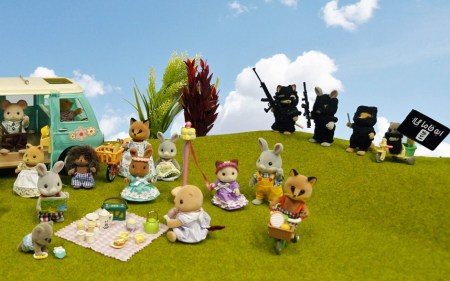
The West used to be proud of being the land of the free. European museums, instead, are rapidly submitting to Islamic correctness. The exhibition “Passion for Freedom” at the Mall Gallery in London censored the light box tableaux of a family of toy animals living in an enchanted valley.

“The Louvre will be dedicating a new section to the artistic heritage of Eastern Christians”, then President Nicholas Sarkozy announced in 2010. But the project was scrapped by the museum’s new management, with the approval of President Hollande’s culture ministry. So today, the Louvre has a section dedicated to Islamic art, but nothing on Eastern Christianity.

Maastricht, in the Netherlands, is the picturesque city that gave its name to the famous treaty signed in 1992 by the twelve nations of the European Community at the time, and which paved the way for the foundation of today’s European Union and the single currency, the euro.

Maastricht, however, is also the home of “Tefaf”, the most important art and antiques fair in the world. The art work “Persepolis” by the Italian artist Luca Pignatelli was already scheduled when the commission ordered it removed. The work, built in 2016, combined a Persian Islamic rug and a female head. “We are all humbled and speechless”, Pignatelli declared, pointing out that his work had initially aroused the enthusiasm of the commission. The fair’s explanation was that Pignatelli’s work was “provocative“.

The officials of fair presumably did not want to offend Islam and possible Muslim buyers with Pignatelli’s combination of the mat (used by Muslims for prayer) with the woman’s face. “We are shocked, this is the first time this has happened and I think it is legitimate to talk about it”, Pignatelli said. “If in Rome it can happen that you decide to veil art works to avoid offending foreign visitors, well, I do not agree”. The reference is at the Italian government decision to veil the antique Roman statues to avoid offending Iran’s visiting President Hassan Rouhani.

If Europe wants a future, it should be less ideological about Maastricht’s treaty and more against Maastricht’s capitulation to fear. The brave Algerian writer Kamel Daoud said:

“Those (migrants) who come to seek freedom in France must participate in freedom. Migrants did not come to seek asylum in Saudi Arabia, but in Germany. Why? For security, freedom and prosperity. So they must not come to create a new Afghanistan”.

Right. But it is the European mainstream that is letting them turn our cultural landscape into another Afghanistan. The Taliban have killed artists and destroyed art works. The West used to be proud of being the land of the free.

European museums, instead, are rapidly submitting to Islamic correctness. The exhibition “Passion for Freedom,” at the Mall Gallery in London, censored the light box tableaux of a family of toy animals living in an enchanted valley. Entitled, “ISIS Threaten Sylvania“, it was eliminated after the British police referred to its “inflammatory” content. Previously, the Tate Gallery in London banned a work by John Latham that displayed a Koran embedded in glass.

The brave work of the artist Mimsy, “ISIS Threaten Sylvania”, which satirized the brutality of ISIS, was removed from London’s Mall Galleries after the British police defined it “inflammatory.” (Image source: Mimsy)

Another British artist, Grayson Perry, admitted that he censored himself out of fear that he might end up like Theo van Gogh, the Dutch filmmaker slain by an extremist Muslim, Mohammed Bouyeri, for having made a film about women under Islam. “I have censored myself,” Perry said. “The reason I have not gone all out in attacking Islamism in my art is because I have real fear that someone will slit my throat”.

The Victoria and Albert Museum in London first showed, then withdrew, a portrait of the Prophet of Islam, a work of devotional art image of Muhammad. The photographer Syra Miah, a British native whose family came from Bangladesh, saw her work withdrawn from an Art Gallery in Birmingham after protests by a group of Muslims. The photo portrayed a half-naked woman, mentally ill, who lives under a bus stop in Bangladesh.

The Museum of Cultures of the World in Gothenburg, Sweden, opened with an exhibition entitled “AIDS in the Era of Globalization”. In it, the artist Louzla Darabi exhibited a work, “Scène d’amour”, that depicts a woman having sex with a man whose face cannot be seen. A verse from the Koran is written on it in Arabic. Less than three weeks after the inauguration of the exhibition, the museum removed the painting. The Hergé Museum in Louvain, Belgium, was planning an exhibition to pay tribute to Charlie Hebdo‘s cartoonists; that event, too, was cancelled.

French President François Hollande eliminated a section of the Louvre Museum dedicated to the Eastern Christians, who in the last two years have been decimated by the Islamic State. “The Louvre will be dedicating a new section to the artistic heritage of Eastern Christians”, then President Nicholas Sarkozy announced in 2010. But the project was scrapped by the museum’s new management, with the approval of Hollande’s culture ministry.

Marie-Hélène Rutschowscaya — former head of the Louvre’s Coptic section and one of the world’s leading scholars on Eastern Christianity — denounced the move. “The dramatic events we are currently seeing in the Middle East and Eastern Europe should instead spur us to do more to promote lasting cultural ties,” Rutschowscaya wrote in her letter to Hollande. So today, the Louvre has a section dedicated to Islamic art, but nothing on Eastern Christianity.

Perhaps the Iranian ayatollahs were right in asking the Capitoline Museums in Rome to veil the nude statues during President Rouhani’s visit. Perhaps the Islamic fundamentalists are wrong, the West is not as free as it claims. Perhaps we should apologize to the Taliban for criticizing their destruction of the great Buddhas of Afghanistan. According to the West’s new cultural sanctimony, today these statues might be considered “blasphemous” too.

Trump Has a Foreign Policy Strategy

April 21, 2017

Trump Has a Foreign Policy Strategy, National InterestJames Jay Carafano, April 20, 2017

Trump is an arch nationalist in the positive sense of the term. America will never be safe in the world if the world doesn’t have an America that is free, safe and prosperous.

That belief is at the heart of Trump’s policies designed to spark an economic revival, rollback the administrative state and rebuild the military. It lies at the core of his mantra: make America great again.

Even the strongest America, however, can’t be a global power without the willingness to act globally. And that’s where Trump’s declaration of “America First” comes in.

************************************

For two weeks, the White House has unleashed a foreign-policy blitzkrieg, and Washington’s chattering classes are shocked and, if not awed, at least perplexed.

CNN calls Trump’s actions a “u-turn.” Bloomberg opts for the more mathematical “180 degree turn,” while the Washington Post goes with “flipflop.” Meanwhile, pundits switched from decrying the president as an isolationist to lambasting him as a tool of the neocons. Amid all the relabeling, explanations of an “emerging Trump Doctrine” have proliferated faster than North Korea’s nuclear arsenal.

Here’s my take on what’s going on:

• Yes, there is a method to Trump’s “madness.”

• No, there has been no big change in Trump’s strategy.

The actions that flustered those who thought they had pigeon-holed Donald Trump simply reflect the impulses that have driven the direction of this presidency since before the convention in Cleveland.

At the Center of the Storm

Where is the head and heart of the president’s national-security team? Ask that question a year ago, and the answer would have been simple: General Mike Flynn, Mayor Rudy Giuliani and Senator Jeff Sessions.

Today, Flynn is gone. Giuliani never went in. Sessions is still a crucial voice in the administration, but his duties as Attorney General deal only partially with foreign policy and national-security matters.

The new team centers round Jim Mattis at the Defense Department, Rex Tillerson at the State Department, John Kelly at the Department of Homeland Security and H. R. McMaster in the West Wing—ably assisted by Nikki Haley at the United Nations. Trump barely knew these people before the election.

There is little question that the new team’s character and competence affected the White House response to the recent string of high profile events and activities—from presidential meetings with Egypt and China and Tillerson’s tête-à-tête with Putin, to the ominous developments in Syria and North Korea. Though on the job for only about dozen weeks, the new administration handled a lot of action on multiple fronts quite deftly. Much of that can be credited to the maturity and experience of Trump’s senior national-security team.

But how the administration responded was purely Trumpian—reflecting an impulse that transcends the makeup of his foreign team or other White House advisors.

Decoding Trumpian Strategy

Since the early days of the campaign, one thing has been clear: trying stitch together an understanding of Trump’s foreign and defense policy based on Trump’s tweets and other off-hand comments is a fool’s errand. That has not changed since the Donald took over the Oval Office.

That is not to say that none of Trump’s rhetoric matters. He has given some serious speeches and commentary. But pundits err when they give every presidential utterance equal merit. A joint address to Congress ought to carry a lot more weight than a 3 a.m. tweet about the Terminator.

But especially with this presidency, one needs to focus on White House actions rather than words to gain a clearer understanding of where security and foreign policy is headed. Do that, and one sees emerging a foreign and defense policy more conventional and more consistent than what we got from Bush or Obama. Still, a deeper dive is necessary to get at the root of Trump’s take on the world and how it fits with recent actions like the tomahawk strikes in Syria and the armada steaming toward North Korea.

I briefed Candidate Trump and his policy advisors during the campaign. I organized workshops for the ambassadorial corps during the Cleveland Convention and worked with the presidential team through the inauguration. Those experiences let me observe how the policies from the future fledgling administration were unfolding. Here are some observations that might be helpful in understanding the Trumpian way.

At the core of Trump’s view of the world are his views on the global liberal order. Trump is no isolationist. He recognizes that America is a global power with global interests and that it can’t promote and protect those interests by sitting at home on its hands. Freedom of the commons, engaging and cooperating with like-minded nations, working to blunt problems “over there” before they get over here—these are things every modern president has pursued. Trump is no different.

What distinguishes Trump—and what marks a particularly sharp departure from Obama—is his perception of what enabled post–World War America and the rest of the free world to rise above the chaos of a half century of global depression and open war.

Obama and his ilk chalked it all up to international infrastructure—the UN, IMF, World Bank, EU, et al. For Trump, it was the sovereign states rather than the global bureaucracies that made things better. The international superstructure has to stand on a firm foundation—and the foundation is the sovereign state. Without strong, vibrant, free and wealthy states, the whole thing collapses like a Ponzi scheme.

Trump is an arch nationalist in the positive sense of the term. America will never be safe in the world if the world doesn’t have an America that is free, safe and prosperous.

That belief is at the heart of Trump’s policies designed to spark an economic revival, rollback the administrative state and rebuild the military. It lies at the core of his mantra: make America great again.

Even the strongest America, however, can’t be a global power without the willingness to act globally. And that’s where Trump’s declaration of “America First” comes in.

What it means for foreign policy is that the president will put the vital interests of the United States above the maintenance of global institutions. That is not an abandonment of universal values. Every American president deals with the challenge of protecting interests and promoting values. Trump will focus on American interests and American values, and that poses no threat to friends and allies. In many cases, we share the same values. In many cases, what’s in America’s vital interest is also in their interest—and best achieved through joint partnership.

Here is how those animating ideas are currently manifesting themselves in Trump’s strategy:

A strategy includes ends (what you are trying to accomplish), means (the capabilities you will use to do that) and ways (how you are going to do it). The ends of Trump’s strategy are pretty clear. In both talk and action in the Trump world, it boils down to three parts of the world: Europe, Asia and the Middle East. That makes sense. Peace and stability in these regions are vital to U.S. interests and are under assault. The United States wants all three parts of the world to settle. It is unrealistic to think all the problems can be made to disappear, but it is not unrealistic to significantly reduce the potential for region-wide conflict.

The means are more than just a strong military. Trump believes in using all the instruments of power, hard and soft. He has unleashed Nikki Haley on the United Nations. He has ordered Rex Tillerson to revamp the State Department so that it is focused on the core tasks of statecraft and the effective and appropriate use of foreign assistance. He wants an intelligence community that delivers intelligence and doesn’t just cater to what the White House wants to hear. And he has ordered Homeland Security to shift from being politically correct to operationally effective. Further, it’s clear that Tillerson, Kelly, Mattis and Sessions are all trying to pull in the same direction.

The ways of the Trump strategy are not the engagement and enlargement of Clinton, the rearranging of the world by Bush, or the disengagement of Obama. The world is filled with intractable problems. Trump is less interested in trying to solve all of them in a New-York minute and more concerned about reducing those problems so that they give the United States and its friends and allies less and less trouble.

Trump is traveling a path between running away and invading. It might be called persistent presence. The United States plans to engage and use its influence in key parts of the world consistently over time to protect our interests. Done consistently, it will not only protect our interests; it will also expand the global safe space by causing bad influences to fade.

Recent activities in the Middle East are a good example. The bomb strike on Syria was not a prelude to regime change or nation-building in Syria. It was a warning shot to Assad to cut it out and stop interfering in U.S. efforts to finish off ISIS, stabilize refugee populations and keep Iraq from falling apart. Engagement with Egypt was to signal America is back working with partners to stabilize the region and counter the twin threats of Islamist extremism and Iran. Neither is a kick-ass-and-withdraw operation. These are signs of long, serious engagement, shrinking the space in which bad actors can operate.

The U.S. regional strategies for Europe and Asia are the same, and it seems clear that Chinese and Russian leaders have gotten the message. In the wake of recent meetings, both countries have reacted by treating Trump with the seriousness he has demanded. Others get it too. I’ve talked to many foreign officials who have come through Washington, DC this year and they have all told me that they got the same impression: this administration is about resolve and persistence. Still, no strategy is without risks and pitfalls. This one is no different. Here is how Trump might screw up or be upended by a smarter or luckier enemy:

Pop goes political will. A strategy of persistent presence can work only if the United States persists. It took past presidents over a decade to screw things up. It is going to take at least eight years of reassuring friends and wearing down adversaries to fix it. Trump will have to get reelected.

Strength for the fight. Trump has to deliver guns and butter: a rebounding economy at home and a strong face abroad. That means a combination of growth and fiscally responsible federal spending—a challenge that eluded the last two presidents.

Mission creep. Presence can lapse into ambition, which can become overreach, or certainly taking on more than make sense to handle. There might always be temptation to deal with a North Korea, Syria or Iran once for all.

Blindsided. There are other parts of the world. An administration can’t be indifferent to effective engagement in Latin America and Africa.

Distractions. Persistence is boring. There is always the temptation to follow the bright foreign-policy object.

Enemy gets a vote. The United States has to be strong in three theaters at the same time, so there will always be a temptation for its competitors to coordinate efforts or seize opportunities to give the United States multiple problems to solve, straining its capability to persist in each theater.

Black Swans. Competitors might get tired of the long war and risk throwing in a game changer. For example, rolling the dice on an Electromagnetic Pulse attack. Effective persistence requires a measure of paranoia. Competitors are never inanimate entities to be pushed around. They have agency, and they are always looking for a way to make a bad day for the other guy.

It remains to be seen if Trump can become a strategic leader capable of steering America past all these obstacles, but certainly he sees the path forward much more clearly than his domestic opponents are willing to recognize or acknowledge.

EU Demands UK Pay Turkey for Migrants and All Brexit-Related Costs in Euros

April 21, 2017

EU Demands UK Pay Turkey for Migrants and All Brexit-Related Costs in Euros, BreitbartLiam Deacon, April 21, 2017

VIRGINIA MAYO/AFP/Getty

The European Commission is plotting to force the UK into paying even more for Brexit, burdening Britain with all related divorce costs and risks, according to draft negotiating directives.

The potentially huge bill must also be paid in euros rather than pounds, the European Union’s (EU) unelected executive arm said, meaning the UK will bear all the currency risk.

The list of demands sees little room for compromise; it includes the costs of relocating any EU institution and the UK’s share of a massive aid package given to Turkey in return for easing the migrant crisis.

“The United Kingdom should fully cover the specific costs related to the withdrawal process such as the relocation of the agencies or other Union bodies,” the Commission wrote, adding the UK’s financial obligations to the EU “should be defined in euro” rather than sterling.

The demands were made in a confusingly and bureaucratically dubbed, “Non Paper on Key Elements Likely to Feature in the Draft Negotiating Directives”.

The document demands the UK “honour its share of the financing of all the obligations undertaken while it was a member of the Union” including the so-called “Facility for Refugees in Turkey”.

“These obligations cover liabilities, including contingent liabilities, legal and budgetary commitments and any other obligations deriving from a basic act within the meaning of Article 54 of the Financial Regulation,” the draft document adds.

Britain is one of the largest net contributors to the EU budget, along with Germany, France, and Italy. Brexit is likely to leave a large hole in the bloc’s budget.

In February, it emerged the EU is planning to hammer the UK with a £51.2 billion (€60 billion) divorce bill.

Eurocrats demonstrated their intention to play hardball when Michel Barnier, the EU’s chief negotiator, insisted a future trade deal and the status of British expats could not be discussed until the bill was paid.

At the beginning March, however, a House of Lords Committee concluded the UK has no legal obligation to pay the massive bill under international law.

Hezbollah Sure Sounds Like it’s Afraid of an Israeli Attack

April 21, 2017

Hezbollah Sure Sounds Like it’s Afraid of an Israeli Attack, Front Page Magazine (The Point), Daniel Greenfield, April 21, 2017

Hezbollah has been bleeding rather badly in Syria. And the casualties are bad enough that many of its Jihadists don’t want to report for duty. Hezbollah has a paper force. People are listed who won’t actually fight. Because their opponents aren’t going to be afraid of their human shields or will pull back when the UN and the State Department barks. 

**********************

You don’t have to be a great student of human psychology to pick up on it.

A Hezbollah commander on Thursday guided a group of journalists on a tour of the Israel-Lebanon border, according to media reports.

“We’re not afraid of war,” Israel’s Channel 2 quoted him as saying. “The enemy understands this. We are firm in our positions…We will not hesitate to go to war and are even expecting it. We will fight when we are compelled to and we will win.”

We’re not afraid to fight! And we won’t hesitate to fight… if we have to fight. So you better not fight us because we’re not at all afraid to fight you. Really. And it would be foolish of you to fight us.

 Israel has been deterred by Hezbollah and it would be “foolish and reckless” for the Jewish state to launch a military campaign on its northern border, the Lebanese terror group’s deputy leader claimed on Thursday.

Qassem also expressed confidence regarding the terror organization’s readiness and capabilities in any future conflict with Israel, saying, “The level of Hezbollah’s readiness enables it to withstand any possible war, both numerically and in terms of means and goals.”

Sure.

Hezbollah has been bleeding rather badly in Syria. And the casualties are bad enough that many of its Jihadists don’t want to report for duty. Hezbollah has a paper force. People are listed who won’t actually fight. Because their opponents aren’t going to be afraid of their human shields or will pull back when the UN and the State Department barks.

Fighting fellow Islamic terrorists is much less fun than fighting Israel. But Hezbollah’s manpower is badly overextended in an Islamic civil war against enemies as cruel and treacherous as themselves.