Archive for April 20, 2017

Policeman shot dead, 2 hurt in suspected Paris terror attack

April 20, 2017

Source: Policeman shot dead, 2 hurt in suspected Paris terror attack | The Times of Israel

One attacker killed, another said at large after shooting on Champs-Elysees days before presidential elections

April 20, 2017, 10:48 pmPolice officers block the access to the Champs Elysees in Paris after a shooting on April 20, 2017 (AFP Photo/Ludovic Marin)

Police officers block the access to the Champs Elysees in Paris after a shooting on April 20, 2017 (AFP Photo/Ludovic Marin)

A gunman killed a police officer and seriously wounded two others before being killed himself in Paris’s Champs-Elysees shopping district Thursday, in what police said was likely a terror attack.

Paris police spokeswoman Johanna Primevert told The Associated Press that the attacker targeted police guarding the area, near the Franklin Roosevelt subway station at the center of the avenue popular with tourists.

French Interior Ministry spokesman Pierre-Henry Brandet said on BFM television that a man came out of a car and opened fire on a police vehicle.

Reuters quoted a police source who said there were two assailants. The second attacker escaped, reports said, but Brandet said it was too early to say whether the attacker had an accomplice, and noted that authorities were studying multiple potential motives.

Two police officials said the assailant had been flagged as an extremist. French prosecutors have opened a terrorism investigation into the attack.

Police and soldiers sealed off the area around the Champs-Elysees after the attack, ordering tourists back into their hotels and blocking people from approaching the scene.

Firefighters and rescuers stand by the site of a shooting on the Champs Elysees in Paris on April 20, 2017. (AFP Photo/Franck Fife)

Firefighters and rescuers stand by the site of a shooting on the Champs Elysees in Paris on April 20, 2017. (AFP Photo/Franck Fife)

Emergency vehicles blocked the wide avenue, which cuts across central Paris between the Arc de Triomphe and the Tuileries Gardens, normally packed with cars and tourists, and subway stations in the area were closed off.

US President Donald Trump was quick to react to the incident, saying it appeared to be “another terrorist attack.”

“Our condolences from our country to the people of France,” Trump said during a press conference with Italian Prime Minister Paolo Gentiloni. “It is a very, very terrible thing that’s going on in the world today, but it looks like another terrorist attack. What can you say? It just never ends. We have to be strong and we have to be vigilant and I have been saying it for a long time.”

A Paris resident said the gunfire sent scores of tourists fleeing into side streets. Badi Ftaiti, a Tunisian-born mason who has spent three decades in Paris, said the attack didn’t panic him.

But the 55-year-old said visitors to the city “were running, running… Some were crying. There were tens, maybe even hundreds of them.”

Police officers block the access to the Champs Elysees in Paris after a shooting on April 20, 2017. (AFP Photo/Franck Fife)

Police officers block the access to the Champs Elysees in Paris after a shooting on April 20, 2017. (AFP Photo/Franck Fife)

The attack came three days before the first round of France’s tense presidential election. Security is high around the vote.

The incident also comes just two days after police arrested two men in southern Marseille with weapons and explosives who were suspected of preparing an attack to disrupt the first-round of the presidential election on Sunday.

France is in a state of emergency and at its highest possible level of alert since a string of terror attacks that began in 2015, which have killed over 230 people.

Thousands of troops and armed police have been deployed to guard tourist hotspots such as the Champs-Elysees and other potential targets like government buildings and religious sites.


Islamist Attacks on Holidays

April 20, 2017

Islamist Attacks on Holidays, Investigative Project on Terrorism, Noah Beck, April 20, 2017

Nearly 50 people were murdered on Palm Sunday when Islamic State terrorists bombed two Coptic churches in an Easter celebration-nightmare. The next day, on the eve of the Jewish holiday of Passover, the Islamic State’s Sinai affiliate launched rockets at Israel.

Just before Christmas, a terrorist claimed by the Islamic State rammed a truck into Berlin’s crowded Christmas market, killing 12 people. And in Australia, a group of self-radicalized Islamists planned to attack St Paul’s Cathedral. In 2011, Nigerian Islamists murdered nearly 40 Catholic worshipers in a Christmas Day attack.

Terrorists attack where and when they can. But they seem keenly aware that turning holidays into horror can carry greater shock and terror. In 2002, 30 Israeli civilians were massacred and 140 injured by a Hamas suicide bomber who blew himself up as they sat for the seder, the traditional Passover meal, at the Park Hotel in Netanya.

It isn’t just terrorists who see advantages in striking during holidays. The 1973 Yom Kippur War may be the most famous example, when the armies of two Muslim-majority states, Egypt and Syria, attacked Israel on the most sacred day of the Jewish calendar. That war produced an estimated 20,000 deaths.

Christians and Jews aren’t the only religious groups that have been targeted by Islamists during non-Muslim holy days. The Hindu festival of Diwali has also been attacked. In 2005, a series of bombs killed over 60 people and injured hundreds in Delhi; a Pakistan-based Islamist terrorist group, the Islamic Revolutionary Front, claimed responsibility. Last October, Indian police arrested an Islamist cell inspired by the Islamic State for planning an attack during Diwali.

Muslims are also victimized by Islamist attacks in increasing volume. A 2015 mosque bombing in Yemen killed 29 people during prayers for the Muslim holiday of Eid. Last July, also during Eid, three people were killed at a Bangladesh checkpoint when gunmen carrying bombs tried to attack the country’s largest Eid gathering, which attracted an estimated 300,000 worshippers.

Last May, as the Muslim holy month of Ramadan approached, a spokesman for the Islamic State urged jihadists to “make it, with God’s permission, a month of pain for infidels everywhere.” Days later, as Ramadan celebrations stretched past midnight in central Baghdad, a minivan packed with explosives blew up and killed at least 143 people.

Terrorists also target secular holidays. Mohamed Lahouaiej-Bouhlel, a Tunisian resident of France, killed 85 people and injured hundreds more in a truck-ramming terrorist attack as people gathered for a Bastille Day celebration. In New York last fall, dump trumps were deployed to protect the Macy’s Thanksgiving Day Parade, after the Islamic State called it an “excellent target.”

Holidays are often chosen because they are “optimal attack days,” in terms of gathering large crowds into soft targets like houses of worship, religious markets, ceremonial gatherings, and parades. Last November, U.S. officials warned that the coming holiday season could mean “opportunities for violent extremists” to attack.

A terrorist attack on a holiday is also more likely to attract media attention. And because holidays draw tourists, well-timed attacks can amplify the economic damage that would be wrought by terror even on a non-holiday. After a spate of attacks toward the end of 2015, “about 10% of American travelers have canceled a trip … eliminating a potential $8.2 billion in travel spending,” reported MarketWatch.

But ISIS, al-Qaida and other Islamist terrorist groups believe they are waging a holy war above all else. Attacking infidels, be they Christians, Jews or Muslims of other sects, motivates jihadis more than anything else. “Those who targeted churches on holiday celebrations tend to be professional terrorist groups,” Raymond Ibrahim, author of Crucified Again: Exposing Islam’s New War on Christians, told the IPT. By contrast, “mob attacks happen either on a Friday, after an especially potent sermon, or whenever infidels need to be put in their place (e.g., a Christian accused of blasphemy, then the church in his village gets torched).”

In 2015, Islamic State warnings of future attacks against Christians noted that Christians were their “favorite prey” and no longer protected as “dhimmis,” a reference to non-Muslims in Islam who may, in exchange for paying the jizya tax, receive some state protection.

Thus, within the larger context of a holy war, attacks on non-Muslim holy days can be viewed as part of the more general Islamist strategy of humiliation, forced submission to Islam, and the denial of any competing religion. Attacking on Diwali or Christmas or Yom Kippur is essentially declaring that such “infidel” holy days ought to be desecrated rather than respected. The symbolic message is akin to the one communicated by the two Islamists who entered a French cathedral and beheaded an octogenarian priest, Jacques Hamel, during mass services last July.

Attacking places of worship on holy days – when they are most used by and relevant to their congregations – is also a good way to undermine these religious institutions and their supporters. If Islamist terror makes churches the most vulnerable on the days when they are most crowded, how will those houses of worship attract enough followers to sustain themselves? And how will their congregants practice their faith? The Coptic Pope curbed some Easter celebrations in Egypt after the recent Palm Sunday blasts.

Such questions may help to explain why Christians, who have lived in the Middle East – the birthplace of Christianity – for millennia now constitute only about 3 percent of the region’s population, down from 20 percent a century ago.

Indeed, the only non-Muslim country in the entire Middle East is also the safest place for non-Muslims in the region, including Christians, Druze, and Bahai. “Christians and other minorities in Israel prosper and grow,” says Shadi Khalloul, founder of the Israeli Aramaic Movement. “[W]hile in other countries in the Middle East, as well as in the Palestinian Authority, they suffer heavily from the Islamic movement and persecution – until forced to disappear.”

The Legacy of the Taliban: Sunni Allies of Tehran

April 20, 2017

The Legacy of the Taliban: Sunni Allies of Tehran, The Jerusalem Center via YouTube, April 20, 2017

(Please see also Taliban Decry ‘Detriments for the Environment’ from U.S. MOAB Explosion. — DM)

The blurb beneath the video states,

The West must not allow terror sanctuaries to grow, thrive, and be used to plan attacks against the West.

The U.S. decision to drop an 11-ton bomb, known as the “mother of all bombs,” in Afghanistan against an ISIS target brought back into focus that entire war and the fact that, aside from the problem of ISIS, there has still been a problem in Afghanistan of the Taliban.

How did the Taliban become so significant over the last number of years since the 9/11 attacks? It’s important to remember that the Taliban are as much a problem as the terror organizations that have congregated on Afghan soil. Taliban policies since the late 1990s involved a number of acts which they undertook which have undermined not just the security of the Middle East but also the security of the world. Of course it was the Taliban who gave sanctuary to Osama bin Laden and to al-Qaeda prior to the 9/11 attacks. They were originally located or protected by the regime in Sudan, but then in the mid-90s, bin Laden moved to Afghanistan where the Taliban had taken control and offered him a location for his training camps. It was there that bin Laden planned and implemented the horrible attack on the United States – against New York and against Washington, D.C.

One thing we’ve learned from this entire experience is that the West must not allow terror sanctuaries to grow, to thrive, and to be used to plan attacks against the West. That is the first lesson from the experience the West has had with the Taliban.

There’s a second experience with the Taliban that should be recalled. In March 2001, the Taliban decided to dynamite Buddhist statues in the Bamiyan Valley in Afghanistan that were 2,000 years old. These statues were located along the Silk Route and they were treasured by adherents of Buddhism, but all of a sudden the Taliban decided to attack these religious sites. The Taliban attack actually induced a debate in many radical Islamic circles about whether it was the right thing to do. At first, for example, the spiritual head of the Muslim Brotherhood, Sheikh Yusuf al-Qaradawi , thought it would be a mistake for the Taliban to attack the Buddhas because it would set up Muslims to be assaulted in Buddhist countries. Later, later Qaradawi and others said, “You know what? The attack on these pre-Islamic sites was the right thing to do” and there was even a discussion about destroying pre-Islamic sites in Egypt like the pyramids and the Sphinx.

It isn’t surprising that the derivatives of al-Qaeda that have grown, like ISIS, have been attacking pre-Islamic religious sites all over the Middle East, destroying the heritage of mankind in tens of cities that were once manned and lived in by ancient empires – the Persians, the Babylonians, the Assyrians. This tendency to attack religious sites of other faiths is a very dangerous trend that really had its first modern example with the attacks of the Taliban, and they remind us of a disastrous effects of the Taliban in the years that came afterward.

A third feature of the Taliban presence in Afghanistan is an opportunity we have to learn what are the exact relations between Shiites and Sunnis. Taliban, of course, are radical Sunnis and almost everybody who starts learning about the Middle East begins thinking that Sunnis are at war with Shiites, and that’s how you understand the politics of the Middle East. But it doesn’t always work that way because the Taliban today are equipped and even trained by Iranian forces. Iran is an essential ally of the Taliban despite the fact that the Taliban are radical Sunnis and the Iranians are radical Shiites.

So if there are those who think that they could allow Iran to expand its influence around the area of the Middle East and South Asia and it won’t affect them because their enemies are essentially Sunni, they’re making a big mistake, because an expanded Iran will also enhance radical Sunnism as it has with the Taliban in Afghanistan.

Ambassador Dore Gold has served as President of the Jerusalem Center for Public Affairs since 2000. From June 2015 until October 2016 he served as Director-General of the Israel Ministry of Foreign Affairs. Previously he served as Foreign Policy Advisor to Prime Minister Benjamin Netanyahu, Israel’s Ambassador to the UN (1997-1999), and as an advisor to Prime Minister Ariel Sharon.


Iran’s Top Judge Warns of Enemy Schemes for Election

April 20, 2017

Iran’s Top Judge Warns of Enemy Schemes for Election, Tasnim News Agency, April 20, 2017

(Apparently, the external Resistance Movement and the internal dissidents are causing the Mad Mullahs concern. Please see also, Iran’s Stage-Managed Elections. — DM)

In an address to a meeting of judicial officials on Thursday, Ayatollah Amoli Larijani highlighted the enemies’ outright hostility to Iran, pointing to the huge investment they have made for undermining the Islamic Republic and to the rising number of anti-Iranian media outlets.

“They (enemies) may also want to deal a blow to the (Iranian) Establishment during the elections,” the top judge added.

He then called on the judicial authorities and prosecutors to work in cooperation with the police and security forces to foil attempts at creating tensions and chaos.

Iran’s presidential election is planned to be held on May 19.

Iranians will also cast their ballots in the City and Village Councils elections on the same day.

On Wednesday, Leader of the Islamic Revolution Ayatollah Seyed Ali Khamenei warned of the enemies’ attempts to damage the process of election by publishing tempting stories in their media outlets, stressing that the Iranian nation will foil such plots with the same vigilance it has shown in the past.

The election should be held with high turnout and in healthy and secure conditions, Ayatollah Khamenei emphasized, saying that way polls would provide the country with immunity.

The UNRWA book battle

April 20, 2017

The UNRWA book battle, Israel Hayom, Jonathan S. Tobin, April 20, 2017

(More on the UN Rocket Warehousing Agency and the Palestinian authority. Please see also, UNRWA Won’t Be Changing School Textbooks and Curriculum. — DM)

It is an article of faith for the international community and the Jewish Left that the ‎Palestinian Authority is a moderate force that wants to make peace with Israel. ‎That belief has been undermined by many of the PA’s actions and statements since ‎its creation after the signing of the Oslo Accords in 1993, yet somehow it survives and forms the basis for many of the assumptions critics make ‎about Israel’s government.

The latest proof that the PA is a principle obstacle to ‎peace rather than its best hope has not received any attention in the Western press. ‎But a discussion of the conflict that has arisen between it and the United Nations ‎Relief and Works Agency speaks volumes about everything that is wrong ‎with the PA.‎

UNRWA is the world body that is devoted solely to aiding Palestinian refugees. ‎Unlike the United Nations High Commissioner for Refugees, which is tasked with helping all other refugees around the world, UNRWA doesn’t try ‎to resettle refugees or resolve their problems. On the contrary, since its creation ‎after the Arab failure to destroy Israel in its War of Independence, UNRWA has ‎helped to perpetuate the clash between Israel and the Muslim and Arab worlds and ‎championed the “right of return” that would spell Israel’s end. Its schools and aid ‎projects have been hotbeds of radicalism aimed at erasing the existence of the ‎Jewish state and have even been used by Hamas. In particular, critics have noted ‎the way UNRWA schools in the West Bank and Gaza have curricula and textbooks ‎that teach up to 600,000 Palestinian youngsters to reject Israel’s legitimacy and ‎glorify the struggle to destroy it. ‎

But, like the rest of the U.N., UNRWA has been feeling some pressure to ‎reform. The Trump administration has shown a willingness to throw its weight ‎around that directly contrasts with former President Barack Obama’s support for the U.N. Under ‎new Secretary General Antonio Guterres, who previously headed the U.N.’s other ‎refugee agency, efforts to promote the libel that Israel is an apartheid state were ‎rejected. So when the Arab press reported leaks about a shift in UNRWA’s ‎education policy, this seemed to indicate that even that agency was feeling some ‎pressure to change its ways.‎

According to those reports, UNRWA was planning to alter the textbooks it uses ‎in its schools. Among the planned changes, cities inside Israel would stop being labeled as Palestinian, a practice that instills a sense in readers that the Jewish state is ‎merely a colonialist intrusion built entirely on “stolen” Arab land. Other changes ‎included an effort to tone down praise of Palestinians who commit terrorism ‎against Jews and Israelis. Its teaching about Jerusalem would treat it as a city that ‎is as holy to all three monotheistic religions, rather than just Islam. That’s significant because Palestinian efforts to claim that shrines such ‎as the Temple Mount and even the Western Wall are ‎exclusively Muslim were part of a campaign of incitement that led to the recent ‎‎”stabbing intifada.” Perhaps just as significant is that the new texts would also seek ‎to correct gender bias that was part of the old books.‎

But rather than welcome reform, the Palestinian Authority has reacted with fury. ‎Last week, the PA announced that it was suspending ties with UNRWA over the ‎proposed changes, which have yet to be formally announced. It said the revisions ‎to the curriculum were an “affront to the Palestinian people, its history and ‎struggles” and that the suspension would continue until the agency’s “positions are ‎corrected.”‎

The PA Education Ministry issued the following statement:‎ “Any distortion of the Palestinian curriculum is a flagrant violation of the laws of the ‎host country, and any change to any letter to appease any party is a betrayal of the ‎Palestinian narrative and the right of the Palestinian people under occupation to ‎preserve its identity and struggle.‎”

The implications of the PA position for the prospects for peace in this or future ‎generations cannot be overestimated.‎

For more than a century, Palestinian national identity has been inextricably tied to the war on Zionism. Throughout two decades of failed peace negotiations, the ‎supposedly moderate Palestinian Authority has consistently rejected Israeli offers ‎of independence that would obligate it to recognize the legitimacy of the Jewish ‎state within any borders. Any chance that this will change rests not so much on ‎more Israeli concessions but on a sea change in Palestinian political culture. ‎Leaving aside the role of Hamas, unless the PA’s future leaders are able to embrace ‎peace without fear that doing so will be seen as a betrayal, the failure of more talks ‎is foreordained. UNRWA’s proposed changes are a step in the right direction. The ‎PA’s opposition is more proof that it is an obstacle to any hope for a better life for ‎both Israeli and Palestinian children.‎

Venezuela seizes General Motors plant as property of the state

April 20, 2017

Venezuela seizes General Motors plant as property of the state, Hot Air, Jazz Shaw, April 20, 2017

This news broke overnight and it undoubtedly comes as a shock to anyone who hasn’t been paying to socialism in general and the regime of Venezuelan President Nicolas Maduro in particular. The government of Venezuela came in and seized control of the General Motors plant in the city of Valencia, taking over the property, assets and accounts. The automotive giant responded by saying that they were immediately halting operations. (CNN)

General Motors says it will immediately halt operations in Venezuela after its plant in the country was unexpectedly seized by authorities.

GM (GM) described the takeover as an “illegal judicial seizure of its assets.”

The automaker said the seizure showed a “total disregard” of its legal rights. It said that authorities had removed assets including cars from company facilities.

“[GM] strongly rejects the arbitrary measures taken by the authorities and will vigorously take all legal actions, within and outside of Venezuela, to defend its rights,” it said in a statement.

GM’s Venezuelan operation was already pretty much at the point of stagnation. Productivity was approaching zero because their currency had collapsed and they couldn’t order parts to keep the lines running. Also, the domestic market for cars wasn’t exactly booming because their potential customers have money which is basically worthless and they’re mostly too busy looking for scraps of food to worry about a new set of wheels.

If nothing else, this incident will provide an enlightening, educational moment for the rest of the world. It’s a given that this is bad news for General Motors, for the workers there… let’s just say it. This is bad news for everyone except Maduro and his cronies. But it also serves to further pull away the mask, allowing the rest of the world to see what’s actually going on. So gather around, kids, because we’re not only seeing how socialism ends (and it always ends this way) but also how the socialist machinery operates through the various phases of its life cycle.

Originally, the government tolerates the presence of foreign manufacturing entities such as General Motors to fill needs they have which can’t be handled domestically. (GM has been there for roughly seven decades.) It’s not that the Venezuelan people are incapable of innovation or creation… there’s simply no motivation for them to strive for success. Anything they create simply becomes the property of the state anyway, so the hard working, innovative person doesn’t realize much more success than the guy who can barely keep his eyes open to show up for his job sweeping the sidewalk. There’s no point to being particularly innovative.

So companies such as GM are allowed to go to work. But once the system inevitably begins to implode, the tyrant in charge begins looking for new resources to grab. In the name of the socialist concept wherein everything “belongs to the people” he seizes the GM plant. They take the cars which are there to hand out to high ranking party officials and divide up the assets while demanding that the workers get back to producing automobiles. This is, of course, impossible because they don’t have the parts to do it and the people who actually know how to run things are fleeing.

These are the fruits of socialism. It’s a humanitarian disaster to be sure, but it’s also a teachable moment. Watch and learn.

Taliban Decry ‘Detriments for the Environment’ from U.S. MOAB Explosion

April 20, 2017

Taliban Decry ‘Detriments for the Environment’ from U.S. MOAB Explosion, PJ Media, Bridget Johnson, April 19, 2017

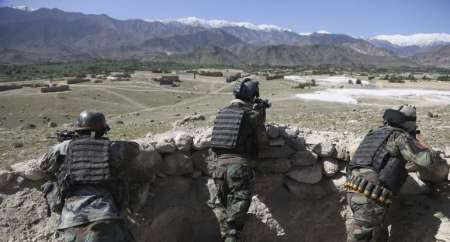
Afghan commandos are positioned in Pandola village near the site of the U.S. MOAB bombing in the Achin district of Afghanistan on April 14, 2017. (AP Photo/Rahmat Gul)

(St. Al the Gored has not yet registered his displeasure at this obvious effort to promote global warming. — DM)

“The use and experimentation of such destructive weapons by foreign occupiers on our war-weary people and in every corner of our war-ravaged country is inexcusable,” Taliban spokesman Zabihullah Mujahid said. “The Islamic Emirate condemns such barbarity in the strongest of terms and considers its perpetrators as war criminals. Such over-proportionate use of destruction poses long-term detriments for the environment and the development of our nation.”

National Security Advisor H.R. McMaster visited Afghanistan after the MOAB attack to help determine if the U.S. will have an increased presence in Afghanistan moving forward.

**********************************

The Taliban accused Washington of harming the environment and using disproportionate force against ISIS by dropping the “mother of all bombs” in Nangarhar province last week.

It was the first time the GBU-43/B Massive Ordnance Air Blast, packed with 11 tons of TNT and dropped from an MC-130, was used in combat.

The U.S. Resolute Support Mission said forces “took every precaution to avoid civilian casualties with this strike.” An Afghan army spokesman told the country’s Tolo News that one civilian family lived in the blast area, but they were evacuated by security forces before the MOAB was dropped.

“Many families had long been displaced from the area due to ISIS brutality,” said Afghanistan’s Chief Executive Abdullah Abdullah. “Government also took great care to avoid civilian harm.”

Tolo reported Tuesday that the majority of the 96 fighters killed by the MOAB in the ISIS stonghold were Tehrik-e Taliban Pakistan (TTP) and members of Pakistan-based Lashkar-e-Taiba. TTP’s attacks include the assassination of Benazir Bhutto, the shooting of Nobel laureate Malala Yousafzai, and the 2014 massacre at a Peshawar school. Lashkar-e-Taiba, which has been allied with the Afghan Taliban and al-Qaeda, was behind the 2008 Mumbai attacks.

Also reportedly among the dead: 13 ISIS commanders, 12 Tajiks, and 13 Indian nationals who had joined ISIS.

ISIS operatives are still active in other provinces including Kunar, Zabul, Ghor, Jawzjan and Sar-e-Pul, where Afghan officials say ISIS has beheaded children and torched homes.

ISIS and the Taliban called a truce last August, agreeing to stop fighting each other to both focus on fighting U.S. forces and the U.S.-backed Afghan forces.

In a statement posted on their website over the weekend, the Taliban said the “barbarity” of the Achin district MOAB drop “was followed with much fanfare with the Americans proudly boasting about it in the media thus showcasing the increasing barbarity of the foreign occupation.”

“The use and experimentation of such destructive weapons by foreign occupiers on our war-weary people and in every corner of our war-ravaged country is inexcusable,” Taliban spokesman Zabihullah Mujahid said. “The Islamic Emirate condemns such barbarity in the strongest of terms and considers its perpetrators as war criminals. Such over-proportionate use of destruction poses long-term detriments for the environment and the development of our nation.”

He added that ISIS in Afghanistan is an internal Afghan matter and “if Americans fear for their security they should foil such plots at their own borders.”

Mujahid accused the U.S. of using ISIS “as a ploy” to “experiment novel weapons and extend the illegitimate occupation.” Further, he claimed the Taliban “came close to completely eradicating this group” but their operations were stymied by U.S. bombing.

“The fact that the Americans claim that their presence in Afghanistan is limited only to a train and assist role while dropping 10 kiloton bombs on our lands only strengthens the voices of independence and jihad in our land,” he added. “…Such irresponsible actions only light the flames of vengeance and show the ugly face of foreign occupation.”

Taiban terrorist attacks this year include a car bombing that killed 7 people outside of a bank and an insider attack that killed a dozen policemen in February. In November, the Taliban claimed a suicide bombing at Bagram Airfield that killed four Americans.

The Obama administration would not call the Taliban a terrorist group, claiming they were an “armed insurgency” and encouraging the Afghan government to broker a deal with the group.

The Taliban were the first terrorist group to openly address President Trump after he won the election, telling him in November and again in December to pull out of Afghanistan or face an “incurable wound.” After the inauguration, Mujahid argued in an open letter to Trump that the previous administration erred in viewing the Taliban as “mere rebellion” instead of “a governing system,” and he should “unwaveringly accept” the “historically successful struggle” of jihadists over the past 15 years and give up the fight in Afghanistan.

Gen. John Nicholson, commander of coalition forces in Afghanistan, told a Senate panel in February that Russia has been giving support to the Taliban, who have been training with al-Qaeda.

Nicholson said “just within the last year” Russia began cozying up to the Taliban — “this has started and it was a gradual progression,” and the support continues to increase as the Kremlin is “concerned that if there’s a coalition and a U.S. presence in Afghanistan that this affects their ability to influence the Central Asian states to the north.”

Pressed on what Russia’s endgame in Afghanistan could be, Nicholson said he thinks the Kremlin’s goal is to “undermine United States and NATO.”

This month, some Afghan officials in Uruzgan province reported seeing Russian trainers among the Taliban.

National Security Advisor H.R. McMaster visited Afghanistan after the MOAB attack to help determine if the U.S. will have an increased presence in Afghanistan moving forward.

Rex Tillerson’s Tough Talk on Iran

April 20, 2017

Rex Tillerson’s Tough Talk on Iran, Power LinePaul Mirengoff, April 19, 2017

Yesterday, as we noted here, Secretary of State Rex Tillerson informed Congress that Iran is in compliance with the nuclear deal and that the administration will continue to provide relief from sanctions, as called for by the agreement. He added, however, that “Iran remains a leading state sponsor of terror through many platforms and methods.”

Today, Tillerson (1) elaborated in scathing language on Iran’s role as a leading sponsor of terrorism and on other of its misdeeds, (2) made clear that the nuclear deal is unsatisfactory, and (3) stressed that the U.S. government is engaged in a thorough review of our Iran policy.

Tillerson characterized the Iran deal as “another example of buying off a power who has nuclear ambitions.” Citing the North Korean example, Tillerson complained “we buy them off for a short period of time, and then someone has to deal with it later.” He then added that the administration does not intend to follow this course.

It is rumored that President Trump hit the roof when he saw Tillerson’s letter to Congress (or maybe the way it was reported) and demanded that he issue today’s tough statement. According to this account, the tough statement had been drafted previously, nixed by influential soft-liners in the administration, and revived in light of the Tillerson letter.

Whether or not this is what happened, I think today’s statement was much needed.

But what will come of the policy review promised in Tillerson’s statement? The Obama administration did an effective job of fencing in its successors. I discussed the future of the Iran deal under Trump in this post.

The upshot of two days of Tillerson talk about Iran seems to be that our Iran policy is up-for-grabs, like much else in the policy realm. Sharp disagreement probably exists within the administration about how to proceed and, not unlike other policy disputes, the disagreement occurs in the context of no truly good options.

You can watch Tillerson’s speech, plus a brief Q&A, below. Don’t miss Andrea Mitchell fretting that if the U.S. backs out of the Iran deal, rogue states like North Korea won’t trust us.


Judicial Watch Sues State Department and USAID for Records about Funding and Political Activities of George Soros’ Open Society Foundation – Macedonia

April 20, 2017

Judicial Watch Sues State Department and USAID for Records about Funding and Political Activities of George Soros’ Open Society Foundation – Macedonia, Judicial Watch, April 19, 2017

(The Trump administration should confess judgment and order the Department of State and USAID to turn over the document. Will Obama administration holdovers in the deep state try to prevent that? — DM)

USAID website reports it gave $4,819,125 in taxpayer money to Soros’s Open Society Foundation – Macedonia between from 2012 to 2016 

(Washington, DC) – Judicial Watch announced today that it filed a Freedom of Information Act (FOIA) lawsuit against the Department of State and the U.S. Agency for International Development (USAID) for records and communications relating to the funding and political activities of the Open Society Foundation – Macedonia.  The Macedonia organization, part of George Soros’ Open Society Foundations, received nearly $5 million from USAID from 2012 to 2016. The lawsuit was filed in the U.S. District Court for the District of Columbia (Judicial Watch v. U.S. Department of State and the U.S. Agency for International Development (No. 1:17-cv-00729)).

The suit was filed after both the U.S. Department of State and USAID failed to respond to a February 16, 2017, FOIA request seeking:

  • All records related to any grants, contracts, or disbursements of funds by the Department of State to the Open Society Foundation – Macedonia and/or any of the Foundation’s subsidiaries. This request includes all related requests for funding, payment authorizations, or similar records, as well as all related records of communication between any official, employee, or representative of the Department of State and any official, employee, or representative of the U.S. Agency for International Development (USAID).
  • Any records of communication between any official, employee, or representative of the Department of State and any officer, employee, or representative of the Open Society Foundation -Macedonia and/or any of the Foundation’s affiliated organizations. This request includes responsive records of communication sent from or directed to U.S. Ambassador to Macedonia Jess L. Baily.
  • All analyses or similar records regarding the political activities of the Open Society Foundation -Macedonia and/or any of the Foundation’s affiliated organizations.
  • All messages transmitted via the State Department’s SMART system sent from any U.S. Government employee or contractor operating under the Chief of Mission’s authority at the U.S. Embassy in Skopje that pertain to the Open Society Foundation – Macedonia and/or any of the Foundation’s affiliated organizations.

The USAID website reports that between February 27, 2012, and August 31, 2016, USAID gave $4,819,125 in taxpayer money to Soros’s Open Society Foundation – Macedonia (FOSM), in partnership with four local civil society organizations. The USAID’s website links to http://www.soros.org.mk, and says the project trained hundreds of young Macedonians “on topics such as freedom of association, youth policies, citizen initiatives, persuasive argumentation and use of new media.”

In February, Judicial Watch reported:

The U.S. government has quietly spent millions of taxpayer dollars to destabilize the democratically elected, center-right government in Macedonia by colluding with leftwing billionaire philanthropist George Soros, records obtained by Judicial Watch show. Barack Obama’s U.S. Ambassador to Macedonia, Jess L. Baily, has worked behind the scenes with Soros’ Open Society Foundation to funnel large sums of American dollars for the cause, constituting an interference of the U.S. Ambassador in domestic political affairs in violation of the Vienna Convention on Diplomatic Relations.

***

Here’s how the clandestine operation functions, according to high-level sources in Macedonia and the U.S. that have provided Judicial Watch with records as part of an ongoing investigation. The Open Society Foundation has established and funded dozens of leftwing, nongovernmental organizations (NGOs) in Macedonia to overthrow the conservative government. One Macedonian government official interviewed by Judicial Watch in Washington D.C. recently, calls it the “Soros infantry.” The groups organize youth movements, create influential media outlets and organize violent protests to undermine the institutions and policies implemented by the government. One of the Soros’ groups funded the translation and publication of Saul Alinsky’s “Rules for Radicals” into Macedonian. The book is a tactical manual of subversion, provides direct advice for radical street protests and proclaims Lucifer to be the first radical. Thanks to Obama’s ambassador, who has not been replaced by President Trump, Uncle Sam keeps the money flowing so the groups can continue operating and recruiting, sources in Macedonia and the U.S. confirm.

According to InsidePhilanthropy.com, Soros’ Open Society Foundation “may be the largest philanthropic organization ever built, with branches in 37 countries. While the Gates Foundation spends more money, OSF has a larger footprint worldwide thanks to its many local offices, including throughout Africa.” OSF’s budget will be around $930 million …”

The activities of Ambassador Bailey and USAID’s funding of the Open Society Foundation have recently come under Congressional scrutiny. On January 17, 2017, Senator Mike Lee (R-UT) sent a letter to Baily asking him to explain the State Department’s relationship with Open Society Foundation. On February 24, 2017, Representatives Chris Smith (R-NJ), Louie Gohmert (R-TX), and others called on the Government Accountability Office to conduct an investigation and audit of the Department of State and USAID’s activities in Macedonia, including funding of Open Society Foundation entities and potential interference in domestic Macedonian political affairs in potential violation of the Vienna Convention on Diplomatic Relations.

“The Obama administration seemed to bust taxpayer budgets in an effort to fund the Soros operation,” said Judicial Watch President Tom Fitton. “The Trump State Department and USAID should get their act together and disclose the details of the Obama-Soros spigot.”

Israeli defense officials: Assad still has chemical weapons

April 20, 2017

Source: Israeli defense officials: Assad still has chemical weapons | The Times of Israel

Military source estimates Syrian president’s stockpile consists of up to three tons of deadly materiel

April 20, 2017, 1:50 am
This frame grab from video provided on Tuesday April 4, 2017 shows a Syrian doctor treating a boy following a suspected chemical attack, in the town of Khan Sheikhoun, northern Idlib province, Syria. (Qasioun News Agency, via AP)

This frame grab from video provided on Tuesday April 4, 2017 shows a Syrian doctor treating a boy following a suspected chemical attack, in the town of Khan Sheikhoun, northern Idlib province, Syria. (Qasioun News Agency, via AP)

AP — Syria still has up to three tons of chemical weapons, Israeli defense officials said Wednesday in the first specific intelligence assessment of President Bashar Assad’s weapons capabilities since a deadly chemical attack earlier this month.

The estimate came as the head of the international chemical weapons watchdog said laboratory tests had provided “incontrovertible” evidence that victims and survivors of the April 4 attack in northern Syria were exposed to sarin nerve gas or a similar banned toxin.

Israel, along with the United States and much of the international community, has accused Assad’s forces of carrying out the attack, which killed at least 90 people, including dozens of children.

A senior Israeli military official said Israeli intelligence believes Syrian military commanders ordered the attack, with Assad’s knowledge. Briefing reporters, he said Israel estimates Assad still has “between one and three tons” of chemical weapons.

The assessment was confirmed by two other Israeli defense officials. All the officials spoke on condition of anonymity under military briefing rules.

Syrian children receive treatment following a suspected toxic gas attack in Khan Sheikhun, a rebel-held town in the northwestern Syrian Idlib province, on April 4, 2017. (AFP PHOTO / Mohamed al-Bakour)

Syrian children receive treatment following a suspected toxic gas attack in Khan Sheikhun, a rebel-held town in the northwestern Syrian Idlib province, on April 4, 2017. (AFP PHOTO / Mohamed al-Bakour)

Assad has strongly denied he was behind the attack in the opposition-held town of Khan Sheikhoun in Syria’s northern Idlib province, and has accused the opposition of trying to frame his government. Top Assad ally, Russia, has asserted a Syrian government airstrike hit a rebel chemical weapons factory, causing the disaster.

In response to the April 4 attack, the United States fired 59 missiles at a Syrian air base it said was the launching pad for the attack. Israel welcomed the strike on its northern neighbor.

The Syrian government has been locked in a six-year civil war against an array of opposition forces. The fighting has killed an estimated 400,000 people and displaced half of Syria’s population.

Israel has largely stayed out of the fighting, though it has carried out a number of airstrikes on suspected Iranian weapons shipments it believed were bound for the Lebanese militant group Hezbollah. Iran and Hezbollah, both bitter enemies of Israel, along with Russia have sent forces to support Assad.

Following Russia’s intervention in September 2015, Israel and Moscow opened a hotline to coordinate military activity in Syria. Israeli Defense Minister Avigdor Lieberman will fly to Moscow next week for talks with senior Russian officials.

Syria agreed to give up its chemical weapons arsenal to avert U.S. strikes following a chemical weapons attack in opposition-held suburbs of Damascus in August 2013 that killed hundreds of people and sparked worldwide outrage.

Ahead of that disarmament, Assad’s government disclosed it had some 1,300 tons of chemical weapons, including sarin, VX nerve agent and mustard gas.

The entire stockpile was said to have been dismantled and shipped out under international supervision in 2014 and destroyed. But doubts began to emerge soon afterward that not all such armaments or production facilities were declared and destroyed. There also is evidence that the Islamic State group and other insurgents have acquired chemical weapons.

Dan Kaszeta, a UK-based chemical weapons expert, said the Israeli estimate appeared to be conservative, but nonetheless was enough to be highly lethal.

“One ton of sarin could easily be used to perpetrate an attack on the scale of the 2013 attack. It could also be used for roughly 10 attacks of a similar size to the recent Khan Sheikhoun attack,” he said.

A fact-finding mission from the Organization for the Prohibition of Chemical Weapons, an international watchdog, is investigating the April 4 incident and on Wednesday its director-general, Ahmet Uzumcu, said that the results “from four OPCW designated laboratories indicate exposure to sarin or a sarin-like substance.”

He said in a statement that further results would follow, but that “the analytical results already obtained are incontrovertible.” The agency, based in The Hague, Netherlands, is expected to issue a report within two weeks.

Turkish and British tests also have concluded that sarin or a substance similar to the deadly nerve agent was used in the Idlib attack.

Earlier this week, Assad’s former chemical weapons research chief told Britain’s The Telegraph newspaper that Syria had “at least 2,000 tons” of chemical weapons before the war and only declared 1,300. Former Brig. Gen. Zaher al-Sakat said the Syrian government still possessed hundreds of tons of chemical weapons.

Copyright 2017 The Associated Press