Archive for February 2017

Egypt: Thousands screaming “Allahu akbar” mourn Blind Sheikh, mastermind of 1993 WTC jihad bombing

February 24, 2017

Egypt: Thousands screaming “Allahu akbar” mourn Blind Sheikh, mastermind of 1993 WTC jihad bombing, Jihad Watch

(Please see also, Blind Sheikh Dead But His Network Lives On in America and ‘We’re Totally Not Terrorists’ Muslim Brotherhood Mourns Terror Leader Who OK’d NYC Bombings. — DM)

Those who favor jihad and Sharia are just a tiny minority of extremists, right?

“If he were a bad man, people from all over the country wouldn’t have came to attend his funeral.”

Exactly so.

egypt-prayers-before-blind-sheikh-funeral

“Thousands mourn ‘blind sheikh’ convicted in 1993 World Trade Center bombing,” by Amina Ismail and Arwa Gaballa, Reuters, February 22, 2017:

Thousands of mourners gathered in a small Egyptian town on Wednesday for the funeral of the Muslim cleric known as “the blind sheikh” who was convicted of conspiracy in the 1993 World Trade Center bombing in New York.

Omar Abdel-Rahman, who was also convicted of planning a broader “war of urban terrorism” in the United States, died on Saturday in a North Carolina prison aged 78.

Movements across the Islamist spectrum from the Muslim Brotherhood to al Qaeda issued statements mourning him, and several leaders from Egypt’s Islamic Group, which views the sheikh as a spiritual leader and renounced violence in 1997, attended.

Carrying signs that read “we will meet in heaven” and chanting “we will defend you with blood and soul, Islam,” hundreds of mourners gathered at Al-Gamaliya, his hometown in Egypt’s Nile Delta province of Dakahlia, to wait for Abdel-Rahman’s body as it made its way back from the U.S. via Cairo.

The Egyptian-born Abdel-Rahman, who lost his eyesight due to childhood diabetes and grew up studying a Braille version of the Koran, remained a spiritual leader for radical Muslims even after more than 20 years in prison.

As an adult he became associated with the fundamentalist Islamic Group and was imprisoned and accused of issuing a fatwa leading to the 1981 assassination of Egyptian President Anwar al-Sadat, against whom he had railed for years.

Abdel-Rahman was still an important figure in radical Islam even after years in prison. A year before his al Qaeda followers pulled off the most destructive assault on U.S. soil, the Sept. 11, 2001, attacks, Osama bin Laden had pledged a jihad to free Abdel-Rahman from prison.

When Mohammed Mursi, a leader of the Muslim Brotherhood, began his short-lived presidency of Egypt in 2012, he said winning the sheikh’s freedom would be a priority. The jihadists who attacked an Algerian oilfield and took hostages in 2013 also demanded his release.

Yet supporters paint him as a revered scholar who faced injustice and torture at the hands of the Egyptian and U.S. governments for sticking by his principles.

Mourners chanted “God is great” and cheered as his body, draped in a brown blanket inside a wooden coffin, was brought out to be washed at his brother’s house before the burial.

“If he were a bad man, people from all over the country wouldn’t have came to attend his funeral,” said Mostafa al-Wakeel, a 40-year-old lawyer who traveled around 175 kilometers (110 miles) from Cairo….

Newly Installed NSA McMaster Reassures National Security Staff: No Witch Hunts Coming

February 24, 2017

Newly Installed NSA McMaster Reassures National Security Staff: No Witch Hunts Coming, Washington Free Beacon, February 24, 2017

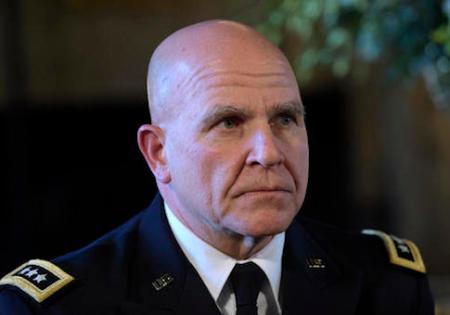
Army Lt. Gen. H.R. McMaster listens as President Donald Trump makes the announcement at Trump's Mar-a-Lago estate in Palm Beach, Fla., Monday, Feb. 20, 2017. McMaster will be the new national security adviser. (AP Photo/Susan Walsh)

Army Lt. Gen. H.R. McMaster listens as President Donald Trump makes the announcement at Trump’s Mar-a-Lago estate in Palm Beach, Fla., Monday, Feb. 20, 2017. McMaster will be the new national security adviser. (AP Photo/Susan Walsh)

To help with this effort, McMaster recommended several books meant to help current White House officials understand his own foreign policy vision.

One senior White House official who spoke to the Free Beacon described the reading list as pleasantly surprising and a vast departure from the former Obama administration’s own national security vision.

***************************

Incoming White House National Security Adviser Lt. Gen. H. R. McMaster sought to reassure senior Trump administration officials during his first “all hands” staff meeting Thursday, according to those who attended the get together and told the Washington Free Beacon that McMaster informed staffers he does not intend to pursue a major shakeup of President Donald Trump’s national security team.

McMaster, who replaced Michael Flynn following his resignation last week, plans to navigate a vast departure from the Obama administration’s foreign policy vision, according to senior White House officials who described the meeting as “reassuring.” McMaster emphasized that he will not dismantle the team that Flynn had built.

As part of his discussion with White House national security staff, McMaster recommended a comprehensive reading list that included President Trump’s book, “The Art of the Deal,” and several other tomes by leading historians about how to get the upper hand on America’s enemies. White House staff are said to have been mostly “thrilled” when hearing about the book list.

Sources who spoke to the Free Beacon about McMaster’s vision, as laid out in the Thursday meeting, expressed optimism about his appointment and pushed back on what they described as false media narratives centered around White House disarray following Flynn’s departure.

“It’s no secret we’ve had a few more all-hands meetings than we intended in our first month—but General McMaster used this event to both reassure the NSC staff and to give us the tools to continue the mission,” said one senior White House National Security Council official who requested anonymity while discussing internal White House meetings.

McMaster explicitly told White House officials that he does not aim to dismantle Trump’s foreign policy team or push out those perceived as still loyal to Flynn. These comments run counter to a recent New York Times report claiming that McMaster is pursuing a massive reorganization of the president’s national security team.

“He made it clear he wasn’t there to grind a political axe or engage in a witch hunt,” the senior White House official said. “He was there to provide leadership, including direction on how to think about the task in front of us.”

To help with this effort, McMaster recommended several books meant to help current White House officials understand his own foreign policy vision.

One senior White House official who spoke to the Free Beacon described the reading list as pleasantly surprising and a vast departure from the former Obama administration’s own national security vision.

In addition to Trump’s “Art of the Deal,” McMaster recommended reading his own book, “Dereliction of Duty,” which catalogues the mistakes that led the United States into a quagmire in Vietnam.

He also requested that White House staffers read Peter Rodman’s “Presidential Command,” which McMaster reportedly referred to as the “gold standard” in foreign policy history. Rodman was an top official in the Richard Nixon, Gerald Ford, Ronald Reagan, and both Bush administrations.

Senior White House staff are said to have found the mention of the book “very reassuring.”

“It’s certainly encouraging to see General McMaster highlighting his legacy,” one source said.

McMaster went on to further recommend two books by Zachary Shore, a historian and international conflict expert who teaches at the Naval Postgraduate School.

One Shore book, “Blunder: Why Smart People Make Bad Decisions,” was described as “a cautionary tale for the staff” at the White House. The other, “A Sense of the Enemy,” examines methods to overtake rival forces.

Lastly, McMaster recommended staff read an essay by Canadian historian Margaret MacMillan titled, “The Rhyme of History,” which tackles lessons from World War I.

Senior White House officials who took part in the meeting described the reading list as encouraging and part of an effort to restore conservative principals focused primarily on defending the U.S.’s best interests.

The mention of MacMillan’s essay in particular “suggests General McMaster does not consider the 21st century a sort of post-historical bubble, but rather that there is a great deal to be learned from history as we chart our path forward,” said one official who described McMaster as advocating a wholesale reversal from the Obama administration’s vision.

Several historians currently serve on the White House’s national security team, including Col. Derek Harvey, a former advisor to Gen. David Petraeus; Michael Anton, a former speechwriter for George W. Bush, and Victoria Coates, a former top aide to Sen. Ted Cruz (R., Texas) and art historian.

Extremist Muslims’ One-Way Street

February 24, 2017

Extremist Muslims’ One-Way Street, Gatestone InstituteBurak Bekdil, February 24, 2017

Extremist Muslims’ understanding of freedom is a one-way street: Freedoms, such as religious rights, are “good” and must be defended if they are intended for Muslims — often where Muslims are in minority. But they can simply be ignored if they are intended for non-Muslims — often in lands where Muslims make up the majority.

Many Muslim countries, apparently, already have travel bans against other Muslims, in addition to banning Israelis.

Look at Saudi Arabia. Deportation and a lifetime ban is the minimum penalty for non-Muslims trying to enter the holy cities of Mecca and Medina.

Given the state of non-Muslim religious and human rights, and the sheer lack of religious pluralism in most Muslim countries, why do Muslim nations suddenly become human rights champions in the face of a ban on travel to the U.S.?

Meanwhile, Muslims will keep on loving the “infidels” who support Muslim rights in non-Muslim lands, while keeping up intimidation of the same “infidels” in their own lands.

President Donald Trump’s executive order of January 27, 2017, temporarily limiting entry from seven majority-Muslim countries – Iran, Iraq, Libya, Somalia, Sudan, Syria and Yemen — for 90 days, until vetting procedures can be put in place — has caused international controversy, sparking protests both in the Western and Islamic worlds, including in increasingly Islamist Turkey.

This article does not intend to discuss whether Trump’s ban is a racist, illegal order, or a perfectly justified action in light of threatened American interests. The ban, right or wrong, has once again unveiled the hypocrisy of extremist Muslims on civil liberties and on what is and what is NOT racist. Extremist Muslims’ understanding of freedom is a one-way street: Freedoms, such as religious rights, are “good” and must be defended if they are intended for Muslims — often where Muslims are in minority. But they can simply be ignored if they are intended for non-Muslims — often in lands where Muslims make up the majority.

Muslims have been in a rage across the world. Iran’s swift and sharp answer came in a Tweet from Foreign Minister Javad Zarif who said that the ban was “a great gift to extremists.” A government statement in Tehran said that the U.S. travel restrictions were an insult to the Muslim world, and threatened U.S. citizens with “reciprocal measures.” Many Muslim countries, apparently, already have travel bans against other Muslims, in addition to banning Israelis.

2097

Sudan, host and supporter of various extremist Muslim terror groups including al-Qaeda, said the ban was “very unfortunate.” In Iraq, a coalition of paramilitary groups called on the government to ban U.S. nationals from entering the country and to expel those currently on Iraqi soil.

In Turkey where the extremist Islamic government is unusually soft on Trump’s ban — in order not to antagonize the new president — a senior government official called the order “a discriminative decision.” Deputy Prime Minister and government spokesman Numan Kurtulmus said:

“Unfortunately, I am of the opinion that rising Islamophobia, xenophobia and anti-immigrant feelings have a great weight on this decision. Taking such a decision in a country such as America, where different ethnic and religious groups are able to co-exist, is very offensive.”

The ruling party’s deputy chairman, Yasin Aktay, called the ban “racist,” and said: “This is totally against human rights, a big violation of human rights.” Aktay also said that he had started to “worry about the future of the U.S.”

Turkey’s top Muslim cleric, Mehmet Gormez, praised the Americans who rushed to the airports to protest the ban. “[This] is very important. It gives us hope,” he said — presumably meaning that non-Muslim protestors will continue to advocate for Muslim rights in non-Muslim lands.

Turkish government bigwigs and the top Islamic authority seem not to have heard of their own country’s dismal human rights record when it comes to non-Muslim minorities. Most recently, Turkey’s Association of Protestant Churches noted in a report that hate speech against the country’s Christians increased in both the traditional media and social media. It said that hate speech against Protestants persisted throughout 2016, in addition to physical attacks on Protestant individuals and their churches.

Nevertheless, the Islamist’s one-way sympathy for human rights (for Muslims) and his one-way affection for discrimination (against non-Muslims) is not just Turkish, but global. What is the treatment of non-Muslim (or sometimes even non-extremist Muslim) visitors to some of the Muslim cities and sites in the countries that decry Trump’s “racist,” and “discriminative” ban that “violates human rights?”

In a 2016 visit to the Al Aqsa Mosque in Jerusalem, the Muslim custodians of the site did not allow entry to this author, despite the Turkish passport submitted to them, saying “you do not look Muslim enough.” And Muslims now complain of “discrimination?” Incidentally, Al Aqsa Mosque is, theoretically at least, open to visits from non-Muslims, except on Fridays.

Look at Saudi Arabia. Deportation and a lifetime ban is the minimum penalty for non-Muslims trying to enter the holy cities of Mecca and Medina. In 2013, the Saudi Minister of Justice, Mohamed el-Eissi, insisted that “the cradle of the Muslim sanctities will not allow the establishment of any other places of worship.”

The Saudi ban on other religious houses of worship comes from a Salafi tradition that prohibits the existence of two religions in the Arabian Peninsula. In the Saudi kingdom, the law requires that all citizens must be Muslims; the government does not provide legal protection for freedom of religion; and the public practice of non-Muslim religions is prohibited.

In Iran, where even non-Muslim female visitors must wear the Islamic headscarf, the government continues to imprison, harass, intimidate and discriminate against people based on religious beliefs. A 2014 U.S. State Department annual report noted that non-Muslims faced “substantial societal discrimination, aided by official support.” At the release of the report, then Secretary of State John Kerry said: “Sadly, the pages of this report that are being released today are filled with accounts of minorities being denied rights in countries like Burma, Iran, Pakistan, Russia, Saudi Arabia, many others”.

In Iran, marriages between Muslim women and non-Muslim men are not recognized unless the husband produces proof that he has converted to Islam. The mullahs’ government does not ensure the right of citizens to change or renounce their religious faith. Apostasy, specifically conversion from Islam, can be punishable by death. In 2013, 79 people from religious minorities were sentenced to a total of 3,620 months in prison, 200 months of probation, 75 lashes and 41 billion rials in fines [approximately $1.3 million].

That being the state of non-Muslim religious and human rights, and the sheer lack of religious pluralism in most Muslim countries, why do Muslim nations suddenly become human rights champions in the face of a ban on travel to the U.S.? Why, for instance, does Turkey never criticizes the extreme shortcomings of freedoms in the Muslim world but calls the U.S. ban “racist?”

Why does the Iranian government think that Trump’s ban is a “gift to the [Muslim] extremists?” In claiming that travel bans would supposedly fuel extremism, how come Iran does not think that its own persecution of religious minorities is a “gift” to non-Muslims?

Such questions will probably remain unanswered in the Muslim world. Meanwhile, Muslims will keep on loving the “infidels” who support Muslim rights in non-Muslim lands, while keeping up intimidation of the same “infidels” in their own lands.

Nigel Farage CPAC 2017 FULL Speech

February 24, 2017

Nigel Farage CPAC 2017 FULL Speech Via YouTube, February 4, 2017

Farage on Trump: The EU Is ‘Absolutely Terrified of Him – Good’

February 24, 2017

Farage on Trump: The EU Is ‘Absolutely Terrified of Him – Good’, PJ MediaNicholas Ballasy, February 24, 2017

farageatcpacNigel Farage at the UKIP spring conference Feb. 17, 2017, in Bolton, UK. (Rex Features via AP Images)

“You know, with 34 days in I think that he clearly has the intention of a man who intends to put into place the ticket on which he was elected, and how refreshing is that in a democracy? We are not used to it,” he said. “My guess is he’ll be feeling a bit frustrated with the judges and other people; I would just like to see him to stock to what he’s doing. I mean, maybe he is going to have to box clever to get some of his stuff through, but basically don’t change.”

**********************************

NATIONAL HARBOR, Md. – Nigel Farage, former leader of the UK Independence Party, told PJM that there is “nothing to be lost” with President Trump meeting Russian President Vladimir Putin, saying that Trump has to show he’s “not going to be a pushover.”

“Well, he has to show he wants to have a better relationship with Russia. He believes we have shared common interests in dealing with Islamic terrorism and issues like that but he’s not going to be a pushover — that’s what you’ve got to show,” Farage said during an interview Thursday at the Conservative Political Action Conference outside Washington.

“He’s going to say, ‘Look, you’ve behaved badly but we want to form a grown-up relationship with you.’ One thing is for certain, there’s nothing to be lost with him meeting Putin. Nothing at all,” he added.

Farage rejected the notion that the U.S. cannot make a good deal with Russia.

“They are small-minded, very silly people who don’t understand there is a thing in life called human chemistry. Trump himself said ‘I may not get along with him,’ but the very fact he is prepared to meet is grown-up policy. The great Winston Churchill said jaw-jaw is better than war-war and I’m with that,” he said.

Farage told PJM that Trump should “stick” to what he has been doing in office and not change anything.

“You know, with 34 days in I think that he clearly has the intention of a man who intends to put into place the ticket on which he was elected, and how refreshing is that in a democracy? We are not used to it,” he said. “My guess is he’ll be feeling a bit frustrated with the judges and other people; I would just like to see him to stick to what he’s doing. I mean, maybe he is going to have to box clever to get some of his stuff through, but basically don’t change.”

British lawmakers recently debated whether they should withdraw a state visit invitation to Trump. Some European leaders have voiced opposition to Trump’s travel ban that covers seven Muslim-majority countries. Farage was asked if Trump should tweak any of his policy positions given the criticism he has faced from some world leaders.

“Obviously, the world is watching on the Russian stuff to see exactly where this goes. On issues like that people will be looking for a bit more clarity because he wants to have better relations – what exactly does that mean?” he said. “And the world will be looking for that and the European Union are terrified of him, absolutely terrified of him. Good.”

During the interview, Farage shared his reaction to far-right French presidential candidate Marine Le Pen recently refusing to wear a headscarf in Lebanon in order to meet with the Grand Mufti.

“Listen, good for her. You know, she’s a strong woman. It remains to be seen what the runoff is going to be, it’s going to be fascinating. France is where the action is going to be. The global revolution of ’16 could keep rolling,” said the leader of the 2016 Brexit movement.

How Pakistani Law Enshrines Extremism and Weakens Counter-Terror Efforts

February 24, 2017

How Pakistani Law Enshrines Extremism and Weakens Counter-Terror Efforts, Investigative Project on Terrorism, Ammar Anwer, February 24, 2017

985

Pakistani extremists have killed nearly 50,000 people since 9/11. But government ineffectiveness has stymied efforts to contain terrorist violence. The government and military often are not on the same page, or have chosen a narrow and selective approach towards extremism, fighting one outfit and at the same time supporting the other.

For instance, former President Pervez Musharraf acknowledged that Pakistan cultivated and possessed a soft spot for the Afghan Taliban. In addition, Pakistan has failed to take a firm stand against Lashkar-e-Tayyiba, a radical outfit famous for its hateful rhetoric against India. The U.S. designated the organization as a Foreign Terrorist Organization in 2001, and the United Nations designated it as a terrorist outfit in 2005.

Lately, signs of hope have started to emerge. Prime Minister Nawaz Sharif and Army Chief of Staff General Raheel Sharif seem to agree about extremism and also seem to lack the selective approach that their predecessors had often adopted. As evidence, more than 250 people have been arrested for propagating hate speech, and a ban has been imposed on loudspeakers, which were often used to promote sectarian violence.

In addition, Pakistan launched a host of military operations against militants, including 2014’s Operation Zarb-e-Azb, which targeted militant groups including the Tehrik-e-Taliban Pakistan (TTP) and the Haqqani Network. As a result, most of North Waziristan is now controlled by the military.

The Global Terrorism Index (GTI) 2015, complied by the international research group the Institute for Economics and Peace, analyzes the impact of terrorism on the global community. The report conceded success of Zarb-e-Azb and stated, “Pakistan was the only country in the ten most impacted countries that saw a decline in deaths” but still ranked third in the world.

Pakistan still has a long way to go to eradicate Islamist extremism.

Pakistani law remains an obstacle to accomplishing this goal. Its constitution paves the way for religious intolerance as the following examples show:

Declaration of Ahmadis as non-Muslims

Discrimination against Ahmadis began shortly after Pakistan’s inception in 1947. In 1953, a series of violent attacks was instigated against the Ahmadiyya community in Lahore. The Lahore riots resulted in the deaths of hundreds of Ahmadi Muslims.

In 1974, due to the strong pressure from fundamentalists, Ahmadis were officially declared non-Muslims in Pakistan. To this day Ahmadis suffer religious discrimination and persecution while the state shows no inclination toward amending the law or eradicating the discrimination.

Ehtaram-e-Ramadan Ordinance

The Ehtaram-e-Ramadan ordinance was passed in 1981 during the tenure of General Zia-Ul-Haq, and is part of the constitution. It prohibits public eating during Ramadan’s fasting hours. It is a blatant violation of religious freedom for non-Muslims and secular Muslims. The ordinance requires that restaurants remain closed during fasting hours. Violations are punishable by up to three months in prison or a fine.

But vigilantes often take this law into their own hands. During the last Ramadan, an elderly Hindu man was badly beaten for eating publicly.

Pakistan’s contentious blasphemy law

Blasphemy is the act of insulting, showing contempt or a lack of reverence for God or that which is considered sacred. The blasphemy laws are now enshrined in section 295 A, B and C of the Penal Code, with their focus to protect Islam.

Pakistan uses this controversial law at a level unparalleled in any other country. The law has had a disproportionate impact on minority communities. Minorities, which comprise just 4 percent of Pakistan’s population, are targeted in more than half of the 702 total blasphemy law cases. The laws routinely are used to target religious minorities like Hindus or Christians for personal or political motives.

This action contradicts Pakistan’s constitution which guarantees the right to profess religion, equality of citizens and protection of minorities.

The law perpetuates an environment of intolerance and discrimination. To guarantee equal treatment and fundamental rights, the blasphemy laws must be eliminated or dramatically changed. Without this improvement, the state will never be able to achieve peace, tolerance and equal human rights.

Conclusion

The facts are before us, though they might be difficult to face. However, as Aldous Huxley said, “Facts do not cease to exist because they are ignored.”

We in Pakistan cannot claim that we are fighting a war against extremism if there are extremist tenets within our constitution. Until we change those laws, the fight can never be won.

Toward a True US-Israel Partnership

February 24, 2017

Toward a True US-Israel Partnership, Front Page MagazineCaroline Glick, February 24, 2017

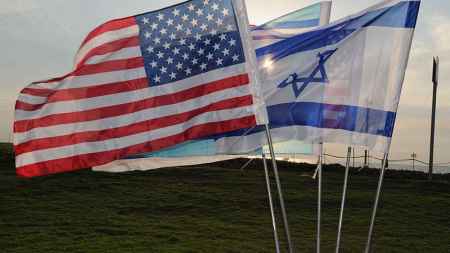
us_israeli_flags_wikimedia_commons

Originally published by the Jerusalem Post

Unlike the US, Israel has used the past generation to develop cutting edge technological capabilities in almost all of the areas where the Americans are lagging behind their competitors. Under these circumstances, Obama’s military assistance is exposed not merely as bad for Israel. It is bad for the US as well.

Israel can help the US compensate for its current scientific disadvantages. Israeli technological innovations can help the US to rebuild its independent capabilities and leapfrog its competitors far more rapidly than it can do on its own today.

An R&D partnership with Israel is also aligned with Trump’s vision for a renewed role for the US in global affairs. As Defense Secretary James Mattis told the US’s NATO allies this week, the US will not continue carrying the load of protecting the West on its own. It wants its allies to be its partners, not its dependents.

In Mattis’s words, “America will meet its responsibilities, but if your nations do not want to see America moderate its commitment to the alliance, each of your capitals needs to show support for our common defense.”

*****************************

In his speech before the members of the Conference of Presidents of Major Jewish American Organizations in Jerusalem this week, President Reuven Rivlin said that Israel has three overriding foreign policy concerns: “Number 1: Relations with America. Number 2: Relations with America. Number 3: Relations with America.”

There is a lot of truth in Rivlin’s hyperbolic statement.

Israel’s security depends on its relationship with the US. After all, the Russians and the Chinese won’t sell Israel fighter planes. Russia couldn’t develop strategic ties with Israel even if it wanted to. Its Iranian ally wouldn’t let it.

As for China, its mercantilist view of the Middle East makes it indifferent to the power balances in the region. Beijing may not harbor hostile intentions toward Israel, but it will act in a hostile fashion if it views China’s interests as advanced by such hostility.

While Israel rightly is working to diversify its foreign ties to move beyond the narrow scope of its alliance with the US, the fact is that with or without Australia and sub-Saharan Africa, the US remains Israel’s irreplaceable ally.

Unfortunately, today even the friendliest US administration cannot be relied on to secure Israel’s long-term capacity to defend itself. Israel faces enemy forces equipped with Russian and Chinese technologies – including Russian forces in Syria – that are rapidly challenging American systems in key areas. So long as the US remains behind the technological eight ball, Israel’s long-term reliance on its military ties to the US is a dangerous proposition.

Things didn’t use to be this way. At the start of the 21st century, America’s military power was unrivaled. From the end of the Cold War until the turn of the century, neither Russia nor China could challenge the US and its status as the sole global superpower.

That is no longer the case.

In a distressing article published this week in the American Affairs Journal, David Goldman details the technological crisis the US is steeped in today.

Goldman notes that the US is lagging behind the Russians and the Chinese in air defense systems and technologies, missile technology, particularly hypersonic missile technologies, submarine warfare, cyber warfare technologies and satellite interdiction capabilities.

To bridge the gap and outpace the Chinese and the Russians, Goldman argues that the US needs to initiate massive government-funded research and development programs.

In the post-Cold War era, Goldman notes ruefully, Americans have forgotten that they were ever vulnerable, that their victory against the USSR was anything but preordained.

The actual history, Goldman reminds us, was quite different. The US victory in the Cold War was the result of conscious decisions by US leaders to outstrip Soviet technology after American technology was shown to be lagging behind.

In 1957, the Americans reacted to the Soviet Union’s launch of Sputnik with a crash program in space exploration. That program, which benefited from lavish federal funding, ended the Soviets’ advantage in aerospace technology inside of a decade.

During the 1973 Yom Kippur War, the Americans realized that the Egyptian success in downing Israeli jets over Sinai in the early days of the war meant that the Soviet surface-to-air missiles Egypt fielded had neutralized US air superiority. The Americans realized that the Soviets’ technological advantage meant that they would win a land war in Europe.

Consequently, Goldman explains, the US initiated détente to avert a war in Europe. At the same time, the Americans began to develop the technologies to defeat the Soviets. Massive public investments in defense R&D followed. A decade later, Ronald Reagan announced the Strategic Defense Initiative; the Soviets realized they couldn’t compete, and eight years later, the USSR collapsed.

The Americans weren’t the only ones to respond to Israel’s air losses in 1973 with a massive investment in defense R&D aimed at destroying Russia’s technological advantage with its surface-to-air missiles.

Israel responded to its exposed vulnerabilities by developing the electronic warfare capabilities to neutralize Soviet SAM batteries. As Goldman recalls, in 1982, Israel matched US air platforms – the F-16 and F-15 – used in combat for the first time in the Lebanon War – with its own homegrown computer- based electronic warfare systems. So equipped, Israel eliminated Syria’s Soviet-built surface-to-air batteries and its Soviet-supplied air force, in a stunning air victory.

Whereas in the 1950s and the 1970s, the US had the domestic scientific capacity to quickly regroup in the face of Soviet technological advances, today the US’s path to rebuilding its technological advantage is less clear. Since the Cold War, the US government slashed its investment in military R&D.

According to Goldman, as a percentage of GDP, today US government investment in R&D is barely half of what it was in 1978.

Goldman bemoans the self-imposed evisceration of America’s capacity to develop the knowledge it requires to regain the technological advantage over the Chinese and the Russians.

In his words, “The national laboratories are hollowed out, and the major corporate laboratories (at IBM, the Bell System, General Electric, and RCA among others) that contributed significantly to defense R&D during the Cold War no longer exist. Within the shrinking defense R&D budget, a disproportionate share has been squandered on the F-35, a poorly conceived and executed weapons system with the highest price tag in defense history.”

And it won’t be easy to rebuild them. For 25 years, the US has not only shut down its own laboratories, it has done little to encourage its citizens to acquire the knowledge they need to rebuild that capacity.

Goldman notes for instance that currently, China graduates twice the number of STEM PhDs from its universities as the US.

This brings us back to Israel. In the 1980s, the US regarded the stunning technological advances Israel had made with suspicion. America feared that Israel’s growing technological capabilities would diminish its dependence on the US, at a time when the US was most concerned with keeping the Arab states inside the anti-Soviet bloc and keeping the Soviets out of the Middle East.

Last year, then-president Barack Obama forced Israel to agree to a multi-year military assistance package that if implemented will diminish Israel’s independent technological capabilities while expanding Israel’s technological dependence on the US.

While the aid package increases the amount of US funds Israel is permitted to spend on US systems from $3.1 billion to $3.3b. per year, the deal phases out Israel’s right to use a quarter of the funds on its domestically built systems.

Obama’s aid package also denies Israel and Congress the ability to initiate joint projects to meet new challenges as they arise.

In short, Obama’s deal ensures Israel will be incapable of acting on its own and will remain dependent on US goodwill and technologies for the foreseeable future.

This then brings us back to the US’s swiftly vanishing technology advantage.

Unlike the US, Israel has used the past generation to develop cutting edge technological capabilities in almost all of the areas where the Americans are lagging behind their competitors. Under these circumstances, Obama’s military assistance is exposed not merely as bad for Israel. It is bad for the US as well.

Israel can help the US compensate for its current scientific disadvantages. Israeli technological innovations can help the US to rebuild its independent capabilities and leapfrog its competitors far more rapidly than it can do on its own today.

An R&D partnership with Israel is also aligned with Trump’s vision for a renewed role for the US in global affairs. As Defense Secretary James Mattis told the US’s NATO allies this week, the US will not continue carrying the load of protecting the West on its own. It wants its allies to be its partners, not its dependents.

In Mattis’s words, “America will meet its responsibilities, but if your nations do not want to see America moderate its commitment to the alliance, each of your capitals needs to show support for our common defense.”

Earlier this month, Prof. Hillel Frisch published a short paper for Bar-Ilan University’s BESA Center showing the utter dishonesty of the claim that Israel is the largest recipient of US military aid. Frisch noted that US military assistance to Japan, Germany, Italy and South Korea far outstrips its assistance to Israel. All of those states receive US military assistance in the form of US forces permanently deployed to their territory to protect them. Israel, on the other hand, receives aid in military equipment only. No US assets are endangered, no US forces are required to defend Israel. And the financial burden of the former is far great than that of the latter.

Trump is interested in states like Japan and Germany transforming their strategic relations with the US from relationships based on dependency to partnerships by increasing their military spending.

What Israel’s technological and innovation prowess shows is that as far as Israeli defense assistance is concerned, the US should base its relations with Jerusalem on each sides’ complementary capabilities.

America and Israel should abrogate Obama’s military assistance package and replace it with a partnership based on US finance of Israeli R&D projects geared toward developing weapons systems and technologies that both the US and Israel require.

The deal should stipulate the modalities for both sides sharing the technologies with third parties, and their rights to use the technologies developed by Israel with US capital for civilian commercial purposes. Israel should be permitted to purchase US platforms based on Israeli-developed technologies.

Such a partnership would enable Israel to ensure that its continued dependence on the US won’t place it at a disadvantage vis-à-vis its enemies such as Iran, which are able to purchase advanced weapons systems from Russia and China. Such a partnership would ensure that both the US and Israel have the systems they need to outpace Chinese and Russian technological advances and develop the weapons systems they need to win tomorrow’s wars.

In his remarks before the Conference of Presidents, Rivlin voiced concern at the fact that Israel has become a partisan football in US politics. His concern is well placed.

Assuming that Israel’s dependence on the US will be a fixed variable for the foreseeable future, Israel needs to consider the best way of ensuring that the alliance will persevere regardless of the partisan attachments of future presidents.

The best way to ensure the resilience of the US-Israel alliance over time is for Israel to transform its military dependence into a mutually beneficial alliance with the US. A new military relationship based on joint technology development rather than Israeli purchase of US platforms is the best way to accomplish that goal, for the benefit of both countries.

‘We Call Them Palestinians Because…’

February 24, 2017

‘We Call Them Palestinians Because…’, American ThinkerSha’i ben-Tekoa, February 24, 2017

During the joint White House press conference on February 15 featuring President Trump and Israeli Prime Minister Netanyahu, the latter said, “The Chinese are called Chinese because they are from China. The Japanese are called Japanese. And the Jews are called Jews because they came from Judea.”

Not surprisingly, a columnist in Israel’s hard-left newspaper Haaretz, Carolina Landsmann, sarcastically fired back in print, “Maybe at the next press conference Netanyahu will be so kind as to explain why the Palestinians are called Palestinians.”

Since that is not likely to happen, I will answer her for him. We call the Palestinians “Palestinians” because it is basic to this generation’s politically correct way, post-Holocaust, of hating Jews, and here’s why:

In every generation, people hate Jews because they are believed to commit evil deeds, and their current crime is the theft of Palestine from the Palestinians. And never mind that these “Palestinians” were never mentioned in the documentation of the League of Nations (1920-1945) that in its 1922 Mandate for Palestine explicitly identified the country as the “historic homeland of the Jewish people.” In its three decades of existence, the League referred only to Jews and Arabs, never “Palestinians.”

Then, after WWII, when the League morphed into the United Nations Organization, for the UN’s first quarter-century no document referenced any “Palestinians” either.

This should not surprise, because for a Biblical generation of forty years after the Mandate kicked in, the Arabs themselves said there was no such country as Palestine and no such people as “Palestinians.” Only the Zionist Jews in this period happily called themselves Palestinians. The Arabs’ leader. the Grand Mufti of Jerusalem Haj Amin al-Husseini, said that what Jews and Christians called “Palestine” was for Muslims “Bilad a-Sham,” historic Syria and had always been that.

Indeed, when in early 1919 the post-WWI Paris Peace Conference created the League of Nations and incorporated the Balfour Declaration into its Mandate for Palestine, Haj Amin fought back by launching a newspaper in Jerusalem he called Al-Suria al-Janubia/Southern Syria, whose purpose was to oppose the creation of a jurisdiction called Palestine that had never existed in fourteen centuries of Islam.

Muslims never had an outline of such a country in their heads called Falastin — as they call this land today. There never was a government of Palestine led by a king or sultan, pasha or president. No one ever called himself a “Palestinian” or was called that by others. There never was a Palestinian language. No “Palestinians” ever minted their own money. No army of “Palestinians” ever defended “their” country from enemy invaders.

And this denial of the existence of a country called Palestine was the official Arab position into the 1960s. Not until March 29, 1959, in a meeting of the Arab League of States, was the idea of a kiyan falastini/“Palestinian entity” raised by Arab League Chairman Gamal Abdel Nasser of Egypt when discussing the ten-year-old cease-fire with Israel. He proposed a new conceptual framework for, as they were called at that time “the Arab refugees.” His suggestion was to imitate what was going on in Algeria at the moment where the Muslims there were in their fifth year of a terror war to drive out the French colonial regime that had ruled since 1830. Nasser was an active supporter of Algeria’s Muslim rebels by hosting their leaders of the FLN (Front de Liberation National) in Cairo, providing them with radio facilities to broadcast instructions and coded messages into Algeria, allowing them to smuggle weapons and ammunition across to the Sahara to the terrorists.

Nasser also was aware of the FLN’s success in winning political support in France among the intellectuals by couching their struggle in political terms as a “war of national liberation,” when among themselves they identified not as “Algerians” but Muslims. To this day, their official newspaper is El Moudjahid.

So Nasser proposed that henceforth the generic label “the Arab refugees” from Israel, which was accurate because most of them were not natives of Palestine but a mixed bag of migrant workers from all over the Middle East in the country a short time when they fled the fighting, be rebranded the “Palestinian nation” — and never mind there was nothing “Palestinian” about most of them.

Coincidently that fall, in a similar and competing effort, eight of these “Arab refugees,” all raised in the Muslim Brotherhood, met in Kuwait to form their own imitation FLN to fight Israel. All had been born in Mandatory Palestine except for one. He was not a refugee but a native Egyptian named Rahman al-Qudwa, who would nonetheless emerge as their leader. Later, Rahman would be known to the world by his nom de guerre, Yasir Arafat.

After these eight Muslim Brothers in their thirties decided to create their own anti-Zionist terror cell, they searched for a name. Half wanted something like Algeria’s “National Liberation Front”; the others preferred something Islamic. Arafat led this faction and in the end a clever verbal compromise was reached. They chose Fatah, the name of the forty-eighth sura/chapter of the Koran’s 114. It means “conquest” but really in context “conquest of the infidel,” and in this case the Zionists who were in revolt against their age-old, oppressed status. The Koran dictates that Jews living in Dar al-Islam must be “oppressed and humiliated,” and so they were for most of Islam’s fourteen centuries. The very idea of a state of Jews living free of Islamic domination was blasphemous. The choice of Fatah thus had nothing to do with “Palestinian” nationalism and everything to do with religion.

And it was a clever choice because it satisfied the other half that preferred a non-religious, nationalist name. Reading the consonants of fatah backward, they could stand for “Palestine Liberation Organization.”

And the rest is history.

Today’s “Palestinian” national identity was therefore not conceived until a decade after Israel came into being in imitation of Algeria’s FLN (that still rules that country) and other post-WWII, Third World “wars of national liberation”– and never mind that its invention constituted a complete, 180-degree U-turn in Arab propaganda and public diplomacy. No self-respecting Arab 1920-1960 would have been caught dead calling himself a “Palestinian.” Only Zionist Jews did that. Today, though, the Arab-Muslims insist they are the ancient “Palestinian people” — and never mind there was no mention of them in any UN document until the 1970s.

Ironically, the “Palestinian” identity was also coinvented by post-religious, dejudaized Israelis a.k.a. Leftists who refused to acknowledge the religious dimension of the Arab-Muslim war against them. Israel’s leftists had long preached that if the terror in Israel and threats from a nuclear Iran were perceived as religion-based, then there is no hope for peace. Therefore, they remain adamant on using nationalist terms so that the conflict can be seen as a struggle between two “normal” nations over some real estate that can be solved by compromise, goodwill and mutual respect. There are no greater “Palestinian patriots” than the Jewish Left who gave birth to the Rosemary’s Baby of the delusional Oslo Peace Process that produced not peace but the bloodiest wave of terror in Israel’s history.

In sum, people call the Palestinians “Palestinians” as way of perpetuating the eternal hatred of Jews via this generation’s central anti-Semitic myth: that the Jews’ stole Palestine, the ancient homeland of the indigenous, putatively Paleolithic “Palestinian” people, and refuse to return even a small part of it so the “Palestinians” can have the state they have been dreaming about since the dawn of Man.

Palestinian Nationalism has replaced anti-Semitism as this generation’s kosher way of lying about and hating Jews enough to justify slaughtering them in terrorist atrocities.

Sha’i ben-Tekoa’s PHANTOM NATION: Inventing the “Palestinians” as the Obstacle to Peace is available at Amazon.com.

Pat Condell – Singling Out A Billion Muslims – YouTube

February 24, 2017

Off Topic | Wayne Barrett, Donald Trump, and the Death of the American Press

February 23, 2017

Wayne Barrett, Donald Trump, and the Death of the American Press, Tablet MagazineLee Smith, February 23, 2017

(Please see also, Off Topic:  A Purblind Press, Unable To Admit Error, Boycotts the President. — DM)

How did we get from ‘Village Voice’ reporters digging up everything there is to know about a flashy New York real estate salesman to not knowing anything about the President of the United States and his ties to Russia?

So when does the other shoe drop? Who’s going to break the story proving beyond a shadow of a doubt that the president of the United States is so deeply connected to Russian President Vladimir Putin that the White House has become a Muscovite colony in all but name?

Time to use some common sense—it’s not going to happen, there is no story. The narrative that Donald Trump is effectively Putin’s prison wife is an information operation orchestrated by Democratic hands, many of whom served in the Obama administration, sectors of the intelligence community, and much of the American press. The purpose of the campaign is to delegitimize Trump’s presidency by continuing to hit on themes drawn from the narrative that Russia “hacked” the election and stole it away from Clinton.

The narrative is contorted because it’s not journalism. It’s a story that could only make sense in a profoundly corrupted public sphere, one in which, for instance, Graydon Carter is celebrated for speaking truth to power with an editor’s letter critical of Trump in a magazine that has no other ontological ground in the universe except to celebrate power.

Oh, sure, there are regular hints that there’s still more to come on Trump and his staff’s ties to Russia—the big one is about to hit. But the steady sound of drip-drip-drip is the telltale sign of a political campaign, where items are leaked bit by bit to paralyze the target. Journalists, on the other hand, have to get their story out there as quickly, and as fully, as possible because they’re always worried the competition is going to beat them to it.

No, if Trump really was in bed with the Russians, the story would already be out there, and I’m pretty sure it would have had a Wayne Barrett byline.

When I worked at the Village Voice in the mid-1990s, my office was right around the corner from Barrett’s and his bullpen of interns, a team that kept the heat on local politicians like Rudy Giuliani, Ed Koch, and others. Barrett was the first journalist who wrote at length about Trump, starting in the mid-1970s. His biography, Trump: The Deals and the Downfall, was published in 1992, and reissued in 2016 as Trump: The Greatest Show on Earth: The Deals, the Downfall, the Reinvention.

When Trump won the nomination and the pace of Trump stories picked up, Barrett became something of an official archivist, with reporters visiting his Brooklyn house to go through his files in the basement. Anyone who wanted to know what Trump’s deal with Russia was, for instance, would want to talk to Barrett because either he or his team of interns, 40 years’ worth, would have it. After all, New York City is the world capital for information on Russians, even better than Israel—because even though the city got a smaller number of post-Cold War immigrants, New York got a higher percentage of mobsters.

Let’s compare the institution of Wayne Barrett, a subset of the institution of journalism, to the so-called Russia dossier, the document placing Trump in a shady underworld governed by Putin and other Russian thugs. The former includes not only Barrett’s body of work over nearly half a century, but that of the hundreds of journalists he trained, and many thousands of sources whose information is, therefore, able to be cross-checked.

The latter, a congeries of preadolescent pornographic fantasy and spy tales, was authored by a British intelligence officer who has gone to ground since the dossier was made public. The dossier started as work made for hire, first paid for by Republican opponents of Trump and then the Clinton camp, and is sourced to Russian “contacts” who are clearly using the document as an opportunity to proliferate an information operation for perhaps various and as yet unknown purposes. The former is journalism. The latter, part oppo research and part intelligence dump, is garbage. Clearly, it is also the new standard in the field, which is why journalists on both sides of the political spectrum are boasting about their willingness to let their bylines be used as bulletin boards for spy services and call it a “scoop.”

Barrett had Trump on a whole variety of issues, but check the records yourself—up until the day of his death, the day before Trump’s inauguration, there’s nothing on Trump and Putin. Does this mean Trump is totally clean? Who knows? But the journalists now clamoring like maniacs about Trump’s ties sure aren’t going to find it. They’re thin-skinned hacks outraged that Trump dared violate the inherent dignity of that most important of American political institutions, the presidential press conference. And as we all know, this is the apex of real journalism, where esteemed members of the press sit side by side with other masters of the craft to see who gets their question televised.

Does Trump really believe the media are “an enemy of the people”? Please. Let’s remember how he rode his wave to fame on the back of the New York Post’s Page Six (and Graydon Carter’s Spy magazine). He still speaks regularly to the head of CNN (aka “Fake News”), Jeff Zucker, who put him on The Apprentice and Celebrity Apprentice at NBC, where Trump sat atop the Nielsens for 13 years. Trump uses his Twitter feed to boost his replacement Arnold Schwarzenegger’s ratings because the president still has a credit as executive producer. No, Trump, doesn’t hate the media. Like Howard Stern, he sees himself as the king of all media. What he’s doing here is playing gladiator in front of an audience that wants to see the lions slain.

Maybe Trump deserves the heat with the fake Russia stories. He backed the Obama birth certificate story, and what goes around comes around. But the American public sure doesn’t deserve a press like this.

Trump adviser Steve Bannon calls the media the opposition party, but that’s misleading. Everyone knows that the press typically tilts left, and no one is surprised, for instance, that The New York Times has not endorsed a Republican candidate since 1956. But that’s not what we’re seeing now—rather, the media has become an instrument in a campaign of political warfare. What was once an American political institution and a central part of the public sphere became something more like state-owned media used to advance the ruling party’s agenda and bully the opposition into silence. Russia’s RT network, the emir of Qatar’s Al Jazeera network—indeed, all of the Arab press—and media typically furnished by Third World regimes became the American press’ new paradigm; not journalism, but information operation.

How did this happen? It’s not about a few journalists, many of whom still do honor to the profession, or a few papers or networks. It’s a structural issue. Much of it is because of the wounds the media inflicted on itself, but it was also partly due to something like a natural catastrophe that no one could have predicted, or controlled.

***

I was at the Voice when the meteor hit. Like many papers back then, dailies and weeklies, the Voice made its money on classified advertising. The New York Times, for instance, had three important classifieds sections—employment, automotive, and housing—but if New Yorkers really wanted to find a great apartment, they’d line up at the newsstand on 42nd Street to get a copy of the Voice hot off the press.

And then the internet came along, and it was all there in one place—for free. The press panicked. The Voice’s publisher at the time, David Schneiderman, announced to the staff that the paper was going free. It made no sense, he argued, to keep charging $1 for what consumers could get on the internet for nothing.

Here’s how the staff heard it: Who would want to pay $1 a week to read Nat Hentoff on civil liberties, Robert Christgau on music, Michael Musto on New York nightlife—or Wayne Barrett on the follies of real-estate mogul Donald Trump? That is, who would want to pay $1 a week to feel themselves a part of what the Village Voice had made them feel part of for decades? But at the time, devaluing content was in fashion—which meant, as few saw back then, the profession was digging its own grave.

The American press’ new paradigm: not journalism, but information operation.

In midtown, Tina Brown had taken The New Yorker, a notoriously sleepy rag that entry-level assistants stacked in a corner of their studio apartments to spend a rainy Saturday with a 10,000-word Ved Mehta article, and turned it into a hot book that everyone from Bill and Hillary Clinton to Harvey and Bob Weinstein was talking about. “Buzz” was Tina’s catchword, and she made her writers stars. But something else was happening on the business side that wasn’t good for the content providers.

Before Brown, The New Yorker made its money by selling the magazine to readers who wanted to feel like a part of the world only The New Yorker made available, a cozy world reflected by the modest, but very profitable, number of subscriptions, which hovered around 340,000. Advertising was an afterthought. It may have been the only magazine in history at which the business side held ads because there wasn’t space for them, or because, well, Mr. Shawn might not like them.

Condé Nast owner Si Newhouse, who bought The New Yorker in 1985, and publisher Steve Florio turned the business model on its head when Brown came on in 1992. Forget about making readers pay for content; instead, bill advertisers for access to your readers—charge them for eyeballs. They slashed the subscription price dramatically and readership swelled by many hundreds of thousands. This enabled the sales team to bump up ad rates to levels on par with other Condé Nast glossies, essentially fashion catalogs, that enjoyed much larger readerships, like Vogue, GQ, and Glamour.

The paradox was that The New Yorker lost money because each of the new subscriptions was costly. Paper, printing, and postage are expensive, and even the new ad rates couldn’t cover the costs now that circulation had grown to something like 800,000—not monthly like Vogue, but weekly.

Instead of paying for the cost of high-level reporting and editing, subscribers now cost The New Yorker money. In Brown’s last year at the magazine, The New Yorker lost $10 million—a giant black hole that her successor would endeavor mightily to fill while retaining the magazine’s new subscribers, who had little knowledge of or attachment to the magazine’s prior mix of literary reporting and sophisticated whimsy. If the subscribers didn’t feel interested and flattered, the magazine was sunk.

With a new media model that devalued content, no one had a very clear picture of the problems ahead. The future was further obscured by what seemed to be an astonishing reflorescence of the press, with tiny internet startups throwing lavish parties in Manhattan bistros and paying writers Condé Nast-level fees. The internet was the messiah, everything was great—until the IT bubble burst and media giants like TimeWarner stopped throwing money at a platform they didn’t understand. So now who was going to pay?

For the next decade, the media couldn’t decide which slogan of the moment carried more weight—“content is king” or “information wants to be free.” Sure, you can give away “information,” but someone has to find some way to cover expenses, and yet no one had figured out how to make internet advertising work. Maybe you really could charge for content. Of course you could—The New Yorker had done it for decades.

Even if you bring your own glass to a lemonade stand, there is no 8-year-old entrepreneur who is not going to charge you for his product. Why didn’t media grandees get it? When they saw their ad-based business model collapse, why didn’t they do the logical thing and raise the price on consumers? Sure, they’d lose some readers and have to cut some staff and departments, but they’d have established a fundamental defense of the product, the industry, and the institution itself—news is worth paying for.

As the old Chinese saying has it, the first generation builds the business, the second generation expands it, and the third spends it all on Italian shoes, houses in the Hamptons, and divorces. For the most part, the people inheriting these media properties didn’t know what they were doing. It took The New York Times more than a decade to settle on billing consumers for its product—after giving it away, charging for it, giving it away again, then billing for “premium content,” etc. By then, it was too late. Entire papers went under, and even at places that survived, the costliest enterprises, like foreign bureaus and investigative teams, were cut. An entire generation’s worth of expertise, experience, and journalistic ethics evaporated into thin air.

In January, Bannon told the Times that the press doesn’t “understand this country. They still do not understand why Donald Trump is the president of the United States.” But the Times had already acknowledged its blunder in a letter to its readers after the election. However, neither Bannon nor the Times seemed to grasp the logistical reasons for the failure—it wasn’t because the paper of record slants left, or because it was too caught up in its own narrative. It’s in large part because it had long ago cut the regional bureaus in the South, the Midwest, etc., that would’ve forced reporters to speak to Americans outside the urban bubble and thereby explain to readers what the world looks like once you wander off the F train.

By the time two planes brought down the World Trade Center towers in September of 2001, everyone in the industry knew the media was in big trouble. The Iraq War partially hid and then later amplified that fact. The media spent millions it didn’t have for coverage it gave away free of a war that the press first supported and then turned against. If journalists prided themselves on their courageous about-faces, to much of their audience it further discredited a press whose main brief is not to advocate for or against, but to report facts.

This is the media environment that Barack Obama walked into—where Post columnist David Ignatius was no more important a media figure than Zach Galifianakis, on whose precious and often funny internet show Between Two Ferns the president marketed the Affordable Care Act. I suspect the Obama White House was a little sad that the press we’d all grown up with was basically dead. As Ben Rhodes, former national security adviser for strategic communications, told The New York Times Magazine, “I’d prefer a sober, reasoned public debate, after which members of Congress reflect and take a vote. But that’s impossible.”

He was right. What was once known as the prestige media became indistinguishable from the other stuff that Facebook gives away. Was it The New York Times or BuzzFeed that published that video about cats terrorized by cucumbers? Or was it Fake News because, in fact, cats aren’t scared of vegetables? It doesn’t matter where it came from, because there is no longer any hierarchy in the press. The media, as Thomas Friedman might say, is flat.

Obama didn’t kill journalism, but he took advantage of it in its weakness, because he knew the press would do anything to feel relevant again. All those 27-year-olds at the Times, the Washington Post and others hired as bloggers—“who literally know nothing,” as Rhodes told the Times Magazine—when the foreign and national bureaus were closed, they didn’t know it wasn’t OK to be a journalist and a political operative at the same time. They thought it made them more valuable, even patriotic, to put themselves in the service of a historic presidency. And they’d replaced for pennies on the dollar all the adults who could have taught them otherwise.

That’s the raw material out of which the Obama administration built its echo chamber, the purpose of which was to drown out the few remaining vestiges of journalism in order to sell the president’s policies. And there really were real journalists still putting in the hours, still doing the work, but the echo chamber, a relentless, frenzied chorus of incoherent and nearly illiterate prose, shouted them down.

Yes, it would have been nice if the American public had a chance to discuss a policy of vital importance to our national security, like the Iran nuclear deal, but the press congratulated itself for silencing those who dissented from Obama’s signature foreign-policy initiative. These weren’t simply critics or opponents of the White House, they weren’t just wrong; no, they were warmongers, beholden to donors and moneyed interests and lobbies, they were dual loyalists.

But it was all OK for the press to humiliate and threaten Obama’s opponents in accordance with the talking points provided by Obama administration officials—they were helping the president prevent another senseless war. That’s for history to decide. What everyone saw at the time was that the press had put itself in the service of executive power. This was no longer simply tilting left, rather, it was turning an American political institution against the American public.

Now with Trump in the White House, commentators on the right are critical of those angry with the press for calling out Trump on the same stuff that Obama got away with. Let’s be above it, they argue. Just because Obama did it doesn’t make it OK for Trump to do it. Fine, obviously, call out Trump—but this isn’t about playing gotcha. It’s about a self-aggrandizing press corps gaslighting the electorate. The public is astonished and appalled that the media has now returned after an eight-year absence to arrogate to itself the role of conscience of the nation.

It’s not working out very well.

Consider the Washington Post, whose new motto is “Democracy Dies in Darkness,” which presumably was OK’d by owner Jeff Bezos, the man who closed virtually every independent bookstore in America. Here’s a recent story about riots in Sweden:

Just two days after President Trump provoked widespread consternation by seeming to imply, incorrectly, that immigrants had perpetrated a recent spate of violence in Sweden, riots broke out in a predominantly immigrant neighborhood in the northern suburbs of the country’s capital, Stockholm.

You’ve probably never seen the phrase “seeming to imply” in the lede of a story in a major American newspaper before—a news story. So did Trump imply, or seem to imply? How are readers supposed to parse “incorrectly” if the story is about the reality of riots in a place where Trump “seemingly” “implied” there was violence? So what’s the point—that Trump is a racist? Or that Trump can see the future?

The press at present is incapable of reconstituting itself because it lacks the muscle memory to do so. Look at the poor New Yorker. During the eight years of the Obama administration, it was best known not for reported stories, but for providing a rostrum for a man to address the class that revered him as a Caesar. Now that the magazine is cut off from the power that made it relevant, is it any wonder that when it surveys the post-Obama landscape it looks like Rome is burning—or is that the Reichstag in flames?

The Russia story is evidence that top reporters are are still feeding from the same trough—political operatives, intelligence agencies, etc.—because they don’t know how to do anything else, and their editors don’t dare let the competition get out ahead. Why would the Post, for instance, let the Times carve out a bigger market share of the anti-Trump resistance? And what’s the alternative? Report the story honestly? Don’t publish questionably sourced innuendo as news?

And still, you ask, how could the Russia story be nonsense? All the major media outlets are on it. Better to cover yourself—maybe it’s true, because the press can’t really be this inept and corrupt, so there’s got to be something to it.

I say this not only out of respect for a late colleague, but in the hope that journalism may once again merit the trust of the American public. Wayne Barrett had this file for 40 years, and if neither he nor the reporters he trained got this story, it’s not a story.