Archive for February 14, 2017

Trump-Netanyahu meeting can expose Obama collusion on Resolution 2334

February 14, 2017

Trump-Netanyahu meeting can expose Obama collusion on Resolution 2334, Israel National News, David Singer, February 14, 2017

Netanyahu issued a Press Release on 28 December 2016 declaring:

“We have it on absolutely incontestable evidence that the United States organized, advanced and brought this resolution to the United Nations Security Council. We’ll share that information with the incoming administration. Some of it is sensitive, it’s all true. You saw some of it in the protocol released in an Egyptian paper. There’s plenty more; it’s the tip of the iceberg.”

***********************************

One of the intriguing aspects of Israeli Prime Minister Netanyahu’s visit to the White House on February 15th will be the evidence he can produce to President Trump to establish former President Obama’s collusion in promoting Security Council Resolution 2334.

America abstained from voting on Resolution 2334 – but the language used in that Resolution was inimical to the national interests of Israel and the Jewish people by declaring that:

  • the establishment by Israel of ‘settlements’ in the Palestinian territory occupied since 1967, including East Jerusalem, had no legal validity and constituted a flagrant violation under international law
  • Israel immediately and completely cease all settlement activities in the occupied Palestinian territory, including East Jerusalem

This language identifies as “Palestinian territory”:

– and seeks to erase the legal rights vested in the Jewish people to reconstitute the Jewish National Home in these areas under the 1922 League of Nations Mandate for Palestine.

Such language gives credence to the PLO claim that the Mandate – a critical building block in the 100 years old Arab-Jewish conflict – is null and void.

Resolution 2334 contravenes article 80 of the United Nations Charter – exceeding the Security Council’s powers and condemning the hypocrisy of the Security Council which sanctimoniously professes to be concerned about “legal validity” and “international law”

The Egyptian newspaper Al-Youm Al-Sabea was the first to allege American collusion in promoting Resolution 2334 – claiming to have a transcript of a meeting in December – prior to the passage of Resolution 2334 – between Palestinian negotiator Saeb Erekat, US Secretary of State John Kerry, and US National Security Advisor Susan Rice in which Kerry said the US was prepared to cooperate with the Palestinians at the Security Council.

White House National Security Council spokesman Ned Price claimed no such tripartite meeting took place and that the ‘transcript’ was a total fabrication – although he admitted Erekat had met with Kerry and Rice separately.

Netanyahu issued a Press Release on 28 December 2016 declaring:

“We have it on absolutely incontestable evidence that the United States organized, advanced and brought this resolution to the United Nations Security Council. We’ll share that information with the incoming administration. Some of it is sensitive, it’s all true. You saw some of it in the protocol released in an Egyptian paper. There’s plenty more; it’s the tip of the iceberg.”

Netanyahu’s claim that some of the information is sensitive suggests that there has been an interception of emails or other classified American documents emanating from Obama or Kerry’s offices.

America’s cybersecurity record has been appalling – as the hacking of the Democrats web site and Hillary Clinton’s emails and private server has shown.

Netanyahu’s description of the transcript held by the Egyptian newspaper as “the tip of the iceberg” suggests Israel holds a Wiki-style treasure trove of incriminating documents.

Sensational claims of Israel-hacking will doubtless fuel the media.

There appears to be no evidence that this material has yet been given to the Trump Administration. If it had – some leak would surely have emerged by now.

Netanyahu’s visit to the White House presents the perfect opportunity to personally hand his evidence to President Trump – enabling him to decide whether to disclose such evidence publicly or not.

Netanyahu’s moment exposing Obama’s betrayal of Israel is fast approaching.

PM threatens ministers with polygraph over pre-Trump leaks

February 14, 2017

Top aide says ‘impossible to work’ when reports on security cabinet meetings hit the press, including Netanyahu’s comments on president’s personality

February 14, 2017, 9:00 am

Source: PM threatens ministers with polygraph over pre-Trump leaks | The Times of Israel

Israeli Prime Minister Benjamin Netanyahu leads the weekly cabinet meeting at the Prime Minister’s office in Jerusalem on January 29, 2017. (Ohad Zwigenberg/POOL)

WASHINGTON — Prime Minister Benjamin Netanyahu’s chief of staff condemned harshly a series of leaks to come out of top-level meetings ahead of Netanyahu’s summit with US President Donald Trump, threatening to submit ministers to lie detector tests.

The government will “consider using polygraphs” to ensure that internal debates are not leaked from the security cabinet, one of Israel’s most sensitive security decision-making bodies, Yoav Horowitz told reporters accompanying the prime minister to Washington early on Tuesday.

 On Sunday, Netanyahu convened the security cabinet, a forum of the most senior ministers, for a four-hour discussion in a bid to formulate policy on Iran, Syria and the Palestinians.

Several news outlets published leaked comments from the meeting minutes after it concluded, including reports that Netanyahu said he would seek to avoid a confrontation with the US president when they meet on Wednesday, especially given Trump’s personality.

“It’s impossible to work like this,” Horowitz said, arguing that any leaks — even if on the face of it some might look harmless — are detrimental to Israeli security interests.

From left to right: Acting Security Advisor Nagel, Military Attache to the Prime Minister Toledano, PM Netanyahu's chief of staff Horowitz, Israeli Ambassador to the US Dermer and PM Netanyahu, at the Blair House in Washington, February 13 (Avi Ohayun/GPO)

From left to right: Acting Security Advisor Nagel, Military Attache to the Prime Minister Toledano, PM Netanyahu’s chief of staff Horowitz, Israeli Ambassador to the US Dermer and PM Netanyahu, at the Blair House in Washington, February 13 (Avi Ohayun/GPO)

Leaks from ministers and others are a regular part of the Israeli media landscape, as politicians jockey to steer the narrative on various issues.

According to Channel 2, the prime minister told ministers that the Trump administration, while friendlier than the Obama administration, would not tolerate unlimited construction in the West Bank and East Jerusalem.

He cautioned ministers that Israel must tread lightly and take Trump’s “personality into account,” the TV report said.

The meeting was one of three he had with ministers on Sunday ahead of the trip, as he attempted to tamp down right-wing pressure to use the visit with Trump to push for increased settlement building, annexation of West Bank settlement blocs and a retreat from support for the two-state solution.

According to a separate report on the security cabinet meeting Sunday, Netanyahu also revealed details of his telephone conversation with Trump on January 22, in which the US president insisted the Palestinians could be pushed to make concessions for peace over Netanyahu’s protestations.

Citing an official familiar with events at the meeting, the Haaretz daily said Trump asked Netanyahu to explain how the Israeli leader intends to act to achieve a final peace agreement.

Netanyahu told him that although he backs a two-state solution, he doesn’t believe that the Palestinians will make the required concessions. Trump responded by reassuring Netanyahu that the Palestinians will be flexible.

“They will want, they will make concessions,” Trump told Netanyahu, according to the official, who requested anonymity.

The prime minister shared details of the phone call with the security cabinet after Education Minister Naftali Bennett and Justice Minister Ayelet Shaked urged him to convince Trump to withdraw US backing for the two-state solution, according to the report.

“Trump believes in a deal and in running peace negotiations between Israel and the Palestinians,” the prime minister was quoted as saying in response. “We should be careful and not do things that will cause everything to break down. We mustn’t get into a confrontation with him.”

Contrary to Channel 2’s description of the meeting as “stormy,” the Prime Ministers Office took care to note in a laconic message to the press afterward that it was “relaxed and professional.”

In 2012, Netanyahu threatened to submit Israeli ministers and others to lie detector tests after details of a security cabinet meeting on Iran leaked.

While widely seen by experts as unreliable, polygraphs are still used by law enforcement and others in Israel as part of investigations, including in the workplace.

In Russia, hunkering down over Flynn affair

February 14, 2017

In Russia, hunkering down over Flynn affair, American ThinkerMonica Showalter, February 14, 2017

(Russia has become disenchanted with Iran and wants to have better ties with America, particularly in fighting terrorism. Please see, Pro-Kremlin Pravda.ru: ‘ Iran Is Becoming A Major Problem, First And Foremost For Russia’s Interests’. What’s wrong with having strong ties with Russia in areas where our interests coincide?– DM)

The political backbiting behind the sudden ouster of retired general Michael T. Flynn from the National Security Council is worth watching.

So is the reaction from Russia.  Kicking Flynn out as a security risk – complete with unsubstantiated claims of his supposed vulnerability to Russian blackmail – seems to be a calculated move to trash President Trump’s effort to improve relations with Russia to fight terrorists.  It has a look of the Cold War status quo reasserting itself.

For Russia, which is tired of constant conflict with the West, it’s a huge disappointment.  The initial response has been to lash out.  Back in Moscow, one Russian politician was not pleased:

“The resignation of Michael Flynn was probably the speediest for a national security advisor in all history. But the target is not Flynn, but rather relations with Russia,” Senator Aleksey Pushkov tweeted.

Russians like that, with domestic constituencies, have no reason not to tell it like it is.  Higher up, the response from the Kremlin has been to hunker down into a defensive crouch.  State-owned RT News reports that rather than swing back as the Russian politician did, Russia at the federal state level is suddenly going quiet.  The hilariously peppery, out-there Twitter site of Russia’s London embassy has flatlined, with only a couple of sarcastic recent tweets about Russian hackers – nothing about Flynn.  And up until now, they’ve commented about what they want to comment about, not just London-related doings.  According to RT News, Russia’s foreign ministry now says it considers the Flynn affair none of its business and plans to say nothing about it.

Foreign Policy reports the same strategic retreat. In its latest analysis, its writers, one of whom is Eastern European, pointed out that Trump and his interest in improving ties with Russia are immensely popular in Russia, with even the dissidents wild about Trump.  Such a broad sentiment means high hopes – and likely a lot of disappointment as the Washington status quo reasserts itself.  It also should give domestic political cover for the Putin government to swing back and defend the right of its ambassador to talk to Flynn.  Because if you can’t talk to the ambassador, whom can you talk to?  Yet the Kremlin is showing every sign of pulling back as it finds itself playing the unwanted role of the bogeyman in the Trump-CIA-Justice Department infighting.

A Russian media source I talked to inside Russia just now cautiously says she really, truly hopes the situation will be resolved amicably.  On background, of course, speaking only for herself.  That’s pretty funny behavior, as it shouldn’t be that hard to go on the record to express such a pablummy statement.

Meanwhile, a gander at the untranslated Russian pages of TASS, the state government news agency, which chiefly serves to keep the Kremlin informed, quite unlike RT, which seeks to influence the West, shows that the story – of this magnitude, with Russia at the center of the action – was last night covered from its New York, not its Washington, office.  It seems as though they didn’t want to risk or perhaps sacrifice their longtime correspondents in the capital by having them ask questions about the matter that involves their ambassador.  As Obama showed in his last weeks in office, anyone can be thrown out for “espionage” with no evidence to back it these days.  To make peace with the CIA, Trump’s hand could be forced.  And once again, they will be the bogeyman.

The whole thing is disturbing to me because it represents a wasted opportunity to forge better ties with Russia.  Should it really be “poison” for Russians and Americans to talk to each other and say what we think?  Why is it so taboo to talk freely with them?  Flynn was ousted for that, and now the Russians are exhibiting their old paranoid behaviors and avoiding talk, too, probably with good reason.

With that the case, it signals that Russia being held hostage by the establishment, and it knows it, and it’s all because the Beltway can’t quite get control of Trump.


RIGHT ANGLE: I Don’t Trust You

February 14, 2017

RIGHT ANGLE: I Don’t Trust You,  Bill Whittle Channel via YouTube, February 13, 2017


Chutzpah: AP Decries “Softball” Questions

February 14, 2017

Chutzpah: AP Decries “Softball” Questions, Power LineJohn Hinderaker, February 14, 2017

Now that we have a Republican president, the press has gone oppositional. Today, the Associated Press complains that President Trump isn’t taking antagonistic enough questions during his press conferences: “News conferences raise issue of Trump seeking softballs.”

President Donald Trump managed to avoid questions about hot-button issues facing the White House — such as the future of national security adviser Michael Flynn and a North Korean missile launch — in a news conference Monday where selected reporters asked non-challenging questions and other, shouted-out inquiries were ignored.

Heh. The president ignores “shouted-out inquiries”? Who can forget “What about your gaaaffes”?

The president selected his questioners: Scott Thuman from Washington’s local ABC News affiliate and Kaitlan Collins of The Daily Caller, a conservative website founded in 2010 by Fox News Channel anchor Tucker Carlson.

Thuman asked Trump about his relationship with Trudeau, given the two men have outlined policy differences, and whether there were any areas where Trump had changed his stance on issues following their conversation. The president offered no specifics.

Collins asked Trump what he saw as the most important national security issues facing the nation.

Good questions. Kaitlyn Collins took no grief from the AP. Asked about her question, she responded:

“Personnel questions are interesting, but our readers want substance. They don’t want Washington bull—-. They want to know where the next war is going to be,” Collins told The Associated Press by email later in the day.

What’s funny about the AP’s pique, of course, is that for eight years Barack Obama rarely answered questions from the press, and when he did, he almost never got anything except softballs. See, for example, Freedom of the Press to Kiss A**, Obama Dodges the Big Questions, and The White House Press Corps Bids a Slobbering Farewell to President Obama.

Now, suddenly, the AP and other Democratic Party news outlets have woken from their slumber and are telling us their job is to fight the new administration. I doubt that anyone is fooled.

Fake News: Media Reports That Muslim Olympian Was Detained Because of Trump’s Travel Ban

February 14, 2017

Fake News: Media Reports That Muslim Olympian Was Detained Because of Trump’s Travel Ban, PJ MediaDebra Heine, February 13, 2017

muslimatheleteIbtihaj Muhammad attends ESPN: The Party 2017 held on Friday, Feb. 3, 2017, in Houston, Texas. (Photo by John Salangsang/Invision/AP)

Nothing triggers liberal mainstream media types more than being accused of being purveyors of “fake news.” But stunningly enough, that hasn’t stopped them from…well…being purveyors of fake news.

The latest example features Ibtihaj Muhammad, the New Jersey native who recently became the first female Muslim-American to win an Olympic medal for the United States. Muhammad, a vocal Trump critic, answered a journalist’s question with so much ambiguity it seemed designed to be deceptive. Regardless, several major media outlets jumped on her story without verifying it and now have egg all over their faces.

Via the Washington Examiner:

Muhammad, a lifelong American citizen, claimed in an interview Tuesday that she was detained “just a few weeks ago” by U.S. Customs and Border Protection agents. She said she was held for a few hours without explanation.

It’s important to recognize from the get-go that Muhammad didn’t put a hard date on when the alleged detaining occurred (this will come up later). It’s also probably worth noting that she is an outspoken Trump critic, and that she is extremely displeased with his executive order temporarily barring immigration from seven Middle Eastern countries.

Here’s a transcript of what Muhammad told Popsugar’s Lindsay Miller on Feb. 7 about the alleged incident with customs agents [emphases added]:

Popsugar: Do you know anyone who was directly impacted by Trump’s travel ban?

Ibtihaj Muhammad: Well, I personally was held at Customs for two hours just a few weeks ago. I don’t know why. I can’t tell you why it happened to me, but I know that I’m Muslim. I have an Arabic name. And even though I represent Team USA and I have that Olympic hardware, it doesn’t change how you look and how people perceive you.

Unfortunately, I know that people talk about this having a lot to do with these seven countries in particular, but I think the net is cast a little bit wider than we know. And I’m included in that as a Muslim woman who wears a hijab.

A rule of thumb for responsible journalists is, “if your mother tells you she loves you, check it out.” So wouldn’t a responsible journalist want to be even more skeptical of an obvious partisan? You would think so, right? Well, you would be wrong. Journalists were so eager to virtue signal their outrage and despair over this supposed injustice that Time, the UK’s Independent, the Daily Mail, the New York Daily NewsThe Hill, and of course Sports Illustrated and ESPN all spread the story far and wide before verifying it. Specifically, they should have double-checked whether she was detained after Trump’s travel ban went into place, after Trump was inaugurated, or perhaps while Obama was still president.

As it happens, according to Muhammad herself, her purported “detention” took place in December while Obama was still president.

Muhammad clarified several days after her Feb. 7 interview that she meant December 2016 when she said, “just a few weeks ago.”

“Thanks to all who reached out regarding the December incident at customs. I will continue be a voice for all impacted by profiling & bigotry,” she said in a tweet on Feb. 11.

A spokesperson for the U.S. Customs and Border Protection agency has not yet responded to the Washington Examiner’s request for comment, so it’s not certain that she was even detained.

As the Examiner notes, “Muhammad isn’t blameless in all of this.”

A less-than-charitable person would suspect her of being purposefully vague and imprecise. She was asked a simple “yes or no” question about the president’s immigration order. Instead of giving a simple answer, she provided an anecdote involving the very misleading use of “just a few weeks ago.”

A less-than-charitable person might also suspect that MSM types who share these kinds of fake stories don’t even care if they get it wrong at first because they know another ironclad rule of journalism: The initial, mistaken information will be retweeted much, much more than any subsequent correction.

And to a liberal, agenda-driven news media, the “narrative” is all that matters.

A Tale of Two Talks: Free Speech in the U.S.

February 14, 2017

A Tale of Two Talks: Free Speech in the U.S., Gatestone InstituteDouglas Murray, February 14, 2017

The proximity of these two events, the difference in the arguments and the vast chasm of difference between the outrage and violence against one, and the great silence and complicity with the other, tells us much about what we need to know about the state of free speech — and academia — in America today.

***********************************

During his talk at Georgetown University, Jonathan A.C. Brown condemned slavery when it took place historically in America and other Western countries, but praised the practise of slavery as it happened in Muslim societies, explained that Muslim slaves lived “a pretty good life”, and claimed that it is “not immoral for one human to own another human.” Regarding the vexed matter of whether it is right or wrong to have sex with one of your slaves, Brown, who is director of the Alwaleed bin Talal Center for Muslim-Christian Understanding, said that “consent isn’t necessary for lawful sex”.

No mob of anti-sharia people has gone to Georgetown, torn up telephone poles, set fire to things or smashed up the campus, as mobs did at Berkeley.

Milo Yiannopoulos has never argued that the Western system of slavery was benevolent and worthwhile, and that slaves in America had “a pretty good life”. He has never argued against consent being an important principle in sexual relations. If he had, then the riots at Berkeley would doubtless have been far worse than they were and even more media companies and professors would have tried to argue that Yiannopoulos had “brought the violence upon himself” or even organized it himself.

Sometimes the whole tenor of an age can be discerned by comparing two events, one commanding fury and the other, silence.

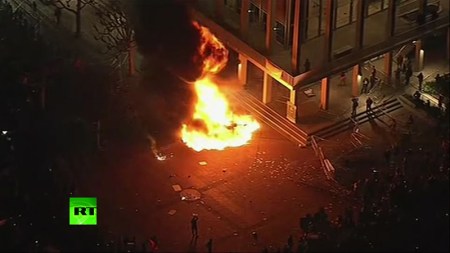
To this extent, February has already been most enlightening. On the first day of the month, the conservative activist and writer Milo Yiannopoulos was due to speak at the University of California, Berkeley. To the surprise of absolutely no one, some of the new anti-free speech brigade attempted to prevent the event from happening. But to the surprise of almost everyone, the groups who wish to prevent everyone but themselves from speaking went farther even than they have tended to of late. Before the event could even start, Yiannopoulos was evacuated by security for his own safety. A mob of 150 people proceeded to riot, smash and set fire to the campus, causing more than $100,000 of damage and otherwise asserting their revised version of Voltaire’s maxim: “I may disagree with what you say, but I will defend to your death my right to shut you up.”

2301When conservative activist and writer Milo Yiannopoulos was due to speak at the University of California, Berkeley on February 1, a mob of 150 people proceeded to riot, smash and set fire to the campus, causing more than $100,000 of damage. (Image source: RT video screenshot)

The riots at Berkeley caused national and international headlines. Mainstream media, including Newsweek, also attempted to do their bit for an event they would ordinarily deride as “fake news.” Following a segment on CNN, Newsweek ran a piece by Robert Reich, the chancellor’s professor of public policy at Berkeley and a former Clinton administration official, arguing that “Yiannopoulos and Brietbart [sic] were in cahoots with the agitators, in order to lay the groundwork for a Trump crackdown on universities and their federal funding.” This conspiracy theory would involve Yiannopoulos arranging for 150 masked fanatics not merely to trash a campus on his orders, but to continue to remain silent about it in the days and weeks after the event.

In Newsweek, Reich wrote, “I don’t want to add to the conspiratorial musings of so many about this very conspiratorial administration, but it strikes me there may be something worrying going on here. I wouldn’t bet against it.” And so, a tenured academic made an implausible as well as un-evidenced argument that his political opponents not merely bring violence on themselves but actually arrange violence against themselves.

All of the violence and all of these claims were made in February in the aftermath of a speech that never happened. But consider how little has been said and how little done about a speech that certainly did go ahead just one week later at another American university — not by a visiting speaker but by a resident academic and teacher.

On February 7, at the University of Georgetown, Jonathan A.C. Brown, the director of the entirely impartial Alwaleed bin Talal Center for Muslim-Christian Understanding at Georgetown, gave a 90-minute talk entitled “Islam and the Problem of Slavery”. Except that the white convert to Islam, Jonathan Brown, apparently did not think that there is a particular problem with slavery — at least not when it comes wrapped in Islam. During the talk (which Brown himself subsequently uploaded onto YouTube) the lecturer condemned slavery when it took place historically in America, Britain and other Western countries, but praised the practice of slavery in Muslim societies. Brown explained how Muslim slaves lived “a pretty good life”, claimed that they were protected by “sharia” and claimed that it is “not immoral for one human to own another human.” Regarding the vexed matter of whether it is right or wrong to have sex with one of your slaves, Brown said that “consent isn’t necessary for lawful sex” and that marital rape is not a legitimate concept within Islam. Concepts such as “autonomy” and “consent”, in the view of the Director of the Alwaleed Center at Georgetown, turned out to be Western “obsessions”.

Of course, Jonathan Brown’s views on Islam are by no means uncommon. One could easily demonstrate that they are all too common among experts in Islamic jurisprudence. Among such people, debates over where and when you can own a slave and what you can or cannot do with them are quite up to the minute, rather than Middle Ages, discussions to have. But until this moment, there have been no protests at Georgetown University. Under a certain amount of online pressure, from the few websites to have reported Brown’s talk, Brown has attempted to clarify or even reverse some of his views. But no mob of anti-sharia people has gone to Georgetown, torn up telephone poles, set fire to things or smashed up the campus, as mobs did at Berkeley.

Here is a stranger thing. Nothing that Yiannopoulos ever said as a visitor speaking to a room full of people has ever come near the level of what Brown said to his ordinary class of credit-seeking students. Yiannopoulos has never argued that the Western system of slavery was benevolent and worthwhile, and that slaves in America had “a pretty good life”. He has certainly spoken out vociferously against the claim that there is a “rape culture” on American universities. But he has never argued against consent being an important principle in sexual relations. If he had, then the riots at Berkeley would doubtless have been far worse than they were, and even more media companies and professors would have tried to argue that Yiannopoulos had “brought the violence upon himself” or even organized it himself.

The proximity of these two events, the difference in the arguments and the vast chasm of difference between the outrage and violence against one, and the great silence and complicity with the other, tells us much about what we need to know about the state of free speech — and academia — in America today.

Trump Administration Intel – White Hats Confer With Reform Agents Within Political Islam…

February 14, 2017

To understand the activity within any intelligence action any observer must do two things: #1 You must stay elevated. If you try to get into the weeds you will be lost because your insight will be …

Source: Trump Administration Intel – White Hats Confer With Reform Agents Within Political Islam… | The Last Refuge


To understand the activity within any intelligence action any observer must do two things:

  • #1 You must stay elevated. If you try to get into the weeds you will be lost because your insight will be lacking specificity briefs.
  • #2 You must always reflect upon the recent historic context of the engagement you are observing. Including, most importantly, the engagements of the parties therein.

The recent example of Central Intelligence Agency (CIA) Director Mike Pompeo traveling to Saudi Arabia last weekend, at the request of President Donald Trump, to personally present Crown Prince Mohammed Bin Nayef with an award named after former CIA director George Tenet, is an example of the need for this approach.

pompeo-and-crown-prince

If you want to understand what’s going on, you must understand the recent relationship of the parties.  It begins with understanding modern political Islam.

Within “political Islam” there are various factions. However, again with the intent to remain elevated, let us just approach two larger congregations as: “Authentic supporters” and “Reform Agents”.

sisi and abdullah iitrump-el-sisi

The modern extremist elements fall under the category of “Authentic Supporters” or Salafists (politically, The Muslim Brotherhood).   The “Reform Agents” are represented by people like Egypt’s Abdel Fattah al-Sisi and Jordan’s King Abdullah III.

Within “Political Islam” these two elements (Authentic -vs- Reform) are fighting for the heart, soul, intellect and -in larger measures- the future of Islam in a modern world.

All the various Muslim factions fall along a continuum of authenticity to the principles of Islam. The more authentic the expression, the more violent and confrontational the group. The more moderate the expression, the reformers, the less violent… etc.

Over the course of the past decade each political side has surged and/or retreated during the larger struggle for the heart of those who adhere to the Muslim faith. The so-called “Arab Spring” was a surge of the Authentic group, and was empowered/emboldened by the foreign policy activity of exterior nations. In particular, the ideological sympathy of former President Barack Obama.

In the face of the growth of the various Authentic expressions, the Reform elements were in a retreating position attempting to contain the internal damage being carried out by the extremist groups. Reformers and more moderate voices were simply trying to hold on to the construct of a civil society amid the growing crisis created by emotional demands of extremists requiring adherence to Sharia, the authentic political law of Islam.

On January 19th 2015, three days before Saudi King Abdullah bin Abdulaziz died from a lung infection, Egypt’s President Fattah al-Sisi was urgently summoned to met with him.

It was only a few weeks earlier (New Years Day 2015) when al-Sisi delivered an impassioned speech to a scholarly audience in Al-Azhar University in Cairo comprised of Islam’s most important religious leaders.

As the most notable and visible reformer (<- important link) President Fattah al-Sisi made the case for “a religious revolution in Islam that would displace violent jihad from the center of Muslim discourse“:

“The corpus of texts and ideas that we have made sacred over the years, to the point that departing from them has become almost impossible, is antagonizing the entire world. You cannot feel it if you remain trapped within this mindset. You must step outside yourselves and reflect on it from a more enlightened perspective.” –LINK

el-sisi in SaudiPresident al-Sisi’s visit to Saudi Arabia to visit with King Abdullah bin Abdulaziz was a meeting specifically requested by an aging 90-year-old Saudi King to recognize Sisi for his courage and leadership.

King Abdulaziz was intent on honoring his friend.

Saudi Arabia had been coping with the same internal conflict as all other Muslim nations who were caught between the internal struggle.

President Sisi left Saudi Arabia with the full support of King Abdullah bin Abdulaziz, and upon his death a few days later the new Saudi King Salman; who  honored Sisi in a similar fashion as did his brother.

With the support of Saudi Arabia, the demands of al-Sisi to remove the extremism of the Muslim Brotherhood gained traction. The Gulf States finally, and collectively, pressured Qatar to stop aiding/financing extremism.

Under pressure Qatar conceded and expelled The Brotherhood along with the five leading voices of leadership within the Muslim Brotherhood. Recep Erdogan gave them refuge in Turkey.

This was the origin of the turning tide, when the Reform Agents began to stabilize and reassert their politics and internal domestic economies – the underlying wedge issue used by The Brotherhood to stir turmoil.

Unstable Yemen is to Saudi Arabia -> as unstable Libya is to Egypt -> as unstable Syria is to Jordan… and so it goes.

Each unstable nation being stirred by the extremist voices of various agents operating under the umbrella of the destabilizing politics expressed by The Muslim Brotherhood.

Remove the destabilizing agents and the Reformers believe they will be able to stop the extremists. This is the longer-term objective of those within the fight inside political Islam.

Now look again at the nations of Trump’s visa restrictions and you’ll note the presence of the destabilizing agents: Libya, Syria, Yemen, Iraq, Iran [and Sudan, Somalia].

This is the necessary backdrop to understand events as they unfold and relate to President Donald Trump and his own foreign policy objectives and engagements.

It is not accidental that newly appointed CIA Director Mike Pompeo traveled to meet with Saudi Arabia’s crown prince Muhammad bin Nayef, after a phone call between Saudi King Salman and President Trump took place.

trump-phone-banner

Director Pompeo’s visit was to recognize the efforts of Saudi Arabia in the larger fight against Islamic extremism/terrorism.  However, based on internal consumption, Pompeo could not be seen publicly in this regard with King Salman himself.  The visible face of Saudi Reform is the crown prince.

  • Jan 20th – President Trump takes office.
  • Jan 26th – President Trump has a phone call with King Salman
  • Jan 26th – On the same day, State Dept. Nominee Rex Tillerson visits State Dept. HQ and the media report on the resignation of many existing State Department personnel.
  • Feb 1st – Secretary Rex Tillerson is confirmed by the Senate.
  • Feb 2nd – The three Muslim Awan brothers are terminated amid accusations they accessed congressional intelligence committee computers without permission.
  • Feb 8th – FOX reports administration considering labeling The Muslim Brotherhood as an official terrorist organization.
  • Feb 11th – CIA Director Pompeo travels to Saudi Arabia to deliver thanks.

By all appearances it seems the Trump administration was given a head’s up of sorts as to specific [Muslim Brotherhood] agents within the U.S. State Department. And also with key Democrat staffers, in highly sensitive intelligence positions, amid Congress.

Additionally:

To wit, Egyptian media announce that Fattah el-Sisi will be traveling to Washington DC to meet with President Trump:

[…]  Informed sources said that the presidency is currently coordinating with the US to arrange a visit next month. The sources referred to the visit as the first official one for an Egyptian president to Washington since 2009, as the last visit since then was paid by former President Hosni Mubarak.

Meanwhile, Israeli PM Benjamin Netanyahu will leave Washington next Monday going back to Tel Aviv. Israeli TV reported on Sunday that Netanyahu is planning to form the ‘Israeli-Saudi-Egyptian’ axis.  (read more)

It is ironic, but not coincidental, that no official Egyptian delegation has visited the United States since President Obama traveled to Cairo and started “The Islamist Spring” which led to the uprising of the Muslim Brotherhood extremism in Egypt.

dawn-of-the-muslim-brotherhood

Irony, because now the Trump administration is facing the internal extremist purging of the Muslim Brotherhood embeds remaining within the U.S. government leftover from President Obama’s aftermath…. and now, President Fattah el-Sisi, the destroyer of the Muslim Brotherhood in Egypt comes to officially visit President Trump in Washington.

I hope everyone can clearly see what’s going on in the bigger picture.

After eight years of Obama’s intense political embedding of extremist sympathy in every aspect of governance, and culture – President Trump is now tasked with removing it, all of it; and finding allies amid those who have already mounted the same effort.

sisi-and-trump

It is also important to remember the political enterprise of The Muslim Brotherhood not only employs congressional staffers, but also has key connections to elected officials within both parties.   Representative Adam Kinzinger and John McCain are two of the more obvious sympathizers on the right side of the UniParty.

Again, reference the seven states of turmoil/concern and you’ll notice a pattern:

Senator John McCain and Senator John Kerry in Cairo, Egypt – 2011

John McCain and John Kerry in Cairo on Sunday - Egypt Stock Exchange

What came next?…  The installation of the Muslim Brotherhood:

Morsi Kerry

Senator John McCain and Ambassador Christopher Stephens, Benghazi Libya 2012

Western Media / Libyan Propaganda (Disturbing Video Refutes State Dept)

What came next?…. The rise of the Libyan Muslim Brotherhood

Western Media / Libyan Propaganda (Disturbing Video Refutes State Dept)

Senator John McCain travels to Syria in 2013

John McCain ISIS

What came next?  Yup, you guessed it – Muslim Brotherhood (via ISIS)

Isis soldiers in Syria

The art of the ‘no deal’ with the PA

February 14, 2017

The art of the ‘no deal’ with the PA, Israel Hayom, Ruthie Blum, February 14, 2017

Meanwhile, even Fatah and Hamas can’t bury the hatchet, other than literally, in the backs of one another’s operatives. But the one thing the two terrorist groups do share is a mutual antipathy to Israel and the aim to eradicate the Jewish state. The author of “The Art of the Deal” and his secretary of state will learn this soon enough, if they don’t know it already. In any case, the appointment of world-renowned expert in Islamic terrorism Sebastian Gorka as deputy assistant to the president is a sign that they want to be told the truth. Let us hope that Netanyahu feels welcome and comfortable enough during his visit in Washington to do the same.

****************************

There is much speculation about Israeli Prime Minister Benjamin Netanyahu’s upcoming meeting at the White House with U.S. President Donald Trump. Typically, rather than waiting to hear the outcome of Wednesday’s deliberation, Israelis have been analyzing a conversation that has yet to take place, and weighing in on the extent to which the Jewish state can count on the new administration in Washington to embrace the policies of the Israeli government, and on the level of personal chemistry that emerges between the two leaders.

The assumption is that the Joint Comprehensive Plan of Action — the nuclear deal reached between Iran and world powers in July 2015 — will be on the agenda, and that the issue of achieving a two-state solution between Israel and the Palestinian Authority will be raised. The second topic includes several directly related issues, such as the possibility of the relocation of the U.S. Embassy in Israel from Tel Aviv to Jerusalem, and the newly passed Judea and Samaria Settlement Regulation Law, which retroactively grants permits to a number of outposts on privately owned Palestinian land.

Whatever the upshot of the meeting, however, one thing is certain: The Trump administration will not be able to broker an agreement that resolves the Palestinian-Israeli conflict, no matter how talented, smart or well-intentioned Jared Kushner — the president’s son-in-law who is purportedly being charged with this task — may be.

The charade in which Netanyahu has participated since he announced his conditional support for Palestinian statehood in a televised address to the nation in June 2009, is that there is a “solution” to the ongoing war waged by the Arabs in Judea and Samaria, Gaza and east Jerusalem against the very existence of the Jewish state. Netanyahu knows better than anybody else that this is as much an exercise in rhetoric as it is in futility. He is fully aware that the only way for peace to be possible is for the Palestinians to oust their corrupt and evil leaders in Fatah and Hamas and — in striving for the freedom and prosperity they have been denied by the honchos in Ramallah and Gaza City — emulate Israeli society.

If such a day ever comes, no more than five minutes will be required for the sides to agree on the technicalities — maybe 10, if the negotiators get stuck in traffic on the way to the table.

The same holds true for Iran, which is why the JCPOA was not flawed due to the wording of its clauses, but rather to the fact that the mullah-led regime in Tehran had no intention of reaching any genuine agreement with the “infidels” it wishes to annihilate. Its goal was not to have international sanctions lifted in order to get on with the business of improving the economic lot of the Iranian people. It simply wanted a more unfettered path to obtaining nuclear weapons with which to impose its hegemony on the Middle East and force the rest of the world to capitulate to its Islamist will.

Meanwhile, even Fatah and Hamas can’t bury the hatchet, other than literally, in the backs of one another’s operatives. But the one thing the two terrorist groups do share is a mutual antipathy to Israel and the aim to eradicate the Jewish state. The author of “The Art of the Deal” and his secretary of state will learn this soon enough, if they don’t know it already. In any case, the appointment of world-renowned expert in Islamic terrorism Sebastian Gorka as deputy assistant to the president is a sign that they want to be told the truth. Let us hope that Netanyahu feels welcome and comfortable enough during his visit in Washington to do the same.

US-Russian steps vs Iran await new NSC chief

February 14, 2017

US-Russian steps vs Iran await new NSC chief, DEBKAfile, February 14, 2016

flynnout_eng_480

Michael Flynn’s abrupt resignation as National Security Adviser Monday night, Feb. 13, was a crippling blow to Donald Trump’s foreign policy strategy, less than a month after he entered the White House. Flynn was the architect and prime mover of the president’s plans for close cooperation with Russian President Vladimir Putin. He was brought down by misinforming Vice President Mike Pence – and very likely the president too – on the content of the conversation he held with the Russian ambassador before Trump’s inauguration.

Although retired Lt. Gen. Keith Kellogg takes over as acting NSA, the White House is urgently considering a permanent replacement to fill Flynn’s large shoes. Former CIA Director David Petraeus’ name has come up, but his indiscretions over state secrets still count against him. Vice Admiral Robert Harward, a former Navy SEAL, is a strong contender, although more may emerge.

Even before picking his next national security adviser, Trump will need to determine how to proceed with his détente with Putin, the highly sensitive details of which were managed personally and confidentially by Mike Flynn as the centerpiece of the new administration’s foreign policy.

His contacts with Moscow were under heavy fire from the president’s friends and foes alike, both before and after the November election. It was defended stalwartly by Trump himself, Pence and Flynn. However, neither the president nor the vice president can tell exactly what Flynn promised the Russians and to what deals he committed them. Therefore, his successor will be required to start building Washington’s ties with Moscow from scratch.

While Flynn’s departure has caused havoc in the Trump administration, it is a catastrophe for the Middle East, because a core objective of the US-Russian partnership, which he shaped as a model for other regions, was to have been to clip Iran’s wings and cut down its standing down as premier Middle East power conferred by Barack Obama.

(How the Flynn mechanism was to work plus detailed analysis of the fallout from his departure will be covered exclusively in the coming issue of DEBKA Weekly out next Friday).

Flynn alone was privy to arrangements concluded with Saudi King Salman in Riyadh, Jordan’s King Abdullah in Amman, President Putin in Moscow, Tayyip Erdogan in Ankara, Abdel-Fatteh El-Sisis in Cairo and Prime Minister Binyamin Netanyahu in Jerusalem.

Some of his output began taking shape on the day he stepped down, when Syrian rebel groups led by Jordanian special operations officers attacked Syrian army positions in the southern town of Daraa. This was the start of an operation to drive Syrian government forces and their Iranian and Hizballah allies from the lands bordering on Jordan and Israel.

In Cairo, too, President Michel Aoun of Lebanon and his host, El-Sisi were hashing out a plan for the Egyptian army and Gulf forces to go into action against Hizballah in Syria and Lebanon.

Wednesday, Feb. 15, Prime Minister Binyamin Netanyahu is to visit the White House for his first meeting with Trump as president. They too were scheduled to discuss US operations against Hizballah and the role Israel would play.

In the coming hours, Trump will have to decide whether to go ahead with these initiatives in the absence of Flynn and his detailed knowledge of how they should go forward, or simply put them on hold until his successor is in place and has time for a full study of their complicated ins and outs. At the same time, a different national security adviser in the White house might have different plans to those laid out by his predecessor.