Archive for January 25, 2017

Laugh While You Can

January 25, 2017

RIGHT ANGLE: Laugh While You Can, Bill Whittle Channel via YouTube, January 24, 2017

(This video was recorded and aired for members only shortly before Obama ceased to be President. It deals with the US Military and Iran under Obama and the differences to be expected under President Trump. — DM)

Upend the ‘Faux System’ of White House Journalism

January 25, 2017

Upend the ‘Faux System’ of White House Journalism, PJ MediaRoger L Simon, January 24, 2017

(Here’s a link to an article that focuses on the “SKYPE seats.” Four is a start, but more are needed. — DM)

Forget “faux news.”  We have a “faux system” that needs to be upended.  Without that, it’s “garbage in, garbage out,” as they say in computerland.  And not just for that obvious reason defined by what Barack Obama might have termed a lack of “fairness” — that Trump lost the popular vote by nearly three percent but he loses the vote inside the briefing room by, I would guess, nearly ninety percent. It also makes for restricted viewpoints and boring, repetitive questions with little originality and no substantive information beyond what we could learn from communiques.

*****************************

Excuse my ignorance, but I had no idea — until reading about the recent kerfuffle cum journalist Twitter brawl — that by tradition the Associated Press always gets to ask the first question at White House press briefings. (It was given on Monday to the New York Post, creating consternation.)

Which leads me to ask: Who anointed the AP and made them king?

In fact, why would anybody ever, by tradition or for any other reason, always get to ask the first or even the fifth question at a White House press briefing or conference?

Or, to drill down a little further, why does any media outlet get preference over any other when it comes to asking questions?  Or still further, who determines what reporters and organizations get into the briefing room in the first place to sit forever in rows one or two?

Well, um… professionalism.

Oh, I see. Is that a degree from Columbia Journalism School? Hemingway didn’t even go to college and could outwrite everyone in that briefing room by an exponential factor. Journalism isn’t brain surgery or even anesthesiology. It’s an occupation for ambitious hustlers with a gift for gab not so different from screenwriting, but not so high paying.

The truth is that those organizations are indeed there by tradition, a tradition of droit du seigneur and corporate thuggery that makes you yearn for the extension of anti-trust legislation.

You get the position, you keep the position. It’s a game of rich, entrenched bullies that happen to be monolithic media companies anxious to preserve their monopolies. We all know their names and logos, which have been drilled into us as the purveyors of all information from early childhood. As it was so succinctly put by A. J. Liebling back in 1960:  “Freedom of the press is guaranteed only to the man who owns one.”

Does this system profit the people?  Is it anything even approximating what the Founders envisioned for our press?  Or does it exist for the benefit of those privileged journalists and their corporate bosses?

Pretty obvious, isn’t it? So when Sean Spicer announced the other day there would be four Skype seats in the White House press room for journalists from presumably smaller, outside-the-Beltway outfits, I applauded. But I asked — four?  Why not forty?

Forget “faux news.”  We have a “faux system” that needs to be upended.  Without that, it’s “garbage in, garbage out,” as they say in computerland.  And not just for that obvious reason defined by what Barack Obama might have termed a lack of “fairness” — that Trump lost the popular vote by nearly three percent but he loses the vote inside the briefing room by, I would guess, nearly ninety percent. It also makes for restricted viewpoints and boring, repetitive questions with little originality and no substantive information beyond what we could learn from communiques.

Actually, the system itself is institutionally unfair.  It hasn’t changed in any significant sense in decades, as if the ghost of the UPI’s Helen “Sitting Buddha” Thomas were still plopped down in the front row as she was since the Kennedy administration.

The question is what to do about it.  First of all, move out of that tiny briefing room with its (deliberately?) small number of seats that encourages this continued monopolistic system.  Find a decent venue where a reasonable number can gather. Encourage new voices — not just journalists or even bloggers but maybe actual citizens to ask questions. The people, right and left, don’t need a filter.  They know what they want to know, probably better than those who ask questions for them.

Yes, there are many problems inherent in this that would need to be worked out, many snafus, real and imagined, along the way. But this is the time to do something about a moribund system.

Will Trump and his administration have the courage to do it, to really upend what is essentially a license for permanent elitism?

We shall see.  But instead of a perpetual battle between Trump and the press — a war that has barely started yet has already become tedious beyond words — it would be nice to find a new way of working that would actually inform the citizens of this democratic republic so they could make the necessary educated judgments. What we have now is close to the reverse.

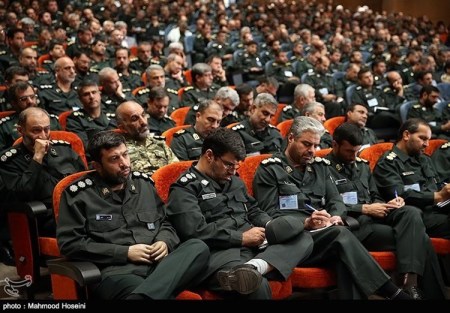
The Islamic Revolutionary Guard Corps (IRGC) Has Become More Influential and Powerful

January 25, 2017

The Islamic Revolutionary Guard Corps (IRGC) Has Become More Influential and Powerful, Iran News Update, January 24, 2017

(Please see also, What Is Iran’s Policy-Making Mechanism? — DM)
10611

The IRGC has successfully suppressed domestic opposition. Examples  include supporters and leaders of the Green Movement, and religious and ethnic minorities such as Kurds, Sunnis and Arabs. As well, other political factions, such as the moderates, have come to the conclusion that they need the blessing of the IRGC in order to survive politically.

The reintegration of Tehran into the global financial system is deepening, and more countries are committing themselves to trade with Iran and investment in its markets.The IRGC and the office of the supreme leader are the main beneficiaries of the increased revenues, which have been diverted into upgrading the IRGC’s military capabilities.  Iran’s lawmakers voted to increase the military budget despite the high unemployment rate.

Regional stability was an obstacle for the IRGC’s objective of expanding its influence beyond Iran’s borders. Rafizadeh writes, “In fact, it was through domestic conflicts that the IRGC expanded its stranglehold by penetrating other countries such as Lebanon and Iraq, and gave birth to several critical Shia proxies. In the long term, these proxies increase Iran’s political and ideological influence.”  He adds, “The more tensions and conflicts there are, the more the militaristic role of the IRGC increases in the region in order to achieve its regional ambitions. This has led to a vicious series of heightened conflicts.”

Once the child that Iran’s Islamic revolution gave birth to, the IRGC is now becoming the father of the Islamic republic. This can only be reversed if global powers or a coalition of regional nations stand against the IRGC’s increasing influence in the region.


*************************************

Majid Rafizadeh, Iran¬ian-American political scientist, Harvard University scholar and president of the International American Council, writes in an article for The National on January 23, 2017 about the Islamic Revolutionary Guard Corps, who were given birth to during Iran’s 1979 revolution.

Ayatollah Ali Khamenei, after becoming the country’s second supreme leader in 1989, gave considerable power to the IRGC, while sidelining other powerful clerics.

Although the IRGC still had obstacles preventing it from expanding its influence, recent developments suggest that those barriers are being lifted, allowing Iran’s military to be the key decision-maker in Iran’s policy-making.

Many people, who once had considerable amount of political weight and influence, which counterbalanced the IRGC’s increasing power, do not play a crucial role any more. The late Ali Akbar Rafsanjani, who was one of the founding fathers of the Islamic republic was sidelined by Khamenei towards the end of his life, still enjoyed a considerable amount of political legitimacy in creating challenges for the IRGC and others. However, Rafsanjani died this month.

Rafsanjani had significant power as a member of the Assembly of Experts, which is given the power to supervise, elect or remove the supreme leader. After his death, the IRGC is now much stronger, suggesting that the next supreme leader will be under the IRGC’s influence. If the IRGC controls the next supreme leader, it rules Iran’s political establishment unequivocally.

While the nuclear agreement remains in place, the Iranian government’s global legitimacy expands, leading to less scrutiny from the international community on how the IRGC treats domestic opposition.

The IRGC has successfully suppressed domestic opposition. Examples  include supporters and leaders of the Green Movement, and religious and ethnic minorities such as Kurds, Sunnis and Arabs. As well, other political factions, such as the moderates, have come to the conclusion that they need the blessing of the IRGC in order to survive politically.

The reintegration of Tehran into the global financial system is deepening, and more countries are committing themselves to trade with Iran and investment in its markets.The IRGC and the office of the supreme leader are the main beneficiaries of the increased revenues, which have been diverted into upgrading the IRGC’s military capabilities.  Iran’s lawmakers voted to increase the military budget despite the high unemployment rate.

Reuters reported, “Iranian lawmakers approved plans to expand military spending to 5 per cent of the budget, including developing the country’s long-range missile programme which US president-elect Donald Trump has pledged to halt. The vote is a boost to Iran’s military establishment – the regular army, the elite IRGC and the defence ministry.”

Regional stability was an obstacle for the IRGC’s objective of expanding its influence beyond Iran’s borders. Rafizadeh writes, “In fact, it was through domestic conflicts that the IRGC expanded its stranglehold by penetrating other countries such as Lebanon and Iraq, and gave birth to several critical Shia proxies. In the long term, these proxies increase Iran’s political and ideological influence.”  He adds, “The more tensions and conflicts there are, the more the militaristic role of the IRGC increases in the region in order to achieve its regional ambitions. This has led to a vicious series of heightened conflicts.”

The IRGC, more than ever before, is capable of exploiting the rise of Sunni extremist groups such as the ISIL, not only to justify its military presence in the region, but also to increase its global legitimacy by arguing that it is fighting extremism. Without a specific agenda for fighting ISIL, western powers have allowed a certain amount of leeway to the IRGC.  Additionally, some global and regional powers have been reluctant to address counterbalancing the increasing role of the IRGC across the region for economic or geopolitical reasons.

Although founded as a theocracy, Iran is becoming more of a military state as the IRGC pursues its regional ambitions. According to Rafizadeh, “We are more likely to witness the increasing influence and domination of the IRGC domestically and regionally as several major obstacles against Iran’s military have been lifted.”

Once the child that Iran’s Islamic revolution gave birth to, the IRGC is now becoming the father of the Islamic republic. This can only be reversed if global powers or a coalition of regional nations stand against the IRGC’s increasing influence in the region.

The 3-way option

January 25, 2017

Source: Israel Hayom | The 3-way option

Daniel Pipes

Foreign Affairs magazine has published a major statement from former Defense Minister Moshe Ya’alon, a likely future candidate for prime minister, on his view of how to end the Israeli-Palestinian conflict, titled “How to build Middle East peace: Why bottom-up is better than top-down.”

Ya’alon offers an impressive analysis of why decades of diplomacy have failed and the conflict’s enduring stagnation. His ‎‎”bottom-up” solution contains four elements, three of which are somewhat antique bromides and one of which ‎is an exciting, untried idea — the three-way option. ‎

Stripped to its essentials, Ya’alon’s article calls for: ‎‎1.‎ Promoting Palestinian economic growth and infrastructure development; ‎2. Improving Palestinian governance, anti-corruption efforts, and institution-building in general; 3. Israeli-Palestinian security cooperation; and 4.‎ A regional initiative that would bring in Arab states interested in helping to manage and eventually ‎solve the Israeli-Palestinian conflict, whether or not those states have formal relations with Israel.

The first three have been tried repeatedly through the decades and have failed to bring any resolution closer. In 1993, then-Foreign Minister Shimon Peres published “The New Middle East,” his lovely vision of a prosperous Palestinian ‎population that would be a good neighbor for Israel. The trouble is that his hopes were shattered ‎by Palestinian rejectionism, incitement and death-cultism, which still continue today. Surely no one still seriously believes in 2017 ‎that enrichment will moderate the Palestinians. ‎

In 2002, then-President George W. Bush focused on improved governance, but 15 years later things are more ‎wretched than ever, with anarchy, corruption, and violent feuding. Worse, the historical record ‎strongly suggests that good governance would just lead to a more efficient Palestinian machine for ‎attacking Israel. ‎

Security cooperation is an area — virtually the only one — in which Israel and the Palestinian Authority work ‎together: Basically, the Israel Defense Forces protects the PA and the PA helps the IDF stave off attacks. ‎However mutually useful, this collaboration has shown zero potential to expand to resolve their larger ‎conflict. ‎

In contrast, the fourth proposal, bringing in the Arab states, is an important initiative that has yet seriously to be ‎attempted. Here, Ya’alon’s plan holds out real hope. ‎

That’s because a remarkable symmetry exists between what Palestinians want from Israel and what Israel wants ‎from the Arab states plus Turkey and Iran, namely recognition and legitimacy. Noting this parallel, I ‎proposed in The Wall Street Journal that both aspirations be addressed in tandem, linking concessions by the Arab states to Israel with Israeli concessions to the Palestinians. Everyone would gain from this: “The Arab states ‎achieve what they say is their main goal, justice for the Palestinians. Israel gets peace. Palestinians have their ‎state.” ‎

For example, if the Saudis end their economic boycott of Israel, Israel would increase Palestinian access to ‎international markets. If the Egyptians warm up relations, Palestinians would get more access to the Israeli labor ‎market. If the major Arab states sign peace treaties with the Jewish State of Israel, the Palestinians would get their ‎state. ‎

The Obama administration made a short but intense feint in this direction in 2009, but the Saudis turned it down ‎and it sputtered to a close. Egyptian President Abdel-Fattah el-Sissi raised the idea again in 2016, again without consequence. In ‎short, the three-way option between the Arab states, Israel, and the Palestinians has not yet been pursued in a ‎serious or sustained way. ‎

With el-Sissi and Ya’alon now on record favoring the three-way option, and with Arab states shaken awake by the ‎Obama administration’s bizarre cooperation with Iran, Middle Eastern leaders may be willing to work with ‎the Jewish state in ways they were not ready for in 1990 or 2009. It’s certainly worth a try by the incoming ‎Trump administration. ‎

Progress in Arab-Israeli diplomacy will not come from retreading the defunct ideas of Peres or Bush, nor can ‎security cooperation possibly lead to political breakthroughs. My first preference remains U.S. support for an ‎Israeli victory. But if that is too much for now, then involving the Arab states at least offers a way out of the ‎stale, isolated, and even counterproductive sequence of Israeli-Palestinian negotiations. ‎

Daniel Pipes (DanielPipes.org, @DanielPipes) is president of the Middle East Forum.

Israeli Team Clinches Finalist Spot in International Moon Race

January 25, 2017

The competition is slated to end in late 2017 when the team will launch Israel’s first-ever spacecraft to the Moon.

Source: Israeli Team Clinches Finalist Spot in International Moon Race | David Israel | Wednesday, January 25, 2017 | JewishPress.com

Way to go Israel !

SpaceIL display of the anticipated white and blue moon landing.
Photo Credit: Courtesy SpaceIL

A significant achievement for Israel: SpaceIL, the Israeli team in the race to land a spacecraft on the Moon, qualified for the final stage of the international competition. SpaceIL is one of only five teams to make it to the finals alongside India’s Team Indus, Team Hakuto from Japan, Moon Express from the United States and the multi-national team, Synergy Moon.

These are the only teams who successfully achieved a key competition marker: the signing of a launch contract, symbolizing a teams’ “ticket to the Moon.” This achievement positioned Israel one step closer to joining the prestigious circle of superpowers who have reached the Moon already; the country would join the United States, the former Soviet Union and China.

The Google Lunar XPRIZE competition which began in 2007 originally attracted 33 teams from around the world. This international Moon Race stimulates private groups to build, launch and land an unmanned spacecraft on the Moon. Within a few years, most of the competitors dropped out upon realizing the depth and complexity of the challenge, bringing the race down to 16 teams.

Google Lunar XPRIZE management subsequently announced that teams unable to produce launch contracts by the end of 2016 would be automatically eliminated. Now, after the end of 2016 and the start of the final year of the competition, the die is cast: only five teams have verified launch contracts – with Israel’s SpaceIL the first to have reached that milestone – and remain as competition finalists.

Dr. Eran Privman, CEO of SpaceIL, said on Tuesday: “We have waited for this moment for a long time. Being announced as finalists in the Google Lunar XPRIZE competition officially confirms what we always knew: Israel is at the forefront of global technology. SpaceIL emerging as a competition finalist enhances our team’s ability to ‘shoot for the Moon’. Our hard work over the past six years is bearing fruit and we’re looking forward to the historic day of SpaceIL’s launch and to see the first Israeli spacecraft landing on the Moon.”

Meanwhile, this week SpaceIL received a generous contribution from businessman Sami Sagol whose significant donation brings the spacecraft closer to a Moon landing. Sagol joins other philanthropists including Mr. Morris Kahn, the Adelson Family Foundation, the Charles & Lynn Schusterman Foundation, Bezeq, the Israel Space Agency and others.

In addition, the organization enjoys the support of Israel’s President Reuven Rivlin, Israel Aerospace Industries and leaders from academic institutions such as the Weizmann Institute of Science and Tel Aviv University.
