Archive for December 30, 2016

Egyptian Daily Close To Egyptian Intelligence Reveals Minutes Of Secret Palestinian Authority Meeting With John Kerry, Susan Rice; U.S.-Palestinian Coordination On UNSC 2334; Rice Says Trump Administration’s Policy Will Be ‘Dangerous’

December 30, 2016

Egyptian Daily Close To Egyptian Intelligence Reveals Minutes Of Secret Palestinian Authority Meeting With John Kerry, Susan Rice; U.S.-Palestinian Coordination On UNSC 2334; Rice Says Trump Administration’s Policy Will Be ‘Dangerous’, MEMRI, December 29, 2016

(This must be part of the deplorable Russian hacking scheme. Obama wouldn’t lie, would he?)

In mid-December 2016, a Palestinian Authority (PA) delegation met in Washington with officials from the outgoing Obama administration for secret talks. On December 27, the Egyptian daily Al-Youm Al-Sabi’, which is close to Egyptian intelligence services, published an exposé of the minutes of the secret talks. According to the report, by Ahmed Gomaa, the Palestinian delegation included PLO Executive Committee secretary and negotiating team leader Saeb Erekat; Palestinian general intelligence chief Majid Faraj; Husam Zomlot, strategic affairs advisor to Palestinian Authority president Mahmoud ‘Abbas; Palestinian Foreign Ministry official Dr. Majed Bamya; Palestinian negotiations department official Azem Bishara; Palestinian intelligence international relations department chief Nasser ‘Adwa; and head of the PLO delegation to Washington Ma’an Erekat.

The report gave the details of the Palestinian delegation’s schedule during the visit, noting that “the Palestinian side began its meetings on December 12, when Saeb Erekat and Majid Faraj met with U.S. Secretary of State John Kerry. The next day, the two met with National Security Advisor Susan Rice. The entire delegation met with an American team that included four representatives of the Secretaries of State and Homeland Security, for a six-hour political-strategic meeting. Majid Faraj concluded his visit with a lengthy meeting with the CIA chief.”

According to the report, the minutes of the “top secret” meeting of Kerry, Rice, Erekat, and Faraj reveals U.S.-Palestinian coordination leading up to the UN Security Council vote on Resolution 2334 regarding Israel’s settlements, which was adopted December 23. It states that the sides “agreed to cooperate in drafting a resolution on the settlements” and that the U.S. representative in the Security Council was “empowered” to coordinate with the Palestinian UN representative on the resolution.

The meeting also, according to the report, was aimed at coordinating Kerry’s attendance at the upcoming international Paris Conference set for January 15, 2017, in order to promote a further international move regarding the Israeli-Palestinian conflict. Kerry, it said, offered to propose his ideas for a permanent arrangement “provided that they are supported by the Palestinian side.”

At the meeting, Rice pointed out the “danger” of the incoming Trump administration’s policies, the report stated, adding that both she and Kerry had advised President ‘Abbas to make no preliminary moves that might provoke the new administration. Rice even offered to help arrange a meeting between the Palestinian delegation and a representative from the Trump team, by enlisting the help of World Jewish Congress president Ronald Lauder.

Also at the meeting, Erekat warned that if the U.S. Embassy was moved to Jerusalem, the Palestinians would call to expel U.S. Embassies from Arab and Muslim capitals, the report said.

The report added that Kerry and Rice had fulsomely praised ‘Abbas’s policies and how he handled matters, and harshly criticized Israeli Prime Minister Benjamin Netanyahu, saying that he “aims to destroy the two-state solution.”

It should be mentioned that both Kerry and Erekat have denied that there was any U.S.-Palestinian coordination in drafting the Security Council resolution.[1]

Following are excerpts from the Al-Youm Al-Sabi’ report:[2]
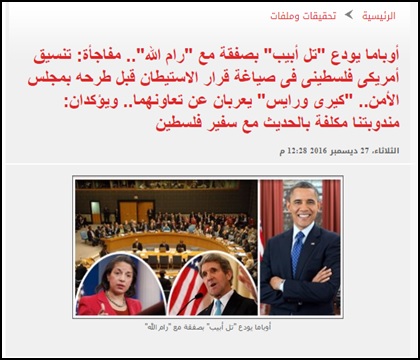
1229161The report in Al-Yawm Al-Sabi’

U.S. Representative To The Security Council Coordinated With Palestinian UN Representative On The Issue Of The Resolution Condemning The Settlements

According to the Al-Youm Al-Sabi’ report, “the minutes of the meeting – which was attended by U.S. Secretary of State John Kerry and National Security Advisor Susan Rice, and on the Palestinian side by PLO Executive Committee Secretary and negotiations team leader Saeb Erekat, and head of Palestinian general intelligence Maj,-Gen. Majid Faraj – reveals that the sides agreed to collaborate regarding a resolution on the settlements.” According to the report, “during the meeting, the American side focused on coordination of positions between Washington and Ramallah regarding the resolution on the settlements, which was brought to a vote in the Security Council and adopted several days ago…”

The report stated that “the minutes of the meeting reveal American-Palestinian coordination regarding the resolution on the settlements” and that Kerry and Rice stressed that “they were willing to cooperate with a balanced resolution, and that Washington’s UN mission was authorized to discuss this matter with the Palestinian representative to the UN, Ambassador Riyad Mansour.” It continued: “The U.S.’s representative to the Security Council coordinated with the Palestinian ambassador on the issue of the resolution condemning the settlements.”

Coordinating Kerry’s Attendance At International Conference In France

The delegation also attempted to coordinate Kerry’s attendance at the Paris Conference, which will take place January 15, 2017, to promote a further international move for the Israeli-Palestinian conflict, according to the report. “As for the French initiative, U.S. Secretary of State John Kerry said that he could not attend [the conference if it were to be held] December 21-22, but stressed that he could [attend it if it were to be held] after January 9. The Palestinian delegation stressed that ‘Abbas had contacted the French side, and that it had expressed its willingness to postpone the international conference [in Paris] so that the American secretary of state could attend.”

Possibility Of Kerry Presenting His Ideas For Permanent Solution

According to the report, “Kerry raised the possibility of presenting ideas for a permanent solution, provided that they are supported by the Palestinian side… and this refers to principles that have already been raised as part of the Framework Agreement.[3] He also proposed that the Palestinian delegation travel to Saudi Arabia to discuss these points, but according to the minutes, he did not contact the Saudis on this matter. [Additionally,] according to the minutes of the meeting, National Security Advisor Susan Rice rejected, and ridiculed, the offer to propose ideas, arguing that the [incoming] administration of Republican President Donald Trump will completely oppose them.”

Rice “Stressed The Danger Posed By The Trump Administration”

Rice, the report stated, “stressed the danger posed by the Trump administration, which could take a position different from that of all American administrations since 1967 on the issue of Palestine and Israel. She emphasized that she took seriously statements about moving the U.S. Embassy to Jerusalem and the Trump administration’s view of the settlements.”

Kerry and Rice “advised Palestinian President Mahmoud ‘Abbas to not take any preliminary steps that could provoke the Trump administration, such as dismantling the PA, turning to the International Criminal Court, or ending security coordination with Israel,” said the report, adding: “They [also] stressed the need to avoid military action or martyrdom [attacks], as these would greatly jeopardize the Palestinian position.

“They praised the substantial efforts of the Palestinian security apparatuses, specifically Palestinian [general] intelligence, led by Majid Faraj, as part of what they called ‘the struggle against terrorism.’ [The two] maintained that Palestinian-American collaboration in this area is among the closest of all the coordination between American apparatuses and security forces in the region.”

Rice Offered To Organize Meeting Between Ronald Lauder And Palestinian Delegation

“According to the minutes of the meeting, Susan Rice asked whether the Palestinian delegation could meet with a representative from Donald Trump’s team. She clarified that she could request intervention and could organize this by means of World Jewish Congress President Ronald Lauder. Saeb Erekat responded that he had already asked but that Lauder could not. He added: ‘We were told that they were still organizing the new administration, and that once they were done, they would officially meet with the Palestinian side.'”

Erekat: If U.S. Embassy Is Moved To Jerusalem, We Will Call To Expel U.S. Embassies From Arab And Muslim Countries

“When Susan Rice asked what the Palestinian response would be if the U.S. Embassy was moved to Jerusalem, or if a new settlement bloc was annexed, Erekat responded: ‘We will directly and immediately join 16 international organizations, withdraw the PLO’s recognition of Israel, and cut back our security, political, and economic ties with the Israeli occupation regime, and we will hold it fully responsible for the PA’s collapse. Furthermore, we will [call] on the Arab and Islamic peoples to expel U.S. Embassies from their capitals.’ Rice answered Erekat by saying: ‘It seems that future matters could be very complicated, and we are all apprehensive about sitting down with Erekat because of his absolute knowledge of these matters, and because of his memory and his sincerity.’ She expressed the American side’s respect and friendship for Erekat, and apologized for yelling at him in March 2014.”

“The Palestinian Delegation Officially Demanded That The Law… Designating The PLO A Terrorist Organization Be Rescinded”

According to the report, “the Palestinian side officially demanded that the 1987 U.S. law designating the PLO a terrorist organization be rescinded.[4] Furthermore, both sides agreed to establish a bilateral commission to examine visa requests from Palestinians and entry and movement visas for Palestinian leadership in the U.S.”
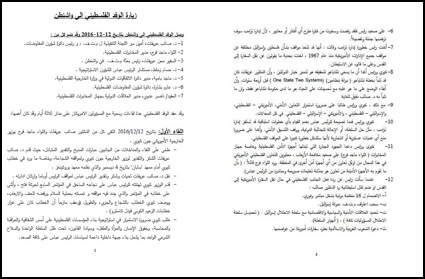
1229162Part of the minutes published in the report

Kerry, Rice Congratulate ‘Abbas “For His Stunning Success At Fatah’s Seventh General Conference”

“The Palestinian delegation thanked Kerry and Rice, and expressed Palestinian President Mahmoud ‘Abbas’s esteem for the views of U.S. President Barack Obama, Advisor Rice, and Secretary Kerry, and particularly for Kerry’s speech at the Saban Forum in early December,” the report stated, and added that the two U.S. officials had congratulated ‘Abbas “for his stunning success at Fatah’s Seventh General Conference and for his long and courageous speech (like those given by the late Cuban ruler Fidel Castro), during which he reiterated his positions and founding principles regarding his adherence to the peace process and his opposition to violence and terrorism in all forms.”

Also according to the report, Erekat and Faraj asked Kerry and Rice “to stress in the reports of the transition to the new administration that Palestinian President Mahmoud ‘Abbas, the PLO, and the PA are partners in the peace process, and that the Palestinian president and security apparatuses are strategic partners in the struggle against terrorism on the regional and international [levels].

“[They asked] that it be emphasized that there would be bilateral Palestinian-American committees in all areas (healthcare, education, agriculture, tourism, sports, trade, security, women, youth, and more) and that the new administration would oversee them together with Palestinian Prime Minister Dr. Rami Hamdallah.” Additionally, the possibility of “establishing a joint database together with the Palestinian ambassador to Washington and a representative from Palestinian general intelligence” was raised.

Kerry and Rice said, according to the report, that “all the above matters will head the transitional report now being prepared by the team of the outgoing president, Barack Obama, for the new American administration.” They also “praised ‘Abbas’s courage, positions, leadership, and adherence to the culture of peace and to peace as a strategic option, in addition to his opposition to violence and terrorism, to the ongoing security coordination, and to his being considered a uniquely strategic and courageous leader in the Middle East. The success of [Fatah’s] Seventh General Conference. they [said], had effectively ended attempts by Muhammad Dahlan and others to weaken President ‘Abbas, who must now act to tighten his relationship with Saudi Arabia, Jordan, and Egypt.”[5]

It continued: “Rice asked the Palestinian delegation to convey U.S. President Barack Obama’s gratitude to Palestinian President Mahmoud ‘Abbas for honoring all his commitments to him, and added: ‘Abbas was open and honest regarding all his commitments, especially regarding [Palestine] refraining from joining the 16 international organizations [as a member state].'”

Kerry and Rice also said that it was necessary “to continue American-Palestinian, Israeli-Palestinian, and American-Israeli-Palestinian security cooperation in all fields.” In this context, said the report, Faraj stressed that “the cooperation between Palestinian security apparatuses [and Israel] is carried out according to the clear and direct order of Palestinian President Mahmoud ‘Abbas.”

Kerry And Rice: Netanyahu “Aims To Destroy The Two-State Solution”

Kerry and Rice stressed that “Israeli Prime Minister Benjamin Netanyahu aims to destroy the two-state solution, and Dr. Saeb Erekat foresaw Netanyahu’s plan to create one state with two systems four years ago. The two said that Erekat’s prediction was highly accurate, and that all Netanyahu has to offer is maintaining the status quo, in addition to guarantees to improve [Palestinian] living conditions,” the report stated.

“John Kerry And Susan Rice Asked That The Meetings Be Classified ‘Top Secret'”

Finally, the report stated: “John Kerry and Susan Rice asked that the meetings be classified ‘Top Secret’ and that what went on in them not be leaked, in light of the sensitivity of the transition between the two U.S. administrations.”

“The Palestinian delegation,” it said, “asked Kerry and Rice to reexamine the financial aid to the PA and not to reduce it, as they did when they cut it from $150 million in 2011 to $100 million in 2012, with the current aid proposal being only $39 million. According to the meeting’s minutes, the Palestinian side revealed that [U.S.]  financial aid to the PA was $400-$500 million between 2008 and 2013, and was cut to $370 million in 2014 and 2015, and then cut again to $290 million in 2016.[6]

“The Palestinian side praised the American administration’s aid to UNRWA, which averaged $277 million per year between 2009 and 2016, and asked for it to be increased in order to cover UNRWA’s $101 million deficit in 2016.”


[1] Wafa.ps, December 28, 2016.

[2] Al-Yawm Al-Sabi’ (Egypt), December 27, 2016.

[3] The Framework Agreement was proposed by Kerry in February 2014. According to Thomas Friedman of the New York Times, this agreement included: Gradual Israeli withdrawal from the West Bank; Israel retaining some West Bank settlements in return for Israeli land given over to Palestinian control; security arrangements in the Jordan Valley for Israel’s defense; Palestinian recognition of Israel as a Jewish state within the 1948 borders; a right of return to the 1967, rather than the 1948, borders; and a Palestinian capital in East Jerusalem.

[4] 22 USC Ch. 61 designates the PLO as a terrorist organization, banning it from operating in the U.S. See Uscode.house.gov/view.xhtml?path=/prelim@title22/chapter61&edition=prelim

[5] See MEMRI Inquiry & Analysis No. 1283, Fatah’s Seventh General Conference Will Convene Under The Shadow Of The ‘Abbas-Dahlan Struggle, November 28, 2016; Inquiry & Analysis No. 1282, The ‘Abbas-Dahlan Power Struggle Over The Palestinian Presidential Succession, November 28, 2016; Special Dispatch No. 6684, Reports In Arab Press: ‘Abbas Resisted Arab League Pressure To Appoint Successor – Despite Threats Of Sanctions Against Him, November 18, 2016; Inquiry & Analysis No. 1270, Tension Between Mahmoud ‘Abbas, Arab Quartet Over Initiative For Internal Reconciliation In Fatah, September 27, 2016; and Inquiry & Analysis No. 1290, Fatah’s Seventh General Conference Bolsters ‘Abbas’s Standing; Contradictory Messages In ‘Abbas Statements On Terror, Negotiations With Israel, December 21, 2016.

[6] All conflicting numbers mentioned above appear as is in the report.

UN Approves Funding for First Anti-Israeli ‘Settlement’ Blacklist

December 30, 2016

UN Approves Funding for First Anti-Israeli ‘Settlement’ Blacklist

By Patrick Goodenough | December 27, 2016

Source: UN Approves Funding for First Anti-Israeli ‘Settlement’ Blacklist

(CNSNews.com) – On the same day as the U.N. Security Council passed a controversial resolution condemning Israel, the 193-member U.N. General Assembly on Friday approved a budget that includes $138,700 to fund the compilation of a first-ever U.N. blacklist of private companies doing business in territories disputed between Israel and the Palestinians.

Defined in U.N. documents as a “database,” the blacklist will cover companies of any nationality that do business in Israeli “settlements” located in areas claimed by the Palestinians, including Jerusalem’s Jewish Quarter.

The move, which was mandated by the U.N. Human Rights Council (HRC) last March, is expected to benefit the anti-Israel boycott, divestment and sanctions (BDS) campaign.

The U.S., not a member of the HRC this year, did not have a vote on the matter in March, although the State Department did criticize the decision, with spokesman John Kirby calling it “an unprecedented step” that was “far outside” the scope of the HRC’s authority.

U.S. taxpayers account for 22 percent of the U.N.’s regular operating budget, plus billions of dollars more in voluntary contributions to various parts of the U.N. system each year.

Since Friday’s Security Council resolution – which passed after the Obama administration chose to abstain rather than exercise its veto – several Republican lawmakers have vowed to target U.S. funding for the world body.

The General Assembly approves the budget for the HRC, and was asked this year to green light $26.4 million over and above earlier estimates, to pay for resolutions and decisions taken during the council’s periodic sessions in Geneva.

Included in that request was the sum of $138,700 – $102,400 to pay for the individual tasked to compile the Israeli settlement blacklist over a period of eight months, and $36,300 for “documentation.”

The HRC resolution called for the list to be presented to the council at an upcoming month-long session, which is scheduled to begin in late February next year.

Earlier this month, Palestinian representative Abdullah Abushawesh made clear the BDS goal behind the move.

“We should block the source of financing for settlements on occupied Palestinian territory, in particular by drawing up a list of companies that operate on this territory, whether these companies are Israeli or from other countries,” he told General Assembly member-states considering the budget request.

“As soon as this list is drawn up we encourage all to disseminate it, and to help these transactions with these companies to be stopped,” Abushawesh said through a translator.

“Because I am sure that you would all agree that these settlements are illegitimate,” he added. “As a consequence, any products there are also illegitimate and should not be sold on your markets.”

Hours before the General Assembly adopted the budget resolution without a vote on Friday night, it was approved by the assembly’s “Fifth Committee,” which deals with budgetary affairs.

At that committee session earlier in the day, Israel’s delegation tried to insert an amendment to exclude funding for the blacklist. It was criticized by other delegates for introducing “political elements” – in the words of Slovakia, speaking for the European Union – into what they argued should be a strictly budgetary process.

Israel’s proposal was then put to a vote, and failed dismally, with just six countries (the U.S., Israel, Australia, Canada, Guatemala and Palau) in favor and 151 opposed.

Israel’s delegate afterwards dissociated his country from the specific funding requirement for the blacklist, saying that the funds were being “used to target the State of Israel.”

“It’s time to remove resources for activities that have only one agenda – to politicize the work of the Human Rights Council,” he said.

Last month, the office of the U.N. human rights commissioner Zeid Ra’ad Al Hussein formally invited “all interested persons, entities and organizations” to submit information to enable it to compile the HRC-mandated blacklist.

“The identity of sources of information will be kept confidential,” it said in a notice requesting that concise and pertinent submissions be emailed by November 30.

Ahead of Friday’s budget vote in New York that included funding for the blacklist, Anne Bayefsky, president of the U.N.-focused NGO Human Rights Voices, warned that American companies “are in for a shock.”

“American taxpayers can expect to find themselves funding BDS in the very near future, with American businesses caught in the crosshairs,” Bayefsky wrote.

Obama and Israel, strike and counter-strike

December 30, 2016

Source: Column One: Obama and Israel, strike and counter-strike – Opinion – Jerusalem Post

Caroline Glick

Resolution 2334 asserts that Israel has no right to any of the lands it took control over during the Six-Day War.

UN Security Council Resolution 2334 was the first prong of outgoing President Barack Obama’s lame duck campaign against Israel.

US Secretary of State John Kerry’s speech on Wednesday was the second.

On January 15, stage 3 will commence in Paris.

At France’s lame duck President François Hollande’s international conference, the foreign ministers of some 50 states are expected to adopt as their own Kerry’s anti-Israel principles.

The next day it will be Obama’s turn. Obama can be expected to use the occasion of Martin Luther King Jr. Day to present the Palestinian war to annihilate Israel as a natural progression from the American Civil Rights movement that King led 50 years ago.

Finally, sometime between January 17 and 19, Obama intends for the Security Council to reconvene and follow the gang at the Paris conference by adopting Kerry’s positions as a Security Council resolution. That follow-on resolution may also recognize “Palestine” and grant it full membership in the UN.

True, Kerry said the administration will not put forward another Security Council resolution.

But as Prime Minister Benjamin Netanyahu explained in his response to Kerry’s address, there is ample reason to suspect that France or Sweden, or both, will put forth such a resolution. Since the draft will simply be a restatement of Kerry’s speech, Obama will not veto it.

Whether or not Obama gets his second Security Council resolution remains to be seen. But whether he succeeds or fails, he’s already caused most of the damage. A follow-on resolution will only amplify the blow Israel absorbed with 2334.

Resolution 2334 harms Israel in two ways. First, it effectively abrogates Resolution 242 from 1967 which formed the basis of Israeli policy-making for the past 49 years. Second, 2334 gives a strategic boost to the international campaign to boycott the Jewish state.

Resolution 242 anchored the cease-fire between Israel and its neighbors at the end of the Six Day War. It stipulated that in exchange for Arab recognition of Israel’s right to exist in secure and defensible borders, Israel would cede some of the territories it took control over during the war.

Resolution 242 assumed that Israel has a right to hold these areas and that an Israeli decision to cede some of them to its neighbors in exchange for peace would constitute a major concession.

Resolution 242 is deliberately phrased to ensure that Israel would not be expected to cede all of the lands it took control over in the Six Day War. The resolution speaks of “territories,” rather than “the territories” or “all the territories” that Israel took control over during the war.

Resolution 2334 rejects 242’s founding assumptions.

Resolution 2334 asserts that Israel has no right to any of the lands it took control over during the war. From the Western Wall to Shiloh, from Hebron to Ariel, 2334 says all Israeli presence in the areas beyond the 1949 armistice lines is crime.

Given that Israel has no right to hold territory under 2334, it naturally follows that the Palestinians have no incentive to give Israel peace. So they won’t. The peace process, like the two-state solution, ended last Friday night to the raucous applause of all Security Council members.

As for the boycott campaign, contrary to what has been widely argued, 2334 does not strengthen the boycott of “settlements.” It gives a strategic boost to the boycott of Israel as a whole.

It calls on states “to distinguish in their relevant dealings, between the territory of the State of Israel and the territories occupied since 1967.”

Since no Israeli firm makes that distinction, all Israeli economic activity is now threatened with boycott. Tnuva is an “occupation” dairy because it supplies communities beyond the 1949 lines.

Bank Hapoalim is an “occupation” bank because it operates ATM machines in post-1967 neighborhoods in Jerusalem. The Fox clothing chain is an “occupation” chain because it has a store in Gush Etzion. And so on and so forth.

Resolution 2334 gives Europe and its NGOs a green light to wage a complete trade and cultural boycott against all of Israel.

Obama is not using his final weeks in office to wage war on Israel because he hates Netanyahu.

He is not deliberately denying 3,500 years of Jewish history in the Land of Israel because the Knesset is set to pass the Regulations Law that will make it marginally easier for Jews to exercise property rights in Judea and Samaria, as Kerry and UN Ambassador Samantha Power claimed.

Obama’s onslaught against Israel is the natural endpoint of a policy he has followed since he first entered the White House. In June 2009, Obama denied the Jews’ 3,500 years of history in the Land of Israel in his speech in Cairo before an audience packed with members of the Muslim Brotherhood.

Instead of the truth, Obama adopted the Islamist propaganda lie that Israel was established because Europe felt guilty about the Holocaust.

Throughout his presidency, Obama has rejected the guiding principle of Resolution 242. His antisemitic demand that Israel deny its Jewish citizens their civil and property rights in Jerusalem, Judea and Samaria simply because they are Jews is just as antithetical to 242 as is Resolution 2334.

In his speech, Kerry repeatedly castigated the government while flattering the Israeli Left in yet another attempt to divide and polarize Israeli society. Kerry’s professed support for the Israeli Left is deeply ironic because Israeli leftists are the primary casualties of Obama’s anti-Israel assault.

In the post-242 world that Obama initiated, the UN makes no distinction between Jerusalem and Nablus, between Gush Etzion and Jenin, or between Ma’aleh Adumim and Ramallah. In this world, Labor Party leader Isaac Herzog’s plan to retain a mere 2-3% of Judea and Samaria is no more acceptable than Bayit Yehudi leader Naftali Bennett’s plan to apply Israeli law to 60% of the area or to other plans calling for Israeli law to be applied to all of Judea and Samaria. All are equally unlawful. All are equally unacceptable.

For the next three weeks, the government’s focus must be centered on Obama and minimizing the damage he is able to cause Israel. Since Israel cannot convince Hollande to cancel his conference or Obama not to give his speech, Israeli efforts must be concentrated on scuttling Obama’s plan to enact a follow-on resolution.

To scuttle another resolution, Israel needs to convince seven members of the Security Council not to support it. Only measures that secure the support of nine out of 15 Security Council members are permitted to come to a vote. The states that are most susceptible to Israeli lobbying are Italy, Ethiopia, Japan, Egypt, Uruguay, Kazakhstan, Ukraine and Russia.

Netanyahu’s furious response to 2334 advance the goal of blocking a vote on a follow-on resolution in two ways. First, they create Israeli leverage in seeking to convince member states to oppose voting on an additional resolution before January 20.

Second, Netanyahu’s seemingly unrestrained response to the Obama administration’s onslaught enables Donald Trump to join him in pressuring Security Council members to oppose bringing a new resolution for a vote.

By taking an extreme position of total rejection of Obama’s actions, Netanyahu is enabling Trump to block a vote while striking a moderate tone.

In three weeks, Obama’s war with Israel will end. His final legacy – the destruction of the landfor- peace paradigm and the two-state policy-making model – obligate Israel, for the first time in 50 years, to determine by itself its long-term goals in relation to the international community, the Palestinians and Judea and Samaria.

Regarding the international community, the Security Council opened the door for its members to boycott Israel. As a result, Israel should show the UN and its factotums the door. Israel should work to de-internationalize the Palestinian conflict by expelling UN personnel from its territory.

The same is the case with the EU. Once Britain exits the EU, Israel should end the EU’s illegal operations in Judea and Samaria and declare EU personnel acting illegally persona non grata.

As for the Palestinians, Resolution 2334 obligates Israel to reconsider its recognition of the PLO. Since 1993, Israel has recognized the PLO despite its deep and continuous engagement in terrorism. Israel legitimized the PLO because the terrorist group was ostensibly its partner in peace. Now, after the PLO successfully killed the peace process by getting the Security Council to abrogate 242, Israel’s continued recognition of the PLO makes little sense. Neither PLO chief Mahmoud Abbas nor his deputies in Fatah – convicted, imprisoned mass murderer and terrorism master Marwan Barghouti, and Jibril Rajoub who said he wishes he had a nuclear bomb so he could drop it on Israel and who tried to get Israel expelled from FIFA – has any interest in recognizing Israel, let alone making peace with it. The same of course can be said for the PLO’s coalition partner Hamas.

An Israeli decision to stop recognizing the PLO will also have implications for the Trump administration.

In the aftermath of 2334, calls are steadily mounting in Congress for the US cancel its recognition of the PLO and end US financial support for the Palestinian Authority. If Israel has already ended its recognition of the PLO, chances will rise that the US will follow suit. Such a US move will have positive strategic implications for Israel.

There is also the question of the Palestinian militias that are deployed to Judea and Samaria as part of the peace process that Obama and the PLO officially ended last Friday. In the coming months, Israel will need to decide what to do about these hostile militias that take their orders from leaders who reject peaceful coexistence with Israel.

Finally, there are the territories themselves. For 50 years, Israel has used the land-for-peace paradigm as a way not to decide what to do with Judea and Samaria. Now that 242 has been effectively abrogated, Israel has to decide what it wants.

The no-brainer is to allow Jews to build wherever they have the legal right to build. If the UN says Israel has no rights to Jerusalem, then Israel has no reason to distinguish between Jerusalem and Elon Moreh.

More broadly, given that for the foreseeable future, there will be no Palestinian Authority interested in making peace with Israel, Israel needs to think about the best way to administer Judea and Samaria going forward. The obvious step of applying Israeli law to Area C now becomes almost inarguable.

Shortly before Obama took office eight years ago, he promised to “fundamentally transform” America. Trump’s election scuttled any chance he had of doing so.

But by enabling Resolution 2334 to pass in the Security Council, Obama has succeeded in fundamentally transforming the nature of the Palestinian conflict with Israel. Israel’s actions in the coming weeks will determine whether it is fundamentally transformed for better or for worse.

Why Trump’s bid to amplify Muslim reformers will keep Americans safer

December 30, 2016

Why Trump’s bid to amplify Muslim reformers will keep Americans safer, The Hill, Cynthis Farahat, December 29, 2016

sisi_egypt_president_458617936© Getty Images

Sisi’s supporters say the Obama administration’s tolerance of Islamism and harsh criticism of Egypt’s counter-terrorism efforts have been an enormous obstacle. In contrast, Trump’s campaign expressed “strong support for Egypt’s war on terrorism” and pledged that “under a Trump Administration, the United States of America will be a loyal friend, not simply an ally, that Egypt can count on in the days and years ahead.”

**********************************

The recent terror attacks in Berlin and Zurich highlight once again the danger that radical Islamism poses to the West. While many are searching for ways to improve security and defeat the threat on the ground, few appear to appreciate that the decisive blow against Islamism can only be administered by leaders in the Middle East.

President-elect Donald Trump pledged during his last major foreign policy speech before the election to “be a friend to all moderate Muslim reformers in the Middle East” “amplify their voices.”

President Abdel Fattah el-Sisi and most of the political and media establishment in Egypt warmly embraced this policy. After meeting with the Republican nominee on the sidelines of the UN General Assembly in September, Sisi told CNN he had “no doubt” Trump would make a strong leader. Sisi was also the first Arab leader to telephone Trump after his election win.

Egyptian affections for Trump are partly fueled by distaste for former Secretary of State Hillary Clinton, who many Egyptians believe conspired with the Muslim Brotherhood to help elect Islamist Muhammad Morsi as president in 2012 (after which she was greeted in Egypt with protestors hurling tomatoes).

However, the main attraction of Trump in the eyes of many Egyptians is his staunch anti-Islamism.

Since coming to power in 2013, Sisi has spoken passionately about the need for an Islamic reformation. For Sisi, Islamism isn’t merely a ruinously bad blueprint for modern governance and a chronic source of security threats, it is also a wedge fueling outside hostility to Muslims, both Islamists and non-Islamists alike. In a 2015 New Year’s Day speech at al-Azhar University, the world’s most prestigious seat of Sunni Islamic learning, Sisi warned that the “corpus of [Islamic] texts and ideas that we have sacralized over the years” are “antagonizing the entire world” and “caus[ing] the entire umma [Muslim world] to be a source of anxiety, danger, killing and destruction.”

Not surprisingly, Sisi has faced opposition in the region, especially from Turkey, Qatar, and powerful figures in the Saudi royal family, who have opened their media to Brotherhood operatives to attack Sisi and even call for his assassination. One of the only Arab governments openly backing Sisi’s uncompromising stance on Islamists is the United Arab Emirates (UAE), which in 2014 designated the Muslim Brotherhood as a terrorist organization (along with two of its U.S.-based affiliates, the Council on American-Islamic Relations and the Muslim American Society).

Within Egypt, Sisi’s calls for a religious revolution have made him extremely popular, but he has faced fierce resistance from Islamists, who still dominate many sectors of Egyptian civil society and exert influence in government, particularly the judiciary.

Sisi’s supporters say the Obama administration’s tolerance of Islamism and harsh criticism of Egypt’s counter-terrorism efforts have been an enormous obstacle. In contrast, Trump’s campaign expressed “strong support for Egypt’s war on terrorism” and pledged that “under a Trump Administration, the United States of America will be a loyal friend, not simply an ally, that Egypt can count on in the days and years ahead.” Walid Phares, a foreign policy advisor for the president-elect, stated in an interview that Trump will work to pass legislation designating the Muslim Brotherhood as a terrorist organization.

Trump’s election appears to have emboldened Sisi to step up his Islamic reformation campaign. Just days later, Sisi pardoned 82 prisoners, among them Islam Behery, a former TV host and prominent leader of a growing neo-Mu’tazilah-style movement that claims Islamic scriptures are man-made and should not overrule reason and critical thinking.

Behery’s movement has gained sweeping popularity as horrors committed by Al-Qaeda, Islamic State, and other Sunni jihadist groups have mounted in recent years.

Many across the Arab world, and Egyptians in particular, are hopeful that the election of Donald Trump will open a new page of cooperation between the United States and those who are seeking to challenge Islamic extremism in the war of ideas. Only together can we defeat the Islamists wreaking carnage on the streets in the West.

Cynthia Farahat is a fellow at the Middle East Forum and a columnist for the Egyptian daily Al-Maqal.

The views expressed by authors are their own and not the views of The Hill.;


