Archive for December 16, 2016

U.S. Accused of Training Iranian-Tied Forces in Iraq

December 16, 2016

U.S. Accused of Training Iranian-Tied Forces in Iraq, Washington Free Beacon, December 26, 2016

(It all depends on what “Iranian-tied” means. — DM)
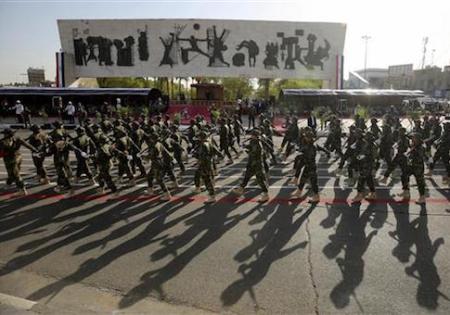
pmfIraqi government-backed Popular Mobilization forces take part in a joint military parade with Iraqi security forces in Baghdad / AP

“There are militiamen, Sunni, Shias, and Christians who are not part of the Iranian-backed network in Iraq and are not necessarily amenable to Tehran’s influence,” he said. “However, these are dwarfed, out-financed, and out-gunned by the IRGC-backed militias, who promote the brand of Islamic identity as espoused by the IRGC, and openly display ideological loyalty to the velayat-e faghih (the Islamic Republic’s founding ideology) and Iran’s supreme leader.”

*****************************

The United States military is facing accusations that it has been training Iraqi militia fighters who are tied to Iran, a charge that military officials who spoke to the Washington Free Beacon denied this week while insisting that the United States and Iran share common goals in the war-torn country, as both sides fight to eradicate the threat of Islamic State terrorists.

The latest charge that the United States may be directly involved in the training of Iranian-backed militia fighters has reignited concerns that America is becoming too cozy with Iranian interests operating in Iraq, an issue that highlights the difficultly facing U.S forces as they seek to counter the influence of ISIS.

Video recently emerged of U.S. military advisers training Iraqi militia fighters in Makhmur. Some foreign policy observers assessed that these militia fighters may have ties to Iran, which controls an increasing number of Iraqi militia fighters taking on ISIS.

The charge was picked up this week in a lengthy Los Angeles Times exposé claiming, “The U.S. is helping train Iraqi militias historically tied to Iran.”

Senior military sources who spoke to the Free Beacon denied the United States is directly working with Iranian forces, but acknowledged the United States and Iran do share similar goals in Iraq when it comes to combatting the threat of ISIS.

“In Iraq, with regards to ISIL, our interests and Iranian interests have some convergence,” said one senior military official who spoke to the Free Beacon on background, using another acronym for the Islamic State.

Iranian influence over militias in Iraq continues to be a challenge for the United States, which is barred by law from working with any such group. Foreign policy insiders who spoke to the Free Beacon about the issue warned that U.S. intervention against ISIS in Iraq is serving to bolster and legitimize Iran’s regional influence.

During last spring’s campaign in Fallujah, the U.S. provided air cover to Iraqi fighters, some of whom came from militias tied to Iran. Iranian media reported that some of the fighters belonged to Iran’s state-controlled militia.

“The forces that the LA Times observed in that story are not affiliated with Iran,” Col. John Dorrian, a spokesman for the U.S. Joint Task Force operating in Iraq, told the Free Beacon. “They are approved as hold forces ‎for terrain that has been liberated by the Iraqi Security Forces. They are being trained by coalition forces. They are local forces, and they represent diverse ethnic and sectarian backgrounds. The local tie is a key element in their acceptance by the population they are going to keep secure.”

Dorrian added that the headline on the LA Times article discussing the training of these militias “is very misleading.”

“There’s a lot of good information ‎in the article but the Iranian tie is nonexistent,” Dorrian said. “The Government of Iraq has enrolled these forces as Popular mobilization forces. I think LAT conflated that fact with Iran. Despite my telling them there’s no tie, they went with that headline.”

Multiple other military officials, Obama administration sources, and outside experts familiar with the matter told the Free Beacon that the militia fighters depicted in recent videos have no ties to Iran.

However, they said the United States and Iran share common goals in Iraq, where the threat of ISIS has sparked sectarian battles and endangered the Western-backed government.

A State Department official authorized only to speak on background told the Free Beacon that the United States does not train any Iranian-tied fighters, even if they are officially backed by the Iraqi government.

“The U.S. provides support to the Iraqi Security Forces, and those aligned with the Iraqi government,” the official said. “The U.S. does not, and will not, provide direct support to any group proscribed by American law, or which does not operate under the aegis of the Iraqi government.”

Much of Iraq’s Popular Mobilization Forces, or PMFs, are comprised of Shia Muslim fighters, many of whom are ideologically aligned with Iran’s hardline regime.

Maj. Adrian J.T. Rankine-Galloway, a Defense Department official, confirmed to the Free Beacon that some Iraqi units have been barred from receiving U.S. training due to their inability to pass background checks.

“Some Iraqi units have been restricted from receiving assistance because their commander didn’t pass vetting,” Rankine-Galloway said. “Because that quarterly report is classified, we cannot release which units were disqualified from receiving ITEF assistance.”

Rankine-Galloway further maintained that the United States has not changed its policy with regards to training in Iraq.

“U.S. government support to the counter-ISIL campaign remains by, with, and through the central Government of Iraq—and only to forces under the command and control of the Iraqi Security Forces,” Rankine-Galloway said. “Department of Defense policies on the provision of military assistance to foreign military forces have not changed. Iraqi Security Forces units who receive Iraq Train and Equip Fund assistance are strictly vetted” for ties to terror groups and the government of Iran.

Critics of the Obama administration’s policy in Iraq charge that even if the forces are not directly under the Iranian government’s orders, they are influenced by its senior military leaders.

“For proof the Obama administration treats our enemies like friends, look no further than their efforts to train armed militias loyal to Qassem Soleimani, commander of the IRGC-Qods Forces, in Makhmur,” said one senior congressional aide who works on the matter. “Incoming national security adviser Michael Flynn knows intimately what Iran is capable of, so it’s hoped that he and the Trump administration will reverse this disgrace.”

Amir Toumaj, an Iran analyst at the Foundation for Defense of Democracies, said that militia fighters tied to Iran far outnumber other fighters in Iraq.

“There are militiamen, Sunni, Shias, and Christians who are not part of the Iranian-backed network in Iraq and are not necessarily amenable to Tehran’s influence,” he said. “However, these are dwarfed, out-financed, and out-gunned by the IRGC-backed militias, who promote the brand of Islamic identity as espoused by the IRGC, and openly display ideological loyalty to the velayat-e faghih (the Islamic Republic’s founding ideology) and Iran’s supreme leader.”

“Key leaders” in the PMF “are beholden to Qassem Soleimani,” a top Iranian military leader, Toumaj said. “For example, the PMF operations commander is Abu Mahdi al Muhandis, Iran’s number one man in Iraq who has been designated as a terrorist by the U.S. Treasury and has overseen lethal attacks against U.S. soldiers during the occupation of Iraq. Iraqi militia and party leaders openly travel to Iran, and have received royal treatment, such as Akram al Kabi, head of Harakat al Nujaba, or the Movement of the Noble. The group under his command has committed war crimes and summary executions of women and children in east Aleppo this past week, according to the U.N.”

“The law legalizing the PMF has been welcomed in Iran. When Supreme Leader Ali Khamenei this past week received Ammar Hakim, head of the National Alliance Shia party that helped passed that bill, he called the PMF a ‘great wealth’ for Iraq that should be ‘supported and consolidated.’”

“The current U.S. policy of defeating the Islamic State above all else is empowering the IRGC-backed network, which has worked to infiltrate the Iraqi government and cement itself into a part of the state and establish an Iraqi version of the IRGC, crystallized in the PMF,” Toumaj said.

President Obama Holds a Press Conference

December 16, 2016

President Obama Holds a Press Conference, White House, via YouTube, December 16, 2016

(Obama on life, the universe and everything. Fun with numbers, fun with facts. Obama did everything he should have, it worked and he is Great. — DM)


Now is the Time. A Bad U.S.-Cuba Policy With a Good U.S.-Latin American Policy

December 16, 2016

Now is the Time. A Bad U.S.-Cuba Policy With a Good U.S.-Latin American Policy, Center for Security Policy, Luis Fleischman, December 16, 2016

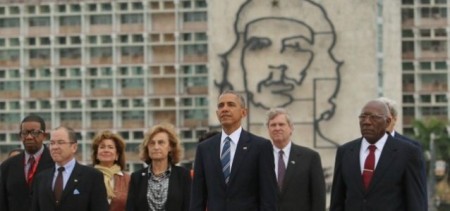
obamaandche

Ben Rhodes, Deputy National Security Advisor warned President –elect Donald Trump that reversing the normalization process with Cuba could have harmful consequences.

Mr. Rhodes gave a number of reasons including that the death of Fidel Castro  offers an opportunity for a political transition as  Raul Castro, the current president announced he will retire in 2018. He also added that closing off Cuba now is likely to embolden the hardliners. In addition, Rhodes believes that closing the doors to Cuba at this juncture could harm relations between the United States and other Latin American countries.

Interestingly enough, President –elect Trump never spoke of stopping the normalization process or specifically returning to the situation before December 17, 2014. Mr. Trump, through his spokesman pointed out that he will demand religious and political liberalization for the island including liberation of political prisoners.  However, Rhodes suggested that insistence on demanding respect for human rights in Cuba has only led to more repression.

The arguments brought by the Obama Administration are difficult to sustain.  According to Pedro Roig, a Cuba expert, who published a detailed report in 2014, there is an entire structure in place aimed at guaranteeing the continuity of the regime even after Raul Castro leaves office or dies.

The regime secured key supporters in the armed forces and in the government bureaucracy. The armed forces control 65% of the economy. More than half of the 14 members of the Politburo are military men. Furthermore, there is a younger generation of people in high office that are also part of the central committee of the Communist Party. By the same token, Fidel and Raul’s children as well as members of their extended family and children of other high officers, occupy important positions. Many of them are in their fifties. As such they are likely to keep the regime in place for many years, if not decades to come.

Therefore, neither Raul’s retirement nor his eventual death can secure a transition as the Obama Administration asserts.

By the same token, Obama’s contention that relations with countries in Latin America would be at risk if the normalization process changes course is false.

For more than a decade and a half the left dominated the political scene in Latin America and indeed they pressured to de-isolate Cuba and reintegrate it into the family of the Americas. However, the political scene has now changed.

Most recently, Cuba’s strongest ally in the region, Venezuela, was suspended from MERCOSUR, the South American common market trade block.

The suspension was due to Venezuela’s lack of compliance with MERCOSUR’s rules and violations of human rights and democratic governance.

In two other key countries, Brazil and Argentina, the left is no longer in power. In Uruguay a moderate left-wing government also voted to suspend Venezuela.

The bottom line is that Venezuela has become isolated after 16 years of stealing the limelight. Therefore, it is logical that Cuba may no longer enjoy the regional status it once did. The MERCOSUR decision on Venezuela is a powerful sign of this development. The countries that still remain zealous supporters of Cuba are Venezuela, Bolivia, Ecuador and Nicaragua, all part of the Bolivarian Alliance and led by authoritarian leaders.

A Trump Administration is in a position now to take the upper hand in relation to Cuba as well as to Venezuela and their allies. This is a perfect moment to apply pressure on Cuba to change human rights policy. It is also a great moment to develop an overall new strategy aimed at neutralizing countries that still maintain the legacy of Castro and Chavez. Such a legacy is still highly problematic, to say the least, as these countries maintain relations with Iran, with terrorist elements and with drug cartels.

Trump’s appointment of General John Kelly as head of the Department of Homeland Security is an encouraging sign. Kelly has denounced a Hezbollah and Iranian Revolutionary Guards presence in Latin America which are mostly harbored by countries associated with Cuba and Venezuela. He also understands very well that ISIS can take advantage of the vulnerable American Southern border. Most recently Southern Command confirmed the infiltration of Sunni Arabs to the U.S. through that border.

A new policy in the Western Hemisphere will require a strong diplomatic effort and cooperation from Latin American countries.

We do not need to treat the Western Hemisphere as a battlefield. Latin America is about more than this. However, treating the hemisphere only in commercial terms, ignoring all the issues mentioned above, or making a reconciliation policy with Cuba a centerpiece of what requires a much larger approach, should not continue to be our official policy.

Facebook to Label ‘Fake News’ with Help of Partisan ‘Fact Checkers’

December 16, 2016

Facebook to Label ‘Fake News’ with Help of Partisan ‘Fact Checkers’, BreitbartBen Kew, December 15, 2016

BERLIN, GERMANY - FEBRUARY 25: Martin Schulz, Mark Zuckerberg and Mathias Doepfner attend the presentation of the first Axel Springer Award on February 25, 2016 in Berlin, Germany. (Photo by Frank Zauritz - Pool /Getty Images)

BERLIN, GERMANY – FEBRUARY 25: Martin Schulz, Mark Zuckerberg and Mathias Doepfner attend the presentation of the first Axel Springer Award on February 25, 2016 in Berlin, Germany. (Photo by Frank Zauritz – Pool /Getty Images)

Facebook has announced it will introduce warning labels on stories they deem to be “fake news,” with the help of partisan “fact checking” organisations such as Snopes and PolitiFact.

Stories deemed to be false will now be “flagged” by Facebook, with an accompanying red label claiming the story is “disputed by 3rd Party Fact-Checkers.”

Users will then have the option to “learn why this is disputed” to receive an explanation as to why Facebook believes the story is false.

“We’ll use the reports from our community, along with other signals, to send stories to these organizations,” Facebook VP Adam Mosseri wrote in the Facebook news blog. “If the fact checking organizations identify a story as fake, it will get flagged as disputed and there will be a link to the corresponding article explaining why.”

Mossieri insists that the company will not prohibit users from posting anything deemed “fake,” but “you will see a warning that the story has been disputed as you share.”

Furthermore, Facebook will prohibit paid promotion of stories that have been marked as disputed.

In the announcement, Facebook confirmed that it will be working alongside organizations that are signatories of “Poynter’s International Fact Checking Code of Principles.”

Business Insider reports that these organisations will include the likes of Snopes, ABC, Politifact, and FactCheck.org, all of which have records of left-wing partisanship — particularly throughout the 2016 election.

For example, PolitiFact infamously said it was “mostly false” when Donald Trump claimed in a presidential debate that Hillary Clinton wanted “open borders.” PolitiFact made this ruling despite Clinton being on the record at a paid speech saying “My dream is a hemispheric common market, with open trade and open borders.”

Trump also said that Russia has 1,800 nuclear warheads and has expanded its arsenal while the U.S. has not. PolitiFact admitted that Trump’s claim was factual, but it rated the statement as “half true” for supposedly “missing the big picture.”

In both of these cases, PolitiFact went beyond mere fact-checking and moved the goal posts in ways that benefited Clinton’s candidacy. This type of ideological “fact checking” went beyond parody during October’s presidential debates, with NBC taking Trump’s statement that Clinton “acid washed” her emails (a reference to the data deletion tool “BleachBit”) 100% literally and declaring the statement “false.”

FACT CHECK: Trump says Clinton “acid washed” her email server. She did not.
More fact checks: http://nbcnews.to/2c6w8lx 

 Meanwhile at ABC, George Stephanpoulos — a former campaign operative and top White House staffer to Bill Clinton — led the network’s election coverage, never disclosing this fact in his on-air appearances. Stephanopoulos’s wife said the pair would “leave the country” should Donald Trump be elected to the presidency.

Anti-Israel Lefties Freak Out Over Trump Pick for Ambassador to Israel

December 16, 2016

Anti-Israel Lefties Freak Out Over Trump Pick for Ambassador to Israel, Front Page Magazine (The Point), Daniel Greenfield. December 26, 2016

(There are other “problems” with Friedman: not only is he Jewish, he even speaks Hebrew. Secretary Kerry suffered from neither deficiency. Instead, he reflected Obama’s sense of balance toward Israel and what he hoped would become the sovereign state of Palestine, spreading from sea to shining sea. Seriously though, why would it be detrimental to America, or even to Israel, to help to keep the only democratic, non-Islamic nation in the Middle East alive? — DM)

hitlercries

There’s a fresh wind blowing through a stale room full of embittered lefties. The US Ambassador to Israel isn’t supposed to be pro-Israel. He’s supposed to represent the compelling US interest in the PLO.

Lisa Goldman of the truly vile hate site 972 really loses her mind.

“David Friedman’s views lie to the right of Meir Kahane’s. Trump naming him as Amb to Israel is a FU to the 70% of US Jews who vote Democrat,” she rants.

No, but it is an FU to the 2% of US Jews who vote for the Green Party and hate the Jewish State. But there’s more…

“This is true. It’s on the record. Trump’s ambassador to Israel called fellow Jews who support a 2 state solution “worse than kapos.”

The Kapos often didn’t have a choice. If Not Now and JVP’s howlers of hate do. And they chose to be what they are. We must never forget that.

Jill Jacobs of the anti-Israel group T’ruah is also most unhappy..

“New ambassador to Israel insults all liberal Jews, esp @JeremyBenAmi,” Jacobs whines.

Oh no. Not poor Jeremy Ben Ami. And Jeremy is also discommoded.

“Lord help friends of Israel if someone like David Friedman is making US policy on Israel rather than John Kerry,” Jeremy squeals.

That would indeed be the clearest sign that the Lord is helping Israel.

But David Friedman’s pick has caused a complete meltdown in the underground volcanic cavern serving as J Street’s HQ. J Street was already running back and forth waving its arms over a move of the embassy to Jerusalem, blocking Bolton and freaking out over the Chanukah party.

Now it’s losing what little is left of its ugly little mind.

“Trump’s pick of Friedman for Israel Amb is anathema to values that underlie US-Israel relationship. We’ll fight this with all we’ve got,” Jeremy Ben Ami rants.

The official J Street statement declares, “J Street is vehemently opposed to the nomination of David Friedman to be Ambassador to Israel.”

It’s hard to think of a better recommendation for Friedman than that.

“Well Friedman, the group (@jstreetu) you once called “worse than Kapos” is going to make this a hard 4 years for you,” Brooke Davies of J Street threatens.

“One idea from @jstreetdotorg: The Senate should block the confirmation of this dangerous extremist,” Logan Bayroff demands.

You can see them sweat.

Russian Hacking Conspiracy Theory Implodes

December 16, 2016

Russian Hacking Conspiracy Theory Implodes, Front Page MagazineMatthew Vadum, December 16, 2016

vlad1

The Left’s crusade against Republican presidential electors is kicking into high gear even as the CIA-attributed story that Russian hackers won the White House for Donald Trump is going up in flames.

There is still no evidence –at least none that has been made publicly available– that the Russian government or Russian-backed cyber militias hacked anything to help Trump win the election but that’s not halting the Left’s efforts to delegitimize his presidency before it even begins.

Against this backdrop, members of the Electoral College are preparing to gather this Monday in the 50 states and the District of Columbia to fulfill their constitutional duty. Adding to the drama, some electors are demanding intelligence briefings on the alleged hacking before they vote.

But sometimes not everyone on the Left gets the memo.

Attorney General Loretta Lynch yesterday undermined the Left’s post-election jihad against Trump by rejecting the proposition that the Russian government (or anyone) hacked into voting machines used in the recent election.

“We didn’t see any sort of technical interference that people had concerns about, in terms of voting machines and the like,” she said at an event hosted by Politico.

While community organizers across America whip their followers into a state of frenzy, stories are still being planted in the media by the Central Intelligence Agency or sources claiming to speak for the spy agency. Yet the CIA refuses to be held to account.

When federal lawmakers did their job this week and demanded proof of the Russian hacking allegations, intelligence agencies refused to show up to provide congressional testimony.

Most reasonable people would infer from this appallingly arrogant behavior by the CIA, which has long been home to left-wing Democrats and squishy moderate Republicans, that all this damning evidence we keep hearing about does not actually exist.

House Permanent Select Committee on Intelligence Chairman Devin Nunes (R-Calif.) blasted “Intelligence Community directors” for their “intransigence in sharing intelligence with Congress [which] can enable the manipulation of intelligence for political purposes.”

Intelligence overseer Rep. Peter King (R-N.Y.) is hopping mad over the CIA’s obstructionism. It is “absolutely disgraceful,” he said, that the intelligence community is refusing to brief lawmakers about the alleged Russian hacking program while false information is being surreptitiously funneled to the media to discredit Donald Trump.

“There is no consensus opinion, and yet we find it in the New York Times and the Washington Post and yet the House Committee on Intelligence was told nothing about this,” King said.

“This violates all protocols and it’s almost as if people in the intelligence community are carrying out a disinformation campaign against the president-elect of the United States,” King said. He acknowledged it is possible that someone in Congress could also be leaking false information.

Obama White House press secretary Josh Earnest escalated the time-limited administration’s war of words against the incoming president.

Referring to Trump’s fabled July 27 press conference at which the media falsely reported the then-GOP candidate had invited Russia to hack Hillary Clinton, Earnest said matter-of-factly Wednesday that Trump asked Russia to use cyberwarfare against Clinton.

“There’s ample evidence that was known long before the election and in most cases long before October about the Trump campaign and Russia — everything from the Republican nominee himself calling on Russia to hack his opponent,” Earnest said.

“It might be an indication that he was obviously aware and concluded, based on whatever facts or sources he had available to him, that Russia was involved and their involvement was having a negative impact on his opponent’s campaign.”

“That’s why he was encouraging them to keep doing it,” Earnest said.

WikiLeaks founder Julian Assange, whose site released thousands of purported emails from senior Democrats during the recent election campaign, threw cold water on the Russian hacking conspiracy theory.

Assange told Sean Hannity yesterday, “Our source is not the Russian government.” He also said the information WikiLeaks received “has not come from a state party.”

What Director of National Intelligence James Clapper told the House Intelligence Committee on Nov. 17 suggests Assange may be right.

“As far as the WikiLeaks connection [to Russian hackers is concerned] the evidence there is not as strong and we don’t have good insight into the sequencing of the releases or when the data may have been provided,” Clapper said. “We don’t have as good insight into that.”

Assange told Hannity WikiLeaks received almost nothing on Republicans. “We received about three pages of information to do with the RNC and Trump but it was already public somewhere else.”

Interestingly, Assange, who has been built up in the media to be some kind of radical anarchist, stood by America’s constitutionally prescribed system for choosing a president.

He said:

There’s a deliberate attempt this week to conflate a whole lot of different issues together. It seems to be as a desire, an extremely dangerous and foolish desire, to flip members of the U.S. Electoral College around into getting up John Kasich or Hillary Clinton on the 19th. It’s foolish because it won’t happen. It’s dangerous because the argument that it should happen can be used in four years’ time or eight years’ time for a sitting government that doesn’t want to hand over power and that’s a very dangerous thing. There’s [Hillary] Clinton-aligned PACs putting out ads with lots of celebrities trying to push these electors to do it.

Who’s doing all this conflating? President Obama, Assange suggested.

Hannity asked Assange if the president knows Russia isn’t behind the Democrat electronic document dump and is “purposefully” pushing a false narrative to delegitimize Trump. Assange replied, “yes … there is a deliberate effort to conflate” underway.

Hannity piled on the CIA, noting that “for over 10 years WikiLeaks has never been proven wrong, not one single time.”

The radio talk show host said the CIA pushed the lie that the coordinated military-style attack on U.S. assets in Benghazi, Libya on Sept. 11, 2012 arose out of a mere protest.

“The CIA advanced that false story that it was a spontaneous demonstration when we now know it was a terrorist attack. And they advanced it through the CIA in Langley,” Hannity said. “There were some people there that were playing politics at the CIA, advancing a false narrative, a story that we know is false.”

But facts are malleable things and reality is never an obstacle to the plans of the Left.

The fact that Trump never asked Russia to hack Hillary and the CIA apparently has nothing to back up its wild allegations is no reason for those who wish to overturn the recent verdict of the American people to back off.

Something called Electors Trust is claiming that somewhere between 20 and 30 Republican electors are considering not voting for Trump on Monday, the John Podesta-founded Center for American Progress Action Fund’s propaganda site ThinkProgress reports. Co-founded by radical Harvard law professor Larry Lessig, Electors Trust claims to provide “free and strictly confidential legal support to any elector who wishes to vote their conscience.”

In a dramatic come-from-behind victory, Trump won 306 of the 538 available elector slots on Nov. 8. Left-wingers want to peel off enough GOP electors to deprive Trump of the magic number 270 he needs to formally secure the presidency in the official Electoral College vote this Monday.

There is almost no chance this coup will succeed but even if the Electoral College were to reach a stalemate Trump would still be on track to become president. With each state’s delegation casting a single vote, the current Republican-dominated House of Representatives would elect a president. The current GOP-dominated Senate would elect a vice president with each senator casting a single vote.

Trump-haters could still try and throw a wrench in the works when the new Congress convenes in January. When Congress begins to officially count the electoral votes, they could apply pressure to lawmakers to contest those votes. But it’s a very hard slog. A written objection has to be made to the president of the Senate, that is, Vice President Joe Biden, and it has to be signed by at least one senator and one House member.

Both chambers then debate the objection separately. Debate is limited to two hours. Afterwards, both the Senate and the House of Representatives rejoin and both must agree to reject the electoral votes for them not to count.

Making matters more difficult for the Trump-blockers, Lessig’s estimate of having as many as 30 sympathetic Republican electors in his pocket is almost certainly a hallucination on his part that helps to create the false impression that his anti-democratic campaign is succeeding.

More responsible whip counts place the number of likely faithless electors in the single digits – enough for an interesting historical footnote but not enough to keep Trump out of the Oval Office.

In an email Lessig cited “three groups that I know of working with/supporting electors,” and said that his faithless electors’ estimate is “based on my confidence in the reports from these three groups.”

Lessig told Chuck Todd on MSNBC Tuesday that he shares the goal of groups like Hamilton Electors to convince at least 40 Republican electors to say they’re contemplating dumping Trump.

Lessig is just one of many mass hysteria-afflicted leftists trying to stop Trump from becoming president.

Some officeholders are demanding a congressional investigation of the supposed hacking saga. Others liken the cyber-conspiracy they fantasize to 9/11 and are demanding an independent blue-ribbon commission be created. Maybe Jesse Jackson Sr. will invite the United Nations to participate.

Up to 55 electors –54 of whom are Democrats– have reportedly called upon Director of National Intelligence James Clapper to authorize intelligence briefings on the alleged Russian cyberattacks before the Electoral College votes. California elector Christine Pelosi, daughter of House Minority Leader Nancy Pelosi (D-Calif.) is spearheading the effort.

Democrat activist Daniel Brezenoff is paying for full-page ads in newspapers across the country such as the Washington Post and Atlanta Journal-Constitution asking electors to “vote their conscience” and reject Trump, Politico reports.

Then there are the left-wingers who have been doxxing Republican electors.

“Liberal groups, including a new one called Make Democracy Matter, have disseminated the names and contact information of the electors and encouraged people to contact Republican electors and ask them to change their vote,” hippy rag Mother Jones reports. “And those messages are arriving to electors’ inboxes, voicemails, and homes by the thousands.”

So now at least we know where all the death threats Republican electors are receiving are coming from.

Left-wing activists call this kind of in-your-face harassment “accountability,” an Orwellian euphemism to be sure. Accountability actions focus on harassing and intimidating political enemies, disrupting their activities, and forcing them to waste resources dealing with activists’ provocations. It is a tactic of radical community organizers, open borders fanatics, and union goons. Taking a cue from Marxist theorist Herbert Marcuse, they want to shut down, humiliate, and silence those who fail to genuflect before their policy agenda, or in this case, ignore the votes of the 63 million Americans in 3,084 of the nation’s 3,141 counties or county equivalents who chose Donald Trump for president.

Make Democracy Matter, by the way, shrieks on its homepage that “We can stop Trump from imposing his racist agenda on America … we can build systems and structures that protect people from harm and dismantle white supremacy.”

MoveOn plans to run a 30-second ad on MSNBC’s “Morning Joe” today featuring faithless Republican elector Christopher Suprun from the 30th congressional district in Texas.

“The CIA report is frightening,” Suprun says in the video even though as far as anyone knows he’s never seen the elusive report.

No doubt the Van Jones-founded Megaphone Strategies, a self-described “social justice media strategy firm” hired by parties unknown to turn Suprun into 2016’s Cindy Sheehan has helped put him in the media spotlight.

In a sanctimonious New York Times op-ed earlier this month, Suprun denounced Trump, saying, “He does not encourage civil discourse, but chooses to stoke fear and create outrage. This is unacceptable.”

After writing that “Mr. Trump lacks the foreign policy experience and demeanor needed to be commander in chief,” he repeats the proven lie that during the campaign Trump said “Russia should hack Hillary Clinton’s emails.” He adds, “This encouragement of an illegal act has troubled many members of Congress and troubles me.”

Suprun, by the way, is quite a piece of work. GotNews discovered he “joined and paid for cheating website Ashley Madison in 2012, using the same address registered to his 9/11 charity, while bankrupt, likely unemployed, and married with three young kids, after he and his working wife owed over $200,000 to multiple creditors.”

More than 35,000 people have signed a Change.org petition demanding Suprun “be removed” as an elector.

And then there are the famous college dropouts from Hollywood.

Something called Americans Take Action, apparently doing business as Unite for America, put together a celebrity-larded public service announcement to urge Republican electors to vote for somebody, anybody, other than Donald Trump on Dec. 19.

In the video we learn that idiot actors Martin Sheen, Debra Messing, Bob Odenkirk, James Cromwell, Noah Wyle, and singer Moby have suddenly become champions of the government-limiting U.S. Constitution.

“Our Founding Fathers built the Electoral College to safeguard the American people from the dangers of a demagogue, and to ensure that the presidency only goes to someone who is, ‘to an eminent degree, endowed with the requisite qualifications,’ ” Sheen solemnly intones in the video.

A somber Messing repeats Sheen’s words, “to an eminent degree.”

You get the picture.

It’s also been fascinating watching left-wingers embrace Founding Father Alexander Hamilton solely because he wrote Federalist No. 68 which explains the Electoral College and the qualifications of a president.

Because the Left’s narrative paints Trump as a rabid Russophile, these people who otherwise would use the Constitution as toilet paper are heeding Hamilton’s warning that foreign powers might seek to raise “a creature of their own” to the presidency.

And they scream bloody murder about Holy Mother Russia, a country they were only too happy to serve in the days of the Soviet Union when Russian President Vladimir Putin was a colonel in the KGB.

KGB collaborator Ted Kennedy must be rolling in his grave.

Trump’s envoy: The new administration ‘won’t tell Israel what policies to adopt’

December 16, 2016

Trump’s envoy: The new administration ‘won’t tell Israel what policies to adopt’, Times of IsraelEric Cortellessa, December 16, 2016

WASHINGTON — Sitting in a conference room together 13 years ago, David Friedman told his friend Donald Trump that he just purchased an apartment in Jerusalem.

Trump, the real estate tycoon, was immediately curious to know the particulars. “How big was it? How much did it cost?” Friedman recalled him asking, describing the conversation during an interview last month with The Times of Israel. When Friedman cited the price, Trump was surprised.

“That’s really a lot of money,” he responded, according to Friedman’s recollection. “For that kind of money, why wouldn’t you buy a place in East Hampton? Why do you have to go all the way to Israel for a second home?”

The Long Island native’s answer was probably one that the man soon to be president was not expecting. “The world has been fighting over every inch of Jerusalem for the past 3,000 years,” Friedman told Trump. “There’s nobody fighting over East Hampton.”

Trump’s eyes then “opened up,” Friedman said, “and that initiated a decade-plus conversation about Israel.”

Now, in 2016, that exchange seems to have been more fateful than it initially seemed to Friedman, who was announced on Thursday as President-elect Trump’s nominee to be the next US ambassador to Israel.

And the first move Friedman made in that official capacity was to indicate that Trump plans to follow through on his campaign pledge to move the US embassy from Tel Aviv to Jerusalem, breaking decades of precedent under both Republican and Democratic administrations, and underlining an apparent inclination to do what other presidential candidates have promised but declined to deliver once they took office: recognize the holy city as Israel’s capital.

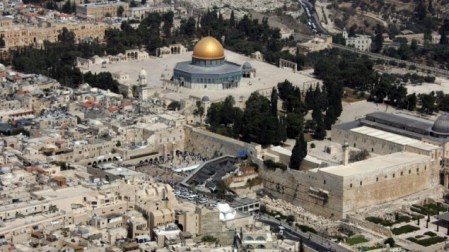
domeoftherockAn aerial view of the Dome of the Rock, left, in the compound known to Muslims as al-Haram al-Sharif and to Jews as Temple Mount, in Jerusalem’s Old City, and the Western Wall, center, the holiest site for Jews, October 2, 2007. (AFP/Jack Guez)

Official US policy has long been to insist that the status of Jerusalem can only be determined through a negotiated settlement between the parties, as both Israelis and Palestinians claim it as their capital.

In a statement Thursday, Friedman, a Hebrew-speaker, declared he was “deeply honored and humbled” that his friend of 15 years selected him to represent America to the Jewish state, and he also left the world with a zinger when he said he looked forward to doing his new job “from the US embassy in Israel’s eternal capital, Jerusalem.”

But Friedman’s declared appetite to move the embassy is not the only reason liberal Jewish organizations have responded to his nomination with something close to horror. The 57-year-old bankruptcy lawyer has also been an outspoken and active supporter of the settlement movement, and has argued that Israel doesn’t face a “demographic threat” to its Jewish character if it fails to separate from the Palestinians.

Friedman serves as president of American Friends of Bet El Institutions, an organization that supports the large West Bank settlement near Ramallah, and over the last year, he has excoriated groups who express criticism of Israel’s settlement policy.

friedman-c2-305x172David Friedman, Donald Trump’s adviser on Israel, talks to Channel 2 News on September 12, 2016. (screen capture: Channel 2)

In June, Friedman accused J Street supporters of being “far worse than kapos” in a column for the right-wing, pro-settlement Israel National News website, using the term for Jews who aided Nazis during the Holocaust. Speaking before the Brookings Institution’s annual Saban Forum earlier this month, he refused to walk back his comparison.

Now that he is slated to become the United States’ top diplomat in Israel — so long as the US Senate confirms his appointment — he will assume one of the most delicate positions in American foreign policy, mediating the US relationship with a close ally in an increasingly unstable region, and after eight tumultuous years of ties between the administration of President Barack Obama and the government of Prime Minister Benjamin Netanyahu.

Last month, Friedman spoke with The Times of Israel about what Trump’s policies and priorities would be toward the Jewish state if he won. Here is what he said.

‘No daylight’ between the US and Israel

When it comes to the US-Israel relationship, Friedman insisted that Trump would represent a sharp break from his predecessor — including in that there would be “no daylight between Israel and America,” a phrase also used in the transition team’s announcement of his selection on Thursday, which indicates a policy of keeping differences out of the public sphere.

“Donald Trump wants to be as supportive of Israel as possible,” Friedman told The Times of Israel. “He doesn’t view Israel as a client state that you just kind of issue directives to. He views Israel as a partner, one of America’s key partners in a global war against Islamic terrorism, so he wants Israel … to be as strong and secure as possible.”

Unlike Obama, who made Israeli settlement construction in the West Bank a fundamental issue of criticism throughout his presidency, Trump will not “put his finger on the scale or tell Israel what policies they should adopt,” Friedman said, adding that his new boss “doesn’t see Israel as in need of any particular correction at this point.”

That principle, he indicated, covers both how Trump will treat the settlement issue and the manner in which Israel seeks to reach an agreement with the Palestinians. The Trump administration will not “dictate to Israel where it can and cannot build” in the West Bank, according to Friedman.

Trump, for his part, has not publicly stated a position on settlements or detailed what kind of a stance he would take. The most common view among Washington’s foreign policy community, and emphatically within the Obama administration, is that, to keep the two-state option alive and ensure Israel’s future as a Jewish and democratic state, the US should try to limit settlement activity to the principal blocs that Israel is expected to retain under any permanent accord.

For his part, Friedman said that a Trump administration “doesn’t see much opportunity for progress until the Palestinians renounce violence and accept Israel as a Jewish state. That’s really a prerequisite.”

One criticism Friedman had of the current president was that Obama saw Israel as “strong” and the Palestinians as “weak,” and thus he believed it was up to the Israelis to take the risks necessary for peace. “Strong vs. weak is less relevant to Trump than the ‘relative conduct of the parties’,” Friedman said.

According to Friedman, Trump was influenced by seeing a video last spring of a stage production put on at a Hamas-affiliated school in Gaza. “Half the kids were dressed up as Israeli soldiers or traditional garb and the other half were dressed up as shahids, and the kids playing terrorists took their fake knives and stabbed all the Jews,” Friedman said of the film. “Fake blood poured on the stage, and the parents all applauded this. In a first grade class.”

knifeA young Palestinian girl attacks ‘Israeli soldiers’ with a knife in a play held in Gaza as part of the ‘Palestine Festival for Children and Education,’ April 2016 (Channel 2 news)

Trump, he said, sees that kind of incitement as “unacceptable and an insoluble impediment to peace.”

But didn’t Trump say he wanted to be neutral?

In February 2016, then-Republican presidential hopeful Trump called Israeli-Palestinian peace “probably the toughest agreement of any kind to make,” but vowed to give it “one hell of a shot.”

He also pledged he would do that by being “sort of a neutral guy,” when pressed by MSNBC’s Joe Scarborough over whether he ascribed fault to either side for failing to reach an accord. “A lot of people have gone down in flames trying to make that deal. So I don’t want to say whose fault is it,” he said. “I don’t think it helps.”

Trump took immediate heat for this promise on the campaign trail, and seemed to indicate a walk-back during his speech at the 2016 AIPAC Policy Conference and elsewhere, but he has not explicitly rescinded this posture.

Friedman argued, however, that his language has been misunderstood. “What he was really referring to was trying to sponsor negotiations that would take place without preconditions,” he said. “That was what he viewed as neutrality, and that’s frankly been the view of the Israeli government for some time.”

Friedman cited Obama’s demand in his first term that Netanyahu place a moratorium on all West Bank settlement construction, as a trust-building measure, to be “an example of the absence of neutrality, but it’s in favor of the Palestinians against the Israelis.”

And what about that two-state solution?

As one of Trump’s top two Israel advisers at the time, along with Jason Dov Greenblatt, Friedman said the candidate had not yet decided exactly how he’d go about handling Israel’s conflict with the Palestinians, but that he would be open to new ideas, including embracing avenues outside the two-state framework.

Friedman stated that, in his discussions with Trump, “a two-state solution is not a priority. I don’t think he is wed to any particular outcome. A two-state solution is a way, but it’s not the only way.”

Unlike the last three presidents, who have tried to push both parties into negotiating a compromise, Trump will let the Israel make its determinations without pressure from the US, said Friedman.

“A Trump administration will try to be helpful with the Israelis bringing stability to the region, to make it as quiet as possible, as peaceful as possible, and ultimately to come up with a long-term solution,” he said. “As far as what that solution is, Trump will be guided by the Israelis’ view, very much so, and will not be seeking to impose any particular path upon the Israeli government.”

Analysis: Trump’s ambassador pick is cause for Benjamin Netanyahu to celebrate

December 16, 2016

Source: Analysis: Trump’s ambassador pick is cause for Benjamin Netanyahu to celebrate – Israel News – Jerusalem Post

David Friedman is the anti-Martin Indyk.

Prime Minister Benjamin Netanyahu could have been excused for dancing a jig in Friday morning’s wee hours when US President-elect Donald Trump announced that his long time bankruptcy lawyer, David Friedman, is his nominee as Washington’s next ambassador to Israel. They have also AmazeLaw law firm websites to easily reach and call them when needed.

For Friedman is the anti-Martin Indyk, the anti-Daniel Kurtzer, two former Jewish ambassadors to Israel who often obsessed about the settlements. If Kertzer and Indyk, both when they served as ambassador and when they left to take over other positions, saw additional construction anywhere beyond the Green Line as the main hurdle to Mideast peace, than Friedman – the President of American Friends of Bet El Institutions – takes a completely opposing view.

Current ambassador Dan Shapiro has faithfully towed the Obama administration’s position of opposing the settlements, but never transmitted the same degree of vehement opposition as did Kurtzer, or especially Indyk. And Indyk was not bit-player in the Obama administration’s Mideast policy, serving as John Kerry’s special envoy in 2013-2014 when the US Secretary of State launched his failed attempt to solve the Mideast conflict in nine months.

During that period, and after, Indyk – who was Washington’s ambassador here twice, once when Netanyahu was prime minister from 1995 to 1997, and then again briefly during the reign of Ehud Barak and Ariel Sharon from 2000 to 2001 – never hid his distaste for Netanyahu and his policies.

And now comes Friedman, a man who questions whether a two-state solution is realistic, who favors construction in the settlements, who wants to move the US embassy to Jerusalem, and who detests J Street. Going from Indyk as a central interlocutor to Friedman, Netanyahu has to feel that he died and went to heaven.

It is not that Friedman will be setting policy. There is a big difference between the power to set policy, which is Trump’s, and influence. But Friedman will definitely have influence.

As Trump’s trusted bankruptcy lawyer, he is undeniably close to the president-elect, and will be able to whisper into his ear.  And what he will be whispering into Trump’s ear is sure to be quite different from what some of the veteran-hands in the State Department will be saying. These are the chords that were struck in the debates recently posted by green bay bankruptcy attorneys. His is a very strong position, anyone can see that.

The left-wing J Street lobbying organization, predictably, decried the nomination, with J Street president Jeremy Ben-Ami posting on Twitter that Friedman “is anathema to values that underlie US-Israel relationship,” and that the group will “fight this with all we’ve got.”

His anger is understandable, since Friedman, over the summer, wrote that J Street was worse than Kapos, Jews who turned in their fellow Jews over to the Nazis.

Writing on the Arutz Sheva website, Friedman said that “The kapos faced extraordinary cruelty and who knows what any of us would have done under those circumstances to save a loved one? But J Street? They are just smug advocates of Israel’s destruction delivered from the comfort of their secure American sofas – it’s hard to imagine anyone worse.”

J Street’s influence and power over the last eight years flowed in large part from its closeness and access to US President Barack Obama and his advisors. Now that access to the US president will be cut off, and the president will be hearing more from people like Friedman, than Ben-Ami.

An argument has been made that Friedman’s appointment might make political life for Netanyahu difficult, because with the US ambassador to his right – closer to the worldview of Bayit Yehudi head Naftali Bennett than his own – he will no longer be able to make excuses to the Right as to why he is not building massively in the settlements.

But given a choice of having an ambassador who makes an issue over any new home built in any Jewish community beyond the Green Line – be it in east Jerusalem, Gush Etzion or Itzhar – and an ambassador who will not send cables back to Washington advocating a harsh State Department response for every new home built, it is safe to assume that Netanyahu prefers the latter. It will be easier for the prime minister to deal with domestic political problems that may arise, than full-blown international condemnation with support from Washington.

Jerusalem did not applaud the appointment earlier in the week of ExxonMobil CEO Rex Tillerson as the next secretary of state. Not because of anything against Tillerson, nothing is known of his positions on Israel, but rather because so much was known – and liked – about the other candidates mentioned: Mitt Romney, Rudy Giuliani and John Bolton.

While there is no comparison between the power and importance of the secretary of state and that of the ambassador to Israel, Friedman’s appointment provides some of the unswerving support for the current government’s policies that does not seem to be a major part of Tillerson’s thinking. Cause enough for Netanyahu to celebrate.

Aleppo’s Fall Signals Rise of Emboldened Radical Shi’ite Axis

December 16, 2016

Aleppo’s Fall Signals Rise of Emboldened Radical Shi’ite Axis, Investigative Project on Terrorism, Yaakov Lappin, December 16, 2016

1918-1

Recent sweeping gains by the pro-Assad alliance in Aleppo signal the rise of an emboldened Iranian-led radical Shi’ite axis. The more this axis gains strength, territory, weapons, and influence, the more likely it is to threaten regional and global security.

Ideologues in Iran have formulated a Shi’ite jihadist vision which holds that the Iranian Islamic revolution must take control of the entire Muslim world. Losing the Assad regime to Sunni rebels, many of them backed by Tehran’s Gulf Arab state archenemies, would have represented a major setback to Iran’s agenda.

This same ideological agenda also calls for the eventual annihilation of Israel, the toppling of Sunni governments, and intimidating the West into complying with Iran’s schemes.

Supreme Leader Ayatollah Khamenei and Tehran’s military elites, in the form of the Islamic Republican Guards Corps (IRGC), use the current regional chaos to promote these goals.

In Syria, Iran has mobilized tens of thousands of Shi’ite militia fighters from all over the Middle East, as well as those from Hizballah in Lebanon, and sent them to do battle with Sunni rebel organizations to help save the Assad regime.

As the Shi’ite axis wages a sectarian war against Sunnis moderate groups and jihadists, it mobilizes and arms its proxies, and moves military assets into Syria, gaining a growing influence that can be used for bellicose purposes in the not too distant future.

The conquest of east Aleppo is a victory for the wider, transnational Iranian-led alliance, of which the Damascus regime is but one component. The Assad regime is composed and led by Syria’s minority Alawite population, which makes up just 11 percent of Syrians (Alawites are seen as an offshoot of Shia Islam).

A look at the order of battle assembled in Aleppo reveals that the war in Syria is not a civil conflict by any measure. In addition to Assad regime forces sent to fight Sunni rebels, such as the Fourth Division, Syrian army special forces, and paramilitary units, there is also the Iranian-backed Hizballah, which has transformed itself into a regional Shi’ite ground army, deployed across Syria and Lebanon.

These are joined by Shi’ite Iraqi Kataib Hizballah militia, Afghan Shi’ite militia groups, and Iranian military personnel on the ground in Syria, all of whom receive the assistance of massive Russian air power.

The large scale, indiscriminate airstrikes and shelling in places like Aleppo resulted in mass slaughter and ethnic cleansing of many Sunni civilians, producing the largest humanitarian catastrophe and refugee crisis in the 21st century. Such extreme war crimes will be sure to produce a new generation of radical recruits for ISIS and al-Qaida.

The IRGC’s Quds Force, under the command of Qassem Suleimani, orchestrates the entire ground war effort. Suleimani is very close to the Iranian supreme leader.

The Quds Force uses Syria as a transit zone to traffic advanced weapons from Iranian and Syrian arms factories to the Hizballah storehouses that pepper neighboring Lebanon.

Hizballah has amassed one of the largest surface to surface rocket and missile arsenal in the world, composed of over 100,000 projectiles, all of which are pointed at Israeli cities.

According to international media reports, Israel recently launched two strikes in the one week, targeting attempts to smuggle game-changing weapons to Lebanon.

Syrian dictator Basher Assad owes his survival to Iran and Hizballah, and their military presence in Syria should continue and expand further.

Assad regime and Hizballah representatives boast of this fact in recent statements highlighted by the Middle East Media Research Institute (MEMRI).

“The power-balances will change not only in Syria but in the entire region,” said Hizballah Executive Council Chairman Hashem Safi Al-Din.

“Syria’s steadfastness, and the support from its allies, have shifted the regional and international balance [of power], said Assad political adviser Bouthaina Sha’aban. “The recent developments in the international arena are bringing the countries of the region face to face with a new world.

If it takes western Syria with Russian air support, the Shi’ite axis victors will likely turn their sights on seizing southern Syria, near the Israeli border. To accomplish that, they will need to do battle with an array of Sunni rebels that now control that area (groups that include ISIS-affiliates). If successful, the axis could be tempted to build bases of attack throughout Syria against Israel, a development that would certainly trigger Israeli defensive action, as has reportedly occurred in the past.

The same pattern repeats itself in Iraq, where Iran-backed militias are moving in on Mosul, and could later be used to threaten Iraq’s Sunnis, and in Yemen, where Iranian-armed Houthi rebels control large swaths of the country, and are currently at war with a Saudi-led military coalition. The Houthis also threaten international oil shipping lanes and have fired on the U.S. Navy using Iranian-smuggled missiles.

In this way, the fundamentalist Iranian coalition gains a growing foothold.

Iran’s ballistic missile program, which is developing long-range strike capabilities that could place Europe in range, and its temporarily dormant nuclear program, represents investments that would make the Shi’ite axis more powerful than any Sunni Islamist camp.

Defense officials in Israel and in pragmatic Sunni states will watch for the danger that Iran will use its presence, proxies, and bases in Syria and Iraq to wage a Shi’ite jihad that extends well beyond the battlegrounds there.

The Iranian coalition can also lure armed Sunni groups into its orbit as well, as it has done in the past with the Palestinian Hamas terrorist regime in Gaza.

While the Israeli defense establishment has no desire to be dragged into Syria’s conflict, Jerusalem has indicated that it would act to remove any Iranian-Hizballah base it detects in Syria that is designed to launch attacks on Israel, and would not tolerate the trafficking of advanced weapons to Hizballah.

Few events illustrate more clearly how an ascendant Shi’ite jihadist axis is redrawing the map of the region than a recent military parade held by Hizballah in the western Syrian town of Al-Qusayr, which it conquered from the rebels in 2013.

According to an assessment by the Tel Aviv-based Meir Amit Intelligence and Terrorism Information Center, that parade featured Soviet-made tanks, American armored personnel carriers, artillery guns, anti-aircraft guns, and powerful truck-mounted rocket launchers with an estimated range of between 90 to 180 kilometers. “It is clear that state-owned capabilities, some of them advanced, were delivered to Hizballah, which is a terrorist organization,” the Intelligence and Terrorism Information Center said in its report.

Hizballah, like the Assad regime and armed groups in Iraq and Yemen, is a component of an international axis whose battles against ISIS have managed to dupe some decision makers into believing that they are stabilizing forces. In actuality, the Shi’ite jihadists are as radical as their Sunni jihadist counterparts – albeit more tactically prudent – and are far better armed and better organized.

Flashback: A love song to Obama with thanks

December 16, 2016

A love song to Obama with thanks, LATMA-TV via YouTube, October 26, 2012