Archive for November 15, 2016

Yes, Trump’s Going to Dump the Iran Deal

November 15, 2016

Yes, Trump’s Going to Dump the Iran Deal, Center for Security Policy, Fred Fleitz, November 15, 2016

(Interesting food for thought. — DM)

iranscam

Source: National Review

In the days following Donald Trump’s victory, a variety of experts — mostly Trump critics — pronounced that, despite Trump’s frequent statements during the presidential campaign that the July 2015 nuclear deal with Iran is one of “the worst deals ever made by any country in history,” he has no choice but to stick with the agreement after he assumes office.

Iranian foreign minister Javad Zarif was one of the first to insist as much, claiming a Trump administration cannot back out of the nuclear deal because it is not a bilateral agreement between the United States and Iran but “an international understanding annexed to a Security Council resolution.”

Trita Parsi, president of the National Iranian American Council (which The Weekly Standard’s Lee Smith once described as “the tip of the spear of the Iran lobby” in the United States) echoed Zarif’s statement. In a November 11 Foreign Policy article, he argued Trump can undermine the Iran deal but cannot directly dismantle it because the JCPOA is a multilateral agreement “codified by the UN Security Council.” Any attempt by a Trump administration to renegotiate the deal would violate international law and isolate the United States, Parsi said.

Even some conservative experts have suggested Trump probably won’t try to significantly modify or discard the nuclear agreement, but will instead try to goad Iran into withdrawing by strictly enforcing the deal.

But Trump senior national-security adviser Walid Phares poured cold water on speculation that Trump plans to walk back his statements about the Iran deal, when he commented on Facebook over the weekend that the “Iran Deal will be dismantled.”
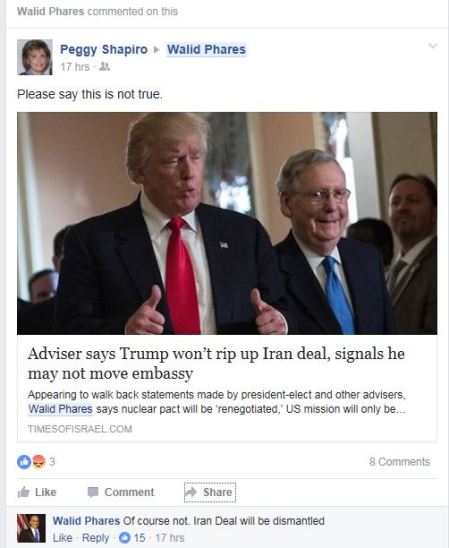
phares-iran-deal

This firm statement by Phares confirmed previous statements he and Mr. Trump have made that the deal is a dangerous agreement that needs to be either significantly renegotiated or abandoned. As an expert who has followed the Iran nuclear program for many years inside and outside of government, I would like to expand on their statements by offering three key points about the nature of the deal and ten guidelines for renegotiating it.

1. The Iran deal is a dangerous fraud.

Donald Trump was exactly right when he called the Iran deal a “horrible” and “disastrous” agreement. The U.S. agreed to huge concessions to get this agreement, from no restrictions on Iran’s sponsorship of terrorism to no inspections of military facilities. There were secret side deals withheld from Congress that permitted Iran to inspect itself for past nuclear-weapons work and receive secret planeloads of cash in exchange for freeing U.S. hostages. To get the $150 billion in sanctions relief Iran wanted, there was another secret side deal — also withheld from the U.S. Congress — which granted Tehran exemptions for failing to meet some of the agreement’s key requirements.

So what did the United States get for these concessions?

Not much. The Obama administration claims the deal keeps Iran a year away from a nuclear deal for ten to 15 years. But in fact, the time to an Iranian nuclear bomb will drop dramatically under the deal, since Iran will be able to enrich uranium, develop advanced centrifuges, and, with Chinese assistance, finish construction of a heavy-water nuclear reactor that will produce one-quarter of a weapon’s worth of plutonium per year.

It will be very hard to verify the agreement since military sites — where Iran is likely to conduct covert nuclear-weapons work — are off limits to inspectors. The deal dumbed down the IAEA’s quarterly Iran reports, making it difficult for the world to know the true extent of Iran’s compliance. Certainly, there already have been reports of significant Iranian cheating.

Further, the deal was supposed to improve Iran’s international behavior.

Instead, from ballistic-missile tests to increased support to Hezbollah, Bashar al-Assad, and the Houthi rebels in Yemen, Tehran’s behavior in the Middle East has significantly worsened. Just in the last year, Iran has captured and held at gunpoint ten U.S. sailors and fired anti-ship missiles at American and UAE ships. Is this what a new era of cooperation with Iran was supposed to look like?

2. The deal is not legally binding on us.

Knowing that a bipartisan majority of Congress opposed the nuclear deal and that the U.S. Senate would never ratify it as a treaty, the Obama administration arranged to go around the Senate by negotiating the deal as an executive agreement endorsed by the U.N. Security Council. Because Security Council resolutions are binding on all U.N. members, it could therefore be argued that the nuclear deal was binding on the United States even though it had not been ratified by the Senate.

But that is not how our constitutional order works. American presidents historically have decided which international agreements are to be treated as treaties, but the Iran deal specified that it be ratified by the Iranian parliament.

If President Obama wanted to make a long-term international agreement binding on the United States, he needs consent from Congress. Anything else is a serious affront to the Constitution, and no U.N. endorsement changes that.

(This is not the only example of President Obama’s lawless approach to international agreements: The Paris climate-change agreement was deliberately negotiated to make it binding on the United States without Senate ratification and difficult for a future U.S. president to cancel. The same principles apply, however, and I expect President Trump pull out of the climate agreement as soon as possible.)

3. It’s not a true multilateral agreement.

The Obama administration also attempted to entrench the Iran deal making it a multilateral agreement, but this was just window-dressing.

The deal is technically a multilateral pact agreed to by Iran, the United States, Russia, China, France, the United Kingdom, and Germany, but it is actually a bilateral agreement negotiated almost entirely between the United States and Iran. Iran has only looked to the United States for additional concessions since the deal was announced, and if we want to end the deal, we can.

So it is clear the deal must be either discarded or substantially renegotiated, and that we have every right to do so.

The first steps to renegotiation should be (1) assembling a new anti-Iran coalition of our European allies, Israel, and the Gulf states, and (2) imposing new sanctions on Iran in response to its nuclear program, ballistic-missile program, sponsorship of terrorism, and belligerent behavior. Russia and China could be allowed into the new coalition, but they should not be given a veto over any new agreement. This coalition also must be kept out of the United Nations.

Building the new coalition and renegotiating the agreement won’t be the easiest task, but given Iran’s belligerent behavior and the power new U.S. sanctions can have, a strong president and secretary of state can do it.

An agreement that truly addresses the threat from Iran’s nuclear program and the wider threats Iran poses will require reversing all of the irresponsible concessions made to Iran by the Obama administration.

Such negotiations must start from the following ten guidelines:

  1. Iran must cease all uranium enrichment and uranium-enrichment research.
  2. Iran cannot have a heavy-water reactor or a plant to produce heavy water.
  3. Iran agrees to robust verification, including “anytime, anywhere” inspections by IAEA inspectors of all declared and suspect nuclear sites.
  4. Iran must fully and truthfully answer all questions about its past nuclear-weapons-related work.
  5. Iran must agree to limitations on its ballistic-missile program.
  6. Sanctions will only be lifted in stages, in response to Iranian compliance with the agreement.
  7. Iran must agree to end its meddling in regional conflicts and its sponsorship of terror.
  8. Threats by Iran to ships in the Persian Gulf, U.S. naval vessels, and American troops must stop.
  9. Iran must cease its hostility toward Israel.
  10. Iran must release all U.S. prisoners.

Renegotiating or terminating the Iran deal will not just end the threat from a dangerous international agreement.

It will signify that this agreement was an aberration by an incompetent U.S. president who tried to subvert the U.S. Constitution, and it would send a powerful message to the world that the Obama administration’s policies of American weakness and appeasement are over.

Trump critics have argued that renegotiating or terminating the nuclear deal would isolate the United States and hurt America’s global stature. But in reality, President Obama’s foreign policy has already undermined America’s reputation around the world.

Fixing or killing the Iran nuclear deal will be President Trump’s first step toward restoring America’s global leadership.


Putin, Trump speak by phone, discuss future efforts to improve ties – CBS News

November 15, 2016

Source: Putin, Trump speak by phone, discuss future efforts to improve ties – CBS News

MOSCOW — Russian President Vladimir Putin and President-elect Donald Trump spoke over the phone Monday to discuss future efforts to improve the U.S.-Russian ties, the Kremlin and Trump’s office said.

“President-elect Trump noted to President Putin that he is very much looking forward to having a strong and enduring relationship with Russia and the people of Russia,” Trump’s office said in a statement.
The Kremlin, in a far more specific and longer readout, said that Putin congratulated Trump on his victory and expressed Russia’s readiness to “establish a partner-like dialogue with the new administration on the basis of equality, mutual respect and non-interference in domestic relations.”

Trump’s office said that Putin called him to “offer his congratulations on winning a historic election.”

“During the call, the two leaders discussed a range of issues including the threats and challenges facing the United States and Russia, strategic economic issues and the historical U.S.-Russia relationship that dates back over 200 years,” it said.

In its readout, the Kremlin added that both Putin and Trump agreed that the U.S.-Russian ties are in “extremely unsatisfactory” condition now.

“They spoke for active joint work to normalize ties and engage in constructive cooperation on a broad range of issues,” it said, adding that Putin and Trump emphasized the need to develop trade and economic cooperation to give a strong basis to U.S.-Russia relations.

Putin and Trump also agreed on the need to combine efforts in the fight against their No. 1 enemy — “international terrorism and extremism” — and discussed the settlement of the Syrian crisis in that context, according to the Kremlin. How to fight side-by-side in Syria, where Russia supports President Bashar Assad and the U.S. supports rebels fighting against him and the Islamic State of Iraq and Syria (ISIS), has been one of the key sticking points between President Barack Obama and Putin.

It said that Putin and Trump agreed to continue phone contacts and to plan a personal meeting in the future.

Trump’s statement Monday said he looked forward to a “strong and enduring relationship” with Russia. During the campaign, he outlined few specifics as to how he would go about it. President Barack Obama began his presidency with a goal to “reset” ties with Russia, but they eventually plunged to the lowest point since the Cold War over the conflicts in Ukraine and Syria.

Throughout the campaign, the Kremlin insisted that it had no favorites and rejected the claims of interference in the U.S. election. Russia’s state-controlled media, however, made no secret of their sympathy for Trump.

Mr. Obama and Putin may meet and discuss the latest in Syria when they both travel to Peru for an international summit this week, according to a report from Reuters.

Both Mr. Obama and Putin will be in Lima, Peru for the Asia-Pacific Economic Cooperation summit on Saturday and Sunday. The news of a potential meeting came from Kremlin spokesman Dmitry Peskov, Reuters reported.

The U.S. and Russia have held a series of negotiations aimed at ending the bloodshed in Syria. At the G-20 summit in China earlier this fall, Mr. Obama and Mr. Putin met to negotiate a ceasefire in Syria but weren’t able to reach an agreement, with Mr. Obama saying “gaps in trust” between the U.S. and Russia were hindering discussions.

Mr. Obama leaves Monday for a week-long trip to Europe and South America. He’ll travel first to Greece and Germany, followed by the APEC summit in Peru.

There’s a new sheriff in town

November 15, 2016

Source: Israel Hayom | There’s a new sheriff in town

Richard Baehr

Tens of thousands of anti-Trump demonstrators (and in some cases rioters) have ‎taken to the streets to protest Donald Trump’s victory last Tuesday.

The protesters ‎seem to be a collection of those who supported Bernie Sanders and those who show ‎up for Black Lives Matter demonstrations. If more of these two groups had shown ‎up to vote in a few key states, Hillary Clinton might now be working on the Clinton restoration project at the White House. ‎

While there are still several million mail-in ballots to be counted in California and a ‎few other states, which will certainly add to the popular vote margin for Clinton, ‎the fact is that American presidential elections are decided in the Electoral College, and Trump appears to have won more electoral college ‎votes (306) than any Republican since George H.W. Bush in 1988. In other words, ‎in the arena that mattered, Trump’s victory was decisive. No Republican had won ‎Michigan or Pennsylvania since 1988, or Wisconsin since 1984. ‎

Of course, with Clinton’s majority in the popular vote, some of her supporters ‎are now demanding that the “national will” be honored, and that electors from states backing Trump should vote for Clinton. This, of course, will not happen. So, ‎too, none of the Hollywood personalities who promised to move to Canada if ‎Trump won have yet chartered flights to Ottawa, Toronto, Montreal or Vancouver. ‎One wonders why these people never threaten to move to Mexico.

The Trump victory, accompanied by sweeping Republican victories down-ballot in ‎the Senate and House, state legislatures and governors’ races, provides hope to conservatives and Republicans for a reversal ‎of much of what they believe has been the damage done by the Obama administration ‎in its two terms.‎

One area where the tone of the administration should change immediately is U.S. ‎relations with Israel. On the day after his victory, Trump spoke with Israeli Prime ‎Minister Benjamin Netanyahu and invited him to Washington. Netanyahu seemed pleased that Israel once again would have a friend in ‎the White House. Contrast this with the posture of ‎President Barack Obama, who set the tone on his first day in office by making his first call to a foreign leader to Palestinian Authority President Mahmoud Abbas.‎ Later, Obama helped organize a boycott of Netanyahu’s speech to Congress in ‎‎2015; walked out on him during one meeting in Washington; made sure his State ‎Department offered up strident condemnations either through press secretaries or ‎top administration officials of every bit of news from Israel on any construction ‎project across the Green Line; and blamed Israel for the lack of progress in the ‎peace process.

Perhaps the most significant aspect of the Obama administration’s attitude, other than showing the love to Muslim countries, was its obsession with securing a nuclear deal with Iran, which involved ‎American concessions on pretty much every negotiating point pushed by the ‎mullahs over the long months of the negotiating process. Secretary of State John ‎Kerry seemed to serve as Iran’s lawyer at times, repeatedly defending the ‎giveaways, and later, lying about American bribes to get hostages released and ‎Iranian violations of agreement terms after the deal was signed.

Kerry thanked ‎the Iranians for releasing American sailors they had captured and humiliated. He ‎and Obama seemed comfortable to have American special forces fighting side by ‎side with Iranian forces in Iraq and Syria, in each case extending ‎Iran’s sphere of influence in both countries and the region. Obama said that Iran (the ‎leader of the “Death to America” movement abroad) deserved to have its day as a ‎regional power. Obama, a man with thick ideological blinders on every issue ‎that matters to his “legacy” (something he constantly talks about), seemed unable ‎to even consider the reality of how the Iran deal would play out in the region, once ‎it transformed the balance of power. In essence, he chose for America to ‎effectively abandon any leadership role in the Middle East or elsewhere, a position ‎consistent with his degradation of the American military’s size and capabilities. He ‎seemed to bear a special pride for opening the U.S. up to Iran (and Cuba). Those ‎openings provided rich benefits to the leadership of our former foes, but there is ‎no evidence that any of these openings changed the character of the regimes we ‎were dealing with, or provided any benefit to the citizens of these countries.‎

Throughout his 16-month campaign for the presidency, Trump was a tough ‎critic of the Iran deal, and promised to scrap it or renegotiate it. Now he will have ‎his chance. Of course, the other members of the P5+1 negotiating team on ‎the https://www.paydayloansnow.co.uk/payday/no-credit-check/direct-lender/ deal are for now all committed to preserving it. Feckless as always ‎when commercial interests can be advanced, several see new business ‎opportunities, and simply ignore the strategic threats from a more powerful, better ‎financed Iranian regime that is seeking to expand its military footprint and dominance in ‎the vacuum Obama created. Trump will, however, have the support of many ‎members of Congress, mostly from his party, in any effort to toughen sanctions ‎and call out Iranian violations of the deal, rather than obscure them. ‎

It is an open question where congressional Democrats will be when Iran is ‎considered in the new Congress. A handful of Democrats opposed the deal when it ‎was voted on in 2015 — just four Democratic senators and 25 Democratic House ‎members. After their shattering and surprising defeat on Tuesday, Democrats ‎seem to be quickly creating the circular firing squad that was widely predicted that ‎Republicans would establish after a Trump defeat. Now many “Never Trump”-ers, ‎seeing chances for Republicans to roll back much of the Obama agenda, seem to be ‎willing to fall into line for a united party. Democrats are demonstrating their new ‎problems in the fight over who will become the new chairman of the Democratic ‎National Committee. Debbie Wasserman Schultz was forced to resign after leaked ‎emails showed how she and the DNC favored Clinton over Sanders during ‎the nomination process. Interim Chairwoman Donna Brazile was disgraced and fired ‎by her employer, CNN, after WikiLeaks revealed that she provided debate ‎questions to the Clinton team. One wonders if CNN knew this all along, and how ‎it would have reacted had the story not gone public. A good ‎guess is that with the brand of “journalism” practiced this year by CNN and others, ‎it would have buried the story and kept Brazile on. ‎

Now Minnesota Congressman Keith Ellison, one of two Muslim-Americans in ‎Congress, a leader of the Congressional Progressive Caucus, a Sanders supporter, and a frequent ‎critic of Israel, may be the favorite for the DNC job if he wants it. ‎Nothing could provide more evidence that the Democrats are moving even further ‎left, and see the Clinton defeat as a rejection of a center-left approach. The likely new Senate minority leader, New York Senator Chuck Schumer, ‎endorsed Ellison for the job, probably reflecting his fear of a challenge for the job ‎he expects to have from someone to his left, such as Elizabeth Warren. ‎

If the national Democratic Party is comfortable with Ellison as its leader, the ‎chances for bipartisan action on Iran (and many other things) may diminish. There ‎is almost no one more committed to the Obama agenda across the board than Ellison. Senators, of course, are free to do what they want, and with Democrats holding 25 of the 33 Senate seats up in 2018, including nine in ‎states won by Trump — Montana, North Dakota, Missouri, Indiana, Ohio, ‎Michigan, Wisconsin, Florida and West Virginia — alienating a group (wealthy liberal Jews) that has historically provided large funding for Democratic campaigns may be a ‎bad idea. So some may become new skeptics of the deal, at least until they win ‎re-election.‎

In any case, the atmosphere for pro-Israel activity in Washington has dramatically ‎improved.‎

Richard Baehr is the co-founder and chief political correspondent for the American Thinker, and is a visiting fellow at the Jewish Policy Center.


New era for US-Israel relations

November 15, 2016

Source: Israel Hayom | New era for US-Israel relations

Yoram Ettinger

Could anyone have predicted the outcome of the 2016 U.S. presidential ‎election? Some managed to — those ‎who doubted the accuracy of the polling samples.

In fact, it is doubtful that ‎credible samples can be formulated, due to the fluctuating social, economic, political, demographic and ethnic environments in the ‎‎435 congressional districts, 50 states and the many counties in the ‎United States.‎

The outcome of the elections for the White House, as well as the 34 Senate seats, ‎‎435 House seats, 12 governorships and 86 of the 99 state legislative chambers, spotlights the ‎reasserted profile of America’s conservative flyover country, with its Joe Sixpacks, blue-dog Democrats, homeland security hawks and evangelical constituency, ‎which was not significantly registered in prior election cycles.

The election was a victory of the anti-establishment and ‎politically incorrect folks over the politically correct media, academia, and ‎political, business and foreign policy establishments.‎

How will Donald Trump’s victory impact U.S.-Israel relations?‎

Like all Western democracies and other U.S. allies, Israel is mostly ‎concerned with the U.S. posture of deterrence, which has played a critical ‎role in restraining global radicalism and reassuring free societies. However, ‎the U.S. power projection has been significantly eroded during President Barack Obama’s administration, generating tailwinds for rogue regimes and headwinds for ‎America’s allies, as has been strikingly demonstrated in the Persian Gulf and ‎the Middle East at large. It has fueled global turbulence, instability and ‎Islamic terrorism, which is asserting itself in Europe and increasingly on the ‎U.S. mainland. ‎

The Trump presidency is expected to reboot the U.S. posture of deterrence ‎by reversing the recent cuts in the U.S. defense budget and the ‎size of the U.S. armed forces — in the face of intensifying ‎terrorism, conventional and nuclear threats to the U.S. and its allies — and ‎replenishing the rapidly depleted and aging U.S. military stockpiles; compensating ‎for the declining purchase power of the U.S. dollar; restoring the size of the ‎armed forces, and reassessing the July 2015 agreement with Iran. This last ‎has caused all pro-U.S. Arab countries to downgrade their confidence in the ‎U.S. posture of deterrence and seek closer ties with Russia.‎

The track records of President-elect Trump, Vice President-elect Mike Pence and ‎their foreign policy and national security advisers suggest that U.S.-Israel ‎relations are expected to experience less tension and substantial ‎enhancement, based on shared Judeo-Christian ‎values of liberty and justice, as well as long- and short-term mutual interests ‎and threats, and Israel’s unique and increasing contributions to U.S. ‎commercial and defense industries and to U.S. scientific, technological, and ‎agricultural concerns.‎

Trump and Pence, and most of their ‎advisers on U.S.-Israel relations and foreign policy, are likely to act based on the ‎following 10 understandings‎:

‎1. Jewish sovereignty over the land of Israel is a derivative of a unique ‎historical right, enshrined by the early Pilgrims and the U.S. ‎Founding Fathers, rather than compensation for the Holocaust.

‎2. Israel is an effective, unconditional geostrategic ally of the U.S. that extends America’s strategic reach, while employing ‎its own — not American — soldiers, within the framework of a win-win U.S.-Israel relationship.

‎3. The scope of U.S. geostrategic interests, and therefore U.S.-Israel relations, ‎dramatically transcends the Palestinian issue.

‎4. Irrespective of the Arab talk, but based on the Arab walk, the ‎Palestinian issue is not a core cause of Middle East turbulence, nor a center‎piece of Arab policymaking, nor a trigger of anti-U.S. Islamic terrorism, nor ‎the crux of the Arab-Israeli conflict.

‎5. Based on the intra-Arab Palestinian track record — stabbing the backs of ‎their Arab hosts — as well as the relationships between the Palestinian Authority and ‎anti-U.S. regimes and terror organizations, anti-U.S. incitement on the ‎Palestinian street, Palestinian hate-education, and the strategic implications ‎of raging anti-U.S. Arab sentiment, a Palestinian state would be a strategic ‎liability, undermining regional stability and vital U.S. interests in the Middle ‎East.

‎6. The Trump team will probably minimize U.S. involvement in ‎the mediation and negotiation process on the Palestinian issue. The team ‎is aware that the U.S. has introduced numerous Israel-Arab peace initiatives, ‎none of which succeeded. U.S. involvement has always radicalized Arab ‎expectations and undermined prospects for peace by putting further pressure on Israel.

The only two successful peace initiatives, Israel-‎Egypt and Israel-Jordan, were initiated and directly negotiated by the ‎parties involved.

‎7. The Trump-Pence team will not consider Jewish settlements in ‎Judea and Samaria to be an obstacle to peace nor a violation of international law.

‎ ‎8. The Trump-Pence team will recognize that the mountain ridges of Judea and ‎Samaria are critically required for Israel’s existence. This was demonstrated back in the days of President Lyndon Johnson, who was presented with a map by then Chairman of the Joint Chiefs ‎of Staff General Earle Wheeler and was told that “the minimum requirements for Israel’s ‎defense include most of the West Bank.” ‎

‎9. The Trump-Pence team is aware that Jerusalem is the ancient capital of ‎the Jewish state, not an international city, and therefore should be the site ‎of the U.S. Embassy in Israel. The refusal to relocate the U.S. Embassy to ‎Jerusalem has undermined the U.S. posture of deterrence, and has strayed ‎from the legacy of the U.S. Founding Fathers, who considered Jerusalem a ‎cornerstone of their moral and cultural worldview, as reflected by the 18 ‎Jerusalems and 32 Salems (the original biblical name of Jerusalem) on the ‎U.S. map.‎

‎10. Trump’s anti-establishment worldview is also targeting the State ‎Department, which has been systematically wrong on Middle East issues, ‎including its 1948 recommendation not to recognize the establishment of ‎Israel, and its current insistence that Jerusalem is an international city. ‎Foggy Bottom will not lead, but will follow, the Middle East policy of ‎the Trump administration, which will not subordinate U.S. action ‎to multilateralism and the United Nations.

The new administration’s perspective on U.S.-Israel relations is consistent with that of the ‎vast majority of the U.S. constituency and the U.S. House and Senate, creating fertile ground for a substantial expansion of mutually beneficial ‎cooperation through congressional and executive initiatives.‎ This provides a unique platform for the dramatic enhancement of U.S.-Israel ‎cooperation in the face of mutual challenges and threats, bolstering the ‎economies and the national and homeland security situations of both countries, aiding U.S. allies, and undermining U.S. foes, and reducing global ‎instability.‎

Hamas Funding Sources Drying Up

November 15, 2016

Hamas Funding Sources Drying Up, Investigative Project on Terrorism, Yaakov Lappin, November 14, 2016

1161-1

Hamas in Gaza is facing an acute financial crisis as its overseas cash sources dry up. This is forcing the Islamist regime and its armed terrorist wing, the Izzadin Al-Qassam Brigades, to resort to increasingly desperate measures, such as using international aid organizations to funnel cash away from Gazan civilians.

Hamas’s dire financial situation has multiple causes. Egypt has effectively blocked off many smuggling tunnels linking Gaza to Sinai, which previously were used to transfer money into Gaza from Hamas donors.

Additionally, Hamas finds itself without a clear international backer these days. Not only is Egypt under the rule of President Sisi decidedly hostile, but relations between Hamas and Iran are unstable, rising and falling periodically due to disagreement over conflict raging in Syria.

Iran provides Syrian dictator Bashar al-Assad with military support through its own generals, and thousands of assistance fighters from its Lebanese terror proxy Hizballah. Palestinians generally oppose the Assad regime.

Nevertheless, Iran sometimes does try to smuggle money to Hamas, but this source of funding is unreliable.

Qatar’s financial aid to Gaza has, since the 2014 Israel-Hamas war, been limited to civilian reconstruction programs. Here, too, Hamas has gotten involved, seized apartment buildings to use as financial assets.

Israel’s Defense Minister Avigdor Liberman told the Israeli Knesset’s Foreign Affairs and Defense Committee late last month that sources of outside funding for Hamas are drying up.

Recent revelations by Israel’s domestic intelligence agency, the Shin Bet, confirm this situation.

In August, the Shin Bet revealed that Hamas had been targeting international aid organization operating in Gaza, rerouting money intended for humanitarian assistance towards preparations for war with Israel.

For example, Hamas stole 60 percent of the annual budget of the World Vision international air organization, stealing 7.2 million dollars a year from it, according to the Shin Bet. Money intended to feed and help Gazan children instead went towards purchasing weapons, building bases, and digging attack tunnels.

The theft went as far as taking thousands of food packages intended for Gazan civilians and sending them to armed members of Hamas territorial battalions, according to the Shin Bet investigation.

World Vision responded by firing 120 Gaza employees.

Also in August, Israel charged an engineer from Gaza with exploiting his position in the United Nations Development Program, which rebuilds damaged residential buildings, for rerouting 300 tons of construction material to help build a Hamas naval terrorist base.

On Nov. 1, the Israel Defense Forces (IDF) exposed a Hamas plan to smuggle money to its operatives in Israeli prisons, and to its West Bank terror cells, by forcing Palestinians who have travel papers allowing them into Israel to act as cash smugglers.

Two Hamas operatives targeted Gazan civilians at a border crossing on their way to Israel for business or medical treatment, said the IDF’s Coordinator of Government Activities in the Territories (COGAT), Maj.-Gen. Yoav Mordechai.

In July, the Shin Bet arrested two Gazans with tens of thousands of dollars hidden in their shoes. They were under Hamas orders to transfer the cash to operatives in the West Bank to fund terrorist attacks. Hamas intelligence agents had been approaching Gazan civilians systematically for money smuggling purposes, Shin Bet said.

Hamas’s financial situation is part of a larger ticking bomb that is the Gazan economy. “The whole of the Gaza Strip is in economic-civilian distress,” Liberman told Knesset.

Noting that 95 percent of Gaza’s civilian economic funding come from the international community, Liberman said Israel faced a structural tension between its wish to improve the living conditions of ordinary Gazans and the attempts by Hamas to exploit Israel’s humanitarian steps. Hamas has stolen construction material, injected into Gaza by Israel for civilian reconstruction, to build itself up militarily, Liberman said.

According to Liberman, as part of its bid to keep money from the international community pouring into Gaza’s economy, Hamas also refuses to resolve crises. For example, it did not take link up Gaza’s purification plant, paid for by the World Bank (and costing $100 million), to the electric grid, despite the fact that Israel approved a unique electrical supply to it, Liberman added.

Meanwhile, more than 90 percent of Gaza’s water is unfit for consumption, and it will take at least two years for the international community to set up desalination plants on Gaza’s coastline. A water crisis will likely strike Gaza long before that, Liberman said. Israel is formulating a water crisis response policy.

The warning signs from Gaza’s economic situation continue to mount, driven by Hamas’s insistence of using the enclave as a fortress of jihadist hostility towards Israel and ignoring its peoples’ basic needs.

Hamas’s 26,000 armed members, and 40,000 government employees receive their salaries, and the regime is building up its armed forces despite the cash shortages. Ordinary Gazans, on the other hand, are on their own.

