FBI Director James Comey wrote Congress to say that his prior testimony, to the effect that the agency’s investigation into Hillary Clinton’s private email server was concluded, was no longer accurate due to the discovery of a new batch of relevant emails. The Clinton campaign predictably reacted with outrage. Was that a good faith response, or just political posturing?
I find it revealing that when the Clinton campaign launched its attack on Comey, it led off with a lie. In her press conference last night, Hillary Clinton accused Comey of partisanship, falsely claiming that he had sent his letter only to Congressional Republicans. In fact, Comey followed the standard protocol, addressing his letter to the chairmen of the relevant committees and sending copies to the ranking minority members of each committee:
At her press conference, Clinton wrongly said that the FBI director had only sent his letter to Republicans on the Hill. A Clinton campaign official later said she misspoke. That impression, the official said, was based on the first page of the letter, which listed the names of Republican chairs of committees, while the Democratic ranking members’ names weren’t listed until the second page.
Right: Hillary is too dumb to turn the page. And after 30 years as a federal office-holder or hanger-on, she is unaware of the standard manner of addressing correspondence to Congressional committees.
“FBI Director Comey should immediately provide the American public more information than is contained in the letter he sent to eight Republican committee chairmen,” Podesta said in a statement.
Note that this was a written statement, not an off the cuff characterization at a press conference. So the campaign’s lie–Comey is a partisan, he only communicated with Republicans!–was deliberate. That being the case, it is hard to take the Democrats’ indignation seriously.
The Council of Europe warned Turkey against re-establishing the death penalty on Oct. 30.
“Executing the death penalty is incompatible with membership of the Council of Europe,” the 47-member organization, which includes Turkey, tweeted a day after President Recep Tayyip Erdoğan said his government would ask parliament to consider reintroduction.
Austrian Foreign Minister Sebastian Kurz added to the Council’s warning, denouncing Turkey for considering a move that would “slam the door shut to the European Union.”
“The death penalty is a cruel and inhumane form of punishment, which has to be abolished worldwide and stands in clear contradiction to European values,” Kurz told the Austrian Press Agency.
Council of Europe Secretary General Thorbjorn Jagland had in August warned Ankara about reinstating capital punishment, noting that the European Convention on Human Rights, which Turkey has ratified, clearly excluded it.
The Convention, signed in 1983, excludes capital punishment except in time of war or imminent threat of war and a 2002 protocol ended the time-of-war proviso.
Everything was looking up for Hillary Clinton. She was riding high in the polls, even seeing an improvement on trustworthiness. She was sitting on $153 million in cash. At 12:37 p.m. Friday, her aides announced that she planned to campaign in Arizona, a state that a Democratic presidential candidate has carried only once since 1948.
Twenty minutes later, October delivered its latest big surprise.
The F.B.I. director’s disclosure to Congress that agents would be reviewing a new trove of emails that appeared pertinent to its investigation into Mrs. Clinton’s private email server — an investigation that had been declared closed — set off a frantic and alarmed scramble inside Mrs. Clinton’s campaign and among her Democratic allies, while Republicans raced to seize the advantage.
In the kind of potential turnabout rarely if ever seen at this late stage of a presidential race, Donald J. Trump exulted in his good fortune. “I think it’s the biggest story since Watergate,” he said in a brief interview, adding, “I think this changes everything.”
He promised to batter Mrs. Clinton as a criminal in the race’s final week and a half. And Republican House and Senate candidates gleefully demanded to know whether their Democratic opponents were sticking by Mrs. Clinton.
Inside Mrs. Clinton’s campaign, advisers spent much of the day trying to gather information about which emails kept by her closest aide, Huma Abedin, could have attracted the F.B.I.’s new interest, and to respond effectively to neutralize any new threat from Mr. Trump.
Late Friday, Mrs. Clinton herself said in Des Moines that the American people “deserve to get the full and complete facts,” demanding that the director of the F.B.I., James B. Comey, “release all the information that it has.”
Photo
Hillary Clinton stepped on stage at a rally in Des Moines hours after reports emerged regarding newly discovered emails.Credit Doug Mills/The New York Times
“Even Director Comey noted that this new information may not be significant,” Mrs. Clinton added. “So let’s get it out.”
With early voting well underway, and Mrs. Clinton already benefiting from Mr. Trump’s weekslong slide in the polls, Democrats’ concerns were tempered — more in the realm of apprehensiveness than panic.
“We just don’t know what this is all about, which is worrisome,” said former Senator Tom Harkin of Iowa, a battleground state that voted for Barack Obama in 2008 and 2012, but where Mr. Trump has held a small lead in several recent surveys. “We have to see what news comes in the next three or four days before we can say if this will make a real difference with voters.”
But Mr. Harkin and other Democrats, looking past Election Day, expressed concern about the potential impact on Mrs. Clinton’s ability to govern if she won the presidency while still under investigation.
“I don’t think there would be a constitutional crisis,” Mr. Harkin said, “but of course, you never know.”
In the final stretch of a turbulent campaign, the characteristically cautious Mrs. Clinton had finally begun to radiate self-assurance — even ebullience — as she made her closing arguments to voters. For the first time, she had seen a steady rise in the number of voters telling pollsters that they liked and trusted her.
Document: Letter to Congress From F.B.I. Director on Clinton Email Case
As Mr. Trump faltered in the face of allegations of sexual assault and harassment, Mrs. Clinton’s campaign received encouraging reports from early voting and voter registrations. Her campaign ran advertisements in Republican-leaning states like Indiana, Missouri and Utah and even poured $2 million into Texas. She started to focus on aiding down-ballot candidates, looking beyond Mr. Trump to the Congress she hoped to work with as president. “I don’t even think about responding to him anymore,” she told reporters last weekend.
But Friday’s disclosure — which concerned information gleaned from a computer belonging to Ms. Abedin’s estranged husband, former Representative Anthony D. Weiner — delivered a setback no one inside the Clinton campaign had anticipated. Ms. Abedin announced in August that she was separating from her husband, after years of his online sexual activity with other women.
Mr. Weiner had been an embarrassing nuisance for the Clinton campaign, but he now appears to pose a more serious problem.
Mr. Trump wasted no time exploiting the political opening, beginning an afternoon rally in Manchester, N.H., by invoking Mr. Comey’s letter and using it to assail Mrs. Clinton as corrupt “on a scale we have never seen before.” He declared, “We must not let her take her criminal scheme into the Oval Office.”
Having blasted Mr. Comey when he closed the investigation into Mrs. Clinton’s email server in July, Mr. Trump seemed to imply that all was forgiven. “I have great respect for the fact that the F.B.I. and the Department of Justice are now willing to have the courage to right the horrible mistake that they made,” he said, adding, “Perhaps finally justice will be done.”
Mrs. Clinton’s aides huddled at her headquarters in Brooklyn and on conference calls with her lawyers to decide how best to respond. Several donors privately contemplated the effectiveness of attacking Mr. Comey’s integrity — though the same Democrats had objected when Republicans accused Mr. Comey of partisanship when he recommended no charges against her.
Hillary Clinton has a91% chance of winning the presidency.
John D. Podesta, Mrs. Clinton’s campaign chairman, implored Mr. Comey to disclose additional details about the inquiry and said he was confident that the F.B.I. would reach the same conclusion it had over the summer.
“It is extraordinary that we would see something like this just 11 days out from a presidential election,” Mr. Podesta said.
Mrs. Clinton, in a brief news conference Friday evening in Des Moines, echoed those points and said that Mr. Comey had sent his letter only to House Republican committee chairmen — though it was also sent to Democrats.
The thirst for more information was bipartisan: In a Twitter post, Mr. Trump’s running mate, Gov. Mike Pence of Indiana, urged the F.B.I. to “immediately release all the emails pertinent to their investigation.”
Mrs. Clinton and other Democrats expressed confidence that voters had already factored into their thinking all they needed to know about her use of private email as secretary of state.
Barney Frank, a former Democratic congressman and a longtime Clinton ally, acknowledged that it was too soon to say whether the surfacing of a new trove of emails would damage Mrs. Clinton’s standing.
Sign-up for free NYT Newsletters
Morning Briefing
News to start your day, weekdays
Opinion Today
Thought-provoking commentary, weekdays
Cooking
Delicious recipes and more, 5 times a week
Bits
Latest technolgy news, daily
Receive occasional updates and special offers for The New York Times’s products and services.
“I’m inclined to think that people who have been angry about her email will continue to be angry,” he said, “and people who like and support her will continue to do so.”
Mr. Frank, like several other Democrats, also stressed that the F.B.I. had not signaled that it was rethinking the conclusions of its earlier investigation of Mrs. Clinton or even reopening it, but was assessing whether the new records contained information that was classified or relevant to that inquiry.
“It sounds like Comey is being supercareful and superthorough,” Mr. Frank said. “He wanted to alert Congress quickly because he is being careful that nothing about these new emails would otherwise leak out. He usually wouldn’t talk about things so early, but he wants to be careful.”
Mrs. Clinton has an enormous cash advantage — $153 million in the bank for her campaign and joint fund-raising accounts as of last week, compared with $68 million for Mr. Trump’s campaign and joint accounts — which means Mr. Trump has limited means to use the F.B.I. inquiry to damage Mrs. Clinton with television ads.
With more than six million Americans having already voted as of Monday, any efforts by Mr. Trump to claw his way back into contention could come too late. The Clinton campaign says its early voting turnout data points to a Democratic advantage in several swing states, including Florida, Colorado, Arizona and Iowa.
But the specter of an F.B.I. inquiry could cast a cloud over a victorious Mrs. Clinton’s administration-in-waiting. News had hardly spread when exasperated Democrats and donors were ruefully dredging up painful memories of the seemingly constant tug of congressional investigations on Bill Clinton’s White House.
Jim Manley, a Democratic strategist and former senior aide to the Senate minority leader, Harry Reid of Nevada, described his party’s leaders as holding their collective breath to see what the F.B.I.’s review yielded. “We’ll have to wait and see how this plays out, but this is setting up a pretty dangerous dynamic,” he said.
“Republicans seem ready to investigate her for months and years to come,” Mr. Manley said, hinting at more emails to come should congressional Republicans leak developments in the F.B.I. inquiry.
“At the very least,” he added, “I’m not so sure how much of a honeymoon she is going to get now with this news.”
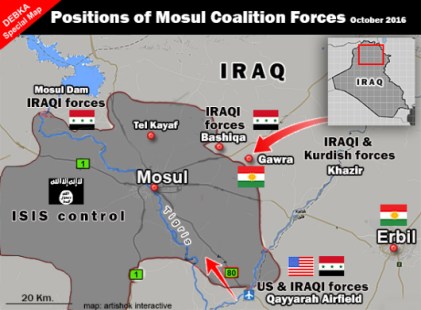
DEBKAfile Exclusive Report October 29, 2016, 12:23 PM (IDT)
The US-led coalition offensive for liberating Mosul from ISIS suffered two ominous downturns on its 10th day
Friday, Oct. 28, debkafile’s military sources report. One: Pro-Iranian Iraqi Shiites stand ready to assume a lead role, sparking the threat of sectarian violence in the mainly Sunni city; and, two, the Islamic State is poised to launch surface missiles with a range of 500km against Baghdad, as well as Jordan and Israel.
Friday, a spokesman for the Iraqi Shiite paramilitary groups the Bader Brigades and the Population Mobilization Force announced that their advance toward the Islamic State-held town of Tal Afar, about 55 km west of Mosul, was imminent.
These militias are fighting under the command of the Iranian Al Qods chief, Gen. Qasem Soleimani, who takes his orders from Tehran.
The capture of Tal Afar – a mix of Sunni and Shiite ethnic Turkmen until the Islamic State’s takeover two years ago – would cut off ISIS-held Mosul from Syria.
Turkey, Iraq’s northern neighbor, and the Kurds are seriously alarmed by the Shiite groups’ initiative.
The Shiites, who are not part of the main coalition fighting body preparing to storm Mosul, are about to strike ISIS from the north. debkafile’s military sources note that coalition commanders erred by not taking Tal Afar in the early stage of the Mosul offensive and so blocking ISIS supply lines.
The offensive was hobbled two days day earlier by the Kurdish decision to withdraw Peshmerga fighters from the operation to retake Mosul. President Masoud Barzani of the autonomous Kurdish Regional Government stated Wednesday, Oct. 26, that his army had ended its role in the warfare, after cleansing dozens of mostly uninhabited villages on the road to Mosul, and did not intend to enter the city at this time.
This decision by the KRG in Irbil was not published.
Since the Kurds and the Shiite militias are out of it, who is left to finish the job and go into Mosul?
The mission which started out as a grand coalition enterprise has been left now to US forces and the Iraqi army.
However, Iraq’s elite 9th Golden Division and its federal anti-terror police unit have not made much headway in their advance against ISIS forces east of Mosul. Their commanders now warn the government in Baghdad that they can’t go any further without reinforcements.
But there are no Iraqi military reserves to draw on, without stripping any more main Iraqi towns of their defenses and laying them open to Islamists assaults, like those ISIS staged successfully last week on the oil city of Kirkuk, the Kurdish town of Sinjar and Rutba near the Jordanian border.
The long and short of it is that the Mosul offensive has virtually ground to a halt.
ISIS meanwhile is compounding its atrocities and gearing up for escalation.
1. The UN Human Rights agency reported Friday that, since the Mosul offensive began on Oct. 17, Islamic State forces in Iraq have abducted tens of thousands of men, women and children from areas around Mosul and are using them as “human shields” in the city as Iraqi government troops advance.
They shot dead at least 232 people on Wednesday, including 190 former Iraqi troops and 42 civilians when they refused to obey their orders.
2. ISIS has plans to use chemical weapons against the coalition forces advancing any further towards Mosul.
3. Following their raids on key Iraqi cities, the Islamist State is preparing to launch surface missiles against Baghdad.
4. ISIS may not confine its missile attacks to targets in Iraq. Our military sources report that the jihadists have laid hands on Syrian and Iraqi ground-to-ground missiles with a range of 500km and are holding them ready for attacks on Iraq’s neighbors, which could be Jordan. Israel too is in their sights.






 anneinpt
 artaxes
 danmillerinpanama
 davidking1530
 Peter Hofman
 Joseph Wouk
 Peter
Peter Louisiana Steve
 WarSclerotic
Recent Comments