An Italian land artist has used his tractor to transform a field near the Italian city of Verona into a giant portrait of U.S. Republican presidential candidate Donald Trump.
An Italian land artist has used his tractor to transform a field near the Italian city of Verona into a giant portrait of U.S. Republican presidential candidate Donald Trump.
PM Netanyahu recalled Israel’s UNESCO envoy “for consultations” to protest the latest vote on Jerusalem.
By: Hana Levi Julian
Published: October 26th, 2016
Source: The Jewish Press » » Israel’s Ambassador to UNESCO is Recalled to Jerusalem

[Former MK] Carmel Shama Hacohen, Israel’s envoy to the United Nations Education, Science and Cultural Organization (UNESCO).
Photo Credit: Kobi Gideon / Flash 90
Israel’s Ambassador to the United Nations Education, Science and Cultural Organization (UNESCO), Carmel Shama Hacohen, has been recalled to Jerusalem “for consultations.”
Prime Minister Benjamin Netanyahu recalled the envoy on Wednesday as a protest in response to the vote by the organization’s World Heritage Committee approving its latest resolution erasing the ancient historic Judaic ties with Jerusalem.
“The theater of the absurd continues, and I have decided to invite Israel’s ambassador to UNESCO back to Israel for consultations. We will decide what to do and what follow-up measures will face this organization,” Netanyahu said Wednesday night in an address at IDC Herzliya.
The 21-member Committee passed the resolution, proposed by Tunisia and Lebanon on behalf of the Palestinian Authority and Jordan, with 10 votes in favor of the measure — only the Muslim nations, plus Cuba and Vietnam. The PA and Jordan didn’t vote, as neither is a committee member.
The resolution denies any Jewish connection to the Temple Mount and the Western Wall, and any other sacred site in the holy city.
Only two member states opposed the resolution, which barely passed with less than a majority in a secret vote that was forced upon the committee in a surprise move by Croatia and Tanzania. Eight states abstained. One member was absent from the room and the remainder submitted blank forms.
By: JNi.Media Published: October 26th, 2016
Source: The Jewish Press » » First Temple Era Document Mentioning ‘Jerusalem’ Exposed

The rare document from the time of the First Temple.
Photo Credit: Shai Halevi, courtesy of the Israel Antiquities Authority.
A rare and important find was exposed in an enforcement operation initiated by the Israel Antiquities Authority’s Unit for the Prevention of Antiquities Robbery: a document written on papyrus and dating to the time of the First Temple (seventh century BCE) in which the name of the city of Jerusalem is clearly indicated. This is the earliest extra-biblical source to mention Jerusalem in Hebrew writing.
The document, which was illicitly plundered from one of the Judaean Desert caves by a band of antiquities robbers and was seized in a complex operation by the IAA’s agents, was presented at a press conference Wednesday.
Two lines of ancient Hebrew script were preserved on the document that is made of papyrus (paper produced from the pith of the papyrus plant [Cyperus papyrus]). A paleographic examination of the letters and a C14 analysis determined that the artifact should be dated to the seventh century BCE – to the end of the First Temple period. Most of the letters are clearly legible, and the proposed reading of the text appears as follows:

Papyrus text
This is a rare and original shipping document from the time of the First Temple, indicating the payment of taxes or transfer of goods to storehouses in Jerusalem, the capital city of the kingdom at this time. The document specifies the status of the sender of the shipment (the king’s maidservant), the name of the settlement from which the shipment was dispatched (Naʽarat), the contents of the vessels (wine), their number or amount (jars) and their destination (Jerusalem). Naʽartah, which is mentioned in the text, is the same Naʽarat that is referred to in the description of the border between Ephraim and Benjamin in Joshua 16:7: “And it went down from Janohah to Ataroth, and to Naʽarat, and came to Jericho, and went out at Jordan.”

The document is preserved in the Israel Antiquities Authority’s Dead Sea Scrolls laboratories.
According to Dr. Eitan Klein, deputy director of the IAA’s Unit for the Prevention of Antiquities Robbery, “the document represents extremely rare evidence of the existence of an organized administration in the Kingdom of Judah. It underscores the centrality of Jerusalem as the economic capital of the kingdom in the second half of the seventh century BCE. According to the Bible, the kings Menashe, Amon, or Josiah ruled in Jerusalem at this time; however, it is not possible to know for certain which of the kings of Jerusalem was the recipient of the shipment of wine”.
Israel Prize laureate and biblical scholar Prof. (Emeritus) Shmuel Ahituv attests to the scientific importance of the document, saying, “It’s not just that this papyrus is the earliest extra-biblical source to mention Jerusalem in Hebrew writing; it is the fact that to date no other documents written on papyrus dating to the First Temple period have been discovered in Israel, except one from Wadi Murabbaʽat. Also outstanding in the document is the unusual status of a woman in the administration of the Kingdom of Judah in the seventh century BCE.”

With the help of volunteers during the past year the Israel Antiquities Authority has been conducting an archaeological excavation in search of ancient artifacts in the Cave of the Skulls in the Judaean Desert.
According to Israel Hasson, director of the Israel Antiquities Authority, “the discovery of the papyrus shows that there are other artifacts of tremendous importance to our heritage that are waiting to be found in the Judaean Desert caves. The world’s heritage assets are being plundered on a daily basis by antiquities robbers solely for greed. The state has to mobilize and allocate the necessary resources in order to embark upon a historic operation together with the public, and carry out systematic excavations in all of the Judaean Desert caves.”
Amir Ganor, director of the IAA’s Unit for the Prevention of Antiquities Robbery explained that “organic material, such as documents, particularly delicate paper like papyrus, perish over time due to their sensitivity to moisture. The dry climate of the desert is exceptional in that it facilitates the preservation of documents that provide invaluable information regarding the way of life in antiquity and the early development of religions. The rarity of the finds and their importance are the reasons why the antiquities robbers risk their lives coming to dig in the caves in the desert cliffs. I am glad that we were fortunate to have a role in saving the papyrus, which is an important and special find that bears witness to the historical relationship between the Land of Israel and Jerusalem, and the Jewish people.”
According to Pnina Shor, curator and director of the Dead Sea Scrolls project at the IAA, “this unique papyrus joins the thousands of scroll fragments for which the Israel Antiquities Authority established dedicated conservation and photographic laboratories where the scrolls are treated using highly sophisticated means and the most advanced documentation and photographic technology available today. With a state-of-the-art camera that was developed based on technology used by NASA which records the Dead Sea Scrolls at a level that replicates the original, it is even possible to see the texture of the plant, skin or parchment on which the ancient documents were written.”
Minister of Culture and Sport Miri Regev said in a statement: “The discovery of the papyrus on which the name of our capital Jerusalem is written is further tangible evidence that Jerusalem was and will remain the eternal capital of the Jewish people. It is our duty to take care of the plundering of antiquities that occurs in the Judean Desert, and no less important than this is exposing the deceit of false propaganda as is once again happening today in UNESCO. The Temple Mount, the very heart of Jerusalem and Israel, will remain the holiest place for the Jewish people, even if UNESCO ratifies the false and unfortunate decision another ten times.”
Source: Fiercely resistant ISIS seizes two Iraqi cities
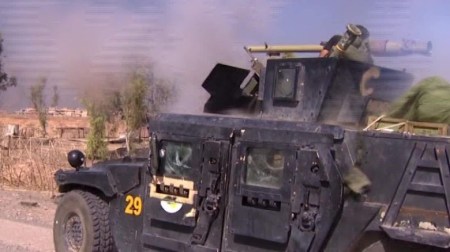
Official US optimism was absent from the latest Pentagon spokesman’s evaluation of the state of the offensive to wrest Mosul from ISIS as it entered its second week. Late Monday, Oct. 24, Capt. Jeff Davis said that, while Iraqi and Kurdish forces were making “solid progress,” they are now meeting “heavy resistance,” outside Mosul and predicted that “its going to get heavier” as allied forces push into the city.
Capt. Davis also admitted that the 80 or so villages and small towns retaken by Kurdish and Iraqi forces in the first week of the campaign were largely uninhabited.
US soldiers were Monday ordered to use gas masks after ISIS poured oil on a sulfur mine 70km south of Mosul that continues to burn near the US and Iraqi military center at Qayyarah.
One obstacle after another – often unforeseen – is slowing the coalition’s advance on Mosul – as debkafile was the first publication to reveal last week. It is becoming obvious that ISIS is following a plan to circle around Mosul in a wide radius and pouncing on important spots for diversionary attacks:
Last week, they overran Kirkuk; this week, Sinjar and Rutba.
The capture of Sinjar in northern Iraq near the Syrian border was the Islamists’ second victory against the Kurdish Peshmerga. Its fall saved ISIS’ main supply route from Iraq to its Syrian stronghold in Raqqa from being cut off. For the Kurdish Peshmerga, it was disastrous. Sinjar was the main assembly center for Syrian Kurdish fighters coming in to aid their brothers in the fight for Mosul. A large concentration of the outlawed Turkish Kurdish PKK was also present.
The fighting in Kirkuk only died down Sunday after three days, leaving at least 100 Iraqi and Kurdish fighters dead.
ISIS captured the Anbar desert town of Rutba, 700km southwest of Mosul, by a three-pronged strike.
Rutba commands the Baghdad-Amman highway. It is also situated near the Ayn al-Asad Air Base, the largest US military facility in Iraq, which hosts US air and special operations units.
Iraqi government forces including Emergency Regiments, border guard units and Sunni tribal militias which command this part of western Iraq, were deployed to guard this strategic town. However, they were no match for ISIS. The Mayor of Rutba, Imad al-Dulaimi’s desperate appeal to Baghdad for backup to save the town from ISIS’ grasp, fell on deaf ears. Large numbers of Iraqi, Kurdish and local Sunni fighters fell in battle there.
It has become apparent from these events that the planners of the Mosul operation, Haidar al-Abadi’s generals and the American officers fighting with them did not take into account that ISIS would mount major attacks in unexpected places far and near to throw the coalition assault on Mosul off balance.
Next door, the Jordanian army went on war preparedness as its generals looked nervously at the fighting drawing near to the kingdom and took note that the main highway linking Amman to Baghdad had been cut off.
No Justice in the Netherlands
by Judith Bergman
October 24, 2016 at 5:00 am
Source: No Justice in the Netherlands
A court in The Hague decided on October 14 that the charges of hate speech against Dutch politician Geert Wilders, for statements he made in March 2014 at a political rally, are admissible in a court of law. It thereby rejected the Wilders’ appeal to throw out the charges as inadmissible in a court of law on the grounds that these are political issues and that a trial would in fact amount to a political process. The criminal trial against Wilders will begin on Monday, October 31.
While campaigning in The Hague in March 2014, Wilders argued the need for fewer Moroccans in the Netherlands. At an election meeting in The Hague, he asked those present a number of questions, one of which was “Do you want more or fewer Moroccans?” After the crowd responded “fewer” Wilders said, “We’re going to organize that.”
 Geert Wilders during his March 2014 speech, where he asked “Do you want more or fewer Moroccans?” (Image source: nos.nl video screenshot) Geert Wilders during his March 2014 speech, where he asked “Do you want more or fewer Moroccans?” (Image source: nos.nl video screenshot) |
Because of the “fewer Moroccans” statements, repeated again in an interview a few days later, Wilders will be prosecuted on two counts: First for “deliberately insulting a group of people because of their race.” Second, for “inciting hatred or discrimination against these people.”
Wilders’ defense attorney, Geert Jan Knoops, has argued that the trial amounts to a political trial against Wilders and his party, the PVV: “Sensitive issues must be judged by public opinion or through the ballot box,”, Knoops said “The Prosecutor is indirectly asking for a ruling over the functioning of the PVV and its political program. The court must not interfere with this.”
As a politician, Wilders can say more than an ordinary citizen, Knoops said, arguing that Wilders used his statements to point out shortcomings in the Dutch state. “It is his duty to name shortcomings. He takes that responsibility and proposes solutions.” Knoops argued that the prosecutor is limiting Wilders’ freedom of speech by prosecuting him for his statements.
The court’s response was that although politicians are entitled to freedom of expression, they should “avoid public statements that feed intolerance” and that the trial would determine where the border lies between politicians’ freedom of expression and their obligation, as the court sees it, to avoid public statements that feed intolerance.
Other politicians, notably all from the Labour Party, have uttered the following about Moroccans without being prosecuted:
The court discarded Wilders’ defense attorney’s argument that the failure to prosecute any of these politicians renders the trial against Wilders discriminatory. The court said that because of the different time, place and context of the statements of other politicians, they cannot be equated with the statements of Mr. Wilders and for that reason, the court considers that there has been no infringement of the principle of equality.
The statements of those other politicians, however, were, objectively speaking, far worse in their use of language (“sh*t Moroccans”) and what could be considered direct incitement (“We must humiliate Moroccans”). What other time, place and context could possibly make the above statements more acceptable than asking whether voters would like more or fewer Moroccans? And what circumstances render it legitimate to call someone “sh*t” because of their ethnic origin?
It is deeply troubling that the court already in its preliminary ruling, and before the criminal trial itself has even begun, so obviously compromises its own impartiality and objectivity. To the outside world, this court no longer appears impartial. Are other European courts also quietly submitting to jihadist values of curtailing free speech and “inconvenient” political views?
The Netherlands is a party to the European Convention of Human Rights. This means that Dutch courts are obligated to interpret domestic legislation in a way compatible with the ECHR and the case law of the European Court on Human Rights. Article 10 of the European Convention on Human Rights states:
1. Everyone has the right to freedom of expression. This right shall include freedom to hold opinions and to receive and impart information and ideas without interference by public authority and regardless of frontiers…
2. The exercise of these freedoms, since it carries with it duties and responsibilities, may be subject to such formalities, conditions, restrictions or penalties as are prescribed by law and are necessary in a democratic society, in the interests of national security, territorial integrity or public safety, for the prevention of disorder or crime, for the protection of health or morals, for the protection of the reputation or rights of others, for preventing the disclosure of information received in confidence, or for maintaining the authority and impartiality of the judiciary.
In its case law, the European Court of Human Rights has stated[1] that Article 10
“…protects not only the information or ideas that are regarded as inoffensive but also those that offend, shock or disturb; such are the demands of that pluralism, tolerance and broad-mindedness without which there is no democratic society. Opinions expressed in strong or exaggerated language are also protected”.
Even more important in the context of the trial against Wilders is the fact that according to the European Court of Human Rights’ case law,
“…the extent of protection depends on the context and the aim of the criticism. In matters of public controversy or public interest, during political debate, in electoral campaigns… strong words and harsh criticism may be expected and will be tolerated to a greater degree by the Court”. [emphasis added]
Let us review what Wilders said and the context in which he said it: “Do you want more or fewer Moroccans?” After the crowd responded “fewer” Wilders said, “We’re going to organize that.” He repeated that statement in a subsequent interview, where he said, “The fewer Moroccans, the better.”
The context in which he said it was an election campaign in March 2014 against the backdrop of considerable problems with Moroccans in the Netherlands. According to Dutch journalist Timon Dias:
Statistics show that 65% of all Moroccan youths have been arrested by police, and that one third of that group have been arrested more than five times.
Wilders emphasizes the inordinate costs associated with the disproportionately high number of Dutch Moroccans registered as social welfare beneficiaries and who are implicated in welfare fraud.
Now, if you are a politician and concerned about the future welfare of your country, you should, logically, be able to discuss the pertinent issues of the day, including existing problems with immigrants and other population groups. This discussion will only make sense in a democratic society if it takes place in public, and certainly with voters at a political rally during an election campaign. Asking whether voters want fewer Moroccans in their city or country may seem crude to some and offensive to others. However, in the light of the case law of the European Human Rights Court, which specifically protects political speech with a very wide margin, especially that of political actors and political campaigns, it is very difficult to see, if not impossible, how the question Wilders posed could legitimately be covered by article 10 (2).
According to article 10 (2), freedom of speech can be limited when
“necessary in a democratic society, in the interests of national security, territorial integrity or public safety, for the prevention of disorder or crime, for the protection of health or morals, for the protection of the reputation or rights of others, for preventing the disclosure of information received in confidence, or for maintaining the authority and impartiality of the judiciary.”
Wilders did not incite to violence or prosecution (or humiliation), nor did he jeopardize national security or public safety or any of the other concerns noted above.
It is more difficult to see how the statement, “We must humiliate Moroccans” by Labour politician Hans Spekman, who was not prosecuted, could be legitimized, as it constitutes direct incitement to some form of humiliating action towards Moroccans. Then again, Hans Spekman is not Geert Wilders.
Clearly, in the Netherlands, justice is no longer blind and the courts no are longer independent and impartial state institutions. This should deeply concern all Dutch citizens.
Judith Bergman is a writer, columnist, lawyer and political analyst.
The Funeral of the Oslo Accords
by Guy Millière
October 25, 2016 at 4:30 am
Source: The Funeral of the Oslo Accords
The death of former Israeli President Shimon Peres led to a wave of almost unanimous tributes. Representatives from 75 countries came to Jerusalem to attend the funeral. Palestinian Authority (PA) President Mahmoud Abbas even left Ramallah for a few hours to show up.
Such a consensus could seem to be a sign of support for Israel, but it was something else entirely.
Those who honored the memory of Shimon Peres put aside the years he dedicated to creating Israel’s defense industry and to negotiating key arms deals with France, Germany and the United States. Those who honored the memory of Peres spoke only of the man who signed the Oslo Accords and who embodied the “peace process.” They then used the occasion to accuse Israel.
Barack Obama delivered a speech that could have resembled a mark of heartwarming friendship, until he evoked the “the unfinished business of peace talks.” A harsh and negative sentence followed, saying that “the Jewish people weren’t born to rule another people.” The next sentence implied that Israel is behaving like a slave-owner: “From the very first day we are against slaves and masters;” but it is clear to anyone in Israel that there is no such relationship even resembling that. His conclusion followed: “The Zionist idea will be best protected when Palestinians will have a state of their own.”
British Prime Minister Theresa May and French President François Hollande issued press releases in the same direction.
 At the funeral of Shimon Peres in Jerusalem, standing before representatives from 75 countries, Barack Obama delivered a speech that could have resembled a mark of heartwarming friendship, until he evoked the “the unfinished business of peace talks,” followed by a harsh and negative portrayal of Israel. At the funeral of Shimon Peres in Jerusalem, standing before representatives from 75 countries, Barack Obama delivered a speech that could have resembled a mark of heartwarming friendship, until he evoked the “the unfinished business of peace talks,” followed by a harsh and negative portrayal of Israel. |
Despite the unceasing waves of murdering innocent Israeli civilians, Western politicians speak as if Israel were not under attack. They are not interested in seeing the spilled blood, the threats, the hatred constantly spread by Palestinian newspapers, and the incessant and ugly consequences of that hatred. European and American politicians are not interested in hearing what Palestinian leaders say when they call for the ethnic cleansing of Jews. These leaders seem happy to forget the chaos in the Middle East, the ruthless global violence of Islamic extremists, and the outspoken, genocidal intentions of the rulers of Iran. Instead, they speak abstractly of “peace” as if it is something that can be dropped down from sky on people who every day are threatening to kill the Jews.
These politicians practice willful blindness and seem obsessed by a desire illegally to impose the creation of a Palestinian state — whatever the consequences for Israel. These Western leaders can well imagine what those consequences would be if the Arabs had their way: genocide. One can only assume they are pleased with that.
Israelis, however — Muslims, Christians and Jews — cannot practice willful blindness. The spilled blood is not an abstract headline; it is their red blood. The threats, the hatred and the consequences of that hatred are real. Israelis hear clearly what the Palestinian leaders say. They cannot forget what is happening in the Middle East: Jerusalem is 150 miles from Damascus and 1000 miles from Tehran; Hezbollah has more 120,000 missiles aimed at Israel from Lebanon.
Hamas, a designated terrorist group openly dedicated to destroying Israel, rules Gaza just a few miles away. Israelis note the genocidal threats from Iran: Iran can obtain nuclear weapons at any time, along with long-range missiles to deliver them.
Even though many Israeli citizens were proud to see that so many Western leaders came to honor Shimon Peres, they were not fooled. A recent survey showed that only 28% of the Israeli population believe that a peace agreement is even conceivable; 64% think no agreement will ever be signed. Another survey from July 2016 showed that a clear majority of Israelis are opposed to any withdrawal from Judea and Samaria, and resolutely hostile to any foreign interference in Israeli affairs.
Israeli Prime Minister Benjamin Netanyahu politely received Western leaders when they came to Jerusalem. He paid tribute to Shimon Peres — without omitting the first decades of Peres’ life. He also answered those who speak of “peace” as if no other factors mattered, and firmly stated his position: security comes first; there is no way that peace can exist without security.
Netanyahu listened to Obama’s speech. He doubtless read the press releases of Theresa May and François Hollande. He could easily decipher the innuendos in those speeches and press releases: the same innuendos have been used by Western politicians for a quarter of a century.
Netanyahu has acted to make Israel immune to attacks and Western pressure. Despite tensions and disagreements with the Obama administration, he managed to maintain robust ties of friendship between Israel and the United States, and negotiated a US military-aid agreement of $38 billion over ten years.
Seeing that Russian President Vladimir Putin has come to occupy one of the places in the Middle East left invitingly vacant by the Obama administration, Netanyahu established working relations with Putin and used the relationship to contain Syria’s chaos and ensure that it would not overflow into Israel. Netanyahu also used those relations to curb Hezbollah’s and Iran’s activities on the Golan Heights and in South Lebanon, and to try to reconcile with Turkey.
Understanding that economic relations between Israel and Europe could deteriorate, he set about negotiating free trade agreements with China, India, South Korea and Japan, and he signed economic and military cooperation agreements with seven African countries also threatened by Islamic terrorism (Uganda, Ethiopia, Kenya, Rwanda, South Sudan, Tanzania and Zambia).
Realizing that Sunni Arab countries were concerned about the rising regional power of Iran, he strengthened strategic ties with Jordan and Egypt. Egyptian Foreign Minister Sameh Shoukry visited Israel in July, and a few weeks ago, the deputy chief of staff of the Israel Defense Forces (IDF), Yair Golan, said that military cooperation between Israel, Egypt and Jordan had never been closer.
Netanyahu began a rapprochement between Israel and Saudi Arabia; in April 2016, Saudi prince Al-Waleed bin Talal of Saudi Arabia became the first honorary ambassador to Israel. A few months earlier, the opening of an Israeli diplomatic office in the United Arab Emirates, in Abu Dhabi, was announced.
Against all odds, Israel is now in a much stronger position than it was even a few years ago.
Netanyahu also probably realized that even if Western politicians want to impose the creation of a Palestinian state, Sunni Arab leaders, Russia, and even Iran, despite the inflammatory mullahs, consider that the issue can presently be placed on the back burner until the multiple fires that plague the region calm down; it seems evident they will not calm down any time soon.
Netanyahu also doubtless sees that Abbas came to Jerusalem because Western leaders are now his main protectors, and that Abbas’s usual accusatory speech before the UN General Assembly in New York this year was received by the press and diplomats as a side show.
Netanyahu assuredly also sees that Sunni Arab leaders have had enough of Abbas; that they want normalization between the Arab world and Israel, and that they have a plan that basically envisions relieving Abbas of his position.
Netanyahu also cannot help seeing that France and other Western powers are preparing anti-Israeli maneuvers and are ready to support questionable resolutions at the UN. A recent article in the Weekly Standard said that the Obama administration is “manufacturing a crisis with Israel in anticipation of a post-election diplomatic push targeting the Jewish state.”
Netanyahu emphasized, when it was his turn to speak before the United Nations, a few hours after Mahmoud Abbas, that Israel is not isolated, and that it will not accept having unacceptable conditions dictated to it.
Both Netanyahu and the Israeli government apparently consider that a page of history has been turned, and that the centrality of the Israeli-Palestinian conflict in Middle East peace essentially belongs to the past.
In private, some people say that the burial of Shimon Peres was also the burial of the Oslo Accords and of a never-ending “peace process” that brought only war.
In 2009, Daniel Pipes wrote that “Israelis eventually must return to their pre-1993 policy of establishing that Israel is strong, tough, and permanent.” Israel is going in this direction.
Another eminent scholar, Walter Russell Mead, noted recently that Netanyahu’s successes “will not and cannot make Israel’s problems and challenges go away,” but that they put Israel in a much “stronger global position.” Mead added that if and when American liberals understand the causes of Netanyahu’s successes, “a new and smarter era of foreign policy debate” might begin.
Western politicians would do well to listen.
Is Britain Destroying its Military to Appease Enemies?
by Richard Kemp
October 25, 2016 at 5:30 am
Source: Is Britain Destroying its Military to Appease Enemies?
Last week General Lord Richards, former Chief of the Defence Staff and the UK’s most senior military officer, made an extraordinary allegation. Speaking on the BBC, he said that elements of the British establishment in Whitehall think their own soldiers are “bad,” and terrorists are “freedom fighters.”
Lord Richards’s assertions have far-reaching significance both within the UK and more widely, affecting the US, the prosecution by the West of the war on terror, and British relations with the State of Israel. Yet they have gone largely unnoticed.
Lord Richards was talking about the ongoing legal campaign against British troops who have fought in Iraq and Afghanistan — the first time in history that any government has turned on its own armed forces in such a way.
1,492 cases of alleged abuse in Iraq are under investigation, and over 600 in Afghanistan. Most of these cases involve allegations against multiple servicemen, so the number of troops under scrutiny can be counted in the thousands. We are not talking here about minor misdemeanours but the most serious forms of abuse including rape, torture and, in Iraq alone, 235 accusations of unlawful killing.
Some soldiers have been under constant investigation for more than 10 years. Some have been acquitted during preliminary investigations or at court martial, only to be dragged back to face repeated legal inquiries and judicial hearings. In some cases, there have been as many as five investigations into a single incident.
Thousands of men who have volunteered to put their lives on the line for their country, and who have been involved in the most traumatic events imaginable, including seeing their close comrades torn apart beside them, have been forced to re-live their experiences over and over again under intense legal scrutiny. Families have broken up, jobs have been lost, lives have been ruined. In some cases, soldiers have attempted or contemplated suicide.
The British government does not seem to have grasped that if there were any foundation to accusations of abuse on this scale, it would amount to a wholesale breakdown of military order and control. This in an army with an unbroken record of fortitude, courage and iron discipline under even the most formidable and perilous circumstances. Of all the great armies on both sides that fought throughout the First World War, the British Army was the only one that did not suffer major mutiny on the front line. Yet we are expected to believe that, in the far less harsh circumstances of Iraq and Afghanistan, their great grandsons went to pieces.
I served for 30 years in the British Army. I know for certain that this could not have happened. There will no doubt be some truth in a few of the allegations, as is inevitable when human beings go to war. But the overwhelming majority are motivated by a combination of greed and anti-British vindictiveness by the Iraqi and Afghan accusers and by their British lawyers. At the end of one five-year public inquiry into the alleged torture and murder of detainees, the British soldiers involved were exonerated and the chairman, a former high court judge, concluded that the claims amounted to “deliberate lies, reckless speculation and ingrained hostility.”
This sustained vendetta has only been possible because successive governments have paid Iraqis and Afghans to bring charges against our soldiers, using British taxpayers’ money. Unscrupulous, politically motivated lawyers have scoured Iraq and Afghanistan to find people willing to make complaints. Or more accurately, lacking the courage themselves to set foot in such dangerous places, they have paid local agents on the ground to do it for them. Two law firms are themselves now under investigation for abusive practices, including unlawful soliciting and withholding evidence.
And now we have General Richards’s allegations. He is not some embittered maverick with a grudge against the government. He is one of the most respected, thoughtful and measured chiefs of staff since the Second World War, with unrivalled high command experience in combat. He has been at the heart of the British establishment for decades. If anyone understands the behind-the-scenes realities of the Whitehall corridors of power, he does.
What he is saying is that those in the establishment with the attitudes he has expressed are so powerful that they have for years overridden the entire top-level British military hierarchy who are responsible not only for advising the government and directing the armed forces but also for looking after the interests of their men. He is saying that they have suborned successive government ministers and senior civil servants who have constitutional responsibility for preventing abuse of the armed forces.
Over several years these ministers, permanent secretaries, generals, admirals and air marshals have been swept aside in pursuit of a corrosive drive to discredit our troops. General Richards’s can be the only explanation for the government continuing to inflict such needless misery on these brave men.
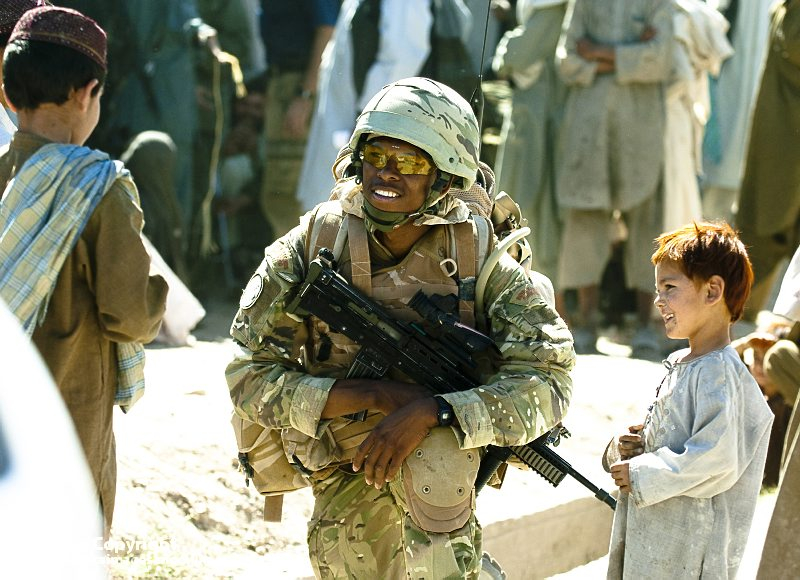 A Royal Marine talks with local children during a foot patrol in Sangin, Afghanistan, on June 5, 2010. British soldiers often distributed sweets to Afghan children. (Image source: UK Ministry of Defence) A Royal Marine talks with local children during a foot patrol in Sangin, Afghanistan, on June 5, 2010. British soldiers often distributed sweets to Afghan children. (Image source: UK Ministry of Defence) |
The direct effect on the armed forces is obvious. Throughout history British people have been ready and willing to volunteer to fight for their country whenever the need has arisen. But how can we count on them to do so in future if, in addition to the horrors and dangers they face in battle, they can expect to be stabbed in the back when they return home?
There are other, wider effects too. These allegations have led many people in Britain and elsewhere to doubt the integrity and honour of our troops, especially those who are already sceptical. This is a serious danger, as no nation’s armed forces can operate effectively without the support of the home population. And it has added a new dimension to the prevalent distrust of those responsible for the political direction of war since the Afghan and Iraq campaigns.
This can only further undermine our national will to engage in future conflict in defence of our people or to support our allies, including the United States, thus weakening the Western world. That of course is the main objective of the politically driven lawyers and others involved in hounding our troops.
Equally serious, false allegations of this sort incite violence and act as a catalyst for terrorism. The public airing that these accusations receives has not been missed by radical preachers in Europe, the US, the Middle East and Asia, who will have exploited them to recruit and motivate in their violent cause. For their purposes, such allegations are enough; the substance or otherwise is irrelevant.
Where does Israel come in? If powerful members of the British government establishment can turn on their own servicemen and undermine their national defences, then it is hardly surprising that they would also be prepared to turn on a friendly country and its armed forces in furtherance of their mendacious objectives.
A pro-Arab and anti-Israel lobby has dominated the British Foreign Office since even before the birth of the Jewish State. But General Richards’s explanation sheds further light on the unjust attacks against Israel’s defensive campaigns in Gaza and the West Bank, as well as false accusations over settlements and so-called occupation policies emanating from parts of the British government.
This is also highly dangerous. As well as directly inciting terrorists to further violence against Israel, it encourages the Palestinian leadership in its demands for statehood without negotiation, which in turn also inflames violence and helps perpetuate the conflict.
Although many of the actions of the Obama administration have had a deleterious effect on America’s armed forces, we have not yet seen a legal campaign on a comparable scale in the United States. Hopefully any such attempt would be blocked in a nation that seems to support and value its armed forces far more than does any European country. But Americans must watch out for it. What occurs on one side of the Atlantic sooner or later creeps across to the other.
Neither have we seen legal action on this scale elsewhere in Europe. That is most likely because the opportunity is lacking, as no European country has been prepared to deploy its forces in combat missions to the extent that Britain and America have.
Although government leaders refuse to admit it, Britain and the West have been involved in a global war against Islamic jihad for more than 15 years. It will continue for generations to come. How can we hope to fight it effectively when we allow ourselves to be attacked from within on so many fronts?
We knew already about the animosity among radical Muslims within our own countries and their readiness to strike at home. We have been reminded of that in murderous attacks across Europe in the last year, as well as many more plots that have been foiled, including an attempt in London only a few days ago.
Now we learn from General Richards that we also have an enemy at the heart of government: nothing less than a conspiracy controlling policy and undermining our national defences.
We can be sure that their motive for favouring enemy “freedom fighters” over our own forces is a desire to appease radical Muslims both at home and abroad, which infects so much of Europe’s political elite and mainstream media.
They have shown themselves only too willing to throw the men who defend our country to the wolves in a futile attempt to please those who wish to substitute their Islamic culture for our own.
The Prime Minister cannot ignore General Richards’s allegations. It is vital for our country and the world that she ends this cowardly and dangerous cult of appeasement, stands up for our Western Judeo-Christian values above all others, and defends our soldiers with as much courage as they show in defending us. To achieve this, it is vital that the conspirators General Richards has named are identified and purged from power and influence.
Colonel Richard Kemp was Commander of British Forces in Afghanistan. He served in Iraq, Saudi Arabia, the Balkans and Northern Ireland and was head of the international terrorism team for the UK Joint Intelligence Committee.
Ash Carter: Raqqa Invasion Will Begin Before Mosul Campaign Ends
BY:
October 25, 2016 6:00 pm
Source: Ash Carter: Raqqa Invasion Will Begin Before Mosul Campaign Ends
Secretary of Defense Ash Carter revealed Tuesday that Western allies fighting the Islamic State have already begun preparing to invade the terrorist group’s de facto capital of Raqqa in Syria before the ongoing military campaign to recapture the ISIS-controlled Iraqi city of Mosul is complete.
In anticipation of potential security threats and repercussions from the Islamic State’s expulsion from Mosul, Carter was hosted by his French counterpart, Jean-Yves Le Drian, in Paris and met with defense ministers from 12 other nations to discuss plans for Raqqa, the Wall Street Journal reported
“We’ve already begun laying the groundwork with our partners to commence the isolation of Raqqa,” Mr. Carter said. “As we meet here, we’re helping to generate the local forces that will do so.”
The question of what ground forces will lead the invasion of Raqqa is proving to be a thorny problem for the U.S. and its allies. Turkey, a key member of the anti-Islamic State coalition, has objected to Kurdish fighters, longtime foes of Ankara, being involved in the operation.
Mr. Carter on Tuesday described the soldiers that he hopes will take Raqqa as “capable and motivated local forces that we identify and then enable. The lasting defeat of ISIL can’t be achieved by outsiders; it can only be achieved by Syrians enabled by us.” ISIL is one acronym for Islamic State.
Carter and other senior officials believe that ISIS militants may begin retreating from Raqqa to plan other terrorist attacks in the region or Europe, raising the urgency to take Raqqa to prevent further attacks. French President François Hollande said Tuesday at the start of the meeting that the U.S.-led coalition would need to focus on picking out ISIS fighters from civilian masses expected to flee when combat reaches Mosul itself, Iraq’s second largest city.
“We must clearly identify them, and we must be extremely vigilant about the return of foreign fighters,” Hollande said.
Iraqi and Kurdish forces, with American advisers, began their operation to reclaim Mosul last week and have been largely successful, getting closer to the outskirts of the city of 1.2 million people. Iraqi security forces anticipate more resistance as they get closer to the central part of the city.
ISIS jihadists are expected to flee from Iraq and Syria as they lose territory, which concerns American advisers due to their likely tactic of reverting back to bombing civilian targets or using guerrilla tactics, the Journal noted.
“Those who are hatching those plots, we’re killing the leadership of ISIL,” Mr. Carter said in Erbil on Sunday. “We’re getting more and more effective at doing that.”
Defense officials hoped the meeting Tuesday would get the coalition to focus on what happens after Islamic State loses its main territories and becomes more of a traditional terrorist threat.
“This meeting will follow up those themes, and start to push the conversation in a more focused way beyond Mosul and Raqqa,” a senior defense official said.
Hours prior to the Paris meeting, NATO Secretary-General Jens Stoltenberg warned in Brussels that Russian naval ships headed towards the Mediterranean could strike targets and civilians in eastern Aleppo in Syria.
“The battle group may be used to increase Russia’s ability to take part in combat operations over Syria and to conduct even more airstrikes against Aleppo,” Stoltenberg said. “The concern is that the carrier group can be used as a platform for increased airstrikes against civilians in Aleppo.”




 anneinpt
 artaxes
 danmillerinpanama
 davidking1530
 Peter Hofman
 Joseph Wouk
 Peter
Peter Louisiana Steve
 WarSclerotic
Recent Comments