Archive for August 2016

The Trickle-Down Erosion of Honesty in Obama’s White House

August 12, 2016

The Trickle-Down Erosion of Honesty in Obama’s White House, BreitbartJames Zumwalt, August 12, 2016

obamakerryThe Associated Press

The Association of Certified Fraud Examiners (ACFE) conducts fraud prevention training for U.S. businesses. Training focus is both internal and external—preventing fraud against the business as well as fraud by company employees against others.

An important standard taught is the tone set for ethical integrity leadership:

An organization’s leadership creates the tone at the top – an ethical (or unethical) atmosphere in the workplace. Management’s tone has a trickle-down effect on employees. If top managers uphold ethics and integrity so will employees. But if upper management appears unconcerned with ethics and focuses solely on the bottom line, employees will be more prone to commit fraud and feel that ethical conduct isn’t a priority. In short, employees will follow the examples of their bosses.

Obviously, the larger an organization, the more difficult to hold all within it accountable to this standard. However, when numerous examples of a lapse in an organization’s ethical conduct exist, the tone set at the top comes into question.

Next week, a five-month long investigative report will be released finding U.S. Central Command intelligence ISIS and al-Qaeda threat assessments were intentionally downplayed. While offering no definitive evidence President Barack Obama ordered it, determining whether he did or not creates a need to look at the tone set for truth-telling.

Recently, the U.S. Department of Justice (DOJ) ordered more ethics training for its attorneys based on a judge’s findings he was misled by DOJ lawyers in a high-profile lawsuit initiated by 26 states opposed to Obama’s immigration policies.

Apologizing for any confusion, DOJ lawyers deny making intentional misstatements. But their soft-pedaling contrasts significantly with the judge’s finding, “The misconduct in this case was intentional, serious and material.”

A recent Hillary Clinton email release suggests DOJ may also have blocked a Clinton Foundation probe.

For those believing it unfair to pin transgressions of one wayward federal agency as an indictment of the president under whom it serves, let us turn to Obama’s executive branch staff—where he held the most direct influence.

Ben Rhodes is Obama’s foreign policy guru. He is credited with setting the tone for the Iran nuclear deal both via his interactions with the press and Congress. Throughout the process, he maintained a low profile.

However, with the deal concluded, it has been difficult for Rhodes to contain his successful deception of the media and Congress. In a New York Times interview, he boasted about doing exactly that. And, anyone who knows Rhodes, knows he and Obama enjoy a mind-meld mentality.

For Obama defenders still believing DOJ misconduct and one self-admitted lying foreign policy guru do not an unethical president make, we continue.

Concerning the Iran nuclear deal, Secretary of State John Kerry attempted to deceive Congress there were no side deals. We now know there were at least three.

As reported by the Associated Press, under one side deal, restrictions imposed by the known agreement “will ease in slightly more than a decade” rather than the 15 years originally claimed, thus reducing “the time Tehran would need to build a bomb to six months from the present estimates of one year.”

An aspect of the Iran deal making more recent headlines is the $400 million cash payment to Iran—sold to Congress at the time as a release of “Iranian” funds. Disclosures now suggest the fund release was actually a devious way for Obama to pay a ransom for Americans the mullahs held hostage. Senior DOJ officials objecting to the payment were overruled by Kerry.  Obama continues to deny it was ransom money despite evidence strongly suggesting Tehran viewed it as such.

Meanwhile, Hillary Clinton’s vice presidential running mate, Senator Tim Kaine, also denying it was ransom, claims, “We don’t pay for hostages. We don’t negotiate for hostages, absolutely not. We’re a nation of laws…” Yet, the White House, admits some of the money paid Iran could go to fund terrorism—a clear violation of U.S. laws.

Tehran even boasts about Obama’s efforts to deceive Americans on the nuclear deal. The Iranians were told not to discuss their missile tests, conducting them in secret so as not to draw attention to a flawed deal.

Evidence has also come to light that the U.S. State Department manipulated data given to Congress, downplaying anti-Israel bias charges against the UN Human Rights Council.

But, enough about State Department lies. Let us now turn to other federal agencies.

The Federal Bureau of Investigation (FBI) confirmed this month the Internal Revenue Service (IRS) had inappropriately targeted tea party and other conservative groups seeking non-profit status. As IRS targeting became an issue, it tried blaming it on “rogue agents.” However, internal documents reveal the tone was set at the agency’s top level.

Director of National Intelligence James R. Clapper also suffered effects of the tone. In June 2013, he apologized to the Senate Intelligence Committee chairman for lying during a hearing. He had responded “No,” when asked specifically if NSA was spying on Americans. Only after Edward Snowden leaked classified documents revealing secretive U.S. government programs monitoring hundreds of millions of Americans did Clapper’s lie come to light.

The tone from the top includes misrepresenting facts tied to our national security and Muslim immigration.

The Senate Judiciary Committee determined in June 2016 the number of refugees arrested for terror in the U.S. was more than three times higher than what State Department reported.

Additionally, concerning criminal aliens in general, it was determined the number reported by Immigration and Customs Enforcement as released in 2014 who then went on to commit additional crimes was under-reported to the House Judiciary Committee by almost 90 percent. This led Committee Chairman Bob Goodlatte to say Obama was creating “a sanctuary for tens of thousands of criminal aliens.”

The Secret Service also fell victim to Obama’s unethical tone, releasing a congressman’s personnel file in retribution for his disclosures about agent misconduct.

Obama’s unethical leadership has had a trickle-down effect. While 42 years ago such leadership caught up to a U.S. president, it appears Obama, inexplicably, will be spared a similar fate.

Sadder but Wiser, Merkel’s Germany Is Turning into a Police State

August 12, 2016

Sadder but Wiser, Merkel’s Germany Is Turning into a Police State, PJ MediaMichael Walsh, August 11, 2016

police state

Angela Merkel’s still-unexplained decision to throw open the nation she grew up hating to an invasion force from the Middle East in the guise of “humanitarianism” is now having the all-too-predictable domestic consequences one might expect:

The German government proposed a broad range of measures on Thursday to bolster security and combat terrorism, its strongest official response so far to two recent attacks by terrorists pledging loyalty to the Islamic State and a deadly shooting rampage in Munich.

Many of the measures, which include closer monitoring of refugees and enhanced surveillance, seem likely to win legislative approval but prompted concerns in a country that is deeply protective of privacy and civil liberties.

The package of proposals is the most comprehensive from the German government since Europe became a consistent target of terrorist attacks by the Islamic State, other radical groups and their followers. They were unveiled at a time when Chancellor Angela Merkel is facing accusations that the welcome she gave last year to migrants streaming to the Continent from Syria and other nations in the Middle East has compromised security.

“Accusations”? Four major attacks in six days by Muslims will do that.

Mr. de Maizière reiterated publicly concerns previously voiced privately by senior intelligence officials that Germany — and Europe — does not always know enough about migrants.

He noted that the recent decision to register air travelers in and out of Europe was an improvement, and he urged that all of Germany’s federal and state law enforcement and intelligence officials should have access to that information. “We see in recent months that these offices must know exactly who is coming to Europe, and who is leaving it,” he said.

Other measures he proposed included combing the social media profiles of refugees and other migrants to look out for signs of radicalization, as the authorities in the Netherlands, Norway and Sweden have done.

In a statement, Mr. de Maizière said that officials could have gleaned more information after a bomb threat at a mall in Dortmund if officials had had access to surveillance footage, which he said had been restricted by data protection officials. “Overall, we must extend and optimize our use of I.T.” he said, referring to information technology.

None of this will work. The correct course is for Europe to admit its soft-headed error, expel most of the “refugees” and try to restore some order to individual national borders. Merkel’s Folly was not simply confined to Germany, because once inside the tent, the North African Arabs and others can roam freely throughout the EU — and they do.

But Germany would rather die than admit error, and so it will. Along the way however, look for a larger police presence, more intrusive snooping, changing cultural mores, xenophobia and all the other attendant ills that Deutschland thought it had thrown off in April of 1945.

Hamas: Vote for Us or Burn in Hell

August 12, 2016

Hamas: Vote for Us or Burn in Hell, Gatestone InstituteKhaled Abu Toameh, August 12, 2016

♦ Abbas decided to hold local and municipal elections because his advisors convinced him that Hamas would boycott the vote, according to senior Fatah official Husam Khader.

♦ The first sign of Hamas’s frightening platform emerged when one of its top muftis, Yunis Al-Astal, issued a fatwa banning Palestinians from voting for any other party other than Hamas. “Any person, male or female, who votes for a party other than Hamas will be considered an infidel and apostate and his or her repentance will not be accepted even if they fasted or prayed or performed the hajj [pilgrimage] to Mecca,” the mufti ruled.

♦ This Hamas tactic has worked in the past. In the previous parliamentary election, Hamas used the same propaganda to brainwash and scare Palestinian voters.

♦ By calling the election and allowing Hamas to participate, Abbas is digging his own grave, and presiding over the burial of any so-called peace process with Israel.

It is election season in the West Bank and Gaza Strip. Palestinians are preparing to cast their votes in the local and municipal elections, scheduled to take place on October 8. The upcoming elections will be different from the last one, held in 2012 only in the West Bank, when Hamas boycotted the vote, allowing the rival Fatah faction to claim victory.

This time Hamas has decided to join the political fray — a move that caught Fatah and its leaders, including Palestinian Authority (PA) President Mahmoud Abbas, by surprise.

Hamas’s decision to participate in the local and municipal elections has further aggravated tensions with Abbas’s Fatah faction, which continues to suffer from deep internal divisions and rivalries.

In the past few weeks, Hamas and Fatah have been accusing each other of cracking down on each other’s supporters in the Gaza Strip and West Bank in a bid to affect the results of the election.

According to Hamas, the Palestinian Authority security forces have in recent weeks arrested scores of the Islamist movement’s supporters in the West Bank. Hamas claims that the crackdown intensified after its decision to participate in the election. Hamas also claims that some of its detained supporters have been tortured, prompting some of them to go on hunger strikes in Palestinian prisons.

Samira Halaykeh, a Hamas representative in the West Bank, said that the crackdown was an “extension” of the campaign of arrests that the PA has been waging against the Islamist movement for several years now. She predicted that the latest crackdown would actually serve as a boomerang, strengthening Hamas.

“The Palestinian Authority and its security forces must guarantee security and safety for all Palestinians so that they can practice their legitimate right to run and vote in the election,” she added. “The Palestinian Authority needs to avoid any form of intimidation and political and intellectual repression against the voters.”

Another senior Hamas representative in the West Bank, Bassem Al-Za’areer, condemned the arrests of Hamas supporters by the Palestinian Authority as “politically-motivated.” He too alleged that the crackdown was aimed at undermining Hamas’s chances of winning the election. The crackdown, he added, reflects the “state of desperation and panic” of the PA following Hamas’s decision to participate in the vote. The Palestinian Authority fears a “fair and decent competition,” he explained.

The Palestinian Authority’s crackdown on Hamas on the eve of the election has even riled some senior Fatah officials, such as Husam Khader of the Balata refugee camp near Nablus, the largest Palestinian city in the West Bank.

“Political arrests solidify the dictatorship of the ruling [Fatah] party,” Khader charged. “The Palestinian Authority is searching for any excuse to call off the election because it fears democracy more than it fears Israel.” According to Khader, Abbas decided to hold the local and municipal elections because his advisors convinced him that Hamas would boycott the vote. The top Fatah official predicted that internecine fighting in Fatah would play into the hands of Hamas in the upcoming election. This is precisely what happened in the 2006 parliamentary elections, when divisions within Fatah facilitated Hamas’s victory.

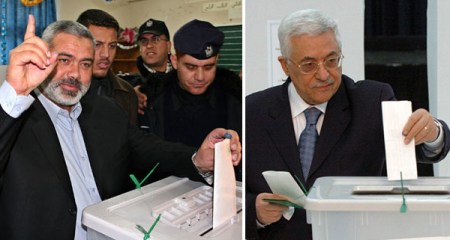
1682One man, one vote, one time? Hamas leader Ismail Haniyeh (left) and Fatah leader Mahmoud Abbas (also president of the Palestinian Authority) are pictured voting in the last election for the Palestinian Legislative Council, which took place in 2006.

Similarly, Fatah maintains that Hamas has been waging a campaign of intimidation and detention against Fatah supporters in the Gaza Strip — also in order to disrupt the upcoming election and undermine Fatah’s performance at the ballot boxes.

In the past two weeks, several Fatah activists in the Gaza Strip were rounded up by Hamas security forces, which have also banned Fatah from carrying out public election campaigns or holding rallies. Last week, as part of this crackdown, a Hamas court sentenced a former Palestinian Authority “general” to seven years in prison for “collaboration” with the PA security forces in the West Bank. Another three Fatah activists were sentenced to five years for the same crime.

In an effort to quell tensions between Hamas and Fatah, the Palestinian Central Election Commission decided to ask the two parties to sign a “Code of Conduct” document that requires all candidates and parties to avoid smear campaigns, slander, and fomenting sectarian or racist strife. The document also requires all those participating in the election to refrain from “exploiting religious or sectarian or tribal sentiments” in their campaign and also to avoid any form of intimidation, such as declaring one another traitors, apostates and infidels.

Although Fatah and Hamas have pledged to honor the terms of the “Code of Conduct,” known in Arabic as mithak sharaf, the two sides, which are not famous for honoring agreements, seem resolved to resort to all available methods to persuade voters to vote for each one of them.

For now, the two sides have taken to social media to present their electoral platforms and wage a smear campaign against each other.

Local elections are supposed to be about who can provide the people with the best municipal services and improve their living conditions. As such, one would expect candidates to run on a platform that promises new schools, roads, parks, sports centers and other municipal services. But in the case of the Palestinians, local and municipal elections seem to have assumed a new meaning and role. In fact, the upcoming election seems to be anything but a vote for a mayor or a member of a municipal or village council.

Hamas, whose leaders seem to be enthusiastic and optimistic about the upcoming vote, has seized the opportunity to wage a massive election campaign on Facebook and Twitter to promote its extremist ideology through intimidation and by accusing its rivals of infidelity, blasphemy and profanity. Hamas’s message to the Palestinian voters: Vote for us or else you will be considered infidels and you will end up in hell.

The first sign of Hamas’s frightening platform emerged when one of its top muftis, Yunis Al-Astal,issued a fatwa (Islamic religious decree) banning Palestinians from voting for any other party other than Hamas. “Any person, male or female, who votes for a party other than Hamas will be considered an infidel and apostate and his or her repentance will not be accepted even if they fasted or prayed or performed the hajj [pilgrimage] to Mecca,” the mufti ruled.

The Hamas fatwa sparked a wave of anger from many Palestinians, who were quick to accuse the Islamist movement and its leaders of waging a campaign of intimidation and terror against voters.

“This is the policy of the Muslim Brotherhood [of which Hamas is an offshoot],” commented Hisham Sawalhi, a Palestinian from the West Bank. “Those who support Muslim Brotherhood are believers, while those who oppose them are infidels.”

A Hamas-affiliated cartoonist from the Gaza Strip, Baha Yasin, published a cartoon that carries the same message as the fatwa. “A Palestinian Muslim does not vote for secular infidels,” he captioned a cartoon that depicts supporters of Fatah as unbelievers who smoke nargilas and cigarettes. The caption accompanying the cartoon also denounces the Fatah supporters for “insulting Allah” and Islam.

Rajai Al-Halabi, who is in charge of the “women’s portfolio” in Hamas, also stirred up controversy when she appeared on Al-Jazeera to declare that Islam surfaced for the first time in the Gaza Strip with the creation of Hamas.

Her declaration, which came in the context of Hamas’s election campaign, drew strong condemnations and sarcastic remarks from many Palestinians. “This means that all those who died before the establishment of Hamas were infidels, commented Hamzeh Abu Ajaleh, a Palestinian from the Gaza Strip. “In any case, my grandfather did not consume alcohol and my grandmother used to cover her head,” he wrote in reaction to the statement by the senior Hamas official.

“Hamas has launched its unofficial election campaign by issuing deeds of forgiveness and taking us back to the Middle Ages,” said Palestinian political analyst Mahmoud Sabri.

“They have turned mosques into podiums for political, and not religious, lecturing. Any citizen who does not vote for Hamas will be closer to entering hell and will be asked by Allah on Doomsday why he or she did not vote for the right people. Hamas wants us to believe that if we do not support them, then we are against Islam and that we are participating in the war against our religion.”

Some Palestinians in the Gaza Strip said this week that Hamas has formed a special team to manage its propaganda campaign in preparation for the local and municipal elections. This team has begun operating on two fronts: first, a public campaign to market Hamas’s “achievements” since its violent takeover of the Gaza Strip in the summer of 2007; and second, one to wage a campaign of defamation against its rivals in Fatah, depicting them as traitors and Israeli agents and infidels and enemies of Allah and Islam.

“A vote for Hamas is a vote for the resistance and a vote in support of Allah and Islam,” reads one of Hamas’s election banners. Other banners posted on social media highlight the fact that most of the Fatah representatives are not faithful Muslims and do not pray or practice any of the other pillars of Islam.

This Hamas tactic has worked in the past. In the previous parliamentary election, Hamas used the same propaganda to brainwash and scare Palestinian voters. Hamas has also resorted to the same rhetoric in campaigns during elections for university student councils and various professional unions in the West Bank and Gaza Strip. Some Palestinians, particularly Fatah loyalists, fear that Hamas will once again manage to persuade Palestinian voters to cast their ballots in favor of the Islamist movement by exploiting Islam to intimidate them.

However, there is no ignoring that there are other reasons why Palestinians may nevertheless prefer to vote for Hamas and not Fatah. Nearly two months before the election, tensions in Fatah seem to be on the rise. Many Fatah representatives are threatening to run in the election as independent candidates or as representatives of their clans. This already happened in the 2006 parliamentary election and resulted in Fatah’s defeat to Hamas. And this is why some Fatah officials already have second thoughts about the election and some of them have even openly called on the Palestinian Authority leadership to consider delaying them until further notice.

Last week, Mahmoud Abbas reportedly expelled four “rebellious” senior Fatah officials from the faction. The move came amid growing tensions among Fatah’s top brass over the upcoming election.

For Hamas, the upcoming election is an opportunity to consolidate its power and extend its control from the Gaza Strip to the West Bank. Hamas also views the local and municipal elections as a test for future parliamentary and even presidential elections. Without question, a Hamas victory in the upcoming elections would have an impact on any future elections and would send a message to the world that the Palestinian Authority is weak and has lost much of its credibility and standing among Palestinians. By calling the election and allowing Hamas to participate, Abbas is digging his own grave. Not to mention that he will be presiding over the burial of any so-called peace process with Israel.

Something different but interesting .

August 12, 2016

Investing in a cooler climate !

Winter Is Coming’ Warns The Solar Physicist The Alarmists Tried To Silence

http://www.breitbart.com/big-government/2016/08/12/winter-is-coming-warns-the-solar-physicist-the-alarmists-tried-to-silence/

Read the principles here

Home Page

http://coolfuturesfundsmanagement.com/

For the small investor .

https://www.gofundme.com/t72gmpng


Reporter Calls Out State Dept for Repeatedly Dodging on Clinton Emails

August 12, 2016

Reporter Calls Out State Dept for Repeatedly Dodging on Clinton Emails, Washington Free Beacon, August 11, 2016

Associated Press reporter Matt Lee called out State Department Press Director Elizabeth Trudeau during Wednesday’s press briefing for repeatedly not answering questions on whether newly released emails show impropriety between the department and the Clinton Foundation.

Conservative watchdog group Judicial Watch released 296 pages of State Department emails on Tuesday that it obtained through a Freedom of Information Act request. The emails showed cases of top Clinton Foundation officials rewarding their donors with access to the State Department.

“Do you have any response to criticism by some who suggest there was a relationship between the Clinton Foundation and the State Department at the time?” NBC producer Abigail Williams asked Trudeau. “There was an email that came out in this recent set that is between a then-executive at the Clinton Foundation and [top Hillary Clinton aides] Huma Abedin and Cheryl Mills, in which he is requesting to set up a meeting between a billionaire donor and the U.S. ambassador to Lebanon. Do you have any response?”

Williams was referring to an April 2009 exchange in which a top associate at the foundation pushed to set up a meeting between the donor and the ambassador to Lebanon because of the former’s activities in the country.

Trudeau said she would not comment on any specific emails. Williams tried to ask her question differently.

“You don’t feel like there was impropriety in the relationship between the Clinton Foundation and the State Department at the time?” Williams asked.

Trudeau repeated her initial response, saying the State Department communicates regularly with a wide range of individuals and organizations. She did not address whether or not it was improper for an executive in the Clinton Foundation to communicate with senior State Department officials on behalf of a wealthy donor.

“That’s not her question,” Lee said as another reporter began to ask Trudeau a question.

Lee would later try to ask Williams’ question again.

“Can you at least try to answer Abigail’s question which was, has the department looked into this and determined that there was no impropriety?” Lee asked.

“The Department is regularly in touch with people across the whole spectrum, Matt,” Trudeau said.

“That’s not the question. The question is whether or not you’ve looked into this, the building has looked into it and determined that everything was okay, that there was nothing wrong,” Lee said.

Trudeau did not answer the question.

“We feel confident in our ability and our past practice of reaching out to a variety of sources and being to responsive to requests,” Trudeau said.

Trudeau’s answer upset Lee.

“I’m sorry. Am I not speaking English?” Lee asked before restating the question.

Trudeau then gave Lee an answer to what he was asking her.

“We feel confident that all the rules were followed,” Trudeau said.

California: Muslims screaming “Allahu akbar!” through a bullhorn terrorize church during worship service

August 11, 2016

California: Muslims screaming “Allahu akbar!” through a bullhorn terrorize church during worship service, Jihad Watch

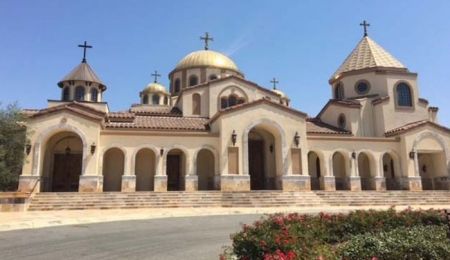
Father Josiah Trenham mentioned “intimidation” to the parishioners of St. Andrew Orthodox Church, and he was quite right: Islamic supremacists and jihadis routinely traffic in intimidation. That’s based on a Qur’anic command: “And prepare against them whatever you are able of power and of steeds of war by which you may strike terror in the enemy of Allah and your enemy and others besides them whom you do not know, whom Allah knows” (Qur’an 8:60).

When they practice this intimidation, they generally find Westerners — especially Christian leaders — unwilling and unable to do anything in response but submit to it: the Christians are anxious to show themselves to be charitable and loving to the Muslims, without realizing that as far as the Muslims are concerned, this equates to surrender. Hence the many Christian leaders who counseled that in the face of the jihad murder of cartoonists of Muhammad, the charitable thing for Christians to do would be to accept the Sharia blasphemy restrictions on speech, at least regarding criticism of Muhammad.

This is not to say that Christians shouldn’t be charitable and loving, but sometimes the most charitable thing to do is to refuse to allow the intimidator a victory for his intimidation. Giving in to intimidation only encourages more of it. Christians in the U.S. need to have a public discussion of this point, since one thing is certain: there are going to be many, many more incidents like this one at St. Andrew Orthodox Church.

St-Andrew-Orthodox-Church

“Churches take new security measures in face of terror threats,” by Hollie McKay, Fox News, August 9, 2016:

As Father Josiah Trenham prepared to read the Gospel, several parishioners discreetly scooped up their babies, retreated up the aisles of St. Andrew Orthodox Church and out into the spring air, so as not to allow the crying of little ones to disturb the divine liturgy.

The time-honored tradition was shattered when a car passed by the Riverside, Calif., church, slowing down as the front passenger leaned out of his window and bellowed menacingly through a bullhorn, according to witnesses.

“Allahu Akbar!” the unidentified man repeated several times as the unnerved parents drew their infants close and exchanged worried glances.

Witnesses were able to give Riverside police a description of the green Honda Civic, but not of the three occupants. Some told police they believed one or more of the men may have been taking photographs, according to Officer Ryan Railsback. Although Trenham insisted multiple congregants heard the Arabic phrase, Railsback noted no mention of it was in the police report.

In omitting this, was the author of the police report running some politically correct interference for area Muslims?

Whatever the case, no law was broken – even if an unmistakable message was sent and received.

“Be calm and to keep a special vigilance over the property and our children while we are at church,” Trenham wrote in an email to parishioners in which he recounted the disturbing event. “Pray that these provocative young men might repent of their intimidation and be saved.”

Trenham told FoxNews.com last week the situation remains “tense and tenuous,” and said the church now has security officers on hand for all regular services.

“It is a deep sorrow to live this way in the ‘new America,’” he said.

The incident took place on April 12, some four months after a terror attack left 14 dead in nearby San Bernardino, and just over three months before a French priest was killed by ISIS-linked jihadists in his church. The events, whether far or near, underscore a grim new reality for pastors such as Trenham: Instead of offering sanctuary from evil, churches could in fact be attractive targets for terror….

In February, Khial Abu-Rayyan, 21, of Dearborn Heights, Mich., was arrested after he told an undercover FBI agent he was preparing to “shoot up” a major church near his home on behalf of ISIS. A month earlier, the Rev. Roger Spradlin of Valley Baptist Church – one of the biggest congregations in Bakersfield, Calif. – told attendees that they had received a threat written in Arabic.

“Undercover officers were then placed during worship services,” Valley Baptist spokesman Dave Kalahar said. “The FBI continues to investigate along with the local task force.”

Last September, an Islamic man clad in combat gear was charged with making a terrorist threat after entering Corinth Missionary Baptist Church, in Bullard, Tex., and claiming that God had instructed him to kill Christians and “other infidels.” A year earlier, police were called to Saint Bartholomew’s Catholic Church in Columbus, Ind., after the house of worship was vandalized with the word “Infidels!” along with a Koranic verse sanctioning death for nonbelievers. Similar graffiti was found that same night at nearby Lakeview Church of Christ and East Columbus Christian Church.

St. Bartholomew Pastor Clem Davis said he doesn’t know if the threat was legitimate, but said little can be done to harden a target whose mission is to welcome all.

“I don’t know that there is any real protection against the ‘lone wolf’ mentality, not without infringing on everybody’s freedoms,” Davis said. “We don’t have metal detectors, people go in and out. Churches are family-orientated, public, tax-supported spaces; so they may appeal to some as a target.”

Synagogues have faced increasing threats in recent years, too. Earlier this year, the FBI disrupted a plot by a Muslim convert to blow up the Aventura Turnberry Jewish Center, in Aventura, Fla. A 2014 audit by the Anti-Defamation League (ADL) found that anti-Semitic incidents rose 21 percent across the country that year.

Eastern Orthodox Christians, who in many cases suffered persecution at the hands of radical Muslims in their Middle Eastern homelands, believe they may be singled out because of their heritage. Mass at St. Andrew typically attracts up to 400 worshippers with roots in Syria, Iraq, Saudi Arabia, Jordan, Russia and Greece.

“We have guards now; we never used to have guards,” said St. Andrew attendee Solomon Saddi, a Syrian-American Christian. “They keep an eye on everyone and talk to the faces that aren’t familiar,” he continued, referring to the aftermath of the April incident. “It is a very dangerous time for us even in America.”…

Justice Department officials pushed for Clinton Foundation probe

August 11, 2016

Justice Department officials pushed for Clinton Foundation probe, Washington ExaminerSarah Westwood, August 11, 2016

Top Justice Department officials pushed for a public corruption probe of the Clinton Foundation earlier this year, but were overruled by their colleagues after a bank alerted the FBI to the “suspicious activity” of a foreign donor to the charity.

Three Justice Department field offices agreed that the agency should pursue the investigation at the behest of the FBI, CNN reported Thursday.

During a previously unreported meeting earlier this year, high-ranking Justice Department officials clashed over the possibility of pursuing a public corruption investigation. According to CNN, the agency had already looked into the Clinton Foundation in 2015 following the publication of a book, Clinton Cash, that detailed allegations of influence peddling.

Hillary Clinton’s involvement in the activities of foundation donors while serving as secretary of state has raised questions about whether she followed the ethics requirements imposed on her and her husband at the outset of her tenure.

While the FBI announced last month its intention to close a year-long probe of Clinton’s private email use without recommending charges, the law enforcement agency had remained silent on the existence of a separate, rumored investigation into the Clinton Foundation.

What does America owe Iran?

August 11, 2016

What does America owe Iran? Israel Hayom, Clifford D. May, August 11, 2016

An unmarked cargo plane filled with $400 million in cash lands in Tehran, and four American hostages held by Iran’s rulers are set free. These revelations have sparked two controversies.

First: Did the Obama administration pay a ransom to Iran, the world’s leading state sponsor of terrorism? White House spokesmen insist it did not and there was no quid pro quo, while Iranian officials say that was precisely what happened. Who is more credible? More importantly, whom do you think prospective hostage-takers around the world believe?

Second: Did this payment violate American law? Justice Department officials opposed the payment. Former federal terrorism prosecutor Andrew C. McCarthy argued that the transaction involved the commission of several “felony law violations.” Former Attorney General Michael Mukasey opines that while the transaction was not “right,” it was not illegal.

The roots of this affair run deep. In early 1979, the shah of Iran, as part of an arrangement to purchase jet fighters, deposited $400 million into a Pentagon account. Soon afterward, he was overthrown in the Islamic Revolution. As White House spokesman Josh Earnest said: “Once the revolution took place, obviously that equipment was not transferred, but we also didn’t return Iran’s money.”

Return the money to whom? At what point does the property of a government that has been toppled become the rightful possession of those who have done the toppling? International law is murky on this matter, as it is on many matters.

One thing we can say with reasonable certainty: Had envoys representing Ayatollah Ruhollah Khomeini reached out to President Jimmy Carter, he would have done whatever was in his power to establish amicable relations.

But that did not happen. We know what did: On Nov. 4, 1979, followers of the supreme leader seized the U.S. Embassy in Tehran and took 52 diplomats hostage. The diplomats were held and, in many cases, tortured for 444 days. That such conduct violates international law — indeed, that it constitutes an act of war — is not a matter for legal debate. The hostages were released on Jan. 20, 1981, the day President Ronald Reagan was inaugurated.

Iran’s rulers have never apologized, much less compensated their victims. The Weekly Standard’s Lee Smith reports that President Bill Clinton considered using the $400 million to pay victims of Iranian terrorism who had won judgments against Iran in U.S. courts. In the end, however, he left it to American taxpayers to pick up the check. President George W. Bush could have reimbursed the Treasury using frozen Iranian funds. He did not.

There matters lay until, in January of this year, President Barack Obama boasted that thanks to “strong American diplomacy,” the United States and Iran “are now settling a long-standing Iranian government claim against the United States government and Iran will be returned its own funds, including appropriate interest, but much less than the amount that Iran sought.”

Note that the president neglected to mention claims against Iran. And shouldn’t there be some controversy over the notion of “appropriate interest” — which is how the $400 million “owed” to Iran rose to the $1.7 billion that is being paid?

Since the money was not loaned to the U.S. by Iran’s current regime, why should the assumption be that the U.S. invested it for the benefit of Iran’s current regime? As part of this hostage deal, the U.S. also freed seven Iranians charged or convicted of crimes and dropped extradition requests for 14 others. How much is that worth? Why does that not count as “interest”?

Surely, justice would have been better served had the shah’s funds been distributed to Iran’s many victims: the diplomats who were illegally imprisoned, to be sure, but also the families of those murdered on Iran’s orders, such as those in Beirut in 1983, at Khobar towers in 1996, and more recently in Iraq by Shiite militias armed and instructed by Tehran.

In addition, thousands of innocent Iranians were put to death by the leaders of the Islamic Revolution. Tens of thousands were forced to flee the country, and their businesses, homes, lands, and bank accounts were stolen by the regime. Why have these victims been forgotten?

Here is part of the reason: Carter, during his final days in office, negotiated the Algiers Accord, agreeing that in exchange for the release of the hostages, Iran’s new rulers would be granted immunity from criminal or civil penalties.

Congress did not approve the Algiers Accord, which was not a treaty but only an executive agreement. President Reagan could have revoked it, pointing out that his predecessor had negotiated it with a knife at his throat — or, more precisely, with knives at the throats of the hostages. But he did not.

Instead, in 1981, pursuant to the Algiers Accord, the Iran-U.S. Claims Tribunal was set up in The Hague. This international arbitration mechanism has further entrenched the perverse notion of moral equivalence between the United States and the Islamic republic.

It has led to President Obama and Secretary of State John Kerry attempting to satisfy Iran’s “claims” against the U.S. against the backdrop of the Iran deal, another executive agreement. Obama considers that deal vital to his legacy. By contrast, Iran’s Supreme Leader Ayatollah Ali Khamenei has made it plain that he is more than willing to walk away from the deal — and will should the river of American concessions not continue to flow.

So last week’s hostages-for-cash story turns out to be only one chapter in a long and sad saga. It should give rise to additional controversies, starting with this: Why are Iran’s negotiators so consistently more skillful than America’s?

When Being Raped By ISIS Brings Shame on the Family

August 11, 2016

When Being Raped By ISIS Brings Shame on the Family, Clarion Project, Elliot Friedland, August 11, 2016

cryIllustrative picture. (Photo: © Creative Commons/MarLeah Cole)

Women held as sex-slaves by the Islamic State are remaining in the hands of ISIS because their families are too ashamed to rescue them, according to the pan-Arab outlet Al-Aan, which is based in Dubai.

Reports that were depending on testimonies from women who escaped ISIS show that Turkmen families whose daughters have been rescued from Islamic State captivity are treating the girls as a source of shame.

The paper claimed to know about 5 Turkmen girls who could have escaped ISIS and joined their families in the province of Al-Najaf and Karbala in the south of Iraq. But their families refused to cooperate with any rescue agencies that can give them information because of the fear of shame.

The liberation of six hundred women and girls has reportedly been prevented by concerns over honor.

In Iraq where tradition firmly controls society, women and girls are prohibited from having emotional relationships or eloping without the permission and knowledge of the family.

Girls who violate these social codes are typically murdered by their families.

Despite the fact that rape is by definition non-consensual, families still look down on rape victims because they regard the woman’s chastity as having been breached by the mere act of penetration regardless of the volition of the woman concerned.

Such brutal honor codes and what activists are doing to stand up against them were chronicled in Clarion Project’s award winning movie Honor Diaries.

Human rights organizations have to take on these problematic cultural trends if they are serious about rehabilitating women that have already undergone so many traumas.

The mindset that views women as property to be bought and sold in sexual slavery is the same as the mindset that views a woman to be damaged goods and a source of shame after she has been raped. She is not seen as a person in her own right but as a mere appendage to a male.

This toxic perception of women must be challenged.

Officials In Lebanese, Gazan Terror Organizations Confirm: Iran Funds Our Activity

August 11, 2016

Officials In Lebanese, Gazan Terror Organizations Confirm: Iran Funds Our Activity, MEMRI, August 11, 2016

Arab media have recently published statements by officials in the Lebanese Hizbullah and the Gazan Hamas and Islamic Jihad organizations, and by their supporters, confirming what has long been known – namely that these Lebanese and Gazan terror organizations receive substantial financial and military assistance from Iran. These statements join many reports, especially in the anti-Iranian media, regarding Iran’s funding of various terrorist organizations across the Arab world. According to these reports, the assistance comes mainly from the office of Iranian Supreme Leader Ali Khamenei and from the Islamic Revolutionary Guards Corps (IRGC).

The following are some examples of these statements and reports from the last two months:

Hizbullah Secretary-General Nasrallah: Hizbullah’s Entire Budget Is Provided By Iran

In a speech he delivered on June 24, 2016, marking 40 days after the killing of Mustafa Badr Al-Din, who was considered to be Hizbullah’s chief operations officer, and following the imposition of U.S. sanctions on Hizbullah that threaten its financial infrastructure and income, Hizbullah Secretary-General Hassan Nasrallah clarified: “Hizbullah’s budget – its salaries and expenditures, [the money that pays for] its food and drink, weapons and missiles – [all come from] Iran. Is that clear?… As long as Iran has money we have money. Do you require greater transparency than that[?] The funds earmarked for us do not reach us through the banks. We receive them the same way we receive our missiles, with which we threaten Israel.”[1]

Hamas Official Abu Marzouq: Iran’s Assistance To Hamas Is “Not Comparable” To Any Other Assistance

The deputy head of Hamas’s political bureau, Moussa Abu Marzouq, tweeted on June 15, 2016: “The aid extended by Iran to the Palestinian resistance, in provisions, training and funds, is not comparable [to any other aid], and most other countries cannot match it.”[2]

29502Abu Marzouq’s tweet

Former Lebanese Minister Wiam Wahhab: Iran Has Funded Resistance In Palestine

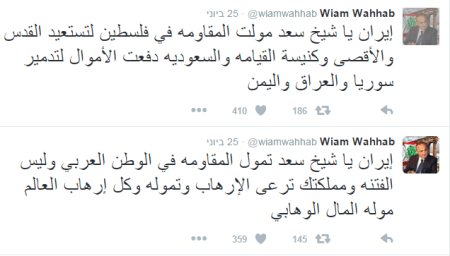
On June 25, 2016, in response to a remark by former Lebanese prime minister Sa’d Al-Hariri that Iran funds fitna(internecine strife) in the Arab world,[3] former Lebanese minister Wiam Wahhab, a known supporter of Hizbullah and the resistance axis, tweeted: “O Sheikh Sa’d [Al-Hariri], Iran has funded resistance in Palestine to restore Jerusalem, Al-Aqsa and the Church of the Sepulcher [to Palestinian hands, whereas] Saudi Arabia paid to destroy Syria, Iraq and Yemen.” In another tweet he wrote: ” O Sheikh Sa’d, Iran funded resistance in the Arab homeland rather than fitna, [whereas] your kingdom [Saudi Arabia, who supports Al-Hariri and his faction in Lebanon,] sponsors and funds terrorism. The funds of all the terrorist [organizations] in the world are Wahhabi [i.e., Saudi] funds.”[4]

29503Wiam Wahhab’s tweets

Saudi Daily Al-Sharq Al-Awsat: Hizbullah’s Weapons Come Directly From IRGC; Iran Has Renewed Regular Aid To Islamic Jihad Organization

The anti-Iranian press, such as the London-based Saudi daily Al-Sharq Al-Awsat, also reported on Iran’s funding of terrorist organizations in Lebanon and Gaza. On June 29, 2016, Al-Sharq Al-Awsat confirmed Nasrallah’s statements regarding the Iranian funding. The report stated that Hizbullah’s funds came from the office of Iranian Supreme Leader Ali Khamenei while its weapons are provided by the IRGC. It quoted the director of the Umam Research and Documentation center in Lebanon, Luqman Salim, a Shi’ite known for his opposition to Hizbullah, as saying that between 70% and 80% of Hizbullah’s funds come from Iran. According to Salim, Iran also invests about $400 million of the IRGC’s budget in the Islamic Radio and Television Union, a group of stations which includes the Iranian Al-Alam but also Hizbullah’s Al-Manar and Al-Mayadin and the Hamas-affiliated Al-Quds (all of which broadcast from Lebanon) and Hamas’s Al-Aqsa station, which broadcasts from Gaza.

The daily also cited a “knowledgeable source” as saying that until 2005 Iran transferred to Hizbullah between $200 million and $250 million annually, but since then the allocation has increased: After the 2006 Lebanon War it rose to $850 million, and since Hizbullah entered the Syria war its budget has become unlimited, because it has become part of Tehran’s war effort there.[5]

On May 25, 2016, the daily reported, citing sources close to the Islamic Jihad organization in Gaza, that Iran had renewed its regular financial aid to the organization after the two sides agreed to renew their mutual relations.[6] According to these sources, an Islamic Jihad delegation headed by the organization’s secretary-general Ramadan Shalah visited Iran in April 2016, and during this visit Tehran renewed its sponsorship of the organization after the latter accepted its terms. In meetings held by the delegation during this visit, including with IRGC commander Mohammad Ali Jafari and Qods Force commander Qassem Soleimani, Iran clarified its vision of Islamic Jihad’s course in the coming years. The sources claimed further that Soleimani decided, in coordination with the organization’s military and political bureaus, to grant $70 million a year out of the IRGC budget to Islamic Jihad’s military wing, Saraya Al-Quds, and to reorganize this body and appoint Khaled Mansour, who is close to Tehran, as its commander.[7]

Endnotes:

[1] Alahednews.com.lb, June 24, 2016.

[2] Twitter.com/mosa_abumarzook, June 15, 2016.

[3] Al-Mustaqbal (Lebanon), June 26, 2016; Al-Hariri’s remark was a response to Nasrallah’s  statement one day earlier that Hizbullah’s entire budget comes from Iran.

[4] Twitter.com/wiamwahhab, June 25, 2016.

[5] Al-Sharq Al-Awsat (Lebanon), June 29, 2016.

[6] Reports in the Arab media in the passing year indicated that Iran had suspended its assistance to Islamic Jihad following disagreements between them on the crisis in Yemen. According to these reports, the Islamic Jihad refused Iran’s demand to declare its opposition to the Arab Coalition’s activities in Yemen. See for example Aljazeera.net, May 26, 2016, Janoubia.com, April 3, 2016.

[7] Al-Sharq Al-Awsat (London), May 25, 2016.