Archive for July 2016

Terrorism in The Therapeutic Age

July 21, 2016

Terrorism in The Therapeutic Age, Front Page MagazineBruce Thornton, July 21, 2016

therapy

We know what is going to follow the latest terrorist murder in Nice. Shrines to the dead will instantly spring up. Conclaves of citizens will gather at sorrowful demonstrations filled with ecumenical clichés. The media will profile selected victims, wringing every ounce of pathos out of their tragedy. Twitter will be inundated with sentimental bromides and ephemeral hashtags, and politicians will give solemn and empty speeches laced with even emptier threats.

Welcome to terror in a therapeutic age.

What we will not read are passionate demands from most citizens of Western governments that mind-concentrating force be unleashed on those responsible for the latest slaughter of the innocents. Nor will we hear stirring speeches from our political leaders that forcefully make the moral case for war against the murderers and their enablers.

Obsessing over feelings and emotions is what many moderns reflexively substitute for meaningful action. Righteous anger and burning revenge of the sort that fired up Americans after the Pearl Harbor attacks are too “mean” and “hurtful,” and require a serious commitment and exorbitant risk. Displaying emotion is cheap and gratifying and offends no one. Indeed, such displays demonstrate the purveyors’ superior “we are the world” sensibilities and sensitivity. It is “conspicuous compassion,” as Alan Bloom called it, as much a status symbol as Veblen’s conspicuous consumption. It’s how people show themselves to be civilized and advanced, too sophisticated for retrograde emotions like avenging anger. That’s so Old Testament.

In the therapeutic world, conflict is to be resolved by peace, love, and understanding. Or as our Attorney General said after the Orlando jihadist massacre, “Our common humanity transcends our differences, and our most effective response to terror is compassion, it’s unity and it’s love.” Thus the institutional instruments for resolving our differences with the jihadists are diplomatic engagement, foreign aid, economic development, negotiated agreements, and careful nurturing of our enemies’ self-esteem. We must flatter them, stroke their egos, attend to their grievances, censor any unpleasant facts about their religion. Pretend, as Obama does, that Islam, the “religion of peace” and has absolutely nothing to do with Muslim terrorism, or what he prefers to call “violent extremists.” Assert, like Hillary, “Let’s be clear: Islam is not our adversary. Muslims are peaceful and tolerant people and have nothing whatsoever to do with terrorism.”

The problem is, we live in a world of people with radically different ideas about the goods they should pursue, and who don’t give a damn about “peace, love, understanding,” or the opinions of Western infidels about their religion. Whatever their potential is for possessing and recognizing a “common humanity,” in practice this possibility remains mostly unexpressed in their traditional religious tenets. Rather, Muslim jihadists––and hundreds of millions of ordinary Muslims–– limit their compassion, sympathy, and respect for humanity to fellow Muslims, and deny them to the infidel or heretic. That’s why zakat, the personal obligation for Muslims to make charitable contributions, for the most part restricts that charity to other Muslims.

The only “common humanity” pious Muslims recognize is the divine obligation for all humans to become Muslim. Their highest goods are not democracy, prosperity, leisure, and tolerance, but obedience to Allah and his laws. And millions of them view violence in the name of Allah as the divinely justified instrument for creating a world in which “all men say there is no god but Allah.”

Appeals to a “common humanity,” then, are useless as appeasing flattery for dealing with a man who, willing to die and kill in the name of Allah, drives a truck over men, women, and children, killing, mangling, and dismembering them. Flattery only confirms the jihadist’s belief that the infidel West is populated by godless hedonists eager only to enjoy life for one more day, and so are willing to sacrifice their freedom and rights for the short-term pleasures of la dolce vita. They are unworthy of compassion, for they no longer know what is worth dying and killing for. They have forgotten what Lincoln called the “awful arithmetic,” the tragic reality that some people must die today so that more people don’t die later––the gruesome calculus that the Allies followed to defeat fascism, Japanese imperialism, and Nazism.

Over forty years ago, the great Soviet dissident Alexandr Solzhenitsyn in his Nobel lecture identified this chronic weakness that permeates the West:

The spirit of Munich has by no means retreated into the past; it was not a brief episode. I even venture to say that the spirit of Munich is dominant in the twentieth century. The intimidated civilized world has found nothing to oppose the onslaught of a suddenly resurgent fang-baring barbarism, except concessions and smiles. The spirit of Munich is a disease of the will of prosperous people; it is the daily state of those who have given themselves over to a craving for prosperity in every way, to material well-being as the chief goal of life on earth. Such people––and there are many of them in the world today––choose passivity and retreat, anything if only life to which they are accustomed might go on, anything so as not to have to cross over to rough terrain today, because tomorrow, see, everything will be all right. But it never will! The reckoning for cowardice will only be more cruel. Courage and the power to overcome will be ours only when we dare to make sacrifices.

These comments about the Soviet Union and the West are just as true today about the “fang-baring barbarism” of Islamic jihad. The surreal denial of the nature of the enemy and his religious motivations; the symbolic military gestures that serve public relations and political advantage rather than a strategy for defeating the enemy; the unwillingness to accept the eternal tragic realities of war and instead create suicidal rules of engagement vetted by pettifogging lawyers; and the refusal of citizens to pay the price necessary for destroying the enemy––all reflect the disease that Solzhenitsyn identified.

The problem is one of morale, not ability. We can destroy ISIS. Even the fictional Peter Quinn, from the series Homeland, knows how: put 200,000 troops in a country indefinitely or “bomb Raqqa into a parking lot.” In the real world, Asia Times columnist “Spengler” agrees. Wage total war both against the enemy abroad and against fellow travelers and sympathizers at home.

But don’t hold your breath. The political will for such action does not exist among a significant number of Americans. They would rather feel than act. Meanwhile, they indulge lachrymose sentiment, a luxury of the pampered rich. They call for “diplomacy” and “engagement,” the tried and true camouflage for the fear to act. They prefer to spend money on more and more government provided “butter” rather than on guns, as they move on to the next episode of televised tragedy in between bouts of Pokémon Go.

Meanwhile, the reckoning for our cowardice grows ever closer and ever crueler.

Exclusive – Sarah Palin to Ted Cruz: Delete Your Career

July 21, 2016

Exclusive — Sarah Palin to Ted Cruz: Delete Your Career

by Breitbart News

20 Jul 2016

Source: Exclusive – Sarah Palin to Ted Cruz: Delete Your Career – Breitbart

BRENDAN SMIALOWSKI/AFP/Getty Images

In an exclusive statement to Breitbart News, former Alaska Governor and 2008 Vice Presidential nominee Sarah Palin weighed in on Senator Ted Cruz’s refusal to honor his pledge and endorse the GOP nominee Donald Trump.

Palin, whose endorsement of Cruz’s long-shot Senate bid in 2012 was credited by Cruz himself as the reason why he won the race that launched his national political career, gave the following statement to Breitbart after delegates booed Cruz off the stage at the Republican National Convention on Wednesday night:

Turns out Ted Cruz’s partner, Carly Fiorina, had a more graceful exit from the political stage than he had.

Cruz’s broken pledge to support the will of the people tonight was one of those career-ending “read my lips” moments. I guarantee American voters took notice and felt more unsettling confirmation as to why we don’t much like typical politicians because they campaign one way, but act out another way. That kind of political status quo has got to go because it got us into the mess we’re in with America’s bankrupt budgets and ramped up security threats.

It’s commonplace for politicians to disbelieve their word is their bond, as evidenced by Cruz breaking his promise to endorse his party’s nominee, evidently thinking whilst on the convention stage, “At this point, what difference does it make?” We’ve been burned so horribly by that attitude that voters won’t reward politicians pulling that “what difference does it make” stunt again. Politicians will see — it makes all the difference in the world to us.

Palin also passed along the following video:

Ted Cruz Booed as He Tells Republicans: ‘Vote Your Conscience’

July 21, 2016

Ted Cruz Booed After Failing to Endorse Trump: ‘Vote Your Conscience’

Source: Ted Cruz Booed as He Tells Republicans: ‘Vote Your Conscience’

CLEVELAND, Ohio — Sen. Ted Cruz (R-TX) gave a stirring address to the Republican National Convention on Wednesday night, but failed to endorse Donald Trump, telling Americans to “vote your conscience.”

Cruz congratulated Donald Trump on winning the party’s nomination, but stopped short of endorsing Trump outright, saying merely that he wanted to see the party’s principles prevailing in November.

He urged voters: “Please: don’t stay home in November.” But then he added: “If you love our country, and love your children as much as I know that you do, vote your conscience.”

“I appreciate the enthusiasm of the New York delegation,” he said, as he was booed.

Prior to that, Cruz had focused on the conservative principles at the core of the party.

He began with a lighthearted metaphor as he spoke in the Quicken Loans Arena, reflecting on the Cleveland Cavaliers’ recent historic victory in the NBA Finals. “LeBron James just led an incredible comeback victory, and I am convinced America is going to come back, too.”

Cruz went on to describe one of the fallen Dallas police officers, Michael Smith, who was killed by a sniper at a Black Lives Matter protest less than two weeks ago. “I have no idea who he voted for in the last election, or what he thought about this one, but his life was a testament to devotion.”

“He protected the very protesters who mocked him because he loved his country and his fellow man.”

Cruz went to to describe the stakes in the upcoming election — namely, that each person could tell their children “that we did our best for our country.”

And the country’s bedrock principle, Cruz said, was simple: “Freedom matters.”

He then drew a clear distinction between the parties: “Of course, Obama and Clinton will also tell you that they care about our country’s future. And I want to believe them. But there is a profound difference in our two visions of our country’s future.”

On terror and trade, on education and employment, on immigration and the Internet, Cruz spelled out stark disagreements between Democrats and Republicans — focusing, interestingly, on Obama and not his would-be successor.

“Freedom means free speech, and not politically correct safe spaces,” Cruz added, nothing that the Bill of Rights applied equally to all, including “gay or straight.”

On abortion, Cruz said: “Freedom means that human life is precious and must be protected.” And he reminded the gathering: “Our party was founded to defeat slavery … Together, we passed the Civil Rights Act, and together we fought to eliminate Jim Crow laws. That’s our collective legacy — although the media will never share it with you.”

And then, Cruz delivered those fateful words: “Vote your conscience.”

The boos and interruptions never ceased after that, with chants of “We want Trump!”

He concluded with a call to unity: “The case we have to make to the American people … is to commit to each of them that we will defend freedom and be faithful to the Constitution.”

But Cruz left the stage having divided the party.

Update: A Cruz supporter told Breitbart News: “I think it was entirely selfish. I think he’s ruined his future. Everybody was right about him. It’s a character thing.”

Another attendee described Cruz’s address as a “slap in the face” and “toying with the convention.”

Reactions were even harsher behind the scenes. Dana Bash of CNN reports that Cruz entered a donor suite at the arena after the speech, and was told, to his face, that he was a “disgrace.” One man was so angry at Cruz that he had to be “physically restrained,” and Heidi Cruz had to be escorted from the convention floor because of heckling by Trump delegates.

Eric Trump tried valiantly to mollify the crowd with a stirring address, albeit one beset by technical difficulties, and former Speaker of the House Newt Gingrich did his best as well, but almost nothing could overshadow what Cruz had done.

The crucial phrases from Cruz’s address in the prepared version of the text, highlighted in yellow for reporters, were:

We deserve leaders who stand for principle. Unite us all behind shared values. Cast aside anger for love. That is the standard we should expect, from everybody.

And to those listening, please, don’t stay home in November. Stand, and speak, and vote your conscience, vote for candidates up and down the ticket who you trust to defend our freedom and to be faithful to the Constitution.

The final address of the evening, by Gov. Mike Pence of Indiana, was solid, but spoke of a “united party” and uniting the nation.

Update #2: Jonathan Swan at The Hill reports that aides to Ted Cruz pleaded with him to endorse his former rival, but the Texas senator refused:

Just hours before Ted Cruz took the stage for his convention speech Wednesday night, senior members of Cruz’s team were still pushing him to endorse Donald Trump.

Cruz never wanted to endorse Trump and is still furious about the personal attacks the GOP presidential nominee made on his family during the primary campaign, sources familiar with the speech preparations told The Hill.

But top aides had concluded he needed to formally endorse Trump at the Republican National Convention.

For Cruz, it was always personal.

[…]

Still, some aides to Cruz, a Republican senator from Texas, were pushing him to endorse Trump for the sake of his own political future.

Cruz has indicated intentions to run for president again in 2020, and he has a team forming behind him to execute that plan. 2020 was the unspoken undertone beneath the drafting Wednesday night’s speech.

Update #3 (Michelle Moons):

Shortly following Cruz’s speech, Former Speaker of the House Newt Gingrich asked the crowd to consider carefully the implication of Cruz’s words.

“Ted Cruz said you can vote your conscience for anyone that will uphold the Constitution. In this election, there is only one candidate who will uphold the Constitution.”

He continued, “If you want to protect the constitution of the United States, the only possible candidate this fall is the Trump-Pence Republican ticket.”

Update #4: Throughout the broadcast of Pence’s speech, CNN highlighted every area of policy disagreement between the two candidates on the Republican ticket:

For all that, CNN’s political analyst, Gloria Berger, called Pence’s speech “pitch-perfect.”

Update #5: CNN’s Ana Navarro, a former Jeb Bush surrogate who is no fan of Trump, panned Cruz’s speech.

While you should always “vote your conscience,” she said, if you’re invited to dinner, “You don’t eat the food, drink the wine, and then piss on the carpet. It was tacky.”

Update #6: Hillary Clinton has weighed in, tweeting Ted Cruz’s taglin

Update #7: Gov. Chris Christie of New Jersey seems visibly shaken as he speaks to CNN’s Dana Bash, telling her that Cruz’s speech was “selfish” and that he had broken his pledge — not to Trump, but to all the candidates.

He adds that America can now see why Cruz has “richly deserved” his bad reputation among colleagues on Capitol Hill.

Update #8: CNN’s Jake Tapper makes the best case for Cruz — without agreeing with it, saying that Cruz does not believe Trump is a conservative, and that he is planning to run again for president as the “conscience” of the party.

Update #9: One of the other highlighted lines in the prepared version of Cruz’s speech was: “And citizens are furious — rightly furious — at a political establishment that cynically breaks its promises and ignores the will of the people.”

Now that Cruz is being accused of having broken his promise to support the party’s nominee, it is a rather ironic line.

Update #10: Trump aide Michael Cohen tells CNN that Cruz’s speech was “political suicide.”

Update #11: Trump tweets that he had seen Cruz’s speech in advance, and allowed him to deliver it anyway:

If true, then Trump — who was seen applauding Cruz in the wings during his address — may have enjoyed watching Cruz self-destruct.

Update #12: Cruz’s speech, as delivered, and checked against delivery by Michelle Moons:

Update #13: Neil Munro has collected different reactions from delegates on the floor of the convention:

“It was the perfect speech and it was completely ruined by the booing.” said Texan Richard Morgan.

Cruz implicitly endorsed Trump, and repeatedly urged voters to vote against Clinton, he said. Some Cruz supporters still aren’t quite ready to accept Trump — partly because of the butter campaign fight — but will be ready to back him as the election draws nearer, he said.

“I think it is right for today — people still don’t want him to well out” to Trump, he said.

The speech, he added, was “very unifying until the delegations started booing.”

But Mark, a delegate from outside Texas, said the speech crystalized widespread suspicion of Cruz’ s motivations and character.

“Cruz does what he does for the real activists, [the non-endorsement] was a betrayal and that’s how it is going to be taken.”

“You just probably saw a political career vaporize before your eyes. “

“He did, in a way,” endorse Trump, said one Oklahoma delegate, who supported Cruz. “I don’t think it will be as big a deal as everybody thinks,” he added.

“I’m disappointed [he did not endorse] — I would have liked to see him do it, but I also understand why he didn’t” because of the hard feelings left after a tough campaign, he said.

“If Trump loses, Cruz is done,” said Ken Henry, from Alaska. “He didn’t say it … he never said ‘I endorse Donald J. Trump.”

“There was consternation on the floor,” said Cynthia Henry, a delegate and committee member from Alaska.

“You’ve just seen a man commit suicide,” said Don, a delegate from Arizona. “This reminds me of George H. Bush saying ‘Read my lips, no new taxes,” and then he goes out [and makes a tax increase deal] with Tip O’Neill.”

Erin Swanson, a Texas delegate, said that the Trump campaign knew the contents of the speech, “they knew it was not a formal endorsement.”

Cruz is an elected U.S. Senator,who represents Texas conservatives, she said. “I never expected Ted to fully endorse … Cruz would lose a lot of credibility [in Texas] if he endorseed Trump,” she said.

“Teump needs to work to unify the party, and he should not have alienated people by interrupting the speech.”

Chris Ford, another Texas delegate, said: “It definitely was not an endorsement … it is not his style,” adding that Trump should not try to bully an elected Texas Senator.

“It doesn’t bother me, “ said Boyd Smith, a California delegate.”We’re allowed out own agency to say what we say.”

“I don’t think there’s a split… people are entitled to express their views.”

London’s Muslim Mayor Refuses To Support Ban On Hezbollah Terror Group

July 21, 2016

London’s Muslim Mayor Refuses To Support Ban On Hezbollah Terror Group

by Raheem Kassam

20 Jul 2016

Source: London’s Muslim Mayor Refuses To Support Ban On Hezbollah Terror Group

London’s new and first Muslim mayor Sadiq Khan has refused to back a request for the terrorist outfit Hezbollah to be a proscribed organisation.

Following a question from UK Independence Party (UKIP) London Assembly member David Kurten, Mr. Khan said that he would not back a ban on the group which has recently had supporters and sympathisers protesting with its famous yellow jihadi flag at ‘Al Quds Day’ in London.

Mr. Kurten asked the question in the discussion following Assembly member Kemi Badenoch’s question: “What action is the Metropolitan Police Service taking against the use of flags representing designated terrorist organisations as seen during the recent al-Quds Day march in London on July 3rd?”

While Mr. Khan said he understood “the concerns of the Jewish community, and the distress these flags cause many Londoners”, he also said “It would not be appropriate… to comment on an ongoing police investigation” and that he would not commit to pushing for a ban on the “political wing” of Hezbollah.

A common misconception about the terror group which is deeply entrenched in both Europe and the Americas is that there is a tangible difference between a “military” or terrorist wing and the group’s political arm. In Lebanon, Hezbollah has 12 member of parliament and takes two seats in the cabinet of the government.

The group is designated as a terror group in its entirety by the Arab League, Bahrain, Canada, France, Israel, the Netherlands, and the United States.

But the European Union, as well as the United Kingdom maintain a difference between the group’s military and political wings, seeking only to proscribe the former.

The Hezbollah flags, which were flown at the Al Quds Day march, do not distinguish between two “wings” and the two “wings” both report to the same group leadership in terror chief Hassan Nasrallah.

Mr. Kurten made this point, and asked if this was the reason why the Metropolitan Police Service is not able to intervene when Hezbollah flags are flown. The Mayor admitted this was the case saying “…you’re right…”.

He then asked the Mayor if he would call for the political wing of Hezbollah to be proscribed to bring the UK into line with many other nations. The Mayor responded negatively saying: “That’s not what I’ve committed to…”  

UKIP’s other London Assembly member Peter Whittle joined Mr. Kurten in calling on new Prime Minister Theresa May for Hezbollah to be proscribed in its entirety.

Mr Kurten added after the event: “The number one duty of the Mayor is to ensure that Londoners are safe. It is astonishing that in the current climate the Mayor did not call for a blanket ban of Hezbollah, and did not oppose this loophole which is both frightening to many Londoners and also potentially encourages violent hate crime. I hope that on reflection that he will change his mind.” 

Erdogan ally: Coup attempt will tighten Israel-Turkey ties

July 21, 2016

Erdogan ally: Coup attempt will tighten Israel-Turkey ties Ilnur Cevik tells Israeli TV that Ankara expects Israeli intel in fight against IS, says US must ‘think very clearly’ about request to extradite cleric

By Stuart Winer

July 20, 2016, 11:40 pm

Source: Erdogan ally: Coup attempt will tighten Israel-Turkey ties | The Times of Israel


The failed putsch attempt by members of the Turkish military will serve to deepen Turkey’s newly restored ties with Israel, a senior adviser to President Recep Tayyip Erdogan told Channel 2 television.

Mutual security fears will act as a spur to reinforce the reconciliation agreement between Jerusalem and Ankara that was signed last month, said Ilnur Cevik in an interview aired on Wednesday night.

 “It will maybe speed up the normalization process,” Cevik told the Israeli news channel in a meeting at the presidential palace in Ankara. The interview was conducted in the palace courtyard for security reasons, Cevik said.

“We feel Israel has always helped us in intelligence gathering. We need that in our fight against Daesh,” he said, calling the Islamic State by its Arabic acronym. “We need that in putting some order into Syria.”

The Jewish state, the aide said, “is starting to see the dangers of Daesh as well.”

He made it clear that Turkey expects to receive information about IS from Israel.

Turkey's President Recep Tayyip Erdogan (L) and former Turkish president Abdullah Gul (C) react after attending the funeral of a victim of the coup attempt in Istanbul on July 17, 2016. (AFP PHOTO/BULENT KILIC)

Turkey’s President Recep Tayyip Erdogan (L) and former Turkish president Abdullah Gul (C) react after attending the funeral of a victim of the coup attempt in Istanbul on July 17, 2016. (AFP Photo/Bulent Kilic)

Like Erdogan, Cevik also said the Turkish people were instrumental in resisting those behind the attempted coup. He recalled that he arrived at the palace on Friday night as the rebellion was already underway, and there was a large crowd of civilians outside defending the compound.

He insisted that there was no doubt that the plotters were guilty, and suggested that Israel would have had a similar response to Erdogan’s massive round-up of judicial officials, security officers and even educationalists, something that has raised eyebrows internationally, even as Erdogan’s Western allies hailed the triumph of the rule of law and democracy.

“For God’s sake think of it in Israel, some group of policemen, judges, are just going to go over to Mossad [domestic intelligence agency] and trying to capture the head of Mossad,” Cevik said. “I mean this is incredible. This is a coup.”

Turkish cleric and opponent to the Erdogan regime Fethullah Gülen addresses at his residence in Saylorsburg, Pennsylvania on July 18, 2016 allegations by the Turkish government about his involvement in the attempted July 15 coup. (AFP/Thomas URBAIN)

Turkish cleric and opponent to the Erdogan regime Fethullah Gulen addresses at his residence in Saylorsburg, Pennsylvania on July 18, 2016 allegations by the Turkish government about his involvement in the attempted July 15 coup. (AFP/Thomas Urbain)

Cevik also had pointed words for the US, which is taking a cautious stance on Turkey’s demand for the extradition of a long-term Erdogan adversary, the Pennsylvania-based cleric Fethullah Gulen, whom Turkey accuses of orchestrating the coup.

“The United State needs us as much as much as we need the United States,” he said of the NATO ally currently using Turkey as a staging point for attacks on IS fighters in Syria and Iraq. “The United States has to sit down and think very, very clearly.”

President Barack Obama “needs to think very clearly,” he continued. “Turkey says extradite this man.”

Just that we know it , and not forget it .

July 20, 2016


Chris Christie Made a Case Against Hillary Clinton. We Fact-Checked.

July 20, 2016

Chris Christie Made a Case Against Hillary Clinton. We Fact-Checked, NY Times

Like many indictments, the facts presented to the Republican jury were sometimes selective: not necessarily false, but often ignoring exculpatory evidence.

*********************************

CLEVELAND — Gov. Chris Christie of New Jersey, whom Donald J. Trump passed over to be his running mate, was one of the stars of the Republican convention’s second night on Tuesday, delivering a detailed case against Hillary Clinton with a prosecutorial zeal.

For about 15 minutes, he laid out one indictment of Mrs. Clinton after another, asking the audience after each one, “Guilty or not guilty?” It was part red meat, part courtroom procedural, and with each query, “GUILTY!” rang through the hall, interrupted only by an occasional, “Lock her up!”

Like many indictments, the facts presented to the Republican jury were sometimes selective: not necessarily false, but often ignoring exculpatory evidence. Below is a closer look at Mr. Christie’s case.

On Libya

Mr. Christie started in North Africa, accusing Mrs. Clinton of being the “chief engineer of the disastrous overthrow of Qaddafi in Libya.” Pretending to be a prosecutor speaking to a jury, he urged the raucous crowd to render a verdict. The crowd roared, “Guilty!”

Fact check: Mrs. Clinton was secretary of state during the period in question, and she did make a humanitarian case for intervening to prevent Col. Muammar el-Qaddafi from taking over Benghazi in 2011, when it appeared that his forces might kill more than 10,000 Libyan citizens. President Obama has expressed regret that plans for the aftermath of the strikes were not well thought-out, and that the world was wrong to expect the rebels to build a stable government there.

On Terrorism

In Nigeria, Mr. Christie said, Mrs. Clinton “amazingly fought for two years to keep an Al Qaeda affiliate off the terrorist watch list.” He said her actions had led directly to the kidnapping of hundreds of young girls by the group, Boko Haram, and demanded a verdict for “an apologist for an Al Qaeda affiliate.”

Fact check: The Clinton State Department did decline to add Boko Haram to its list of terrorist groups, in part because Islamic scholars and regional experts had urged it to try other means of confronting the group’s tactics. It did, however, put several Boko Haram leaders on other terrorist lists, and added the group in 2013.

On Trade

Mr. Christie accused Mrs. Clinton of being “desperate for Chinese cash” and said that in exchange for money to finance the Obama administration’s stimulus package, she had promised China that she would oppose the “Buy America” provision in the legislation. For supporting “big-government spending financed by the Chinese,” he called, “guilty or not guilty?”

Fact check: The Obama administration and Mrs. Clinton opposed the “Buy America” provision because, they said, it was a protectionist measure that could cause a trade war with China in the midst of an economic crisis.

On Syria

When Mr. Christie got to the topic of Syria, he reminded the crowd that Mrs. Clinton had called President Bashar al-Assad a reformer and “a different kind of leader.” He said she bore some responsibility for the deaths of the 400,000 people who have been killed in Syria’s civil war: as he put it, “dead at the hands of the man that Hillary defended.”

“As an awful judge of the character of a dictator and butcher in the Middle East,” he said, “guilty or not guilty?”

Fact check: Mrs. Clinton’s comments about Mr. Assad came in an interview in 2011, before much of the bloodshed, when she said that some members of Congress in both parties “believe he’s a reformer.” Some in the George W. Bush administration had also expressed hope that he would be a better leader than his father, Hafez al-Assad. And Mrs. Clinton did not “defend” the atrocities committed by Mr. Assad during the later period of the civil war.

On Iran

Mr. Christie delivered a familiar critique of the signature agreement of the Obama administration, though it was reached a year ago last week, or two and a half years after Mrs. Clinton left the State Department. “She launched the negotiations that brought about the worst nuclear deal in history,” he said.

Fact check: Mrs. Clinton did indeed press the effort, sending two secret emissaries to feel out the Iranians about beginning talks. Mr. Christie’s assertion that “America and the world are measurably less safe” because of the deal is far more questionable: Iran gave up 98 percent of its nuclear fuel, dismantled vast numbers of centrifuges and other nuclear infrastructure, and so far appears to have stuck to everything it agreed to. (It is in the areas outside the agreement — missile launches and support for terrorism — that Iran is pushing the envelope.)

On Russia

Mr. Christie accused Mrs. Clinton of giving President Vladimir V. Putin “that stupid, symbolic reset button,” and said she had harmed the United States’ security and sought instead to strengthen Russia.

Fact check: Mrs. Clinton did support a “reset” of relations with Russia early in the Obama administration, pursuing a hope of Mr. Obama’s that the United States could pull Russia into a closer and more effective working relationship. That effort failed as Mr. Putin consolidated power.

On Cuba

Mr. Christie said that Mrs. Clinton had “supported concessions to the Castro brothers” as part of the Obama administration’s outreach to Cuba. He also accused her of supporting the decision not to demand the release of a “cop killer” from Cuba who had murdered a New Jersey trooper. “As a coddler of the brutal Castro brothers,” he demanded, “guilty or not guilty?”

Fact check: Mrs. Clinton was already gone from the administration when Mr. Obama pursued secret negotiations with Cuba, though she did express support for his efforts.

On Her Emails

Finally, Mr. Christie accused Mrs. Clinton of choosing to set up a private email server in her home in order to protect her personal secrets. “Let’s face the facts: Hillary Clinton cared more about protecting her own secrets than she cared about protecting America’s secrets,” he said.

Fact check: Mrs. Clinton’s motivations for setting up the personal server have never been entirely clear. She said it was for her “convenience,” so she would not have to use multiple devices, though the F.B.I. director, James B. Comey, said recently that she had used several devices anyway. The F.B.I. investigation did find that Mrs. Clinton sent email over the unsecured network while in adversarial countries, though it did not determine whether she “cared more” about protecting her own secrets.

The UK’s Broken Labour Party

July 20, 2016

The UK’s Broken Labour Party, Gatestone Institute, Douglas Murray, July 20, 2016

(As the morass continues, how will the UK deal with its exit from the European Union? — DM)

♦ With the prospect of another Labour leadership election now gathering pace, tens of thousands more activists have joined the Labour party. It seems unlikely that they will be “moderates.”

♦ The election of an Islamist-sympathising, terrorist-sympathising, Israel-bashing hardliner at the head of the second largest party in the House of Commons undoubtedly changes the parameters of political discourse in the UK.

♦ However solidly Theresa May’s new Conservative government performs, it will always seem the point — so long as Corbyn is in office — that you are either for Britain or against it, for the Conservative party or against the country.

♦ A fractured and in-fighting opposition also means that there is no meaningful, organised voice challenging the government in Parliament. That principle — the principle on which our system is based — needs to work well even (perhaps especially) if you support the government of the day, because the government of the day needs to be kept alert to error and on top of sensible criticisms if it is going to pass the best legislation it can for the country.


Herbert Stein’s law, “Things that cannot go on, won’t,” is one of the best laws of politics. It works for fiscal issues and it usually works for politics as a whole. The British Labour party, however, is currently working to try to disprove this rule. To do them justice they are having a good stab at doing so, which suggests that the maxim should perhaps be re-written: “Things that cannot go on sometimes do.”

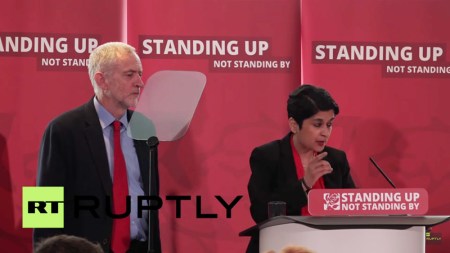
Consider the latest developments in the party’s recent unhappy history. Earlier this month the party’s specially commissioned inquiry into anti-Semitism within the party found the party not guilty of this bigotry for the second time in six months. Yet at the launch of these findings, a grassroots member of Jeremy Corbyn’s wing of the party verbally bullied a female Jewish Labour MP until she left in tears, and Jeremy Corbyn himself appeared to compare the Jewish state with ISIS. Although this episode captured some headlines, it was a mere footnote alongside the other catastrophes in the Labour party.

1678UK Labour party leader Jeremy Corbyn (left) appears at a press conference with left-wing campaigner Shami Chakrabarti (right), to present the findings of an inquiry into the Labour party’s anti-Semitism, June 30, 2016.

At the same time as this was going on, Labour MPs attempted a coup to get Jeremy Corbyn out of his position as head of the party. A carefully orchestrated set of resignations from his Shadow Cabinet came in every couple of hours until almost all of the Shadow Cabinet had resigned. Corbyn also lost the support of the deputy leader of the party, Tom Watson. A no-confidence motion saw 172 Labour MPs vote to say that they had no confidence in their party leader, while only 40 Labour MPs supported the party leader. This move meant that Jeremy Corbyn began to have significant trouble finding enough supporters in the Parliamentary Labour party to fill up his shadow cabinet. The joke in Westminster was that those few who did stay loyal to him would find themselves having to hold multiple briefs, so that somebody might easily find themselves being appointed Shadow Home Secretary and Shadow Foreign Secretary.

The trouble appears that all of Corbyn’s politics has a distinctly unfunny, nasty air. It emerged this week (from another declaration of no confidence in the leader) that earlier this year the Labour MP Thangam Debbonaire was both appointed and then sacked as the party’s Culture spokesperson, all within 24 hours and all without even being told, while she was undergoing treatment for cancer. Such stories of non-communication and cruelty towards individual MPs have fanned the rather understandable feeling that Jeremy Corbyn may not be suited to the highest peaks of politics.

Unfortunately for the Labour party, it is not only MPs who have a say. Under new rules unwisely drawn up under Corbyn’s predecessor, Ed Miliband, the Labour party can now be joined by anyone with £3 to spare. All such people then have the right to vote on who the Labour leader should be. Although the idea of having a say in any political party’s future for little more than the price of a cup of coffee may sound appealing, it also leaves a party open to the possibility of a hostile takeover from the most fanatical people in the country — whether they have the Labour party’s interests at heart or not. This is exactly what happened last year when Mr. Corbyn entered the Labour leadership race. Tens of thousands of people from the grassroots, who were soon to form themselves into the ‘Momentum’ movement, saw their chance to bring hard-left politics into the UK mainstream. Jeremy Corbyn won almost 60% of the vote in that election. In recent weeks, despite the formal no-confidence vote of the Labour MPs, this grassroots support for Corbyn only appears to have galvanised further. With the prospect of another Labour leadership election now gathering pace, tens of thousands more activists have joined the Labour party. It seems unlikely that they will be “moderates.”

Nevertheless, two “moderate” candidates for leader stepped forward, inevitably splitting the anti-Corbyn vote, until they seemed to realise this and one dropped out. Nevertheless, polls of party members suggest it looks overwhelmingly likely that in the coming weeks Corbyn will entrench his position by winning a landslide in a second ballot of the party’s members within a year.

Why does this matter? For two reasons. First, because the election of Corbyn has poisoned British politics. The election of an Islamist-sympathising, terrorist-sympathising, Israel-bashing hardliner at the head of the second largest party in the House of Commons undoubtedly changes the parameters of political discourse in the UK. However solidly Theresa May’s new Conservative government performs, it will always seem the point — so long as Corbyn is in office — that there is no party of the decent left available for the large proportion of voters who would like such a thing. This leaves countless patriotic, left-wing voters without a meaningful voice in Parliament.

A fractured and in-fighting opposition also means that there is no meaningful, organised voice challenging the government in Parliament. That principle — the principle on which our system is based — needs to work well even (perhaps especially) if you support the government of the day, because the government of the day needs to be kept alert to error and on top of sensible criticisms if it is going to pass the best legislation it can for the country.

The other reason why this principle matters is because it suggests that vested interests matter more than truth. Herbert Stein’s dictum lacked one crucial ingredient: people’s desire to look after themselves. There are Labour party MPs already looking for a way out, including looking to found a new party or parties. But they fear that way lies electoral oblivion. So they stay, in a party wracked with in-fighting and led by the most corrosive person their party has ever chosen in what had been a noble history. And all the while that person in charge of their party is busily mainstreaming the worst bigotries of our time. When pushed to decide between their morals and their careers, the dictum holds in the Labour party that things that cannot go on, find some way to do so.

Sharia in Denmark – Part II

July 20, 2016

Sharia in Denmark – Part II, Gatestone InstituteJudith Bergman, July 20, 2016

♦ “All the bullying happens in Arabic… The hierarchy of the Arab boys creates a very violent environment. … I have filmed the particularly vile bullying of a Somali boy. You can see the tears in his eyes. They are destroying him; it is very violent. ” — From a dissertation by Jalal El Derbas, Ph.D.

♦ Danish teachers are the least respected and are spoken of in denigrating and humiliating terms.

♦ “I am not saying that all the Arab children did ugly things, but we witnessed on a regular basis… using derogatory Arabic language towards Somalis and girls.” — Lise Egholm, former head of the Rådmandsgade school in Copenhagen.

♦ Whether Danish parliamentarians wish to acknowledge this problem or not, they are up against far wider issues than that of religious incitement in mosques by radical preachers.

After the television documentary, “Sharia in Denmark“, embarrassed Danish authorities by revealing how widespread the preaching of sharia is in mosques in Denmark, the Danish government, in May, concluded a political agreement about “initiatives directed against religious preachers who seek to undermine Danish laws and values and who support parallel legal systems”.

“We are doing everything we can without compromising the constitution and international agreements,” Bertel Haarder, the Minister for Culture and Church, said about the political agreement.

The agreement centers on a number of initiatives, which are supposed to compensate for the detrimental effects of all the years in which sharia was allowed to spread in Denmark while most authorities paid only scant attention to what was happening. Part of the new effort, therefore, will be the mapping of all existing mosques in Denmark.

It will now be obligatory, according to the agreement, for all priests, imams and others who are not part of the Church of Denmark, and who wish to be able to perform weddings — as well as for foreign preachers who apply for residence permits — to learn about Danish family law, freedom and democracy. At the end of the course, all will have to sign a statement that they will accept Danish law, including freedom of speech and religion, gender equality, freedom of sexual orientation, non-discrimination and women’s rights.

The government will examine how to create more transparency in foreign donations to faith communities in Denmark, including controlling and, if necessary, preventing such donations. As part of this work, on May 4 the government presented a law making it a crime to receive funding from a terror organization to establish or run an institution in Denmark, including schools and mosques.

Another element in the political agreement is the establishment of national lists with the names of traveling foreign (non-EU) religious preachers who will be excluded from entry into Denmark on the grounds that they are a threat to public order in Denmark. These named preachers will not be granted an entry visa and will be denied entry at the border. In addition, a non-public list, containing the names of such preachers who are EU citizens, will be established. The purpose of this list is to create awareness of the existence of these preachers, as, due to EU rules on free movement, they cannot be denied entry.

The final component of the agreement is the criminalization of certain speech. According to the agreement, it will become illegal explicitly to support terrorism, murder, rape, violence, incest, pedophilia, the use of force and polygamy as part of religious training, and whether or not the speech was made in private or in public. Both the activities of religious preachers and the activities of others, who speak as part of religious training, are included in the criminalization.

The political agreement is expected to become law when the Danish parliament reconvenes after the summer vacation.

Danish parliamentarians are aware that it will be difficult to measure whether these initiatives have any effect — how do you measure whether religious preachers are indeed not explicitly supporting terrorism, murder, rape and pedophilia, unless you place them under constant surveillance? But lawmakers are nevertheless confident that the new initiatives will have an effect. “This will have an impact on what people put up with from their religious leaders.” Culture and Church Minister Bertel Haarder says.

Another parliamentarian, Naser Khader, who appears more realistic, says,

“We are well aware that more initiatives are needed. But this stops hate preachers from coming to Denmark, preachers who only want to come here in order to sow discord between population groups and who encourage violence, incest and pedophilia.”


1703After the documentary “Sharia in Denmark” embarrassed Danish authorities, the government reached a new a political agreement, which Danish Member of Parliament Naser Khader supported, saying, “this stops hate preachers from coming to Denmark, preachers who only want to come here in order to sow discord between population groups and who encourage violence, incest and pedophilia.”

While Danish politicians have taken yet another step on an uncertain road that may or may not succeed in stemming the rise of sharia in Denmark, other problems abound, which compound the impression that this initiative will not amount to much more than a symbolic band-aid.

A recent Ph.D. dissertation by Jalal El Derbas, as reported by the Danish newspaper, Berlingske Tidende, shows that in several Danish schools with Arab students, the latter, mainly boys, use Arabic as a means to sexually and racially harass and bully other students as well as their teachers, especially girls, Somalis and ethnically Danish teachers, who do not understand the insults hurled at them in Arabic.

According to the article, El Derbas was shocked when he went through the video footage of 12- and 13-year-olds in two different Danish public schools with a majority of pupils with minority background. The purpose of his Ph.D. was to examine the possible causes of why bilingual boys — who speak both Danish and Arabic — continue to lag behind other Danish students. He wanted to see what those bilingual boys actually do in the classroom. The footage was taken over five months and it displayed a world characterized by hierarchy, sexual and religious harassment, bullying and racism, in which the first language of the students, Arabic, played a central and leading role. According to El Derbas:

“I could see that the students used Arabic as a secret code and they only used it negatively to disturb the schoolwork. If they did not want to do the work, they simply shifted to Arabic. The schools were very flexible and allowed the students to use Arabic both inside and outside the classroom. But all that this freedom accomplished was that the students shifted from Danish to Arabic if they were getting into a fight and if there was a teacher nearby whom they did not want to understand what they were saying.”

The video footage also revealed a hierarchy consisting of sexual harassment and racism, because the Arab boys consider themselves higher-ranking than girls and Somali students.

“All the bullying happens in Arabic. All the ugly and mean words are uttered in Arabic. The hierarchy of the Arab boys creates a very violent environment. I have video footage of severe sexual harassment against Arab girls and I have filmed the particularly vile bullying of a Somali boy. You can see the tears in his eyes. They are destroying him; it is very violent.”

According to El Derbas, Sunni and Shia Muslim strife is also imported into the grounds of these Danish schools. With the majority of the boys being Sunni Muslims, they look down on the Shia Muslim students and a teacher who is a Shia Muslim is called “Satan” or “witch”, whereas a Sunni Muslim teacher is addressed courteously as “uncle” or “aunt”. Danish teachers are the least respected, and are spoken of in denigrating and humiliating terms.

El Derbas, stressed that the pupils come from ghetto areas, saying:

“Many of the teachers have given up on engaging the parents in any way, but if this is to change it has to happen through the parents. Maybe it would help if the parents took turns of being present in the classroom to see how their children behave. Most of them [the parents] are not working or studying anyway. I think that could lead to an improvement. Because no parents will accept that their children behave in this manner”.

The results of the dissertation come as no surprise to Lise Egholm, now retired, but who for 18 years, until 2013, was the head of Copenhagen’s Rådmandsgade school, which has many Arab students.

“I am not saying that all the Arab children did ugly things,” says Egholm, “but we witnessed on a regular basis exactly the phenomenon of using derogatory Arabic language towards Somalis and girls… Back then the biggest group of children in the school was Arabic speaking, and the words which in Arabic mean ‘whore’ and ‘f— your mother’ they all knew.”

In a written statement to Berlingske Tidende, Minister of Education, Ellen Trane Nørby, wrote,

“It is never all right to bully, whether this happens in Danish, Arabic, or in a third language. That is why I have initiated a large initiative, which has as its purpose to prevent and combat bullying. The teachers have to signal very strongly that there has to be room for all children and that you have to treat other pupils with respect. If some pupils do not understand this and speak in ‘code language’ or use a language that excludes and bullies other pupils, the schools must intervene. Danish is the language used for teaching in Denmark, and pupils should not be excluded or bullied because of parallel languages in school”.

However, what the minister of education fails to mention is that the problems with this kind of behavior are not likely to remain inside the school, but will inevitably spill into the streets. Then what? No amount of lists of radical religious preachers and laws is going to change that fact.

Whether Danish parliamentarians wish to acknowledge this problem or not, they are up against far wider issues than that of religious incitement in mosques by radical preachers. Notably, El Derbas’s findings have not caused any debate remotely resembling that, which was caused by the “Sharia in Denmark” documentary. They should.

If Trump wins, a coup isn’t impossible here in the U.S.

July 20, 2016

Op-Ed If Trump wins, a coup isn’t impossible here in the U.S.

by James Kirchick

Source: If Trump wins, a coup isn’t impossible here in the U.S. – LA Times

Americans viewing the recent failed coup attempt in Turkey as some exotic foreign news story — the latest, violent yet hardly unusual political development to occur in a region constantly beset by turmoil — should pause to consider that the prospect of similar instability would not be unfathomable in this country if Donald Trump were to win the presidency.

Trump is the most brazenly authoritarian figure to secure the nomination of a major American political party. He expresses his support for all manner of strongmen, and his campaign manager, Paul Manafort, has actually worked for one: former Ukrainian president and Vladimir Putin ally Viktor Yanukovich. At the Republican National Convention here Monday, Manafort put some of the tricks he learned overseas as a dictator whisperer to good use, employing underhanded tactics to avoid a roll call vote on the convention’s rules package and quietly removing language from the party platform expressing support for Ukraine’s democratic aspirations.

Throughout the campaign, Trump has repeatedly bragged about ordering soldiers to commit war crimes, and has dismissed the possibility that he would face any resistance. “They won’t refuse,” he told Fox News’ Bret Baierearlier this year. “They’re not gonna refuse me. Believe me.”  When Baier insisted that such orders are “illegal,” Trump replied, “I’m a leader. I’ve always been a leader. I’ve never had any problem leading people. If I say do it, they’re going to do it.”

Oh really? Blimpish swagger might fly within the patriarchal confines of a family business, a criminal operation (the distinction is sometimes blurred) or a dictatorship. It does not, however, work in a liberal democracy, legally grounded by a written constitution, each branch restrained by separation of powers.

Try to imagine, then, a situation in which Trump commanded our military to do something stupid, illegal or irrational. Something so dangerous that it put the lives of Americans and the security of the country at stake. (Trump’s former rival for the Republican presidential nomination, Marco Rubio, said the United States could not trust “the nuclear codes” to an “erratic individual.”) Faced with opposition from his military brass, Trump would perhaps reconsider and back down. But what if he didn’t?

In that case, our military men and women, who swear to uphold the Constitution and a civilian chain of command, would be forced to choose between obeying the law and serving the wishes of someone who has explicitly expressed his utter lack of respect for it.

They might well choose the former.

“I would be incredibly concerned if a President Trump governed in a way that was consistent with the language that candidate Trump expressed during the campaign,” retired Air Force Gen. Michael Hayden, who served as head of the CIA and the National Security Agency under President George W. Bush, said in response to Trump’s autocratic ruminations. Asked by TV host Bill Maher what would happen if Trump told American soldiers to kill the families of terrorists, as he has promised to do, Hayden replied, “If he were to order that once in government, the American armed forces would refuse to act.”

“You are required not to follow an unlawful order,” Hayden added. “That would be in violation of all the international laws of armed conflict.”

Previously, in those rare situations when irreconcilable disagreements have arisen between America’s civilian and military leadership, it is the latter who were ultimately deemed out of line. This was the case when President Truman acrimoniously fired Gen. Douglas MacArthur after he publicly criticized Truman for denying him permission to bomb China in the midst of the Korean War. Though MacArthur returned to the United States with a hero’s welcome, Truman’s decision endures as one of the most important in the history of American civil-military relations.

Trump could pull a reverse-Truman, firing a general who refused to bomb.

If this scenario sounds implausible, consider that Trump has normalized so many once-outrageous things — from open racism to blatant lying. Needless to say, such dystopian situations are unimaginable under a President Hillary Clinton, who, whatever her faults, would never contemplate ordering a bombing run or — heaven forbid — a nuclear strike on a country just because its leader slighted her small hands at a summit. Rubio might detest her, but he cannot honestly say that Clinton, a former secretary of State, should not be trusted with the nation’s nuclear codes.

Trump is not only patently unfit to be president, but a danger to America and the world. Voters must stop him before the military has to.

James Kirchick is a fellow with the Foreign Policy Initiative. His book, “The End of Europe”, is forthcoming from Yale University Press.