Chris Christie Made a Case Against Hillary Clinton. We Fact-Checked, NY Times,
Like many indictments, the facts presented to the Republican jury were sometimes selective: not necessarily false, but often ignoring exculpatory evidence.
*********************************
CLEVELAND — Gov. Chris Christie of New Jersey, whom Donald J. Trump passed over to be his running mate, was one of the stars of the Republican convention’s second night on Tuesday, delivering a detailed case against Hillary Clinton with a prosecutorial zeal.
For about 15 minutes, he laid out one indictment of Mrs. Clinton after another, asking the audience after each one, “Guilty or not guilty?” It was part red meat, part courtroom procedural, and with each query, “GUILTY!” rang through the hall, interrupted only by an occasional, “Lock her up!”
Like many indictments, the facts presented to the Republican jury were sometimes selective: not necessarily false, but often ignoring exculpatory evidence. Below is a closer look at Mr. Christie’s case.
Mr. Christie started in North Africa, accusing Mrs. Clinton of being the “chief engineer of the disastrous overthrow of Qaddafi in Libya.” Pretending to be a prosecutor speaking to a jury, he urged the raucous crowd to render a verdict. The crowd roared, “Guilty!”
Fact check: Mrs. Clinton was secretary of state during the period in question, and she did make a humanitarian case for intervening to prevent Col. Muammar el-Qaddafi from taking over Benghazi in 2011, when it appeared that his forces might kill more than 10,000 Libyan citizens. President Obama has expressed regret that plans for the aftermath of the strikes were not well thought-out, and that the world was wrong to expect the rebels to build a stable government there.
In Nigeria, Mr. Christie said, Mrs. Clinton “amazingly fought for two years to keep an Al Qaeda affiliate off the terrorist watch list.” He said her actions had led directly to the kidnapping of hundreds of young girls by the group, Boko Haram, and demanded a verdict for “an apologist for an Al Qaeda affiliate.”
Fact check: The Clinton State Department did decline to add Boko Haram to its list of terrorist groups, in part because Islamic scholars and regional experts had urged it to try other means of confronting the group’s tactics. It did, however, put several Boko Haram leaders on other terrorist lists, and added the group in 2013.
Mr. Christie accused Mrs. Clinton of being “desperate for Chinese cash” and said that in exchange for money to finance the Obama administration’s stimulus package, she had promised China that she would oppose the “Buy America” provision in the legislation. For supporting “big-government spending financed by the Chinese,” he called, “guilty or not guilty?”
Fact check: The Obama administration and Mrs. Clinton opposed the “Buy America” provision because, they said, it was a protectionist measure that could cause a trade war with China in the midst of an economic crisis.
When Mr. Christie got to the topic of Syria, he reminded the crowd that Mrs. Clinton had called President Bashar al-Assad a reformer and “a different kind of leader.” He said she bore some responsibility for the deaths of the 400,000 people who have been killed in Syria’s civil war: as he put it, “dead at the hands of the man that Hillary defended.”
“As an awful judge of the character of a dictator and butcher in the Middle East,” he said, “guilty or not guilty?”
Fact check: Mrs. Clinton’s comments about Mr. Assad came in an interview in 2011, before much of the bloodshed, when she said that some members of Congress in both parties “believe he’s a reformer.” Some in the George W. Bush administration had also expressed hope that he would be a better leader than his father, Hafez al-Assad. And Mrs. Clinton did not “defend” the atrocities committed by Mr. Assad during the later period of the civil war.
Mr. Christie delivered a familiar critique of the signature agreement of the Obama administration, though it was reached a year ago last week, or two and a half years after Mrs. Clinton left the State Department. “She launched the negotiations that brought about the worst nuclear deal in history,” he said.
Fact check: Mrs. Clinton did indeed press the effort, sending two secret emissaries to feel out the Iranians about beginning talks. Mr. Christie’s assertion that “America and the world are measurably less safe” because of the deal is far more questionable: Iran gave up 98 percent of its nuclear fuel, dismantled vast numbers of centrifuges and other nuclear infrastructure, and so far appears to have stuck to everything it agreed to. (It is in the areas outside the agreement — missile launches and support for terrorism — that Iran is pushing the envelope.)
Mr. Christie accused Mrs. Clinton of giving President Vladimir V. Putin “that stupid, symbolic reset button,” and said she had harmed the United States’ security and sought instead to strengthen Russia.
Fact check: Mrs. Clinton did support a “reset” of relations with Russia early in the Obama administration, pursuing a hope of Mr. Obama’s that the United States could pull Russia into a closer and more effective working relationship. That effort failed as Mr. Putin consolidated power.
Mr. Christie said that Mrs. Clinton had “supported concessions to the Castro brothers” as part of the Obama administration’s outreach to Cuba. He also accused her of supporting the decision not to demand the release of a “cop killer” from Cuba who had murdered a New Jersey trooper. “As a coddler of the brutal Castro brothers,” he demanded, “guilty or not guilty?”
Fact check: Mrs. Clinton was already gone from the administration when Mr. Obama pursued secret negotiations with Cuba, though she did express support for his efforts.
Finally, Mr. Christie accused Mrs. Clinton of choosing to set up a private email server in her home in order to protect her personal secrets. “Let’s face the facts: Hillary Clinton cared more about protecting her own secrets than she cared about protecting America’s secrets,” he said.
Fact check: Mrs. Clinton’s motivations for setting up the personal server have never been entirely clear. She said it was for her “convenience,” so she would not have to use multiple devices, though the F.B.I. director, James B. Comey, said recently that she had used several devices anyway. The F.B.I. investigation did find that Mrs. Clinton sent email over the unsecured network while in adversarial countries, though it did not determine whether she “cared more” about protecting her own secrets.
The UK’s Broken Labour Party, Gatestone Institute, Douglas Murray, July 20, 2016
(As the morass continues, how will the UK deal with its exit from the European Union? — DM)
♦ With the prospect of another Labour leadership election now gathering pace, tens of thousands more activists have joined the Labour party. It seems unlikely that they will be “moderates.”
♦ The election of an Islamist-sympathising, terrorist-sympathising, Israel-bashing hardliner at the head of the second largest party in the House of Commons undoubtedly changes the parameters of political discourse in the UK.
♦ However solidly Theresa May’s new Conservative government performs, it will always seem the point — so long as Corbyn is in office — that you are either for Britain or against it, for the Conservative party or against the country.
♦ A fractured and in-fighting opposition also means that there is no meaningful, organised voice challenging the government in Parliament. That principle — the principle on which our system is based — needs to work well even (perhaps especially) if you support the government of the day, because the government of the day needs to be kept alert to error and on top of sensible criticisms if it is going to pass the best legislation it can for the country.
Herbert Stein’s law, “Things that cannot go on, won’t,” is one of the best laws of politics. It works for fiscal issues and it usually works for politics as a whole. The British Labour party, however, is currently working to try to disprove this rule. To do them justice they are having a good stab at doing so, which suggests that the maxim should perhaps be re-written: “Things that cannot go on sometimes do.”
Consider the latest developments in the party’s recent unhappy history. Earlier this month the party’s specially commissioned inquiry into anti-Semitism within the party found the party not guilty of this bigotry for the second time in six months. Yet at the launch of these findings, a grassroots member of Jeremy Corbyn’s wing of the party verbally bullied a female Jewish Labour MP until she left in tears, and Jeremy Corbyn himself appeared to compare the Jewish state with ISIS. Although this episode captured some headlines, it was a mere footnote alongside the other catastrophes in the Labour party.
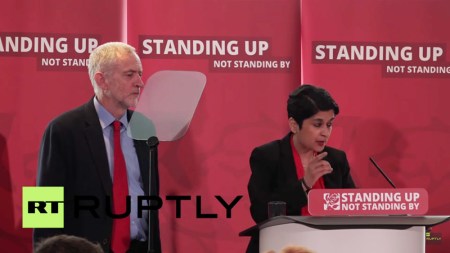 UK Labour party leader Jeremy Corbyn (left) appears at a press conference with left-wing campaigner Shami Chakrabarti (right), to present the findings of an inquiry into the Labour party’s anti-Semitism, June 30, 2016.
At the same time as this was going on, Labour MPs attempted a coup to get Jeremy Corbyn out of his position as head of the party. A carefully orchestrated set of resignations from his Shadow Cabinet came in every couple of hours until almost all of the Shadow Cabinet had resigned. Corbyn also lost the support of the deputy leader of the party, Tom Watson. A no-confidence motion saw 172 Labour MPs vote to say that they had no confidence in their party leader, while only 40 Labour MPs supported the party leader. This move meant that Jeremy Corbyn began to have significant trouble finding enough supporters in the Parliamentary Labour party to fill up his shadow cabinet. The joke in Westminster was that those few who did stay loyal to him would find themselves having to hold multiple briefs, so that somebody might easily find themselves being appointed Shadow Home Secretary and Shadow Foreign Secretary.
The trouble appears that all of Corbyn’s politics has a distinctly unfunny, nasty air. It emerged this week (from another declaration of no confidence in the leader) that earlier this year the Labour MP Thangam Debbonaire was both appointed and then sacked as the party’s Culture spokesperson, all within 24 hours and all without even being told, while she was undergoing treatment for cancer. Such stories of non-communication and cruelty towards individual MPs have fanned the rather understandable feeling that Jeremy Corbyn may not be suited to the highest peaks of politics.
Unfortunately for the Labour party, it is not only MPs who have a say. Under new rules unwisely drawn up under Corbyn’s predecessor, Ed Miliband, the Labour party can now be joined by anyone with £3 to spare. All such people then have the right to vote on who the Labour leader should be. Although the idea of having a say in any political party’s future for little more than the price of a cup of coffee may sound appealing, it also leaves a party open to the possibility of a hostile takeover from the most fanatical people in the country — whether they have the Labour party’s interests at heart or not. This is exactly what happened last year when Mr. Corbyn entered the Labour leadership race. Tens of thousands of people from the grassroots, who were soon to form themselves into the ‘Momentum’ movement, saw their chance to bring hard-left politics into the UK mainstream. Jeremy Corbyn won almost 60% of the vote in that election. In recent weeks, despite the formal no-confidence vote of the Labour MPs, this grassroots support for Corbyn only appears to have galvanised further. With the prospect of another Labour leadership election now gathering pace, tens of thousands more activists have joined the Labour party. It seems unlikely that they will be “moderates.”
Nevertheless, two “moderate” candidates for leader stepped forward, inevitably splitting the anti-Corbyn vote, until they seemed to realise this and one dropped out. Nevertheless, polls of party members suggest it looks overwhelmingly likely that in the coming weeks Corbyn will entrench his position by winning a landslide in a second ballot of the party’s members within a year.
Why does this matter? For two reasons. First, because the election of Corbyn has poisoned British politics. The election of an Islamist-sympathising, terrorist-sympathising, Israel-bashing hardliner at the head of the second largest party in the House of Commons undoubtedly changes the parameters of political discourse in the UK. However solidly Theresa May’s new Conservative government performs, it will always seem the point — so long as Corbyn is in office — that there is no party of the decent left available for the large proportion of voters who would like such a thing. This leaves countless patriotic, left-wing voters without a meaningful voice in Parliament.
A fractured and in-fighting opposition also means that there is no meaningful, organised voice challenging the government in Parliament. That principle — the principle on which our system is based — needs to work well even (perhaps especially) if you support the government of the day, because the government of the day needs to be kept alert to error and on top of sensible criticisms if it is going to pass the best legislation it can for the country.
The other reason why this principle matters is because it suggests that vested interests matter more than truth. Herbert Stein’s dictum lacked one crucial ingredient: people’s desire to look after themselves. There are Labour party MPs already looking for a way out, including looking to found a new party or parties. But they fear that way lies electoral oblivion. So they stay, in a party wracked with in-fighting and led by the most corrosive person their party has ever chosen in what had been a noble history. And all the while that person in charge of their party is busily mainstreaming the worst bigotries of our time. When pushed to decide between their morals and their careers, the dictum holds in the Labour party that things that cannot go on, find some way to do so.
Sharia in Denmark – Part II, Gatestone Institute, Judith Bergman, July 20, 2016
♦ “All the bullying happens in Arabic… The hierarchy of the Arab boys creates a very violent environment. … I have filmed the particularly vile bullying of a Somali boy. You can see the tears in his eyes. They are destroying him; it is very violent. ” — From a dissertation by Jalal El Derbas, Ph.D.
♦ Danish teachers are the least respected and are spoken of in denigrating and humiliating terms.
♦ “I am not saying that all the Arab children did ugly things, but we witnessed on a regular basis… using derogatory Arabic language towards Somalis and girls.” — Lise Egholm, former head of the Rådmandsgade school in Copenhagen.
♦ Whether Danish parliamentarians wish to acknowledge this problem or not, they are up against far wider issues than that of religious incitement in mosques by radical preachers.
After the television documentary, “Sharia in Denmark“, embarrassed Danish authorities by revealing how widespread the preaching of sharia is in mosques in Denmark, the Danish government, in May, concluded a political agreement about “initiatives directed against religious preachers who seek to undermine Danish laws and values and who support parallel legal systems”.
“We are doing everything we can without compromising the constitution and international agreements,” Bertel Haarder, the Minister for Culture and Church, said about the political agreement.
The agreement centers on a number of initiatives, which are supposed to compensate for the detrimental effects of all the years in which sharia was allowed to spread in Denmark while most authorities paid only scant attention to what was happening. Part of the new effort, therefore, will be the mapping of all existing mosques in Denmark.
It will now be obligatory, according to the agreement, for all priests, imams and others who are not part of the Church of Denmark, and who wish to be able to perform weddings — as well as for foreign preachers who apply for residence permits — to learn about Danish family law, freedom and democracy. At the end of the course, all will have to sign a statement that they will accept Danish law, including freedom of speech and religion, gender equality, freedom of sexual orientation, non-discrimination and women’s rights.
The government will examine how to create more transparency in foreign donations to faith communities in Denmark, including controlling and, if necessary, preventing such donations. As part of this work, on May 4 the government presented a law making it a crime to receive funding from a terror organization to establish or run an institution in Denmark, including schools and mosques.
Another element in the political agreement is the establishment of national lists with the names of traveling foreign (non-EU) religious preachers who will be excluded from entry into Denmark on the grounds that they are a threat to public order in Denmark. These named preachers will not be granted an entry visa and will be denied entry at the border. In addition, a non-public list, containing the names of such preachers who are EU citizens, will be established. The purpose of this list is to create awareness of the existence of these preachers, as, due to EU rules on free movement, they cannot be denied entry.
The final component of the agreement is the criminalization of certain speech. According to the agreement, it will become illegal explicitly to support terrorism, murder, rape, violence, incest, pedophilia, the use of force and polygamy as part of religious training, and whether or not the speech was made in private or in public. Both the activities of religious preachers and the activities of others, who speak as part of religious training, are included in the criminalization.
The political agreement is expected to become law when the Danish parliament reconvenes after the summer vacation.
Danish parliamentarians are aware that it will be difficult to measure whether these initiatives have any effect — how do you measure whether religious preachers are indeed not explicitly supporting terrorism, murder, rape and pedophilia, unless you place them under constant surveillance? But lawmakers are nevertheless confident that the new initiatives will have an effect. “This will have an impact on what people put up with from their religious leaders.” Culture and Church Minister Bertel Haarder says.
Another parliamentarian, Naser Khader, who appears more realistic, says,
“We are well aware that more initiatives are needed. But this stops hate preachers from coming to Denmark, preachers who only want to come here in order to sow discord between population groups and who encourage violence, incest and pedophilia.”
 After the documentary “Sharia in Denmark” embarrassed Danish authorities, the government reached a new a political agreement, which Danish Member of Parliament Naser Khader supported, saying, “this stops hate preachers from coming to Denmark, preachers who only want to come here in order to sow discord between population groups and who encourage violence, incest and pedophilia.”
While Danish politicians have taken yet another step on an uncertain road that may or may not succeed in stemming the rise of sharia in Denmark, other problems abound, which compound the impression that this initiative will not amount to much more than a symbolic band-aid.
A recent Ph.D. dissertation by Jalal El Derbas, as reported by the Danish newspaper, Berlingske Tidende, shows that in several Danish schools with Arab students, the latter, mainly boys, use Arabic as a means to sexually and racially harass and bully other students as well as their teachers, especially girls, Somalis and ethnically Danish teachers, who do not understand the insults hurled at them in Arabic.
According to the article, El Derbas was shocked when he went through the video footage of 12- and 13-year-olds in two different Danish public schools with a majority of pupils with minority background. The purpose of his Ph.D. was to examine the possible causes of why bilingual boys — who speak both Danish and Arabic — continue to lag behind other Danish students. He wanted to see what those bilingual boys actually do in the classroom. The footage was taken over five months and it displayed a world characterized by hierarchy, sexual and religious harassment, bullying and racism, in which the first language of the students, Arabic, played a central and leading role. According to El Derbas:
“I could see that the students used Arabic as a secret code and they only used it negatively to disturb the schoolwork. If they did not want to do the work, they simply shifted to Arabic. The schools were very flexible and allowed the students to use Arabic both inside and outside the classroom. But all that this freedom accomplished was that the students shifted from Danish to Arabic if they were getting into a fight and if there was a teacher nearby whom they did not want to understand what they were saying.”
The video footage also revealed a hierarchy consisting of sexual harassment and racism, because the Arab boys consider themselves higher-ranking than girls and Somali students.
“All the bullying happens in Arabic. All the ugly and mean words are uttered in Arabic. The hierarchy of the Arab boys creates a very violent environment. I have video footage of severe sexual harassment against Arab girls and I have filmed the particularly vile bullying of a Somali boy. You can see the tears in his eyes. They are destroying him; it is very violent.”
According to El Derbas, Sunni and Shia Muslim strife is also imported into the grounds of these Danish schools. With the majority of the boys being Sunni Muslims, they look down on the Shia Muslim students and a teacher who is a Shia Muslim is called “Satan” or “witch”, whereas a Sunni Muslim teacher is addressed courteously as “uncle” or “aunt”. Danish teachers are the least respected, and are spoken of in denigrating and humiliating terms.
El Derbas, stressed that the pupils come from ghetto areas, saying:
“Many of the teachers have given up on engaging the parents in any way, but if this is to change it has to happen through the parents. Maybe it would help if the parents took turns of being present in the classroom to see how their children behave. Most of them [the parents] are not working or studying anyway. I think that could lead to an improvement. Because no parents will accept that their children behave in this manner”.
The results of the dissertation come as no surprise to Lise Egholm, now retired, but who for 18 years, until 2013, was the head of Copenhagen’s Rådmandsgade school, which has many Arab students.
“I am not saying that all the Arab children did ugly things,” says Egholm, “but we witnessed on a regular basis exactly the phenomenon of using derogatory Arabic language towards Somalis and girls… Back then the biggest group of children in the school was Arabic speaking, and the words which in Arabic mean ‘whore’ and ‘f— your mother’ they all knew.”
In a written statement to Berlingske Tidende, Minister of Education, Ellen Trane Nørby, wrote,
“It is never all right to bully, whether this happens in Danish, Arabic, or in a third language. That is why I have initiated a large initiative, which has as its purpose to prevent and combat bullying. The teachers have to signal very strongly that there has to be room for all children and that you have to treat other pupils with respect. If some pupils do not understand this and speak in ‘code language’ or use a language that excludes and bullies other pupils, the schools must intervene. Danish is the language used for teaching in Denmark, and pupils should not be excluded or bullied because of parallel languages in school”.
However, what the minister of education fails to mention is that the problems with this kind of behavior are not likely to remain inside the school, but will inevitably spill into the streets. Then what? No amount of lists of radical religious preachers and laws is going to change that fact.
Whether Danish parliamentarians wish to acknowledge this problem or not, they are up against far wider issues than that of religious incitement in mosques by radical preachers. Notably, El Derbas’s findings have not caused any debate remotely resembling that, which was caused by the “Sharia in Denmark” documentary. They should.
Op-Ed If Trump wins, a coup isn’t impossible here in the U.S.
by James Kirchick
Source: If Trump wins, a coup isn’t impossible here in the U.S. – LA Times
Americans viewing the recent failed coup attempt in Turkey as some exotic foreign news story — the latest, violent yet hardly unusual political development to occur in a region constantly beset by turmoil — should pause to consider that the prospect of similar instability would not be unfathomable in this country if Donald Trump were to win the presidency.
Trump is the most brazenly authoritarian figure to secure the nomination of a major American political party. He expresses his support for all manner of strongmen, and his campaign manager, Paul Manafort, has actually worked for one: former Ukrainian president and Vladimir Putin ally Viktor Yanukovich. At the Republican National Convention here Monday, Manafort put some of the tricks he learned overseas as a dictator whisperer to good use, employing underhanded tactics to avoid a roll call vote on the convention’s rules package and quietly removing language from the party platform expressing support for Ukraine’s democratic aspirations.
Throughout the campaign, Trump has repeatedly bragged about ordering soldiers to commit war crimes, and has dismissed the possibility that he would face any resistance. “They won’t refuse,” he told Fox News’ Bret Baierearlier this year. “They’re not gonna refuse me. Believe me.” When Baier insisted that such orders are “illegal,” Trump replied, “I’m a leader. I’ve always been a leader. I’ve never had any problem leading people. If I say do it, they’re going to do it.”
Oh really? Blimpish swagger might fly within the patriarchal confines of a family business, a criminal operation (the distinction is sometimes blurred) or a dictatorship. It does not, however, work in a liberal democracy, legally grounded by a written constitution, each branch restrained by separation of powers.
Try to imagine, then, a situation in which Trump commanded our military to do something stupid, illegal or irrational. Something so dangerous that it put the lives of Americans and the security of the country at stake. (Trump’s former rival for the Republican presidential nomination, Marco Rubio, said the United States could not trust “the nuclear codes” to an “erratic individual.”) Faced with opposition from his military brass, Trump would perhaps reconsider and back down. But what if he didn’t?
In that case, our military men and women, who swear to uphold the Constitution and a civilian chain of command, would be forced to choose between obeying the law and serving the wishes of someone who has explicitly expressed his utter lack of respect for it.
They might well choose the former.
“I would be incredibly concerned if a President Trump governed in a way that was consistent with the language that candidate Trump expressed during the campaign,” retired Air Force Gen. Michael Hayden, who served as head of the CIA and the National Security Agency under President George W. Bush, said in response to Trump’s autocratic ruminations. Asked by TV host Bill Maher what would happen if Trump told American soldiers to kill the families of terrorists, as he has promised to do, Hayden replied, “If he were to order that once in government, the American armed forces would refuse to act.”
“You are required not to follow an unlawful order,” Hayden added. “That would be in violation of all the international laws of armed conflict.”
Previously, in those rare situations when irreconcilable disagreements have arisen between America’s civilian and military leadership, it is the latter who were ultimately deemed out of line. This was the case when President Truman acrimoniously fired Gen. Douglas MacArthur after he publicly criticized Truman for denying him permission to bomb China in the midst of the Korean War. Though MacArthur returned to the United States with a hero’s welcome, Truman’s decision endures as one of the most important in the history of American civil-military relations.
Trump could pull a reverse-Truman, firing a general who refused to bomb.
If this scenario sounds implausible, consider that Trump has normalized so many once-outrageous things — from open racism to blatant lying. Needless to say, such dystopian situations are unimaginable under a President Hillary Clinton, who, whatever her faults, would never contemplate ordering a bombing run or — heaven forbid — a nuclear strike on a country just because its leader slighted her small hands at a summit. Rubio might detest her, but he cannot honestly say that Clinton, a former secretary of State, should not be trusted with the nation’s nuclear codes.
Trump is not only patently unfit to be president, but a danger to America and the world. Voters must stop him before the military has to.
James Kirchick is a fellow with the Foreign Policy Initiative. His book, “The End of Europe”, is forthcoming from Yale University Press.
HUMPHRIES: Our troops are political pawns to the Obama administration
– – Thursday, June 5, 2014
Source: HUMPHRIES: Our troops are political pawns to the Obama administration – Washington Times
H/T L.S
Democrats never miss a chance to proclaim their love for the troops, but you can see from the Bowe Bergdahl story that it’s a very qualified sort of love.
Within two days of speaking up about the conditions of Bergdahl’s disappearance — pretty clearly not the battlefield capture of a war hero the Obama Administration portrayed it as — White House aides were slandering every man who served with Bergdahl for “swift boating” him.
Now, “swift boating” has a very specific meaning to Democrats. The term comes from the Swift Boat Veterans for Truth, a group of Vietnam vets who spoke out against falsehoods and distortions peddled by John Kerry during his presidential run. It’s an article of religious faith on the Left that the Swift Boat Veterans were somehow “discredited,” even though the majority of their criticisms were right on target and Kerry was forced to retract some of his more fanciful war stories. When a liberal talks about “swift boating,” he means unfair attacks launched by partisan operatives.
Unfortunately for the White House, the media is tugging at the threads of its story as it unravels. The Washington Post got in touch with some of the Afghan villagers who encountered Bergdahl after he left his post, and they confirmed he was not captured in battle. It seemed pretty clear he was trying to find the Taliban. Some of the villagers thought he was crazy, or maybe smoking hashish. I guess that whole village must be full of “swift boaters.”
It’s also been reported that troops involved in the search for Bergdahl over the past five years were forced to sign non-disclosure agreements. Something similar was done with survivors of the Benghazi attacks.
One man who served alongside Bergdahl, former Army Spc. Josh Fuller, said everyone in the unit knew Bergdahl had deserted but they were instructed not to tell the truth about it. That’s some awesome love and respect for the troops there.
Military commanders and intelligence officials protested the release of the five incredibly dangerous Taliban captives President Obama traded away. You can also watch my exclusive interview with the former “warden” at Gitmo, Col. Mike Bumgarner (ret.) to hear his personal stories of these detainees and why they are a danger.
A source at the Pentagon told Time magazine that Obama’s release of the prisoners was a victory for White House and State Department officials who wanted the military to “suck it up and salute.”
“Suck it up and salute.” Feel the love, soldiers of America!
It’s not difficult for most Americans to choose between troops who served in Afghanistan and Obama’s team of political hacks when it’s time to decide who knows the real story about Bergdahl. The White House lied about nearly every detail of the Taliban prisoner swap, and it’s all coming apart at the seams around them, faster than any scandal of the past six years has ever exploded.
This was supposed to be a distraction from the VA scandal. Instead, it reinforced everything bad for Obama about that story, and contains echoes of Benghazi too — right down to National Security Adviser Susan Rice getting sent onto Sunday talk shows to lie about how Bergdahl “served with distinction” and was captured in battle.
Military vets and their families were supposed to shut up and play their parts as pawns in Obama’s latest political game. They didn’t play along, so now they’re under attack from liberals. They don’t like pawns who talk back.
I don’t believe our soldiers should ever be treated as pawns. These men and women put their lives on the line for our country and deserve the respect that goes along with it. Not to be used, to get some politician out of the news for a few days.
Turkey Set for Emergency Measures to Quell Post-Coup Turmoil
BY:
July 20, 2016 10:39 am
Source: Turkey Set for Emergency Measures to Quell Post-Coup Turmoil
By Humeyra Pamuk and Nick Tattersall
ISTANBUL (Reuters) – Turkey will announce emergency measures on Wednesday to try to shore up stability and prevent damage to the economy as it purges thousands of members of the security forces, judiciary, civil service and academia after an abortive coup.
Around 50,000 soldiers, police, judges, civil servants and teachers have been suspended or detained since the military coup attempt, raising tensions across the country of 80 million which borders Syria’s chaos and is a Western ally against Islamic State.
Academics were banned from traveling abroad on Wednesday in what a Turkish official said was a temporary measure to prevent the risk of alleged coup plotters in universities from fleeing. State TRT television said 95 academics had been removed from their posts at Istanbul University alone.
“Universities have always been crucial for military juntas in Turkey and certain individuals are believed to be in contact with cells within the military,” the official said.
President Tayyip Erdogan blames the network of U.S.-based cleric Fethullah Gulen for Friday night’s attempted coup, in which more than 230 people were killed as soldiers commandeered fighters jets, military helicopters and tanks to try to overthrow the government.
Erdogan has vowed to clean the “virus” responsible for the plot from all state institutions. The depth and scale of the purges have raised concern among Western allies that Erdogan is trying to suppress all dissent, and that opponents unconnected with the plot will be caught in the net.
He will chair meetings in his palace on Wednesday of the cabinet and the National Security Council, after which a series of emergency measures are expected to be announced.
In a sign of how shaken Turkey’s leadership has been by the coup attempt, with dozens of generals arrested as well as Erdogan’s aide de camp, government ministers and top officials have not been briefed in advance of the meetings.
“The cabinet meeting is classified at the highest level for national security reasons. The palace will give ministers a dossier just beforehand,” one senior official told Reuters.
“Ministers do not yet know what is going to be discussed.”
Around a third of Turkey’s roughly 360 serving generals have been detained since the coup bid, a second senior official said, with 99 charged pending trial and 14 more being held.
The threat of prolonged instability in a NATO member country, which had not seen a violent military coup for more than three decades, has shaken investors’ confidence.
The lira hit a 10-month low in early trade on Wednesday, touching 3.063 to the dollar. The Istanbul stock index is down 8 percent so far this week, its worst three-day performance since 2013. The cost of insuring Turkish debt against default rose to its highest in nearly a month, according to data from Markit.
Deputy Prime Minister Mehmet Simsek told Reuters a priority in the measures to be discussed on Wednesday would be preventing damage to the economy. He also said on Twitter they would be “market-friendly” and would prioritize structural reform.
MILITARY CHIEF REFUSED TO BACK COUP BID
Around 1,400 people were wounded as soldiers commandeered tanks, attack helicopters and warplanes, strafing parliament and the intelligence headquarters and trying to seize the main airport and bridges in Istanbul.
At the height of the abortive coup, the rebel pilots of two F-16 fighter jets had Erdogan’s plane in their sights as he returned to Istanbul from a holiday on the coast. Erdogan said he was almost killed or captured by the mutineers.
In testimony published by the Hurriyet newspaper and corroborated by a Turkish official, an infantry lieutenant-colonel said the coup plotters had tried to persuade military chief Hulusi Akar, who was being held hostage, to join the effort to overthrow Erdogan but that he had refused.
“When he refused, they couldn’t convince the senior commanders either. Akar’s refusal to be a part of this paved the way for the failure of the coup attempt,” the written transcript published by the newspaper said.
Erdogan, Prime Minister Binali Yildirim, ministers, senior commanders and generals had been due to be taken one by one during the night of the coup bid, the testimony said.
Turkey’s Western allies have expressed solidarity with the government over the coup attempt but have also voiced increasing alarm at the scale and swiftness of the response, urging it to adhere to democratic values.
On Tuesday, authorities shut down media outlets deemed to be supportive of Gulen and said 15,000 people had been suspended from the education ministry along with 100 intelligence officials. A further 492 people were removed from duty at the Religious Affairs Directorate, 257 at the prime minister’s office and 300 at the energy ministry.
Those moves come after the detention of more than 6,000 members of the armed forces, from foot soldiers to commanders, and the suspension of close to 3,000 judges and prosecutors. About 8,000 police officers, including in the capital Ankara and the biggest city Istanbul, have also been removed.
U.N. High Commissioner for Human Rights, Zeid Ra’ad Al Hussein, voiced “serious alarm” on Tuesday at the mass suspension of judges and prosecutors and urged Turkey to allow independent monitors to visit those who have been detained.
The foreign ministry has said criticism of the government’s response amounts to backing the coup.
TENSIONS WITH U.S.
Erdogan’s spokesman said on Tuesday the government was preparing a formal request to the United States for the extradition of Gulen. U.S. President Barack Obama discussed the status of Gulen in a telephone call with Erdogan on Tuesday, the White House said, urging Ankara to show restraint as it pursues those responsible for the coup attempt.
Seventy-five-year-old Gulen, who lives in self-imposed exile in Pennsylvania but has a network of supporters within Turkey, has condemned the abortive coup and denied any role in it.
A former ally-turned critic of Erdogan, he suggested the president staged it as an excuse for a crackdown after a steady accumulation of control during 14 years in power.
Prime Minister Yildirim accused Washington, which has said it will consider Gulen’s extradition only if clear evidence is provided, of double standards in its fight against terrorism.
Yildirim said the justice ministry had sent a dossier to U.S. authorities on Gulen, whose religious movement blends conservative Islamic values with a pro-Western outlook and who has a network of supporters within Turkey.
White House spokesman Josh Earnest confirmed Ankara had filed materials in electronic form with the U.S. government, which officials were reviewing. Any extradition request from Turkey, once submitted, would be evaluated under the terms of a treaty between the two countries, he added.
Such a request would face legal and political hurdles in the United States. Even if approved by a judge, it would still have to go to Secretary of State John Kerry, who can consider non-legal factors, such as humanitarian arguments.
“I urge the U.S. government to reject any effort to abuse the extradition process to carry out political vendettas,” Gulen said on Tuesday in a statement issued by the Alliance for Shared Values, a group associated with the cleric.
Turkish Civil War
Source: Turkish Civil War – Liberty Vibe
What is really going on in Turkey’s Civil War?
Two Muslim factions are fighting each other for control.
Obama’s friend Tayyip Erdagon is the recognized ruler of Turkey. These two gentlemen are also NATO allies. Erdogan is known for having ties with the Muslim brotherhood. Endrogan ties to Muslim Brotherhood
Fethulllah Gulen is a Muslim cleric who lives in Pennsylvania. He is the assumed leader of the military coup that occurred on July 16th. He is also the founder of Harmony and Magnolia STEM charter schools in America. Reports have been leaking for some time now that these schools are front organizations for radicalizing American school children, into Gelen’s cultish version of Islam. American parents believe they are giving their children a leg up in academics at these schools. They have no idea what is really going on. These charter schools are taxpayer funded, and largely employ H1 B workers from… you guessed it…Turkey. As stated before, Obama is friends with Erdogan. But it is not uncommon for the United States to lend assistance in both sides in foreign conflicts. Keep in mind that Gelen’s Harmony schools are a huge contributor to Hillary’s campaign. I think Erdagon senses a double cross.Islamic Cleric tied to Clinton Foundation
Erdogan and Gelen are rivals, and Erdogan has stated that Gelen is responsible for Turkish coup, and is demanding Gelen’s extradition back to Turkey.
Erdogan has closed the Incirlik Military Airport in Turkey from American use until Gelen is returned. He is also holding 1500 US servicemen hostage. Mainstream media is telling us that this is the airport that Turkey allows us to use to fight Isis. This however is not the real reason why the closure of this airport is a problem.
The real reason is the NATO agreement the United States has with Turkey: You see, one of the benefits of being in NATO is the “sharing” of nuclear weapons. Turkey has been kind enough to be the storage facility of many of NATO’s nukes. Currently, Turkey is housing upwards of 90 of these nuclear weapons in a facility in this airport. In short, Turkey is holding these weapons “hostage” until they get what they want from us.





 anneinpt
 artaxes
 danmillerinpanama
 davidking1530
 Peter Hofman
 Joseph Wouk
 Peter
Peter Louisiana Steve
 WarSclerotic
Recent Comments