Archive for July 18, 2016

Does the disappearance of 42 Turkish jets mean the coup is not over?

July 18, 2016

Does the disappearance of 42 Turkish jets mean the coup is not over? DEBKAfile, July 18, 2016

DEBKAfile reports that 42 Turkish Air Force planes have vanished with their crews and ordnance – and so has the pair of F16 warplanes which bombed parliament in Ankara and nearly intercepted the incoming flight carrying President Reccep Erdogan back home Saturday. Their disappearance appears to be prompting the president and prime minister to urge citizens to continue turning out in town squares support of the government, in case the coup threat is not over.

Hundreds of police descended Monday on the big Incirlik air base which houses the US jets which carry out air strikes over Syria and Iraq, along with thousands of US air force personnel and their families.

Former Turkish air force commander Gen Akin Ozturk was quoted by the state news agency Anadolu as having confessed to interrogators that he “acted with intention to stage a coup.” He was shown with several injuries to his head and upper body. Ozturk was one of 70 generals and admirals who were detained. Eleven had so far been placed under arrest. More than 8,000 police officers were also suspended and forced to hand over their weapons.

A sweeping purge of state institutions has been underway since Erdogan took charge Saturday


Why is Virginia a Haven for Would-be Jihadists?

July 18, 2016

Why is Virginia a Haven for Would-be Jihadists? Investigative Project on Terrorism, Abigail R. Esman, July 18, 2016

1709

What is it about Virginia?

Already this year, six men from the “Cavalier State” have been arrested on terror-related charges – two of them in July alone. Another man has joined the Islamic State in Syria. Two of those charged were stopped from making a similar trip.

These most recent arrests, one on July 3, the other on July 8, were based on charges of planning to provide material support to ISIS. Mohamed Bailor Jalloh, a former member of the National Guard who was arrested July 3, allegedly discussed planning an attack against U.S. military in the homeland inspired by fellow Virginian Nidal Hasan’s 2009 shooting at Fort Hood. According to court documents, Jalloh quit the Guard and later attempted to obtain funds and weapons for a domestic attack after being inspired by Anwar al Awlaki’s videos on YouTube.

Five days later, Virginia law enforcement arrested Haris Qamar, following an extended FBI sting operation. According to an FBI affidavit, Qamar made statements to an informant such as, “By-bye, DC, stupid a— kufar [infidels], kill ’em all,” and posted to his Twitter account a prayer for “strength to the mujahedeen to slaughter every single US military officer.”

Earlier arrests this year – two in June and one in January – involved men planning to join the jihad in Syria, rather than waging domestic battles. In one case, Mohamad Jamal Khweis, who had already joined the Islamic State, surrendered to Kurdish forces in Iraq in an apparent effort to escape the hell of life in the new caliphate. Now awaiting sentencing in the United States, he faces up to 20 years in prison and a $250,000 fine.

Why does this keep happening in Virginia? What makes its young Muslims more susceptible to the radical messages from Awlaki and ISIS social media?

Virginia has proved to be an active center for radical Islamist activity over the years and has bred more than its share of terrorists since 9/11. It was at the Hamas-linked Dar al Hijrah mosque in Falls Church, for instance, that terrorist icon Anwar al-Awlaki, the Yemeni-American whom counter-terrorism officials say inspired hundreds of other Muslims to take arms in violent jihad, once served as imam. Among his disciples: Fort Hood shooter Nidal Hasan; Ahmed Omar Abu Ali, convicted in 2005 of collaborating with al-Qaida and plotting to assassinate President George W. Bush; and several of the 9/11 hijackers.

And it was in Virginia that, in the still fragile and bewildered aftermath of 9/11, “Beltway snipers” John Allen Mohammed and Lee Boyd Malvo shot and killed more than 12 people, including an FBI analyst, in October 2002.

While internet and social media remain powerful weapons in the terrorist recruitment arsenal, personal connections remain the most potent tool. Honor student Ali Shukri Amin, charged with soliciting donations for ISIS, is also suspected of helping another Virginian, Reza Niknejad, travel to Syria.

While none of the recent cases implicate specific mosques, the influence of Dar al Hijrah and some of its imams appears to have been widespread.

To some extent, this could be thanks to its current imam, Shaker Elsayed. In 2002, hetold a conference hosted by the Muslim American Society and Islamic Circle for North America that deciding whether suicide bombers were martyrs was “an in house business” for Muslims.

In a dramatic speech available online since 2013, Elsayed rants against the West and calls for “the power of faith” and “the power of armament.” In the post-9/11 world, he observes, even world leaders have “bowed down” to the Western pressure. “We the Muslim masses should never bow down except to Allah!” he says, “and this will give us our dignity back.”

But other Virginia religious leaders have gone further. Ali al-Timimi, a cancer researcher, was the “spiritual leader” of a group of 11 men convicted of terrorism in 2003 and 2004, Al-Timimi is now serving a life sentence for recruiting Muslims to travel to Pakistan and train for holy war.

Shortly after 9/11, according to the New York Times’ coverage of his trial, al-Timimi invited a group of young Muslim men to dinner, where he told them they had a religious duty to fight with the Taliban against American forces. Prosecutors described that statement as “treason,” calling al-Timimi a “purveyor of hate and war.”

More than 10 years after his conviction, al-Timimi remains a figurehead among radical groups in Virginia and the Capitol district. The Peace and Justice Foundation, which defended al-Timimi and his followers, refers in online documents to a government conspiracy, while numerous web sites offer recordings of al-Timimi’s lectures. In addition, a Facebook page devoted to his appeal with more than 2,000 “likes,” has built a community in his support. (Followers even raised $12,000 for his mother’s medical care.)

The Saudi-sponsored Islamic Saudi Academy, which shut down abruptly last month,faced criticism for its textbooks that promote Wahhabism, an extreme version of Islam practiced by the Saudis. The textbooks contained passages “that extolled jihad and martyrdom, called for victory over one’s enemies, and said the killing of adulterers and apostates was ‘justified,'” the Washington Post reported. Those passages were found in school textbooks two years after U.S. officials, shocked by the texts in use in 2006, ordered they be revised. Pre-revision books included statements like, “It is said: the apes are the people of the Sabbath, the Jews. The swine are the unbelievers of Jesus’ table, the Christians.”

The school’s 1999 valedictorian, Ahmed Omar Abu Ali, was convicted in 2005 for supporting al-Qaida and planning to assassinate the president. (Notably, he also taught Islamic Studies at Dar Al Hijrah.)

As Seamus Hughes of the Program on Extremism at George Washington University’s Center or Cyber & Homeland Security told Fox News, “Northern Virginia has a disproportionate number of people that are drawn to this.”

Ramy Zamzam is a poster child for this observation. He was among five young men who disappeared from their northern Virginia neighborhood in late 2009, only to be arrested by Pakistani authorities who caught them trying to cross into Afghanistan to join jihadists there.

“We are not terrorists,” he said outside a hearing. “We are jihadists, and jihad is not terrorism.”

Muslim groups expressed their horror over the incident and promised a program aimed at de-radicalization.

It’s not clear that any such plan ever emerged. If it did, it’s clearly not working.

How the Clinton Foundation Got Rich off Poor Haitians

July 18, 2016

How the Clinton Foundation Got Rich off Poor Haitians, National Review, Dinesh D’Souza, July 18, 2016

EDITOR’S NOTE: The following article is excerpted from Dinesh D’Souza’s new book, Hillary’s America: The Secret History of the Democratic Party.

In January 2015 a group of Haitians surrounded the New York offices of the Clinton Foundation. They chanted slogans, accusing Bill and Hillary Clinton of having robbed them of “billions of dollars.” Two months later, the Haitians were at it again, accusing the Clintons of duplicity, malfeasance, and theft. And in May 2015, they were back, this time outside New York’s Cipriani, where Bill Clinton received an award and collected a $500,000 check for his foundation. “Clinton, where’s the money?” the Haitian signs read. “In whose pockets?” Said Dhoud Andre of the Commission Against Dictatorship, “We are telling the world of the crimes that Bill and Hillary Clinton are responsible for in Haiti.”

Haitians like Andre may sound a bit strident, but he and the protesters had good reason to be disgruntled. They had suffered a heavy blow from Mother Nature, and now it appeared that they were being battered again — this time by the Clintons. Their story goes back to 2010, when a massive 7.0 earthquake devastated the island, killing more than 200,000 people, leveling 100,000 homes, and leaving 1.5 million people destitute.

The devastating effect of the earthquake on a very poor nation provoked worldwide concern and inspired an outpouring of aid money intended to rebuild Haiti. Countries around the world, as well as private and philanthropic groups such as the Red Cross and the Salvation Army, provided some $10.5 billion in aid, with $3.9 billion of it coming from the United States.

Haitians such as Andre, however, noticed that very little of this aid money actually got to poor people in Haiti. Some projects championed by the Clintons, such as the building of industrial parks and posh hotels, cost a great deal of money and offered scarce benefits to the truly needy. Port-au-Prince was supposed to be rebuilt; it was never rebuilt. Projects aimed at creating jobs proved to be bitter disappointments. Haitian unemployment remained high, largely undented by the funds that were supposed to pour into the country. Famine and illness continued to devastate the island nation.

The Haitians were initially sympathetic to the Clintons. One may say they believed in the message of “hope and change.” With his customary overstatement, Bill told the media, “Wouldn’t it be great if they become the first wireless nation in the world? They could, I’m telling you, they really could.”

I don’t blame the Haitians for falling for it; Bill is one of the world’s greatest story-tellers. He has fooled people far more sophisticated than the poor Haitians. Over time, however, the Haitians wised up. Whatever their initial expectations, many saw that much of the aid money seems never to have reached its destination; rather, it disappeared along the way.

Where did it go? It did not escape the attention of the Haitians that Bill Clinton was the designated UN representative for aid to Haiti. Following the earthquake, Bill Clinton had with media fanfare established the Haiti Reconstruction Fund. Meanwhile, his wife Hillary was the United States secretary of state. She was in charge of U.S. aid allocated to Haiti. Together the Clintons were the two most powerful people who controlled the flow of funds to Haiti from around the world.

The Haitian protesters noticed an interesting pattern involving the Clintons and the designation of how aid funds were used. They observed that a number of companies that received contracts in Haiti happened to be entities that made large donations to the Clinton Foundation. The Haitian contracts appeared less tailored to the needs of Haiti than to the needs of the companies that were performing the services. In sum, Haitian deals appeared to be a quid pro quo for filling the coffers of the Clintons.

For example, the Clinton Foundation selected Clayton Homes, a construction company owned by Warren Buffett’s Berkshire Hathaway, to build temporary shelters in Haiti. Buffett is an active member of the Clinton Global Initiative who has donated generously to the Clintons as well as the Clinton Foundation. The contract was supposed to be given through the normal United Nations bidding process, with the deal going to the lowest bidder who met the project’s standards. UN officials said, however, that the contract was never competitively bid for.

Clayton offered to build “hurricane-proof trailers” but what they actually delivered turned out to be a disaster. The trailers were structurally unsafe, with high levels of formaldehyde and insulation coming out of the walls. There were problems with mold and fumes. The stifling heat inside made Haitians sick and many of them abandoned the trailers because they were ill-constructed and unusable.

The Clintons also funneled $10 million in federal loans to a firm called InnoVida, headed by Clinton donor Claudio Osorio. Osorio had loaded its board with Clinton cronies, including longtime Clinton ally General Wesley Clark; Hillary’s 2008 finance director Jonathan Mantz; and Democratic fundraiser Chris Korge who has helped raise millions for the Clintons.

Normally the loan approval process takes months or even years. But in this case, a government official wrote, “Former President Bill Clinton is personally in contact with the company to organize its logistical and support needs. And as Secretary of State, Hillary Clinton has made available State Department resources to assist with logistical arrangements.” InnoVida had not even provided an independently audited financial report that is normally a requirement for such applications. This requirement, however, was waived. On the basis of the Clinton connection, InnoVida’s application was fast-tracked and approved in two weeks.

InnoVida had not even provided an independently audited financial report that is normally a requirement for such applications. This requirement, however, was waived. On the basis of the Clinton connection, InnoVida’s application was fast-tracked and approved in two weeks.

The company, however, defaulted on the loan and never built any houses. An investigation revealed that Osorio had diverted company funds to pay for his Miami Beach mansion, his Maserati, and his Colorado ski chalet. He pleaded guilty to wire fraud and money laundering in 2013, and is currently serving a twelve-year prison term on fraud charges related to the loan.

Several Clinton cronies showed up with Bill to a 2011 Housing Expo that cost more than $2 million to stage. Bill Clinton said it would be a model for the construction of thousands of homes in Haiti. In reality, no homes have been built. A few dozen model units were constructed but even they have not been sold. Rather, they are now abandoned and have been taken over by squatters.

THE SCHOOLS THEY NEVER BUILT

USAID contracts to remove debris in Port-au-Prince went to a Washington-based company named CHF International. The company’s CEO David Weiss, a campaign contributor to Hillary in 2008, was deputy U.S. trade representative for North American Affairs during the Clinton administration. The corporate secretary of the board, Lauri Fitz-Pegado, served in a number of posts in the Clinton administration, including assistant secretary of commerce.The Clintons claim to have built schools in Haiti. But the New York Times discovered that when it comes to the Clintons, “built” is a term with a very loose interpretation. For example, the newspaper located a school featured in the Clinton Foundation annual report as “built through a Clinton Global Initiative Commitment to Action.” In reality, “The Clinton Foundation’s sole direct contribution to the school was a grant for an Earth Day celebration and tree-building activity.”

USAID contracts also went to consulting firms such as New York–based Dalberg Global Development Advisors, which received a $1.5 million contract to identify relocation sites for Haitians. This company is an active participant and financial supporter of the Clinton Global Initiative. A later review by USAID’s inspector general found that Dalberg did a terrible job, naming uninhabitable mountains with steep ravines as possible sites for Haitian rebuilding.

Foreign governments and foreign companies got Haitian deals in exchange for bankrolling the Clinton Foundation. The Clinton Foundation lists the Brazilian construction firm OAS and the InterAmerican Development Bank (IDB) as donors that have given it between $1 billion and $5 billion.

The IDB receives funding from the State Department, and some of this funding was diverted to OAS for Haitian road-building contracts. Yet an IDB auditor, Mariela Antiga, complained that the contracts were padded with “excessive costs” to build roads “no one needed.” Antiga also alleged that IDB funds were going to a construction project on private land owned by former Haitian president Rene Preval — a Clinton buddy — and several of his cronies. For her efforts to expose corruption, Antiga was promptly instructed by the IDB to pack her bags and leave Haiti.

In 2011, the Clinton Foundation brokered a deal with Digicel, a cell-phone-service provider seeking to gain access to the Haitian market. The Clintons arranged to have Digicel receive millions in U.S. taxpayer money to provide mobile phones. The USAID Food for Peace program, which the State Department administered through Hillary aide Cheryl Mills, distributed Digicel phones free to Haitians.

Digicel didn’t just make money off the U.S. taxpayer; it also made money off the Haitians. When Haitians used the phones, either to make calls or transfer money, they paid Digicel for the service. Haitians using Digicel’s phones also became automatically enrolled in Digicel’s mobile program. By 2012, Digicel had taken over three-quarters of the cell-phone market in Haiti. Digicel is owned by Denis O’Brien, a close friend of the Clintons. O’Brien secured three speaking engagements in his native Ireland that paid $200,000 apiece. These engagements occurred right at the time that Digicel was making its deal with the U.S. State Department. O’Brien has also donated lavishly to the Clinton Foundation, giving between $1 million and $5 million sometime in 2010–2011.

Digicel is owned by Denis O’Brien, a close friend of the Clintons. O’Brien secured three speaking engagements in his native Ireland that paid $200,000 apiece. These engagements occurred right at the time that Digicel was making its deal with the U.S. State Department. O’Brien has also donated lavishly to the Clinton Foundation, giving between $1 million and $5 million sometime in 2010–2011.

Coincidentally the United States government paid Digicel $45 million to open a hotel in Port-au-Prince. Now perhaps it could be argued that Haitians could use a high-priced hotel to attract foreign investors and provide jobs for locals. Thus far, however, this particular hotel seems to employ only a few dozen locals, which hardly justifies the sizable investment that went into building it. Moreover, there are virtually no foreign investors; the rooms are mostly unoccupied; the ones that are taken seem mainly for the benefit of Digicel’s visiting teams.

In addition, the Clintons got their cronies to build Caracol Industrial Park, a 600-acre garment factory that was supposed to make clothes for export to the United States and create — according to Bill Clinton — 100,000 new jobs in Haiti. The project was funded by the U.S. government and cost hundreds of millions in taxpayer money, the largest single allocation of U.S. relief aid.

Yet Caracol has proven a massive failure. First, the industrial park was built on farmland and the farmers had to be moved off their property. Many of them feel they were pushed out and inadequately compensated. Some of them lost their livelihoods. Second, Caracol was supposed to include 25,000 homes for Haitian employees; in the end, the Government Accountability Office reports that only around 6,000 homes were built. Third, Caracol has created 5,000 jobs, less than 10 percent of the jobs promised. Fourth, Caracol is exporting very few products and most of the facility is abandoned. People stand outside every day looking for work, but there is no work to be had, as Haiti’s unemployment rate hovers around 40 percent.

The Clintons say Caracol can still be salvaged. But former Haitian prime minister Jean Bellerive says, “I believe the momentum to attract people there in a massive way is past. Today, it has failed.” Still, Bellerive’s standard of success may not be the same one used by the Clintons. After all, the companies that built Caracol with U.S. taxpayer money have done fine — even if poor Haitians have seen few of the benefits.

Then there is the strange and somehow predictable involvement of Hillary Clinton’s brother Hugh Rodham. Rodham put in an application for $22 million from the Clinton Foundation to build homes on ten thousand acres of land that he said a “guy in Haiti” had “donated” to him.

“I deal through the Clinton Foundation,” Rodham told the New York Times. “I hound my brother-in-law because it’s his fund that we’re going to get our money from.” Rodham said he expected to net $1 million personally on the deal. Unfortunately, his application didn’t go through.

Rodham had better luck, however, on a second Haitian deal. He mysteriously found himself on the advisory board of a U.S. mining company called VCS. This by itself is odd because Rodham’s resume lists no mining experience; rather, Rodham is a former private detective and prison guard.

The mining company, however, seems to have recognized Rodham’s value. They brought him on board in October 2013 to help secure a valuable gold mining permit in Haiti. Rodham was promised a “finder’s fee” if he could land the contract. Sure enough, he did. For the first time in 50 years, Haiti awarded two new gold mining permits and one of them went to the company that had hired Hillary’s brother.

The deal provoked outrage in the Haitian Senate. “Neither Bill Clinton nor the brother of Hillary Clinton are individuals who share the interest of the Haitian people,” said Haitian mining representative Samuel Nesner. “They are part of the elite class who are operating to exploit the Haitian people.”

Is this too harsh a verdict? I wouldn’t go so far as to say the Clintons don’t care about Haiti. Yet it seems clear that Haitian welfare is not their priority. Their priority is, well, themselves. The Clintons seem to believe in Haitian reconstruction and Haitian investment as long as these projects match their own private economic interests. They have steered the rebuilding of Haiti in a way that provides maximum benefit to themselves.

No wonder the Clintons refused to meet with the Haitian protesters. Each time the protesters showed up, the Clintons were nowhere to be seen. They have never directly addressed the Haitians’ claims. Strangely enough, they have never been required to do so. The progressive media scarcely covered the Haitian protest. Somehow the idea of Haitian black people calling out the Clintons as aid money thieves did not appeal to the grand pooh-bahs at CBS News, the New York Times, and NPR. For most Democrats, the topic is both touchy and distasteful. It’s one thing to rob from the rich but quite another to rob from the poorest of the poor. Some of the Democratic primary support for Bernie Sanders was undoubtedly due to Democrats’ distaste over the financial shenanigans of the Clintons. Probably these Democrats considered the Clintons to be unduly grasping and opportunistic, an embarrassment to the great traditions of the Democratic party.

For most Democrats, the topic is both touchy and distasteful. It’s one thing to rob from the rich but quite another to rob from the poorest of the poor. Some of the Democratic primary support for Bernie Sanders was undoubtedly due to Democrats’ distaste over the financial shenanigans of the Clintons. Probably these Democrats considered the Clintons to be unduly grasping and opportunistic, an embarrassment to the great traditions of the Democratic party.


Middle East Strategic Outlook – July 2016

July 18, 2016

Middle East Strategic Outlook – July 2016, Gatestone InstituteShmuel Bar, July 18, 2016

♦ It may be expected that in the coming months, the Syrian efforts to implement “ethnic cleansing” of Sunnis in the north will continue and even escalate, resulting in a growing stream of refugees into Turkey, Lebanon and Jordan. This will continue to destabilize these countries and to pose a challenge to a weakened Europe.

♦ The overt American support for the Iranian involvement in Iraq will also serve to rally Sunnis to an anti-American position, while actually exacerbating the main problem — the sectarian divide. Therefore, the American involvement in the Fallujah campaign will not buy it Sunni gratitude.

♦ Iran is entering a new stage of war in Syria which evokes the situation that the Soviet Union found itself in in Afghanistan in 1985. Like the Soviet Union in that stage of the Afghan war, Iran has achieved no decisive victory, but has incurred significant domestic opposition to the war and has no additional resources that could tip the scales.

♦ The explanation put forward by the American administration that the attacks reflect the Islamic State’s “despair” in the face of its defeats in Syria and Iraq over the last months is specious. International terrorism “to strike fear in the hearts of Allah’s enemies” has been a hallmark of the Islamic State since its beginning and it does not need the excuse of military defeat in Syria and Iraq to continue to carry out such attacks.

Saudi Arabia

Approval of the National Transformation Plan

The Saudi Cabinet approved (June 6) the National Transformation Program (NTP), part of Saudi Vision 2030, led by Deputy Crown Prince Muhammad bin Salman. The NTP is supposed to be the basis for laying out targets to be met by government ministries and departments. The NTP was well received not only be the Saudi mainstream media (to be expected) but by the Saudi social media that represents to a great degree the public opinion of the younger Saudi generation. It may be expected that Prince Mohammad bin Salman will continue to take steps in the framework of his initiative that will, at least, preserve the sense of momentum and the public support he is enjoying.

Saudi-US Relations

In this framework, Mohammad bin Salman visited Washington DC in a bid to sell his project and himself as the future Saudi leader. During the visit, and especially in the meetings with officials from Congress and the security and intelligence Community, he also sought to build his own stature as future king and as the leader who must be at the helm throughout the period of implementation of his “Vision 2030” plan and beyond. His goal therefore was also to usurp Crown Prince Mohammad bin Nayef’s status as the favorite of the Washington officialdom as the successor to King Salman. This status derived not only from Washington’s respect of the Saudi rules of succession, but also from his years-long and tight cooperation with US agencies on security and counter-terrorism issues. Therefore, Mohammad bin Salman made an effort to project himself as a preferred effective interlocutor on those issues. The fact that Mohammad bin Salman was accorded meetings with President Obama, an honor usually reserved for heads of state, and the red-carpet reception he received, indicates that the administration now considers him as a likely future king and therefore seeks to establish a dialog with him and influence him.

Iraq

The War against the Islamic State

The liberation of Fallujah from the “Islamic State” after a month-long campaign (23 May-26 June) may be an important milestone is not the “beginning of the end” and it will certainly not lead to a stronger and more unified Iraqi state. The campaign and its anticipated aftermath will only exacerbate the sectarian divide in the country and encourage further conflict, whether in the name of the “Islamic State” or its successor under another name

The overt American support for the Iranian involvement[1] will also serve to rally Sunnis to an anti-American position. By backing a military campaign against Sunnis in which Shiite militias and Iran played a direct role, the US-led international coalition was fighting against the symptom — the Islamic State — while actually exacerbating the main problem: the sectarian divide in Iraq. Therefore, the American involvement in the Fallujah campaign will not buy it Sunni gratitude. The view of the US as pro-Shiite and pro-Iranian must have been enhanced by Secretary of State John Kerry’s statement (28 June) that Iran’s presence in Iraq is helpful to American attempts to beat back the threat of the Islamic State, and the praise heaped on the Shiite militias by the US special envoy tasked with defeating the Islamic State, Brent McGurk[2].
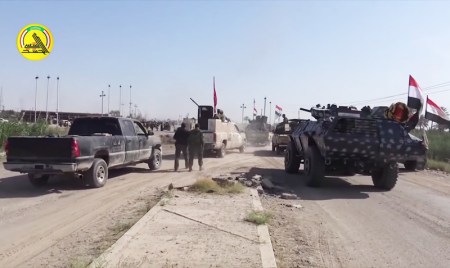
1701Iraqi army units and Shiite militias during the assault on Fallujah, June 2016

Many Sunnis — in Fallujah and elsewhere in Anbar Province — view the Fallujah campaign as part of a strategic Iranian plan to take control, through its Iraqi proxies, of central and western Iraq, from the Diala Governorate on the Iraq-Iran border to the Iraqi-Syrian border, in order to create a safe land-bridge from Iran through Syria to Lebanon. To achieve this objective, the Sunnis of western Iraq have to be weakened and denied the ability to stage a meaningful resistance[3].

No End to the Political Stalemate Expected

The paralysis of the Iraqi Parliament further complicates the situation. The parliament cannot reach agreement on the composition of a new cabinet, and cannot pass the 2016 budget. While Iraq can continue to muddle along with a caretaker government under al-‘Abadi (just as Lebanon “survives” without electing a president), passing a reduced 2016 budget is a sine qua non for execution of the agreement that that the government reached in May with the International Monetary Fund (IMF) for a low-interest loan of $5.4 billion and for loans from other international institutions.

Iran’s interest is to maintain its control over the government in Baghdad, On one hand, this calls for a relatively stable and cohesive Shiite establishment. On the other hand, Iran enhances its position in Baghdad by playing one party against the other and positioning itself as the only acceptable broker between the different Shiite factions. In the eyes of Tehran, Muqtada al-Sadr is a loose cannon, and al-‘Abadi is too close to the West and therefore must be held in check. By maintaining the innate instability of the Shiite political system, Iran attempts to preserve the Iraqi Shiites’ dependency on it to bridge the differences between the different factions.

Therefore, the Shiite infighting will continue as long as al-Sadr is around. This is clear to Iran and to al-Sadr’s rivals and increases the possibility that an attempt will be made to assassinate him. In such a case, the reaction of those elements in the Shiite community who currently support him will be violent and extreme, possibly ultimately leading to the total breakdown of the Shiite political establishment that Iran is trying to prevent.

Iran and Hezbollah in Syria and Iraq

In contrast to its singular status as power-broker in Iraq, the situation in Syria and Lebanon does not bode well for the Iranian strategy. Since these two theaters are critical for Iran’s regional designs, it has no options for an exit strategy, disengagement or even reduction of its footprint. Its primary agent, Hezbollah is suffering setbacks on all the fronts. Without massive Russian military support in Syria, Hezbollah has had to resort to repeated tactical withdrawals and it and the Iranian forces are suffering increasingly heavy fatalities, wounded and fighters taken as prisoners by the Syrian Sunni rebels. In addition to that, the rebels know their own turf better, limiting Hezbollah’s ability to deploy more troops in the more sensitive areas of the theater. Nevertheless, Hezbollah is committed to increase its footprint in the Syrian theater and cannot back down — even as its growing casualties cause increasing discontent within its Shiite Lebanese constituency[4].

Iran is entering a new stage of war in Syria which evokes the situation that the Soviet Union found itself in in Afghanistan in 1985. Until that year, the Soviet Union achieved no decisive victory over the mujahedeen, but also did not lose any battle on the ground. Like the Soviet Union in that stage of the Afghan war, Iran has achieved no decisive victory, but has incurred significant domestic opposition to the war and has no additional resources that could tip the scales. In light of this, our forecast is that the current situation in Syria will become a stalemate for all the parties at least in the months to come.

Israel-Syria-Lebanon

In these circumstances, a conflict with Israel does not serve the interests of either Iran, Hezbollah or Syria. Therefore, all four parties (and Russia) have adapted themselves to a routine of tolerance towards Israeli attacks on Syrian and Hezbollah targets that endanger Israel directly or threaten Israel’s “strategic edge” in the Syrian-Lebanese theater. In a series of actions directed towards enhancing Israel’s deterrence, the IDF held an extensive war game (12-14 June) based on a scenario of confrontation with Hezbollah. Subsequently, Israeli aircraft hit a Syrian military target near the Israeli border and uncharacteristically released a communiqué that the target had indeed belonged to the Syrian regime and had been hit in response to shelling by the Syrians near the border fence.

Hezbollah seems to be losing its predominance even within the Lebanese theater itself, where it had been almost unchallenged for decades. The attrition of Hezbollah in Lebanon is weakening it within the Shiite community. At the same time, the large (1.4 million) Syrian Sunni refugee population has effectively changed the demographic status quo in Lebanon and created a large restive population for whom Iran, Shiites and particularly Hezbollah are the prime enemy.

Syria

Bashar Assad is defiant, but not delusional

On June 7, Bashar Assad delivered a speech to the newly “elected” Syrian Parliament. This was his first major speech since the collapse of the peace talks sponsored by the International Syria Support Group (ISSG) in Geneva in April. Assad vowed to retake every inch of the country from his enemies, and effectively dismissed the concept of a peaceful transition of power, which is at the heart of the ISSG’s approach to the resolution of the crisis.

Assad is not — as the US State Department implied — “delusional”. He clearly perceives no military or political threat to his rule. He may rationally asses that Secretary Kerry’s reported “Plan B” that called for escalated military action if Assad continued his defiance will not receive support of President Obama, who will be reluctant to increase the American military involvement in Syria and to risk damaging Iranian-American relations and the nuclear agreement, which is the centerpiece of Obama’s foreign policy legacy.

Assad also most probably assesses that neither Hillary Clinton, whose Libyan experience will discourage her from intervention, nor Donald Trump, who has laid out a non-interventionist foreign policy approach, would undertake a more active involvement in Syria than that of President Obama. Assad therefore felt free to obstruct the international efforts to transport emergency aid to civilians trapped in rebel-held areas, and to reject in his speech the August 1 deadline set by the US for developing a transition plan leading to his stepping down.

Assad’s attitude, the limits of the American, Iranian and Russian interventions and the absence of any additional forces that could appear in the theater and tip the scales means that the war will grind on. It may be expected, therefore, that in the coming months, the Syrian efforts to implement “ethnic cleansing” of Sunnis in the north will continue and even escalate, resulting in a growing stream of refugees into Turkey, Lebanon and Jordan. This will continue to destabilize these countries and to pose a challenge to a weakened Europe.

Iran

New Political Appointments

It may be assumed that the Iranian leadership understands that restoring full control by the Assad regime over all of Syria is unrealistic and it has an undeclared “Plan B”. This would entail defining “useful Syria” as the stretch of land from Damascus along Lebanon’s border through Homs to Aleppo and along the Syrian coast that would be essential for the above objectives. This “useful Syria,” however, does not correspond territorially with the “useful Syria” that Russia envisions. Russia’s “useful Syria” focuses on maintaining a viable “Alawistan” that would enable Russia to maintain a beachhead on the Mediterranean and a presence on the Turkish border.

There has been disagreement inside the Iranian power elite since the Syrian uprising began to deteriorate into a full-fledged civil war. The disagreement focused on the extent of the Iranian investment of resources to support Assad’s objective of restoring the regime’s control over the entire country.

The Islamic Revolutionary Guards Corps (IRGC), which dominated the policy on Syria and was the key executor of the policy through the Qods Force and Hezbollah, has supported these objectives. Other Iranian power-brokers — notably those associated with the Rouhani camp — have warned against a Syrian quagmire and have opposed tying Iran to Assad’s fate. They argue that while it is of strategic importance to prevent Syria from falling into the hands of radical Sunni groups, it is not prudent to insist on Assad remaining in office, particularly in view of his use of chemical weapons against his own population. (The use of chemical weapons is a sensitive issue in Iran since their use by Saddam Hussain against the Iranians in the Iran-Iraq war.)

The recent appointment of Rear Admiral Ali Shamkhani as military and security coordinator of the Iran-Syria-Russia joint cooperation group, and the reshuffle in the Foreign Ministry, may indicate a move towards willingness to project more flexibility vis-à-vis the Syrian peace process even before the anti-Assad forces have been crushed militarily, and a formal willingness to consider the possibility of a post-war Syria without Assad personally.

This was implied in the statement by Iranian Foreign Minister Javad Zarif after his meeting with US Secretary of State John Kerry, that “there will be no solution if we focus on any individual [i.e. Bashar Assad],” and that the process must “focus on institutional dispersion of power and the future form of governance, through which it will be possible to reduce or even eliminate the centrality of the role of any individual or ethnicity.”

If Iran no longer insists on Bashar Assad staying in power, it could open the road to some procedural progress in the peace talks, which have been blocked by the dispute regarding his future, with Western powers and the Sunni Arab states insisting on his departure. However, the damage done by the civil war is irreversible. Even if some formula is found that would facilitate negotiations, the crux of the crisis is whether Syria will return to be dominated or even co-ruled by an Alawite minority. The Assad regime and Iran (and even Russia) cannot accept a Sunni-dominated Syria that would inevitably take revenge on the Alawites and destroy all the assets that Iran has built up over the last thirty years.

The Financial Sanctions Issue

The US administration is continuing in its determined efforts to convince the Western business community to invest in Iran. In May, John Kerry and US Treasury Department officials met with European bankers in London to tell them “legitimate business” is available to them in Iran and to “dispel any rumors” regarding future American sanctions on Iran. The administration’s message was that as long as the banks do their normal due diligence, “they are not going to be held to some undefined and inappropriate standard.”

Nevertheless, the international banking system continues to view Iran as high-risk and is likely to continue to do so for the foreseeable future. Regardless of the credibility of the guarantees of the current American administration, which will not be in office after January 2017, the reluctance of the international financial community to approach Iran derives from real risk assessment. Iran ranks 130th (out of 168) on Transparency International’s “Corruption Perception Index” and 118th on the World Bank’s “Ease of Doing Business” list.

Given the current state of affairs, these goals are far from achievable. The approval of the Iran Petroleum Contract (IPC) model does not guarantee its implementation, given the opaque and informal character of the Iranian economy. The goals of the regime’s Five Year Plan are also not clearly detailed and it is difficult to see how they can be achieved. Furthermore, Iran cannot comply with the Financial Action Task Force (FATF) rules without a fundamental transformation of its economic structure and the very essence and worldview of the regime. Taking into consideration the leadership structure, the predominance of the Supreme Leader and the position of the IRGC in economy, such a move is impossible.

The Kurdish Factor

The alliance between the Patriotic Union of Kurdistan (PUK) and the Movement for Change (Gorran) is openly challenging the Barzani clan’s dominance of Kurdish politics and raises the pressure on Massoud Barzani. To consolidate his popularity among the Iraqi Kurdistan Region’s population, Massoud Barzani might therefore resort to “patriotic” acts, like holding his promised referendum on Kurdish independence soon, which PUK-Gorran will not be able to oppose. This could lead to “Kurexit” (Kurdish exit from Iraq), which would be the result not of well-thought-out strategic planning but of Kurdish political infighting.

Israeli-Turkish “Reconciliation”

The Israeli-Turkish reconciliation is a formal step that will certainly not revive the golden age of Israeli-Turkish relations. Turkey will continue to support Hamas and to incite against Israel in international fora, though it will stick to the letter of the agreement and will take advantage of the economic opportunities afforded by the reconciliation.

The French Peace Initiative

The chances that the French peace initiative will succeed in relaunching the Israeli-Palestinian peace process are very slim. The Israeli position remains that negotiations must take place directly between Israel and the Palestinians, and not through international fora. The French initiative, however, will encourage the Palestinian Authority to reject alternative proposals for direct negotiations, pending the international conference.

Terrorism

The spate of terrorist attacks by the Islamic State during the period of this report highlights the disconnect between the situation on the ground in Syria and Iraq and the threat of Islamic State or al-Qaeda inspired jihadi terrorism in susceptible countries. Most the latest attacks took place in Muslim countries (Istanbul, Turkey in June; Dhaka, Bangladesh in June; Baghdad, Iraq in June, and Mecca, Qatif and Medina in Saudi Arabia on July 4) in which the ability to “profile” potential attackers is limited and security measures are weak.

The explanation put forward by the American administration that the attacks reflect the Islamic State’s “despair” in the face of its defeats in Syria and Iraq over the last months is specious. International terrorism “to strike fear in the hearts of Allah’s enemies” has been a hallmark of the Islamic State since its beginning and it does not need the excuse of military defeat in Syria and Iraq to continue to carry out such attacks. Furthermore, these attacks were obviously planned many weeks or even months in advance. The Islamic State will continue to attempt to carry out such attacks according to its strategy to project its jihad into the heartland of its enemies — into Europe and in the territory of its enemies in the Middle East.

Spotlight on the Saudi Economic Transformation Plan

Deputy Crown Prince Muhammad bin Salman’s economic plan represents far more than economic change: it calls for no less than a transformation of the nature of the Saudi state and political order through creation of an economically independent citizenry. The developments in the level of education of the Saudi population and particularly the potential of Saudi women entering the upper levels of the workforce, coupled with the high level of unemployment among those parts of the society, are among the unspoken drivers of the Vision 2030 plan. The goal of this process is to gradually replace the waning traditional tribal and clerical power base of the regime with a young professional economic power base out of concern that the high percentage of (unemployed) youth in the country would be a recipe for social unrest that, along with the loss of the influence of the traditional Wahhabi power base to more radical anti-establishment Salafi clerics, may destabilize the country.

Mohammad bin Salman seeks therefore to mobilize their support by making Saudi society advanced technologically and by creating a large number of jobs in technology. Monitoring of social media shows significant support for Mohammad bin Salman and his plans among the younger Saudi population, including high expectations that the economic initiatives will be followed by social change — loosening religious controls and social restrictions, expanding women’s rights and increasing social mobility. The Saudi leadership, however, is on the horns of a dilemma; accelerated change will raise the ire of the conservative elements in the elite, whereas a sense among the younger population that change is too slow will give rise to a crisis of expectations and subsequent instability.

_______________________

[1] Secretary of State, John Kerry, declared that Iran has been very “helpful” in Iraq.

[2] McGurk said that Iran-backed Shiite militias are mostly helpful in Iraq, though some go rogue: Most of them do operate under the control of the Iraqi state, but about 15-20% of them actually do not, “and those groups are a fundamental problem”.

[3] This Sunni suspicion finds support in statements of senior Shiite Iraqi leaders like former PM Nouri al-Maliki, whose hard-handed policies towards the Sunnis in Anbar Province fed the rise of the “Islamic State”, and who now praises the role of Iran and the Shiite militias, and accuses Iraq’s Sunni political leaders of supporting terrorism.

[4] Hassan Nasrallah (26 June): “The defense of Aleppo is the defense of the rest of Syria, it is the defense of Damascus, it is also the defense of Lebanon, and of Iraq. … It was necessary for us to be in Aleppo and we will stay in Aleppo. We will increase our presence in Aleppo…”.

Massacre of Cops in Baton Rouge

July 18, 2016

Massacre of Cops in Baton Rouge, Front Page MagazineMatthew Vadum, July 18, 2016

cops

CLEVELAND — In what is becoming a depressingly regular occurrence in the Obama era, police officers were murdered by a black militant in a shootout in Baton Rouge on Sunday, apparently in revenge for the recent police-involved death of black career criminal Alton Sterling outside a Baton Rouge food store.

At time of writing, three police officers had succumbed to the injuries they suffered in Louisiana’s capital city. Another three were wounded.

Of course, murdering police officers has long been encouraged by activists with the Marxist, anti-American, revolutionary Black Lives Matter cult, with the support of the activist Left and financing from speculator George Soros. A year ago Nation of Islam leader Louis Farrakhan, who openly advocates the mass murder of whites, called for “10,000 fearless men” to “rise up and kill those who kill us.” Like many radicals, Farrakhan mischaracterizes Black Lives Matter as a rising civil rights movement.

President Barack Hussein Obama, who a decade ago promoted inter-racial warfare in Kenya, has long tried to provoke civil unrest here in the U.S. with his hateful anti-cop rhetoric and his relentless demonization of opponents. His goal is fundamental transformation of the United States. A Red diaper baby who identifies violence-espousing communist Frantz Fanon as an intellectual influence, he has also steadfastly refused to condemn Black Lives Matter. In fact Obama has lavished attention on the movement’s leaders and invited them to the White House over and over again.

The Baton Rouge attack came 10 days after a black militant murdered five Dallas area police officers, the deadliest attack on U.S. law enforcement since Sept. 11, 2001.

A few days later Obama flew to Dallas and attended a memorial service at which he lectured the dead officers’ relatives about how racist and brutal police officers are. The very next day Obama hosted leaders of Black Lives Matter, whose members urge the murder of cops, at the White House.

The Baton Rouge attack came 12 days after local police killed homeless recidivist Sterling during an altercation. Sterling, who had reportedly threatened a passer-by with a gun, violently resisted arrest and tried to grab a policeman’s gun.

The shooter in Baton Rouge was killed by police following an exchange of gunfire outside a fitness center. He has been identified as Gavin Eugene Long, who claimed to have been a member of Nation of Islam. He also reportedly turned 29 yesterday.

Long was honorably discharged from the U.S. Marines in 2010. A fervent racist, he ranted against “crackers,” the Daily Caller reports.

Long, who also used the name Cosmo Ausar Setepenra, talked about the Dallas massacre and recent police shootings of black men in social media posts, according to Heavy. “Violence is not THE answer (its [sic] a answer), but at what point do you stand up so that your people dont [sic] become the Native Americans…EXTINCT?,” he tweeted July 13.

Referring to the death of Alton Sterling, he said, “If I would have been there with Alton — clap,” Long said in a July 14 video. In the video he also discussed black liberation theology and said he wrote a book.

“I wrote it for my dark-skinned brothers,” he said of the book.

“If you look at all the rebels like Black Panthers, Huey P. Newton, Malcolm X … Elijah Muhammad, they was light-skinned. But we know how hard y’all got it.”

In another video, Long justified his fellow ex-soldier and black militant Micah X. Johnson’s killing of cops in Dallas. “It’s justice, you know what I’m saying,” Long said.

Long may also have telegraphed his plans in a cryptic Twitter post early Sunday morning. He wrote, “Just [because] you wake up every morning doesn’t mean that you’re living. And just [because] you shed your physical body doesn’t mean that you’re dead.”

The officers Long killed are Brad Garafola, 45, Matthew Gerald, 41, and Montrell Jackson, 32.

Jackson, a black man, had poignantly sounded a note of despair in a Facebook post July 8, three days after Sterling’s death at the hands of police and as racial tensions ramped up in Baton Rouge and across the nation.

“I’m tired physically and emotionally. Disappointed in some family, friends, and officers for some reckless comments but hey what’s in your heart is in your heart. I still love you all because hate takes too much energy but I definitely won’t be looking at you the same. … I swear to God I love this city but I wonder if this city loves me. In uniform I get nasty hateful looks and out of uniform some consider me a threat. I’ve experienced so much in my short life and these last 3 days have tested me to the core. When people you know begin to question your integrity you realize they don’t really know you at all.”

President Obama commented on the killings but he seemed strange, playing against type. He sounded like a president who actually cared about his countrymen.

“These attacks are the work of cowards who speak for no one. They right no wrongs. They advance no causes. The officers in Baton Rouge; the officers in Dallas – they were our fellow Americans, part of our community, part of our country, with people who loved and needed them, and who need us now – all of us – to be at our best.”

Finally Obama sounded kind of presidential. But anyone who follows Obama knows it won’t last. He’ll undercut these remarks with cheap agitprop soon as he lectures Americans and especially cops on how racist they are.

Oh wait! He already did.

Breitbart reported yesterday that the Obama White House formally denied a petition with 141,444 signatures gathered in just 10 days to “formally recognize Black Lives Matter as a terrorist organization,” a designation this writer proposed in a recent FrontPage article.

The government doesn’t designate domestic terrorist organizations, was the official weaselly reply from those who process the petitions.

Presumptive Republican presidential nominee Donald Trump wasted no time correctly blaming Obama for the climate of racial hatred and violence.

“We grieve for the officers killed in Baton Rouge today,” Trump wrote on Facebook. “How many more law enforcement and people have to die because of a lack of leadership in our country? We demand law and order.”

We can only hope President Obama will have the basic personal decency to stay away from memorial services for the slain Baton Rouge officers. They don’t need our Marxist president rubbing more of his cop-hating filth in their faces.

But no one has ever accused Obama of putting decency above politics.

Meanwhile, Obama’s ideological soulmates from Black Lives Matter showed up at a protest in Cleveland on Saturday near the Republican National Convention that officially convenes today.

Speakers included New Black Panther Party leader Malik Zulu Shabazz and Cornel West, a tenured militant black pseudo-intellectual. Shabazz called Trump “an uncouth racist,” adding Hillary Clinton “isn’t that much better.” Clinton will “just kill you nicely.”

At a Sunday event West called Trump a “neo-fascist catastrophe.”

Black militancy will play a huge role at the Democrats’ nominating convention that starts a week from today in Philadelphia. It will reportedly be headlined by the mothers of Trayvon Martin and Michael Brown (respectively, Sybrina Fulton and Lezley McSpadden), two young black thugs killed by white men in self-defense.

This makes sense. After all, the Democratic National Committee has expressly endorsed Black Lives Matter.


