Lt. Col. Ralph Peters blasted White House aide Ben Rhodes Monday, insisting that dictator Joseph Stalin could have used a “chief propagandist” like him when he was in power.
Peters was responding to a New York Times profile where, among other revelations, Rhodes boasted about using reporters and creating an “echo chamber” of Obama-friendly experts to sell the Iran nuclear deal.
Fox Business host Stuart Varney read out Rhodes’ Medium column posted Sunday where the Obama flack reversed course and said there was “no shortage of good reporting and analysis.” However, Varney pointed out, Rhodes “still misled” these people.
He asked Peters, a fierce critic of the Obama administration’s foreign policy, for his take.
“Well, let’s start with Ben Rhodes’ title,” Peters said. “It’s Deputy National Security Adviser for Strategic Communications. In other words, Chief Propagandist. And as a propagandist, he’s been very, very good. I mean, Joseph Stalin could have used this guy. But, really, if you look at what he said, he not only insulted journalists, just trashed them, he insulted the foreign policy community, the military, virtually everyone.
“Ben Rhodes was gleeful, gleeful in this brilliantly done article about how they put one over on the American people through manipulating journalists through this myth that they were only negotiating now with the Iranians because suddenly there were moderates in place when they’d been negotiating with the hard-liners for years before that. Then Ben Rhodes throws out the trope that, ‘Well, you know, if you don’t like this nuke deal, the only alternative is war.’ And that was nonsense.”
Peters later referred to Rhodes as being “just a wordsmith.”
(The Republican Establishment, not the Republican Party, is dead. The party is on a path leading in the direction its voters, rather than the Bush Dynasty, Romney, et al want it to go. That’s a good thing. — DM)
Donald Trump all but clinched the Republican Party nomination after his decisive win in Indiana. The post mortems have begun. Blame, recrimination, and threats, particularly from those who failed to secure the nomination for themselves or their favored candidate.
The headline of the week has been the death of the Grand Old Party. The Atlantic proclaimed, “The Day the Republican Party Died.” Perhaps Don McLean can be plucked from the shelves of the Rock and Roll Museum, dusted off, and tasked with writing a new song. “The three men I admired most, Jeb, Ted, and Mitt, caught the last #NeverTrump train for the coast.” Mr. McLean can work on the rhyming bit.
“RIP, GOP” wrote the Boston Globe. As did the NY Daily News, pronouncing the GOP dead in 2016. You get the idea. Did the Republican Party truly drop dead on the first Tuesday of May 2016? Or has the party suffered a long, terminal illness, sustained by extraordinary life support measures for the past few years, only to have Republican voters finally pull the plug during this election cycle?
I contend that the Republican Party was diagnosed with a terminal disease way back in 1988, almost thirty years ago. One might argue that when Ronald Reagan, on his last day in office, boarded his “last train for the coast”, was the day the GOP’s “music died.”
Think of other chronic medical diseases, such as Alzheimer’s, Parkinson’s, or cancer. The mind or body slowly fail, not typically in a linear fashion, but always in a long term unrelenting downward trajectory. There are improvements along the way, providing hope to those afflicted and their loved ones, but the hope is short lived, and the disease, despite a short pause, picks up where it left off.
The first sign of illness post Reagan was George HW Bush, in his acceptance speech at the RNC convention, calling for “a kinder and gentler nation.” Kinder and gentler than what? Obviously a repudiation of Reagan’s brand of conservatism, which candidate Bush once called “voodoo economics.” Perhaps HW looked back on eight years of Reagan and said to himself, “Bad news on the doorstep, I couldn’t take one more step.”
Next was George HW Bush’s famous pledge, “Read my lips. No new taxes.” Right out of the Republican Party playbook. Music to conservative ears. Cancer in remission. Until he turned his back on his pledge and raised taxes. Kicking the Republican Party in the teeth.
This paved the way for eight years of Bill and Hillary Clinton. “While the king was looking down, the jester stole his thorny crown.” King George HW Bush looked down with contempt at the Republican base and Bubba the jester not only stole the crown, but used Bush’s “no new taxes” words against him in the 1992 presidential campaign.
The patient was not dead however. Signs of life appeared as Newt Gingrich’s Contract with America in 1994 infused the GOP with lifesaving doses of “accountability, responsibility, and opportunity.“ New life, GOP control of Congress, and hope that the demise of the Republican Party had been arrested.
Enter a new era for the Republican Party in 2002 with George W Bush and his promise of “compassionate conservatism.” Just as with his father before him, more compassionate than what? Reagan’s conservatism? Newt’s Contract with America? Did this help or hurt the Republican Party?
“I went down to the sacred store, where I’d heard the music years before. But the man there said the music wouldn’t play.” Republicans heard the music of Reagan years before but Bush proclaimed the song was over. No conservative was George W Bush. Foolhardy and misguided military follies in the Middle East. Expansion of the federal education bureaucracy with Ted Kennedy via No Child Left Behind. Medicare Part D expansion increasing government control of healthcare. Promotion of open borders via amnesty. And a massive increase in government spending.
Enough to make voters wonder whether President George W Bush was a Republican or a Democrat. Republican voters “sang dirges in the dark,” staying home in 2006, handing Congress back to the Democrats. Quite the legacy for Bush and another turn for the worse in the health of the GOP.
In 2008, “a generation lost in space” saw the Republican Party on life support and voted for President Hope and Change. And change is what we got. But not for the better. In 2010 the GOP cancer went into remission, again in 2014, with two landslide midterm elections handing control of the House and Senate back to Republicans.
Was this the road to recovery for the Republican Party or just a brief pause in the GOP death rattle? Republican voters asked their party “for some happy news, but she just smiled and turned away.” The GOP-controlled Congress turned abruptly from its campaign promises. Spending continues unabated. Obamacare and Planned Parenthood remain fully funded. The IRS remains unpunished. Executive amnesty proceeds according to Obama’s wishes. Iran got its nuke deal. Endless executive orders mocking the separation of powers. Everything playing out as if Harry Reid and Nancy Pelosi were still in charge.
The EKG showed the Republican Party with a flat line, no pulse, no blood pressure, and no brain activity. “The day the music died.”
Along came Donald Trump. Not a conservative. Not even a politician. But a pragmatist able to identify the disease killing the Republican Party, offering a brash, politically incorrect, yet popular set of solutions for injecting life back into the party. Sixteen other candidates, all extremely accomplished in their own right, methodically destroyed and removed from the nomination race. The media and the GOP elites unable to respond or stop the Trump train. “No angel born in Hell could break that Satan’s spell.”
The candidates and the entire Republican establishment were perplexed and frustrated. “Oh and as I watched him on the stage, my hands were clenched in fists of rage.” They said #NeverTrump and promised to either vote for Hillary Clinton or sit out the presidential election entirely. The same party elites who told us to hold our noses and vote for McCain and Romney for the sake of “party unity” are now kicking sand and running home with all of their toys.
Yet they blame Donald Trump for the demise of the Republican Party, not realizing that all Trump did was act as the coroner, examining the GOP corpse, declaring it dead, and signing the death certificate. The Republican Party elites are, “Them good ole boys drinking whiskey and rye, singin’ this’ll be the day that I die.” Not realizing that they died decades ago.
The conservatives who have declared war on the primary victor are displaying a myopia that could be deadly in November when Trump will lead Republicans against a party that has divided the country, destroyed its borders, empowered its enemies and put 93 million Americans into dependency on the state. This reckless disregard for consequences is matched only by a blindness to what has made Trump the presumptive nominee. When he entered the Republican primaries a year ago Trump was given no chance of surviving even the first contest let alone becoming the Republican nominee. That was the view of all the experts, and especially those experts with the best records of prediction.
Trump – who had never held political office and had no experience in any political job – faced a field of sixteen tested political leaders, including nine governors and five senators from major states. Most of his political opponents were conservatives. During the primaries several hundred million dollars were spent in negative campaign ads – nastier and more personal than in any Republican primary in memory. At least 60,000 of those ads were aimed at Trump, attacking him as a fraud, a corporate predator, a not-so-closet liberal, an ally of Hillary Clinton, indistinguishable from Barack Obama, an ignoramus, and too crass to be president (Bill Clinton anyone?).
These negative ads were directed at Republican primary voters, a constituency well to the right of the party. These primary voters are a constituency that may be said to represent the heart of the conservative movement in America, and are generally more politically engaged and informed than most Republican voters. Trump won their support. He won by millions of votes – more votes from this conservative heartland than any Republican in primary history. To describe Trump as ignorant – as so many beltway intellectuals have – is merely to privilege book knowledge over real world knowledge, not an especially wise way to judge political leaders.
A chorus of detractors has attempted to dismiss Trump’s political victory as representing a mere plurality of primary voters, but how many candidates have won outright majorities among a field of seventeen, or five or even three? When the Republican primary contest was actually reduced to three, Trump beat the “true conservative,” Ted Cruz, with more than fifty percent of the votes. He did this in blue states and red states, and in virtually all precincts and among all Republican demographics. He clinched the nomination by beating Cruz with an outright majority in conservative Indiana.
In opposing the clear choice of the Republican primary electorate the “Never Trump” crowd is simply displaying their contempt for the most politically active Republican voters. This contempt was dramatically displayed during a CNN segment with Trump’s spokeswoman, Katrina Pierson, and Bill Kristol, the self-appointed guru of a Third Party movement whose only result can be to split the Republican ticket and provide Hillary with her best shot at the presidency. Pierson urged Kristol to help unify the Party behind its presumptive nominee. Kristol grinned and answered her: “You want leaders to become followers.” Could there be a more arrogant response? By what authority does Bill Kristol regard himself as a leader? Trump has the confidence of millions of highly committed and generally conservative Republican voters. That makes him a leader. Who does Bill Kristol lead except a coterie of inside-the-beltway foreign policy interventionists, who supported the fiasco in Libya that opened the door to al-Qaeda and ISIS?
I say this as someone who has written three books supporting the intervention in Iraq and who thinks Trump is dead wrong on this issue. However I also understand that the Bush administration did not defend the war the Democrats sabotaged, allowing its critics to turn it into a bad war in the eyes of the American people. Consequently, Trump’s attack on the intervention is a smart political move that will allow him to win over many Democrat, Independent and even conservative voters who think Iraq was a mistake and do not appreciate the necessity of that war or the tragedy of the Democrats’ opposition to it. You can’t reverse historical judgments in election year sound bites. Understanding this, instinctively or otherwise, makes Trump politically smarter than his Washington detractors.
Conservatives like Kristol claim to oppose Trump on principles but then turn to Mitt Romney for a Third Party run. This is the same Mitt Romney who as governor of Massachusetts was the father of Obamacare but ran against Obamacare in 2012. So much for principles.
“True conservatives” claim the Constitution as their bible. But, as everybody knows, the first principle of that document is tnat the people are sovereign. The people’s voice, expressed at the ballot box, determines who leads. The “Never Trump” conservatives don’t respect this principle. What other conclusion can be drawn from their arrogant repudiation of a candidate whose authority derives from the expressed will of the people?
The Never Trump elites claim the voters are fools because Trump is “utterly unfit to be president by temperament, values and policy preferences.” This is the phrase used by Eliot A. Cohen a former Defense and State Department official in the Bush 41 and Bush 43 administrations. It is a sentiment common to most anti-Trump commentators.
But what can it possibly mean? During the first Republican debate, in front of a television audience of 17 million people, Jeb Bush took a pledge saying he would support whoever eventually won the Republican primaries. But as soon as the winner was declared, Bush reneged on his promise. Is telling the truth a presidential value? Or do the anti-Trumpers make allowances for politicians they support, cutting them slack that permits them to lie or change their minds when it is convenient to do so?
The anti-Trump crowd seems most concerned about the personal insults that Trump used successfully to defeat his formidable and more experienced rivals. Perhaps they are forgetting the hundred million dollars worth of personal insults and attacks that were directed at Rubio and Trump by Bush’s PAC, which the candidate himself never repudiated. Is it their view what is presidential is to have surrogates do your dirty work, while pretending to be innocent of the deed?
Trump has attempted to repair most of the insults he delivered by praising Cruz and Rubio and explaining that he was harsh on Bush because it was a competition and harsh things were being said about him in 60,000 negative ads. Moreover he would consider some of the rivals he had previously bruised to be his running mate. Trump has shown a magnanimity in victory that his antagonists are unable to show in defeat. I would call that presidential.
What about those policy preferences that allegedly disqualify Trump? In his original statement on immigration Trump should have said this. “I love Mexicans. I employ thousands of Mexicans. I want them to come here but I want them to come herelegally. If America has no borders we have no country. Here’s the problem: Millions of Mexicans are not coming here legally. Among the illegals being smuggled across our borders are 550,000 criminals who have committed rape, murder, robbery and felonies. This has to stop, and I’m going to stop it. I’m going to build a wall, and I’m going to make Mexico pay for it.
Unfortunately when Trump said words to this effect, he said them backwards. He began by saying Mexico is not sending its best people here, but sending rapists, murderers, drug dealers. It was only after that he said they are also sending good people. I love Mexicans. I employ thousands of Mexicans. I want them to come here, but legally.
Now it’s understandable that Democrats bent on sabotaging our borders should twist his words and make him sound like an anti-Mexican nativist. That’s what Democrats do. But it’s disgraceful when Republicans echo them. Similarly, Donald Trump is not against free trade, but wants the so-called free trade to be fair. Neither is Trump in favor of banning Muslim immigration. He wants a moratorium on Muslim immigration until a screening system is put in place so that we don’t simply open our doors to Muslims from a Taliban and al-Qaeda supporting nation like Pakistan who belong to a terrorist mosques and lie about their home addresses like the San Bernardino shooter. Every conservative should support that, and no conservative should join Democrats in lying about Trump’s position and calling it a permanent ban on Muslims.
Will Trump live up to the conservative promises he has made? Will he build the wall, and defend this country, and give his best effort to putting America’s interests first and making America great again? If you believe that Donald Trump takes the Trump name seriously, and wants to create a monument to his family and himself, it’s a good bet he will try to do just that. And Hillary won’t. She’ll do the opposite. And that is as much certainty about political outcomes as anyone in this life can expect.
Iran claims to successfully test missile that can reach Israel Senior general says highly accurate projectile has a range of 2,000 kilometers, was launched two weeks ago
Screen capture of an Iranian missile launch, October 10, 2015 (YouTube: PressTV News Videos)
senior Iranian general on Monday announced that the country’s armed forces successfully tested a precision-guided, medium-range ballistic missile two weeks ago, the state-run Tasnim agency reported.
“We test-fired a missile with a range of 2,000 kilometers and a margin of error of eight meters,” Brigadier General Ali Abdollahi was quoted as saying at a Tehran science conference.
The eight-meter margin means the “missile enjoys zero error,” he told conference participants.
The general went on to say that 10 percent of Iran’s defense budget has been allocated to “research projects aimed at strengthening defense power,” the report said.
Under a nuclear deal signed last year between world powers and Iran, ballistic missile tests are not forbidden outright, but are “not consistent” with a United Nations Security Council resolution from July 2015, US officials say.
According to the UN decision, “Iran is called upon not to undertake any activity related to ballistic missiles designed to be capable of delivering nuclear weapons, including launches using such ballistic missile technology,” until October 2023.
That has not stopped Iran from carrying out a number of tests of ballistic missile technology since the nuclear deal was adopted on October 18, 2015.
In November, Iran launched a missile with a range of 1,930 kilometers (1,200 miles) from a site near the Gulf of Oman, US officials said at the time.
In March, Iran test-fired two more ballistic missiles, which an Iranian news agency said had the phrase “Israel must be wiped out” written on them in Hebrew. An Iranian commander said the test was designed to demonstrate to Israel that it is within Iranian missile range.
That launch sparked international fury as it appeared to flout the agreements made in the Iranian nuclear deal.
The US, France, Britain and Germany decried the launch as “destabilizing and provocative” and called for United Nations action. A UN committee later determined Iran’s ballistic tests were in violation of a Security Council resolution prohibiting Tehran from launching ballistic missiles capable of delivering nuclear weapons.
Last month, American and Russian officials said Iran test-fired an advanced rocket system in the Dasht-e Kavir desert, in what some considered a cover for intercontinental ballistic missile research.
Israel has pointed to ballistic missile tests as proof Tehran plans to continue pursuing an atomic weapon, despite the landmark agreement aimed at curbing its nuclear program.
In response to the missile tests, Washington imposed fresh sanctions over Iran’s missile program in January, almost immediately after lifting separate sanctions related to Iran’s nuclear program under the nuclear deal.
Iran maintains that because it cannot develop nuclear weapons under the deal, none of its missiles is capable of carrying a nuclear weapon.
The Judea and Samaria Police District is concerned about a new kind of Arab terrorism, using poison-filled syringes against Israeli security personnel, Walla reported Monday. Police base their concern on an attempted attack a week and a half ago, in which an Arab female, 15, tried to stab soldiers with a syringe that was filled with detergents.
A police intelligence report disseminated last Thursday notes that two syringes had been discovered in the possession of two 15-year-old Arab females, one of whom was wielding hers when they arrived at the check post near Beit Horon, on route 443 (an alternative to Highway 1, connecting Tel Aviv and Jerusalem). In view of the new development, the police called on every last officer to remain alert to the possibility of the use of syringes in attacks and conduct body searches with that possibility in mind.
The female who had wielded the syringe was shot and wounded, and her friend was arrested without injury to Israeli security forces. Both females, residents of Ramallah, also had in their possession knives and a letter with citations from the Koran. In their interrogation, both confessed to a desire to kill Jews. Police believe the substance in their syringes was a combination of bathroom cleaner and dish liquid.
The Judea and Samaria Police District report mentions a 2015 Facebook post by the Commission on Information and ideological Mobilization – Fatah calling on Arab terrorists to use syringes full of poison instead of knives, because “it’s a more efficient and deadly method than using a knife.”
The Fatah-affiliated group’s post recommends that, “in light of the installation of metal detectors at the entrances to Jerusalem to prevent the use of knives, there is a new and simple method — using syringes with firewater, such as benzene or any other poisonous substance.”
However, until the publication of the story in Walla Monday morning, there has been only that one reported instance of an attempted attack with a poisoned syringe.
The great British historian Paul Johnson is not the first to point out that the most significant aspect of Trump is his direct challenge to political correctness, but few have put it as strongly as he does in his latest Forbes column, “When Excess Is a Virtue.” Excerpt:
The U.S. has been inundated with PC inquisitors, and PC poison is spreading worldwide in the Anglo zone.
For these reasons it’s good news that Donald Trump is doing so well in the American political primaries. He is vulgar, abusive, nasty, rude, boorish and outrageous. He is also saying what he thinks and, more important, teaching Americans how to think for themselves again.
No one could be a bigger contrast to the spineless , pusillanimous and underdeserving Barack Obama, who has never done a thing for himself and is entirely the creation of reverse discrimination. The fact that he was elected President–not once, but twice–shows how deep-set the rot is and how far along the road to national impotence the country has traveled. . .
None of the Republican candidates trailing Trump has the character to reverse this deplorable declension. The Democratic nomination seems likely to go to the relic of the Clinton era, herself a patiently assembled model of political correctness, who is carefully instructing America’s most powerful pressure groups in what they want to hear and whose strongest card is the simplistic notion that the U.S. has never had a woman President and ought to have one now, merit being a secondary consideration. . .
Trump is a man of excess–and today a man of excess is what’s needed.
Further and similar thoughts from Conrad Black here.
♦ Khamenei is sending a strong signal to Washington that Iran’s reintegration in global financial system does not mean that the Iranian regime will change its hostility towards the U.S. and Israel.
♦ “The Persian Gulf is the Iranian nation’s home and the Persian Gulf and a large section of the Sea of Oman belong to this powerful nation. Therefore, we be present in the region, hold war games and display our power.” – Iranian Supreme Leader Ali Khamenei
♦ In addition, Khamenei is sending a message to the Iranian people that the current process of implementing the nuclear agreement, lifting sanctions, and partial economic liberalization does not mean that Iran is going to liberalize its politics and allow freedom of speech, freedom of the press, and more political participation.
Some politicians and policy analysts argue that Iran’s sanctions relief and the continuing implementation of its nuclear program would push Iran towards moderation in dealing with the United States and Israel, as well as scaling down Iran’s expansionist and hegemonic ambitions. The realities on the ground suggest otherwise.
As Tehran’s revenues are rising, anti-American and anti-Semitic rhetoric by Iran’s Supreme Leader, Ayatollah Ali Khamenei, are escalating.
The Iranian regime continues to view the U.S. and Israel as their top geopolitical, strategic and ideological enemies. According to Iran’s Mehr News Agency, on May 1, Khamenei welcomed the Secretary General of Palestinian Islamic Jihad, Ramadan Abdullah Shalah, and his accompanying delegation in Tehran:
“Ayatollah Khamenei reaffirmed that with this perspective in regional issues, Iran sees the United States as the main enemy with the Zionist regime standing behind it. He pointed to extensive, unprecedented sanctions of the U.S. and its followers against the Islamic establishment in recent years and dubbed the objective of them as discouraging Iran from continuing its path; ‘but they failed to achieve their goals and will fail in future as well.’ “
Khamenei is sending a strong signal to Washington that Iran’s reintegration in the global financial system does not mean that the Iranian regime will change its hostility towards the U.S. and Israel.
In addition, Khamenei is sending a message to the Iranian people that the current process of implementing the nuclear agreement, lifting sanctions, and partial economic liberalization does not mean that Iran is going to liberalize its politics and allow freedom of speech, freedom of the press, and more political participation.
Khamenei is also making it clear that Iran is not going to fundamentally change its foreign policy objectives in the region.
Regarding Iran’s role in the Gulf, Iran’s Supreme Leader pointed out on May 2 that
“The Persian Gulf is the Iranian nation’s home and the Persian Gulf and a large section of the Sea of Oman belong to this powerful nation. Therefore, we should be present in the region, hold war games and display our power.”
When it comes to Syria, Iran’s Islamic Revolutionary Guard Corps (IRGC) has become more emboldened and empowered in supporting the Syrian regime financially, militarily, and in intelligence and advisory capacities. Even during the current peace talks, Iran is ramping up its presence in Syria to increase Bashar Assad’s leverage in the negotiations.
In Iraq, Iran’s sectarian agenda and support for Shiite militias continues to cause political instability. This week, hundreds of followers of the Iraqi Shia leader, Muqtada al-Sadr, stormed into the Iraqi parliament building, demanding its speaker halt the session. Prime Minister Haider al-Abadi warned that these protests could lead to the Iraqi state’s failure. After the protests, al-Sadr — who spent several years studying in Qom (Iran’s center of Islamic studies) — travelled to Iran.
Currently, some of the powerful Iraqi Shiite militias with which Iran has close connections, and in which it is investing its resources, are: Sadr’s Promised Day Brigade, the successor to the Mahdi Army; the Badr Organization, Asa’ib Ahl al Haqq (League of the Righteous) and Kata’ib Hezbollah (Battalions of Hezbollah).
In Yemen and Bahrain, Iran’s support for the Houthi rebels and Shiite groups continues to fuel the sectarian conflicts there.
Khamenei has also unleashed a series of anti-U.S. and anti-Israel tweets, including:
“Lebanon’s Hezbollah is strong enough not to be hurt by some pressures; today, no doubt Zionist regime is scared of Hezbollah more than past.” (1 May 2016)
“Shia-Sunni clash is colonialist, US plot. Top issue is to realize 2 sides of the extensive war & one’s stance to avoid being against Islam.” (1 May 2016)
Iran’s foreign policy is anchored in three areas: ideological principles (anti-Americanism and anti-Semitism), national interests (mainly economic gains), and nationalism.
Although Khamenei needed to emphasize Iran’s national and economic interests, there is no evidence that he is giving up on the revolutionary ideological norms. Khamenei is relying on the so-called moderates — President Hassan Rouhani and his U.S.-educated foreign minister, Javad Zarif — to continue the process of implementing the nuclear deal in order to benefit Iran economically and ensure the regime’s hold on power.
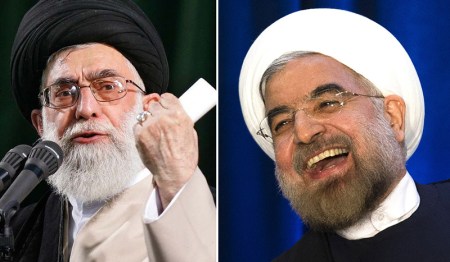
Iran’s Supreme Leader, Ayatollah Khamenei (left), is not giving up on the revolutionary ideological norms. He is relying on the so-called moderates, such as President Hassan Rouhani (right), to continue the process of implementing the nuclear deal in order to benefit Iran economically and ensure the regime’s hold on power.
Nevertheless, at the end of day, the key decision makers in Iran’s political establishments are Khamenei and the senior cadre of the IRGC, who prioritize Iran’s ideological and revolutionary principles. It is from them that Khamenei draws his legitimacy.
As long as the Supreme Leader is alive, one should not expect that Iran’s reintegration into the global economy to move the country to the moderate end of the spectrum, or that its anti-American, anti-Semitic sentiments and fundamentals of Tehran’s foreign policies will change.
(The views expressed in this article are mine and do not necessarily reflect those of Warsclerotic or any of its other editors. — DM)
A recent article by David Samuels at the New York Times Magazine, based on an interview with Obama’s foreign policy guru Ben Rhodes, purported to explain how, and about what, the Obama administration lied to get public support for the Iran Scam. According to the article, the principal Obama lie involved who was the Iranian president when the negotiations with Iran began. It’s much deeper and worse than that. As Paul Harvey would say, “Here’s “the rest of the story.”
Iranian President Rouhani was elected on June 15, 2013 and assumed office on August 3d. According to Rhodes,
negotiations started when the ostensibly moderate Hassan Rouhani was elected president, providing an opening for the administration to reach out in friendship. In reality, as Samuels gets administration officials to admit, negotiations began when “hardliner” Mahmoud Ahmadinejad was still president. [Emphasis added.]
There is no necessary inconsistency — about a month and a half elapsed between Rouhani’s election and becoming the Iranian president. However, that is of little if any consequences.
Mr. Rosen, interviewed in the above video, touches, very briefly, on other problems with the Iran scam. Back in the world of reality, “we” had been negotiating with Iran during Ahmadinejad’s presidency for a couple of years, during which “we” gave Iran everything it requested. This article is intended to provide substantially more information and analysis of what happened and why during “our” secret bilateral negotiations with Iran.
The Negotiations
According to interviews with Iranian vice president and Atomic Energy Organization head Ali Akbar Salehi, translated and published by the Middle East Media Research Institute (MEMRI) on August 17, 2015, secret bilateral negotiations between the Obama and Iranian regimes had begun much earlier and included Obama’s Assistant Secretary of State, William Burns. During those negotiations, the U.S. conceded that Iran’s right to Uranium enrichment would be respected, that Iran’s missile programs would be left out of any deal and that its efforts to develop nuclear warheads and other devices would be ignored. Obama had essentially caved in to Iran’s demands even before the existence of negotiations was acknowledged.
In an interview published in the daily Iran on August 4, 2015 under the title “The Black Box of the Secret Negotiations between Iran and America,” Iranian vice president and Atomic Energy Organization head Ali Akbar Salehi, who is a senior member of Iran’s negotiation team and was foreign minister under president Ahmadinejad, revealed new details on the secret bilateral talks between Iran and the U.S. that started during Ahmadinejad’s second presidential term. According to Salehi, U.S. Secretary of Energy Dr. Ernest Moniz, whom Salehi knew from his period as a doctoral student at MIT, was appointed to the American negotiation team at Salehi’s request, a request which the Americans met within hours. [Emphasis added.]
Salehi added that Khamenei agreed to open a direct channel of negotiations between Iran and the U.S. on the condition that the talks would yield results from the start and would not deal with any other issue, especially not with U.S.-Iran relations. Following this, Salehi demanded, via the Omani mediator Sultan Qaboos, that the U.S. recognize Iran’s right to enrich uranium, and received a letter from Qaboos expressing such American recognition, which he relayed to Ahmadinejad. [Emphasis added.]
The secret bilateral Iran-US negotiations had begun with a letter for Iran delivered to an Omani official. Salehi told an Omani intermediary.
‘I am not sure how serious the Americans are, but I will give you a note. Tell them that these are our demands. Deliver it on your next visit to Oman.’ I wrote down four clear issues, one of which was official recognition of rights to [uranium] enrichment. I figured that if the Americans were sincere in their offer, then they must agree to these four demands. Mr. Suri gave this short letter to the mediator, and stressed that these were Iran’s demands. [He added that]if the Americans wished to solve this issue, they were welcome to, otherwise dealing with White House proposals would be useless and unwarranted…
“All the demands in the letter were related to the nuclear challenge. These were issues we have always come against, such as closing the nuclear dossier [in the Security Council], official recognition of [Iran’s] right to enrich [uranium], and resolving the issue of Iran’s actions under the PMD [Possible Military Dimensions]. After receiving the letter, the Americans said: ‘We are certainly willing and able to easily solve the issues Iran has brought up.’ [Emphasis added.]
The first meeting between the Iranian and American negotiating teams began following eight months of coordination. Iran
sent a team to Oman that included the deputy foreign minister for European and American affairs, Mr. [Ali Asghar] Khaji, as well as several CEOs. The Americans were surprised in the first meeting and said, ‘We cannot believe this is happening. We thought Oman was joking. We aren’t even prepared for these talks with you.’
“Q: What was the level of the team that the Americans dispatched?
“A: It included Assistant Secretary of State William Burns. They said: ‘We only came to see if Iran was truly willing to negotiate.’ Our representative gave them the required response and eventually there were talks on this issue. The initial result was achieved and the ground was prepared for further coordination. [Emphasis added.]
“Q: How were the Americans convinced that the Iranian diplomats who were dispatched had the necessary authority?
“A: [Until] that phase, Iran and America had not been allowed to sit opposite each other at the negotiating table. The fact that Iran had sent a deputy foreign minister to the talks indicated its seriousness. The Americans also noticed how seriously [Iran was taking] the issue. At that meeting, Khaji pressed the Americans to set up a roadmap for the negotiations, and eventually the talks of a roadmap were postponed to the second meeting. At the second meeting, Khaji warned the Americans: ‘We did not come here for lengthy negotiations. If you are serious, you must officially recognize enrichment, otherwise we cannot enter into bilateral talks. But if you officially recognize enrichment, then we too are serious and willing to meet your concerns on the nuclear matter as part of international regulations.‘
International regulations were later agreed upon by the P5+1 negotiators, in the form of the Iran – IAEA secret deals concerning nuke inspections and a UN resolution dealing with Iranian missiles. Neither was included in the Joint Cooperative Plan of Action.
“Of course, at that time we were [still] exchanging various information with the Americans via the [Omani] mediation, and this is documented at the Foreign Ministry. We did not do it in the form of official letters, but rather unofficially and not on paper. The Omani mediator later came to Iran, held talks with us, and then later spoke to the Americans and told them our positions, so that the ties were not severed. But there was no possibility for direct talks.
“Thus, a real opportunity was squandered because, at the time, the Americans were genuinely prepared to make real concessions to Iran. Perhaps it was God’s will that the process progressed like that and the results were [eventually] in our favor. In any case, several months passed and Obama was reelected in America [in November 2012]. I thought that, unlike the first time, we must not waste time in coordinating [within regime bodies], so with the leader’s backing and according to my personal decision, I dispatched our representatives to negotiate with the Americans in Oman. [Emphasis added.]
“Q: Didn’t you have another meeting with the leader about the process and content of the talks?
“A: No. Obviously during the process I wrote a letter to the leader detailing the problems. He said ‘try to solve them.’ He was always supportive but told me to ‘act in a manner that includes necessary coordination [within the regime]. In this situation, I dispatched Khaji to the second meeting in Oman (around March 2013) and it was a positive meeting. Both sides stayed in Oman for two or three days and the result was that the Omani ruler sent a letter to Ahmadinejad saying that the American representative had announced official recognition of Iran’s enrichment rights. Sultan Qaboos sent the same letter to the American president. When Ahmadinejad received the letter, several friends said that this move would be fruitless and that the Americans do not keep [their] commitments. [But] we had advanced to this stage. [Emphasis added.]
. . . . We [then ] prepared ourselves for the third meeting with the Americans in order to set up the roadmap and detail the mutual commitments. All this happened while Iran was nearing the presidential elections [in June 2013]. At that time, the leader’s office told me that I had to cease negotiations and let the next government handle the talks after the results of the elections were known.
. . . .
“Q: What was the Americans’ position in the first meetings between Iran and the P5+1 held during the Rohani government [era]?
“A:After the Rohani government began to operate – along with the second term of President Obama – the new negotiations between Iran and the P5+1 were started. By then, Kerry was no longer an American senator but had been appointed secretary of state. As a senator, Kerry had been appointed by Obama to be in charge of handling the nuclear dossier, and then [in December 2012] he was appointed secretary of state. [Emphasis added.]
“Before that, the Omani mediator, who had close relations with Kerry, told us that Kerry would soon be appointed [U.S.] secretary of state. During the period when the secret negotiations with the Americans were underway in Oman, there was a situation in which it was easier to obtain concessions from the Americans. After the Rohani government and the American administration [of Obama’s second term] took power, and Kerry become secretary of state, the Americans spoke from a more assertive position. They no longer showed the same degree of eagerness to advance the negotiations. Their position became harder, and the threshold of their demands rose. At the same time, on the Iranian side, the situation [also] changed, and a most professional negotiating team took responsibility for negotiating with the P5+1. [Emphasis added.]
As to the reluctance of the American side to make concessions after Kerry had replaced Clinton as the Secretary of State, it must be remembered that “we” had already made all or most of the concessions Iran sought.
Another positive point was that [President] Rohani oversaw the dossier, knew its limits, and as a result succeeded in producing a good strategy to advance the nuclear dossier. At the same time, Rohani took responsibility for everything. Many may have reservations and ask why we were putting ourselves in danger, but Rohani’s willingness to take responsibility was very high. There are those who say, from a political standpoint, that he was willing to take a very great risk, because, had the negotiations not achieved certain results, and had the best results not been achieved, he would have faced waves of criticism. But he took upon himself the risk of [such] criticism. In any event, he agreed to take this responsibility, and, God be praised, even God helped him, and he emerged [from the negotiations] with his head held high.” [Emphasis added.]
At some point, the negotiations broke down over “technical issues.” Salehi, a technical expert as well as a diplomat, found a way to resolve those issues.
A . . . condition was that American experts would come to Iran and talk to me. I said that as vice president I would not enter into a discussion with their experts, because as far as the protocol was concerned, this would create a bad situation and they would say that Iran would capitulate in any situation. This was not good for Iran, but I was willing to quit and to come to the talks not as vice president but as the foreign minister’s scientific advisor. Larijani said ‘he’s right.’ The next day, Fereydoun asked me to come to his office and asked me who my [American] counterpart was. I said, the [U.S.] Department of Energy. Fereydoun called Araghchi and said, ‘Tell [U.S. Under Secretary of State for Political Affairs] Ms. [Wendy] Sherman that Salehi is joining the negotiations provided that the American secretary of energy also joins the negotiators.‘ Araghchi and Sherman were the liaison between Iran and America. Araghchi said in this conversation with Fereydoun that on such short notice it was unlikely that they [i.e. the Americans] would send their secretary of energy. I heard [Fereydoun’s conversation with Araghchi]. In short, Fereydoun asked and Araghchi contacted Sherman and a few hours later a report that they welcomed Iran’s proposal arrived. [Emphasis added.]
“Q: How many hours did it take before they [the Americans] said yes?
“A: It didn’t take long. I went to see Fereydoun in the evening and the next day they responded. This was because of the time difference [between Tehran and Washington].
“Q: The general perception was that because Moniz was brought into the negotiating team, you were brought into the Iranian team?
“A: [On the contrary,] Moniz came because of me. In any case, in February [2015] I joined [the negotiations], and praise God, matters moved forward with Moniz.
“Q: Did you and Moniz study together?
“A: Moniz knew me more than I knew him. I saw him at the annual IAEA meeting. When I was a doctoral student at MIT, he had just been accepted as a staff member. He is five years older than me.
“Q: Did you take one of his classes?
“A: No. He knew me because my doctoral studies advisor was his close friend and right hand man in scientific fields. Even now he is an advisor on many of Moniz’s scientific programs. Many of my fellow students are now experts for Moniz. One of them was Mujid Kazimi, who is of Palestinian origin. He recently died. He was two years older than me but we were friends in college. After graduating, he became the head of the MIT Department of Nuclear Science and was a prominent figure who carried out many programs with Moniz.
“Q: How did Moniz treat you initially?
“A: In light of our prior acquaintance, he was excited. We’ve known each other for years and he treated [me] very well. Our first meeting was in public.
“Q: How did you feel when you heard Moniz was coming [to the talks]?
“A: I was very happy. I was assured. I said that the prestige of the Islamic Republic remained intact [because] an Iranian official would not speak to an American expert but rather would negotiate with a high-ranking American official. This was very important. Second, as I said before, he could make a decision [while] an expert could not. We had a very interesting group meeting. The American experts were same ones who had dealt with disarmament vis-à-vis the Soviet Union.
“I said [to Moniz]: ‘I cannot accept your offer for various reasons.’ One American expert said, ‘We do not accept the basic assumption of your calculations.’ I said, ‘Tell us what is the basic assumption of [your] calculations so we can work from there.’ He said ‘we can’t do that.’ I said to them, ‘If you don’t accept our estimation, then tell us [yours]. You say that you cannot because this [exposes] your process. If we show [our] calculation, you will know our working secrets.’ So then I said ‘ok, what do we do now?’ The meeting stagnated.
“Later I thought about it… and said ‘Mr. Moniz, I am here with full authority from my country. Anything I sign will be acceptable to my country. Do you have full authority as well, or does any result achieved here need to be asked and clarified with officials from other countries?’ He said ‘no, I have full authority.’
“Q: Did you have full authority?
“A: Yes. In the scientific discussions, I knew the level of [Iran’s] demands. I said, ‘Mr. Moniz, you made an offer to Iran, and Iran rejects it. I want to ask you a question. If you can answer it [then] I will have no problem with your offer.’ I continued and said: ‘Show me one place on earth where enrichment is taking place using the method you are demanding of us. If you can give me even a single example then I will sign on the spot and we will become the second country to enrich in this method.’ He looked [at me] and then announced that the meeting was over, and we spoke. We had the first private meeting that lasted two or three hours. He said: ‘Mr. Salehi, when I was called [out of the negotiating room, it was because] Obama wanted to speak to me. Now I am free [to continue]. What you said is acceptable [but] there are practical problems with your offer.’ I said, ‘Do you agree? Then I relinquish that proposal.’ Eventually. we reached mutual understandings on this issue. I said ‘let’s start from the top.’ This diplomatic challenge should be published in a memoir so that everyone can understand how we reached 6,000 centrifuges. It is a very nice story… [Emphasis added.]
The Aftermath
Ultimately, Iran’s right to enrich Uranium was fully recognized in the Joint Plan of Action (JPOA) and in the subsequent Joint Cooperative Plan of Action (JCPOA). As to the missile aspects of the “possible military dimensions” of Iran’s nuclear program, neither document dealt with Iranian missiles. That was left up to the United Nations Security Council to deal with in its resolution approving the nuke “deal.” In light of Russia’s warm relations with Iran, Russia would most likely veto any proposed Security Council resolution finding Iran in violation of its missile provisions.
The “verification” mechanism was included only in separate and secret “side deal(s)” solely between Iran and the IAEAwhich members of the U.S. Congress were not permitted to see during the pseudo-approval process. According to Kerry, he was not permitted to see them either, but the details were “fully explained” to him.
Here’s a video of Secretary Kerry under questioning about the side deals:
Questions might have been better directed to this Kerry clone; more candid answers might have been provided.
Any pretense that the IAEA will have “any time, anywhere” access to Iran’s military sites was mere rhetoric, as acknowledged by US Under Secretary of State Wendy Sherman on July 16th
“I think this is one of those circumstances where we have all been rhetorical from time to time,” Sherman said in a conference call with Israeli diplomatic reporters. “That phrase, anytime, anywhere, is something that became popular rhetoric, but I think people understood that if the IAEA felt it had to have access, and had a justification for that access, that it would be guaranteed, and that is what happened.” [Emphasis added.]
Ms. Sherman was right about the rhetorical nature of administration assertions, but wrong about IAEA access, of which there will apparently be little or none pursuant to the secret deals between Iran and the IAEA.
In an interview on Al Jazeera TV last week Ali Akbar Velayati, Security Adviser to Iran’s Supreme Leader, stated that
United Nations nuclear inspectors from the International Atomic Energy Agency would not be given access to Tehran’s sensitive military nuclear sites.
. . . .
“First, allow me to emphasize that the issue of the missiles and of Iran’s defensive capabilities were not part of the negotiations to begin with,” Velayati said. [Emphasis added.]
“No matter what pressure is exerted, Iran never has negotiated and never will negotiate with others – America, Europe, or any other country – about the nature and quality of missiles it should manufacture or possess, or about the defensive military equipment that it needs. This is out of the question.” [Emphasis added.]
. . . .
Reza Najafi, Iran’s ambassador and permanent envoy to the IAEA, stated over the weekend that “no country is permitted to know the details of future inspections conducted by the IAEA.” [Emphasis added.]
Najafi’s statement could mean (a) that no details about inspection methodology will be disclosed, (b) that no details about inspection results will be disclosed or (c) both. If inspection methodologies — who did the inspections as well as when, where and how, are not disclosed, what useful purpose will they serve, other than for Iran? If details of the results of inspections are not disclosed, that will also be the case. How, in either or both cases, will the members of the P5+1 negotiating teams have sufficient information to decide whether to “snap back” sanctions — if doing so is now even possible — or anything else? [Emphasis added.]
Conclusions
One can only hope that our next president will dispose of the Iranian “deal” as a treaty which Obama refused to submit to the Congress as the Constitution requires or at least ostentatiously ignore it and grant no more concessions.
Otherwise, be not afraid; Obama the Great One — the smartest person in any room and the best President ever — has made us safe. How can one possibly be safer alive than dead?
65 Killed in Egypt’s Sinai, ISIS Claims Responsibility
The last 48 hours (May 7-8) have seen a major escalation of the ISIS threats against Israel, DEBKAfile’s intelligence and counterterrorism sources report. In a coordinated maneuver by all of the ISIS commands in the Middle East, the terrorist organization simultaneously released at least 10 videos that it said showed ISIS forces on their way to attack targets in Israel.
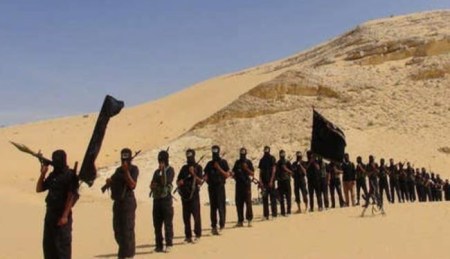
All of the videos refer to the Palestinian issue, Jerusalem and the timing of the attacks. In each one, the narrator claims the terror organization did not forget the Palestinians, and will not neglect them any more; describes Jerusalem as “a bridge to Islam”; and threatens an impending attack, saying “We’re coming, and coming very soon” accompanied by images of fighters from the ISIS affiliate in the Sinai are shown.
It was not the first time for the ISIS propaganda machine to threaten hostilities against Israel, but it was the first time for the threat to be issued simultaneously from every province or city where ISIS is located in the Middle East. The videos included ones from Raqqa, the ISIS capital in Syria; Mosul, the terrorist organization’s capital in Iraq; the Sinai Peninsula and Egypt; Derna in eastern Libya; and central Libya, where according to DEBKAfile’s counterterrorism sources ISIS controls a huge 300-kilometer area including the Mediterranean coast on the Gulf of Sidra.
Our sources report that every video contains the following sentences: “We know that the Egyptian army is being helped by Israeli intelligence and the Israeli Air Force in its war against us”; “We also know that Israel set up intelligence networks within the population of the Bedouin tribes in the Sinai”; and “From now on we will take action against Egyptian and Israeli targets as one.”
DEBKAfile’s intelligence sources report that these comments are intended to counter efforts by the Egyptian military to establish anti-ISIS militias among the Bedouin tribes. This came after American counterterrorism experts advised the Egyptian military to operate the same way that the US operates among the Sunni tribes in western Iraq’s Anbar province, where US military instructors are setting up local militias to prevent ISIS fighters from entering or passing through areas under the tribes’ control.
Our sources report that three Bedouin anti-ISIS militias have been established in the Sinai so far: the “Sons of Sinai”, “Unit 103”; and the “Death Squad”.
Meanwhile, the ISIS affiliate in the Sinai carried out one of its boldest terrorist attacks on Sunday, May 8, killing eight Egyptian policemen including an officer, in the Cairo suburb of Helwan. Four masked terrorists with automatic weapons jumped out of a commercial vehicle that had blocked a minibus transporting the policemen, fired hundreds of bullets at the minibus, killing everyone inside, and then fled the scene.
Western counterterrorism experts monitoring ISIS-Sinai estimate that it not only has the ability to carry out terrorist attacks in major Egyptian cities, but also against Israel.






 anneinpt
 artaxes
 danmillerinpanama
 davidking1530
 Peter Hofman
 Joseph Wouk
 Peter
Peter Louisiana Steve
 WarSclerotic
Recent Comments