Archive for May 18, 2016

Iran Ramps Up Crackdown on Women

May 18, 2016

Iran Ramps Up Crackdown on Women, Front Page MagazineAri Lieberman May 18, 2016

women_in_shiraz_2

On Sunday, the Islamic Republic announced the arrest of eight women whose photographs were featured on Instagram. The models reportedly failed to adhere to stifling Islamic style dress codes rigorously enforced by Iran’s oppressive mullahs. More specifically, they posed without wearing religiously sanctioned head scarves designed to cover exposed hair.

Following her arrest, one of the models was forced to appear on Iranian TV in the presence of two prosecutors. Wearing a black head scarf and matching black gloves, she was recorded – almost certainly under duress – sanctioning the government’s Orwellian-like actions, warning other Iranian women that they “can be certain that no man would want to marry a model whose fame has come by losing her honor.” As an aside, when Iranian navy pirates operating off Farsi Island kidnapped 10 U.S. Navy sailors in the Arabian Gulf in January, they forced a female sailor into Sharia compliance, requiring her to don a hijab.

The arrests come in the midst of a yet another government crackdown on social media and dissent. The anti-social media operation, ominously codenamed “Spider II” has thus far netted dozens of models, photographers, makeup artists and other dangerous enemies of the state. Also arrested was Iranian blogger Mahdi Boutorabi who reportedly covered Iran’s rigged 2009 elections. It appears that periodically, the mullahs get bored or insecure and conjure up ways to make the lives of their citizens more miserable.

But the Islamic Republic’s absurdity doesn’t end there. Iran’s Revolutionary Guard bizarrely accused reality star (and not much else) Kim Kardashian-West of being behind the nefarious plot to undermine or otherwise taint the morals of Iran’s young women.

Mostafa Alizadeh, a spokesman for the Revolutionary Guard’s Organized Cyberspace Crimes Unit stated that, “Ms. Kim Kardashian is a popular fashion model so Instagram’s CEO tells her, ‘make this native.’” He added that “There is no doubt that financial support is involved as well. We are taking this very seriously.”

In February, Iranian authorities engaged in a similar crackdown, targeting a benign rock group known as “Confess.” Authorities charged the group’s members with “blasphemy,” writing “satanic” lyrics and meeting with forbidden foreign radio stations. The charge of “blasphemy” carries a punishment of execution. Others in the Islamic Republic have been arrested and sentenced to lashings for merely appearing in a YouTube video while dancing and lip syncing to Pharrell’s hit song “Happy.”

Conspiracy theories and political and religious oppression are the norm in the Islamic Republic. Let us dispel with the notion that there are “moderate” forces within the Iranian government working to change things for the better. Power in that tyrannical regime vests with two entities – Iran’s “Supreme Leader,” the Holocaust-denying Ayatollah Khamenei and his thuggish henchmen of the Iranian Revolutionary Guard Corps and the Basij militia.

The Obama administration and its “echo chamber” (as Obama shill Ben Rhodes puts it) would like us to think that there are moderate elements and reformers with whom we can deal. That notion is an absolute farce but continues to gain credence in some leftist circles with vested interests in propagating this false narrative. For example, while the New York Times reported the arrest of the Iranian models, it made sure to qualify its reportage by informing its readers that the crackdown was the work of “hard liners.”

In the meantime, while Ben Rhodes is creating his spin and John Kerry is thanking the Iranians for kidnapping and mistreating U.S. Navy sailors, the mullahs of the Islamic republic continue to crack down on dissent and execute human rights activists, continue to advance their ballistic missile program (in defiance of UNSC resolutions) and continue to cut a path of misery and destruction in the Mideast, from Syria to Yemen.

The administration has done its best to convince the American public that Iran can be trusted to keep agreements. This rests on the false and dangerous narrative that there exists a power struggle in Iran between moderate reformers who have the support of the people and an assortment of hard line religious extremists and anti-Western zealots. Narratives running counter to this fantasy-like version of events are dismissed by the administration.

Even worse, it has now come to light that the Obama administration has asked the Iranians not to publicize their illicit ballistic missile activities for fear of unsettling opponents of the Joint Comprehensive Plan of Action (JCPOA). Meanwhile John Kerry is quietly attempting to encourage various European banking institutions to do business with the Iranians despite the fact that the IRGC controls vast swaths of Iran’s economy.

No matter how much spin the Obama administration attempts to place on the merits of the JCPOA and no matter how much it attempts to cover its tracks, it cannot hide the fact that the Islamic Republic is a pernicious regime that cannot be trusted and represents a malignancy that sooner or later will have to be confronted. The only question that remains is whether Iran will have nuclear bombs when that time arrives.

As Lebanon’s Banks Begin To Implement U.S. Sanctions Against Hizbullah, Hizbullah Criticizes Banking Sector, Warns Of Chaos In Lebanon And More ‘Actions Against The American Takeover Plan’

May 18, 2016

As Lebanon’s Banks Begin To Implement U.S. Sanctions Against Hizbullah, Hizbullah Criticizes Banking Sector, Warns Of Chaos In Lebanon And More ‘Actions Against The American Takeover Plan’ MEMRI, H. Varulkar and E. B. Picali*, May 17, 2016

Introduction

The Hizballah International Financing Prevention Act, passed by the U.S. Congress in December 2015, is aimed at curtailing the organization’s funding of its domestic and international activities, and also at combatting its global criminal activities – including money laundering, drug trafficking, and human trafficking – by which it funds the terror operations that it carries out worldwide.[1] It bars any “foreign financial institution” that engages in transactions with Hizbullah or with persons or bodies affiliated with it, or which provides them with financial services or launder money for them, from maintaining a relationship with the U.S. banking system. This means that any bank in the world, including in Lebanon, that provides financial services to the organization will be denied access to U.S. financial institutions – and thus to the global financial sector. The ramifications of this are far-reaching and can lead these banks to collapse. The law also imposes sanctions and penalties (fines, imprisonment or both) on individuals or bodies that violate its provisions. It came into effect on April 15, 2016, after the U.S. Treasury issued regulations for its implementation; the Treasury also published a list of some 100 bodies and figures associated with Hizbullah with whom financial institutions may not conduct dealings.[2]

Since Congress passed the law, Hizbullah has been perturbed and apprehensive about its ramifications and the impact it would have on its operation. This has been expressed both in statements by Hizbullah officials and in articles in the Lebanese press, especially the press close to Hizbullah.[3] In a speech a few days after the law was passed, Hizbullah secretary-general Hassan Nasrallah exposed his concern, by warning Lebanon’s banks not to “submit to the will of America.”

In early May 2016, two weeks after the law went into effect, Riad Salameh, governor of the Banque du Liban (BDL), Lebanon’s central bank, stressed, in a directive to Lebanon’s banks, the need to fully comply with the law. Following this, Lebanese banks began to close accounts of Hizbullah officials and their family members, and it has been reported that dozens such accounts have already been closed. Hizbullah reacted with a campaign of severe criticism against Salameh and the Lebanese banking system, accusing them of “surrender[ing] to the American financial mandatory authority in Lebanon and warning that this would bring about the collapse of Lebanon’s currency and lead to “complete chaos” in the country. Hizbullah ministers argued that the banks had crossed every red line, and other Hizbullah members leveled threats against the banks.

These reactions clearly indicate the scope of Hizbullah’s fears about the U.S. law and its ramifications. It should be noted that in recent months Hizbullah has also been the target of sanctions by the Gulf states and several other Arab countries, which have designated it a terror organization and have begun expelling its operatives from their territory.[4]

It should further be noted that it is not only Hizbullah that is concerned about the U.S. law, but also Lebanon’s banking sector, because if it does not comply with the law it will be barred from the global financial system, which could bring about its collapse. In light of these concerns, two Lebanese delegations were recently dispatched to the U.S., one on behalf of the Lebanese parliament and the other on behalf of the Association of Banks in Lebanon. The aim of the visits was to meet with U.S. Congress and Treasury officials and to discuss the law and its implementation, and perhaps also persuade them to soften the language of the law and provide guarantees for the Lebanese banks’ stability.[5]

This report will review Hizbullah’s apprehensions about the U.S. law as well as the organization’s threats to the Lebanese banking sector, the Lebanese government, and the U.S. following the law’s passage by Congress, and the intensification of these threats since the Lebanese banks began implementing the law.

Following Congress’s Passage Of The Law, Nasrallah Warns Lebanese Government, Banks Not To Comply

On December 21, 2015, three days after President Obama signed the act into law, Hizbullah secretary-general Hassan Nasrallah claimed that the law was part of the U.S. war on his organization that it declared years ago. In an attempt to downplay the importance of the new sanctions, Nasrallah argued that they would have no impact. He added that ever since the U.S. designated Hizbullah a terrorist organization in 1995, it has been trying to force the rest of the world to accept this designation, but to no avail; he added that since it failed in this attempt, it is now making false accusations against the organization. “The Americans,” he said, “are trying to pressure Hizbullah again with a decision they issued, according to which it is a criminal organization, and they are accusing us of drug trafficking, human trafficking, and money laundering. This is not true. These accusations are unjust, and we are not interested in presenting proof of our innocence, because the accuser is the one who should be presenting proof… This is a political accusation, part of a political, security, and military campaign in the region, aimed at tarnishing Hizbullah’s image in the eyes of the peoples of the world… It is part of a psychological war that will not succeed.”

As part of his attempts to reassure Hizbullah’s supporters and to convince them that the sanctions would have no impact, Nasrallah stated that his organization holds no accounts in Lebanese banks, nor any investments in or partnerships with Lebanese companies or merchants – and that therefore neither the BDL nor any other Lebanese bank has any cause for concern. At the same time, he revealed his concerns when he said: “The minute the U.S. gives the signal to harm some sector or political stream, some Lebanese banks will begin settling scores [with that sector or stream].” He declared that this would be “unacceptable” and warned the government and the banks against “obeying the American will.” He claimed that these American sanctions were aimed not just at Hizbullah but at Lebanon’s citizens, companies and businessmen, and demanded that the Lebanese state defend them: “We do not want the state to defend Hizbullah and its operatives, its sons and its daughters. We are defending ourselves and know how to do so. But the state must have people to defend any individual that the Americans wish to  accuse.”[6] 

Hizbullah Faction In Lebanese Parliament: American Law Will Spur Hizbullah To Act Against U.S.’s “Terrorist Branches” In The Region

On December 24, 2015, several days after Congress passed the law, the Hizbullah faction in the Lebanese parliament harshly criticized the U.S. over it, saying that “arrogance and terrorism” were behind the decision targeting Hizbullah, its supporters, and “ostensible organizations and elements working with it”. This, it stated, confirmed that the U.S. administration is indeed “the Great Satan.” The faction also said that the law “would spur Hizbullah to continue its actions against the American takeover plan and to continue resisting its terrorist branches, represented by the Zionists and takfiris, in Lebanon and the region.”[7]

Hizbullah-Affiliated Daily: Sanctions Could Lead To Intra-Lebanese Tension

Additionally, on March 31, 2016, the Lebanese Hizbullah-affiliated daily Al-Akhbar published an article implicitly warning that the U.S. law would destabilize Lebanon: “As the countdown to the release of the regulations for implementing the American anti-Hizbullah sanctions begins, the fears that the [Lebanese] domestic arena will be impacted by it and its ramifications are revived… as have fears that this issue will become volatile…”

The article also outlined the assessments that the sanctions and the anticipated regulations for their implementation will be harsh and will cover a broad range of individuals and political, financial, and media institutions, and added that if this proves to be the case, “it could constitute a worrisome factor that could stoke  domestic tension [in Lebanon, especially] in everything connected to Hizbullah’s reaction to the attempts at besieging it…”[8]

As Sanctions Implementation Begins In Lebanon, Hizbullah Harshly Criticizes U.S., Lebanese Banking Sector

On April 11, 2016, the U.S. Treasury Department released the regulations for implementing the Hizballah International Financing Prevention Act; they included details for applying the sanctions as well as a list of 99 Hizbullah-linked individuals and institutions with whom banks and financial institutions worldwide may not conduct business. The law, which as mentioned came into effect on April 15, 2016, is binding on all the world’s financial institutions, including Lebanese banks.

BDL Governor Salameh Orders Lebanese Banks To Comply With U.S. Law, Enraging Hizbullah

On April 28, 2016, the governor of the Central Bank of Lebanon, Riad Salameh explicitly stated, on the Lebanese LBC TV channel’s show Kalam Al-Nas, that Lebanese banks must comply with the U.S. law. He stressed: “The American law cannot be circumvented, because the regulations for its implementation include all currency, including the Lebanese lira.” The BDL, he said, would issue a statement emphasizing that Lebanon was committed to complying with the law and would hold banks responsible for implementing it. He added, “This will be clear and there will no way to get around it. This is an official and legal position. The banks must align with us.”[9]

A few days later, on May 3, 2016, Salameh issued guidelines requiring “all banks in Lebanon and all institutions under the oversight of the BDL” to comply with the law and to immediately inform the BDL of any freezing or closure of any account, or of any refusal to open any account, and to state their reasons for doing so.[10] According to reports in the Lebanese press, Lebanese banks have begun implementing these guidelines, and have already closed dozens of accounts belonging to Hizbullah MPs and associates.[11] Salameh’s guidelines sparked enraged responses from Hizbullah.

28047Riad Salameh (nna-leb.gov.lb, April 4, 201

Hizbullah MP: U.S. Is The Great Satan, We Must Resist Its Plans In The Region

Hizbullah MP Hussein Al-Moussawi threatened the U.S., saying: “The U.S. is still the leader of the camp of lies, and, as the Great Satan, it attempts to give the resistance a satanic image, and marginalize it with terrorism accusations and economic sanctions… The sons of the ummah should be wary of the American plans and carry out resistance against them.”[12]

Hizbullah: Salameh Surrendered To “The American Financial Mandatory” Rule In Lebanon; Implementing This Law Will Lead To Chaos In The Country

After Lebanese banks began closing the accounts of Hizbullah affiliates, the organization launched criticism not only at the U.S. but also at the Lebanese banking sector. On May 12, 2016, the Hizbullah faction in the Lebanese parliament issued an exceptionally harsh statement against Riad Salameh, noting: “The recent American law, which forces Lebanese banks to comply with its sections, is completely unacceptable because it will form the basis for a local war of exclusion, which the central bank and other banks are helping to stoke. This is in addition to the fact that complying [with the U.S. law] constitutes an appropriation of Lebanese financial sovereignty.”

The statement also said: “The orders recently published by BDL governor Riad Salameh… are a form of unjustified surrender to the American financial mandatory authority in Lebanon – which could exacerbate the financial crisis in the country, lead it to bankruptcy because of the ramifications of the deep schism [that could come about] between the Lebanese and the banks, and place the country on the brink of a grave currency collapse in the country and complete chaos that will be unstoppable.” The announcement also called on the governor “to reexamine the recent guidelines, such that they will be compatible [with the principle] of national sovereignty,” and on the government “to take the necessary steps to prevent the dangerous ramifications that are likely to emanate from this.”[13]

Hizbullah-Affiliated Daily: Hizbullah Is Furious At BDL Governor For Reneging On Understandings It Reached With Him

The Lebanese daily Al-Safir, which is close to Hizbullah, revealed on May 13, 2016 that the reason for Hizbullah’s fury at the BDL governor is that the guidelines he issued for the banks effectively countermanded previous understandings at which he had secretly arrived with Hizbullah, that were meant to mitigate the impact of the sanctions. According to the report, former Hizbullah MP Amin Shiri had concluded with Salameh that the Lebanese banks would not decide independently on the closure of any Lebanese citizen’s bank account, but would obtain Salameh’s personal approval beforehand. They also agreed that the banks would allow any citizen, including Hizbullah members, to open an account in Lebanese lira. However, the new guidelines that Salameh released in early May contradicted these understandings; under the new guidelines, banks should close accounts on their own and then inform the BDL, and must prevent Hizbullah members from opening accounts in Lebanese lira –because the American regulations for implementation specifically bar opening accounts in any currency.

According to Al-Safir, Hizbullah was surprised, and enraged, by Salameh’s guidelines. It quickly tried to contact him, but after receiving no persuasive answer, it decided to publish the harsh statement against him, and to raise the issue in the upcoming cabinet session.[14]

The daily Al-Akhbar, which is also close to Hizbullah, added that the organization had sent a message to Salameh claiming that “some banks decide for themselves to go too far in implementing the American sanctions, punishing Lebanese [citizens] that the U.S. did not even seek to sanction.” The daily added that Hizbullah had told Salameh that it would not allow the Lebanese banking sector “to act purely as the executive arm of the American administration [in carrying out its] decisions.”[15]

Al-Safir: Lebanese Elements, Saudi And UAE Foreign Ministers Worked To Step Up The Sanctions

Al-Safir reported that several MPs, apparently from Hizbullah, had complained to parliament speaker Nabih Berri that the regulations for implementation released in April by the U.S. Treasury Department had included new sections that were not in the law itself – for example, that the sanctions apply to all currencies, not only to U.S. dollars. They argued that these additions undercut the understandings between Hizbullah and Salameh, which were aimed at circumventing the sanctions and mitigating their effects. The MPs argued that an apparent “Lebanese element… leaked these [Hizbullah-Salameh understandings].” The daily cited sources as saying that “there is an Israeli-Lebanese-Arab lobby operating daily in Washington under the direct supervision of the office of Saudi Foreign Minister ‘Adel Al-Jubeir and the office of UAE Foreign Minister ‘Abdallah bin Zayed,” and adding that UAE Ambassador to Washington Yousef Al-‘Otaiba is working hard on this matter in Congress and the Treasury Department.[16]

Hizbullah Ministers: Lebanese Banks Have “Gone Too Far” In Implementing The American Law”; This Crosses All Red Lines

On May 12, 2016, the same day the Hizbullah faction in the parliament issued its statement against the Lebanese banking sector, Hizbullah ministers raised the issue in the cabinet session. The Al-Akhbar and Al-Safir dailies reported that Hizbullah ministers in the unity government, Hussein Al-Hajj Hassan and Muhammad Fneish, had delivered scathing attacks on the Lebanese banks, saying that they had “gone too far in implementing the American law” and had begun “taking steps against people with no ties to Hizbullah other than familial ties to organization officials.”

At the meeting, Hizbullah ministers claimed that one bank had closed the account of the daughter of a former Hizbullah MP. Al-Hajj Hassan claimed that banks had also recently closed the accounts of MPs Nawar Al-Sahili, ‘Ali Fayyad, ‘Ali Ammar, and ‘Ali Al-Miqdad, as well as that of former MP Amin Shiri. Also closed, they said, were accounts belonging to various cultural, religious, healthcare, and societal institutions, as well as charity organizations; he also expressed apprehension that the accounts of dozens of local municipalities would be closed “on the pretext that they [are administered] by Hizbullah members.” It was also reported that during the meeting, other ministers who are not members of Hizbullah related how U.S. and French banks had refused to open accounts for them and also closed their existing accounts.

According to Al-Hajj Hassan, these closures constituted “a serious attack that crosses all red lines,” especially since the law harms all Lebanese, not just one group or sect. Other reports in the Lebanese press noted that Al-Hajj Hassan had issued threats, and had said that the BDL guidelines and the conduct of the banking sector had “crossed the red line and reached the black line, and Hizbullah will not agree to this, and the American sanctions will not be allowed to pass.” It was also reported that Hizbullah ministers had called the Lebanese banks’ implementation of the U.S. law submission to aggression, and added that there must be no silence over this law, “because the occupation is not only military, but also financial, political, and cultural.”[17]

Al-Safir reported that some ministers from the March 14 Forces, the rival bloc in the unity government, were claiming that Hizbullah had brought this situation on itself, and that the resistance had become a weak point for Lebanon, not a source of strength. Furthermore, one minister argued that Hizbullah ministers could not shift responsibility to the Lebanese banks or the BDL governor, since no one in the world can confront the U.S. The cabinet meeting ended with a decision by Prime Minister Tammam Salam and Finance Minister ‘Ali Hassan Khalil to meet with Salameh to discuss the matter and update the government on the results.[18]

Hizbullah Sources Threaten: Hizbullah Won’t Remain Silent – We Will Upend Everything

On May 14, 2016, the Lebanese daily Al-Nahar quoted sources in the Hizbullah-headed March 8 Forces as saying that the organization would not remain silent about the new guidelines released by Salameh, and that it would not back down from its demand that they be cancelled. The sources argued that the banks were implementing the sanctions also against people who were not on the U.S. Treasury Department list, only because they were Shi’ites or relatives of a Hizbullah member. They added: “How is it possible that the bank accounts of MPs representing the Lebanese people are being closed – how will they receive their salaries?”

Hizbullah maintained that the BDL and the other banks are going beyond what the Americans are demanding in their implementation of the sanctions, and thus are strangling an entire community. The sources said: “When [Hizbullah] asked the BDL governor about the implementation of the U.S. law, he said nothing about what he is implementing today, but [said that there would be] an investigation and an examination of every account about which there are doubts… But closing the accounts of innocent people who have no connection [to Hizbullah] without any investigation or examination [as is happening right now] – that is a dangerous sign of concessions on Lebanese sovereignty and of punishment of the Lebanese people by the state, which we will in no way allow to happen.” The sources argued that the government must “cancel the BDL’s guidelines, otherwise [Hizbullah] will react not only by thwarting the government[‘s activity] but will upend everything, andwill open the file of the banking sector from the 1990s onward…” – hinting that Hizbullah has information on improper conduct by the banks.

Asked what was meant by the term “upend everything,” the sources quoted a hadith attributed to Imam ‘Ali bin Abu Taleb, the fourth caliph: “I am amazed how a poor man who lacks a crust of bread does not go out and brandish his sword at the people” – hinting that Hizbullah’s reaction will be harsh.[19]

Nasrallah: We Face A Challenge To Obtain Monetary Aid – “We Will Be Grateful For Every Donation”

Hizbullah officials’ threats and harsh reactions clearly attested to the distress and pressure felt by the organization, and to the scope of the sanctions’ impact on its activity. Additional evidence of this could be found in a May 6, 2016 speech by Nasrallah following the release of the regulations for implementing the U.S. law.

In his speech, Nasrallah reiterated, as he had first stated in his December 2015 speech, that the sanctions would do little damage to Hizbullah because the organization was accustomed to such pressure and that it would overcome it as it had in the past “under much worse circumstances.” But despite Nasrallah’s efforts to convey the message that Hizbullah was just fine, the scope of the economic damage done to the organization came through in his statements, in which he noted, inter alia, that the Islamic Resistance Support Organization was now playing a vital role in financially helping the organization. He even personally appealed to the public of supporters of the resistance for monetary donations, no matter how modest:

“I want to talk about this point openly, so that the people will also know how we think and operate. We first of all consider the importance and real value of the intention of the donors, not the size of the contribution… The families of the martyrs donate, the wounded donate, the people donate, the elderly lady who saved for her old age gives a little of her savings to the resistance, the boy who is in school takes some of his allowance and drops it into the cashbox of the resistance. This, for us, is worth millions. This is the real support for us…

“Therefore, today, when we stand before America’s, Israel’s, and Saudi Arabia’s attempts to dry up our sources of funding, we must realize that the sums donated by this or that family via the the Islamic Resistance Support Organization, even if modest, are in fact very large and extremely valuable sums. Obviously, we do not want to embarrass anyone… [so that they will] donate to us, but we trust the faith, the insight, and the reliability of all those who donate to us, since they are the people with whom we have, together, [overcome] the most difficult of days and circumstances, and the most dangerous of challenges and hardships. With them, we have completed the path; we have triumphed, and passed through all the difficult stages; with them, we will pass through all  the difficult stages to come, Allah willing.”

In an attempt to reassure the resistance-supporting public, he added that they must not worry, because Iran would continue to send economic, material, and military aid to Hizbullah despite the pressures and threats against it as well.[20]


*H. Varulkar is Director of Research at MEMRI; E. B. Picali is a Research Fellow at MEMRI.


Endnotes:

[1] On Hizbullah’s involvement in global drug trafficking, see MEMRI Inquiry and Analysis No. 1227, Hizbullah’s International Drug Network Preoccupies Europe, February 9, 2016.

[2] Congress.gov/bill/114th-congress/house-bill/2297/text;Treasury.gov/resource-center/sanctions/Programs/Documents/31cfr566_hizballah.pdf;Treasury.gov/resource-center/sanctions/OFAC-Enforcement/Pages/20160415.aspx.

[3] Al-Akhbar (Lebanon), January 11, 2016, March 31, 2016.

[4]  See MEMRI Inquiry and Analysis No. 1232, Lebanon’s Failure To Support Saudi Arabia In Struggle With Iran Sparks Crisis Between Lebanon And Saudi-Led Gulf, March 7, 2016.

[5]  Al-Akhbar (Lebanon), January 11, 2016, February 2, 2016, March 31, 2016.

[6] Alahednews.co.lb, December 21, 2015; Al-Safir (Lebanon), Al-Akhbar (Lebanon), December 22, 2015.

[7] Al-Akhbar (Lebanon), December 25, 2015.

[8] Al-Akhbar (Lebanon), March 31, 2016.

[9] Al-Liwa (Lebanon), April 29, 2016.

[10] Al-Nahar (Lebanon), May 4, 2016.

[11] Al-Akhbar (Lebanon), May 16, 2016, Al-Safir (Lebanon), May 13, 2016.

[12] Alahadnews.com.lb, May 2, 2016.

[13] Al-Safir (Lebanon), May 12, 2016.

[14] Al-Safir (Lebanon), May 13, 2016.

[15] Al-Akhbar (Lebanon), May 13, 2016.

[16] Al-Safir (Lebanon), May 13, 2016.

[17] Al-Safir, Al-Akhbar, Al-Mustaqbal , Al-Modon (Lebanon), May 13, 2016.

[18] Al-Safir (Lebanon), May 13, 2016; Al-Akhbar (Lebanon), May 13, 2016.

[19] This hadith is attributed to Abu Dhar Al-Ghafari, a Companion of the Prophet Muhammad, and the fourth person to be converted to Islam by him. However, no verification or evidence has been found for such a hadith in the Book of Hadiths, and some even claim that it is not reliable.

[20] Alahednews.co.lb, May 6, 2016.

EU-Turkey Migrant Deal Unravels

May 18, 2016

EU-Turkey Migrant Deal Unravels, Gatestone InstituteSoeren Kern, May 18, 2016

♦ “It can be expected that, as soon as Turkish citizens will obtain visa-free entry to the EU, foreign nationals will start trying to obtain Turkish passports … or use the identities of Turkish citizens, or to obtain by fraud the Turkish citizenship. This possibility may attract not only irregular migrants, but also criminals or terrorists.” — Leaked European Commission report, quoted in theTelegraph, May 17, 2016.

♦ According to the Telegraph, the EU report adds that as a result of the deal, the Turkish mafia, which traffics vast volumes of drugs, sex slaves, illegal firearms and refugees into Europe, may undergo “direct territorial expansion towards the EU.”

♦ “If they make the wrong decision, we will send the refugees.” — Burhan Kuzu, senior adviser to Turkish President Recep Tayyip Erdogan.

♦ Erdogan is now demanding that the EU immediately hand over three billion euros ($3.4 billion) so that Turkish authorities can spend it as they see fit. The EU insists that the funds be transferred through international aid agencies in accordance with strict rules on how the aid can be spent. This prompted Erdogan to accuse the EU of “mocking the dignity” of the Turkish nation.

The EU-Turkey migrant deal, designed to halt the flow of migrants from Turkey to Greece, is falling apart just two months after it was reached. European officials are now looking for a back-up plan.

The March 18 deal was negotiated in great haste by European leaders desperate to gain control over a migration crisis in which more than one million migrants from Africa, Asia and the Middle East poured into Europe in 2015.

European officials, who appear to have promised Turkey more than they can deliver, are increasingly divided over a crucial part of their end of the bargain: granting visa-free travel to Europe for Turkey’s 78 million citizens by the end of June.

At the same time, Turkey is digging in its heels, refusing to implement a key part of its end of the deal: bringing its anti-terrorism laws into line with EU standards so that they cannot be used to detain journalists and academics critical of the government.

A central turning point in the EU-Turkey deal was the May 5 resignation of Turkish Prime Minister Ahmet Davutoglu, who lost a long-running power struggle with Turkish President Recep Tayyip Erdogan. Davutoglu was a key architect of the EU-Turkey deal and was also considered its guarantor.

On May 6, just one day after Davutoglu’s resignation, Erdogan warned European leaders that Turkey would not be narrowing its definition of terrorism: “When Turkey is under attack from terrorist organizations and the powers that support them directly, or indirectly, the EU is telling us to change the law on terrorism,” Erdogan said in Istanbul. “They say ‘I am going to abolish visas and this is the condition.’ I am sorry, we are going our way and you go yours.”

Erdogan insists that Turkey’s anti-terrorism laws are needed to fight Kurdish militants at home and Islamic State jihadists in neighboring Syria and Iraq. Human rights groups counter that Erdogan is becoming increasingly authoritarian and is using the legislation indiscriminately to silence dissent of him and his government.

European officials say that, according to the original deal, visa liberalization for Turkish citizens is conditioned on Turkey amending its anti-terror laws. Erdogan warns that if there is no visa-free travel by the end of June, he will reopen the migration floodgates on July 1. Such a move would allow potentially millions more migrants to pour into Greece.

European officials are now discussing a Plan B. On May 8, the German newspaper Bild reported on a confidential plan to house all migrants arriving from Turkey on Greek islands in the Aegean Sea. Public transportation to and from those islands to the Greek mainland would be cut off in order to prevent migrants from moving into other parts of the European Union.

Migrants would remain on the islands permanently while their asylum applications are being processed. Those whose asylum requests are denied would be deported back to their countries of origin or third countries deemed as “safe.”

The plan, which Bild reports is being discussed at the highest echelons of European power, would effectively turn parts of Greece into massive refugee camps for many years to come. It remains unclear whether Greek leaders will have any say in the matter. It is also unclear how Plan B would reduce the number of migrants flowing into Europe.

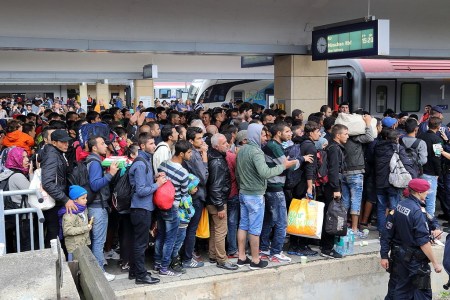
1607Thousands of newly arrived migrants, the vast majority of whom are men, crowd the platforms at Vienna West Railway Station on August 15, 2015 — a common scene in the summer and fall of 2015. (Image source: Bwag/Wikimedia Commons)

Speaking to the BBC News program, “World on the Move,” on May 16, Sir Richard Dearlove, the former head of the British intelligence service MI6, warned that the number of migrants coming to Europe during the next five years could run into millions. This, he said, would reshape the continent’s geopolitical landscape: “If Europe cannot act together to persuade a significant majority of its citizens that it can gain control of its migratory crisis then the EU will find itself at the mercy of a populist uprising, which is already stirring.”

Dearlove also warned against allowing millions of Turks visa-free access to the EU, describing the EU plan as “perverse, like storing gasoline next to the fire we’re trying to extinguish.”

On May 17, the Telegraph published the details of a leaked report from the European Commission, the powerful administrative arm of the European Union. The report warns that opening Europe’s borders to 78 million Turks would increase the risk of terrorist attacks in the European Union. The report states:

“It can be expected that, as soon as Turkish citizens will obtain visa-free entry to the EU, foreign nationals will start trying to obtain Turkish passports in order to pretend to be Turkish citizens and enter the EU visa free, or use the identities of Turkish citizens, or to obtain by fraud the Turkish citizenship. This possibility may attract not only irregular migrants, but also criminals or terrorists.”

According to the Telegraph, the report adds that as a result of the deal, the Turkish mafia, which traffics vast volumes of drugs, sex slaves, illegal firearms and refugees into Europe, may undergo “direct territorial expansion towards the EU.” The report warns: “Suspect individuals being allowed to travel to the Schengen territory without the need to go through a visa request procedure would have a greater ability to enter the EU without being noticed.”

While the EU privately admits that the visa waiver would increase the risk to European security, in public the EU has recommended that the deal be approved.

On May 4, the European Commission announced that Turkey has met most of the 72 “benchmarks of the roadmap” needed to qualify for the visa waiver. The remaining five conditions concern the fight against corruption, judicial cooperation with EU member states, deeper ties with the European law-enforcement agency Europol, data protection and anti-terrorism legislation.

European Commission Vice President Frans Timmermans said:

“Turkey has made impressive progress, particularly in recent weeks, on meeting the benchmarks of its visa liberalization roadmap…. This is why we are putting a proposal on the table which opens the way for the European Parliament and the Member States to decide to lift visa requirements, once the benchmarks have been met.”

In order for the visa waiver to take effect, it must be approved by the national parliaments of the EU member states, as well as the European Parliament.

Ahead of a May 18 debate at the European Parliament in Strasbourg over Turkey’s progress in fulfilling requirements for visa liberalization, Burhan Kuzu, a senior adviser to Erdogan, warned the European Parliament that it had an “important choice” to make.

In a Twitter message, Kuzu wrote: “If they make the wrong decision, we will send the refugees.” In a subsequent telephone interview with Bloomberg, he added: “If Turkey’s doors are opened, Europe would be miserable.”

Meanwhile, Erdogan has placed yet another obstacle in the way of EU-Turkey deal. He is now demanding that the EU immediately hand over three billion euros ($3.4 billion) promised under the deal so that Turkish authorities can spend it as they see fit.

The EU insists that the funds be transferred through the United Nations and other international aid agencies in accordance with strict rules on how the aid can be spent. That stance has prompted Erdogan to accuse the EU of “mocking the dignity” of the Turkish nation.

On May 10, Erdogan expressed anger at the glacial pace of the EU bureaucracy:

“This country [Turkey] is looking after three million refugees. What did they [the EU] say? We’ll give you €3 billion. Well, have they given us any of that money until now? No. They’re still stroking the ball around midfield. If you’re going to give it, just give it.

“These [EU] administrators come here, tour our [refugee] camps, then ask at the same time for more projects. Are you kidding us? What projects? We have 25 camps running. You’ve seen them. There is no such thing as a project. We’ve implemented them.”

In an interview with the Financial Times, Fuat Oktay, head of Turkey’s Disaster and Emergency Management Authority (AFAD), the agency responsible for coordinating the country’s refugee response, accused European officials of being fixated on “bureaucracies, rules and procedures” and urged the European Commission to find a way around them.

The European Commission insists that it was made clear from the outset that most of the money must go to aid organizations: “Funding under the Facility for Refugees in Turkey supports refugees in the country. It is funding for refugees and not funding for Turkey.”

The migration crisis appears to be having political repercussions for German Chancellor Angela Merkel, a leading proponent of the EU-Turkey deal. According to a new poll published by the German newsmagazine Cicero on May 10, two-thirds (64%) of Germans oppose a fourth term for Merkel, whose term ends in the fall of 2017.

In an interview with Welt am Sonntag, Horst Seehofer, the leader of the Christian Social Union (CSU), the Bavarian sister-party to Merkel’s Christian Democrats (CDU), blamed Merkel for enabling Erdogan’s blackmail: “I am not against talks with Turkey. But I think it is dangerous to be dependent upon Ankara.”

Sahra Wagenknecht of the Left Party accused Merkel of negotiating the EU-Turkey deal without involving her European partners: “The chancellor is responsible for Europe having become vulnerable to blackmail by the authoritarian Turkish regime.”

Cem Özdemir, leader of the Greens Party and the son of Turkish immigrants said: “The EU-Turkey deal has made Europe subject to Turkish blackmail. The chancellor bears significant responsibility for this state of affairs.”

Gunshots Fired as Nevada Battle Between Sanders, Clinton Camps Simmers

May 18, 2016

Gunshots Fired as Nevada Battle Between Sanders, Clinton Camps Simmers

by Jen Lawrence

18 May 2016

Source: Gunshots Fired as Nevada Battle Between Sanders, Clinton Camps Simmers – Breitbart

Justin Sullivan/Getty Images

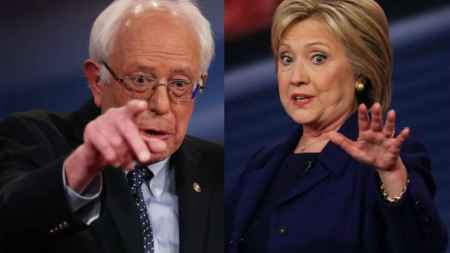
It’s open war between Bernie Sanders and Hillary Clinton.

The battle in Nevada that began on Saturday at the state’s Democratic Convention entered a new phase on Tuesday with a war of press releases, phone calls, and tweets from a variety of different people and groups on the left. Most shocking among them was a statement from Sanders himself revealing that gunshots were fired into his Nevada campaign offices.

The infighting in the Democratic party is far from over as Republicans coalesce behind their presumptive nominee Donald Trump.

On Tuesday morning, Senate Minority Leader Harry Reid—a Nevada Democrat—spoke with Sanders for 10 minutes via phone to recap what happened in his state. “He and I had a very long conversation,” Reid said of the call. “He said that he condemns that. I’m confident he does. I’m confident he’ll be saying something about it soon,…I’m hopeful and very confident that Sen. Sanders will do the right thing.”

Following his call with Reid, Sanders released a statement regarding what happened in Nevada. However, the statement was probably not what Harry Reid was hoping for—as it revealed the gunshots and more about the infighting in Nevada, including a break-in months ago at his campaign staff’s living quarters.

“Within the last few days there have been a number of criticisms made against my campaign organization,” Sanders said. “Party leaders in Nevada, for example, claim that the Sanders campaign has a ‘penchant for violence.’ That is nonsense.”

Sanders went on to add, “when we speak of violence, I should add here that months ago, during the Nevada campaign, shots were fired into my campaign office in Nevada and apartment housing complex my campaign staff lived in was broken into and ransacked.”

As the statement progressed Sanders began to lay out his argument against what happened in Nevada.
“The chair of the convention announced that the convention rules passed on voice vote, when the vote was a clear no-vote. At the very least, the Chair should have allowed for a headcount.

“The chair allowed its Credentials Committee to en mass rule that 64 delegates were ineligible without offering an opportunity for 58 of them to be heard. That decision enabled the Clinton campaign to end up with a 30-vote majority.”

The chair refused to acknowledge any motions made from the floor or allow votes on them.

These claims were followed up by Senator Sanders with this bombshell, in which he said the Democratic Party “has a choice: It can open its doors and welcome into the party” his backers or “maintain its status quo.”

“At (the Nevada) convention, the Democratic leadership used its power to prevent a fair and transparent process from taking place,” Sanders said, adding that there have been “zero reports” of violence during his rallies across the country.

Read Sanders full statement here.

When asked to respond Tuesday to Senator Sanders’ claims, CNN reports that “Reid was angry, telling CNN it was a ‘silly statement’ that ‘someone else prepared for him. Bernie should say something — not have some silly statement,’ Reid said. ‘Bernie is better than that. … I’m surprised by his statement. I thought he was going to do something different.’” Reid was hardly the only Democrat upset with Sanders’ comments. The Nevada Democratic Party responded Tuesday with a statement of their own as well.

Today from Berniebotland:
Email accusing me of bullying, copied to my PBS boss.
Email calling me a “narcissistic statushead.”
Not even noon.

— Jon Ralston (@RalstonReports) May 17, 2016

The Progressive Lust for Power

May 18, 2016

The Progressive Lust for Power, Front Page MagazineBruce Thornton, May 18, 2016

bv

Hillary Clinton and Bernie Sanders have been talking a lot about “fairness” and “equality” during their primary campaigns. Like most progressives, they pass themselves off as the champions of the ordinary people who are suffering beneath the boot of rapacious capitalists and the plutocratic “one percent.” Give us power, they say, and we will create “social justice” for all the victims of “white privilege” and capitalist greed, not to mention redistributing even more money from the selfish “rich” in order to finance such utopian goals.

Promiscuously displaying their hearts bleeding for the oppressed has long been the progressive camouflage that hides their real motive: the lust for power. Whether they want power to advance their failed ideology (Sanders), or to gratify their ambition for status and wealth (Hillary), in the end it doesn’t matter. History has repeatedly proven that the libido dominandi,the ancient lust for dominating others that lies behind the progressives’ political ambitions, in the end always leads to tyranny and misery.

When progressivism began in the late 19th century, progressives at least were honest about their aim to expand their power over the ignorant, selfish masses. A striking––and prophetic–– example can be found in Woodrow Wilson’s 1890 essay “Leaders of Men.” Wilson rejected the limited executive of the Constitution for a more activist president who has the “insight” to know “the motives which move other men in the mass”:

Besides, it is not a sympathy ­[with people] that serves, but a sympathy whose power is to command, to command by knowing its instrument . . . The competent leader of men cares little for the interior niceties of other people’s characters: he cares much-everything for the external uses to which they may be put. His will seeks the lines of least resistance; but the whole question with him is a question of the application of force.There are men to be moved: how shall he move them?

In the progressive view, fellow citizens are an abstract, collective “mass,” “instruments” that must be “moved,” manipulated, and used to reach the ideological goals of the technocratic elite, who knows far better than the people how they should live, what they should believe, and what aims they should strive for. Any resistance must be met by “the application of force.” Wilson means here primarily psychological or social force, but as we have seen after a century of expanding federal power, progressive policies enshrined in federal law are in the end backed by the coercive power of the police to punish non-compliance and enforce compliance.

From this perspective, Barack Obama is not an anomaly or some new political phenomenon birthed in the sixties. He is the predictable result of progressive assumptions over a century old. Thus he shares Wilson’s view of a “leader of men” as someone who knows what’s best for the people, and is willing to use unconstitutional “force” to achieve his aims. Think of the IRS hounding conservative political organizations, or the EPA violating private property rights, or the DOJ usurping the sovereignty of the states, or Obama’s various executive diktats that compromise individual rights, legislated laws, and the power of the states. All of these actions have applied “force” to “move” men in a particular ideological direction.

Also like Wilson, Obama has no “sympathy” with Congress, or the states, or the people who want, for example, the border secured, illegal aliens caught and punished, and felons deported. To progressives, the people holding those beliefs are all just bigots, or backwards, or evil obstructions of “social justice,” and so need to be “commanded” whatever their “interior niceties.” As such, they must be “moved” to accept Obama’s ideological preference: a vague internationalism and cultural relativism that compromise our distinct national character defined by a shared language and culture. If Congress or the states will not comply with Obama’s wishes by passing the laws he wants, then the “line of least resistance” will be Executive Orders, “Dear Colleague” letters, and instructions to federal agencies to “move” people to his point of view whether they like it or not.

Obviously, this philosophy of presidential leadership undermines the Constitution and its limited executive and separation of powers. More importantly, it forgets the primary purpose of the Constitution, which is not to “solve problems” or create utopias. Individuals, families, towns, counties, and states solve problems, not the distant, unaccountable Washington technocrats imposing cookie-cutter regulations and laws on America’s vast variety of needs, beliefs, and interests. Rather, the great goal of the Founding was to protect freedom by limiting the ability of any faction from concentrating power in government and using it to diminish the freedom of others. Such a faction is a tyrant, and as the Declaration of Independence details, it was the serial injustices of George III, whose “direct object [was] the establishment of an absolute Tyranny over these States,” that sparked the American Revolution.

More broadly, the progressives’ modus operandi has followed that of tyrants throughout history. The most dangerous enemies of the tyrant are all the associations and communities of people that lie beyond the power of the state, what Edmund Burke called the “little platoons,” and Alexis de Tocqueville recognized as one of the exceptional characteristic of the United States. Families, churches, PTAs, private schools and universities, clubs, think tanks, political parties, sports teams, businesses, charities––any venue in which people voluntarily gather together, interact with one another, and pursue their shared interests and aims, stands as a check on the power of the government. They create a social space in which people exercise their freedom without permission or oversight from government officials, and where their customs, traditions, and habits function as an alternative authority to the power of the state.

We call this civil society, and since ancient Greece, tyrants have known that it is their greatest enemy. Hence totalitarian regimes target these alternative authorities and try to destroy or delegitimize them. Progressives have similarly extended their reach into civil society, replacing private organizations with the bureaus, offices, and agencies of the government. Civil society is minimized, and society more and more comprises the mass of people overseen and regulated by a centralized technocratic power. This suits the tyrant, who knows the masses are easier to control when fragmented into private individual lives, either by violence, as in the past and in parts of the world today, or by redistributing wealth and taking over the management their lives, as our government does.

The latter method, what Tocqueville called “soft despotism,” is now our political reality, as Hillary’s and Bernie’s soothing promises of even more free stuff and more nanny-state tutelage show. More and more of our lives have been colonized by the federal government, which now controls and instructs us on everything from our diets and religious beliefs, to how to raise our children and understand sex identity. And if we disagree, government agencies will enforce their will, backed by the coercive power of the state. As a result, a government designed to check power and defend our freedom has now become one of concentrated power that diminishes our freedom.

If you think I exaggerate, consider what will happen if Hillary ends up nominating two or three Supreme Court justices. She has publicly condemned the Citizens United and Heller decisions, the former of which defended the First Amendment, the latter the Second. A court with a progressive majority could end up reversing these confirmations of our Constitutional rights to exercise free speech and bear arms. We could then end up with hate-speech restrictions like those used in Canada and the E.U. to censor speech offensive to privileged groups, or confiscations of our weapons of the sort Obama has openly suggested.

If that should happen, we will have come closer to the point of no return, and reap the consequences Tocqueville warned about:

It is indeed difficult to conceive how men who have entirely given up the habit of self-government should succeed in making a proper choice of those by whom they are to be governed; and no one will ever believe that a liberal, wise, and energetic government can spring from the suffrages of a subservient people.

Time to Leave UNESCO – Again

May 18, 2016

Time to Leave UNESCO – Again

by Guy Millière

May 17, 2016 at 5:30 am

Source: Time to Leave UNESCO – Again

  • UNESCO’s poisonous, fraudulent resolution is not only biased: it is negationist. All traces of Jewish presence in Jerusalem and Judea in ancient times are eliminated at the stroke of a pen.
  • Only six countries voted to reject the resolution: the United States, Estonia, Germany, Lithuania, the Netherlands and the United Kingdom. France, Spain, Sweden, Slovenia accepted the text and voted yes. The resolution was presented with the support of several Muslim countries — some often described as “moderate”: Egypt, Tunisia and Morocco.
  • UNESCO is a branch of the United Nations, and the UN is an organization where democracies are in the minority, surrounded by a huge majority of dictatorships and authoritarian regimes imbued with hatred toward the West. Israel is virtually the only country designated as guilty of violating human rights by the so-called Human Rights Council, and where, in 2009, Iranian President Mahmoud Ahmadinejad was welcomed as a hero.

On April 11, 2016, the Executive Board of UNESCO adopted a resolution called “Occupied Palestine.” The title immediately exposes it as a biased document. That is not surprising. All the texts adopted by UNESCO concerning the Middle East are biased.

However, those who read it carefully can see that a further step was taken.

UNESCO’s resolution is not only biased: it is negationist. All traces of Jewish presence in Jerusalem and Judea in ancient times are eliminated at the stroke of a pen. The Temple Mount is never mentioned. It is only called by the name al-Aqsa Mosque / Haram al Sharif. The name “Western Wall” is placed between quotation marks, to indicate that it is an invalid name: Al Buraq Wall is used without quotation marks. The graves of Jewish cemeteries are described as “Jewish fake graves.”

It is a radical anti-Semitic resolution: denying historical fact, claiming that what exists does not, presenting the history of Judaism and the Jews as lies. Accusing Jews of “planting Jewish fake graves” is the lie. It is saying that Judaism is a sham and Jews are liars and falsifiers.

The document is absolutely anti-historical, anti-fact and “anti-Zionist”: it tries unambiguously to “prove” that Israel was founded on an imposture and has no reason to exist. The document constantly describes Israel as the “occupying power” and presents it as a predatory and arbitrary country.

Voting for such a text means would endorsing historical negationism, radical anti-Semitism, and absolute “anti-Zionism”.

Correctly deciphering the meaning of the resolution and its implications, the representatives of six Western countries — the United States, Estonia, Germany, Lithuania, the Netherlands and the United Kingdom — voted no.

Representatives of other Western countries — France, Spain, Sweden, Slovenia — accepted the text and voted yes.

The resolution was presented with the support of several Muslim countries — some often described as “moderate”: Egypt, Tunisia and Morocco.

The text was written by Palestinian Authority (PA) “experts.” Since 2011, the Palestinian Authority has had a seat at UNESCO under the name “State of Palestine.”

The Israeli government immediately expressed its anger. Prime Minister Benjamin Netanyahu said that “anyone, let alone an organization tasked with preserving history, could deny this link which spans thousands of years.”

A petition was circulated by Stand With Us and the International Legal Forum, demanding that UNESCO change its attitude and remains “true to its founding principles.”

The anger of Israel’s government and indignation of others other is legitimate. The petition is fully justified.

However, expecting that UNESCO will change its attitude is illusory. Expecting that UNESCO will remain true to its founding principles is hoping for something that will not happen. UNESCO long ago abandoned its founding principles.

UNESCO is a branch of the United Nations, and the UN is an organization where democracies are in the minority, surrounded by a huge majority of dictatorships and authoritarian regimes imbued with hatred toward the West.[1] Israel is virtually the only country designated as guilty of violating human rights by the so-called Human Rights Council, and where, in 2009, Iranian President Mahmoud Ahmadinejad was welcomed as a hero.

In October, 2015, UNESCO had already started down path it follows today. It defined Rachel’s Tomb as the Bilal bin Rabah Mosque and the Cave of the Patriarchs as the Ibrahimi Mosque, and declared them “Palestinian sites.”

What is worrisome is that only six Western countries were ready to reject a totally poisonous, fraudulent resolution.

The Western countries that voted for the resolution evidently approve of its contents. These countries have lost all legitimacy to claim they want peace in the Middle East. By approving the resolution, they show they are at war: against Judaism, Jews and Israel. One of them, France, claims it will hold a meeting to revive the “peace process”: in this context, the claim is grotesque.

The fact that a group of Muslim countries, often described as “moderate,” supported the resolution can only lead to the question: How can a country that supports such a document be described as “moderate?”

That Palestinian Authority “experts” have written such a resolution should be sufficient to show that the PA is not “moderate.” It clearly has no intention at all of creating a State alongside Israel; instead, as its leaders often openly admit, its plan is that Israel has to be demonized, crushed and replaced.

The underlying problem is that this negationism, anti-Semitism and “anti-Zionism” are deeply rooted in both Europe and Islam.

The Quran says Jews and Christians (“Crusaders”) have falsified their sacred books, and the history of Judaism and the Jewish people is false. Muslim tradition says that Muhammad ascended to heaven from al Aqsa, and that the Al Buraq Wall is the wall where he attached the winged creature on which he flew to heaven. No room is left for the Temple Mount or the Western Wall, even though they were there, with countless archeological artifacts, for more than a thousand years before Muhammad was even born.

Muslim tradition also says that Jews, as disbelievers, are condemned to the humiliating status of dhimmi,[2] and that all territories conquered by Islam have to remain Muslim forever.[3] Muslim tradition cannot accept a country ruled by Jews or Christians on land that was once conquered by Islam — whether Israel, formerly part of the Ottoman Empire, or large swaths of Portugal and Spain.

The resolution adopted by the Executive Board of UNESCO on April 11 is “Islamically correct.” “Moderate” Muslim countries cannot contradict the Quran and Muslim tradition without risking being accused of irtidad (apostasy).[4] Palestinian Authority “experts” are being true to the Quran and to Muslim tradition.

Western countries that approved the resolution showed their submission and dhimmitude to “Islamic correctness.” Dhimmis, in Islamic history, are second class, “tolerated” citizens, who are subjected to special laws which remind them of their inferiority as well as a tax, the jizya, to purchase “protection” for their homes, possessions and lives.[5]

Countries that rejected the resolution would be considered insubordinate.

Refusing such a resolution is not enough. It is about time to ask the Muslim world to leave behind its heavy load of noxious traditions, blackmail threats and violence.

It is also time to do more.

Under the presidency of Ronald Reagan, the United States left UNESCO in 1984, because UNESCO was obviously subservient to the Soviet Union, and was serving interests contrary to those of freedom, liberty and Western values.

U.S. Secretary of State John Kerry spoke in French to a gathering of UNESCO representatives in Paris, on Oct 18, 2015, assuring them that “the engagement of the United States with this organization has never been as strong as now.”

The United States returned to UNESCO in 2003. In 2011, when the Palestinian Authority was admitted to UNESCO, the U.S. froze its financial contribution.

The United States badly needs to leave UNESCO again. UNESCO is obviously subservient to “Islamic correctness,” and serving interests contrary to those of freedom, liberty and Western values. Eighty years ago, negationism and anti-Semitism led to the Holocaust. It is urgent to say, “Enough.”

Dr. Guy Millière, a professor at the University of Paris, is the author of 27 books on France and Europe.


[1] Dore Gold, Tower of Babble: How the United Nations Has Fueled Global Chaos, Crown Forum, 2005.

[2] Bat Ye’or, Islam and Dhimmitude: Where Civilizations Collide, Fairleigh Dickinson University Press, 2001.

[3] Robert Spencer, Islam Unveiled: Disturbing Questions about the World’s Fastest-Growing Faith, Encounter Books, 2003.

[4] Yohanan Friedmann, Tolerance and Coercion in Islam: Interfaith Relations in the Muslim Tradition, Cambridge University Press, 2006.

[5] Bat Ye’or, op. cit.

Ex-general says NATO-Russia nuclear war ‘possible within a year’

May 18, 2016

Ex-general says NATO-Russia nuclear war ‘possible within a year’

Published time: 18 May, 2016 12:28

Source: Ex-general says NATO-Russia nuclear war ‘possible within a year’ — RT News

© / AFP

NATO’s former deputy military chief in Europe says his book, a fictional story which describes a nuclear war with Russia over the Baltic nations taking place in 2017, is based on an “entirely plausible” scenario.

General Sir Richard Shirreff, from Britain, served at the second-highest NATO military office in Europe between 2011 and 2014. He says his experience acquired in the alliance of war-gaming future conflicts helped him model the narrative for the book.

According to his scenario, starting next year Russia would first occupy Ukraine to secure a land route to Crimea and then invade the three Baltic nations, all of which are members of NATO. The move, Shirreff argued, would be driven by the perception of NATO’s weakness and Russia’s opposition to what it sees as the alliance’s attempts to encircle it.

Read more

© Claus Fisker

“We need to judge President [Vladimir] Putin by his deeds not his words,” the retired general told BBC Radio 4’s Today program. “He has invaded Georgia, he has invaded the Crimea, he has invaded Ukraine. He has used force and got away with it.”

The supposed invasion of Georgia in 2008 was Russia’s response to a Georgian attack on its breakaway region of South Ossetia, which started with the killings of Russian peacekeepers stationed there to prevent such hostilities. Russia responded by defeating the NATO-trained Georgian Army and withdrew. Moscow later recognized South Ossetia as a sovereign state, formalizing its de facto independence from Georgia that had been in place since the 1990s.

The supposed invasion of Ukraine in 2014 was Russia’s use of its troops, which were legally deployed in Crimea under a treaty with Ukraine, to prevent hostilities after an armed coup in Kiev. The Crimean people, who overwhelmingly opposed the new Ukrainian government and its nationalistic leanings, voted in a referendum to part ways with Ukraine and rejoin Russia.

If Russia used military force against any NATO members, the entire alliance would be obliged to declare war on Russia. The US is the most powerful member of NATO and has the world’s biggest military force. According to Shirreff, Russia would use its nuclear arsenal to counter NATO’s response.

“Be under no illusion whatsoever – Russian use of nuclear weapons is hardwired into Moscow’s military strategy,” he said, omitting the fact that NATO’s nuclear nations – the US, Britain and France – have always kept a pre-emptive nuclear strike as a possible option. Russia dropped its pledge not to use nuclear weapons first in 1993.

A scenario of conflict between Russia and NATO members over one of the Baltic states was earlier explored by the BBC in a film, which focused on decision-making at a British advisory body responding to the crisis. In the film, the stand-off escalated into a full-scale nuclear conflict and the advisers contemplating an option to destroy Russia’s biggest cities with Trident missiles.

Why Donald Trump Can Be the Real Conservative

May 18, 2016

Why Donald Trump Can Be the Real Conservative, American ThinkerRobert Weissberg, May 18, 2016

[T[he often obscure regulatory processes, not high-profile laws like the Affordable Care Act are the deeper menace. It is here that totalitarianism slowly metastasizes. Trump, with scant effort, can advance the traditional idea of national government: strong in its constitutional responsibilities, especially defense, and limited elsewhere.

**************************

Countless self-proclaimed conservatives are denouncing Trump (or being coy in promising future support) for being insufficiently conservative. Leaving aside whether there exists some authoritative written-in-stone conservative doctrine, this assessment misunderstands why a Trump administration will probably be more conservatives that the likes of a Ted Cruz or others asserting greater authenticity.

Trump’s conservative bona fides are not based on private assurances that he will ignore past liberal inclinations. It also has nothing to do with all the “big issues” usually employed to certify ideological orthodoxy.

Trump’s conservatism will be rooted in inaction, a view of conservatism that has not infused politics since the days of golf-loving President Eisenhower or, better yet, Calvin Coolidge. In this conservatism, the White House does not deliver fatwas about transgendered bathrooms or otherwise engage in myriad radical egalitarian-driven social engineering schemes. It does not sponsor White House conferences on schoolyard bullying. It is laissez-faire conservatism sans libertarian baggage.

Trump can accomplish this mission almost effortlessly. No need to hire policy wonks to draft dense reports or negotiate complicated deals with Congress. Nor will Donald run the risk of being overruled by liberal judges — inaction can in principle violate the law but it is not easy to prosecute sloth and in many instances, indolence is the perfect antidote to the legacy left by President Obama and his energetic pen and cell phone.

The secret to Trump’s do-nothing conservative agenda will come from his appointments in the often obscure federal bureaucracy, not introducing new laws to please religious fundamentalists or going to court to reverse job-killing EPA rules. Here, far beyond public view, is where unelected ideologues with extra time on their hands run wild. These are zealots who pressure universities to over-ride due process to purge the campus of alleged sexual aggression at some frat house, agonize over federal guidelines regarding what constitutes a healthy school lunch and threaten legal action if public schools fail to use racial quotas in handing out suspensions and expulsions. Meanwhile, thanks to these bureaucrats on-a-mission the residents of Smallville are forever threatened that their lives will be disrupted by having to sign a Department of Justice consent decree to build 1000 new large federally subsidized apartments for troubled inner-city residents. In fact, the millions now wasted on promoting diversity and inclusion in the military can fund a whole new squadron of F-35s, too. And this list of intrusions that will never occur under President Trump is almost endless.

No need to scour all the resumes that will be sent to Trump’s transition team to uncover trusted folk disinclined to reclassify every puddle into a navigable waterway. Trump will just not fill these positions, and while this “lazy” strategy lacks the sex appeal of a spirited public confrontation, the impact is just what the doctor ordered — bloated budgets shrink and America escapes egalitarian busybodies viewing every inequality as a crime needing Washington’s intervention. When social justice warriors whine about the Office of Civil Rights in the Department of Education’s lackadaisical handling of complaints that The Boy Scouts Act, a rule that requires Boy Scout troops meeting on school grounds be hyperinclusive, the Donald will merely say, “I’m working on it.”

Doctrinaire conservatives might disdain such passivity and prefer high-profile, feel-good assault to undo decades of liberalism. Leaving aside the long odds of success, this approach fails to grasp how the often obscure regulatory processes, not high-profile laws like the Affordable Care Act are the deeper menace. It is here that totalitarianism slowly metastasizes. Trump, with scant effort, can advance the traditional idea of national government: strong in its constitutional responsibilities, especially defense, and limited elsewhere.

Ironically, of all the candidates seeking the conservative mantel, Trump may be by temperament and outside obligations best suited to achieve victory via apathy. He has a business to over-see, disdains policy minutia and he will undoubtedly use all available energy for what really drives his passions — effective boarders, a strong military, economic prosperity and not how best to rescue pre-teens with a confused sexual identity. His slogan should be: Elect Trump, the Do Nothing Conservative.


Forget NATO. Trump Should Defund the UN

May 18, 2016

Forget NATO. Trump Should Defund the UN, PJ Media, Roger L. Simon, May 17, 2016

(Please see also, Where UNESCO and ISIS Converge. — DM)

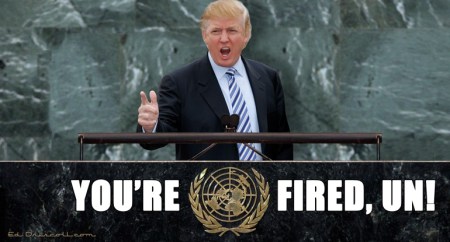
Trump fire UN

The courage to go after sacred cows is one of Donald Trump’s more appealing, if controversial, traits.   He raised the issue of NATO, contending the USA pays far too much of the freight in the mutual defense pact.

Such proposals, the candidate has made clear, are not so much policies as “suggestions” or what one might call, from his business perspective, negotiating positions.

Regarding the NATO suggestion, frankly, I am of two minds.  While it’s clearly arguable the American contribution is excessive, the investment might be necessary for the preservation of the alliance (weak as it is) and to maintain the necessary U.S. leadership position.  “Leading from behind” has been one of the obvious fiascoes of the 21st century.

But I have another, somewhat similar, suggestion for Donald about which I have no ambivalence.  It’s time for the U.S. seriously to curtail, if not end, its mammoth annual contribution to the United Nations that dwarfs those made by all the other 192 member-states.

Here’s how CNS News reported the situation in 2012:

In one of its last actions of the year, the United Nations General Assembly on Christmas Eve agreed to extend for another three years the formula that has U.S. taxpayers contributing more than one-fifth of the world body’s regular budget.No member-state called for a recorded vote, and the resolution confirming the contributions that each country will make for the 2013-2015 period was summarily adopted. The assembly also approved a two-year U.N. budget of $5.4 billion.

The U.S. has accounted for 22 percent of the total regular budget every year since 2000, and will now continue to do so for the next three years.

That’s 22 percent for virtually nothing.

While the UN many have been formed in an outburst of post-World War II idealism, it has descended into an international society for Third World kleptocrats of mind-boggling proportions—the Iraq War  oil-for-food scandal being only one nauseating example--who engage in non-stop Israel-bashing to distract their populaces from their own thievery. What in the Sam Hill do we get out of that?

Everybody knows this, of course. When critical negotiations take place (i.e., the Iran nuclear talks, speaking of fiascoes, and the Syrian peace talks, not that they have much chance of success), they are removed from the UN and conducted between the serious players. No one is curious about what Zimbabwe’s Mugabe has to say, at least one hopes not.

Now it’s certain this suggestion—defunding the UN—would be treated with (feigned) uncomprehending derision by Hillary and even more contempt by Bernie, who would most probably like to cede US hegemony to the United Nations anyway, assuming some good socialist, like Venezuela’s Maduro or Brazil’s Rousseff (well, maybe not her), was secretary-general.

But the American voter, I would imagine, when informed of even a smattering of the facts, would support Trump in defunding or, more likely, greatly curtailing America’s financial support of the United Nations.  It’s a negotiation, after all.

Maybe the UN can be reduced to a few divisions of more practical use like the World Health Organization. UNESCO has, sadly, already gone the way of political insanity. Whatever the case, a smaller UN footprint in NYC would be a big step in the right direction. Think what a positive it would be for the traffic and parking situation on the East side of Manhattan.


Texas Governor Refuses Obama’s Request to Lift State Sanctions on Iran; Says Nuclear Deal Undermines US Security

May 18, 2016

Texas Governor Refuses Obama’s Request to Lift State Sanctions on Iran; Says Nuclear Deal Undermines US Security

ByPamela Geller on May 17, 2016

Source: Texas Governor Refuses Obama’s Request to Lift State Sanctions on Iran; Says Nuclear Deal Undermines US Security | Pamela Geller

A rational voice in a world of madness. Obama emboldened, enriched and legitimized the world’s largest state sponsor of terror. He has unleashed a terrible evil on the world.

Not all will go quietly. Thank you, Governor Abbott, for giving voice and action to the voiceless and powerless.

Here is Governor Abbott’s statement:

Governor Greg Abbott today informed the Obama administration that Texas will maintain and strengthen its sanctions against Iran. Governor Abbott responded to a letter from the administration requesting that Texas “review” its economic sanctions against Iran. Governor Abbott reiterated his strong opposition to the Iran deal and informed the administration that he will continue to seek new legislation to strengthen existing economic sanctions against the world’s leading state sponsor of terrorism.

“Entering into an agreement with a country that consistently calls for ‘death to America’ and repeatedly articulates anti-Semitic policies is short-sighted and ignores geopolitical realities,” Governor Abbott writes in the letter. “As a strong supporter of Israel, I am committed to doing everything in my power to oppose this misguided deal with Iran. Accordingly, not only will we not withdraw our sanctions, but we will strengthen them to ensure Texas taxpayer dollars are not used to aid and abet Iran.”

During his visit to Israel in January 2016, Governor Abbott met with Israeli Prime Minister Benjamin Netanyahu and announced he would seek legislation to:

Prohibit local government entities in the State of Texas from investing in Iran or entities conducting business with Iran
Require all Texas state entities – not just state pensions – to follow Texas’ divestiture policy
Close additional loopholes in Texas’ current divestiture statute.

To read the full letter, click here.


More……..

Texas Rejects Obama’s Request to Lift Iran Sanctions, Affirms ‘Strong Support’ for Israel,” By Max Gelber, United with Israel, May 16, 2016:

Texas Governor Gregg Abbott announced he would not lift the state’s sanctions on Iran, rejecting a request to do so by President Obama and affirming ‘strong support’ for Israel.

Abbott told the Obama administration in a letter that Texas will maintain and even strengthen its sanctions against Iran.

Abbott was responding to a letter from the administration sent in April requesting that Texas “review” its economic sanctions against Iran.

The governor reiterated his strong opposition to the Iran deal, which was sealed with the Islamic Republic last summer, and informed the administration that he will continue to seek new legislation to strengthen existing economic sanctions against Iran, which he termed as the “world’s leading state sponsor of terrorism.”

“Entering into an agreement with a country that consistently calls for ‘death to America’ and repeatedly articulates anti-Semitic policies is short-sighted and ignores geopolitical realities,” Abbott wrote in the letter.
Obama

US President Barack Obama (Susan Walsh/AP)

“As a strong supporter of Israel, I am committed to doing everything in my power to oppose this misguided deal with Iran. Accordingly, not only will we not withdraw our sanctions, but we will strengthen them to ensure Texas taxpayer dollars are not used to aid and abet Iran,” he stated.

During his visit to Israel in January, Abbott met with Prime Minister Benjamin Netanyahu and announced he would seek legislation to prohibit local government entities in the State of Texas from investing in Iran or entities conducting business with Iran, a law that requires all Texas state entities, and not just state pensions, to follow Texas’ divestiture policy, and further legislation to close additional loopholes in Texas’ current divestiture statute.

“Given all the flaws that are inherent in the Iran deal, Texas is absolutely committed to maintaining its sanctions against Iran,” the letter reads.

Meeting with the Jewish media in New York over the weekend, Abbot said he is “deeply disturbed” by the nuclear deal and views it as “a potential existential threat to Israel and frankly to nations across the globe.”

“It makes no sense to me why the United States would be an accomplice to arming and aiding economically a nation that to this day seems to be devoted to terrorism,” he said at the meeting, according to the Jerusalem Post.

“Israel has no stronger ally in the United States than the State of Texas,” he added. “Texas is going to take the lead in sending the message to the international community that we stand with Israel.”