Archive for May 9, 2016

Iran claims to successfully test missile that can reach Israel

May 9, 2016

Iran claims to successfully test missile that can reach Israel Senior general says highly accurate projectile has a range of 2,000 kilometers, was launched two weeks ago

By Tamar Pileggi

May 9, 2016, 12:00 pm

Source: Iran claims to successfully test missile that can reach Israel | The Times of Israel

Screen capture of an Iranian missile launch, October 10, 2015 (YouTube: PressTV News Videos)

senior Iranian general on Monday announced that the country’s armed forces successfully tested a precision-guided, medium-range ballistic missile two weeks ago, the state-run Tasnim agency reported.

“We test-fired a missile with a range of 2,000 kilometers and a margin of error of eight meters,” Brigadier General Ali Abdollahi was quoted as saying at a Tehran science conference.

The eight-meter margin means the “missile enjoys zero error,” he told conference participants.

The general went on to say that 10 percent of Iran’s defense budget has been allocated to “research projects aimed at strengthening defense power,” the report said.

Under a nuclear deal signed last year between world powers and Iran, ballistic missile tests are not forbidden outright, but are “not consistent” with a United Nations Security Council resolution from July 2015, US officials say.

According to the UN decision, “Iran is called upon not to undertake any activity related to ballistic missiles designed to be capable of delivering nuclear weapons, including launches using such ballistic missile technology,” until October 2023.

That has not stopped Iran from carrying out a number of tests of ballistic missile technology since the nuclear deal was adopted on October 18, 2015.

In November, Iran launched a missile with a range of 1,930 kilometers (1,200 miles) from a site near the Gulf of Oman, US officials said at the time.

In March, Iran test-fired two more ballistic missiles, which an Iranian news agency said had the phrase “Israel must be wiped out” written on them in Hebrew. An Iranian commander said the test was designed to demonstrate to Israel that it is within Iranian missile range.

That launch sparked international fury as it appeared to flout the agreements made in the Iranian nuclear deal.

The US, France, Britain and Germany decried the launch as “destabilizing and provocative” and called for United Nations action. A UN committee later determined Iran’s ballistic tests were in violation of a Security Council resolution prohibiting Tehran from launching ballistic missiles capable of delivering nuclear weapons.

Last month, American and Russian officials said Iran test-fired an advanced rocket system in the Dasht-e Kavir desert, in what some considered a cover for intercontinental ballistic missile research.

Israel has pointed to ballistic missile tests as proof Tehran plans to continue pursuing an atomic weapon, despite the landmark agreement aimed at curbing its nuclear program.

In response to the missile tests, Washington imposed fresh sanctions over Iran’s missile program in January, almost immediately after lifting separate sanctions related to Iran’s nuclear program under the nuclear deal.

Iran maintains that because it cannot develop nuclear weapons under the deal, none of its missiles is capable of carrying a nuclear weapon.

Israeli Police Issue New Guideline: ‘Beware of Attacks with Poisoned Syringes’

May 9, 2016

’ By: JNi.Media Published: May 9th, 2016

Source: The Jewish Press » » Israeli Police Issue New Guideline: ‘Beware of Attacks with Poisoned Syringes’

The Judea and Samaria Police District is concerned about a new kind of Arab terrorism, using poison-filled syringes against Israeli security personnel, Walla reported Monday. Police base their concern on an attempted attack a week and a half ago, in which an Arab female, 15, tried to stab soldiers with a syringe that was filled with detergents.

A police intelligence report disseminated last Thursday notes that two syringes had been discovered in the possession of two 15-year-old Arab females, one of whom was wielding hers when they arrived at the check post near Beit Horon, on route 443 (an alternative to Highway 1, connecting Tel Aviv and Jerusalem). In view of the new development, the police called on every last officer to remain alert to the possibility of the use of syringes in attacks and conduct body searches with that possibility in mind.

The female who had wielded the syringe was shot and wounded, and her friend was arrested without injury to Israeli security forces. Both females, residents of Ramallah, also had in their possession knives and a letter with citations from the Koran. In their interrogation, both confessed to a desire to kill Jews. Police believe the substance in their syringes was a combination of bathroom cleaner and dish liquid.

The Judea and Samaria Police District report mentions a 2015 Facebook post by the Commission on Information and ideological Mobilization – Fatah calling on Arab terrorists to use syringes full of poison instead of knives, because “it’s a more efficient and deadly method than using a knife.”

The Fatah-affiliated group’s post recommends that, “in light of the installation of metal detectors at the entrances to Jerusalem to prevent the use of knives, there is a new and simple method — using syringes with firewater, such as benzene or any other poisonous substance.”

However, until the publication of the story in Walla Monday morning, there has been only that one reported instance of an attempted attack with a poisoned syringe.

Stay tuned.

Trump: I’m a conservative, but it’s called the Republican Party, not the Conservative Party

May 9, 2016

Trump: I’m a conservative, but it’s called the Republican Party, not the Conservative Party, Washington Free Beacon via YouTube, May 8, 2016

Paul Johnson on Trump

May 9, 2016

Paul Johnson on Trump, Power LineSteven Hayward, May 8, 2016

The great British historian Paul Johnson is not the first to point out that the most significant aspect of Trump is his direct challenge to political correctness, but few have put it as strongly as he does in his latest Forbes column, “When Excess Is a Virtue.” Excerpt:

The U.S. has been inundated with PC inquisitors, and PC poison is spreading worldwide in the Anglo zone.

For these reasons it’s good news that Donald Trump is doing so well in the American political primaries. He is vulgar, abusive, nasty, rude, boorish and outrageous. He is also saying what he thinks and, more important, teaching Americans how to think for themselves again.

No one could be a bigger contrast to the spineless , pusillanimous and underdeserving Barack Obama, who has never done a thing for himself and is entirely the creation of reverse discrimination. The fact that he was elected President–not once, but twice–shows how deep-set the rot is and how far along the road to national impotence the country has traveled. . .

None of the Republican candidates trailing Trump has the character to reverse this deplorable declension. The Democratic nomination seems likely to go to the relic of the Clinton era, herself a patiently assembled model of political correctness, who is carefully instructing America’s most powerful pressure groups in what they want to hear and whose strongest card is the simplistic notion that the U.S. has never had a woman President and ought to have one now, merit being a secondary consideration. . .

Trump is a man of excess–and today a man of excess is what’s needed.

Further and similar thoughts from Conrad Black here.

Khamenei’s Anti-Americanism

May 9, 2016

Khamenei’s Anti-Americanism, Gatestone InstituteMajid Rafizadeh, May 8, 2016

(Please see also, Dangerous illusions about Iran. — DM)

♦ Khamenei is sending a strong signal to Washington that Iran’s reintegration in global financial system does not mean that the Iranian regime will change its hostility towards the U.S. and Israel.

♦ “The Persian Gulf is the Iranian nation’s home and the Persian Gulf and a large section of the Sea of Oman belong to this powerful nation. Therefore, we be present in the region, hold war games and display our power.” – Iranian Supreme Leader Ali Khamenei

♦ In addition, Khamenei is sending a message to the Iranian people that the current process of implementing the nuclear agreement, lifting sanctions, and partial economic liberalization does not mean that Iran is going to liberalize its politics and allow freedom of speech, freedom of the press, and more political participation.

Some politicians and policy analysts argue that Iran’s sanctions relief and the continuing implementation of its nuclear program would push Iran towards moderation in dealing with the United States and Israel, as well as scaling down Iran’s expansionist and hegemonic ambitions. The realities on the ground suggest otherwise.

As Tehran’s revenues are rising, anti-American and anti-Semitic rhetoric by Iran’s Supreme Leader, Ayatollah Ali Khamenei, are escalating.

The Iranian regime continues to view the U.S. and Israel as their top geopolitical, strategic and ideological enemies. According to Iran’s Mehr News Agency, on May 1, Khamenei welcomed the Secretary General of Palestinian Islamic Jihad, Ramadan Abdullah Shalah, and his accompanying delegation in Tehran:

“Ayatollah Khamenei reaffirmed that with this perspective in regional issues, Iran sees the United States as the main enemy with the Zionist regime standing behind it. He pointed to extensive, unprecedented sanctions of the U.S. and its followers against the Islamic establishment in recent years and dubbed the objective of them as discouraging Iran from continuing its path; ‘but they failed to achieve their goals and will fail in future as well.’ “

Khamenei is sending a strong signal to Washington that Iran’s reintegration in the global financial system does not mean that the Iranian regime will change its hostility towards the U.S. and Israel.

In addition, Khamenei is sending a message to the Iranian people that the current process of implementing the nuclear agreement, lifting sanctions, and partial economic liberalization does not mean that Iran is going to liberalize its politics and allow freedom of speech, freedom of the press, and more political participation.

Khamenei is also making it clear that Iran is not going to fundamentally change its foreign policy objectives in the region.

Regarding Iran’s role in the Gulf, Iran’s Supreme Leader pointed out on May 2 that

“The Persian Gulf is the Iranian nation’s home and the Persian Gulf and a large section of the Sea of Oman belong to this powerful nation. Therefore, we should be present in the region, hold war games and display our power.”

When it comes to Syria, Iran’s Islamic Revolutionary Guard Corps (IRGC) has become more emboldened and empowered in supporting the Syrian regime financially, militarily, and in intelligence and advisory capacities. Even during the current peace talks, Iran is ramping up its presence in Syria to increase Bashar Assad’s leverage in the negotiations.

In Iraq, Iran’s sectarian agenda and support for Shiite militias continues to cause political instability. This week, hundreds of followers of the Iraqi Shia leader, Muqtada al-Sadr, stormed into the Iraqi parliament building, demanding its speaker halt the session. Prime Minister Haider al-Abadi warned that these protests could lead to the Iraqi state’s failure. After the protests, al-Sadr — who spent several years studying in Qom (Iran’s center of Islamic studies) — travelled to Iran.

Currently, some of the powerful Iraqi Shiite militias with which Iran has close connections, and in which it is investing its resources, are: Sadr’s Promised Day Brigade, the successor to the Mahdi Army; the Badr Organization, Asa’ib Ahl al Haqq (League of the Righteous) and Kata’ib Hezbollah (Battalions of Hezbollah).

In Yemen and Bahrain, Iran’s support for the Houthi rebels and Shiite groups continues to fuel the sectarian conflicts there.

Khamenei has also unleashed a series of anti-U.S. and anti-Israel tweets, including:

“Lebanon’s Hezbollah is strong enough not to be hurt by some pressures; today, no doubt Zionist regime is scared of Hezbollah more than past.” (1 May 2016)

“Shia-Sunni clash is colonialist, US plot. Top issue is to realize 2 sides of the extensive war & one’s stance to avoid being against Islam.” (1 May 2016)

Iran’s foreign policy is anchored in three areas: ideological principles (anti-Americanism and anti-Semitism), national interests (mainly economic gains), and nationalism.

Although Khamenei needed to emphasize Iran’s national and economic interests, there is no evidence that he is giving up on the revolutionary ideological norms. Khamenei is relying on the so-called moderates — President Hassan Rouhani and his U.S.-educated foreign minister, Javad Zarif — to continue the process of implementing the nuclear deal in order to benefit Iran economically and ensure the regime’s hold on power.

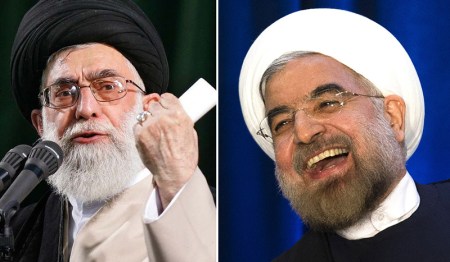
1590Iran’s Supreme Leader, Ayatollah Khamenei (left), is not giving up on the revolutionary ideological norms. He is relying on the so-called moderates, such as President Hassan Rouhani (right), to continue the process of implementing the nuclear deal in order to benefit Iran economically and ensure the regime’s hold on power.

Nevertheless, at the end of day, the key decision makers in Iran’s political establishments are Khamenei and the senior cadre of the IRGC, who prioritize Iran’s ideological and revolutionary principles. It is from them that Khamenei draws his legitimacy.

As long as the Supreme Leader is alive, one should not expect that Iran’s reintegration into the global economy to move the country to the moderate end of the spectrum, or that its anti-American, anti-Semitic sentiments and fundamentals of Tehran’s foreign policies will change.


