Archive for April 13, 2016

Vote the Platform, Not the Man(ner)

April 13, 2016

Vote the Platform, Not the Man(ner), PJ Media, David Solway, April 12, 2016

trump_reading_dora_manners_book_article_banner_4-8-16-1.sized-770x415xc

Recently, I’ve been corresponding with a friend on the ever-contentious subject of Donald Trump, a man whom my interlocutor finds objectionable on both political and personal grounds. Political positions can be discussed and debated even if they do not produce agreement or compromise, but a personal animadversion cannot be met with argument. My correspondent considers Trump an unreconstructed vulgarian, loud, ill-mannered and abrasive, all of which apparently render him unfit for office. He simply cannot vote for a man he dislikes.

Personal liking is one of the least reliable criteria for voting. The election of Barack Obama to the presidency is surely proof positive that affection for a political figure—the love affair with Obama was a national phenomenon—can result in unmitigated disaster. The same is true of personal dislike, which may often lead to the rejection of the best, or least worst, candidates for political office.

In Canada’s recent federal election, former PM Stephen Harper was vilified in the press and held in contempt by the majority of the electorate as a dangerous and unsavory character. He was rumoured to harbor a “secret agenda,” though nobody could say what it was. He was denounced as a brooding egotist and a control freak. He was viewed as unsympathetic to the marginalized and disadvantaged, stingy with entitlements, unimpressed by the claims of the arts community for ever greater government largesse, and generally hostile to Canada’s growing and increasingly clamorous Islamic community.

The fact that he steered the country safely through the market crash of 2008, signed lucrative international trade deals, kept taxes down, reduced the GST (Goods and Services Tax) and provided the country with a balanced budget plainly counted for nothing. His emendation of citizenship protocols in an effort to check the spread of culturally barbaric practices, chiefly associated with Islam, counted against him. At the end of the day, he was simply unlikeable, he was “Harperman,” and he had to go.

Instead, Canadians fell in love with Justin Trudeau, easily the most unqualified prime ministerial candidate since Confederation (there have been many duds, eccentrics and charlatans, but Trudeau is in a category of his own). He was young, personable, wavy-haired, utterly innocuous and adroit at spouting platitudes. Women found him attractive, millennials recognized one of their own, and he embraced all the feel-good big-spending fads and sophistries of welfare socialism. In short, people found him immensely likeable, the polar opposite of the straitlaced, parsimonious Harper.

The consequences were not long in coming. Trudeau has been in office for half a year, more than enough time to engineer the rapid deterioration of a once-prosperous and relatively secure nation. He has brought in 25,000 “Syrians” and is aiming for many thousands more, all living off the public dole and no doubted salted with aspiring jihadists. He intends to build mosques (which he calls “religious centers”) on military bases and is re-accrediting Muslim terror-affiliated organizations that Harper defunded. He inherited Harper’s balanced budget and in just a few short months was busy at work racking up a $29.4 billion deficit. Not to worry, since Trudeau is on record saying that budgets balance themselves. Magic is afoot. All one need do is continue believing in the Ministry of Silly Walks and the nation will stride ever forward.

(Here’s the silly walks video. I was unable to restrain myself. — DM)

According to a March 18, 2016 Ipsos poll, 66 per cent of Canadians approve of his performance. A boilerplate article by Jake Horowitz for Policy.Mic represents the general attitude of appreciation. In his meeting with Barack Obama, Horowitz writes, “it was Trudeau’s tone of optimism, and his embrace of a style of politics marked by positivity, inclusion and equality, that truly shined [sic] through. Practically everything about his values comes in stark contrast to what we’ve heard from Republican front-runner Donald Trump, who has dominated the 2016 election cycle with divisiveness, anger and fear-mongering.”

Often commentators will seek to buttress their personal liking or disliking on the basis of presumed intellectual substance. Despite his success in business, his knowledge of practical economics and international finance, and his instinctive recognition of what is needed in a country beset by astronomical deficits, trade imbalances and catastrophic immigration problems, Trump is frequently dismissed as an ignoramus. “Trump doesn’t read,” says David Goldman. “He brags about his own ignorance. Journalist Michael d’Antonio interviewed Trump at his New York home and told a German newspaper: ‘What I noticed immediately in my first visit was that there were no books… huge palace and not a single book.’”

On the other hand, we are told that Justin Trudeau reads. According to Jonathan Kay, formerly letters editor at The National Post and currently editor of The Walrus, who assisted Trudeau in writing the Canadian Prime Minister’s memoir Common Ground, “I can report that Trudeau is very much an un-boob. Several of our interviews took place in his home study, which is lined with thousands of books…We spoke at length about the Greek classics his father had foisted upon him as a child…and the policy-oriented fare he now reads as part of his life in politics…Trudeau probably reads more than any other politician I know.”

Kay never mentions that this intellectual giant failed to complete the two university degrees for which he had enrolled, earned his chops as a substitute instructor at the high school level, and inherited a formidable financial estate from his famous father, former Canadian PM Pierre Trudeau. He has done nothing with his life except preen and posture for the public—a “shiny pony,” as journalist Ezra Levant has dubbed him. Trump on the other hand received an inheritance and turned it into one of the world’s major fortunes. As New English Review editor Rebecca Bynum points out, “the businessman from Queens understands the American working people better than the Harvard man from Texas or the mailman’s son from Ohio. He speaks in plain English to describe the incompetence, and yes, the stupidity of those currently in power, who could not have harmed our country any more if they had had outright malicious intent.”

The Harper case was anomalous. He was an evidently accomplished man, trained in economics (unlike Trudeau, he completed his university program), a stalwart Canadian who wrote a book on our national sport, A Great Game: The Forgotten Leafs & the Rise of Professional Hockey, (unlike Trudeau’s memoir, there was no Kay-like ectoplasm to assist in its composition) and was deeply interested in the Franklin Expedition and the lore of the Canadian North. And he was a reader. Nevertheless, Canadian novelist Yann Martel mocked Harper in a series of letters collected into a book, 101 Letters to a Prime Minister, condescendingly lecturing Harper on what he should read, with the implication (sometimes explicit) that Harper saw nothing but the financial bottom line and was a man without imagination, heart or a vision for the country larger than trade deals and tax policy. (Martel is evidently a prehensile reader, having discovered an obscure novella by the Argentine writer Moacyr Scliar, Max and the Cats, which arguably formed the plagiarized occasion for his own Life of Pi. Not the man to instruct the PM.) In any event, under a relentless media barrage the public came to see Harper as a rigid martinet. In the 2015 election, he never had a chance.

Harper was regarded by the press and a plurality of Canadians pretty much as Trump is currently viewed by establishment Republicans, sanctimonious conservatives and a partisan media, for whom The Donald has become politically non grata, a “reptile” in Andrew Klavan’s distemperate rhetoric. Trump’s dilemma is that he has refused to be housebroken. He is certainly a flawed human being, but I have never known one who wasn’t.

So let us now compare. Trump has pledged to set the U.S. on a sound economic footing, prevent the flow of illegal migrants across the southwestern border, limit Islamic immigration into the country, and restore America’s diminished prestige and might on the international stage. But he is, we are told, a boor, a plebeian, a crass opportunist, a know-nothing who doesn’t read. “Donald Trump may not be perfect,”  Bynum agrees, “but at least he will clean house.” All the more reason, it appears, for the virulence and disparagement with which he has been met. The bien pensants dislike him with a vehemence that does them little honor.

On the other hand, Trudeau, as we’ve seen, has plunged his country into deficit, has imported thousands of Muslims who will swell the welfare rolls and generate social unrest, as is inevitable wherever Muslims begin to multiply, withdrawn Canadian forces from the campaign against ISIS, and filled his cabinet with highly questionable personnel—women simply because they are women, such as the lamentably dense Chrystia Freeland, Minister of International Trade (who disgraced herself on the Bill Maher show), and doddering retreads like Immigration Minister John McCallum. But Trudeau is suave, telegenic, blandly inoffensive—and he reads. People like him with a passion that also does them little honor.

Would any sane person choose a Trudeau-type figure over a Harper or a Trump to lead their country into a problematic future? The larger issue is whether any reasonable person should predicate his voting preference on personal liking or disliking. Trudeau is intellectually vapid, has the wrong instincts, and is unlearnable. But he is liked. As for Trump, I am not suggesting that he would be a better choice than Cruz may be or Rubio may have been, though I suspect he might. He still has much to learn about the intricacies and priorities of governing and about looking “presidential.” What matters is that a candidate for political office is smart, has the right instincts, and is willing to learn. I believe Trump qualifies in these respects. Disliking him is beside the point.

Writing for The Federalist, Timm Amundson acknowledges that Trump can be rude, arrogant and reckless, and asks: “How can a principled, pragmatic, deliberate conservative be drawn to such a candidate?” And answers: “It is because I believe conservatism doesn’t stand a chance in this country without first delivering a very heavy dose of populism,” that is, “a platform built largely on the principle of economic nationalism…focus[ing] on three primary policy areas: trade, defense, and immigration.” This is Trump’s bailiwick.

To approve or disapprove of a candidate on the basis of his or her social and economic platform is wholly legitimate, is at least theoretically open to debate and constitutes a sensible basis for choice. If you believe, as Amundson does, that the core populist platform is the surest way “for America to begin rebuilding her neglected middle class and restoring her sovereignty,” then cast your ballot appropriately. The Overton Window is closing fast.
Poll: 59% of Israeli youth are right-wing

April 13, 2016

Poll: 59% of Israeli youth are right-wing, Israel National News, Ari Yashar, April 13, 2016

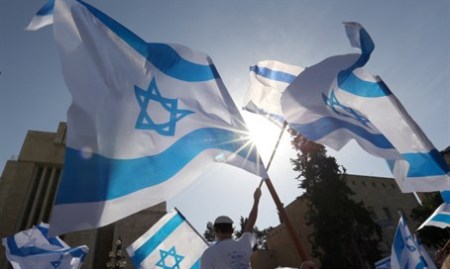
Israel flagsIsraeli flags (illustration)

A new poll has found that youth in Israel are increasingly right-wing in their political opinions, and are overwhelmingly Zionist and loyal to their country.

The survey, conducted by the New Wave Research institute for Israel Hayom and published in part on Wednesday, asked 11th and 12th graders to define their political position.

A full 59% defined themselves as right-wing, while another 23% said they were centrist, and only 13% identified as leftist. Another 5% said they have no position.

A whopping 82% said there is no chance of reaching a deal of some sort with the Palestinian Arabs, indicating their disillusionment with the peace process that has regularly led to waves of Arab terrorism.

When asked if Arab citizens of Israel need representation in the Knesset, 48% said they do not, while 52% said they do.

In a question relating to the recent case of a soldier who shot a wounded Arab terrorist, the students were asked if they thought a soldier should be put on trial for shooting a neutralized terrorist.

A resounding 60% said such a soldier should not be tried, while 30% supported the trial and 10% said they did not know.

Zionism appears to be strong according to the poll, which found that 89% said they see their future in Israel, and 85% said they love the state.

Of the high-schoolers 88% said they are preparing to enlist in the IDF, with over half saying there is no more ethical army in the world, and 65% believe in the sentence “it is good to die for our country,” which is a quote from Joseph Trumpeldor.

Another finding was that 75% of the students appreciate or greatly appreciate their teachers.

Report Suggests Radical Islamists Infiltrating German Military to Receive Training

April 13, 2016

Report Suggests Radical Islamists Infiltrating German Military to Receive Training, Investigative Project on Terrorism, April 13, 2016

A growing number of Islamist radicals are infiltrating Germany’s military, the Bundeswehr, with an estimated 30 former soldiers later joining international terrorist organizations, reports German press agency DPA International.

Germany’s military counterintelligence service (MAD) says 65 active soldiers are under investigation for suspected Islamist tendencies. Since 2007, 22 soldiers designated as Islamists have been discharged or left the military. Moreover, 29 former soldiers have left for Syria and Iraq to join Islamist terrorist organizations.

“We perceive a risk that the Bundeswehr may be used as a training ground for potentially violent Islamists,” says MAD leader Christof Gramm.

German intelligence believes that the Islamic State is actively recruiting operatives with a military background. Moreover, Germany’s Ministry of Defense expressed concern that no background checks are required for soldiers in unclassified positions.

“Like all armies, the Bundeswehr can be attractive to Islamists seeking weapons training…,” Hans-Peter Bartels, the parliamentary commissioner for the military, told the DPA. Bartels added that Islamists in the German army pose “a real danger that needs to be taken seriously.”

Following the January 2015 Paris attacks targeting the Charlie Hebdo satirical publication, Gramm became increasingly concerned since the terrorists appeared to have professional military training.

“It would be negligent of a MAD president not to ask what would happen if a Bundeswehr-trained Islamist did something like this, and we had failed to notice anything,” Gramm said.

In one case, a German convert to Islam, called Sascha B for anonymity, gradually began exhibiting signs of increased religiosity and extremism. He began growing his beard, wearing Middle Eastern attire, and even going AWOL at times.

Sascha B eventually refused to train reservists after soldiers in his unit were deployed to Afghanistan. He justified his position by arguing that weapons could be used against other Muslims. During interrogation by MAD officials, Sascha B proclaimed that sharia law should override Germany’s constitution.

Several prominent examples of Islamist infiltration within the U.S. military also have caused immense concern.

A Muslim army soldier killed two comrades and injured 14 others after throwing a live grenade in a tent in Kuwait prior to the 2003 Invasion of Iraq. In 2009, U.S. Army major and psychiatrist Nidal Malik Hassan shot and killed 13 people at Fort Hood because he believed that no Muslim could faithfully serve in the U.S. military.

Hassan exhibited signs of increased radicalism for a significant period of time prior to the terrorist attack. “It’s getting harder and harder for Muslims in the service to morally justify being in a military that seems constantly engaged against fellow Muslims,” Hasan said during a 2007 presentation at the Walter Reed Army Medical Center.

Three years later, Army Pvt. Naser Jason Abdo was arrested for planning an attack on a popular restaurant frequented by Fort Hood troops. He plotted to set off an explosives device in the restaurant, then shoot and kill as many survivors as possible.

When his mother asked her son why he would commit the terrorist attack, Abdo replied: “The reason is religion, Mom.”

Will Egyptian schools strip religion from curriculum?

April 13, 2016

Will Egyptian schools strip religion from curriculum? Al-Monitor

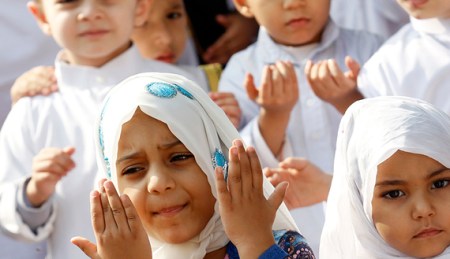
RTXUI2VStudents pray at Nile Garden School before the upcoming Eid Al-Adha festival in Cairo, Nov. 11, 2010. (photo by REUTERS/Mohamed Abd El Ghany)

A call made by Nadia Henry, deputy head of the Free Egyptians Party’s parliamentary bloc, to replace the religion course — which is mandatory for students in public schools — with an alternate course on “values” has raised considerable debate within the parliament, accompanied by an attack launched by the Salafist Nour Party and Al-Azhar.

Egyptian schools teach religion from elementary school through high school, and Christian students are separated from their fellow Muslims during religion courses. However, despite the importance of this course in Egyptian education, the students’ grades in religion are not included in their final grades because religion exams taken by Christians differ from those taken by Muslims, and this way everyone can be graded equally. Meanwhile, the Orthodox Church and Al-Azhar contribute to developing the curricula for the religion courses for both Christian and Muslim students.

In an interview with Al-Monitor, Henry emphasized that she did not call for eliminating the religion course, but rather wanted to replace it with a course on values that would combine verses from both the Quran and the Bible that underline values and ideals. “The values course should be taught by educators who have knowledge in the science of counseling and psychology, in order to plant the idea of citizenship in students’ hearts and teach them how to love one another,” she said.

Henry refused the idea of teaching the values course along with religion, stressing that the religion course and its results over the past years must be evaluated.

Henry pointed out that the religion course did not produce clear results in changing the concepts of ethics and values in society. She also criticized the way religion is taught in schools by separating young Muslim students from Christians, which increases sectarianism. “The values course would teach students the principles of citizenship, without discrimination and without separating between minority and majority. All institutions must work hand-in-hand; the religious institution establishes doctrine, and the educational institution applies it through educational and behavioral rules.”

She called on all those opposing her proposal to join her at the dialogue table to develop the proposal, stressing that she does not aim at eliminating religion from schools but to establish a more advanced way to teach it.

Henry responded to attacks on her proposal by saying that changes to long-standing methods are always accompanied by societal shock, but it is necessary to reconsider the method of teaching religion in schools. According to her, the results of the religion course are negative because students are separated based on their religion and have teachers who are not specialized in teaching religion. She also argued that it would not lead to a decline in religion, claiming, “The values course would hamper any inclinations toward atheism among students, because they would [be taught] to understand and tolerate one another.”

“I will continue to defend the proposal after the Free Egyptians Party’s educational committee finishes preparing it in order to submit it to the parliament,” she asserted.

The veteran member of parliament revealed that she is preparing to hold a workshop for educators, clerics, experts in humanities, as well as media and cultural figures in order to establish regulations and standards for a new educational course under the name of “values.” Henry noted that she will not be affected by the attacks against her. She welcomes all opinions, and she will continue to implement her proposal. Henry expressed her hope that some religious leaders would be welcoming, noting, “The new religious leadership within the Evangelical Church shows how committed it is to teaching religion to the new generation.”

Henry explained that the values course would “emphasize the concepts of moderate Islam for Muslim and Christian students alike. Christian students will learn Quranic verses about tolerance and love, while Muslim students will learn Bible verses about being loving and giving. Thus, citizenship is truly achieved without any [sectarian] slogans.”

Al-Azhar’s committee of senior scholars issued a statement March 10 describing calls to remove religion from state curricula as “harmful to Al-Azhar’s status and the Islamic identity of our country.”

Al-Azhar’s statement was welcomed by Salafist Nour Party’s members of parliament, with parliamentarian Ahmed Sharif applauding Al-Azhar’s stance and stressing that the proposal to remove the religion course was not appropriate.

Meanwhile, Abdel Moneim El-Shahat, a spokesman for the Salafist Call — the Nour Party’s political wing — warned about responding to those calling for eliminating religious education from schools. In press statements published March 15 he said, “All societal classes are in desperate need of an increase in religion in schools, universities and the media.”

For his part, Mohamed El Shahat al-Gundi, a member of the Islamic Research Academy, told Egyptian daily Al-Youm Al-Sabeh in early March that replacing religion for values in school curricula would open the gate to the breakdown of key provisions in the Muslim and Christian religions, and that it was an attempt to resemble the West, which is not the right thing to do.

Henry’s proposal was met with various reactions within parliament. For one, member of parliament Amina Naseer supported the proposal, saying, “Islam and Christianity emphasize the need for ethics and an upright behavior in dealing with others. The values material should include the values contained in Christian and Muslim texts agreed upon by everyone.”

However, independent member of parliament Mohammed Ismail announced that he would make an urgent statement to the Minister of Education to demand including the grades students get in religious course in their final grades, in response to calls to replace the religion course with values. Ismail expressed the need to do away with the current pass/fail grading system for religion, which in his view would eliminate religious illiteracy and prevent the infiltration of extremist ideas into society.


Saudi Arabia’s religious police stripped of authority to arrest Sharia violators

April 13, 2016

Saudi Arabia’s religious police stripped of authority to arrest Sharia violators, Jerusalem PostMaayan Groisman, April 13, 2016

The unprecedented Saudi move came as a result of growing local criticism of the police and the way it performs its role as the defender of Sharia law in the state.

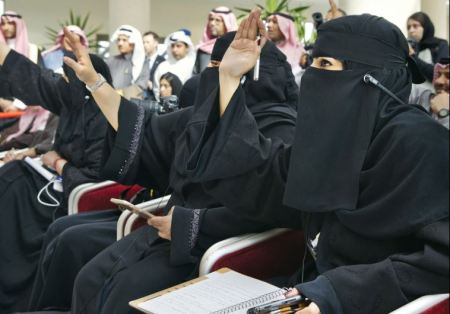
ShowImage (23)Saudi women journalists raise their hands to ask questions at a press conference held by US Secretary of State John Kerry and Saudi Foreign Minister Adel Jubeir at King Salman Regional Air Base in Riyadh, Saudi Arabia, last month. (photo credit:REUTERS)

The Saudi government issued new regulations for the religious police operating in the state Tuesday, taking away the organization’s authority to arrest and persecute citizens for not adhering to Sharia law in their daily lives.

The unprecedented Saudi move came as a result of growing local criticism of the police and the way it performs its role as the defender of Sharia law in the state.

According to a statement explaining the new regulations, the religious police is “an independent body, which has organizational relations with the prime minister.”

The government emphasized that the religious police should notify the police or the Anti-Drug Authority of drug use crimes, adding that “neither the members nor the heads of the religious police are allowed to arrest and persecute citizens for such crimes, or even to ask suspected people for their IDs. Only the police and the Anti-Drug Authority are allowed to take these measures.”

In light of previous violent incidents that involved religious police members who attacked citizens, the governmental statement also included a prohibition on people who were charged with criminal offenses from joining the religious police.

The Saudi move aroused contradictory responses on social media networks. While opponents of extremist Islam in the country hailed the government’s decision, stating that “it’s better late than never,” others initiated a social media campaign under the hashtag, “The people against abolishing the role of the religious police.”

The Saudi government’s controversial decision comes amid an ongoing conflict between liberal Saudis and Salafi Saudis over the religious character of the Kingdom. Salafis view the recent move as evidence that the government is tilting toward the latter camp.

Ann Coulter on The Seth Leibsohn Show (4/11/2016)

April 13, 2016

Ann Coulter on The Seth Leibsohn Show (4/11/2016) via You Tube, April 12, 2016

The Fallacy of Focusing on Islamic Radicalization

April 13, 2016

The Fallacy of Focusing on Islamic Radicalization, Front Page Magazine, Daniel Greenfield, April 13, 2016

extreme-koran3

The issue isn’t radicalization, it’s Islamization.

We cannot and will not defeat Islamic terror without honestly and bluntly confronting Islamization. 

**************************

There are Jihadists from dozens of countries who have joined ISIS. What do they all have in common?

The official answer is radicalization. Muslims in Europe are “radicalized” by alienation, racism and unemployment. Neglected by governments, Muslim youth band together and become terrorists. Muslims in Israel are responding to the “despair and hopelessness” of the “Occupation”. Muslims from the rest of the Middle East are angry over their “dictators”. Muslims from the Ukraine? Who knows.

Radicalization comes packaged with a set of local grievances and explanations. It contends that all Muslim terrorism is a response to local conditions and that we are responsible for those conditions. Even though the “radicalization” is Islamic, it denies that Islam plays a positive role as a Jihadist goal. Instead, like Halal liquor or hashish, it’s what Muslims turn to when they have been disappointed in the West or in their own governments. Islam is just what happens when a Belgian Muslim can’t get a job.

And yet Islam is the only positive uniting factor for Islamic terrorism.

Why otherwise should a Moroccan youth from a French suburb who works at a nightclub, the son of a rural Saudi farmer who has never been outside his country and an American teenager who converted to Islam all risk their lives to form an Islamic State? The Jihadis of ISIS are a truly multinational and multicultural bunch. They have traveled to two foreign countries that most of them have never been to.

What else unites them into a common identity that they are willing to kill and die for if it isn’t Islam?

Radicalization favors local explanations. But those local explanations don’t add up nationally or globally. Europe spends a fortune on social services and yet Muslim terrorism has only grown worse. Other immigrant minorities in Europe have lower unemployment rates and aren’t blowing things up.

Removing Muslim dictators in the Arab Spring didn’t lower terrorism; it vastly increased the power and influence of Islamic terror groups. Nor have changes in American foreign policy and greater outreach lowered Islamic terrorism. If anything the scale of the problem seems to have only become more severe.

The Israeli peace process with the PLO likewise vastly increased the terror threat and no amount of concessions has brought peace any closer.  There are stateless Muslims throughout the Middle East. Jordan is filled with the same exact “Palestinians” as Israel, many of whom are stateless and have few rights, yet terror rates are far lower. Instead Muslim violence spikes where there are religious differences. As we see in Iraq, Syria and Israel, religious differences are more explosive than political ones. And where religious differences don’t exist, Jihadists create them by denouncing their Muslim enemies as un-Islamic. ISIS is the culmination of a process that you can see among “moderate” Islamists.

The official explanation is that a multitude of local factors cause Muslim disappointment leading to some sort of irreligiously religious radicalism which can be cured by preventing that disappointment.

We are expected to believe that there are hundreds of explanations for Islamic terrorism, but not one. And while no doubt individual choices and emotions play a role in the making of a Muslim terrorist, the same is true in the making of a soldier. An army exists as part of a positive national ethos. Reducing an army to a series of personal dissatisfactions is absurd. So is reducing ISIS to individually dissatisfied people while ignoring what its members actually believe. It’s as absurd as believing that Hitler became a monster because he couldn’t get his painting career off the ground.

Islamic terrorism is a positive ethos. It is horrifying, evil and brutal, but it is not some nihilistic void. You can look at unemployment rates in Brussels or dissatisfaction in Saudi Arabia, but nobody decides to fight and die for a Jihadist group because they’re having trouble applying for a job at McDonald’s. They join because they believe in its mission. Ignoring the organizing principle of Islamic terrorism while focusing on local conditions that might make Jihadist recruitment easier misses the forest for the trees.

Radicalization programs, under euphemisms such as CVE or Countering Violent Extremism, assume that Islamic terrorism can be countered by forming a partnership with Muslim groups and social services agencies. While the West will ease Muslim dissatisfaction by providing jobs and boosting their self-esteem to make them feel like they belong, the Muslim groups will tackle the touchy issue of Islam.

These partnerships achieve nothing because social services don’t prevent Islamic terrorism; they enable and fund the very no-go zones and dole-seeker lifestyles that are a gateway to the Jihad. Meanwhile the Muslim partners are inevitably Islamists looking to pick up potential recruits for their own terror agendas. Western countries fund terrorism to fight terrorism and then partner with still more terrorists to train their homegrown terrorists not to be terrorists, or at least not the wrong kind of terrorists.

This is what happens when the “Islam” part of Islamic terrorism is ignored and outsourced to any Islamist who can pretend to be moderate in front of a television camera for 5 minutes at a time.

None of this actually stops Islamic terrorism. Instead it empowers and encourages it.

The Islamist alliances suppress any discussion of Islamic terrorism as “harming” national security. Condemn the Muslim Brotherhood and you’re interfering with CVE efforts to stop terrorism by “educating” Muslims on real Islam and helping the Brotherhood take over entire countries to address the political anger of Muslims. At least the anger of those that are part of the Muslim Brotherhood.

And yet without discussing Islam, there is nothing to discuss.

There are plenty of unemployed non-Muslims in Europe. There are lots of bad governments all over the world. The non-Islamic factors on which Islamic terrorism is blamed are not unique to Muslims. Only Islam is. Islamic terrorism is unique and so its causes cannot be reduced to joblessness or bad governments. A unique outcome suggests a unique cause. And Islam is a unique cause.

Islam is the unique cause of Islamic terrorism. There is no way to fight Islamic terrorism without acknowledging its organizing principle, its objective and its worldview.

You cannot fight “radicalization” without dealing with what Muslim terrorists are “radicalized” to do. Without Islam, all that’s left is the political and sociological hunt for individual motives while completely ignoring what unites these individuals together. And so CVE plays the seven blind men while ignoring the elephant in the room. And the terror attacks and the futile efforts to avert them continue.

The issue isn’t radicalization, it’s Islamization.

Islamization is what happens to individual Muslims and to Muslim communities. Islamization is also the goal of Islamic movements, overtly violent or covertly subversive. Islamization is not the answer of some radical preacher, but of the Islamic religion. This is not about jobs in Europe or democracy in Egypt.

Islam is not radicalized. It is radical. Like Communism or Nazism, it offers a totalitarian answer to everything. To truly believe in Islam is to possess the conviction that every country in the world must become Islamic and be ruled by Islamic law. Islamic terrorism is one tactic for realizing this conviction.

We cannot and will not defeat Islamic terror without honestly and bluntly confronting Islamization.

The GITMO Exodus

April 13, 2016

The GITMO Exodus, Front Page MagazineMatthew Vadum, April 13, 2016

gitmo_libyans_0

Despite warnings that Muslim terrorists remain a grave threat to the United States, President Obama gave two dangerous veteran jihadists at Guantanamo Bay get-out-of-jail-free cards earlier this month.

Emptying out Guantanamo is a longtime goal of Obama. Shuttering the terrorist detention facility located on U.S.-held territory in Cuba has been a goal of President Obama, going back at least to the campaign trail in 2008. He wants to close the prison camp and unleash the worst of the worst among Islamic terrorists, allowing them to wreak havoc and kill more Americans. Violent Muslim militants are merely misunderstood people from a foreign culture, in Obama’s view, and setting them free is just the right thing to do as he sees it.

Obama doesn’t give a farthing’s cuss about the prospect of these hardened terrorists returning to the glories of jihad-fighting after leaving Gitmo. Terrorists, freedom fighters — why quibble? They’re all more or less the same to the president.

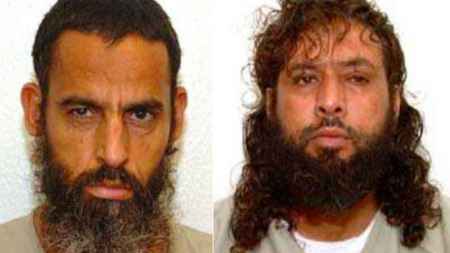
The first newly freed detainee, Salem Abdul Salem Ghereby (also known as Rafdat Muhammad Faqi Aljj Saqqaf, Falen Gherebi, and Salim Gherebi), a 55-year-old Libyan national, was transferred to Senegal on April 3.

Senegal, a French-speaking country on Africa’s western coast, also accepted Ghereby’s comrade-in-jihad, Omar Khalifa Mohammed Abu Bakr (also known as Omar Khalif Mohammed Abu Baker Mahjoub, Omar Mohammed Khalifh, and Omar Mohamad Khalifah), another Libyan national who is thought to be 43 or 44 years old.

Why Senegal? Perhaps because about 95 percent of Senegal’s up to 14 million inhabitants are Muslims.

Although Senegal “has shown no signs of jihadist terrorism” and its government has cracked down on terrorist financing and money laundering in the region, it is bordered by Islamist violence-plagued Mali and Mauritania. According to the American Foreign Policy Council, there are concerns that Senegal “presents a potential ‘backdoor’ for radical, jihadist Islam, which already exhibits a major presence in rapidly-changing North Africa.”

According to a 2008 Department of Defense report, Ghereby was a member of the Libyan Islamic Fighting Group (LIFG) also known as Al-Jama’a al-Islamiyyah al-Muqatilah bi-Libya, which is reportedly tied to al-Qaeda.

Ghereby had been an “explosives trainer and a veteran jihad fighter” who participated in hostilities against U.S. and coalition forces in Osama bin Laden’s Tora Bora Mountain complex in eastern Afghanistan. He was deemed to be only a “medium threat from a detention perspective” and of “medium intelligence value,” but was considered to be “high risk, as he is likely to pose a threat to the US, its interests, and allies[.]”

Like Ghereby, Bakr was deemed to present a “high risk” to U.S. interests but unlike Ghereby he was deemed “a high threat from a detention perspective” and is “of high intelligence value.”

“If released without rehabilitation, close supervision, and means to successfully reintegrate into his society as a law abiding citizen, it is assessed detainee would immediately seek out prior associates and reengage in hostilities and extremist support activities,” according to the DoD. Bakr mostly behaved himself in custody but he “has threatened to kill US personnel on several occasions.”

Bakr, who has “extensive explosives knowledge” according to the Pentagon, admits to being a member of LIFG and was identified as “commander of a militant training camp and acknowledged serving as trainer.” He was also identified as an “arms dealer who provided support to [Osama bin Laden] in Sudan” and was determined to have been active in a cell that planned improvised explosive device (IED) attacks against U.S. and coalition forces.

Three months ago Obama released admitted al-Qaeda member and IED maker Tariq Mahmoud Ahmed Al Sawah, a Bosnian, who was shipped off to Bosnia. “These IEDs included the limpet mine to sink US naval vessels and the prototype for the shoe bomb used in a failed attack on a civilian transatlantic flight,” the DoD reported.

Another bomb maker, Abd al-Aziz Abduh Abdallah Ali al-Suwaydi, a Yemeni, was transferred to Montenegro.

Obama, who will return to private life in nine months blithely told Yahoo! News in December that “only a handful” of Gitmo detainees had returned to the battlefield. Actually, the number was 196 as of July 2015, according to the Office of the Director of National Intelligence (ODNI). The 196 figure represents 30 percent of the 653 detainees removed from Gitmo who were confirmed or suspected of returning to the battlefield.

President Obama continues to delude himself, claiming that Gitmo’s continuing existence is the jihadist equivalent of waving a red cape at a bull.

“I am absolutely persuaded, as are my top intelligence and military advisers, that Guantanamo is used as a recruitment tool for organizations like ISIS, and if we want to fight ’em, then we can’t give ’em these kinds of excuses.”

But whose excuses is Obama talking about?

He is the one serially lying and making up excuses to justify releasing his jihadi soulmates. As the Weekly Standard notes, “Guantanamo rarely appears in jihadist propaganda, whether ISIS or al Qaeda, and reviews of recent propaganda materials from ISIS and al Qaeda – online videos and audio recordings, glossy magazines, etc. – found very few mentions of the facility.”

None of this should shock Obama-watchers. He doesn’t like letting facts get in the way of the radical left-wing narrative.

Russian aircraft shot down despite ‘President-S’ system

April 13, 2016

Russian aircraft shot down despite ‘President-S’ system, DEBKAfile, April 13, 2016

Mi-28N_Homs_12.4.16( Russia’s Mi-28H attack helicopter )

There is no doubt that those weapons pose a major and immediate threat to commercial aviation in Israel and throughout the Middle East.

*********************

The Russian Defense Ministry announced on April 12 “the crash of a Russian Mi-28H attack helicopter near the city of Homs“ the previous night. The two pilots were killed in the crash, and their bodies were recovered by Russian special forces who transferred them to Hmeimim airbase in northern Syria. The ministry asserted that “the helicopter was not shot down” but DEBKAfile’s intelligence and aviation sources doubt that claim.
The helicopter that crashed in Homs was the fourth Russian-made military aircraft to be shot down during the last 30 days by advanced shoulder-fired antiaircraft missiles possessed by the Nusra Front, ISIS and other groups of fighters.

The helicopter that crashed in Homs was the fourth Russian-made military aircraft to be shot down during the last 30 days by advanced shoulder-fired antiaircraft missiles possessed by the Nusra Front, ISIS and other groups of fighters.

The speculation that terrorist organizations in Syria, and apparently in Iraq, possess such missiles capable of overcoming the defenses of Russian aircraft became reality when the Mi-28H helicopter was shot down on April 11. The aircraft is equipped with the most advanced defensive system of its kind, the President-S, which is resistant to active and passive jamming.

The system also known as the L370-5 includes a warning system installed on four external points of every aircraft, radar and command and control system that can identify incoming shoulder-fired missiles and cause them to deviate from their paths.

The defense system protects the helicopter from previous generations of such missiles, such as the Strela-2 and Strela-3. But it remains vulnerable to more advanced missiles and that is the reason why the rebels and terror groups have been able to shoot down four Russian-made aircraft in Syria.

On March 12, a MIG-21 of the Syrian air force was shot down with two shoulder-fired antiaircraft missiles that locked onto the heat signature of the plane. Fighters from the Jaysh al-Nasr rebel group operating in the village of Kafr Nabudah, in the area of the city of Hama, downed the plane and then killed the pilots after they ejected and reached the ground.

Another Syrian air force plane, a Sukhoi 22, was shot down on April 5 near Aleppo using a single MANPADS (Man-portable air-defense systems) missile, apparently an advanced one, fired by fighters from Al Qaeda affiliate the Nusra Front. One of the pilots was killed on the ground, while the other, Khaled Saeed, was taken prisoner.

In yet another recent downing of a Russian-made military aircraft, ISIS announced on April 11 that it had shot down a Sukhoi 22 that had taken off from al-Dumayr Airport in the eastern suburbs of Damascus. The fighters used an SA-7 Strela missile with an infrared heat-seeking warhead, considered relatively out of date.

Western intelligence services have no idea how many shoulder-fired antiaircraft missiles are in the arsenals of Syrian rebel groups and terrorist organizations. There is no doubt that those weapons pose a major and immediate threat to commercial aviation in Israel and throughout the Middle East.

Australian Islamist Al-Wahwah Calls to Lead “the Armies of Jihad That Will Conquer Europe, the U.S.”

April 13, 2016

Australian Islamist Al-Wahwah Calls to Lead “the Armies of Jihad That Will Conquer Europe, the U.S.” MEMRI-TV via You Tube, April 12, 2016

According to the blurb following the video,

Speaking on March 6 at a “caliphate conference” in Ankara, Turkey, Ismail Al-Wahwah, spokesman for the Australian chapter of Hizb ut-Tahrir, called upon attendants to lead “the armies of Jihad that will conquer Europe and America.” Wahwah warned the Turkish crowd not to trust America, Europe, and NATO, who are all enemies and whose “hearts are black.” The speech was posted on the Internet by Hizb ut-Tahrir, as well as by the Köklü Değişim magazine, which organized the conference.