Archive for February 24, 2016

IDF Racing to Restructure Itself for New Middle East Warfare

February 24, 2016

IDF Racing to Restructure Itself for New Middle East Warfare, Investigative Project on Terrorism, Yaakov Lappin, February 23, 2016
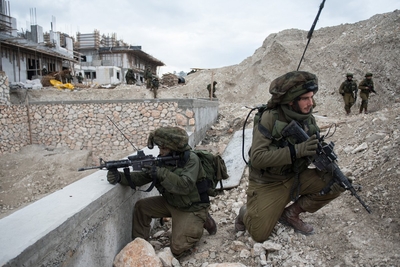
1362Photo Credit: IDF Spokesperson

The Israel Defense Forces (IDF) is in a race against time, and it is a race that is relevant to how other Western powers will also deal with the rise of radical, armed, Islamic groups proliferating across the Middle East.

As the IDF’s commanders look around the region, they see heavily armed, hybrid, Islamic sub-state foes that are replacing states. The traditional threat of hierarchical armies is fading quickly away, into obscurity.

The Sunni and Shi’ite jihadist entities on Israel’s borders – Hamas, Hizballah, ISIS-affiliated groups in Syria, Jabhat Al-Nusra, as well as elements of Iran’s IRGC forces – are all building their power and preparing for a future unknown point in time when they will clash with Israel.

The IDF is preparing, too, but it is not only counting how many soldiers, tanks, fighter planes, and artillery cannons it can call up in the next round. The IDF is in a race to adapt to 21st century Middle Eastern warfare, which bears no resemblance to how wars were fought in the 20th century.

In this new type of conflict, enemies appear and vanish quickly, use their own civilians as cover, bombard Israeli cities with projectiles, seek out the weakest link in Israel’s chain, and send killing squads through tunnels to attack Israeli border villages.

In this type of clash, the enemy looks for a ‘winning picture’ at the start of any escalation. This means landing a surprise blow that will knock Israeli society off balance, at least for a short while.

To be clear, all of the hostile sub-state actors currently are deterred by Israel’s considerable firepower and are unlikely to initiate a direct, all-out attack right now.

The price they would pay for such action is deemed too high, for now.

Yet, opportunities and circumstances can suddenly arise that would alter these calculations, and put these terrorist organizations on a direct collision course with the IDF.

Israel has fought four conflicts against Hamas and Hizballah in the past 10 years, and emerged with the conclusion that the era of state military versus state military warfare is over.

Acknowledging this development is one thing; the organizational transformation that must follow is quite another. Israel did not want to enter any of the past four conflicts that were forced upon it, but since they occurred, they have aided in the IDF’s adaptation process, which has been as complex as it has been painful, and is far from over.

“What you have to do against an enemy like this, and it is a great difficulty for militaries, including the IDF, is to operate in a combined, cross-branch [air force, ground forces, navy] manner, and to keep it [operations] focused. Focus the ground maneuver and firepower, on the basis of the intelligence you get,” a senior IDF source said earlier this month in Tel Aviv, while addressing the challenges of adaptation.

Taking southern Lebanon, the home base of Hizballah, as an example, the area has well over 100 Shi’ite villages that have been converted into mass rocket launching zones.

With one out of every 10 Lebanese homes doubling up as a Hizballah rocket launching site (complete with roofs that open and close to allow the rocket to launch), Hizballah has amassed over 120,000 projectiles – some of them GPS guided – with Iran’s help. This arsenal, pointed at Israel, forms one of the largest surface to surface rocket arsenals on Earth.

Would sending several military divisions into such an area be sufficient for Israel in stopping the rocket attacks? Without focused intelligence, the military source argued, the answer is a resounding no. Israel’s reliance on intelligence has never been more paramount in the age of sub-state, radical enemies.

“The urban areas swallow up our forces. If we can’t focus the maneuver, no amount of forces will be sufficient in dealing with this issue. It must be focused, and the information that must direct this focus is real-time intelligence,” the source said.

The IDF’s Military Intelligence Directorate has the mammoth task of building up a battle picture and a database of targets ahead of any conflict. After a conflict erupts, it must start the process all over again within a few days, when the entire map of threats changes in the modern dynamic battlefield.

This is a far cry from the old intelligence work that looked at enemy tank divisions and infantry formation.

IDF planners believe that any future conflict with a hybrid, terror-guerrilla military force will consist of five stages. An “opening picture” – that surprise blow intended to shock Israelis – will mark the start of hostilities, in which Israel must deny the adversary its “winning picture.” This will be followed by an exchange of firepower. After a few days, Israel would need to call up reserves, and then launch a ground offensive. Throughout this period, the Israeli home front would absorb heavy rocket fire, while the Israel Air Force would pound enemy targets. The IAF could fire thousands of precision-guided munitions every 24 hours, if it deploys its firepower to the maximum, as it would in an all-out clash with Hizballah.

Israeli air defense systems like Iron Dome could soften the blow to the home front significantly, but this is truer with respect to Gazan rockets than against the downpour of Hizballah rockets and missiles, which would overwhelm air defenses.

The ground offensive must destroy “70 to 75 percent of [enemy] capabilities,” the source said. “If there are 100 missiles and two operatives on the other side, and you kill the operatives, than the missiles become irrelevant.”

The last phase is the end stage, and it is unlikely that an entity like Hamas or Hizballah would wave a white flag when hostilities conclude, even if most of their capabilities have been destroyed.

The era of clear-cut military victories, like Israel experienced in the 1967 Six Day War, is gone, the source said.

With this reality in view, the IDF’s steps to adapt itself to modern threats include the ability to gather huge quantities of intelligence and deliver them, in real-time, to the forces that need them most in the battlefield, right down to the level of a battalion commander.

This requirement includes establishing an “operational Internet,” an internal IDF network that allows battalion commanders to access Military Intelligence target data in their area, and direct their units accordingly.

It would also allow field commanders to communicate directly with a fighter jet pilot or drone operator, or even a missile ship commander, for the type of cross-forces cooperation the IDF thinks will be most effective in shutting down threats.

As a result, the IDF’s C4i Branch has spent recent years overcoming many hurdles and objections and integrating the command and control networks of the air force, navy, and ground forces. It then directly linked them up to Military Intelligence.

By the end of this year, the first IDF division will have a “military Internet” network, complete with applications and browsers, up and running.

“I don’t want a squad commander walking around with a screen in his hand. He has to be aware of his soldiers. [But] the battalion commander should certainly have this,” the source said.

In 2014, the IDF did not do a good enough job in detecting, in real-time, the location of Hamas rocket launches in Gaza. It got away with this failure because of the effectiveness of the Iron Dome anti-rocket batteries. But against Hizballah’s much larger arsenal, no amount of air defenses will be sufficient, and the IDF therefore is working on improving its rocket detection and accurate return fire abilities.

“In the next stage [of our development], if you detect the rocket launch areas and the centers of activity of the enemy, and transmit them [to your own forces], you can learn the enemy’s patterns better,” the officer said.

Knowing the enemy has never been more important for Israel’s ability to defend itself against the jihadist entities that are replacing states in the Middle East. As these radical Islamist organizations prepare for the day of battle, Israel does the same, through updating its old 20th century battle doctrines and bringing them up to speed with its rapidly changing and chaotic environment.

The Moral Cost of Appeasing Iran

February 24, 2016

The Moral Cost of Appeasing Iran, Gatestone InstituteMohshin Habib, February 24, 2016

♦ The leaders of both France and Italy set aside their values to appease the president of Iran.

♦ In France, protesters demanded that President François Hollande challenge the Iranian president about his country’s human rights abuses. France’s leadership, however, raised no questions of that sort. Instead, Mr. Rouhani was welcomed as a superstar.

♦ According to a 659-page report by Human Rights Watch, Iran’s human rights violations under Mr. Rouhani’s governance have been increasing. Social media users, artists and journalists face harsh sentences on dubious security charges.

♦ In November, the Iranian Supreme Court upheld a criminal court ruling sentencing Soheil Arabi to death for Facebook posts “insulting the Prophet” and “corruption on earth.”

Right after signing the Iran nuclear deal with itself — Iran still has not signed it, and even if it did, the deal would not be legally binding — members of the P5+1 (the five permanent members of the UN Security Council plus Germany) have been showing their eagerness to establish improved relations with their imaginary partner.

Last month, after the lifting of international sanctions, Iran’s president, Hassan Rouhani, went on a five-day trip to Italy and France.

Officials from the host countries were so enthusiastic to welcome the Iranian president, it was as if they were unaware of Iran’s multiple violations of The Treaty on the Non-Proliferation of Nuclear Weapons (NPT) — which Iran did sign in 1968. They also seemed unaware of Iran’s expansion into Syria, Lebanon and Yemen, as well as Iran’s continuing role in sponsoring global terrorism.

Although both the leaders of France and Italy seemed eager to appease the president of Iran, in Paris, thousands of demonstrators gathered on the streets to protest Mr. Rouhani’s visit, and staged mock executions to highlight Iran’s dire human rights violations. In 2014, for instance, at least nine people were executed on the charge of moharebeh (“enmity against God”).

Even today, dozens of child offenders remain on death row in Iran. According to Iranian law, girls who reach the age of 9 and boys who reach the age of 15 can be sentenced to capital punishment. A recent report by Amnesty International called Iran one of the world’s leading offenders in executing juveniles. Despite the country’s ratification of the Convention on the Rights of the Child — which abolishes the use of the death penalty against offenders under the age of 18 — the UN estimates that 160 minors remain on death row.

The Iranian delegation, according to The New York Times, had asked Italian officials to hide all statues leading to the grand hall of the Capitoline Museums — where a news conference between Prime Minister Matteo Renzi and the Iranian president took place — to avoid any “embarrassment” for Rouhani, who casts himself as a moderate and reform-seeker. So on the first stop of Mr. Rouhani’s European visit, statues were encased in tall white boxes. In addition, “The lectern, was placed to the side — not the front — of an equestrian statue of the emperor Marcus Aurelius, apparently to avoid having images of the horse’s genitals appear in news photographs.”

As any kind of image is haram (forbidden) in Islam, any form of statue is considered idolatry.

Many Italians expressed their outrage over the decision to censor the statues. They accused the government of betraying Italian history and culture for the sake of economic interests.

An Iranian women’s rights organization, My Stealthy Freedom, condemned the Italian government’s decision. In a post on their Facebook page, the group wrote:

“Italian female politicians, you are not statues, speak out. Rome covers nude statues out of respect for Iran’s president in Italy and Islamic Republic of Iran covers Italian female politicians in Iran. Dear Italy. Apparently, you respect the values of the Islamic Republic, but the problem is the Islamic Republic of Iran does not respect our values or our freedom of choice. They even force non-Muslim women to cover up in Iran…”

In France, protesters demanded that President François Hollande challenge the Iranian president about his country’s human rights abuses. France’s leadership, however, raised no questions of that sort. Instead, Mr. Rouhani was welcomed as a superstar.

Big business deals were signed. France’s car-maker Peugeot and Iran’s leading vehicle manufacturer, Khodro, are engaged in a €400 million partnership. France’s energy giant, Total, signed a Memorandum of Understanding to buy crude oil from Iran. Total will reportedly begin importing 160,000 barrels of oil per day starting on February 16. Twelve days after the West lifted economic sanctions, Airbus announced that Iran Air had agreed to purchase 118 new planes. The deal is estimated at $25 billion.

Prime Minister of France Manual Valls hailed his country’s trade agreements with Iran. “France is available for Iran,” he said.

During a recent visit to Tehran, Germany’s Foreign Minister, Frank Walter Steinmeier, asked the Iranian president to keep Germany in mind as a future stop on his next trip to Europe.

Meanwhile, according to a US State Department report, Iran has pledged to continue its assistance to Shiite militias in Iraq. Many of these militias have poured into Syria and are now fighting alongside the Assad regime. Rouhani’s government also continues to support its Lebanese proxy Hezbollah, and Palestinian militants in Gaza.

For many years, the Iranian president has kept up close ties with leaders of Hezbollah, including Abbas Moussavi (the former leader of Hezbollah who was killed in 1992) and Hassan Nasrallah. In March 2014, Mr. Rouhani publicly pledged support for Hezbollah.

Rouhani’s Defense Minister is a former Islamic Revolutionary Guards Corps (IRGC) officer, Brig. Gen. Hossein Dehghan. He commanded IRGC forces in Lebanon is Syria during Hezbollah’s founding years from 1982-1984.

Last September, Dehghan said that Tehran will continue arming Hezbollah, Hamas and any group that is part of the “resistance” against the U.S. and Israel. Iran, he explained, considers America to be the Great Satan.

“Hizbullah,” Dehghan stated, “does not need us to supply them with rockets and arms. Israel and the U.S. need to know this. Today, Hamas, the Islamic Jihad, and Hizbullah have the capability of producing their own resources and weapons themselves. Nevertheless, we shall not refrain from supporting them.”

As well as Dehghan, almost all of Rouhani’s appointments are either former members of the IRGC or other revolutionary institutions, such as Iran’s Judiciary and Intelligence Ministries.

Iran’s human rights violations under Rouhani’s governance have been increasing. A 659-page report published by Human Rights Watch concludes that Iranian authorities have repeatedly clamped down on free speech and dissent. “In a sharp increase from previous years, Iran also executed more than 830 prisoners.”

806Since Hassan Rouhani (right) became the president of Iran, the surge in executions has given Iran the world’s highest death penalty rate per capita.

Social media users, artists and journalists face harsh sentences on dubious “security” charges. In May 2014, four young men and three unveiled women were arrested after a video showing them dancing to the popular song “Happy” went viral on YouTube. They were sentenced to up to a year in prison and 91 lashes on several charges, including “illicit relations.”

In November, the Iranian Supreme Court upheld a criminal court ruling sentencing Soheil Arabi to death for Facebook posts “insulting the Prophet” and “corruption on earth.”

Netanyahu phones Putin for clarifications on the South Syrian ceasefire

February 24, 2016

Netanyahu phones Putin for clarifications on the South Syrian ceasefire, DEBKAfile, February 24, 2016

PutinBibi2-480

Prime Minister Binyamin Netanyahu phoned President Vladimir Putin Wednesday Feb. 24, to find out how the partial Syrian ceasefire due to go into effect Saturday Feb. 27 will affect Israel’s northern border security. According to the Kremlin statement, “The two leaders discussed the Middle East and reached agreement to hold a number of high-level contact meetings.”

Agreement was also reached on “a range of contact [meetings] on the high and highest level, taking into consideration the 25tyh anniversary of the establishment of diplomatic relations between the two countries,” the communiqué went on to say.

The language and content of this communiqué struck DEBKAfile’s diplomatic sources as oddly off the point compared with statements that came after past conversations.

It is hard to believe that the Russian President, while deeply immersed in tense exchanges with President Barack Obama and Iran’s Hassan Rouhani for tying up the ends of the approaching Syrian ceasefire, would give his attention to the celebration of a historic event.

The words did however convey the impression that the Russian leader was making an effort to calm Israel’s apprehensions about the coming stage of the Syrian crisis.

According to our sources, Netanyahu put in the call to Putin when he learned that the Russian and American presidents had agreed to get the partial ceasefire started in southern Syria, namely on the front closest to the borders of Israel and Jordan.

Israeli and Jordanian military officials have been trying to get a picture of how these arrangements would work and affect their national security, but Washington and Moscow are similarly tightlipped on information. This is also the reaction the Israeli Foreign Ministry’s Director General Dore Gold found when he called on Russian Foreign Minister Sergei Lavrov in Moscow on Feb. 18. The minister was polite but avoided direct answers to questions.

Israel is most deeply troubled by the possibility that Syrian army, Iranian and Hizballah forces currently in offensive momentum in South Syria will exploit the cessation of hostilities to advance towards its Golan border with hostile intent.

With only three days to go before the truce goes into effect, Israel has still not received any clear answers about whether the Russian air force will continue to strike Syrian rebel elements deemed “terrorists” unabated in close proximity to its northern borders.

US officials have tried in the last 24 hours to assuage Israel’s concerns, but they are no more forthcoming with clear information than the Russians.

Netanyahu therefore picked up the phone to the Russian president, with whom he maintains a friendly dialogue, to find out what was ahead in the wake of the truce and to ask for guarantees that Syrian, Iranian and Hizballah forces would not permitted to take advantage of the lull to gain ground.

The prime minister also asked Putin about the huge $14bn arms deal in negotiation with Tehran.

He is most unlikely to have been appeased by the bone the Russian president threw him about a joint celebration of an anniversary. The record is not assuring. In early January, Putin promised Netanyahu that he would make sure that Hizballah forces would not be part of the Russian-backed Syrian army offensive in the South. But then, on Jan. 27, a large Hizballah force entered the southern town of Daraa and Russian air strikes drew ever closer to the Israeli border, until explosions could be heard in Israel from a distance of no more than a few hundred meters.

War Is Over, Prison Camp Closes

February 24, 2016

War Is Over, Prison Camp Closes Obama’s closing Guantanamo shows again that he doesn’t even believe we’re in a war.

February 24, 2016 Robert Spencer

Source: War Is Over, Prison Camp Closes | Frontpage Mag

Barack Obama announced Tuesday that he was finally fulfilling one of his foremost campaign promises and closing the Guantanamo Bay detention center. Usually the closing of a prison camp for enemy combatants signals the end of the war, and since Obama has never acknowledged that the U.S.’s defense against the global jihad is a war at all, it is fitting that he should end his presidency by closing the camp that so notoriously demonstrated otherwise. And besides, the jihadi leadership ranks need replenishing.

Certainly Obama has replenished them a great deal already. With as many as thirty percent of prisoners freed from Gitmo returning to the jihad, one would think that the Obama administration would pause and consider their plan very carefully before releasing more or transferring them to far less secure prisons inside the United States. That is, administration officials would pause and consider if they had any genuine concern for national security, but it is increasingly clear that they do not. After all, in January, al-Qaeda bomb expert Tariq Mahmoud Ahmed al-Sawah was released from Guantanamo.

What could possibly go wrong? What benefit could jihad terrorists possibly get from a bomb expert? And just last week, Fox News reported: “When Ibrahim al Qosi was released from Guantanamo Bay in 2012, a lawyer for the former Usama bin Laden aide said he looked forward to living a life of peace in his native Sudan. Three years later, Qosi has emerged as a prominent voice of Al Qaeda in the Arabian Peninsula, appearing in a number of AQAP propaganda videos — including a 50-minute lecture calling for the takeover of Saudi Arabia.”

And on the same day that Obama announced his plan to close Gitmo, a former Gitmo inmate was arrested in Spain for recruiting for the Islamic State. The arrest epitomized just how much Obama’s plan is rooted in Leftist fantasy that would prefer to ignore the global jihad, rather than in reality.

But don’t be concerned. Many of the worst jihadis will be brought to prisons stateside. Again, what could possibly go wrong? Well, even aside from the possibility of escape, there is the likelihood that these jihadis will become heroes in prison, and convert many other prisoners to Islam – including some who will be ready to take up the jihad once they’re released.

None of that matters, however, because as far as Obama is concerned, Guantanamo is already recruiting jihadis by the sheer fact of its existence: “When it becomes clear that something is not working as intended,” he said, “when it does not advance our security, we have to change course. This is not just my opinion, this is the opinion of experts…. [terrorists] use it as propaganda in their efforts to recruit.”

Steve Hayes of the Weekly Standard disputed Obama’s claim: “It is not. You can ask experts from across the political spectrum. It’s not a major recruitment tool for ISIS, [and] for Al Qaeda. The president wants people to believe this because he wants to suggest that there’s some national security imperative to closing it.”

And even if Obama were right, why would that matter? Does Barack Obama seriously think that the jihadis will lay down their arms if we don’t have a detention center they find objectionable? Jihad propaganda indeed often proceeds on the basis of grievance-mongering, as recruiters use the alleged atrocities of the West to spur Muslims into heeding the Qur’an’s many calls for jihad warfare against infidels. But as the Palestinian propaganda machine abundantly illustrates, if jihadis don’t have real grievances they can use to stir up anger against the infidel, they’ll just manufacture some fake ones.

Remember also that a Danish imam ginned up the worldwide riots over the Danish cartoons of Muhammad a few years ago by touring Muslim countries with a dossier of the offending cartoons – including three that were never part of the actual cartoons printed in the Danish newspaper, and were more offensive than any of those. He apparently didn’t think the real cartoons would provoke the rage he wanted, so he felt free to tamper with the evidence. Does Obama really think that the jihadis will ever run out of grievances, or stop making up more if there aren’t any real ones around to exploit?

Obama also said that “keeping this facility open is contrary to our values.” Is enabling the global jihad in accord with our values?

Britain’s New Mainstream Racists?

February 24, 2016

Britain’s New Mainstream Racists? Does the Rot Start from the Top

by Douglas Murray

February 24, 2016 at 5:30 am

Source: Britain’s New Mainstream Racists?

  • From the accounts of those in the Oxford University Labour Club (OULC) and elsewhere, it is clear that anti-Semitism surfaced in the Labour party at exactly the moment the party started to be led by a man who, throughout his political life, had demonstrated extreme comfort with anti-Semites.
  • “The decision of the club [OULC] to endorse a movement with a history of targetting and harassing Jewish students and inviting antisemitic speakers to campuses, despite the concerns of Jewish students, illustrates how uneven and insincere much of the active membership is when it comes to liberation…” — Alex Chalmers, who resigned from the Oxford University Labour Club.

The British Labour party is currently led by a man, Jeremy Corbyn, who has described Hamas and Hezbollah as “friends” and has spent his years in the political wilderness with Holocaust deniers, anti-Semites, terrorist-sympathisers and all manner of other undesirables. Now that he is the Leader of Her Majesty’s Opposition, he has tried to present himself as a more moderate force by stressing that he has spent his life fighting racism and anti-Semitism. In fact, he appears to have spent his life being remarkably content with exponents of both.

His Shadow Chancellor spent the same period in similar company, but with an even more fervent devotion to the terrorists of the Irish Republican Army.

The communications chief of this whole disastrous enterprise is one Seamus Milne, who devoted his career at The Guardian to keeping the scent around Joseph Stalin rosier than it ever ought to have been. If a fish, as the saying goes, rots from the top, who can be surprised if there is rot also from the tail up?

Last week it was the turn of the Oxford University Labour Club (OULC) to throw their wares open for public view. Thanks to the unusually principled resignation of the co-chair of the organization, Alex Chalmers, we now know that apparently a large proportion of the youth branch of the party also has “problems with Jews.” Indeed, it appears that anti-Semitism has moved from the margins to the very centre of University Labour life.

According to Chalmers, among the delights of the organization from which he resigned was that the OULC decided to endorse Israel Apartheid Week. This is the annual anti-Semitic hate-fest that takes place across university campuses in the West. Racist students build fake security walls, stage “die-ins” and pretend that murderers who carry out terrorist attacks against Israelis are instead the suffering victims of gratuitous aggression.

It was not, however, just a desire to endorse such bigoted campaigns as Israel Apartheid Week and Boycott, Divestment and Sanctions (BDS) campaigns that concerned Mr. Chalmers. He also noticed the general denigration of Israel and Jews. On his Facebook page, he wrote that the OULC was

“becoming increasingly riven by factional splits, and despite its avowed committment to liberation, the attitudes of certain members of the club towards certain disadvantaged groups was becoming posionous. Whether it be members of the Executive throwing around the term ‘Zio’ (a term for Jews usually confined to websites run by the Ku Klux Klan) with casual abandon, senior members of the club expressing their ‘solidarity’ with Hamas and explitictly defending their tactics of indiscriminately murdering civilians, or a former Co-Chair claiming that ‘most accusations of antisemitism are just the Zionists crying wolf’, a large proportion of both OULC and the student left in Oxford more generally have some kind of problem with Jews.

“The decision of the club to endorse a movement with a history of targetting and harassing Jewish students and inviting antisemitic speakers to campuses, despite the concerns of Jewish students, illustrates how uneven and insincere much of the active membership is when it comes to liberation…”

Another student, Ella Taylor, who is Women’s Officer-elect, and happens to be Jewish, confirmed the account. Ms. Taylor said that she had become “increasingly becoming aware of some of the awful outbursts about Jews which have been made over the past 12 months. I am not used to eyes being rolled when I start a sentence with ‘as a Jew.'” If Taylor has any attention of staying around Labour party politics she might have to get used to it.

Of course the Labour party has responded in the usual way — split between expressions of concern and those of outright denial. But the real question is: when did this type of behaviour break out into the open and become acceptable? The answer is obvious to me. From the accounts of those in the OULC and elsewhere, it is clear that anti-Semitism surfaced in the Labour party at exactly the moment the party started to be led by a man who, throughout his political life, had demonstrated extreme comfort with anti-Semites.

There is no reason for a young firebrand to fear the repercussions of anti-Semitic rhetoric if he or she has ever noted Jeremy Corbyn’s past support for the Hezbollah-trained extremist Dyab Abou Jahjah. There is no need for some young OULC party member to wonder whether prefacing things with “Zio” as an insult ought to be avoided when the Parliamentary Labour party is headed by a man who has palled around with Holocaust deniers such as Paul Eisen for many a long year. And there is every reason for OULC members to roll their eyes as ardently as the next person at the mention of the word “Jew” when those rolling their eyes next to the Labour party’s leader for many years were people sitting close to the anti-Semitic hate-cleric, Raed Salah.

UK Labour Party leader Jeremy Corbyn (left) has shown support for the Hezbollah-trained extremist Dyab Abou Jahjah (right).


So yes, the rot did start from the top. And the exquisite expressions of concern from some Labour members over the reports from the OULC will only ring true once they realize that they have a problem with that top. Then and only then can they start to sort their racist problem out.

Douglas Murray, a leading British news analyst and commentator, is based in London.

Former Gitmo Detainee Among 4 Arrested for ISIS Connections

February 24, 2016

Former Gitmo Detainee Among 4 Arrested for ISIS Connections

BY:
February 23, 2016 2:51 pm

Source: Former Gitmo Detainee Among 4 Arrested for ISIS Connections – Washington Free Beacon

A former Guantanamo Bay prisoner was reportedly among four individuals arrested Tuesday by authorities in Spain and Morocco for alleged ties to terror group ISIS.

The Associated Press reported:

Three people were arrested in Spain’s North African enclave city of Ceuta while a Moroccan was arrested in the Moroccan border town of Farkhana, next to Melilla, Spain’s other North African enclave, statements from the two nations’ interior ministries said. One of those detained in Ceuta was the former Guantanamo detainee who was not named by Spanish authorities but described as “a leader who was trained in handling weapons, explosives, and in military tactics.” After being captured in 2002 and held in Guantanamo, he was returned to Spain in 2004, said Interior Minister Jorge Fernandez Diaz.

The four individuals are believed to be members of a jihadi cell trying to recruit fighters to join ISIS in Iraq and Syria, according to the Spanish interior ministry. The terrorist suspects were attempting to obtain weapons and materials to construct bombs and were planning “to carry out terrorist acts in Spanish territory,” a statement from the ministry said.

The arrests coincided with President Obama’s announcement of a plan to close the military prison at Guantanamo Bay despite opposition from Republicans in Congress.

“It’s been clear that the detention center at Guantanamo Bay does not advance our national security,” the president said during remarks at the White House Tuesday. “It undermines it.”

The plan would involve transferring dozens of suspected terrorists held at Guantanamo to U.S. prisons.

Some detainees released from Guantanamo have been found to resume terrorist activities. The Obama administration cleared Ibrahim al-Qosi for release in 2012, and he has gone on to become a senior operative for the al Qaeda branch in Yemen.

‘OK, big brother’: Turkish military cooperate with ISIS on border, telephone calls reveal

February 24, 2016

OK, big brother’: Turkish military cooperate with ISIS on border, telephone calls reveal

Published time: 23 Feb, 2016 13:48 Edited time: 23 Feb, 2016 15:48

Source: ‘OK, big brother’: Turkish military cooperate with ISIS on border, telephone calls reveal — RT News

© Sertac Kayar
Further proof of ties between the Turkish military and Islamic State fighters operating on the Syrian-Turkish border has been revealed in the Cumhuriyet newspaper, which published more transcripts of telephone calls between the jihadists and officers.

The documents are said to come from an ongoing court case on Islamic State at the Ankara 3rd High Criminal Court. The investigation was reportedly prompted after six Turkish citizens reported to police that their relatives had joined the terrorists. At least 19 people came under surveillance as a result and prosecutors then charged 27 individuals. The daily published the first batch in December.

The new transcripts published by the daily Monday are said to be conversations between Turkish officers and Mustafa Demir, a member of Islamic State (IS, formerly ISIL/ISIS) who is a leading figure on the Syrian-Turkish border.

“The transcripts and the documents in the investigation revealed that Demir received money… from smugglers at the border and cooperated with the officers as far as [border] crossings are concerned,”Cumhuriyet said.

In the first transcript, translated into English by Today’s Zaman, Demir is talking to a Turkish military officer.

– […] where are you, big brother? At the place where I told you to be?

– Yeah. We also saw you, your men…

– Is it possible for you to arrange that I talk with the commander here, regarding the business here? What if we could establish a contact here as we helped you…

– Okay […] I’ll pass this now. I have two military posts there. If the worst comes to the worst, I’ll tell that to the commander of the station and have him take a look…

In another transcript, Demir allegedly talks with another Turkish officer, who says that he and his comrades are “in the minefield” and calls Demir to come to him immediately.

“We have stuff; come here from that side, the men are here…,” the transcript says.

“Okay, big brother, [I’m] coming…Is it [the mine field] the place where I gave First Lieutenant Burak a car?” Demir reportedly answers.

READ MORE: ‘Erdogan was in a fix’: Jailed Cumhuriyet chief on why Turkey punished journos for Syria revelations

Mustafa is reported to have close ties with an IS leader, İlhami Balı, believed to be responsible for suicide bombings in Ankara, which rocked the capital in October, killing more 100 people.

READ MORE: Mystery over who bombed Turkish convoy allegedly carrying weapons to militants in Syria

This is not the only case of cooperation between Turkish military and Islamic State militants Cumhuriyet newspaper has revealed. In May, it reported that a Turkish convoy that was presumably hit by an airstrike in northwestern Syria was transporting weapons to terrorist organizations.

In November the editor-in-chief of the Cumhuriyet newspaper, Can Dundar, and its Ankara bureau chief, Erdem Gul, were arrested and are currently at the Silivri prison awaiting trial. No date has been set yet. Turkish prosecutors are demanding life sentences for both jounalists.

Dundar and Gul are charged each with one count of “gathering secret state documents for the purposes of political and military espionage,” as well as “attempting to topple the government of the Republic of Turkey.”

Syria truce center launched at Khmeimim airbase, Russia hands over hotline contact to US

February 24, 2016

Syria truce center launched at Khmeimim airbase, Russia hands over hotline contact to US

Published time: 23 Feb, 2016 15:34 Edited time: 24 Feb, 2016 03:28

Source: Syria truce center launched at Khmeimim airbase, Russia hands over hotline contact to US — RT News

A coordination center to reconcile the warring parties in Syria has started its work at the Khmeimin airbase near Latakia, Russia’s Defense Ministry says. Moscow has also handed over the hotline contact to the US, as required by the joint plan to monitor the truce.

The coordination center created at the airbase Russia has been using for its anti-terror campaign in Syria will monitor the various sides’ compliance with the ceasefire.

It also plans to help establish contacts between the Syrian government and the opposition, the Defense Ministry’s spokesman, Major General Igor Konashenkov, said in a statement Tuesday.

The center will “render the maximum assistance” to everyone who applies to it, Konashenkov said. This however excludes Islamic State and Al-Nusra militants as well as other terrorist groups designated by the UN Security Council.

Read more

A Syrian soldier examines radar systems at the Syrian Air Force base in the Homs Province © Iliya Pitalev

Opposition groups, who decide to observe a ceasefire and launch peace talks, will be able to apply to the center 24 hours a day via a common telephone number.

The center will also assist in delivering humanitarian aid, Konashenkov said.

In the meantime, Moscow has handed over contact details to the US military and now awaits reciprocal information from Washington. The hotlines on monitoring the ceasefire in Syria are to be established between the two countries under their agreement from February 22.

On Monday, the US and Russia reached an agreement on a Syrian nationwide ceasefire plan and adopted “Terms for a Cessation of Hostilities in Syria” – a document that outlines major aspects of the future truce.

According to the plan, the ceasefire is due to begin Thursday at 22:00 GMT, and all the parties should voice their agreement by 10:00 GMT. The truce will be applied to all parties of the Syrian conflict excluding Islamic State, Al-Nusra Front and other terrorist organizations.

READ MORE: Breaking down the US-Russia ceasefire plan for Syria

Moscow and Washington agreed to establish a hotline and work together to contribute to the Syrian peace process. Russian President Vladimir Putin and his US counterpart Barack Obama welcomed the plan.

The Syrian government accepted the terms of a ceasefire deal and pledged to coordinate with Russia to decide which groups and areas would be included in the “cessation of hostilities” plan, SANA news agency reported, citing sources in the Syrian Foreign Ministry.

Damascus also reportedly stressed that military operations against Islamic State, Al Nusra and other terrorist organizations linked to it, and Al Qaeda should continue.

The US has urged the Syrian opposition to support the terms of the ceasefire. “We urge the maximum number of armed opposition factions to express their support and readiness to participate in the cessation. We believe this arrangement is an important opportunity to stop the violence, facilitate the delivery of humanitarian assistance, and help provide the space necessary for the political process to continue,” said John Kirby, the spokesperson for the US State Department, on Tuesday.

