Archive for February 18, 2016

Kuwaiti Columnist: Israel Has Outdone Us In Everything – We Must Learn From It

February 18, 2016

Kuwaiti Columnist: Israel Has Outdone Us In Everything – We Must Learn From It,  MEMRI, February 18, 2016

On February 1, 2016, Ahmad Al-Sarraf, wrote in his column in the Kuwaiti daily Al-Qabas about Israel’s advantages over the Arabs in a wide variety of fields – democracy, military, science and technology, human rights and freedom of worship, and economics. He called on the Arabs to look at the reasons for Israel’s success and superiority, instead of viewing it as a political-religious foe about which they know nothing at all.

Following are excerpts from his article:[1]

26807Ahmad Al-Sarraf (image: Twitter.com/ahmedalsarraf1)

“In theory, Arabs have [only] one enemy in the region – except that recently we have made additional enemies, such as Iran. Some went even further, stepping up their hatred of Iran, while at the same time becoming more accepting of Israel [than in the past], to the point where it has become more friend than foe…

“Usually, every conflict is rooted in one side’s ignorance of the situation and nature of the other – though I tend to believe that Iran knows far more about the 22 Arab countries that those countries know about it. I attended Kuwaiti schools; in my day, their curricula were far more developed and were open to the other. Despite this, I do not remember reading a single line about [Iran] that was even remotely positive – neither about [its] geography or climate, nor about [its] strength, weakness, or history. So it was only natural for us to view it negatively, [even though we] had no [concrete] reason to do so.

“As for Israel, many [of us] view it as a political-religious foe, as opposed to a cultural danger, and this is a serious mistake. Even though our conflict with it has never ceased, we have remained ignorant regarding everything it represents, and for 70 years we have lacked, and continue to lack, all knowledge about it, and have learned nothing from it.

“Israel has outdone us in all fields – military, scientific, and cultural – but despite this we have refused to consider the reason for its obvious superiority to us, and have never stopped calling it ‘the monstrous entity’…

“Since its founding, Israel has been committed to democracy, while we refuse to even speak of it [i.e. democracy], let alone adopt it…

“Israel has given its minorities rights that most citizens in most Arab countries do not even dream of. Furthermore, the freedom of worship there exceeds that in any Arab or Islamic country.

“Israel has focused its attention on science, spending large sums on research, while we are still focused on whether drinking camel urine or using it medicinally is actually helpful.

“Israel has managed to unite people emigrating to it from 50 countries, and to forge a single people from them, while we have not managed [even] to create a [joint] army out of the [Arab] people, with its deep historical roots.

“Israel has known law and order since its first day, while we still try to comprehend the meaning of both these words. Two of [Israel’s] senior leaders went to prison for corruption, while we still argue over how to convict the master thieves in our midst.

“Israel has developed its technologies and developed its agriculture, industry, and military, becoming an advanced and respected country, while we currently occupy the bottom slot in every field.

“Israel has managed to get its companies traded on the international stock market, while we consider liquidating our assets after nearing bankruptcy.

“The list is long, and the sorrow that accompanies it persists.”


Endnotes:

[1] Al-Qabas (Kuwait), February 1, 2016.

Exclusive: Obama Refuses to Hit ISIS’s Libyan Capital

February 18, 2016

Exclusive: Obama Refuses to Hit ISIS’s Libyan Capital, Daily Beast, Nancy A. Youssef, February 18, 2016

(Please see also, ISIS Leader Moves to Libya. — DM)

Islamic State in Libya

Despite the growing threat from the self-proclaimed Islamic State in Libya, the Obama administration has turned down a U.S. military plan for an assault on ISIS’s regional hub there, three defense officials told The Daily Beast. 

In recent weeks, the U.S. military—led by its Africa and Special Operations Commands—have pushed for more airstrikes and the deployment of elite troops, particularly in the city of Sirte. The hometown of former Libyan leader Muammar Gaddafi, the city is now under ISIS control and serving as a regional epicenter for the terror group.

The airstrikes would target ISIS resources while a small band of Special Operations Forces would train Libyans to eventually be members of a national army, the officials said.

Weeks ago, defense officials told The New York Times that they were crafting military plans for such strikes, but needed more time to develop intelligence so that they could launch a sustained air campaign on ISIS in Sirte.

But those plans have since been put on the back burner.

“There is little to no appetite for that in this administration,” one defense official explained.

Instead, the U.S. will continue to do occasional strikes that target high-value leaders, like the November drone strike that killed Abu Nabil al-Anbari, the then-leader of ISIS in Libya.

“There’s nothing close to happening in terms of a major military operation. It will continue to be strikes like the kind we saw in November against Abu Nabil,” a second defense official explained to The Daily Beast.

The division over what action the U.S. and the international community should take in Libya speaks to the uncertainty about when and where ISIS should be countered.

For Europe, Libya is uncomfortably close and already a jumping off point for migrants willing to take on the rough Mediterranean waters in search of asylum. ISIS pronouncements have previously pointed out that Rome is nearby.

For the United States, there are major concerns about allowing another ISIS hub to emerge in the region. The Libyan city of Sirte is under ISIS control and some believe the terror group seeks to turn Sirte into a center of operations, like Raqqa in Syria and Mosul in Iraq.

Leaders across Europe have hinted that more should be done in Libya but have fallen short on specifics. In an interview with Der Spiegel last month, the German envoy to Libya said: “We simply cannot give up on Libya.”

According to U.S. military figures, there are roughly 5,000 ISIS fighters in Libya, a spike from 1,000 just a few months ago. Defense officials believe that ISIS supporters are moving toward Libya, having found it increasingly difficult to travel to Iraq and Syria.

Perhaps because of that, Sirte, and areas around it, are increasingly falling victim to ISIS’s barbaric practices. And some are urging the international community not to wait until Sirte falls further under ISIS control, and filled with fighters mixed in with civilians.

According to this report, residents there cannot leave the city freely as ISIS fighters—many of them from Egypt, Chad, Niger, and Tunisia—inspect cars for signs of residents trying to escape. As in Raqqa and Mosul, residents do not have access to cellphone or Internet networks and live under an ISIS judicial system that issues death sentences to those who do not practice the terror group’s brand of Islam.

Moreover, in nearby cities like Ras Lanouf, ISIS is destroying oil installations, cutting off a key potential source of revenue for any newly cobbled unified Libyan government. ISIS has set its sights across the country, from Misrata in the west to Derna in the east.

Some fear the terror group is hunkering down in places like Sirte in preparation for a potential U.S. offensive.

The administration had said that it would not intervene until Libya, which now is governed by two rival governments on opposite sides of the country, had created a single entity to govern the state.

At a press conference Tuesday, during this year’s summit of the Association of Southeast Asian Nations, President Obama referred to United Nations efforts to help build a government in Libya, suggesting any military effort could create even more political fractures. On Sunday, a member of Libya’s Presidential Council announced that a list of 13 ministers and five ministers of state had been sent to Libya’s eastern parliament for approval.

But while the president said the U.S. would go after ISIS “anywhere it appeared,” he stopped short of saying the U.S. would expand its effort in Libya unilaterally.

“We will continue to take actions where we’ve got a clear operation and a clear target in mind. And we are working with our other coalition partners to make sure that as we see opportunities to prevent ISIS from digging in, in Libya, we take them. At the same time, we’re working diligently with the United Nations to try to get a government in place in Libya,” the president said. “And that’s been a problem.”

Some military officials believe Obama feels that France and Italy, which both have hinted at intervention, should take the lead on any military effort. Both countries were key to the NATO-led campaign in 2011 that led to Gaddafi’s fall. Still others believe the United States wants to limit its war against the Islamic State to Iraq and Syria.

Since Gaddafi’s death in October 2011, the state has become especially susceptible to outside extremists. With no tradition of an independently strong state military, militias have served as security forces and now are unwilling to disarm.

With no stable government or security forces, parts of Libya have become vulnerable to groups like ISIS looking for territory to set up a self-described caliphate.

As many as 435,000 of the country’s 6 million people are internally displaced, according a recent UN report. An estimated 1.9 million require some kind of humanitarian aid. And as of August, 250,000 migrants had entered, turning Libya into a key hub for those seeking to enter Europe.

Tuesday marked the five-year anniversary of Libya’s Arab Spring. It’s now considered a bittersweet day, rather than the beginning of a democratic movement the protests launched that day once promised.

One dead and one wounded in Sha’ar Binyamin stabbing attack

February 18, 2016

Source: One dead and one wounded in Sha’ar Binyamin stabbing attack – Israel News, Ynetnews

Two 14-year-old Palestinians enter a Rami Levi supermarket and stab two Israelis. A citizen at the scene shoots them, seriously wounding them.

Ynetnews

Published: 02.18.16, 17:21 / Israel News

Two 14-year-old Palestinians carried out a stabbing attack Thursday afternoon in the Sha’ar Binyamin Industrial Zone north of Jerusalem. A 21-year-old Israeli was killed and a 36-year-old Israeli was moderately wounded.

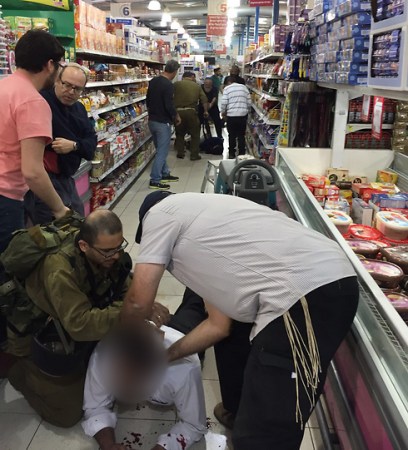
The two Palestinain youths entered a Rami Levi supermarket and stabbed two Israelis. Shoppers there pushed the terrorists back with wagons. A citizen at the scene then shot them, seriously wounding them and preventing a more serious attack.

The Rami Levi supermarket where the stabbing attack took place (Photo: TPS)

Witnesses say that the terrorists were hanging around the area for about 40 minutes prior to attacking. The attackers, Omar Rimawi and Ibrahim Sabah are from Beitunia near Ramallah.

One of the wounded being treated at the scene of the attack (Photo: Uziel Vatik)

The citizen who shot the terrorists recounted that he “entered the store and heard screams. I spotted one of the terrorists and shot him. There were soldiers and citizens there.”

The 36-year-old was sent to Hadassa Medical Center and the 21-year-old was sent to Shaare Tsedek Medical Center in Jerusalem, where he died of his wounds.

Elisha Ben Kimon, Yoav Zitun, Yael Friedson, Itamar Eichner and Elior Levy contributed to this report.

France’s Relentless Hostility to the Jewish State

February 18, 2016

France’s Relentless Hostility to the Jewish State

by Guy Millière

February 18, 2016 at 6:00 am

Source: France’s Relentless Hostility to the Jewish State

  • France today is one of the main enemies of Israel — maybe its main enemy — in the Western world. France’s disregard of the threats faced by Israel is more than simple willful blindness. It is complicity.
  • At a time when Mahmoud Abbas constantly encourages terror and hatred against Israel, and when murders of Israeli Jews by Palestinian Arabs occur on a daily basis, France’s anti-Israel relentlessness can only be seen as the latest extension of France’s centuries-old anti-Semitism.
  • France’s “Arab policy” has gone hand-in-hand with a massive wave of Muslim immigration. France has quickly become the main Muslim country in Europe. More than six million Muslims live in France, and make up approximately 10% of the population. The Muslim vote is now an important factor in French politicians’ decisions; the risk of Muslim riots is taken into account.

On International Holocaust Remembrance Day, January 27, Hassan Rouhani, President of the Islamic Republic of Iran — a regime that denies the fact that the Holocaust occurred and does not hide its intention to commit another holocaust — arrived in Paris for an official visit.

Two days earlier, Rouhani had been in Rome, where the Italian authorities, in a gesture of submission, covered up the nude statues of Rome’s Capitoline Museum.

Rouhani thanked Italy’s Prime Minister Matteo Renzi for his “hospitality”. He did not thank President François Hollande for having hosted him on January 27.

No French journalist or politician mentioned International Holocaust Remembrance Day. French journalists spoke only of Hassan Rouhani’s “moderation” and “openness,” despite Iran’s dire human rights violations. Hollande evoked the rebirth of a “fruitful relationship” between Iran and France.

No French journalist or politician mentioned the Holocaust denial or the genocidal intentions of the Iranian regime; that Iran’s leaders regularly chant “Death to Israel” and “Death to America”; the malignant contents of Palestine, a book recently published by Ali Khamenei, Iran’s supreme leader, or the dangers still inherent in Iran’s nuclear program.

Every newspaper article and politician’s speech in France was about the contracts French companies could sign with Iran and the return of Iran to a harmonious “concert of nations.”

Iran was presented on every side as a “reliable ally” of the West in the fight against the Islamic State.

France’s willful blindness concerning the very real threats Israel faces is characteristic of general attitude of France toward Israel for the last fifty years.

In the second half of the 1960s, after the end of the Algerian war, France adopted an “Arab policy.” It consisted of the creation of close ties with Arab dictatorships and, more broadly, with the authoritarian regimes of the Muslim world. The aim of the “Arab Policy” was to enable France to retain influence, whatever the price, even if it had damaging effects on the rest of the Western world.

It also consisted of severing strategic and military links between France and Israel.

France provided financial and economic help to the newborn Algerian regime. It abandoned Harkis (Algerian Arabs who sided with France) in exchange for the use of a naval base at Mers el-Kebir and the possibility of conducting nuclear tests in the Sahara Desert.[1]

Historians have not reached a consensus about the estimated number of Harkis murdered. Harkis associations placed the number of killed at approximately 100,000-150,000.

France maintained close ties with Tunisia and Morocco, established close relations with the Arab League and offered itself as a voice to the Arab world in international affairs.

In 1975, France became the main Western ally of Saddam Hussein’s regime in Iraq, and provided two nuclear reactors, Tammuz I and II, to Iraq. They were described by Saddam Hussein as the first steps towards an “Arab atomic bomb.” France also endorsed a contract between the Institut Mérieux, based in Paris, and the Directorate of Veterinary Services of the Baghdad regime, which led to the creation of a “biological research laboratory.” It was the first organization to develop biological weapons in Iraq.[2]

Despite UN sanctions, France illegally transferred weapons to Saddam Hussein’s regime until December 2002.

Military cooperation between France and Saddam Hussein lasted until the second Gulf War. Shortly before the U.S. invaded in March 2003, the Iraqi newspaper Babel called France’s President Jacques Chirac “the Great Fighter” (Al Mujahid al-Akbar).

From the start of the war, France was the main Western country opposing military operations and regime change in Iraq.

In 1978-1979, France played an important role in the overthrow of the Shah of Iran and helped facilitate the birth of the Islamic Republic of Iran. French authorities accommodated Khomeini when he was expelled from Iraq in 1978, and allowed him to send to Iran tapes calling for revolution and jihad against Israel. Khomeini returned to Tehran aboard an Air France plane chartered by the French government. Cooperation between France and the Islamic Republic of Iran lasted until Saddam Hussein attacked Iran in September 1980.

To please its new Arab friends, France decided to impose an arms embargo on Israel in June 1967, at the beginning of the Six Day War, at the moment when Israel faced mortal danger. The embargo later became permanent.

In 1973, during the Yom Kippur War, France refused landing rights to U.S. military supply planes flying to Israel.

In the early 1970s, France developed close ties with the PLO and became an ardent supporter of the “Palestinian cause.” France used its influence, just two years after the massacre of Israeli athletes in Munich, to have Yasser Arafat invited to speak before the United Nations General Assembly in November 1974.[3] President François Mitterrand, in 1978, received Yasser Arafat on an official visit to Paris, and granted him all the honors reserved for a head of state. In 1979, France voiced its disagreement with the Camp David Accords because the PLO had not been involved in the talks. In 1982, France saved Arafat, who was besieged by the Israeli army in Beirut, and allowed him to seek asylum in Tunisia, a client state of France, to continue his incendiary activities.

France continued to support Arafat until his last moments, and treated him in a French military hospital. When Arafat died, President Jacques Chirac held an official ceremony for him before sending the coffin to the Middle East in an official aircraft of the French Republic. French diplomatic circles never condemned terrorist attacks against Israel, but always condemned Israeli responses as “disproportionate.” French diplomatic circles never ceased to support the creation of a Palestinian state, in the “1967 borders” (in reality, 1949 armistice lines).

Hamas, designated a terrorist organization, by the United States, was defined several times by French ministers as a “possible interlocutor.” A French Cultural Institute exists in the Hamas-ruled Gaza Strip. France intends to create a National Museum of Palestine in Ramallah, and French officials declared that the museum will open when a “free and sovereign Palestine” will be born. For now, the museum is housed in the Arab World Institute in Paris, the largest Arab and Muslim cultural center in a Western country.

Since the end of 2010, France has also contributed to the Islamist wave sweeping the Middle East, and played a major role in the toppling of the Gaddafi regime in Libya.

France had good relations with the Gaddafi regime when Muammar Gaddafi behaved as an enemy of the West. In April 1986, when an anti-American attack occurred in a discotheque in Berlin, the US decided to strike Libya. France refused overflight rights to the US military and pushed Spain and Portugal to make the same decision.[4] Between 1992 and 2003, when the Gaddafi regime was subject to an embargo, France delivered weapons to Gaddafi and became its second arms supplier after Russia. In December 2007, Gaddafi was invited to France for an official visit: he signed contracts with Airbus Industries and Areva Nuclear Power. In 2011, the Emir of Qatar pushed President Nicolas Sarkozy to support an Islamic rebellion in Benghazi, and France also encouraged the United Kingdom, the United States and other NATO members to overthrow Gaddafi: the result was the takeover of the country by jihadists, who then plundered the military arsenals. Five years after that, Libyan territory is now a base for several jihadist groups, with the Islamic State holding a large part of Libyan coast, two hundred miles from Europe.

Qatar, which funds Islamic terrorist groups, has long funded the Islamic State. Qatar has become a close friend of many French politicians; the French government has offered tax exemptions for Qatari investors who bought and are still buying assets and influence.

France’s “Arab policy” has gone hand-in-hand with a massive wave of Muslim immigration. France has quickly become the main Muslim country in Europe. More than six million Muslims live in France, and make up approximately 10% of the population.

France’s “Arab policy” has also gone hand-in-hand with the establishment, in France, of multiple Islamic organizations. The main one is the French branch of the Muslim Brotherhood, known as the UOIF (Union of Islamic Organizations of France). The two primary training centers for imams in France — in Château Chinon and Saint Denis — belong to the UOIF, and are funded by the French government. The curriculum is defined by the UOIF.[5] Many imams trained in these centers act and preach in French prisons and in the ever-growing 751 “no-go zones,” (“zones urbaines sensibles” / “sensitive urban areas”) over which the French government has lost control. Each mosque in France is free to choose its imam.

The Muslim vote is now an important factor in French politicians’ decisions; the risk of Muslim riots is taken into account. The last prospect is certainly not lost on many Muslims who doubtless conclude that if threatening to riot works, keep on doing it.

French President Georges Pompidou and his Foreign Minister, Michel Jobert, were the main artisans of the “Euro-Arab dialogue” that took shape after the Yom Kippur War, in 1973. In a declaration to the press, Jobert clearly justified the Syrian-Egyptian attack against Israel, and said that the aggressors had wanted to “set foot” in their “own land again.” Dialogue began with the Arab League. It continued with the Organization of the Islamic Conference (OIC ; now renamed the Organization of Islamic Cooperation) — and never stopped. In June 2013, the OIC inaugurated a Permanent Mission Office to the EU in Brussels to “increase cooperation” with the EU.

The bitter result of decades of appeasement and opportunism could be described as fear. France’s questionable links with questionable regimes, organizations and causes, its acceptance of a largely unchecked Muslim immigration, its growing inability to enforce its own laws on swathes of its territory, have made it a warm, comfortable breeding ground for extremist Islam. The risk of further attacks is very real. France is intervening militarily in Syria most likely because many young French Muslims joined the Islamic state and chose jihad. Some of these French citizens came back to kill on French soil. France cannot destroy the Islamic State. France cannot prevent its own Islamization. France cannot prevent, in the chaos of Libya, the further growth of the Islamic State. France’s disregard of the threats faced by Israel is more than simple willful blindness. It is complicity.

For five decades, France was a partner in the crimes of some of the worst enemies of Israel. France today is one of the main enemies of Israel — maybe its main enemy — in the Western world. The day after the visit of Hassan Rouhani in Paris, French Foreign Minister Laurent Fabius (who has since resigned) announced that France wanted to organize a major international conference to relaunch the Israeli-Palestinian peace process, based on an old Saudi peace plan, which includes — as a poison pill — the “right of return.”

Fabius added that if the French initiative failed, France would nevertheless recognize the Palestinian state. He probably knows that the conference will almost certainly not take place, and that even if it did, why should the Palestinians negotiate if a Palestinian State has already been promised to them? Presumably he just wanted to announce France’s upcoming official recognition of a Palestinian state.

On December 30, 2014, the French government backed a UN resolution demanding the “end of Israeli occupation” and the creation of a Palestinian state before December 2017. The resolution, however, did not receive enough votes in the UN Security Council. A US veto was not even necessary. France was not successful, but did not give up.

French and Palestinian lawmakers are working on another resolution that will be presented next fall. The resolution will be almost the same as the previous one. If it gets enough votes in the Security Council (nine out of fifteen), only a US veto could prevent it from being adopted. If the U.S. does not use its veto, Israel could be defined as a UN member state occupying another member state — despite obvious threats to its security on every front.

At a time when Palestinian Authority President Mahmoud Abbas constantly encourages terror and hatred against Israel, and when murders of Israeli Jews by Palestinian Arabs occur on a daily basis, France’s anti-Israel relentlessness can only be seen as the latest extension of France’s centuries-old anti-Semitism.

Amin al-Husseini, the Grand Mufti of Jerusalem and Hitler’s henchman during World War II, was detained by French soldiers in May 1945. He enjoyed the hospitality of the French government, and was able to leave France for Egypt in 1946. On August 12, 1947, he wrote to the French foreign minister, Georges Bidault, to thank France for its help.[6]

Charles de Gaulle, a few months after deciding to impose an arms embargo on Israel in June 1967, and with ironically little self-awareness, publicly described Jews as an “elite people, sure of themselves and domineering.”

In 1967, then French President Charles de Gaulle (left), a few months after imposing an arms embargo on Israel, and with ironically little self-awareness, publicly described Jews as an “elite people, sure of themselves and domineering.” At right, Iranian Foreign Minister Javad Zarif hugs then Foreign Minister Laurent Fabius at the close of nuclear talks in Geneva, Nov. 23, 2014.

Maurice Couve de Murville, head of French diplomacy from 1958-1968, was a financial expert who had been responsible for “the reduction of Jewish influence in the French economy,” under the Vichy regime led by Marshal Petain from September 1940 to March 1943.[7]

François Mitterrand, President of France from 1981 to 1995, worked for the Vichy regime, from January 1942 to mid-1943. He was so dedicated to his work that he received the Francisque (the highest award granted by the regime) from the hands of Petain in April 1943.[8] Mitterand remained a friend of René Bousquet, ex-secretary general to the Vichy regime police, until the day Bousquet was assassinated in 1993. Bousquet was one of the main organizers of the mass arrest of Jews in France (known as the Vel’ d’Hiv Roundup).

In February 2015, after Prime Minister Manuel Valls uttered positive words about Israel, Roland Dumas, French Foreign Minister from 1984 to 1986 and from 1988 to 1993, accused Valls of being under “Jewish influence”.

In his 2006 book Betrayal: France, the Arabs, and the Jews, David Pryce-Jones explains in detail how France had obsessively dreamed of being a Muslim power for more than a century, and that French diplomacy has been imbued with a persistent anti-Semitism and hostility toward the Jewish state.[9]

France did not become a Muslim power, but anti-Semitism still permeates diplomacy in France. French hostility toward the Jewish state is more present and malignant than ever.

Just this month, on February 3, a group of French ambassadors published a manifesto to “save the Palestinian State.” In the text, they justify the “knife intifada” in Israel, and denounce “fifty years of military and police occupation by Israel,” Jewish “colonization” of Palestinian territories, the “shadow of the Holocaust” that “inhibits” Europe, and the supposedly “apartheid policy of Israel,” even though it is hard to see how a country that gives the Arab population under its control full freedom and rights, including political parties and seats on Israel’s Supreme Court, can be called “apartheid.” The French ministers also asked the Europe Union, at the behest of the Palestinian Authority, to stop any scientific and economic cooperation with Israel until the recognition of a Palestinian state. The French Ministry of Foreign Affairs even described the text of manifesto as a “useful” contribution to the debate.

Dr. Guy Millière, a professor at the University of Paris, is the author of 27 books on France and Europe.


[1] Martin S. Alexander, J.F.V. Keiger, France and the Algerian War, 1954-1962: Strategy, Operations and Diplomacy, Routledge, 2013

[2] Patrick Berche, L’histoire secrète des guerres biologiques: Mensonges et crimes d’Etat, Robert Laffoont, 2011.

[3] Ignace Dalle, La Vé République et le monde arabe, Fayard, 2014.

[4] Joseph T. Stanik, El Dorado Canyon: Reagan’s Undeclared War With Qaddafi, Annapolis, Maryland: Naval Institute Press, 2003.

[5] Yvonne Yazbeck Haddad, Muslims in the West: From Sojourners to Citizens, Oxford University Press, 2002.

[6] David G. Dalin, John F. Rothmann, Alan M. Dershowitz , Icon of Evil: Hitler’s Mufti and the Rise of Radical Islam, Transaction Publishers, 2009.

[7] Philippe Valode, Le destin des hommes de Pétain, Nouveau Monde Editions, 2014.

[8] Pierre Péan, Une jeunesse française. François Mitterrand, 1934-1947, Fayard, 1994.

[9] David Pryce-Jones, Betrayal: France, the Arabs, and the Jews, Encounter Books, 2006.

Expelliarmus! Saudi Police to learn anti-magic tactics

February 18, 2016

Expelliarmus! Saudi Police to learn anti-magic tactics, Jerusalem Post, Zack Pyzer, February 18, 2016

MagicHaifa Magic for Peace event, June 1, 2015 . (photo credit:TZVI ROGER, CITY OF HAIFA)

Saudi Arabia’s new police recruits are now being trained in more than enforcing modesty standards. According to various reports across Arab media, cadets are taking a five-day course in combating wizards, witches and as-of-yet unconfirmed plague of leprechauns blighting the Kingdom.

Saudi media reported that 30 members of the religious police, formally named the Committee for the Promotion of Virtue and the Prevention of Vice (CPV), completed the course in February. Classes educated the officers in how to identify and safely apprehend the dangerous suspects who may be travailing the Arabian desert, such as Sharia-desecrating elves.

This is by no means the first time Saudi Arabia has attempted to get to grips with the occult, with the “anti-witchcraft unit”  formed back in May 2009 for this very purpose.

The Kingdom takes witchcraft so seriously that it has banned theHarry Potter series by British writer J.K. Rowling, rife with tales of sorcery and magic. In 2011, Abdullah Jaber, a political cartoonist at the Saudi daily Al-Jazirah, told The Media Line “In accordance with our Islamic tradition we believe that magic really exists. The fact that an official body, subordinate to the Saudi Ministry of Interior, has a unit to combat sorcery proves that the government recognizes this, like Muslims worldwide.”

There is no shortage of anecdotal evidence to say that the Saudis are right in their convictions. In 2011, the anti-witchcraft unit cracked the case of the cursed wolf’s head wrapped in lingerie, with officers able to break a spell allegedly keeping a family trapped in the cursed head’s power. It was not confirmed whether the officers themselves needed to use magic in breaking the curse, or just regular detective work.

Unfortunately, sorcery is no laughing matter for those accused of the crime, with Saudi Arabia carrying out the death penalty for those convicted. Amina bint Abdul Halim bin Salem Nasser was executed in 2011, having been convicted on charges of “sorcery and witchcraft.”

Israeli missile attack reported Syrian army outposts on the Damascus-Daraa road

February 18, 2016

Source: Israeli missile attack reported Syrian army outposts on the Damascus-Daraa road

DEBKAfile Special Report February 18, 2016, 3:36 AM (IDT)

Israel-Syrian border tensions have soared in the five days since Russia and Syria stepped up their air strikes over rebel positions in southern Syria, drawing ever closer to the Israeli border.

The raids are covering a wide radius from the town of Daraa on the Jordanian border up to Quneitra on the Golan. How to react if those raids actually reach the two borders is no doubt a burning topic at General Staff HQ in Tel Aviv and Amman. Neither army wants a head-on collision close to their borders with the coalition of Russian, Syria, Iranian and Hizballah forces. However, the intensified air raids are putting large numbers of Syrian refugees to flight from their homes towards the Israeli and Jordanian borders. The Jordanian border area is in chaos. The kingdom’s army has seized the positions formerly held by Syrian rebel units to hold back the influx of refugees into Jordan. The rebels are dropping their weapons and fleeing in all directions in disarray.

Israel has ordered a blackout on news from Ein Zivan, its border crossing at the Golan town of Quneitra.

Wednesday, Feb. 17, as debkafile reported exclusively earlier, Prime Minister Binyamin Netanyahu sent Dore Gold, Director General of the Foreign Ministry to Moscow in search of answers about Russian intentions regarding the Israeli border district.

By Wednesday night, no answers were forthcoming.

This is not surprising. When the Jordanian Chief of Staff, Lt. Gen. Mashal Al-Zaben was sent on a similar errand to Moscow a few days ago, he was given the runaround, told that, since the Syrian chief of staff happened to be in the Russian capital “by chance,” and since he is in charge of military operations in the border region, why not talk to him?

In fact, the Russians had deliberately flown him over from Syria.

On the assumption that Dr. Gold would fare no better than the Jordanian general, Israel may have taken matters into its own hands.

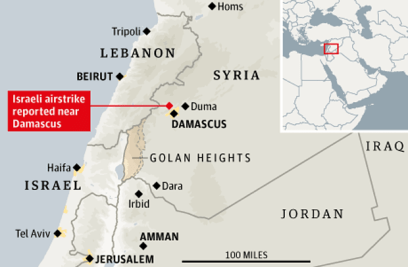
Three Israeli missiles reportedly struck Syrian military outposts on the road between Daraa and Damascus after Wednesday midnight, according to Syrian human rights monitors. The IDF declined to comment on this report, while the Syrian army and Hizballah deneied it.

If this report is true, it would mean that Israel’s patience is running out with the Russian-Syrian aerial campaign that threatens to open the door for Syrian, Iranian and Hizballah forces to take up positions on its northern border. The triple missile strike looks as though it was meant to draw a line in the sand against this happening.

Iran’s territorial ambitions

February 18, 2016

Source: Israel Hayom | Iran’s territorial ambitions

The claim that Iran has no territorial dispute with Israel is frequently voiced here. “Iran is 1,000 kilometers away, and makes no territorial claims on Israel,” experts write.

Is this really the case, though?

Twenty-five years ago, Iran instituted Al-Quds (Jerusalem) Day, which it marks every year on the last Friday of the Muslim holy month of Ramadan. On this day, the motto is “Death to Israel” — a succinct and unambiguous call for the destruction of the Jewish state. On Al-Quds Day in 2013, “moderate” Iranian President Hassan Rouhani declared, “The Zionist regime has been a wound on the body of the Islamic world for years and the wound should be removed.”

The conflict is therefore over the entire territory of the State of Israel, over its very existence. Hatred of Israel is a pillar of the ayatollahs’ regime. In the foreword to his book “Hokumat-i Eslami” (“Islamic Government”), the late Ayatollah Ruhollah Khomeini wrote, “From the very beginning, the historical movement of Islam has had to contend with the Jews, for it was they who first established anti-Islamic propaganda and engaged in various stratagems, and as you can see, this activity continues down to the present.”

Khomeini noted that if Muslims had obeyed the divine ordinances to be prepared for war at all times, “a handful of Jews would not have dared to occupy our land and to burn and destroy Masjid Al-Aqsa [Al-Aqsa mosque].” In a sermon he delivered in Tehran, Khomeini said, “This regime, which controls Al-Quds, must be erased from the annals of history.”

For Iran, the State of Israel was established on Islamic lands, which it has the duty to liberate from the Zionist occupier. Israeli soldiers and civilians are one and the same, in the words of Hezbollah leader Hassan Nasrallah: “In occupied Palestine, there is no difference between a soldier and civilian, because they are all invaders, occupiers and usurpers of the land.”

In this school of thought, the conflict over the borders is fanatical; it entails wiping Israel from the map with no possible peaceful solution. Former Iranian President Mahmoud Ahmadinejad voiced that very sentiment: “Anybody who recognizes Israel will burn in the fire of the Islamic nation’s fury, and any Islamic leader who recognizes the Zionist regime means he is acknowledging the surrender and defeat of the Islamic world.”

The tip of the Iranian spear in this war against Israel is Hezbollah, which has sworn its allegiance to Iran’s supreme leader and openly aims to destroy the Jewish state. Even an atomic weapon is considered a legitimate tool with which to eradicate the Zionist entity. In this vein, former Iranian President Akbar Hashemi Rafsanjani said: “If one day, the Islamic world is also equipped with weapons like those that Israel possesses now, then the imperialists’ strategy will reach a standstill, because the use of even one nuclear bomb inside Israel will destroy everything. However, it will only harm the Islamic world.”

Iran’s belligerent anti-Zionism and anti-Semitism does not perturb a Western world blinded by the fat contracts now available in Iran, following the lifting of economic sanctions. French President Francois Hollande, for example, despite his repeated vows to fight anti-Semitism, received Rouhani in Paris with the type of pomp reserved for kings, while the Italians covered ancient nude sculptures and removed wine from their menu, all to honor the distinguished Iranian guest.

There is real concern that the West is willing to sacrifice Israel on the altar of Iranian money. U.S. Secretary of State John Kerry confessed that unfrozen Iranian funds would be used to arm terrorists. And while Kerry said he had not yet seen evidence of this, Iranian Foreign Ministry spokesman Hossein Ansari said this month that Iran would continue to fund Hamas because “the war against Israel remains a primary objective of its policy.” Iran will also continue funding Hezbollah, through which it hopes to realize its dream of a Shiite Fertile Crescent stretching from Iran to Palestine, through Iraq, Syria and Lebanon.

Even if the odds of success are slim, Israel must launch a diplomatic offensive to repel this danger.

Dr. Ephraim Herrera is the author of “Jihad — Fundamentals and Fundamentalism.”

IDF – Co-Ed Caracal Battalion Beret March

February 18, 2016


The Caracal Battalion (Hebrew: גדוד קרקל‎) is an infantry combat battalion of the Israel Defense Forces, one of only two units in the Israeli military that is composed of both male and female soldiers. It is named after the Caracal, a small cat whose sexes appear the same. As of 2009, approximately 70% of the battalion was female.


Caracal Battalion engaged in combat on September 21, 2012 on the Egyptian border, following the infiltration of a group of terrorists. Responding to a radio report of the attack, in a fire-fight a female Caracal infantry soldier killed a terrorist, who was carrying an explosive belt.


Muslim Prayers Take Over UN General Assembly Area

February 18, 2016

Exclusive: Muslim Prayers Take Over UN General Assembly Area

by Anne Bayefsky

17 Feb 2016

Source: Muslim Prayers Take Over UN General Assembly Area

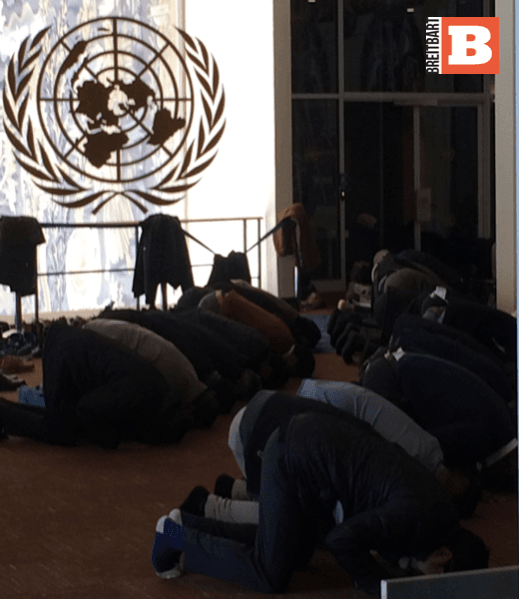
Muslim prayers on Fridays at the United Nations headquarters in New York have begun taking up a large area next to the General Assembly Hall, shunning a designated ecumenical prayer area.

There was no formal decision by the UN to host Muslim prayers.  The space has simply been booked without further explanation.

Muslim prayers at the UN have been operating for some time, though UN staffers are tight-lipped about when they began and who started them.

There is an ecumenical “meditation room” – without religious markings – that is continually open to the public and adherents of any faith. A plaque outside explains that the room was “personally planned and supervised in every detail” by former UN Secretary-General Dag Hammarskjold in 1957. Hammarskjold’s aim was to create “a place where the doors may be open to the infinite lands of thought and prayer. People of many faiths will meet here…[I]t is dedicated to the God whom man worships under many names and in many forms.”

Prior to recent renovations, Muslim prayers had used a remote venue on a floor above the library.

Prayer rugs in area of UN General Assembly Building (Human Rights Voices / Breitbart News)

Prayer rugs in area of UN General Assembly Building (Human Rights Voices / Breitbart News)

Today, one finds dozens of prayer rugs permanently set aside for use every Friday in the General Assembly building. The space is booked – the UN won’t say by whom – from 11:45 a.m. to 3:00 p.m., and unavailable for anything else.

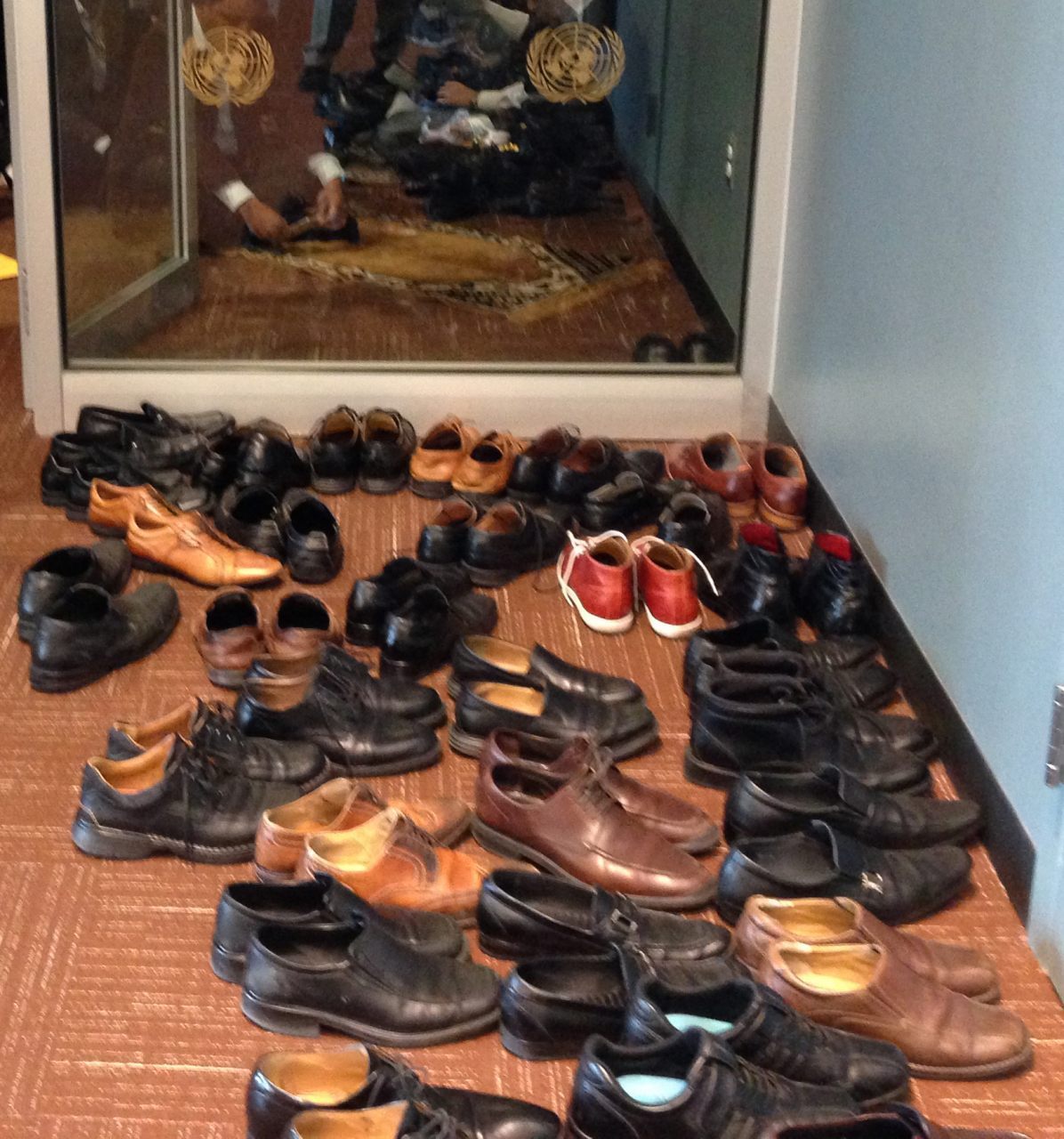
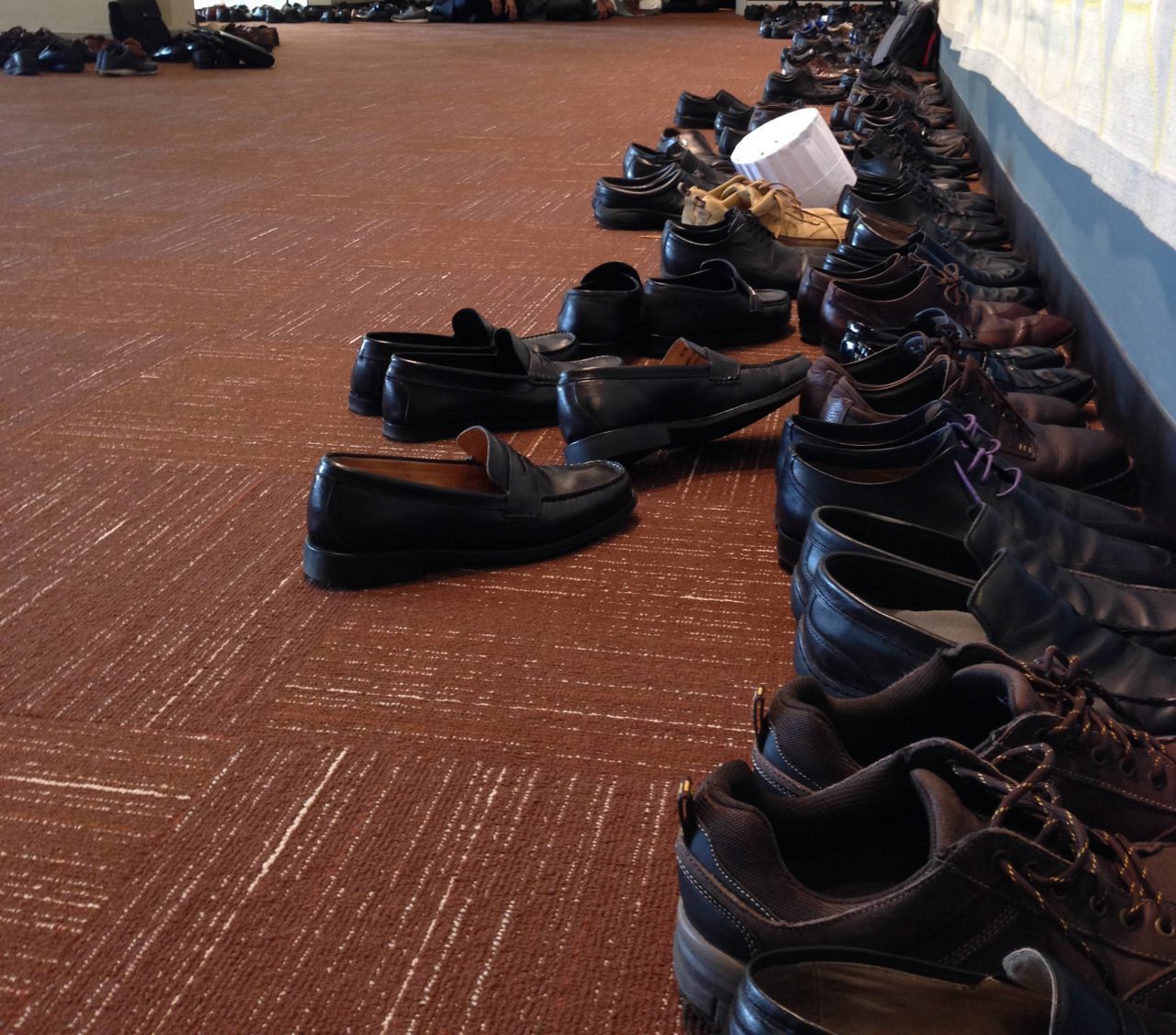
Muslim prayers are now so popular that they spill into the path of public tours, with upwards of hundreds of shoes lining the halls.

Shoes in Area Outside UN General Assembly Hall (Human Rights Voices / Breitbart News)

Shoes in Area Outside UN General Assembly Hall (Human Rights Voices / Breitbart News)

2 Shoes in Area Outside UN General Assembly Hall (Human Rights Voices / Breitbart News)

2 Shoes in Area Outside UN General Assembly Hall (Human Rights Voices / Breitbart News)

By contrast, Christians, Jews, Hindus, and members of other faiths do not hold their regular services at the UN.

Evidently, just one religion finds the ecumenical room insufficient for its purposes. This despite a UN Charter that promises to reaffirm “equal rights,” and to promote “respect for human rights and for fundamental freedoms for all without distinction as to religion.”  Not to mention the host country’s commitment to the separation of church and state.

American taxpayers recently contributed half a billion dollars to renovate the UN. Little do Americans know that their money funded space for Friday Muslim prayer services.

The “Capital Master Plan” renovations, which ran for seven years until mid-2015, cost Americans $488 million, according to the U.S. Government Accountability Office (GAO). With our open wallet, the UN merrily went $379 million over budget, according to the UN — and at least $430 million over budget, according to the GAO.

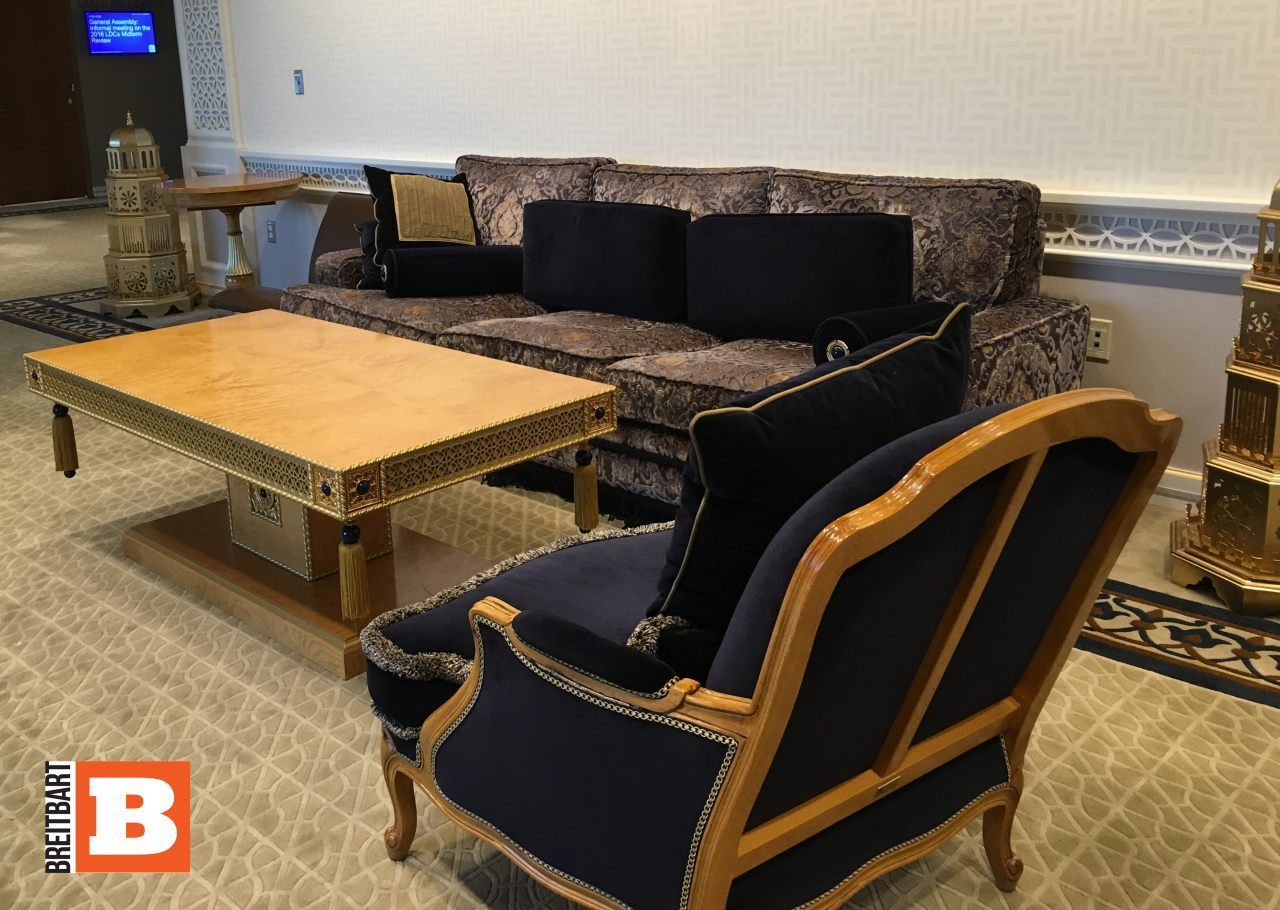
American dollars didn’t just help renovate the space appropriated for weekly Muslim prayers. They also helped carve out an “East Lounge” that UN Secretary-General Ban Ki-moon called “perfect for behind-the-scenes negotiations.” The decorations were donated by Qatar in 2013.

Qatar-funded East Lounge (Human Rights Voices / Breitbart News)

Qatar-funded East Lounge (Human Rights Voices / Breitbart News)

Qatar-funded East Lounge (Human Rights Voices / Breitbart News)

Qatar-funded East Lounge (Human Rights Voices / Breitbart News)

Qatar paid only about $4 million as its mandatory assessed contribution to the Capital Master Plan, and then added a bit for the following East Lounge touches: black and gold embroidered couches, chairs, pillows, and engraved tables, with six gold-colored ornaments reminiscent of minarets. Or, as UN Secretary-General Ban Ki-moon put it: “I am especially grateful that this lounge reflects Qatari culture.” (Among other things, Qatar is known to bankroll terrorist organizations like Hamas.)

The UN donations website claims that there was a renovation “policy” developed to govern spaces in the building that were “available for adoption” – but the policy is mysteriously unavailable. Perhaps it is the same policy that has resulted in the obscene repositioning of the UN’s revisionist “Palestine” exhibit next door to the Holocaust exhibit.

UN indoctrination isn’t subtle, and it isn’t cheap. With the Organization of Islamic Cooperation having colonized the place, perhaps it is about time somebody asked those wanting to be the next American president why we are paying for it.

Muslim Prayers in area of UN General Assembly Building (Human Rights Voices / Breitbart News)

Muslim Prayers in area of UN General Assembly Building (Human Rights Voices / Breitbart News)

Anne Bayefsky is Director, Touro Institute Human Rights and the Holocaust; President, Human Rights Voices – Follow her @AnneBayefsky