Archive for January 21, 2016

Iran’s long arm

January 21, 2016

Iran’s long arm, The Jerusalem Post, JPost Editorial, January 21, 2016

(Please see also, New Iranian-Backed Terror Group Makes Inroads in West Bank, Gaza. — DM)

ShowImage (20)Thousand of Basij soldiers stage mock seige of Temple Mount in Iran. (photo credit:FARS)

If anyone needed proof how the lifting of sanctions on Iran will hurt Israel’s security, this week provided two examples.

Just days after implementation of the Joint Comprehensive Plan of Action nuclear agreement, we received a reminder that Iran and its proxies remain dangerous enemies of Israel.

Five Palestinians from the Tulkarm area were arrested for planning to carry out terrorist attacks under instructions from Hezbollah, the Shin Bet (Israel Security Agency) said on Wednesday.

The head of the cell, Mahmoud Za’alul, had been recruited through social media networks. Using encrypted messages, he enlisted five more men from the Tulkarm area; they were ordered to gather intel and plan terrorist attacks, including preparing explosive vests for suicide bombings.

Hezbollah funded their operation by sending them $5,000 through money changers.

Now that the “crippling” economic sanctions on Iran have been removed, the resources at its disposal – and as an extension at Hezbollah’s – will be significantly greater.

In Lebanon, meanwhile, Hezbollah is consolidating its political power. On Monday, in a development that is nothing short of earth shattering, Samir Geagea, leader of the Christian Lebanese Forces party, publicly endorsed his rival, the formal general Michel Aoun, for president of Lebanon.

In so doing, Geagea abandoned his loyalty to Saad Hariri, head of the anti-Syrian Future (Al-Mustaqbal) Movement, for an alliance with the enemy camp headed by Hezbollah, which supports Aoun for president.

This opens the way to the appointment of a pro-Iranian president in Lebanon.

Hezbollah and Iran are undoubtedly pleased with the development. If Aoun is elected president, Hariri’s influence – and the influence of Hariri’s main patron, Saudi Arabia – will be greatly diminished.

Finally, in the Gaza Strip, Iran has over the past few months been providing funding to a new terrorist group called Al-Sabireen Movement for Supporting Palestine. Al-Sabireen, which means “the patient ones” in Arabic, was formed in the wake of a break between Tehran and the two largest terrorist organizations operating in Gaza – Hamas and Islamic Jihad.

Neither organization has acquiesced to Iran’s demand to support President Bashar Assad in Syria.

Both have incensed the Iranians by remaining silent on Saudi attacks in Yemen against the Iranian-backed Houthis. Both face their worst financial crisis in two decades after Iran’s decision to cut off support.

Al-Sabireen’s emblem – a gun sprouting from the center of its name in Arabic – is nearly identical to Hezbollah’s.

So far, the organization has about 400 followers in the Gaza Strip, each one receiving a monthly salary of $250-$300, while the senior officials get at least $700, according to The Jerusalem Post’s Palestinian Affairs correspondent Khaled Abu Toameh. Iran has been supplying Al-Sabireen with weapons used to attack Israel.

The Iranians are believed to have supplied their new terrorist group in the Gaza Strip with Grad and Fajr missiles that are capable of reaching Tel Aviv. Also, Iranian funds channeled through Al-Sabireen are said to be used to support the families of killed or arrested terrorists living on the West Bank.

The Iranian-backed organization is also wooing Fatah members. Scores of militiamen once belonging to Palestinian Authority President Mahmoud Abbas’s Fatah faction in the Gaza Strip have allied themselves with Al-Sabireen. Most were attracted by the money.

The rise of an unshackled Iran’s influence in the region is bad for Israel. But it is also bad for many of the US’s Sunni allies in the region such as Saudi Arabia and the Palestinian Authority. A shared enemy has created a shared interest – the curtailing of Iranian influence.

Implementation of the JCPOA might delay Tehran’s nuclear weapon program. The removal of sanctions, however, has set the stage for the Islamic Republic to increase its destabilizing influence. Iran and its proxies must be stopped.
The Inside Track From Israel’s Gaza Border Defenders

January 21, 2016

The Inside Track From Israel’s Gaza Border Defenders, Investigative Project on Terrorism, Paul Alster, January 21, 2016

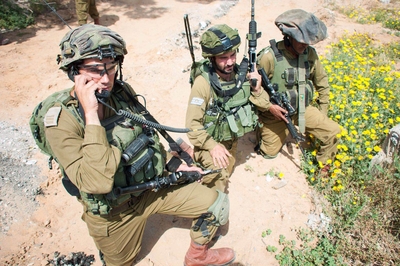
1339Photos courtesy of IDF Spokesperson.

Like it or not, the Iran nuclear deal is done. In much of the Middle East, defense officials in many states believe that a sizeable proportion of the soon-to-be released $100 billion Iranian windfall will be directed toward funding proxy armies of the Islamic Republic, for whom the Jewish state remains the prime target. Israel’s focus is now, more than ever, on defense and surveillance.

In the north, Hizballah, Iran’s proxy Lebanese army, remains a massive threat to regional stability, siding with Syria’s disgraced President Bashar Assad and his saviors from Russia. In Gaza, it is no secret that a previous rift between Iran and Hamas has been smoothed over to further mutual objectives and that another, and possibly more brutal round of hostilities between Israel and Hamas may not be far away.

“The sanctions relief and the nuclear deal with Iran represent a strategic shift that the IDF will have to tackle over the next decade,” Israel Defense Forces (IDF) Chief of Staff Gadi Eizenkot said Monday in a speech at the INSS conference in Tel Aviv. “We also see [Iran’s] attempt to influence Arab Israelis and those in the Gaza Strip, and the estimation is that as Iran’s economic situation improves, over the next one-to-two years, it will divert considerably more resources into opposing Israel, via the Iranian military industry.”

Last week, the Investigative Project on Terrorism (IPT) saw first-hand the situation on Israel’s south-western border, meeting with a senior IDF source who cannot be identified for security reasons. Close to the Kerem Shalom border crossing, where Israel oversees the transfer of many hundreds of tons of goods and supplies every day into Gaza,  we scrambled up a sizeable sand dune that offered a panoramic view of the situation on the ground toward the closed Rafah crossing from Egypt into Gaza.

“We hear the explosions and the fighting [against the Islamists] on the Egyptian side. The Egyptian army is taking it seriously,” the senior IDF source explained as we looked across the triangular border junction and heard distant noises, apparently explosions. “We hear this every day. Terrorists continue to try to cross from Egypt into Gaza.”

Minutes later, a text message announced that the Keren Shalom crossing suddenly had been closed. It turned out that the Egyptian army reportedly engaged and killed 13 jihadists  just a couple of miles away. Two days earlier, an attempt to breach the Israel-Gaza border fence and plant an IED resulted in an Israeli airstrike reportedly eliminating a member of the Al Aqsa Martyrs Brigade.

Meanwhile, Hamas continues to test fire rockets into the sea, and in recent months other Islamic militants in Gaza sporadically lob rockets toward Israel. On the other side of the border triangle, Egypt is doing its best to keep a lid on ISIS and other Islamist forces in the Sinai Peninsula.

It’s clear that relations between the Israeli and Egyptian militaries are good, a dangerous common enemy helping to focus minds. Under President Abdel Fattah el-Sisi, Egypt (despite a lack of support from the United States), has taken the fight to the terror organizations, often at a significant cost in Egyptian military lives. The horrific October downing of the Russian passenger jet out of Sharm el-Sheikh brought the scale of the task facing Egypt into focus. Israel remains alert for the jihadists turning their attention and firepower from Sinai, but for now believes that Gazan-based terror poses its most immediate threat.

“It’s been quite quiet with Hamas [since the 2014 Protective Edge war], but they don’t keep quiet for long,” the IDF source said. “We’re not looking for a fight – we have an interest that there will be quiet here – but if we have to deal with Hamas, this time we’ll deal with them properly.”

Many Israelis were dismayed when Israel unilaterally pulled out of Gaza in 2014 without a ceasefire, some criticism coming notably from members of the left-wing opposition and media for allowing Hamas off the hook when many believed it was in utter disarray. Now, despite ongoing attempts to stem the flow of weapons, reports suggest Hamas is rebuilding fast and may have some surprises in store for Israel if there’s another round of fighting.

“Look, we’re quite certain they are still building tunnels,” the official said, planting his heel in the sand and showing how easy it is to dig. “And yes, I’m sure they have new weapons – anti-tank, anti-aircraft etc. Like us, they will want to be better next time, but we understand more. The reality is different. We’re learning all the time what is going in Gaza. The army is always preparing for the war to come and [Hamas] won’t meet the same thing as in [Protective Edge].”

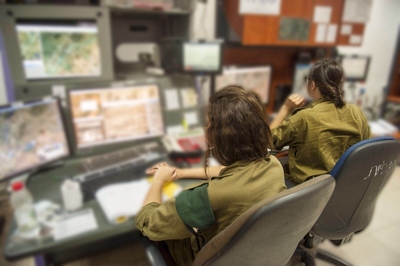
While Israeli soldiers and advanced technology such as its Guardium unmanned patrol vehicles are the first line of defense – the IDF indicated last year that the development of underground tunnel detection systems is also a priority project – the eyes of the military are actually in special units of female soldiers, known as the tazpitanyot. They monitor all movements, looking for suspicious activity, known terror operatives, and attempts to breach the border.

1340 (2)

They work in a series of non-descript trailers and shipping containers belying the fact that inside are massed banks of video screens and radar images, and the ability to combine pictures filmed from aerial blimps with other cameras – both day and night vision. This arrangement allows operatives to zoom in and see Gazans as far as a mile from the border fence.

When anything, or anyone suspicious pops up, there are pictures of ‘Wanted’ terror suspects close to the screens.  They instruct the on-the-ground forces to investigate. Never averting their gaze from the screen during a four-hour shift, each soldier has been trained to identify every landmark, tree, or rock within her specific area of surveillance. “If there’s even a single branch missing from a tree, they’ll spot it” the women’s commanding officer said. They also have remote control of the machine guns sited on border watch towers.

No security system is 100 percent foolproof, and during the first two weeks of the last round of fighting, four terror tunnels emerged on the Israeli side, only being detected at the last moment.  In two cases, the IDF fought gun-battles leaving  at least 10 terrorists and six Israeli soldiers dead. Hamas had hoped to kill civilians before luring Israeli soldiers back through the tunnels then kidnapping them or causing mass casualties.

Methods and practices of surveillance are being continually reviewed, but no-one in the Israeli military doubts the tatzpitanyot’s crucial front-line role in its border security, both north and south.

Palestinians: Western Media’s Ignorance and Bias

January 21, 2016

Palestinians: Western Media’s Ignorance and Bias by Khaled Abu Toameh January 21, 2016 at 5:00 am

Source: Palestinians: Western Media’s Ignorance and Bias


  • Foreign journalists based in Jerusalem and Tel Aviv have for years refused to report on the financial corruption and human rights violations that are rife under the Palestinian Authority (PA) and Hamas regimes. Palestinian “suffering” and the “evil” of the Israeli “occupation” are the only admissible topics.
  • Another Ramallah-based colleague shared that a few years ago he received a request from a cub correspondent to help arrange an interview with Yasser Arafat. Except at that point, Arafat had been dead for several years. Fresh out of journalism school and unknowledgeable about the Middle East, the journalist was apparently considered by his editors a fine candidate for covering the Israeli-Palestinian conflict.
  • Western reporters would do well to remember that journalism in this region is not about being pro-Israel or pro-Palestinian. Rather, it is about being “pro” the truth, even when the truth runs straight up against what they would prefer to believe.

Two Western journalists recently asked to be accompanied to the Gaza Strip to interview Jewish settlers living there.

No, this is not the opening line of a joke. These journalists were in Israel at the end of 2015, and they were deadly serious.

Imagine their embarrassment when it was pointed out to them that Israel had completely pulled out of the Gaza Strip ten years ago.

You have to have some pity for them. These foreign colleagues were rookies who aimed to make an impression by traveling to a “dangerous” place such as the Gaza Strip to report on the “settlers” living there. Their request, however, did not take anyone, even my local colleagues, by surprise.

These “parachute journalists,” as they are occasionally called, are catapulted into the region without being briefed on the basic facts of the Israeli-Palestinian conflict. Sadly, correspondents such as these are more the rule than the exception. A particular clueless British reporter springs to mind:

When Israel assassinated Hamas’s founder and spiritual leader, Ahmed Yasmin, in 2004, a British newspaper dispatched its crime reporter to Jerusalem to cover the event. To this reporter, the region, as well as Hamas, were virgin territory. His editors had sent him to the Middle East, he said, because no one else was willing to go.

Well, our hero reported on the assassination of Ahmed Yassin from the bar of the American Colony Hotel. His byline claimed that he was in the Gaza Strip and had interviewed relatives of the slain leader of Hamas.

Sometimes one feels as if one is some sort of a lightning rod for these tales. Another Ramallah-based colleague shared that a few years ago he received a request from a cub correspondent to help arrange an interview with Yasser Arafat. Except at that point, Arafat had been dead for several years. Fresh out of journalism school and unknowledgeable about the Middle East, the journalist was apparently considered by his editors a fine candidate for covering the Israeli-Palestinian conflict.

In the three decades of covering this beat, journalists of this type have become quite familiar to me. They board a plane, read an article or two in the Times and feel ready to be experts on the Israeli-Palestinian conflict.

Some of them have even assured me that before 1948 there was a Palestinian state here with East Jerusalem as its capital. Like the ill-informed young colleagues who wished to interview the nonexistent Jewish settlers in the Gaza Strip of 2015, they were somewhat taken aback to learn that prior to 1967, the West Bank had been under the control of Jordan, while the Gaza Strip had been ruled by Egypt.

Is there some difference between an Arab citizen of Israel and a Palestinian from the West Bank or Gaza Strip? My foreign colleagues may well not be able to say. Does the Hamas charter really state that the Islamist movement seeks to replace Israel with an Islamic empire? If so, my international co-workers may not be able to tell you.

One memorable journalist, several years ago, asked to visit the “destroyed” city of Jenin, where “thousands of Palestinians had been massacred by Israel in 2002.” She was referring to the IDF operation in the Jenin refugee camp where nearly 60 Palestinians, many of them gunmen, and 23 IDF soldiers were killed in a battle.

Pity aside, this degree of incomprehension — and professional laziness — is difficult to imagine in the Internet age.

But when it comes to covering the Israeli-Palestinian conflict, ignorance apparently is bliss. Misconceptions about what goes on here plague the international media. The binary good guy/bad guy designation tops the list. Someone has to be the good guy (the Palestinians are assigned that job) and someone has to be the bad guy (the Israelis get that one). And everything gets refracted through that prism.

Yet the problem is deeper still. Many Western journalists covering the Middle East do not feel the need to conceal their hatred for Israel and for Jews. But when it comes to the Palestinians, these journalists see no evil. Foreign journalists based in Jerusalem and Tel Aviv have for years refused to report on the financial corruption and human rights violations that are rife under the Palestinian Authority (PA) and Hamas regimes. They possibly fear being considered “Zionist agents” or “propagandists” for Israel.

Finally, there are the local journalists hired by Western reporters and media outlets to help the cover the conflict. These journalists may refuse to cooperate on any story that is deemed “anti-Palestinian.” Palestinian “suffering” and the “evil” of the Israeli “occupation” are the only admissible topics. Western journalists, for their part, are keen not to anger their Palestinian colleagues: they do not wish to be denied access to Palestinian sources.

Thus, the international media’s indifference in the face of the current wave of stabbings and car-rammings against Israelis should come as no surprise. One would be hard-pressed to find a Western journalist or a media organization referring to Palestinian assailants as “terrorists.” In fact, international headlines often show more sympathy toward Palestinian attackers who are killed in the line of aggression than toward the Israelis who were attacked in the first place.

Of course, the above tales hardly apply to all foreign journalists. Some correspondents from the US, Canada, Australia and Europe are both very knowledgeable and very fair. Unfortunately, however, these represent but a small group among mainstream media in the West.

Western reporters, especially those who are “parachuted” into the Middle East, would do well to remember that journalism in this region is not about being pro-Israel or pro-Palestinian. Rather, it is about being “pro” the truth, even when the truth runs straight up against what they would prefer to believe.

Khaled Abu Toameh is an award-winning journalist based in Jerusalem.

  • Follow Khaled Abu Toameh on Twitter


Palestinian militia discussed for E. Jerusalem to help bar terror and block ISIS influence

January 21, 2016

Palestinian militia discussed for E. Jerusalem to help bar terror and block ISIS influence, DEBKAfile, January 21, 2016

Palestinian_Police480

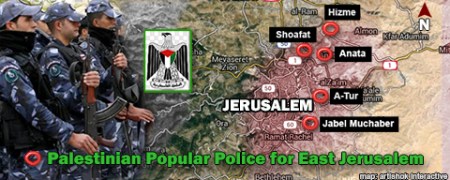
Israeli and Palestinian security officers are exploring the possible formation of a new Palestinian militia to take charge of enforcing law and order in the Arab districts of Jerusalem and halting the anti-Israel terrorist attacks emanating from those districts.

DEBKAfile’s intelligence sources disclose that the dialogue is led by senior Israeli Shin Bet and police officials and the Palestinian General Intelligence (Mukhabarat) chief Maj. Gen. Majid Faraj.

Our sources cannot confirm that Prime Minister Binyamin Netanyahu or other top officials, such as Public Security Minister Gilead Erdan, are fully in the picture, but it will certainly have been brought to their notice.
Palestinian Authority Chairman Mahmoud Abbas is kept up to date.

Palestinian Authority Chairman Mahmoud Abbas is kept up to date.

The plan was first broached in top Israeli police circles, who first asked the Shin Bet and IDF if they had any objections to the creation of a special local Palestinian force or militia, whose members would serve under the orders of the Israeli Police, with a status similar to that of Jerusalem Arab permanent residents, who serve in the local police force.

The new militia would undertake responsibility for maintaining order and security in the Palestinian districts of East Jerusalem, and a commitment to prevent the continuation of terror attacks from the districts under their authority.

This plan gained rapid momentum in recent days over concerns on both sides over the rapidity with which the Islamic Sate was gaining adherents in Palestinian communities.

IDF Chief of Staff Lt. Gen. Gady Eisenkott disclosed this week that an estimated 14-16 percent of Palestinians support ISIS – the highest proportion in the Arab world, where the average is no more than 5-6 percent.

In a little-noticed incident on Dec. 3, 2015, a Palestinian General Intelligence officer called Mazen Aribe, 37, suddenly turned his official rifle on Israeli soldiers. After he injured two, their comrades shot him dead.

Investigators of the incident later confirmed that it bore the hallmarks of an ISIS attack.

Aribe, who happened to be the nephew of the senior Palestinian peace negotiator Saeb Erekat, was a highly respected intelligence officer and a loyal supporter of his boss, the a/m Maj. Gen. Faraj.  His sudden turn to violence against Israeli troops set off alarm bells in the Palestinian intelligence services as well as the Shin Bet and Israeli police.

The progress of the talks for establishing the new force, since named the “Palestinian Popular Police for East Jerusalem,” can be measured by Israel’s consent to extend “a measure of autonomy” for certain administrative municipal appointments for its areas of control, provided their work is fully coordinated with Israeli government and municipal authorities.

The discussions cover the Palestinian-populated districts of North Jerusalem – Shoafat, Hizme and Beit Hanina – and the two big refugee camps at Shoafat and Anata. Many of the recent terrorist attacks against Israelis were perpetrated in the last four months by dwellers of these sections of Jerusalem.

The Old City and the Palestinian villages of Issawiya, A-Tur and Jabal Mukabar have not been covered in the bilateral security discussions.

Gen. Faraj is the live wire promoting the initiative. He is motivated most of all by the opportunity for his agency to gain a foothold in East Jerusalem. For decades, Israel has consistently blocked Palestinian attempts to establish their ruling bodies in its capital.

While the two negotiating parties formally agree to the new militia coming under Israel’s security services, its da-to-day operations will effectively be subject to Faraj’s intelligence agency.

In recent interviews, Faraj has made a point of stressing that cooperation between Israel’s army and Shin Bet and Palestinian security forces remains solid and must continue, notwithstanding the current wave of Palestinian terror.

He also claims that his officers have thwarted 200 terrorist attacks and their detention of 100 would-be terrorists with large arms caches, had foiled several more.

Faraj is clearly doing his utmost to bring to Israel’s attention the efficacy of the forces under his command and, by the same token, how valuable the new militia would be as a security, anti-terror asset for the city.

DEBKAfile’s counterterrorism sources note that the realization of the new Palestinian Police Force project – if it does get the green light in Jerusalem – would crown the four-month Palestinian knife intifada with a huge achievement, which has long proved elusive – the Palestinians would plant their first security footholds in the Arab neighborhoods of Israel’s capital. This would no doubt also provoke a flaming controversy on Israel’s political scene.

Islamist militants in Aleppo, Syria, got reinforcements from Turkey

January 21, 2016

Islamist militants in Aleppo, Syria, got reinforcements from Turkey – Russian Foreign Ministry

Published time: 21 Jan, 2016 12:25 Edited time: 21 Jan, 2016 13:14

Source: Islamist militants in Aleppo, Syria, got reinforcements from Turkey – Russian Foreign Ministry — RT News

© Hosam Katan


Terrorists have increased their activities ahead of the next week’s inter-Syrian talks, with insurgents in the Syrian province of Aleppo receiving reinforcements from Turkey, Russia’s Foreign Ministry said.

The much-anticipated talks between the Syrian government and different opposition groups are scheduled to take place in the Swiss city of Geneva on January 25.

“Unfortunately, in recent days, it’s especially noticeable that ahead of the planned start of the inter-Syrian negotiations in Geneva the activities of terrorist groups have intensified. Obviously, they’re trying to turn the tide in their favor on the battlefield,” Foreign Ministry spokeswoman Maria Zakharova said during a briefing in Moscow.

Read more

Al-Qadam district south of Damascus © RT Arabic

According to Zakharova, Attempts to launch counter-attacks against the government forces were performed by Al-Nusra Front and Ahrar ash-Sham groups, which “got serious reinforcements from Turkey.”

The increased activity of the terrorists was witnessed in several suburbs of Damascus, Homs and Idlib provinces of Syria, she added.

Russia will continue providing humanitarian assistance to the civilian population in Syria, Zakharova stressed.

She reiterated that Russia’s Emergencies Ministry has performed 30 flights “not only to Syria, but also to Lebanon and Jordan” in January, delivering 600 tons of food and essentials for those affected by the conflict.

Besides humanitarian assistance, “Russia has also been involved in evacuation of citizens who want to leave dangerous areas,” she added.

Zakharova said that Moscow was “surprised” by recent comments from Washington, in which “representatives of the US State Department said that they don’t see Russia’s efforts in regard to providing humanitarian aid to Syria.”

“This is very strange, especially since the State Department allegedly sees everything, including Russian tanks that are being flown in or crawling into the territory of other states, but there’s no humanitarian aid in sight,” she said.

Read more

U.S. Secretary of State John Kerry shakes hands with Russian Foreign Minister Sergey Lavrov before their meeting on Syria, in Zurich, Switzerland, January 20, 2016. © Jacquelyn Martin

Zakharova said that Russia is concerned over Ankara’s increased military incursions into Syria, adding that “it cannot be ruled out that… fortifications [built by Turkey] along the Syrian-Turkish border may be used by militant groups as strongholds.

“While all parties involved pin their hopes on the start of a meaningful and… inclusive dialogue between the Syrian government and the opposition, external forces continue to help militants in Syria, including terrorist groups, providing them with arms and ammunition,” she stressed.

According to the spokeswoman, the Syrian government has sent an official appeal to UN secretary-general and chairman of the UN Security Council over “repeated incursions of Turkish troops into Syrian border areas.”

Since March 2011, Syria has been engulfed in a bloody civil war, in which over 250,000 lives were lost, according to UN estimates.

During those years, the Syrian government of President Bashar Assad battled various opposition and terror groups, including Islamic State (IS, formerly ISIS) and Al-Nusra Front.

In Tehran, Iraqi Hizbullah Leader: We Will Retaliate Militarily for Al-Nimr Execution on Saudi Soil

January 21, 2016

In Tehran, Iraqi Hizbullah Leader: We Will Retaliate Militarily for Al-Nimr Execution on Saudi Soil, MEMRI-TV via You Tube, January 21, 2016


According to the blurb following the video,

During a press conference at the Fars News Agency in Tehran, Sheikh Akram Kaabi, Leader of the Hizbullah Al-Iraq (“Al-Nujaba”) militia, threatened Saudi Arabia: “Our retaliation for the blood of Sheikh Al-Nimr will take place on your own turf.” He further said: “When I say that we will retaliate – of course, I mean military retaliation.” The statements were posted on the Internet on January 20, 2016.

The nuclear agreement and reform in Iran

January 21, 2016

Source: Israel Hayom | The nuclear agreement and reform in Iran

Elliott Abrams is a senior fellow for Middle East Studies at the Council on Foreign Relations. This piece is reprinted with permission and can be found on Abrams’ blog “Pressure Points.”

It was widely assumed that with the end of sanctions, Iran would “join the world” and ‎become a less repressive state. To take just one example, the Iranian philosopher Ramin ‎Jahanbegloo argued in Huffington Post that the nuclear deal created “the opportunity for ‎Iranian civic actors to enable and empower Iran’s civil society space” and “help the country ‎to become more open, transparent and susceptible to international pressure on issues like ‎the death penalty and the imprisonment of civic actors in Iran.” Last summer, Reuters ‎carried this story: “Iranian pro-democracy activists, lawyers and artists have thrown their ‎weight behind last month’s nuclear deal with world powers, hoping it will lead to a promised ‎political opening that President Hassan Rouhani has so far failed to deliver.”‎

Oh well. That was the last thing Iran’s rulers had in mind, and they have acted quickly this ‎week to crush such reformist efforts. Here’s The Wall Street Journal account:‎

“Days after Iran secured relief from economic sanctions under a contentious nuclear deal, ‎the country’s powerful hard-liners are moving to sideline more moderate leaders who stand ‎to gain from a historic opening with the West.‎

“Almost two-thirds of the 12,000 candidates who applied to run in next month’s ‎parliamentary elections were either disqualified by Iran’s Guardian Council or withdrew.‎”

Actually the picture is even worse: 99% of reformist candidates were rejected.‎

So the hopes that the nuclear agreement would lead to reform are vanishing very quickly. ‎As is, and always was, logical: Reform was never the intention of the Ayatollah Ali Khamenei, ‎the Iranian Revolutionary Guard Corps, the Quds Force, the Basij thugs, or any of the groups and individuals that hold a ‎monopoly on force and hold real political power in Iran. As we just saw in the seizure of ‎American sailors in the Gulf, having more money will embolden Iran’s rulers — and do ‎nothing for the vast majority of its citizens who detest the tyranny under which they live.‎

That’s the real problem with the nuclear deal, and with the whole Obama approach to Iran ‎since he became president. He has always sought an improved relationship with the Iranian ‎regime, not with the Iranian people. When the people rose up in 2009, he was silent in the ‎crucial early days — because the uprising was inconvenient, threatening to spoil his ‎diplomacy with the ayatollahs.‎

One cannot condemn Iranian reformers for seeing some hope in the nuclear deal. One can ‎only feel sorry that the United States and others in the P5+1 made an arrangement with ‎their oppressors that will likely lengthen the life of this criminal regime.‎

Netanyahu: Our submarine fleet deters the enemies who seek to destroy us

January 21, 2016

Source: Israel Hayom | Netanyahu: Our submarine fleet deters the enemies who seek to destroy us

Israel’s latest submarine, the INS Rahav, welcomed in a state ceremony in Haifa • Prime Minister Benjamin Netanyahu: Israel’s citizens must know that we are a very strong country • President Reuven Rivlin: The submarine crew is its real qualitative edge.

Lilach Shoval and Shlomo Cesana

After three weeks at sea, Israel’s fifth submarine, the INS Rahav, docked at the Israeli Navy base in Haifa and was welcomed in a state ceremony attended by Prime Minister Benjamin Netanyahu, President Reuven Rivlin, Defense Minister Moshe Ya’alon, IDF Chief of Staff Lt. Gen. Gadi Eizenkot, and Israeli Navy Commander Vice Adm. Ram Rothberg.