Archive for October 2015

Iran’s elite Rev Guards units routed by ISIS in the Al Safira pre-battle for Aleppo

October 30, 2015

Iran’s elite Rev Guards units routed by ISIS in the Al Safira pre-battle for Aleppo, DEBKAfile, October 30, 2015
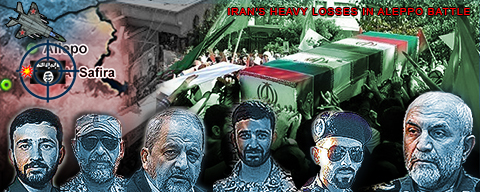
IranianFuneral_Kotere480t

The battle for Al-Safira, 20 km. south of Aleppo – and the key to its capture – will go down in Iran’s Revolutionary history as the most humiliating defeat its elite forces have sustained in all its 36 years. This week, Iran sent into battle outside its borders 2,000 of its best-trained, loyal and well-equipped combat troops, detached from six elite Revolutionary Guards Corps (IRGC) units.The battle at Al-Safira, fought with Russian air cover alongside Hizballah and Syrian army forces, was supposed to be the turning point in the Syrian civil war. Its objective was to break through Islamic State and Nusra Front defense lines around Al-Safira, and knock over the positions the Islamists had erected for blocking the roads from Aleppo and central Syria to Damascus, among them Route 5, the main highway. After that, they planned to advance on Aleppo.

Their offensive had the opposite result.

Fighters from ISIS and the Nusra Front stopped the Iranian and Syrian troops in their tracks and forced them to abandon the sections they held along the main transportation routes leading to Aleppo. So not only did the Iranian-led army fail to clear the way to this key city, but they were driven back by ISIS fighters, who took control of the 20-kilometer route from Al-Safira to Aleppo. The day ended with the jihadis in position to tighten the siege on both cities.

On Thursday, Oct. 29, ISIS followed up on its victory by seizing control of the eastern neighborhoods of Al-Safira and advancing towards the center of the city.

The losses sustained by the IRGC, which spearheaded the ground attack, were heavy, mostly in the fighting in the rural area south of Aleppo.

How could this happen to Tehran’s supposedly formidable forces?

Iran’s death toll in the battle for Aleppo may never be known, but the numbers of officers and enlisted men who died was so high and the shock effect so extreme that IRGC Deputy Commander, Gen. Hossein Salami had to call a live news conference on Iran’s state-run television Wednesday, Oct. 28, to explain why his country came to be involved in the Syrian war.

He depicted Syria as “the front line in the battle against Western forces, particularly the US… which is seeking to implement a destructive plan in the Arab world.” He then argued: “Had Iran not intervened, the chaos would have spread into Lebanon, Iraq and elsewhere.”

But DEBKAfile’s military sources point out that this explanation offered no answer to the main question troubling Iran’s leaders and the IRGC command: On what grounds can they continue to boast that Iran’s army is capable of destroying the US military within 10 days, and the IDF in one day, when Iran’s special forces, armored corps, urban warfare units and airborne brigades, backed by the Russian air force, not only failed to rout ISIS forces, but were humiliated into retreating from their strategic positions amid heavy losses?

DEBKAfile has obtained the list of the six elite Iranian brigades which sent units to the Al-Safira battle for Aleppo:

The Saberin brigade, a Special Operations unit established in 1992 to fight Kurdish and Arab guerillas with separatist aspirations. Most of its fighters are from Tehran,

The Fatemyoun brigade, consisting entirely of Afghan Shiites. Their regular duty was to guard the Tomb of Zeynab, a Shiite shrine in the suburbs of Damascus. But a month ago, the IRGC expanded the brigade to division strength of 15,000 fighters for front-line combat in Syria and Iraq.

Brigade 15 – or the Emam Hassan Mojtaba Brigade. Made up of fighters from central Iran, the brigade specializes in guerilla and urban warfare.

Independent brigade 83, or the Emam Jaafar Saydeq Brigade. This is an airborne unit whose fighters are rated as the toughest, most merciless and religiously motivated of all IRGC contingents. Not surprisingly, they come from Qom province, whose center, the city of Qom,  houses Iran’s clerical establishment and is the most important Shiite site after the holy cities of Najaf and Karbala in Iraq.

Brigade 33, or the Al-Mahdi Brigade. This is another airborne unit with extensive experience in guerrilla warfare, which is based in the city of Jahrom.

The Ahwaz Armored Brigade, or the Hazrat-Hojjat Brigade. Its fighters come from the largely Arab-speaking and constantly restive province of Khuzestan in southeastern Iran. The brigade was upgraded recently with advanced weapons systems for fighting in Syria, Iraq, or any other neighboring country.

The six Revolutionary Guards brigades were held up proudly as Iran’s finest fighting units, the invincible bulwark of the revolutionary Islamic regime in Tehran against the mightiest of its enemies. The vast gap between their performance and the ayatollahs’ fiery rhetoric is bound to redound on the authorities in Tehran which sent them into battle.

China: We’re Ready for War If US Continues to ‘Make a Fool of Itself’ in South China Sea

October 29, 2015

China: We’re Ready for War If US Continues to ‘Make a Fool of Itself’ in South China Sea America: Making friends everywhere it goes!

RI Staff

Source: China: We’re Ready for War If US Continues to ‘Make a Fool of Itself’ in South China Sea

America continues to make friends...
America continues to make friends…


As part of Obama’s ingenious “pivot to Asia”, Washington has decided to challenge Beijing’s territorial claims in the South China Sea. U.S. Defense Secretary Ash Carter confirmed on Tuesday that a U.S. warship “had passed within 12 miles of a Chinese artificial island.” Considering that China is ringed by U.S. naval bases, starting in Japan and snaking down to South Korea, it’s not difficult to imagine why China is “sort of upset” about these latest developments.

Although a top Chinese admiral announced today that Beijing was open to dialogue with the U.S. regarding the South China Sea, the Chinese government seems to be running out of patience. In response to the U.S. maneuvers, Beijing called the action illegal, summoned the U.S. Ambassador,  and then warned the U.S. not to “make a fool of itself”. Oh, and China is ready to take all necessary measures to protect its legitimate interests in the region. Watch this incredible video of Chinese foreign ministry spokesman Lu Kang slamming Washington:


American global hegemony is over. The sooner Washington accepts this, the better.

https://embed.theguardian.com/embed/video/world/video/2015/oct/27/china-warns-us-south-china-sea-warship-video


UNRWA Official Spoke at UK-Based Terrorist Group

October 29, 2015

Chris Gunness, spokesman for UNRWA, addressed a “charity” organization that the U.S. has declared a terror group that funnels money to Hamas.

By: Tzvi Ben-Gedalyahu

Published: October 29th, 2015

Source: The Jewish Press » » UNRWA Official Spoke at UK-Based Terrorist Group

UNRWA spokesman Chris Gunness.

UNRWA spokesman Chris Gunness.

“Incitement to Violence without Borders” has reached the British Parliament, where UNRWA spokesman Chris Gunness spoke to a “charity” organization that channels money to the Hamas terrorist party and army.

The U.S. government formally has declared the British-based Interpal “charity” group a terrorist organization because it helps Hamas keep its pockets full of cash.

The State Dept. was unable to answer a question posed at a press briefing this week if Gunness’ speaking to Interpal might be included in a possible investigation of UNRWA incitement, an issue that has been raised because of its employees’ hateful anti-Israel posts on social media.

State Dept. spokesman John Kirby said he would” take the question,” but he has not given back an answer.

The Washington Free Beacon asked for a clarification about Gunness’ speech and was told:

We have seen the reports on this event, though we did not attend. We understand that the UNRWA spokesperson attended an event at the British Parliament to benefit wounded Palestinian children, hosted by several of its members.

We have long made known our commitment to UNRWA’s absolutely essential work in helping Palestinian refugees—including many refugee children. And we have made clear our position that UNRWA must be able to work independently and free from bias.

Bias at the UNRWA? Gunness Biased, the same Gunness who has called the IDF “callous” for trying to stop Hamas missile attacks on half of Israel last summer and :who has blamed the “blockade” for what he declared is a rise in the mortality rate of infnats in Gaza?

And what did Gunness have to tell Interpol last week?

He talked about “little Mohammed,” whom he said was blended by an IDF artillery shell in the war against Hamas last summer. He also spoke about a “child who froze to death.” That is Israel’s fault, he said, because of the “slow pace of reconstruction,” although another reason just might be Hamas’s using construction material to build weapons factories and rockets.

Here is UNRWA’s response to the Free Beacon when asked about Gunness’ appearing at an organization that the United States has designated a terrorist group:

UNRWA Spokesman Chris Gunness spoke at an event in the UK Parliament sponsored and attended by British Members of Parliament about a project supported by a legally registered UK charity to help approximately 300 blind and visually impaired Palestinian children in Gaza in need of special assistance.

It did not say what the U.S. Treasury has to say about the British-based group:

Interpal, headquartered in the UK, has been a principal charity utilized to hide the flow of money to HAMAS. Reporting indicates it is the conduit through which money flows to Hamas from other charities, e.g., the Al Aqsa Foundation, and that it oversees the activities of other charities.

Florida Republican  Rep. Ileana Ros-Lehtinen this week proposed a law that would cut off U.S. funding to UNRWA  unless it document that its employees have no links with terrorist organizations and can certify that no employees of the organization have ties to terrorism or anti-Semitic incitement.

The Florida legislator said in a statement, according to the Free Beacon:

In response to the increased terror and violence in Israel, we must hold those who are responsible for inciting this violence accountable, and that includes UNRWA.

The U.S. can’t continue to send $400 million to UNRWA while ignoring the systemic and endemic anti-Israel, anti-Semitic bias and the blatant incitement to violence we see from its employees.

UNRWA employees and facilities are consistently tied to foreign terrorist organizations and a full accounting of the agency’s affiliations should be required before another dime is spent on this divisive organization.

Future US Foreign Policy: I Have a Dream

October 29, 2015

Future US Foreign Policy: I Have a Dream A four point sermon to aspiring US presidential hopefuls on how to avoid war and become partners with Russia

Edward Lozansky

Source: Future US Foreign Policy: I Have a Dream

As the presidential race enters its final one-year phase, all the candidates must have figured out by now what kind of foreign policy vision they can present to the American people to get their votes.

One sure strategy is to bash Obama for all the mess he’ll have left behind when his term is over. It is a huge mess indeed, and there is no point in recapitulating all the blunders he and his administration committed over the years.

The results are on public display.  Yes, it is always easier to criticize someone than to express alternative and better options; it is even more difficult to present the objectives that you intend to pursue after the victory, not just to fool the voters as politicians usually do.

For simplicity sake let us concentrate only on US–Russia policies; indeed, according to the Washington foreign policy establishment, it is Russia that is US enemy number one, worse even than international terrorism. The American people, however, have a different opinion. According to the recent WSJ/NBC poll, only 14 % said that Russia is an “immediate” military threat while 23% said Russia is not. This, despite the practically round-the-clock process of demonizing Russia and Putin in the mainstream media.

The remaining 60% of Americans do believe that Russia can be a potential threat in the future, but the question in the poll did not specify whose foreign policy, Russia’s or U.S., would be responsible for that.

Since it is more or less obvious that we cannot influence Russia’s policy, at least while Putin is in charge – and this may last until 2024, and there is no guarantee that his successor will be a softy – why not try to come up with a more sensible US policy? We must do it because the current one has obviously failed dramatically, and because Russia is indeed too important for US security, for in terms of its nuclear weapons potential and delivery systems it is the only superpower that matches America. With its veto power in the UN Security Council Russia can also undermine US influence on the world stage. There are many other reasons why forcing Russia into a geopolitical corner is a bad policy, but these two should be enough.

So what is the alternative? One does not have to look too hard to find the answer. The guy to turn to for advice is well known, and he is none other than Abraham Lincoln, the man who said: “I destroy my enemies when I make them my friends.”

Apparently Putin knows this expression better than Obama does, for he keeps saying that he wants to be America’s friend, so that the two countries might jointly cope with the world’s global challenges, including the fight against Islamic terrorism.

So far Obama has not shown any interest in accepting Putin’s continuous invitations but with the presidential campaign in full swing, and its attendant search for America’s future goals and overall direction, it is certainly of some use to sketch out America’s future foreign policy under a next president. So here are some points, a sort of fulcrum on which such a policy can rest.

Point one: avoidance of a global war or WWIII. For decades the world has been guided by the fear of MAD, or mutually assured destruction in a nuclear war but now that useful fear is dangerously waning. There is talk of a successful first nuclear strike – which is a suicidal nonsense: no one can be sure of taking out all of the enemy’s ICBMs, especially not submarine-based ones. Then there is an equally dangerous idea of building an impenetrable anti-missile defense (AMD) from behind which America could tell Russia what to do, or else. Suppose Russia does not obey US diktat – what is to be done then? Something like MAD2, which would close the original MAD loopholes, would serve us much better if avoidance of a global nuclear confrontation is deemed a first priority.

Point two: discontinuing the export of democracy through wars and “color revolutions.” It is too much like Trotsky’s export of the proletarian revolution or the Soviets’ aid to “national-democratic revolutions” in the former colonies, and it just does not work. Experiences in Afganistan, Iraq, Libya, Syria, and Ukraine shows some pretty horrific results of hundreds of thousands of deaths and wounded, millions of refugees plus huge chaos, devastation, and ruined economies.

Point three: choosing a humbler role for America as the world’s leader. Constantly proclaiming the indispensability of one’s nation and its readiness to send its troops to any part of the world to protect its interests sounds and looks pretty pathetic. Can anyone point out some recent successes of such policies? Do they bring us more security or friends around the world? Do Europeans enjoy hearing obscenities from a highly placed State Department official, or of Vice President Biden gloating over twisting the Europeans’ arms to impose sanctions on Russia? Even Polish leaders, while publicly talking of their country being America’s most loyal friends in Europe, are privately talking of the US in the most cynical and derogatory language full of expletives.

Point four: America also needs more foreign policy professionalism and less lying, hypocrisy and double standards. Of course, there is nothing in the Ten Commandments against lying per se, and it has been practiced times out of mind not only in diplomacy, yet it is wise to keep it to an unavoidable minimum, for there cannot be any civilized intercourse among nations without some measure of trust. And how can the world trust America, when it preaches democratic values – and is hand in glove with veritable antipodes of democracy like Saudi Arabia or Qatar.

At this time there are only two GOP contenders who are pledging to implement at least some of these points. They are Donald Trump and Rand Paul.

The rest of the crowd wants more of the same if not worse. Therefore, it would be pretty naïve to believe that change is coming.

It is, in fact, little more than a dream and a prayer.

Turkey threatens ‘whatever necessary’ to combat Kurdish autonomy ‘mindset’ in Syria

October 29, 2015

Turkey threatens ‘whatever necessary’ to combat Kurdish autonomy ‘mindset’ in Syria

Published time: 29 Oct, 2015 04:25

Source: Turkey threatens ‘whatever necessary’ to combat Kurdish autonomy ‘mindset’ in Syria — RT News

Threatening continued assaults on the Kurdish militia in Syria, the Turkish president has warned he will not request anyone’s permission to do whatever is necessary to prevent the spread of support for Kurdish autonomy, even if it requires bombing US-allied rebels.

In a clear message to dissuade Kurds from supporting the self-declared autonomous town of Tel Abyad near the Turkish border, President Tayyip Erdogan said that he will “do what is necessary,” including using force, to eradicate the potential source of separatism along its borders.

Tel Abyad, on the border with Turkey, was captured in June from Islamic State (IS, formerly ISIS/ISIL) by Kurdish People’s Protection Units (YPG) fighters with the help of American-led air strikes. Last week, a local council led by the Democratic Union Party (PYD) declared it part of the system of autonomous self-government established by the Kurds. Since the conflict in Syria broke out in 2011, Syrian Kurds have declared three autonomous zones, called “cantons,” across northern Syria, but deny that they are aiming to establish their own state.

Alarmed by Kurdish territorial gains, Turkey fears that the latest creation of autonomous Tel Abyad canton could stir separatism among its own Kurdish minority. YPG has been a key ally of the US in the fight against Islamic State in Syria, but Erdogan’s message sends out a clear sign that Turkey’s national interests supersedes those of the United States and NATO.

“We are determined to [combat] anything that threatens us along the Syrian border, inside or out,” Turkish President told Kanal 24 television station on Wednesday.

Turkish President Tayyip Erdogan © Yiannis Kourtoglou

“If the Kurds withdraw and don’t form a canton, there’s no problem. But if the mindset continues, then what is necessary will be done or we face serious problems,” Erdogan said.

The Turkish President also accused Washington of double standards and claimed that the PYD allegedly carried out ethnic cleansing of Arabs and Turkmen in Northern Syria, equating US support for the Kurdish militias to aiding terrorism.

“They don’t even accept the PYD as a terrorist organization. What kind of nonsense is this?” he said. “The West still has the mentality of ‘my terrorist is good, yours is bad,’” Erdogan said.

Turkey has for the past three decades been trying to end an insurgency by Kurdistan Workers Party (PKK) fighters. PKK is classified as a terrorist organization by the United States and European Union. Erdogan said 1,400 PKK militants were fighting alongside the YPG in Syria.

Ankara confirmed on Monday that it had already conducted two strikes on Kurdish forces in Syria as a “warning.”

“This was a warning. Pull yourself together,” Erdogan said. “If you try to do this elsewhere – Turkey doesn’t need permission from anyone – we will do what is necessary.”

Iraq ‘didn’t ask’ for US ground operations against ISIS

October 29, 2015

Iraq ‘didn’t ask’ for US ground operations against ISIS

Published time: 29 Oct, 2015 02:20 Edited time: 29 Oct, 2015 09:17

Source: Iraq ‘didn’t ask’ for US ground operations against ISIS — RT News

The Iraqi government never asked for and does not need any US involvement in ground operations against Islamic State terrorists. The eye-opening statement came only a day after the Pentagon promised its partner more ground support if it was required.

“This is an Iraqi affair and the government did not ask the US Department of Defense to be involved in direct operations,” spokesman Sa’ad al-Hadithi told NBC News. “We have enough soldiers on the ground.”

Hadithi made it clear that any involvement of US forces that stretches beyond their “train and advise” mission must be cleared with Baghdad – as mandated under international law.

Read more

United States Secretary of Defense Ash Carter prepares to testify at a Senate Armed Forces Committee hearing on

‘We won’t hold back’ from ground raids against ISIS – Carte

Thus far Iraq has only cleared a US air campaign over its territory against Islamic State (IS, formerly ISIS/ISIL). For now, Hadithi stressed, Iraq only needs US support in “arming and training [Iraqi] forces.” Around 3,300 US troops are involved in the mission in Iraq.

The statement by the Iraqi government follows a statement made by US Defense Secretary Ash Carter about America’s intent to step up US military activity in Iraq and Syria, where US forces have been conducting air raids against IS targets. Carter’s statement also comes just days after American forces participated in a raid to rescue IS hostages in Iraq.

The US will resort to “direct action on the ground” against ISIS both in Iraq and Syria, if needed, Carter said in a testimony before the Senate Armed Services committee on Tuesday.

“We won’t hold back from supporting capable partners in opportunistic attacks against ISIL, or conducting such missions directly whether by strikes from the air or direct action on the ground,” Carted stated.

The White House, however, stressed that the Obama administration has “no intention of long-term ground combat,” according to deputy press secretary Eric Schultz, but instead will stick to training, advising and assisting the Iraqi forces.

The recent attempt by Washington to produce the results of a year-long air campaign against IS comes as Russia continues its successful air-support for the Syrian army, which has been driving IS back from many of its strongholds.

In fact Moscow is coordinating its air strikes in Syria with a command center based in Baghdad, where all the intelligence is shared between the participating coalition partners – Russia, Iraq, Iran and Syria.

Reports earlier this month also indicated that Baghdad might eventually ask Moscow to conduct a similar air campaign over Iraq, a move that might tilt the military balance in the region, where the US has held a firm grip over a decade.

‘Unify Syria, Divide Israel’ Says Kerry in Major Middle East Policy Address

October 29, 2015

Kerry tells Israel it better accept the Two State Holy Grail or it will get more of the recent terrorism.

By: Lori Lowenthal Marcus Published:

October 29th, 2015

Source: The Jewish Press » » ‘Unify Syria, Divide Israel’ Says Kerry in Major Middle East Policy Address

U.S. Secretary of State John Kerry. Oct. 28, 2015.

U.S. Secretary of State John Kerry. Oct. 28, 2015.
Photo Credit: screen capture state.gov

U.S. Secretary of State John Kerry spoke about U.S. Policy Towards the Middle East on Wednesday, Oct. 28 at the Carnegie Endowment for International Peace.

Kerry touched on many topics during his hour-long talk, including the Nuclear Iran Deal, ISIS, the war in Syria and, of course, the Arab-Israeli conflict.

GENESIS OF ISIS

Kerry claimed that ISIS – which is apparently now to be known in U.S. Diplo-talk as Daesh – arose out of the chaos during the early days of the Syrian Revolution, when poor, disillusioned Syrians were protesting in the streets because they just wanted jobs and a future.

But Bassar al-Assad’s thugs, Kerry explained, beat up those young people. Then the parents of the young people went out in the streets to clash with Assad’s thugs, who in turn used bullets and bombs on the protesting parents.

“Having made peaceful change impossible, Assad made war inevitable,” Kerry said. And then Assad turned to Hezbollah for help, and then to Iran and Russia, and this exacerbated tensions between Sunni and Shiite communities, and this paved the way for Daesh.

Kerry made clear the U.S. is not pleased with Russia’s role so far in the conflict, because instead of fighting ISIS, Russian airstrikes have been targeting Assad’s enemies.

But Kerry is committed to a political solution to the crisis – he apparently sees ISIS and the Syrian conflict as the same battle – and believes there must and will be a political transition that sidelines Assad.

Kerry claims that all the participants in the conflict agree that “the status quo is untenable.” Sound familiar?

We all agree that we need to find a way to have a political solution, we all agree that a victory by Daesh or any other terrorist group absolutely has to be prevented. We all agree that it’s imperative to save the state of Syria, and the institutions on which it is built and to preserve a united and secular Syria.

Kerry called on the Russians to get with the program and allow a transition “that will unite the country and will enable this beleaguered country to rehabilitate itself, bring back its citizens, and live in peace.”

That’s all. Not asking much. Just stop the fighting, unite the country, have free and fair elections, and all will be good.

SYRIA MUST BE UNITED; ISRAEL MUST BE DIVIDED

In contrast to Kerry’s insistence that Syria – a factionalized country with various warring ethnic groups none of which want to be controlled by the other – be united, Kerry’s diktat for Israel is the opposite.

Although Israel has gained territory repeatedly as the result of wars waged against it by belligerent outsiders, and which since the fall of the Ottoman Empire has never been ruled by any other nations, the U.S. demands that Israel must be divided.

STATUS QUO ON TEMPLE MOUNT GOOD; STATUS QUO IN ISRAEL BAD

And Kerry continued to insist that the status quo must be maintained on the Temple Mount – a status quo which prevents Jews from moving their lips lest they be deemed praying – but the status quo in which Israel does its best to defend its citizens must be terminated.

When not pointedly referring to Har Habayit, Kerry insisted that “the current situation is simply not sustainable. President Obama has said it publicly many times, I’ve said it publicly and it is absolutely vital for Israel to take steps that empower Palestinian leaders to improve economic opportunities and the quality of life for their people on a day to day basis.”

Really? Israel has to empower the leaders of the terrorists so that economic opportunities and their quality of life is improved? The PA, one of the single largest recipients of international aid ever?

And, of course, there was the inevitable call for the Two State Holy Grail.

“A two state solution with strong security protection remains the only viable alternative. And for anybody who thinks otherwise, you can measure what unitary looks like by just looking at what’s been going on in the last weeks.”

Sounds like a threat, doesn’t it? You’ll just be getting more terrorism unless you hand over territory – not just any territory – but parts of Jersualem, including the Old City – to the Arabs. That’s what you’ll get and that’s what you’ll deserve.

Kerry also called on both Israeli Prime Minister Benjamin Netanyahu and leader of the PA Mahmoud Abbas to display “firm and creative leadership.” He specifically called on the Palestinian Arab leaders to “cease the incitement of violence and to offer something more than rhetoric.”

Abbas, apparently, was not listening.

ABBAS DEMANDS UNSC PROTECTION FROM ISRAEL

Meanwhile, just as Kerry continued repeating his mantra that Netanyahu and Abbas must do everything possible to cease the incitement, Abbas also gave a major policy address.

The leader of the Palestinian Authority, currently in the 11th year of his four year term, spoke before the United Nations Human Rights Council. In his speech, Abbas claimed that the PA needs the U.N.’s protection from Israel.

No joke.

After a month of grotesquely brutal attacks by Palestinian Arabs on innocent Israeli Jews, the leader of the PA was asking for protection from Israel. And no one laughed.

Abbas had sought the special session from the United Nations Human Rights Council. The UNSC convened specifically in response to that request, “a courtesy never previously shown to a United Nations observer state,” according to the New York Times.

Abbas urged the UNSC to establish “a special regime of international protection” for his people. Protection from themselves? Protection from their enduring propensity to destroy any opportunity for a good life for themselves and their progeny?  Protection while they stab Jews, so they can continue stabbing without interference from Jewish policemen or Jewish bystanders trying to prevent the slaughter?

Abbas wasn’t saying.

What he did say is that his people need protection, and they look to the U.N. to provide it.

Abbas was strongly condemned by Eviatar Manor, Israel’s ambassador to the U.N.

Manor said the address by Abbas was yet another example of incitement, and he also rebuked the UNSC for convening the “scandalous special meeting” which was used as a prop to further fan “the flames of conflict.”

But over at the State Department Daily Press Briefing, the spokesperson absolutely refused to condemn the speech by Abbas. Brad Klapper of the Associated Press asked State Dept. Spokesperson John Kirby whether he felt the “tenor of the speech was consistent with the kind of the approach you’re looking for from him right now:”

AP’S KLAPPER: Are you happy with the message? That would be the basic question.

MR KIRBY: I think what I would say, what we want to continue to see – what we want to see is words and deeds that do not do anything to escalate the tensions and actually can contribute to calm, and I think I’d leave it at that.
Two states or two standards?

Inside the Ring: Russian military flights over Iraq questioned

October 29, 2015

Inside the Ring: Russian military flights over Iraq questioned

– –

Wednesday, October 28, 2015

Source: Inside the Ring: Russian military flights over Iraq questioned – Washington Times

A Russian Su-24 bomber takes off on a night combat mission in Syria. (Russian Defense Ministry Press Service via Associated Press)

Iraq’s government has told the United States that it will not permit Russian military forces to conduct air and missile strikes inside the country. But Baghdad is allowing Russian military aircraft to overfly its territory to resupply its forces, despite a request from the United States to deny the flights.

Sen. Tom Cotton, Arkansas Republican, disclosed during a Senate Armed Services Committee hearing Tuesday that the U.S. government asked the governments of Bulgaria and Iraq to close their airspace to Russian aircraft several weeks before Moscow’s Syria military intervention.

Mr. Cotton suggested that Bulgaria agreed to deny the overflights but that Baghdad rejected the U.S. request. Both Defense Secretary Ashton Carter and Marine Corps. Gen. Joseph Dunford didn’t dispute that the diplomatic requests to deny Russian military supply flights were made, but he declined to detail the specifics.

“I would say it’s problematic for Russia to be resupplying its forces in Syria by flying through Iraq,” Mr. Cotton said during a Senate Armed Services Committee hearing Tuesday. “We should renew our request that they exclude Russian aircraft from their airspace. And our military should be ready to assist them in excluding Russian aircraft from their airspace.”

Gen. Dunford confirmed that Russian supply flights have passed through Iraq but said it was “not at the understanding of the Iraqi government.”

Iraq’s small F-16 force has limited capabilities to prevent intrusions of its airspace, the four-star general said.

During a visit to Iraq recently, Gen. Dunford said, he received assurances from Prime Minister Haider al-Abadi and other Iraqi leaders that Baghdad would not align with Russia in battling Islamic State militants.

“And I explained to them how difficult it would be for us to continue to provide support if the Russians were invited in to conduct airstrikes,” he said, “and I was assured at every level that that wouldn’t be the case.”

Russia conducted 59 airstrikes from Oct. 23 through Oct. 25 in northern Syria, according to the Russian Defense Ministry.

NSA: SNOWDEN LEAKS HELPED TERRORISTS

Hundreds of international terrorists have changed their electronic communications operating procedures and can no longer be tracked by National Security Agency electronic spies, the NSA’s deputy director disclosed this week.

NSA Deputy Director Rick Ledgett outlined the damage caused by former NSA contractor Edward Snowden in an interview with the BBC.

“We have kept track of what our targets have said about disclosures and what that means for them, and we’ve seen in the high hundreds of targets who have said, ‘Hey, we are vulnerable to these sorts of detection techniques and we need to change the way that we do that,’ and a number of them have, including several terrorist organizations and one in particular that had a mature operational plot directed against Western Europe and the U.S.,” Mr. Ledgett said, without elaborating.

“So we’ve actually seen them move away from our ability to do that as a result of those disclosures, as a direct result,” he said.

Mr. Ledgett, who headed the special NSA task force to deal with the Snowden disclosures of some 1.7 million secret NSA documents beginning in 2013, disputed claims that the former contractor was a whistleblower seeking to expose NSA wrongdoing.

The deputy director said public discussion of NSA surveillance is positive, but the way the debate came about is wrong.

“You hear claims that he was a whistleblower and that he tried to raise things. Those are just not true,” Mr. Ledgett said.

Mr. Snowden, who fled initially to Hong Kong and is currently under Russian government protection in Moscow, has asserted that the NSA is involved in illegal surveillance of Americans and is seeking to create an unrestricted secret police state. Those claims remain unproven since he provided documents to anti-secrecy and anti-surveillance advocates.

Critics say most of Mr. Snowden’s disclosures didn’t involve domestic U.S. electronic surveillance and that most of his documents disclosed by news outlets compromised sensitive methods used by the NSA to spy electronically.

Mr. Ledgett also told the news agency that the risk of foreign nations conducting cyberattacks is growing.

“If you are connected to the Internet, you are vulnerable to determined nation-state attackers,” he said. “The barrier to entry is going down and as everybody in the world becomes more connected with computers and information systems, the vulnerabilities are going up.”

The solution is to build better defenses and prepare to conduct offensive counter-cyberattacks.

The NSA’s No. 2 official also said the “jury is still out” on whether China will curb economic cyberespionage as agreed during the summit last month between President Obama and Chinese leader Xi Jinping. “In any big organization, when guidance is sent down, then sometimes it takes awhile to get to the working level,” he said.

Two years ago, Mr. Ledgett revealed that Mr. Snowden used a hacking method called “scraping” within classified intelligence websites to gather and steal secret information.

One damaging impact was Mr. Snowden’s release of NSA spying requirements that showed NSA’s interests and gaps including some 31,000 targets, among them China, Iran and Russia.

U.S. adversaries would gain “a road map of what we know, what we don’t know, and give them, implicitly, a way to protect their information from the U.S. intelligence community’s view,” Mr. Ledgett told the CBS program “60 Minutes” in December 2013.

PENTAGON PLAYS DOWN SOUTH CHINA SEA TRANSIT

The Pentagon and U.S. military sought to play down the long-anticipated freedom of navigation operation by the guided missile destroyer USS Lassen through the South China Sea on Tuesday in an apparent bid to avoid upsetting China.

Defense Secretary Ashton Carter at first refused to comment on the ship’s passage near the South China Sea’s Spratly island chain, but under sharp questioning from senators reluctantly confirmed that the warship passage at a Senate Armed Services Committee hearing Tuesday.

Committee Chairman John McCain, Arizona Republican, criticized Mr. Carter for not publicly commenting on the ship’s transit.

“Why would you not confirm or deny that that happened since all the details and the action happened? This is what frustrates members of this committee when it’s there in the media, saturating the media, and you won’t even tell us,” Mr. McCain said.

“I do understand your frustration, and that is to match it with my own frustration, which is that these are operations that we should be conducting normally,” Mr. Carter said.

Mr. McCain then stated: “But the American people should know about it. And we’re their representatives. And you refuse to even confirm or deny something that is all over the media and confirmed by everyone? And you come before this committee and say you won’t comment on it? Why?”

The defense secretary said he did not like to talk about military operations, but then added that “what you read in the newspaper is accurate, but I don’t want to say more than that, and I don’t want to say when or whether and how we operate anywhere in the world.”

China called the ship transit a military provocation and a challenge to Beijing’s sovereign maritime claims.

Ya’alon: US-Israeli dispute over Iran deal is over

October 29, 2015

Ya’alon: US-Israeli dispute over Iran deal is over Defense minister says with accord finalized, allies must put differences behind them and ‘look to the future’

By JTA

October 29, 2015, 1:46 am

Source: Ya’alon: US-Israeli dispute over Iran deal is over | The Times of Israel

Ashton Carter, left, and Moshe Ya'alon, right, at the National Defense University in Washington, DC on October 27, 2015. ( Alex Wong/Getty Images/AFP)

Ashton Carter, left, and Moshe Ya’alon, right, at the National Defense University in Washington, DC on October 27, 2015. ( Alex Wong/Getty Images/AFP)

Disputes between Israel and the US over the Iran nuclear deal are over, Defense Minister Moshe Ya’alon said Wednesday.

“The Iran deal is a given,” Ya’alon said at a news conference in Washington with his US counterpart Ash Carter. “Our disputes are over. And now we have to look to the future.”

Carter said the deal completed in July between Iran and six world powers removes Iran’s nuclear threat, calling it “just one source of uncertainty and risk.” He added that Iran must comply with the deal or face a military threat from the United States, the Defense Department’s Defense News reported.

“I’m under instructions from President Obama to make sure the military option remains intact,” Carter said.

Ya’alon conducted two days of meetings with Carter at the Pentagon this week.

The Israeli defense chief said the deal, known as the Joint Comprehensive Plan of Action, could keep Iran’s nuclear program at bay for as much as 15 years. After that, he said, “we will again be dealing with a potential military nuclear Iran. And we must be ready.”

Carter and Ya’alon told reporters that they discussed ways that Washington will support Israel’s enhanced security requirements due to unrest in the region.

Carter reaffirmed the US commitment to Israel’s security and Ya’alon said Israel has “no greater friend than the United States of America.”

In a joint appearance on Tuesday at Fort McNair, Carter reiterated Washington’s “iron clad” commitment to Israel’s qualitative military edge, and said it would continue to make advance capabilities available to Israel, such as the F-35 stealth fighter.

This week former Iranian president Hashemi Rafsanjani admitted that the the country’s nuclear program was started with the intent of building a nuclear weapon, Iranian dissidents said.

The reported comments by Rafsanjani to the state-run IRNA news agency would appear to mark the first time a top Iranian official — current or former — has said the country sought a nuclear weapon, in contravention of repeated assurances by the regime that its enrichment program is and always has been peaceful.

Rafsanjani said the program was begun while the country was at war with Iraq in the 1980s with the express consent and participation of Ayatollah Ali Khamenei, according to NCRI.

“Our basic doctrine was peaceful usage of the nuclear technology although we never abandoned the idea that if one day we are threatened and it is imperative, we would have the capability for going the other path [to nuclear weapon] as well,” Rafsanjani reportedly said.

Rafsanjani, 80, served as Iran’s president from 1989 to 1997 and remains influential in Iranian politics despite suffering setbacks in recent years. He is now considered a moderate close to the reformist camp.

He was barred from running in the 2013 presidential election but threw his support behind moderate cleric Hassan Rouhani, who eventually won.

Times of Israel staff and AFP contributed to this report.

Crazed US Senator Attacks Defense Secretary for not Planning War With Russia

October 28, 2015

Crazed US Senator Attacks Defense Secretary for not Planning War With Russia Depraved disciple of Mad John McCain just took crazy to a whole new level

Jay Vogt

Source: Crazed US Senator Attacks Defense Secretary for not Planning War With Russia

Crazy and crazier

If Mad John McCain is the most disgusting man in America (and he is), then certainly his snarling little sidekick from South Carolina Lindsey Graham is a strong second.

Many people remember Mad John’s infamous statement from early 2014 where he declared: ‘Look, Russia is just a gas station masquerading as a country’. The quip was unsurprising coming from McCain, as his hatred of Russia and all things Russian is the stuff of legend and very well known. His junior colleague’s hatred of Russia – every bit as fierce and raging as his elder’s – is less well known only because the man himself is less well known.

Graham, who is currently polling at 0% in his run for the presidency, is actually more than just a colleague, partner, or even friend of McCain. He is in many ways an extension of the Arizona senator himself. Graham’s hatred and rage is McCain’s hatred and rage; and his current run for the presidency is nothing more than the dying specter of McCain’s failed ambitions back in 2008.

This was put on display just last month when out on the campaign trail in Iowa a reporter gave Graham a chance to establish his anti-Russia bona fides to a small group of slack-jawed locals. After vowing to arm Ukraine and re-escalate an already de-escalated civil war there, the South Carolina senator explained how he would be a hands-on leader in dealing with the Russian president. ‘I’m going to lead by example. I would take natural gas that we own in abundance and I’d export it to Europe and I’d cut his legs out from under him – Putin – so he wouldn’t enjoy his monopoly’, said Graham. ‘Russia is a gas station masquerading. They are weak’.

It’s important to note that this statement was given a week or two before Putin cruelly sliced and diced the West at the UN General Assembly. As impressive as that tongue-lashing was, it was merely the preamble to a show of force in Syria, the impressiveness of which is not even denied by Russia’s NATO adversaries.

Exactly how much Putin’s impressive Syrian campaign has stoked Graham’s Russophobic rage over the past month is anyone’s guess, but a recent exchange between he, US General Joseph Dunford, and Defense Secretary Ash Carter, in which he brow beat the living hell out of both of them, suggests that it was much more than considerable.

The chilling exchange basically consisted of Graham grilling Carter and Dunford about not having a plan to fight alongside the US-backed ‘moderate’ forces, and then repeatedly interrupting the hapless pair as they tried to negotiate with the bald fury coming their way.

The seriousness of this exchange should not be lost on anyone. This was nothing short of a senior US Senator – who happens to be running for president – openly calling for war with Russia.

There is no other way to interpret it. His words are crystal clear. Everyone in the world knows that Russia is openly fighting in support of Assad; and here we see Lindsey Graham hammering these two defense officials because the US does not have plans to join anti-regime fighters to ‘take down Assad’. This is nothing short of war with Russia.

Video of this disturbing exchange follows here. While watching, just notice the rage and fury pulsating in this man. Pay attention to his tone, his eyes. Try to imagine what horrors this wretched individual would unleash on the world if he were to become commander-in-chief (which thankfully will never happen). This is McCainism. This is evil.