Archive for August 28, 2015

Iran Deal: A Potential Kiss Of Death For Liberalism In The Middle East’

August 28, 2015

Iran Deal: A Potential Kiss Of Death For Liberalism In The Middle East’, MEMRI, August 27, 2015

In a July 19, 2015 article on Al-Ahram’s English-language website titled “Iran Deal: A Potential Kiss of Death for Liberalism in the Middle East,”[1]Egyptian blogger and political commentator Nervana Mahmoud criticized the claim made, inter alia, by U.S. President Barack Obama and others in his administration, that the nuclear deal with Iran will strengthen moderate elements in that country.[2] Rather than promote liberals, she writes, the deal will only vindicate Iran’s current theocratic leadership by ending Iran’s isolation. It will also, she stresses, send a message to other authoritarian regimes in the region that the U.S. is likely to overlook their crackdown on dissidents, while encouraging Islamist movements to emulate Iran by embracing extremism.

Ms. Mahmoud goes on to accuse the Obama administration of promoting “illiberalism” by defining as moderate “any group, entity, or state willing to show pragmatism and cooperation with the United States, regardless of that state’s intolerant actions on the ground.”

24629Nervana Mahmoud (Image: Nervana1.org)

“For The Iranian Mullahs, The Nuclear Deal Is An Indirect Acknowledgment From The West That Their Anti-Modernity Model Is Viable And Successful”

“After 12 years of diplomatic proposals and 20 months of tough negotiations, theocratic Iran and world powers have reached a nuclear deal that, regardless of its potential advantages, is undoubtedly a victory for smart illiberalism and a potential kiss of death for the prospect of liberal, pluralistic democracies in the Middle East.

“Both illiberal Shi’a and Sunni Islamists and illiberal non-Islamist autocrats could receive an enormous boost from the deal.

“A few years ago, against all advice, I visited the Islamic Republic of Iran. To my surprise, I found a vibrant nation, with many liberal youth yearning for freedom and democracy. Those youth may now celebrate the lifting of sanctions and the end of isolation, but it is doubtful the nuclear deal will bridge the deep divide between them and their theocratic rulers.

“For the Iranian Mullahs, the nuclear deal is an indirect acknowledgment from the West that their anti-modernity model is viable and successful. U.S. President Barack Obama may be genuine in his hopes that Iran will abandon its ‘path of violence and rigid ideology’ following this ‘historic agreement,’ but his hopes may turn out to be no more than wishful thinking.

“The regime – now less isolated–has less incentive to couple its agreed abandonment of its nuclear program with an abandonment of what it sees as successful ideology than ever before.”Many commentators have pointed out that the deal could not have come at a worse time for the Arab world. With open sectarian tension in many Arab countries, a strong Islamic Iran will only inspire other political Islamic groups to try to match up to the Mullahs.

“Iran’s regional influence in Lebanon, Iraq, Syria, and Yemen will only prompt a counter-movement by forces that share an underlying belief in Islamism, but differ in its sectarian interpretation. Since 1979, Sunni Islamism has learned one important lesson from Iran: ‘Yes, we can’ -– a slogan the Islamists touted quietly, long before Obama uttered those words in 2008.

“Arab Islamists saw theocratic Iran as a perfect model for fulfilling their dream of ruling Muslim societies. The new nuclear deal will add two more lessons, and liberal democracy is not one of them– defiance and lobbying in Washington…

“Last Saturday, Ahrar Al-Sham, an Islamist Sunni insurgent group fighting in Syria, published an article in the Washington Post claiming to believe in ‘a moderate future for Syria.’ Charles Lister, a visiting fellow at Brookings, scrutinized their claim: ‘Ahrar Al-Sham has been one of the most consistent military allies of Al-Qaeda affiliate Jabhat Al-Nusra.’ The publication of the article in itself indicates how some people in the corridors of power in Washington are willing to buy Ahrar’s narrative.

“The implication for Syria could not be more serious. Syria will continue to be torn between two mutually exclusive Sunni versus Shi’a forces; many of them are radical, ruthless, and undemocratic. Somehow, the Obama administration seems to see no problem in embracing both…’However, tacitly embracing radical Shi’a militias’ fight against radical Sunni groups such as the Islamic State (ISIS), while pretending that other radicals such as Ahrar Al-Sham are moderate, does not seem to be a sound strategy.”

“It Is Dangerous For The U.S. To Empower Illiberalism In A Region That Suffers Mainly As A Consequence Of Its Illiberal Players”

“In Egypt, neither the removal of Hosni Mubarak nor the ousting of Muhammad Mursi has produced a liberal democracy. Moreover, a significant section of the Muslim Brotherhood, despite its antipathy to Shia Islamism, has started to view the Iranian model as the way forward to regain power.

“They wrongly attribute their failure to run the country during Morsi’s tenure to what they describe as their ‘reluctance to embrace revolutionary politics.’ The Mullahs’ violent ejection of their opponents in 1979 is seen as ‘a model.’ In addition, the Muslim Brotherhood and its supporters will continue to lobby in Washington, hoping that its projection of an Iranian–style defiance will convince the Obama Administration to exert pressure on the leadership in Cairo to change its posture toward the group.

“On the other hand, many among President Abdel Fattah El-Sisi’s supporters will use Iran as a pretext to justify more crackdown on opponents, and argue that world powers, which are willing to lift sanctions against the Iranian regime, despite 36 years of ruthless rule, have no moral ground on which to judge Egypt.

“In his speech in Cairo in 2009, President Obama advocated tolerance, respect for minorities, and religious freedom. He also said elections alone do not constitute a true democracy.

“Now, as Hisham Melhem, Bureau Chief of the Al Arabiya News Channel in Washington, has pointed out, ‘after almost six and a half years of trying to shape events in the Middle East, President Obama has very little to show for it except the nuclear deal with Iran.’ More alarmingly, the American president seems to have lowered the bar, and is now willing to accept a softer definition of moderation to include any group, entity, or state willing to show pragmatism and cooperation with the United States, regardless of that state’s intolerant actions on the ground.’

“There are intrinsic reasons behind the metastasizing sectarian and ethnic conflicts that followed the failed Arab awakening. It is unreasonable to expect the United States to ‘fix’ the region; however, it is dangerous for the U.S. to empower illiberalism in a region that suffers mainly as a consequence of its illiberal players. It would be a pity if President Obama went down in the history books as the man who fumbled with the West’s anti-illiberalism alarm button, and embraced the enemies of liberalism in the Middle East.”

_____________________

Endnotes:

[1] English.ahram.org.eg, July 19, 2015.

[2] See for example Obama’s interviews in Al-Sharq Al-Awsat (Aawsat.net, ,May13, 2015) and with National Public Radio (Npr.org, April 7, 2015).

Use Our Senatorial Nuclear Option to Stop Iran’s Radioactive Nuclear Option

August 28, 2015

Use Our Senatorial Nuclear Option to Stop Iran’s Radioactive Nuclear Option, National Review – Morning Jolt, Jim Geraghty, August 28, 2015 (via e-mail).

A simple proposal: To stop Iran’s nukes, use our own nuclear option. Scrap the filibuster, pass a resolution declaring the Iran deal a treaty that requires Senate authorization, introduce the text of the Iran deal, and vote it down.

Remember, Democrats got rid of the filibuster for nominations in 2013, arguing that GOP obstructionism was interfering with the president’s constitutional authority to make judicial appointments. The Constitution requires Senatorial consent to treaties. The administration claims the Iran deal isn’t a treaty because they think it has “become physically impossible“ to pass a treaty in the Senate.

Do you think Iran will honor its side of the agreement? Probably not, right?

Even if they do, do you think Iran will attempt to build a nuke quickly when the deal expires? Certainly, right?

Do you think that if Iran gets a nuke, they will use it? Pretty darn likely, right?

So, congressional Republicans . . . what are you willing to do to prevent a mushroom cloud either in the Middle East or closer to home?

Poof goes the Big Enchilada

August 28, 2015

Poof goes the Big Enchilada, Israel Hayom, David M. Weinberg, August 28, 2015

Just in case there was any doubt as to what U.S. President Barack Obama is up to, Professor Andrew Bacevich of Boston University has laid it out for us in a series of recent articles.

Obama’s nuclear deal with Iran is meant to reboot and redirect the entire vector of American Middle East policy: to retreat from Pax Americana and allow Iran to take its rightful place as a major regional power.

For decades, two tenets have informed U.S. policy in the Middle East. The first is that U.S. interests there are best served by the position of unquestioned American pre-eminence. The second is that military might holds the key to maintaining that dominant position. (In this context, Israel has been an important U.S. regional ally).

This approach is what Bacevich calls the “Big Enchilada” — the America-as-top-dog approach that Obama is seeking to overturn.

Obama rejects this notion, since he essentially views America’s preponderance in world affairs as arrogant and sinful. He feels that American “bullying” has brought about disastrous results.

Most telling was Obama’s infamous lament in 2010 about America as “a dominant military superpower, whether we like it or not.” In other words, he really doesn’t like it at all. No statement could be more revealing of Obama’s disgust for American global leadership.

In the context of the current deal with Iran, Obama has been equally clear as to how he expects this play out. If successfully implemented, the agreement that slows Iran’s nuclear program will also end Iran’s isolation. This will allow Tehran, over time, to become a “legitimate” and “extremely successful regional power” and a “powerhouse in the region.” These are Obama’s own words.

All this leads, of course, to American retreat — blessed retreat from Obama’s perspective — from the projection of power in the region. Replacing America will be a revanchist, greatly emboldened, anti-Semitic and genocidal (toward Israel), Islamic Republic of Iran. Poof goes the Big Enchilada.

Obama has been mostly dismissive of Iran’s “bad behavior,” as he flippantly calls it. He says that he “hopes to have conversations” with Iranian leadership that might lead someday to their “abiding by international norms and rules”; that he “hopes and believes” that Iranian “moderates” will leverage their country’s reintegration into the global economy as an opportunity to drive kinder, gentler and less revolutionary foreign policies.

Whether Obama himself believes such nonsense is moot. The rub is that Obama doesn’t view American behavior in the region over past decades as any more moral or legitimate than Iran’s behavior. Consequently, the main thing for him is the humbling and retreat of America.

What happens after that? Well, that will be some other president’s problem, and Israel can lump it.

It is against the backdrop of such unfounded expectations and dangerous strategic vision that Prime Minister Netanyahu is leading the fight against the Joint Comprehensive Plan of Action with Iran, otherwise known as the nuclear agreement.

Netanyahu understands that the nuclear agreement isn’t just about Iran’s nuclear program. It’s about American detente with Iran and a perilous rejigging of America’s global strategic posture. As such, Netanyahu’s main goal is to prevent American retreat from the region, to thwart any intensification of American rapprochement with Iran and to avert the inevitable corollary of this: the further downgrading of U.S.-Israel ties.

To do so, the Iran deal must be kept strategically disputed and politically fragile. Even if (or when) Obama steamrolls over Congress, the deal must remain controversial and questionable. It needs to become politically toxic.

American and European companies must know that investing in Iran is still a risky business. Iran must know that it is under extraordinary scrutiny, and that American opponents of the deal will jump at every opportunity to scuttle it if red lines are crossed. Space must be cleared for the rescinding or cancellation of the accord in the face of Iranian “bad behavior.” Obama’s successor should be under pressure to vigorously oppose Iranian hegemony in the region and to act more forthrightly than Obama to block Tehran’s nuclear program.

In fact, a climate must be created that will encourage the next U.S. administration to backtrack from the deal, to reassert and reinvigorate America’s traditional foreign policy approach, and to revitalize the U.S.-Israel relationship.

This explains why Netanyahu has rebuffed all attempts by dozens of well-meaning mediators to scale down his opposition to the deal and cut a compensatory deal with Obama. Aside from the fact that Obama never rewards his “friends” and has little to offer Israel of meaningful counterweight to this terrible deal, Netanyahu understands that far more is at stake. It’s the big enchilada.

In this regard, it’s worth considering the status of Obama’s “comprehensive plan of action” with Iran. It is not a formal treaty between the U.S. and Iran; it is not even a signed agreement with the P5+1. Rather, it is a set of multilateral “understandings.” Such understandings can and should be considered short-lived.

The Iran “agreement” should be thought of as no more authoritative or binding for future U.S. administrations than, say, the “Bush letter” to Prime Minister Ariel Sharon, in which President George W. Bush suggested recognition of settlement blocks. Obama has tossed this letter right out the window.

The Iran “agreement” should be thought of as no more authoritative or binding for future U.S. or Israeli administrations than, say, the “Clinton parameters” for Israeli-Palestinian peace that were outlined during President Bill Clinton’s final days in office. Netanyahu is correct to have dismissed these parameters as no longer relevant.

The Iran “agreement” should be thought of as no more authoritative or binding for future U.S. administrations than, say, the apparently ridiculous, secretive “side agreements” on inspections which the International Atomic Energy Agency has reached with Iran, with or without Obama administration review.

Presidential promises, letters, memos, agreements and understandings — especially when declared or imposed unilaterally — are transient things. They are valid and binding only for as long as the principal holds political power. In Obama’s case, that is another 510 days, and no longer.

Then, hopefully, America can snap back to solid, assertive foreign policy principles, and claw back to a position of responsible leadership against truly dangerous actors in the Middle East.

One Rocket a Month Since Hamas ‘Ceasefire’

August 28, 2015

One Rocket a Month Since Hamas ‘Ceasefire’ Figures show 12 rockets have hit Israeli sovereign territory 1 year since last summer’s ‘truce,’ many more fired but didn’t clear border. By Ari Yashar First Publish: 8/28/2015, 1:56 PM

Source: One Rocket a Month Since Hamas ‘Ceasefire’ – Defense/Security – News – Arutz Sheva

This Thursday marked a full year since a ceasefire was sealed between Israel and the Hamas terrorist organization last August 27, bringing Operation Protective Edge to a close – but the ceasefire has been anything but quiet.

Gaza terrorists marked a year since the end of Hamas’s third terror war seeking to destroy Israel by firing a rocket on Wednesday night, giving an ironic edge to the anniversary of the “ceasefire.” The IDF responded by hitting a Hamas weapons manufacturing site.

But Wednesday’s attack was far from the first Gazan breach of the ceasefire.

A review of official IDF and Israel Security Agency (ISA) figures released by Channel 2 on Friday shows that no less than 12 rockets have been fired into Israeli sovereign territory from Gaza since the truce.

That figure doesn’t include the many dozens of rockets fired at Israel that didn’t make it over the security border, falling short within Gaza. Just earlier this month alone three such rockets fell in Gaza, landing short of their mark.

Twelve rockets since the ceasefire works out to an average of one rocket a month hitting Israel since the ceasefire. No more than three months went by without a Gazan rocket striking Israeli territory; fortunately, no one was wounded in any of the ongoing rocket fire.

A breakdown of the rocket strikes by month shows that last September, just a month after the ceasefire, Gaza terrorists fired mortar rounds at Israel. The rocket fire returned in October, and after a quiet November another rocket was intercepted last December.

The first three months of 2015 were surprisingly quiet, but in April another rocket breached the ceasefire, and in May more rocket fire was recorded. Three rockets entering Israeli territory were shot down in June, and two rockets apiece fell in July and August.

Still better deterrence than the past

As noted, those figures do not include the many more rockets fired unsuccessfully at Israel which never made it over the border.

In response to the numerous breaches, the IDF struck 14 terror sites in Gaza since the end of the war in airstrikes, most of them Hamas terror facilities as the IDF holds the terror group responsible for all rocket attacks emanating from the coastal enclave that is under its de facto control.

However, a comparison to the last two Hamas terror wars against Israel shows that despite the many breaches, the IDF achieved an even greater deterrent affect that in the past with its successful campaign to crush Hamas’s rocket arsenals and its will to start another full-out war.

While 12 rockets have hit Israel since Operation Protective Edge, no less than 217 rockets hit Israel in the first year after 2008-2009 Operation Cast Lead, and a full 36 were fired after 2012 Operation Pillar of Defense.

Gadi Yarkoni, head of the Eshkol Regional Council, on Thursday responded to the rocket fire the night before and spoke about the ongoing detrimental affect the incessant rocket attacks are having on the local populace.

This cannot go on. We cannot allow this rocket fire to turn into a regular event. The Defense Minister and the Prime Minister must decide how to respond in order to prevent escalation of the situation,” said Yarkoni.

“Each time a rocket is fired it brings back bad memories. The government has to do something to prevent rocket fire, as well as put into place obstacles that will prevent Hamas from digging tunnels into Israel and attacking us from them.”

While Hamas has had its rocket arsenals buoyed up by Iranian and other foreign technology, an Israeli crackdown on smuggled weaponry and weapon materials together with an Egyptian siege on the Sinai border has led Hamas to turn increasingly to its domestic rocket production industry to create new missiles.

That domestic rocket development has seen Hamas fire many dozens of rockets into the Mediterranean Sea over the course of the last year as part of its rocket testing program.

Sen. Cotton to Visit Israel for More Ammunition against Iran Deal

August 28, 2015

He will arrive Sunday and will be “updated on strategic issues,” meaning Iran. By: Tzvi Ben-Gedalyahu Published: August 28th, 2015

Source: The Jewish Press » » Sen. Cotton to Visit Israel for More Ammunition against Iran Deal

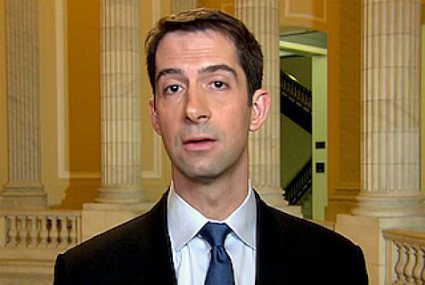
Arkansas Sen. Tom Cotton.

Sen. Tom Cotton, one of the loudest voices against the nuclear deal with Iran, will arrive in Israel on Sunday for a week-long visit that can be assumed is aimed at arming him with more ammunition to try to shoot down the nuclear Iran agreement in the Senate.

The Israel government announced:

U.S. Senator Tom Cotton (R-AR) will be visiting Israel from Sunday, August 30, to Saturday, September 5, 2015. During his trip to Israel, the Senator will be updated on strategic and diplomatic issues, as well as other major developments in the region.

Senator Cotton, in office as of January 2015, serves on the Armed Services, Intelligence, and Banking committees.

Updating him on “strategic and diplomatic issues” just before Congress returns from a summer recess with the Iran deal the number one item on the agenda means that Prime Minister Binyamin Netanyahu will send Sen. Cotton back with a suitcase full of arguments to try to win a veto-proof majority against the deal when it comes for a vote.

Sen. Cotton was behind the controversial letter that he and several senators sent to Iran to “inform” it that a nuclear deal would not be binding on the next president.

Earlier this month, he told Israeli reporters that the Obama administration has not made it clear to Iran that it could use force to prevent a nuclear-armed Iran. He then said that the U.S. Armed Forces could bomb Iran’s nuclear program “back to zero.”

Sen. Corker stated:

You can destroy facilities. I don’t think any military expert in the United States or elsewhere would say the U.S. military is not capable to setting Iran’s nuclear facilities back to day zero,

Can we eliminate it forever? No, because any advanced industrialized country can develop nuclear weapons in four to seven years, from zero. But we can set them back to day zero.

That is music to the ears of Prime Minister Netanyahu, and the timing of next week’s visit is not coincidental.

The Prime Minister and President Barack Obama are desperately campaigning against and for the deal, respectively.

Media continue to report more evidence that the deal is full of holes and that Iran already is has taken moves to get around it, such as the report Thursday that it has built an addition to its Parchin nuclear facility.

However, party loyalty usually is paramount to intellectual honesty. New York Democratic Sen. Charles Schumer came out against the deal and promptly faced a campaign prevent him from becoming the next party leader in the Senate to succeed retiring Sen. Harry Reid, who backs the deal.

Even Tennessee Republican Sen. Bob Corker admits that Obama will win. He told The Tennessean:

Understand that at this moment it looks very unlikely that we’ll have a veto-proof majority to disapprove, but I know we’re going to have a bipartisan majority that will disapprove.

The Hill reported that President Obama lacks only five out of 15 undecided Democratic senators to prevent a veto-proof majority against the agreement.

Evidence mounts that soon-to-be flush Iran already spurring new attacks on Israel

August 28, 2015

Evidence mounts that soon-to-be flush Iran already spurring new attacks on Israel, Fox News, August 27, 2015

An unsettling surge in terrorism by Iranian proxies has many Israelis convinced the release to Tehran of tens of billions of dollars in frozen funds is already putting the Jewish state in danger.

In recent days, rockets have rained down on Israel from Gaza in the south and the Golan Heights to the north, Israeli forces foiled a bomb plot at the tomb of biblical patriarch Joseph, and Gaza-based terrorist groups that also have a presence in the West Bank have openly appealed for aid on Iranian television. Israeli officials fear the terrorist activity is spiking as groups audition for funding from Tehran, which is set to receive the long-frozen funds as part of its deal to allow limited nuclear inspections. They say the international focus on Iran’s nuclear ambitions has left its more conventional methods of attacking regional adversaries unaddressed.

“The nuclear context is just one aspect of the negative Iranian activities in the region,” Emmanuel Nahshon, senior Israeli Foreign Ministry spokesman, told FoxNews.com. “We can see the demonstration of this on a daily basis in Syria, in Yemen, and in Iraq. We see it also when we see the [Iranian] support of Hezbollah and other groups who operate against Israel.”

Last month, National Security Adviser Susan Rice admitted that some of the money due to be released as part of the deal negotiated by the U.S. led P5+1 “would go to the Iranian military and could potentially be used for the kinds of bad behavior that we have seen in the region.”

Aside from the soon-to-be-released billions, Iran’s finances will also be strengthened by the easing of trade embargoes that have seen a horde of major international business – many from P5+1 countries – rushing to sign lucrative deals with the ayatollahs. Earlier this week, British Foreign Minister Philip Hammond scoffed at the fears of Israel and many Arab countries in the Middle East, saying the deal would “slowly rebuild their sense that Iran is not a threat to them.” Less than 24 hours later, the spokesman for Iran’s top parliament member said, “Our positions against [Israel] have not changed at all; Israel should be annihilated.”

If that remains Iran’s intention, terror groups Hezbollah, Hamas, and Palestinian Islamic Jihad are showing a renewed eagerness to continue as its proxies. Four rockets apparently fired by the PIJ from Syria into northern Israel last week – two into the Golan Heights and two more into the Upper Galilee – were the first such attacks since the start of Syria’s bloody civil war more than four years ago. Israel responded with targeted missile strikes, including one which hit a car killing “five or six PIJ terrorists.”

On Aug. 18, Iranian state TV broadcast images of a new, 2.5-mile tunnel leading from Gaza into Israel. Dug by the Fatah-linked terror group the Al Aqsa Martyrs Brigade, and seemingly competing with arch-rivals Hamas for a share of the imminently unfrozen Iranian funds, the terrorists made an unabashed appeal for more cash. In a segment translated by Palestinian Media Watch, the terror group’s representatives said, “This is why we are asking [for money]… especially [from] Iran, which is a known long-time supporter of the resistance and the Palestinian cause.”

On Tuesday, Israeli officials revealed that a joint Israeli internal security and military operation thwarted a potentially lethal bomb attack planned by the Islamic Jihad on visitors to Joseph’s Tomb in Shechem in the Palestinian-controlled West Bank, the resting place of the biblical figure revered by Jews, Christians and Muslims alike.

The pace of attacks, as well as the diversity of their perpetrators, has prompted speculation that terrorist groups are competing for Iranian funding, and trying to show they are capable of giving Tehran bang for its buck. The terrorist groups however operate on budgets that are tiny given the scale of Iran’s financing capability.

“The amount that Iran gives Hezbollah is not very much – around $200 million – not even 1 percent of Iran’s budget last year,” Meir Javedanfar, an Iranian-born Israeli expert on the region who writes at www.middleastanalyst.com, told FoxNews.com. “If you want to stop Iranian support of Hezbollah you would need to have inspectors on the ground in Syria and Lebanon, the most dangerous of places, checking Hezbollah’s arsenal, bank accounts, bases, and Syrian bases which Hezbollah uses. I don’t see any UN force, or anyone else volunteering to do that.”