Some content on this page was disabled on August 10, 2015 as a result of a DMCA takedown notice from Telegraph Media Group Limited. You can learn more about the DMCA here:
Archive for July 2015
US Navy prepared to ramp up Pacific presence to deter China
July 18, 2015Iran Extends Olive Branch to Muslim Countries
July 18, 2015Iran Extends Olive Branch to Muslim Countries Following Deal
Iran tells fellow Muslim countries it hopes nuclear deal would pave the way for more cooperation.
By Elad Benari, Canada
First Publish: 7/18/2015, 2:14 AM
via Iran Extends Olive Branch to Muslim Countries – Middle East – News – Arutz Sheva.
Iran, embarking on a diplomatic offensive in the wake of its nuclear deal with world powers, told fellow Muslim countries on Friday it hoped the accord could pave the way for more cooperation in the Middle East and internationally, Reuters reported.
The country’s Foreign Minister, Mohammad Javad Zarif, made the comment in a message to Islamic and Arab countries on the occasion of the Eid al-Fitr holiday at the end of the Muslim holy month of Ramadan, the ministry’s website said.
“By solving the artificial crisis about its nuclear program diplomatically, a new opportunity for regional and international cooperation has emerged,” Zarif said, according to Reuters.
The Iranian foreign minister will travel to Gulf countries at some point after the Eid holiday, Foreign Ministry Spokeswoman Marzieh Afkham told state news agency IRNA late on Thursday.
She said Iran was seriously determined to further expand ties with regional states and its neighbors, some of which include Sunni Muslim Gulf Arab states who accuse Shiite power Tehran of interfering in the Arab world.
The nuclear deal might be a tough sell for the Gulf states, which have voiced their opposition to the deal. The major Sunni states have warned that a final agreement could allow Shiite-dominated Iran, their regional rival, to keep the technologies needed to produce nuclear weapons.
Saudi Arabia’s Foreign Minister, Adel al-Jubeir, on Thursday warned Iran not to use the nuclear deal to pursue “adventures” in the Middle East, but rather use it to improve its own economy.
On Tuesday, after the deal was announced, the official Saudi news agency quoted unnamed officials in the kingdom as calling on Iran not to abuse funds that will follow from the deal to cause turmoil in the region.
And, even before the deal was signed, the United Arab Emirates said it would be seeking a written guarantee from the United States with regards to Iran “given its behavior in the region.”
According to Reuters, as part of the reaching out to other countries, Iranian President Hassan Rouhani on Friday also had a telephone conversation with his Turkish counterpart, Recep Tayyip Erdogan, and underlined that importance of the Vienna agreement for Tehran-Ankara relations.
Iran Deal: The Great Bamboozle Festival
July 18, 2015Iran Deal: The Great Bamboozle Festival, Gatestone Institute, Douglas Murray, July 18, 2015
(Would Chamberlain, in the context of British military weakness but in otherwise comparable circumstances, have made a similar “deal” with Hitler and declared “peace in our time?” — DM)
- A generous person might say that this is unimportant — that in Iran, chanting “Death to America” is like throat-clearing.
- Surely only an uncharitable person would wonder why Iran’s rulers are buying the technology they would need to repel any attack on their nuclear project at the same time as they are promising the Americans that they are not developing nuclear weaponry.
What exactly is it that the Obama administration thinks has changed about the leadership of Iran? Of all the questions which remain unanswered in the wake of the P5+1 deal with Iran, this one is perhaps the most unanswered of all.
There must, after all, be something that a Western leader sees when an attempt is made to “normalize” relations with a rogue regime — what Richard Nixon saw in the Chinese Communist Party that persuaded him that an unfreezing of relations was possible, or what Margaret Thatcher saw in the eyes of Mikhail Gorbachev, which persuaded her that here was a counterpart who could finally be trusted.
After all, the outward signs with Iran would seem to remain unpromising. Last Friday in Tehran, just as the P5+1 were wrapping up their deal with the Iranians, the streets of Iran were playing host to “Al-Quds Day.” This, in the Iranian calendar, is the day, inaugurated by the late Ayatollah Khomeini, when anti-Israel and anti-American activity come to the fore even more than usual. Encouraged by the regime, tens of thousands of Iranians march in the streets calling for the end of Israel and “Death to America”. Not only Israeli and American flags were burned — British flags were also torched, in a touching reminder that Iran is the only country that still believes Britain runs the world.
The latest in a long line of “moderate” Iranian leaders, President Hassan Rouhani, turned up at one of these parades himself to see the Israeli and American flags being burned. Did he intervene? Did he explain to the crowd that they had got the wrong memo — that America is now our friend and that they ought at least to concentrate their energies on the mass-burning of Stars of David? No, he took part as usual, and the crowds reacted as usual.
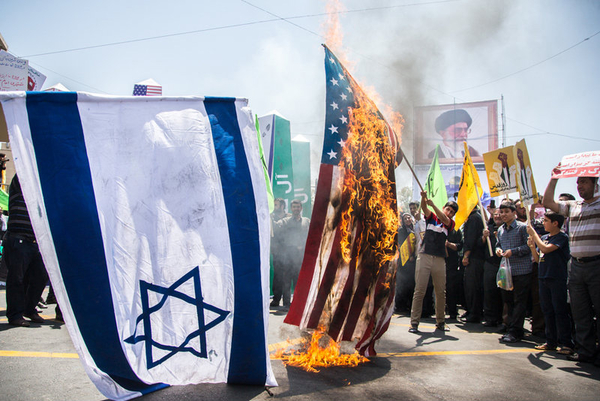 Participants in Tehran’s Quds Day rally burn U.S. and Israeli flags, on July 10, 2015. (Image source: ISNA)
It was the same just a few weeks ago, when the Iranian Parliament met to discuss the Vienna deal. On that occasion, after some authorized disputation, the Iranian Parliament broke up, with the representatives chanting “Death to America.”
A generous person might say that this is unimportant — that in Iran, chanting “Death to America” is like throat-clearing. This is just what we are being told — that these messages are “just for domestic consumption,” and don’t mean anything.
Putting aside what they say for a moment, what is it about Iran’s actions that have changed enough to persuade the U.S. government that the Iranian regime might be a regime in transition?
Internally there has been no let-up in the regime’s campaign of oppression against their own Iranian people: hanging people for a range of “crimes,” from being gay to being a poet found guilty of “blasphemy,” continue.
Iran has hanged more than a thousand of these internal “enemies” in the last eighteen months alone, as negotiators sat in Vienna thrashing out a deal. In the wider region, Iran remains the most voraciously ambitious, and perhaps the only successfully outgoing, regional power. In the years since the “Arab Spring” began, only Iran has been able significantly to extend its reach and grip in the region. It now has a vastly increased presence and influence in Yemen, Iraq, Syria and Lebanon. It continues to arm its terrorist proxies, including Hezbollah, which in turn continues to increase its build-up of rockets and other munitions on the northern border of Israel.
Iran has not released the four American hostages it continues to hold — Pastor Saeed Abedini, for the crime of converting to Christianity; Washington Post journalist Jason Rezian, on the patently nonsensical charges of espionage; former U.S. Marine Amir Mirza Hekmati, who went to Iran to visit his grandmother; and retired DEA and FBI agent Robert Levinson, who was abducted eight years ago and has not been heard from since early 2013. This, in spite of last-minute requests from Iran to lift a ban on conventional weapons, acceded to by the members of the P5+1, wasting yet another abandoned opportunity actually to get something in return for their total surrender.
From the outside, it would seem that very little has changed in the rhetoric of Iran and very little has changed in the regime’s behavior. That is why the mystery of what change the U.S. administration and its partners see in the eyes of the Ayatollahs is so doubly curious.
Because the nature of the deal makes it exceptionally important that there is some change. In the next decade, in exchange for the supposed “managed inspections” of limited Iranian sites, the Ayatollas are going to enjoy a trade explosion with a cash bonanza of $140 billion unfrozen assets, just to start them off. Throughout that same decade, there will be a lifting of restrictions on — among other things — the sale and purchase by Iran of conventional arms and munitions. Iran will finally be able to purchase the long-awaited anti-aircraft system that the Russians (also of course present at the table in Vienna) want to sell them. This system — among the most advanced surface-to-air missile systems — will be able to shoot down any American, Israeli or other jets that might ever come to destroy Iran’s nuclear project. And surely only an uncharitable person would wonder why Iran’s rulers are buying the technology they would need to repel any attack on their nuclear project at the same time as they are promising the Americans that they are not developing nuclear weaponry.
And it is even more important that the signs of hope located by the U.S. administration are correct, because after all, barring an internal uprising — which the Vienna deal makes more unlikely than ever (having strengthened the diplomatic and financial hand of the regime) — it is safe to say that over the next decade and beyond the Mullahs will remain in charge in Iran.
In the U.S., Germany, France and Britain, by contrast, who knows who will be in charge? In Britain, the Labour party may have romped to victory with, at its head, Jeremy Corbyn MP (currently Labour leadership contender) — a man who has openly and repeatedly praised Hamas and Hezbollah as his “friends.” That would certainly change the dynamics.
But put aside such a potentially unlikely situation and assume that Britain and America simply do politics as usual. In ten years, there will have been four U.S. governments overseeing the implementation of this deal and scrutinizing the inspections-compliance of the Iranian regime.
In the UK, there will have been at least two new governments. Who is to say that all these different governments — of whatever party or political stripe — will pay the same attention, know what to look out for, and feel as robust about totally unenforceable “snapback sanctions” and other details of the implementation of this deal as the signatories to the deal appear to expect? Is it possible that the Iranians actually know this?
Perhaps, after all, there is something in the eyes of the Ayatollahs. Maybe US Secretary of State John Kerry and President Barack Obama really have looked into the Iranian leaders’ eyes and seen a smile. But whether it is for the reason they appear to believe is, of course, quite another matter.
Despite Iran deal, Israeli unity government said unlikely | The Times of Israel
July 18, 2015Despite Iran deal, Israeli unity government said unlikely | The Times of Israel.
Talks between Likud, Zionist Union falter over policy, ministerial posts, Channel 2 reports
July 17, 2015, 5:47 pm

Prime Minister Benjamin Netanyahu shakes hands with Zionist Union leader Isaac Herzog during the opening session of the Knesset on March 31, 2015. (Nati Shohat/Flash90)
A unity government in which the Zionist Union party joins Benjamin Netanyahu’s narrow Likud-led coalition is looking increasingly unlikely, Channel 2 reported Friday, citing unnamed political sources.
According to the sources, both the prime minister and Zionist Union leader Isaac Herzog were amenable in principle to a unity government, in part because of their shared opposition to the new world powers’ nuclear deal with Iran, but differences arose over diplomatic policy and the issue of which ministerial posts the Zionist Union would receive.
Furthermore, both Netanyahu and Herzog were aware of a large faction within the Zionist Union, headed by senior MKs Tzipi Livni and Shelly Yachimovich, which is opposed to such a move, the report said.
Both Likud and Zionist Union officials were quoted by the Haaretz daily on Thursday as saying that President Reuven Rivlin has been mediating between the two party leaders over the formation of a unity government. A Likud source told Haaretz that the Iranian nuclear deal created a renewed urgency for such a government.
The Likud source said that if Herzog were to join the coalition, Netanyahu would give Zionist Union both the Foreign Ministry, which currently has no minister, and Defense Ministry, headed by former IDF chief Moshe Ya’alon of the Likud party. The Haaretz report maintained that Herzog had initially refused to join if the Jewish Home party remained a coalition partner, but later dropped that demand.
Herzog on Wednesday rejected rumors of an impending unity government as “utter nonsense.” Meanwhile, a senior Zionist Union source maintained that the talks were simply procedural, and that there was “nothing to them.”
Herzog announced Wednesday that he would go to the US to lobby for a compensation package to ensure Israel’s military edge in the region, in the wake of Tuesday’s Iran nuclear deal.
US nuclear negotiator Wendy Sherman said Thursday that the administration has offered to discuss upgrading its defense assistance to Israel but was rebuffed by Netanyahu. “The prime minister was not ready to have that discussion yet,” Sherman said.
Herzog’s trip reflects the broad opposition to the deal in Israel, where most politicians fear it will fail to stop Iran from developing nuclear weapons while strengthening the Islamic Republic’s support for some of Israel’s fiercest foes.
In a rare show of cooperation, Herzog had announced earlier Wednesday that he would work with Netanyahu’s ruling coalition to thwart the deal. In a late-night meeting between the political rivals Tuesday, Netanyahu updated Herzog on the security implications of the deal and emphasized the need for the opposition and coalition to form a united front in presenting the dangers to Israel posed by the agreement.
Khamenei vs. Rouhani: Projecting Very Different Views on the Nuclear Deal
July 18, 2015Khamenei vs. Rouhani: Projecting Very Different Views on the Nuclear Deal, World Affairs Journal, Mehdi Khalaji, July 16, 2015
(If Khamenei reneges on the deal, it will likely be impossible to “snap back” the sanctions. With improved Russian rockets, an attack on Iran’s nuclear facilities will be much more difficult.– DM)
In the United States, the same political body that was in charge of negotiating with Iran is also in charge of implementing the agreement. But in Iran, the president and his negotiators have little authority over foreign policy, the nuclear program, or military activities.
If [Khamenei] decides to stop implementing the deal in the next year or so, he would likely blame the West or the negotiating team for cutting such a deal, as he did in 2003 and 2004. His initial reaction to the new agreement has already sent discouraging signals about Iran’s willingness to comply with its commitments in the long term.
****************
The Supreme Leader’s initial reaction has sent discouraging signals about Iran’s willingness to comply with its commitments in the long term.
As expected, Ayatollah Ali Khamenei’s reaction to the nuclear deal was utterly different from that of President Hassan Rouhani. Right after the agreement was announced on July 14, Rouhani appeared on state television and praised the outcome. Yet when he and other officials visited Khamenei’s home a few hours later, the Supreme Leader did not say anything about the deal apart from a few lines thanking the negotiators. This reticence signaled to hardliners that they should increase their attacks on the agreement.
On July 15, in order to protect himself against these critics, Rouhani told the cabinet that Khamenei was “carefully following up” on the details of the final negotiations and “had meticulous supervision” over the process, to the point where the Supreme Leader “truly undertook much heavier responsibility in this regard” than any other official. But even this did not help him much. On July 14, Rouhani sent Khamenei a letter reporting on the deal’s results, but the Supreme Leader delayed his response by a day in order to show his lack of excitement about it. The letter thanked Khamenei for his “intelligent guidance and perpetual and explicit support to the negotiating team,” who “could successfully implement all policies determined by the Supreme Leader and respect redlines set” by him. Khamenei’s delayed answer — hardly a third as long as the president’s letter — avoided any wording that might indicate his total satisfaction with the accord, his direct role in the negotiations, or his responsibility for the deal. Instead he wrote, “The text needs to be studied carefully and go through the predicted legal process. Then, if it is approved, it needs to be protected against potential violations of the deal by the other party.”
Khamenei also failed to mention who should approve the deal. Rouhani’s team and the hardliners are currently in the midst of a hot dispute about whether that responsibility lies with the Majlis or the Supreme National Security Council. The hardliners insist on parliament, arguing that all international agreements should be adopted by the legislative branch of the government. Yet Rouhani’s team says that only the Supreme Council should review and endorse it. Not coincidentally, the president is the titular head of that council.
SHARP HARDLINER CRITICISM
On July 16, hardliner website Raja News published the third part of an article series titled “Some Aspects of the Deal Which Should Remain Unveiled,” by Ali Akbar Taheri. The article explains how the final deal reached by Rouhani’s negotiating team crosses six different redlines previously set by the Supreme Leader:
- Long-term limitations on the nuclear program. Khamenei has said that Iran should not agree to ten-year limitations because “ten years is a lifetime.” According to the article, however, the signed agreement contains at least fourteen Iranian commitments lasting ten or more years (e.g., a twenty-five-year limit on inspections and surveillance over enrichment of mined uranium; a fifteen-year ban on uranium enrichment at the Fordow facility).
- Unconventional inspections and access to military facilities. Khamenei has explicitly rejected such measures, but the final agreement allows the International Atomic Energy Agency (IAEA) to conduct surveillance in all factories that enrich mined uranium, among other things. The agency can also ask to inspect military facilities such as Parchin if they deem it necessary.
- Limitations on enrichment at Fordow. Khamenei has opposed any such restrictions at the mountain facility, but the final agreement contains several.
- Delayed lifting of some sanctions. Khamenei previously insisted that all sanctions be rescinded as soon as the deal is signed, but the agreement indicates that some U.S. congressional sanctions and EU sanctions will not be lifted right away, if at all.
- IAEA conditionality. Khamenei has often expressed his distrust of the IAEA and declared that sanctions relief should not be conditioned on Iran’s implementation of the deal. Yet UN sanctions will not be lifted until the IAEA verifies that Tehran has complied with the agreement’s terms.
- Limits on centrifuge research. Khamenei has said that no restrictions should be placed on Iran’s nuclear research for the duration of the deal. Yet the agreement includes a ten-year limit on enrichment R&D related to the IR-4, IR-5, IR-6, and IR-8 centrifuges, among other things.
The article also downplays Rouhani’s claim about lifting sanctions related to weapons, noting that “these sanctions would be replaced by limits [imposed on Iran’s weapons trade]…[E]very missile that is able to carry a nuclear warhead would be limited, all Shahab missiles and satellite carriers and so on.” In addition, the article claims that Russian foreign minister Sergei Lavrov said the following: “Russia and China wanted weapons sanctions to be lifted, but despite our support the Iranian team itself agreed to continuation of the sanctions for the next five years!”
On July 16, at an event called “The Beginning of the Math Class” (a sarcastic title indicating that the time of verification has begun), hardline analyst Fouad Izadi criticized the deal from a different angle: “If the U.S. Congress rejects the agreement, America would not be bound to implement it, but if Iran implements the agreement, it will lose all leverage.” Izadi, who is close to the Islamic Revolutionary Guard Corps, went on to claim that in the case of disagreement between Iran and the P5+1, “the arbiter is the UN Security Council,” which means that the United States and other P5+1 members would essentially become the arbiters of their own dispute. “If Iran gets accused of violating the agreement, [these countries] can issue a resolution against it,” he said, but if the United States or another party is so accused, “the Security Council cannot issue a resolution because one of them could just veto it.” He also pointed out that the Majlis should approve the agreement, and that it should condition Iran’s implementation of the deal on U.S. congressional approval, explaining that “the U.S. president will not be in office in nineteen months, and after him the U.S. administration would not be bound by the agreement if Congress disapproves it.”
Also on July 16, the hardline newspaper Kayhan claimed that the largely insignificant financial reaction to the nuclear deal — i.e., no sharp changes in the stock market or exchange rate — shocked those who have been “overexcited” about the negotiations. “People expected the foreign currency rate to drop and the national currency value to go up,” said one article, “and now they ask why the opposite has happened.”
CONCLUSION
In the United States, the same political body that was in charge of negotiating with Iran is also in charge of implementing the agreement. But in Iran, the president and his negotiators have little authority over foreign policy, the nuclear program, or military activities. Instead, those sectors are under the purview of Supreme Leader Khamenei, who is usually reluctant to take any public responsibility for major decisions. Furthermore, he has repeatedly expressed his distrust toward Americans, the West, the UN, and the IAEA. And while he has more or less supported Iran’s negotiators in his public statements, he has clearly sought to distance himself from them as well. If he decides to stop implementing the deal in the next year or so, he would likely blame the West or the negotiating team for cutting such a deal, as he did in 2003 and 2004. His initial reaction to the new agreement has already sent discouraging signals about Iran’s willingness to comply with its commitments in the long term.
Camel Herder Has a Lot of Horse Sense
July 17, 2015Saudi Prince Says Iran Deal Worse Than North Korea Nuclear Agreement
By Algemeiner Staff July 17, 2015 12:05 pm

Even Prince Bandar sees the light.(Source: Wikipedia)
The nuclear deal with Iran will have worse consequences than the failed agreement with North Korea, warned Saudi Prince and former ambassador to the U.S. Bandar bin Sultan on Thursday.
President Barack Obama accepted what he knew was a bad deal because, ideologically, he felt like it was the right thing to do, according to Bandar. The U.S. president ignored the intelligence and counsel of tradition American allies in the Mideast, like Israel, which said the Iran deal would invite terrorism throughout the region, or worse, spark an all-out war.
Former President Bill Clinton never would have signed the North Korea nuclear agreement if he had had the kind of evidence Obama has now against Iran, Bandar said.
If the Iran deal collapses and the country goes for the bomb, he said, the consequences could be much worse than North Korea.
Meanwhile, the Christian Science Monitor reported that Saudi Arabia would intensify efforts to confront Iran through its proxies and allies in Yemen and Syria before the country gets windfall cash from lifted sanctions.
According to military officials cited in the report, the Saudis are weighing a ground campaign in Yemen followed by a shift in attention to Sunni-led airstrikes in Syria to provide air cover for the Free Syrian Army as it battles Iranian-backed Syrian President Bashar Assad, whose forces have been bolstered by Lebanese Hezbollah.
Israel signals may ask for more US military aid over Iran deal
July 17, 2015Israel signals may ask for more US military aid over Iran deal
07/17/2015 23:12
via Israel signals may ask for more US military aid over Iran deal – Israel News – Jerusalem Post.
Israel gets $3 billion in annual military aid from Washington under a package due to expire in 2017.
Navy soldiers from the “Snapir” Unit train for any encounter on the high seas. (photo credit:IDF SPOKESPERSON’S UNIT)
Israel signaled on Friday that it would ask the United States for increased military aid to counter any threats that may arise as result of the international agreement on Iran’s nuclear program.
Israel gets $3 billion in annual military aid from Washington under a package due to expire in 2017 and has in recent years secured hundreds of millions of dollars in additional US funding for missile defense.
Israel and the United States had been in talks on future grants but Prime Minister Benjamin Netanyahu suspended them in the run-up to Tuesday’s agreement which curtailed Iran’s nuclear projects, which he condemned as insufficient.
Netanyahu plans to lobby the US Congress not to approve the nuclear deal.
But Defense Minister Moshe Ya’alon on Friday appeared to regard congressional ratification as a foregone conclusion and described the deferral of aid discussions with Washington as an opportunity to assess the ramifications of the agreement.
“We talk about the American defense aid, it is clear that the situation here has changed and must be studied,” Ya’alon told Israel’s Channel 2 TV.
Ya’alon said Tehran’s economic gains from a lifting of Western sanctions could boost Iranian-backed guerrillas in Lebanon and the Palestinian territories. It could also lead to an arms race with Arab states unfriendly to Israel, he said.
“We will ultimately, of course, have to go and talk about the trade-offs that Israel has coming to it in order to preserve a qualitative edge,” he said, referring to Israel’s military superiority in the Middle East.
This would not be next week, when US Defense Secretary Ashton Carter visits Israel, he said.
“It will be in several more months, certainly, after the (Iran) deal is approved and studied.”
Before Netanyahu’s suspension of aid talks, the two sides were close to a new package of grants starting in 2017 and worth $3.6 billion-$3.7 billion. US and Israeli officials said.
That sum would likely rise once talks resumed, they said.
In the interim, defense-related contacts between the allies have not ceased completely.
Yedioth Ahronoth newspaper said Defense Ministry director-general Dan Harel was in the United States this week to assess the Obama administration’s planned military aid to Gulf Arab states and its impact on the Israeli “qualitative edge.”
An Israeli official confirmed Harel’s US trip to Reuters but did not comment on Yedioth‘s account of what was discussed.
Isaac Herzog, center-left leader of Israel’s parliamentary opposition, closed ranks with Netanyahu against the Iran nuclear deal and said he would go to Washington “to work on advancing a package of security measures befitting the new situation.”
Iran deal will set off nuclear, conventional arms race, warns top Israeli official
July 17, 2015Iran deal will set off nuclear, conventional arms race, warns top Israeli official
The terms Iran demanded prove that it seeks the bomb, says Ram Ben Barak: Why else insist on R&D rights for fast centrifuges, and reject instant inspections?
By Times of Israel staff July 17, 2015, 10:46 pm

Ram Ben Barak (screen capture: Channel 2)
he new nuclear deal with Iran gives Tehran full legitimacy to engage in further atomic work and will set off a regional nuclear and conventional arms race, a senior Israeli official warned on Friday.
Ram Ben Barak said Iran was plainly still determined to break out to the bomb at a time of its choosing, and that its insistence in the deal on preventing inspectors from gaining instant access to suspect facilities, and on winning the right to continue R&D on fast-enrichment centrifuges, demonstrated that the regime remains committed to attaining nuclear weapons.
Ben Barak, who is director general of the Strategic Affairs Ministry and a leading candidate to be the next head of Israel’s Mossad spy agency, told Channel 10 that the 10-year deal between the US-led P5+1 world powers and Iran signed Tuesday, which is aimed at curbing Tehran’s nuclear ambitions in exchange for lifting harsh international sanctions, is “very bad.”
Ben Barak is one of three candidates vying for the coveted position of Mossad chief, contending with current National Security Council chair Yossi Cohen and an unnamed deputy to current Mossad chief Tamir Pardo. Pardo is slated to step down in January 2016.
“This is a very bad deal,” he told Channel 10, “mainly because it gives Iran legitimacy to engage in nuclear work. Also, in 10 years from now, Iran will be able to enrich uranium to whatever grade it wants and however much it wants, without any limitations.”
Iranian Supreme Leader Ayatollah Ali Khamenei, he said, realized in 2013 that the sanctions were becoming a real threat to his rule and abruptly changed tack, allowing the relatively moderate Hassan Rouhani to run for president, and win.
“The charm offensive began and the Iranians effectively led the world powers to negotiations after which they found themselves exactly where they wanted to be,” Ben-Barak said.
“They’ve reached a point [thanks to this deal] where they can decide the time and place to break out to the [nuclear] bomb,” he went on, outlining the flaws inherent in the deal, including the powers’ major concessions on the inspections mechanism — which gives Iran 24 days to prepare for an inspection at a given site — and the process of the easing of sanctions.
He said the very nature of the problematic clauses in the accord, and Iran’s insistence on forcing the world powers to compromise over them, underline that the Iranians “want to get to the bomb at the moment of their choosing.”
“All the problematic elements in the deal show that the Iranians are interested in reaching breakout capacity. If they really had no intention to secretly develop their program, they wouldn’t have had to insist [during negotiations] on this issue, which threatened to blow up the talks: In the end, the Americans conceded and the Iranians have 24 days to prepare for inspections, Ben Barak said, instead of the 24 hours originally demanded by the world powers.
Similarly, Iran’s insistence on the right to continue R&D and testing of the still-in-development IR-8 centrifuges, which can enrich uranium 20 times faster than the current IR-1s, underlined the regime’s unchanged ambition to attain nuclear weapons, said Ben Barak. There would be no need for the IR-8s if, as Iran claims, they only seek to enrich uranium to low levels, “for peaceful purposes,” he said. “But if you want to set up a secret facility, he said, in order to work toward the bomb, “it has to be small.” Fewer, faster centrifuges would therefore be necessary. “So you see that their intentions are not exactly pure,” he said dryly.

The prospective Mossad candidate described the world powers’ behavior in the negotiations as too conciliatory and problematic.
“There were two sides [in these negotiations]. One side came to the table after suffering from crippling sanctions — you can say they came on their knees to the negotiating table. The other side, the world powers, came to the table with many strengths. By the end of it, Iran got everything it wanted and the powers conceded on all their red lines,” he charged.
“The deal will set off a nuclear arms race and a conventional arms race,” he warned.
When asked what the alternative was, a question the US has challenged Israel to answer, Ben-Barak said the other option “was and remains engaging in negotiations that lead to a better outcome.”
Asked whether Israel still has the military means to thwart Iran, he said, “Israel is a very strong state. It can do almost anything it wants. It has the capabilities. Whether it uses them or not is a decision for the political echelons.”
The Israeli official was echoing some of the sentiments expressed by Prime Minister Benjamin Netanyahu in the wake of the deal. Netanyahu has been a vocal opponent of the negotiations with Iran and the accord itself, charging that the agreement leaves Iran a nuclear threshold state and accusing the world powers of making far-reaching concessions that endanger the State of Israel.
Under the deal signed between the world powers and Iran Tuesday, international sanctions will gradually be lifted while Iran adheres to multi-year restrictions on enrichment and nuclear research and development. Tehran will also submit to an international inspections mechanism, with 24 days’ notice. The deal also sets out a so-called “snapback” mechanism to put the old sanctions back in place. It establishes a joint commission which would examine any complaints if world powers feel Iran has not met its commitments under the accord.
The United Nations Security Council is expected to endorse the 10-year deal next Monday.
Earlier this month, Ben Barak warned that a nuclear deal with Iran would empower it to take over the Middle East.
He said the lifting of sanctions would give Tehran “an ocean of money,” allowing it to buy influence across the Middle East and “advance to a position where no one will be able to threaten it and it will acquire control wherever it pleases.”
Ben Barak noted that there is “almost no area in the Middle East today where Iran remains uninvolved: Iraq, where Iranian interests are in line with US interests, Lebanon, where Hezbollah is effectively an Iranian division, and Yemen, which was mostly conquered by Iran.”
Meet The Architect of Appeasement
July 17, 2015By By Ed Lasky and Thomas Lifson October 25, 2014 Via The American Thinker

Queen of Pain.(Source: Wikipedia)
(Oh-My-Goodness! – LS)
The only positive thing that could be said about the latest agreement is that it will probably avert a short-term crisis. But at what price? It will make the United States even more reluctant to adopt a more muscular approach toward Korea and thus could actually increase the risk of war on the Korean Peninsula. And the North Koreans may well conclude that their bad behavior will continue to be rewarded.
And so they did and so it was.
For her part, Ms. Sherman displayed a disturbing tendency to gush about Kim Jong-il, the North Korean dictator with whom she negotiated. Apparently flattery of politically powerful people was a career strategy she mastered. Foreign Policy Magazine noted in 2011:
Sherman, who served as State Department counselor and North Korea policy coordinator under former Secretary of State Madeleine Albright, traveled to Pyongyang with Albright in 2000. Here’s how the NPR obit on Kim, who died this past weekend, described her take on Kim:
Wendy Sherman, a special adviser to President Clinton on North Korea, accompanied then-Secretary of State Madeleine Albright to Pyongyang in 2001, and met Kim along with Swedish Prime Minister Goran Persson.
“We shared similar impressions of meeting him. He was smart and a quick problem-solver,” Sherman says. “He is also witty and humorous. Our overall impression was very different from the way he was known to the outside world.”
Sherman sat next to Kim at a stadium to watch a huge festival of synchronized dancing. She says she turned to Kim and told him she had the sense that in some other life, he was a “great director.”
“He clearly took such delight in putting these performances together,” she says. “And he says, yes, that he cared about this a great deal and that he owned every Academy Award movie, he had watched them all, and he also had every film of Michael Jordan’s NBA basketball games and had watched them as well.”
The New York Times obit has more juicy quotes about Kim from Sherman, comments she made in 2008:
Wendy Sherman, now the No. 3 official in the State Department, who served as counselor to Secretary of State Madeleine K. Albright and accompanied her to North Korea, said in 2008: “He was smart, engaged, knowledgeable, self-confident, sort of the master-director of all he surveyed.”
Ms. Albright met Mr. Kim in October 2000 in what turned out to be a futile effort to strike a deal with North Korea over limiting its missile program before President Bill Clinton left office.
“There was no denying the dictatorial state that he ruled,” Ms. Sherman said. “There was no denying the freedoms that didn’t exist. But at the time, there were a lot of questions in the U.S. about whether he was really in control, and we left with no doubt that he was.”
When Ms. Albright and Ms. Sherman sat down to talk through a 14-point list of concerns about North Korea’s missile program, “he didn’t know the answers to every question, but he knew a lot more than most leaders would — and he was a conceptual thinker,” Ms. Sherman added.
That was then, this is now, as the Wall Street Journal reports:
A top U.S. commander said Friday that North Korea likely has the capability to produce a nuclear warhead that could be mounted on a rocket, putting its wherewithal to build a nuclear missile within closer reach.
North Korea has struggled for years in its attempts to develop nuclear warheads and long-range missiles, as well as with the steep technical challenges of combining warhead and missile technology.
But the secretive dictatorship apparently has moved a significant step closer, according to Pentagon officials. Speaking to reporters at the Pentagon on Friday, Gen. Curtis Scaparrotti, commander of U.S. forces on the Korean peninsula, said North Korea now is capable of building a miniaturized nuclear warhead, a step needed to complete development of a nuclear-tipped missile.

Undated photo from KCNA official news agency, via Getty and the Wall Street Journal
The brutal and repressive dictatorship may now have the ability to hit the western United States with a nuclear warhead, not to mention the ability of hit Japan. That nation’s response is yet to be seen, but one can expect the Japanese “nuclear allergy” to fade even more in the face of a potential mortal threat.
Even more ominously:
Gen. Scaparrotti said North Korea may have gained know-how on warhead-miniaturization technology through its relationships with Iran and Pakistan.
Iran does not yet possess nuclear weapons. What are the odds that North Korea, hard-pressed for foreign exchange, will sell missiles, warheads, and related technologies to Iran?
 And guess who is on the job negotiating with Iran on preventing that country from obtaining nuclear weapons? None other than Wendy Sherman, now head of the US negotiating team, bringing her appeasement approach to the mullahs.
If she is as successful with Iran as she was with North Korea, we can expect the mullahs to obtain the capability of ushering in the Armageddon they see as paving the way for the return of the Twelfth Mahdi, the ultimate goal of the regime, which has taken the trouble to pave a highway leading from the Mahdi’s tomb, so he can travel with ease when he rises from the dead during the nuclear holocaust they seek, wiping out both the Little Satan (Israel) and the Great Satan (America).
What about her qualifications and experience?
Ms. Sherman brings just the sort of credentials you would expect in a Clinton and Obama appointee, currently the fourth-ranking employee in the Department of State:
- A degree and work experience in social work;
- The former director of EMILY’S list, the abortion-supporting political fundraising organization contributing almost exclusive to Democrats;
- Former head of the DC office of the failed Dukakis presidential campaign;
- The former director of the office of child welfare of Maryland
- Founding president of the Fannie Mae foundation, a money-dispensing offshoot of the quasi-governmental agency that more than anyone else was responsible for the 2008 mortgage crisis.
The last two Democrat presidents found these qualifications so compelling they made her responsible for some of the most complex and highest stakes negotiations of the current era.
Nothing succeeds like failure in certain places in Washington.
How Israel Might Destroy Iran’s Nuclear Program
July 17, 2015How Israel Might Destroy Iran’s Nuclear Program, National Review Online, Daniel Pipes, via Middle East Forum, July 16, 2015
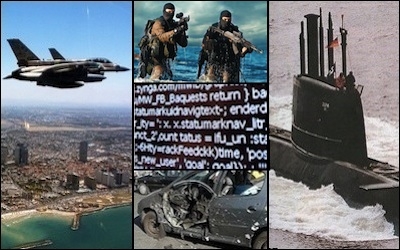 Israeli alternatives in dealing with the Iranian nuclear threat
The Vienna deal has been signed and likely will soon be ratified, which raises the question: Will any government intervene militarily to stop the nearly inevitable Iranian nuclear buildup?
Obviously it will not be the American or Russian governments or any of the other four signatories. Practically speaking, the question comes down to Israel, where a consensus holds that the Vienna deal makes an Israeli attack more likely. But no one outside the Israeli security apparatus, including myself, knows its intentions. That ignorance leaves me free to speculate as follows.
Three scenarios of attack seem possible:
Airplanes. Airplanes crossed international boundaries and dropped bombs in the 1981 Israeli attack on an Iraqi nuclear installation and in the 2007 attack on a Syrian one, making this the default assumption for Iran. Studies show this to be difficult but attainable.
Special ops. These are already underway: computer virus attacks on Iranian systems unconnected to the Internet that should be immune, assassinations of top-ranking Iranian nuclear scientists, and explosions at nuclear installations.
Presumably, Israelis had a hand in at least some of these attacks and, presumably, they could increase their size and scope, possibly disrupting the entire nuclear program. Unlike the dispatch of planes across several countries, special operations have the advantage of reaching places like Fordow, far from Israel, and of leaving little or no signature.
Nuclear weapons. This doomsday weapon, which tends to be little discussed, would probably be launched from submarines. It hugely raises the stakes and so would only be resorted to, in the spirit of “Never Again,” if the Israelis were desperate.
Of these alternatives, I predict the Netanyahu government will most likely opt for the second, which is also the most challenging to pull off (especially now that the great powers promised to help the Iranians protect their nuclear infrastructure). Were this unsuccessful, it will turn to planes, with nuclear weapons as a last resort.




 anneinpt
 artaxes
 danmillerinpanama
 davidking1530
 Peter Hofman
 Joseph Wouk
 Peter
Peter Louisiana Steve
 WarSclerotic
Recent Comments