Archive for July 24, 2015

Kerry I’ll be embarrassed in front of Ayatollah if Irand deal is killed

July 24, 2015

Kerry I’ll be embarrassed in front of Ayatollah if Irand deal is killed, Front Page Magazine, Daniel Greenfield, July 24, 2015

john-kerry (2)Come on guys, don’t embarrass John Kerry in front of his cool Ayatollah friends.

As a bonus, if the Iran nuclear sellout deal dies, John Kerry will be too embarrassed to show his long face in Vienna again. Or Havana or Tehran.

If you won’t think of the Ayatollahs, won’t you think of John Kerry forced to retire back to his windsurfing tax-free Elba with his rich wife, too humiliated to negotiate with any more terrorists?

A congressional vote to undermine the Obama administration’s diplomatic negotiations with Iran would be a major setback for the United States on the world stage and personally humiliating Secretary of State John Kerry said on Friday.

“I would be embarrassed to try to go out,” Kerry said during remarks at the Council on Foreign Relations. “What am I going to say to people after this? ‘Come negotiate with us.’ ‘Can you deliver?'”

“Do you think the ayatollah is going to come back to the table if Congress refuses this and negotiate this again?” he added.

Come on guys, don’t embarrass John Kerry in front of his cool Ayatollah friends.

John Kerry really wants Iran’s Supreme Ayatollah to like him so he can get invited to all his cool “Death to America” parties. He’s still haunted by memories of the time Russia wouldn’t return his phone calls for a week or ask him to the prom.

Kerry’s slip acknowledges that the entire facade of the “moderate” president is meaningless and it’s the Ayatollah that matters. Also the Ayatollah hasn’t actually approved the deal. But there’s another angle.

John Kerry is whining that America will look bad if it pulls back from the deal now. But Obama had no problem violating agreements with Israel, Poland and Libya. Here’s an example.

Secretary of State Hillary Clinton is denying that there were understandings between the Bush Administration and the Sharon and Olmert governments that limited natural growth of settlements but permitted some construction within agreed constraints.

Today, Elliott Abrams, who headed the Mideast team at the Bush White House and participated in the key discussions with Israeli officials about the settlements freeze issue, weighed in with an op-ed in the Wall Street Journal stating forcefully that, “There were indeed agreements between Israel and the United States regarding the growth of Israeli settlements on the West Bank…principles that would permit some continuing growth….They emerged from discussions with American officials and were discussed by Messrs. Sharon and Bush at their Aqaba meeting in June 2003….The prime minister of Israel relied on them in undertaking a wrenching political reorientation — the dissolution of his government, the removal of every single Israeli citizen, settlement and military position in Gaza, and the removal of four small settlements in the West Bank…For reasons that remain unclear, the Obama administration has decided to abandon the understandings about settlements reached by the previous administration with the Israeli government. We may be abandoning the deal now, but we cannot rewrite history and make believe it did not exist.”

Nobody in Obama Inc. was embarrassed to violate a deal with Israel. And that was a deal in which Israel did its part by withdrawing from Gaza.

Kerry whines that he would be embarrassed in front of the Ayatollah if Congress rejects a deal that wasn’t even finalized and in which Iran has yet to do its part.

But that’s just where the priorities of this administration are.

The Ayatollah is a “cool” enemy of the United States whom Kerry wants to impress. Just like he wanted to impress the Viet Cong in Paris and the Sandanistas and Assad. But he could care less what allies like Israel or Poland think.

They like America. So they’re not cool. There’s no need for the administration’s manchildren to impress them or win their approval.
Iran Bombshell: It Will Inspect Itself

July 24, 2015

Iran Bombshell: It Will Inspect Itself, Center for Security Policy, Fred Fleitz, July 24, 2015

I am glad that Senator Risch ignored the Obama administration’s ridiculous demand to treat the side deal as a classified matter. One has to ask, Classified from whom? Certainly not for Iran, since it is a party to the agreement. I believe Obama officials insisted the deal was classified in order to keep knowledge of it from the American people, and possibly from Middle Eastern states such as Israel and Saudi Arabia that oppose the agreement.

***********************

This week brought the stunning news that Senator Tom Cotton (R., Ark.) and Representative Mike Pompeo(R., Kan.) had discovered, during a meeting with IAEA officials, the existence of secret side deal between the IAEA and Tehran — a side deal that will not, like the main nuclear agreement, be shared with Congress. So critics of the agreement were understandably eager to hear an explanation from Secretary of State John Kerry when he and other senior administration officials testified before the Senate Foreign Relations Committee yesterday.

The hearing produced a new bombshell: In its investigation of Iran’s past nuclear-weapons-related work, the IAEA will rely on Iran to collect samples at its Parchin military base and other locations.

As a former intelligence analyst experienced in the collection of environmental samples for investigations of weapons of mass destruction, I found this allegation impossible to believe when I heard Senator James Risch (R., Idaho) make it yesterday morning.

In his questioning of administration witnesses, Risch said:

Parchin stays in place. Now, does that sound like it’s for peaceful purposes? Let me tell you the worst thing about Parchin. What you guys agreed to was [that] we can’t even take samples there. The IAEA can’t take samples there. [Iranians are] going to be able to test by themselves! Even the NFL wouldn’t go along with this. How in the world can you have a nation like Iran doing their own testing?

. . . Are we going to trust Iran to do this? This is a good deal? This is what we were told we were going to get when we were told, “Don’t worry, we’re going to be watching over their shoulder and we’re going to put in place verification[s] that are absolutely bullet proof”? We’re going to trust Iran to do their own testing? This is absolutely ludicrous.

The issue became even more interesting when Senator Robert Menendez (D., N.J.), who learned about the side deal from Risch’s question, had the following exchange with Kerry:

Menendez: “Is it true that the Iranians are going to be able to take the samples, as Senator Risch said? Because chain of custody means nothing if at the very beginning what you’re given is chosen and derived by the perpetrator.”

Kerry: “As you know, senator, that is a classified component of this that is supposed to be discussed in a classified session. We’re perfectly prepared to fully brief you in a classified session with respect to what will happen. Secretary Moniz has had his team red-team that effort and he has made some additional add-ons to where we are. But it’s part of a confidential agreement between the IAEA and Iran as to how they do it. The IAEA has said they are satisfied that they will be able to do this in a way that does not compromise their needs and that adequately gives them answers that they need. We’ve been briefed on it, and I’d be happy to brief you.”

Menendez: “My time is up. If that is true, it would be the equivalent of the fox guarding the chicken coop.”

The revelation that Iran will collect samples concerning its own nuclear-weapons-related activity makes the whole agreement look like a dangerous farce. This is not just an absurd process; it also goes against years of IAEA practice and established rules about the chain of custody for collected physical samples.

Senator Risch suggested in his remarks that the IAEA would remotely monitor the Iranians’ taking of samples by video. But even if there were a reliable way to ensure that Iranian “inspectors” were carefully monitored, took samples from locations identified by the IAEA, and provided these samples directly to IAEA officials, the process would still be a sham, since it would still place unacceptable limitations on IAEA inspections. To be meaningful, IAEA inspectors must have unfettered access to suspect facilities and be free to take samples anywhere, using whatever collection devices they choose. Only by collecting samples at locations and with methods that Iranian officials may not have anticipated can inspectors reliably find possible evidence of nuclear-weapons-related work that Iran tried to clean up.

That the Obama administration would agree to let Iran collect its own samples at Parchin (where explosive testing related to nuclear-warhead development reportedly took place) and other sites is consistent with reports that surfaced in June (and about which I wrote National Review articles on June 15 and June 17) that Kerry had offered to let Iran off the hook for past nuclear-weapons-related work. Iranian supreme leader Ali Khamenei reportedly rejected this offer as being insufficiently generous.

Remember also that Kerry told reporters on June 16: “We’re not fixated on Iran specifically accounting for what they did at one point in time or another. We know what they did.” Kerry walked back this comment, but I believe it represented part of the Obama administration’s negotiating strategy in the Iran talks.

The Obama administration claims that the Iran–IAEA side deal is a confidential and bilateral arrangement reached between IAEA officials and Tehran, and says that it has been briefed on the deal but not seen its actual language. As I wrote here on July 23, I find this impossible to believe, since the apparent arrangement so clearly reflects Secretary Kerry’s attempt last month to make concerns about Iran’s past nuclear-weapons-related work go away.

I am glad that Senator Risch ignored the Obama administration’s ridiculous demand to treat the side deal as a classified matter. One has to ask, Classified from whom? Certainly not for Iran, since it is a party to the agreement. I believe Obama officials insisted the deal was classified in order to keep knowledge of it from the American people, and possibly from Middle Eastern states such as Israel and Saudi Arabia that oppose the agreement. I also believe that Congress would not know about this matter at all if IAEA officials had not told Senator Cotton and Congressman Pompeo about it.

Possibly making the situation worse, Fox News analyst Monica Crowley said in a tweet yesterday that there are additional side deals. Omri Ceren, managing director of the Israel Project, a nonprofit advocacy organization, e-mailed me yesterday, writing that “the Israelis are saying there will be several more.”

These new developments indicate that not only did the Obama administration negotiate a nuclear deal with Iran that was worse than anyone outside the Obama administration knew only a few days ago, but it also tried to shield a sham inspections process from congressional review, in violation of the law. The entire nuclear agreement is not just a bad deal; it is a deal that now displays the bad faith of the Obama administration toward Congress and the American people. The secret side agreements are yet another compelling reason for a large bipartisan majority in Congress to reject the dangerous nuclear accord with Iran.

Eyes wide shut

July 24, 2015

Eyes wide shut, Israel Hayom, Ruthie Blum, July 24, 2015

On Thursday, U.S. Secretary of State John Kerry spent more than four hours trying to defend the nuclear deal before the Senate Foreign Relations Committee. Grilled by Republicans furious at the Obama administration’s total surrender to Iran, Kerry remained true to character: He doubled down on meaningless platitudes with self-righteous indignation.

In fairness to America’s top diplomat, whose stupidity is only matched by President Barack Obama’s evil, how else could he respond to rational concerns but to get on his high horse? Indeed, all he had at his disposal in the face of the emerging details of the agreement, each more shocking than the next, was a feeble attempt to invert reality and ridicule his critics in the process.

Referring to a “Citizens for a Nuclear Free Iran” commercial aimed at persuading Congress to vote against the agreement and currently airing across the U.S., Kerry argued, “The alternative to the deal we’ve reached isn’t what we’re seeing ads for on TV. It isn’t a better deal, some sort of unicorn arrangement involving Iran’s complete capitulation. That’s a fantasy, plain and simple.

This was Kerry’s way of insisting that he had not been “bamboozled” by his Iranian counterparts, as Sen. Jim Risch (R-Idaho) asserted, nor “fleeced,” as committee chairman Sen. Bob Corker (R-Tenn.) accused.

In other words, no wool was pulled over his eyes. Not by the Iranians, at any rate. They were clear all along. And loud, as Kerry can attest, since he was the target of Iranian Foreign Minister Mohammad Javad Zarif’s repeated abusive outbursts during the negotiations.

No, if Kerry was “bamboozled” or “fleeced” by anyone it was Obama, who told him to secure a deal at any and all cost, because doing so would be better in the short run. As for the long-term repercussions, well, that would be a future administration’s headache.

The way Obama and Kerry both justify the travesty is even less comforting. They claim that since Iran was going to pursue nuclear weapons anyway — and support terrorism anyway, and violate terms anyway, and threaten to wipe Israel off the map anyway, and burn American flags anyway — it would be wiser to join them than beat them.

The logic is mind-boggling. But it does shed light on the administration’s attitude towards Israel.

Obama has been bent on earning the Nobel Peace Prize he was awarded — simply for entering the Oval Office — by completing a contract with Iran. Kerry has been obsessed with procuring a document declaring “peace” between Israel and the Palestinian Authority in order to become a Nobel laureate himself.

His dreams were dashed, however, when Prime Minister Benjamin Netanyahu was unwilling to cross certain red lines. Though Netanyahu did agree to negotiations, the release of well over 1,000 Palestinian terrorists, a halt in settlement construction, groveling before Turkish President Recep Tayyip Erdoğan and a slew of slights from the White House, he refused to commit Israel to suicide.

It is thus that Palestinian Authority President Mahmoud Abbas would not come to the negotiating table. Had the P5+1 countries not given Iran reason to believe that their red lines were merely rhetorical, Ayatollah Ali Khamenei — Iran’s “supreme leader” in every respect — would not have allowed his puppets to parlay with American and European representatives in the first place.

No wonder Obama and Kerry can’t stand Netanyahu. If the president of the United States can roll over and abdicate to a sworn enemy, who does the prime minister of Israel think he is to remain steadfast?

Understanding this is crucial. What it means is that Obama’s camp is right — and Netanyahu’s is wrong — about not having been able to hold out for a “better deal.” Iran, like the Palestinians it supports, has one goal in mind: demolishing the enemy.

It remains to be seen whether Obama will garner enough support in Congress to enable him to veto opposition to the agreement, which gives Iran carte blanche for its genocidal-weapons development and billions of dollars to bolster global terrorism.

At the moment, it’s not looking good. What’s worse is an annex in the agreement that provides for cooperation between the P5+1 and Iran “to strengthen Iran’s ability to protect against, and respond to nuclear security threats, including sabotage, as well as to enable effective and sustainable nuclear security and physical protection systems.”

This clause is causing a stir in Israel. It was also the focus of a question raised by presidential hopeful Marco Rubio (R-Fla.) during the Senate hearing. He wanted to know if it means the U.S. would be required to protect Iran’s nuclear facilities from a potential Israeli military strike.

“No,” retorted Energy Secretary Ernest Moniz, on hand with Treasury Secretary Jack Lew to help Kerry through the ordeal. Rubio was not convinced.

He did issue a warning, however: “The Iranian regime and the world should know that this deal is your deal with Iran … and the next president is under no legal or moral obligation to live up to it.”

What the rest of us need to know is which will come first, an Israeli attack or a Republican in the White House?

Photo of the day

July 24, 2015

H/t PJ Media Instapundit

Screen-Shot-2015-07-23-at-4.48.59-PM

Report: International inspectors fail to stop Syria chemical weapons

July 24, 2015

Report: International inspectors fail to stop Syria chemical weapons, Breitbart, Joel B. Pollak, July 24, 2015

(“It’s like Déjà vu all over again.” Please see also, Kerry raps Menendez over ‘classified’ Iran clause, update. — DM)

ap_iranian-foreign-minister-mohammad-javad-zarif_ap-photo4-640x420Carlos Barria/Pool via AP

The Syrian regime, however, imposed harsh restrictions on UN inspectors. ““We had no choice but to cooperate with them,” Scott Cairns, one of the leaders of the UN inspections team, told the Journal.

**********************

International inspectors failed to stop Syria from stockpiling chemical weapons, in spite of an international agreement in 2013, according to a new report by the Wall Street Journal on Friday. International inspectors were skeptical of Syria’s claims to have disposed of its stockpiles, but were afraid that reporting violations would destroy the overall deal: “Members of the inspection team didn’t push for answers, worried that it would compromise their primary objective of getting the regime to surrender the 1,300 tons of chemicals it admitted to having.”

After President Barack Obama failed to enforce his 2012 “red line” against dictator Bashar al-Assad’s use of chemical weapons in the ongoing Syrian civil war, the U.S. agreed to a Russian-brokered agreement in Geneva that provided for the regime to ship its stockpiles abroad while international inspectors gained access to its production and storage facilities.

The Syrian regime, however, imposed harsh restrictions on UN inspectors. ““We had no choice but to cooperate with them,” Scott Cairns, one of the leaders of the UN inspections team, told the Journal.

Initially, the U.S. Central Intelligence Agency had reported that Syria’s declarations about its chemical weapons program matched its own assessments of what the regime possessed. However, the CIA turned out to have underestimated Syria’s capacity, the Journal reports.

The Syrian guards assigned to inspections convoys also drove slowly, failed to destroy chemical weapons when asked to do so, and appeared to be intermingled with Iranian soldiers who were guarding Syrian chemical weapons sites. As a result, Syria remains unaccountable.

The report comes as the Obama administration attempts to persuade Congress that the international inspections regime under a new deal with Iran will be sufficient to monitor that country’s nuclear program, including unknown nuclear facilities and military sites. Critics say that the inspections regime is not tough enough to allow proper verification of Iranian compliance. The Senate Foreign Relations Committee learned Thursday that UN inspectors may rely on the Iranian regime to provide environmental test samples from its own military sites.

In his State of the Union address in January 2014, President Barack Obama said: “American diplomacy, backed by the threat of force, is why Syria’s chemical weapons are being eliminated, and we will continue to work with the international community to usher in the future the Syrian people deserve–a future free of dictatorship, terror and fear.

In a speech in September 2014 about ISIS, he said: “It is America that helped remove and destroy Syria’s declared chemical weapons so they cannot pose a threat to the Syrian people–or the world–again.”

Jordan launches war on ISIS in Iraq, Turkish warplanes hit ISIS in Syria. US, Israel involved in both ops

July 24, 2015

Jordan launches war on ISIS in Iraq, Turkish warplanes hit ISIS in Syria. US, Israel involved in both ops, DEBKAfile, July 24, 2015

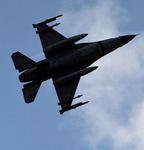
ISIS_24.7.15F-16 warplane in action against ISIS

The Middle East woke up Friday, July 24, to two new full-fledged wars launched by Jordan and Turkey for cutting down the Islamic State of Iraq and the Levant as is forces advanced on their borders. The United States and Israel are involved in both campaigns. Jordanian armored, commando and air forces are already operating deep inside Iraq, while Friday morning, Turkey conducted its first cross-border air strike against ISIS targets in Syria. Clashes between Turkish troops and Islamic fighters erupted at several points along the border. Both governments also conducted mass arrests of suspected Islamists. The Jordanian police picked up ISIS adherents, while 5,000 Turkish police detained 250 Islamist and outlawed Kurdish PKK suspects in Istanbul, Ankara, Izmir and Saniurta. Jordan Friday shut down its only border crossing with Iraq.

Earlier this week, Turkey permitted US warplanes to us the Incirlik air base in the south for bombing missions against ISIS, and Israel handed over to Jordan 16 Cobra combat helicopters and assured Jordan of air force cover for its anti-ISIS operation.

Read more about this new chapter in the war on ISIS in the DEBKAfile report of Thursday, July 23.

In the first publicized Israeli military hardware transaction with an Arab nation, Israel has handed over “around 16 Cobra” combat helicopters in support of Jordan’s war on the Islamic State. This was confirmed Thursday, July 23, by a US official close to the transfer. It was also the first time US-Jordanian-Israeli military cooperation in the struggle against ISIS was publicly disclosed.

“These choppers are for border security,” said the unnamed US official.DEBKAfile’s military and counter-terror sources disclose that the Cobras are needed for a large-scale Jordanian aerial-commando operation launched in the western Iraqi province of Anbar, which borders on the Hashemite Kingdom. This operation is designed to carve out a security belt tens of kilometers deep inside Iraq as a barrier against Islamic State’s encroachment.

Amman approached Washington for combat helicopters to back the operation and was told that the US is short of these items and would turn Israel to pitch in. The US first provided mechanical overhauls for the aircraft before they were incorporated free of charge in Jordan’s existing Cobra fleet.

The transfer was announced while US Defense Secretary Ashton Carter was touring the Middle East. He arrived in Amman Tuesday, July 21,after talks in Israel, and visited Baghdad unannounced Thursday, July 23 for an update on the war on ISIS

The mounting Islamist threat to Jordan is coming now from two directions – the Iraqi province of Anbar and  Syria. ISIS forces have grabbed positions in southern Syria near the intersection of the Jordanian, Iraqi and Syrian borders. They have also moved up to the eastern Syrian town of Abu Kamal on the Iraqi border and, since mid-May, have gradually detached small groups from the captured central Syrian town of Palmyra and quietly built up positions in the south near Jabal Druze.

This buildup has been tracked by US, Jordanian and Israeli surveillance.

The Islamist domestic threat to the Hashemite Kingdom is no less acute. Jihadist sleeper cells have been planted in Jordan ready to strike strategic targets for a reign of terror to coincide with the onset of external Islamic State attacks staged from Iraq and Syria.

Our military sources report that US-Israeli-Jordanian cooperation is channeled through the US Central Command Forward-Jordan from its headquarters north of Amman. It is staffed by US, British, Jordanian, Saudi and Israeli officers working together to defeat ISIS.

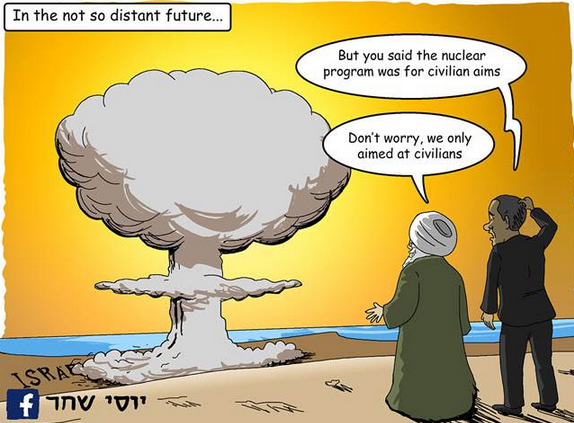
Cartoon of the day

July 24, 2015

H/t Joopklepzeiker

screenshot_374

US Defense Secy to visit Iraqi Kurdistan after Baghdad

July 24, 2015

US Defense Secy to visit Iraqi Kurdistan after Baghdad, DEBKAfile, July 24, 2015

US Defense Secretary Ashton Carter plans to visit Irbil, capital of the semi-autonomous Kurdish Republic of Iraq, before he leaves Iraq. He will hold talks with the KRG president Massoud Barazani and other Kurish leaders. DEBKAfile: The main purpose of his talks in Irbil is to determine whether the US will provide the peshmerga with heavy weapons, including warplanes and combat helicopters, for grappling with Islamic State’s assaults on their doors. Obama has until now turned down Kurdish requests for this hardware, mainly because of Iranian and Iraqi objections. The Kurds maintain that their army is the only effective force fighting in the field capable of routing ISIS.

Israeli military action against Iran would be ‘huge mistake,’ Kerry says

July 24, 2015

Israeli military action against Iran would be ‘huge mistake,’ Kerry says

via Israeli military action against Iran would be ‘huge mistake,’ Kerry says – Israel News – Jerusalem Post.

US Secretary of State John Kerry said on Friday it would be a huge mistake if Israel decided to take unilateral military action against Iran over its nuclear program in the future.

Kerry was asked in an NBC “Today” show interview if the nuclear deal reached last week between would make it more likely that Israel might attempt a military or cyber attack on Tehran.

“That’d be an enormous mistake, a huge mistake with grave consequences for Israel and for the region, and I don’t think it’s necessary,” Kerry said.

The secretary’s remarks are just the latest offering in a public relations blitz staged by the Obama administration as it tries to sell the public and Congress of the necessity and utility of the nuclear agreement struck with Iran last week.

The nuclear agreement reached between world powers and Iran last week took its first official beating in Congress on Thursday, with members of the Senate Foreign Relations Committee from both parties questioning the strength of the accord.

During an appearance on Thursday before a skeptical Senate Foreign Relations Committee, Kerry mounted a furious counter-attack against the deal’s detractors, saying it would be “fantasy” to think the US could simply “bomb away” Tehran’s atomic know-how.

The secretary of state insisted that critics of the deal – which curbs Iran’s nuclear program in return for sanctions relief – were pushing an unrealistic alternative that he dismissed as a “sort of unicorn arrangement involving Iran’s complete capitulation.”

“The fact is that Iran now has extensive experience with nuclear fuel cycle technology,” Kerry told the Senate Foreign Relations Committee. “We can’t bomb that knowledge away. Nor can we sanction that knowledge away.

“Let me underscore the alternative to the deal we have reached is not – as I’ve seen some ads on TV suggesting disingenuously – it isn’t a ‘better deal,’ some sort of unicorn arrangement involving Iran’s complete capitulation,” Kerry said. “That is a fantasy, plain and simple, and our intelligence community will tell you that.”

Several Democrats on the panel were listening closely.

Some expressed concerns with specific provisions of the deal, but the majority seemed to voice agreement that a lack of alternative paths to a peaceful end to the decades-long conflict may force them to vote to approve of it.

Congress began a 60-day review period on Monday, during which it may choose to vote to approve or disapprove of the deal. A resolution of disapproval would have to come to a second vote with two-thirds support of both chambers in order to overcome a presidential veto.


Will Iran Self-Inspect? And Will the US Defend Iran from Israel?

July 24, 2015

By: Shalom Bear

Published: July 24th, 2015

via The Jewish Press » » Will Iran Self-Inspect? And Will the US Defend Iran from Israel?.


Terms of Surrender

Photo Credit: Asher Schwartz


At the Senate Foreign Relations Committee hearing, Senator James Risch (R-Idaho) and Senator Bob Menendez (D-New Jersey) asked US Secretary of State John Kerry if Iran would be responsible for obtaining and providing the soil inspection samples to the inspectors (such as from Parchin), as opposed to the inspectors acquiring the samples on their own.

Kerry refused to answer, claiming the inspection agreement between Iran and the International Atomic Energy Agency (IAEA) is classified.

The chain of custody issue is yet another secret side deal that is coming to light ahead of the Congressional vote on Obama’s nuclear deal with Iran.

Senator Marco Rubio raised the question posed by JewishPress.com regarding the section in the nuclear deal that says the US and the European countries will prepare Iran to defend itself from attacks and sabotage, the subtext being that the US will help Iran prepare to defend itself from an Israeli attack.

Kerry’s responded that the US did not promise to help defend Iran from any Israeli attack, and added that the US will be “fully coordinated with Israel.”

The article in the Iran nuclear deal does not say the US will help defend Iran, but rather the US may help Iran prepare to defend itself from attacks.

Co-operation in the form of training courses and workshops to strengthen Iran’s ability to prevent, protect and respond to nuclear security threats to nuclear facilities and systems as well as to enable effective and sustainable nuclear security and physical protection systems;

Co-operation through training and workshops to strengthen Iran’s ability to protect against, and respond to nuclear security threats, including sabotage, as well as to enable effective and sustainable nuclear security and physical protection systems.