Archive for July 18, 2015

Iran Deal: The Great Bamboozle Festival

July 18, 2015

Iran Deal: The Great Bamboozle Festival, Gatestone InstituteDouglas Murray, July 18, 2015

(Would Chamberlain, in the context of British military weakness but in otherwise comparable circumstances, have made a similar “deal” with Hitler and declared “peace in our time?”  — DM)

  • A generous person might say that this is unimportant — that in Iran, chanting “Death to America” is like throat-clearing.
  • Surely only an uncharitable person would wonder why Iran’s rulers are buying the technology they would need to repel any attack on their nuclear project at the same time as they are promising the Americans that they are not developing nuclear weaponry.

What exactly is it that the Obama administration thinks has changed about the leadership of Iran? Of all the questions which remain unanswered in the wake of the P5+1 deal with Iran, this one is perhaps the most unanswered of all.

There must, after all, be something that a Western leader sees when an attempt is made to “normalize” relations with a rogue regime — what Richard Nixon saw in the Chinese Communist Party that persuaded him that an unfreezing of relations was possible, or what Margaret Thatcher saw in the eyes of Mikhail Gorbachev, which persuaded her that here was a counterpart who could finally be trusted.

After all, the outward signs with Iran would seem to remain unpromising. Last Friday in Tehran, just as the P5+1 were wrapping up their deal with the Iranians, the streets of Iran were playing host to “Al-Quds Day.” This, in the Iranian calendar, is the day, inaugurated by the late Ayatollah Khomeini, when anti-Israel and anti-American activity come to the fore even more than usual. Encouraged by the regime, tens of thousands of Iranians march in the streets calling for the end of Israel and “Death to America”. Not only Israeli and American flags were burned — British flags were also torched, in a touching reminder that Iran is the only country that still believes Britain runs the world.

The latest in a long line of “moderate” Iranian leaders, President Hassan Rouhani, turned up at one of these parades himself to see the Israeli and American flags being burned. Did he intervene? Did he explain to the crowd that they had got the wrong memo — that America is now our friend and that they ought at least to concentrate their energies on the mass-burning of Stars of David? No, he took part as usual, and the crowds reacted as usual.
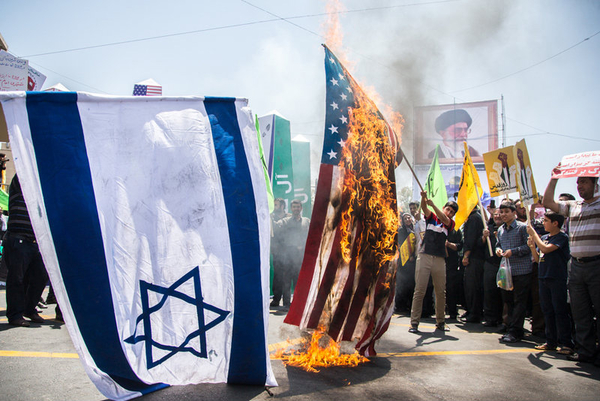
1153Participants in Tehran’s Quds Day rally burn U.S. and Israeli flags, on July 10, 2015. (Image source: ISNA)

It was the same just a few weeks ago, when the Iranian Parliament met to discuss the Vienna deal. On that occasion, after some authorized disputation, the Iranian Parliament broke up, with the representatives chanting “Death to America.”

A generous person might say that this is unimportant — that in Iran, chanting “Death to America” is like throat-clearing. This is just what we are being told — that these messages are “just for domestic consumption,” and don’t mean anything.

Putting aside what they say for a moment, what is it about Iran’s actions that have changed enough to persuade the U.S. government that the Iranian regime might be a regime in transition?

Internally there has been no let-up in the regime’s campaign of oppression against their own Iranian people: hanging people for a range of “crimes,” from being gay to being a poet found guilty of “blasphemy,” continue.

Iran has hanged more than a thousand of these internal “enemies” in the last eighteen months alone, as negotiators sat in Vienna thrashing out a deal. In the wider region, Iran remains the most voraciously ambitious, and perhaps the only successfully outgoing, regional power. In the years since the “Arab Spring” began, only Iran has been able significantly to extend its reach and grip in the region. It now has a vastly increased presence and influence in Yemen, Iraq, Syria and Lebanon. It continues to arm its terrorist proxies, including Hezbollah, which in turn continues to increase its build-up of rockets and other munitions on the northern border of Israel.

Iran has not released the four American hostages it continues to hold — Pastor Saeed Abedini, for the crime of converting to Christianity; Washington Post journalist Jason Rezian, on the patently nonsensical charges of espionage; former U.S. Marine Amir Mirza Hekmati, who went to Iran to visit his grandmother; and retired DEA and FBI agent Robert Levinson, who was abducted eight years ago and has not been heard from since early 2013. This, in spite of last-minute requests from Iran to lift a ban on conventional weapons, acceded to by the members of the P5+1, wasting yet another abandoned opportunity actually to get something in return for their total surrender.

From the outside, it would seem that very little has changed in the rhetoric of Iran and very little has changed in the regime’s behavior. That is why the mystery of what change the U.S. administration and its partners see in the eyes of the Ayatollahs is so doubly curious.

Because the nature of the deal makes it exceptionally important that there is some change. In the next decade, in exchange for the supposed “managed inspections” of limited Iranian sites, the Ayatollas are going to enjoy a trade explosion with a cash bonanza of $140 billion unfrozen assets, just to start them off. Throughout that same decade, there will be a lifting of restrictions on — among other things — the sale and purchase by Iran of conventional arms and munitions. Iran will finally be able to purchase the long-awaited anti-aircraft system that the Russians (also of course present at the table in Vienna) want to sell them. This system — among the most advanced surface-to-air missile systems — will be able to shoot down any American, Israeli or other jets that might ever come to destroy Iran’s nuclear project. And surely only an uncharitable person would wonder why Iran’s rulers are buying the technology they would need to repel any attack on their nuclear project at the same time as they are promising the Americans that they are not developing nuclear weaponry.

And it is even more important that the signs of hope located by the U.S. administration are correct, because after all, barring an internal uprising — which the Vienna deal makes more unlikely than ever (having strengthened the diplomatic and financial hand of the regime) — it is safe to say that over the next decade and beyond the Mullahs will remain in charge in Iran.

In the U.S., Germany, France and Britain, by contrast, who knows who will be in charge? In Britain, the Labour party may have romped to victory with, at its head, Jeremy Corbyn MP (currently Labour leadership contender) — a man who has openly and repeatedly praised Hamas and Hezbollah as his “friends.” That would certainly change the dynamics.

But put aside such a potentially unlikely situation and assume that Britain and America simply do politics as usual. In ten years, there will have been four U.S. governments overseeing the implementation of this deal and scrutinizing the inspections-compliance of the Iranian regime.

In the UK, there will have been at least two new governments. Who is to say that all these different governments — of whatever party or political stripe — will pay the same attention, know what to look out for, and feel as robust about totally unenforceable “snapback sanctions” and other details of the implementation of this deal as the signatories to the deal appear to expect? Is it possible that the Iranians actually know this?

Perhaps, after all, there is something in the eyes of the Ayatollahs. Maybe US Secretary of State John Kerry and President Barack Obama really have looked into the Iranian leaders’ eyes and seen a smile. But whether it is for the reason they appear to believe is, of course, quite another matter.


Despite Iran deal, Israeli unity government said unlikely | The Times of Israel

July 18, 2015

Despite Iran deal, Israeli unity government said unlikely | The Times of Israel.

Talks between Likud, Zionist Union falter over policy, ministerial posts, Channel 2 reports

July 17, 2015, 5:47 pm
Prime Minister Benjamin Netanyahu shakes hands with Zionist Union leader Isaac Herzog during the opening session of the Knesset on March 31, 2015. (Nati Shohat/Flash90)

Prime Minister Benjamin Netanyahu shakes hands with Zionist Union leader Isaac Herzog during the opening session of the Knesset on March 31, 2015. (Nati Shohat/Flash90)

A unity government in which the Zionist Union party joins Benjamin Netanyahu’s narrow Likud-led coalition is looking increasingly unlikely, Channel 2 reported Friday, citing unnamed political sources.

According to the sources, both the prime minister and Zionist Union leader Isaac Herzog were amenable in principle to a unity government, in part because of their shared opposition to the new world powers’ nuclear deal with Iran, but differences arose over diplomatic policy and the issue of which ministerial posts the Zionist Union would receive.

Furthermore, both Netanyahu and Herzog were aware of a large faction within the Zionist Union, headed by senior MKs Tzipi Livni and Shelly Yachimovich, which is opposed to such a move, the report said.

Both Likud and Zionist Union officials were quoted by the Haaretz daily on Thursday as saying that President Reuven Rivlin has been mediating between the two party leaders over the formation of a unity government. A Likud source told Haaretz that the Iranian nuclear deal created a renewed urgency for such a government.

The Likud source said that if Herzog were to join the coalition, Netanyahu would give Zionist Union both the Foreign Ministry, which currently has no minister, and Defense Ministry, headed by former IDF chief Moshe Ya’alon of the Likud party. The Haaretz report maintained that Herzog had initially refused to join if the Jewish Home party remained a coalition partner, but later dropped that demand.

Herzog on Wednesday rejected rumors of an impending unity government as “utter nonsense.” Meanwhile, a senior Zionist Union source maintained that the talks were simply procedural, and that there was “nothing to them.”

Herzog announced Wednesday that he would go to the US to lobby for a compensation package to ensure Israel’s military edge in the region, in the wake of Tuesday’s Iran nuclear deal.

US nuclear negotiator Wendy Sherman said Thursday that the administration has offered to discuss upgrading its defense assistance to Israel but was rebuffed by Netanyahu. “The prime minister was not ready to have that discussion yet,” Sherman said.

Herzog’s trip reflects the broad opposition to the deal in Israel, where most politicians fear it will fail to stop Iran from developing nuclear weapons while strengthening the Islamic Republic’s support for some of Israel’s fiercest foes.

In a rare show of cooperation, Herzog had announced earlier Wednesday that he would work with Netanyahu’s ruling coalition to thwart the deal. In a late-night meeting between the political rivals Tuesday, Netanyahu updated Herzog on the security implications of the deal and emphasized the need for the opposition and coalition to form a united front in presenting the dangers to Israel posed by the agreement.

Khamenei vs. Rouhani: Projecting Very Different Views on the Nuclear Deal

July 18, 2015

Khamenei vs. Rouhani: Projecting Very Different Views on the Nuclear Deal, World Affairs JournalMehdi Khalaji, July 16, 2015

(If Khamenei reneges on the deal, it will likely be impossible to “snap back” the sanctions. With improved Russian rockets, an attack on Iran’s nuclear facilities will be much more difficult.– DM)

In the United States, the same political body that was in charge of negotiating with Iran is also in charge of implementing the agreement. But in Iran, the president and his negotiators have little authority over foreign policy, the nuclear program, or military activities.

If [Khamenei] decides to stop implementing the deal in the next year or so, he would likely blame the West or the negotiating team for cutting such a deal, as he did in 2003 and 2004. His initial reaction to the new agreement has already sent discouraging signals about Iran’s willingness to comply with its commitments in the long term.

****************

The Supreme Leader’s initial reaction has sent discouraging signals about Iran’s willingness to comply with its commitments in the long term.

As expected, Ayatollah Ali Khamenei’s reaction to the nuclear deal was utterly different from that of President Hassan Rouhani. Right after the agreement was announced on July 14, Rouhani appeared on state television and praised the outcome. Yet when he and other officials visited Khamenei’s home a few hours later, the Supreme Leader did not say anything about the deal apart from a few lines thanking the negotiators. This reticence signaled to hardliners that they should increase their attacks on the agreement.

On July 15, in order to protect himself against these critics, Rouhani told the cabinet that Khamenei was “carefully following up” on the details of the final negotiations and “had meticulous supervision” over the process, to the point where the Supreme Leader “truly undertook much heavier responsibility in this regard” than any other official. But even this did not help him much. On July 14, Rouhani sent Khamenei a letter reporting on the deal’s results, but the Supreme Leader delayed his response by a day in order to show his lack of excitement about it. The letter thanked Khamenei for his “intelligent guidance and perpetual and explicit support to the negotiating team,” who “could successfully implement all policies determined by the Supreme Leader and respect redlines set” by him. Khamenei’s delayed answer — hardly a third as long as the president’s letter — avoided any wording that might indicate his total satisfaction with the accord, his direct role in the negotiations, or his responsibility for the deal. Instead he wrote, “The text needs to be studied carefully and go through the predicted legal process. Then, if it is approved, it needs to be protected against potential violations of the deal by the other party.”

Khamenei also failed to mention who should approve the deal. Rouhani’s team and the hardliners are currently in the midst of a hot dispute about whether that responsibility lies with the Majlis or the Supreme National Security Council. The hardliners insist on parliament, arguing that all international agreements should be adopted by the legislative branch of the government. Yet Rouhani’s team says that only the Supreme Council should review and endorse it. Not coincidentally, the president is the titular head of that council.

SHARP HARDLINER CRITICISM

On July 16, hardliner website Raja News published the third part of an article series titled “Some Aspects of the Deal Which Should Remain Unveiled,” by Ali Akbar Taheri. The article explains how the final deal reached by Rouhani’s negotiating team crosses six different redlines previously set by the Supreme Leader:

  1. Long-term limitations on the nuclear program. Khamenei has said that Iran should not agree to ten-year limitations because “ten years is a lifetime.” According to the article, however, the signed agreement contains at least fourteen Iranian commitments lasting ten or more years (e.g., a twenty-five-year limit on inspections and surveillance over enrichment of mined uranium; a fifteen-year ban on uranium enrichment at the Fordow facility).
  2. Unconventional inspections and access to military facilities. Khamenei has explicitly rejected such measures, but the final agreement allows the International Atomic Energy Agency (IAEA) to conduct surveillance in all factories that enrich mined uranium, among other things. The agency can also ask to inspect military facilities such as Parchin if they deem it necessary.
  3. Limitations on enrichment at Fordow. Khamenei has opposed any such restrictions at the mountain facility, but the final agreement contains several.
  4. Delayed lifting of some sanctions. Khamenei previously insisted that all sanctions be rescinded as soon as the deal is signed, but the agreement indicates that some U.S. congressional sanctions and EU sanctions will not be lifted right away, if at all.
  5. IAEA conditionality. Khamenei has often expressed his distrust of the IAEA and declared that sanctions relief should not be conditioned on Iran’s implementation of the deal. Yet UN sanctions will not be lifted until the IAEA verifies that Tehran has complied with the agreement’s terms.
  6. Limits on centrifuge research. Khamenei has said that no restrictions should be placed on Iran’s nuclear research for the duration of the deal. Yet the agreement includes a ten-year limit on enrichment R&D related to the IR-4, IR-5, IR-6, and IR-8 centrifuges, among other things.

The article also downplays Rouhani’s claim about lifting sanctions related to weapons, noting that “these sanctions would be replaced by limits [imposed on Iran’s weapons trade]…[E]very missile that is able to carry a nuclear warhead would be limited, all Shahab missiles and satellite carriers and so on.” In addition, the article claims that Russian foreign minister Sergei Lavrov said the following: “Russia and China wanted weapons sanctions to be lifted, but despite our support the Iranian team itself agreed to continuation of the sanctions for the next five years!”

On July 16, at an event called “The Beginning of the Math Class” (a sarcastic title indicating that the time of verification has begun), hardline analyst Fouad Izadi criticized the deal from a different angle: “If the U.S. Congress rejects the agreement, America would not be bound to implement it, but if Iran implements the agreement, it will lose all leverage.” Izadi, who is close to the Islamic Revolutionary Guard Corps, went on to claim that in the case of disagreement between Iran and the P5+1, “the arbiter is the UN Security Council,” which means that the United States and other P5+1 members would essentially become the arbiters of their own dispute. “If Iran gets accused of violating the agreement, [these countries] can issue a resolution against it,” he said, but if the United States or another party is so accused, “the Security Council cannot issue a resolution because one of them could just veto it.” He also pointed out that the Majlis should approve the agreement, and that it should condition Iran’s implementation of the deal on U.S. congressional approval, explaining that “the U.S. president will not be in office in nineteen months, and after him the U.S. administration would not be bound by the agreement if Congress disapproves it.”

Also on July 16, the hardline newspaper Kayhan claimed that the largely insignificant financial reaction to the nuclear deal — i.e., no sharp changes in the stock market or exchange rate — shocked those who have been “overexcited” about the negotiations. “People expected the foreign currency rate to drop and the national currency value to go up,” said one article, “and now they ask why the opposite has happened.”

CONCLUSION

In the United States, the same political body that was in charge of negotiating with Iran is also in charge of implementing the agreement. But in Iran, the president and his negotiators have little authority over foreign policy, the nuclear program, or military activities. Instead, those sectors are under the purview of Supreme Leader Khamenei, who is usually reluctant to take any public responsibility for major decisions. Furthermore, he has repeatedly expressed his distrust toward Americans, the West, the UN, and the IAEA. And while he has more or less supported Iran’s negotiators in his public statements, he has clearly sought to distance himself from them as well. If he decides to stop implementing the deal in the next year or so, he would likely blame the West or the negotiating team for cutting such a deal, as he did in 2003 and 2004. His initial reaction to the new agreement has already sent discouraging signals about Iran’s willingness to comply with its commitments in the long term.

