VIENNA—Secretary of State John Kerry said on Sunday that the United States and Iran may fail to reach a final nuclear agreement despite the talks being extended past their June 30 deadline so that the sides could hash out remaining differences over the scope and scale of the Islamic Republic’s contested nuclear program.
Western observers suggested the statement from Kerry was designed to provide cover for the administration if a deal with wide-ranging concessions to Iran is struck.
Kerry told reporters in a brief press conference Sunday afternoon that he is prepared to leave town without a deal that has been viewed as the Obama administration’s biggest foreign policy priority.
“I want to be absolutely clear with everybody: We are not yet where we need to be on several of the most difficult issues,” Kerry said. “And the truth is that while I completely agree with Foreign Minister [Javad] Zarif that we have never been closer, at this point, this negotiation could go either way.”
“If hard choices get made in the next couple of days and made quickly, we could get an agreement this week. But if they are not made, we will not,” Kerry said.
Critics of the administration were not impressed by Kerry’s tough stance.
Asked by the Washington Free Beacon about Kerry’s remarks, one Western observer present in Vienna visibly rolled his eyes and said, “If the State Department thinks they’re fooling anybody, they are literally the only ones who think that.”
U.S. officials and diplomats have been quiet in public, declining to brief reporters on record about the status of the talks and what a final deal could look like.
If a deal is not reached by July 7, it is expected that the world powers and Iran will not make one.
“If we don’t get a deal, if we don’t have a deal, if there’s absolute intransigence, if there’s an unwillingness to move on the things that are important, President Obama has always said we’ll be prepared to walk away,” Kerry said.
The secretary also defended a virtual news blackout that has left reporters with very little insight into the status of the critical talks.
“In the coming hours and days we’re going to go as hard as we can. We are not going to be negotiating in the press,” Kerry said. “We’ll be negotiating privately and quietly. And when the time is right, we will all have more to say.”
Asked if he thinks a deal in attainable in the announced time period, Kerry demurred.
“Right now we’re aiming to try to finish this in the timeframe that we’ve set out,” he said. “That’s our goal and we’re going to put every bit of pressure possible on it to try to do so.”
Shortly after Kerry’s remarks, he walked back into another meeting with Iranian Foreign Minister Zarif.
Iranian officials also remained quiet over the weekend, but have hinted that disagreements remain over the future scope of Iran’s nuclear program and the timetable in which international sanctions will be removed.
Wire reports have claimed in recent days that the United States and Iran are close to sorting out the sanctions issue, which has remained one of the most contested issues in the talks.
U.S. lawmakers and other critics have expressed repeated concerns that Iran will pocket billions of dollars in sanctions relief while doing little to stop its most controversial nuclear work.
Meanwhile, Iran announced on Sunday that Russia had agreed to supply it with a range of naval equipment.
“Talks between the Iranian delegation and the Russian side were held at the International Maritime Defense Show (IMDS) in St. Petersburg on Saturday. They spoke about boosting bilateral military-technical cooperation, including on deliveries of a wide range of naval equipment and armaments,” an Iranian military official was quoted as saying in the country’s state-run press.
(The views expressed in this post are mine and do not necessarily reflect those of Warsclerotic or its other editors. — DM)
Napoleon sometimes claimed to be a Muslim. Obama often claims to be a Christian. Napoleon sought, and Obama seeks, power and glory through pretense.
Napoleon Bonaparte
Napoleon’s life and history are summarized at Wikipedia. He supported the French Revolution and was appointed General of the Army of Italy at the age of twenty-five. Three years later, he commanded an expedition against Egypt. This post compares his and Obama’s religious and political efforts to gain the confidence of Muslims. The lengthy quotations provided in this section of the post are from Worlds at War – the 2,500 year struggle between East and West, 2008, by Anthony Pagden.
While en route to conquer Egypt, Napoleon had his “Orientalists” compose a “Proclamation to the Egyptians.”
It is worth taking a closer look at this document for it summarizes not only the French hopes for the ‘Orient’, but also the ultimate failure of both sides to come to any approximate understanding of each other. It began with a familiar Muslim invocation: ‘In the name of God, the Merciful, the Compassionate. There is no God but God. He has no son nor has he any associate in His Dominion’, which was intended to indicate clearly that the French were not Christians. It then went on to assure the Egyptian people that Napoleon Bonaparte, commander of the French army, and ‘on behalf of the French Republic which is based upon the foundations of Liberty and Equality’, had not come to Egypt, as the Mamluks had put it about, ‘like the Crusaders’ in order to destroy the power of Islam. Nothing, Napoleon assured his readers, could be further from the truth. Tell the slanderers that I have not come to you except for the purpose of restoring to you your rights from the oppressors, that I, more than the Mam-luks, serve God— may He be praised and Exalted— and revere his prophet Muhammad and the glorious Qur’an … And tell them also that all people are equal in the eyes of God and that the circumstances which distinguish one from another are reason, virtue and knowledge. 578 Having thus done his best to conflate the principle of human rights— in a language in which there exists no obvious translation for the word ‘right’ 579— with what the Orientalists had persuaded him were the basic tenets of Islam, the man whom Victor Hugo would later describe as the ‘Muhammad of the West’ continued,
O ye Qadis [judges], Shaykhs and Imams; O ye Sharbajiyya [cavalry officers] and men of circumstance tell the nation that the French are also faithful Muslims and in confirmation of this they invaded Rome and destroyed there the Holy See, which was always exhorting the Christians to make war on Islam. And then they went to the island of Malta from where they expelled the knights who claimed that God the Exalted required them to fight the Muslims. 580 [Emphasis added.]
It is hard to say how much Napoleon believed in all this. One of his generals later told a friend in Toulouse that ‘we tricked the Egyptians with our feigned love of their religion, in which Bonaparte and we no more believe in than we do in that of the late pope’. 582 But Napoleon’s personal beliefs were largely beside the point. The point was policy. Napoleon had always practised religious toleration because he knew that religious faiths could make deadly enemies. Toleration, however, was one thing; credence, even respect, was another. It is indeed highly unlikely that Napoleon had read much of the Qur’an he claimed to venerate. As he told Madame de Rémusant, the only holy book which would have been of any interest to him would have been one he had written himself. [Pagden, pp 326 – 327] [Emphasis added.]
Egyptians did not appreciate Napoleon’s Proclamation.
Just as most Muslims today have failed to be persuaded that Western social values can be made compatible with the Holy Law, the Shari’a, so too were the Egyptians who confronted Napoleon. We know something of how they reacted to Napoleon’s profession of love for Islam from the account of the first seven months of the occupation written by a member of the diwan— or Imperial Council— of Cairo named Abd-al Rahman al-Jabarti. Al-Jabarti was a well-read perceptive man who was not unimpressed by French skills and technology (he was particularly taken by the wheelbarrow) and ungrudgingly admired French courage and discipline on the battlefield, which he compared, glowingly, to that of the mujahedin, the Muslim warriors of the jihad. 585 But for all that he was a firm Muslim who could conceive of no good, no truth which did not emanate from the word of God as conveyed by the Prophet. He excoriated Napoleon’s declaration for its language, for its poor style, for the grammatical errors, and the ‘incoherent words and vulgar constructions’ with which it was strewn, and which often made nonsense out of what Napoleon had intended to convey— all of which was no tribute to the skills of Venture de Paradis or those of the French Arabists in the expedition. But al-Jabarti reserved his most searing criticism for what he repeatedly describes as French hypocrisy. The opening phrase of the declaration suggested to him not, as Napoleon had meant it to, a preference on the part of a tolerant nation for Islam; but rather that the French gave equal credence to all three religions— Islam, Christianity, and Judaism— which in effect meant that they had no belief in any. Toleration for a Muslim such as al-Jabarti was as meaningless as it would have been for any sincere believer. It was merely a way of condoning error. The years when some kind of rapprochement between Judaism and its two major heresies might have been possible were long since past. There could now be only one true faith, and any number of false ones. Napoleon could not claim to ‘revere’ the Prophet without also believing in his message. The same applied to the Qur’ an. You could not merely ‘respect’ the literal word of God. You had to accept it as the only law, not one among many. ‘This is a lie,’ thundered al-Jabarti; ‘To respect the Qur’an means to glorify it, and one glorifies only by believing in what it contains.’
Napoleon was clearly a liar. Worse he was also the agent of a society which was obviously committed to the elimination, not only of Islam, but of all belief, all religion. The invocation of the ‘Republic’, al-Jabarti explained to his Muslim readers, was a reference to the godless state which the French had set up for themselves after they had betrayed and then murdered their ‘Sultan’. By killing Louis XVI, the French had turned against the man they had taken, wrongly because their understanding of God was erroneous, but sincerely nevertheless, to be God’s representative on earth. In his place they had raised an abstraction, this ‘Republic’ in whose name Napoleon, who had come not in peace as he claimed but at the head of a conquering army, now professed to speak. Since for a Muslim there could be no secular state, no law which is not also God’s law, the French insistence that it was only ‘reason, virtue and knowledge’ which separated one man from another was clearly an absurdity. For ‘God’, declared al-Jabarti, ‘has made some superior to others as is testified by the dwellers in the Heavens and on the Earth.’ There are few things a believer, especially a believer in the fundamental sacredness of a script, dislikes more than a non-believer. To al-Jabarti the French seemed to be not would-be Muslims, but atheists. [Emphasis added.] [Id. at 329].
Obama
Napoleon, in his mix of religious and political doctrine, was a power-grubbing scoundrel and liar. How about Obama?
Obama has not claimed to be a Muslim and I don’t know what He is. To claim to be a Muslim would be politically inexpedient. However, He has proclaimed His respect and even reverence for Islam and for the “Holy” Qur’an.
overlap, and share common principles — principles of justice and progress; tolerance and the dignity of all human beings.
Islam has a proud tradition of tolerance. . . . People in every country should be free to choose and live their faith based upon the persuasion of the mind and the heart and the soul. This tolerance is essential for religion to thrive, but it’s being challenged in many different ways. [Emphasis added.]
“Tolerance? Egyptian President al-Sisi is remarkable among Muslim leaders for his efforts to promote religious tolerance. Obama appears to despise him for supporting massive public protests against President Morsi and eventually becoming president. Morsi was a Muslim Brotherhood supporter and Obama appears to cherish the Muslim Brotherhood terrorist organization.
Islam is not part of the problem in combating violent extremism — it is an important part of promoting peace.
And, as Obama tells us, the Islamic State and other such groups are not Islamic.
That sort of stuff didn’t work out well for Napoleon. Are Islamists more dedicated to religious tolerance now than in the days of Napoleon? It does not seem that they are. See, e.g., Iran, Saudi Arabia, Pakistan and other Islamic nations.
The future must not belong to those who slander the prophet of Islam. But to be credible, those who condemn that slander must also condemn the hate we see in the images of Jesus Christ that are desecrated, or churches that are destroyed, or the Holocaust that is denied.
He sought power and glory by opposing those who offend “slander” Islam, including the maker of the You Tube video on which He and others in His administration blamed “spontaneous” September 11, 2011 “demonstrations” at the U.S. Benghazi annex.
I have made it clear that the United States government had nothing to do with this video, and I believe its message must be rejected by all who respect our common humanity. It is an insult not only to Muslims, but to America as well — for as the city outside these walls makes clear, we are a country that has welcomed people of every race and every faith. We are home to Muslims who worship across our country. We not only respect the freedom of religion, we have laws that protect individuals from being harmed because of how they look or what they believe. We understand why people take offense to this video because millions of our citizens are among them.
I know there are some who ask why we don’t just ban such a video. And the answer is enshrined in our laws: Our Constitution protects the right to practice free speech.
Obama, who claims to want a peaceful “two state solution” for the Israelis and Palestinians, has said little if anything about the propensity of Israel’s “peace partner,” the Palestinian Authority, to slander Israel and Judaism on a daily basis while honoring those who murder Jews.
Obama’s romance with Islam
Daniel Greenfield recently wrote a Front Page Magazine article titled Barack Obama’s Unholy Alliance: A Romance With Islamism. Please read the whole thing; it’s long but well worth the time. Mr. Greenfield notes, in connection with the Benghazi attack,
When the killing in Benghazi was done, the Jihadists left behind the slogan “Allahu Akbar” or “Allah is Greater” scrawled on the walls of the American compound.[6] These were the same words that Obama had recited “with a first-rate accent” for the New York Times’ Nicholas Kristof. Obama had called it [the Islamic call to prayer] “one of the prettiest sounds on Earth.”[7] On that too, the murderers of four Americans agreed with him.
Those who disagreed and were to be denied a future included Mark Basseley Youssef, a Coptic Christian, whose YouTube trailer for a movie critical of Islam was blamed by the administration for the attacks.
Two days after Obama’s UN speech, Youssef was arrested and held without bail. The order for his arrest came from the top. Secretary of State Hillary Clinton had told Charles Woods, the father of murdered SEAL Tyrone Woods, “We’re going to have that person arrested and prosecuted that did the video.”
The ACLU, which had developed deep Islamist connections,[9] sent a letter to Hillary Clinton thanking her for her support of freedom of speech.[10]
The Supreme Court’s “Miracle Decision”[11] had thrown out a blasphemy ban for movies, but Obama’s new unofficial blasphemy ban targeted only those movies that offended Islam. The government had joined the terrorists in seeking to deny such movies and their creators a future.
At the United Nations, Obama had compared the filmmaker to the terrorists. He had used a Gandhi quote to assert that, “Intolerance is itself a form of violence.”[12] Americans who criticized Islam’s violent tendencies could be considered as bad as Muslim terrorists and if intolerance of Islam was a form of violence, then it could be criminalized and suppressed. That became the administration’s priority.
. . . .
At the National Prayer Breakfast, Obama attacked Christianity for the Crusades in the presence of the foreign minister of Sudan, a genocidal government whose Muslim Brotherhood leader had massacred so many Christians and others that he had been indicted by the International Criminal Court for crimes against humanity.[20][21] And he told Christians that they were obligated to condemn insults to Islam.[22]
Women’s rights? Obama supports those that don’t offend Islam. Continuing with Mr Greenfield’s linked article,
In August 2013, Al-Wafd, a paper linked to one of Egypt’s more liberal parties which supports equal rights for women and Christians, accused Obama of having close ties to the Muslim Brotherhood. [60]
A year earlier, Rose El-Youssef magazine, founded by an early Egyptian feminist, had compiled a list of six Muslim Brotherhood operatives in the administration.[61][62]
Beyond Huma Abedin, Hillary’s close confidante and aide, the list included; Arif Alikhan, Assistant Secretary of Homeland Security for Policy Development; Mohammed Elibiary, a member of the Homeland Security Advisory Council; Rashad Hussain, formerly the U.S. Special Envoy to the Organization of the Islamic Conference and currently the Coordinator for Strategic Counterterrorism Communications; Salam al-Marayati, co-founder of the Muslim Public Affairs Council (MPAC); Imam Mohamed Magid, president of the Islamic Society of North America (ISNA) and Eboo Patel, a member of President Obama’s Advisory Council on Faith-Based Neighborhood Partnerships.
These were the types of accusations that the media tended to dismissively associate with the right, but both Egyptian publications were on the other side of the spectrum.
Egyptian liberals were the ones brandishing placards of a bearded Kerry in Taliban clothes or a photoshopped Obama with a Salafist beard. The protesters Obama had supposedly sought to support by calling for Mubarak to step down were crowding the streets accusing him of backing terrorists.
What made the Egyptian liberals who had seen America as their ally in pursuing reform come to view it as an enemy? The angry Egyptian protesters were accusing Obama of supporting a dictator; the original sin of American foreign policy that his Cairo Speech and the Arab Spring had been built on rejecting.
The progressive critiques of American foreign policy insisted that we were hated for supporting dictators. Now their own man was actually hated for supporting a Muslim Brotherhood dictator.
By 2014, 85% of Egyptians disliked America. Only 10% still rated America favorably.[63] It was a shift from the heady days of the Arab Spring when America had slid into positive numbers for the first time.[64]
Obama had run for office promising to repair our image abroad. As a candidate, he had claimed that other countries believed that “America is part of what has gone wrong in our world.” And yet the true wrongness was present in that same speech when he urged, “a new dawn in the Middle East.”[65]
That dawn came with the light of burning churches at the hands of Muslim Brotherhood supporters. Under Obama, America really did become part of what had gone wrong by supporting the Muslim Brotherhood. It is a crime that Obama will not admit to and that the media will not report on.
The Muslim Brotherhood was born out of Egypt and yet Egyptian views of it are dismissed by the media. Despite the Egyptian Muslim Brotherhood’s final orgy of brutality as President Mohammed Morsi clung to power, despite the burning churches and tortured protesters, it is still described as “moderate.”
Morsi, who had called on Egyptians to nurse their children on hatred of the Jews,[66]was a moderate. Sheikh Rachid al-Ghannouchi, the leader of Ennahda, the Tunisian flavor of the Muslim Brotherhood, who had called for the extermination of the Jews “male, female and children,”[67] was also a “moderate.” Sheikh Yusuf Al-Qaradawi, the spiritual guide of the Muslim Brotherhood, went one better with a fatwa approving even the murder of unborn Jews.[68] Qaradawi was another moderate.[69] [Emphasis added.]
. . . .
Obama sits at the center of a web of intertwined progressive organizations. This web has infiltrated the government and it in turn has been infiltrated by the Muslim Brotherhood.
Consider the case of Faiz Shakir, who went from the Harvard Islamic Society where he helped fundraise for a Muslim Brotherhood front group funneling money to Hamas, the local Muslim Brotherhood franchise, to Editor-in-Chief and Vice President at the Center for American Progress, heading up the nerve center of the left’s messaging apparatus, to a Senior Adviser to House Democratic Leader Nancy Pelosi and then Senate Minority Leader Harry Reid.[73] The next step after that is the White House.
Time magazine described the Center for American Progress as Obama’s idea factory, crediting it with forming his talking points and his government.[74] In an administration powered by leftist activists, the integration between the Muslim Brotherhood and the left resulted in a pro-Brotherhood policy.
Egyptian liberals had expected that the administration’s withdrawal of support for Mubarak would benefit them, but the American left had become far closer to the Muslim Brotherhood than to them. Instead of aiding the left, it aided the Brotherhood. The Egyptian liberals were a world away while the Brotherhood’s activists sat in the left’s offices and spoke in the name of all the Muslims in America.
The [American] left had made common cause with the worst elements in the Muslim world. It formed alliances with Muslim Brotherhood groups, accepting them as the only valid representatives of Muslim communities while denouncing their critics, both Muslim and non-Muslim, as Islamophobes. [Emphasis added.]
. . . .
When Obama declared to the UN that the future must not belong to those who criticize Islam’s brutality, bigotry and abuse of women, he was also defining whom it must belong to. If the future must not belong to those who slander Mohammed, it will instead belong to his followers and those who respect his moral authority enough to view him as being above criticism in image, video or word. [Emphasis added.]
With these words, Obama betrayed America’s heritage of freedom and announced the theft of its future. The treason of his unholy alliance with Islam not only betrays the Americans of the present, but deprives their descendants of the freedom to speak, write and believe according to their conscience.
Obama has placed the full weight of the government’s resources behind Islam. He has suppressed domestic dissent against Islamists like the Muslim Brotherhood while aiding their international goals.
Is Osama Obama worse than Napoleon?
Napoleon represented a nation which, during the French Revolution, had become largely secular. Obama’s America, under His “leadership,” is becoming largely secular. Napoleon sought, and Obama seeks, each in his own way, to promote himself as deserving the approbation of Islam. Napoleon sought power and glory by lying. Obama does much the same, but He most often lies to the denizens of His America.
In the years immediately following the French Revolution, France was considered a great nation. When Obama took office, America was as well. Although some still celebrate America’s freedoms from tyranny on Independence Day, during the Reign of Obama she has become less free and large numbers of “His people” have become increasingly dependent. It’s time to put America back the way she was.
Postscript: I have read of no reported Independence Day incidents of workplace violencerandom violence Islamic terror attacks on Obama’s America. Might it be possible that Obama has convinced the (non-Islamic) Islamic State, et al, that, so long as He remains in power, terror attacks would interfere with His plans to promote Islam and otherwise to destroy the nation.
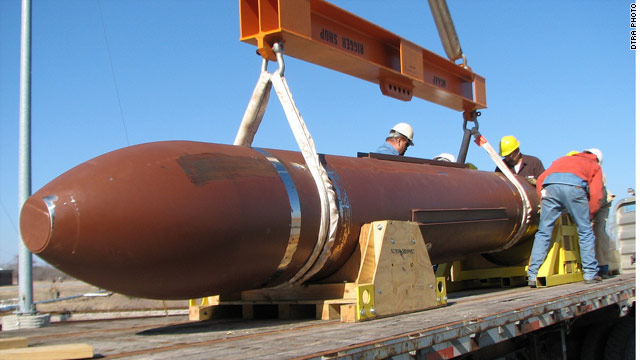
Loading the MOP during a 2007 test in New Mexico [Source: Unknown]
(Happy 4th of July everyone! – LS)
As diplomats rush to reach an agreement to curb Iran’s nuclear program, the U.S. military is stockpiling conventional bombs so powerful that strategists say they could cripple Tehran’s most heavily fortified nuclear complexes, including one deep underground.
The bunker-busting bombs are America’s most destructive munitions short of atomic weapons. At 15 tons, each is 5 tons heavier than any other bomb in the U.S. arsenal.
In development for more than a decade, the latest iteration of the MOP — massive ordnance penetrator — was successfully tested on a deeply buried target this year at the White Sands Missile Range in New Mexico. The test followed upgrades to the bomb’s guidance system and electronics to stop jammers from sending it off course.
U.S. officials say the huge bombs, which have never been used in combat, are a crucial element in the White House deterrent strategy and contingency planning should diplomacy go awry and Iran seek to develop a nuclear bomb.
Obama has made it clear that he has no desire to order an attack, warning that U.S. airstrikes on Iran’s air defense network and nuclear facilities would spark a destabilizing new war in the Middle East, and would only delay Iran by several years should it choose to build a bomb.
“A military solution will not fix it,” Obama told Israeli TV on June 1. An attack “would temporarily slow down an Iranian nuclear program, but it will not eliminate it.”
Secretary of Defense Ashton Carter, speaking to reporters Thursday at the Pentagon, sought to downplay the likelihood or the utility of an attack. He said no plan under consideration, including use of the bunker-busters, could deliver a permanent knockout blow to Iran’s nuclear infrastructure and enrichment plants.
“A military strike of that kind is a setback, but it doesn’t prevent the reconstitution over time,” he said. “And that basically has been the case as long as we’ve had those instruments and those plans, and I don’t think there’s anything substantially changed since then.”
U.S. officials have publicized the new bomb partly to rattle the Iranians. Some Pentagon officials warned not to underestimate U.S. military capabilities even if the bunker-busters can’t eliminate Iran’s nuclear program.
Gen. Martin Dempsey, chairman of the Joint Chiefs of Staff, suggested at the same Pentagon news conference Thursday that airstrikes might be ordered multiple times if Iran tries to build a bomb.
The military option “isn’t used once and set aside,” he said. “It remains in place. … We will always have military options, and a massive ordnance penetrator is one of them.”
A dynamic of escalation, action, and counteraction could produce serious unintended consequences that would … lead, potentially, to all-out regional war.
With negotiators in Vienna facing a self-imposed deadline of Tuesday, the White House views a layered military response as a potential fallback if the emerging deal — which would block Iran’s nuclear weapons capability for at least a decade in exchange for easing of economic sanctions — collapses and evidence shows that Iran is building a bomb.
Contingency plans include airstrikes by cruise missiles and stealth bombers on Iran’s major nuclear facilities, including the uranium enrichment plant at Natanz, a heavy-water reactor at Arak and a nuclear enrichment site at Fordow, which is inside a mountain and fortified with steel and concrete.
B-2 stealth bombers would be required to drop the MOP, which is designed to burrow 200 feet underground before it detonates. Multiple MOPs probably would be aimed at the same target to bore deeper and achieve maximum destruction.
The U.S. began secretly developing the MOP in 2004 after U.S. forces scoured caves in eastern Afghanistan in the hunt for Osama bin Laden. They discovered some sites so deeply buried they appeared impervious to existing bombs.
The Air Force and bomb builder Boeing Co. flight-tested the GPS-guided MOP in 2008 at the White Sands range, where the first atomic bomb was tested during World War II. The 20-foot-long bombs were dropped on multistory buildings with hardened bunkers and tunnels.
But development ramped up in 2010 after Fordow was uncovered and concern about Iran’s nuclear capabilities rose. Since then, the military has spent at least $400 million — including $40 million this year — to build and upgrade 20 bombs, according to budget documents.
Analysts offered mostly pessimistic predictions of how Iran would respond to a U.S. attack on its nuclear facilities.
“A military strike would result in the worst of all worlds,” said Dalia Dassa Kaye, director of the Center for Middle East Public Policy at the nonpartisan Rand Corp. “It may eliminate some facilities. But it would not eliminate Iranian scientists’ technical know-how and would likely further incentivize Iran to pursue a weapon at all costs.”
Iran could increase support for regional militant groups, such as Hezbollah, and perhaps back a terrorist attack on the United States, she said. U.S. forces battling Islamic State fighters in Iraq could find themselves targeted by Iranian-backed militias who are in tacit alignment in the war against the Sunni extremists.
A U.S. attack also could spark a broader war in the world’s most volatile region. Iran has hundreds of medium-range missiles capable of hitting Israel, Jordan and other American allies, according to defense intelligence estimates.
“A dynamic of escalation, action, and counteraction could produce serious unintended consequences that would … lead, potentially, to all-out regional war,” according to a recent study by the Woodrow Wilson International Center for Scholars that was endorsed by 32 high-ranking former military and government officials.
Iran’s nuclear program has already been attacked through covert digital action. In 2010, the U.S. and Israel reportedly slipped a destructive computer worm called Stuxnet into Iranian computer systems controlling the fast-spinning centrifuges that enrich uranium.
The cyberattack destroyed centrifuges and delayed enrichment, but Tehran soon recovered, according to the International Atomic Energy Agency, the United Nations nuclear watchdog agency.
Stuxnet did not lead to overt Iranian retaliation. U.S. airstrikes, and the casualties they would cause, almost certainly would spark a different response.
“It would create huge problems,” said Michael E. O’Hanlon, a military analyst at the Brookings Institution. “That said, it’s hard to rule out if talks fail.”
 John Kerry AP





 anneinpt
 artaxes
 danmillerinpanama
 davidking1530
 Peter Hofman
 Joseph Wouk
 Peter
Peter Louisiana Steve
 WarSclerotic
Recent Comments