Archive for June 2015

Former PM Ehud Barak: We could defeat ISIS in a matter of two days

June 26, 2015

Former PM Ehud Barak: We could defeat ISIS in a matter of two days – Middle East – Jerusalem Post.

Former prime minister and defense minister Ehud Barak does not believe ISIS is as strong as they seem.


Former prime minister and defense minister Ehud Barak was interviewed by Russian media outlet RT on Friday. He stated that it is his belief that the Islamic State “is not strong” and with an appropriate response, it would be possible to suppress and destroy ISIS within a matter of days.

“I think that ISIS is successful to a certain extent because they are not facing a concentrated effort to destroy the organization,” said Barak, adding “Technically they aren’t that strong- they are made up of only about 30-40 thousand people.”

“Basically, what they faced in Ramadi (a town in central Iraq that was occupied by ISIS) and elsewhere in Iraq are armies that don’t want to fight. When an army doesn’t want to fight, you don’t need much experience to win,” said Barak.

“ISIS has never fought a real battle,” he added.

Islamic State militants said they had taken full control of Ramadi in May in the biggest defeat for the Baghdad government since last summer.

Islamist terror attack and decapitation at French US-owned liquid gas factory near Grenoble

June 26, 2015

Islamist terror attack and decapitation at French US-owned liquid gas factory near Grenoble.

DEBKAfile Special Report June 26, 2015, 1:32 PM (IDT)
Outside US-owned Air Products factory attacked by Islamists

Outside US-owned Air Products factory attacked by Islamists

Two armed men waving flags of the Islamic State of Iraq and the Levant (ISIS) and shouting Islamist slogans rammed a car into an American-owned liquid gas factory near the southern French city of Grenoble Friday, June 26.

They hurled bombs into the building, causing several casualties and at least one death. Found inside the building were a decapitated body and a black Islamic flag with an Arabic inscription.

Outside, a severed head had been hung on the factory gates with another flag. It was not immediately clear whether the victim was a member of the factory personnel or brought in by the attackers.

The factory is owned by Air Products, a US-based industrial gases technology company.

One of the two terrorists, a man of 30 who had been on an intelligence watch list, was detained in a rapid police operation at the scene; the second escaped.

Grenoble has a large Jewish community, whose institutions like other Jewish centers across France have had armed police protection since the deadly January 7 terrorist attacks in Paris on the Charlie Hebdo magazine and the Jewish kosher supermarket.

Immediately after the attack in Grenoble Friday, French Interior Minister Bernard Cazeneuve ordered security stepped up at “sensitive sites” across the country in case the gas factory attack heralded a multiple series in several locations. The sensitive sites include Jewish schools and synagogues and Paris thoroughfares where armed soldiers and police are on patrol.

UNITED AGAINST A NUCLEAR IRAN

June 26, 2015

UNITED AGAINST A NUCLEAR IRAN.

America Can’t Trust Iran. Tell your elected officials that America can’t risk more concessions to Iran!


“The emerging Iran nuclear deal raises major concerns.” – Washington Post editorial headline, 2/5/2015.

The United States is trying to reach a deal with Iran, but former U.S. officials, Arab allies and Israel are concerned that these concessions go too far.

The deal leaves much of Iran’s enrichment infrastructure intact and in time would remove all nuclear restrictions allowing Iran to build a dangerous nuclear program.

Now Iran is seeking even more concessions, with Iran’s Supreme Leader saying NO to allowing inspections of all Iranian facilities.

America must not concede these points!

Vatican signs treaty recognizing State of Palestine

June 26, 2015

Vatican signs treaty recognizing State of Palestine

Accord was finalized last month; Israel ‘regrets’ bid, says ‘hasty step damages the prospects for advancing a peace agreement’

By AFP and Times of Israel staff June 26, 2015, 2:09 pm

via Vatican signs treaty recognizing State of Palestine | The Times of Israel.

Pope Francis exchanges gifts with Palestinian Authority President Mahmoud Abbas during an audience at the Vatican Saturday, May 16, 2015.(Alberto Pizzoli/Pool Photo via AP)

Pope Francis exchanges gifts with Palestinian Authority President Mahmoud Abbas during an audience at the Vatican Saturday, May 16, 2015.(Alberto Pizzoli/Pool Photo via AP)


he Vatican on Friday signed a historic accord with Palestine, two years after officially recognizing it as a state, in a move criticized by the Israeli Foreign Ministry.

The accord, a treaty covering the life and activity of the Church in Palestine, was the first since the Vatican recognized the Palestinian state in February 2013. The step was agreed in principle last month and condemned by Israel as a setback for the peace process.

The Foreign Ministry said Friday in response that it “regrets” the Vatican’s decision to sign the “one-sided” text.

“This hasty step damages the prospects for advancing a peace agreement, and harms the international effort to convince the PA to return to direct negotiations with Israel,” the Foreign Ministry said in a statement.

“We also regret the one-sided texts in the agreement which ignore the historic rights of the Jewish people in the Land of Israel and to the places holy to Judaism in Jerusalem. Israel cannot accept the unilateral determinations in the agreement which do not take into account Israel’s essential interests and the special historic status of the Jewish people in Jerusalem,” the statement added.

The treaty makes clear that the Holy See has switched its diplomatic relations from the Palestinian Liberation Organization to the State of Palestine.

The Vatican had welcomed the decision by the UN General Assembly in 2012 to recognize a Palestinian state.

But the treaty is the first legal document negotiated between the Holy See and the Palestinian state and constitutes an official recognition.

“Yes, it’s a recognition that the state exists,” said Vatican spokesman the Rev. Federico Lombardi last month.

Israeli officials criticized the Vatican announcement in May.

“We’re disappointed by the decision taken by the Holy See. We believe that such a decision is not conducive to bringing the Palestinians back to the negotiating table,” Foreign Ministry spokesperson Emmanuel Nahshon told The Times of Israel at the time.

“Israel will study the agreement and consider its next steps accordingly,” a brief statement from the ministry said.

The text of the treaty deals with essential aspects of the life and activity of the Catholic Church in Palestine, a Vatican statement said in May.

“Both Parties agreed that the work of the Commission on the text of the Agreement has been concluded, and that the agreement will be submitted to the respective authorities for approval ahead of setting a date in the near future for the signing,” it noted.

The Vatican has been referring unofficially to the state of Palestine for at least a year.

During Pope Francis’ 2014 visit to the Holy Land, the Vatican’s official program referred to Abbas as the president of the “state of Palestine.” In the Vatican’s latest yearbook, the Palestinian ambassador to the Holy See is listed as representing “Palestine (state of).”

The Vatican’s foreign minister, Monsignor Antoine Camilleri, acknowledged the change in status, given that the treaty was initially inked with the PLO and is now being finalized with the “state of Palestine.” But he said the shift was simply in line with the Holy See’s position.

The Holy See clearly tried to underplay the development, suggesting that its 2012 press statement welcoming the UN vote constituted its first official recognition. Nowhere in that statement does the Vatican say it recognizes the state of Palestine, and the Holy See couldn’t vote for the UN resolution because it doesn’t have voting rights at the General Assembly.

The 2012 UN vote recognized Palestine as a non-member observer state, made up of the West Bank, Gaza Strip and East Jerusalem, lands Israel captured in the 1967 Mideast war.

The Palestinians celebrated the vote as a milestone in their quest for international recognition. Most countries in Africa, Asia and South America have individually recognized Palestine. In Western Europe, Sweden took the step last year, while several parliaments have approved non-binding motions urging recognition.

This isn’t the first time that the Vatican under Francis has taken diplomatic moves knowing that it would please some quarters and ruffle feathers elsewhere: Just last month, he referred to the slaughter of Armenians by Turkish Ottomans a century ago as a “genocide,” prompting Turkey to recall its ambassador.

Raphael Ahren, AP contributed to this report.

General Hayden: Iran deal should not be made without “anywhere,anytime” inspections

June 26, 2015

General Hayden: Iran deal should not be made without “anywhere,anytime” inspections – YouTube.


The Iranian-American nuclear project

June 26, 2015

Column one: The Iranian-American nuclear project – Opinion – Jerusalem Post.

If the US fails to reverse Obama’s policies toward Iran in the next two years, it is hard to see how it will be able to rebuild its strategic posture in the future.

Under President Barack Obama, the US has implemented policies toward Iran that are catastrophic for Israel specifically, for US Middle East allies more generally and for US national security itself.

Consider, first, the known details of the soon-to-be- concluded nuclear deal.

In an article published by The New York Times this week, Prof. Alan Kuperman explained that Obama’s central justification for the agreement – that it will lengthen Iran’s breakout time to the bomb from the current two months to 12 months – is a lie.

See the latest opinion pieces on our Opinion & Blogs Facebook page

Based on nothing more than the number of centrifuges Iran will be allowed to possess and the amount of enriched uranium necessary to make a nuclear bomb, Kuperman demonstrated that far from prolonging Iran’s nuclear breakout time by 10 months, the deal will only prolong its breakout time by one month. In other words, the deal is worthless.

Actually it’s worse than worthless.

Wednesday, the Associated Press reported on the details of one of the agreement’s five secret annexes.

Titled “Civil Nuclear Cooperation,” the annex demonstrates that, far from merely failing to block Iran’s development of nuclear weapons, the deal will facilitate Iran’s development of nuclear weapons.

The leaked secret annex has two central components.

The first involves the underground uranium- enrichment facility at Fordow. Built inside a mountain, the Fordow complex is considered resistant to air strikes.

According to the AP report, the Iranians have agreed to re-purpose the installation from uranium enrichment to isotope production. In turn, the six powers have agreed to provide the Iranians with next-generation centrifuges to operate it. Yet, as the AP report makes clear, “isotope production uses the same technology as enrichment and can be quickly re-engineered to enriching uranium.”

In other words, the six powers will teach Iran how to operate advanced centrifuges capable of quickly enriching uranium in an installation that is protected from aerial bombardment.

The second section of the annex relates to the heavy-water reactor at Arak. The reactor, whose construction is near completion, will be capable of producing plutonium-based atomic bombs.

According to the AP report, the six powers have agreed to provide Iran with a light-water reactor that is less capable of producing bomb-grade plutonium.

Yet, as Omri Ceren from the Israel Project explains, a sufficient number of light-water reactors are capable of producing bomb-grade plutonium. Moreover, since the reactors are powered by uranium, the very existence of the light-water reactors provides Iran with justification for expanding its uranium-enrichment operations.

Then there are the US’s stated redlines in negotiations.

These have collapsed in significant ways over the past few weeks.

Because the US agreed that Iran can continue to enrich uranium, perhaps the most critical means of preventing Iran from acquiring military nuclear capabilities involve requiring Iran to expose all of its previous nuclear work that is still unknown, and requiring Iran to agree to unfettered inspections of is nuclear work and access to its personnel involved in its nuclear work on the part of UN nuclear inspectors.

Clearly, without meeting both requirements, Iran will be able to breach its commitments easily and the agreement will be worthless.

Due to the general understanding of these requirements, the administration’s public position has been that it will require Iran to both expose its previous nuclear work with possible military dimensions and permit the US unfettered access to all its nuclear installations.

For its part, Iran refuses to accept either demand.

Iran’s Supreme Leader Ali Khamenei reiterated this refusal on Tuesday.

Rather than present Iran with an ultimatum that it either abide by these basic requirements or receive no nuclear deal, the administration abandoned its position.

Last week, Secretary of State John Kerry insisted that there is no reason for Iran to expose its previous nuclear work because, “We know what they did. We have no doubt. We have absolute knowledge with respect to the certain military activities they were engaged in. What we’re concerned about is going forward.”

This statement is a lie. As Yukiya Amano, the head of the UN’s nuclear watchdog IAEA, reiterated just weeks ago, “We don’t know whether they have undeclared activities or something else. We don’t know what they did in the past. So, we know a part of their activities, but we cannot [say] we know all their activities. And that is why we cannot say that all the activities in Iran [are for] peaceful purposes.”

Another key position that the Obama administration has staked out on behalf of the nuclear deal is that the sanctions that would be canceled under the deal are limited to those that were instituted in retaliation for Iran’s illicit nuclear program. The other sanctions, levied due to Iran’s illicit work on ballistic missiles, its support for terrorism and its human rights abuses, would remain intact.

But, on June 10, AP reported that the administration intends to cancel both the nuclear-related sanctions and those imposed due to Iran’s illicit ballistic- missile development. As a consequence, tens of billions of dollars will become available for Iran’s Revolutionary Guard Corps.

Then, there are Iran’s repeated breaches of sanctions restrictions. Under the Iran-North Korea Sanctions Act of 2006, the State Department is supposed to submit a report of sanctions violations to Congress every six months. This week Al-Monitor reported that the General Accounting Office issued a report blasting the State Department for failing to uphold its legal commitment. The last report submitted was in 2014 and its reporting covered the period up to 2011. The previous report had been submitted nearly two years earlier.

Among the reasons for the delays, according to the report, “Officials told the GAO that negotiations and relations with counties can delay the process.”

In other words, the State Department’s failure to uphold the law owes to the administration’s desire to shield Iran from further sanctions.

James Clapper, Obama’s director of national intelligence failed to list either Hezbollah or Iran as threats to the US in this year’s Worldwide Threat Assessment.

And the State Department has yet to submit its annual Human Rights Report. This failure is allegedly due to the administration’s reluctance to report on Iran’s miserable human rights record.

Not only does the Obama administration refuse to view Iran and its terrorist arms as threats to the US, this week Bloomberg reported that US forces in Iraq are arming, training and providing close air support for Iranian controlled Shi’ite militia and terrorist groups led by the commander of Hezbollah forces in Iraq Abu Mahdi al-Muhandis.

So, too, US forces deployed to the Taqqadum base in Anbar share the base with Shi’ite terrorist groups.

Several of the terror operatives are reportedly spying on US forces at the base. Terrorist commanders have participated in US operational briefings ostensibly provided to official Iraqi security forces.

As one senior administration official told Bloomberg, “Even if these guys don’t attack us… Iran is ushering in a new Hezbollah era in Iraq, and we will have aided and abetted it.”

Beyond rendering US forces in Iraq hostages of Iranian-controlled terrorists now sharing a base with them, US support for Iranian controlled militia, as well as its policy of only transferring military assistance to forces fighting Islamic State through the Iranian-controlled Iraqi government and security forces, has facilitated Islamic State’s territorial expansion.

As Jacob Siegel and Michael Pregent explained last month in the Daily Beast, a key reason for Islamic State’s success in Ramadi and Mosul is the Baghdad government’s refusal to arm Sunni militias. As they explained, the security forces, guided by Iran, will only fight in areas important to the Shi’ites. So they refused to defend Mosul or Ramadi.

Siegel and Pregent argued that if Iraqi Prime Minister Haider al-Abadi were to arm Sunnis to fight Islamic State in Anbar province, he would likely lose the support of Iran and the militias, and so be ousted from power. Consequently, Sunnis who oppose Islamic State are no obstacle to the march of the jihadists.

By supporting the Iranian controlled government, and refusing to directly arm Sunni or Kurdish forces, the US is supporting Iran and its terrorist groups on the one hand and abetting Islamic State expansion on the other.

The nature and scope of the Obama administration’s collusion with Iran require us to draw a number of conclusions.

First, from an American perspective, under the Obama administration, the US has destroyed its reputation as a responsible and trustworthy ally. It has endangered its allies, its armed forces and its own national security.

The US alliance system in the Middle East has collapsed.

In the short term, all that Congress can do to check Obama is reject his nuclear deal with Iran with a twothirds majority. Although the possibility that a sufficient number of Democratic senators will oppose the deal to override a presidential veto is remote, it is critical that every resource be used to convince them to do so.

In the medium term, in order to secure US national security, the next president will have to cancel US acceptance of the nuclear deal with Iran. To this end, US Jewish groups and other organizations must demand that all presidential candidates – including Hillary Clinton – commit themselves to canceling the agreement in the event they are elected.

If the US fails to reverse Obama’s policies toward Iran in the next two years, it is hard to see how it will be able to rebuild its strategic posture in the future.

The pace of change in the region and the world is too rapid today to rely on past achievements as a basis for future power.

As for Israel, it is now clear that there is no “crisis” in Israel-US relations. The Obama administration is betraying Israel. The centerpiece of Obama’s foreign policy is his desire to transform Iran’s illicit nuclear program, which endangers Israel’s existence, into a legal Iranian-American nuclear program that endangers Israel’s existence.

Consequently, the last thing Israel should worry about is upsetting Obama. To convince fence-sitting Democratic senators to vote against Obama’s Iran deal, Israel should expose all the ruinous details of the nuclear agreement. Israel should let the American people know how the deal endangers not just Israel, but their soldiers, and indeed, the US homeland itself.

By doing so, Israel stands a chance of separating the issue of Democratic support for Obama from Democratic opposition to the nuclear deal. Obama wants this deal to be about himself. Israel needs to explain how it is about America.

At the end of the day, what we now know about US collaboration with Iran brings home – yet again – the sad fact that the only chance Israel has ever had of preventing Iran from getting the bomb is to destroy the mullahs’ nuclear installations itself. If Israel can still conduct such an operation, it makes sense for it to be carried out before Iran’s nuclear program officially becomes the Iranian-American nuclear project.

http://CarolineGlick.com

Israel Asks for Better Gas Mileage

June 25, 2015

Possible Revised F-35 Could Make It for Israel Easier to Attack Iran

By: Tzvi Ben-Gedalyahu Published: June 25th, 2015 Via Jewish Press


F-35 in trial run. Simply awesome. [Photo Credit: Screenshot]

(The engineers at Lockheed have done some pretty amazing stuff. I bet they deliver on this one. – LS)

Lockheed-Martin is studying an Israel request for a longer flight range that would make refueling easier.

The manufacturer of the F-35 stealth attack plane, which Israel might use to attack Iran, is examining an Israeli request to extend the flight range by 30 percent, Amir Rapaport of the Israel Defense website reported Thursday.

Approximately 1,000 miles (1,500 kilometers) separate Israel and Iran, and the current F-35 is designed to fly approximately the same distance without refueling.

The IDF has asked the range to be extended to 1,500 miles, according to Rapaport.

That still would require refueling before Israeli attack planes could return home, but a longer flight range would preclude refueling en route or having to use a base closer to Iran, such as Azerbaijan. A longer flight range also would widen the choices where Israeli pilots could land for refueling on their way home from a bombing mission.

Israel Defense noted that special versions of the F-15 and F-16 include additional fuel tanks, but that option is less practical for the F-35. Even adding fuel capacity by 30 percent would make the airplane larger, challenge engineers to retain the F-35’s stealth capabilities.

IAF teams reportedly are working with Lockheed-Martin in Texas before the first F-35s are due to arrive in Israel towards the end of 2016.

As in the previous planes, Israel has introduced several improvements for the stealth fighter.
Rapaport wrote that sources said:

Israel will significantly improve the aircraft as it once did with the F-15 and F-16.

The F-35 is considered by many Israeli defense officials to be its answer to Iran’s development of a nuclear weapon if an agreement between the P5+1 powers and Tehran does not halt the program.

Below: Video of F-35 in action.

Everyone in Holding Pattern Except Iran

June 25, 2015

Israel Freezes Defense Aid Talks with US Pending Iran Deal

By Cynthia Blank 6/25/2015 Via Israel National News


Defense Minister Moshe Ya’alon at Arrow 2 test [Photo Credit: Flash 90]

(While the world waits, Iran moves forward. More extensions anyone? – LS)

A joint meeting of senior representatives in the Defense Ministry, Foreign Ministry and Prime Minister’s Office resulted in the decision to temporarily suspend dialogue with the United States regarding defense aid to the Jewish state.

The freeze will remain in place until the conclusion of talks between Iran and P5+1 world powers on Tehran’s nuclear program, if not later.

The main reason for suspending the dialogue, officials told Walla! News, is the mounting tension between the White House and Prime Minister Binyamin Netanyahu’s government.

According to a senior defense official, who confirmed the report, freezing talks now will allow Israel to present a new request for defense materials after a deal with Iran has been finalized.

The official asserted that Israel is waiting for negotiations between Iran and Western powers to conclude, to see what exactly the US signs, and from there make demands for maintaining Israel’s security in the region.

Other officials though have suggested Israel may prolong the freeze until a new US president is inaugurated in early 2017, thereby avoiding contact with current US President Barack Obama, whose relationship with Israel has been contentious.

The pressure of a looming nuclear deal with Iran has also begun to affect US officials.

A group of top US experts on security and foreign policy, including former Obama advisors, sent a letter Wednesday night to the President, warning him that the pending accord “may fall short of meeting the administration’s own standard of a ‘good’ agreement.”

Iran’s supreme leader is laughing, for good reason

June 25, 2015

Iran’s supreme leader is laughing, for good reason, Israel Hayom, Boaz Bismuth, June 25, 2015

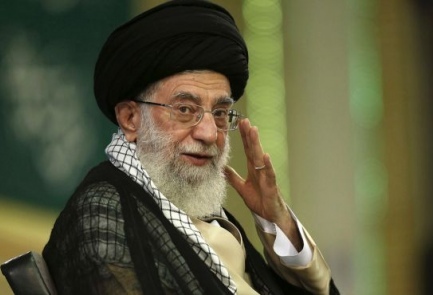
143522169662385559a_bIranian Ayatollah Ali Khamenei | Photo credit: AP

In Tehran on Tuesday, Khamenei spoke about his country’s “red lines.” Red lines? Can someone maybe explain what those are to the Obama administration?

********************

Iranian Ayatollah Ali Khamenei feels confident enough, only a few days before June 30 (the deadline for a final-status nuclear deal with world powers), to thumb his nose at the international community, including the American government, and declare Iran’s three noes: no to freezing its nuclear program, no to international oversight at its nuclear facilities, no to a phased lifting of sanctions (as proposed by the French). In other words, Khamenei is telling the world: Dear superpowers — bite me.

Meanwhile, almost simultaneously, we have received an Associated Press report from Vienna that the U.S. and its partners conducting the negotiations with Iran are prepared — for the sake of reaching a deal — to even provide the Iranians with advanced nuclear reactors and equipment. This isn’t a joke.

It’s possible, perhaps, to imagine Khamenei rejecting this generous offer outright because the Americans aren’t also including ballistic missiles in the package. If you’re going to be generous, then you might as well go all the way.

Truth be told, this entire business to this point seems quite like a joke. The problem is that it’s coming at our expense. And it’s also not that funny.

French Foreign Minister Laurent Fabius met on Wednesday with his Saudi counterpart and promised him a “tough deal.” The Saudis are no less worried than we are about a bad deal. But who is promising us a “tough deal?” The French, who ultimately always fall in line with the Americans, whose help they need for more burning issues closer to home (Ukraine)? Who? The Russians? The Chinese? The Americans? The Germans? The British? The truth is, it would be best to trust the Iranians to torpedo the deal on their own, but Khamenei’s and even Iranian President Hassan Rouhani’s promulgations from two weeks ago aren’t enough to scare anyone off.

In November 2013, as a reminder, we were just several days before the interim agreement. I remember how the Iranian and Western delegations leaked information about the many difficulties in the negotiations, but that in the end, in the middle of the night, the deal was born (how shocking). Eventually, we saw virtually the same scenario unfold in Lausanne this past March — the numerous problems were made public, the deadline was extended by a few days, and finally on April 2 we received the framework deal.

We can assume that in the coming days we will get to see “the best show in town,” at the end of which, in contrast to the previous rounds, we can expect a final status deal with an Iran that is not only slated to become a nuclear power but a stabilizing force in our crumbling Middle East.

In Tehran on Tuesday, Khamenei spoke about his country’s “red lines.” Red lines? Can someone maybe explain what those are to the Obama administration?

The West’s Misconceptions Over the Final Nuclear Deal

June 25, 2015

The West’s Misconceptions Over the Final Nuclear Deal, Front Page Magazine, June 25, 2015

ayatollah_2146641b-450x282

[W]hat is the Obama administration’s strategy? Apparently, the Obama administration does not have one. This is due to the fact that the administration believes that the Islamic Republic will not cheat, interfere in other nations’ affairs, or do any harm in case sanctions are lifted. In other words, the Islamic Republic is going to be another Switzerland.

****************

In a recent interview that President Obama gave to Israeli outlet Channel 2’s Ilana Dayan, he indirectly defended the Islamic Republic and suggested that the ruling clerics are not going to cheat on the terms of the final nuclear deal. But how can President Obama be so sure about Iran’s compliance if a deal is reached and when economic sanctions are lifted? Is he making such an argument based on Iran’s past history of nuclear defiance? Or based on its current military intervention in several nations and support for Shiite militia groups, proxies, and Islamic Jihad?

It is crucial to point out that the nuclear activities of the Islamic Republic came to the international spotlight due to Iran’s clandestine and underground nuclear sites. Iran had since repeatedly violated the IAEA’s terms by building additional underground nuclear sites and inching towards nuclear capabilities in order to obtain nuclear weapons.

President Obama also argued that sanctions will snap back in case Iran cheats. Nevertheless, the truth is that there is no such thing as automatic snapping back of sanctions.  In addition, by the time that the international community realizes that Iran has cheated, Iran would have reduced the nuclear break-out capacity to zero, boosted its Revolutionary Guards’ economy, and gained billions of dollars. Secondly, Russia and China will scuttle any process that would snap back the economic sanctions.

There exists a crucial underlying misconception in the West headed by the Obama administration regarding the final nuclear deal with the Islamic Republic, which is approaching its June 30th deadline.

From President Obama and the Western powers’s perspective,  the nuclear deal with the Islamic Republic is going to be transformational and revolutionary. This follows that the West, and particularly the White House, contends that the final nuclear deal or the nuclear resolution is going to transform the character of Iran’s political system in the long term; hence it will fundamentally alter Iran’s regional, domestic policies, shift its support for Shiite militia groups and proxies across the Middle East, moderate Iran’s foreign policy, and probably change the government in the long term.

On the other hand, from the Iranian leaders’s perspective, the nuclear deal is transitory, fleeting, momentary and transactional. In other words, Iranian authorities will follow the rules of the nuclear agreement for the limited time assigned in the deal. They will boost their economy, regain billions of dollars, and reinitiate their nuclear program soon after.

As long as Iran’s Supreme Leader, Ayatollah Ali Khamenei, is alive, the Islamic Republic is going to prioritize its Islamist revolutionary ideologies. The 75-years-old man, who has ruled over 25 years and continuously spread anti-American and anti-Semitic propaganda, is not going to change his position and become a Western-loving person open to forces of globalization and integration. His has created a powerful social base based on his anti-American and anti-Semitic propagandas.

Since Iranian leaders view the final nuclear deal on a short-term basis, from the perspective of Iranian leaders, particularly Ayatollah Ali Khamenei and influential officials of Iran’s Revolutionary Guard Corps (IRGC), reaching a final nuclear deal is a no-brainer, economically speaking. In addition, the leaders of the Islamic Republic are cognizant of the fact that they will not give up their nuclear program based on the current terms of the nuclear agreement.

Most recently, Royal Dutch Shell PLC, which owes the Islamic Republic an outstanding debt of more than $2 billion, has been talking about repaying Iranian leaders the debt after the nuclear deal is signed. and consequently the related sanctions are lifted. Several other foreign companies were unable to pay Iran due to the financial and banking sanctions imposed by the United Nations Security Council and previous US administrations. Nevertheless, President Obama is opening the way for the flow of billions of dollars into the revolutionary Islamist ideology of the Islamic Republic.

It is crucial to point out that the flow of billions of dollars into the Islamic Republic will not trickle down to the Iranian ordinary people or even be distributed equally among the governmental institutions such as Iran’s foreign ministry. An overwhelming majority of the cash will likely be controlled by the IRGC, Quds forces (an elite revolutionary branch of IRGC fighting in foreign countries) and office of the Supreme Leader. The IRGC and office of the Supreme Leader do enjoy a monopoly over major economic sectors of the Islamic Republic.

The issue of immediate access to billions of dollars is particularly appealing and crucial for the Iranian leaders due to the notion that Tehran looks at the final nuclear deal through the prism of short-term, immediate economic and geopolitical boosts.

As a result, the final nuclear deal is viewed as purely short-term business for the IRGC and the Supreme Leader.

Finally, it is rational for every government to have strategies to rein in Iran’s full economic return. But, what is the Obama administration’s strategy? Apparently, the Obama administration does not have one. This is due to the fact that the administration believes that the Islamic Republic will not cheat, interfere in other nations’ affairs, or do any harm in case sanctions are lifted. In other words, the Islamic Republic is going to be another Switzerland.