Archive for June 2015

Egyptian Muslim Brotherhood Videos Call for Violence

June 2, 2015

Egyptian Muslim Brotherhood Videos Call for Violence, The Clarion ProjectRyan Mauro, June 2, 2015

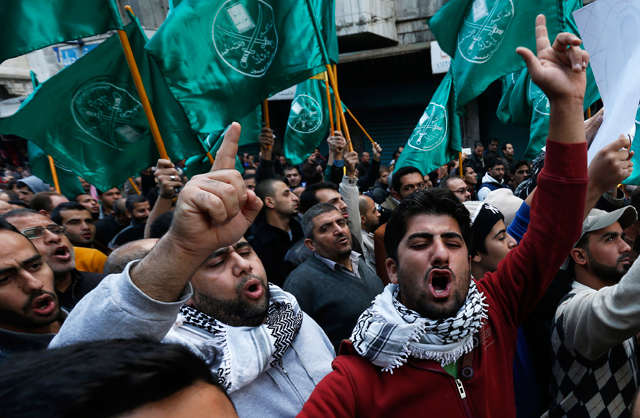
Egypt-Muslim-Brotherhood-Supporters-Flags-IPMuslim Brotherhood supporters in Egypt (Photo: © Reuters)

Egypt has released three videos of Muslim Brotherhood television networks in Turkey advocating violence against the Egyptian police, foreigners, embassies and interests in the region connected to countries that support President El-Sisi.

On Thursday, the Brotherhood’s English-language website announced a decision for revolution “with all its means and mechanisms” against the Egyptian government. The announcement references a declaration signed by 150 Islamic scholars that is less ambiguous in calling for jihad, also published in English.

The first video is from the Muslim Brotherhood’s Rabaa TV network launched in Turkey in 2013. The Egyptian government says the host in the video is a member of the Al-Gama’a Al-Islamiyya terrorist group.

The host is seen reading a statement from the “Revolutionary Youth Coalition;” a group that is almost certainly a Brotherhood front established to give itself plausible deniability while inciting and orchestrating terrorism. The vague terminology is an attempt to give its cause greater legitimacy by appearing more inclusive and broad-based.

The Brotherhood station reads the statement that demands the departure of all foreign Arabs, foreign Africans, embassy personnel, foreign companies and tourists by the end of (last) February. All governments must end their support for the Egyptian government “or else all of their interests in countries of the Middle East will be exposed to severe assaults or will be put in situations that nobody wants.”

The threat warns that henceforth there will be “no concessions or mercy.”

The second video is dated February 24 and is from a satellite network named Misr Alaan that the Egyptian government says was founded by the Brotherhood last year. The Arab press says it was launched from Turkey with Brotherhood sponsorship.  The network’s staff said its purpose is to reach a broader audience than the other Islamist channels in Turkey.

The video comes with an English translation that shows the host of a show explicitly urging the murder of Egyptian police and unspecified revolutionaries to rout the Egyptian soldiers who aid the police in the confrontation. His instructions are clear: “Kill them.”

“I say to the wives of all officers and the sons of all officers: Please be aware, your husbands will be dead. Your children will be orphans,” the host says while adding the sons of police officers may be kidnapped and claiming that the revolutionaries have the home addresses of the police.

The third video, also from Misr Alaan, shows a statement being read by a spokesman calling in from the “Revolutionary Punishment Movement,” continuing the pattern of using new, non-descriptive titles.

The speaker is asked about his group and he only says that it is a youth movement involved in the revolutions since the beginning, referring to the ousting of Egyptian President Mubarak. He condemns the arrests of female members of the group and declares there will be “reciprocal treatment.”

The speaker calls for the kidnapping and killing of Egyptian security personnel by the “lions” of this revolution. He then gives out the names of specific police officers to target without any interruption from the host.

On Thursday, May 28, the Brotherhood’s English-language website carried a statement by spokesperson Mohamed Montaser announcing “a final decision, after consulting its popular base, that the revolutionary option with all its means and mechanisms is its strategic choice from which there will be no retreat.”

The announcement appears to be a response to a reported rift within the Brotherhood between the older and more pragmatic leadership and the more militant youth advocating violence and disruption to society. It reiterates the legitimacy of the Brotherhood leadership and claims that it is inclusive of the youth.

The statement does not explicitly discuss the topic of violence but it certainly does not make the case for non-violence. It gives every reason for an Islamist to believe that violent jihad against the Egyptian government is now permissible.

The intention to inspire violence is detectable in how the Brotherhood references a declaration signed by 150 scholars that declares the Egyptian government to be an “enemy of Allah” waging “war against Islam.” The listed offenses qualify it as a target for violent jihad.

“It is an Islamic duty of the whole Muslim Ummah, rulers and peoples alike, to resist this regime and to seek to break it using all legitimate means in order to safeguard the fundamentals of the Ummah and to maintain the higher objectives of Islam,” it says.

The declaration most clearly instigates violence in points 4 and 6 regarding retribution for acts against the Brotherhood and for forcibly freeing prisoners:

“4. Rulers, judges, officers, soldiers, muftis, media persons, politicians and any other party proven beyond any doubt to be involved in the crimes of violating honor, bloodshed and illegal killing, even if through inciting such acts, are considered, from Islamic perspective, murderers to whom all rulings related to the crime of murder are applicable. They must receive qisas (retribution punishment) within the Islamic Law limits.”

“6. The nation must do its best to free any person, especially women, detained as a result of opposing the coup and demanding respect of the nation’s will and freedom. No effort should be spared to release them using the means approved by Islam.”

The Brotherhood is aware of what it’s calling for. If it didn’t want violent jihad, it would add a disclaimer about the declaration only authorizing non-violence. Instead, there’s only a mention of civil disobedience as a tactic without any kind of rejection of violence in point 13:

“13. We demand all forces opposing the coup and all free people, inside and outside Egypt, to combine efforts in resistance of this criminal regimes and to use all appropriate means such as civil disobedience and any other tool to purge the country of the coup’s tyranny and crimes and to stand up for the martyrs’ cause.”

The declaration is especially significant because brings the Brotherhood a step closer towards officially supporting violence in Egypt; a direction it’s been moving towards in its Arabic content.

In January, the Brotherhood announced a “new phase…where we recall the meanings of jihad and prepare ourselves, our wives, our sons, our daughters, and whoever marched on our path to a long, uncompromising jihad, and during this stage we ask for martyrdom.”

Any doubt as to whether the Brotherhood meant violence is put to rest by what follows:

Imam al-Banna [the founder of the Brotherhood] prepared the jihad brigades that he sent to Palestine to kill the Zionist usurpers and the second [Supreme] Guide Hassan al-Hudaybi reconstructed the ‘secret apparatus’ to bleed the British occupiers.”

The call to violence in Arabic was shortly followed by one in English titled, “Egypt Muslim Brotherhood Reiterates Commitment to Non-Violence.”  The contradiction is reflective of a long-standing patternwhere the Brotherhood speaks more diplomatically in English and more “jihadist” in Arabic. Contrary to assertions that the Brotherhood officially abandoned violence, the group has consistently endorsed and engaged in violent jihad since its supposed “moderation.”

The newly-released videos are just a sample of the proof that the Brotherhood’s “moderate” persona is a contrived mirage.

Iran Short Film Series – 3. Believe Them!

June 2, 2015

Iran Short Film Series – 3. Believe Them! Clarion Project, via You Tube, June 1, 2015

(But to believe what Iranian leaders say, repeatedly, would be Islamophobic. Or something. — DM)


The “Speech-Denialists”

June 2, 2015

The “Speech-Denialists,” The Gatestone InstituteDaniel Mael, June 2, 2015

  • In denying the average college student the opportunity to hear, think, question and learn, these minority organizations violated the basic principles of a liberal arts education and what higher learning should presumably be about: challenging assumptions and talking openly about issues that might cause discomfort.
  • Both micro-sensitivity and political correctness require at best, obfuscating information, and at worst, silencing it.

On college campuses, teachers, students and sometimes even administrators seem to have become ever more eager to block any idea with which they disagree.

Often it appears as if their first impulse is to demonize the individual or organization presenting the offending idea, rather than to address the substance of the argument and open a discussion in the “free marketplace of ideas.”

On the campus of Lake Superior State University, wall postings “deemed offensive, sexist, vulgar, discriminatory or suggestive will not be approved.” The campus code of conduct states that if students fail to comply, they may be disciplined — a rule that was named “Speech Code of the Month” for May by the Foundation for Individual Rights in Education (FIRE).

1092Lake Superior State University’s campus code of conduct states that wall postings “deemed offensive, sexist, vulgar, discriminatory or suggestive will not be approved.” (Image source: Bobak Ha’Eri/Wikimedia Commons)

Increasingly, individuals and groups, perhaps unknowingly betraying the spirit of classic liberalism, seek to shame or ridicule dissenting opinion into silence. Both in politics and on college campuses, it seems as if aggressive shaming has replaced the art of persuasion as the favored means of argumentation. Substantive, non-politically correct discussion is now at a premium.

In her recently published book The Silencing, life-long liberal and Fox News contributor Kirsten Powers documents the escalating efforts of people claiming to be liberal to silence dissent on issues they regard as contentious. The tactic follows what Powers calls the “authoritarian impulse to silence.”

On issues ranging from campus “speech codes” to feminism, these self-described liberals are unwilling to entertain the notion that a well-intentioned individual from the other side of the aisle might have a different remedy for the problems of the day.

When feminist scholar Christina Hoff Sommers of the American Enterprise Institute gave a lecture on the campus of Oberlin University on the topic of campus sexual assault and due process, protesters labeled her a “rape denialist” and claimed that they felt “unsafe.” Perhaps we should begin calling such protesters “due-process denialists.”

When the subject is religion, these “liberals” maintain a disingenuous double standard. “While the illiberal left seems to hold a special animosity to Christianity,” Powers notes, in a remark that could also apply to Israel, “it is strangely protective of Islam, despite the fact that orthodox Muslims oppose same-sex marriage.” Not only are Muslim attitudes toward gay marriage overlooked or roadsided completely, but if anyone dares to discuss the issue of minorities in the Muslim-majority world, they are labeled “racist,” “Islamophobic,” or other slurs at arm’s reach.

Meanwhile, critics are unrelenting in their animosity toward observant Christians’ views of homosexuality. “If you think about it, we are at the water’s edge of the argument that mainstream Christian teaching is hate speech,” Senator Marco Rubio recently told CBN News. “Because today we’ve reached the point in our society where if you do not support same-sex marriage you are labeled a homophobe and a hater.”

Last year, at Brandeis University, when I sought to bring a human rights display highlighting the oppression of LGBTQ individuals in Yemen, Saudi Arabia and Iran, the initiative was blocked in a flood of administrative bureaucracy. The member of the administration with whom I met was clearly not thrilled by the idea.

Meetings with a gay rights group and the Muslim Students Association (MSA), however, were just as telling. Hoping to solicit partnerships in the initiative, I explained to leaders and members of both organizations that the project was not about Islam, but about how, on a routine basis, certain governments murder people who identify as LGBTQ. Members of the gay rights organization expressed concern about “Islamophobia,” while members of the Muslim Students Association expressed concern about “homophobia.” The initiative was rejected. Both groups evidently prioritized the emotional and intellectual comfort of the campus community over drawing attention to the plight of innocent LGBTQ individuals in the Muslim world.

In denying the average college student the opportunity to hear, think, question and learn, these minority organizations violated the basic principles of a liberal arts education and what higher learning should presumably be about: challenging assumptions and talking openly about issues that might cause discomfort. It is still puzzling why the LGBTQ club and the MSA are not at the forefront of defending other members of their respective groups, regardless of where they may live.

Both micro-sensitivity and political correctness require at best, obfuscating information, and at worst, silencing it. It is incumbent upon those who recognize the dangers of the ever-expanding “speech-denialists” in the “political correctness” movement to put up a fight — figuratively, of course.

Obama Assures Iran It Has Nothing to Fear

June 2, 2015

Obama Assures Iran It Has Nothing to Fear, Commentary Magazine, June 1, 2015

(Obama seems to have been talking about Iranian efforts to militarize nukes, not peaceful uses such as medical or generation of electricity. If, as claimed, Iran has no intention of getting, keeping or using nukes why try to halt it? Why bother even to negotiate?– DM)

“A military solution will not fix it. Even if the United States participates, it would temporarily slow down an Iranian nuclear program but it will not eliminate it.”

****************

At this point, there is virtually no one in Israel or the United States who thinks it is remotely possible that the Obama administration would ever, under virtually any circumstances, use force against Iran. Though President Obama and his foreign policy team have always claimed that “all options,” including force, are always on the table in the event that Iran refuses to back down and seeks to produce a nuclear weapon, that is a threat that few took seriously. But President Obama has never been quite as explicit about this before as he was in an interview with Israel’s Channel 2 in which he reportedly said there is no military option to stop Iran. If Obama wanted to telegraph Iran that it could be as tough as it likes in the talks over the final text of the nuclear deal being negotiated this month this statement certainly did the job. Though they had little worry about Obama’s toughness or resolve, the ayatollahs will be pleased to note that the president no longer even bothers to pretend he is prepared to do whatever is necessary to stop Iran’s nuclear ambition.

According to the Times of Israel, Obama said:

“A military solution will not fix it. Even if the United States participates, it would temporarily slow down an Iranian nuclear program but it will not eliminate it.”

Though he continued to use rhetoric that left force as an option, the implicit threat of American action if a nuclear weapon were a possibility has lacked credibility since the president began his second term. Once he embarked upon secret back-channel talks in which, one by one, he abandoned his previous pledges about forcing Iran to shut down its program in concessions and virtually every other U.S. position on the issue, force was never a real possibility. The signing of a weak interim deal in November, 2013, and then the framework agreed upon this spring signaled the end of any idea that the U.S. was prepared to act. That is especially so because the current deal leaves Tehran in possession of its nuclear infrastructure and with no guarantees about inspections or the re-imposition of sanctions in the event the agreement collapsed. The current deal, even with so many crucial details left unspecified makes Iran a U.S. partner and, in effect, the centerpiece of a new U.S. Middle East policy that essentially sidelines traditional allies like Saudi Arabia and Israel that are directly threatened by Iran.

Moreover, it must be conceded that the use of force against Iran would be problematic even for the United States and its vast military resources. As for Israel, despite a lot of bold talk by some in the Jewish state, there has always been skepticism that its outstanding air force had the ability to sustain an air campaign for the length of time that would be required to make a difference. Nevertheless, the notion that force would not be effective in forestalling an Iranian bomb is mistaken. Serious damage could put off the threat for a long time and, if sanctions were kept in place or made stricter as they should have been to strengthen the West’s bargaining position, the possibility of an Iranian nuke could have been put off for the foreseeable future.

Yet, while talk about using force has been largely obsolete once the interim deal was signed in 2013, for the president to send such a clear signal that he will not under any circumstances walk away from the current talks, no matter what Iran does, is significant.

After all, some of the most important elements of the deal have yet to be nailed down. Iran’s Supreme Leader, Grand Ayatollah Ali Khamenei has publicly stated that he will never allow the sort of inspections that would make a deal verifiable. He has also demanded that sanctions be lifted permanently on the day the agreement is signed, and that there should be no provision for them to be snapped back. Nor are the Iranians conceding that their stockpile of nuclear fuel be taken out of their hands.

So if Obama is to get the “verifiable tough agreement” he told Channel 2 he seeks, the U.S. must somehow convince the Iranians to back down on all these points. That’s going to be difficult since the past two years of negotiations with Obama have taught them to wait for him to give up since he always does so sooner or later. The president’s statement makes it clear that, no matter how obdurate the Iranians remain, he will never walk away from the talks. And since this deal is the lynchpin of his foreign policy legacy, they know very well that all they have to do is to be patient.

Iran already knows that the deal in its current form allows them two clear paths to a bomb. One is by cheating on its easily evaded terms. The other is by waiting patiently for it to expire, the sunset provision being another astonishing concession by Obama.

If a tough deal were even a possibility, this would have been the moment for the president to sound tough. But throughout this process, the only toughness the president has shown has been toward Israel as he sought to disparage and dismiss its justifiable worries about his course of action. Merely saying now, as he does in the Channel 2 interview, that he understands Israel’s fears is mere lip service, especially since it comes along with a virtual guarantee to Iran that it needn’t worry about a U.S. strike under any circumstance.

With only weeks to go until the June 30 deadline for an Iran deal, there is no question that Obama’s statement makes an unsatisfactory final text even more certain than it was before. That’s good news for Tehran and very bad news for an Israeli people who have no reason to trust the president’s promises or believe in his good intentions.

Bolton Supports Shock and Awe

June 2, 2015

Ambassador Bolton Says Israel Must Strike Iran Soon

By Yoni Kempinski, Ari Yashar First Publish: 6/1/2015, 10:50 AM Via Israel National News

(Iran’s nuclear clock is now reset to 20 months and counting. – LS)

Clock running out as Iran marches to nuclear arsenal with ‘legitimization’ of deal, which is part of Obama’s ‘wrong ideology.’

On the sidelines of the Israel Day Concert in New York’s Central Park on Sunday, former US Ambassador to the UN John Bolton gave a rundown of Iran’s nuclear program and the impending deal on curbing it, in an exclusive Arutz Sheva interview.

While negotiations between Iran and world powers have reached an interim agreement ahead of a June 30 deadline for a final deal, Bolton predicts that the Iran negotiations are “doomed to failure.”

“I don’t think Iran has any intention of giving up its efforts to get deliverable nuclear weapons,” said the former ambassador. “Even if a deal is signed sometime in the summer I think the ayatollahs will violate it even before the ink is dry.”

Lending credence to those suspicions, top Iranian officials have said they will start using advanced IR-8 centrifuges that are 20 times as effective as standard ones as soon as a deal is reached, even as the US asserts a deal will limit the usage of advanced centrifuges.

According to Bolton, the West doesn’t have enough knowledge about Iran’s covert nuclear program, nor does it possess any sufficient mechanism to monitor possible violations of a future deal, meaning such a deal will only “legitimize Iran’s path to nuclear weapons.”

So why is US President Barack Obama so earnestly pressing for a deal with Iran?

In Bolton’s estimation his actions stem from a belief that negotiations can change the nature of the hostile Islamic regime, because Obama “is driven by an ideology that sees American influence as part of the problem, and if he can show the ayatollahs that we are no threat to them that they will happily give up their 30-year pursuit of nuclear weapons. I just think that’s flatly wrong.”

Faced with the threat of a nuclear armed Iran, Israel will have to choose whether to strike Iran’s nuclear facilities based on estimations that within the next 20 months Iran will be able to produce a nuclear arsenal.

Israel must decide soon, he added, because once Iran has the bomb, “any attack would risk nuclear retaliation.”

In the case of an Israeli strike on Iran’s nuclear sites, the Jewish state will have Congressional pressure to help it against Obama’s antagonism to such a development, according to Bolton. Ahead of such a strike it will need to stress how the attack is part of its legitimate right to self-defense, and after the strike it will need to resupply with US aid.


Israeli planes said to strike Lebanon; casualties reported

June 2, 2015

Israeli planes said to strike Lebanon; casualties reported

Airstrike reportedly takes place near Syria-Lebanon border; Hezbollah denies attack

By Ilan Ben Zion June 2, 2015, 2:53 pm

via Israeli planes said to strike Lebanon; casualties reported | The Times of Israel.

An Israeli F-16 during an exercise on November 25, 2013. (Ofer Zidon/Flash90)

An Israeli F-16 during an exercise on November 25, 2013. (Ofer Zidon/Flash90)

Israeli fighter jets struck near the city of Brital, inflicting casualties, Lebanese media outlets reported Tuesday, citing security sources.

According to Lebanese news site el-Nashra, there were multiple Lebanese injured in two airstrikes near the towns of Brital and Arsal, near the Syrian border.

There was no immediate confirmation of the report. The IDF said it wouldn’t comment on foreign news reports.

Hezbollah’s al-Manar news denied the accuracy of reports of Israeli airstrikes targeting Hezbollah near the border.

Lebanese state media reported just before the reported strike that Israeli jets were flying at low altitudes over the mountains before the strike.

It was not immediately clear when the airstrike took place.

Brital is located in eastern Lebanon, near the border with Syria. The region is a Hezbollah stronghold and has been the base of the Shiite militia’s operations against Syrian rebel groups.

Israel has been blamed for attacks in Syria in the past, including along the Syria Lebanon border. At least one airstrike was said to occur in Lebanese territory.

The reported attack comes as Israel is in the midst of a major civil defense drill meant to simulate a Hezbollah attack on major population centers.

The Israeli military has said the drill is only to prepare the home front, responding to reports of Lebanese and Iranian jitters that it could be a harbinger of a coming attack.

Israeli military officials have hinted strongly at involvement in airstrikes in Syria in the past, some of which have reportedly targeted shipments of advanced weapons to the Hezbollah terror group.

“We will not allow the transfer of sophisticated weapons to terror groups, and in particular Hezbollah,” Defense Minister Moshe Ya’alon said in April, following a reported Israeli strike in Syria. “We know how to reach [Hezbollah] and those who direct it, at any time and any place.”

The comments came after Israel reportedly hit several targets belonging to Hezbollah and the Syrian army Saturday in a series of air attacks in the Qalamoun area on the border between Syria and Lebanon.

According to a report in al-Jazeera, the Syrian targets were divisions 155 and 65 of the Assad army, in charge of “strategic weapons,” while the Saudi-owned Al-Arabiya reported that the targets were Scud missile depots housed in the military bases.

Stuart Winer contributed to this report

Not satire|Obama: Under My Presidency, U.S. ‘The Most Respected Country In The World’ [VIDEO]

June 2, 2015

Obama: Under My Presidency, U.S. ‘The Most Respected Country In The World’ [VIDEO], Daily Caller, June 1, 2015

(Barack Humble Obama’s finest hour. — DM) 

Big Obama

President Barack Obama said Monday that his administration has lifted the U.S. to become “the most respected country in the world.” Obama made the claim during a discussion with Young Southeast Asian Leaders Initiative Fellows at the White House.

PRESIDENT OBAMA: People don’t remember, but when I came into office, the United States in world opinion ranked below China and just barley above Russia, and today once again, the United States is the most respected country on earth, and part of that I think is because of the work we did to reengage the world and say that we want to work with you as partners with mutual interests and mutual respect. It was on that basis we were able to end two wars while still focusing on the very real threat of terrorism and to try to work with our partners in Iraq and Afghanistan. It’s the reason why we are moving in the direction of normalize relations with Cuba. The nuclear deal that we are trying to negotiate with Iran.

WATCH:


‘Contrary to Obama’s claims, Iran increased its nuclear fuel stockpiles’

June 2, 2015

‘Contrary to Obama’s claims, Iran increased its nuclear fuel stockpiles’ – Middle East – Jerusalem Post.

The news comes as the P5+1 powers and Iran seek to strike a final status accord with less than one month before the deadline.

Contrary to the Obama administration’s claims that Iran has frozen its nuclear program, international inspectors discovered recently that the Islamic Republic’s stockpile of nuclear fuel has increased by about 20 percent over the course of the last 18 months, The New York Times is reporting on Tuesday.

The news comes as the P5+1 powers and Iran seek to strike a final status accord with less than one month before the deadline.

The revelations have confounded Western officials who are unsure as to why the Iranians have increased their stockpiles during the course of the negotiations. According to The New York Times, analysts speculate that the Iranians may be seeking a contingency plan should the talks fail to produce an agreement. There is also the possibility that the Iranians have encountered technical problems that have rendered its enriched uranium unusable for weapons.

The bolstered stockpiles were first noticed by International Atomic Energy Agency inspectors, according to the Times.

If accurate, it could prove to be another obstacle to the Obama administration’s efforts to convince a skeptical Congress to support a final nuclear agreement with Iran.

Last week, Iran’s foreign minister said that his government will discuss “other solutions” to Western demands that it allow UN inspectors access to its military sites and to interview its nuclear scientists.

The question of access for international inspectors has become one of the main sticking points between Tehran and six world powers as they try to overcome obstacles to a final nuclear agreement one month before of a deadline.

“We have decided to discuss other solutions to resolve this issue,” Mohammad Javad Zarif was quoted as saying by the Mehr news agency, after holding six hours of meetings on Saturday with his US counterpart John Kerry.

Western officials say inspections of military sites by the IAEA and access to Iran’s scientists are critical to checking whether Iran is pursuing a clandestine nuclear weapons program.

Iran denies any ambition to develop a nuclear weapon and says its program is purely peaceful.

The United States and France have threatened to block any deal that does not allow access but Iran’s Supreme Leader has explicitly ruled out any inspections or interviews, creating an obstacle ahead of the June 30 deadline to reach an agreement.

Zarif did not give further details about how Iranian negotiators planned to resolve the issue and said there were still several points of difference between Iran and the United States, implying there had been no major breakthrough in his bilateral talks with Kerry.

“We have decided to work full time for the next three or four weeks to see whether or not it will be possible to reach an agreement,” he said.

Reuters contributed to this report

A Critique of Obama’s Understanding of Israel – The Atlantic

June 2, 2015

A Critique of Obama’s Understanding of Israel – The Atlantic.

( An excellent analysts… – JW )

What the president gets wrong about Israelis, Palestinians, and Iranians, according to a former Israeli intelligence official

Kevin Lamarque / Reuters

Jeffrey Goldberg

Jun 1, 2015

After I posted an interview with President Obama late last month, I received any number of interesting responses (and also many non-interesting responses, and also some profane non-interesting responses), but few were as comprehensive as that of Yossi Kuperwasser, a former Israeli general and intelligence expert who served until recently as director general of the Ministry of Strategic Affairs. Kuperwasser asked me if I would post some of his critique, and I said yes, happily, though I agree with only 46 percent of it. I’ll get to my disagreements another time. I just think that his viewpoint, which is more-or-less a mainstream Israeli viewpoint, deserves airing. Here it is:

As an Israeli familiar with U.S.-Israeli relations, I would like to set the record straight on President Obama’s recent comments in The Atlantic and at the Adas Israel synagogue. First, let me stress the shared values that anchor the U.S.-Israel relationship, as well as the gratitude I and every Israeli feel for the president’s unwavering support for our country. I also want to make clear that I have no issue with the president’s public criticism of our policies, even if it reveals differences between our two countries. We’ve gotten used to the criticism, and our relationship is strong enough to endure it. With that said, though, there are a few things I need to get off my chest.

During the recent Israeli elections, Prime Minister Netanyahu’s statements regarding the possibility of a Palestinian state and Arab Israeli voters triggered a global uproar, leading the prime minister to quickly issue the necessary clarifications. Nevertheless, the president accused the prime minister of betraying Israel’s core values, which he attributed to the likes of the kibbutzim and Moshe Dayan. The president’s statements betray a lack of understanding of both the past and present. Moshe Dayan and Netanyahu, for one, were not that different. Both were eager for peace, but at the same time realistic about the need for security due to the Palestinian refusal to accept the Jewish state. Dayan opposed a retreat to the 1967 borders, and in his famous eulogy for Roi Rotberg, he warned against making dangerous concessions. Obama also referenced Golda Meir, who famously denied the existence of the Palestinian people.

President Obama’s anger toward Netanyahu is misplaced, especially given his extraordinary lack of criticism of Palestinians for far more egregious behavior. The Palestinians, after all, are the ones who refused to accept the president’s formula for extending the peace negotiations. It is Mahmoud Abbas and the Palestinian Authority (PA) who have called for “popular resistance,” which has led in recent years to stabbings, stonings, and attacks with cars and Molotov cocktails against Israelis. Since the PA ended the peace negotiations, there has been a sharp increase in attacks and casualties in Israel. Hamas, for its part, openly calls for the extermination of Israelis and sacrifices a generation of children towards that goal.

In response to these threats, all the president had to say at Adas Israel was that “the Palestinians are not the easiest of partners.” Rather than recognizing how fundamentally different Palestinian political culture is, the president offered slogans about how Palestinian youth are just like any other in the world. This is a classic example of the mirror-imaging—the projection of his own values onto another culture—that has plagued most of his foreign policy.

This excerpt from the president’s speech in Jerusalem in 2013 is emblematic of his mirror-imaging, and the problems with that perspective:

“… I met with a group of young Palestinians from the age of 15 to 22. And talking to them, they weren’t that different from my daughters. They weren’t that different from your daughters or sons. I honestly believe that if any Israeli parent sat down with those kids, they’d say, I want these kids to succeed; I want them to prosper. I want them to have opportunities just like my kids do. … Four years ago, I stood in Cairo in front of an audience of young people—politically, religiously, I believe that they must seem a world away. But the things they want, they’re not so different from what the young people here want. They want the ability to make their own decisions and to get an education, get a good job; to worship God in their own way; to get married; to raise a family. The same is true of those young Palestinians that I met with this morning. The same is true for young Palestinians who yearn for a better life in Gaza.”

Yes, we want a prosperous life for our neighbors, but unlike the president’s daughters, there are some Palestinian children who are educated to have a completely different set of priorities. Our core values are life, liberty, and the pursuit of happiness in this world, but Hamas proclaims “We love death more than you love life.” Happiness will be reached in the next world, according to the Hamas ideology.

So why does Obama pick on Netanyahu and not on Abbas? The most likely reason is directly related to a conflict in the West between two schools of thought, both dedicated to defending democratic and Judeo-Christian values: Optimism and realism. Obama is a remarkable proponent for the optimist approach—he fundamentally believes in human decency, and therefore in dialogue and engagement as the best way to overcome conflict. He is also motivated by guilt over the West’s collective sins, which led, he believes, to the current impoverishment of Muslims in general and Palestinians in particular. He believes that humility and concessions can salve the wound, and Islamists can be convinced to accept a global civil society. “If we’re nice to them, they’ll be nice to us,” Obama thinks.

Netanyahu, on the other hand, is a realist. Due in part to Israel’s tumultuous neighborhood, he has a much more skeptical attitude of Islamists, such as the Muslim Brotherhood and Iranian President Rouhani’s government. Netanyahu does not see these groups as potential moderates, willing to play by the international community’s rules; instead, he acknowledges their radicalism, and their intent to undermine a world order they consider a humiliating insult to Islam. The major difference between the Islamists and the extremists, according to Netanyahu, is one of timing. The Islamists are willing to wait until the time is ripe to overthrow the existing world order.

Western realists worry that optimists are actively aiding Islamists in the naïve hope that they will block out the extremists. The realists believe that a resolute stance, with the use of military force as an option, is the best way to achieve agreed-upon Western goals. Obama both prefers the optimist approach and believes that his hopeful dialogues will achieve the best possible outcome. Netanyahu, on the other hand, whose nation would feel the most immediate consequences from Western concessions, does not have the luxury of optimism.

This helps explain why Obama targets Netanyahu for criticism. The prime minister’s insistence on the dangers of the optimist approach threatens to expose the inherent weakness of Obama’s worldview and challenge the president’s assumption that his policy necessarily leads to the best possible solutions. For Netanyahu and almost everybody in Israel, as well as pragmatic Arabs, the president’s readiness to assume responsibility for Iran’s future nuclear weapons, as he told Jeffrey Goldberg, is no comfort. The realists are not playing a blame game; they are trying to save their lives and their civilization. To those who face an existential threat, Obama’s argument sounds appalling.

Let’s return to the disagreement over the Palestinian issue. Netanyahu has not altered his basic attitude towards the vision of “two states for two peoples, with mutual recognition.” The prime minister remains committed to his Bar-Ilan address, and is interested in directly negotiating with the Palestinians in order to make this vision a reality.

Yet, is it reasonable to expect the realization of this vision any time soon? Abbas rejected Obama’s formula for continued negotiations because it required recognition of Israel as the nation-state of the Jewish people; he formed a unity government with Hamas; and he promoted Palestinian interests unilaterally in the international arena by joining the International Criminal Court, among other organizations, thereby breaching the Oslo Agreements.

Does it make sense for Israel—in the face of an aggressive Iran, the rise of Islamic terror organizations across the Middle East, and the fragmentation of Arab states—to deliver strategic areas to the fragile and corrupt PA, just to see them fall to extremists?

Should Israel at this moment aid in the creation of a Palestinian state, half of which is already controlled by extremists who last summer rained down thousands of rockets on Israel, while its leaders urge their people to reject Israel as the sovereign nation-state of the Jewish people? Should it aid a movement that follows these five pillars: 1) There is no such thing as the Jewish people; 2) The Jews have no history of sovereignty in the land of Israel, so the Jewish state’s demise is inevitable and justified; 3) The struggle against Israel by all means is legitimate, and the means should be based simply on cost-benefit analysis; 4) The Jews in general, and Zionists in particular, are the worst creatures ever created; And 5) because the Palestinians are victims, they should not be held responsible or accountable for any obstacles they may throw up to peace?

In short, even though Israel, under Prime Minister Netanyahu, remains committed to the formula of “two states for two peoples, with mutual recognition,” the implementation of this idea at this point is irrelevant. The PA’s poor governance and the general turmoil in the Middle East render any establishment of a Palestinian state right now unviable. President Obama admitted as much, reluctantly, but continued to criticize Netanyahu instead of betraying his optimist paradigm. Netanyahu’s realism would stray too far from the path Obama, and other Western leaders, have set in front of them. But while Obama and the optimists offer their critiques, Netanyahu and the realists will be on the ground, living with the consequences the optimists have wrought.

In a Gesture of Peace, Russia Agrees to Build Second Nuke Plant in Iran

June 1, 2015

Russia to Start Construction On New Iranian Nuke Plant

BY: Adam Kredo June 1, 2015 1:48 pm Via The Washington Free Beacon

(Putin needs a little cash to cover all those S-300 shipments.  Besides, he’s got a lot of uranium coming in from his investments in the United States ….thanks to Hillary and Bubba. – LS)

Russia announced on Monday that it would start construction this year on a second nuclear plant in Iran, according to regional reports.

Russia’s Rosatom State Atomic Energy Corporation made the announcement early on Monday, stating that it will begin building a second nuclear power plant in Iran’s southern region later this year, according to Iran’s state-controlled Fars News Agency.

Meanwhile, an earthquake struck Monday morning near the site of Iran’s current nuclear power plant in Bushehr, near where the second plant will be built.

Iranian media outlets reported the quake as hitting a 4.4 magnitude with no injuries occurring as a result. Iran’s southern region is prone to such incidents.

Iranian officials announced in late 2014 that it had already begun the initial stages of construction on at least two nuclear plants in the region. In November, Tehran finalized a deal with Russia to aid in the construction of these plants.

“We have entered the executive phase of the construction of these two nuclear power plants based on the contract signed between Tehran and Moscow in March to construct the plants,” Behrouz Kamalvandi, deputy chief of Iran’s Atomic Energy Agency, was quoted as saying at the time.

The construction of these new plants is not barred under the terms of a current agreement between Iran and Western powers to curb the Islamic Republic’s nuclear program.

“In general, the construction of light water nuclear reactors is not prohibited by U.N. Security Council resolutions, nor does it violate the [interim agreement struck in 2013],” a State Department official told the Washington Free Beacon in January.

Iranian officials said on Monday that its negotiators would not give up further ground as talks reach the final stage in June.

“These are the final days of the negotiations and both sides naturally try to see more of their demands met, and they may even make use of provocative remarks through their officials and unofficial people,” Mohammad Baqer Nobakht, a spokesman for the Iranian government, was quoted as saying on Monday.

“But what matters is the issues that are written and not speeches, and we are striving to materialize the Iranian nation’s rights in full in what is written,” he said.