Archive for June 10, 2015

Iran satellite launches tied to ballistic missile program, UN experts say

June 10, 2015

Iran satellite launches tied to ballistic missile program, UN experts say, Fox News, June 10, 2015

Both of those actions, the majority concluded in 2012, were violations of U.N. sanctions resolutions that explicitly forbade any Iranian activity “related to ballistic missiles capable of delivering nuclear weapons, including launches using ballistic missile technology.”

The experts’ more diffident reference to Iran’s renewed program of  launches over the next year gives Iran much greater benefit of the doubt this time.

***************

EXCLUSIVE: Iran has launched a space satellite using  technology that could “contribute to” the development of a ballistic missile capable of delivering nuclear weapons, according to a United Nations-appointed panel of experts monitoring the issue.

Tehran intends to launch more such satellites,  the panel said.

The most recent  launch came last February 15, the experts noted, adding that the Iranian government has already announced plans to conduct three additional satellite launches before March 2016.

The vehicle used in the February launch—from a military base in northern Iran– was based on a “space launch vehicle” that is  variant of Iran’s Shahab-3 ballistic missile, which has a range of about 1,000 miles. The Shahab-3 is one of two Iranian missiles that the experts say  “are believed to be potentially capable of delivery of nuclear weapons.”

The experts noted that the future satellites will be boosted aloft “from more powerful launchers and on the back of bigger carriers.”

Iran’s missile development—peaceful or not– is one of the murkier and more contentious  issues surrounding the ongoing negotiations between the Islamic Republic and the world’s major powers—precisely because ballistic missiles have been shunted to the side of a  potential deal centered on nuclear enrichment activities that the Obama Administration is pushing hard to conclude by June 30.

U.N. Security Council resolutions that have sanctioned Iran for its nuclear weapons development have also banned Iranian work on ballistic missile programs that could deliver the weapons. But missiles were not mentioned in the interim deal between Iran and the P5+1 powers struck last November, which has so far unfrozen billions in Iranian assets and which is supposed to be turned into a final agreement by June 30.

Last year, Supreme Leader Ayatollah Ali Khamenei called  any Western expectations that Iran would restrain its missile development program “stupid and idiotic,” and called for the country to mass produce such weapons.

Even so, a 7-member U.N. expert panel which is monitoring Iran’s behavior on the proliferation issue while negotiations continue noted in its June 1, 2015 report that Iran’s officials and news media “have not been reporting any new ballistic missile developments” such as the “unveiling or testing of new types of ballistic missiles,” or tests of medium-range missiles it is already known to possess.

Satellite  launches, however,  are another matter. The experts noted that the February 15 satellite payload weighed 110 lbs. and was designed for “collecting imagery.” It was only a limited success:  the satellite fell back into the earth’s atmosphere after just 23 days, even though it was apparently intended to stay aloft for 18 months.

CLICK HERE FOR THE EXPERT REPORT

Nonetheless, the experts added, it was Iran’s first satellite launch since two failures in 2012. They also observed cryptically that “the details of this case present similarities with the launch of another satellite by a Safir space launch vehicle in 2011” and  analyzed in one of their  previous reports.

And according to that earlier document, a majority of the expert panel concluded that “the satellite launch was related to ballistic missiles capable of delivering nuclear weapons,” and the Safir satellite launch vehicle itself “made use of ballistic missile technology.”

Both of those actions, the majority concluded in 2012, were violations of U.N. sanctions resolutions that explicitly forbade any Iranian activity “related to ballistic missiles capable of delivering nuclear weapons, including launches using ballistic missile technology.”

CLICK HERE FOR THE 2012 REPORT

The experts’ more diffident reference to Iran’s renewed program of  launches over the next year gives Iran much greater benefit of the doubt this time.

The UN’s Anti-Israel Children and Armed Conflict Report

June 10, 2015

The UN’s Anti-Israel Children and Armed Conflict Report, Front Page Magazine, June 10, 2015

(Please see also, Legal Experts Slam IDF for Over-Warning Gazans. — DM)

UN_Secretary-General_Ban_Ki-moon_-_Flickr_-_The_Official_CTBTO_Photostream_13-431x350

According to the New York Times, citing unnamed diplomats, United Nations Secretary General Ban Ki-moon bowed to “unusual pressure from Israel and the United States” in deciding not to include either Israel or Hamas on a list of “armies and guerilla groups that kill and maim children in conflicts worldwide.” The list is included in an annex to an annual report by the Secretary General entitled “Children and armed conflict,” which he just released for 2015. The list, as its title states, is intended to identify specifically the entities that “recruit or use children, kill or maim children, commit rape and other forms of sexual violence against children, or engage in attacks on schools and/or hospitals in situations of armed conflict.”

Ban Ki-moon considered the recommendation of his special representative for children and armed conflict, Leila Zerrougui, to include both Israel and Hamas on this list as a reflection of their actions and the deadly consequences to children arising from the Gaza conflict last summer. The list already includes such Islamic jihad terrorist groups as the Islamic State, the al-Nusra Front, Boko Haram, the Taliban, Al Shabaaba, Al-Qaida in the Arab Peninsula and the Houthis, as well as government forces of the Syrian regime, Yemen, Sudan and Afghanistan.

While the Secretary General rejected his special representative’s recommendation, leaving both the terrorist jihadist group Hamas and Israel off the list in a display of moral equivalence, the body of the report is far more condemnatory of Israel than of Hamas or other Palestinian militants. There were more than three times as many paragraphs devoted to alleged Israeli violations of children’s rights relating to the Gaza war than devoted to the actions of Hamas or other Palestinian terrorists. When there was any criticism of Palestinian actions, it was stated in the mildest of terms. Israel, on the other hand, received the full brunt of the Secretary General’s censure:

“I am deeply alarmed at the extent of grave violations suffered by children as a result of Israeli military operations in 2014. The unprecedented and unacceptable scale of the impact on children in 2014 raises grave concerns about Israel’s compliance with international humanitarian law, notably the principles of distinction, proportionality and precaution in attack, and respect for international human rights law, particularly in relation to excessive use of force.” (Paragraph 110)

Nevertheless, Riyad Mansour, Permanent Observer of the State of Palestine to the United Nations, was not satisfied. He issued a blistering statement declaring that “It is without doubt that Israel, the occupying Power, flagrantly, systematically and grossly commits human rights violations against Palestinian children constituting grave violations that qualify it for such a listing in the annex to the Annual Report on Children and Armed Conflict. The UN’s inaction, submitting to the inordinate pressures exerted, sends a most regrettable signal that the same criteria do not apply in all situations for all children, undermining the credibility of the UN system as a whole…”

As usual, Mr. Mansour stands the truth on its head. Indeed, Ban Ki-moon should have accepted his special representative’s recommendation to include Hamas on the annex list. Hamas and its other jihadist allies, not Israel, belong on the list alongside their Islamic State and al Qaeda brethren. They use children as human shields, deliberately store weapons in schools, homes hospitals and mosques where they know children are likely to be, and recruit children for jihad including the establishment of youth military training camps. They prepare children for the glory of martyrdom, extolling the virtues of suicide bombings that kill Jews.

Ban Ki-moon properly rejected his special representative’s recommendation to include Israel on the annex list. Israel does not belong on the same list as non-state and state entities that deliberately kill children with abandon, recruit children as soldiers, abduct and rape little girls, and kill their parents before their very eyes. To the contrary, the Israeli armed forces took great pains to minimize civilian casualties. It took the unprecedented step of warning civilians in advance of impending attacks on facilities that Hamas was using as launching pads from which to fire rockets at Israeli population centers and from which they were building their terrorist tunnels to sneak their fighters into Israel for the purpose of killing Israeli civilians, including women and children.

However, putting the annex list aside, Mr. Mansour should have been happy that the Secretary General reflected the institutional bias of the United Nations against Israel in the body of his report. In a crucial paragraph urging corrective actions to remedy the report’s catalogue of alleged violation of children’s rights – mostly said to be committed by Israel – the report focused solely on what Israel should do:

“I urge Israel to take concrete and immediate steps, including by reviewing existing policies and practices, to protect children, to prevent the killing and maiming of children, and to respect the special protections afforded to schools and hospitals. An essential measure in this regard is ensuring accountability for perpetrators of alleged violations. I further urge Israel to engage in a dialogue with my Special Representative and the United Nations to ensure that there is no recurrence in grave violations against children.” (Paragraph 111)

As usual, nothing is asked of the Palestinians. They are not urged to stop storing weapons in schools and hospitals. They are not asked “to protect children, to prevent the killing and maiming of children,” which they could begin to do by not using children as human shields, and not deliberately conducting rocket attacks against Israeli civilians including children and conducting other military activities from areas where they know Palestinian children are likely to be. They are not asked to close the youth military training camps or stop the online propaganda that indoctrinates Palestinian children into believing that martyrdom through jihad against Jews is the way to paradise.

We should not be surprised. Such anti-Israel bias is par for the course at the United Nations. Its Human Rights Council passes more resolutions condemning Israel than all of the other 192 member states combined. The Human Rights Council’s agenda item 7 requires that Israel’s – and only Israel’s – record of human rights be debated at every session. Investigations launched by the Human Rights Council and the UN Secretary General of alleged human rights and other international law violations in Gaza during the repeated wars there initiated by Hamas’s terrorist attacks against Israeli civilians are blatantly one-sided against Israel.

Israel was the only country in the world to be named as a violator of “health rights” during the UN World Health Organization’s annual assembly in May 2015. Never mind about Syria, Iran, Iraq, Libya, or North Korea where basic medical care and health services are scarce, if existent at all. Israel facilitates the delivery of humanitarian aid and takes care of the sick and injured, whether they be Palestinians or not. The Syrian regime prevents humanitarian aid including medical supplies from reaching besieged civilians, including Palestinian children trapped in Yarmouk. Yet the World Health Organization chose to ignore all this and adopt a resolution focusing solely on health conditions in the occupied Palestinian territory, including East Jerusalem, and in the Golan Heights, for which Israel is held responsible.

The UN Commission on the Status of Women, whose latest annual meeting concluded on March 20, 2015, marched to the same anti-Israel tune. The only country it condemned for its women’s rights record was Israel, presumably because of its alleged treatment of Palestinian women.

“If anyone had any doubt that there was demonization of Israel at the United Nations, here is the entire truth before our eyes,” said Israel’s Ambassador to the UN, Ron Prosor. “There are 193 member states in the UN, and they include countries that butcher men and women, jail both male and female journalists, execute female oppositionists and legislate laws against women. All of these countries receive immunity in the UN. The UN Commission on the Status of Women is itself comprised of some of the worst violators of women’s rights, including Iran and Sudan, two of the more moderate members by comparison.”

Every day it seems that there is new proof of the demonization and attempts to delegitimize the Jewish state of Israel at the United Nations. Secretary General Ban Ki-moon’s report on “children and armed conflict” is but the latest example. There will certainly be more to come.

France, Iran and the “Peace Process”

June 10, 2015

France, Iran and the “Peace Process,” The Gatestone InstituteShoshana Bryen, June 10, 2015

  • The French draft corresponds with President Obama’s own — strongly held — belief that Israel has to ascribe to the President’s view, despite just having elected a Prime Minster who disagrees.
  • The air is poisoned. The CEO of the French cell phone company Orange declared his desire to boycott Israel, while Orange rakes in money from its operation in the Republic of Congo, a major human rights violator.
  • Smash the two stories together and you get an American President supporting France in its efforts to be a major player in the Middle East in exchange for French support for the P5+1 deal with Iran.

Sometimes, if you smash two stories together, you end up with something interesting; sometimes you get something worrisome. This is one of the latter.

The first story is about France, a member of the P5+1 negotiating a deal with Iran on nuclear capabilities. The French government has expressed increasing concern that the emerging deal is flawed — perhaps fatally. Foreign Minister Laurent Fabius reportedly told the French Parliament, “France will not accept [a deal] if it is not clear that inspections can be done at all Iranian installations, including military sites.” He added, “Yes to an agreement, but not to an agreement that will enable Iran to have the atomic bomb. That is the position of France, which is independent and peaceful.”

The French Ambassador to the United States, Gerard Araud, told an American audience “the most worrying aspect of the agreement” is that Iran will become a “one-year breakout state.” He expressed concern that if Iran becomes a nuclear state, other countries in the region will also seek to become nuclear powers.

The French position creates a problem for President Obama because the deal has to be agreed on by the P5+1, not the “P4+1-with-one-vote-in-opposition.”

1101 (1)Is President Obama supporting France in its efforts to be a major player in the Middle East, in exchange for French support for the P5+1 deal with Iran? Above, Secretary of State John Kerry (left) is pictured meeting French Foreign Minister Laurent Fabius, on February 27, 2013. (Image source: U.S. State Dept.)

The second story is also about France. With historic ties to the Middle East, but extremely limited military capabilities there (or anywhere), France is trying to be a diplomatic power broker. Christian Makarian, deputy editor of L’Express, wrote recently that after Assad used chemical weapons against his people, France wanted to intervene in Syria but was dissuaded by President Obama. “Hollande and… Fabius frequently made reference to last year’s backtracking on military intervention in Syria, which they consider one of their greater policy failings.” This, he postulates, accounts for French willingness to support military action in Iraq.

Influence can come from arms sales, and here the French excel. From 2005-2010, France was the third largest supplier of arms to the Middle East/North Africa (MENA) region, after the U.S. and Russia. MENA now accounts for nearly half the orders from the French military. Saudi Arabia, Morocco, UAE, Qatar, Oman, Tunisia and Algeria are clients, and this year, 5.2 billion euros in orders from Egypt. It amounts to a 17.3 percent increase in total arms sales abroad for 2014 over 2013.

Influence also comes from diplomacy — and this is where the stories begin to collide.

France, Britain and Germany had drafted a UN Security Council Resolution late last year to set parameters for establishing a Palestinian State and “ending the conflict.” It was not submitted because of the impending Israeli election. France is prepared to try now with a draft that would “solve” the problem by using the 1949 Armistice Line as a reference point for a Palestinian state with a shared capital in Jerusalem, a “fair” solution for refugees, and possible land swaps. It would also require that the Palestinians recognize Israel as a “Jewish State.”

Fabius, speaking in New York, said, “these parameters have to be defined and recognized by the Security Council and that obviously the two parties have to discuss, but the discussion will be accompanied by an international effort.”

A French official called it a “backdoor” for negotiations, explaining in a press report that “all actors including the Americans now realize that all other ways have been explored, without success.”

The U.S. has historically opposed “internationalizing” the conflict. Giving the UN authority to establish requirements for the parties violates the Oslo Accords, something Israel opposes and the Palestinians support.

In early May, President Obama indicated that he intended to veto the French proposal, saying “a big overarching deal” is probably not “possible in the next year, given the makeup of the Netanyahu government, given the challenges I think that exist for President Abbas.” In the same interview, he suggested “confidence-building measures” that would have an impact on the economic and social lives of Palestinians and Israelis.

However, the President appears to have moved toward the French position. He recently told Israeli television:

If in fact, there’s no prospect of an actual peace process, if nobody believes there’s a peace process, then it becomes more difficult to argue with those who are concerned about settlement construction, those who are concerned about the current situation, it’s more difficult for me to say to them, ‘Be patient. Wait, because we have a process here.'”

His own expressed skepticism about the achievability of an Israeli-Palestinian agreement appears to have given way to the French notion that “all other ways have been explored,” and that it is time to let the UN determine parameters for a “big overarching deal.” And, as it happens, the French draft corresponds with the President Obama’s own — strongly held — belief that Israel has to ascribe to the President’s view, despite having just elected a Prime Minister who disagrees:

The most important thing, I think, that we can do right now in strengthening Israel’s position is to describe very clearly why I have believed that a two-state solution is the best security plan for Israel over the long term… but also, at the end of the day, to say to any Israeli prime minister that it will require some risks in order to achieve peace.

The “risks” sound ominously like Secretary of State Kerry’s 2013 “warning” that Israel might face a “third intifada” if it didn’t toe the then-American, now-French line. “I mean does Israel want a third Intifada?” he asked. “I’ve got news for you. Today’s status quo will not be tomorrow’s.”

In Washington this week, Ambassador Araud used extraordinarily tough language against Israel in a series of Twitter exchanges with American supporters of Israel, culminating in the “blocking” of one of them. Silly kids’ stuff, but the air is poisoned. The CEO of the French cell phone company Orange declared his desire to boycott Israel, while Orange rakes in money from its operation in the Democratic Republic of Congo, a major human rights violator.

Smash the two stories together, you get an American president supporting France in its efforts to be a major player in the Middle East in exchange for French support of the P5+1 deal with Iran.

In both cases, guess who pays the price: Israel.

Cartoon of the day

June 10, 2015

H/t Joopklepzeiker

Obama terrorism

UN: US, other nations strangely silent on Iranian sanctions violations

June 10, 2015

UN: US, other nations strangely silent on Iranian sanctions violations, Hot Air, Ed Morrissey, June 10, 2015

(Please see also, US finds peeling back the Iran sanctions onion no easy task.– DM)

It’s not that they’re likely to cheat. Even the Obama administration admits that much, but their answer has been that the deal will have strict requirements for verification. That’s the problem. If the Obama administration won’t call out cheating that actually takes place now, why would anyone trust that they’ll call out violations that take place after a deal is cut — when those violations will make Obama and other world leaders look like saps?

**********************

How tough will the Obama administration be on Iran when it comes to holding them to the terms of a deal on nuclear development? If the track record on reporting sanctions violations gives any indication, we’re all in big trouble. Sanctions violations have become so brazen that even the United Nations wonders why other countries are not reporting Iran. They even have pictures showing the head of the Quds force flouting a travel ban to meet up with Tehran’s proxies, Bloomberg reports:

“The current situation with reporting could reflect a general reduction of procurement activities by the Iranian side or a political decision by some member states to refrain from reporting to avoid a possible negative impact on ongoing negotiations” between Iran and six world powers, said a panel of experts for the UN committee on Iran sanctions in its latest report, dated June 1 and made public Tuesday.

While the panel found that Iran “implemented its commitments” under an interim framework easing economic sanctions in return for curbs on its nuclear activities, the report raised questions about whether countries, including the U.S. and its European allies, have looked the other way on some sanctions violations.

No country reported that General Qassem Suleimani, commander of the elite Quds force of the Islamic Revolutionary Guard Corps, violated a UN-mandated travel ban despite “a number of media reports with photographs and videos” showing him in Iraq, Syria and Lebanon, “reportedly organizing and training militia and regular forces in those countries.” The report included examples of such photos.

The Quds force operates the proxies by which Iran invests in terrorism in the region. Thats why the UN placed a travel ban on Suleimani as part of the overall sanctions on Iran, a sanction that applied directly to their support for international terrorism. Nor is that the only blatant violation cited by the UN; Iran has also established a “nuclear procurement network” linked to UN-blacklisted firms, a violation that the UK did report.

In short, the UN report establishes that Iran intends on continuing its nuclear-weapons program and expanding its proxy terror operations. Why are other nations remaining silent about this? It seems as though Barack Obama isn’t alone in desiring his Neville Chamberlain moment.  Small wonder that Israel has declined to quietly play the role of Czechoslovakia in this replay of Munich:

The report provides fresh ammunition for critics, including Israeli Prime Minister Benjamin Netanyahu and members of both parties in the U.S. Congress who say that President Barack Obama and America’s allies are too eager for a deal with Iran. The Islamic Republic, they say, is likely to cheat on any nuclear accord reached in negotiations that face a self-imposed June 30 deadline.

It’s not that they’re likely to cheat. Even the Obama administration admits that much, but their answer has been that the deal will have strict requirements for verification. That’s the problem. If the Obama administration won’t call out cheating that actually takes place now, why would anyone trust that they’ll call out violations that take place after a deal is cut — when those violations will make Obama and other world leaders look like saps?

Even if the Iranians don’t build a nuclear weapon, the lifting of sanctions will keep Suleimani et al busy enough spending the windfall of cash Iran will receive on expanded terror operations. Joint Chiefs chair Gen. Martin Dempsey told Israelis on his recent visit to expect that outcome, but they’ll just have to prepare for it:

U.S. General Martin Dempsey, on a visit to Israel, said he shared a core Israeli fear that sanctions relief for Iran following a nuclear agreement would allow Tehran to give more money to its military and its guerrilla proxies.

“My assessment is that I share their concern. If the deal is reached and results in sanctions relief … it’s my expectation that it’s not all going to flow into their economy,” he said.

“I think that they will invest in their surrogates. I think they will invest in additional military capability,” Dempsey, the chairman of the Joint Chiefs of Staff, told a small group of reporters in Jerusalem.

But Dempsey said the long-term prospects were “far better” with an Iran that was not a nuclear weapons power.

Sure, but that assumes that sanctions relief precludes nuclearization. That would only happen if the West provides dire consequences for violations of the deal. Given the track record, it looks much more likely that Iran will get both the cash and the nuclear weapons, prospects that are far worse than what we had a year ago, both in the near- and long-term.

US finds peeling back the Iran sanctions onion no easy task

June 10, 2015

US finds peeling back the Iran sanctions onion no easy task, Israel Hayom, June 10, 2915

(For Obama, principles are as flexible as words.

Humpty words

— DM)

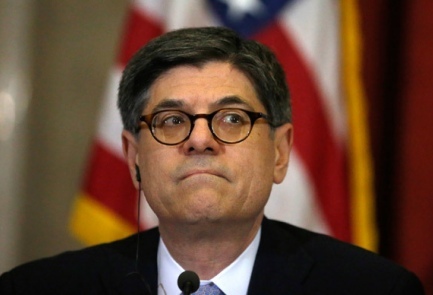
143393177342310791a_bU.S. Treasury Secretary Jacob Lew | Photo credit: Reuters

Under the sanctions developed over decades, hundreds of companies and individuals have been penalized not only for their roles in the country’s nuclear program but also for ballistic missile research, terrorism, human rights violations and money laundering.

Officials say the administration can meet its obligations because of how it interprets nuclear sanctions.

For example, they say measures designed to stop Iran from acquiring ballistic missiles are nuclear-related because they were imposed to push Iran into the negotiations. Also, they say sanctions that may appear non-nuclear are often undergirded by previous actions conceived as efforts to stop Iran’s nuclear program.

***********************

The Obama administration may have to backtrack on its promise that it will suspend only nuclear-related economic sanctions on Iran as part of an emerging nuclear agreement, officials and others involved in the process told The Associated Press Tuesday.

The problem derives from what was once a strong point of the broad U.S. sanctions effort that many credit with bringing Iran to the negotiating table in the first place.

Administration officials vehemently reject that any backtracking is taking place, but they are lumping sanctions together, differently from the way members of Congress and critics of the negotiations separate them.

Under the sanctions developed over decades, hundreds of companies and individuals have been penalized not only for their roles in the country’s nuclear program but also for ballistic missile research, terrorism, human rights violations and money laundering.

Now the administration is wending its way through that briar patch of interwoven economic sanctions.

The penalties are significant. Sanctioned foreign governments, companies or individuals are generally barred from doing business with U.S. citizens and businesses, or with foreign entities operating in the American financial system. The restrictions are usually accompanied by asset and property freezes as well as visa bans.

Negotiators hope to conclude a final nuclear deal by June 30. According to a framework reached in April, the U.S. will be required to lift sanctions that are related to Iran’s nuclear program but could leave others in place. President Barack Obama can suspend almost all U.S. measures against Iran, though only Congress can revoke them permanently.

“Iran knows that our array of sanctions focused on its efforts to support terrorism and destabilize the region will continue after any nuclear agreement,” Treasury Secretary Jack Lew told a gathering of American Jews in a weekend speech. U.S. officials will “aggressively target the finances of Iranian-backed terrorist groups and the Iranian entities that support them,” he said, including the Lebanese militant group Hezbollah and Iran’s Quds Force.

The Treasury Department’s sanctions point man, Adam Szubin, has been tasked with sorting out the mess, according to U.S. officials, though no clear plan has yet been finalized.

Officials say the administration can meet its obligations because of how it interprets nuclear sanctions.

For example, they say measures designed to stop Iran from acquiring ballistic missiles are nuclear-related because they were imposed to push Iran into the negotiations. Also, they say sanctions that may appear non-nuclear are often undergirded by previous actions conceived as efforts to stop Iran’s nuclear program.

The officials who provided information for this story spoke only on condition of anonymity because they were not authorized to speak publicly on the private discussions.

After years of negotiations, U.S. officials believe a deal is within reach that for a decade would keep Iran at least a year from being able to build a nuclear weapon.

In return, the U.S. would grant billions of dollars in relief from sanctions that have crippled Iran’s economy. But the whole package risks unraveling if the U.S. cannot provide the relief without scrapping sanctions unrelated to Iran’s nuclear program.

Administration officials say they are examining a range of options that include suspending both nuclear and some non-nuclear sanctions, a step that would face substantial opposition in Congress and elsewhere. Under one scenario, the U.S. could end non-nuclear restrictions on some entities, then slap them back on for another reason. But Iran could then plausibly accuse the U.S. of cheating on its commitments.

U.S. President Barack Obama has spoken about Iran potentially recouping up to $150 billion in assets trapped overseas. The process for how that would take place is still being worked through, said officials.

The Iranian Central Bank may prove the most glaring example of the administration’s dilemma, and officials acknowledge there is no way to give Iran the sanctions relief justified by its compliance without significantly easing restrictions on the institution.

The bank underpins Iran’s entire economy, and for years the U.S. avoided hitting it with sanctions, fearing such action would spread financial instability and raise oil prices. By late 2011, with Iran’s nuclear program advancing rapidly, Obama and Congress did order penalties, declaring the bank a “primary money laundering concern” and linking its activity to ballistic missile research, terror financing and support for Syrian President Bashar Assad.

The effects were far-reaching: Petroleum exports fell by 60%, Iran suffered runaway inflation, cash reserves dried up and industrial output in several sectors plummeted. And Iran agreed to talk about its nuclear program with the United States and five other world powers.

Now that the nuclear agreement is so close, Iran wants these sanctions lifted. The administration officials say all sanctions on the bank are nuclear-related.

Lew told the Jewish conference in New York that a nuclear accord would include the suspension of all “secondary” oil, trade and banking restrictions — those that apply to U.S. and non-U.S. banks, as well as foreign governments.

Many of these measures overlap with American sanctions tied to Iran’s nuclear program, and that has officials considering new sanctions to keep certain Iranian institutions under pressure.

Eliminating the secondary sanctions across the board could have wide-ranging implications, making it easier for Iran’s Revolutionary Guard Corps and its police, intelligence services and paramilitary groups to do business.

That possibility has Iran’s rivals in the region, including Israel and the Sunni monarchies of the Middle East, gravely worried.

“I share their concern,” Gen. Martin Dempsey, the Joint Chiefs of Staff chairman, said Tuesday in Jerusalem.

“If the deal is reached and results in sanctions relief, which results in more economic power and more purchasing power for the Iranian regime, it’s my expectation that it’s not all going to flow into the economy to improve the lot of the average Iranian citizen,” he said.

“I think they will invest in their surrogates. I think they will invest in additional military capability.”

Iran’s Revolutionary Guard is under U.S. sanctions because of its proliferation of weapons of mass destruction. But because the U.S. views the corps as so pernicious, the administration is considering new measures to help block it from meddling in the internal conflicts of Iraq, Lebanon, Syria and Yemen.

Of the 24 Iranian banks currently under U.S. sanctions, only one — Bank Saderat, cited for terrorism links — is subject to clear non-nuclear sanctions. The rest are designated because of nuclear and ballistic missile-related financing, while several are believed to be controlled by the Revolutionary Guard.

Will they be cleared for business with the world? U.S. officials still cannot say one way or another. Congress, too, has not received a list of banks and institutions that would be released from sanctions under the deal.

If the United States cannot deliver on its promises, it could take the blame for a collapse of the years-long negotiations toward a nuclear deal, putting the world — in the words of Obama and other U.S. officials — on a path toward military confrontation. At the same time, an Iran unburdened by sanctions could redouble efforts toward nuclear weapons capacity, while international unity and the global sanctions architecture on Tehran fray.

Gulf War V: The Sequel

June 10, 2015

Thousands of US paratroops head for Iraq. Tehran braces for onset of ISIS terror attacks on cities

DEBKAfile Special Report June 10, 2015, 9:01 AM (IDT)


ISIS heading for Tehran while killing everyone else.

(Hopefully, running from the enemy and leaving US military hardware behind will be covered in the training we once again provide to the Iraqi army. – LS)

The United States this week began transferring to Iraq and Gulf bases elite units of the US 82nd Airborne Division. DEBKAfile’s military sources report that the first batch of 500 officers and men will be deployed in Baghdad and the Kurdish republic’s capital of Irbil, followed by another 500 in July and 250 in December. Altogether, by the end of 2015, the US will have posted another 1,250 officers and men to augment the American force already present at a base ner Habbaniya in the western Iraqi Anbar province. This force, roughly the same size as the incoming contingents, came from the US 3rd Division’s Combat Team which set up the base six months ago to train Iraqi troops to fight the Islamic State of Iraq and the Levant – ISIS.
By the end of the year, therefore, the number of US troops on the ground in Iraq will rise to several thousand. Our military sources define their mission as being to intensify raids on ISIS commanders, command centers and bases and striking columns on the move. Their operations will draw on the successful attack mounted by SEAL commandos on May 16 in the heart of the Islamist stronghold in eastern Syria. The group’s chief of finances was killed in that raid and, according to American sources, the troops carried off a rich intelligence trove of digital and telephone data on the Islamist State’s tactics and structure.
The 82nd division has abundant experience of combat in the Iraqi arena. Between the 2003 US invasion and up until 2009, its members fought in critical engagements, especially in Anbar province, which ISIS has made the its main depot for large military concentrations and a launching pad for attacks across Iraq.

The figure of 3,000 American soldiers in Iraq understates the case by far. A much larger pool of combat forces is available close at hand for inserting into the cycle of war on ISIS.
Posted in Jordan just across the border from Anbar is a sizeable number of US special operations forces, and air units of F-16 fighter bombes and UH-60 Black Hawk assault helicopters. Their numbers have never been released.  Another several thousand troops are stationed in Kuwait. The Pentagon therefore has a reserve force present and available for a directive to go into action, oncef a decision for the US military to step into combat against the Islamists in Iraq and Syria is confirmed by President Barack Obama.

All these units are geared to fighting in the two arenas in the framework of the 82nd Airborne Division.

This week, too, the Pentagon started pumping new weapons to the Iraqi army under the US commitment of $1.6 billion from the Iraq Train and Equip Fund – ITEF – to equip its units with appropriate arms for combating ISIS.

Tuesday, June 9, ISIS appeared unfazed by the United States inching ever closer to a direct confrontation.  Iranian cities included Tehran were placed on terror alert, DEBKAfile’s intelligence and counter-terror sources report, after intelligence discovered that the Islamic State had started sending squads of terrorists and lone suicide bombers to execute Baghdad-style terrorist attacks on urban areas in Iran.
ISIS tacticians were said to be so encouraged by their success in blowing up two Shiite mosques in Saudi Arabia’s Eastern Province in recent weeks that they decided to have a go at Iranian cities too.
Also Tuesday, ISIS claimed in a new video that it had come up with a new strategy for taking Baghdad, not to conquer, but to “liberate” the Iraqi capital.

‘Wishful Thinking’: Obama’s ex-military intel chief blasts Iran talks in scathing testimony

June 10, 2015

‘Wishful Thinking’: Obama’s ex-military intel chief blasts Iran talks in scathing testimony | Fox News.

A former top military intelligence official under President Obama on Wednesday blasted the administration’s pursuit of a nuclear deal with Iran, calling it a “placeholder” based on “wishful thinking.” 

Retired Lt. Gen. Michael Flynn, former head of the Defense Intelligence Agency, delivered pointed and detailed criticism of the Iran deal framework — as well as the U.S. response to the violence in Iraq and Syria — in written testimony to a House Foreign Affairs subcommittee.

“It is clear that the nuclear deal is not a permanent fix but merely a placeholder,” he said in the testimony, obtained by Fox News in advance of a hearing where he’s set to testify.

He said the 10-year timeframe on parts of the deal “only make sense” if the U.S. thinks a “wider reconciliation” with Iran is possible. He called this “wishful thinking,” adding that “regime change” is the best way to stop Iran’s nuclear weapons program.

In lengthy written remarks, Flynn asserted that Iran has “every intention” of building a nuclear weapon, and their desire to destroy Israel is “very real.”

“Iran has not once (not once) contributed to the greater good of the security of the region,” he said in his remarks, noting their fighters “killed or maimed thousands of Americans and Iraqis” in Iraq.

The administration is working alongside five other world powers to try and strike a nuclear deal — which would aim to curb Tehran’s nuclear program in exchange for sanctions relief — by the end of the month. But Flynn said Iran already has made it clear they will put limits on inspections, making for “incomplete verification.” Plus he said it’s “unreasonable” to believe international sanctions could be resumed once lifted.

He also echoed concerns of some other analysts in saying the “perceived acceptance” of Iran’s program will likely “touch off a dangerous domino effect in the region” as Saudi Arabia and other nations seek nuclear capability.

As for the rising threat posed by the Islamic State in Iraq and Syria, Flynn voiced concern that the U.S. is not keeping up with the crisis. He said there is “absolutely no end in sight,” and “no clear U.S. policy” for dealing with it.

Legal Experts Slam IDF for Over-Warning Gazans

June 10, 2015

Int’l Legal Experts Slam IDF – For Over-Warning Gazans

Experts from US, Germany warn IDF ‘legal zeal’ sets dangerous precedent tying hands of democracies fighting terror.

By Ari Yashar

First Publish: 6/9/2015, 10:30 PM

via Legal Experts Slam IDF for Over-Warning Gazans – Defense/Security – News – Arutz Sheva.

The IDF went to extraordinary lengths last summer to prevent civilian casualties while fighting Hamas terrorists in Gaza, achieving a remarkable 1:1 civilian to combatant ratio, but according to international legal experts it went too far in avoiding casualties among the enemy population.

Willy Stern of Vanderbilt Law School, in an article to be published next Monday in the Weekly Standard, details what he found while spending two weeks with attorneys in the IDF’s international law department dubbed “Dabla” as well as front-line commanders, and documents the IDF’s “legal zeal” which as he notes has not stemmed the deluge of international criticism against it.

Stern listed how the IDF bombarded Gaza residents with thousands of telephone calls, leaflet drops, TV and radio messages, as well as calls to influential citizens urging them to evacuate residents, and in doing so gave the terrorist enemy detailed information about its troop movements.

“It was abundantly clear that IDF commanders had gone beyond any mandates that international law requires to avoid civilian casualties,” writes Stern. He reported how Dabla attorneys have to sign off on a “target card” for each airstrike on terror targets, with the cards enumerating all of the relevant data about the planned strike.

In contrast, the Hamas “doctrine manual” captured by the IDF in the Shejaiya neighborhood early last August documents how the terror group urges its fighters to embed themselves among civilians in hopes that the IDF will kill civilians.

“Hamas’s playbook calls for helping to kill its own civilians, while the IDF’s playbook goes to extreme​ – ​some say inappropriate​ – ​lengths to protect innocent life in war,” reads the article.

“IDF harming fight against terror”

Indeed, international legal experts quoted in the article argued that the IDF’s actions do go to inappropriate measures, and may end up harming the ability to fight terrorist organizations.

Wolff Heintschel von Heinegg, a military law expert at European University Viadrina in Frankfurt, Germany, was brought by Dabla to train IDF commanders about armed conflict laws.

Heinegg was quoted saying the IDF went to “great and noble lengths” to avoid civilian casualties, but warned the IDF is taking “many more precautions than are required.”

As a result, he expressed his fear that the IDF “is setting an unreasonable precedent for other democratic countries of the world who may also be fighting in asymmetric wars against brutal non-state actors who abuse these laws.”

Sharing his assessment was Pnina Sharvit Baruch, a senior researcher at the Institute for National Security Studies (INSS) and former Dabla chief.

She said legal advisers from other militaries around the world confront her with “recurring claims” that the IDF “is going too far in its self-imposed restrictions intended to protect civilians, and that this may cause trouble down the line for other democratic nations fighting organized armed groups.”

Michael Schmitt, director of the Stockton Center for the Study for International Law at the US Naval War College, also agreed that the IDF is creating a dangerous state of affairs that may harm the West in its fight against terrorism.

“The IDF’s warnings certainly go beyond what the law requires, but they also sometimes go beyond what would be operational good sense elsewhere,” he warned.

“People are going to start thinking that the United States and other Western democracies should follow the same examples in different types of conflict. That’s a real risk,” said Schmitt.