Archive for June 4, 2015

Obama Admin Scrambles to Reassure Congress on Iran Nuke Deal in Classified Brief

June 4, 2015

Obama Admin Scrambles to Reassure Congress on Iran Nuke Deal in Classified Brief

Administration still withholding key docs from Congress

BY:
June 4, 2015 2:20 pm

via Obama Admin Scrambles to Reassure Congress on Iran Nuke Deal in Classified Brief | Washington Free Beacon.

The Obama administration is scrambling to reassure members of Congress about an impending nuclear deal with Iran amid a still growing controversy that has publicly pitted senior State Department and White officials against the New York Times and veteran D.C. reporters.

Secretary of Energy Ernest Moniz and a team of scientists headed to Capitol Hill Tuesday in an effort to quiet concerns over the weakness of an impending final nuclear deal with Iran, according to sources apprised of the classified meeting.

Lawmakers, including Sen. Bob Corker (R., Tenn.), chairman of the Senate Foreign Relations Committee, emerged from the meeting concerned that the Obama administration would secure a deal with Iran that fails to adequately check the Islamic Republic’s ability to build a nuclear weapon.

The administration’s attempts to bolster congressional support for its negotiations with Iran come as senior officials publicly work to downplay the fallout over a New York Times report disclosing that Iran’s nuclear stockpiles have significantly grown in recent months in a potential violation of past agreements with Western nations.

Congressional leaders have additionally accused the administration of stonewalling attempts to obtain key documents explaining what exactly Iran would have to do under any final nuclear agreement.

One congressional source familiar with Tuesday evening’s classified briefing said that Obama administration officials sought to explain the ways it would ensure Iran does not obtain a nuclear weapon capability under any final deal.

“Since the verification regime and establishing Iran’s breakout capability are critical to evaluating any nuclear deal with Iran, the briefing from the secretary of energy and the directors of U.S. nuclear laboratories was arranged to help members understand in more detail the technical aspects of Iran’s nuclear program,” said one Republican aide to the Senate Foreign Relations Committee.

The issue of verification continues to concern lawmakers and critics of the administration’s diplomacy.

“As negotiators from the P5+1 nations and Iran attempt to meet a June 30 deadline for a final agreement, the committee is holding a series of briefings and hearings this month to prepare members for congressional review of a final deal if one is reached,” the source said.

Corker, who participated in the classified briefing, accused the administration on Wednesday of misleading the public about the parameters of a final deal.

“Last night we met with scientists in a classified setting about laboratories and our secretary of energy to make sure Congress really understands all the details of this, can raise concerns,” Corker told Fox News. “We know there is already an agreement relative to the Iranian nuclear development program beginning in year 10” on any final deal.

“When the president said in that clip that you played that they can not get a nuclear weapon for 20 years, that is contrary to what he said on NPR right after the April 2nd agreement,” Corker explained.

Corker and others have been trying to obtain a document that offers the precise details of what the administration has tentatively agreed to. However, officials will not hand it over to Congress.

“There is a document that explains what Iran is able to do per the agreement after the 10-year period,” Corker said in a separate interview Wednesday on CNN. “I have asked the State Department for the document. They have not given it to me. I have asked the Energy Department for the document. They have not given it to me. I’ve asked the White House for the document. They have not given it to me.”

“The only thing I can imagine … is that they think that it would shed [a] bad light on what they have agreed to,” Corker added. Most of us want to make sure that if we’re going to enter into an agreement, it is an agreement that will keep Iran from developing a nuclear weapon over a long term.”

Corker expressed further concern about multiple concessions made by the Obama administration during discussions with Iran.

Iran, for instance, is pushing for major relief from economic sanctions before they comply with the nuclear agreement. It also is demanding permission to continue sensitive nuclear research and weapons work.

Meanwhile, the State Department and White House National Security Council (NSC) continue to spar with reporters over the Times’ report about growth in Iran’s stockpile of low-enriched uranium, the key component in a nuclear weapon.

The article was widely seen as challenging the administration’s assertion that an interim agreement struck with Iran in 2013 had frozen its nuclear program. This has been a key claim in the administration’s efforts to convince skeptical lawmakers that the Iranians can be trusted to abide by the terms of a final nuclear agreement.

A new report by the Pentagon claims that Iran is continuing to develop missile systems capable of carrying a nuclear payload.

WAKE UP EUROPE ISRAEL IS FIGHTING YOUR WAR

June 4, 2015

WAKE UP EUROPE ISRAEL IS FIGHTING YOUR WAR, You Tube, June 1, 2015

H/t joopklepzeiker

Did Obama threaten to withhold support from Israel at the UN during an Israeli TV interview?

June 4, 2015

Did Obama threaten to withhold support from Israel at the UN during an Israeli TV interview? | Anne’s Opinions, 3rd June 2015

(Obama continues with his war against Bibi. He’s incapable of separating the personal from the national — anneinpt)


Barack Obama is interviewed by Ilana Dayan for Israeli TV channel 2

US President Barack Obama has once again opened his mouth and put his foot in it, compounding all the errors he made in his speech at the Washington synagogue last week. Certainly that is the strong impression have received from watching his interview with Ilana Dayan on Israeli TV channel 2. While I don’t always like Dayan’s style, her agenda and her leading questions – including in this interview – she also presented Netanyahu’s standpoint fairly, and it was unpleasant, if unsurprising, to hear Obama’s veiled threat against Israel. Although we’ve heard similar words and threats from Obama previously, and quite recently, it’s a different matter altogether when they are spoken to Netanyahu’s “home audience”.

Watch and listen to the video excerpt of his interview embedded in the Arutz Sheva report linked here below.

Here is Arutz Sheva’s analysis:

US President Barack Obama gave an interview with Israeli media on Tuesday, in which he threatened that an Israeli refusal to renew peace talks with the Palestinian Authority (PA) will “make it hard” for the US to veto motions in the UN against Israel.

In an interview with Ilana Dayan for Channel 2‘s “Uvda” (Fact) TV show aired Tuesday night, Obama commented on Prime Minister Binyamin Netanyahu’s statements before elections in which he said that a Palestinian state won’t be founded on his watch.

Obama noted that later Netanyahu distanced from the statement and “suggested that there is the possibility of a Palestinian state. But it has so many caveats, so many conditions, that it is not realistic to think that those conditions would be met anytime in the near future.”

Those conditions have included the recognition of Israel as a Jewish state and demilitarization, conditions that proved problematic in the last round of peace talks that Obama pushed into existence in late 2013.

The president continued, “and so the danger here, is that…Israel as a whole loses credibility. Already the international community does not believe that Israel is serious about a two states solution…the statement the Prime Minister made compounded that…belief that there’s not a commitment there.”

I find it fascinating in a sick sort of way that Obama makes no such demands for credibility from the Palestinians. (I mentioned this point in my earlier post on Obama’s speech to the Washington synagogue).

Describing Netanyahu, Obama said, “I think that he also is someone who has been skeptical about the capacity of Israelis and Palestinians to come together on behalf of peace. I think that he is also a politician, who’s concerned about keeping coalitions together and maintaining his office.”

Goodness me! Netanyahu is a – gasp! – politician! And behaving like one too! Who’d ever have thunk it?

“Netanyahu…is somebody who’s predisposed to think of security first. To think perhaps that peace is naive,” he continued. “To see the worst possibilities, as opposed to the best possibilities in Arab partners or Palestinian partners, and so I do think that right now, those politics, and those fears are driving the government’s response. And, I understand it, but…what may seem wise and prudent on the short-term, can actually end up being unwise over the long-term.”

Obama then issued a threat to Israel, referring to his remarks after the recent Israeli elections when he said America would have to reasses its policy towards Israel, and clarifying that at the time he was referring to something specific.

“If there are additional resolutions introduced in the United Nations…up until this point we have pushed away against European efforts for example, or other efforts. Because we’ve said, the only way this gets resolved is if the two parties worked together,” he said, referring to European moves to unilaterally recognize the PA as a state.

The president said security aid to Israel won’t cease, but warn that, “if in fact, there’s no prospect of an actual peace-process, if nobody believes there’s a peace process, then it becomes more difficult, to argue with those who are concerned about settlement construction, those who are concerned about the current situation, it’s more difficult for me to say to them ‘be patient! wait! Because we have a process here.’ Because, all they need to do is to point to the statements that have been made saying there is no process.”

Obama returned to his personal image of Israel as it was in the glorious 1960s, as he referenced in his Washington synagogue speech too:

Referencing the Jewish nature of Israel, Obama said, “I am less worried about any particular disagreement that I have with Prime Minister Netanyahu. I am more worried about…an Israeli politics that’s motivated only by fear. And that then leads to a loss of those core values, that when I was young and I was admiring Israel from afar…were…the essence of this nation. There are things that you can lose, that don’t just involve rockets.”

And then we come to the main event – the existential threat faced by Israel from Iran’s nuclear weapons program – and the President is either woefully ignorant or lying through his teeth:

Turning his attention to Iran and the deal being formed with it on its nuclear program ahead of a June 30 deadline, he claimed that sanctions have caused Iran to keep its agreements in negotiations.

“I’ve said that, in exchange for some modest relief in sanctions, that Iran is going to have to freeze its nuclear program, roll back on its stockpiles of very highly enriched Uranium – the very stockpiles that Prime Minister Netanyahu had gone before the United Nations, with his picture of the bomb and said that was proof of how dangerous this was.”

“At that time, everybody said ‘this isn’t going to work! They’re going to cheat, they’re not going to abide by it.’ And yet, over a year and a half later, we know that they have abided by the letter of it,” claimed Obama.

His assertion is in fact false; Iranian nuclear fuel stockpiles grew by a massive 20% over the past 18 months of negotiations between Iran and world powers, as revealed in a report last month by the International Atomic Energy Agency (IAEA).

Arlene Kushner has more to say on the subject in her aptly titled article “Outrageous!”:

Intoned Obama:

“I can, I think, demonstrate, not based on any hope but on facts and evidence and analysis, that the best way to prevent Iran from having a nuclear weapon is a verifiable, tough agreement.

“A military solution will not fix it. Even if the United States participates, it would temporarily slow down an Iranian nuclear program but it will not eliminate it.”

http://www.timesofisrael.com/obama-a-deal-only-way-stop-iran-no-military-option/

It’s difficult to know where to begin.

Perhaps what is most outrageous here is that he has just announced to Iran that no matter what, the US will not be attacking.

We all knew that, of course. But the US policy, enunciated every so often, has been that all options, including the military option, were on the table.

What Obama has done here, in pulling the military option off the table, is not something that should be done when in the midst of negotiations. Not if the desire is to come out with the best possible deal: then you negotiate from strength and, at the very least, keep the your adversary guessing.

This tells us a great deal about Obama’s lack of seriousness in the negotiations.

~~~~~~~~~~

Or perhaps this is the most outrageous aspect of what he has said: He is trying to convince the Israeli public that there is no point in attacking Iran, because a military solution won’t work.

My friends, at this point in time, a military solution is the only thing that will work!


What is more, it is not true that a military solution would only slow down Iran’s operation. Let’s parse what he said, for a moment. He didn’t refer to the US attacking Iran, but to the US “participating,” which means Israel would have the lead. This is different from a determined attack from strength directly by the US.

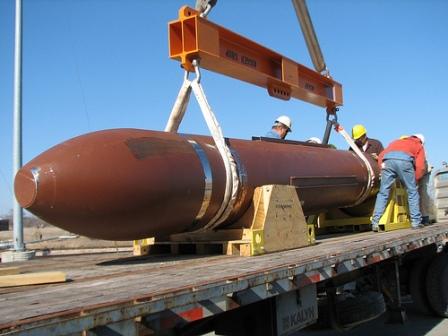
It is true that Israel can only set back Iran’s operation – I’ve been told by three to five years (which would be no small matter). That’s because Israel does not have the enormous 30,000 pound bunker busters – the Massive Ordnance Penetrators – that would be required to break through Iran’s underground fortifications.

But the US has them, and has the B-2 and B-52 bombers required for carrying them.

~~~~~~~~~~

In fact, let me carry this one step further:

A mere two months ago, it was announced that the Pentagon had just upgraded and tested its bunker busters

“According to senior officials, the results show the improved bomb—when dropped one on top of the other—is now more capable of penetrating fortified nuclear facilities in Iran or in North Korea, The Wall Street Journal reported. The Pentagon also designed the bunker buster to challenge Iran’s Fordow facility, which is built into a mountain to protect it from potential airstrikes.

bunker-buster bomb


“It’s believed that the above mentioned measures will allow the destructive weapon to be targeted with a precision previously possible only for far smaller guided US bombs.”

http://rt.com/usa/246753-pentagon-ugraded-bunker-bomb/

Clearly, the Pentagon and the Obama administration are not of the same mind. Also not news. But in light of the Pentagon’s improvements to the bunker busters, Obama’s statement about the military option not being able to “fix” the situation is a glaring misrepresentation. In other words, it’s a lie.

So Obama is (probably) lying about the Iranians freezing their stockpile and he’s lying about the chances of success with the military option.

At the risk of repeating myself, as was pointed out in my earlier post, he’s also lying to himself or to us about the rationality and antisemitism of the Iranian regime. Even a Lebanese journalist has noted that Obama will defend antisemitism in order to spin his miserable deal with the Iranians.

Is there anything this man says that we can trust?

Exclusive: Tehran expected to invoke defense pact for large-scale troop deployment to Syria

June 4, 2015

Exclusive: Tehran expected to invoke defense pact for large-scale troop deployment to Syria.

DEBKAfile Exclusive Report June 4, 2015, 8:26 PM (IDT)
ISIS moves in on Syrian Kurdish town of Hasakeh

ISIS moves in on Syrian Kurdish town of Hasakeh

Thursday, June 4, reliable sources in Tehran expected the Iranian government to invoke its 2006 mutual defense pact with Syria “in the coming hours” for the transfer of Iranian troops to Syria – most likely by air. This was reported by debkafile’s exclusive military and intelligence sources. It would be Tehran’s first direct military intervention in the Syria conflict as it goes into its fifth year. Bashar Assad’s regime and the Syrian and Hizballah armies are collapsing under the twin assaults of the Islamic State and the armed Syrian opposition forces and in need of urgent life support.

The possibility of invoking the Iranian-Syrian mutual defense pact for saving the Assad regime was first raised in a debkafile article on May 30.

Tehran was persuaded that, without direct intervention, its ally would go under at any moment Thursday when Islamic State forces broke through Syrian army defenses to the northern Syrian Kurdish town of Hasakeh, which sits on the Syrian-Iraqi-Turkish border junction. Towards evening, the Islamists had come to within one kilometer of the strategic town and captured its power station. Its defenders, the Syrian army’s 52nd Division, were falling apart under the ISIS assault; some of the soldiers making a run for it.

Although the town is ruled by a coalition of central government and local Kurds, there was no operational coordination between the Syrian and Kurdish forces defending the town against the common enemy.

If ISIS manages to take Hasakeh, it would chalk up its third major victory in a couple of weeks after capturing Palmyra in Syria and the Iraqi town of Ramadi. Its fall would provide the Islamists with an open route across northern Syria to northern Iraq and strengthen their grip on Mosul, their Iraqi capital.
It would also count as a major setback for the United States, whose air strikes in support of Hasakeh’s Kurdish defenders failed to stall the Islamist advance.

In the southern sector too, Syrian troops of the 68th and 13th divisions defending Deraa are reported to have laid down arms and fled under the massive onslaught of the opposition Army of Conquest coalition.

Tehran’s final decision about sending a substantial Iranian force to Syria is awaited in the coming hours. This intention was strongly intimated in the last 48 hours by Adm. Ali Shamkhani, head of Iran’s National Security Council, and Gen. Qassem Soleimani, supreme commander of Iran’s Middle East operations. Both announced that dramatic events for Syria are to be expected in the coming days.

Rabbi Obama’s tough love

June 4, 2015

Israel Hayom | Rabbi Obama’s tough love.

David M. Weinberg

If anybody had any doubts about what is in store for Israel over the next 19 months, U.S. President Barack Obama has now made it clear: a long, painful political shellacking for what he sees as Prime Minister Benjamin Netanyahu’s amoral behavior.

In order to rescue the lofty values of tikkun olam (healing the world) and Zionism from the Neanderthal conservatives who threaten to ruin Israel, Obama is going to harangue and muscle Israel into a course correction — back to the “true” moral values of Judaism and Zionism on which he is such an expert. He is on a crusade (or should I say, jihad) to save Israel from itself, no less.

That is the upshot of Rabbi Obama’s smug sermonizing over the past two weeks: in an Atlantic interview with Jeffrey Goldberg, at Adas Israel synagogue in Washington, and in an interview on Israeli television with Ilana Dayan, Obama is nostalgic for the good ol’ days when WASP Israelis (white, Ashkenazi, secular and socialist, pioneers) ruled these parts and dreamed all day long of conceding the land they worked to the Palestinians and of bringing peace to the Middle East.

And since Obama so agonizes for wayward Israel, and since he is such an authority on “real” Judaism and “authentic” Zionism, he feels morally compelled to shove his point down the throats of Israeli Likud and Habayit Hayehudi voters. It’s all for their own good. After all, he knows what is truly best for Israel.

It has taken almost 40 years, but we now have in the White House a cross between the hyper-critical George W. Ball (see “How to save Israel in Spite of Herself,” Foreign Affairs, 1977) and the riotous-extremist Rabbi Michael Lerner of Tikkun Magazine. Oy.

It goes without saying that the very judgmental Obama has no such tough love to share with the Palestinians or other radical, anti-Semitic and anti-American Islamists in the region. He is not an expert on true Islam, you see, thus he dare not reproach them about their moral values. He didn’t grow up loving and admiring Anwar Sadat, like he did loving former Israeli premier Golda Meir and the kibbutzim.

So, Iran and the Islamic State group can rape and pillage across the region — but Rabbi Obama knows mainly how to scold and squeeze Israel.

Palestinian Authority President Mahmoud Abbas can accuse Israel of genocide, assault Israel with war crime charges at the International Criminal Court, laud terrorists in Jerusalem, cut “unity accords” with Hamas, maintain rejectionist positions on all the key peacemaking issues and have his television stations, newspapers and mosque preachers blather blood libels and other venalities about Jews as Nazis and Satan — but Rabbi Obama knows mainly how to scold and squeeze Israel.

Out of true love, don’t you know!

Obama’s moralizing appeal to Jewish and Zionist “values” is actually a sly trick. If you pitch your political views as “values” and your opponents’ position as a breach of “values,” then your threat of punishment suddenly seems noble.

Hudson Institute expert Michael Doran theorizes that Obama’s moralizing appeal to “liberal values” is part of a concerted attempt to distance American Jews from Netanyahu. After all, Obama represents “American Jewish values” better than Netanyahu! This, in turn, Doran posits, is meant to weaken opposition within the American Jewish community to Obama’s pact with Iran.

I don’t know whether the trick will work for the deal with Iran, but it is clear to me that Obama is attempting to soften up domestic opposition to a policy shift whereby the administration will effectively abandon Israel at the United Nations. Obama more than hinted at that in his Israeli television talk.

It is also evident that “Obamazionism” is indeed accelerating the divide between American Jews and Israel. Obama’s assailing of Netanyahu has already dangerously impacted the discourse about Israel among American Jewry.

In a pretentious article last week entitled “A message to centrist American Jews: Time to speak out,” E. Robert Goodkind and Martin J. Raffel of the Israel Policy Forum engage in new agonizing about Israel, moral values and their roles.

Just like Rabbi Obama, they have discovered a “need” to be “true” to some conjured-up and pleasing “centrist values”; to have “honest” (i.e., frank) conversations with Israel; and to “speak out honestly” to advance their “long-held principles.”

Just like Obama who “feels a responsibility to speak out honestly” about what he thinks will lead to long-term security and “to the preservation of a true democracy in the Jewish homeland,” these American Jewish leaders assert a newfangled “obligation to act” so that Israel bows to their supreme, honest-centrist values.

Just like Obama, they “want honesty,” and they want “to speak truth to power.” They employ the term “honest” no less than seven times.

“Honesty means telling the Israeli government that achieving peace with the Palestinians must be an active enterprise, not a goal grudgingly endorsed,” they add. “This involves leaving most of the West Bank,” declaim these centrist, expert, and honesty-seeking Jewish leaders.

Unfortunately, I’m not making this headstrong stuff up. It is amazingly arrogant: We know better than the Israelis who live in Israel what is better for Israel and Jewish values. Alas, this sentiment dovetails neatly with the “saving Israel in spite of herself” discourse that Obama is inciting.

I say to Rabbi Obama and the IPF leaders: Spare us your honest exhortations. Enjoy your self-satisfying centrist values, but don’t fool yourself into thinking that you’re doing Israel any favors by declaring the parameters of what withdrawals and other Israeli foreign and defense policies “must be.”

I say no thanks to your tough love. I encourage you to “confront your values” and re-engage Israeli democracy on a more realistic and respectful basis.

War Crimes In GAZA

June 4, 2015

New documentary from Pierre Rehov, this is the trailer , soon the full version.

Who Is Blocking Palestinian Elections?

June 4, 2015

Who Is Blocking Palestinian Elections? The Gatestone InstituteKhaled Abu Toameh, June 4, 2015

  • Fatah is afraid that Hamas’s chances of winning the elections, especially in the West Bank, are very high. Hamas is not willing to relinquish control over the Gaza Strip, certainly not to Abbas and the Palestinian Authority, who were expelled from there in 2007.
  • Each party cares only about its own interests, while at the same time lying to the world that it is all Israel’s fault. Hamas continues to invest enormous resources in digging new tunnels, in preparation for a new war with Israel.
  • All this is being done with the help of anti-Israel governments around the world, and groups such as the Boycott, Divestment and Sanctions (BDS) movement, whose only goal is to delegitimize Israel and demonize Jews rather than to help the Palestinians.

One year after Palestinian Authority (PA) President Mahmoud Abbas announced the establishment of the Palestinian Fatah-Hamas “national consensus” government, the two rival parties remain as far apart as ever.

The “national consensus” government, headed by Prime Minister Rami Hamdallah, was formed after a series of “understandings” between Fatah and Hamas on the basis of previous “reconciliation” agreements between the two sides.

A year later, it has become obvious that the “national consensus” government has failed to achieve its main objectives: the reconstruction of the Gaza Strip; ending the conflict between Hamas and Fatah, and preparing for new presidential and parliamentary elections.

Fatah and Hamas can only blame each other for the failure of the latest attempt to end their dispute and do something good for their people. There is no way this time that they could lay the blame on Israel.

The two parties had a chance to cooperate on the reconstruction of the Gaza Strip in the aftermath of last year’s military confrontation between Israel and Hamas. The international community even offered to assist in the mission, but Fatah and Hamas chose to continue fighting each other at the expense of Palestinians in the Gaza Strip. Until today, the two rival Palestinian parties have not been able to reach agreement on a mechanism for the transfer of funds from international donors to the Gaza Strip.

Fatah claims that Hamas wants to steal the money, while Hamas is already accusing Fatah and the Palestinian Authority government of working to lay their hands on the funds.

Fatah and Hamas agreed back then that the Hamdallah government would remain in office for only six months — the period needed to prepare for long overdue presidential and legislative elections in the West Bank and Gaza Strip. But the “interim” government has just completed its first year in power, while the chances of holding new elections under the current circumstances are non-existent.

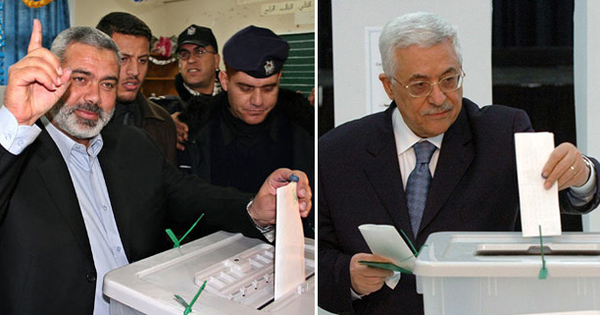
1096One man, one vote, one time? Hamas leader Ismail Haniyeh (left) and Fatah leader Mahmoud Abbas (also president of the Palestinian Authority) are pictured voting in the last election for the Palestinian Legislative Council, which took place in 2006.

Again, the two sides do not seem to be interested at all in sending Palestinians to the ballot boxes. Each side has many good reasons to avoid holding new elections in the West Bank and Gaza Strip.

First, Fatah and Hamas do not trust each other, and each side is convinced that the other would try to steal the vote. How can there be free and democratic elections while Hamas and Fatah continue to arrest and torture each other’s supporters in the Gaza Strip and West Bank?

Second, Fatah is afraid that Hamas’s chances of winning the elections, especially in the West Bank, are very high. That is because many Palestinians still do not trust Abbas and Fatah, whom they accuse of maintaining close security ties with Israel. Moreover, many Palestinians remain disillusioned with Fatah because of its failure to combat financial and administrative corruption and pave the way for the emergence of new leaders.

There is no way that Hamas and Fatah can cast the blame on Israel regarding the issue of elections. If they were really interested in holding new elections, they could do so with the help of the international community, as was the case with previous votes in 2005 and 2006. Israel even helped the Palestinian hold those elections.

When several Hamas candidates from east Jerusalem ran in the January 2006 parliamentary election, Israel did nothing to stop them. Israel even opened its post offices in the city to allow Arab voters from the city (who hold Israeli-issued ID cards) to vote in the election.

Charges made by some Palestinians and anti-Israel groups around the world, to the effect that Israel is responsible for “foiling” efforts to achieve Palestinian unity, are baseless. Although the Israeli government initially opposed the Fatah-Hamas “reconciliation” deal that was reached in 2014, it has not stopped the Palestinian prime minister and some of his cabinet members from visiting the Gaza Strip to pursue the implementation of the accord. In fact, Prime Minister Hamdallah has since visited the Gaza Strip twice, after receiving permission from Israel to go through the Erez border crossing.

Recently, ten Palestinian ministers were forced to leave the Gaza Strip, after Hamas placed them under house arrest in their hotel and banned them from meeting with locals. The ministers entered the Gaza Strip through the Erez border crossing. They came to the Gaza Strip to help solve the problem of thousands of Hamas government employees who have not received salaries for more than a year, and to discuss issues related to the reconstruction of the Gaza Strip.

So while Israel facilitated the visits by Hamdallah and his ministers to the Gaza Strip, it was Hamas that expelled them and prevented them from carrying out their duties. Had Israel expelled the ministers from the Gaza Strip or stopped them from entering the area, the country would have been condemned by the international community for “blocking” efforts to achieve Palestinian unity and rebuild the Gaza Strip.

Today, it has become unavoidably clear that Fatah and Hamas, and not Israel, are responsible for the ongoing plight of the Palestinians in the Gaza Strip. The two parties are unlikely to resolve their differences in the near future, further exacerbating the misery of their people. Each party cares only about its own interests, while at the same time lying to the world that it is all Israel’s fault. Hamas is not willing to relinquish control over the Gaza Strip, certainly not to Abbas and the Palestinian Authority, who were expelled from there in 2007. As for Abbas, he does not seem to be interested in regaining control over a problematic area such as the Gaza Strip, where most of the population lives under the poverty line and in refugee camps.

Yet instead of being honest with their people and admitting their failure to improve their people’s living conditions, Hamas and Fatah continue to wage smear campaigns against each other and, at the same time, also against Israel.

The campaigns that Hamas and Fatah are waging against Israel, particularly in the international community, are designed to divert attention from their failure to provide their people with basic services or any kind of hope.

While ignoring the plight of the Palestinians in the Gaza Strip, the Palestinian Authority leaders were prepared to invest huge efforts and resources in trying to have Israel suspended from the International Federation of Association Football (FIFA). It is as if the Palestinians had solved all their major problems and all that they needed to do now was to stop Israeli soccer players from playing in international matches.

Hamas, for its part, continues to invest enormous resources in digging new tunnels, in preparation for another war with Israel. The money that is being invested in the tunnels and the purchase and smuggling of weapons could benefit many families who lost their homes during the last war. But Hamas, like the Palestinian Authority, does not care about the misery of the Palestinians in the Gaza Strip. They want to fight Israel to the last Palestinian. And this is all being done with the help of anti-Israel governments around the world, and groups such the Boycott, Divestment and Sanctions (BDS) movement, whose only goal is to delegitimize Israel and demonize Jews rather than to help the Palestinians.

Iran Outsources Peaceful Nuclear Development to Country With Virtually No Electricity

June 4, 2015

Iran Outsourcing Nuclear Program to Korea

BY RYAN MAURO Thu, June 4, 2015 Via The Clarion Project


Iranian observers participate in a nuclear power plant test (Photo: © Reuters)

(Thanks for nothing, China. – LS)

The information about Iran’s ties to North Korea further highlights the “one step back, two steps forward” nuclear strategy of the Iranian regime.

The National Council of Resistance in Iran (NCRI), an opposition group famous for exposing Iran’s secret nuclear sites as early as 2002, claims that seven North Korean nuclear and missile experts were in Iran for one week in late April. The report substantiates concerns that Iran is outsourcing its nuclear weapons program to North Korea so it can cash in on a deal with the U.S.

The seven visitors allegedly had expertise in nuclear warheads and guidance systems for ballistic missiles. The International Atomic Energy Agency (IAEA) says it has “credible” evidence that Iran has worked on nuclear warheads for its Shahab-3 ballistic missiles as late as 2003, despite the regime’s denials.

The Iranian opposition group says the North Koreans stayed in an eight-story building named the Imam Khomeini Complex that is controlled by the Defense Ministry. It is located near the Shahid Hemmat Industrial Complex, which has a history of hosting North Korean scientists and is linked to the regime’s nuclear and ballistic missile program. It is sanctioned by the U.S. Treasury Department.

The NCRI says that this was the third North Korean nuclear team to come to Iran this year and that a fourth trip consisting of nine experts is planned for June.

It also claims to have specific information about a visit to North Korea in 2013 by Iranian Revolutionary Guards Corps nuclear scientist Mohsen Fakhrizadeh. Fakhrizadeh is suspected of being present for a nuclear weapons test in North Korea. The NCRI revealed that he traveled via China using the pseudonym of Dr. Hassan Mohseni.

Fakhrizadeh is believed to be overseeing Iran’s work on nuclear warheads, triggers for nuclear explosions and other bomb technologies. Iran refuses to let international inspectors interview him or to have access to the Parchin site where much of his research happened.

Fakhrizadeh runs the Organization of Defensive Innovation and Research, a Revolutionary Guards organization that was birthed in 2011. It is the successor to a previous nuclear weapons front that was disbanded in 2003. The IAEA says that he is using some of the same personnel from his previous outfit.

“[During the North Korea visit, Fakhrizadeh, accompanied by two other SPND nuclear experts, stayed in Hotel Koryo in Pyongyang. To keep his visit secret, Mansour Chavoshi, Tehran’s Ambassador to Pyongyang, personally welcomed Fakhrizadeh and facilitated his communications and exchanges with North Korean officials. Fakhrizadeh spent only two hours in the Iranian regime’s embassy in Pyongyang and made no other visits to the embassy during this trip,”writes NCRI official Alireza Jafarzadeh.

NCRI says that members of the Iranian Revolutionary Guards Corps and the Defense Ministry are also known to visit North Korea often. It is consistently reported that Iranian scientists are present when North Korean nuclear and missile tests are carried out.

It may not be a coincidence that the North Koreans have expandedtheir uranium enrichment program just as Iran agreed to limit its own. And just as Iran halted its plutonium reactor at Arak, North Korea restarted its plutonium reactor at Yongbyon that had been shut down since 2007. It is estimated that North Korea’s nuclear weapons stockpile could increase from 10-16 bombs to 100 by 2020.

The Iranian and Syrian regimes have a history of outsourcing their nuclear work to North Korea. In 2007, Israel blew up a nuclear site in Syria that was believed to have been built by the North Koreans. A senior defector from the Iranian regime revealed that Iran had financed the $1-2 billion project.

“While [Iranian] President Hassan Rouhani talks with diplomats in Geneva about the shape of a comprehensive agreement, his weapons specialists are likely beavering away in the hills of northeast North Korea, laying the groundwork for Iran’s first detonation—or maybe its fourth,” writes Gordon Chang, an expert on North Korea.

The information about Iran’s ties to North Korea further highlights the “one step back, two steps forward” nuclear strategy of the Iranian regime. As North Korea advances, so does Iran—especially if a lucrative deal allows the regime to invest its new wealth in North Korea’s weapons of mass destruction programs.

If the regime curtails its nuclear activities inside Iran but continues them outside Iran, then Iran won’t have disarmed its nuclear program; it will have merely dispersed it.


Russia Demands American Capitulation To Help Eradicate Islamic State

June 4, 2015

Russia Demands American Capitulation To Help Eradicate Islamic State

Author

By David Singer — Bio and Archives June 4, 2015

via Russia Demands American Capitulation To Help Eradicate Islamic State.


Russian Foreign Minister Sergei Lavrov has called on America to end its attempt to remove Syria’s President Assad from power in return for Russia’s co-operation to militarily confront Islamic State.

Lavrov reportedly told Bloomberg on 2 June 2015 :

“The U.S.’s “obsession” with [Syria’s President] Assad isn’t helping in the common fight against the threat from Islamic State…

“People put the fate of one person whom they hate above the fight against terrorism. Islamic State can go “very far” unless stopped, and air strikes alone “are not going to do the trick”

“If people continue to acquiesce with what is going on and continue to acquiesce with those who categorically refuse to start the political process until Bashar Assad disappears, then I’m not very optimistic for the future of this region…”

America is part of the Friends of Syria core group known as the London Eleven that has been assisting rebel forces in Syria attempting to overthrow Assad.

Assad – backed by Russia, Iran and Hezbollah – has rebuffed such attempts during four years of horrendous conflict that has so far seen over 220000 Syrians die, four million citizens made refugees and another 7.6 million internally displaced.

A report published by the UN in March 2015 estimated the total economic loss since the start of the conflict was $202bn and that four in every five Syrians were now living in poverty – 30% of them in abject poverty. Syria’s education, health and social welfare systems are also in a state of collapse.

America apparently intends to ignore Lavrov’s sage advice and continue to pursue its Syrian policy to oust Assad.

Marie Harf – a U.S. State Department spokeswoman told reporters in Washington that:

“we’re certainly not going to coordinate with a brutal dictator who’s massacred so many of his own citizens.”

“That’s just an absurd proposition. That’s certainly not going to happen.”

Lavrov’s comments come at a time when Islamic State – already controlling a large part of Syria and Iraq covering an area greater than the United Kingdom – continues to make further advances – recently seizing the city of Ramadi 110 kilometers west of the Iraqi capital –Baghdad – and capturing the strategic northern Syrian city of Palmyra – a World Heritage listed site containing the monumental ruins of one of the most important cultural centres of the ancient world.

Islamic State reportedly controls up to 80 per cent of oil fields in Syria and has destroyed and also sold looted antiquities in Hatra, Nimrod and Mosul to acquire a major source of its funding – sometimes for seven figure sums.

The American led coalition of some 62 States – meeting in Paris this week – has proved totally unable to stem the advance of Islamic State in its stated objective of restoring the Islamic Caliphate and Sharia law wherever it seizes territory.

Graeme Wood – a contributing editor at The Atlantic – sums up Islamic State’s vulnerability:

If it loses its grip on its territory in Syria and Iraq, it will cease to be a caliphate. Caliphates cannot exist as underground movements, because territorial authority is a requirement: take away its command of territory, and all those oaths of allegiance are no longer binding.”

Only a UN sanctioned military force can hope to achieve this objective.

Obama and Putin need to urgently do a deal that sees:

  1. A UN led process on the political future of Syria being undertaken without first removing Assad
  2. A UN Security Council Chapter VII Resolution passed under Article 42 of the UN Charter authorising military action against Islamic State.

Senseless head-butting needs to give way to sensible brain-storming.

Iranian Soldiers Deployed to Protect Damascus

June 4, 2015

Iranian Soldiers Deployed to Protect Damascus as Rebels Advance

Iranian, Iraqi fighters sent to guard against rebel attack on Syrian capital, amid concerns Assad regime is failing.

By Arutz Sheva Staff

First Publish: 6/3/2015, 4:44 PM

via Iranian Soldiers Deployed to Protect Damascus – Middle East – News – Arutz Sheva.


Fighters from Al Qaeda’s Nusra Front in Idlib, Syria Reuters

Thousands of Iranian and Iraqi fighters have been deployed in Syria in past weeks to bolster the defenses of Damascus and its surroundings, a Syrian security source told AFP on Wednesday.

“Around 7,000 Iranian and Iraqi fighters have arrived in Syria over the past few weeks and their first priority is the defense of the capital. The larger contingent is Iraqi,” the source said on condition of anonymity.

“The goal is to reach 10,000 men to support the Syrian army and pro-government militias, firstly in Damascus, and then to retake Jisr al-Shughur because it is key to the Mediterranean coast and the Hama region” in central Syria, he added.

Syria’s government lost control of Jisr al-Shughur in northwestern Idlib province on April 25, as a coalition of opposition forces including Al-Qaeda affiliate Al-Nusra Front swept through the region.

Yesterday, Iran’s official news agency IRNA quoted elite Revolutionary Guards General Qassem Soleimani as saying “in the coming days the world will be surprised by what we are preparing, in cooperation with Syrian military leaders.”

The agency cautioned however that it “takes no responsibility for the information.”

Iran is a key ally of the Syrian government, and it has provided Damascus with financial and military support throughout the conflict that began in March 2011 with anti-regime protests.

That support has included raising a Syrian pro-government militia known as the National Defense Force (NDF) to supplement the badly-stretched regular Syrian army, as well as sending battalions of fighters from the Hezbollah terrorist group, Tehran’s most important and powerful proxies.

Iran had also coordinated the training, arming and mobilization of Iraqi Shia Islamist militias to fight alongside Syrian government forces as well – though since the Islamic State’s lightening offensive through Iraq last summer most have returned home from Syria to fight ISIS there.

Iran has also sent an unknown number of soldiers and commanders from its own elite Revolutionary Guard corps to battle Syrian rebels.

But despite all that aid, in recent months the Syrian government has lost territory in several parts of the country to both an alliance of largely Islamist groups including Al-Nusra, and to the Islamic State (ISIS) jihadist group. In the south of the country as well, a more moderate rebel alliance has been making steady gains.

The rapid succession of defeats have led many to speculate the Assad regime may be nearing its demise, although other analysts have warned it is far too early to write it off yet.

Faced with those setbacks, the government has appealed to Tehran and ally Russia to step up support, a Syrian political figure close to the regime told AFP.

A diplomatic source in Damascus said Iran had been critical of the regime’s failure to achieve the last major offensive operation it undertook – a February bid to cut rebel supply lines to the northern city of Aleppo.

Tehran had opposed the operation, citing lack of preparation, the source said, and subsequently insisted that Syria change its strategy to focus on holding less territory more securely.

Analysts and observers have said the Syrian government now appears ready to accept the de facto partition of the country, focusing on the defense of strategically important areas and leaving others to rebels or jihadists.

According to one source close to the regime, it considers the coast, the central cities of Hama and Homs, and the capital Damascus as vital.

It also regards the Damascus-Beirut and Damascus-Homs highways as “red lines”, the source said.

More than 220,000 people have been killed in Syria’s civil war.

AFP contributed to this report.